
Peak Demand Production Proof Library

Voice AI Case Studies for Healthcare, Manufacturing and High-Volume Operations

Real production deployments. Real connected workflows. Real performance data. See how Peak Demand combines leading Voice AI infrastructure with a custom orchestration and logic-bridge layer that turns conversations into dependable business actions.

2 published production case studies Healthcare + manufacturing Transit deployment next 6 more industry studies coming
Published Voice AI case studies

Production evidence from medical clinics and manufacturing operations

These studies document how Peak Demand Voice AI systems perform after launch—when callers are unpredictable, business rules are complicated, software integrations matter and the outcome has to be operationally useful.

Peak Demand healthcare Voice AI case study for Creekside Health with Nicole being developed in the Peak Demand lab Published healthcare study
Healthcare Voice AI · Retell AI · TELUS CHR integration

Creekside Health: a Voice AI front desk completing real patient workflows inside TELUS CHR

Nicole moved beyond answering frequently asked questions to support appointment searches, bookings, cancellations, rescheduling, patient lookup and appropriate staff escalation. Peak Demand’s custom orchestration and logic-bridge layer validated identity, provider rules, appointment types, clinic policies and workflow state before actions reached TELUS CHR.

1,119patient calls handled from May 15 through August 31, 2026
273completed appointment actions across connected workflows
74.9%appointment-workflow containment across 529 appointment journeys
94.9%booking-path technical success across classified booking journeys

Why the numbers matter: unsuccessful human transfer attempts were tracked separately from booking-system errors. This keeps the technical booking-success measure focused on the Voice AI and integration—not whether a clinic employee happened to answer a transferred call.
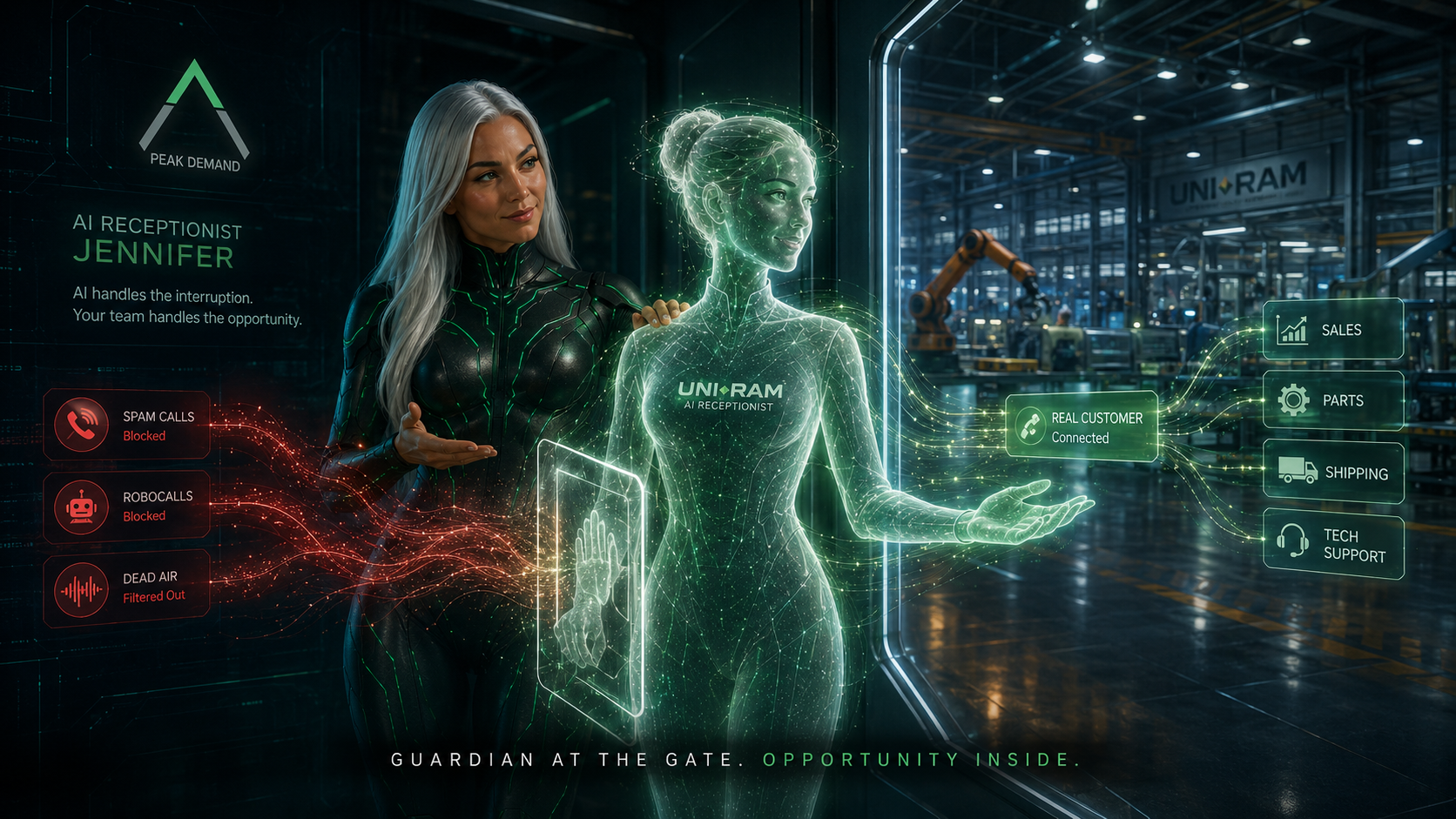
Peak Demand manufacturing Voice AI case study for Uni-ram and the Jennifer AI receptionist Published manufacturing study
Manufacturing Voice AI · intelligent call handling · department routing

Uni-ram: manufacturing Voice AI that filters noise and delivers legitimate demand to the right team

Jennifer became Uni-ram’s intelligent front line: answering inbound calls, screening spam and dead air, handling suitable customer conversations and connecting legitimate demand to Sales, Parts, Shipping, Customer Service, Technical Support and Accounting.

5,285inbound calls answered from December 2025 through August 2026
2,250+spam, robocall and dead-air interactions screened before staff involvement
1,100+real customer calls handled without requiring a live employee transfer
1,400+successful live customer-to-team connections through intelligent routing

Commercial impact: Jennifer delivered more than 500 successful commercial connections to Sales. During the mature March–August period, observed Sales answer performance ranged from 97% to 100%, including 100% in May and June.

Expanding production proof library

More industry Voice AI case studies are coming soon.

Creekside Health and Uni-ram are the beginning of the library—not the end. Peak Demand is expanding its production evidence across industries where inbound calls, customer access, qualification, routing, booking and connected systems create measurable opportunities for managed Voice AI.

Coming soon

Legal Voice AI

Client intake, consultation routing, after-hours coverage, matter qualification and structured handoff for law firms and legal-service teams.

Coming soon

Home Services Voice AI

Lead intake, emergency and after-hours answering, dispatch support, appointment booking and field-service routing for multi-location operators.

Coming soon

Hospitality Voice AI

Reservations, guest services, property information, order and location questions, overflow handling and multilingual support for hospitality operators.

Coming soon

Real Estate & Property Voice AI

Property inquiries, lead qualification, showing coordination, tenant communication, leasing support and intelligent multi-location routing.

Coming soon

Municipal & Government Voice AI

Citizen-service requests, department routing, public information, after-hours intake and multilingual access for government operations.

Coming soon

Utilities & Energy Voice AI

Billing questions, outage communication, move-in and move-out requests, service calls, payment-assistance routing and surge-volume support.

This page is a living production library.New studies, measured results and industry-specific workflow evidence will be added as Peak Demand deployments mature and publishable production data becomes available.
What the case studies prove

The voice engine starts the conversation. Peak Demand’s orchestration layer makes the deployment work.

A dependable Voice AI system needs more than a realistic voice. Peak Demand builds and manages the decision layer between the conversation, the organization’s operating rules, its connected software and its human team.

1

Connected action

The agent can move from understanding a request to checking availability, updating a system, routing a call or completing another approved workflow.

2

Custom logic bridge

Peak Demand validates business rules, identity, eligibility, routing, workflow state and exceptions outside the conversation so the model is not the only control layer.

3

Continuous improvement

Production calls reveal real behaviour. Peak Demand classifies outcomes, isolates causes and hardens the system as new caller patterns and operating requirements emerge.

Next production story

Niagara Transit Voice AI case study in development

Peak Demand’s next proof story will follow a high-volume public-service environment, where dependable information, telephony, routing, accessibility and escalation all matter.

Transit Voice AI and modernized rider access

Deployment work underway

The planned study will document how Voice AI can support rider information, schedule and service questions, route guidance, service alerts, lost-and-found intake, IVR modernization and appropriate human escalation. Performance claims will be added only after the relevant production evidence is available.

LegalHome ServicesHospitalityReal EstateMunicipal ServicesUtilitiesCustomer ServiceHigh-Volume Contact Centres
Voice AI case study FAQ

How to understand Voice AI performance

The strongest Voice AI case studies define what their metrics actually mean. These answers explain the language Peak Demand uses when evaluating a production deployment.

Which Peak Demand Voice AI case studies are published?
Two production case studies are currently published: Creekside Health, covering healthcare Voice AI built with Retell AI and connected to TELUS CHR; and Uni-ram, covering manufacturing Voice AI for frontline call handling, screening and intelligent department routing.
What is Voice AI containment rate?
Containment rate measures the share of eligible journeys the Voice AI resolves without a live staff member taking over. It should not be confused with the percentage of calls answered. For Creekside, appointment-workflow containment means Nicole completed or appropriately resolved an appointment-oriented journey without a human transfer. A correct escalation can still be a successful operational outcome even though it is not counted as contained.
What does booking-path technical success mean?
Booking-path technical success measures whether a classified booking journey proceeded without an identifiable Voice AI, middleware or connected-system error. It does not claim every caller ultimately booked. A caller may only check availability, decline the offered time, abandon the call or request a human. Creekside achieved 94.9% technical success across its classified booking journeys during the study window.
Why are human transfer outcomes measured separately?
A transfer can be initiated correctly by the Voice AI but go unanswered because the receiving team is busy. Counting that as a booking-system failure would misrepresent the integration. Peak Demand separates transfer attempts and human answer outcomes from identifiable Voice AI or connected-workflow errors so each part of the operating system can be evaluated accurately.
What does autonomous call handling mean in the manufacturing study?
It means the Voice AI handled an appropriate real-customer conversation without requiring a live employee transfer. It may answer routine questions, gather information or resolve another approved front-line request. Spam, robocalls and dead-air interactions are measured separately because screening unwanted traffic is a different source of operational value.
What role does Retell AI play?
Retell AI provides the real-time Voice AI infrastructure used for the agents in these deployments. Peak Demand adds the custom conversation design, telephony configuration, integrations, orchestration, validation rules, reporting, quality assurance and ongoing production optimization required for each organization.
What is Peak Demand’s custom orchestration and logic-bridge layer?
It is the control layer between the Voice AI conversation and the organization’s real systems. It can validate inputs, enforce clinic or business rules, control which actions are permitted, clean and transform data, coordinate multi-step workflows, manage exceptions and return a safe outcome to the caller. This is a major reason the deployments can perform reliably beyond a simple demonstration.
Can Peak Demand build Voice AI for other industries?
Yes. Peak Demand designs managed Voice AI around the organization’s actual call types, systems, rules, telephony, staff responsibilities and escalation requirements. The healthcare and manufacturing studies show two different operating environments rather than a single generic receptionist template.
Are more Peak Demand Voice AI case studies coming?
Yes. The case-study library is actively expanding. Niagara Transit is the next production story in development, and additional case studies are planned across legal services, home services, hospitality, real estate and property operations, municipal and government services, utilities and energy, and other high-volume environments.
Build the next production case study

Turn your highest-volume calls into connected, measurable Voice AI workflows.

Peak Demand can define the workflow, connect the systems, build the custom orchestration layer, launch the agent and manage performance after deployment.

Explore your own AI use case on a discovery call.