
Voice AI Receptionists & AI SEO Convert 24/7 On Peak Demand

Peak Demand is an AI-first agency specializing in custom Voice AI receptionists, AI answering systems, and AI SEO (GEO/AEO) strategies designed to convert discovery into revenue. Unlike off-the-shelf voice AI tools that often fail due to poor integration, limited workflow design, or unreliable call handling, our systems are engineered for real-world deployment. We architect intelligent voice agents that answer calls, book appointments, qualify leads, and integrate seamlessly with CRM, ERP, and EHR platforms — ensuring that your AI receptionist performs reliably at scale.

Quick Definition • Voice AI Receptionist

What Is a Voice AI Receptionist?

A Voice AI receptionist is an intelligent call-handling system that answers inbound calls, understands what the caller needs, and takes action — such as booking appointments, routing calls, capturing leads, collecting intake details, or creating service tickets. It uses natural language processing, structured workflows, and business rules to deliver consistent outcomes without relying on a human operator for every call.

In real operations, the “AI voice” is only one layer. A reliable receptionist requires workflow design, systems integration (CRM/EHR/ERP/booking), data validation, escalation logic, safe fallbacks, and performance monitoring. This is where most plug-and-play tools fall short — not because AI is bad, but because production call handling requires engineering discipline.

In one sentence: A Voice AI receptionist answers calls, understands intent, and completes workflows (booking, routing, intake, lead capture) through automation and integrations — 24/7.

Answers, Routes, and Resolves

Handles new callers, repeats, overflow, and after-hours calls with structured routing aligned to your policies and teams.

Books Appointments & Creates Tickets

Connects to scheduling rules and service workflows, collects required details, and confirms next steps without missed calls.

Captures Leads with Context

Captures intent, urgency, and contact details — then pushes structured records into your CRM pipeline for fast follow-up.

Integrates with Your Systems

Connects to CRM/ERP/EHR systems, calendars, ticketing tools, and APIs to reduce manual work and prevent drop-offs.

What makes it “production-grade” (the parts most tools skip)
1) Workflow logic: call flows, policies, routing rules, and required intake fields — designed around how your team actually works.
2) Integrations: CRM + calendar + ticketing + messaging so every call becomes a record, a task, or a booked appointment.
3) Guardrails: validation, confirmation prompts, and safe fallback paths to avoid dead-ends and reduce failures.
4) Escalation: human-first handoff when the caller needs a person — with summarized context so your staff can act fast.
5) Monitoring: outcomes and reporting (booked, routed, captured, escalated) so the system improves over time.
This is why “custom” matters: it’s not just voice quality — it’s conversion reliability.
Q: What can a Voice AI receptionist do on a real business phone line?
A production Voice AI receptionist can handle tasks such as:
  • Answering inbound calls 24/7 (including overflow and after-hours)
  • Booking appointments and enforcing scheduling rules
  • Routing calls based on caller intent, department, or urgency
  • Capturing leads and creating CRM records automatically
  • Collecting intake information (reason for call, service type, details)
  • Creating tickets/cases in customer service or helpdesk systems
  • Escalating to humans with context when policy or confidence requires it
The key is workflow design + integrations — not just the voice model.
Q: Why do many businesses abandon off-the-shelf Voice AI tools?
Most failures aren’t “AI problems” — they’re deployment problems: missing integrations, weak call flows, no validation, no escalation, and no monitoring. A tool might talk, but it won’t reliably complete your workflows. Custom systems are built to reduce dead-ends, prevent inconsistent outcomes, and protect your brand on every call.
Q: How do you reduce hallucinations or incorrect actions on calls?
We reduce risk through guardrails: constrained actions, confirmation steps for critical details, validation checks, confidence thresholds, “ask vs assume” prompts, and human-first escalation when needed. The goal is reliability — not risky improvisation.
Q: Can a Voice AI receptionist book appointments and send confirmations?
Yes. With proper integration, the AI can check availability, apply booking rules, collect required details, send confirmation messages (SMS/email), and log everything into your CRM so your team has context and next steps.
Q: What happens if the AI isn’t sure what the caller means?
Production systems use safeguards: clarification questions, confidence thresholds, and escalation rules. If uncertainty remains, the system can transfer to a human, create a callback task, or collect details for follow-up. The goal is to avoid dead-ends and keep callers moving toward an outcome.
Q: Does Voice AI replace my staff?
Most organizations use Voice AI to reduce call pressure and eliminate missed opportunities — not eliminate staff. Your team stays focused on complex conversations while the AI handles repetitive calls, scheduling, lead capture, and after-hours coverage.
Q: How is pricing determined for custom Voice AI receptionists?
Pricing typically depends on call volume, number of call flows, required integrations (CRM/EHR/ERP/calendar), compliance needs, reliability requirements, and rollout complexity. For a detailed breakdown, go here: https://peakdemand.ca/pricing.
Q: How long does it take to deploy a production Voice AI receptionist?
Timelines depend on complexity. Most projects include discovery, call-flow design, integration work, QA testing, and a monitored launch phase to tune performance. Deployments move faster when call flows and systems access are clear.
Q: What do you need from us to get started?
We typically start with your call routing map, common caller intents, business rules, scheduling constraints, and system access for integrations. If you don’t have call analytics or scripts, we can build them during discovery.
{
  "section": "What is a Voice AI Receptionist",
  "primary_topics": [
    "Voice AI receptionist definition",
    "custom voice AI receptionist",
    "AI answering system",
    "AI call routing",
    "AI appointment booking",
    "AI lead capture",
    "CRM integration",
    "reliability guardrails"
  ],
  "definition": "An AI call-handling system that answers inbound calls and completes workflows such as booking, routing, intake, lead capture, and ticket creation using NLP + automation + integrations.",
  "production_grade_components": [
    "workflow logic and call flows",
    "integrations to systems of record (CRM/calendar/ticketing/EHR/ERP)",
    "guardrails (validation + confirmations + constrained actions)",
    "human-first escalation with context",
    "monitoring + reporting for continuous improvement"
  ],
  "cta": {
    "discovery": "https://peakdemand.ca/discovery",
    "pricing": "https://peakdemand.ca/pricing"
  }
}
    
Production-Grade Delivery

Custom Voice AI Receptionists Built for Real-World Deployment

Most businesses don’t abandon Voice AI because “AI doesn’t work” — they abandon it because the deployment is missing the operational layers required for production: integrations, workflow logic, validation, escalation rules, and monitoring. A voice model alone is not a receptionist. A receptionist is a system.

Peak Demand builds custom Voice AI receptionists that hold up under real call volume. We map intents and business rules, connect the AI to your systems of record (CRM/ERP/EHR/calendar/ticketing), and implement safeguards so callers always reach an outcome: booking, routing, intake completion, or a human handoff.

Why “custom” matters: It’s engineered around your operation — workflows, data, edge cases, escalation, and reporting — not a generic template that breaks when calls get complicated.

Where “off-the-shelf” Voice AI tools fail (most common)

  • No real actions: talks well, but can’t reliably book, route, open tickets, or update the CRM.
  • Weak edge-case handling: interruptions, accents, noisy environments → brittle conversations.
  • Bad handoffs: transfers without context frustrate staff and callers.
  • Messy data: missing fields + poor validation → unusable notes and broken follow-up.
  • Shallow integrations: “connected” but doesn’t enforce rules or complete workflows.
  • No safeguards: lacks confidence thresholds, confirmations, and policy-based routing.
  • No monitoring: failures repeat because outcomes aren’t tracked.

These are implementation gaps — not “AI capability” limits.

When custom Voice AI is the right move

You’re losing revenue to missed calls
After-hours, overflow, slow intake, voicemail leakage.
You need clean CRM records
Required fields, validation, structured follow-up tasks.
You need real integrations
Calendar rules, ticketing queues, ERP/EHR routing, APIs.
You care about reliability
Human-first escalation, safe fallback, monitored performance.

If your current tool “works in demos” but fails on real callers, that’s usually a workflow + integration problem — which is exactly what custom implementation solves.

Peak Demand build standard (what “production-grade” includes)

Intent map + routing logic
Top intents, edge cases, “what happens when…” rules.
Systems of record integrations
CRM/calendar/ticketing/EHR/ERP → records + tasks.
Guardrails + validation
Confirmations, required fields, constrained actions.
Human-first escalation
Transfers with summarized context + safe fallback.
QA testing + monitored launch
Scenario testing, tuning cycles, post-launch optimization.
Reporting + iteration
Bookings, captures, escalations — measure then improve.

What clients track (conversion outcomes)

  • Booking rate: calls → scheduled appointments
  • Lead capture rate: qualified contacts created
  • Abandonment reduction: less voicemail loss
  • Transfer quality: handoffs with context
  • CRM completeness: required fields captured correctly
  • Time-to-follow-up: tasks + SMS/email confirmations
  • Containment rate: calls resolved without a human

The goal is simple: turn calls into measurable pipeline — and make sure your receptionist actually performs at scale.

AI News, AI Updates, AI Guides
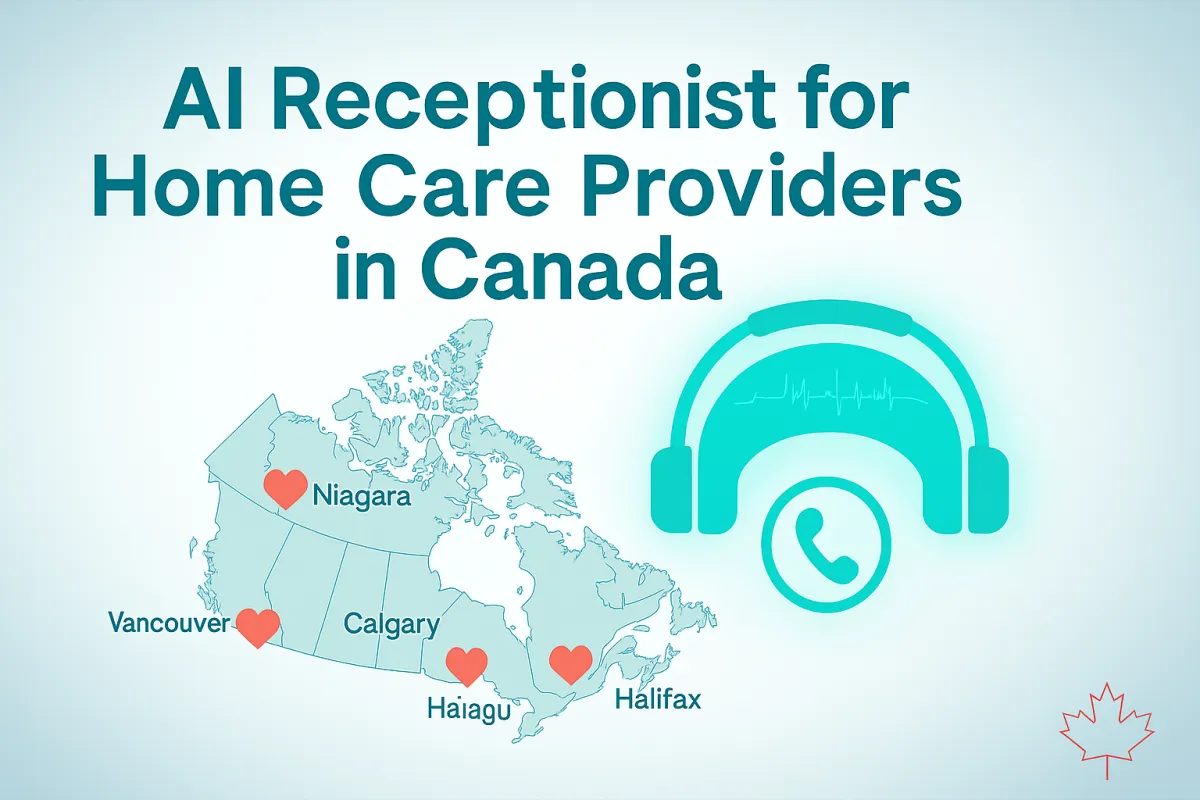
AI receptionist for home‑care after‑hours automation – bilingual voice assistant, Canadian map backdrop, 24/7 call coverage.

How to Automate After‑Hours Calls for Home‑Care Agencies in Canada | AI Receptionist

November 07, 202526 min read

Missed after‑hours calls are the #1 cause of lost intake opportunities for Canadian home‑care providers. A single unanswered ring can mean a family never gets the support they need, a nurse’s schedule goes unused, and the agency forfeits $120‑$250 per month in private‑pay revenue per client.

Map of Canada showing AI receptionist coverage in Niagara, Halifax, Calgary, and Vancouver with heart icons and headset overlay.

Enter the AI receptionist for home care Canada – a voice‑driven virtual front‑desk that works 24/7, greets callers in both English and French, captures the required consent, and routes each request to the right person in real time. Because it is built from the ground up to meet PHIPA (Ontario’s Personal Health Information Protection Act) and PIPEDA (Canada’s federal privacy law), every interaction is logged, encrypted, and stored in a Canadian data centre, keeping you audit‑ready from day one.

In this guide you will get:

  • A step‑by‑step workflow that shows how to configure routing, design bilingual scripts, detect intent (emergency, urgent, new intake, administrative) and automate morning hand‑offs.

  • A compliance checklist covering PHIPA, PIPEDA, and CASL (for any follow‑up SMS or email reminders) with full URLs to the official statutes.

  • A quick ROI calculator – see how a 30‑60 % drop in abandoned calls, a 15‑30 % boost in new‑client conversion, and a 2‑4× return on investment can be realized within the first six months.

By the end of the article you’ll be able to launch a 30‑day pilot that turns every missed after‑hours call into a booked intake, while staying fully compliant and delivering a bilingual, always‑on experience for seniors and their families across the Niagara Region, Greater Toronto Area, Halifax, Calgary, Vancouver, and beyond.

Source: Canadian Institute for Health Information (CIHI) – Home‑Care Call Volume Statistics → https://www.cihi.ca/en/topics/home-care

Why After‑Hours Calls Are a Growing Challenge in Home Care

Even before the pandemic, the volume of calls that land on a home‑care agency’s line after regular business hours has been steadily climbing. The combination of an aging population, faster hospital discharges, and families preferring to stay at home means agencies are now fielding a significant share of inquiries between 5 p.m. and 10 p.m. and on weekends. Missed or abandoned calls translate directly into lost revenue, increased staff stress, and heightened compliance risk.

Peak‑time pressure points

  • Evening and weekend spikes: most after‑hours calls arrive between 5 p.m. and 10 p.m., with a secondary surge on Saturdays and Sundays.

  • Post‑discharge rush: families often call the night after a hospital stay to arrange nursing, personal‑support‑worker (PSW) visits, or equipment delivery.

  • Reference: Canadian Institute for Health Information (CIHI) reports that approximately 35 % of new home‑care inquiries occur after normal business hours – https://www.cihi.ca/en/topics/home-care

Financial consequences of missed calls

Comparison of lost revenue from missed calls versus increased profits using an AI receptionist for home-care agencies.
  • Lost revenue per missed intake ranges from $120 to $250 per month for private‑pay clients, which can amount to $1,440 – $3,000 per year per potential client.

  • Opportunity cost: failing to capture these leads reduces market share in high‑density regions such as the Niagara Region, the Greater Toronto Area, Halifax, and Calgary, where competition among home‑care providers is fierce.

Operational strain on staff

Nurse working late at night assisted by holographic AI receptionist asking “How can I help?” during after-hours home-care calls.
  • On‑call nurses are forced to answer routine intake questions, pulling them away from clinical duties and increasing fatigue.

  • Manual note‑taking leads to inconsistent logging, creating audit gaps that make it difficult to demonstrate compliance with PHIPA (Ontario) and PIPEDA (federal).

  • Without a structured triage system, urgent medical situations can be mis‑routed, raising liability exposure.

Regulatory and compliance pressure

PIPEDA compliance shield with lock icon and Canadian maple leaf border symbolizing secure home-care data protection.

Regional demand spikes

Map of Canada highlighting Niagara, Halifax, Calgary, and Vancouver regions with highest after-hours home-care call volumes.
  • Niagara (Ontario) – roughly 28 % of calls arrive after 5 p.m.

  • Greater Toronto Area – about 33 % of after‑hours inquiries.

  • Halifax (Nova Scotia) – 26 % after‑hours volume.

  • Calgary (Alberta) – 30 % of calls come outside normal hours.

  • Vancouver (British Columbia) – 29 % after‑hours activity.

Why the status‑quo won’t work

AI receptionist answers home-care calls in under 3 seconds on smartphone screen with bilingual English/French display.
  • Speed‑to‑answer: live receptionists average 12 seconds before a caller reaches a human; an AI receptionist can answer in under 3 seconds.

  • Abandonment rates: when callers wait on hold, abandonment climbs above 40 %, directly harming intake conversion.

  • Compliance risk: handwritten notes rarely capture the required consent language, leaving agencies vulnerable during PHIPA or PIPEDA audits.

Because of these challenges, many home‑care providers are turning to a PHIPA‑ and PIPEDA‑compliant AI receptionist that can handle calls 24/7, triage emergencies, capture consent in both English and French, and feed clean, auditable data straight into existing scheduling and CRM systems.

The Business Case for an AI‑Driven After‑Hours Receptionist

Elderly couple waiting by phone at night as an after-hours home-care call comes in, symbolizing missed intake opportunities.

24/7 responsiveness without extra headcount
An AI receptionist answers every inbound ring in under 3 seconds, eliminating the long wait times that human after‑hours staff typically generate (average live answer time ≈ 12 seconds). The system runs a fully bilingual script (English / French), so callers in any province receive the language they need without requiring a separate bilingual operator. Only genuine emergencies are escalated to an on‑call nurse; all routine intake, scheduling and information requests are handled automatically, freeing clinical staff to focus on patient care.

Operational strain reduction
All caller information—name, contact details, care needs, funding source and consent—is captured in a structured format and stored securely in a Canadian data centre. Transcriptions and call logs are automatically uploaded to the agency’s CRM or scheduling platform each morning, providing a ready‑to‑act intake report for staff. By removing repetitive phone work from nurses and coordinators, agencies see a measurable drop in staff overtime and burnout, and the risk of mis‑routing urgent calls is minimized.

Measurable ROI

  • Abandonment rate typically falls by 30 %‑60 % once the AI is live, because callers are never left on hold.

  • New‑client intake conversion increases by 15 %‑30 %, as every call is captured and followed up the same day rather than being lost to voicemail.

  • Financial models based on CIHI‑derived call volumes (see https://www.cihi.ca} show a 2‑4 × return on investment within the first six months for a midsize agency (≈ 50 employees).

In short, an AI‑driven after‑hours receptionist delivers continuous, bilingual coverage, dramatically cuts operational overhead, and generates a clear financial upside while keeping the agency fully compliant with PHIPA, PIPEDA and CASL.

Step‑by‑Step: Designing an After‑Hours AI Call Flow

  1. Routing configuration – Set your phone system to forward every call that arrives between 5 p.m. and 8 a.m., as well as all weekend calls, to the AI endpoint. This can be done in Twilio, RingCentral, a SIP trunk or any cloud‑telephony platform that supports call forwarding. Make sure the forwarding rule uses TLS 1.3 for encryption so the voice data is protected in transit.

  2. Greeting and bilingual privacy notice – As soon as the call is answered, the AI plays a short bilingual greeting and the required privacy notice. Example script (English then French):
    “Thank you for calling [Agency Name] Home Care. For service in English, press or say 1. Pour le service en français, appuyez ou dites 2. Before we begin, this call may be recorded for quality and scheduling. Your information will be used only to coordinate home‑care services in accordance with PHIPA and PIPEDA.”

  3. Intent detection – The AI analyzes the caller’s spoken words and classifies the request into one of four intent categories:

    • Emergency (e.g., “my mother fell”, “can’t breathe”)

    • Urgent non‑emergency (e.g., “need medication soon”, “pain worsening”)

    • New intake (e.g., “I need a home‑care assessment”, “looking for a personal‑support worker”)

    • Administrative (e.g., billing question, scheduling change, general inquiry)

  4. Triage logic – Based on the detected intent the system follows a specific branch:

    • Emergency – The AI immediately plays a “please dial 911” message, logs the call as an emergency, and sends an instant alert to the on‑call nurse or emergency response team via SMS and push notification.

    • Urgent non‑emergency – The call is transferred to the on‑call nurse’s IVR line. The AI provides the nurse with a brief summary (caller name, location, nature of urgency) before the hand‑off.

    • New intake – The AI collects the required data fields: caller name, relationship to client, client’s full name and date of birth, address or postal code, type of care needed (nursing, PSW, respite, etc.), funding source (public, private, mixed), and urgency level. After the data capture, the AI offers the caller available time slots, confirms the chosen appointment, and records the intent as “intake”.

    • Administrative – The AI logs the request in the agency’s CRM, categorizes it (billing, schedule change, general), and queues it for follow‑up during normal business hours. The caller receives a confirmation that the request has been received and will be addressed.

  5. Consent capture and logging – For every call, the AI stores a timestamp, the caller’s consent flag (affirmative response to the privacy notice), and the determined intent. All records are written to a secure Canadian data centre with AES‑256 encryption. The consent flag satisfies PHIPA and PIPEDA requirements and enables easy audit‑trail generation.

  6. Morning report automation – At 8 a.m. each weekday the system compiles a report that includes:

    • Total number of after‑hours calls received

    • Breakdown by intent (emergency, urgent, intake, administrative)

    • List of new intake appointments scheduled, with client details and assigned caregiver

    • Any emergency alerts that were triggered, with resolution status

    • Consent compliance summary (percentage of calls with captured consent)

    The report is emailed as a CSV attachment to the intake coordination team and also posted to an internal dashboard for quick visibility.

By following these six steps, a home‑care agency can transform its after‑hours phone operations from a manual, error‑prone process into a reliable, compliant, and data‑driven workflow that captures every opportunity, protects patient privacy, and frees clinical staff to focus on care delivery.

Compliance Essentials for After‑Hours AI Calls (Canada)

All home‑care agencies that use an AI receptionist must satisfy federal and provincial privacy legislation. The three core statutes you need to align with are PIPEDA, PHIPA (Ontario), and HIA or PIPA in the western provinces. Because voice recordings are considered personal health information, the same rules that apply to paper charts also apply to digital call logs. Below is a concise checklist that breaks down each requirement and shows exactly how to implement it in your AI call‑flow.

1. Federal – PIPEDA (Personal Information Protection and Electronic Documents Act)

  • Meaningful consent – Before any personal or health information is captured, the AI must play a clear privacy notice and obtain an affirmative response from the caller. In the workflow this is the “consent flag” stored with every call record.

  • Data‑retention limit – Store call recordings and transcripts for no longer than 90 days unless a legitimate business reason exists (e.g., a pending complaint or audit). Set an automatic deletion schedule in your storage system.

  • Encryption – All data in transit must use TLS 1.2 or higher; data at rest must be encrypted with AES‑256 or stronger. Verify that your telephony provider (Twilio, RingCentral, etc.) offers end‑to‑end encryption and that your cloud storage (Azure, AWS‑Canada, Google Cloud‑Canada) meets the algorithm standards.

  • Access controls – Implement role‑based access control (RBAC) so only authorized staff (intake coordinators, compliance officers, on‑call nurses) can view raw recordings or transcripts. Use multi‑factor authentication for admin accounts.

  • Breach notification – In the event of a security incident, you must notify the Office of the Privacy Commissioner of Canada (OPC) and any affected individuals “as soon as feasible.” Keep a breach‑response plan that includes the steps to isolate the data, assess impact, and send the required notices.

Reference: Full PIPEDA text – https://www.priv.gc.ca/en/privacy-topics/privacy-laws-in-canada/the-personal-information-protection-and-electronic-documents-act-pipeda/

2. Ontario – PHIPA (Personal Health Information Protection Act) and Regulation 329/04

  • Health‑information custodianship – Your agency is a Health Information Custodian (HIC) under PHIPA. The AI system is considered an “agent” of the HIC, so you must have a written agreement with the AI vendor that obliges them to protect PHI in the same way you would.

  • Privacy notice requirement – The notice must be delivered before any health information is collected. The script in the step‑by‑step flow (“Before we begin, this call may be recorded…”) satisfies this requirement, provided it is audible and the caller affirms consent.

  • Audit‑ready logs – PHIPA requires that every access to PHI be logged with the user’s identity, date, time, and purpose. Your AI platform should automatically create an immutable audit record for each call, including the consent flag and the intent classification.

  • Data residency – While PHIPA does not explicitly require data to be stored in Ontario, many agencies choose Canadian‑hosted data centres to simplify compliance. Ensure that any third‑party storage provider offers a Canadian region and that the data‑processing agreement reflects this.

  • Complaint handling – Patients may file a complaint directly with the Information and Privacy Commissioner of Ontario (IPC). Your internal process should route any PHI‑related complaints to a compliance officer within 5 business days.

Reference: PHIPA statute – https://www.ontario.ca/laws/statute/04p03
Regulation 329/04 – https://www.ontario.ca/laws/regulation/040329

3. Western Provinces – HIA (Alberta) and PIPA (British Columbia)

  • Alberta – Health Information Act (HIA)

    • Custodians and affiliates must obtain consent for the collection, use, and disclosure of health information. The AI consent flag fulfills this.

    • Encryption and access‑control requirements mirror those in PIPEDA; ensure your vendor signs a Data Processing Agreement (DPA) that references HIA compliance.

    • Breach notification to the Office of the Information and Privacy Commissioner of Alberta (OIPC Alberta) must occur within 72 hours of discovery.

  • British Columbia – Personal Information Protection Act (PIPA)

    • Applies to private‑sector organisations, including home‑care agencies that are not health‑information custodians. The same consent, encryption, and retention rules apply.

    • PIPA does not require data localisation, but storing data in Canada simplifies both PIPEDA and provincial compliance.

References:
Alberta HIA overview – https://oipc.ab.ca/legislation/hia/
Alberta HIA statute – https://open.alberta.ca/publications/h05
BC PIPA Act – https://www.bclaws.gov.bc.ca/civix/document/id/complete/statreg/03063_01

4. Anti‑Spam (CASL) for Follow‑Up Messages

  • Scope – CASL does not regulate voice calls, but any SMS or email reminders generated by the AI after an intake must be considered Commercial Electronic Messages (CEMs).

  • Express consent – Obtain explicit consent for each communication channel (e.g., “Would you like a text reminder for your appointment?”). Record this consent in the same “consent flag” field used for the call.

  • Identification and unsubscribe – Every message must clearly identify the agency and provide a simple way to opt‑out (reply STOP or click an unsubscribe link).

  • Record‑keeping – Keep a log of consent timestamps and opt‑out requests for at least two years.

Reference: CASL guidance – https://crtc.gc.ca/eng/internet/anti.htm

5. Practical Implementation Tips

  • Single bilingual consent phrase – Use the same script for English and French; store the language choice in a “language” column alongside the consent flag.

  • Automated deletion – Configure a lifecycle policy on your cloud storage bucket to purge recordings after 90 days automatically.

  • Audit‑trail export – Schedule a nightly job that extracts the audit logs (timestamp, user, action, consent) into a read‑only reporting database for/IPC inspections.

  • Vendor DPA checklist – Before signing with an AI provider, confirm:

    1. They are a PHIPA‑designated agent (Ontario) or HIA‑designated affiliate (Alberta).

    2. Their data centres are located in Canada or they have a documented Transfer Impact Assessment.

    3. They will notify you of any breach within 72 hours.

    4. They support TLS 1.3, AES‑256 encryption, and RBAC.

  • Regular compliance audit – Conduct a quarterly review of consent capture rates, retention policies, and breach‑response drills. Document findings and remedial actions in a compliance log that can be presented to regulators on demand.

Summary

By adhering to the checklist above, your after‑hours AI receptionist will meet every legal requirement across Canada while delivering a seamless, bilingual experience for callers. The combination of explicit consent, encrypted storage, strict retention limits, and immutable audit logs ensures that you can demonstrate compliance to PHIPA auditors, OPC investigators, and OIPC reviewers with confidence.

Integrating the AI Receptionist with Your Existing Stack

The true power of an AI receptionist for home‑care agencies is realized when it works seamlessly with the technology you already use – telephony, scheduling/EHR platforms, caregiver dispatch tools and security controls. Below is a practical, step‑by‑step guide that shows how to connect each piece, the security requirements you must meet, and the URLs you should reference for compliance.

Telephony Integration

  • Choose a cloud‑telephony provider that supports secure call forwarding and API access (examples: Twilio https://www.twilio.com/, RingCentral https://www.ringcentral.com/, Zoom Phone https://zoom.us/phone).

  • Create a SIP trunk or call‑forward rule that routes every call received between 5 p.m. and 8 a.m. (including weekends) to the AI endpoint URL supplied by your AI vendor. Ensure the connection uses TLS 1.3 encryption to protect voice data in transit.

  • Configure the provider’s “record‑on‑answer” setting so that recordings are stored directly in a Canadian data centre of your choice. This satisfies both PHIPA and PIPEDA storage‑location expectations.

Scheduling and EHR Connectivity

  • Identify the primary scheduling/EHR system used by your agency (AlayaCare https://www.alayacare.com/, AxisCare https://www.axiscare.com/, or a custom CRM).

  • Use the system’s RESTful API to pull real‑time caregiver availability and push new appointments created by the AI receptionist. Map the following fields: client name, date of birth, address, service type (nursing, PSW, respite), preferred time slot, and funding source.

  • For each new intake, the AI should send a JSON payload to the scheduling API that includes a “consent_flag” field set to true once the caller has accepted the privacy notice. This flag is required for PHIPA audit logs.

  • Set up a webhook on the scheduling/EHR side that notifies the AI when a caregiver accepts or declines a shift, allowing the AI to instantly confirm the appointment with the caller or to re‑offer the slot.

Dispatch and On‑Call Roster Integration

  • Connect the AI’s “urgent” intent routing to your on‑call nurse roster. Most agencies use a simple SMS gateway (Twilio SendGrid https://www.sendgrid.com/ or Canada Post https://www.canadapost-postescanada.ca/) to deliver an instant alert that includes the caller’s name, location, and a brief description of the emergency.

  • Ensure the alert message complies with PHIPA by containing only the minimal necessary health information and by marking the message as “confidential.”

Security and Data Handling

  • All data stored by the AI platform must be encrypted at rest with AES‑256 or stronger. Verify the vendor’s data‑center certification (ISO 27001, SOC 2) and that the physical location is Canada (Ontario, Alberta, or British Columbia).

  • Implement role‑based access control (RBAC) inside the AI admin console. Create at least three roles: Administrator (full access), Compliance Officer (read‑only audit logs), and Dispatcher (view call summaries and schedule appointments).

  • Enable multi‑factor authentication (MFA) for all admin accounts.

  • Configure an automatic retention policy that deletes call recordings and transcripts after 90 days, unless a legal hold is placed. Use a cloud lifecycle rule (e.g., Azure Blob Storage lifecycle management https://learn.microsoft.com/azure/storage/blobs/lifecycle-management-policy-configure) or AWS S3 Object Expiration https://docs.aws.amazon.com/AmazonS3/latest/userguide/object-lock.html.

  • Set up a nightly export of audit logs to a read‑only reporting database. Each log entry should capture: timestamp, caller ID (masked if not needed), intent, consent_flag, and the user or system component that accessed the record. This export satisfies PHIPA’s requirement for a complete audit trail and prepares you for OPC or IPC inspections.

Testing and Validation

  • Run end‑to‑end test calls for each intent (emergency, urgent, intake, admin) to verify that the call flow, data capture, and system hand‑offs work as expected.

  • Confirm that the AI correctly records the bilingual consent phrase and that the consent_flag is set to true in the scheduling/EHR database.

  • Perform a security scan of the API endpoints (OWASP ZAP https://www.zaproxy.org/ or Burp Suite) to ensure there are no injection or authentication vulnerabilities.

Internal Linking Point
For more detailed guidance on connecting telephony, CRM, and scheduling tools, see the Integration Guide: EHR/CRM, Scheduling & Telephony – https://peakdemand.ca/voice-ai-api-integrations-hub-crm-erp-ehr-emr-booking-customer-service-healthcare-utilities-real-estate-hospitality-manufacturing-enterprise-government-canadian-ai-agency-peak-demand

By following these integration steps, your AI receptionist will become a true extension of your operations: answering every after‑hours call, capturing compliant consent, automatically booking appointments, and alerting on‑call staff—all while keeping data secure and audit‑ready under PHIPA, PIPEDA and CASL.

USE CASES FOR AN AI RECEPTIONIST IN CANADIAN HOME‑CARE AGENCIES

Use Case 1: 24/7 New‑Client Intake

The AI receptionist greets every caller in English or French, then collects the essential intake fields: caller name, relationship to the client, client’s full name and date of birth, address or postal code, type of care needed (nursing, PSW, respite, etc.), funding source (public, private or mixed), urgency level, and explicit consent to record. After the data is captured, the AI offers available appointment slots, confirms the selection, and writes a structured record to the agency’s scheduling system. The consent flag stored with each record satisfies PHIPA and PIPEDA audit requirements.

Use Case 2: Emergency & Urgent Triage

When callers use trigger phrases such as “fell,” “can’t breathe,” “bleeding,” or “need medication now,” the AI instantly classifies the call as an emergency. It plays a “Dial 911 immediately” message, logs the incident, and sends an instant SMS/alert to the on‑call nurse with the caller’s location and a brief description. For non‑life‑threatening urgent calls (e.g., worsening pain, wound‑care questions) the AI routes the call to the nurse’s IVR line, providing a pre‑call summary so the nurse can respond faster and more safely.

Use Case 3: Caregiver Shift‑Fill & Dispatch

When a caregiver’s shift becomes vacant, the AI automatically posts the open slot to a shift‑fill queue, notifies qualified caregivers via SMS or push notification, and asks them to confirm acceptance. The first caregiver to respond receives an instant confirmation; the AI updates the schedule, sends a reminder to the client’s family, and logs the transaction. This reduces manual outreach, shortens fill time to under 15 minutes, and improves the caregiver fill‑rate metric.

Use Case 4: Post‑Visit Follow‑Up & Wellness Checks

After a scheduled home‑care visit, the AI initiates a brief wellness‑check call the next day, asking simple yes/no questions (“Are you feeling okay?” “Did you experience any pain?”). Positive responses are logged; negative responses trigger an immediate escalation to the care coordinator with a priority flag. The AI can also send a follow‑up SMS reminder for medication adherence, using CASL‑compliant opt‑in consent captured during the original intake.

Use Case 5: Family Updates & Authorized‑Contact Communication

Family members listed as authorized contacts can call for status updates. The AI verifies the caller against the authorized‑contact list, then provides a scripted summary (e.g., “Your mother’s visit is scheduled for 2 p.m. today. No issues reported.”). If the caller requests more detailed information, the AI logs the request and forwards it to a human care coordinator, ensuring no protected health information is disclosed without proper authorization.

Use Case 6: Billing Inquiries & Benefit Eligibility Verification

Callers asking about billing, insurance, or eligibility are routed to the administrative intent. The AI collects the client’s account number, verifies the funding source (public health plan, private insurance, or out‑of‑pocket), and provides a concise answer or directs the caller to a secure web portal for detailed statements. All interactions are recorded, and the consent flag ensures compliance with PHIPA and PIPEDA.

Use Case 7: Appointment Reminders & Cancellation Management

When an appointment is scheduled, the AI automatically schedules a reminder SMS or email 24 hours before the visit. The reminder includes an easy opt‑out link to stay compliant with CASL. Recipients can reply “CANCEL” to the message; the AI captures the cancellation, updates the calendar, and offers alternative time slots, reducing no‑show rates by up to 40 %.

Use Case 8: After‑Hours Call‑Back Scheduling

If a caller prefers to speak with a live person after hours, the AI offers to schedule a callback. It records the preferred callback time, confirms the request, and places the callback request into the agency’s CRM queue with a high‑priority flag. During business hours, a staff member sees the queued request and returns the call at the agreed time, improving customer satisfaction and ensuring no inquiry is lost.

Key Benefits Across All Use Cases

– Compliance: every interaction captures consent, timestamps, intent, and audit‑ready logs that meet PHIPA, PIPEDA, and CASL requirements.
– Bilingual Service: the AI greets and converses in both English and French, expanding accessibility for Canada‑wide client bases.
– Efficiency: automated routing, data capture, and reporting eliminate manual note‑taking, reduce staff overtime, and accelerate caregiver deployment.
– Scalability: the same workflow can be rolled out to multiple locations (Niagara, GTA, Halifax, Calgary, Vancouver) with minimal configuration changes.
– ROI: by converting missed calls into booked intakes, reducing abandonment, and improving caregiver fill‑rates, agencies typically see a 2‑4× return on their AI investment within the first six months.

30‑Day Pilot Checklist

1. Define after‑hours windows

  • Set the exact hours the AI will handle calls (e.g., 17:00 – 08:00 on weekdays and all day on weekends).

  • Document the schedule in an operations plan and obtain sign‑off from the operations manager, on‑call nursing supervisor, and compliance officer.

  • Enter the time windows into your telephony provider (Twilio, RingCentral, SIP‑trunk, etc.) and confirm that the routing rule uses TLS 1.3 encryption for all voice traffic.

2. Approve bilingual privacy script

  • Draft the script in English and French, including the required PHIPA/PIPEDA consent language and a clear statement that the call may be recorded.

  • Have the script reviewed by the legal/compliance team to ensure it meets provincial privacy statutes (PHIPA Ontario, HIA Alberta, PIPA BC).

  • If needed, engage a professional translator to verify terminology and tone.

  • Load the final script into the AI platform and tag it as the “privacy_notice” element so it is played before any personal data is collected.

3. Configure call routing to the AI endpoint

  • Create a call‑forwarding rule that directs all inbound calls arriving within the defined windows to the AI’s SIP address or HTTPS endpoint.

  • Ensure the endpoint URL points to a server located in Canada (to satisfy data‑residency requirements).

  • Set the telephony system to start recording only after the consent notice has been played, and store recordings in a secure, encrypted bucket with a 90‑day retention policy.

  • Test the routing rule with a test number to confirm no calls slip through to voicemail or a human operator during the pilot.

4. Run end‑to‑end tests for each intent (emergency, intake, admin)

  • Use a test handset to simulate the four intent categories:
    Emergency – e.g., “my mother fell”; verify the AI plays the 911 instruction and sends an instant SMS/alert to the on‑call nurse.
    Urgent non‑emergency – e.g., “needs medication now”; confirm the call is transferred to the nurse IVR with a pre‑call summary.
    New intake – e.g., “I need a home‑care assessment”; ensure the AI captures all required fields, stores the consent flag, and creates a scheduled callback in the CRM.
    Administrative – e.g., “billing question”; check that the call is logged, the intent is recorded, and the request is queued for business‑hour follow‑up.

  • Review the generated audit logs for timestamp, intent, consent flag, and any errors.

  • Document any issues and adjust the intent‑mapping or dialog flow before the live launch.

5. Launch pilot and capture KPI data daily

  • Activate the routing rule at the start of the pilot (Day 1).

  • Assign a KPI owner (typically the operations manager) to monitor the following metrics each day:
    Speed‑to‑Answer – average seconds from ring to AI greeting.
    Abandonment Rate – percentage of callers who hang up before the AI replies.
    New‑Intake Capture Count – number of complete intake records created.
    Consent‑Capture Rate – percentage of calls with a logged consent flag.
    Emergency‑Escalation Accuracy – ratio of true emergencies correctly routed.

  • Set up an automated dashboard or simple spreadsheet that pulls these metrics from the AI platform’s reporting API each morning.

  • Communicate the pilot launch to all staff, outlining the purpose, reporting cadence, and escalation contacts for any technical or compliance incidents.

6. Review compliance logs with the legal team after two weeks

  • Export the full audit trail for the first 14 days, including timestamps, masked caller IDs, intent classifications, consent flags, and any data‑access events.

  • The compliance officer checks that every call capturing PHI includes a valid consent flag and that the 90‑day retention policy is correctly enforced.

  • Verify that no recordings were stored beyond the permitted period and that all breach‑notification procedures (if any) were followed.

  • Summarize findings in a short compliance report, note any corrective actions (e.g., script tweaks, logging adjustments), and obtain sign‑off before proceeding to the next phase of rollout.


Code‑Block: Example After‑Hours Call‑Flow Logic (YAML)

Insert the following YAML exactly as shown (no additional formatting).

after_hours_call_flow: active_hours: "Weekdays 17:00‑08:00, Weekends 00:00‑23:59" greeting: - "Thank you for calling <Agency Name> Home Care." - "For service in English, press or say 1." - "Pour le service en français, appuyez ou dites 2." privacy_notice: | Before we begin call may be recorded for quality and scheduling. Your information will be used only to coordinate home‑care services in accordance with PHIPA and PIPEDA. intent_detection: emergency: ["fell", "bleeding", "can't breathe", "collapse"] urgent: ["medication", "nurse", "pain", "shortness of breath"] intake: ["new client", "assessment", "quote", "schedule"] admin: ["billing", "invoice", "update", "general question"] routing: emergency: "Play 911 message → notify on‑call nurse" urgent: "Transfer to on‑call nurse IVR" intake: "Collect required fields → schedule callback" admin: "Log to CRM, email admin inbox" data_logging: storage: "Encrypted storage (AES‑256)" fields: ["timestamp","caller_id","intent","consent_flag","notes"] retention_days: 90 morning_report: send_to: "[email protected]" include: ["summary CSV","transcripts","consent flags"]


Turn Every Missed Call Into a Booked Intake

Missed after‑hours calls no longer have to be a revenue‑draining blind spot. By deploying a PHIPA‑ and PIPEDA‑compliant AI receptionist, your agency gains a 24‑hour front desk that answers every ring, captures every piece of required information, and routes each request to the right team member—all while staying fully bilingual and secure.

Why the AI receptionist delivers results

  • Instant answer – The AI greets callers in under 3 seconds, eliminating voicemail back‑logs and the frustration of long hold times.

  • Full‑cycle intake capture – Every call is logged, consent is recorded, and the required fields (caller name, relationship, client details, care type, funding source, urgency) are stored in a structured format that feeds directly into your scheduling or EHR system.

  • Bilingual service – English and French scripts are delivered automatically, ensuring compliance with provincial language requirements and improving accessibility for all Canadian clients.

  • Compliance built‑in – The workflow embeds PHIPA privacy notices, PIPEDA consent flags, and CASL‑compliant opt‑in for any follow‑up SMS or email reminders. All data is encrypted at rest (AES‑256) and in transit (TLS 1.3), with a 90‑day retention policy that satisfies audit requirements.

  • Scalable across regions – The same configuration works for agencies in the Niagara Region, Greater Toronto Area, Halifax, Calgary, Vancouver, and any other Canadian market, allowing you to expand coverage without re‑engineering the solution.

Key performance indicators you can expect

  • Speed‑to‑Answer: < 3 seconds (AI) vs. ~12 seconds (human).

  • Abandonment Rate: ≤ 3 % (target) versus industry averages of 40 %+ for manual after‑hours lines.

  • New‑Intake Capture: +15 % to +30 % increase in booked appointments.

  • Emergency‑Escalation Accuracy: ≥ 95 % correct routing to 911 or on‑call nurse.

  • Caregiver Fill‑Rate: ≥ 90 % of shift‑fill requests answered within 15 minutes.

Next steps – see the solution in action

  1. Book a discovery call – schedule a live, PHIPA‑compliant demo tailored to your organization: https://peakdemand.ca/discovery-call

  2. Walk‑through the bilingual greeting and privacy script – verify that the consent language meets Ontario, Alberta, and British Columbia requirements.

  3. Review the real‑time KPI dashboard – watch speed‑to‑answer, abandonment, and intake conversion metrics update live as calls are processed.

  4. Plan a 30‑day pilot – use our ready‑made pilot checklist to define after‑hours windows, configure routing, run intent tests, and capture daily KPI data.

  5. Validate compliance – after two weeks, audit the consent logs and data‑retention settings with your legal team to ensure full PHIPA/PIPEDA adherence.

Take the first step today

Turning every missed after‑hours call into a booked client is no longer a lofty goal—it is an immediate, measurable outcome when you implement an AI receptionist. Book your discovery call now, and let Peak Demand show you how to boost intake, reduce staff overload, and stay compliant across Canada’s most demanding privacy regimes.

Learn more about the technology we employ.

Network with us on LinkedIn

SCHEDULE DISCOVERY CALL

AI Agency AI Consulting Agency AI Integration Company Toronto Ontario Canada

Check out our comprehensive guide to AI receptionist for Home Care service providers in Canada Try Our AI Receptionist for Healthcare Providers. Ai receptionists are a cost effective alternative to an After Hours Answering Service For Healthcare.

Voice AIAI IntegrationAI for CompaniesAI AdoptionArtificial Intelligence IntegrationDigital TransformationAI Use CasesAfter Hour Answering Service for HealthcareAI Call CenterCall Center ServicesHIPAA compliancePIPEDA compliancehealthcare compliance checklistaudit readinesshealthcare automationvoice AI for clinicspatient data complianceHIPAA call center automationPIPEDA phone system securityhow to automate HIPAA and PIPEDA complianceai receptionist for medical officeEHR integrationnight-shift call handlingAI receptionist for home care CanadaCanadian home care automationAI voice agent for caregivers Canada24/7 voice AI for senior careAI call answering for home health agenciesPIPEDA compliant AI receptionistPHIPA compliant voice automationAI in Canadian healthcare communicationsvoice AI for healthcare operations Canadabilingual English French voice AIhome care intake automation Canadaafter-hours answering service for caregiversAI assistant for senior care agenciesCanadian home health call managementprivacy-first AI call system Canadahealthcare voice automation CanadaPHIPA/PIPEDA compliant call handlingAI for community health and elder careAI answering system for nursing agenciessecure AI receptionist for healthcare clinicsAI receptionist for home care in NiagaraAI home care automation Niagara RegionVoice AI for healthcare providers in HamiltonAI answering service Toronto home careVoice AI receptionist for Mississauga clinicsAI phone system for Ottawa home care agenciesAI receptionist for London Ontario healthcarePHIPA-compliant call assistant OntarioAI receptionist for home care VancouverVoice automation for Alberta home careAI assistant for Calgary caregiving servicesAI answering service for Edmonton home healthAI home care scheduler British ColumbiaAI receptionist for Winnipeg clinicsVoice AI for home care in HalifaxAI automation for senior care in New BrunswickHome health answering service NewfoundlandAI receptionist for PEI home care agenciesRéceptionniste IA pour soins à domicile QuébecSystème vocal automatisé pour soins à domicile MontréalAI voice agent bilingual Canada (EN/FR)PHIPA + PIPEDA + Loi 25 compliance AI CanadaAI answering service for remote care in YukonVoice AI for telehealth NunavutHome care automation Northwest TerritoriesAI receptionist for healthcare clinicsAI assistant for long-term care facilitiesvoice AI for caregiver schedulinghome care dispatch automationAI call routing for nursing agenciescaregiver shift management voice AIautomated intake calls healthcaremedical answering AI for patient familiesvoice AI for caregiver follow-up callsAI scheduling assistant for home nurseshealthcare communications automationAI consent capture voice assistantHIPAA-equivalent privacy Canada PHIPAAI telephony for healthcaresecure call recording for care agenciesPHIPA compliance checklist for AIPIPEDA compliance healthcare voice AICASL and AI calling rules Canadaprivacy-preserving AI receptionistconsent capture automation healthcaresecure voice data residency Canadahealthcare call audit logging AIencryption and access control for AI callscompliant call recording AI CanadaCanadian data residency home care AICanadian AI agency Peak Demandgenerative AI in healthcare operationsvoice automation for community careconversational AI for care schedulingcall triage and escalation workflow AIAI receptionist workflow diagram home careAI care coordination software Canadahuman-in-the-loop AI receptionistexplainable AI for healthcare communicationsLLM-powered voice assistant for home carestructured data for AI content surfacinghealthcare GEO schema markupgenerative engine optimization CanadaOpenAI GPTBot healthcare schemaChatGPT surfacing Canadian AI agenciesAI receptionist ROI model healthcareHow do I get an AI receptionist for my home care agency in Niagara?“Is there a PHIPA-compliant AI answering service in Canada?”“What is the best AI voice system for home care scheduling?”“Does AI handle after-hours home care calls in Ontario?”“How to automate intake calls for caregivers in Canada?”“Who builds bilingual AI receptionists for home health agencies?”“Can AI help reduce no-shows in home care scheduling?”“What’s the ROI of AI call automation in healthcare?”“How does PIPEDA apply to AI voice assistants in healthcare?”home care call automation ROIreduce call abandonment AI healthcareAI receptionist for home care providers in NiagaraNiagara Region AI voice answering service for caregiversautomated home health intake calls Niagara OntarioPHIPA-compliant AI call handling in Niagaravoice AI receptionist for home care agencies in St. CatharinesAI scheduling assistant for nurses Niagara Fallsafter-hours home care call automation Niagarasecure healthcare voice AI Ontario Niagara Region
blog author image

Peak Demand CA

At Peak Demand, we specialize in AI-powered solutions that are transforming customer service and business operations. Based in Toronto, Canada, we're passionate about using advanced technology to help businesses of all sizes elevate their customer interactions and streamline their processes. Our focus is on delivering AI-driven voice agents and call center solutions that revolutionize the way you connect with your customers. With our solutions, you can provide 24/7 support, ensure personalized interactions, and handle inquiries more efficiently—all while reducing your operational costs. But we don’t stop at customer service; our AI operations extend into automating various business processes, driving efficiency and improving overall performance. While we’re also skilled in creating visually captivating websites and implementing cutting-edge SEO techniques, what truly sets us apart is our expertise in AI. From strategic, AI-powered email marketing campaigns to precision-managed paid advertising, we integrate AI into every aspect of what we do to ensure you see optimized results. At Peak Demand, we’re committed to staying ahead of the curve with modern, AI-powered solutions that not only engage your customers but also streamline your operations. Our comprehensive services are designed to help you thrive in today’s digital landscape. If you’re looking for a partner who combines technical expertise with innovative AI solutions, we’re here to help. Our forward-thinking approach and dedication to quality make us a leader in AI-powered business transformation, and we’re ready to work with you to elevate your customer service and operational efficiency.

Back to Blog
Conversion Infrastructure

Voice AI Receptionists That Convert Calls Into Revenue

Missed calls are lost revenue. Voicemail is lost revenue. Slow intake is lost revenue. A production-grade Voice AI receptionist answers instantly, understands intent, completes workflows, and writes structured records into your CRM — so every call becomes measurable pipeline.

Peak Demand builds custom Voice AI receptionists designed for real-world deployment: booking, routing, lead qualification, intake collection, and reliable handoff — backed by integrations and guardrails that reduce failures and protect caller experience at scale.

What you get (production-ready)

Not a demo. A deployment built for real callers.

  • Call flows built around your operations
  • Integrations to CRM / calendar / ticketing
  • Escalation to humans with context
  • Reporting on bookings, leads, drop-offs

Fast fit check

If you say “yes” to any of these, you’ll likely see ROI.

Are calls going to voicemail? After-hours, lunch breaks, busy times, or overflow.
Do you need consistent intake + routing? Wrong transfers and incomplete details hurt conversion.
Do leads fall through the cracks? If it’s not in the CRM, follow-up doesn’t happen.
Outcome: Turn discovery into calls — and calls into booked appointments, qualified leads, clean CRM follow-up tasks, and measurable revenue.
Workflow: Search → Call → Voice AI → CRM → Revenue
Discovery Google / Maps AI Answer Engines (GEO/AEO) Inbound Call New leads + customers After-hours / overflow Custom Voice AI Answers instantly • 24/7 Books / routes / captures Systems of Record CRM • Calendar • Ticketing Clean data + follow-up Revenue Outcomes Booked appointments • Qualified leads • Faster follow-up • Higher conversion Structured CRM records • Fewer missed calls • Better caller experience
24/7 call coverage Structured booking + routing Clean CRM records Human-first escalation Measurable conversion

Stop Losing Leads to Voicemail

Answer immediately, capture intent, and create follow-up tasks — especially after-hours and during peak call volume.

  • Immediate answer + structured next steps
  • Lead capture even when staff is busy
  • Callbacks and tasks created automatically

Improve Booking Rate & Lead Quality

Qualification and routing rules turn calls into outcomes: booked appointments, qualified leads, or correct transfers.

  • Qualification questions aligned to your workflow
  • Routing by urgency, service type, or department
  • Booking rules enforced automatically

Make Your CRM the Single Source of Truth

Every call becomes clean data: contact details, reason for call, next steps, and workflow-triggered actions.

  • Records created and attached to the right contact
  • Notes / summaries stored for staff context
  • Pipelines updated and tasks triggered

Operate at Scale Without Degrading Experience

Call spikes, overflow, and after-hours coverage stay consistent through escalation paths and safe fallbacks.

  • Overflow protection without long hold times
  • Human-first escalation when needed
  • Continuous improvement from call outcomes
Q: Does a Voice AI receptionist actually increase bookings?
It can — when the system is engineered to answer instantly, collect the right details, and complete workflows (booking, routing, lead capture). The biggest lift typically comes from reducing missed calls, shortening response time, and creating consistent CRM follow-up tasks.
Great Voice AI is a conversion system — not just a talking bot.
Q: How do we handle pricing questions for Voice AI projects?
Voice AI pricing varies by call volume, workflows, integrations, compliance requirements, and required reliability. If you’re evaluating cost, use our dedicated pricing guide: https://peakdemand.ca/pricing.
Q: What happens if the AI can’t complete the request?
Production systems include human-first escalation with context, safe fallback paths, and callback workflows — so the caller experience is protected and revenue opportunities aren’t lost.
Q: Can Voice AI integrate with our CRM, calendar, or ticketing system?
Yes. Integrations are what make conversion measurable. When the AI writes clean data into your systems of record, your team follows up faster and closes more consistently.
{
  "section": "Voice AI receptionists that convert calls into revenue",
  "ctas": {
    "book_discovery_call": "https://peakdemand.ca/discovery",
    "pricing_page": "https://peakdemand.ca/pricing",
    "call_sasha": "tel:+16476910082"
  },
  "assistant_contact": {
    "name": "Sasha",
    "role": "Peak Demand AI receptionist",
    "phone": "+1 (647) 691-0082"
  },
  "keywords": [
    "Voice AI receptionist",
    "custom voice AI receptionist",
    "AI answering system",
    "AI call routing",
    "AI lead qualification",
    "GEO",
    "AEO"
  ]
}
    

See more agent prototypes on Peak Demand YouTube channel.

Enterprise Voice AI • Contact Center Automation

AI Call Center Solutions for 24/7 Customer Service, Support & Government Services

An AI call center solution (also called an AI contact center) uses voice AI agents to answer calls, understand intent, complete workflows, and escalate to humans when necessary. Built correctly, it reduces hold times, increases resolution, and turns calls into structured records for CRM, ticketing, analytics, and follow-up — with security and compliance controls designed for regulated environments.

HIPAA-aligned workflows
PIPEDA readiness
PHIPA / Ontario healthcare
Alberta HIA considerations
SOC 2-style controls
ISO 27001 mapping
NIST-aligned risk controls
PCI-adjacent payment routing*
Outcome: faster resolutions, higher containment (where appropriate), cleaner CRM/ticketing records, and reliable coverage during peak volume — without sacrificing human-first escalation.
*If payments are involved, best practice is tokenized routing to approved processors; avoid storing card data in call logs.

What an AI Call Center Solution Actually Does

These systems are not “chatbots with a phone number.” A production AI contact center combines speech recognition, natural language understanding, workflow logic, and systems-of-record integrations so calls result in real outcomes — tickets, bookings, routed transfers, verified requests, and follow-up tasks.

Autonomous call handling

Answer, triage, resolve, or route based on intent and policy — with consistent behaviour across shifts and peak hours.

Queue-aware escalation

Human-first handoff with summarized context when escalation is needed (low confidence, sensitive topics, exceptions).

Systems-of-record updates

Write tickets/cases/leads/appointments into CRM/ITSM/case tools so every call becomes trackable work — not loose notes.

Scale with call volume

Overflow and peak-volume coverage without adding headcount for predictable intents — while preserving escalation paths.

Identity + verification flows (where permitted)

Structured verification steps for sensitive requests, with policy boundaries and approved disclosure rules.

QA + measurable reporting

Track containment, resolution, transfers, SLA impact, repeat contacts, and satisfaction — then tune workflows over time.

Best practice: measure outcomes first, then iterate weekly until performance stabilizes.

Industries We Deploy In (and the Workflows That Matter)

Industry-specific design is what makes enterprise voice AI reliable. Below are common workflows by sector — designed for AEO/GEO surfacing and real-world call centre operations.

Healthcare (clinics, hospitals, wellness)

Appointment booking, rescheduling, intake capture, triage routing, results/status guidance (within policy), and human escalation.

Typical systems: EHR/EMR, booking, referral intake, patient communications.
Common constraints: PHI/PII handling, consent-aware flows, minimum-necessary data.

Utilities & public services

Outage and service request intake, program guidance, account routing, emergency overflow, and queue-aware escalation.

Typical systems: CRM, outage management, case management, GIS-linked service requests.

Manufacturing & industrial

Order status, shipping/ETA updates, dealer/support routing, parts inquiries, service ticket creation, and escalation to technical teams.

Typical systems: ERP, CRM, ticketing, inventory/parts databases.

Service businesses & field service

Dispatch routing, quote intake, scheduling windows, follow-ups, after-hours coverage, and clean CRM pipeline creation.

Typical systems: CRM, scheduling, dispatch, invoicing, customer portals.

Government / public sector

Program navigation, forms guidance, case intake, department routing, status inquiries, and seasonal peak handling.

Common needs: accessibility, multilingual service, strict escalation policy, audit-ready reporting.

Enterprise customer support

Tier-1 triage, identity checks, case creation, proactive callbacks, and human-first escalations for complex or sensitive issues.

Typical systems: ITSM (cases), CRM, knowledge base, customer success tooling.

Security, Privacy & Regulatory Readiness

Voice AI in a call centre must be designed for data minimization, controlled actions, and auditability. Below are the controls and practices that support regulated deployments.

Regulatory frameworks we design around

  • HIPAA (US): PHI safeguards, minimum necessary data collection, access controls, audit trails, and vendor accountability (e.g., BAAs where applicable).
  • PIPEDA (Canada): consent-aware collection, purpose limitation, safeguards, retention, and breach response planning.
  • PHIPA (Ontario): health information privacy controls, logging/auditability, access boundaries, and operational policies.
  • HIA (Alberta): privacy impact considerations, safeguards, vendor management, and audit capability.
  • PCI concepts (payments): tokenized routing to processors; avoid storing card data in transcripts/logs.
We focus on implementation controls and documentation to support your compliance program and privacy officer review.

Enterprise control stack (what we implement)

  • Data minimization: collect only what’s needed to complete the workflow; avoid unnecessary PHI/PII capture.
  • Consent-aware flows: disclosures, consent prompts, and “what we can/can’t do” boundaries.
  • Role-based access: least privilege for dashboards, logs, recordings, and admin controls.
  • Encryption + secure transport: in transit and at rest, plus key management expectations.
  • Retention controls: configurable retention windows for transcripts, recordings, and metadata.
  • Audit logs: intent, actions taken, record writes, transfers, and escalations for accountability.
  • Incident readiness: monitoring, alerts, and operational runbooks for failures and security events.
We map controls to common frameworks (SOC 2-style, ISO 27001, NIST) so security teams can assess quickly.
How we reduce risk (hallucinations, wrong actions, sensitive disclosures)
  • Constrained actions: the AI can only do approved workflow steps (book, create case, route) — not “anything it thinks of.”
  • Validation + confirmations: required fields, spelling/format checks, and confirmations before committing critical updates.
  • Confidence thresholds: low confidence → clarification questions or human escalation with context summary.
  • Knowledge boundaries: prevent speculative answers; use policy-safe scripting and verified knowledge sources.
  • Monitored launch: controlled rollout, QA scenarios, and tuning based on real outcomes.

Deployment Approach

Implementation speed depends on integrations and governance depth. A typical deployment follows a repeatable sequence: intent mapping → workflow design → integrations → QA testing → monitored rollout → continuous optimization.

What is an AI call center solution?
An AI call center solution uses voice AI agents to answer calls, understand intent, complete structured workflows (tickets, bookings, routing, status checks), update CRM/ticketing systems, and escalate to humans when needed.
Is voice AI safe for regulated industries like healthcare?
It can be, when designed with data minimization, consent-aware call flows, access controls, retention policies, audit logs, and constrained actions. Regulated deployments require governance and documentation — not just a “smart voice.”
Which regulations do you design around?
Common requirements include HIPAA (US), PIPEDA (Canada), PHIPA (Ontario), and HIA (Alberta), plus enterprise security mappings aligned with SOC 2-style controls, ISO 27001, and NIST. Payment-related flows should use tokenized routing to approved processors.
What industries benefit most from AI contact center automation?
Healthcare, utilities, manufacturing, service/field service, enterprise customer support, and government services — especially where call volume is high and workflows are repeatable (scheduling, intake, routing, status checks).
How do you prevent wrong actions or sensitive disclosures?
Use constrained workflows, confirmation steps, validation checks, confidence thresholds, escalation rules, and audited logging. When the AI is uncertain or a request is sensitive, it escalates to a human with summarized context.
How is pricing determined?
Pricing depends on call volume, number of workflows, integration complexity (CRM/ITSM/EHR/ERP), and governance/compliance requirements. See peakdemand.ca/pricing.
{
  "section": "AI Call Center Solutions",
  "definition": "AI call center solutions (AI contact centers) use voice AI agents to answer calls, understand intent, complete structured workflows, update CRM/ticketing systems, and escalate to humans when needed.",
  "keywords": [
    "AI call center solutions",
    "AI contact center automation",
    "voice AI agents for customer service",
    "enterprise voice AI",
    "AI government call center",
    "AI call center compliance HIPAA PIPEDA PHIPA HIA"
  ],
  "industries": [
    "healthcare",
    "utilities",
    "manufacturing",
    "service businesses / field service",
    "enterprise customer support",
    "government / public sector"
  ],
  "regulatory_readiness": [
    "HIPAA-aligned workflows (where applicable)",
    "PIPEDA controls (consent, safeguards, retention)",
    "PHIPA (Ontario) considerations",
    "HIA (Alberta) considerations",
    "SOC 2-style controls mapping",
    "ISO 27001 mapping",
    "NIST-aligned risk controls",
    "tokenized payment routing (PCI-adjacent best practice)"
  ],
  "control_stack": [
    "data minimization",
    "consent-aware flows",
    "role-based access + least privilege",
    "encryption in transit/at rest",
    "retention controls",
    "audit logs",
    "monitoring + incident readiness",
    "constrained actions + validation + confirmations",
    "confidence thresholds + human-first escalation"
  ],
  "success_metrics": [
    "containment rate (where appropriate)",
    "first-contact resolution",
    "queue reduction during peak volume",
    "CRM/ticket data quality",
    "SLA impact",
    "satisfaction/sentiment"
  ]
}
      
Managed AI Voice Receptionist

Managed AI Voice Receptionist Deliverables

We do not begin with complex integrations. We begin with a stable modular AI voice agent. Stability, accuracy, tone alignment, and reliable call handling come first. Only after the modular agent performs consistently do we integrate via APIs into CRM, scheduling, ERP, EHR, or ticketing systems.

Phase 1: Modular AI Voice Agent (Pre-Integration)

  • AI Voice Agent Setup & Customization — tone, language, workflow alignment, brand fit
  • Dedicated Phone Number Management — fully managed number for 24/7 coverage
  • Custom Data Extraction — structured capture of caller intent and key details
  • Custom Post-Call Reporting — summaries, inquiry classification, resolution logs
  • Performance Monitoring — continuous tuning for clarity and reliability
  • Ongoing Optimization — refinement based on real-world call behavior

Phase 2: Integration & Automation (Post-Stability)

  • CRM Integration — automatic logging of leads and interactions
  • Scheduling & Calendar Sync — real-time booking capture
  • API Connections — ERP, EHR, ticketing, dispatch, custom systems
  • Workflow Automation — tasks, notifications, confirmations
  • Data Validation Layers — ensure clean system records
  • Conversion Attribution — track calls to revenue outcomes

Why Modular Stability Comes First

Integrating an unstable agent into your systems multiplies errors. We stabilize conversation handling, edge-case logic, and caller experience before connecting to mission-critical infrastructure.

What is a modular AI voice agent?
A modular AI voice agent operates independently before integrations. It handles conversations, extracts data, and produces structured reports. Only after proven stability is it connected to CRM or enterprise systems.
Why don’t you integrate immediately?
Early integration can propagate errors into your systems of record. Stabilizing the agent first ensures accurate data capture and controlled escalation.
How is performance monitored?
We review summaries, resolution rates, escalation patterns, clarity of extracted data, and caller outcomes. Iteration is continuous.
What determines cost?
Cost is determined by call volume, workflow complexity, number of integrations, compliance requirements, and reliability expectations. Full breakdown: peakdemand.ca/pricing
{
  "section": "Managed AI Voice Receptionist Deliverables",
  "approach": "Modular agent stability first, integrations second",
  "phase_1": [
    "AI voice agent customization",
    "dedicated phone number management",
    "custom data extraction",
    "post-call reporting",
    "performance monitoring",
    "optimization"
  ],
  "phase_2": [
    "CRM integration",
    "calendar integration",
    "API connections",
    "workflow automation",
    "conversion tracking"
  ],
  "cta": {
    "discovery": "https://peakdemand.ca/discovery",
    "pricing": "https://peakdemand.ca/pricing"
  }
}
    
GEO / AEO • AI SEO That Converts

AI SEO (GEO/AEO) That Turns Search Visibility Into Booked Calls

“SEO” now includes AI answer engines and LLM-powered discovery — where prospects ask tools like ChatGPT-style assistants and Google’s AI experiences to recommend providers. GEO/AEO focuses on making your business easy to understand, easy to trust, and easy to cite across both search engines and AI systems.

Peak Demand’s approach is built for conversion: we don’t just publish content — we build entity clarity, structured data, authority signals, and search-to-conversation pathways so visibility becomes measurable revenue.

In one sentence: GEO/AEO is SEO designed for AI discovery — improving how your brand is retrieved, summarized, and recommended, then converting that attention into calls, bookings, and qualified leads.

Entity Clarity (LLM-Friendly Positioning)

We make it unambiguous who you are, what you do, where you serve, and why you’re credible. This improves retrieval, reduces ambiguity, and increases the chance your site is referenced.

  • Service definitions + “who it’s for” language
  • Industry & use-case coverage (healthcare, utilities, manufacturing, etc.)
  • Consistent NAP/entity data (site + citations)
LLMs reward clarity. Search engines reward structure. Buyers reward proof.

Technical SEO + Structured Data (Schema)

We implement schema and technical foundations that help engines and assistants understand your pages as services, FAQs, how-it-works workflows, and entities.

  • FAQPage, Service, HowTo, Organization, LocalBusiness
  • Internal linking + topic clusters
  • Indexing hygiene (canonicals, sitemap, duplicates)
Schema doesn’t “rank you by itself” — it reduces misunderstanding and improves extraction.

Conversion Content (AEO-First Q&A)

We write pages that answer the exact questions prospects ask — in a structure that can be surfaced as direct answers, while still moving readers toward a discovery call.

  • Pricing logic explained without forcing a price table
  • Implementation realities (integrations, guardrails, QA)
  • Comparison content (custom vs tools, in-house vs agency)
If the page can be quoted cleanly, it tends to surface more.

Authority Signals (Links, Mentions, Proof)

We build trustworthy signals that influence how engines and AI systems evaluate credibility — including editorial links, citations, and proof blocks.

  • Digital PR + relevant backlinks
  • Case studies, measurable outcomes, “what we deliver” clarity
  • Review & reputation systems (where applicable)
LLM surfacing tends to follow authority + clarity + consistency.

Search → AI Answer → Call → CRM (how we design the funnel)

1) Target questions Capture high-intent queries prospects ask (including voice + AI-style prompts).
2) Publish answer pages Service pages + FAQs + “how it works” content built for extraction and trust.
3) Add schema + entities Structured data, internal links, definitions, and consistent entity signals.
4) Build authority Backlinks, citations, references, proof blocks, and reputation signals.
5) Convert the moment Clear CTAs + a path from discovery to booked call (and a pricing explainer).
6) Measure + iterate Track leads, booked calls, query visibility, and improve monthly.
Q: What’s the difference between SEO and GEO/AEO?
Traditional SEO focuses on ranking in search results. GEO/AEO focuses on being surfaced inside answers — where AI systems summarize, recommend providers, and cite sources. The work overlaps, but GEO/AEO puts extra emphasis on:
  • Clear service definitions and entity signals
  • Answer-first structure (FAQs, workflows, comparisons)
  • Schema that helps machines extract the right meaning
Q: Will schema markup help us show up in AI answers?
Schema can help assistants and search engines understand your content more reliably, which supports extraction and reduces ambiguity. It’s not a magic ranking switch — it’s part of a system: clarity + authority + structure + proof.
Q: How do you choose what content to create?
We prioritize content that maps directly to revenue: “service + location” intent, “best provider” comparisons, pricing logic, implementation questions, and industry-specific pages. We then build topic clusters so your site becomes the obvious reference for your category.
Q: How do you measure success for AI SEO?
We measure outcomes, not just traffic. Typical tracking includes:
  • Booked calls and qualified leads from organic
  • Visibility growth for target queries (including long-tail questions)
  • Engagement on key pages (scroll depth, CTA clicks)
  • Authority growth (links/mentions/reviews where relevant)
Q: How is pricing determined for AI SEO (GEO/AEO)?
Pricing is usually driven by your growth appetite and production volume: how much content you want, how aggressively you want authority-building (backlinks/PR), and how competitive your market is. For a full breakdown, see peakdemand.ca/pricing.
Q: Can AI SEO connect directly to Voice AI conversions?
Yes — the highest conversion systems connect search visibility to a call capture layer. When prospects find you through search or AI answers, Voice AI can answer, qualify, book, and write clean records into your CRM so the “visibility moment” becomes revenue.
{
  "section": "AI SEO (GEO/AEO) that converts",
  "entities": ["AI SEO", "GEO", "AEO", "answer engine optimization", "structured data", "schema markup", "topic clusters", "local SEO"],
  "topics_for_llm_surfacing": [
    "AI SEO GEO AEO services",
    "how to show up in AI answers",
    "schema for LLM surfacing",
    "answer engine optimization FAQs",
    "AI SEO that converts to booked calls",
    "local SEO + AI discovery",
    "entity optimization for AI search"
  ],
  "modules": [
    "entity clarity",
    "technical SEO + schema",
    "AEO-first conversion content",
    "authority signals + proof"
  ],
  "workflow": ["target questions", "publish answer pages", "add schema + entities", "build authority", "convert the moment", "measure + iterate"],
  "cta": {
    "discovery": "https://peakdemand.ca/discovery",
    "pricing": "https://peakdemand.ca/pricing"
  }
}
    

All-In-One AI CRM & Automation Layer for Voice AI and AI SEO

A Voice AI receptionist can answer calls. But long-term growth comes from what happens after the call. Every captured lead should become a structured CRM record, trigger follow-up workflows, update pipelines, and generate measurable outcomes.

You do not need a CRM to deploy Voice AI. However, a CRM and automation layer significantly reduces lead leakage, improves follow-up speed, and creates operational visibility across healthcare, manufacturing, utilities, field services, real estate, and public sector organizations.

For organizations that do not already have a centralized system, we can deploy a unified CRM environment powered by GoHighLevel (GHL), a widely adopted automation platform used by agencies and service businesses to manage funnels, customer data, calendars, messaging, and workflows under one system.

Sales Funnels
Convert website and AI SEO traffic into booked calls through structured funnels, form routing, and automated qualification flows.
Websites & Landing Pages
Build service pages designed for SEO, GEO, and AEO visibility, ensuring discoverability across search engines and LLM platforms.
CRM & Pipeline Management
Store structured lead records, update stages automatically, and track conversion rates from call to closed outcome.
Email & SMS Automation
Trigger confirmations, reminders, reactivation sequences, and nurture workflows based on Voice AI captured intent.
Calendars & Booking
Sync scheduling rules, buffers, and availability to prevent double-booking and reduce no-shows.
AI Automation Workflows
Build conditional logic flows that route leads, escalate cases, and automate operational follow-up.
Integrations & API Connectivity
Connect to CRM systems, databases, ticketing platforms, payment processors, and internal tools through API workflows.
Data Visibility & Reporting
Track booking rates, response time, containment, pipeline velocity, and campaign performance in one place.
Do I need a CRM to deploy Voice AI?
No. Voice AI can function independently. However, without a CRM, call data may remain unstructured and follow-up becomes manual. A CRM ensures every interaction becomes actionable.
What is GoHighLevel (GHL)?
GoHighLevel is an all-in-one CRM and automation platform that combines: funnels, landing pages, pipeline management, email/SMS marketing, calendars, workflow automation, and reporting under one system.
Can we use our existing CRM like HubSpot, Salesforce, or Dynamics?
Yes. Voice AI systems can integrate into existing CRMs so bookings, tickets, and intake details are written directly into your current system of record.
Why recommend a unified CRM + automation layer?
Most revenue loss occurs after the initial call due to slow follow-up, inconsistent reminders, and manual data handling. A unified automation system reduces friction and increases conversion consistency.
Can automation trigger workflows automatically after a Voice AI call?
Yes. When Voice AI captures intent (booking, quote, escalation), automation can instantly send confirmations, update pipeline stages, assign tasks, and notify team members.
Is GoHighLevel secure and compliant?
GoHighLevel includes secure hosting, encrypted data transmission, and role-based access controls. For regulated industries, integrations must be configured to align with HIPAA, PIPEDA, and other relevant compliance standards.
Can we migrate our existing data into this platform?
Yes. Customer records, pipelines, forms, and campaign data can be migrated or integrated depending on your current system architecture.
{
  "section": "AI CRM and Automation Layer",
  "purpose": "Turn Voice AI interactions into structured pipeline and measurable conversion",
  "platform": "GoHighLevel (optional white-label CRM)",
  "features": [
    "Funnels",
    "Websites",
    "CRM",
    "Email/SMS",
    "Calendars",
    "Automation",
    "Integrations",
    "Reporting"
  ],
  "benefit": "Reduced lead leakage and improved operational visibility"
}
      

Peak Demand

Canadian AI agency delivering Voice AI receptionists, call center automation, secure API integrations, and GEO / AEO / LLM lead surfacing for business and government across Canada and the U.S.

What we do: production-grade voice workflows, integrations to your systems of record, and measurable conversion outcomes.
Call our AI assistant Sasha:
381 King St. W., Toronto, Ontario, Canada
© Peak Demand — All rights reserved. | Privacy Policy | Terms of Service
This website is powered by and built on Peak Demand.