
Consultation Scheduling for Law Firms: Voice AI Booking Support, Intake Coordination, Faster Follow-Up, and Better Consultation Conversion

Law firms lose momentum when prospective clients are ready to book a consultation but the scheduling process feels slow, fragmented, or dependent on too many manual callbacks. In many firms, consultation opportunities are delayed because intake details are incomplete, staff are unavailable when the call comes in, or scheduling requests arrive without enough context to move quickly. Consultation scheduling for law firms helps create a cleaner path from first contact to booked conversation, so qualified inquiries do not stall before a lawyer ever speaks with them.
For Peak Demand, consultation scheduling is not just a calendar problem. It is a conversion and workflow problem. A stronger consultation scheduling system helps law firms capture better first-contact information, support intake coordination, reduce scheduling friction, and move qualified prospects into the right next step with more consistency. The goal is not to replace staff or automate legal judgment. It is to give firms a more dependable booking workflow that protects opportunities, improves responsiveness, and keeps legal review, consultation criteria, and representation decisions firmly in human hands.
Law Firms Need a Faster, More Structured Way to Move Qualified Inquiries Into Consultations
For many law firms, the consultation is the most important conversion point in the intake process. It is the moment where interest becomes a real opportunity. But too often, scheduling that consultation depends on incomplete intake notes, missed callbacks, unavailable staff, or manual back-and-forth that slows everything down. When the scheduling path is weak, firms lose momentum before the legal conversation even begins.
This is why consultation scheduling is such a strong operational fit for law firms. Firms need a more dependable way to capture scheduling intent, preserve key inquiry details, identify what kind of consultation may be needed, and move the person into the correct next step without relying entirely on live staff availability in the moment. A well-structured scheduling workflow helps create faster response, cleaner handoffs, and better conversion discipline across intake.
Peak Demand positions consultation scheduling as workflow support, not legal judgment. The role is to help firms reduce booking friction, support intake coordination, and preserve more qualified opportunities while keeping consultation criteria, legal review, and representation decisions with the firm. Across practice areas, that makes consultation scheduling especially practical because the booking problem is often operationally similar even when the underlying legal matters differ.
Why the Workflow Fits
- Many qualified legal inquiries stall because scheduling begins too slowly or with incomplete information.
- Law firms often depend too heavily on callbacks and manual coordination to move prospects into consultations.
- Consultation-driven practices need stronger structure before the matter is formally reviewed.
- Missed or delayed booking opportunities can represent viable matters that never advance.
What Firms Typically Need From Scheduling
- Clear collection of caller details, issue context, and preferred next-step timing.
- Better coordination between intake capture and the booking workflow.
- Cleaner movement into callback, consultation, or review-related paths.
- Less friction across reception, intake, and staff follow-up.

Why is consultation scheduling such a strong fit for law firms?
Does this only help firms with high call volume?
Does this replace intake or scheduling staff?
{
  "section": "Why Consultation Scheduling Is a Strong Fit",
  "entity": "Peak Demand",
  "page": "Consultation Scheduling for Law Firms",
  "focus": [
    "faster consultation movement",
    "cleaner booking workflows",
    "intake coordination",
    "conversion protection"
  ]
}
Consultation Scheduling Support Helps Law Firms Book Faster With Better Intake Context and Less Back-and-Forth
Consultation scheduling support gives a law firm a more dependable way to move from first contact into an actual booked conversation. Instead of relying entirely on missed calls, incomplete notes, or manual callback chains, the firm gains a more structured booking layer that can preserve inquiry details, clarify the purpose of the consultation, capture timing preferences, and prepare the interaction for the right next step. That matters because strong consultation scheduling is often what separates a viable inquiry from a lost opportunity.
For law firms, the value is not just speed. It is also consistency. Consultation scheduling support can help standardize how booking-related details are collected, reduce fragmented handoffs between intake and scheduling, and create a cleaner flow into callbacks, calendar coordination, and staff review. Some callers may be ready for an initial consultation. Some may need a callback first. Some may require internal review before scheduling. A better workflow helps the firm manage those paths more predictably without making the booking experience feel rigid or generic.
Peak Demand frames consultation scheduling as operational infrastructure rather than substitute legal work. The system does not decide whether a matter is viable, recommend strategy, or approve representation. It supports the communication and coordination tasks that sit in front of the legal conversation. That makes it especially valuable for firms that want cleaner booking flow without adding more front-desk pressure or administrative sprawl.
What Consultation Scheduling Support Can Help Handle
- Capturing names, callback details, issue context, and preferred timing for a consultation.
- Supporting cleaner intake-to-booking coordination before staff step into review.
- Helping move inquiries into consultation, callback, or another next-step workflow.
- Reducing missed opportunities caused by voicemail gaps, manual scheduling lag, or inconsistent handoffs.
Why This Matters Across Law Firms
- Many firms lose opportunities because booking begins too late or with poor context.
- Staff time is often drained by repetitive scheduling follow-up and intake cleanup.
- Missed or disorganized consultation flow can hurt both conversion and client confidence.
- A more standardized booking handoff improves follow-up quality across the team.

What does consultation scheduling support actually do?
Can it support both initial consultations and callbacks?
Does consultation scheduling support replace legal staff?
{
  "section": "What Consultation Scheduling Support Does",
  "entity": "Peak Demand",
  "page": "Consultation Scheduling for Law Firms",
  "focus": [
    "booking support",
    "intake-to-calendar coordination",
    "cleaner staff handoffs",
    "front-end legal operations"
  ]
}
Consultation Scheduling Works Better When Intake and Booking Stay Connected Instead of Fragmented
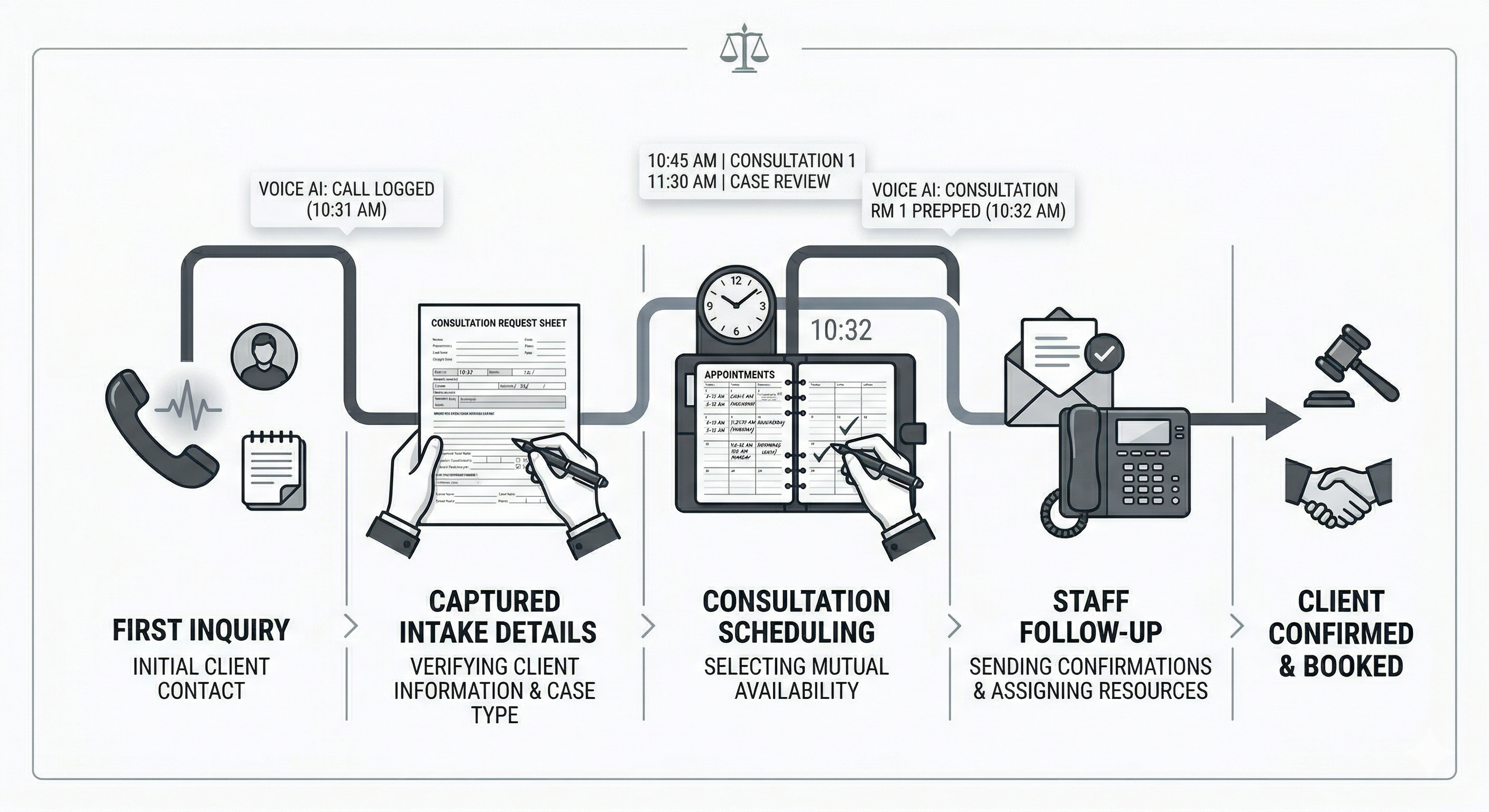
One of the biggest reasons consultation scheduling breaks down in law firms is that intake and booking are treated like separate steps with too much distance between them. A caller shares initial information with one person, waits for a callback from someone else, and then the scheduling process begins without enough continuity or context. That gap creates avoidable delays and weakens the transition from inquiry to booked conversation.
A stronger consultation workflow keeps intake and booking connected. That means preserving the purpose of the inquiry, callback details, preferred timing, urgency signals, and broad next-step needs in a format that supports faster movement into consultation coordination. Instead of forcing staff to reconstruct the situation from scattered notes or voicemail fragments, the firm gets a cleaner intake-to-booking handoff that supports more responsive scheduling.
Peak Demand positions this as workflow continuity support rather than automatic legal screening or case acceptance. The system does not decide whether someone becomes a client or whether the matter is legally viable. It helps law firms reduce booking friction by making sure the consultation workflow starts with stronger information and fewer administrative gaps.
What Better Intake-to-Booking Coordination Looks Like
- Capturing consultation intent and key context before the booking step begins.
- Preserving preferred timing and callback details in a cleaner staff-ready format.
- Reducing fragmented handoffs between reception, intake, and scheduling workflows.
- Helping consultations move forward with less rework and less back-and-forth.
Why This Matters for Conversion
- Qualified prospects are more likely to stay engaged when the booking path feels organized.
- Staff work faster when they do not need to recreate intake context from scratch.
- Stronger continuity helps reduce missed callbacks and stalled consultation opportunities.
- A cleaner handoff protects both professionalism and intake efficiency.
Why do law firm consultations often stall before booking?
Does better intake-to-booking coordination improve scheduling speed?
Does this mean the system decides who gets a consultation?
{
  "section": "Intake-to-Booking Coordination",
  "entity": "Peak Demand",
  "page": "Consultation Scheduling for Law Firms",
  "focus": [
    "intake-to-booking continuity",
    "cleaner consultation handoffs",
    "faster scheduling flow",
    "conversion support"
  ]
}
Consultation Scheduling Needs to Hold Up Even When Qualified Inquiries Come In After Hours
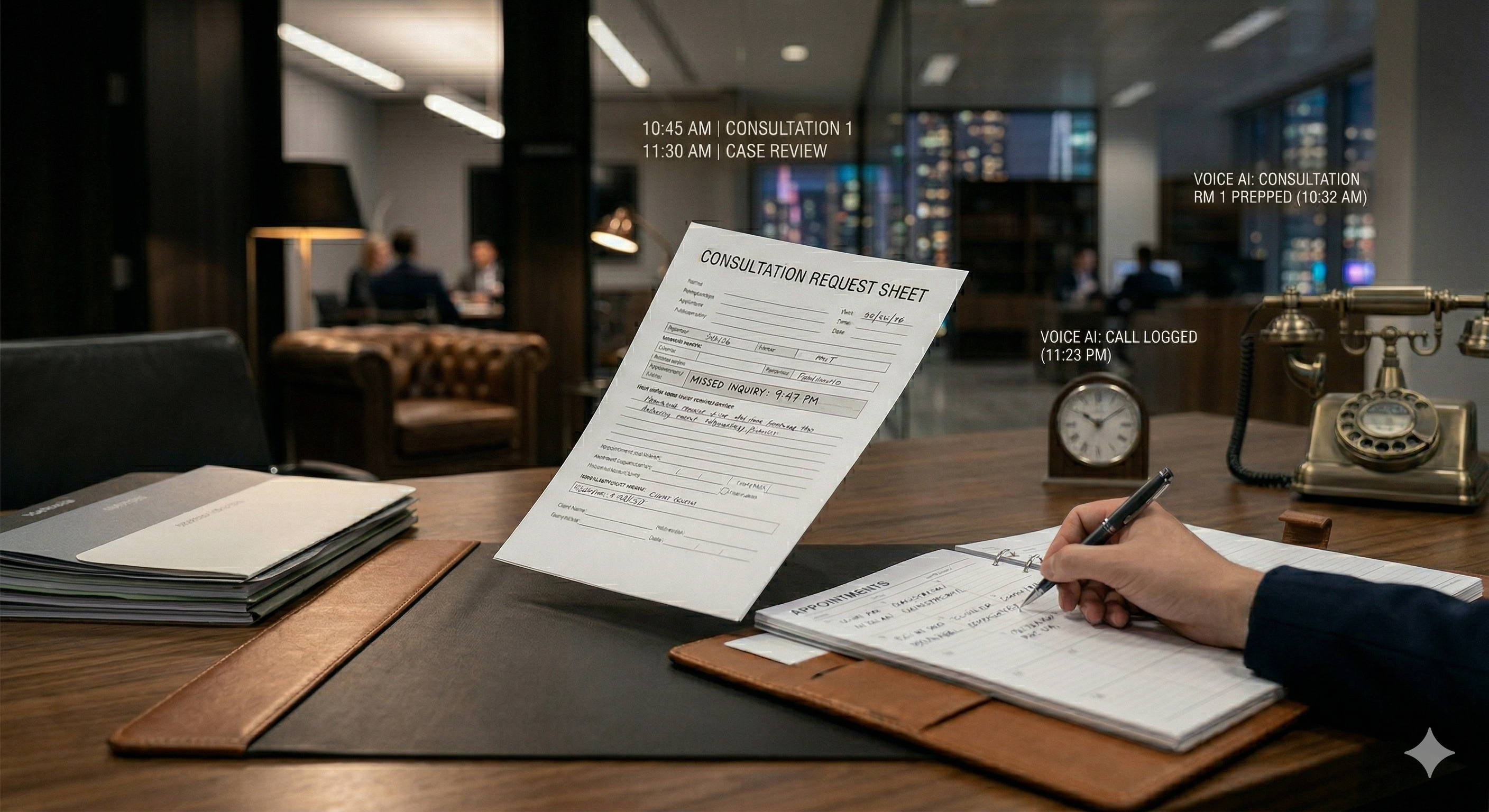
Many prospective clients decide they are ready to speak with a lawyer outside the normal workday. That means consultation opportunities often begin in the evening, on weekends, or at times when staff are unavailable to respond live. If the only option is voicemail, the booking path starts weakly and the prospect may lose momentum before the firm ever has a chance to follow up. A stronger consultation scheduling workflow has to preserve booking intent even when the office is closed.
Consultation scheduling support can help after-hours by preserving caller details, the purpose of the inquiry, preferred timing, and the likely next-step need so the firm begins the next business day with a cleaner booking queue. This does not mean the firm is scheduling legal advice overnight. It means the opportunity is captured more effectively so staff can follow up faster and with better context once they are back online.
Peak Demand treats this as off-hours workflow support rather than always-on legal service. The system should not promise immediate attorney access or imply legal evaluation has already happened. Its role is to make sure consultation intent survives the off-hours gap and reaches the firm in a format that supports better next-day action. That makes after-hours scheduling support one of the most practical ways to reduce lost consultation opportunities.
What Better After-Hours Booking Support Can Preserve
- Consultation intent that would otherwise disappear into voicemail.
- Caller details and preferred timing for stronger next-day outreach.
- More structured context for callback, booking, or intake review.
- Cleaner next-day scheduling queues with less manual guesswork.
Why This Matters for Law Firms
- Many qualified prospects reach out after hours when they finally have time or privacy.
- Weak off-hours handling creates avoidable consultation leakage.
- Better next-day booking readiness improves response speed and conversion discipline.
- Stronger overnight capture reduces morning scheduling friction for staff.
Can consultation scheduling support work after hours?
Does this mean legal consultations are booked automatically overnight?
Why does after-hours scheduling support matter so much?
{
  "section": "After-Hours Consultation Scheduling",
  "entity": "Peak Demand",
  "page": "Consultation Scheduling for Law Firms",
  "focus": [
    "after-hours booking support",
    "consultation intent preservation",
    "cleaner next-day scheduling queues",
    "off-hours conversion protection"
  ]
}
Consultation Scheduling Works Better When Qualified Inquiries Reach the Booking Step With Better Context
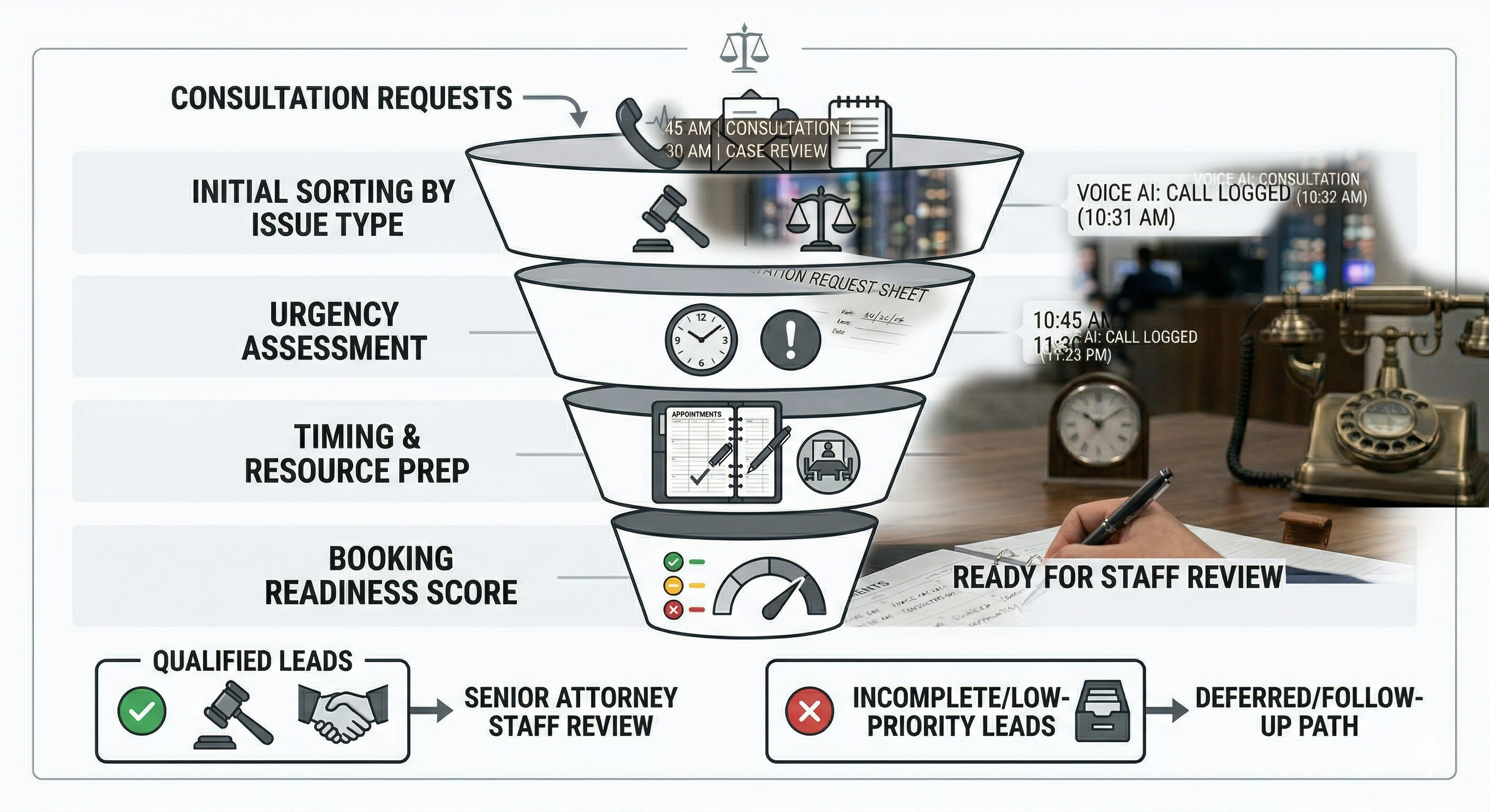
One of the biggest reasons consultation workflows become inefficient is that booking begins before the firm has enough structure around the inquiry. Staff may know the caller wants to speak with a lawyer, but they may not know the broad issue type, urgency, timing needs, or whether the person appears to fit the practice. That lack of context creates slower booking, weaker callbacks, and more internal back-and-forth before a consultation ever gets confirmed.
Consultation scheduling support can help qualification by preserving the caller’s basic details, the purpose of the consultation request, broad issue context, urgency signals, and likely next-step needs before staff begin review. This does not mean the system is deciding legal merit or whether the firm should take the matter. It means the booking workflow begins with more structure, which helps staff prioritize faster, coordinate better, and move stronger opportunities into the right consultation path with less friction.
Peak Demand treats this as qualification support rather than automated legal screening. The system does not determine whether someone has a valid claim, recommend strategy, or approve representation. It helps law firms start the consultation process with better intake context so booking decisions and follow-up happen with more consistency and less administrative drag.
What Better Qualification Support Can Capture
- Caller identity, callback details, and broad matter category before booking begins.
- Timing context and urgency indicators that help staff prioritize consultation follow-up.
- Cleaner differentiation between consultation-ready inquiries and other call types.
- More structured intake records before staff step into review and scheduling.
Why This Matters for Scheduling
- Booking teams work faster when the inquiry already arrives with usable context.
- Stronger qualification support reduces callback lag and scheduling confusion.
- Firms lose fewer viable consultations when staff are not reconstructing basics from scratch.
- Cleaner triage helps protect both conversion and operational discipline.
Can consultation scheduling support help qualify inquiries before booking?
What kind of information helps before a consultation is scheduled?
Is this the same as automated legal screening?
{
  "section": "Qualification Support Before Booking",
  "entity": "Peak Demand",
  "page": "Consultation Scheduling for Law Firms",
  "focus": [
    "better qualification context",
    "cleaner scheduling triage",
    "faster booking support",
    "workflow-ready inquiry capture"
  ]
}
Consultation Scheduling Works Better When Booking Requests Route Into the Right Path Without Extra Friction
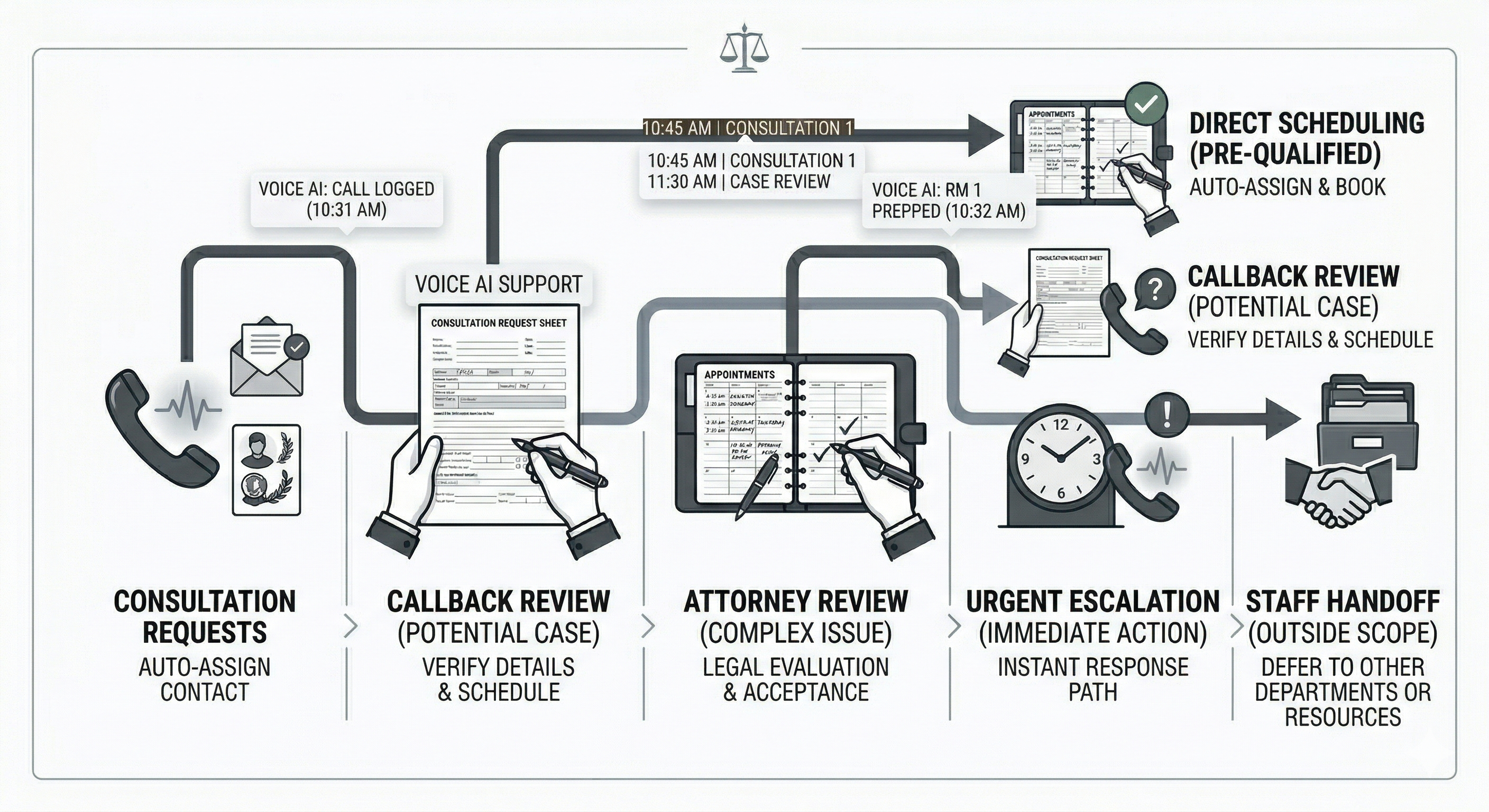
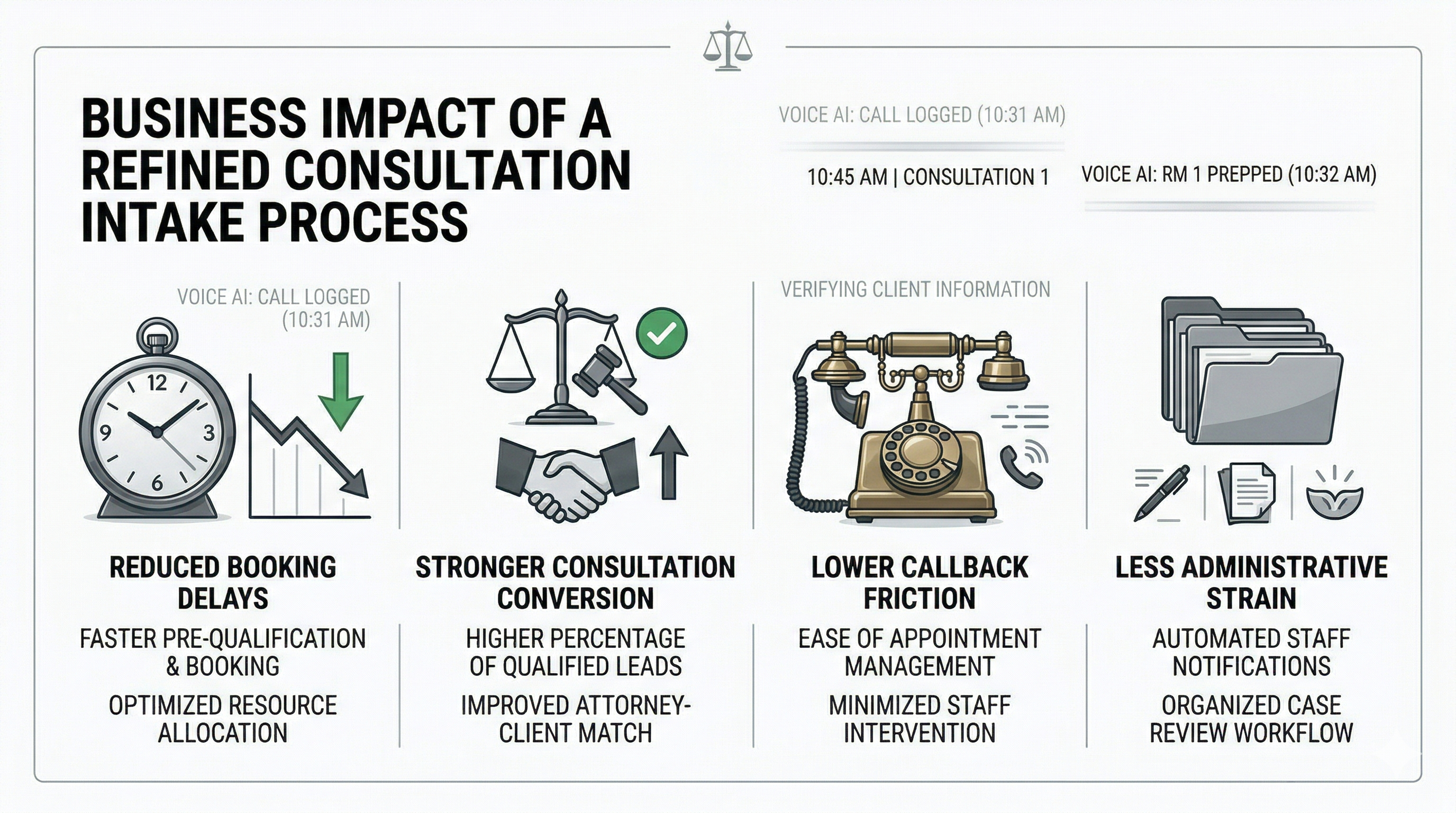
Not every consultation request should move through the exact same path. Some inquiries need a direct booking workflow. Some need a callback first. Some need internal review before scheduling happens at all. When routing is unclear, staff spend extra time sorting through requests, callbacks get delayed, and prospects can lose confidence before the consultation is even confirmed. A stronger consultation scheduling system improves conversion by making routing more disciplined at the point where booking decisions begin.
Consultation scheduling support can help route requests according to broad workflow logic such as caller intent, urgency, practice fit, and next-step requirements. This helps firms separate straightforward booking opportunities from inquiries that need more review, reduce manual handoff confusion, and move consultation-related calls into the right staff workflow faster. For firms with lean intake teams or multiple internal paths, that structure can make scheduling feel far more manageable.
Peak Demand frames this as workflow coordination rather than autonomous decision-making. The system is not deciding legal outcomes or replacing firm review. It is helping the practice begin the booking process with clearer pathways so the right people receive the right information faster. That turns consultation scheduling from a fragmented callback exercise into a stronger operational process.
What Better Routing Support Can Coordinate
- Separation of direct-booking requests, callbacks, internal review needs, and other inquiry paths.
- Faster movement into scheduling, intake review, or designated follow-up workflows.
- More predictable handling of urgent or higher-priority consultation requests.
- Cleaner staff coordination when teams are balancing intake, scheduling, and active matters.
Why This Matters for Consultation Flow
- Different consultation requests often need different next steps before booking can happen.
- Routing gaps create slower scheduling and weaker intake handoffs.
- Teams work better when consultation requests arrive in a more organized, workflow-ready format.
- Routing discipline helps protect responsiveness without creating more administrative noise.
Can consultation scheduling support help route booking requests more effectively?
Can routing differ between different kinds of consultation requests?
Does this remove staff oversight from consultation decisions?
{
  "section": "Routing and Booking Workflow Coordination",
  "entity": "Peak Demand",
  "page": "Consultation Scheduling for Law Firms",
  "focus": [
    "routing support",
    "cleaner booking handoffs",
    "workflow-ready consultation requests",
    "response-time improvement"
  ]
}
Consultation Scheduling Works Better When Booking Requests Route Into the Right Path Without Extra Friction
Not every consultation request should move through the exact same path. Some inquiries need a direct booking workflow. Some need a callback first. Some need internal review before scheduling happens at all. When routing is unclear, staff spend extra time sorting through requests, callbacks get delayed, and prospects can lose confidence before the consultation is even confirmed. A stronger consultation scheduling system improves conversion by making routing more disciplined at the point where booking decisions begin.
Consultation scheduling support can help route requests according to broad workflow logic such as caller intent, urgency, practice fit, and next-step requirements. This helps firms separate straightforward booking opportunities from inquiries that need more review, reduce manual handoff confusion, and move consultation-related calls into the right staff workflow faster. For firms with lean intake teams or multiple internal paths, that structure can make scheduling feel far more manageable.
Peak Demand frames this as workflow coordination rather than autonomous decision-making. The system is not deciding legal outcomes or replacing firm review. It is helping the practice begin the booking process with clearer pathways so the right people receive the right information faster. That turns consultation scheduling from a fragmented callback exercise into a stronger operational process.
What Better Routing Support Can Coordinate
- Separation of direct-booking requests, callbacks, internal review needs, and other inquiry paths.
- Faster movement into scheduling, intake review, or designated follow-up workflows.
- More predictable handling of urgent or higher-priority consultation requests.
- Cleaner staff coordination when teams are balancing intake, scheduling, and active matters.
Why This Matters for Consultation Flow
- Different consultation requests often need different next steps before booking can happen.
- Routing gaps create slower scheduling and weaker intake handoffs.
- Teams work better when consultation requests arrive in a more organized, workflow-ready format.
- Routing discipline helps protect responsiveness without creating more administrative noise.
Can consultation scheduling support help route booking requests more effectively?
Can routing differ between different kinds of consultation requests?
Does this remove staff oversight from consultation decisions?
{
  "section": "Routing and Booking Workflow Coordination",
  "entity": "Peak Demand",
  "page": "Consultation Scheduling for Law Firms",
  "focus": [
    "routing support",
    "cleaner booking handoffs",
    "workflow-ready consultation requests",
    "response-time improvement"
  ]
}
Consultation Scheduling Is an Especially Strong Fit Because Legal Conversion Often Depends on What Happens Before the First Meeting
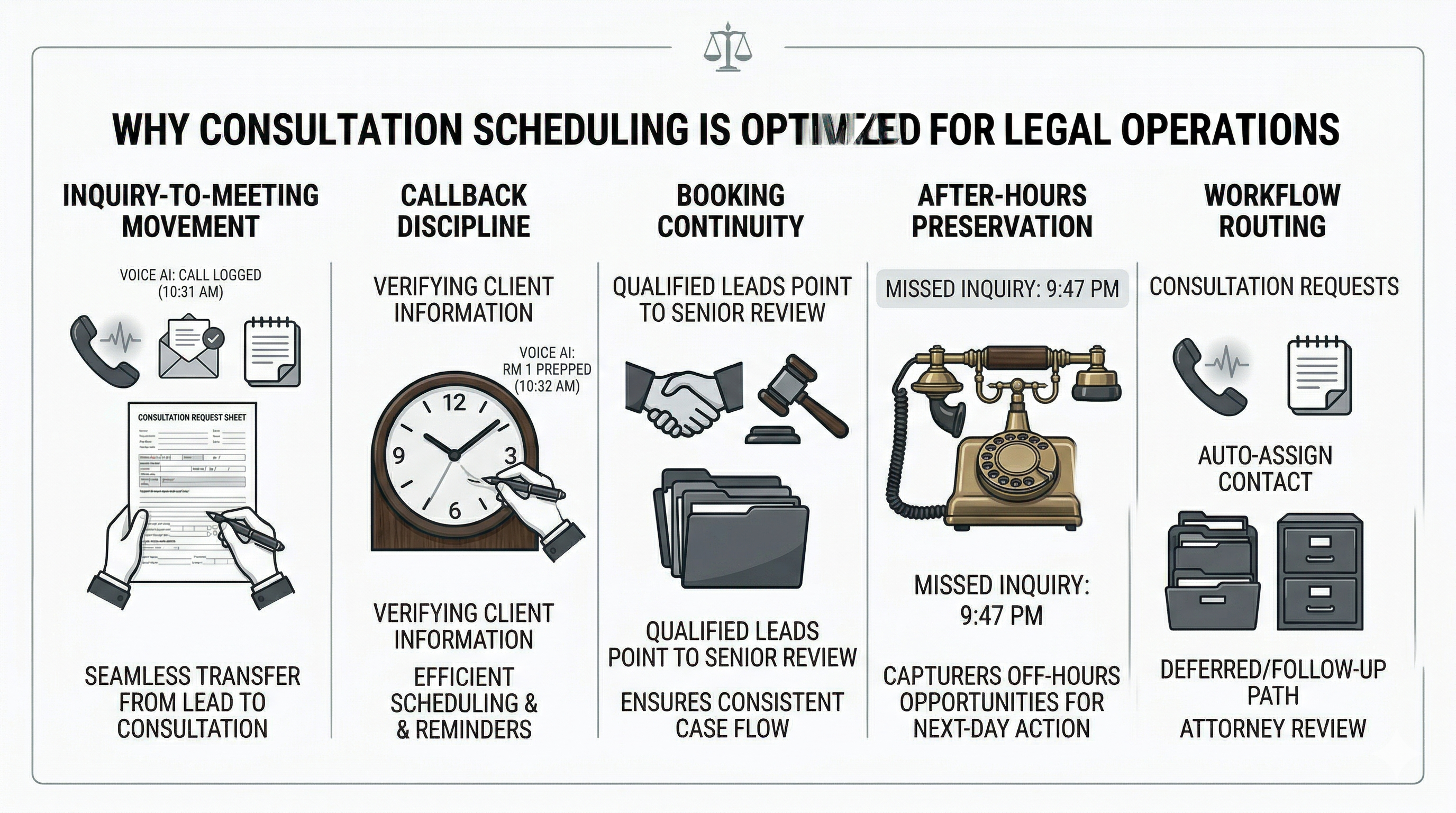
Many law firms think of consultations as the beginning of the client relationship, but operationally, the decisive moment often comes just before that. It is the period between first contact and booked conversation, where delay, missed callbacks, and weak coordination can cause a qualified prospect to disappear. That makes consultation scheduling especially valuable because it improves the conversion layer that sits directly in front of legal review.
This category is a strong fit because the booking tasks themselves are highly repeatable even though the underlying legal matters vary. Gathering scheduling intent, preserving contact details, capturing preferred timing, supporting intake coordination, and routing the inquiry into the correct next step are all front-line workflow tasks that benefit from consistency. A strong scheduling system helps firms standardize that process without turning the experience into a cold script or crossing into legal advice.
Peak Demand sees consultation scheduling as a category fit because the use cases are clear across many practice areas: faster booking, cleaner intake-to-calendar continuity, better after-hours preservation, stronger routing, and more dependable callback flow. The value is not novelty. It is the ability to make one of the most conversion-sensitive parts of legal intake far more dependable.
Why the Category Fits So Well
- Many consultation-driven firms lose momentum between inquiry and booking rather than after the meeting itself.
- The core booking tasks are repeatable even when legal matters vary by practice area.
- Weak scheduling usually creates commercial and operational problems before legal review begins.
- After-hours and busy-period inquiries often need better booking preservation rather than more manual process.
What Law Firms Usually Need Most
- More reliable movement from inquiry to consultation.
- Better booking discipline without making the process feel cold or rigid.
- Support for growth without overwhelming intake and scheduling staff.
- Operational tools that stay within clear legal and professional boundaries.
Why is consultation scheduling a better-than-average fit for law firms?
Does this fit only firms with high consultation volume?
What makes this fit stronger than in some other categories?
{
  "section": "Why the Category Fits So Well",
  "entity": "Peak Demand",
  "page": "Consultation Scheduling for Law Firms",
  "focus": [
    "category fit",
    "repeatable booking tasks",
    "consultation-driven workflow",
    "pre-meeting conversion improvement"
  ]
}
Law Firms Can Use Consultation Scheduling Support Across Multiple Booking and Follow-Up Workflows
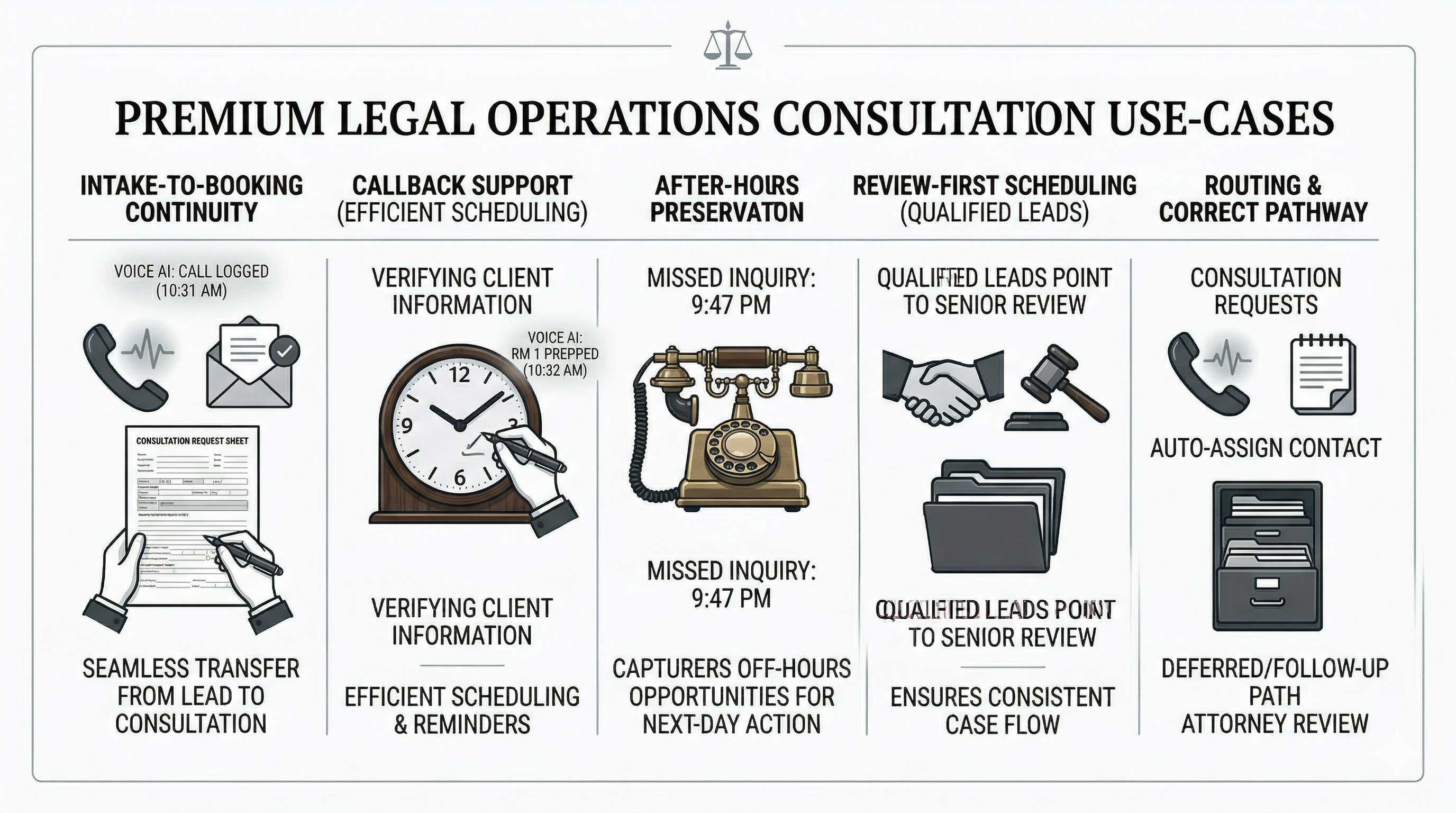
Consultation scheduling support is most effective when it improves more than a single booking step. The real opportunity is to create a connected workflow that begins when a prospective client expresses intent to speak with the firm and continues through intake preservation, qualification support, booking coordination, routing, callback management, and after-hours follow-up readiness. Different firms will emphasize different parts of that workflow depending on how consultations are reviewed, scheduled, and converted. The shared goal is stronger consultation movement at the point where qualified opportunities are most likely to stall.
Some firms may focus on speeding up callback-to-booking movement. Others may care more about cleaner intake-to-calendar continuity, after-hours booking preservation, or routing requests into the right internal review path. Firms with lean intake teams may benefit most from reducing repetitive manual coordination. Consultation-heavy practices may prioritize faster scheduling readiness and fewer missed booking opportunities. A well-configured consultation workflow can support these different priorities without turning legal communication into a rigid script.
Peak Demand approaches this category as a workflow system rather than a single feature. The objective is to help law firms build a more dependable booking layer across the parts of intake that most often create missed opportunities, slower callbacks, and fragmented handoffs. That is what makes consultation scheduling support especially useful for firms that want stronger conversion without adding operational chaos.
Common Consultation Scheduling Use Cases
- Moving new inquiry calls into consultation-ready booking workflows.
- Supporting intake continuity before staff confirm the meeting.
- Preserving after-hours booking intent for next-day follow-up.
- Separating direct-booking requests, callbacks, and review-first consultation paths.
Operational Areas That Benefit Most
- Front-end consultation capture when staff are busy or unavailable live.
- Initial information preservation before booking coordination begins.
- Internal routing across intake, callback, review, and calendar workflows.
- Reduction of missed-opportunity leakage caused by weak booking handoffs.
What are the main use cases for consultation scheduling support?
Can the use cases vary by firm?
Is consultation scheduling support only useful for larger firms?
{
  "section": "Common Use Cases",
  "entity": "Peak Demand",
  "page": "Consultation Scheduling for Law Firms",
  "focus": [
    "connected booking use cases",
    "intake-to-calendar continuity",
    "consultation routing",
    "follow-up workflow readiness"
  ]
}
Build a More Dependable Consultation Booking Workflow for Your Law Firm
If your law firm is losing momentum between inquiry and consultation, struggling with callback delays, or relying on fragmented booking coordination, consultation scheduling support can help create a more dependable path from first contact to booked conversation. The goal is not to replace lawyers or legal staff. It is to give your firm a stronger operational system for preserving consultation intent, supporting intake continuity, and moving qualified prospects into the right next step with more consistency.
Peak Demand helps law firms design consultation scheduling workflows around real legal intake and booking operations rather than generic calendar scripts. That includes intake-to-booking continuity, callback support, qualification before scheduling, after-hours consultation preservation, and routing logic that fits how legal practices actually work. If you want cleaner booking flow without sacrificing professionalism, this is where the conversation starts.
The best deployment is one that reflects how your firm actually works: what information matters before a consultation is booked, which inquiries should move faster, how after-hours requests are preserved, what needs staff review first, and where time is being lost to repetitive scheduling coordination. That is the level Peak Demand is built to support.
What Peak Demand Can Help You Improve
- Consultation movement from inquiry to booked conversation.
- First-contact structure for legal booking and intake continuity.
- Callback consistency and after-hours consultation preservation.
- Routing logic that reflects your actual intake and scheduling model.
Why Firms Reach Out
- Qualified inquiries are stalling before a consultation gets booked.
- Reception and intake teams are overloaded with repetitive scheduling coordination.
- Callback chains are slowing down booking and hurting conversion.
- After-hours consultation requests are not being preserved cleanly.
Is this only for high-volume law firms?
Does Peak Demand build around the firm’s specific consultation workflow?
Will this replace legal staff?
{
  "section": "CTA",
  "entity": "Peak Demand",
  "page": "Consultation Scheduling for Law Firms",
  "focus": [
    "commercial conversion",
    "workflow-fit positioning",
    "consultation booking operations",
    "callback and intake continuity"
  ]
}
Consultation Scheduling for Law Firms Should Operate Within a Clear Communications, Privacy, and Workflow Governance Framework
Consultation scheduling in a law firm is not just a calendar exercise. It often involves capturing sensitive information before a lawyer has even spoken with the prospective client. A caller may disclose personal facts, family issues, criminal allegations, employment concerns, financial problems, business disputes, or other confidential context while trying to book an appointment. That is why consultation scheduling support should be treated as a governed workflow rather than a simple booking layer. The operational upside only matters if the consultation process is structured responsibly.
For Canadian firms, that generally means thinking carefully about privacy and communications obligations under frameworks such as PIPEDA and guidance from the Office of the Privacy Commissioner of Canada, while also accounting for telecommunications and telemarketing rules where relevant. For firms serving U.S. callers or operating across borders, governance may also intersect with TCPA, FCC, FTC, and state-level call recording consent requirements. The point is not to turn scheduling into a legal treatise. It is to recognize that consultation coordination touches regulated communication practices and should be designed accordingly.
Peak Demand frames governance here as a practical operating requirement: define what information should be captured before booking, what should not be collected too early, how disclosures are handled, how scheduling records and call notes are stored, when escalation occurs, and how staff maintain oversight. Law firms do not need vague automation in the booking layer. They need disciplined implementation that respects privacy, communications rules, and the seriousness of legal intake.
Governance Areas That Matter Most
- Privacy-aware handling of consultation-request and intake information.
- Clear rules for disclosures, transparency, and communication boundaries.
- Review of call recording and consent requirements across relevant jurisdictions.
- Defined escalation logic and staff oversight for sensitive or higher-priority inquiries.
Operational Questions Firms Should Answer
- What information should be captured before a consultation is booked and what should wait?
- When should the system escalate to a human instead of continuing the workflow?
- How are scheduling records, transcripts, and consultation notes stored and reviewed?
- Which privacy, telecommunications, and recording rules apply to the firm’s footprint?
Why does governance matter for consultation scheduling?
Does this mean the system handles compliance automatically?
What regulations are commonly relevant in this context?
{
  "section": "Governance and Regulatory Context",
  "entity": "Peak Demand",
  "page": "Consultation Scheduling for Law Firms",
  "focus": [
    "privacy-aware scheduling workflows",
    "operational governance",
    "recording and consent considerations",
    "staff oversight and escalation"
  ]
}
Responsible Consultation Scheduling Needs Clear Limits, Human Oversight, and No Legal Advice
Law firms cannot afford ambiguity about what a scheduling system is doing. The workflow should support booking coordination, intake continuity, callback management, and routing. It should not provide legal advice, assess the strength of a matter, recommend legal strategy, determine whether someone has a valid claim, decide whether the firm should represent the person, or imply that legal review has already occurred just because a consultation request was captured. Those boundaries are central to responsible deployment.
A responsible consultation scheduling model keeps lawyers and staff in control of legal judgment, intake review, scheduling decisions, escalation, and representation criteria. The system can preserve information, support first-response consistency, and prepare cleaner booking handoffs, but it must stay inside defined operational limits. That includes transparency about the nature of the interaction, careful handling of sensitive consultation-request data, and escalation pathways when a situation requires human review before booking can proceed.
Peak Demand positions responsible AI as a practical operating principle rather than a marketing slogan. The goal is to make consultation movement more dependable without creating confusion about the role of the system. In legal services, trust is shaped before the meeting even happens. Firms need implementation that sounds professional, behaves predictably, and reinforces that lawyers and staff remain accountable for the legal relationship and every substantive decision.
What Responsible Deployment Includes
- No legal advice, legal conclusions, or strategy recommendations from the system.
- No autonomous representation decisions or matter-merit determinations.
- Clear escalation paths when a consultation request needs human attention before booking.
- Defined communication boundaries and reviewable workflow rules.
What Should Stay With the Firm
- Lawyer judgment and matter-specific legal analysis.
- Conflict checks, representation decisions, and engagement steps.
- Staff review of sensitive or higher-priority consultation requests.
- Oversight of privacy, communications, and client-experience standards.
Can consultation scheduling support give legal advice?
Can the system decide whether someone should get a consultation?
What makes consultation scheduling responsible in a law firm setting?
{
  "section": "Responsible AI for Consultation Scheduling",
  "entity": "Peak Demand",
  "page": "Consultation Scheduling for Law Firms",
  "focus": [
    "no legal advice",
    "human oversight",
    "clear operational boundaries",
    "responsible consultation-booking deployment"
  ]
}
Frequently Asked Questions About Consultation Scheduling for Law Firms
Law firms usually ask practical questions before improving consultation scheduling. They want to know whether it can help qualified prospects book faster, preserve better inquiry details, reduce callback friction, improve after-hours booking readiness, and route requests more cleanly without crossing legal lines. They also want clarity on where the system stops and where staff and lawyers remain fully in control.
That is the right way to evaluate the category. Consultation scheduling support should be judged on booking quality, operational usefulness, and responsible deployment rather than novelty. The strongest implementation helps the firm move qualified opportunities forward faster without blurring the line between workflow support and legal judgment.
The questions below cover the issues law firms most commonly think through when evaluating booking support, intake continuity, callback management, after-hours consultation preservation, routing, and governance.
What Firms Usually Want to Confirm
- Whether consultation scheduling support can help prospects move to booking faster.
- How it supports intake continuity and callback flow without giving legal advice.
- Whether it helps reduce stalled opportunities and after-hours booking leakage.
- How staff oversight, escalation, and governance remain in place.
What This FAQ Reinforces
- Consultation scheduling support is an operational layer, not a substitute for lawyers or staff.
- Law firms are a strong fit because booking quality, responsiveness, and conversion often overlap.
- Intake continuity, callback discipline, routing, and after-hours preservation are core use cases.
- Responsible deployment depends on clear limits, privacy awareness, and human review.
What does consultation scheduling support actually do?
Can it help qualified prospects book consultations faster?
Can consultation scheduling support help with qualification before booking?
Can it help preserve after-hours consultation requests?
Does consultation scheduling support replace intake or scheduling staff?
Can consultation scheduling support give legal advice?
Why is consultation scheduling such a strong fit for law firms?
Can it support different booking paths depending on the inquiry?
What should firms evaluate before deploying consultation scheduling support?
{
  "section": "FAQ",
  "entity": "Peak Demand",
  "page": "Consultation Scheduling for Law Firms",
  "focus": [
    "booking support",
    "intake continuity",
    "after-hours consultation preservation",
    "routing",
    "responsible deployment"
  ]
}
Explore your own AI use case on a discovery call.