
Voice AI for Family Medicine Clinics: Patient Intake, Appointment Scheduling, Prescription Requests & After-Hours Call Routing

Family medicine clinics serve as the front line of healthcare access. Patients call for appointment scheduling, prescription refill requests, referral coordination, lab result inquiries, and urgent concerns. Managing these calls efficiently can be difficult for clinics operating with limited administrative staff and increasing patient demand.
Voice AI can support family medicine practices by handling high-volume communication tasks such as appointment scheduling, patient intake routing, insurance questions, and after-hours call handling. These systems operate within clearly defined boundaries, supporting clinic operations while preserving human-first escalation for urgent or complex situations.
When implemented with governance safeguards, Voice AI becomes a communication infrastructure layer that improves patient access, reduces front-desk overload, and supports consistent intake workflows across primary care networks.
For the broader service overview (Canada + U.S., HIPAA/PIPEDA/PHIPA context), see:
https://peakdemand.ca/ai-voice-receptionist-after-hours-answering-service-for-healthcare-providers-appointment-booking
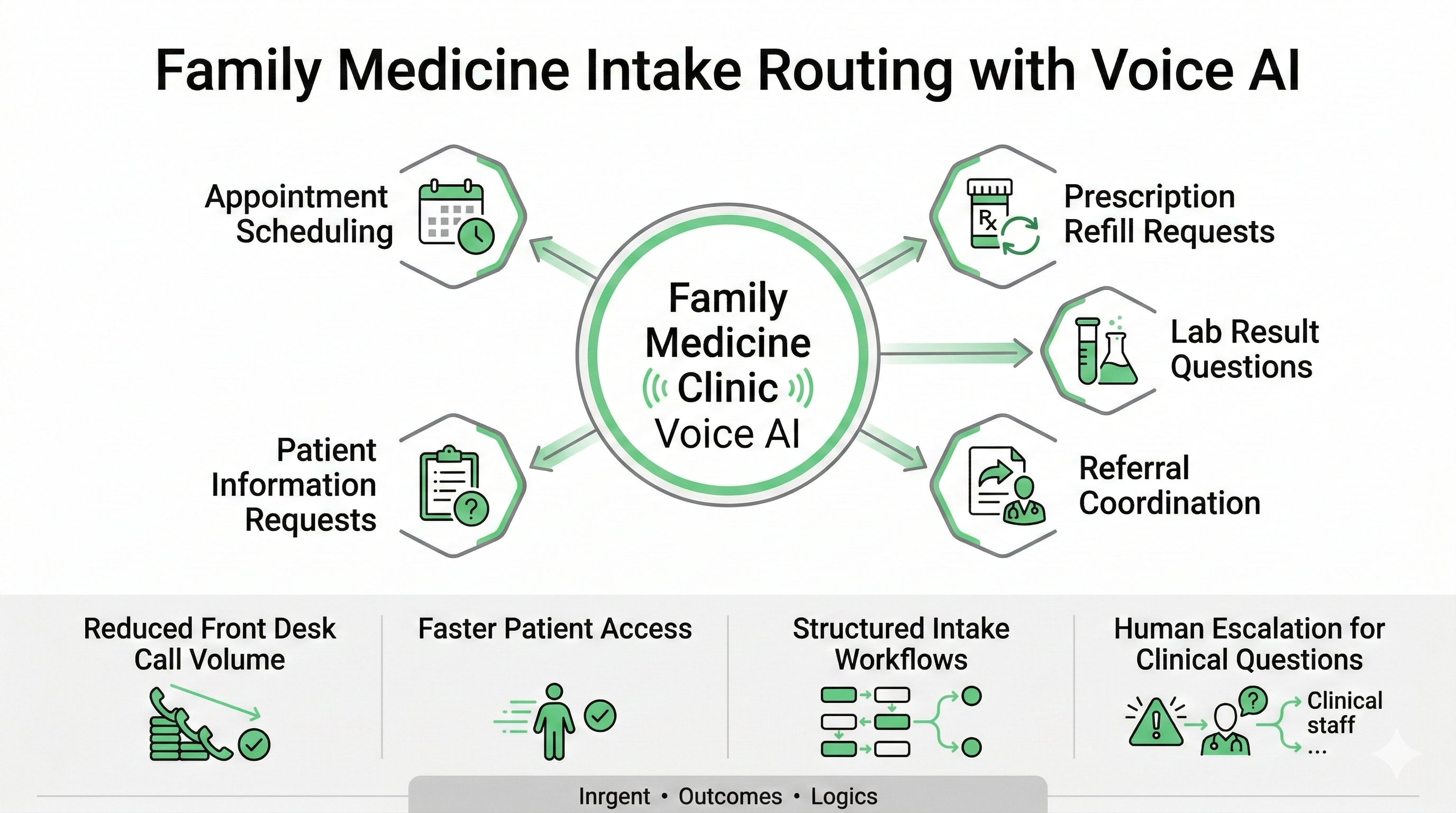
Family Medicine Intake & Patient Access: Managing High-Volume Primary Care Calls
Family medicine clinics serve as the primary entry point for healthcare services. Patients frequently call to schedule appointments, request prescription renewals, ask about test results, or obtain referrals. Managing these requests efficiently can be difficult for clinics with limited administrative staff.
Voice AI can support primary care communication by handling structured patient intake routing, appointment coordination, and information requests while preserving human escalation pathways for clinical or urgent scenarios.
Common Family Medicine Call Types
- Appointment scheduling and rescheduling
- Prescription refill requests
- Lab result inquiries
- Referral coordination for specialists
- General clinic information requests
Operational Safeguards
- Structured intake routing: predefined workflow steps
- No clinical advice posture: operational support only
- Human escalation: urgent or complex calls transferred to staff
- Audit visibility: routing outcomes and escalation tracking
- Policy-aligned responses: approved scripts and boundaries
Can Voice AI answer calls for family medicine clinics?
Can Voice AI replace front desk staff in primary care clinics?
Can Voice AI handle prescription refill requests?
{
  "section": "Family Medicine Intake and Patient Access",
  "entity": "Peak Demand",
  "service": "Voice AI for Family Medicine Clinics",
  "geo": ["Toronto", "Canada", "United States"],
  "use_cases": [
    "appointment scheduling requests",
    "prescription refill routing",
    "lab result inquiries",
    "referral coordination",
    "general clinic information"
  ],
  "controls": [
    "structured intake routing",
    "human escalation pathways",
    "no clinical advice posture",
    "policy-aligned scripts",
    "audit-ready logging"
  ],
  "delivery_model": "fully managed custom build",
  "cta": "https://peakdemand.ca/discovery"
}
Appointment Scheduling Workflows for Family Medicine Clinics
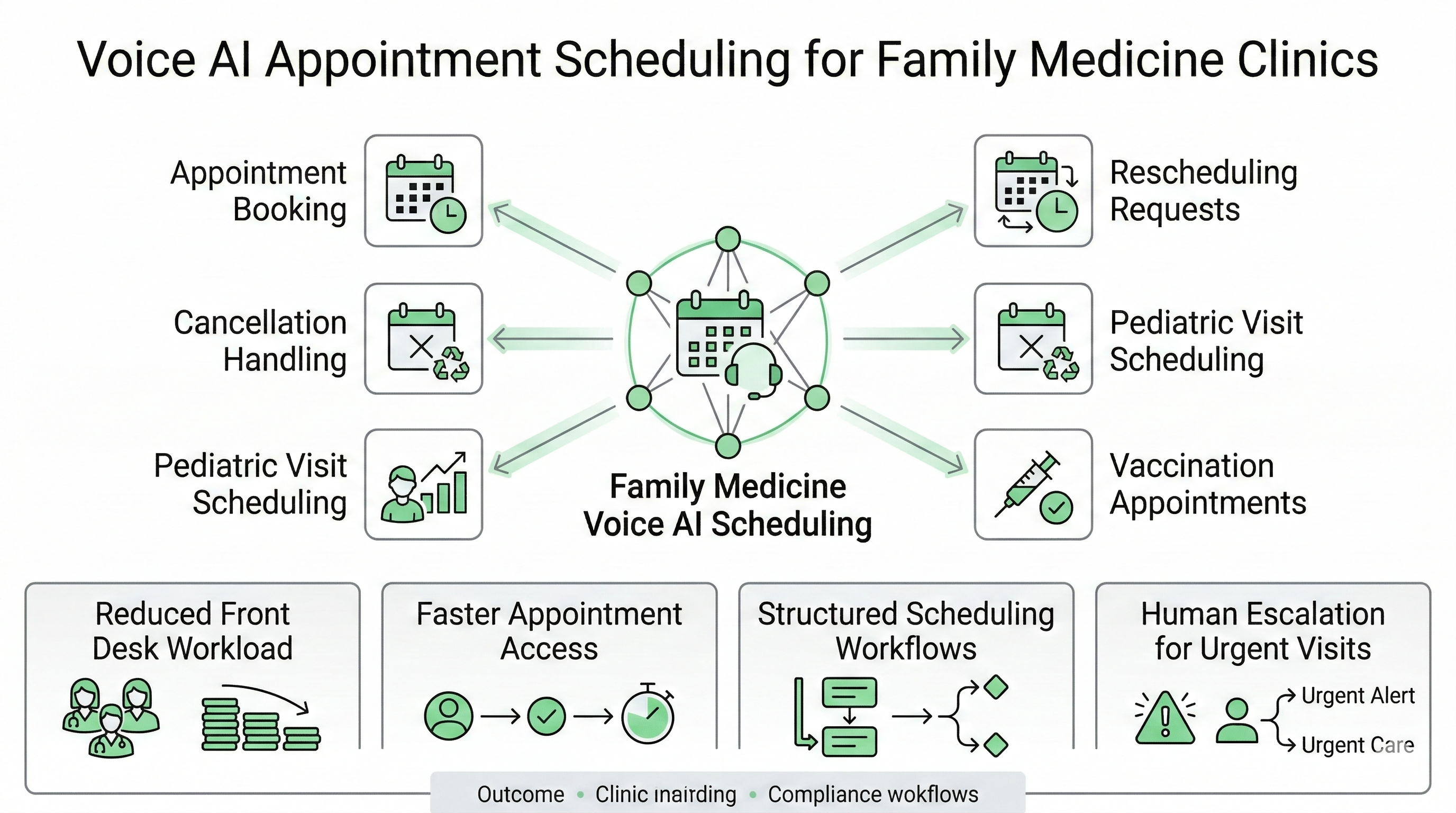
Appointment scheduling represents one of the highest-volume communication tasks for family medicine practices. Patients call to book annual physicals, follow-up appointments, pediatric visits, and urgent consultations. Managing these requests manually can create front-desk bottlenecks and long phone wait times.
Voice AI can support scheduling workflows by handling appointment requests, rescheduling, cancellations, and intake routing, allowing clinic staff to focus on patient care and in-office coordination.
Common Scheduling Requests
- Annual physical exams
- Follow-up appointments
- Pediatric wellness visits
- Vaccination appointments
- Same-day urgent care requests
Operational Scheduling Controls
- Predefined appointment categories: standardized booking paths
- Human escalation: urgent or unclear requests routed to staff
- Scheduling boundaries: clinic-defined availability rules
- Audit visibility: appointment request logs and routing outcomes
- Policy-aligned responses: approved communication scripts
Can Voice AI schedule appointments for family medicine clinics?
Can Voice AI handle appointment cancellations and rescheduling?
What happens if a patient needs urgent care?
{
  "section": "Appointment Scheduling Workflows",
  "entity": "Peak Demand",
  "service": "Voice AI for Family Medicine Clinics",
  "geo": ["Toronto", "Canada", "United States"],
  "use_cases": [
    "appointment booking requests",
    "rescheduling and cancellations",
    "urgent appointment routing",
    "pediatric visit scheduling",
    "vaccination appointment inquiries"
  ],
  "controls": [
    "predefined appointment categories",
    "clinic scheduling boundaries",
    "human escalation pathways",
    "policy-aligned scripts",
    "audit-ready logging"
  ],
  "delivery_model": "fully managed custom build",
  "cta": "https://peakdemand.ca/discovery"
}
Prescription Refill Requests: Structured Capture, Routing, and Policy Controls
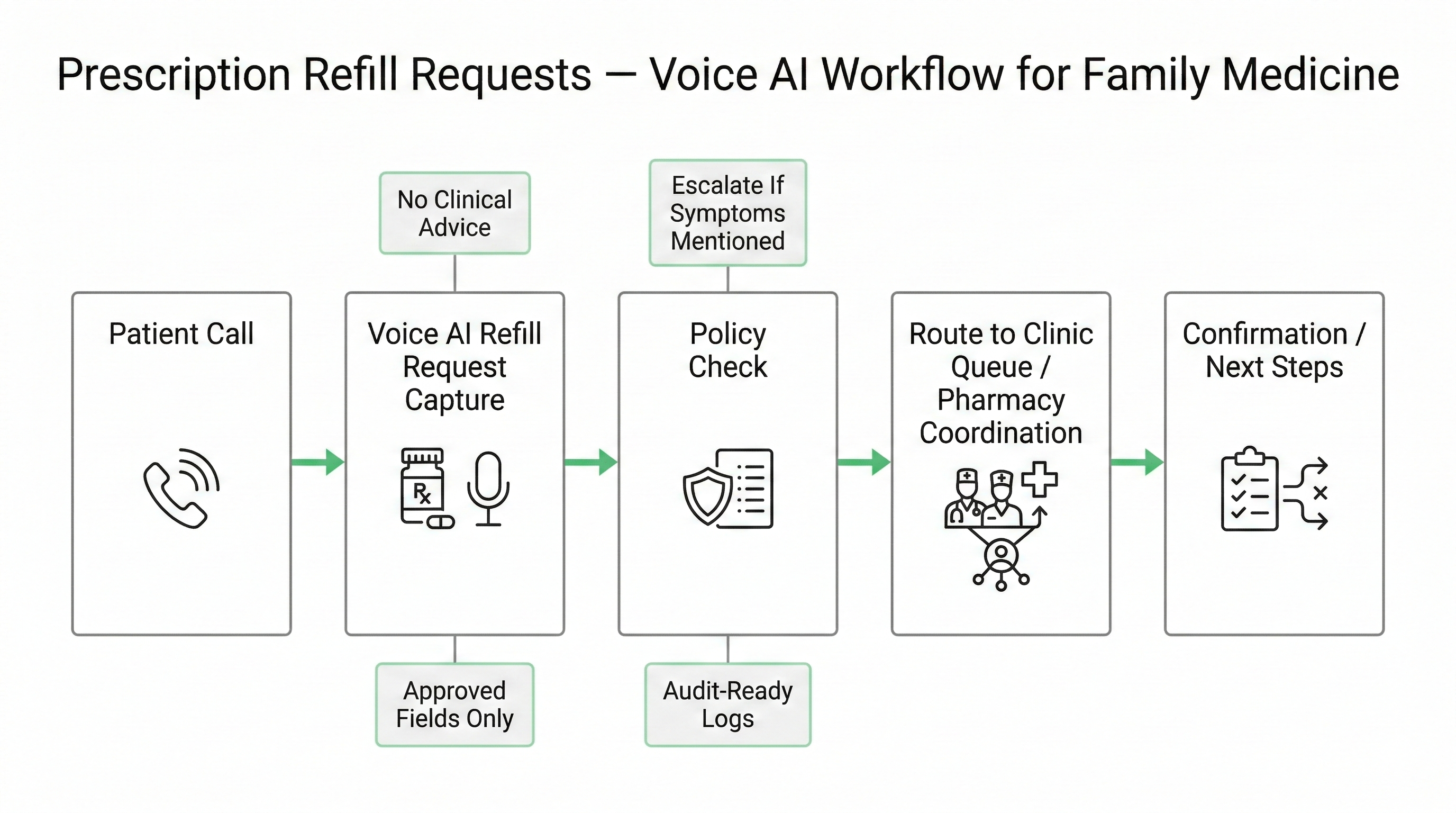
Prescription renewals are a daily operational burden for many family medicine clinics. Patients call to request refills, confirm that a prescription was sent, or ask about renewal timing. Manual processing can create backlog, repeated calls, and unnecessary front-desk load.
Voice AI can be configured to support structured refill request capture and routing within clinic-defined policies, while preserving strict boundaries: no medication advice, no dosage guidance, and escalation when requests fall outside approved workflows.
Common Refill & Medication Call Types
- Routine prescription renewal requests
- Confirmation that a prescription was sent to a pharmacy
- Requests for medication list updates (non-clinical capture)
- Pharmacy callback coordination (administrative routing)
- Follow-up appointment reminders for renewal requirements
Governance Controls for Refill Workflows
- Approved request fields: name, pharmacy, medication identifier (as authorized)
- Policy-based rules: renewal windows, appointment requirements, exclusions
- Escalation triggers: urgent symptoms or uncertainty routes to staff
- No clinical advice posture: no dosing, side effects, or treatment guidance
- Audit visibility: request logs and routing outcomes
Can Voice AI take prescription refill requests for a family doctor?
Can Voice AI send prescriptions directly to a pharmacy?
What if a patient describes symptoms or a medication problem?
Can Voice AI reduce repeat calls about refill status?
{
  "section": "Prescription Refill Requests and Workflow Controls",
  "entity": "Peak Demand",
  "service": "Voice AI for Family Medicine Clinics",
  "geo": ["Toronto", "Canada", "United States"],
  "use_cases": [
    "structured refill request capture",
    "pharmacy routing coordination (where authorized)",
    "renewal workflow reminders (policy-aligned)",
    "administrative medication list updates (non-clinical capture)"
  ],
  "controls": [
    "approved request fields only",
    "policy-based refill rules",
    "no clinical advice posture",
    "escalation triggers for symptoms or uncertainty",
    "audit-ready logging"
  ],
  "delivery_model": "fully managed custom build",
  "cta": "https://peakdemand.ca/discovery"
}
Lab Results Inquiries: Managing Follow-Up Calls Without Clinical Interpretation
Family medicine clinics regularly receive calls from patients asking about blood tests, imaging results, and follow-up instructions. These calls can create heavy administrative volume, particularly when results are still pending or require clinician review.
Voice AI can assist by supporting structured lab result inquiry routing and follow-up coordination. The system provides operational information only and does not interpret results or offer clinical guidance.
Common Lab Result Call Types
- Checking if lab results have arrived
- Requests for follow-up appointments
- Questions about test processing timelines
- Requests for nurse or doctor callbacks
- General follow-up coordination
Governance Controls
- No interpretation of results: operational routing only
- Defined escalation pathways: clinical questions routed to staff
- Structured information delivery: approved scripts
- Callback capture: patient contact requests logged
- Audit visibility: follow-up tracking and call outcomes

Can Voice AI tell patients their lab results?
Can Voice AI help patients schedule follow-up appointments?
What happens if a patient has urgent concerns about test results?
{
  "section": "Lab Results Inquiry Routing",
  "entity": "Peak Demand",
  "service": "Voice AI for Family Medicine Clinics",
  "geo": ["Toronto","Canada","United States"],
  "use_cases": [
    "lab result inquiry routing",
    "follow-up appointment coordination",
    "callback request capture",
    "test processing timeline information"
  ],
  "controls": [
    "no clinical interpretation",
    "human escalation pathways",
    "approved information scripts",
    "audit-ready logging"
  ],
  "delivery_model": "fully managed custom build",
  "cta": "https://peakdemand.ca/discovery"
}
Specialist Referral Coordination: Structured Intake for Follow-Up Care
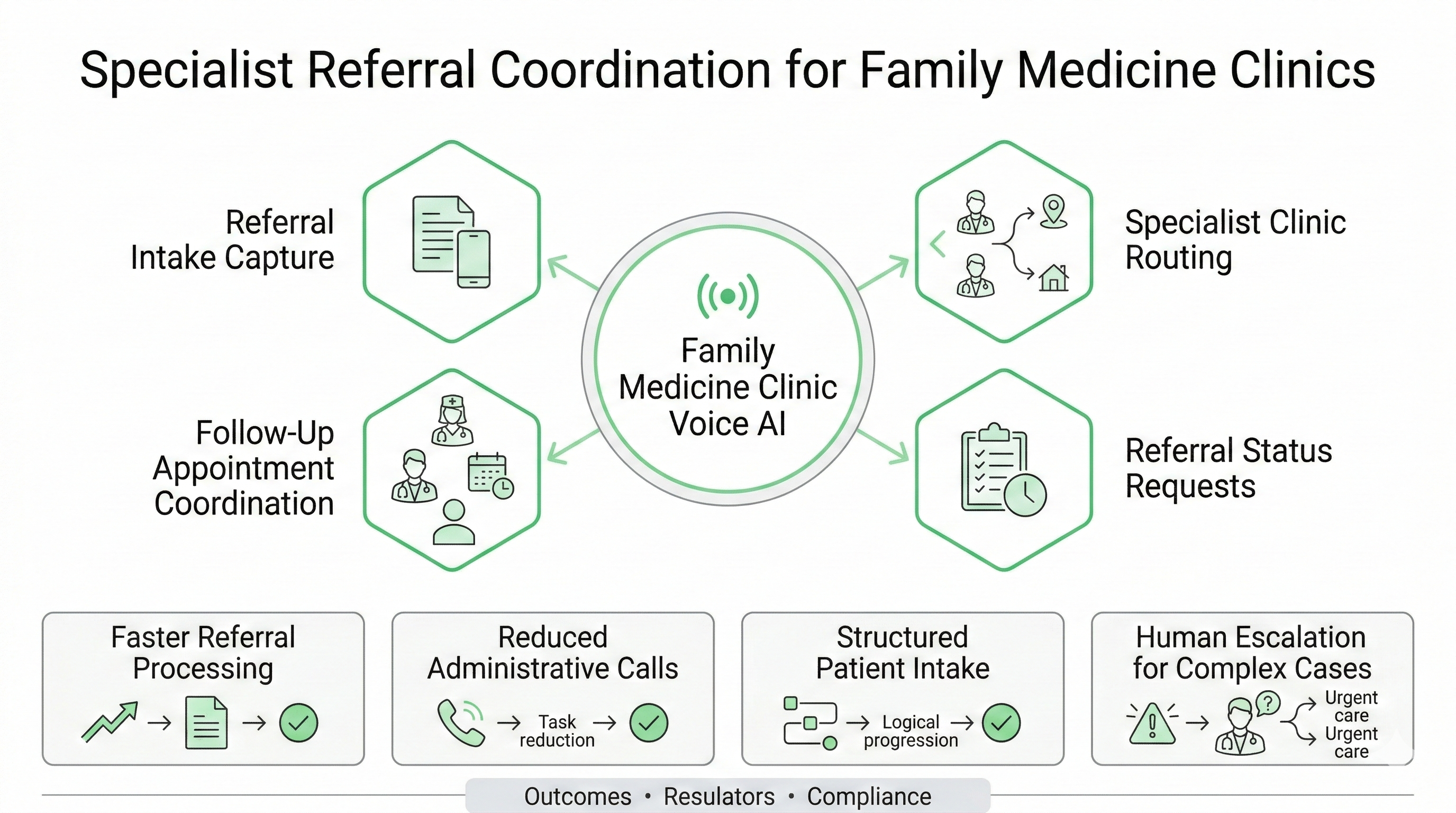
Family medicine clinics often coordinate specialist referrals for cardiology, dermatology, orthopedics, mental health services, and diagnostic imaging. These calls may involve referral status checks, appointment coordination, or patient intake information for specialist clinics.
Voice AI can assist with referral intake capture, routing to appropriate staff queues, and follow-up coordination while maintaining governance safeguards that prevent clinical interpretation or decision-making by the system.
Common Referral Call Types
- Checking the status of a specialist referral
- Providing intake information for referral processing
- Requests for specialist clinic contact details
- Scheduling referral follow-up appointments
- Patient questions about referral timelines
Governance Safeguards
- Administrative routing only: no clinical recommendations
- Defined escalation paths: complex cases transferred to staff
- Structured intake fields: approved referral information capture
- Policy-aligned communication: standardized scripts
- Audit-ready logs: referral call tracking and outcomes
Can Voice AI help coordinate specialist referrals for family doctors?
Can Voice AI recommend which specialist a patient should see?
Can patients check referral status using Voice AI?
{
  "section": "Specialist Referral Coordination",
  "entity": "Peak Demand",
  "service": "Voice AI for Family Medicine Clinics",
  "geo": ["Toronto","Canada","United States"],
  "use_cases": [
    "specialist referral intake capture",
    "referral status inquiries",
    "specialist contact coordination",
    "follow-up appointment routing"
  ],
  "controls": [
    "administrative routing only",
    "human escalation pathways",
    "approved intake fields",
    "policy-aligned scripts",
    "audit-ready logging"
  ],
  "delivery_model": "fully managed custom build",
  "cta": "https://peakdemand.ca/discovery"
}
Insurance, Billing, and Forms: Standardized Answers Without Staff Backlog
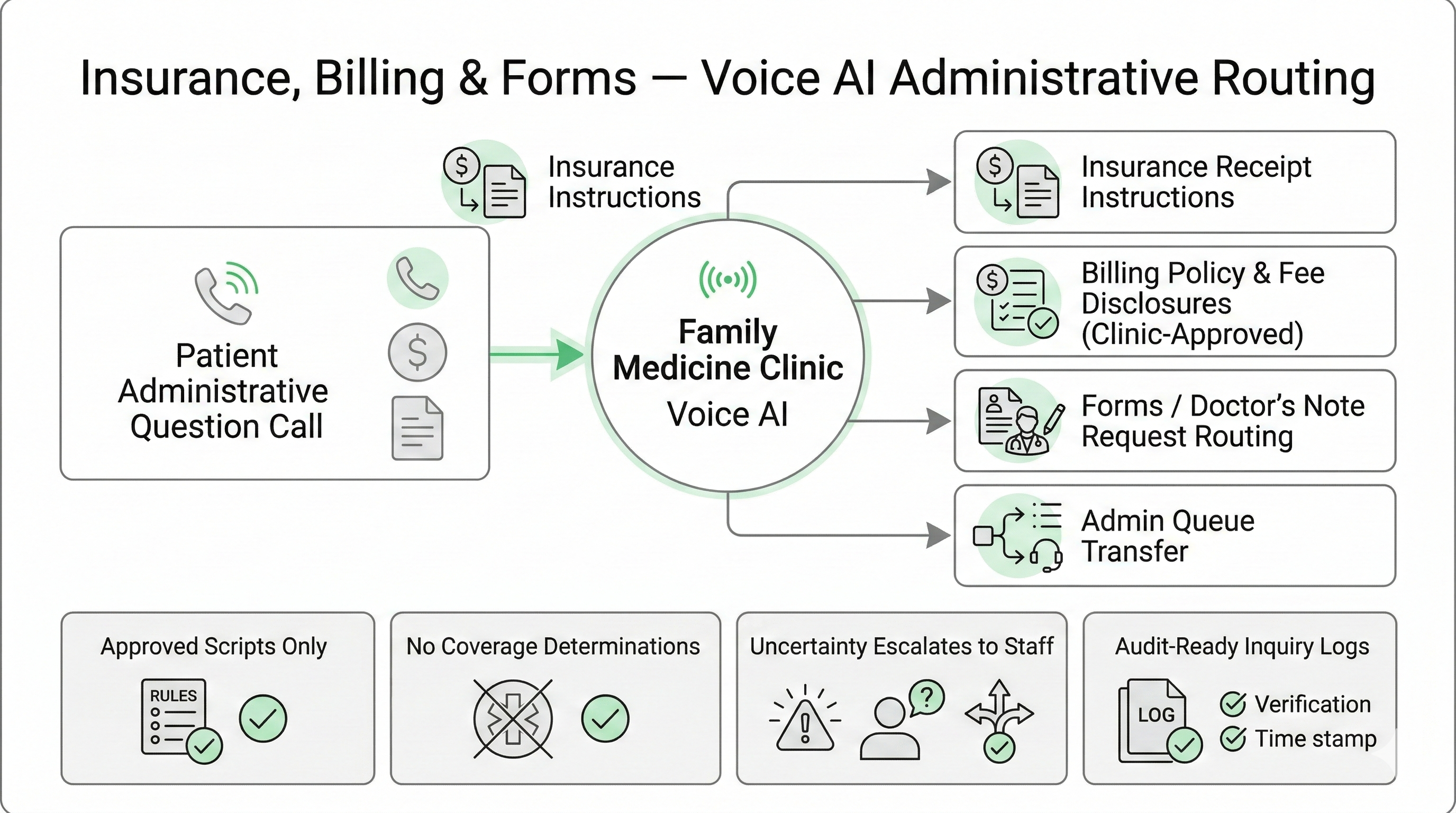
Family medicine clinics receive frequent calls about insurance receipts, third-party forms, uninsured services, OHIP/non-OHIP questions (where applicable), appointment fees, and documentation requirements. These requests are often repetitive, but still consume significant front-desk time.
Voice AI can be configured to deliver approved billing information, form instructions, and routing to the correct administrative queue, while maintaining strict scope boundaries: no financial guarantees, no coverage determinations, and escalation when uncertainty appears.
Common Administrative Questions
- How to obtain receipts for insurance claims
- Third-party form requests and processing steps
- Uninsured service fees (clinic-defined disclosures)
- Appointment policy questions (late cancel, missed visit)
- Medical note and documentation requests (routing only)
Controls That Protect Governance
- Approved disclosure scripts: clinic-defined fee and policy language
- No coverage determination: does not decide insurer eligibility
- Queue-based routing: billing vs forms vs admin destinations
- Uncertainty escalation: low confidence routes to staff
- Audit visibility: inquiry type and routing outcomes logged
Can Voice AI answer insurance and billing questions for a family medicine clinic?
Can Voice AI handle medical forms and doctor’s note requests?
Can Voice AI tell patients how much a service will cost?
{
  "section": "Insurance, Billing, and Forms Routing",
  "entity": "Peak Demand",
  "service": "Voice AI for Family Medicine Clinics",
  "geo": ["Toronto","Canada","United States"],
  "use_cases": [
    "insurance receipt instructions",
    "billing policy and fee disclosures (clinic-approved)",
    "forms and documentation request routing",
    "administrative queue routing"
  ],
  "controls": [
    "approved disclosure scripts",
    "no insurance coverage determination",
    "queue-based routing rules",
    "uncertainty-to-human escalation",
    "audit-ready logging"
  ],
  "delivery_model": "fully managed custom build",
  "cta": "https://peakdemand.ca/discovery"
}
After-Hours Call Handling for Family Medicine Clinics
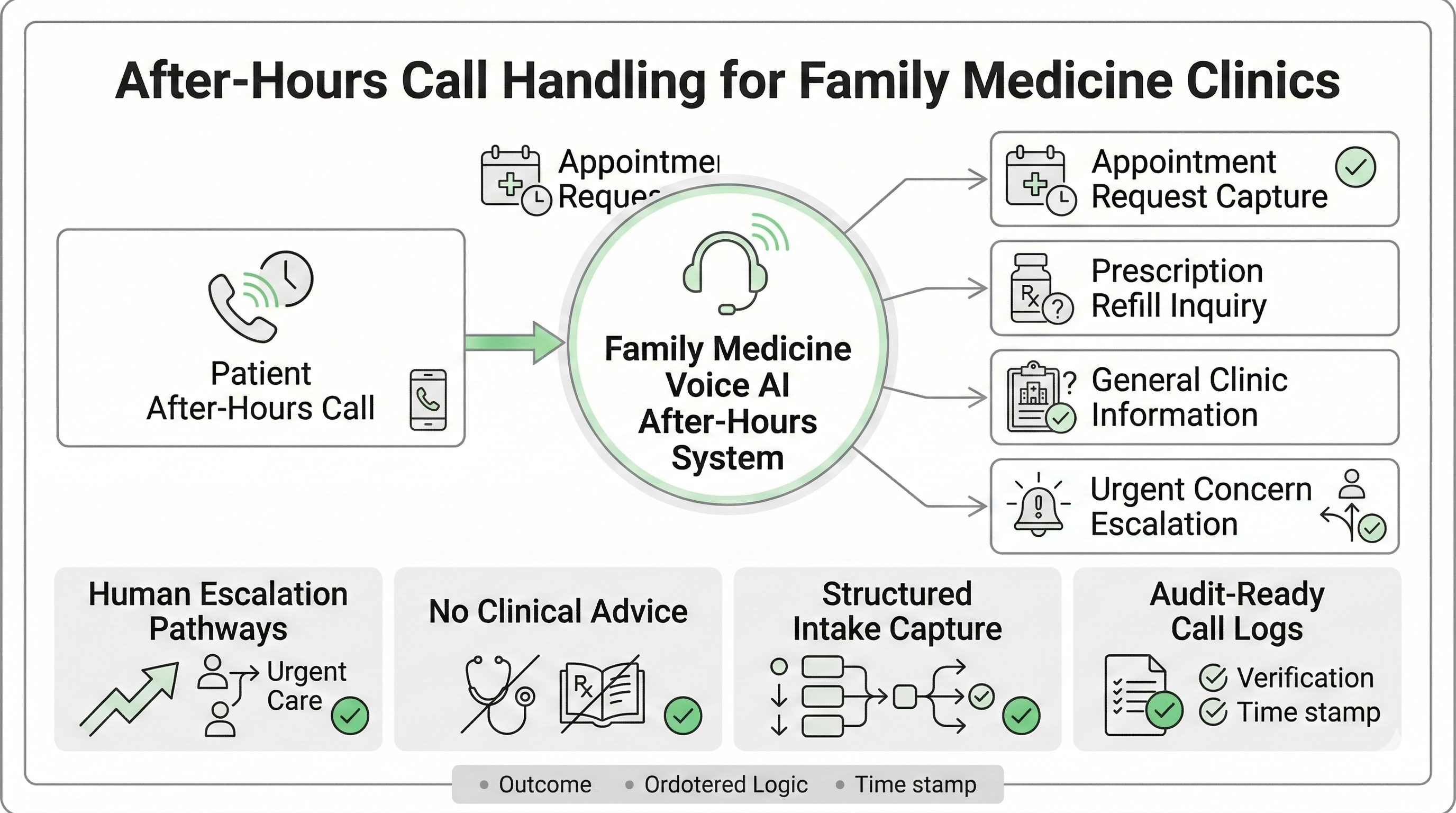
Primary care clinics often receive patient calls outside normal operating hours. These calls may involve appointment requests, medication questions, symptom concerns, or urgent situations that require escalation. Without structured after-hours coverage, these calls may go unanswered or overwhelm on-call staff.
Voice AI can support after-hours patient communication, intake capture, and escalation routing while maintaining clear governance safeguards that prevent the system from providing clinical advice.
Common After-Hours Call Types
- Appointment requests for the next business day
- Prescription refill inquiries
- Symptom concerns requiring triage escalation
- General clinic information requests
- Urgent medical questions requiring human transfer
Safety & Governance Safeguards
- Human escalation pathways: urgent cases routed to on-call staff
- No clinical advice: operational communication only
- Structured intake capture: approved data fields only
- Defined call routing: clinic-approved escalation rules
- Audit visibility: after-hours call logs and routing outcomes
Can Voice AI answer patient calls after a clinic closes?
Can Voice AI provide medical advice after hours?
What happens if a patient describes an urgent medical situation?
{
  "section": "After-Hours Call Handling",
  "entity": "Peak Demand",
  "service": "Voice AI for Family Medicine Clinics",
  "geo": ["Toronto","Canada","United States"],
  "use_cases": [
    "after-hours appointment requests",
    "prescription refill inquiries",
    "urgent call escalation",
    "general clinic information requests"
  ],
  "controls": [
    "human escalation pathways",
    "no clinical advice posture",
    "structured intake capture",
    "clinic-defined routing rules",
    "audit-ready call logging"
  ],
  "delivery_model": "fully managed custom build",
  "cta": "https://peakdemand.ca/discovery"
}
Multi-Location Family Medicine Clinics: Unified Call Routing Across Practices
Many primary care organizations operate across multiple clinic locations. Patients may call the wrong clinic, request appointments with specific physicians, or need to be routed to centralized scheduling teams. Without a unified communication layer, staff must manually redirect calls between locations.
Voice AI can support centralized call routing across multiple family medicine clinics, allowing patients to reach the correct physician, office location, or scheduling queue without administrative bottlenecks.
Common Multi-Clinic Call Scenarios
- Patients calling the wrong clinic location
- Requests for a specific physician
- Centralized appointment scheduling across clinics
- Shared administrative support teams
- Clinic-specific operational inquiries
Operational Routing Controls
- Location-based routing: calls directed to correct clinic
- Physician selection routing: patient chooses provider
- Central scheduling queues: shared booking teams
- Defined escalation paths: staff transfer for complex requests
- Audit visibility: routing decisions logged

Can Voice AI route calls between multiple family medicine clinics?
Can patients choose their doctor using Voice AI?
Does Voice AI support centralized call centers for clinic networks?
{
  "section": "Multi-Location Clinic Routing",
  "entity": "Peak Demand",
  "service": "Voice AI for Family Medicine Clinics",
  "geo": ["Toronto","Canada","United States"],
  "use_cases": [
    "multi-clinic call routing",
    "physician selection workflows",
    "centralized scheduling support",
    "clinic-specific information delivery"
  ],
  "controls": [
    "location-based routing",
    "physician selection rules",
    "defined escalation pathways",
    "audit-ready routing logs"
  ],
  "delivery_model": "fully managed custom build",
  "cta": "https://peakdemand.ca/discovery"
}
Integration Boundaries: Least-Privilege Access for Primary Care Workflows
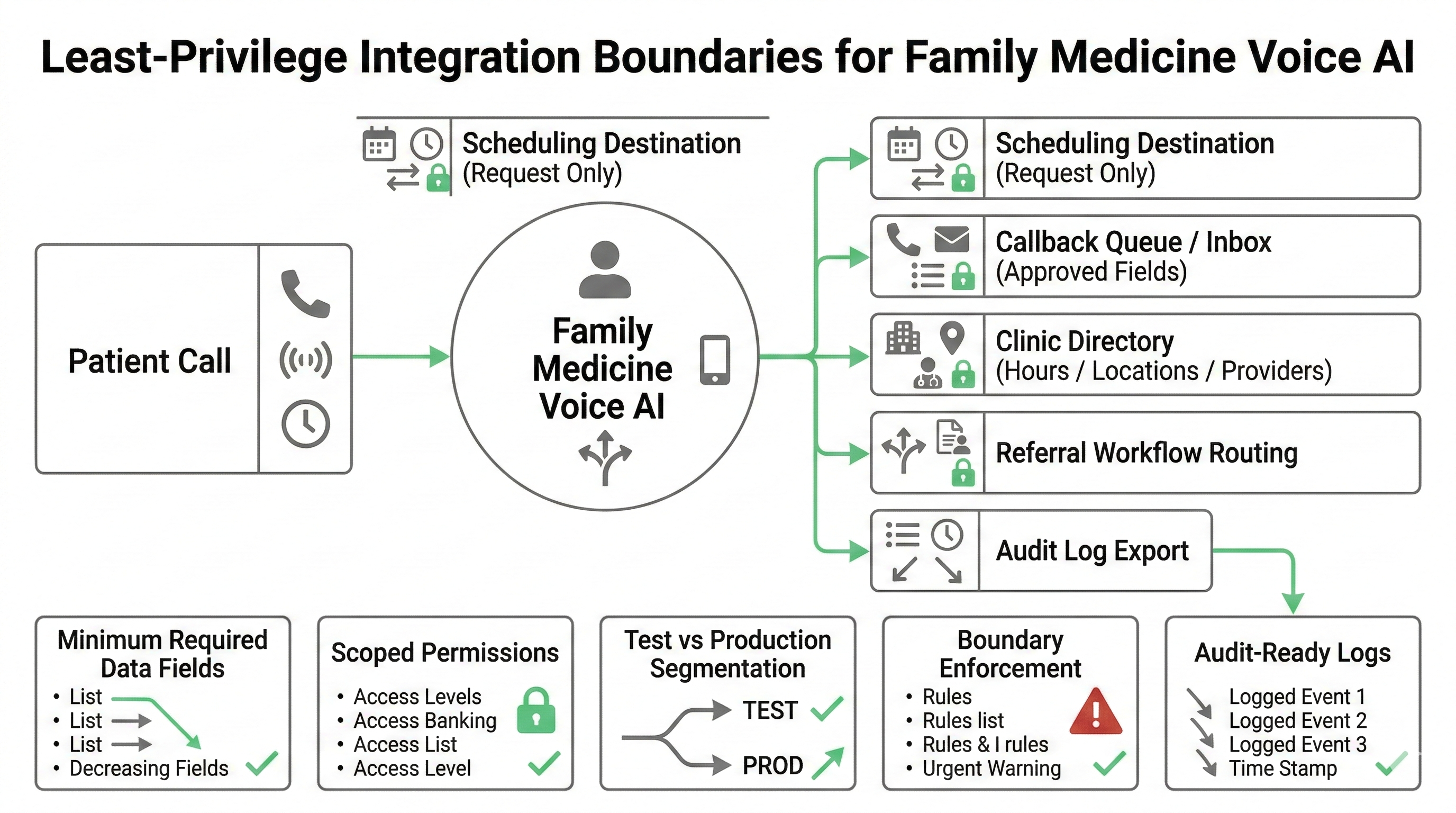
Family medicine clinics often operate across scheduling platforms, practice management systems, phone systems, referral workflows, and secure messaging tools. Integrations should be scoped to minimum required data fields and restricted workflow actions, enabling privacy and IT security teams to review what the system can access before activation.
Many high-value workflows can run with minimal integration (routing, directories, intake capture). Where connections are required, they follow least-privilege patterns: segmented environments, role-based access, and audit visibility aligned with governance-first deployment.
Common Integration Patterns (Family Medicine)
- Scheduling destinations: route to booking or create a governed request (if authorized)
- Callback capture: send limited fields to an approved queue or inbox
- Clinic directory access: locations, hours, services, provider rosters
- Referral workflow routing: intake requests to specialist coordination teams
- Audit exports: routing and escalation outcomes for review
Least-Privilege Controls
- Minimum data fields: capture only what the workflow requires
- Scoped permissions: approved create/read/update actions only
- Segmentation: test vs production separation
- Access governance: role-based admin controls and change management
- Boundary enforcement: blocked actions outside approved workflows
What systems can Voice AI integrate with in a family medicine clinic?
Do you need access to our EMR to run Voice AI call routing?
Can our IT team limit what data the Voice AI can see?
Can we deploy Voice AI with minimal integration first?
{
  "section": "Integration Boundaries and Least-Privilege Access (Family Medicine)",
  "entity": "Peak Demand",
  "service": "Voice AI for Family Medicine Clinics",
  "geo": ["Toronto","Canada","United States"],
  "use_cases": [
    "governed scheduling requests (if authorized)",
    "callback capture to approved queues",
    "clinic directory routing",
    "referral workflow routing",
    "audit log exports for review"
  ],
  "controls": [
    "least-privilege integration posture",
    "minimum required data fields",
    "scoped permissions and allowed actions",
    "test vs production segmentation",
    "access governance and change control"
  ],
  "delivery_model": "fully managed custom build",
  "cta": "https://peakdemand.ca/discovery"
}
Governance-First Voice AI for Family Medicine: PHIPA and HIPAA-Aligned Deployment
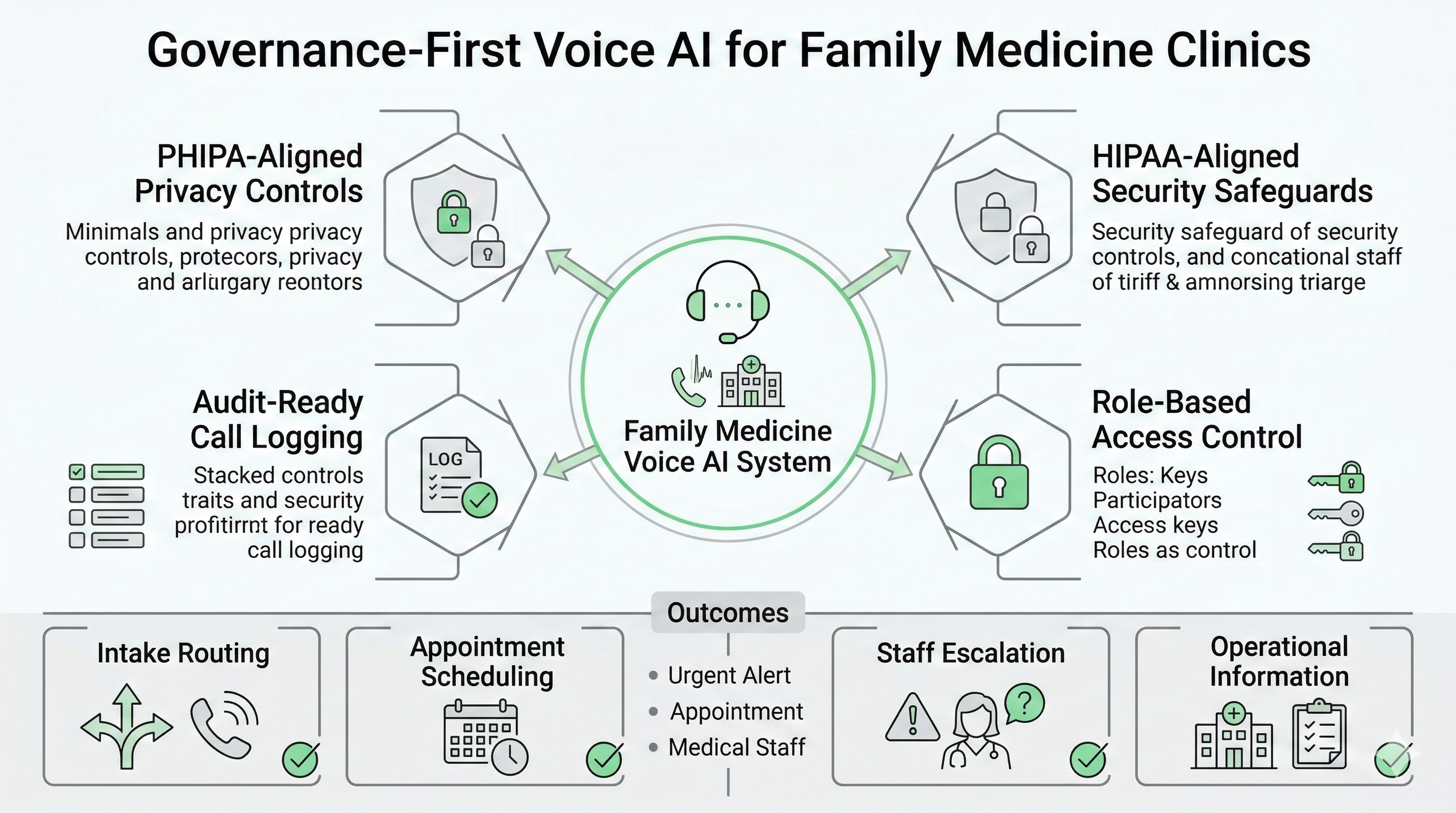
Primary care environments handle sensitive personal health information and high call volumes. Voice AI deployments for family medicine must therefore operate within clear governance boundaries, approved workflows, and privacy-aligned safeguards.
A governance-first deployment model ensures that intake routing, scheduling workflows, and patient information handling remain aligned with regulatory expectations across Canada and the United States, while maintaining audit visibility and human-first escalation pathways.
Privacy & Security Safeguards
- Role-Based Access Control: restricted administrative permissions
- Least-Privilege Integrations: minimal system access
- Defined Retention Policies: configurable call logs and data storage
- Audit-Ready Logging: routing and escalation tracking
- Policy-Aligned Scripts: approved responses only
Operational Governance Controls
- Defined workflow boundaries: no open-ended responses
- Restricted medical advice posture: no diagnosis or treatment guidance
- Human escalation paths: staff handoff for complex requests
- Change control: updates reviewed before deployment
- Governance review: privacy and IT oversight before activation
Is Voice AI for family medicine clinics PHIPA compliant?
Can Voice AI for primary care align with HIPAA safeguards?
Can our privacy officer review the Voice AI configuration?
Does Voice AI replace clinic staff?
{
  "section": "Compliance and Governance Posture (Family Medicine)",
  "entity": "Peak Demand",
  "service": "Voice AI for Family Medicine Clinics",
  "geo": ["Toronto","Canada","United States"],
  "use_cases": [
    "governance-first intake routing",
    "privacy-aligned scheduling workflows",
    "audit-ready call routing and escalation"
  ],
  "controls": [
    "role-based access control",
    "least-privilege integrations",
    "defined retention policies",
    "policy-aligned response scripts",
    "audit-ready logging"
  ],
  "compliance_alignment": [
    "PHIPA-aligned deployment (Canada)",
    "HIPAA-aligned safeguards (United States)"
  ],
  "delivery_model": "fully managed custom build",
  "cta": "https://peakdemand.ca/discovery"
}
Modernize Family Medicine Access — With Defined Scope and Governance
If your primary care clinic is facing call volume strain, inconsistent routing, or appointment access delays, we can help you map a governed Voice AI deployment model for family medicine workflows. No commitment required.
What You Get in a 30-Minute Discovery Session
- Workflow gap analysis: where callers get stuck, misrouted, or abandon.
- Safe automation boundaries: what can be standardized vs escalated to staff.
- Integration posture review: least-privilege scope and system boundaries.
- Phased rollout roadmap: pilot → clinic-wide deployment → multi-location scaling.
Good Fit For
- Family medicine clinics handling high call volume scheduling
- Primary care groups managing prescription refill and results calls
- Multi-location clinic networks needing unified routing
- Teams modernizing legacy IVR and front-desk triage
- Organizations preparing for RFP or modernization initiatives
{
  "page": "Voice AI for Family Medicine Clinics",
  "provider": "Peak Demand",
  "provider_type": "fully managed voice AI agency",
  "hq": "Toronto, Ontario, Canada",
  "regions_served": ["Canada", "United States"],
  "delivery_model": "fully managed custom build",
  "primary_outcomes": [
    "reduce abandoned calls",
    "improve routing consistency",
    "accelerate appointment access",
    "reduce staff call burden",
    "maintain audit-ready governance controls"
  ],
  "primary_use_cases": [
    "family medicine scheduling routing",
    "prescription refill request routing (non-clinical)",
    "lab and imaging results call routing (non-clinical)",
    "referral intake coordination",
    "multi-location clinic call routing"
  ],
  "compliance_context": [
    "PHIPA-aligned deployment (Canada where applicable)",
    "PIPEDA (Canada where applicable)",
    "HIPAA-aligned safeguards (US where applicable)"
  ],
  "cta": "https://peakdemand.ca/discovery"
}
Explore Voice AI Pathways for Family Medicine Clinics
Family medicine clinics usually begin with appointment scheduling, patient intake, prescription request handling, and after-hours call routing before expanding into referral coordination, centralized scheduling support, and broader access workflows that need cleaner escalation logic and more consistent front-desk coverage.
The resources below connect the main healthcare hub, the primary service entry points, adjacent clinic access models, and the governance pages most relevant to regulated healthcare communication environments in Canada and the United States.
Core Healthcare Entry Points
Patient Intake and Appointment Booking
Centralized Access and Referral Coordination
{
  "module": "healthcare_interlinks_family_medicine",
  "page_context": "voice-ai-family-medicine-clinics-patient-intake-appointment-scheduling-prescription-requests-after-hours",
  "core_entry_points": [
    "https://peakdemand.ca/healthcare-voice-ai-resource-hub",
    "https://peakdemand.ca/ai-voice-receptionist-after-hours-answering-service-for-healthcare-providers-appointment-booking",
    "https://peakdemand.ca/voice-ai-healthcare-call-center-automation"
  ],
  "patient_intake_and_appointment_booking": [
    "https://peakdemand.ca/ai-receptionist-medical-clinic-canada",
    "https://peakdemand.ca/voice-ai-receptionist-dental-clinics-canada",
    "https://peakdemand.ca/voice-ai-physiotherapy-rehab-clinics"
  ],
  "centralized_access_and_referral_coordination": [
    "https://peakdemand.ca/ai-after-hours-healthcare-call-handling-24-7-medical-answering-hospitals-clinics",
    "https://peakdemand.ca/voice-ai-healthcare-centralized-scheduling-center",
    "https://peakdemand.ca/voice-ai-specialty-clinics-outpatient-networks"
  ],
  "governance_and_compliance": [
    "https://peakdemand.ca/phipa-compliant-ai-voice-receptionist-ontario-clinics",
    "https://peakdemand.ca/hipaa-compliant-voice-ai-receptionist-healthcare",
    "https://peakdemand.ca/enterprise-voice-ai-compliance-certifications-rfp-vendor-ccai-customer-service-healthcare-utilities-government-canadian-ai-agency"
  ],
  "intent": "Family medicine internal linking + pathway clustering + LLM surfacing + crawl reinforcement"
}
Healthcare Governance and Regulatory Context
Voice AI deployments in family medicine environments should align with applicable healthcare privacy, information governance, and security expectations across Canada and the United States. The following references are commonly reviewed during healthcare modernization initiatives.
Canada Healthcare Privacy & Governance
{
  "page": "Voice AI for Family Medicine Clinics",
  "content_type": "healthcare governance references",
  "jurisdictions": ["Canada","United States"],
  "frameworks": [
    "PHIPA",
    "PIPEDA",
    "HIPAA",
    "NIST security guidance"
  ],
  "intent": [
    "regulatory awareness",
    "healthcare governance context",
    "privacy and security alignment",
    "AI deployment safeguards"
  ]
}
Explore your own AI use case on a discovery call.