
Voice AI for Law Firms: AI Receptionist, Legal Intake Automation, Consultation Scheduling, and After-Hours Call Handling

Law firms often depend on fast, reliable first contact to turn inbound inquiries into booked consultations, qualified next steps, and timely staff follow-up. In many practice areas, a missed call does not just create a communication gap. It can mean a lost intake opportunity, delayed response to a time-sensitive matter, or a prospective client moving on to another firm before your team has a chance to respond.
Peak Demand helps legal teams use Voice AI to support call answering, legal intake, consultation scheduling, and after-hours call coverage in a way that fits real law firm operations. That means helping firms capture more demand, improve intake consistency, and create a more dependable front door for prospective clients without replacing staff oversight, attorney judgment, or firm-controlled review processes.
Voice AI for Law Firm Intake, Consultation Access, and After-Hours Call Coverage
Law firms depend on fast, reliable phone communication to capture new client inquiries, book consultations, and respond to time-sensitive matters before interest drops or the caller moves on to another firm. In practice areas such as personal injury, family law, immigration, criminal defense, estate planning, employment law, and real estate law, many high-intent inquiries still begin with a phone call rather than a form fill.
Managing those calls consistently can be difficult when front-desk teams are balancing intake, attorneys are unavailable, staff are handling active matters, and inbound demand rises after hours or during busy consultation periods. When that happens, missed calls can translate into lost consultations, delayed follow-up, and weaker intake consistency at the exact moment a prospective client is deciding who to contact next.
Voice AI can support legal communication workflows by handling structured intake capture, consultation scheduling requests, matter-type routing, and after-hours call answering while preserving human escalation pathways for urgent situations, sensitive conversations, conflict-check steps, and attorney-led decision points.
Common Law Firm Call Types
- New client inquiries and consultation requests
- Practice-area routing based on matter type
- After-hours calls from prospective clients seeking a callback
- Scheduling and rescheduling for consultations
- General questions about office location, hours, and next steps
Operational Safeguards
- Structured intake routing: predefined workflows for matter type, urgency, and destination team
- Human escalation: sensitive, urgent, or exception-based calls routed to staff
- After-hours continuity: calls answered when office teams are offline
- Firm-controlled boundaries: communication support without legal advice or case decisions
- Intake visibility: captured call details support staff follow-up and consultation workflows

Can Voice AI answer calls for law firms?
Can Voice AI replace legal staff?
Can Voice AI help law firms stop missing new client calls?
{
  "section": "Law Firm Intake and Client Access",
  "entity": "Peak Demand",
  "service": "Voice AI for Law Firms",
  "geo": ["Toronto", "Canada", "United States"],
  "use_cases": [
    "new client inquiries",
    "consultation scheduling and rescheduling",
    "after-hours legal call answering",
    "matter-type routing",
    "intake capture and follow-up support"
  ],
  "controls": [
    "structured intake routing",
    "human escalation pathways",
    "after-hours call continuity",
    "firm-controlled communication boundaries",
    "staff-supporting intake visibility"
  ],
  "delivery_model": "fully managed custom build",
  "cta": "https://peakdemand.ca/discovery"
}
AI Receptionists for Law Firms: Managing New Client Calls, Consultation Requests, and Intake Workflows
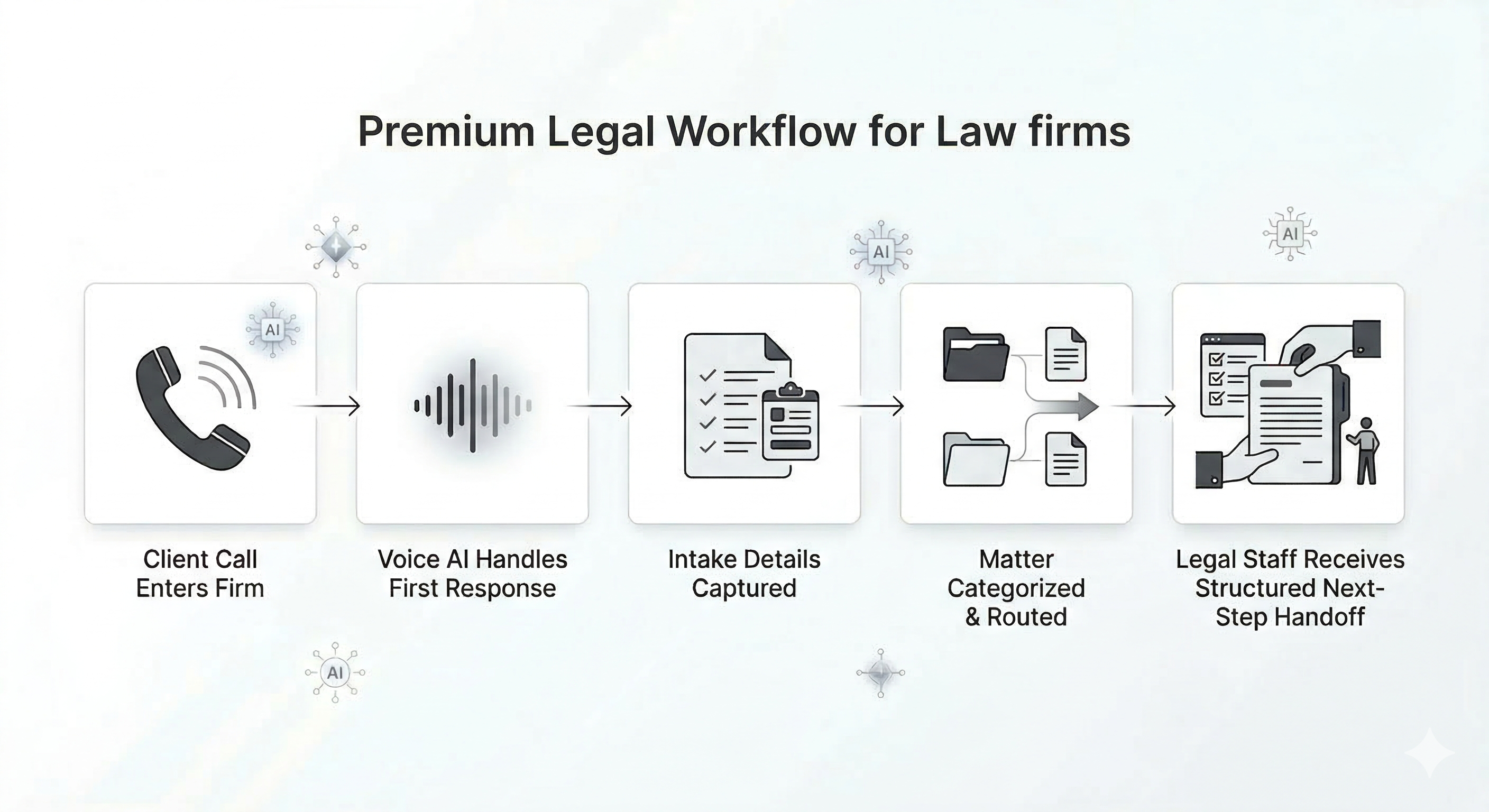
Many law firms first evaluate Voice AI through the lens of an AI receptionist because the most immediate operational problem is simple: someone needs to answer the phone consistently when prospective clients call. That matters even more in legal because many inbound calls come from people dealing with stressful, urgent, or highly personal situations where delayed response can reduce trust and lower the chance of securing the consultation.
Voice AI receptionists can support legal communication by handling inbound call answering, initial intake capture, consultation request collection, basic firm information, and structured call routing while escalating sensitive, urgent, or exception-based situations to human staff. For firms balancing front-desk workload, attorney availability, and uneven inbound demand throughout the day, this helps create a more dependable first-contact layer without changing who controls legal judgment.
This is especially useful for firms that experience after-hours inquiries, lunch-hour call spikes, staff bandwidth constraints, or recurring intake bottlenecks across multiple practice areas. An AI receptionist can help ensure that new client calls are acknowledged, details are captured consistently, and the next step in the intake process is not left to voicemail alone.
Common AI Receptionist Tasks for Law Firms
- Answer new client calls during and after business hours
- Capture contact details and basic matter-type information
- Collect consultation request information for staff follow-up
- Provide firm-approved information about hours, location, and next steps
- Route urgent or practice-specific inquiries to the right team
Operational Controls and Escalation Safeguards
- Structured intake workflows: predefined question paths for matter type, urgency, and consultation handling
- Human escalation: sensitive, urgent, or exception-based calls routed to staff
- Firm-controlled messaging: approved communication boundaries and response rules
- After-hours continuity: calls answered when office teams are unavailable
- Intake visibility: captured summaries support staff review and follow-up workflows
Can AI answer calls for law firms?
Can an AI receptionist help law firms with consultation requests?
Will an AI receptionist replace legal staff?
{
  "section": "AI Receptionists for Law Firms",
  "entity": "Peak Demand",
  "service": "Voice AI receptionist for law firms",
  "audience": [
    "law firms",
    "legal intake teams",
    "firm administrators",
    "attorneys",
    "law office staff"
  ],
  "use_cases": [
    "new client call answering",
    "consultation request capture",
    "basic intake information collection",
    "firm information responses",
    "practice-area routing and escalation"
  ],
  "controls": [
    "structured intake workflows",
    "human escalation pathways",
    "firm-controlled messaging boundaries",
    "after-hours call continuity",
    "intake summaries for staff review"
  ],
  "delivery_model": "fully managed custom build",
  "cta": "https://peakdemand.ca/discovery"
}
Consultation Scheduling for Law Firms: Turning Inbound Interest Into Booked Next Steps
For many law firms, the consultation is the most important conversion point in the intake process. A prospective client may be ready to move forward, but if scheduling feels slow, unclear, or inconsistent, that momentum can disappear quickly. This becomes even more important when inbound demand rises after hours, during lunch-hour call spikes, or when staff are balancing active matters and new inquiries at the same time.
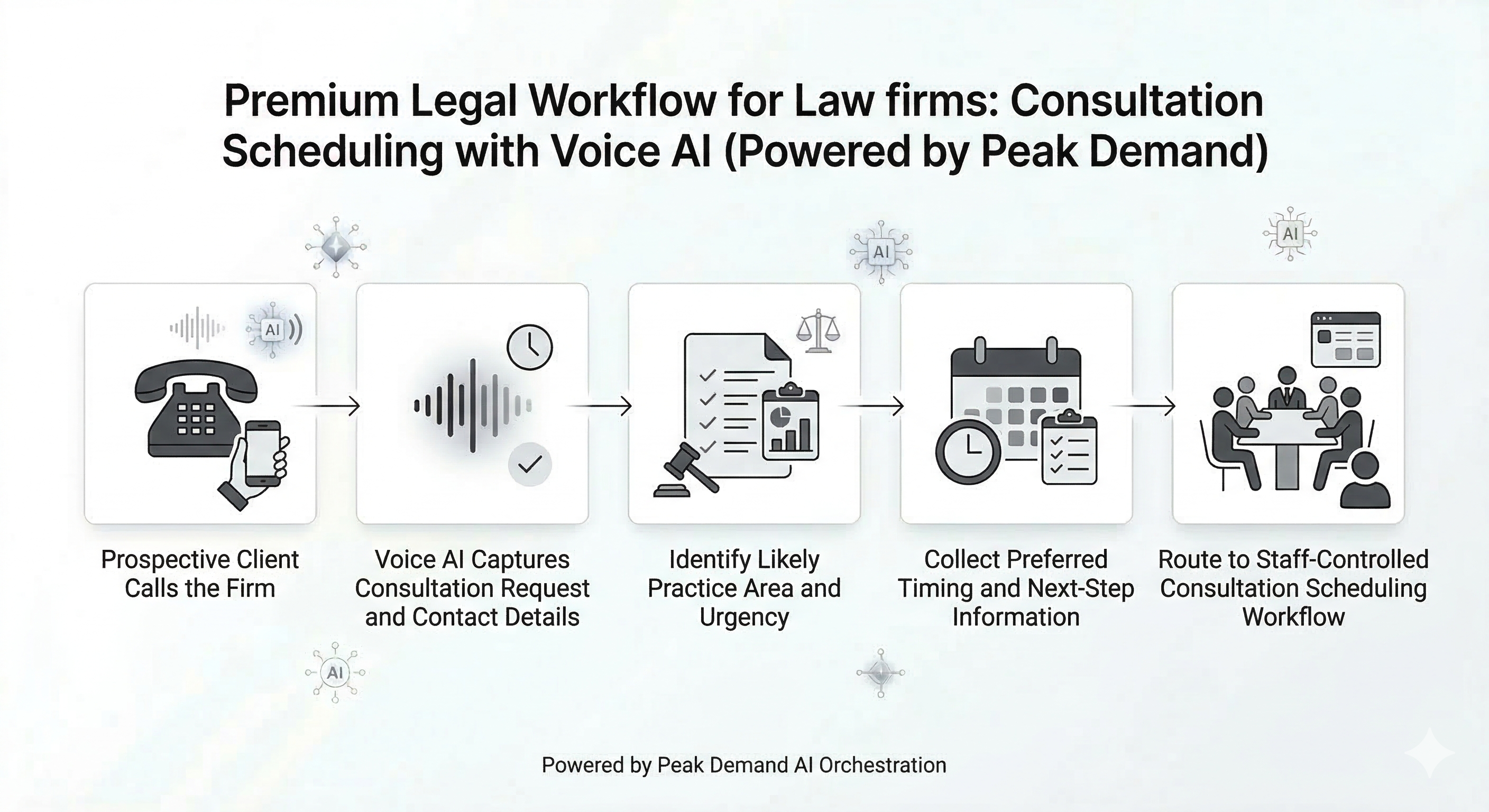
Voice AI can support consultation scheduling by helping capture the information needed to move a caller toward the right next step, including contact details, likely practice area, urgency, and preferred timing. For firms with consultation-heavy workflows, that creates a more dependable path from first call to scheduled follow-up without requiring every inbound inquiry to be answered live by staff in the moment.
The value here is operational continuity. Voice AI can help law firms capture consultation intent, reduce friction in early scheduling workflows, and support coordination across attorneys, intake teams, and office locations while keeping firm-controlled review points in place. It should not be positioned as making representation decisions or evaluating legal merit. Its role is to help firms convert qualified inbound interest into clearer, faster next steps.
Common Consultation Scheduling Tasks
- Capture consultation requests from new inbound callers
- Collect preferred timing and contact details for follow-up
- Identify likely practice area before routing the request
- Support scheduling intake during busy or after-hours periods
- Route requests into staff-controlled booking workflows
Scheduling Workflow Safeguards
- Firm-controlled scheduling rules: booking logic follows availability, intake requirements, and review needs set by the firm
- Practice-area routing: consultation requests directed to the right team or attorney workflow
- Human review points: sensitive or unclear matters can be reviewed before confirmation
- After-hours continuity: consultation intent is captured even when staff are offline
- Consistent intake records: summaries support staff follow-up and reduce handoff friction
Can Voice AI help law firms schedule consultations?
Can Voice AI book consultations automatically?
Why does consultation scheduling matter so much for law firms?
{
  "section": "Consultation Scheduling for Law Firms",
  "entity": "Peak Demand",
  "service": "Voice AI for law firm consultation scheduling",
  "audience": [
    "law firms",
    "legal intake teams",
    "firm administrators",
    "attorneys",
    "law office staff"
  ],
  "use_cases": [
    "consultation request capture",
    "preferred time collection",
    "practice-area identification",
    "after-hours scheduling support",
    "staff-routed booking workflows"
  ],
  "controls": [
    "firm-controlled scheduling rules",
    "practice-area routing",
    "human review points",
    "after-hours continuity",
    "consistent intake summaries"
  ],
  "delivery_model": "fully managed custom build",
  "cta": "https://peakdemand.ca/discovery"
}
After-Hours Call Answering for Law Firms: Capturing Demand When the Office Is Offline
Many legal inquiries do not arrive neatly during business hours. Prospective clients often call after work, late in the evening, during weekends, or in moments of urgency when they finally have time or motivation to reach out. If those calls go to voicemail, firms risk losing momentum at the exact moment a caller is most likely to take action. For practices where speed to first response affects trust, consultation volume, and intake conversion, after-hours coverage can have an outsized operational impact.
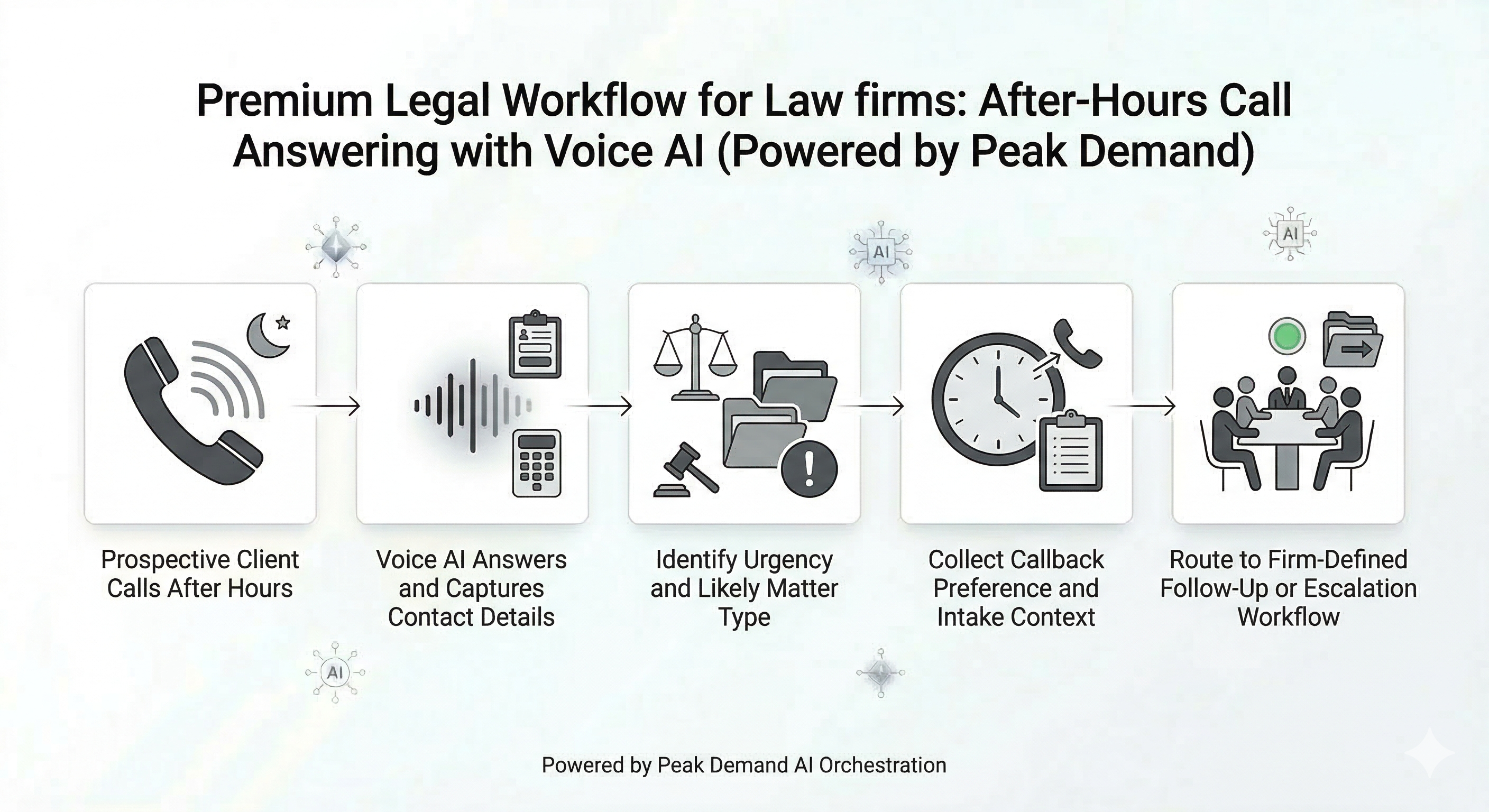
Voice AI can support after-hours call answering by responding to inbound inquiries, capturing contact details, collecting basic matter context, and routing the call or follow-up request according to firm-defined rules. That allows law firms to extend responsiveness beyond normal office coverage without asking attorneys or staff to remain constantly available. Instead of treating after-hours calls as missed opportunities, firms can create a more dependable intake layer that continues working when the front desk is offline.
This matters especially for practice areas that see emotionally charged or time-sensitive inbound calls, but it is also valuable for any firm that wants better consistency at the top of the funnel. The goal is not to provide legal advice or make representation decisions after hours. The goal is to capture intent, preserve the opportunity, and move the inquiry into a structured next-step workflow for staff review once the team is back online.
Common After-Hours Call Tasks
- Answer new client calls outside normal office hours
- Capture contact details and basic inquiry information
- Identify urgency and likely practice area
- Record callback preferences and next-step needs
- Route urgent situations based on firm-defined escalation paths
After-Hours Workflow Safeguards
- Firm-defined escalation rules: urgent or exceptional situations follow approved routing logic
- Structured intake capture: after-hours inquiries are logged consistently for staff follow-up
- Human review boundaries: sensitive matters remain subject to staff or attorney judgment
- Continuity outside office hours: inbound demand is acknowledged instead of pushed to voicemail only
- Clear next-step handoff: summaries support faster response once the office reopens
Can Voice AI answer calls for law firms after hours?
Why do after-hours calls matter for law firms?
Can Voice AI handle urgent legal calls at night or on weekends?
{
  "section": "After-Hours Call Answering for Law Firms",
  "entity": "Peak Demand",
  "service": "Voice AI for after-hours legal call answering",
  "audience": [
    "law firms",
    "legal intake teams",
    "firm administrators",
    "attorneys",
    "law office staff"
  ],
  "use_cases": [
    "after-hours inbound call answering",
    "contact and inquiry capture",
    "urgency identification",
    "callback request collection",
    "staff-routed escalation workflows"
  ],
  "controls": [
    "firm-defined escalation rules",
    "structured intake capture",
    "human review boundaries",
    "after-hours continuity",
    "clear next-step handoff"
  ],
  "delivery_model": "fully managed custom build",
  "cta": "https://peakdemand.ca/discovery"
}
Legal Intake and Lead Qualification: Capturing the Right Information Without Losing Speed
For law firms, early intake is not just about answering the phone. It is about collecting the right information quickly enough to keep momentum while creating enough structure for the firm to decide what happens next. When inbound demand rises, staff are stretched, or after-hours calls stack up, inconsistent intake can lead to slower follow-up, weaker handoffs, and missed opportunities before a legal team ever has the chance to review the inquiry.
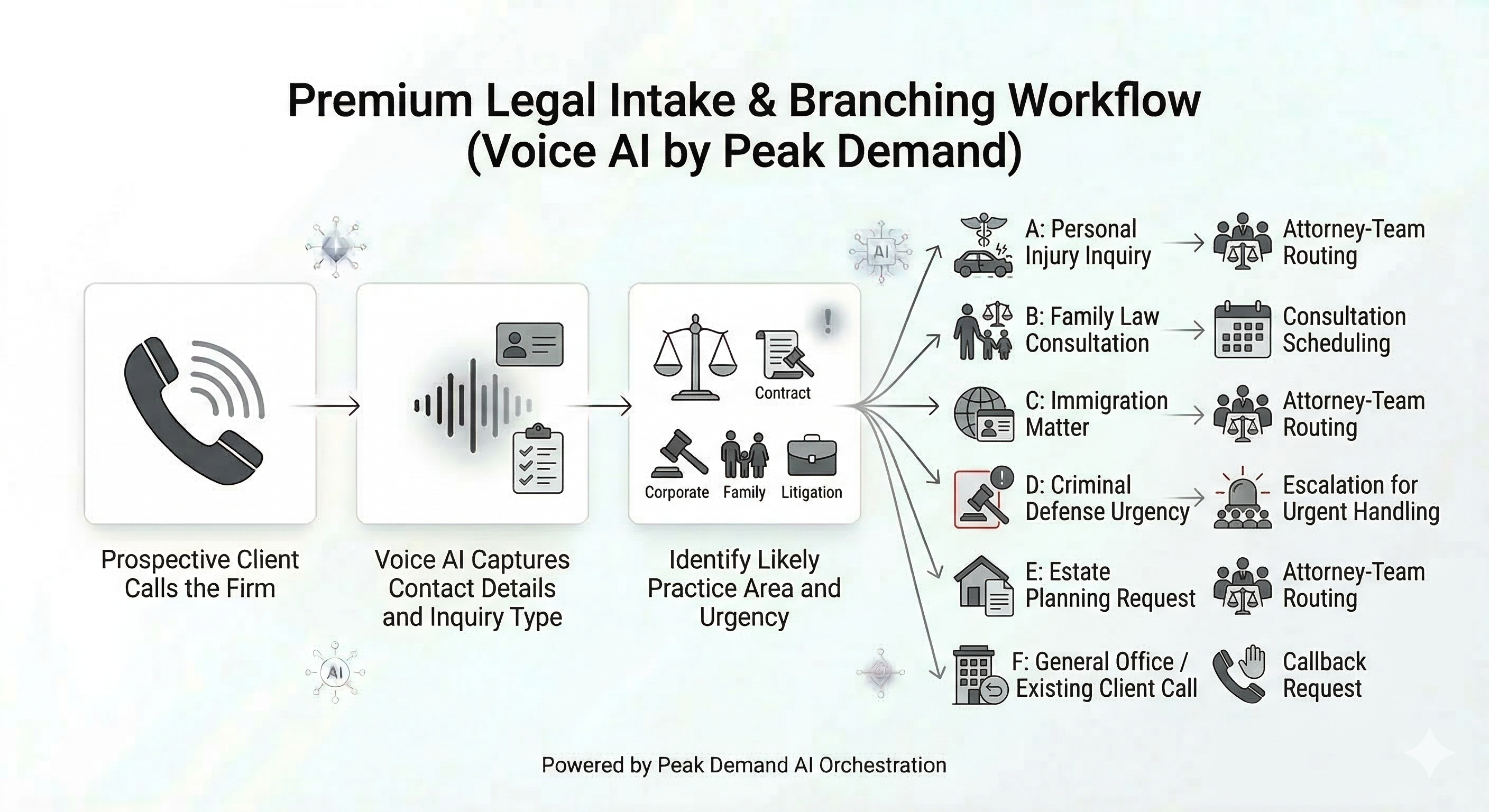
Voice AI can support legal intake by capturing core details such as contact information, practice area, urgency, consultation intent, and other firm-defined intake fields in a consistent sequence. That helps create a cleaner first-step workflow for law firms that want more dependable intake coverage without forcing every caller into the same rigid script or leaving important details to voicemail alone. For firms handling multiple practice areas or a steady flow of new inquiries, this consistency can improve both speed and internal coordination.
The right positioning here matters. Voice AI can help law firms support structured intake, gather qualification inputs, and route inquiries for staff review, but it should not be framed as making legal judgments, deciding whether someone has a valid case, or determining representation. Its role is operational: capture the information the firm needs, preserve the opportunity, and hand it off in a more usable format for the legal team.
Common Intake and Qualification Tasks
- Capture caller name, contact details, and preferred callback information
- Identify likely practice area or inquiry category
- Collect basic intake details using firm-defined question paths
- Record urgency, timing, and consultation intent
- Route inquiries into staff review or next-step workflows
Qualification Workflow Safeguards
- Firm-defined intake logic: question paths follow approved workflows for the practice
- Human review boundaries: staff and attorneys remain responsible for judgment and representation decisions
- Consistent data capture: summaries support cleaner follow-up and reduced handoff friction
- Practice-area routing: inquiries can be directed to the right intake team or workflow
- After-hours continuity: qualification inputs can still be captured when the office is offline
Can Voice AI help law firms with legal intake?
Can Voice AI qualify legal leads?
Why does structured intake matter for law firms?
{
  "section": "Legal Intake and Lead Qualification",
  "entity": "Peak Demand",
  "service": "Voice AI for legal intake and lead qualification",
  "audience": [
    "law firms",
    "legal intake teams",
    "firm administrators",
    "attorneys",
    "law office staff"
  ],
  "use_cases": [
    "caller information capture",
    "practice-area identification",
    "structured intake collection",
    "urgency and consultation intent capture",
    "staff-routed review workflows"
  ],
  "controls": [
    "firm-defined intake logic",
    "human review boundaries",
    "consistent data capture",
    "practice-area routing",
    "after-hours continuity"
  ],
  "delivery_model": "fully managed custom build",
  "cta": "https://peakdemand.ca/discovery"
}
Practice-Area Routing and Staff Coordination for Law Firms: Getting Inquiries to the Right Next Step
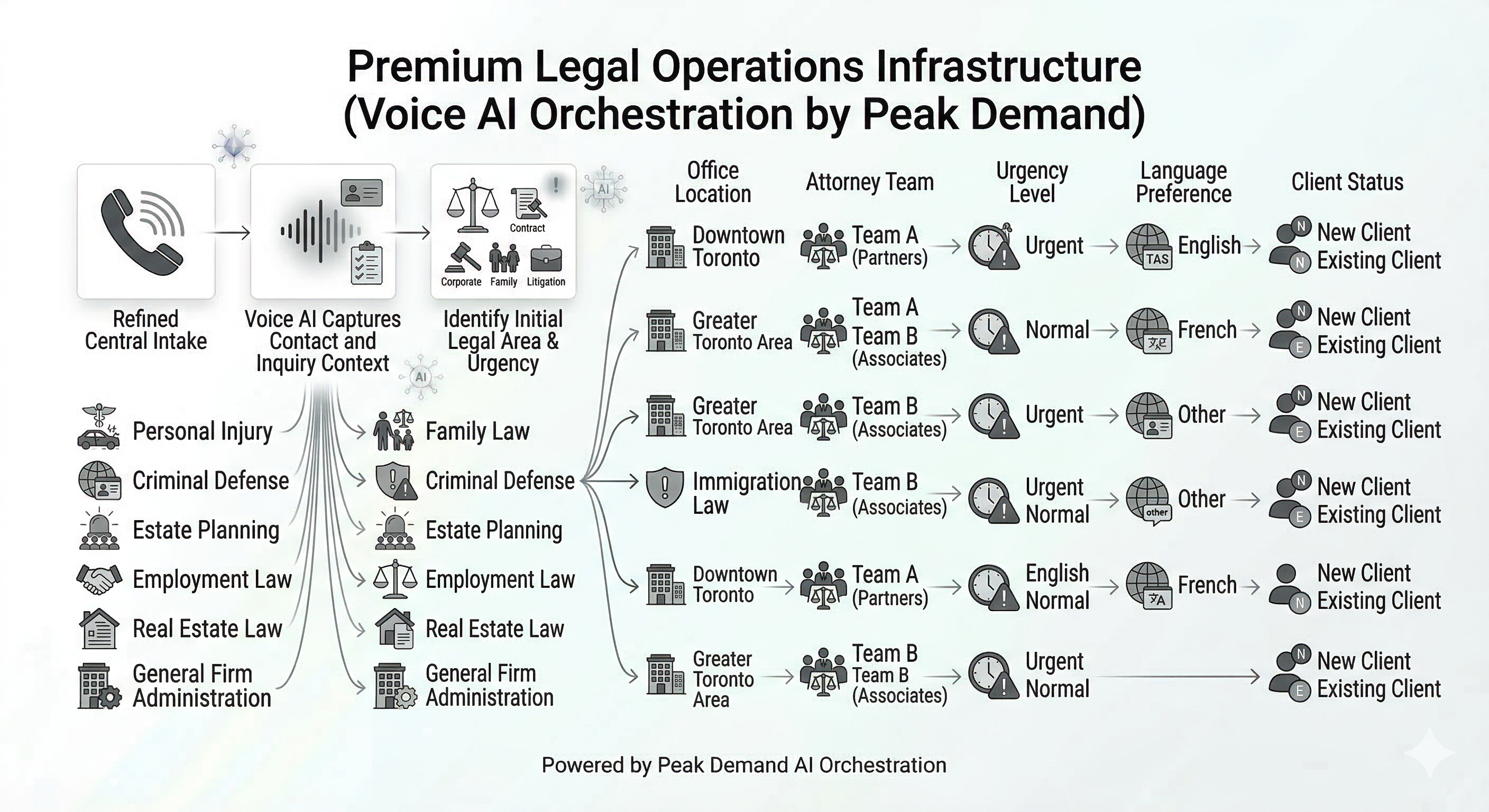
Many law firms do not have just one intake path. Calls may need to be routed by practice area, office location, attorney availability, language preference, urgency, or whether the inquiry is a new consultation request versus an existing client matter. When that routing depends entirely on whoever happens to answer the phone, handoffs can become inconsistent, slower, and more difficult to manage during busy intake periods or after-hours call spikes.
Voice AI can support practice-area routing and staff coordination by helping identify the likely destination for an inquiry before it reaches the next step in the workflow. That may include recognizing whether a call belongs in personal injury, family law, immigration, criminal defense, estate planning, employment law, or another intake path defined by the firm. It can also help separate consultation-driven inquiries from general office questions or matters that need staff review before any scheduling decision is made.
The operational value is clarity. Voice AI can help law firms capture enough structured information to route the call more accurately, reduce front-desk friction, and support cleaner handoffs between intake, attorneys, and administrative staff. That does not remove human oversight. It helps the firm create a more organized first-response layer so the right people get the right inquiry faster.
Common Routing and Coordination Tasks
- Identify likely practice area before staff handoff
- Separate new client inquiries from existing client or administrative calls
- Route calls by office, team, attorney workflow, or intake destination
- Capture language preference or urgency before escalation
- Support cleaner handoff notes for staff follow-up
Routing Workflow Safeguards
- Firm-defined routing logic: call paths reflect the firm’s actual intake structure and escalation rules
- Human override and review: staff remain able to review, redirect, or escalate exception-based inquiries
- Practice-area separation: inquiries can be sorted before they reach the wrong workflow
- Multi-office support: routing can reflect location, coverage, or team structure
- Consistent handoff capture: staff receive more usable context when they take over
Can Voice AI route law firm calls by practice area?
Can Voice AI help law firms with multi-office or multi-team routing?
Why does call routing matter so much for legal intake?
{
  "section": "Practice-Area Routing and Staff Coordination",
  "entity": "Peak Demand",
  "service": "Voice AI for law firm routing and coordination",
  "audience": [
    "law firms",
    "legal intake teams",
    "firm administrators",
    "attorneys",
    "law office staff"
  ],
  "use_cases": [
    "practice-area identification",
    "new client vs existing client separation",
    "office and team routing",
    "language and urgency capture",
    "structured handoff support"
  ],
  "controls": [
    "firm-defined routing logic",
    "human override and review",
    "practice-area separation",
    "multi-office support",
    "consistent handoff capture"
  ],
  "delivery_model": "fully managed custom build",
  "cta": "https://peakdemand.ca/discovery"
}
Business Impact for Law Firms: Better Call Coverage, Cleaner Intake, and More Consistent Follow-Through
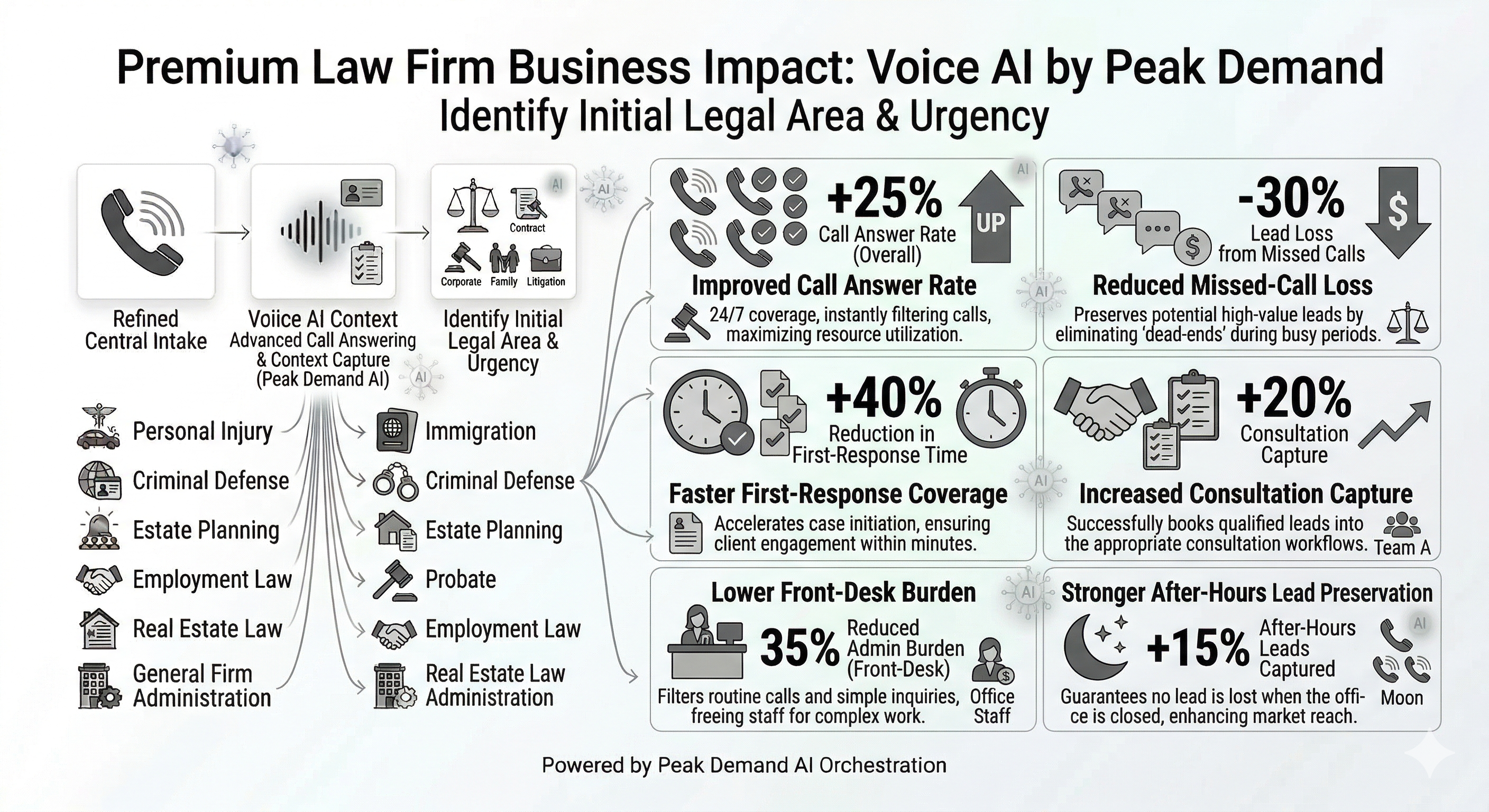
For law firms, the value of Voice AI is not just that more calls get answered. The deeper value is that more inquiries are captured in a usable way, more consultation opportunities stay alive, and intake workflows become more consistent across busy periods, after-hours windows, and multi-practice environments. When first response becomes more dependable, firms can reduce the operational friction that causes promising inbound demand to fall through the cracks.
That business impact shows up in practical ways: fewer missed opportunities from unanswered calls, better intake continuity when staff are overloaded, more structured handoffs for legal teams, and less front-desk strain during periods of uneven demand. For firms that rely on consultations, time-sensitive inquiries, or high call volume across multiple practice areas, stronger first-contact systems can support both client experience and internal efficiency at the same time.
The point is not to automate legal judgment. It is to improve the operational layer around intake so the firm can respond more reliably, review inquiries with better context, and move qualified opportunities forward with fewer delays. Voice AI works best when it helps law firms protect demand, improve response consistency, and create more polished intake operations without adding dashboard burden or extra operational overhead for the legal team.
Where Business Impact Shows Up
- Fewer new client inquiries lost to missed calls or voicemail
- More consistent intake coverage during busy and after-hours periods
- Cleaner consultation handoffs and follow-up workflows
- Reduced administrative strain on front-desk and intake staff
- Stronger first-contact experience for prospective clients
What Better Intake Operations Support
- Response consistency: inbound demand is acknowledged more reliably
- Intake visibility: staff receive better context for review and follow-up
- Operational continuity: workflows hold together during peak demand and coverage gaps
- Consultation preservation: qualified opportunities are less likely to stall early
- Professional client experience: the firm presents a more responsive front door
What kind of business impact can Voice AI have for law firms?
Does Voice AI mainly help with efficiency or growth?
Why does response consistency matter so much for law firms?
{
  "section": "Business Impact for Law Firms",
  "entity": "Peak Demand",
  "service": "Voice AI for law firm intake operations",
  "audience": [
    "law firms",
    "legal intake teams",
    "firm administrators",
    "attorneys",
    "law office staff"
  ],
  "outcomes": [
    "better call coverage",
    "cleaner intake continuity",
    "reduced missed opportunities",
    "stronger consultation follow-through",
    "less front-desk strain"
  ],
  "operational_effects": [
    "response consistency",
    "intake visibility",
    "operational continuity",
    "consultation preservation",
    "professional client experience"
  ],
  "delivery_model": "fully managed custom build",
  "cta": "https://peakdemand.ca/discovery"
}
Voice AI Across Legal Practice Areas: Different Intake Patterns, Different Operational Needs
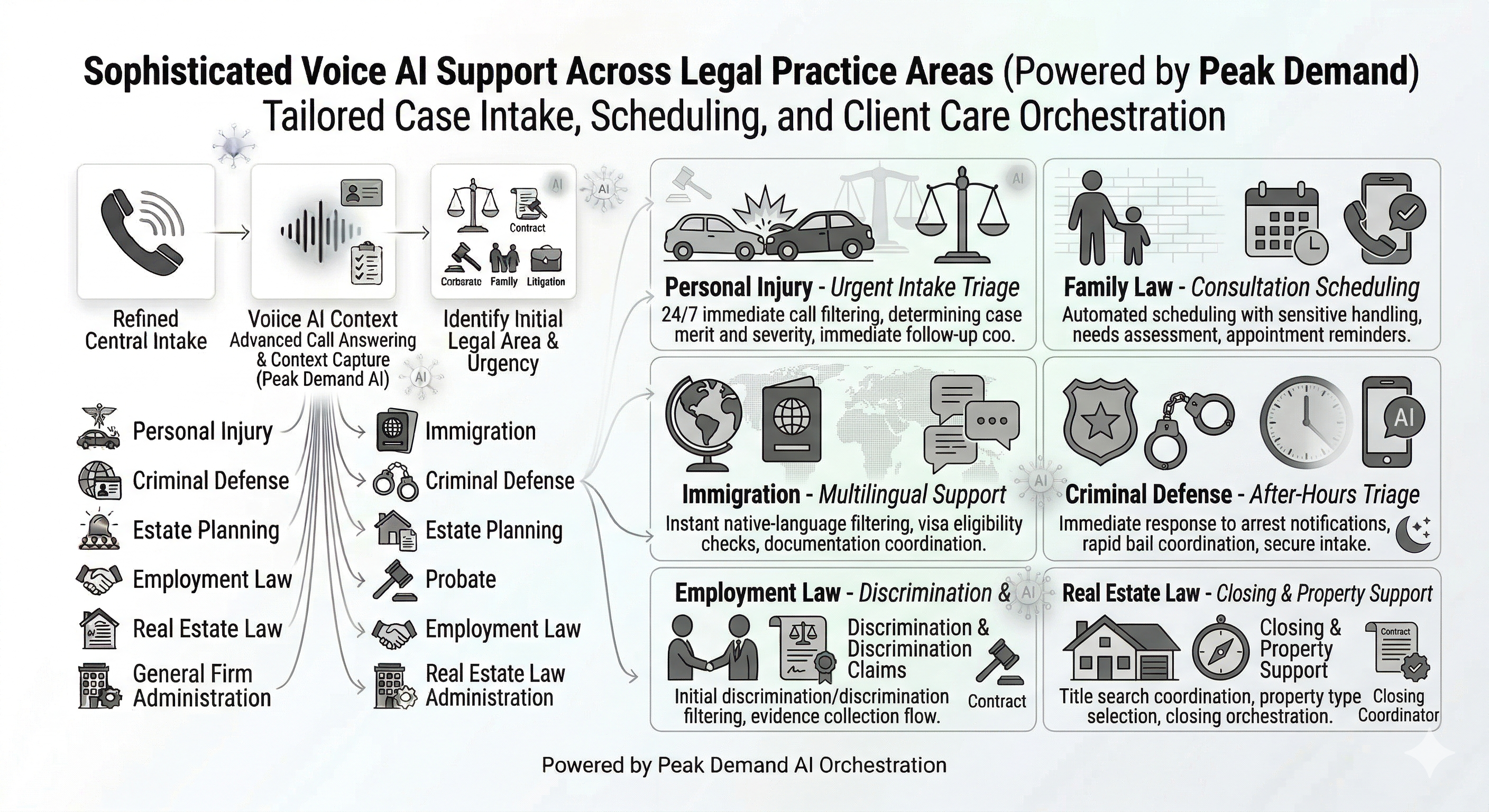
Not every law firm handles inbound demand the same way. The reason Voice AI works well in legal is not just that firms receive calls — it is that different practice areas create different intake pressures, urgency levels, scheduling patterns, and communication expectations. A personal injury inquiry, a family law consultation request, an immigration call, and an estate planning intake all require different first-step workflows even if they begin with the same basic phone interaction.
That is why Voice AI for law firms should be thought of as a flexible intake and communication layer rather than a one-size-fits-all answering tool. Some firms need stronger after-hours response. Some need better consultation scheduling. Some need multilingual intake, cleaner routing, or more consistent new client qualification. The operational design should reflect the practice, not force every caller through the same generic path.
Peak Demand helps law firms shape Voice AI around those real differences. The goal is to support practice-specific intake, more accurate routing, and smoother first-contact workflows across multiple legal service lines while keeping attorney review, staff oversight, and firm-controlled process boundaries in place. That is what makes Voice AI more useful across a broader legal category instead of only one narrow use case.
Practice Areas Where Voice AI Can Be Strongest
- Personal injury firms handling urgent new case inquiries
- Family law firms managing sensitive consultation requests
- Immigration firms needing guided and often multilingual intake
- Criminal defense firms receiving time-sensitive inbound calls
- Estate planning, probate, employment, and real estate law firms with consultation-heavy workflows
What Changes by Practice Area
- Urgency profile: some inquiries need faster escalation and tighter response handling
- Intake complexity: different practices require different first-step information
- Scheduling logic: consultation workflows vary by attorney, team, and matter type
- Language and accessibility: some practices benefit more from multilingual intake support
- Routing structure: practice-area separation matters more in multi-service firms
Does Voice AI work the same way for every type of law firm?
Which law firms are the strongest fit for Voice AI?
Why does practice-area fit matter for legal intake automation?
{
  "section": "Voice AI Across Legal Practice Areas",
  "entity": "Peak Demand",
  "service": "Voice AI for law firms by practice area",
  "audience": [
    "law firms",
    "legal intake teams",
    "firm administrators",
    "attorneys",
    "law office staff"
  ],
  "practice_areas": [
    "personal injury",
    "family law",
    "immigration",
    "criminal defense",
    "estate planning",
    "probate",
    "employment law",
    "real estate law"
  ],
  "operational_variables": [
    "urgency profile",
    "intake complexity",
    "scheduling logic",
    "language and accessibility",
    "routing structure"
  ],
  "delivery_model": "fully managed custom build",
  "cta": "https://peakdemand.ca/discovery"
}
Voice AI for Legal Practice Areas
Different law firms face different intake pressures, consultation patterns, and call-handling demands. Voice AI can support legal teams by answering calls, capturing new client inquiries, helping with consultation requests, and routing matters into the right intake workflow based on the needs of each practice area.
Peak Demand designs Voice AI systems around the operational realities of specific legal practices, so intake logic, escalation boundaries, scheduling flow, and call routing reflect how each firm actually works rather than forcing every inquiry into the same generic path.
{
  "section": "Voice AI by Legal Practice Area",
  "entity": "Peak Demand",
  "service": "Voice AI for law firms",
  "practice_areas_supported": [
    "personal injury",
    "family law",
    "immigration",
    "criminal defense",
    "estate planning",
    "employment law",
    "real estate law",
    "probate"
  ],
  "core_use_cases": [
    "AI call answering",
    "legal intake support",
    "consultation scheduling",
    "practice-area routing",
    "after-hours call handling"
  ],
  "delivery_model": "fully managed custom Voice AI systems",
  "cta": "https://peakdemand.ca/discovery"
}
Modernize Law Firm Intake and Call Handling with Voice AI — Without Adding Operational Burden
If your firm is missing new client calls, struggling with after-hours inquiries, or dealing with intake and consultation scheduling bottlenecks, we can help you map a governed Voice AI deployment model for legal communication workflows. No commitment required.
What You Get in a 30-Minute Discovery Session
- Intake workflow review: where inquiries are missed, delayed, or handed off inconsistently.
- Boundary mapping: what can be supported through intake automation versus what should stay with staff or attorneys.
- Call handling design: how Voice AI can support consultation requests, routing, after-hours response, and first-contact consistency.
- Phased rollout roadmap: pilot workflow → intake optimization → broader firm-wide deployment.
Good Fit For
- Personal injury firms managing urgent consultation inquiries and missed-call sensitivity
- Family law and immigration firms handling high inquiry volume and guided intake needs
- Criminal defense practices needing stronger after-hours call coverage and escalation structure
- Consultation-heavy firms improving intake consistency, scheduling flow, and follow-up clarity
- Multi-practice or multi-location firms needing better routing, intake coordination, and first-response coverage
{
  "page": "Voice AI for Law Firms",
  "provider": "Peak Demand",
  "provider_type": "fully managed voice AI agency",
  "hq": "Toronto, Ontario, Canada",
  "regions_served": ["Canada", "United States"],
  "delivery_model": "fully managed custom build",
  "primary_outcomes": [
    "reduce missed new client calls",
    "improve legal intake consistency",
    "increase consultation capture",
    "reduce front-desk call burden",
    "maintain firm-controlled operational boundaries"
  ],
  "primary_use_cases": [
    "AI receptionist for law firms",
    "legal intake support",
    "consultation scheduling support",
    "after-hours legal call answering",
    "practice-area routing and staff coordination"
  ],
  "governance_context": [
    "human review and escalation pathways",
    "attorney judgment retained by staff",
    "structured intake workflows",
    "firm-controlled communication boundaries",
    "clear next-step handoff visibility"
  ],
  "cta": "https://peakdemand.ca/discovery"
}
Regulatory and Operational Governance for Voice AI in North American Law Firms
Voice AI systems used by law firms should operate within existing privacy, telecommunications, and consumer communication rules across both Canada and the United States. Legal intake workflows often involve sensitive personal information, call recording considerations, and high-trust client communication, so firms need governance models that support transparency, controlled data handling, and clear boundaries around what automation does and does not do.
Voice AI deployments for legal teams should follow privacy-aware intake workflows, transparent recording and disclosure practices where applicable, and human review and escalation controls so automation supports intake and communication without creating confusion around legal advice, representation decisions, or attorney judgment.
Canada: Privacy and Communications Requirements
- Personal Information Protection and Electronic Documents Act (PIPEDA) sets the federal private-sector framework for how organizations collect, use, and disclose personal information in the course of commercial activity.
- Guidance from the Office of the Privacy Commissioner of Canada provides broader privacy expectations for organizations handling personal information, including accountability, consent, and appropriate safeguards.
- Businesses handling recorded client calls should follow transparency and notification practices reflected in the Privacy Commissioner’s guidance on recording customer telephone calls .
- Telecommunications and consumer communication protections in Canada are overseen by the Canadian Radio-television and Telecommunications Commission (CRTC) , which remains relevant where automated communication systems intersect with telecom rules and consumer protection expectations.
United States: Federal Communication and Consumer Protection Context
- The Telephone Consumer Protection Act (TCPA) and related FCC rules are part of the U.S. framework governing certain automated calls and prerecorded voice use.
- The Federal Communications Commission (FCC) oversees federal telecommunications rules relevant to automated communications and robocall-related compliance.
- The Federal Trade Commission (FTC) provides business guidance on consumer protection, advertising, privacy, and data security expectations that can matter when firms deploy technology into client-facing communication workflows.
- In the United States, call recording laws can vary by state, so law firms should review applicable jurisdiction-specific consent and recording requirements before deploying recorded or monitored call workflows across offices or markets.
For law firms operating across North America, responsible Voice AI deployments should make call handling practices clear, collect only the information needed to support intake and follow-up, and maintain appropriate safeguards around communication records and personal information. In legal settings, that governance layer matters because client trust depends not only on responsiveness, but also on how carefully information is handled from first contact onward.
Peak Demand designs Voice AI systems for law firms with structured intake workflows, human escalation controls, firm-defined communication boundaries, and audit-supporting visibility into call handling so firms can modernize intake and first-response coverage while preserving responsible governance over legal communication workflows.
{
  "section": "Voice AI Governance and Regulatory Context for Law Firms",
  "entity": "Peak Demand",
  "service": "Voice AI systems for legal intake and communication workflows",
  "regions": ["Canada", "United States"],
  "regulatory_frameworks": [
    "PIPEDA (Canada)",
    "Office of the Privacy Commissioner of Canada guidance",
    "CRTC telecommunications oversight",
    "TCPA (United States)",
    "FCC telecommunications regulations",
    "FTC consumer protection and privacy guidance",
    "state-level call recording consent laws"
  ],
  "governance_controls": [
    "human review and escalation pathways",
    "firm-controlled communication boundaries",
    "transparent call handling disclosure",
    "structured legal intake workflows",
    "audit-supporting call visibility"
  ],
  "delivery_model": "fully managed custom Voice AI deployment",
  "cta": "https://peakdemand.ca/discovery"
}
Voice AI FAQ for Law Firms
Law firms often explore Voice AI when they begin missing new client calls, dealing with inconsistent intake, or struggling to manage consultation requests and after-hours inquiries. The questions below address common concerns legal teams have when evaluating Voice AI for call answering, intake support, scheduling, and routing workflows.
Can Voice AI answer calls for law firms?
How can law firms stop missing new client calls?
Can Voice AI schedule legal consultations?
Can Voice AI qualify legal leads?
What does an AI receptionist do for a law firm?
Can Voice AI answer law firm calls after hours?
Does Voice AI replace legal staff or attorneys?
What types of law firms are a strong fit for Voice AI?
{
  "section": "Voice AI FAQ for Law Firms",
  "entity": "Peak Demand",
  "service": "Voice AI for legal intake and communication workflows",
  "questions": [
    "Can Voice AI answer calls for law firms?",
    "How can law firms stop missing new client calls?",
    "Can Voice AI schedule legal consultations?",
    "Can Voice AI qualify legal leads?",
    "What does an AI receptionist do for a law firm?",
    "Can Voice AI answer law firm calls after hours?"
  ],
  "practice_areas": [
    "personal injury",
    "family law",
    "immigration",
    "criminal defense",
    "estate planning",
    "probate",
    "employment law",
    "real estate law"
  ],
  "delivery_model": "fully managed custom Voice AI systems",
  "cta": "https://peakdemand.ca/discovery"
}
Responsible Voice AI Communication Principles for Law Firms
Voice AI systems used in legal intake and client communication environments should operate with clear boundaries, transparency, and operational accountability. When automation is introduced into law firm call handling workflows, it should improve responsiveness, intake consistency, and first-contact coverage without removing human oversight or creating confusion around legal advice, representation decisions, or attorney judgment.
Peak Demand designs Voice AI systems for law firms around a set of responsible communication principles that prioritize client clarity, firm control, and transparent automation. These principles guide how automated call handling supports legal intake, consultation workflows, after-hours response, and practice-area routing while keeping the AI operations managed behind the scenes.
Transparency in Automated Communication
- Callers should understand when they are interacting with an automated communication system.
- Recording and monitoring practices should be disclosed where applicable.
- Automated responses should remain clear, professional, and non-deceptive.
- Callers should be able to reach or be routed to human staff when needed.
Human Oversight and Firm Control
- Legal advice and representation decisions remain under human authority.
- Sensitive, urgent, or high-risk matters should trigger staff or attorney escalation.
- Firms retain control over intake rules, consultation workflows, and communication boundaries.
- Automation supports legal teams rather than replacing them.
Privacy Awareness and Data Responsibility
- Client information should be collected only when needed to support intake and follow-up.
- Call handling workflows should align with applicable privacy and recording requirements.
- Communication records should remain available for appropriate operational review.
- Access to intake and call data should follow defined internal security practices.
Operational Reliability and Escalation Readiness
- Voice AI systems should support dependable first-response coverage.
- Sensitive legal communication should never rely solely on automation without escalation paths.
- Fallback handoff routes should always exist for exception-based situations.
- Systems should maintain visibility into intake and communication workflows for firm review.
By following these principles, law firms can modernize intake and client communication workflows while preserving trust, operational control, and responsible boundaries around how automation is used in legal environments.
{
  "section": "Responsible Voice AI Communication Principles for Law Firms",
  "entity": "Peak Demand",
  "service": "Voice AI for legal intake and communication workflows",
  "principles": [
    "transparent automated communication",
    "human oversight and escalation pathways",
    "privacy-aware intake and data handling",
    "firm-controlled communication boundaries",
    "operational reliability safeguards"
  ],
  "regulatory_alignment": [
    "PIPEDA",
    "Office of the Privacy Commissioner of Canada guidance",
    "CRTC telecommunications oversight",
    "TCPA",
    "FCC telecommunications rules",
    "state call recording consent laws"
  ],
  "regions": [
    "Canada",
    "United States"
  ]
}
Explore your own AI use case on a discovery call.