Voice AI Receptionist Integrations for Chiropractic and Specialty Rehab Systems
Chiropractic and specialty rehab clinics often run on repetitive but operationally sensitive communication: new patient calls, recurring visits, scheduling changes, reminder flow, intake continuity, imaging-adjacent coordination, billing-adjacent communication, and front-desk follow-through. For clinic owners, chiropractors, office managers, and operators, those interactions are where workflow strain shows up first.
This page is designed to help specialty clinics understand how a Voice AI receptionist fits into chiropractic and specialty rehab systems across scheduling, intake, recurring visits, SOAP-adjacent workflow continuity, patient communication, and front-desk support. It also makes clear why many of these environments benefit more from a custom workflow-led integration path than from a rigid one-size-fits-all answering tool.
What chiropractic and specialty rehab systems usually govern
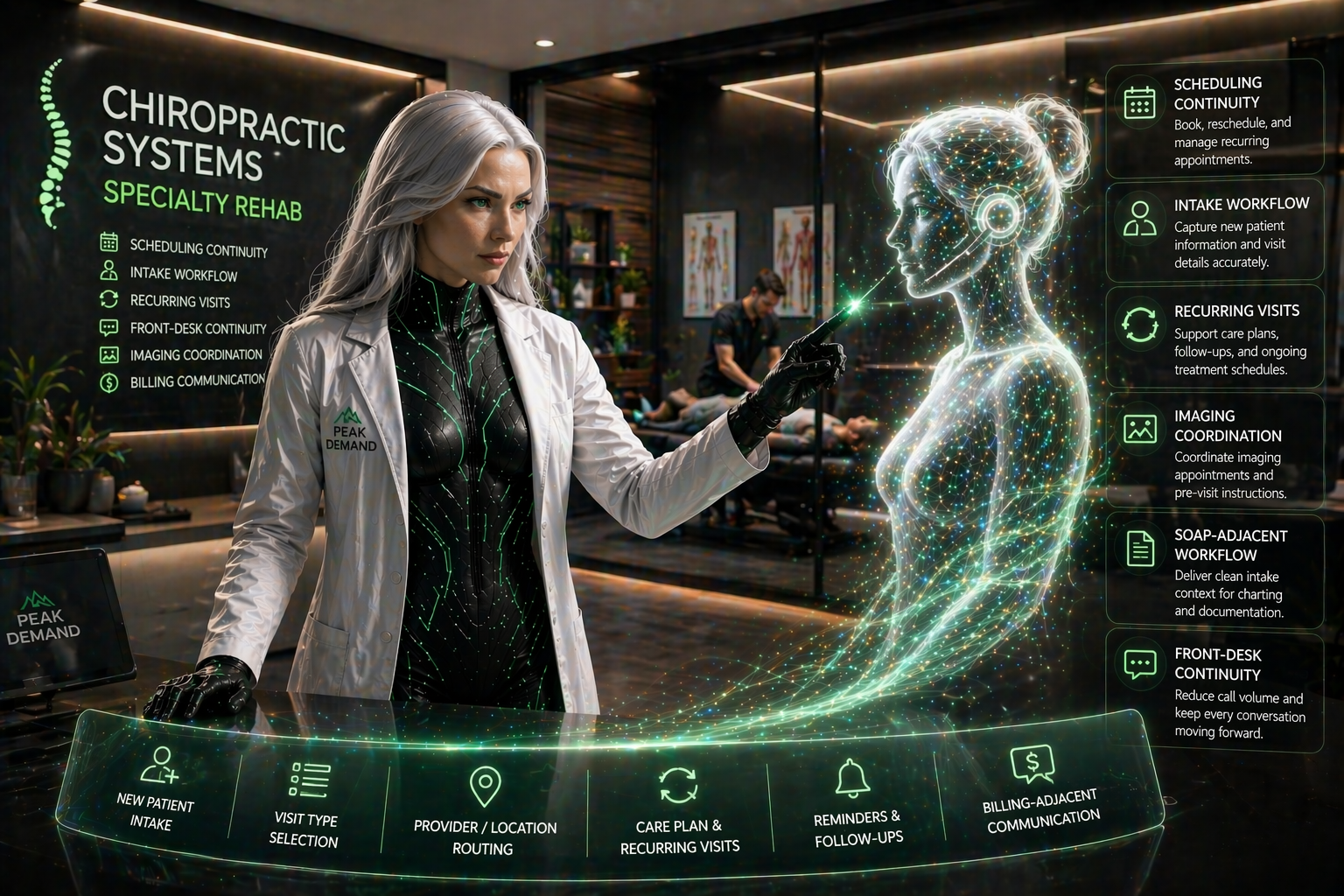
These systems often sit close to appointment flow, first-visit intake, recurring care schedules, reminders, SOAP-adjacent workflow continuity, imaging-adjacent coordination, and billing-adjacent communication. In many clinics, that makes them central to the operational handoff between the conversation and the next action staff must take.
Representative systems in this family
Common systems in this category include ChiroTouch, ChiroSpring, ChiroSUITE, ChartMaster, and FreeCHIRO. Adjacent specialty relevance can also appear around platforms like AcuSimple and MacPractice where workflow overlap exists.
What these environments often have in common
- High volumes of new patient calls and repeat-visit coordination
- Front-desk strain from scheduling, reminders, and repetitive patient requests
- SOAP-adjacent intake or documentation continuity needs
- Imaging-adjacent or specialty coordination around visit flow
- Billing-adjacent communication that still affects patient experience
Where a Voice AI receptionist fits in chiropractic workflows
In this family, a Voice AI receptionist is usually most valuable when it supports the clinic workflow around the system rather than acting like a generic answering layer. The best use cases are the moments where scheduling pressure, recurring care, intake detail, and front-desk continuity all affect the patient experience and the operational load on staff.
New patient calls and first-visit intake
Voice AI can help capture, qualify, and route new patient demand more consistently so first-visit opportunities are not lost to missed calls, front-desk overload, or weak intake structure.
Scheduling and recurring-visit continuity
Many chiropractic and specialty rehab clinics rely on repeated visit patterns, which means scheduling changes, care-plan continuity, and recurring appointments can create sustained communication pressure.
SOAP-adjacent intake continuity
Stronger communication workflows can preserve the reason for the visit, patient context, and next-step details clearly enough that staff do not need to reconstruct every request manually.
Provider, service, and visit-type routing
Specialty clinics often need routing logic tied to provider, service line, treatment type, initial assessment versus follow-up, or location-specific workflow ownership.
Imaging and specialty coordination
Some environments also need cleaner communication around imaging-adjacent coordination, visit preparation, or specialty flow that sits near but not always fully inside the core scheduling task.
Front-desk overload reduction
Repetitive scheduling questions, reschedules, reminders, intake calls, and admin interruptions can consume an outsized amount of front-desk time in specialty rehab environments.
Why custom often matters more in chiropractic and specialty rehab
Chiropractic and specialty rehab clinics often look simpler from the outside than they actually are operationally. Visit types can vary. Recurring-care cadence matters. Some offices need stronger first-visit qualification. Others need cleaner reminder logic, imaging-adjacent coordination, or billing-adjacent communication. That is why a custom workflow-led path is often more credible than a rigid tool that assumes every clinic behaves the same way.
What a custom specialty workflow can support more cleanly
- Practice-specific new patient intake and booking logic
- Different handling for first visits, recurring visits, and specialty follow-up
- Reminder and communication rules that reflect the real care cadence
- Cleaner routing across providers, services, or locations
- Workflow continuity around documentation-adjacent or imaging-adjacent coordination
Why this matters for clinic owners and operators
A workflow that appears simple on the surface can still have a lot of operational nuance once you account for recurring visits, provider-specific scheduling, specialty intake, follow-up patterns, and the way the front desk actually works. A more custom path often gives the clinic a better fit than a generic setup.
Integration paths across chiropractic and specialty rehab environments
These systems do not all support the same path. Some environments are better suited to a custom integration pathway. Others need a closer workflow assessment before deployment. The strongest approach usually comes from understanding what must happen in the system, what should happen around it, and how the clinic actually handles recurring care, intake, and front-desk coordination.
Custom integration pathway available
Many chiropractic environments benefit from a custom workflow-led path that supports scheduling, intake, reminders, and specialty communication logic around the way the clinic already operates.
Environment-dependent fit
Some specialty rehab or mixed-use environments depend on vendor posture, permissions, current workflow design, and what kind of operational continuity the office needs from the communication layer.
Workflow assessment recommended before deployment
For some systems, the strongest path begins with a review of how recurring visits, reminders, specialty intake, and front-desk workflow behave in practice before a clean deployment decision is made.
Custom matters more than connector bragging
In this family, the operational value usually comes less from claiming a simplistic plug-in and more from preserving workflow continuity, patient context, and usable handoff detail for staff.
Systems in this family
These are the chiropractic and specialty rehab systems currently in scope for this family page and broader system-cluster buildout.
What strong chiropractic workflow architecture looks like
In chiropractic and specialty rehab environments, the most useful integration decisions usually come from workflow architecture rather than software logos alone. That means understanding what needs to happen around the conversation, what should happen in the system, and what the front-desk or support team must receive in order to act without extra manual cleanup.
What a stronger specialty communication workflow usually preserves
- Caller intent and the reason for the visit
- New patient versus returning patient context
- Visit type, urgency, and recurring-care timing
- Usable intake details for staff follow-up
- Cleaner continuity between reminders, follow-up, and next-step scheduling
Illustrative specialty rehab workflow example
A simple example of the kind of structured handoff a chiropractic or specialty rehab clinic may need is shown below. The purpose is to demonstrate operational clarity, not to imply one universal payload across every system.
{
  "system_family": "chiropractic_specialty_rehab",
  "workflow": "new_patient_booking_request",
  "caller": {
    "first_name": "Jordan",
    "last_name": "Parker",
    "phone": "+1-416-555-0121",
    "is_existing_patient": false
  },
  "request": {
    "type": "initial_assessment",
    "service_line": "chiropractic",
    "preferred_location": "Main Clinic",
    "preferred_time_window": "Evening",
    "urgency": "routine"
  },
  "intake": {
    "summary": "New patient seeking first appointment for lower back pain.",
    "imaging_question": true,
    "callback_required": true
  },
  "handoff": {
    "route_to": "front_desk_scheduling_team",
    "status": "ready_for_staff_action"
  }
}
What clinic owners and operators should evaluate first
Before choosing a path, it helps to review the communication environment the way patients and staff actually experience it rather than reducing the decision to a software name alone.
Are recurring visits creating scheduling friction?
Ongoing care patterns often create sustained scheduling pressure if appointment changes are frequent or reminder flow is inconsistent.
Does intake arrive with enough usable detail?
If staff still need to rebuild the request manually, the communication layer is likely not preserving enough structure.
Do different providers or visit types need different routing?
Specialty clinics often need the caller matched to the right provider, service, location, or visit type instead of using one generic schedule path.
How much front-desk time is spent on repetitive scheduling and reminders?
Repetitive calls and reminder traffic can consume a disproportionate amount of time that could otherwise go toward higher-value patient interaction.
What part of the workflow is documentation-adjacent or imaging-adjacent?
Some environments need cleaner coordination around charting-adjacent or imaging-adjacent steps, even if those tasks are not handled fully inside the call itself.
What should happen after hours or when calls are missed?
The right answer depends on staffing, urgency, first-visit demand, and how much continuity must be preserved for next-day follow-up.
Chiropractic and specialty rehab systems family FAQ
Talk through the right specialty clinic communication workflow
If you are evaluating a Voice AI receptionist around a chiropractic or specialty rehab system, the best next step is usually a workflow conversation. That means reviewing how your clinic currently handles new patient calls, recurring visits, intake, reminders, front-desk demand, and specialty coordination, then mapping the integration path that makes the most sense for your environment.
About Peak Demand
Peak Demand is a Toronto-based AI agency focused on Voice AI receptionists, communication automation, workflow-aware implementation, and operational AI infrastructure. In healthcare and specialty clinic environments, Peak Demand positions its work around communication systems that support access, scheduling, routing, intake, and governance-conscious deployment.
Explore your own AI use case on a discovery call.