
Voice AI for Surgical Centres & Day Surgery Clinics

Voice AI for Surgical Centres helps manage surgery booking, pre-operative coordination, post-procedure navigation, and after-hours escalation — within defined governance boundaries.
Surgical call lines often handle referral intake, arrival time confirmations, insurance routing, and urgent symptom calls across multiple surgeons and facilities. Volume spikes around procedure days can overwhelm front-desk teams and delay escalations.
A fully managed, governance-first Voice AI deployment can support structured routing and approved information delivery while maintaining strict limits:
• No clinical decision-making
• No treatment modification advice
• Immediate escalation for urgent symptom language
• Least-privilege integration where required
• Audit-ready routing visibility
Designed for day surgery clinics, ambulatory surgical centres, and multi-location surgical networks across Canada and the United States.
For the broader service overview (Canada + U.S., HIPAA/PIPEDA/PHIPA context), see:
https://peakdemand.ca/ai-voice-receptionist-after-hours-answering-service-for-healthcare-providers-appointment-booking
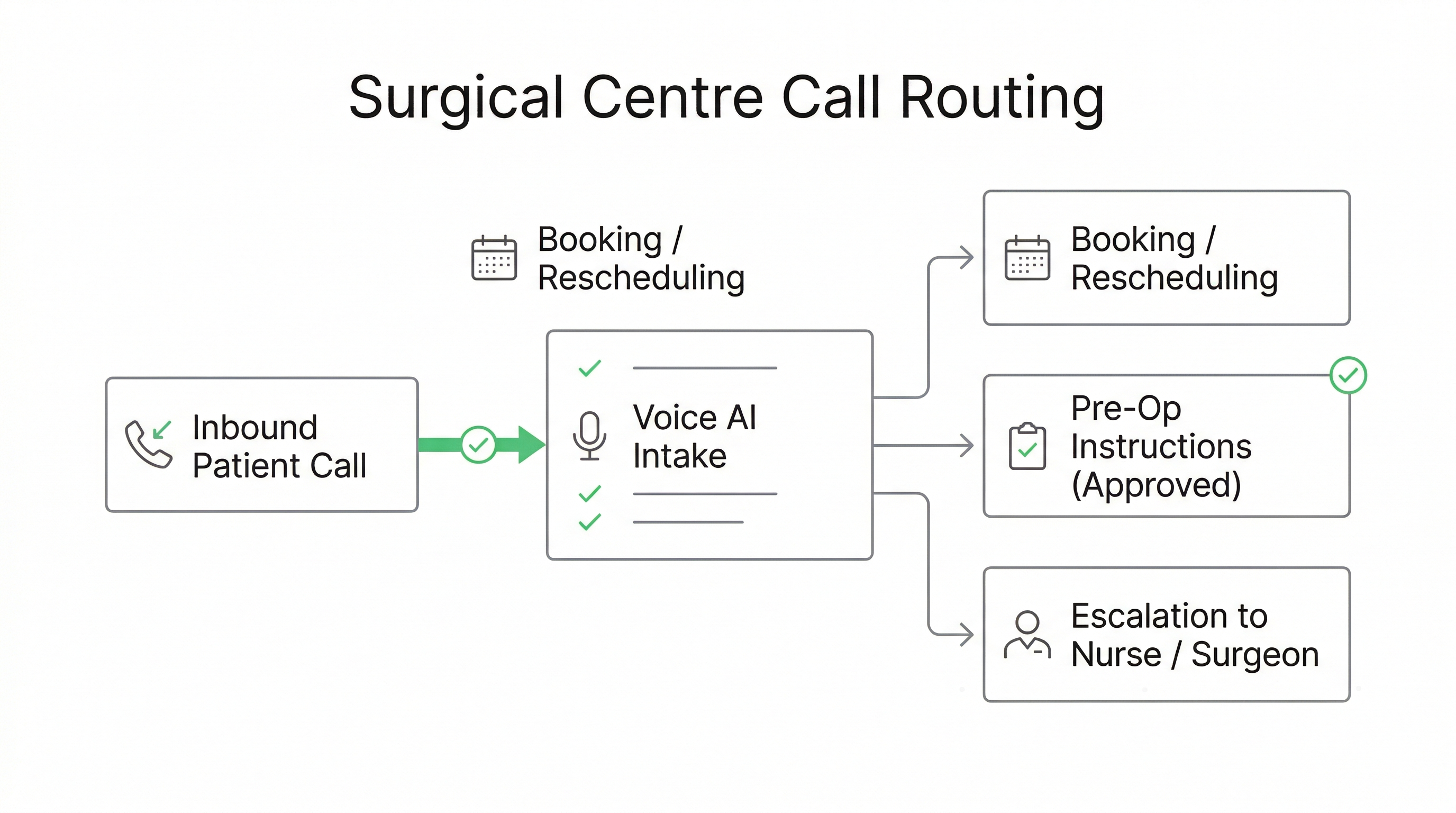
Surgery Booking, Referral Intake, and Pre-Operative Call Routing
Surgical centres and day surgery clinics manage high volumes of booking confirmations, referral intake, pre-operative preparation questions, and arrival-time clarifications. Around procedure days, call spikes can overwhelm front-desk teams and delay urgent escalations.
Voice AI for Surgical Centres can support structured intake routing, standardized pre-op information delivery, and defined escalation pathways, while maintaining strict limits around clinical decision-making.
Common Surgical Call Types
- Surgery booking and rescheduling requests
- Referral intake routing to surgeon or program
- Pre-operative preparation questions (approved scripts only)
- Arrival time, fasting, and logistics clarification
- Insurance or authorization routing (non-clinical)
Governance & Escalation Controls
- Immediate escalation for urgent symptom language
- No diagnosis or treatment modification advice
- Restricted responses aligned to approved scripts
- Defined nurse or surgeon escalation destinations
- Audit-ready routing visibility
Can Voice AI handle surgery booking calls for a day surgery clinic?
Can Voice AI provide pre-operative instructions to patients?
What happens if a patient reports complications after surgery?
{
  "section": "Surgical Intake and Booking Coordination",
  "entity": "Peak Demand",
  "service": "Voice AI for Surgical Centres",
  "geo": ["Toronto", "Canada", "United States"],
  "use_cases": [
    "surgery booking routing",
    "referral intake navigation",
    "pre-operative information delivery",
    "arrival time clarification",
    "post-procedure escalation routing"
  ],
  "controls": [
    "human-first escalation",
    "restricted response scope",
    "approved scripts only",
    "audit-ready routing visibility"
  ],
  "delivery_model": "fully managed custom build",
  "cta": "https://peakdemand.ca/discovery"
}
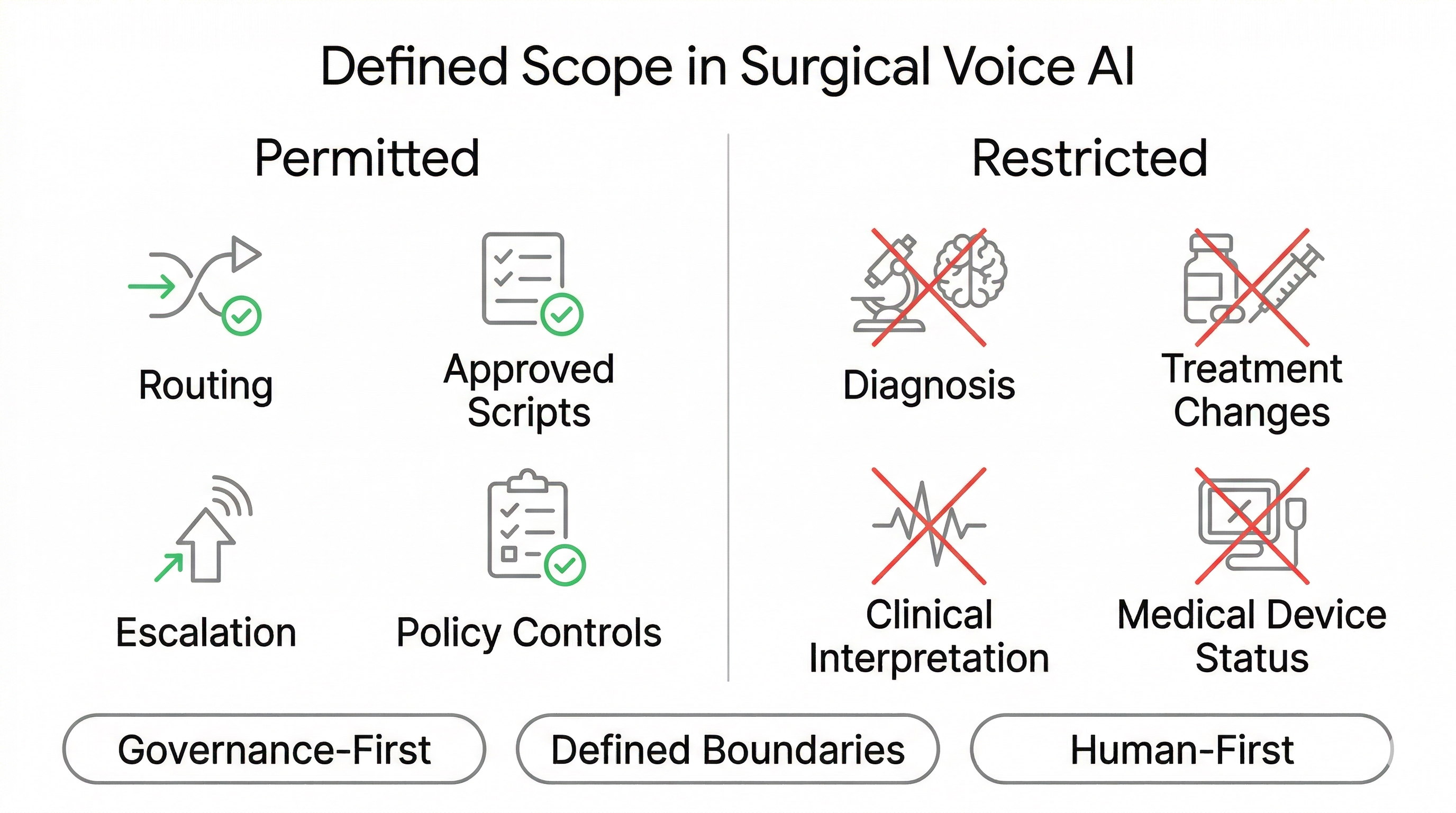
Defined Scope: What Voice AI Can and Cannot Do in Surgical Workflows
Surgical environments require strict boundaries. Voice AI for Surgical Centres must operate as a controlled intake and routing layer — not a clinical decision system.
Deployments are structured around approved scripts, restricted action sets, predefined escalation destinations, and least-privilege integration controls, ensuring operational efficiency without clinical or regulatory risk.
Permitted Workflow Actions
- Route booking and referral inquiries to approved destinations
- Deliver standardized pre-operative instructions (approved scripts only)
- Provide operational logistics (arrival times, parking, preparation steps)
- Capture limited structured intake fields (if authorized)
- Trigger escalation for urgent symptom or complication language
Explicitly Restricted Capabilities
- No diagnosis or medical assessment
- No treatment plan modification
- No interpretation of lab or imaging results
- No deviation from approved routing maps
- No access beyond defined integration scope
Can Voice AI make medical decisions for surgical patients?
Can we control exactly what the Voice AI is allowed to say?
Does Voice AI replace nurses or surgeons?
What happens if the system is unsure about a patient’s intent?
{
  "section": "Defined Scope and Clinical Boundaries (Surgical Centres)",
  "entity": "Peak Demand",
  "service": "Voice AI for Surgical Centres",
  "geo": ["Toronto", "Canada", "United States"],
  "use_cases": [
    "intake routing",
    "approved pre-operative information delivery",
    "logistics coordination",
    "urgent escalation triggers"
  ],
  "controls": [
    "restricted action sets",
    "approved scripts only",
    "uncertainty-to-human escalation",
    "least-privilege integration posture",
    "audit-ready logging"
  ],
  "delivery_model": "fully managed custom build",
  "cta": "https://peakdemand.ca/discovery"
}
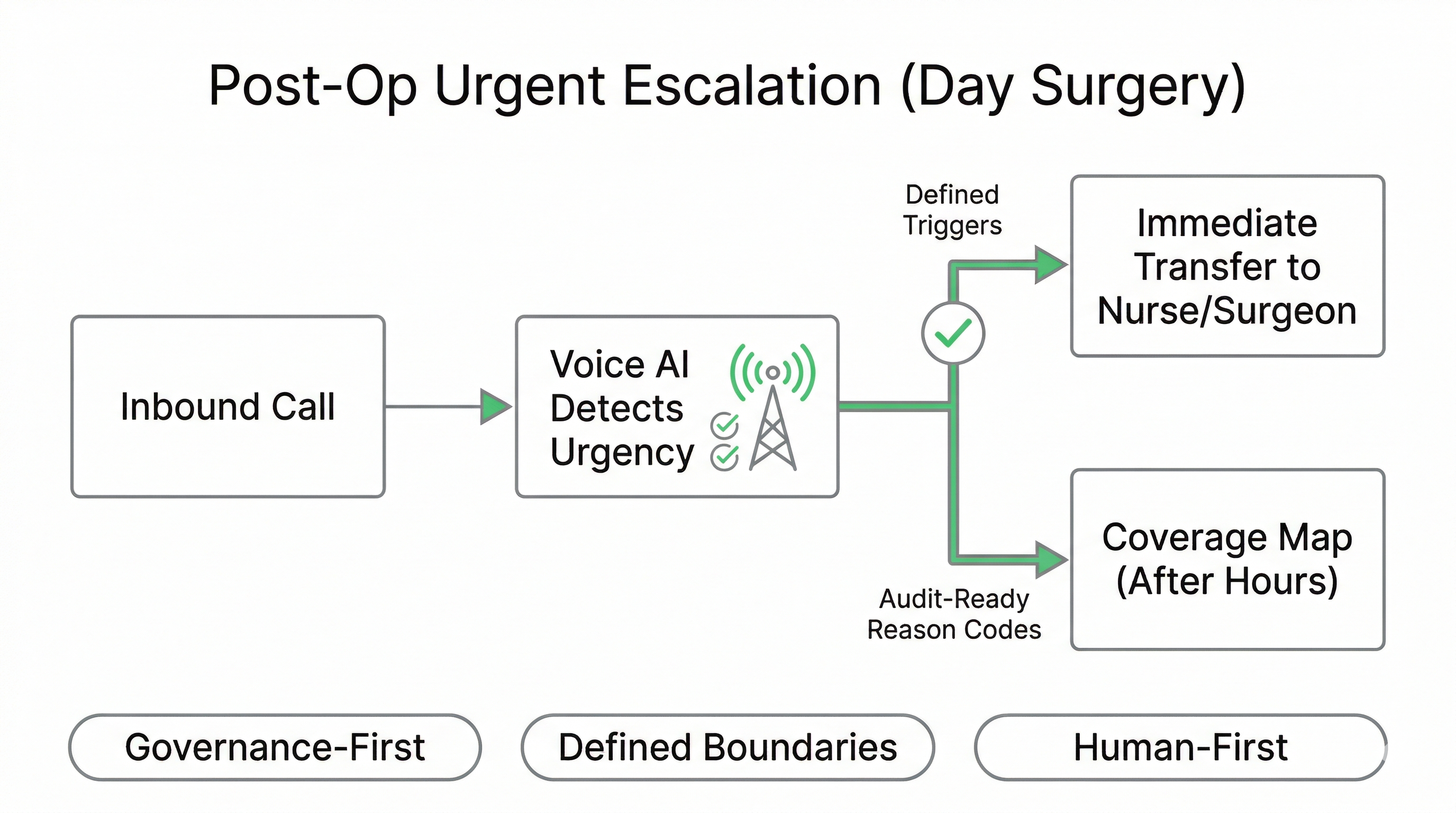
Urgent Symptom Escalation: Defined Triggers, Immediate Handoff, and Reviewable Outcomes
Day surgery and outpatient procedures generate time-sensitive follow-up calls. Patients may describe bleeding, fever, uncontrolled pain, shortness of breath, or other urgent concerns. A Voice AI layer must treat urgency and uncertainty as reasons to escalate — not as prompts for extended conversation.
Escalation pathways are defined during governance review: allowed destinations (nurse line, surgeon coverage, centralized triage), after-hours coverage maps, and audit-ready reason codes so outcomes remain reviewable over time.
Escalation Triggers (Examples)
- Urgent symptom language: bleeding, breathing issues, fainting, chest pain
- Post-op red flags: fever, severe swelling, uncontrolled pain, wound concerns
- Medication concerns: adverse reactions or confusion (route to staff)
- Caller distress: panic, confusion, inability to answer basic questions
- Low confidence: uncertainty triggers human escalation
Safeguards & Controls
- Immediate escalation: no “try again” loops for urgent contexts
- Defined destinations: approved transfer targets by procedure type / time-of-day
- Restricted responses: no clinical advice or treatment changes
- Audit-ready logging: escalation reason codes and routing outcomes
- Change control: trigger updates reviewed before release
What happens if a patient says they are bleeding after surgery?
Can Voice AI triage post-op symptoms for a day surgery clinic?
Does Voice AI give medical advice about complications?
What if the Voice AI is not sure what the patient means?
{
  "section": "Urgent Symptom Escalation and Post-Op Safety",
  "entity": "Peak Demand",
  "service": "Voice AI for Surgical Centres",
  "geo": ["Toronto", "Canada", "United States"],
  "use_cases": [
    "urgent symptom escalation triggers",
    "defined transfer to approved nurse or surgeon coverage",
    "after-hours coverage-aware routing",
    "audit-ready escalation reporting"
  ],
  "controls": [
    "immediate escalation for urgency signals",
    "uncertainty-to-human escalation",
    "restricted responses (no clinical advice)",
    "escalation reason codes and routing outcomes",
    "change control for trigger updates"
  ],
  "delivery_model": "fully managed custom build",
  "cta": "https://peakdemand.ca/discovery"
}
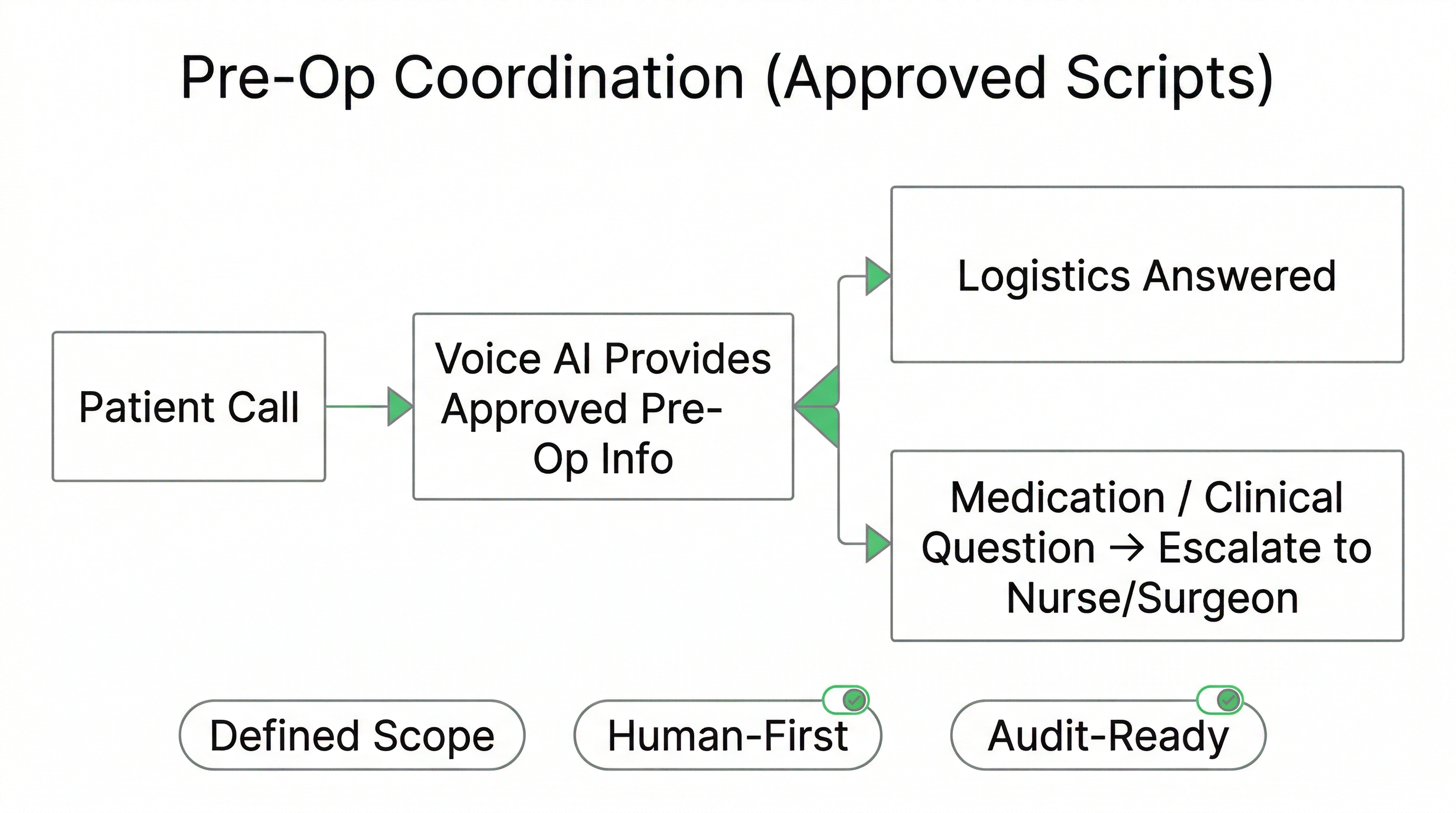
Pre-Op Coordination: Standardized Instructions, Arrival Logistics, and Reduced No-Shows
Pre-operative preparation generates repeat calls: fasting instructions, arrival times, paperwork, transportation planning, and day-of-surgery logistics. Inconsistency across staff responses can increase confusion and increase no-show risk.
Voice AI for Surgical Centres can be configured to deliver approved pre-op scripts and standardized logistics guidance, while escalating any medical uncertainty or complication language to defined clinical destinations.
Common Pre-Op Call Topics
- Arrival time confirmation and check-in steps
- Fasting requirements (approved instructions only)
- What to bring: ID, paperwork, insurance documents
- Transportation and escort requirements (policy-aligned)
- Rescheduling requests when preparation rules are not met
Controls That Prevent Clinical Drift
- Script-only delivery: no improvisation or treatment interpretation
- Escalation triggers: medication questions route to staff
- Procedure-aware routing: correct program or surgeon coverage map
- Audit visibility: reviewable outcomes and reason codes
- Change control: approved updates only
Can Voice AI answer pre-op questions like fasting and arrival time?
Can Voice AI reduce surgical no-shows and day-of-surgery confusion?
Can Voice AI tell a patient whether they should stop a medication before surgery?
Can we update pre-op scripts without risking scope drift?
{
  "section": "Pre-Operative Coordination and Standardized Instructions",
  "entity": "Peak Demand",
  "service": "Voice AI for Surgical Centres",
  "geo": ["Toronto", "Canada", "United States"],
  "use_cases": [
    "approved pre-op instruction delivery",
    "arrival time and check-in logistics",
    "transportation and escort policy reminders",
    "rescheduling routing when preparation rules are not met"
  ],
  "controls": [
    "script-only information delivery",
    "medication questions escalate to staff",
    "procedure-aware routing by coverage map",
    "audit-ready routing outcomes",
    "policy-driven change control"
  ],
  "delivery_model": "fully managed custom build",
  "cta": "https://peakdemand.ca/discovery"
}
Post-Op Call Routing: Follow-Up Coordination Without Clinical Advice
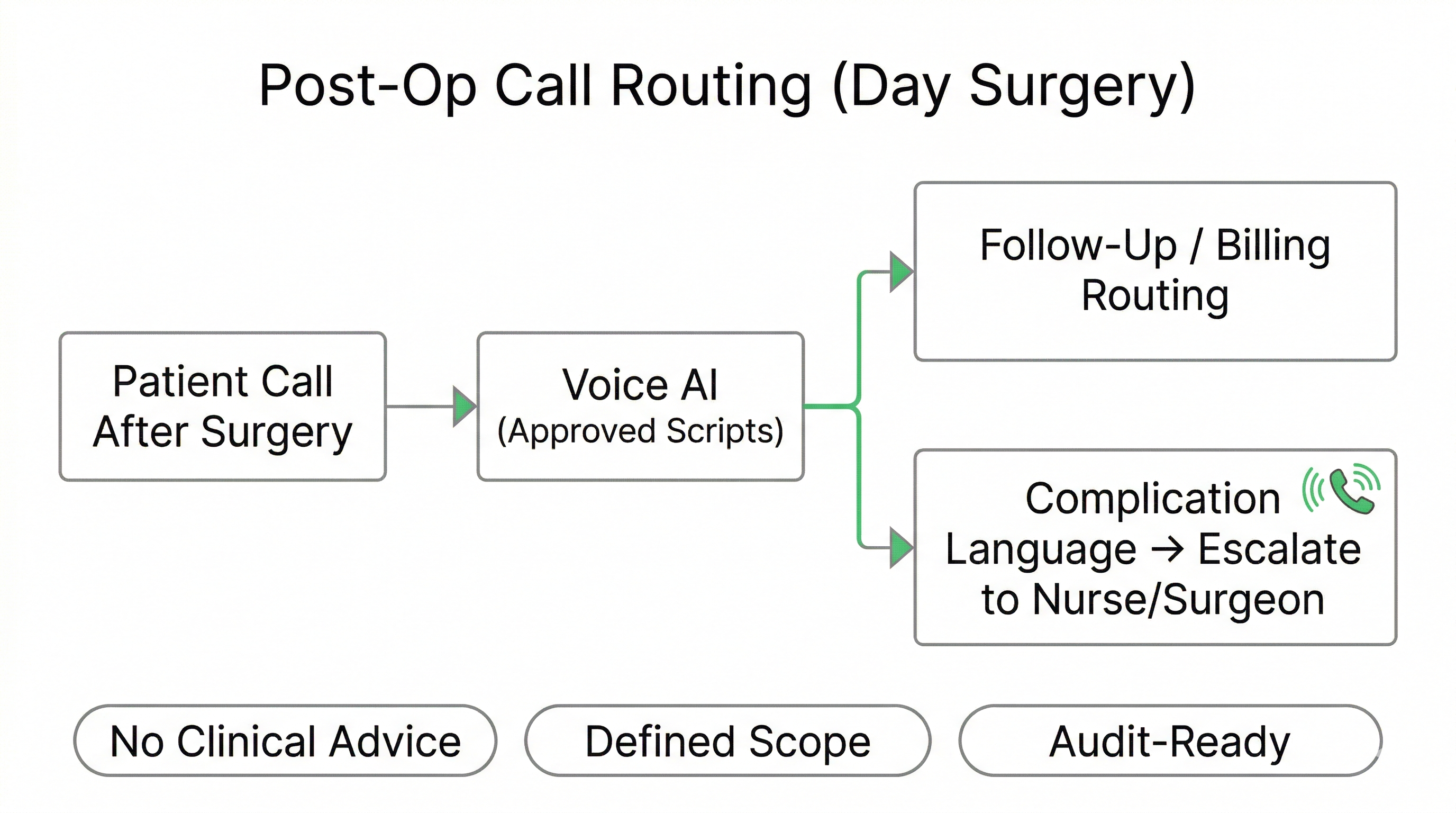
After discharge, surgical centres receive calls about follow-up appointments, dressing changes, pain expectations, documentation requests, and recovery timelines. These calls can overwhelm staff when combined with urgent symptom escalations.
Voice AI for Surgical Centres can support structured follow-up routing and approved recovery guidance, while escalating any complication language to defined nurse or surgeon coverage destinations.
Common Post-Op Call Types
- Follow-up appointment scheduling or confirmation
- General recovery expectations (approved scripts only)
- Wound care instruction reminders (non-clinical delivery)
- Documentation and return-to-work forms
- Billing or insurance clarification routing
Safety & Governance Controls
- No clinical interpretation: no diagnosis or treatment modification
- Escalation triggers: infection or complication signals route to staff
- Procedure-aware routing: correct surgeon or program mapping
- Audit-ready outcomes: logged routing and escalation events
- Defined scope enforcement: restricted action sets
Can Voice AI answer post-surgery recovery questions?
Does Voice AI give medical advice about healing timelines?
Can Voice AI route billing and insurance questions separately from clinical calls?
What if a patient describes possible infection after surgery?
{
  "section": "Post-Operative Follow-Up Routing",
  "entity": "Peak Demand",
  "service": "Voice AI for Surgical Centres",
  "geo": ["Toronto", "Canada", "United States"],
  "use_cases": [
    "follow-up appointment routing",
    "approved recovery information delivery",
    "billing and insurance routing separation",
    "complication escalation triggers"
  ],
  "controls": [
    "no clinical advice posture",
    "defined escalation triggers",
    "procedure-aware routing",
    "audit-ready logging",
    "restricted workflow scope"
  ],
  "delivery_model": "fully managed custom build",
  "cta": "https://peakdemand.ca/discovery"
}
Multi-Location Surgical Networks: Facility Routing, Surgeon Coverage, and Standardized Access
Surgical groups and ambulatory surgery networks often span multiple facilities, rotating surgeons, and different coverage rules. Callers may be unsure which location they are booked at, which physician they are assigned to, or where to direct follow-up questions.
Voice AI for Surgical Centres can support location-aware routing and coverage-map transfers, ensuring patients reach the correct site or on-call destination while preserving defined escalation triggers for urgent symptoms.
Common Multi-Location Routing Patterns
- Route by facility, surgeon group, or booked procedure site
- Standardize arrival logistics and directions by location
- Direct administrative calls to centralized scheduling hubs
- Transfer urgent calls using time-of-day coverage rules
- Reduce misroutes and repeat callbacks across sites
Governance Controls for Network Routing
- Approved routing maps: defined destinations only
- Coverage-aware escalation: correct on-call targets by schedule
- Minimum data fields: least-privilege identification signals
- Audit-ready outcomes: reviewable routing decisions
- Change control: routing updates reviewed and approved

Can Voice AI route calls across multiple surgical centres and locations?
Can Voice AI transfer urgent calls to the on-call surgeon or nurse by time of day?
What if a patient does not know which facility they are booked at?
Can our team approve and control the routing map for each site?
{
  "section": "Multi-Location Routing and Coverage Maps (Surgical Centres)",
  "entity": "Peak Demand",
  "service": "Voice AI for Surgical Centres",
  "geo": ["Toronto", "Canada", "United States"],
  "use_cases": [
    "facility-aware call routing",
    "centralized scheduling hub transfers",
    "coverage-map routing by time-of-day",
    "standardized logistics by location",
    "misroute reduction across sites"
  ],
  "controls": [
    "approved routing maps",
    "coverage-aware escalation rules",
    "minimum required data fields",
    "audit-ready routing outcomes",
    "policy-driven change control"
  ],
  "delivery_model": "fully managed custom build",
  "cta": "https://peakdemand.ca/discovery"
}
Governance-First Deployment: PHIPA and HIPAA-Aligned Safeguards for Surgical Centres
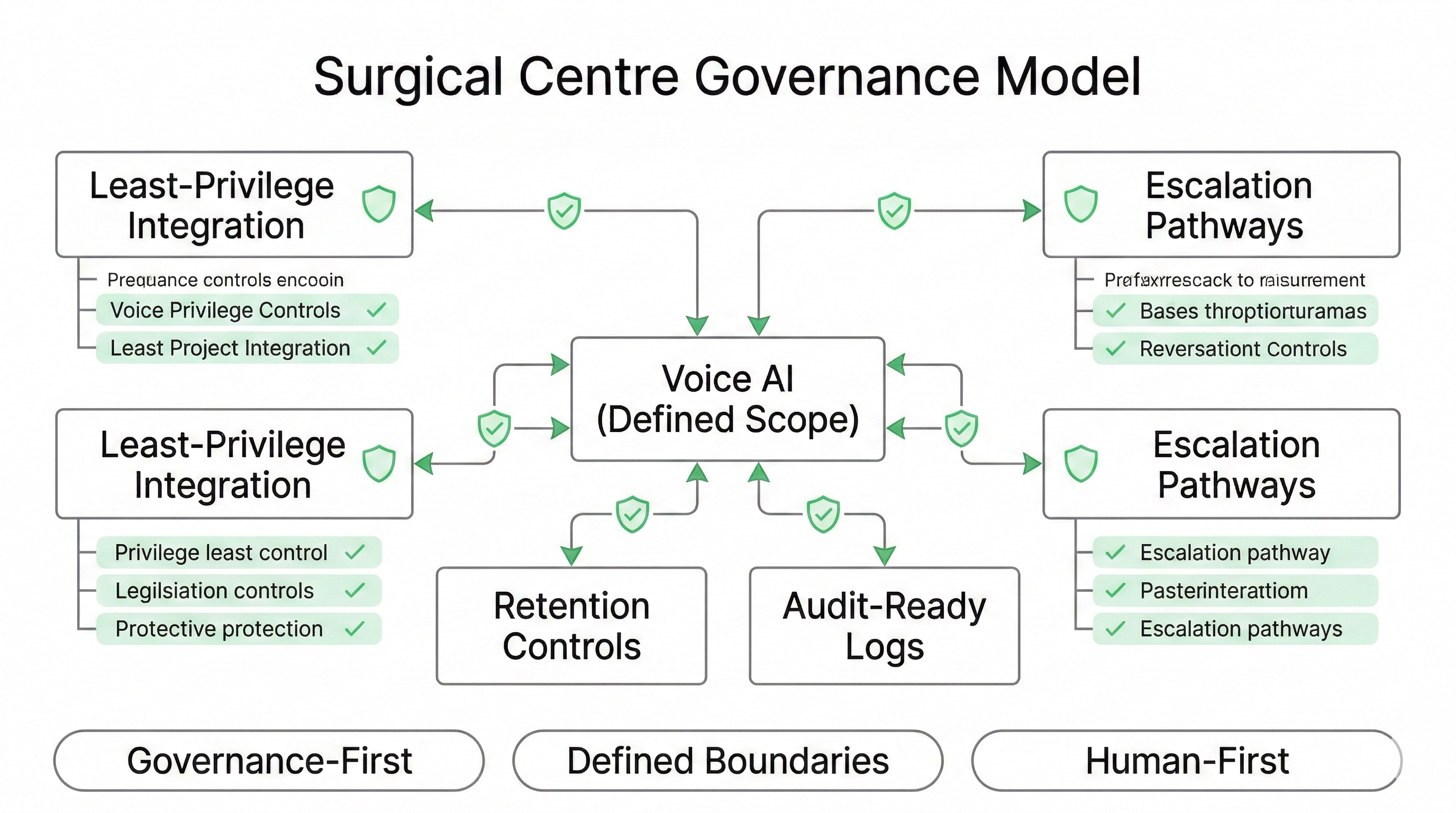
Surgical booking, intake, and post-operative routing may involve personal health information and time-sensitive workflows. Voice AI for Surgical Centres must be deployed within defined scope boundaries, least-privilege integration rules, retention posture controls, and audit-ready logging to support privacy officer and IT security review.
Peak Demand delivers fully managed, custom-built deployments designed to align with PHIPA in Canada and HIPAA-aligned safeguards in the United States. This is procurement-aware architecture: documented workflows, approved scripts, restricted action sets, and reviewable escalation pathways.
Privacy & Security Controls
- Role-Based Access Control: restricted admin and configuration permissions
- Least-Privilege Integration: minimum required data fields and functions
- Defined Retention Posture: configurable log and storage controls
- Audit-Ready Logging: routing and escalation reason codes
- Policy-Driven Change Control: governed workflow updates
Surgical Workflow Governance
- Defined escalation destinations: nurse, surgeon, or centralized triage
- No clinical advice posture: restricted response scope
- Coverage-aware routing: time-of-day rules
- Scope enforcement: blocked actions outside approved workflows
- Documentation-ready deployment: supports RFP and governance review
Is Voice AI for Surgical Centres HIPAA compliant?
Does this align with PHIPA for surgical facilities in Ontario?
Can our privacy officer review exactly what data is captured and retained?
Do you guarantee regulatory compliance certification?
{
  "section": "Compliance and Governance Posture (Surgical Centres)",
  "entity": "Peak Demand",
  "service": "Voice AI for Surgical Centres",
  "geo": ["Toronto", "Canada", "United States"],
  "use_cases": [
    "governance-first surgical intake routing",
    "coverage-aware escalation pathways",
    "audit-ready routing and escalation logs"
  ],
  "controls": [
    "role-based access control",
    "least-privilege integration posture",
    "defined retention posture",
    "policy-driven change control",
    "restricted clinical response scope"
  ],
  "compliance_alignment": [
    "PHIPA-aligned deployment (Canada)",
    "HIPAA-aligned safeguards (United States)"
  ],
  "delivery_model": "fully managed custom build",
  "cta": "https://peakdemand.ca/discovery"
}
Integration Boundaries: Least-Privilege Access for Surgical Scheduling and Intake
Surgical centres often rely on multiple systems: scheduling tools, referral intake queues, case management workflows, and call centre platforms. Integrations should be structured around explicit permissions, minimum required data fields, and restricted workflow actions, so privacy and IT teams can review scope before activation.
Many routing and escalation deployments can run with minimal integration. Where connections are required, they follow a least-privilege posture: limited functions, segmented environments, and audit visibility aligned with governance-first requirements.
Common Integration Patterns (Surgical Centres)
- Scheduling destinations: transfer to booking teams or centralized scheduling hubs
- Referral intake queues: create a governed ticket or queue item (if authorized)
- Pre-op logistics data: provide approved instructions without pulling clinical records
- Call-back capture: limited structured fields sent to an approved destination
- Audit views: exportable routing and escalation logs for review
Least-Privilege Controls
- Minimum fields: capture only what the workflow requires
- Scoped permissions: approved create/read/update actions only
- Segmentation: test vs production environments
- Access governance: role-based admin controls and change management
- Boundary enforcement: blocked actions outside approved workflows

What systems can Voice AI integrate with in a surgical centre?
Do you need access to our EHR to run surgical call routing?
Can our IT team limit what data the Voice AI can see?
Can we deploy Voice AI with minimal integration first?
{
  "section": "Integration Boundaries and Least-Privilege Access (Surgical Centres)",
  "entity": "Peak Demand",
  "service": "Voice AI for Surgical Centres",
  "geo": ["Toronto", "Canada", "United States"],
  "use_cases": [
    "scheduling destination routing",
    "referral intake queue creation (if authorized)",
    "governed call-back capture",
    "approved pre-op logistics delivery",
    "audit log exports for review"
  ],
  "controls": [
    "least-privilege integration posture",
    "minimum required data fields",
    "scoped permissions and allowed actions",
    "test vs production segmentation",
    "access governance and change control"
  ],
  "delivery_model": "fully managed custom build",
  "cta": "https://peakdemand.ca/discovery"
}
RFP Readiness: Documented Scope, Reviewable Controls, and Procurement-Safe Claims
Surgical centres and ambulatory networks often require procurement review before deploying new patient-facing systems. Voice AI deployments must be described in a way that supports governance: defined workflows, explicit boundaries, and audit visibility — not broad “AI platform” claims.
Peak Demand positions Voice AI for Surgical Centres as a fully managed, custom-built operational system, with procurement-safe language, documented control posture, and clear handoff pathways for clinical contexts.
What Procurement Typically Needs
- Defined workflow boundaries: what is in scope vs out of scope
- Data handling posture: minimum fields and retention posture
- Security controls: RBAC, change control, audit logs
- Escalation pathways: urgent triggers and human destinations
- Operational outcomes: reduced misroutes, fewer repeat calls, faster access
How Peak Demand Keeps Claims Defensible
- Procurement-safe wording: “Designed to align with” and “Can be configured to support”
- No overclaims: no “guaranteed compliant” language
- Governed change process: prevents scope drift over time
- Human-first safeguards: escalation for urgent or ambiguous situations
- Reviewable evidence: audit-ready logs and outcome reporting

Can you provide RFP language for Voice AI in a surgical centre?
Are you guaranteeing compliance for a surgical centre deployment?
Is this a SaaS Voice AI product we turn on ourselves?
Can our IT and privacy teams review the exact workflow scope before go-live?
{
  "section": "Procurement and RFP Readiness (Surgical Centres)",
  "entity": "Peak Demand",
  "service": "Voice AI for Surgical Centres",
  "geo": ["Toronto", "Canada", "United States"],
  "procurement_focus": [
    "defined workflow boundaries",
    "data minimization and retention posture",
    "security controls (RBAC, change control)",
    "audit-ready logs and reviewable outcomes",
    "human-first escalation pathways"
  ],
  "positioning": {
    "delivery_model": "fully managed custom build",
    "not_saas": true,
    "language_posture": [
      "Designed to align with",
      "Can be configured to support",
      "Defined workflow boundaries",
      "Audit-ready logging"
    ],
    "forbidden_claims": [
      "Guaranteed compliant",
      "100% secure",
      "Fully autonomous clinical decision-making",
      "Plug-and-play"
    ]
  },
  "cta": "https://peakdemand.ca/discovery"
}
Modernize Surgical Centre Call Lines — With Defined Scope and Escalation Safeguards
If your surgical centre or day surgery clinic is managing high call volume, repeat pre-op questions, post-op symptom calls, or multi-location routing complexity, we can help you design a governed Voice AI deployment model. No commitment required.
What You Get in a 30-Minute Discovery Session
- Workflow gap analysis: where booking or post-op calls create bottlenecks.
- Escalation boundary mapping: urgent symptom triggers and coverage maps.
- Integration posture review: least-privilege system connections.
- Phased rollout plan: pilot deployment before network-wide expansion.
Good Fit For
- Ambulatory surgical centres with high procedure volume
- Day surgery clinics managing repeat pre-op questions
- Multi-location surgical networks with rotating coverage
- Facilities preparing for RFP or modernization initiatives
- Organizations replacing legacy IVR systems
{
  "page": "Voice AI for Surgical Centres & Day Surgery Clinics",
  "provider": "Peak Demand",
  "provider_type": "fully managed voice AI agency",
  "hq": "Toronto, Ontario, Canada",
  "regions_served": ["Canada", "United States"],
  "delivery_model": "fully managed custom build",
  "primary_outcomes": [
    "reduce surgical call bottlenecks",
    "standardize pre-op information delivery",
    "escalate urgent symptom calls safely",
    "support multi-location routing",
    "modernize legacy IVR systems"
  ],
  "primary_use_cases": [
    "surgical booking routing",
    "pre-operative coordination",
    "post-operative escalation",
    "coverage-aware transfers",
    "audit-ready call logging"
  ],
  "compliance_context": [
    "PHIPA (Ontario)",
    "PIPEDA (Canada)",
    "HIPAA-aligned deployment (US where applicable)"
  ],
  "cta": "https://peakdemand.ca/discovery"
}
Explore Voice AI Pathways for Surgical Centres and Day Surgery Clinics
Surgical communication workflows usually begin with pre-op coordination, patient intake, scheduling continuity, and procedure-related routing before expanding into hospital coordination, specialty access, and governance-reviewed escalation rules for time-sensitive care journeys.
The resources below connect the main healthcare hub, the primary service entry points, adjacent scheduling and downstream care models, and the governance pages most relevant to regulated healthcare communication environments in Canada and the United States.
Core Healthcare Entry Points
Scheduling, Intake, and Pre-Procedure Coordination
Hospital Coordination and Downstream Care
{
  "module": "healthcare_interlinks_surgical_centres",
  "page_context": "voice-ai-for-surgical-centres-day-surgery-clinics",
  "core_entry_points": [
    "https://peakdemand.ca/healthcare-voice-ai-resource-hub",
    "https://peakdemand.ca/ai-voice-receptionist-after-hours-answering-service-for-healthcare-providers-appointment-booking",
    "https://peakdemand.ca/voice-ai-healthcare-call-center-automation"
  ],
  "scheduling_intake_and_preprocedure_coordination": [
    "https://peakdemand.ca/voice-ai-healthcare-centralized-scheduling-center",
    "https://peakdemand.ca/voice-ai-for-medical-imaging-diagnostics-scheduling",
    "https://peakdemand.ca/voice-ai-specialty-clinics-outpatient-networks"
  ],
  "hospital_coordination_and_downstream_care": [
    "https://peakdemand.ca/voice-ai-hospital-call-routing-multi-location-networks",
    "https://peakdemand.ca/voice-ai-oncology-cancer-centres",
    "https://peakdemand.ca/voice-ai-for-womens-health-clinics-screening-centres"
  ],
  "governance_and_compliance": [
    "https://peakdemand.ca/phipa-compliant-ai-voice-receptionist-ontario-clinics",
    "https://peakdemand.ca/hipaa-compliant-voice-ai-receptionist-healthcare",
    "https://peakdemand.ca/enterprise-voice-ai-compliance-certifications-rfp-vendor-ccai-customer-service-healthcare-utilities-government-canadian-ai-agency"
  ],
  "intent": "Surgical centres internal linking + pathway clustering + LLM surfacing + crawl reinforcement"
}
Regulatory & Security References (Canada + United States)
Surgical scheduling, intake, and post-operative routing may involve personal health information and regulated workflows. The references below support privacy, security, and governance review conversations for Voice AI deployments in surgical environments.
Canada (PHIPA / PIPEDA)
Are you guaranteeing regulatory compliance?
Can procurement use this for RFP language and risk review?
{
  "section": "References",
  "entity": "Peak Demand",
  "page": "Voice AI for Surgical Centres & Day Surgery Clinics",
  "geo": ["Canada", "United States"],
  "reference_types": [
    "PHIPA",
    "IPC (Ontario)",
    "PIPEDA",
    "OPC (Canada)",
    "HIPAA Privacy Rule",
    "HIPAA Security Rule",
    "HIPAA Breach Notification Rule",
    "NIST CSF"
  ]
}
Explore your own AI use case on a discovery call.