
Voice AI Receptionist Integrations for Allied Health, Rehab, and Wellness Systems
For physiotherapy clinics, rehabilitation practices, wellness centers, multidisciplinary providers, and allied-health operators, communication strain usually shows up in very specific ways: recurring appointment changes, evaluation bookings, follow-up coordination, missed calls, intake backlogs, provider matching, and front-desk overload during peak hours.
This page is designed to help clinic owners, operators, practitioners, and managers understand how a Voice AI receptionist fits into allied health, rehab, and wellness systems across scheduling, rescheduling, intake, recurring appointments, provider and discipline routing, after-hours continuity, and day-to-day clinic communication flow.
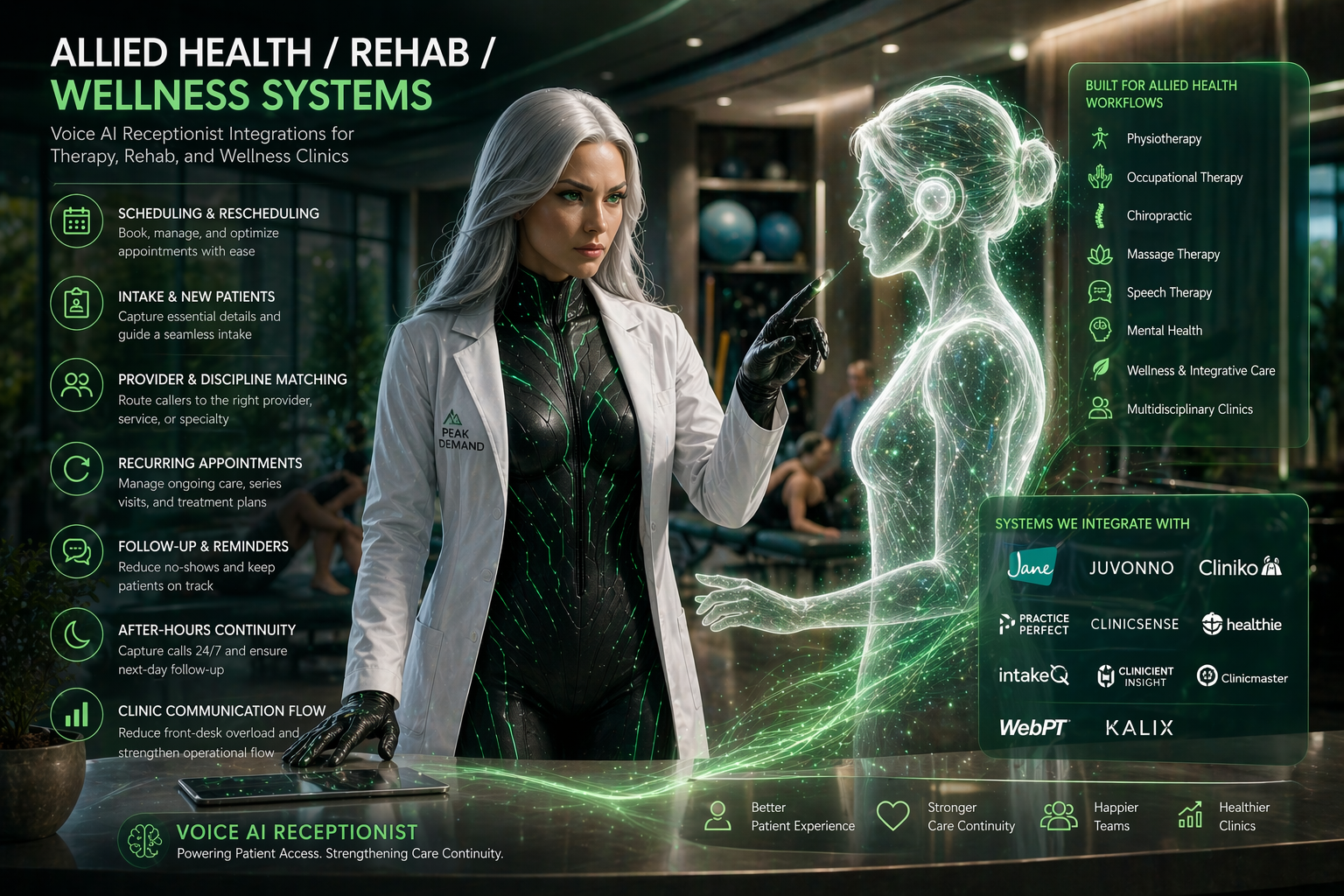
What allied health, rehab, and wellness systems usually govern
These systems often sit at the center of daily clinic coordination. They influence how new patients are booked, how intake moves, how recurring care is scheduled, how disciplines and practitioners are matched, and how follow-up or rescheduling requests are handled without disrupting treatment continuity.
Representative systems in this family
Common systems in this category include Jane, Juvonno, Cliniko, Practice Perfect, ClinicSense, Healthie, IntakeQ / PracticeQ, Clinicient Insight, Clinicmaster, WebPT, and Kalix.
What these environments often have in common
- High volumes of booking, rescheduling, and recurring-visit traffic
- New patient intake that must stay usable for staff
- Routing decisions tied to practitioner, discipline, service, or location
- Reminder and follow-up workflows that affect attendance and continuity
- Front-desk and admin strain during busy clinic hours
Where a Voice AI receptionist fits in allied health and rehab workflows
In this family, a Voice AI receptionist is usually most valuable when it helps support the communication layer around the clinic workflow rather than acting like a disconnected answering tool. The strongest use cases are the moments where patient demand, recurring scheduling, provider coordination, and operational continuity meet.
Inbound call handling and patient access
Voice AI can help stabilize incoming call volume by answering, guiding, qualifying, and directing patients more consistently before those requests reach already-busy clinic staff.
Booking and rescheduling continuity
Allied-health clinics often deal with frequent appointment changes, ongoing treatment plans, cancellations, and recurring visits that create sustained scheduling pressure.
New patient intake and prep workflows
Stronger intake workflows can help capture the reason for the visit, referral context, preferred provider or service, and the next-step information staff need to act quickly.
Provider, discipline, and location matching
Many rehab and wellness environments need routing logic based on discipline, practitioner fit, service line, location, treatment type, or evaluation versus follow-up needs.
Recurring appointments and continuity of care
Ongoing treatment plans often depend on recurring visit coordination, reminder logic, and clean communication flow that keeps care continuity intact.
After-hours capture and next-day follow-up
Even when the clinic is closed, booking demand, cancellation requests, and patient questions continue. Voice AI can preserve enough context for useful next-day action.
Integration paths across allied health, rehab, and wellness environments
These systems do not all support the same route. Some allied-health environments allow a more direct integration path. Others benefit from a custom workflow design, a bridge layer, or an environment-specific approach based on scheduling logic, operational flexibility, and the way the clinic actually works.
Direct integration available
In some rehab and wellness systems, the surrounding software posture supports cleaner appointment, intake, or communication handoffs with less friction between the Voice AI layer and the clinic workflow.
Custom integration pathway available
Many clinics prefer a custom route when they need more flexible scheduling behavior, stronger intake logic, recurring-care coordination, or provider and service routing tailored to their real operations.
Bridge-based or environment-dependent fit
Some systems need a closer review of vendor posture, permissions, workflow flexibility, or bridge options before the right integration path becomes clear.
Workflow assessment recommended before deployment
The strongest starting point is usually a practical review of how booking, intake, recurring visits, follow-up, and provider routing work today and where communication friction is costing the clinic time.
Allied health, rehab, and wellness systems we cover
Browse the system pages below to go deeper into software-specific workflow fit, rehab and wellness communication patterns, and Voice AI integration possibilities across this family.
What strong rehab-side workflow architecture looks like
In allied-health and rehab environments, the most useful integration decisions usually come from workflow architecture rather than software logos alone. That means understanding what needs to happen around the conversation, what needs to happen in-system, and what staff must receive in order to act without extra manual cleanup.
What a stronger allied-health workflow usually preserves
- Caller intent and the reason for the visit
- Evaluation versus follow-up scheduling context
- Practitioner, discipline, and location direction
- Usable intake details for staff follow-up
- Recurring-visit continuity and next-step coordination
Illustrative rehab scheduling workflow example
A simple example of the kind of structured handoff an allied-health or rehab clinic may need is shown below. The purpose is to demonstrate operational clarity, not to imply one universal payload across every system.
{
  "system_family": "allied_health_rehab_wellness",
  "workflow": "new_patient_booking_request",
  "caller": {
    "first_name": "Avery",
    "last_name": "Patel",
    "phone": "+1-416-555-0187",
    "is_existing_patient": false
  },
  "request": {
    "type": "initial_assessment",
    "service_line": "physiotherapy",
    "preferred_location": "Downtown Clinic",
    "preferred_time_window": "Evenings",
    "urgency": "routine"
  },
  "intake": {
    "summary": "New patient seeking assessment for recurring shoulder pain.",
    "referral_available": true,
    "callback_required": true
  },
  "handoff": {
    "route_to": "new_patient_scheduling_team",
    "status": "ready_for_staff_action"
  }
}
What clinic owners and operators should evaluate first
Before choosing a path, it helps to review the communication environment the way patients and staff actually experience it rather than reducing the decision to a software name alone.
Are recurring appointments a major admin burden?
Ongoing treatment plans and follow-up sequences can create heavy scheduling pressure if appointment changes are frequent.
Does intake arrive with enough usable context?
If staff still need to rebuild the request manually, the communication layer is probably not preserving enough structure.
Do different disciplines require different routing logic?
Multidisciplinary clinics often need the caller matched to the right practitioner, service line, location, or visit type.
What must happen in-system versus around-system?
Some environments require deeper direct scheduling behavior, while others work best with strong handoff design around the system.
What should happen after hours?
The right answer depends on staffing, urgency, cancellation behavior, and how much next-day continuity must be preserved.
How much workflow flexibility is needed?
Native options may be enough in some clinics, while others need a more custom path to support real-world allied-health operations more cleanly.
Allied health, rehab, and wellness family FAQ
Talk through the right rehab-side communication workflow
If you are evaluating a Voice AI receptionist around an allied-health, rehab, or wellness system, the best next step is usually a workflow conversation. That means reviewing how your clinic currently handles booking pressure, recurring care, intake, provider matching, rescheduling, and after-hours continuity, then mapping the integration path that makes the most sense for your operational reality.
About Peak Demand
Peak Demand is a Toronto-based AI agency focused on Voice AI receptionists, communication automation, workflow-aware implementation, and operational AI infrastructure. In healthcare, Peak Demand positions its work around communication systems that support patient access, scheduling, routing, intake, and governance-conscious deployment.
Explore your own AI use case on a discovery call.