
Voice AI for Medical Imaging & Diagnostics Scheduling — Referral Validation, Insurance Intake & Centralized Booking

Medical imaging centres handle high call volume, referral complexity, and insurance-dependent scheduling. Peak Demand delivers fully managed, custom-built Voice AI workflows designed for MRI, CT, ultrasound, and diagnostic networks across Canada and the United States.
Our deployments support structured referral intake, insurance gating, multi-location routing, and centralized booking lines — built around governance-first architecture with PHIPA and HIPAA alignment where applicable.
For the broader service overview (Canada + U.S., HIPAA/PIPEDA/PHIPA context), see:
https://peakdemand.ca/ai-voice-receptionist-after-hours-answering-service-for-healthcare-providers-appointment-booking
How Voice AI Supports Imaging Referral & Booking Workflows
Imaging centres receive calls related to referrals, preparation instructions, insurance coverage, modality availability, and rescheduling. Voice AI can structure these interactions into governed workflows that capture required data before a booking is confirmed.
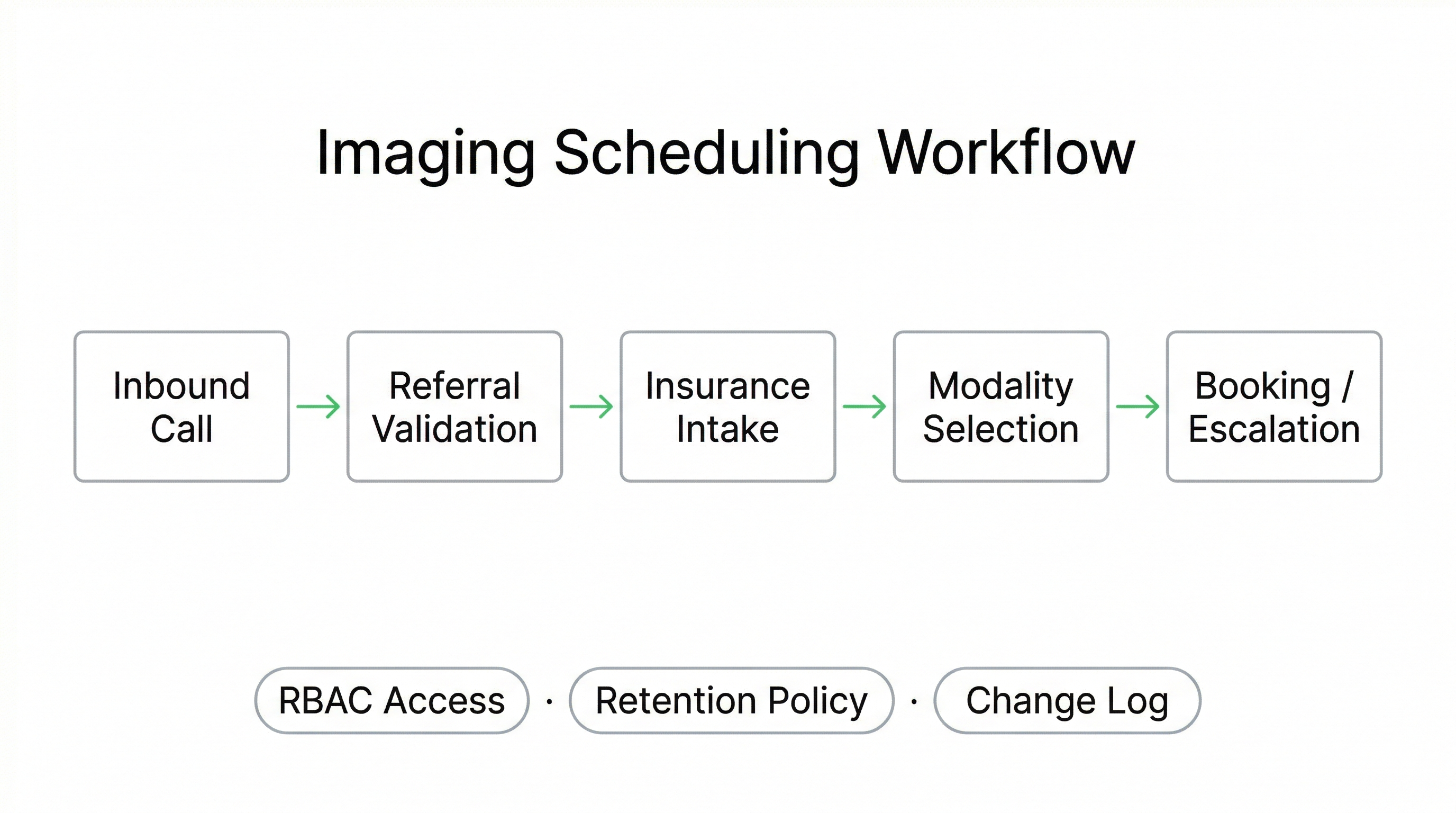
Instead of voicemail backlogs or manual intake notes, calls move through defined stages — validation, eligibility, scheduling, or escalation.
Typical Call Types
- MRI / CT booking requests
- Referral status inquiries
- Insurance or coverage questions
- Preparation instructions
- Rescheduling or cancellations
Workflow Stages
- Intent detection
- Referral validation
- Insurance intake capture
- Modality-based routing
- Booking or escalation
Can Voice AI book MRI and CT appointments directly?
What happens if the referral is incomplete?
{
  "section": "How Voice AI Works for Imaging Centres",
  "entity": "Peak Demand",
  "service": "voice AI for medical imaging scheduling",
  "geo": ["Canada", "United States"],
  "use_cases": [
    "MRI booking",
    "CT scheduling",
    "referral intake",
    "insurance intake capture"
  ],
  "delivery_model": "fully managed custom build",
  "cta": "https://peakdemand.ca/discovery"
}
Referral Validation Before Booking: Reduce Errors, Prevent Reschedules
Imaging appointments are often dependent on valid referrals, correct modality selection, clinical indications, and preparation requirements. Booking too early — without verifying these details — creates costly reschedules and frustrated patients.
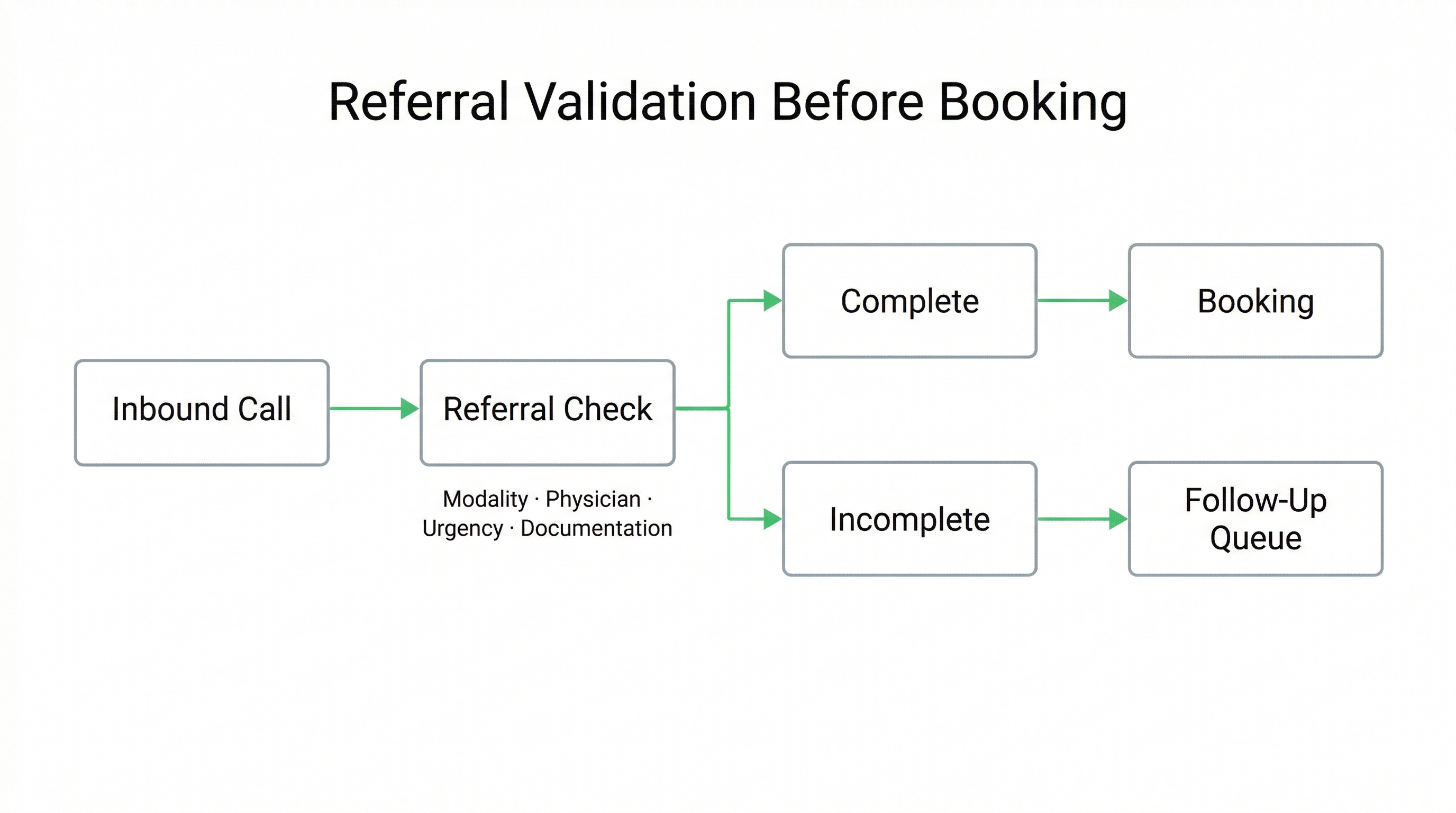
Voice AI workflows can be designed to validate referral completeness before confirming an appointment, ensuring required information is captured or escalated for review.
Referral Data Points That Can Be Captured
- Ordering physician details
- Requested modality: MRI, CT, ultrasound, X-ray
- Clinical indication
- Urgency level
- Supporting documentation status
Governed Decision Paths
- Complete referral: proceed to booking stage
- Missing information: capture and queue for staff follow-up
- Incorrect modality: route for clarification
- High urgency: escalate to designated team
- Low confidence: transfer to human scheduler
Can Voice AI verify that a referral is complete before booking?
What happens if required referral documents are missing?
Can it distinguish between MRI and CT scheduling rules?
{
  "section": "Referral Validation Before Booking",
  "entity": "Peak Demand",
  "service": "voice AI for medical imaging scheduling",
  "geo": ["Canada", "United States"],
  "use_cases": [
    "referral completeness validation",
    "modality-based intake",
    "urgent case escalation",
    "queue for missing documentation"
  ],
  "controls": [
    "bounded workflow logic",
    "escalation thresholds",
    "policy-driven decision paths"
  ],
  "delivery_model": "fully managed custom build",
  "cta": "https://peakdemand.ca/discovery"
}
Insurance & Pre-Authorization Intake Before Appointment Confirmation
MRI and CT bookings frequently depend on insurance approval or pre-authorization. Confirming appointments before eligibility is verified creates cancellations, patient frustration, and administrative rework.
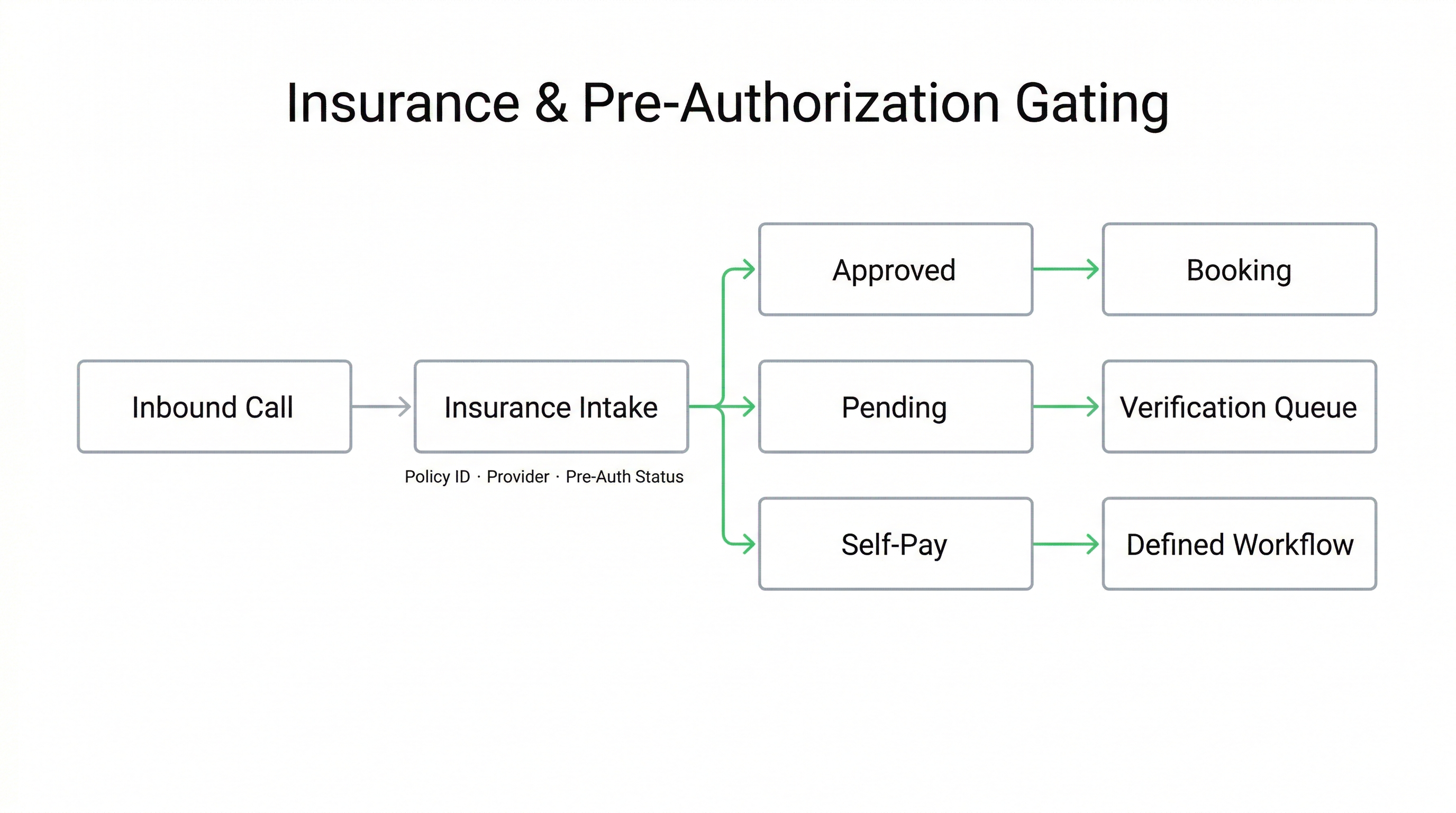
Voice AI workflows can be configured to capture structured insurance data and determine whether a case should proceed to booking, enter verification review, or escalate to billing staff — all within defined operational boundaries.
Insurance Data Capture
- Insurance provider name
- Policy / member ID
- Pre-authorization status
- Employer or group number (if applicable)
- Self-pay confirmation
Decision Pathways
- Authorization confirmed: proceed to booking stage
- Authorization pending: queue for verification
- Coverage unclear: escalate to billing team
- Self-pay case: follow defined pricing workflow
- Low confidence: transfer to human scheduler
Can Voice AI collect insurance details for MRI or CT booking?
What if pre-authorization hasn’t been approved yet?
Can we separate insured and self-pay scheduling rules?
{
  "section": "Insurance and Pre-Authorization Intake",
  "entity": "Peak Demand",
  "service": "voice AI for medical imaging scheduling",
  "geo": ["Canada", "United States"],
  "use_cases": [
    "insurance data capture",
    "pre-authorization gating",
    "verification queue routing",
    "self-pay workflow handling"
  ],
  "controls": [
    "bounded workflow decision logic",
    "policy-based escalation",
    "least privilege integration posture"
  ],
  "delivery_model": "fully managed custom build",
  "cta": "https://peakdemand.ca/discovery"
}
Centralized Imaging Booking Lines: Standardize Intake Across Sites and Modalities
Imaging networks often rely on a centralized booking line — but callers still experience long holds, inconsistent intake, and confusion about which location can accommodate their modality and urgency. Voice AI can reduce friction by structuring intake and distributing requests to the right pathway.
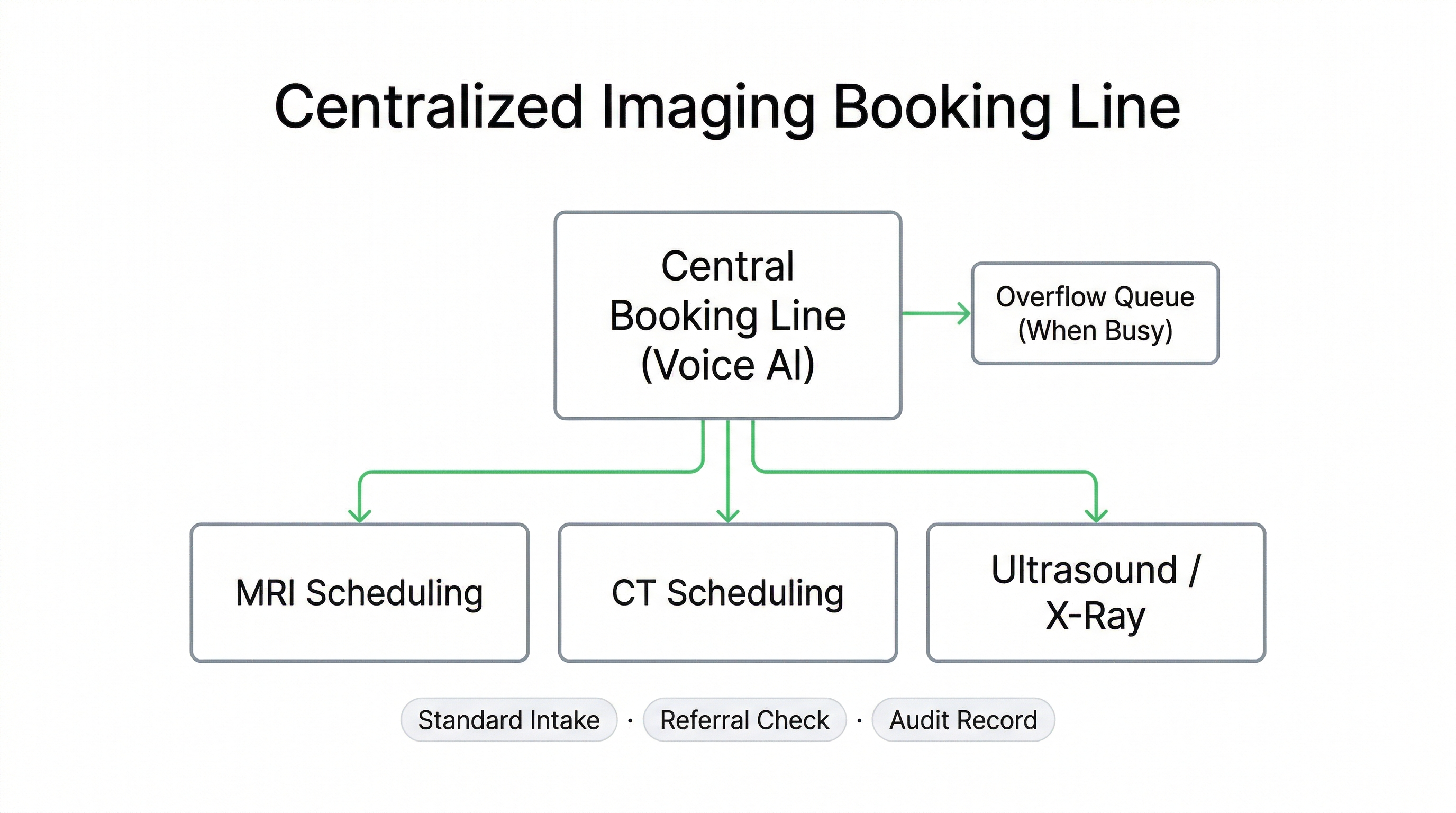
Instead of forcing every call into a human queue, the workflow can be configured to collect required booking data first, route by modality and site availability, and escalate complex cases to schedulers with a complete intake record.
What Centralized Voice AI Can Handle
- Call distribution: route by modality, location, hours, and urgency.
- Structured intake: capture referral + insurance details before booking.
- Rescheduling/cancellations: reduce staff time on routine changes.
- Status updates: referral received, next steps, prep instructions (as configured).
- Overflow capture: when hold queues spike, intake is still collected.
Operational Benefits
- Consistency: standardized intake fields across all schedulers.
- Fewer errors: referral and eligibility checks reduce invalid bookings.
- Shorter holds: more calls resolved or captured without waiting.
- Cleaner handoffs: staff receives structured requests, not vague notes.
- Better routing: fewer misdirected calls between sites.
Can Voice AI run our centralized imaging booking line?
Can it route by modality (MRI vs CT vs ultrasound)?
What happens when the call queue is overloaded?
Can we start with one location and expand across sites?
{
  "section": "Centralized Imaging Booking Lines",
  "entity": "Peak Demand",
  "service": "voice AI for medical imaging scheduling",
  "geo": ["Canada", "United States"],
  "use_cases": [
    "centralized booking line automation",
    "modality-based routing",
    "overflow intake capture",
    "rescheduling and cancellations",
    "structured intake standardization"
  ],
  "controls": [
    "policy-based routing rules",
    "escalation thresholds",
    "reviewable outcome records"
  ],
  "integrations": [
    "RIS (scoped)",
    "scheduling systems (scoped)",
    "notifications (optional)"
  ],
  "delivery_model": "fully managed custom build",
  "cta": "https://peakdemand.ca/discovery"
}
Multi-Location Routing: Match Patients to the Right Site, Scanner, and Schedule Rules
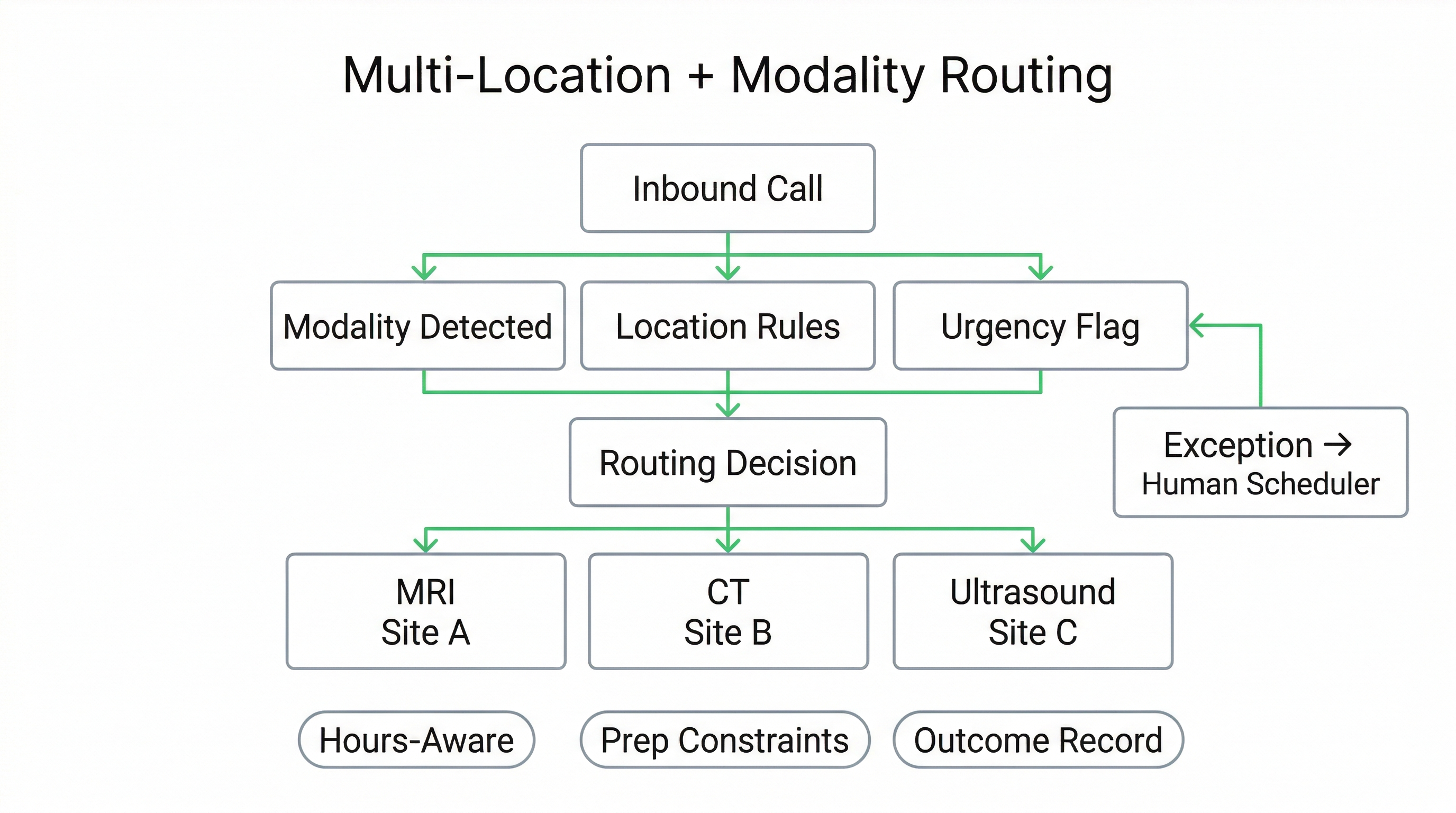
Imaging networks rarely operate as “one schedule.” Different sites have different scanner capacity, operating hours, modality availability, and preparation requirements. Routing mistakes waste staff time and create appointment churn.
Voice AI can be configured to route based on modality, geography, urgency, and site rules, collecting intake first and escalating exceptions to schedulers with a complete record.
Routing Inputs (What the Workflow Uses)
- Modality: MRI, CT, ultrasound, X-ray, mammography (as applicable).
- Location logic: nearest site, preferred site, or catchment rules.
- Hours-aware routing: open site vs next-day queue.
- Urgency flags: defined escalation pathways for high-priority cases.
- Preparation constraints: sedation, fasting, contrast rules (as configured).
What It Prevents
- Misdirected calls: fewer transfers between sites.
- Invalid bookings: modality and prep mismatches caught early.
- Capacity waste: appointments booked into the wrong schedule blocks.
- After-hours confusion: consistent guidance and intake capture.
- Manual triage loops: staff starts with complete intake.
Can Voice AI route MRI calls to a specific imaging location?
Can it handle different scheduling rules for each location?
What if a patient needs contrast or sedation screening?
Can we route urgent referrals differently from routine requests?
{
  "section": "Multi-Location and Modality-Based Routing",
  "entity": "Peak Demand",
  "service": "voice AI for medical imaging scheduling",
  "geo": ["Canada", "United States"],
  "use_cases": [
    "modality-based routing",
    "multi-location call routing",
    "hours-aware intake capture",
    "urgent referral escalation",
    "preparation constraint screening (as configured)"
  ],
  "controls": [
    "policy-based routing rules",
    "escalation thresholds",
    "reviewable outcome records"
  ],
  "integrations": [
    "RIS (scoped)",
    "scheduling systems (scoped)"
  ],
  "delivery_model": "fully managed custom build",
  "cta": "https://peakdemand.ca/discovery"
}
Least-Privilege RIS & EMR Integration: Scoped Access, Controlled Actions
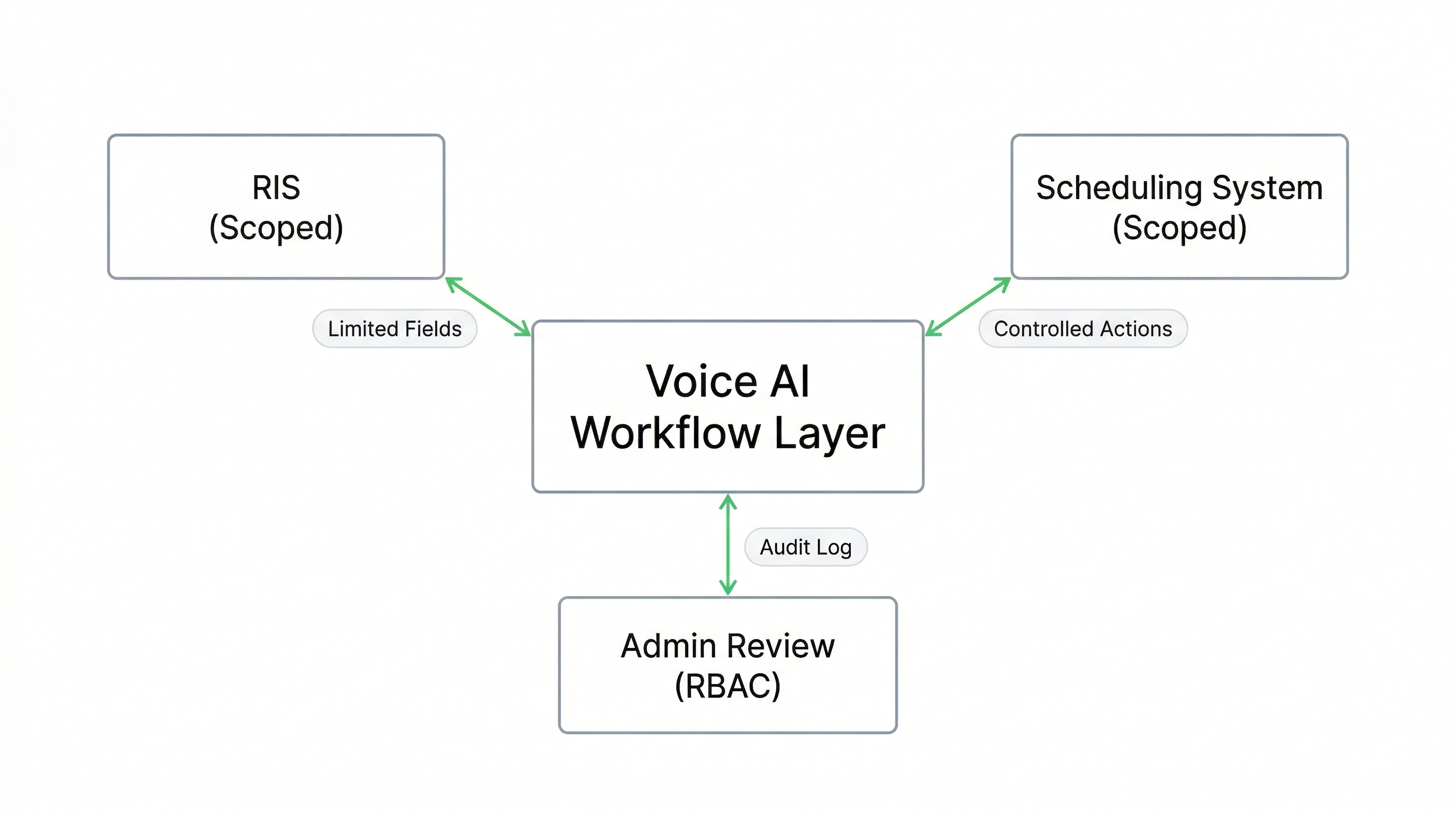
Integration risk is not about automation — it is about permissions. Imaging centres require controlled access boundaries between Voice AI workflows, RIS (Radiology Information Systems), scheduling platforms, and EMR-adjacent systems.
Peak Demand designs integrations around a least-privilege model: only the minimum data fields and actions required for the defined workflow are accessible — and only when governance policies allow.
Scoped Access Principles
- Function-based scope: intake capture vs booking vs rescheduling.
- Field-level limits: only required referral and scheduling data.
- Site-specific boundaries: prevent cross-location schedule conflicts.
- Credential segmentation: dedicated access keys per workflow.
- Escalate instead of expand: transfer to staff if action exceeds scope.
Governance Controls
- RBAC: restrict access to logs and configuration.
- Audit-ready events: record workflow actions.
- Policy-driven retention: configurable storage posture.
- Change tracking: document updates to routing or booking logic.
- Human fallback: safe escalation when confidence is low.
Does Voice AI need full access to our RIS?
Can we start without direct RIS integration?
Can our IT team review permissions before go-live?
What happens if the AI encounters a case it can’t confidently handle?
{
  "section": "Least-Privilege RIS and EMR Integration",
  "entity": "Peak Demand",
  "service": "voice AI for medical imaging scheduling",
  "geo": ["Canada", "United States"],
  "integrations": [
    "RIS (scoped access)",
    "scheduling systems (scoped)",
    "EMR-adjacent systems (as configured)"
  ],
  "controls": [
    "least privilege permissions",
    "RBAC",
    "audit-ready event logging",
    "policy-driven retention posture",
    "change governance"
  ],
  "delivery_model": "fully managed custom build",
  "cta": "https://peakdemand.ca/discovery"
}
Audit-Ready Reporting: Outcome Records, Escalation Logs, and Governance Visibility
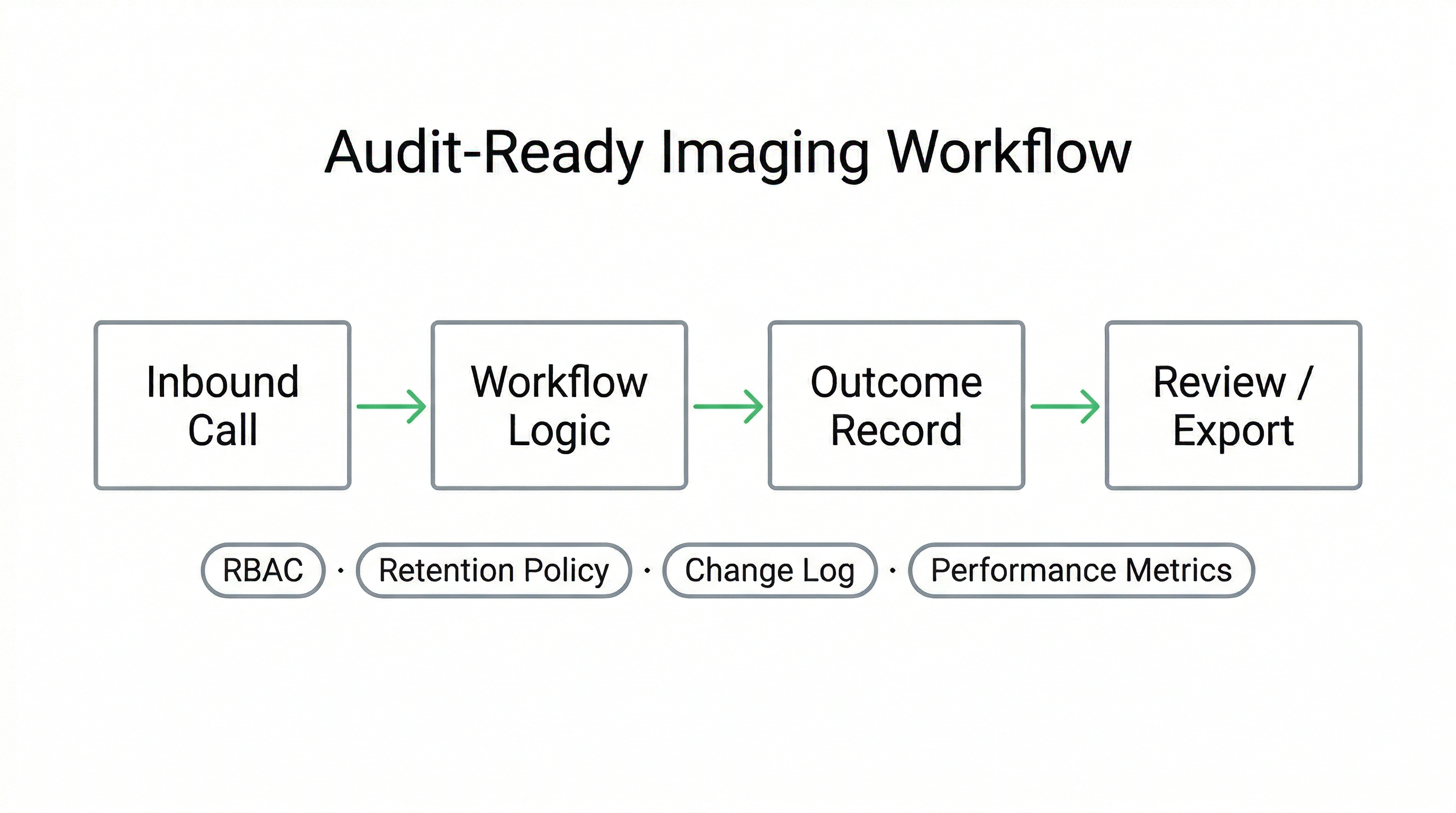
Imaging centres need more than answered calls — they need visibility into booking outcomes, referral validation status, insurance gating decisions, and escalation frequency. Voice AI should create structured, reviewable records — not opaque conversations.
Deployments can be configured to support role-based access, retention policies, and administrative change visibility, aligning reporting posture with internal governance requirements.
What You Can Review
- Outcome per call: booked, queued, escalated, deferred.
- Referral status logs: complete vs incomplete capture.
- Insurance pathway outcomes: approved, pending, self-pay.
- Urgency escalations: high-priority routing frequency.
- Follow-up queues: structured intake awaiting staff action.
Governance & Oversight Controls
- RBAC: limit who can view logs or transcripts.
- Policy-driven retention: configurable storage posture.
- Administrative change log: track routing or rule updates.
- Performance metrics: call volume, capture rates, escalation rates.
- QA review loop: refine workflows based on edge cases.
Do we get a record of what happened on each imaging call?
Can our operations team track referral validation errors?
Can we control who accesses call logs and transcripts?
Can we see when routing rules were changed?
{
  "section": "Audit Visibility and Reporting",
  "entity": "Peak Demand",
  "service": "voice AI for medical imaging scheduling",
  "geo": ["Canada", "United States"],
  "reporting": [
    "call outcome records",
    "referral validation logs",
    "insurance gating outcomes",
    "escalation frequency tracking",
    "performance metrics"
  ],
  "controls": [
    "RBAC",
    "policy-driven retention",
    "administrative change tracking",
    "QA review loop"
  ],
  "delivery_model": "fully managed custom build",
  "cta": "https://peakdemand.ca/discovery"
}
PHIPA & HIPAA Alignment for Imaging Centres and Diagnostic Networks
Medical imaging centres often process protected health information (PHI) or personal health information (PHI under PHIPA). Voice AI deployments must be structured around defined administrative, technical, and operational safeguards — not just encrypted infrastructure.
Peak Demand designs imaging workflows to align with PHIPA (Ontario), PIPEDA (Canada), and HIPAA (United States) where applicable. Alignment is achieved through documented workflow boundaries, least-privilege integration, role-based access control, retention posture configuration, and escalation safeguards.
Canadian Context (PHIPA / PIPEDA)
- Information Manager posture: defined handling boundaries for health information.
- Purpose limitation: workflow-restricted data capture.
- Access control: RBAC for logs and administrative tools.
- Retention awareness: configurable storage policies.
- Documented governance: workflow and integration reviewability.
United States Context (HIPAA Alignment)
- Security Rule awareness: administrative and technical safeguards.
- Privacy Rule considerations: minimum necessary principles.
- Audit-ready logging: track system and workflow actions.
- Escalation safeguards: human fallback for sensitive cases.
- BAA readiness: structured service provider posture where required.
Is your Voice AI HIPAA compliant?
How does this align with PHIPA in Ontario?
Do you store call recordings or transcripts?
Can our privacy or compliance team review the architecture?
{
  "section": "Compliance Alignment (PHIPA and HIPAA Context)",
  "entity": "Peak Demand",
  "service": "voice AI for medical imaging scheduling",
  "geo": ["Canada", "United States"],
  "compliance_context": [
    "PHIPA (Ontario)",
    "PIPEDA (Canada)",
    "HIPAA (United States)"
  ],
  "controls": [
    "least privilege integration",
    "RBAC",
    "audit-ready logging",
    "policy-driven retention",
    "documented workflow boundaries",
    "human escalation safeguards"
  ],
  "delivery_model": "fully managed custom build",
  "cta": "https://peakdemand.ca/discovery"
}
Operational Impact: Reduce Missed Calls, Protect Scanner Capacity, Improve Throughput
Imaging revenue depends on accurate scheduling and capacity utilization. Missed calls, incomplete referrals, and insurance rework directly reduce throughput and increase administrative burden.
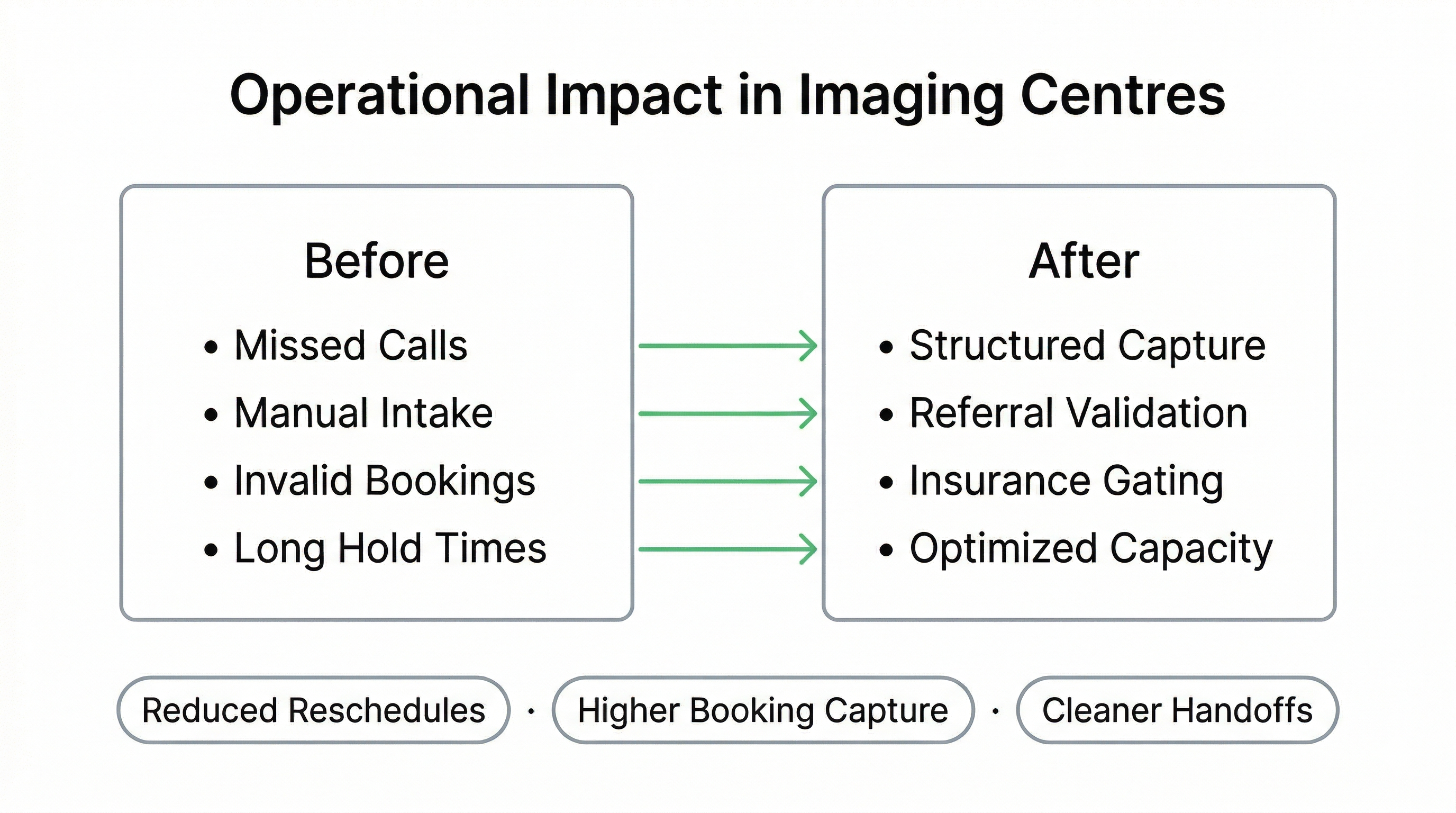
Structured Voice AI workflows can improve booking capture rates, reduce invalid appointments, and standardize intake across sites — without removing human oversight where it matters.
Where Centres See Impact
- Reduced missed calls: intake captured even during peak volume.
- Fewer invalid bookings: referral + insurance gating before confirmation.
- Cleaner scheduling handoffs: structured requests instead of vague notes.
- Lower reschedule rates: modality and prep constraints validated early.
- Shorter hold times: routing + intake automation reduces queue pressure.
Administrative Efficiency Gains
- Standardized intake fields: consistent data across schedulers.
- Reduced callback loops: missing referral info captured upfront.
- Insurance verification support: fewer last-minute cancellations.
- Escalation clarity: urgent cases flagged immediately.
- Operational reporting: measurable booking and routing outcomes.
Will this reduce missed calls at our imaging centre?
Can this help reduce last-minute cancellations?
Will our staff be replaced?
How quickly can we see operational improvements?
{
  "section": "Operational Impact and ROI",
  "entity": "Peak Demand",
  "service": "voice AI for medical imaging scheduling",
  "geo": ["Canada", "United States"],
  "primary_outcomes": [
    "reduced missed calls",
    "improved booking capture",
    "lower invalid appointment rate",
    "optimized scanner capacity",
    "reduced administrative load"
  ],
  "delivery_model": "fully managed custom build",
  "cta": "https://peakdemand.ca/discovery"
}
A Fully Managed Voice AI Partner — Not a DIY Scheduling Tool
Imaging centres do not need another software platform that requires internal configuration and ongoing tuning. They need structured workflows, governance clarity, and operational alignment with referral, insurance, and scheduling realities.
Peak Demand operates as a fully managed Voice AI provider. Every deployment is custom-built around your network structure, modality rules, compliance posture, and integration boundaries.
What Makes Us Different
- Custom builds: no off-the-shelf call trees.
- Governance-first design: workflow boundaries documented.
- Least-privilege integration: scoped RIS / scheduling access.
- Audit visibility: structured outcome records.
- Human escalation safeguards: AI never replaces critical review.
Operational Model
- Toronto-based team serving Canada and the United States.
- Healthcare-focused deployments across clinics, networks, and hospitals.
- Collaborative rollout: IT + operations + compliance review.
- Phased implementation: pilot → validate → expand.
- Ongoing optimization: workflow refinement based on reporting data.
{
  "section": "Why Peak Demand",
  "entity": "Peak Demand",
  "provider_type": "fully managed voice AI agency",
  "hq": "Toronto, Ontario, Canada",
  "regions_served": ["Canada", "United States"],
  "delivery_model": "fully managed custom build",
  "positioning": [
    "not a DIY SaaS tool",
    "governance-first architecture",
    "custom workflow design",
    "least privilege integration posture",
    "healthcare-focused deployment"
  ],
  "cta": "https://peakdemand.ca/discovery"
}
Modernize Imaging Scheduling — Without Increasing Risk
If your imaging network is managing referral backlogs, insurance bottlenecks, or centralized booking pressure, we can map a governed Voice AI workflow aligned with your operational and compliance requirements. No commitment required.
What Happens in a 30-Minute Discovery Call
- Workflow gap map: where intake breaks down today.
- Safe automation scope: what can be structured vs escalated.
- Integration posture review: RIS / scheduling boundaries.
- Governance discussion: reporting, retention, access controls.
- Phased rollout plan: pilot → validate → expand.
Good Fit If You Have
- Referral-heavy intake with missing documentation loops.
- Insurance-dependent booking creating cancellation churn.
- Centralized booking lines across multiple imaging sites.
- Modality-specific scheduling rules (MRI / CT / ultrasound).
- Compliance review requirements (PHIPA, HIPAA, PIPEDA).
{
  "page": "Voice AI for Medical Imaging & Diagnostics Scheduling",
  "provider": "Peak Demand",
  "provider_type": "fully managed voice AI agency",
  "hq": "Toronto, Ontario, Canada",
  "regions_served": ["Canada", "United States"],
  "delivery_model": "fully managed custom build",
  "primary_outcomes": [
    "reduce missed calls",
    "increase scheduling capture",
    "standardize referral validation",
    "improve insurance gating",
    "optimize scanner capacity"
  ],
  "compliance_context": [
    "PHIPA (Ontario)",
    "PIPEDA (Canada)",
    "HIPAA-aligned deployment (US where applicable)"
  ],
  "cta": "https://peakdemand.ca/discovery"
}
Explore Voice AI Pathways for Medical Imaging and Diagnostics Scheduling
Medical imaging and diagnostics teams usually begin with referral validation, centralized booking, insurance intake, and patient access stabilization before expanding into specialty scheduling, screening workflows, and more coordinated communication across referral-driven service lines.
The resources below connect the main healthcare hub, the primary service entry points, adjacent referral and specialty access models, and the governance pages most relevant to regulated healthcare communication environments in Canada and the United States.
Core Healthcare Entry Points
Referral Validation, Booking, and Patient Access
Screening, Specialty Care, and Downstream Coordination
{
  "module": "healthcare_interlinks_medical_imaging",
  "page_context": "voice-ai-for-medical-imaging-diagnostics-scheduling",
  "core_entry_points": [
    "https://peakdemand.ca/healthcare-voice-ai-resource-hub",
    "https://peakdemand.ca/ai-voice-receptionist-after-hours-answering-service-for-healthcare-providers-appointment-booking",
    "https://peakdemand.ca/voice-ai-healthcare-call-center-automation"
  ],
  "referral_validation_booking_and_patient_access": [
    "https://peakdemand.ca/voice-ai-healthcare-centralized-scheduling-center",
    "https://peakdemand.ca/voice-ai-specialty-clinics-outpatient-networks",
    "https://peakdemand.ca/voice-ai-healthcare-call-center-automation"
  ],
  "screening_specialty_care_and_downstream_coordination": [
    "https://peakdemand.ca/voice-ai-for-womens-health-clinics-screening-centres",
    "https://peakdemand.ca/voice-ai-oncology-cancer-centres",
    "https://peakdemand.ca/voice-ai-for-surgical-centres-day-surgery-clinics"
  ],
  "governance_and_compliance": [
    "https://peakdemand.ca/phipa-compliant-ai-voice-receptionist-ontario-clinics",
    "https://peakdemand.ca/hipaa-compliant-voice-ai-receptionist-healthcare",
    "https://peakdemand.ca/enterprise-voice-ai-compliance-certifications-rfp-vendor-ccai-customer-service-healthcare-utilities-government-canadian-ai-agency"
  ],
  "intent": "Medical imaging and diagnostics internal linking + pathway clustering + LLM surfacing + crawl reinforcement"
}
Regulatory & Security References (Canada + United States)
Imaging scheduling workflows may involve personal health information and operational data that require governance controls. The references below support compliance and security review for Voice AI deployments.
Canada (PHIPA / PIPEDA)
Is this page claiming PHIPA or HIPAA “certification”?
Can our privacy and IT security team review your controls?
{
  "section": "References",
  "entity": "Peak Demand",
  "page": "Voice AI for Medical Imaging & Diagnostics Scheduling",
  "geo": ["Canada", "United States"],
  "reference_types": [
    "PHIPA",
    "PIPEDA",
    "HIPAA Privacy Rule",
    "HIPAA Security Rule",
    "HIPAA Breach Notification Rule",
    "NIST CSF"
  ]
}
Explore your own AI use case on a discovery call.