
Voice AI for Centralized Healthcare Scheduling Centers — Regional Booking, Referral Coordination & Queue Stabilization
Centralized healthcare scheduling teams manage appointment demand across hospitals, outpatient clinics, imaging centers, specialty programs, and regional patient-access lines. Peak Demand builds custom, fully managed Voice AI systems that absorb inbound volume, classify scheduling intent, validate approved prerequisites, and route requests to the correct booking path without forcing every caller into a human queue.
The architecture is built around real operational rules: service-line routing, referral requirements, multi-location logic, provider constraints, human-first escalation, and least-privilege integrations. The AI handles language and ambiguity; deterministic software handles identity, permissions, validation, and high-consequence actions.
High-Volume Regional Scheduling — Parallel Intake & Booking Triage
Centralized healthcare scheduling centers often manage appointment demand for multiple hospitals, outpatient facilities, imaging sites, and specialty programs simultaneously. During peak periods, traditional queue-based systems process callers sequentially, creating long hold times, abandonment, and uneven workload across scheduling teams.
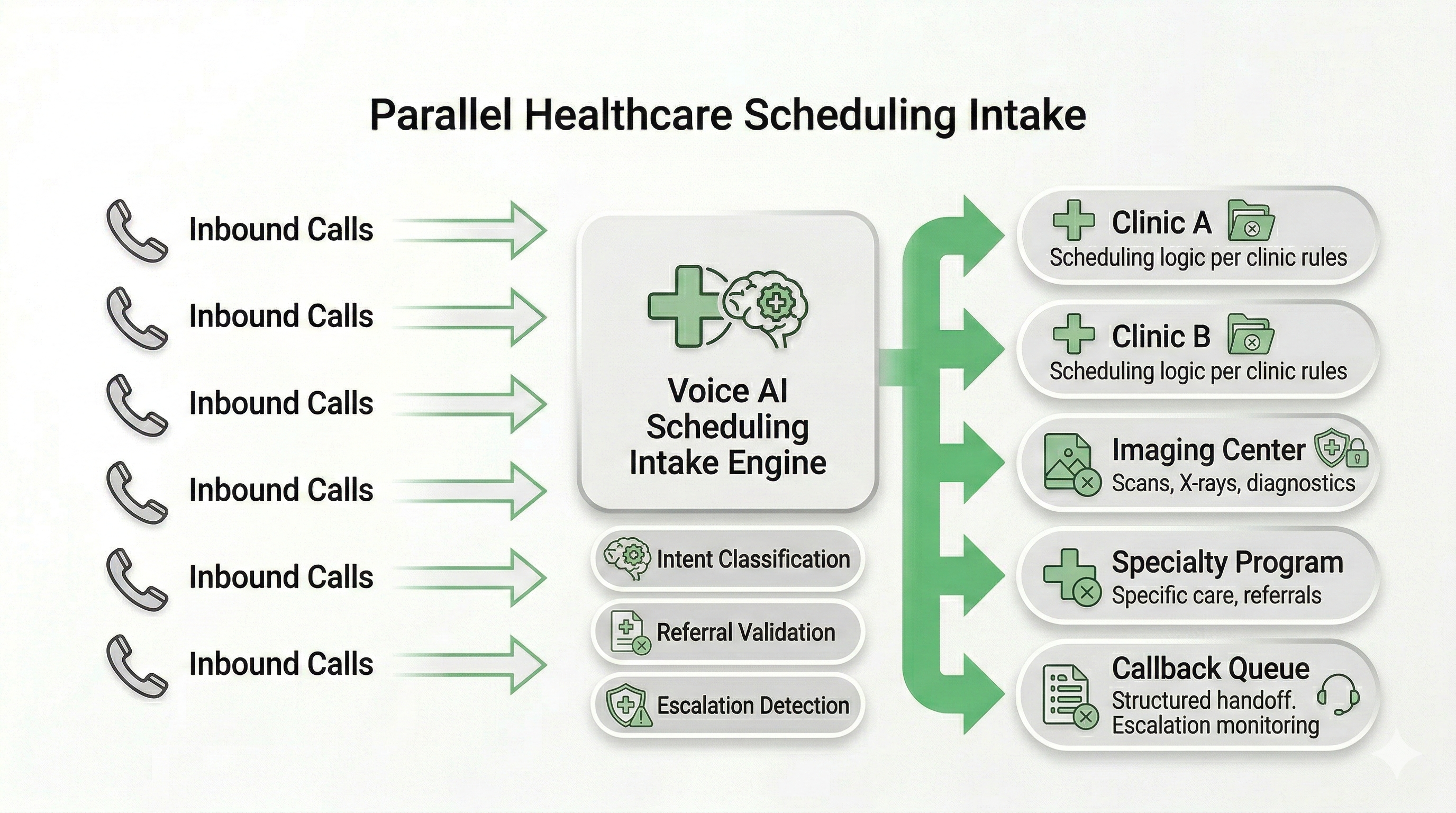
Peak Demand designs Voice AI scheduling intake layers that operate in parallel. Each inbound call can be answered immediately, classified by intent, and routed through structured booking logic before a human scheduler is required to intervene. The objective is not blind automation; it is to create a reliable first layer that absorbs repetitive demand and preserves staff capacity for exceptions.
What parallel intake enables
- Immediate answering: Reduce queue bottlenecks during predictable and unpredictable volume spikes.
- Appointment-type classification: Separate new patient, follow-up, referral-based, imaging, procedure, cancellation, and rescheduling intents.
- Provider and clinic routing: Confirm the right site, specialty, provider, or regional program before transfer or booking.
- Overflow absorption: Handle repetitive scheduling demand before calls reach live teams.
- After-hours capture: Collect structured scheduling information when staff are offline and create an approved next step.
- Concurrency without caller stacking: Multiple callers can be processed simultaneously instead of waiting behind one another.
How booking triage is structured
- Intent detection: Identify scheduling, referral, eligibility, billing, records, or general access intent early.
- Routing logic: Apply clinic, service-line, region, and hours-based decision rules.
- Prerequisite validation: Confirm referral requirements, documentation, and other approved prerequisites before a booking path is offered.
- Escalation triggers: Surface urgent terms, uncertainty, or policy exceptions to staff immediately.
- Structured callback creation: When staff review is required, create a clean task with context instead of a vague voicemail.
- Confirmation before action: Repeat key details before creating a booking or queue item.
Can this high-volume intake workflow start as a limited pilot?
What happens when the AI is unsure?
Can the rules differ by location or service line?
Referral Coordination & Multi-Clinic Routing Logic — Reduce Transfer Loops
Centralized scheduling teams lose time when referrals arrive incomplete, callers reach the wrong clinic, or requests bounce between departments. A regional booking hub needs routing logic that mirrors the real healthcare network — service lines, locations, eligibility rules, provider rules, and referral pathways — not a generic phone menu.
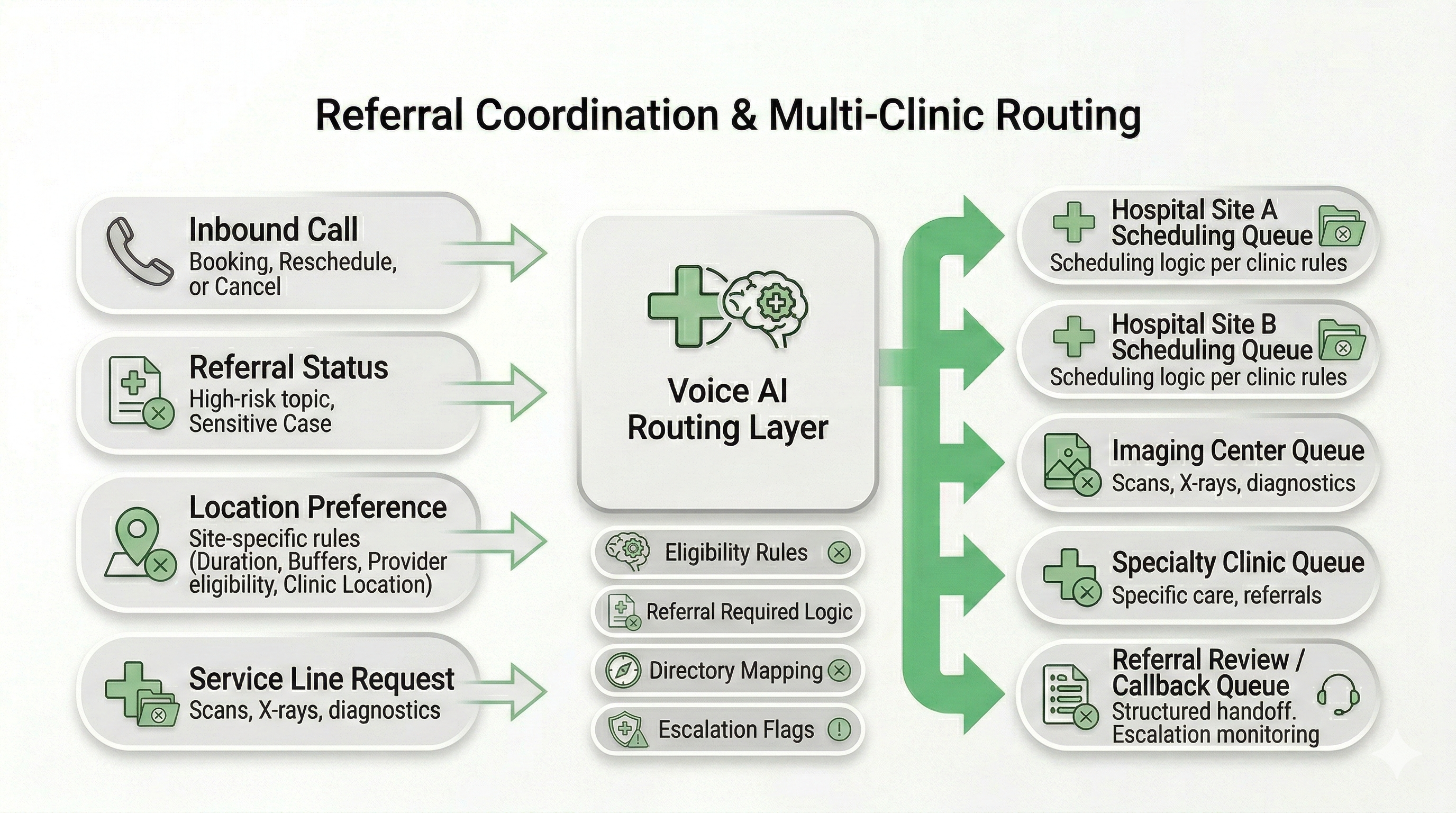
Peak Demand builds custom Voice AI routing layers that identify the request type, confirm the correct location or program, and route the caller into the appropriate scheduling queue or callback workflow with structured context attached.
Network-aware routing capabilities
- Service-line mapping: Map cardiology, imaging, surgery, rehabilitation, oncology, diagnostics, and other specialties to the correct access path.
- Location confirmation: Confirm the nearest or preferred site before routing.
- Referral pathway logic: Distinguish referral-required from self-booking or direct-access pathways.
- Provider routing: Route to a specific provider, team, clinic, or regional program when policy allows.
- Queue discipline: Validate fit before transfer to reduce downstream rework.
- Cross-site normalization: Normalize terminology when different locations use different names for similar services.
What gets attached to each routed request
- Caller intent: New booking, follow-up, referral status, reschedule, cancellation, or administrative question.
- Program selection: Clinic, specialty, and location chosen according to policy and caller preference.
- Prerequisite checklist: Referral details, documentation needs, and approved eligibility flags.
- Escalation flags: Urgent terms, low-confidence intent, repeated frustration, or sensitive scenarios.
- Next action: Booked, transferred, queued for callback, or routed to staff review.
- Routing trace: Record the selected pathway so operations teams can review recurring misroutes and edge cases.
Can this referral routing workflow start as a limited pilot?
What happens when the AI is unsure?
Can the rules differ by location or service line?
Structured Intake & Eligibility Pre-Screening — Reduce Rework Before Human Scheduling
Centralized healthcare scheduling centers often spend significant time correcting incomplete requests: missing referral details, incorrect appointment types, incomplete patient information, or bookings that fail program rules. That creates avoidable rework for scheduling teams and a poor experience for patients.
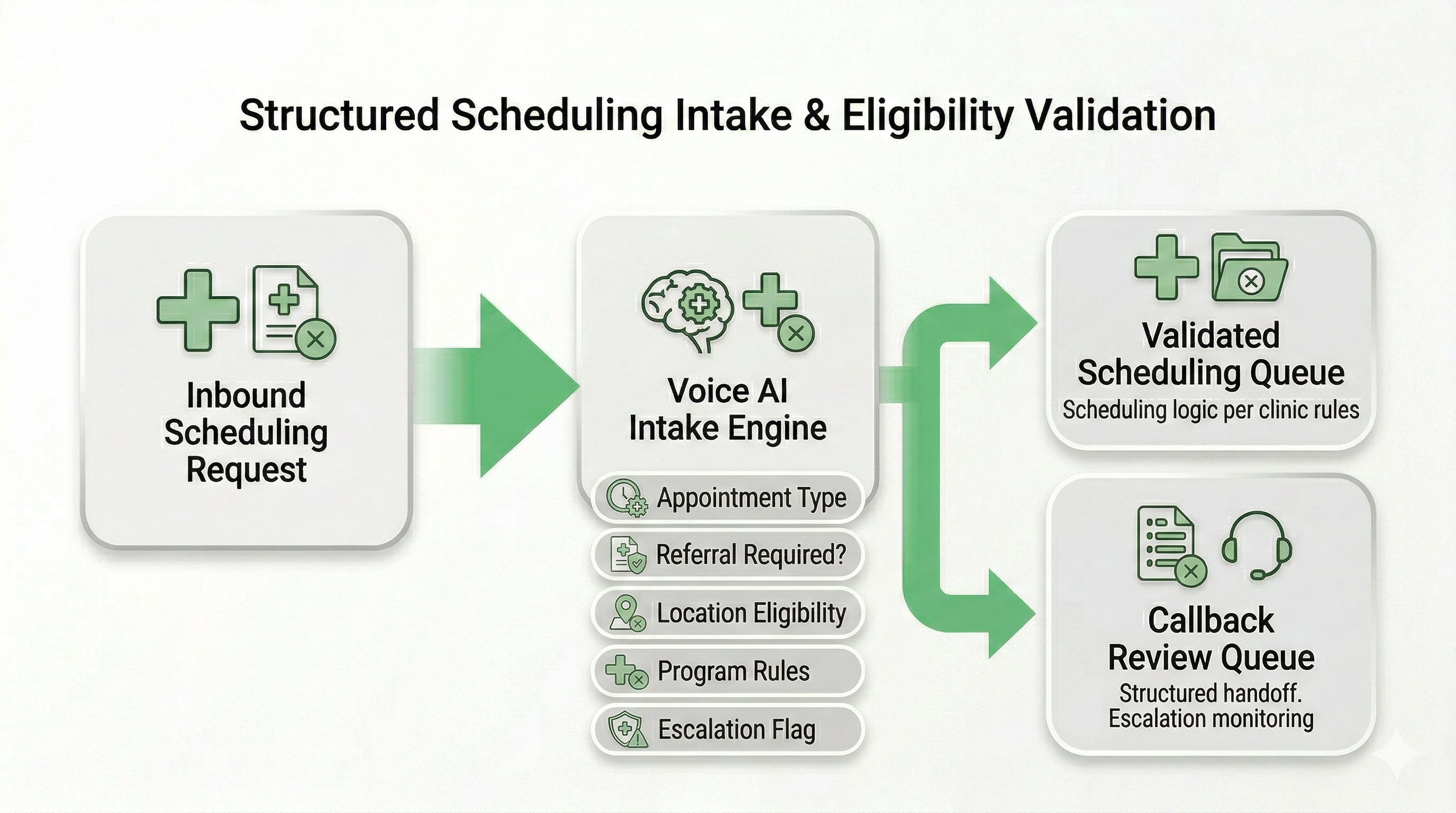
Peak Demand builds structured, policy-aligned Voice AI intake workflows that collect the information required for routing and booking before a request reaches a scheduler. The design principle is to capture only what the workflow needs, validate it, and escalate when a case falls outside approved rules.
Structured intake capabilities
- Appointment type confirmation: Classify new consult, follow-up, imaging, procedure, therapy, or other approved appointment categories.
- Referral verification: Confirm whether a referral exists and whether required documentation is available.
- Program eligibility logic: Apply clinic-specific eligibility and prerequisite rules where those rules are suitable for deterministic automation.
- Location validation: Confirm the appropriate regional site before booking or queue placement.
- Callback structuring: Create clean staff-review tasks when an automated booking should not proceed.
- Data minimization: Capture routing and scheduling information without unnecessarily expanding the data collected on the call.
Operational impact for scheduling teams
- Fewer incomplete requests: Reduce calls and queue items that arrive without the fields staff need.
- Lower handle time: Give schedulers pre-structured context instead of making them repeat basic intake.
- Lower transfer rates: Validate the destination before the caller enters a department queue.
- Improved referral integrity: Keep referral-required workflows distinct from self-booking paths.
- More predictable intake: Standardize first-pass collection during high-volume periods.
- Cleaner exceptions: Make ambiguous or policy-sensitive cases visible instead of forcing them through an automated path.
Can this structured intake workflow start as a limited pilot?
What happens when the AI is unsure?
Can the rules differ by location or service line?
Escalation Pathways for Urgent & High-Risk Requests — Human-First When It Matters
A centralized scheduling center should never trap urgent callers inside automation. Scheduling workflows need clear human override paths and policy-driven escalation for high-risk language, uncertainty, frustration, or any scenario the organization has designated for immediate staff involvement.
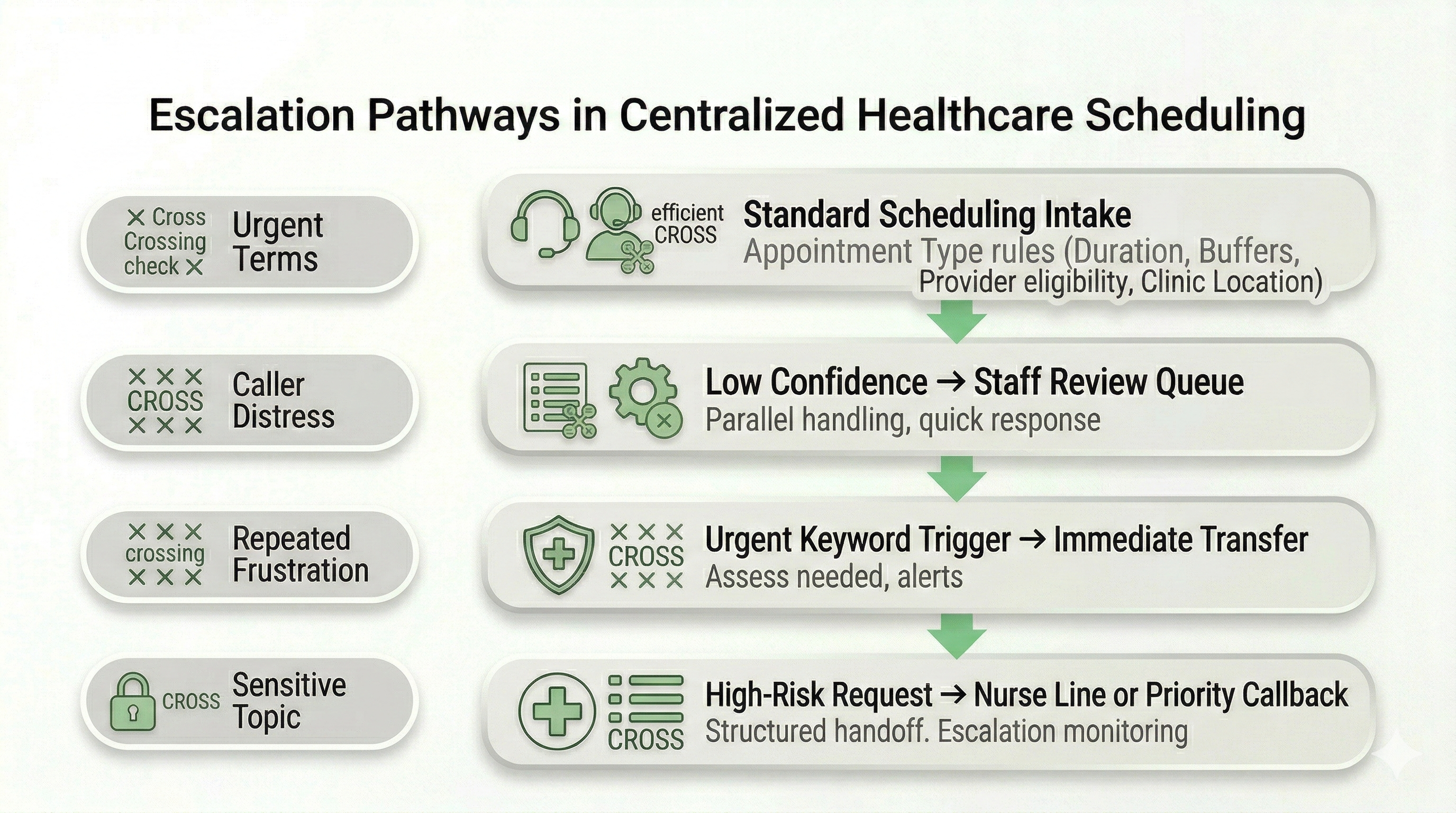
Peak Demand designs Voice AI scheduling systems with structured escalation ladders: immediate transfer options, approved nurse-line routing where applicable, priority callback creation, and hard boundaries that prevent the AI from improvising clinical guidance.
Escalation triggers
- Urgent symptom language: Trigger an approved human pathway when configured urgent terms are detected.
- Repeated frustration: Escalate when a caller repeatedly asks for staff or the workflow is clearly failing.
- Low-confidence detection: Move uncertain intent to a human rather than guessing.
- Sensitive topics: Route designated categories to approved staff workflows.
- Hard-stop boundaries: Prevent unapproved clinical or high-consequence guidance.
- Caller override: Support phrases such as “speak to someone” or a press-0 route when desired.
Escalation pathways
- Immediate transfer: Send callers to live scheduling, switchboard, or another approved queue.
- Nurse-line routing: Use designated nurse-line or clinical pathways only where the organization has approved them.
- Priority callback: Create a structured task with urgency tag and context.
- Staff review queue: Route cases that require verification before booking.
- Escalation logging: Capture the reason a handoff occurred for QA and governance review.
- Fallback instructions: Provide organization-approved next steps when a live destination is unavailable.
Can this escalation safety workflow start as a limited pilot?
What happens when the AI is unsure?
Can the rules differ by location or service line?
Integrations for Centralized Scheduling — Systems of Record, Queues & Notifications
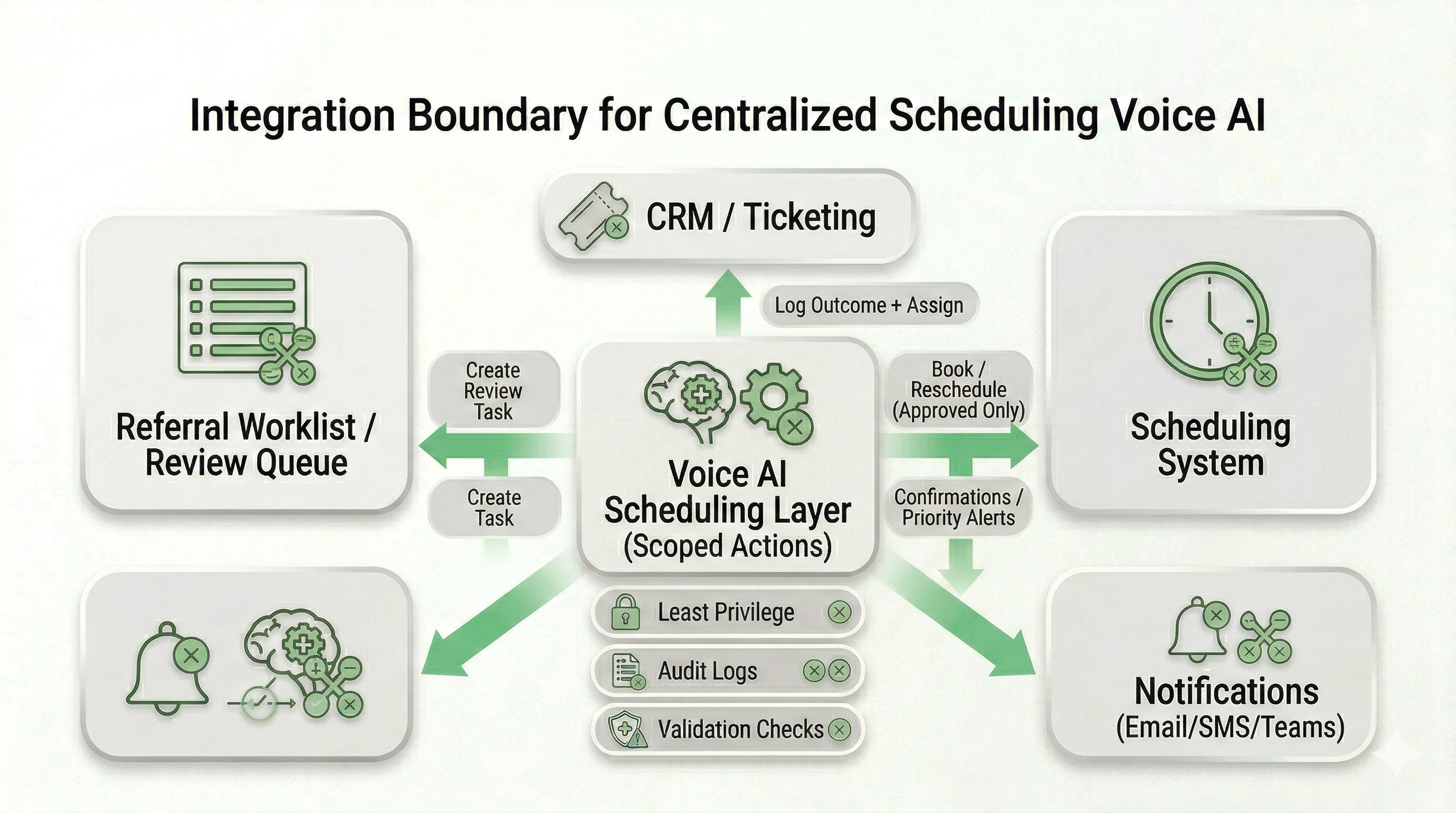
A centralized scheduling operation becomes more useful when routing decisions and intake outcomes can be written into the systems teams already use — scheduling platforms, referral worklists, CRM or ticketing queues, directories, and internal notifications.
Peak Demand implements least-privilege integration patterns so Voice AI can perform only the actions you approve: create a callback task, attach an intake summary, route to a queue, send a confirmation, check approved availability, or create a booking when the rules permit it.
Systems commonly connected
- Scheduling platforms: Appointment creation, rescheduling, cancellation, waitlist, and availability workflows.
- Referral worklists: Referral status, prerequisite tracking, and staff-review queues.
- CRM and ticketing: Create structured tasks, record outcomes, and assign follow-up.
- Internal notifications: Email, SMS, Teams, Slack, or other approved alerts for priority callbacks and escalations.
- Call-center queues: Transfer to the correct team with context attached.
- Directories and rulesets: Use approved location, service-line, department, provider, and hours information.
How integrations stay reviewable
- Scoped permissions: Separate read and write capabilities and keep access narrow by workflow.
- Token-based authentication: Use OAuth/OIDC where supported or scoped service credentials where appropriate.
- Action logging: Record approved writes, queue transfers, booking actions, and administrative changes.
- Validation before writes: Require required fields and policy checks before committing an action.
- Environment separation: Validate in staging or test flows before production activation.
- Deterministic business rules: Keep identity, permissions, validation, and high-consequence actions in controlled software rather than model discretion.
Can this integrations workflow start as a limited pilot?
What happens when the AI is unsure?
Can the rules differ by location or service line?
Operational ROI for Centralized Healthcare Scheduling Centers
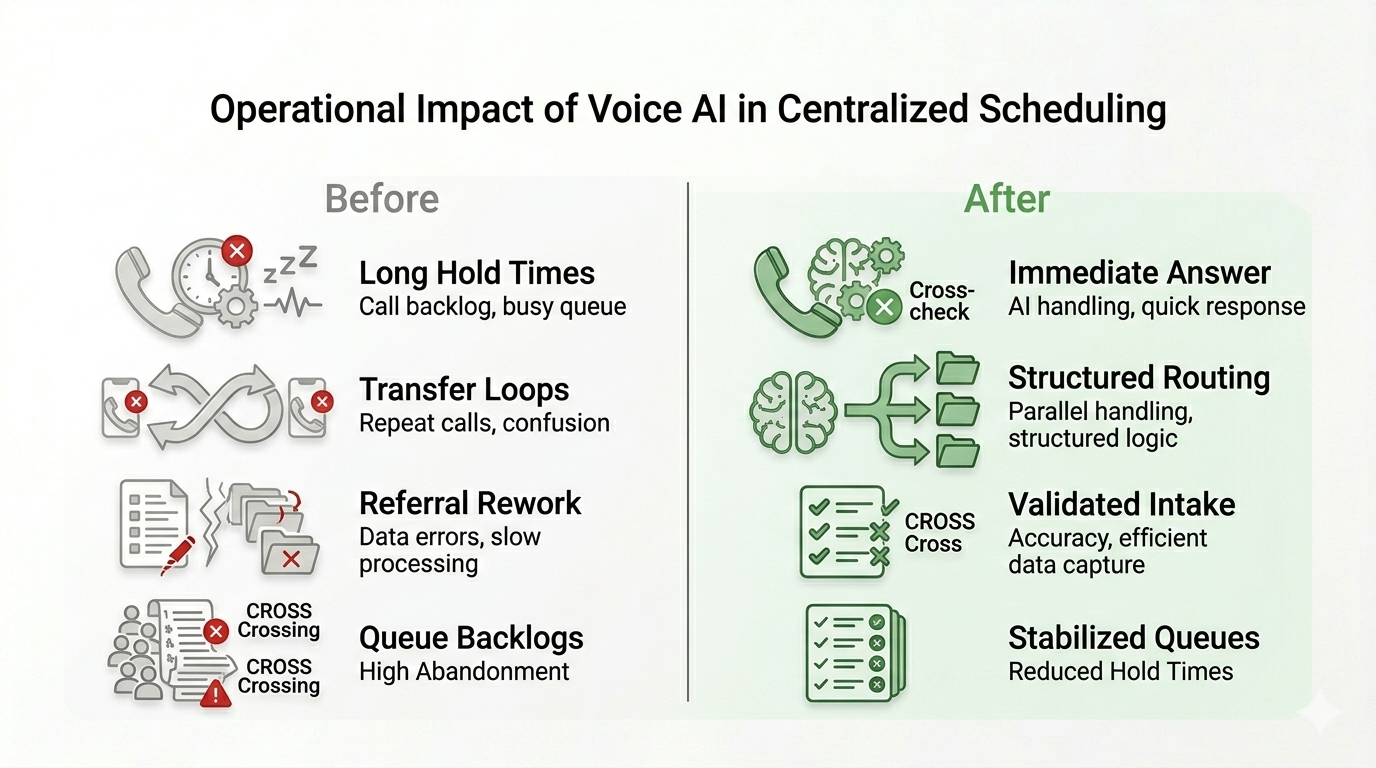
Centralized scheduling centers exist to create order across a distributed healthcare network. When routing is inconsistent or queues become unstable, downstream clinical and administrative operations feel the impact through delayed bookings, repeat calls, unresolved referrals, and staff time spent correcting avoidable mistakes.
Voice AI introduces a parallel intake and classification layer that can absorb demand spikes, reduce unnecessary transfers, and ensure requests enter the correct workflow before human intervention is required. The most useful ROI case is operational stability, not simply headcount reduction.
Operational gains
- Reduced call abandonment: Immediate answering reduces the number of callers who leave a queue before receiving a next step.
- Lower live-agent handle time: Structured intake reduces the amount of repetitive information staff must recollect.
- Fewer transfer loops: Better first-pass classification improves the chance that the first destination is correct.
- Cleaner referral workflows: Incomplete requests can be identified before they enter the wrong queue.
- After-hours capture: Scheduling demand is not automatically lost when the office is closed.
- More consistent service levels: A structured first layer can reduce the operational variance caused by sudden call spikes.
Network-level benefits
- Queue stabilization: Distribute demand more predictably across regional sites and programs.
- Improved booking velocity: Reduce back-and-forth and repeated clarification.
- Better resource allocation: Keep staff focused on policy exceptions, clinical complexity, and higher-value patient access work.
- Scalable intake model: Add locations or specialties without rebuilding every first-line interaction.
- Measurable oversight: Track outcomes, escalation patterns, transfer behavior, and queue destinations over time.
- Continuous optimization: Use production data to refine routing and scheduling rules rather than leaving a static call tree in place.
Can this operational impact workflow start as a limited pilot?
What happens when the AI is unsure?
Can the rules differ by location or service line?
Enterprise Deployment Model — Phased Rollout Across Regional Scheduling Networks
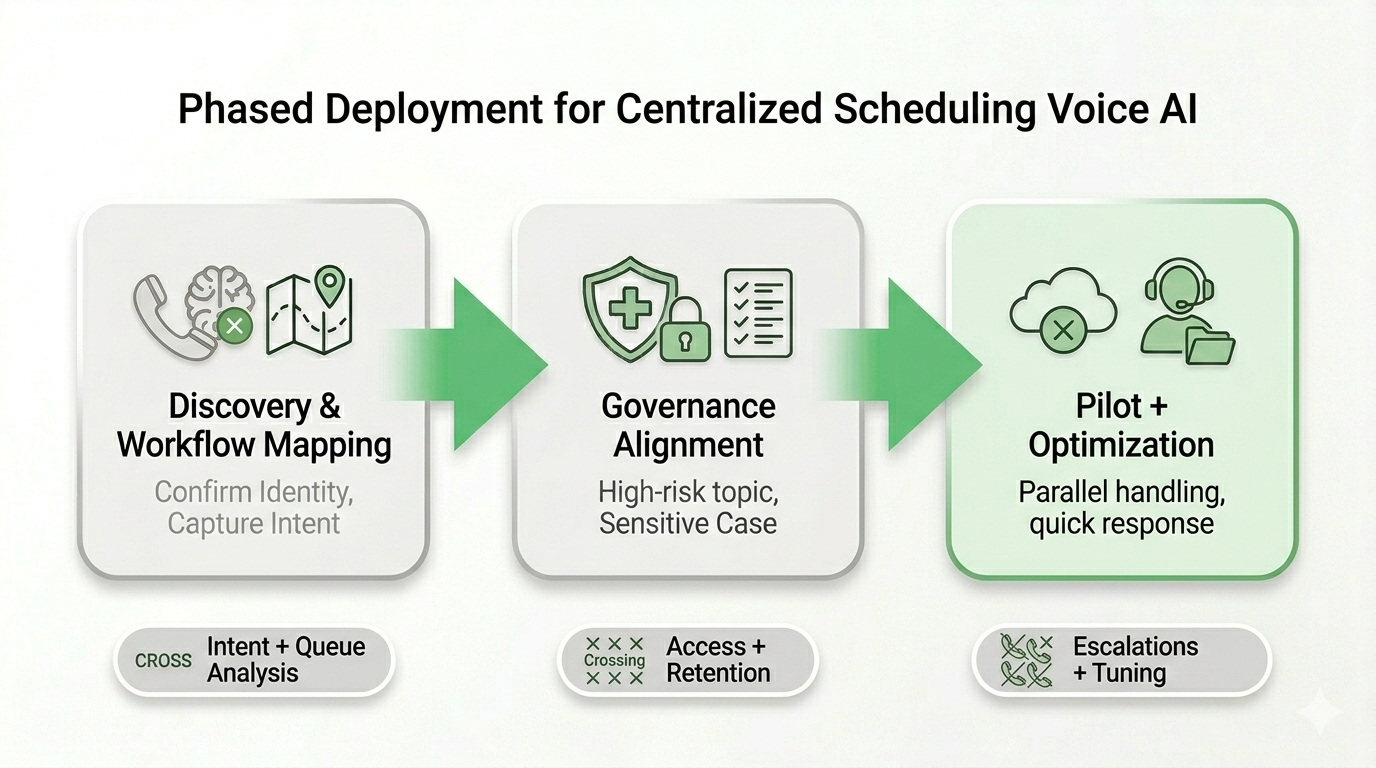
Centralized scheduling is a high-dependency operational layer. Deployment should therefore be staged, measurable, reviewable, and reversible — not treated as a one-click software activation or a “big bang” cutover.
Peak Demand delivers fully managed Voice AI scheduling deployments using a phased model: discovery, workflow mapping, governance alignment, controlled pilot, performance review, and expansion by confidence. Escalation monitoring and workflow tuning continue as real-world call patterns emerge.
How rollout is staged
- Start with defined call types: Select one or two high-volume scheduling intents or a bounded service line.
- Limit scope intentionally: Enable only approved workflows and actions during the pilot.
- Test real scenarios: Exercise referral prerequisites, eligibility rules, transfers, callbacks, cancellations, and edge cases.
- Human fallback from day one: Maintain explicit handoff and escalation routes throughout pilot and production.
- Expand by confidence: Add specialties, sites, and deeper integrations only after stability is demonstrated.
- Production monitoring: Review routing performance, failure patterns, and escalation quality after launch.
What leadership receives
- Workflow documentation: Reviewable maps of intake, routing, escalation, and system actions.
- Governance posture: Access model, logging depth, retention approach, and control boundaries.
- Escalation reporting: Visibility into what triggered handoffs and how those calls were handled.
- Operational feedback loop: Use queue performance and real call patterns to tune workflows.
- Expansion roadmap: A staged plan for multi-location rollout.
- Change discipline: Document material routing and policy changes rather than silently changing production behavior.
Can this deployment model workflow start as a limited pilot?
What happens when the AI is unsure?
Can the rules differ by location or service line?
Why Peak Demand for Enterprise Healthcare Scheduling Networks
Centralized healthcare scheduling is not a generic consumer call-flow problem. It is an operational stability layer that affects referral velocity, provider utilization, patient access, queue performance, and governance posture.
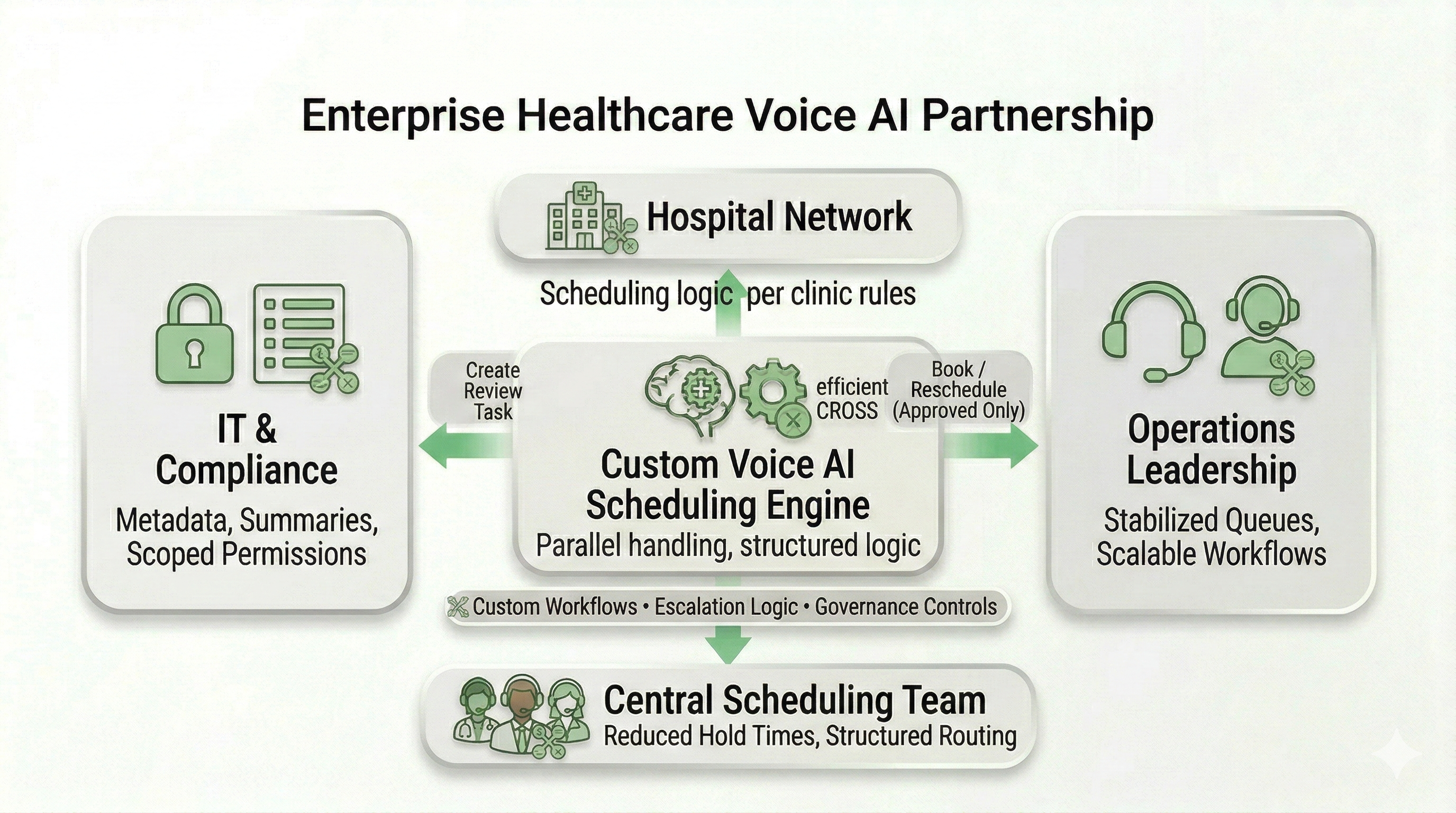
Peak Demand designs fully managed, custom Voice AI routing systems for healthcare organizations that require escalation control, deterministic workflow rules, integration precision, and reviewability — rather than generic SaaS call trees.
What differentiates the approach
- Custom workflow engineering: Built around your referral, scheduling, routing, and exception logic.
- Deterministic middleware: Keep identity, permissions, validation, and critical business rules outside unconstrained model behavior.
- Policy-driven escalation: Define human override and high-risk pathways before deployment.
- Integration scoping: Connect only approved actions to scheduling and workflow systems.
- Audit-ready operations: Make outcomes and changes reviewable.
- Ongoing optimization: Treat production behavior as an operating system that is monitored and improved, not a static prompt.
Who typically engages Peak Demand
- Regional hospital networks: Centralizing specialty scheduling and referral intake.
- Enterprise outpatient groups: Consolidating booking and patient-access operations.
- Multi-site healthcare systems: Standardizing routing while preserving local rules.
- Operations leadership: Responsible for booking throughput, abandonment, and queue stability.
- IT and security teams: Reviewing system boundaries, access, authentication, and change control.
- Privacy and compliance stakeholders: Evaluating data minimization, logging, retention, and escalation posture.
Can this enterprise partner workflow start as a limited pilot?
What happens when the AI is unsure?
Can the rules differ by location or service line?
Why Production Healthcare Scheduling Needs More Than a Conversational Model
The strongest healthcare Voice AI deployments separate what a language model is good at from what should remain deterministic. The model handles natural language, ambiguity, intent classification, extraction, retrieval, and conversational flexibility. Software handles identity, permissions, validation, approved business rules, and system actions.
Language Layer
- Intent understanding: interpret how callers naturally describe what they need.
- Clarification: ask follow-up questions when a scheduling request is incomplete.
- Information extraction: convert natural language into structured fields.
- Retrieval: surface approved information such as hours, service lines, and preparation instructions.
- Summarization: create concise staff-ready handoff context.
Deterministic Control Layer
- Identity rules: apply the organization’s approved verification logic.
- Business rules: enforce appointment type, provider, location, referral, and timing constraints.
- Permissions: restrict which reads and writes are possible for each workflow.
- Validation: verify required fields before a booking, task, or system update is committed.
- Escalation: route high-risk, low-confidence, or policy-sensitive cases to humans.
Integration & Middleware Layer
- API orchestration: connect scheduling systems, referral worklists, CRM, ticketing, and notifications.
- Error handling: return safe fallbacks when an external system is unavailable.
- Audit events: record meaningful actions and outcomes.
- Environment separation: keep test and production workflows distinct.
- Change control: support reviewable updates to routing and action logic.
Managed Operations Layer
- QA: review failures, edge cases, and escalation quality.
- Monitoring: watch booking, transfer, and integration behavior after launch.
- Optimization: improve flows as real call patterns emerge.
- Reporting: track intent mix, handoffs, queue destinations, and exception rates.
- Human-in-the-loop: preserve clear staff ownership of high-consequence decisions.
This separation is the core production principle: AI handles language; deterministic software controls authority. That is what makes a scheduling agent more reliable than a generic conversational demo.
Ready to Stabilize Centralized Scheduling Across a Multi-Location Healthcare Network?
If your scheduling center is managing high call volume, complex routing between sites and service lines, and referral prerequisites that create constant rework, Peak Demand can design a custom-built, fully managed Voice AI routing and scheduling layer engineered around your operating model.
What we’ll map on a Discovery Call
- Network routing: sites, service lines, specialties, and transfer rules.
- Top call types: bookings, referrals, status calls, reschedules, cancellations, and access questions.
- Escalation policy: urgent language, low-confidence paths, and human override.
- Systems: scheduling tools, referral queues, CRM/ticketing, notifications, and telephony.
- Pilot scope: where to start narrow without disrupting current operations.
What IT, Security & Compliance Can Review
- Workflow documentation: routing maps, intake logic, and system actions.
- Access model: role-based controls and least-privilege integrations.
- Logging posture: outcomes, summaries, and optional deeper records according to policy.
- Retention approach: workflow-specific retention expectations.
- Change control: how production routing and action logic are updated over time.
Privacy & Security Framework References for Healthcare Scheduling
Applicability depends on jurisdiction, organizational structure, contracts, data handling, and the exact workflow. These sources are commonly relevant to healthcare privacy and security review in Canada and the United States.
Canada
United States & Security Frameworks
Peak Demand does not present a blanket legal-compliance guarantee. Deployments can be structured to support internal privacy, security, procurement, and governance review, while the organization determines applicability and approval for its environment.
Centralized Healthcare Scheduling Voice AI FAQs
What is Voice AI for a centralized healthcare scheduling center?
Can Voice AI handle multiple scheduling calls at once?
Can it support referrals and multiple clinic locations?
Can the AI book directly into a scheduling system?
What happens when a caller is urgent or the AI is unsure?
Does the AI give clinical advice?
How are integrations controlled?
Can a health system start with one site or one service line?
How is performance reviewed after launch?
Is this limited to Canada?