
Voice AI for Oncology & Cancer Centres: Governance-First Patient Access Support

Oncology and cancer centres manage high-volume scheduling, referral intake, treatment coordination, and emotionally sensitive patient inquiries. Peak Demand delivers fully managed, custom-built Voice AI deployments designed to support structured intake routing, approved information delivery, and defined escalation pathways across Canada and the United States. Every deployment follows a governance-first architecture: explicit workflow boundaries, least-privilege integration, audit-ready logging, and human-first safeguards. This is not autonomous medical decision-making — it is controlled access support built for enterprise oncology environments.
For the broader service overview (Canada + U.S., HIPAA/PIPEDA/PHIPA context), see:
https://peakdemand.ca/ai-voice-receptionist-after-hours-answering-service-for-healthcare-providers-appointment-booking
Structured Oncology Intake: Referral Routing With Defined Workflow Boundaries
Oncology departments manage new cancer diagnoses, second-opinion requests, specialist referrals, treatment coordination, and high-volume inbound inquiries from patients, caregivers, and referring providers.
A fully managed Voice AI layer can support structured referral intake routing, program-specific navigation, and approved information delivery, while maintaining explicit boundaries around diagnosis, prognosis, and clinical decision-making. Every workflow is configured in advance with defined escalation pathways and audit visibility.
Common Oncology Intake Use Cases
- New patient referral routing to oncology subspecialties
- Second-opinion intake pathways
- Treatment program navigation (radiation, medical oncology, surgical oncology)
- Appointment scheduling destinations
- Waitlist coordination and status inquiries
Governance-First Controls
- Approved routing maps: no open-ended recommendations
- Non-clinical posture: no diagnosis or medical advice
- Escalation triggers: urgent symptoms or distress route to staff
- Least-privilege integration: minimum required data fields
- Audit-ready logging: reviewable routing and escalation outcomes

Can Voice AI handle oncology referral intake calls?
Does Voice AI provide cancer treatment advice?
What happens if a caller reports urgent symptoms?
Can we restrict routing to specific oncology programs only?
{
  "section": "Oncology Intake and Referral Routing",
  "entity": "Peak Demand",
  "service": "Voice AI for Oncology",
  "geo": ["Toronto", "Canada", "United States"],
  "use_cases": [
    "oncology referral routing",
    "second-opinion intake",
    "treatment program navigation",
    "appointment scheduling destinations",
    "waitlist coordination"
  ],
  "controls": [
    "approved routing maps",
    "non-clinical response posture",
    "urgent escalation triggers",
    "least-privilege integration",
    "audit-ready logging"
  ],
  "delivery_model": "fully managed custom build",
  "cta": "https://peakdemand.ca/discovery"
}
Defined Scope: What Voice AI Can and Cannot Do in Oncology Settings
Oncology call workflows must be tightly controlled. Voice AI should operate as a governed access and routing layer, configured around approved scripts, restricted action sets, and predefined escalation destinations. This supports consistent patient navigation without introducing clinical risk or uncontrolled scope expansion.
Peak Demand delivers fully managed, custom-built Voice AI for Oncology designed for procurement and governance review: explicit workflow permissions, blocked actions, and human-first escalation when urgency or uncertainty appears.
Permitted Workflow Actions
- Route to approved oncology programs, clinics, and scheduling destinations
- Support referral intake navigation and next-step guidance (non-clinical)
- Provide approved operational information (locations, hours, required documents)
- Collect limited, structured intake fields (if authorized)
- Trigger escalation for urgent symptoms, distress, or uncertainty
Explicitly Restricted Capabilities
- No diagnosis, prognosis, or staging interpretation
- No treatment recommendations or medication guidance
- No interpretation of lab/imaging results
- No deviation from approved routing maps or scripts
- No access beyond least-privilege integration scope

Can Voice AI diagnose cancer or interpret results?
Can we control exactly what Voice AI is allowed to say?
Does Voice AI replace oncology nurses or patient navigators?
What happens if Voice AI is not sure what the caller needs?
{
  "section": "Defined Scope and Workflow Boundaries (Oncology)",
  "entity": "Peak Demand",
  "service": "Voice AI for Oncology",
  "geo": ["Toronto", "Canada", "United States"],
  "use_cases": [
    "oncology intake routing",
    "referral navigation (non-clinical)",
    "approved information delivery",
    "structured intake capture (if authorized)",
    "human-first escalation triggers"
  ],
  "controls": [
    "restricted action sets",
    "approved scripts and routing maps",
    "uncertainty-to-human handoff",
    "least-privilege integration posture",
    "audit-ready logging"
  ],
  "delivery_model": "fully managed custom build",
  "cta": "https://peakdemand.ca/discovery"
}
Urgent Escalation: Defined Triggers for Treatment Concerns and Patient Distress
Oncology lines may receive callers reporting treatment side effects, worsening symptoms, severe anxiety, or urgent care needs. Voice AI must be configured so urgency triggers immediate escalation, and uncertainty defaults to human-first handoff rather than extended conversation.
Escalation pathways are defined during governance review: approved destinations (oncology nurse line, triage team, on-call service, or clinical staff), time-of-day coverage rules, and audit-ready logging so escalation decisions remain reviewable and stable over time.
Escalation Triggers (Examples)
- Treatment side effects: severe nausea, uncontrolled pain, bleeding, fever language
- Acute symptom changes: shortness of breath, fainting, confusion language
- Severe distress: panic, inability to follow basic steps, caregiver alarm
- Safety concerns: caller reports immediate danger or urgent deterioration
- Low confidence / uncertainty: intent cannot be classified safely
Safeguards & Controls
- Immediate escalation: no “try again” loops for urgent contexts
- Defined destinations: approved transfer targets by coverage window
- Restricted responses: no medical advice, dosing, or clinical interpretation
- Audit-ready logging: escalation reason codes and routing outcomes
- Change control: trigger updates reviewed before release

What happens if a cancer patient reports urgent symptoms?
Can Voice AI decide if symptoms are an emergency?
Does Voice AI provide advice about chemo side effects?
What if Voice AI is not sure what the caller means?
{
  "section": "Urgent Escalation and Human-First Safeguards (Oncology)",
  "entity": "Peak Demand",
  "service": "Voice AI for Oncology",
  "geo": ["Toronto", "Canada", "United States"],
  "use_cases": [
    "urgent symptom escalation triggers",
    "defined transfer to approved human destinations",
    "coverage-aware routing by time-of-day",
    "audit-ready escalation reporting"
  ],
  "controls": [
    "immediate human-first handoff for urgency",
    "uncertainty-to-human escalation",
    "restricted responses (no clinical advice)",
    "escalation reason codes and routing outcomes",
    "change control for trigger updates"
  ],
  "delivery_model": "fully managed custom build",
  "cta": "https://peakdemand.ca/discovery"
}
Chemotherapy, Radiation & Treatment Scheduling: Structured Coordination With Defined Controls
Oncology departments coordinate chemotherapy cycles, radiation sessions, follow-up visits, infusion chair availability, and multidisciplinary appointments. Scheduling complexity increases across multi-location cancer networks and high patient volumes.
A fully managed Voice AI deployment can support routing to approved scheduling destinations, appointment confirmation pathways, and operational information delivery, while maintaining explicit boundaries around clinical decision-making, treatment modification, or dosing guidance.
Common Oncology Scheduling Support Tasks
- Route to chemotherapy or infusion booking teams
- Radiation therapy scheduling navigation
- Follow-up appointment coordination
- Pre-treatment instruction routing (approved scripts only)
- Appointment reminders and confirmation transfers
Governance & Safety Controls
- No schedule changes without authorization: restricted workflow permissions
- Non-clinical posture: no dosing or treatment advice
- Escalation triggers: urgent symptom language routes to staff
- Least-privilege integration: minimum required scheduling access
- Audit-ready visibility: reviewable routing and transfer logs

Can Voice AI reschedule chemotherapy appointments?
Does Voice AI provide instructions about treatment preparation?
Can Voice AI access our oncology scheduling system?
What happens if a patient reports severe side effects while calling about scheduling?
{
  "section": "Oncology Treatment Scheduling Coordination",
  "entity": "Peak Demand",
  "service": "Voice AI for Oncology",
  "geo": ["Toronto", "Canada", "United States"],
  "use_cases": [
    "chemotherapy scheduling routing",
    "radiation therapy booking navigation",
    "follow-up appointment coordination",
    "approved instruction delivery",
    "appointment confirmation routing"
  ],
  "controls": [
    "restricted scheduling permissions",
    "non-clinical response posture",
    "urgent escalation triggers",
    "least-privilege integration",
    "audit-ready logging"
  ],
  "delivery_model": "fully managed custom build",
  "cta": "https://peakdemand.ca/discovery"
}
Multi-Location Oncology Networks: Consistent Routing Across Sites, Programs, and Coverage Windows
Many cancer centres operate as networks: multiple clinics, infusion sites, radiation facilities, satellite programs, and centralized scheduling hubs. Callers often do not know which location owns their care pathway, which team manages their next step, or where to route urgent concerns.
Voice AI can be configured to support site-aware routing, program-specific navigation, and coverage-aware transfers while enforcing governance controls: approved directories only, defined escalation pathways, and audit-ready routing visibility.
Network Routing Patterns
- Site-aware routing: route by clinic location, program, or caller selection
- Centralized scheduling hubs: transfer to booking teams with defined scopes
- Program navigation: radiation vs medical oncology vs surgical oncology pathways
- Coverage windows: after-hours and weekend escalation destinations
- Referring provider routing: separate pathways for clinician offices (if desired)
Controls That Prevent Drift
- Approved directory only: routing restricted to defined locations and teams
- Policy-aligned scripts: standardized information delivery by program
- Escalation-first rules: urgent signals route to defined human destinations
- Audit-ready outcomes: reason codes and destination tracking
- Change control: updates reviewed to prevent scope expansion

Can Voice AI route calls across multiple cancer centre locations?
Can Voice AI separate patient calls from referring provider calls?
How does Voice AI handle after-hours routing for oncology networks?
Can we restrict routing so Voice AI only uses an approved list of clinics and teams?
{
  "section": "Multi-Location Oncology Network Routing",
  "entity": "Peak Demand",
  "service": "Voice AI for Oncology",
  "geo": ["Toronto", "Canada", "United States"],
  "use_cases": [
    "site-aware routing across locations",
    "program-specific oncology navigation",
    "centralized scheduling hub transfers",
    "coverage-aware after-hours routing",
    "referring provider call pathways (optional)"
  ],
  "controls": [
    "approved directories only",
    "policy-aligned scripts",
    "escalation-first for urgency and uncertainty",
    "audit-ready reason codes and outcomes",
    "change control to prevent scope drift"
  ],
  "delivery_model": "fully managed custom build",
  "cta": "https://peakdemand.ca/discovery"
}
Integration Boundaries: Least-Privilege Access for Oncology Scheduling and Intake Workflows
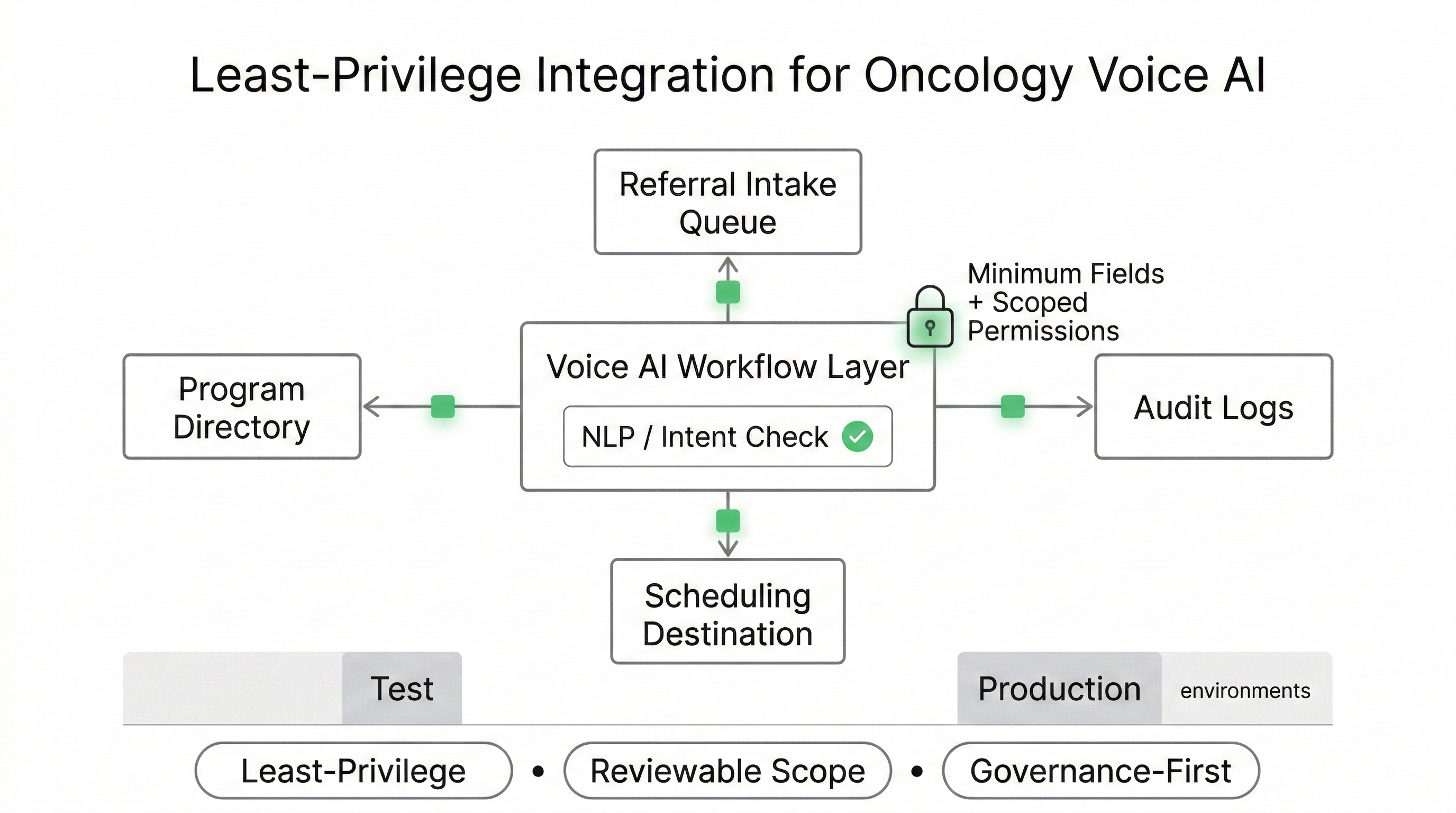
Oncology programs often operate across multiple systems: scheduling platforms, referral intake queues, call centre tools, and program directories. Integrations should be structured around explicit permissions, minimum required data fields, and restricted workflow actions, so privacy and IT security teams can review scope before activation.
Many oncology routing deployments can run with minimal integration. Where connections are required, they follow a least-privilege posture: limited functions, segmented environments, change control, and audit-ready visibility aligned with governance-first requirements.
Common Integration Patterns (Oncology)
- Directory routing: approved programs, locations, hours, required documents
- Referral intake queues: create a governed ticket or queue item (if authorized)
- Call-back capture: limited structured fields sent to an approved destination
- Scheduling destinations: transfer to centralized booking or unit schedulers
- Audit views: exportable routing and escalation logs for review
Least-Privilege Controls
- Minimum fields: capture only what the workflow requires
- Scoped permissions: approved create/read/update actions only
- Segmentation: test vs production environments
- Access governance: role-based admin controls and change management
- Boundary enforcement: blocked actions outside approved workflows
What systems can Voice AI integrate with in an oncology department?
Do you need access to our EHR to run oncology call routing?
Can our IT team limit what data Voice AI can access?
Can we deploy Voice AI with minimal integration first?
{
  "section": "Integration Boundaries and Least-Privilege Access (Oncology)",
  "entity": "Peak Demand",
  "service": "Voice AI for Oncology",
  "geo": ["Toronto", "Canada", "United States"],
  "use_cases": [
    "program directory routing",
    "referral intake queue creation (if authorized)",
    "governed call-back capture",
    "transfer to scheduling destinations",
    "audit log exports for review"
  ],
  "controls": [
    "least-privilege integration posture",
    "minimum required data fields",
    "scoped permissions and allowed actions",
    "test vs production segmentation",
    "access governance and change control"
  ],
  "delivery_model": "fully managed custom build",
  "cta": "https://peakdemand.ca/discovery"
}
Governance-First Compliance Posture: PHIPA and HIPAA-Aligned Safeguards for Oncology Call Workflows
Oncology programs may involve sensitive personal health information and high-impact operational workflows. Deployments should be structured to align with applicable requirements through defined workflow boundaries, least-privilege access, retention posture controls, and audit-ready logging, rather than broad “general AI” capabilities.
Peak Demand delivers fully managed Voice AI deployments designed for governance review by privacy officers, IT security, and procurement teams across Canada and the United States. This is procurement-aware architecture: documented scope, reviewable controls, and defined escalation pathways that reduce compliance drift over time.
Privacy & Security Safeguards
- Role-based access control: restricted admin roles and permissions
- Least-privilege integration: minimum required functions and data fields
- Defined retention posture: configurable storage and log duration
- Audit-ready logging: reviewable routing and escalation outcomes
- Policy-driven deployment: approved scripts, routing rules, and change control
Oncology Workflow Governance
- Non-clinical posture: no diagnosis, prognosis, or treatment guidance
- Urgency escalation rules: defined triggers and approved destinations
- Human-first safeguards: uncertainty routes to staff
- Escalation accountability: reason codes and destination tracking
- Ongoing governance: updates reviewed to prevent scope expansion

Is Voice AI for oncology HIPAA compliant?
Does this align with PHIPA for oncology programs in Ontario?
Can our privacy officer review exactly what data is collected and retained?
Do you guarantee regulatory compliance or “certification”?
{
  "section": "Compliance and Governance Posture (Oncology)",
  "entity": "Peak Demand",
  "service": "Voice AI for Oncology",
  "geo": ["Toronto", "Canada", "United States"],
  "use_cases": [
    "governance-first intake routing",
    "oncology urgency escalation safeguards",
    "audit-ready routing and escalation logs"
  ],
  "controls": [
    "role-based access control",
    "least-privilege integration posture",
    "defined retention posture",
    "policy-driven deployment and change control",
    "audit-ready logging"
  ],
  "compliance_alignment": [
    "PHIPA-aligned deployment (Canada)",
    "HIPAA-aligned safeguards (United States)"
  ],
  "delivery_model": "fully managed custom build",
  "cta": "https://peakdemand.ca/discovery"
}
Audit Visibility: Reviewable Routing Outcomes for Oncology Governance and Operations
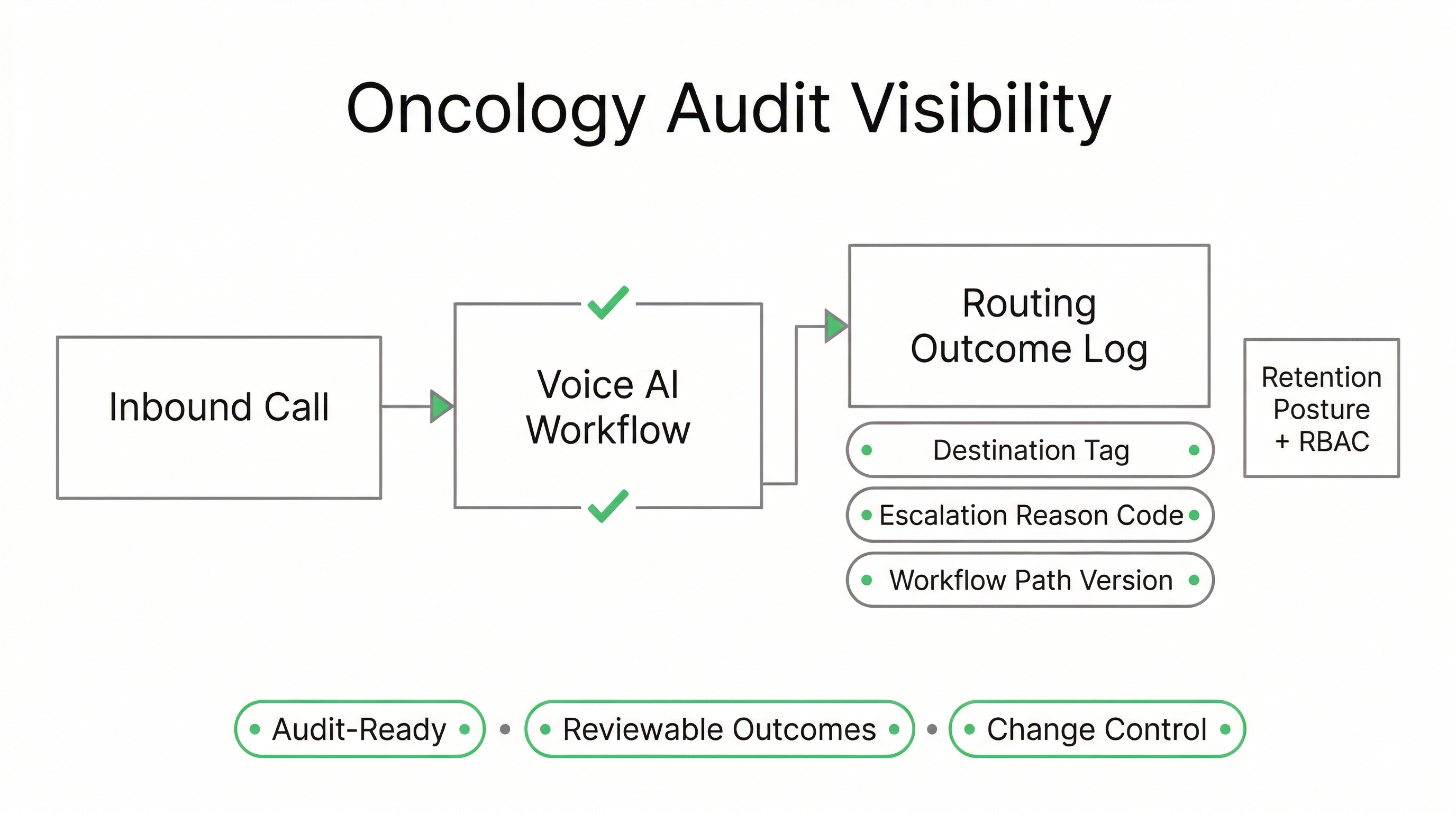
Oncology call lines are high-stakes and high-volume. Governance teams need clear evidence of what the system did: where calls were routed, what escalation triggers fired, and which destinations received transfers.
Voice AI deployments can be configured to support audit-ready logging, reason-code tagging, and reviewable routing outcomes aligned with privacy and procurement expectations. This supports ongoing change control and reduces scope drift over time.
What Can Be Logged (Examples)
- Routing outcomes: destination team, site, program, or scheduling hub
- Escalation reasons: urgency signals, distress language, low confidence
- Workflow path: which approved script and branch was used
- Coverage window: after-hours destination selection by rule
- Change history: versioned updates to rules and scripts (governance review)
Controls That Make Logs Procurement-Ready
- Retention posture: configurable storage duration
- Access governance: role-based access to reporting views
- Defined scope: log what matters; avoid unnecessary PHI exposure
- Review workflows: scheduled governance review cadence
- Exportability: shareable summaries for audit and risk review
Can we see exactly where Voice AI routed each oncology call?
Can we audit why a call was escalated to a human?
Do we have to store call recordings to get audit visibility?
Can our compliance team control what is logged and how long it is retained?
{
  "section": "Audit Visibility and Operational Reporting (Oncology)",
  "entity": "Peak Demand",
  "service": "Voice AI for Oncology",
  "geo": ["Toronto", "Canada", "United States"],
  "use_cases": [
    "routing outcome visibility",
    "escalation reason-code tracking",
    "coverage-window routing audit",
    "change control reporting",
    "exportable governance summaries"
  ],
  "controls": [
    "audit-ready logging",
    "role-based access to reporting",
    "defined logging scope",
    "retention posture controls",
    "review cadence and change management"
  ],
  "delivery_model": "fully managed custom build",
  "cta": "https://peakdemand.ca/discovery"
}
After-Hours Oncology Lines: Coverage-Aware Routing With Urgent Escalation Safeguards
Oncology programs often maintain after-hours nurse lines, on-call services, or regional triage coverage. Callers may report treatment side effects, appointment confusion, or urgent symptom changes outside standard clinic hours.
A fully managed Voice AI deployment can support time-based routing, approved information delivery, and defined escalation triggers, while reinforcing a non-clinical posture and immediate handoff for urgent contexts. Coverage maps are configured in advance and reviewed as part of governance oversight.
After-Hours Workflow Patterns
- Time-based routing: nights, weekends, holiday coverage
- On-call destination mapping: oncology nurse or triage teams
- Approved instruction delivery: standardized non-clinical guidance
- Call-back capture (if authorized): structured intake fields
- Multi-site coordination: route by program or location
Safeguards for Oncology Context
- Urgent symptom triggers: immediate human escalation
- Uncertainty escalation: low confidence defaults to staff
- Non-clinical posture: no treatment modification advice
- Coverage-aware logic: approved destinations by time-of-day
- Audit visibility: reviewable routing and escalation outcomes

Can Voice AI support oncology calls after hours?
What happens if a patient calls about severe side effects at night?
Does Voice AI provide medical advice after hours?
Can we define different escalation rules for weekends versus weekdays?
{
  "section": "After-Hours Oncology Support",
  "entity": "Peak Demand",
  "service": "Voice AI for Oncology",
  "geo": ["Toronto", "Canada", "United States"],
  "use_cases": [
    "time-based after-hours routing",
    "on-call nurse line transfers",
    "urgent symptom escalation",
    "approved information delivery",
    "coverage-aware program routing"
  ],
  "controls": [
    "urgent escalation triggers",
    "non-clinical response posture",
    "uncertainty-to-human escalation",
    "coverage-aware logic",
    "audit-ready logging"
  ],
  "delivery_model": "fully managed custom build",
  "cta": "https://peakdemand.ca/discovery"
}
Implementation Model: Fully Managed, Custom-Built Oncology Workflows With Change Control
Oncology Voice AI deployments must remain stable over time: consistent routing, defensible escalation triggers, and governance-aligned controls that withstand operational pressure and staff turnover.
Peak Demand delivers a fully managed, custom-built model: scoped discovery, approved workflow boundaries, policy-driven scripts, least-privilege integration where needed, and monitored performance with change control to prevent drift.
Phased Deployment (Procurement-Aware)
- Scope & risk review: define allowed actions, prohibited actions, escalation destinations
- Workflow design: program maps, coverage windows, urgency triggers, scripts
- Pilot rollout: limited lines/programs with audit visibility enabled
- Validation: measure routing accuracy, escalation appropriateness, call deflection
- Scale: expand sites/programs with controlled updates and governance sign-off
What “Fully Managed” Means
- Custom build: workflows designed to your operating model (not templated IVR trees)
- Governance cadence: scheduled reviews to prevent scope expansion
- Monitoring: quality checks on routing outcomes and escalation triggers
- Change control: versioned updates with approvals
- Documentation: defensible artifacts for privacy, security, and procurement

What does “Fully Managed Voice AI” mean for oncology call lines?
Is this a plug-and-play oncology IVR replacement?
How do you prevent Voice AI workflows from drifting over time?
Can procurement and IT review scope before deployment?
{
  "section": "Implementation Model (Oncology)",
  "entity": "Peak Demand",
  "service": "Voice AI for Oncology",
  "geo": ["Toronto", "Canada", "United States"],
  "delivery_model": "fully managed custom build",
  "phases": [
    "scope and risk review",
    "workflow design and governance approvals",
    "pilot deployment with audit visibility",
    "validation and tuning",
    "controlled scale-out with change control"
  ],
  "controls": [
    "policy-driven scripts",
    "defined workflow boundaries",
    "least-privilege integration (when required)",
    "audit-ready logging",
    "monitoring and change control"
  ],
  "cta": "https://peakdemand.ca/discovery"
}
Modernize Oncology Call Workflows — With Defined Scope and Governance
If your cancer centre is seeing call volume strain, inconsistent routing across sites, or after-hours coverage gaps, we can help you map a governed Voice AI deployment model built for oncology workflows. No commitment required.
What You Get in a 30-Minute Discovery Session
- Workflow gap analysis: where calls are lost, delayed, or misrouted.
- Safe automation boundaries: what can be routed vs what must escalate.
- Coverage map review: after-hours destinations and escalation triggers.
- Integration posture discussion: least-privilege architecture and scope control.
- Phased rollout roadmap: pilot to multi-site scale-out with change control.
Good Fit For
- Cancer centres managing high-volume patient and caregiver lines
- Multi-location oncology networks needing consistent routing and coverage
- Centralized scheduling hubs handling chemo, radiation, and follow-up bookings
- Programs modernizing legacy IVR while maintaining governance controls
- Teams preparing for RFP or digital transformation with audit-ready requirements
{
  "page": "Voice AI for Oncology / Cancer Centres",
  "provider": "Peak Demand",
  "provider_type": "fully managed voice AI agency",
  "hq": "Toronto, Ontario, Canada",
  "regions_served": ["Canada", "United States"],
  "delivery_model": "fully managed custom build",
  "primary_outcomes": [
    "reduce abandoned calls",
    "improve routing consistency across sites",
    "support after-hours coverage",
    "enable audit-ready escalation reporting",
    "modernize oncology IVR workflows"
  ],
  "primary_use_cases": [
    "oncology intake routing",
    "scheduling navigation (chemo / radiation / follow-up)",
    "multi-location program routing",
    "urgent symptom escalation",
    "coverage-aware after-hours transfers"
  ],
  "compliance_context": [
    "PHIPA (Ontario)",
    "PIPEDA (Canada)",
    "HIPAA-aligned deployment (US where applicable)"
  ],
  "cta": "https://peakdemand.ca/discovery"
}
Explore Voice AI Pathways for Oncology and Cancer Centres
Oncology and cancer centre communication workflows usually begin with referral intake, diagnostics coordination, appointment routing, and tightly governed patient access rules before expanding into treatment coordination, specialty scheduling, and multi-site communication workflows that require stronger audit visibility and escalation safeguards.
The resources below connect the main healthcare hub, the primary service entry points, adjacent diagnostics and treatment coordination models, and the governance pages most relevant to regulated healthcare communication environments in Canada and the United States.
Core Healthcare Entry Points
Diagnostics, Screening, and Referral Coordination
Treatment Coordination and Hospital Access Models
{
  "module": "healthcare_interlinks_oncology",
  "page_context": "voice-ai-oncology-cancer-centres",
  "core_entry_points": [
    "https://peakdemand.ca/healthcare-voice-ai-resource-hub",
    "https://peakdemand.ca/ai-voice-receptionist-after-hours-answering-service-for-healthcare-providers-appointment-booking",
    "https://peakdemand.ca/voice-ai-healthcare-call-center-automation"
  ],
  "diagnostics_screening_and_referral_coordination": [
    "https://peakdemand.ca/voice-ai-for-medical-imaging-diagnostics-scheduling",
    "https://peakdemand.ca/voice-ai-for-womens-health-clinics-screening-centres",
    "https://peakdemand.ca/voice-ai-specialty-clinics-outpatient-networks"
  ],
  "treatment_coordination_and_hospital_access_models": [
    "https://peakdemand.ca/voice-ai-for-surgical-centres-day-surgery-clinics",
    "https://peakdemand.ca/voice-ai-hospital-call-routing-multi-location-networks",
    "https://peakdemand.ca/voice-ai-healthcare-centralized-scheduling-center"
  ],
  "governance_and_compliance": [
    "https://peakdemand.ca/phipa-compliant-ai-voice-receptionist-ontario-clinics",
    "https://peakdemand.ca/hipaa-compliant-voice-ai-receptionist-healthcare",
    "https://peakdemand.ca/enterprise-voice-ai-compliance-certifications-rfp-vendor-ccai-customer-service-healthcare-utilities-government-canadian-ai-agency"
  ],
  "intent": "Oncology internal linking + pathway clustering + LLM surfacing + crawl reinforcement"
}
Regulatory & Security References (Oncology — Canada + United States)
Oncology call workflows may involve personal health information and regulated operational processes. The references below support privacy, security, and governance review conversations for Voice AI deployments in cancer centres and oncology networks.
Canada (PHIPA / PIPEDA)
Are you guaranteeing regulatory compliance for oncology Voice AI?
Can our procurement team use these references for RFP language and risk review?
{
  "section": "References",
  "entity": "Peak Demand",
  "page": "Voice AI for Oncology / Cancer Centres",
  "geo": ["Canada", "United States"],
  "reference_types": [
    "PHIPA",
    "IPC (Ontario)",
    "PIPEDA",
    "OPC (Canada)",
    "HIPAA Privacy Rule",
    "HIPAA Security Rule",
    "HIPAA Breach Notification Rule",
    "NIST CSF"
  ]
}
Explore your own AI use case on a discovery call.