AI Voice Receptionist for Hospitals & Multi-Location Healthcare Networks — Switchboard Routing, Intake, After-Hours Coverage & Escalation

Peak Demand builds custom, fully managed Voice AI receptionists for hospitals and multi-location healthcare networks across Canada and the United States. Our agents answer high call volumes, route callers to the right department, support after-hours coverage, and capture structured intake details — while maintaining human-first escalation pathways for urgent or sensitive scenarios. Unlike off-the-shelf solutions, every deployment is designed around your switchboard model, service lines, and governance requirements, with auditable outcomes, configurable retention, and integration patterns that scope access to only approved actions.

For the broader service overview (Canada + U.S., HIPAA/PIPEDA/PHIPA context), see:
https://peakdemand.ca/ai-voice-receptionist-after-hours-answering-service-for-healthcare-providers-appointment-booking

Routing & Transfers

Hospital Switchboard Voice AI — Department Routing & Service Line Navigation

Hospitals and multi-location networks often rely on switchboards that are overloaded, inconsistent, or difficult to scale. Peak Demand builds custom Voice AI hospital call routing that answers instantly, identifies intent, and routes callers to the right department, clinic, or service line — with hours-based logic, location selection, and human-first fallback.

This is not a generic phone tree. Routing is mapped to your real operational structure: admissions, imaging, cardiology, oncology, outpatient clinics, surgical booking, lab services, billing, records, and more — with clear guardrails for sensitive scenarios.

What hospital-grade routing supports

  • Department transfers: route to cardiology, imaging, lab, admissions, billing, records, and specialty clinics.
  • Service line navigation: map “what the caller wants” to the correct workflow, not just a directory.
  • Hours-based logic: different routing rules after-hours, weekends, and holidays.
  • Location selection: route by site, campus, or region for multi-location networks.
  • High concurrency: handle multiple calls at once during peak periods (no hold-time bottleneck).
  • Human-first fallback: transfer to staff for low-confidence, urgent keywords, or caller frustration.

Common switchboard pain points we solve

  • Call abandonment: long hold times and multiple transfers.
  • Misdirected calls: wrong department, wrong clinic, wrong campus.
  • After-hours confusion: unclear routes when departments close.
  • Staff overload: switchboard teams stuck answering repetitive questions.
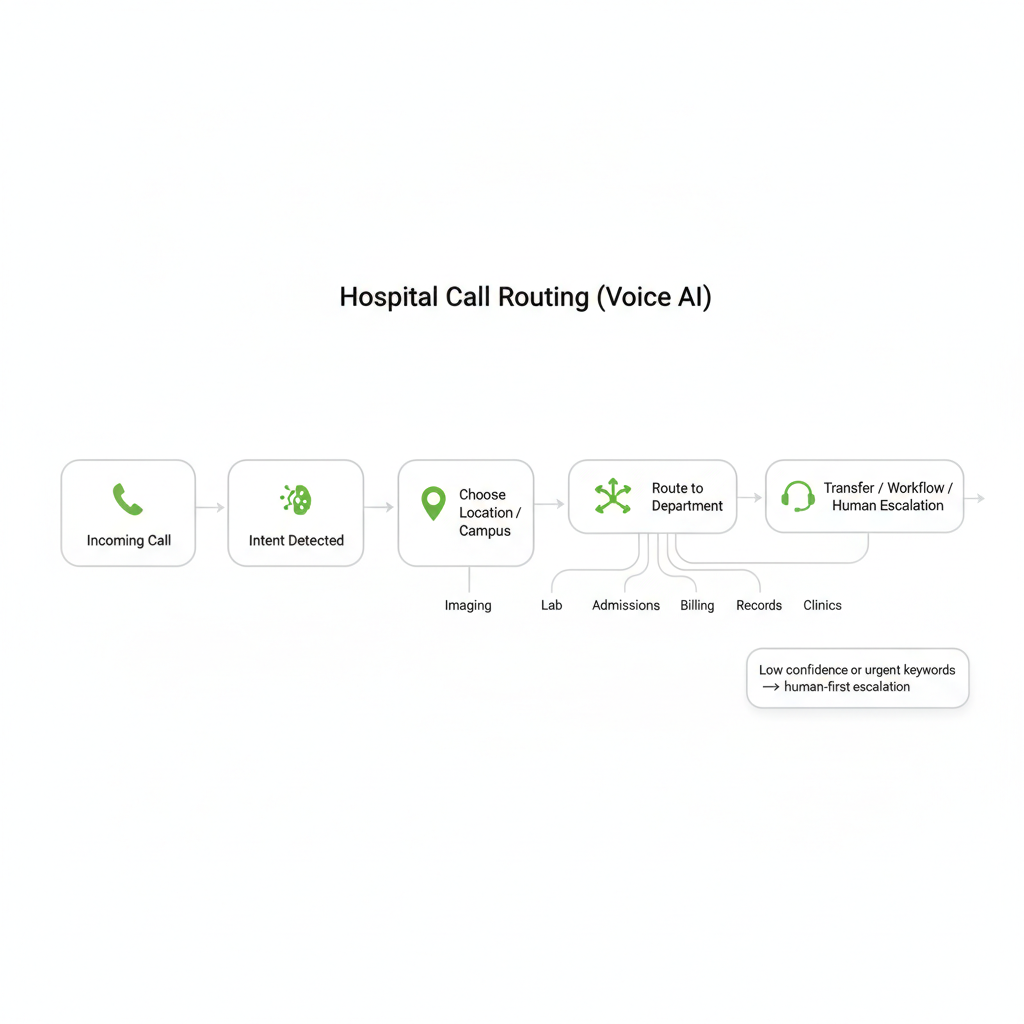
Voice AI hospital call routing diagram for switchboard automation with department transfers and multi-location navigation
Hospital routing pattern: call answered instantly → intent detected → department or site selected → transfer, workflow, or human escalation.
Can a Voice AI system replace a hospital switchboard?
It can augment or reduce switchboard load by handling routine routing and service-line navigation. Hospitals often deploy it as a first-line routing layer with human escalation for urgent, sensitive, or low-confidence situations.
How does the AI decide which department a caller needs?
We map common call intents to your departments and workflows (e.g., “lab results,” “imaging,” “billing,” “referrals,” “clinic booking”). Routing is validated through testing, and the system escalates to humans when confidence is low.
Can it route callers to the right hospital location or campus?
Yes. Multi-location routing can be configured by site, region, service line, postal code, or caller preference — with different hours-based rules per location.
What happens if the caller says it’s urgent or mentions an emergency?
The system can be configured to trigger immediate escalation pathways (transfer to staff / on-call / nurse line) and present approved instructions, based on your policy and operational model. It’s designed to be human-first in high-risk scenarios.
{
  "section": "Hospital Switchboard Routing",
  "entity": "Peak Demand",
  "service": "Voice AI hospital call routing",
  "geo": ["Canada", "United States"],
  "capabilities": [
    "department routing and transfers",
    "service line navigation by intent",
    "hours-based routing logic",
    "multi-location site selection",
    "high concurrency call handling",
    "human-first escalation for urgent/low-confidence"
  ],
  "outcomes": [
    "reduce call abandonment",
    "reduce misdirected calls",
    "reduce switchboard load",
    "improve after-hours clarity",
    "improve routing consistency"
  ],
  "cta": "https://peakdemand.ca/discovery"
}
      
Intake & Safety

Structured Intake & Safe Escalation — Capture the Right Details, Route Responsibly

Hospitals can’t afford “chatty bots” that collect unnecessary details or improvise in high-risk situations. Peak Demand designs structured intake and triage routing so the system captures only what is needed to route, create a request, or trigger a human escalation pathway — with clear policy-driven boundaries.

This is how the AI becomes operationally useful without becoming a risk surface: defined intake fields, confidence thresholds, “press 0” human override, and immediate escalation rules for urgent keywords or sensitive scenarios.

How structured intake works (hospital-safe)

  • Purpose-limited questions: ask only what’s required to route or create a follow-up request.
  • Minimal PHI by design: avoid collecting sensitive details unless your workflow explicitly requires it.
  • Structured fields: reason for call, department needed, location preference, callback number, timeframe.
  • Validation prompts: confirm details before routing or creating a ticket (“Did I get that right?”).
  • Approved disclosures: consistent identification, consent language, and escalation instructions (as configured).

Safe escalation pathways (human-first)

  • Urgent keyword triggers: immediate escalation when defined high-risk terms are detected.
  • Low-confidence fallback: if intent is unclear, transfer to staff instead of guessing.
  • Caller frustration detection: repeated requests or negative sentiment can trigger a handoff.
  • Hard boundaries: no medical advice; route to approved pathways for clinical concerns.
  • Override options: “press 0 / speak to staff” available where desired.
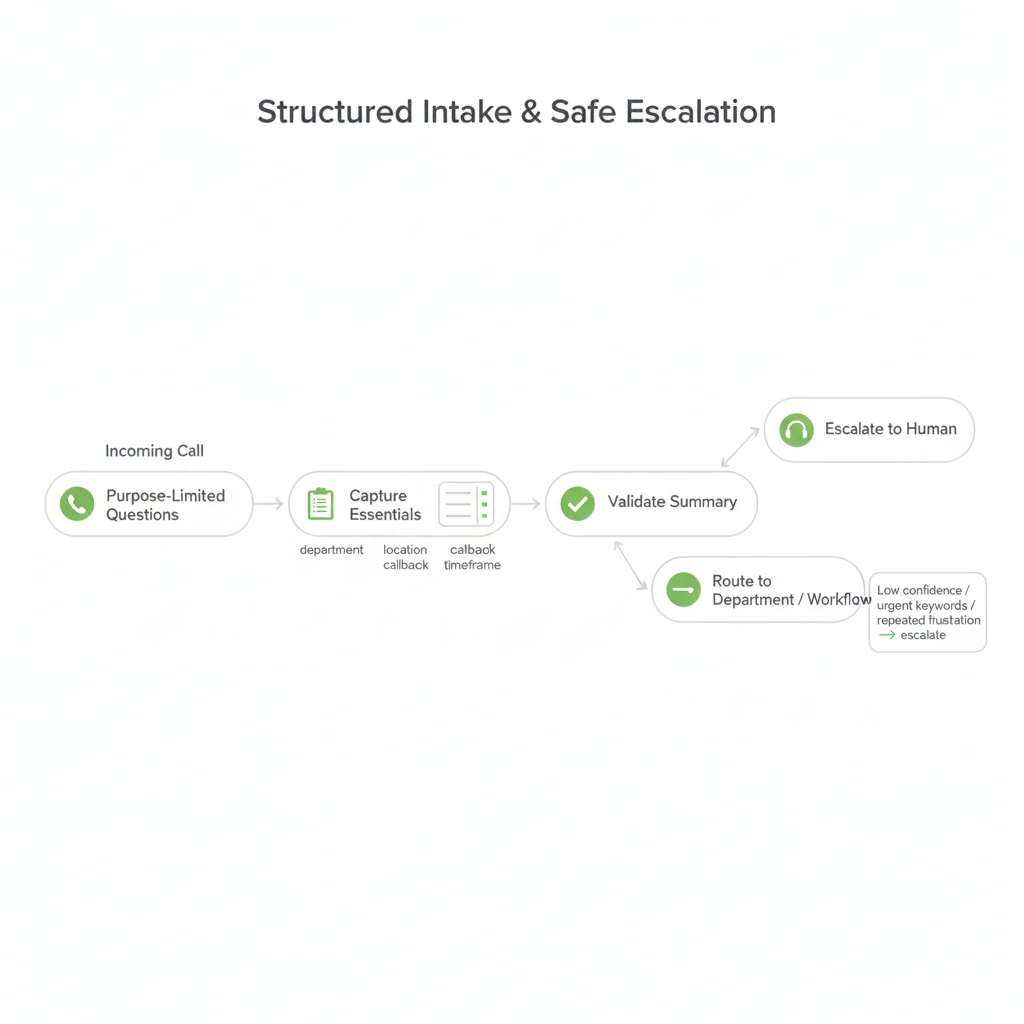
Structured intake and safe escalation workflow for a hospital voice AI call routing system with human-first handoff
Intake is structured and purpose-limited: capture essentials → validate → route or escalate to a human when risk or uncertainty appears.
Does the AI collect personal health information (PHI) during intake?
It can be configured to minimize what it collects and focus on routing essentials (department, location, callback, timeframe). If a workflow requires additional fields, we define strict boundaries and escalation rules so intake stays purpose-limited and reviewable.
What happens when the AI is unsure what the caller needs?
We configure confidence thresholds and fallback rules. If the system is uncertain, it escalates to staff rather than guessing — which reduces misroutes and protects safety in sensitive scenarios.
Can callers always reach a human?
Yes, if you want that. Many hospitals enable a “press 0 / speak to staff” pathway and also trigger automatic escalation for urgent or repeated requests.
Will the AI give medical advice?
No. The system is designed for routing, intake, and operational workflow completion — with human-first escalation for clinical concerns and emergencies.
{
  "section": "Structured Intake & Safe Escalation",
  "entity": "Peak Demand",
  "service": "Voice AI hospital call routing",
  "intake_principles": [
    "purpose-limited questions",
    "minimal PHI collection by design",
    "structured fields (reason, department, location, callback, timeframe)",
    "validation prompts",
    "approved disclosures"
  ],
  "safety_controls": [
    "urgent keyword triggers",
    "low-confidence human fallback",
    "caller frustration handoff",
    "hard boundaries (no medical advice)",
    "human override option (as configured)"
  ],
  "outcomes": [
    "reduce misroutes",
    "increase safety and reviewability",
    "improve caller experience",
    "support governance requirements"
  ],
  "cta": "https://peakdemand.ca/discovery"
}
      
Coverage

After-Hours Coverage & Peak-Hour Overflow — Reduce Abandoned Calls and Voicemail Backlogs

Hospitals experience predictable spikes: early mornings, lunch-hour surges, shift changes, and evenings when departments close but calls keep coming. Peak Demand structures after-hours answering and overflow handling so callers still receive immediate guidance and routing — without forcing staff to “dig out” from voicemail.

Instead of one receptionist handling one caller at a time, Voice AI can handle multiple calls concurrently, follow your hours-based rules, and create structured callback requests when a live transfer isn’t available — all with escalation paths for urgent scenarios.

What after-hours + overflow workflows typically include

  • Immediate answer (24/7): reduce hold-time abandonment during peak periods.
  • Hours-based routing: different rules when clinics close, departments change, or on-call coverage starts.
  • On-call escalation: route defined urgent categories to an on-call line or approved pathway (policy-driven).
  • Structured callback queue: capture department, caller reason, best time, and contact details for follow-up.
  • Information routing: hours, directions, visiting info, clinic locations, and “who to call” guidance.
  • Overflow reduction: offload repetitive calls from switchboard teams so staff focus on true exceptions.

Where hospitals see the biggest lift

  • Less voicemail debt: fewer messages to replay and triage manually.
  • Cleaner department handoffs: fewer misroutes during shift changes.
  • Higher caller satisfaction: faster answers, clearer instructions, fewer transfers.
  • More consistent intake: structured requests instead of scattered notes.
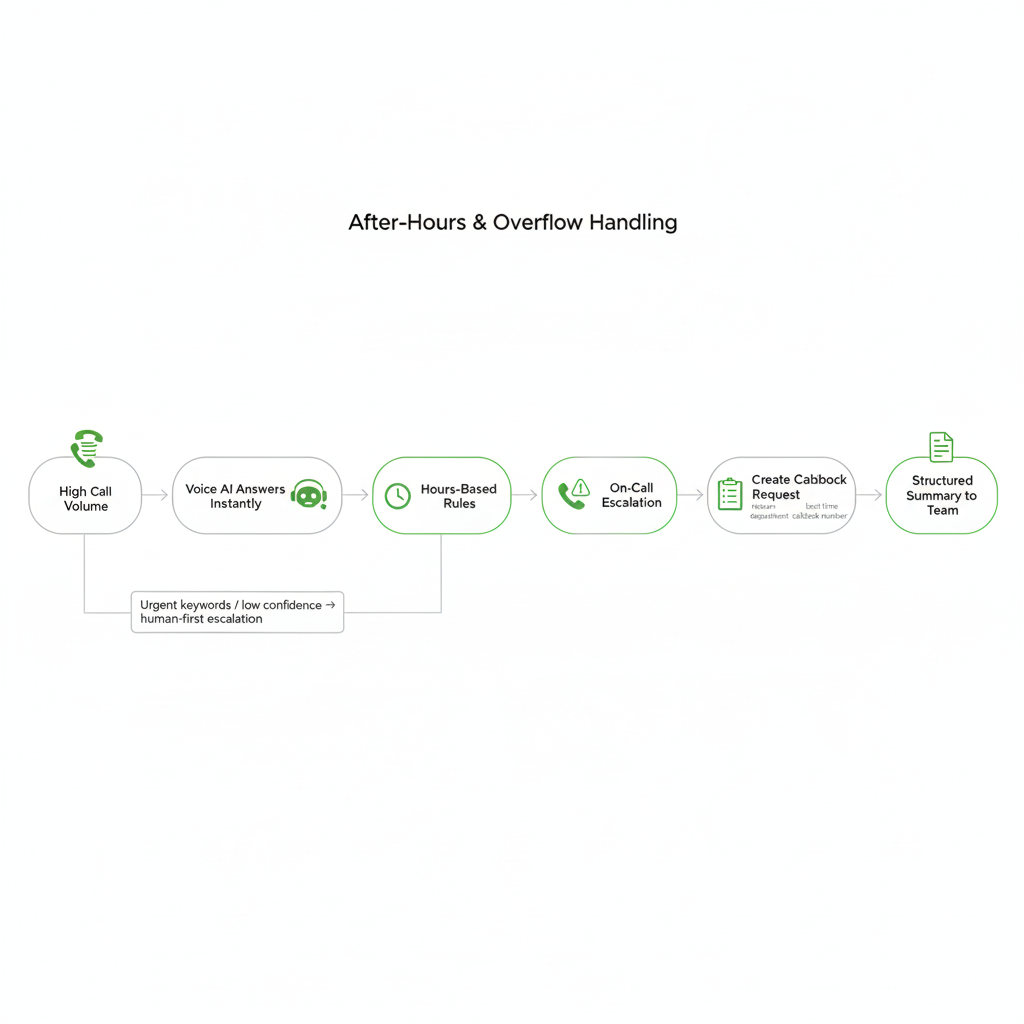
After-hours hospital voice AI call routing workflow showing overflow handling, on-call escalation, and structured callback queue
Coverage pattern: peak-hour overflow + after-hours rules → route, escalate, or create a structured callback request with the right department context.
Can Voice AI handle multiple calls at the same time during peak periods?
Yes. Concurrency is one of the biggest operational advantages: multiple callers can be handled in parallel, reducing hold times and abandonment. Live staff can stay focused on escalations and complex cases.
What happens when a department is closed after hours?
We configure hours-based routing rules: direct callers to the right after-hours pathway, provide approved instructions, or create a structured callback request for the appropriate queue. The exact behaviour is defined by your policy and operational model.
Can it route to an on-call line?
Yes, where appropriate. On-call escalation can be configured for specific call categories and urgent keywords, with clear human-first handoff logic.
Do we still get a record of what happened after hours?
Yes. Outcomes can be logged as structured summaries and/or metadata records (policy-driven), so teams can review what was routed, escalated, or queued for follow-up.
{
  "section": "After-Hours Coverage & Peak-Hour Overflow",
  "entity": "Peak Demand",
  "service": "Voice AI hospital call routing",
  "workflows": [
    "24/7 answering",
    "hours-based routing logic",
    "on-call escalation pathways (policy-driven)",
    "structured callback queue creation",
    "information routing (hours, directions, locations)",
    "overflow handling for peak periods"
  ],
  "outcomes": [
    "reduce call abandonment",
    "reduce voicemail backlogs",
    "improve after-hours clarity",
    "standardize callback requests",
    "reduce switchboard overload"
  ],
  "cta": "https://peakdemand.ca/discovery"
}
      
Multi-Site Networks

Multi-Location Network Standardization — Consistent Routing Across Campuses & Clinics

Large hospital systems and regional healthcare networks often operate multiple campuses, outpatient clinics, specialty centers, and satellite facilities. Without structured routing logic, callers are transferred repeatedly between locations. Peak Demand designs standardized Voice AI routing frameworks that maintain consistency across sites while preserving location-specific rules.

The goal is simple: one predictable, reviewable routing experience — regardless of which campus, clinic, or service line the caller needs. At the same time, each site can retain its own hours, escalation pathways, and department structure.

What network-level standardization includes

  • Centralized routing logic: unified intent mapping across the entire network.
  • Site-specific rules: different hours, escalation pathways, and service availability per location.
  • Department normalization: consistent naming and routing patterns (e.g., imaging vs radiology vs diagnostics).
  • Location selection prompts: allow callers to choose campus or be routed by region/postal code.
  • Shared governance controls: uniform escalation thresholds and intake structure across sites.
  • Expansion-ready architecture: add new clinics or facilities without rebuilding from scratch.

Operational outcomes

  • Reduced transfer loops: fewer “wrong campus” handoffs.
  • Cleaner cross-site reporting: consistent intake categories across locations.
  • Improved caller clarity: faster path to the right site and department.
  • Scalable governance: routing policies updated centrally when needed.
Multi-location hospital voice AI routing diagram showing central system with multiple campuses and standardized department routing
Central routing core → campus selection → department transfer — standardized logic with site-specific rules layered on top.
Can one Voice AI system support multiple hospital campuses?
Yes. Routing can be centralized while still respecting site-specific hours, departments, and escalation policies. The system can prompt callers to select a location or infer routing based on defined rules.
What happens when departments are named differently across sites?
We normalize routing internally so similar intents map correctly, even if naming varies. This improves reporting clarity and reduces misroutes across the network.
Can we add new clinics later without rebuilding everything?
Yes. The routing architecture is designed to scale — new sites and departments can be layered into the framework without disrupting existing workflows.
Is governance managed centrally across all locations?
Governance controls, escalation thresholds, and intake boundaries can be standardized at the network level, while still allowing defined local variations where required.
{
  "section": "Multi-Location Network Standardization",
  "entity": "Peak Demand",
  "service": "Voice AI hospital call routing",
  "scope": "multi-campus and multi-site healthcare networks",
  "capabilities": [
    "centralized intent mapping",
    "site-specific routing rules",
    "department normalization",
    "location selection logic",
    "network-level governance controls",
    "expansion-ready architecture"
  ],
  "outcomes": [
    "reduce cross-site misroutes",
    "improve routing consistency",
    "support scalable growth",
    "standardize reporting categories"
  ],
  "cta": "https://peakdemand.ca/discovery"
}
      
Integrations

Enterprise-Grade Integrations — Secure Notifications, Ticketing & Workflow Sync (Least Privilege)

Voice AI becomes “hospital-ready” when it can complete real tasks — without exposing your entire environment. Peak Demand implements least-privilege integrations so the AI can route, notify, and create follow-ups while keeping access scoped, logged, and reviewable for privacy and security teams.

We focus on safe operational outcomes: create a ticket, message a queue, push a structured summary, update a directory lookup, or trigger an approved notification workflow. The AI is permissioned to do only what you authorize — not “everything in the system.”

Common hospital integration patterns

  • Secure notifications: send structured summaries to on-call, nurse line, or operational inboxes (policy-driven).
  • Ticketing / case creation: open requests for departments (billing, records, referrals, clinic follow-ups).
  • Directory + department lookup: route based on service line, provider, clinic, or location rules.
  • Scheduling coordination: for specific workflows (outpatient clinics, specialty booking) where approved.
  • Queue routing: send follow-up items to the right team queue instead of voicemail.
  • Audit-ready actions: log every “write” action taken (ticket created, message sent, transfer triggered).

Integration security controls we use

  • Scoped permissions: read vs write separation; field-level access where possible.
  • Token-based authentication: OAuth/OIDC where supported; scoped service tokens otherwise.
  • Transport security: TLS for API traffic and webhooks.
  • Integrity checks: signed webhooks (HMAC) where applicable.
  • Environment separation: testing vs production workflows.
  • Human approval gates: for high-risk actions (as required).
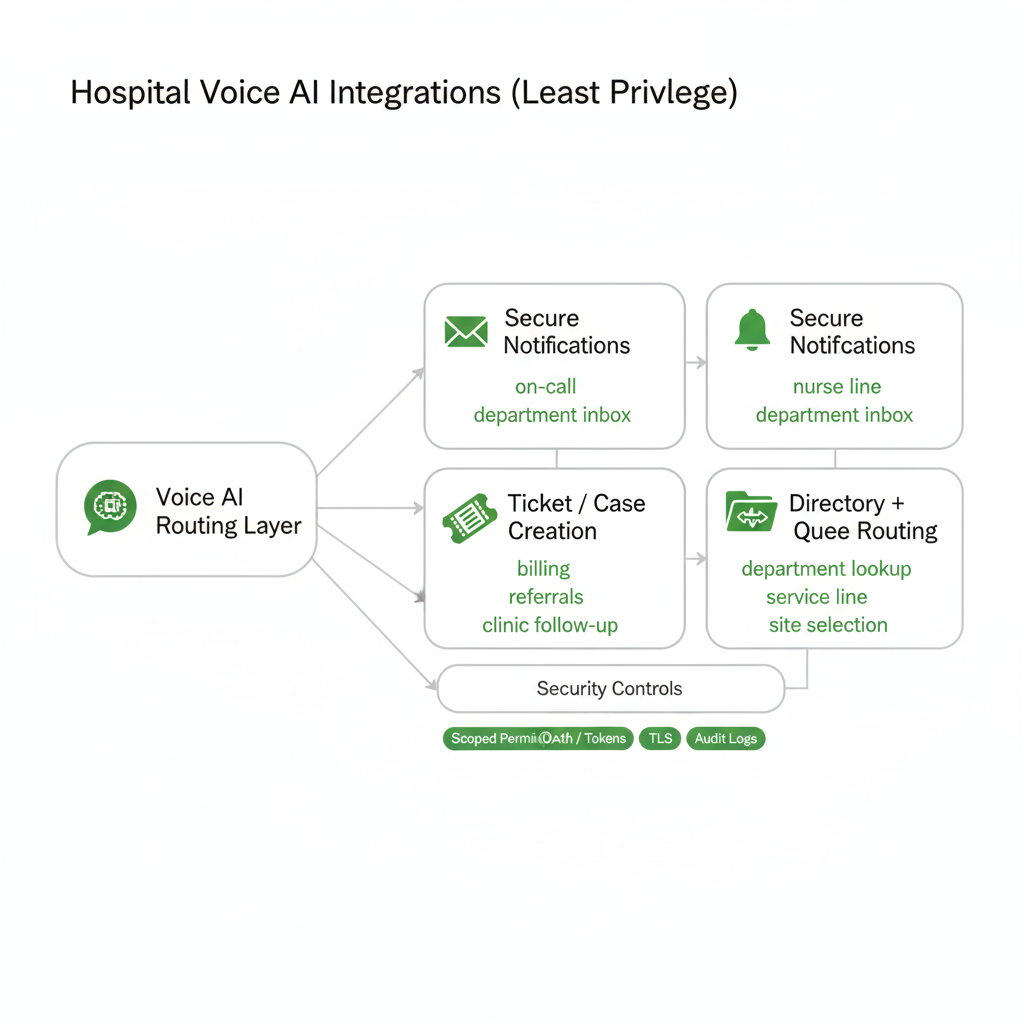
Enterprise hospital voice AI integration diagram showing secure notifications, ticket creation, and least-privilege access controls
Integration principle: the AI can trigger approved actions (notify, ticket, route) with scoped permissions — not broad system access.
Do you integrate directly with our EHR/EMR?
Where appropriate, integrations can be designed for specific approved actions and limited data access. Many hospitals prefer starting with lower-risk integrations (notifications, ticketing, directory routing) and expanding only as workflows are validated.
How do you stop the AI from having access to “everything”?
We scope permissions so the system can only perform approved actions (e.g., create a ticket, send a summary, route to a queue). Access is separated by environment (test vs production) and logged for review.
Can the AI create a request for records, billing, or referrals?
Yes. A common pattern is structured intake → ticket creation → assignment to the right department queue, so staff have context without replaying calls.
Can our security team audit integration actions?
Yes. We can log “write events” such as tickets created, messages sent, transfers triggered, and admin changes — with export options depending on your reporting posture.
{
  "section": "Enterprise Integrations (Hospital)",
  "entity": "Peak Demand",
  "service": "Voice AI hospital call routing",
  "integration_patterns": [
    "secure notifications to teams/queues (policy-driven)",
    "ticketing / case creation for follow-ups",
    "directory and department lookup routing",
    "queue routing and callback creation",
    "approved scheduling coordination (where applicable)"
  ],
  "security_controls": [
    "least privilege scopes (read/write separation)",
    "token-based authentication (OAuth/OIDC where supported)",
    "TLS for API and webhook traffic",
    "signed webhooks (HMAC) where applicable",
    "testing vs production separation",
    "human approval gates for high-risk actions (as required)"
  ],
  "governance": [
    "audit logs for system actions",
    "exportable records (policy-driven)"
  ],
  "cta": "https://peakdemand.ca/discovery",
  "internal_link": "https://peakdemand.ca/ai-voice-receptionist-after-hours-answering-service-for-healthcare-providers-appointment-booking"
}
      
Governance

Governance, Audit Logs & Reviewable Outcomes — Built for Hospital Oversight

Hospitals don’t just need “calls answered.” They need reviewability — the ability to confirm what happened, why a call was routed a certain way, what the AI captured, and whether escalation rules were followed. Peak Demand structures Voice AI deployments with governance controls so security, privacy, and operations teams can validate behaviour over time.

Reporting can be tuned to your risk posture — from metadata-only records to controlled summaries and transcripts with defined retention windows. The core principle stays the same: every meaningful outcome is traceable, exportable (where required), and protected by role-based access.

What hospitals typically want logged (audit trail)

  • Call outcome: routed, transferred, escalated, callback created, message taken.
  • Intent + department: what the caller needed and where they were routed.
  • Escalation reason: urgent keyword, low confidence, frustration, sensitive topic.
  • System actions: ticket created, notification sent, queue updated (when integrated).
  • Access events: who viewed/exported logs or summaries, and when.
  • Admin changes: routing edits, policy updates, permission changes.

Governance controls we design for

  • RBAC: roles for Admin, QA, Compliance, and Analyst (least privilege).
  • Retention windows: configurable by workflow and policy.
  • Review queues: flag edge cases for QA (low confidence, escalations, repeat failures).
  • Change control: controlled updates to routing logic and scripts.
  • Exportability: structured records for audits, investigations, and vendor due diligence (policy-driven).
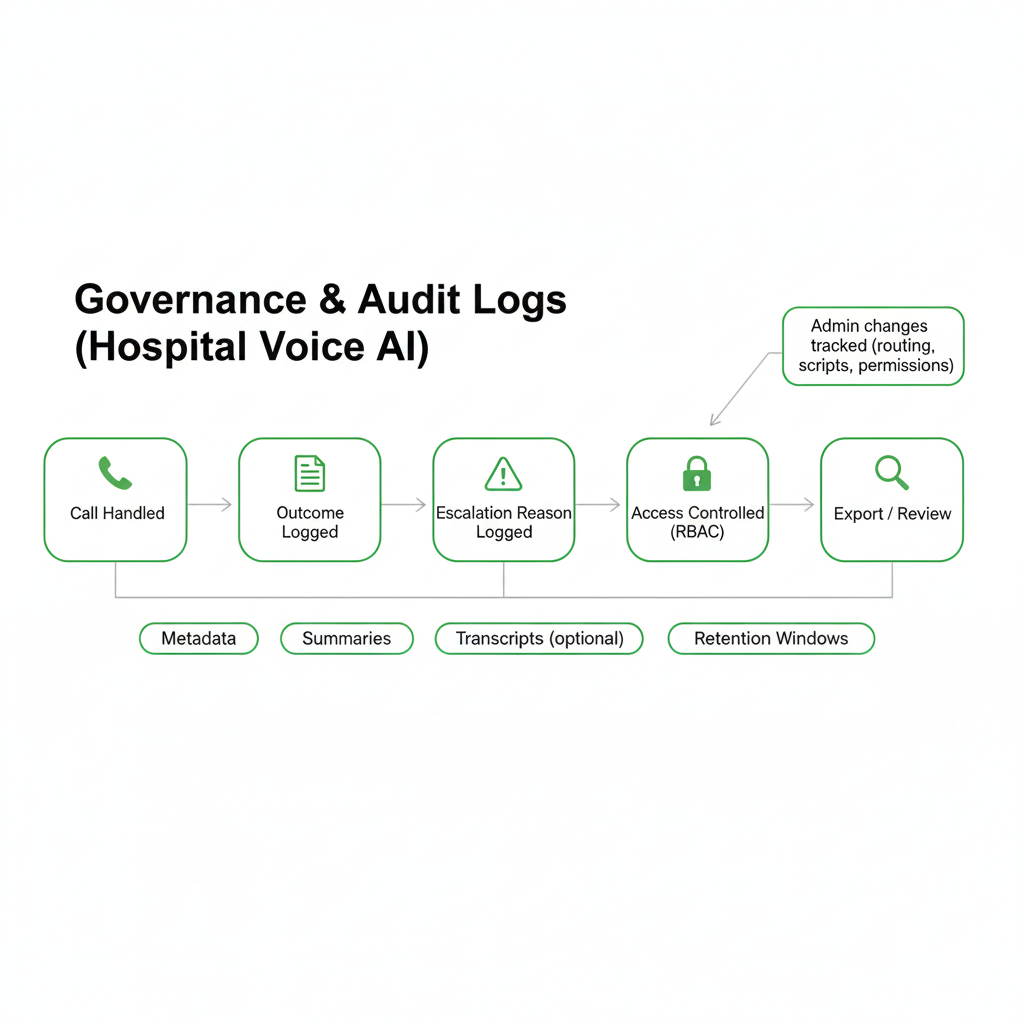
Hospital voice AI governance and audit logging diagram showing call outcomes, escalation reasons, RBAC access controls, and exportable records
Oversight model: outcomes + escalation reasons + system actions are logged, access-controlled, and available for review when required.
Can our compliance or privacy team audit what the AI did on a specific call?
Yes. Reporting can capture call outcomes, routing decisions, and escalation reasons. Depending on your policy, logs may include metadata-only records, structured summaries, and/or controlled transcripts with defined retention windows.
Do we have to store transcripts or recordings?
No. Many regulated teams start with metadata + outcomes and only enable transcripts/recordings where the workflow requires it (for defined QA needs, investigations, or approved training). Storage and retention are configurable.
Can we track where callers are getting stuck?
Yes. Review queues and escalation analytics can highlight low-confidence intents, repeat misroutes, and common failure points, so routing can be improved without guesswork.
Do you log changes to routing logic and scripts?
Yes. Change control is a key governance requirement in hospital environments. Routing updates, policy edits, and permission changes can be tracked so teams can understand what changed and when.
{
  "section": "Governance & Auditability (Hospital)",
  "entity": "Peak Demand",
  "service": "Voice AI hospital call routing",
  "logged_events": [
    "call outcomes (routed/transferred/escalated/callback)",
    "intent + department selected",
    "escalation reason (urgent/low confidence/frustration)",
    "system write actions (ticket/notification) where integrated",
    "access events (view/export)",
    "admin changes (routing/scripts/permissions)"
  ],
  "governance_controls": [
    "role-based access control (RBAC)",
    "retention windows (policy-driven)",
    "review queues for edge cases",
    "change control for routing updates",
    "exportable records (where required)"
  ],
  "reporting_posture": "configurable (metadata-only → summaries → controlled transcripts)",
  "cta": "https://peakdemand.ca/discovery"
}
      
Compliance

Privacy & Security Alignment for Hospitals — PIPEDA/PHIPA Context + HIPAA Where Applicable

Hospital call routing touches sensitive information, even when the goal is “just transfer me.” Peak Demand designs deployments to be reviewable, access-controlled, and purpose-limited so privacy and security teams can map requirements to concrete controls — rather than relying on generic “we’re compliant” claims.

Canadian hospital environments typically evaluate privacy alignment under provincial health privacy frameworks (e.g., PHIPA in Ontario) and broader accountability expectations. For U.S. workflows, systems can be structured to support HIPAA/HITECH safeguard expectations where applicable. Requirements vary by jurisdiction — the implementation is designed for due diligence and governance review.

Controls hospitals typically want to see

  • Consent + disclosure: approved greetings, recording notices (if enabled), and clear human escalation options.
  • Data minimization: collect only what’s needed for routing, callback creation, or approved workflows.
  • Encryption: secure transport (TLS) and encryption at rest where configured for stored artifacts.
  • RBAC + least privilege: restrict access to logs/summaries; separate roles for Admin, QA, Compliance.
  • Audit logs + export: traceable outcomes, system actions, and admin changes for investigations and review.
  • Retention controls: configurable windows and deletion expectations by workflow and policy.

Procurement-ready artefacts we provide

  • Data flow summary: what’s captured, where it moves, and where it’s stored (by workflow).
  • Control boundary: what Peak Demand configures vs what cloud/telephony vendors operate.
  • Logging posture options: metadata-only vs summaries vs controlled transcripts (policy-driven).
  • Escalation map: urgent keywords, low-confidence fallback, and human override pathways.
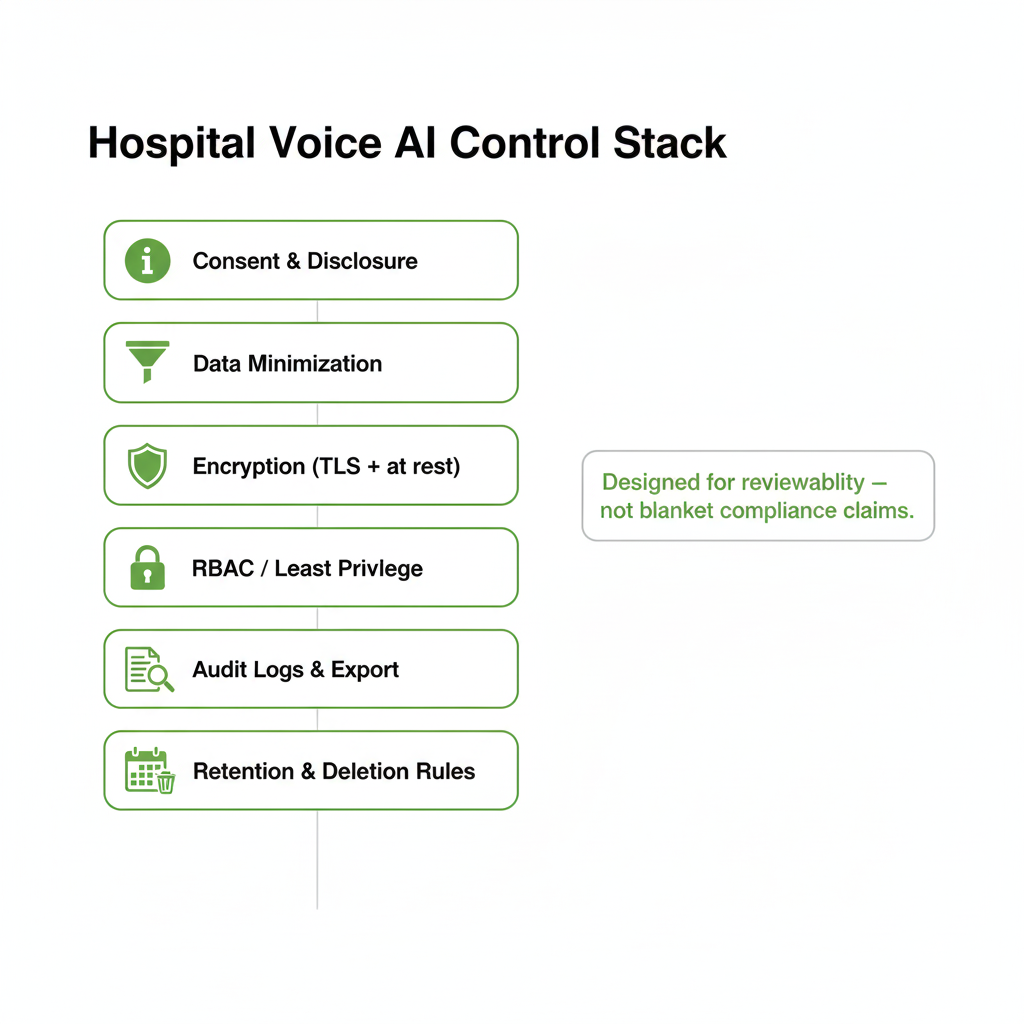
Hospital voice AI privacy and security control stack diagram showing consent, data minimization, encryption, RBAC, audit logs, and retention
Control stack view: consent → minimization → encryption → access controls → audit logs → retention, structured for review by privacy and security teams.
Is this “PHIPA compliant” for Ontario hospitals?
We avoid blanket compliance guarantees. Deployments are designed to align with PHIPA expectations through concrete controls (minimization, RBAC, audit logs, retention rules, and reviewable workflows). Your privacy team ultimately determines fit for your environment.
Do we have to store recordings or transcripts?
No. Many hospital teams start with metadata + structured outcomes and only enable transcripts/recordings where a workflow requires it. Storage and retention are configurable and policy-driven.
Can we get documentation for procurement and vendor risk review?
Yes. We can provide a data-flow summary, control boundary documentation, logging posture options, and escalation maps so security and privacy teams can complete internal due diligence.
How do you align security controls to a hospital framework?
Controls can be mapped to common governance frameworks (e.g., NIST) and to organizational policies. We focus on implementation evidence: who can access what, what is logged, what is retained, and how escalation behaves.
{
  "section": "Privacy & Security Alignment (Hospital)",
  "entity": "Peak Demand",
  "service": "Voice AI hospital call routing",
  "jurisdictions": ["Canada", "United States"],
  "regulatory_context": [
    "PHIPA (Ontario, where applicable)",
    "PIPEDA (Canada, where applicable)",
    "HIPAA/HITECH (U.S., where applicable)"
  ],
  "control_stack": [
    "consent and disclosure",
    "data minimization",
    "encryption in transit (TLS) and at rest (where configured)",
    "RBAC and least privilege",
    "audit logs and export options",
    "retention and deletion policies"
  ],
  "procurement_artifacts": [
    "data flow summary",
    "control boundary documentation",
    "logging posture options",
    "escalation map"
  ],
  "cta": "https://peakdemand.ca/discovery"
}
      
Custom Architecture

Why Hospitals Avoid Off-the-Shelf Voice Bots — And What We Build Instead

Hospital environments are structurally different from small clinics or retail call centers. Service lines vary. Escalation policies differ by department. Multi-campus networks introduce routing complexity. That’s why Peak Demand delivers custom-built hospital Voice AI architectures — not generic SaaS call trees.

Many hospital teams approach us after struggling with templated platforms that couldn’t handle multi-department routing, after-hours rule changes, on-call escalation, or governance requirements. Our deployments begin with workflow mapping, not pre-packaged scripts.

Where off-the-shelf systems break down

  • Rigid call trees: limited flexibility for complex department logic.
  • No multi-campus awareness: weak location-based routing.
  • Minimal escalation logic: cannot differentiate routine vs high-risk intents.
  • Generic scripts: not aligned with hospital-specific terminology.
  • Poor governance visibility: limited audit controls or export options.
  • Hard-to-scale architecture: adding new service lines requires rebuilding flows.

What our custom builds include

  • Workflow mapping sessions: define departments, service lines, escalation rules, and hours logic.
  • Policy-driven escalation design: urgent keywords, low-confidence fallback, and human override.
  • Multi-location logic layers: centralized routing with site-specific overrides.
  • Governance-first architecture: logging posture defined before go-live.
  • Structured testing: simulate real hospital call scenarios pre-launch.
  • Ongoing optimization: refine routing based on live data and edge cases.
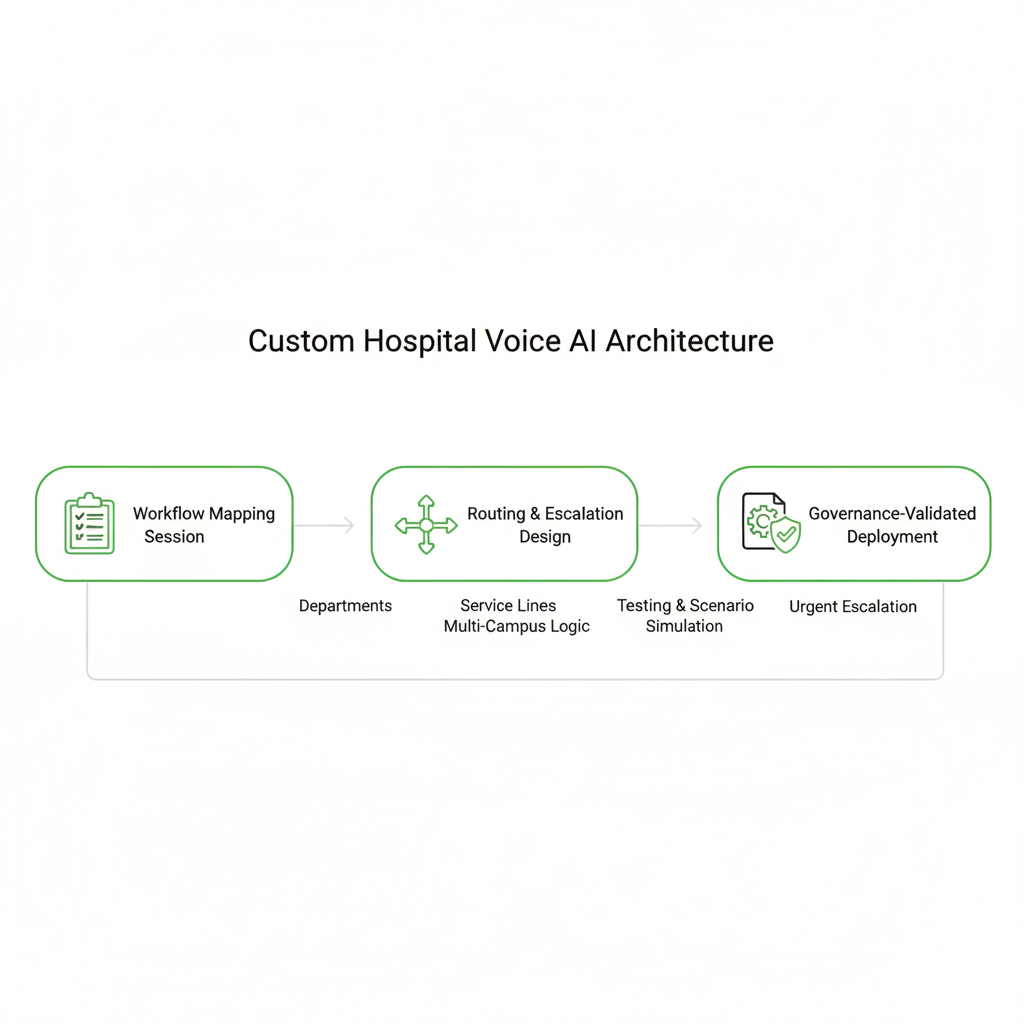
Custom-built hospital voice AI workflow mapping session diagram showing department logic, escalation rules, and multi-location routing
Custom architecture: workflow mapping → routing design → escalation logic → testing → governance validation.
Is this a plug-and-play hospital voice bot?
No. Each deployment is built around your hospital’s structure, service lines, and escalation policies. We do not deploy generic templates without workflow validation.
Can you handle complex multi-department routing?
Yes. Routing is mapped to your actual operational model — including specialty services, multi-campus logic, and hours-based overrides.
How long does a hospital deployment typically take?
Timeline depends on routing complexity, integration depth, and governance review cycles. We begin with structured workflow mapping and testing before go-live.
Do you continue optimizing after launch?
Yes. We monitor routing performance, review edge cases, and refine flows so the system improves over time — not degrades into a static call tree.
{
  "section": "Custom Hospital Voice AI Architecture",
  "entity": "Peak Demand",
  "service": "Voice AI hospital call routing",
  "positioning": "custom-built, fully managed deployment (not off-the-shelf SaaS)",
  "differentiation": [
    "workflow mapping before deployment",
    "policy-driven escalation design",
    "multi-campus routing layers",
    "governance-first architecture",
    "structured testing before go-live",
    "ongoing optimization"
  ],
  "contrast": "not generic call tree software",
  "cta": "https://peakdemand.ca/discovery"
}
      
Why Peak Demand

Why Peak Demand — Fully Managed Hospital Voice AI (Canada & U.S.)

Hospitals require more than automation. They require operational stability, governance visibility, and structured deployment. Peak Demand is a Toronto-based AI agency delivering fully managed Voice AI routing systems for hospitals and multi-location healthcare networks across Canada and the United States.

We are not a telephony reseller or a generic chatbot platform. We design, deploy, monitor, and continuously optimize hospital-grade routing architectures with escalation logic, audit controls, and least-privilege integrations built in from the start.

What differentiates our hospital deployments

  • Custom architecture: built around your departments, service lines, and escalation policies.
  • Governance-first mindset: audit logs, RBAC, retention posture defined before launch.
  • Multi-campus expertise: standardized routing with site-level logic.
  • Human-first design: escalation boundaries and override pathways built into every workflow.
  • Fully managed service: ongoing monitoring, routing refinement, and optimization.
  • Cross-border awareness: Canadian privacy context + U.S. safeguard alignment where applicable.

Who typically engages us

  • Hospital operations leaders seeking to reduce switchboard load.
  • Digital transformation teams modernizing patient access layers.
  • IT & security teams requiring structured integration boundaries.
  • Privacy & compliance leads evaluating new communication systems.
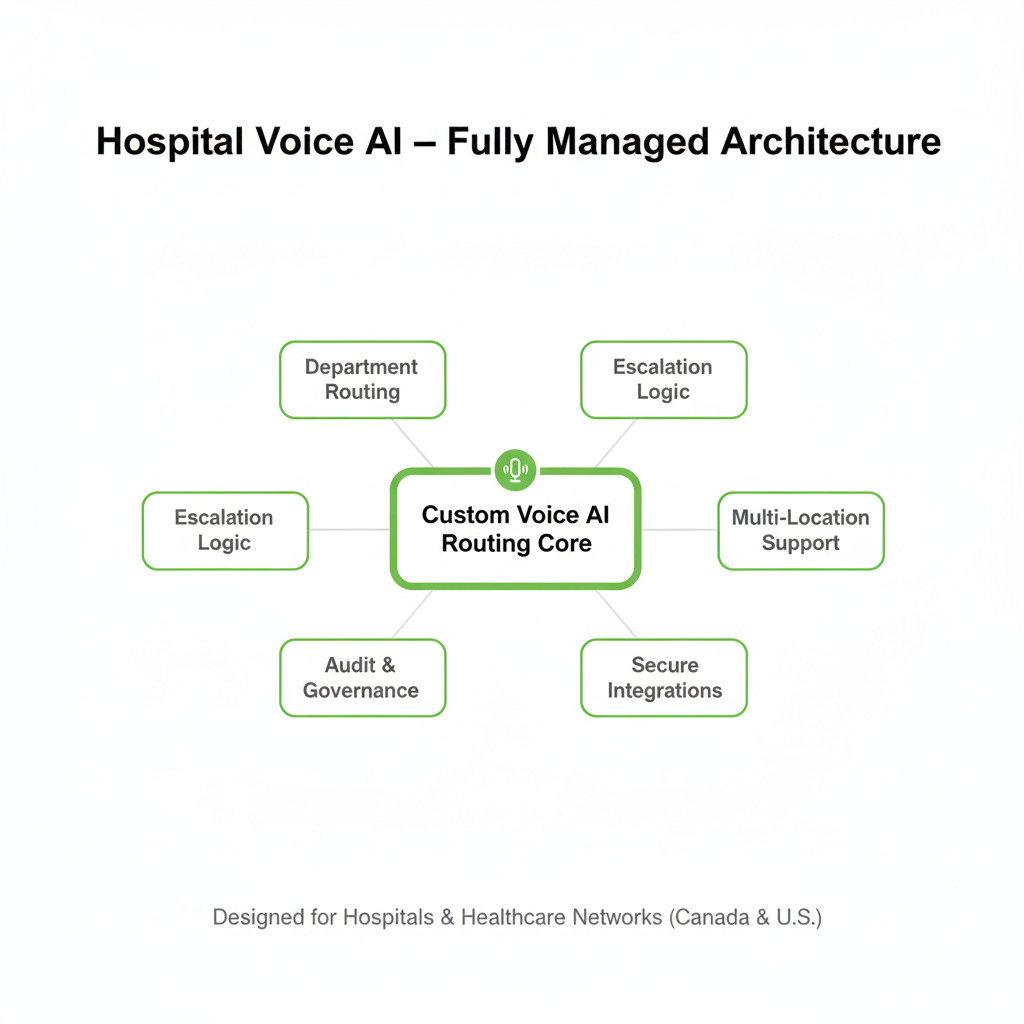
Enterprise hospital voice AI architecture overview showing routing, escalation, governance, and multi-location network support
Enterprise positioning: custom routing architecture + governance controls + multi-location support — fully managed end-to-end.
{
  "section": "Why Peak Demand (Hospital)",
  "entity": "Peak Demand",
  "hq": "Toronto, Ontario, Canada",
  "service": "Fully managed Voice AI hospital call routing",
  "regions_served": ["Canada", "United States"],
  "positioning": [
    "custom-built hospital routing systems",
    "governance-first architecture",
    "multi-campus routing expertise",
    "human-first escalation design",
    "least-privilege integrations",
    "ongoing optimization"
  ],
  "target_buyers": [
    "hospital operations leaders",
    "digital transformation teams",
    "IT & security",
    "privacy and compliance leads"
  ],
  "cta": "https://peakdemand.ca/discovery"
}
      
Next Step

Ready to Reduce Switchboard Load Across Your Hospital Network?

If your hospital or multi-location network is experiencing transfer loops, missed calls, after-hours routing gaps, or overloaded operator teams, Peak Demand can design a custom-built, fully managed Voice AI routing layer tailored to your departments, service lines, and governance requirements.

We work with healthcare organizations across Canada and the United States to modernize patient access without sacrificing oversight: structured escalation rules, reviewable outcomes, and least-privilege integration patterns that are easier to evaluate in procurement and vendor risk review.

What we’ll map on a Discovery Call

  • Top call categories: operator/switchboard routing, departments, clinics, services, after-hours patterns.
  • Multi-campus logic: site selection prompts, region-based routing, hours-based overrides.
  • Escalation rules: urgent keywords, low-confidence thresholds, human override pathways.
  • Workflow scope: what should be automated vs what stays human-first.
  • Integration plan: notifications, ticketing, and approved workflow sync (least privilege).

For IT, Security & Compliance Teams

  • Data-flow summary: what is captured, where it moves, where it is stored (by workflow).
  • Control boundary: Peak Demand responsibilities vs platform/vendor responsibilities.
  • Logging posture: metadata-only → summaries → transcripts (optional, policy-driven).
  • Access model: RBAC roles and least-privilege permission structure.
  • Audit readiness: exportable records and change control (as required).

Toronto-based AI agency. Hospital-grade routing. Multi-location networks. Custom builds — not generic call trees.

Recommended Pathways

Recommended Pathways for Hospital Switchboard Routing & Multi-Location Networks

Hospital network deployments typically start by stabilizing switchboard routing and escalation rules, then expand into centralized scheduling, after-hours coverage, and enterprise patient access standardization across sites and service lines.

{
  "module": "healthcare_interlinks_pathways",
  "page_context": "voice-ai-hospital-call-routing-multi-location-networks",
  "pathways": {
    "routing_access_standardization": [
      "https://peakdemand.ca/voice-ai-healthcare-call-center-automation",
      "https://peakdemand.ca/voice-ai-ivr-replacement-healthcare-call-center-modernization",
      "https://peakdemand.ca/voice-ai-healthcare-centralized-scheduling-center"
    ],
    "escalation_critical": [
      "https://peakdemand.ca/voice-ai-emergency-department-surge-support",
      "https://peakdemand.ca/voice-ai-mental-health-community-health-intake-escalation-support",
      "https://peakdemand.ca/ai-after-hours-healthcare-call-handling-24-7-medical-answering-hospitals-clinics"
    ],
    "governance": [
      "https://peakdemand.ca/enterprise-voice-ai-compliance-certifications-rfp-vendor-ccai-customer-service-healthcare-utilities-government-canadian-ai-agency",
      "https://peakdemand.ca/phipa-compliant-ai-voice-receptionist-ontario-clinics",
      "https://peakdemand.ca/hipaa-compliant-voice-ai-receptionist-healthcare"
    ]
  }
}
      
Regulatory Context

Regulatory & Privacy Context for Hospital Voice AI (Canada & United States)

Hospital communication systems often operate within regulated privacy and security environments. Peak Demand structures Voice AI hospital routing deployments to support internal review, governance alignment, and audit visibility under applicable Canadian and U.S. regulatory frameworks.

Regulatory applicability varies by jurisdiction, organizational structure, and data handling model. Our approach translates legal and policy expectations into technical controls — including data minimization, role-based access, encryption in transit, logging, retention controls, and human-first escalation pathways.

Canada

United States

The goal is not “checkbox compliance,” but reviewability. Hospital IT, security, and privacy teams should be able to trace routing workflows, escalation logic, logging posture, and access controls to defined governance boundaries prior to deployment.

{
  "section": "Hospital Regulatory & Privacy Context",
  "entity": "Peak Demand",
  "service": "Voice AI hospital call routing",
  "jurisdictions": ["Canada", "United States"],
  "regulatory_frameworks": [
    "PHIPA",
    "PIPEDA",
    "Provincial Health Privacy Acts",
    "HIPAA Privacy Rule",
    "HIPAA Security Rule",
    "HITECH"
  ],
  "related_internal_pages": [
    "https://peakdemand.ca/phipa-compliant-ai-voice-receptionist-ontario-clinics",
    "https://peakdemand.ca/hipaa-compliant-voice-ai-receptionist-healthcare",
    "https://peakdemand.ca/enterprise-voice-ai-compliance-certifications-rfp-vendor-ccai-customer-service-healthcare-utilities-government-canadian-ai-agency"
  ],
  "governance_controls": [
    "data minimization",
    "role-based access control",
    "encryption in transit",
    "audit logging",
    "retention configuration",
    "human-first escalation"
  ],
  "purpose": "Provide regulatory awareness context for hospital AI routing deployments"
}
      

Explore your own AI use case on a discovery call.

Peak Demand

Canadian AI agency delivering Voice AI receptionists, call center automation, secure API integrations, and GEO / AEO / LLM lead surfacing for business and government across Canada and the U.S.

What we do: production-grade voice workflows, integrations to your systems of record, and measurable conversion outcomes.
Call our AI assistant Sasha:
381 King St. W., Toronto, Ontario, Canada
© Peak Demand — All rights reserved. | Privacy Policy | Terms of Service
This website is powered by and built on Peak Demand.