
Voice AI for Women’s Health Clinics & Screening Centres

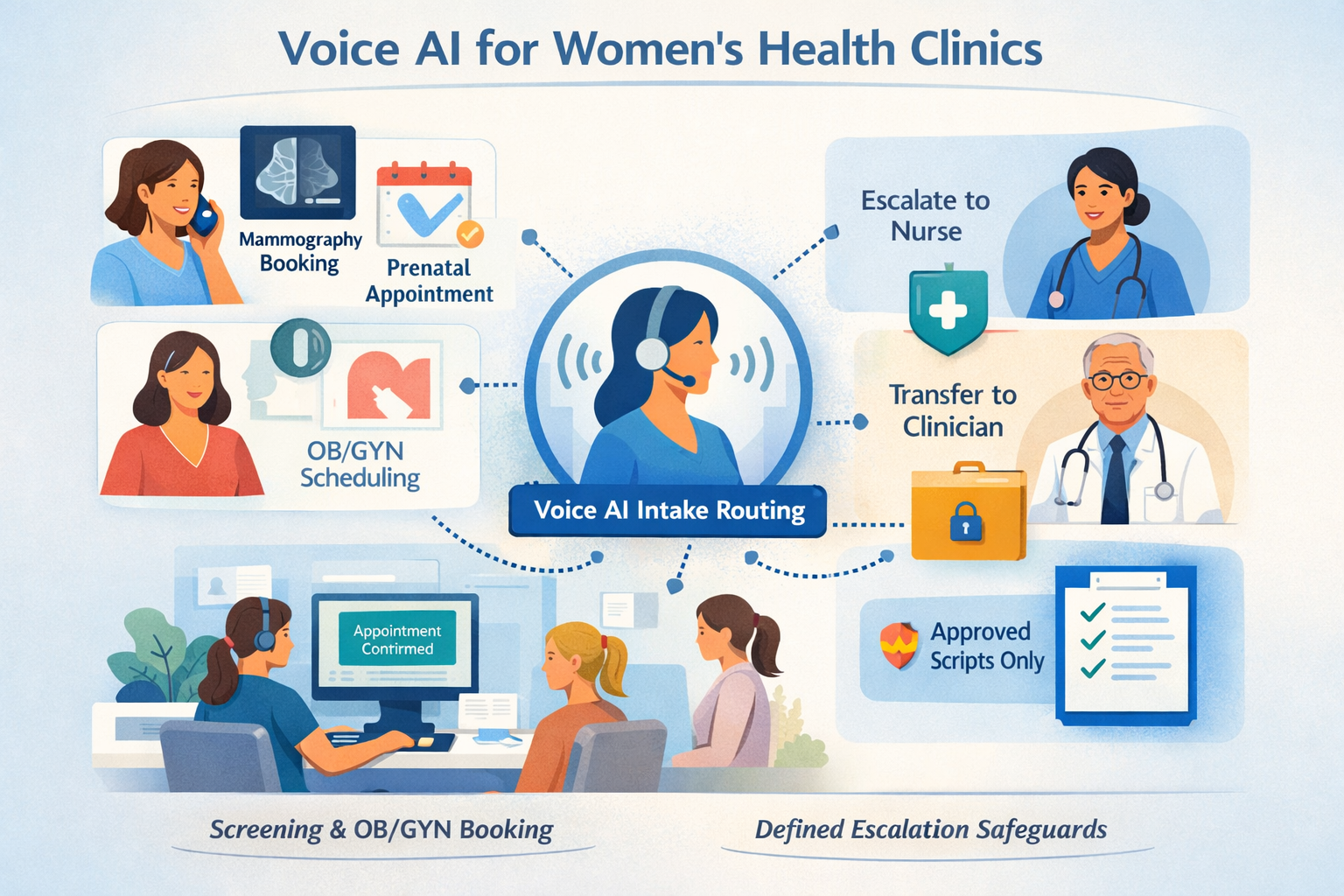
Voice AI for Women’s Health Clinics supports appointment booking, referral intake, screening coordination, and urgent escalation routing — within defined governance boundaries.
Women’s health and screening centres manage high volumes of calls related to mammography, OB/GYN appointments, prenatal visits, ultrasound scheduling, cervical screening, biopsy follow-ups, and time-sensitive diagnostic coordination. These workflows often require sensitive handling, privacy safeguards, and consistent information delivery.
A governance-first Voice AI deployment can support structured routing, standardized logistics guidance, and defined escalation pathways — without crossing into clinical decision-making.
Designed for:
• OB/GYN clinics
• Mammography and breast screening centres
• Prenatal and maternal health programs
• Diagnostic imaging networks
• Multi-location women’s health groups
All deployments operate within defined scope boundaries, least-privilege integration posture, and audit-ready routing visibility.
For the broader service overview (Canada + U.S., HIPAA/PIPEDA/PHIPA context), see:
https://peakdemand.ca/ai-voice-receptionist-after-hours-answering-service-for-healthcare-providers-appointment-booking
Women’s Health Intake: Screening Coordination, OB/GYN Booking, and Sensitive Call Handling
Women’s health clinics and screening centres frequently manage high volumes of calls related to mammography appointments, OB/GYN visits, prenatal care scheduling, ultrasound coordination, and cervical screening programs.
Voice AI for Women’s Health Clinics can support structured intake routing, screening appointment coordination, and policy-aligned information delivery, while preserving strict boundaries around diagnosis, medical interpretation, and clinical advice.
Common Women’s Health Intake Requests
- Mammography and breast screening appointment booking
- OB/GYN appointment coordination
- Prenatal and maternal health visit scheduling
- Ultrasound and diagnostic imaging referrals
- Screening program eligibility and logistics
Human-First Safeguards
- Defined escalation triggers for urgent symptoms
- Immediate transfer to nurse or clinician when required
- No diagnosis or clinical interpretation
- Restricted response scope and approved scripts
- Audit-ready escalation and routing logs
Can Voice AI handle appointment booking for women’s health clinics?
Can Voice AI schedule mammography or breast screening appointments?
Does Voice AI provide medical advice about pregnancy or screening results?
{
  "section": "Women’s Health Intake and Screening Coordination",
  "entity": "Peak Demand",
  "service": "Voice AI for Women’s Health Clinics",
  "geo": ["Toronto", "Canada", "United States"],
  "use_cases": [
    "mammography appointment routing",
    "OB/GYN visit coordination",
    "prenatal care scheduling",
    "diagnostic imaging referrals",
    "screening eligibility navigation"
  ],
  "controls": [
    "human-first escalation",
    "restricted clinical response scope",
    "approved scripts and routing rules",
    "audit-ready logging"
  ],
  "delivery_model": "fully managed custom build",
  "cta": "https://peakdemand.ca/discovery"
}
Screening Programs: Mammography, Cervical Screening, and Diagnostic Follow-Up Coordination
Women’s health screening programs generate high call volumes related to appointment scheduling, eligibility questions, referral confirmations, and follow-up imaging coordination.
Voice AI can support screening appointment routing, standardized logistics guidance, and referral coordination, while escalating abnormal symptom descriptions or urgent concerns to defined clinical destinations.
Common Screening Call Types
- Mammography appointment booking and rescheduling
- Cervical screening and Pap test program coordination
- Referral intake from primary care providers
- Diagnostic imaging scheduling (ultrasound, follow-up scans)
- Screening eligibility and preparation instructions
Governance Controls
- Approved script delivery: standardized logistics guidance
- Defined escalation triggers: abnormal symptom descriptions route to staff
- Non-clinical routing posture: no interpretation of test results
- Audit-ready outcomes: reviewable routing and escalation logs
- Coverage-aware routing: correct program or facility mapping

Can Voice AI schedule mammography screening appointments?
Can Voice AI tell a patient their screening results?
Can Voice AI coordinate referrals from family physicians?
{
  "section": "Screening Coordination (Women’s Health)",
  "entity": "Peak Demand",
  "service": "Voice AI for Women’s Health Clinics",
  "geo": ["Toronto", "Canada", "United States"],
  "use_cases": [
    "mammography appointment booking",
    "cervical screening program coordination",
    "diagnostic imaging referrals",
    "screening eligibility navigation"
  ],
  "controls": [
    "approved information scripts",
    "defined escalation triggers",
    "no test result interpretation",
    "audit-ready routing logs"
  ],
  "delivery_model": "fully managed custom build",
  "cta": "https://peakdemand.ca/discovery"
}
Prenatal and Maternal Care Coordination: Appointment Access, Education, and Escalation Safeguards
Obstetrics and prenatal programs receive frequent calls related to pregnancy confirmation appointments, ultrasound scheduling, prenatal class enrollment, and urgent maternal health questions.
Voice AI can support prenatal intake routing, appointment coordination, and approved educational information delivery, while escalating urgent maternal symptoms to clinical teams according to defined escalation rules.
Common Prenatal Call Types
- Pregnancy confirmation appointment booking
- Ultrasound and diagnostic imaging scheduling
- Prenatal class registration and education programs
- Referral intake from family physicians
- Hospital maternity program navigation
Maternal Safety Controls
- Urgent symptom escalation: bleeding, severe pain, or distress triggers clinical handoff
- Non-clinical information posture: logistics and education only
- Approved maternity workflows: standardized appointment routing
- Coverage-aware routing: clinic vs hospital maternity program destinations
- Audit-ready escalation logs: reviewable routing outcomes

Can Voice AI help schedule prenatal appointments?
What happens if a pregnant patient reports urgent symptoms?
Can Voice AI give pregnancy medical advice?
{
  "section": "Prenatal and Maternal Care Coordination",
  "entity": "Peak Demand",
  "service": "Voice AI for Women’s Health Clinics",
  "geo": ["Toronto", "Canada", "United States"],
  "use_cases": [
    "prenatal appointment booking",
    "ultrasound scheduling",
    "prenatal class coordination",
    "maternal health escalation triggers"
  ],
  "controls": [
    "urgent maternal symptom escalation",
    "approved educational information delivery",
    "non-clinical response posture",
    "audit-ready routing logs"
  ],
  "delivery_model": "fully managed custom build",
  "cta": "https://peakdemand.ca/discovery"
}
Gynecology and Reproductive Health Routing: Sensitive Intake With Defined Escalation Pathways
Gynecology and reproductive health lines often receive calls that require privacy-sensitive handling: appointment requests, symptom questions, contraception care pathways, and follow-up coordination. Callers may be uncertain about where to start or reluctant to share details.
Voice AI can support discreet intake routing, standardized logistics guidance, and program navigation while enforcing strict boundaries: it does not provide medical advice, and it escalates urgent symptom descriptions to defined clinical destinations.
Common Gynecology Call Types
- New patient gynecology appointment requests
- Contraception and reproductive health booking pathways (routing only)
- Pelvic ultrasound scheduling destinations
- Post-visit follow-up coordination and next-step navigation
- Clinic hours, preparation instructions, and location guidance
Controls That Protect Scope
- Privacy-first prompts: minimal questions unless required for routing
- Defined escalation triggers: urgent symptoms route to staff
- Restricted responses: no diagnosis or treatment recommendations
- Approved destinations: clinic teams, nurse lines, or covered services
- Audit-ready outcomes: reviewable routing logs and reason codes

Can Voice AI help route gynecology appointment requests?
Can Voice AI handle sensitive reproductive health calls without collecting too much information?
Can Voice AI give medical advice for gynecology symptoms?
{
  "section": "Gynecology and Reproductive Health Routing",
  "entity": "Peak Demand",
  "service": "Voice AI for Women’s Health Clinics",
  "geo": ["Toronto", "Canada", "United States"],
  "use_cases": [
    "gynecology appointment routing",
    "reproductive health program navigation",
    "ultrasound scheduling destinations",
    "follow-up coordination routing",
    "privacy-first logistics guidance"
  ],
  "controls": [
    "minimal data capture prompts",
    "defined escalation triggers",
    "restricted responses (no clinical advice)",
    "approved destinations and scripts",
    "audit-ready routing logs"
  ],
  "delivery_model": "fully managed custom build",
  "cta": "https://peakdemand.ca/discovery"
}
Postpartum Care Coordination: Newborn Support, Follow-Up Visits, and Maternal Health Escalation
After childbirth, mothers often contact clinics and hospitals for follow-up appointments, breastfeeding support, newborn checkups, and postpartum health concerns. Call volumes during this period can be high, especially in the first weeks after delivery.
Voice AI can support postpartum appointment coordination, newborn care navigation, and educational resource delivery, while escalating urgent maternal symptoms or newborn safety concerns to clinical teams.
Common Postpartum Call Types
- Postpartum follow-up appointment scheduling
- Breastfeeding and lactation support program routing
- Newborn wellness visit coordination
- Vaccination clinic scheduling
- Hospital discharge instructions and resource navigation
Maternal & Newborn Safety Controls
- Urgent symptom escalation: heavy bleeding, fever, or newborn distress
- Human-first safeguards: immediate routing to nurse or maternity team
- Non-clinical information posture: logistics and program navigation only
- Coverage-aware routing: clinic, hospital, or pediatric services
- Audit-ready outcomes: reviewable escalation logs

Can Voice AI help schedule postpartum follow-up visits?
What happens if a new mother reports urgent symptoms after delivery?
Can Voice AI provide newborn care advice?
{
  "section": "Postpartum and Newborn Support",
  "entity": "Peak Demand",
  "service": "Voice AI for Women’s Health Clinics",
  "geo": ["Toronto", "Canada", "United States"],
  "use_cases": [
    "postpartum appointment coordination",
    "newborn wellness visit routing",
    "lactation support program navigation",
    "vaccination clinic scheduling"
  ],
  "controls": [
    "urgent maternal symptom escalation",
    "newborn safety escalation triggers",
    "non-clinical response posture",
    "audit-ready routing logs"
  ],
  "delivery_model": "fully managed custom build",
  "cta": "https://peakdemand.ca/discovery"
}
Fertility Clinic Routing: Appointment Access, Intake Coordination, and Privacy-First Communication
Fertility and reproductive medicine programs often receive high call volume related to new patient intake, referral requirements, cycle monitoring schedules, and appointment availability. These calls can be sensitive and time-dependent.
Voice AI can support intake routing, scheduling destinations, and standardized program navigation, while keeping scope restricted: no diagnosis, no interpretation of lab results, and no treatment recommendations.
Common Fertility Call Types
- New patient fertility intake routing
- Referral requirements and intake documentation steps
- Cycle monitoring appointment destinations
- Ultrasound and lab scheduling coordination (routing only)
- Program logistics: hours, location, preparation instructions
Governance Controls
- Privacy-first prompts: minimal data capture unless required
- Defined escalation triggers: distress, urgency, uncertainty → human handoff
- Restricted responses: no lab result interpretation or treatment advice
- Approved destinations: intake team, booking line, or nurse line
- Audit-ready outcomes: reviewable routing logs and reason codes

Can Voice AI route new patient fertility clinic intake calls?
Can Voice AI explain fertility lab results or IVF treatment options?
Can Voice AI schedule cycle monitoring appointments?
{
  "section": "Fertility and Reproductive Medicine Routing",
  "entity": "Peak Demand",
  "service": "Voice AI for Women’s Health Clinics",
  "geo": ["Toronto", "Canada", "United States"],
  "use_cases": [
    "fertility new patient intake routing",
    "referral requirements navigation",
    "cycle monitoring scheduling destinations",
    "ultrasound and lab routing coordination",
    "program logistics information delivery"
  ],
  "controls": [
    "privacy-first prompts and minimal data capture",
    "restricted responses (no clinical advice)",
    "defined escalation triggers for urgency or uncertainty",
    "approved destinations and scripts",
    "audit-ready routing logs"
  ],
  "delivery_model": "fully managed custom build",
  "cta": "https://peakdemand.ca/discovery"
}
Multi-Location Women’s Health Networks: Centralized Routing With Facility-Level Control
Women’s health groups often operate across multiple clinics, imaging sites, and screening centres. Callers may not know which location to contact, and centralized lines can become overloaded with routing and scheduling questions.
Voice AI can be configured to support centralized call intake, location-aware routing, and standardized program navigation, while preserving facility-level controls, defined destinations, and audit-ready routing visibility.
Multi-Site Routing Patterns
- Route by clinic location, postal/ZIP code, or preferred site (where policy allows)
- Centralize breast screening program calls across multiple facilities
- Direct OB/GYN callers to the correct physician group or booking team
- Coordinate imaging scheduling across distributed diagnostic sites
- Standardize hours, preparation instructions, and arrival guidance by site
Governance Controls
- Approved destination map: routing targets defined per facility
- Escalation pathways: urgent concerns route to defined clinical teams
- Change control: routing map updates reviewed and documented
- Role-based access: facility admins scoped to their sites
- Audit-ready logs: reviewable routing outcomes by location

Can Voice AI route women’s health calls to the right clinic location?
Can we keep control at each facility while still using a centralized intake line?
How do you prevent routing rules from drifting across multiple locations over time?
{
  "section": "Multi-Location Routing and Centralized Intake (Women’s Health)",
  "entity": "Peak Demand",
  "service": "Voice AI for Women’s Health Clinics",
  "geo": ["Toronto", "Canada", "United States"],
  "use_cases": [
    "centralized intake for multi-location networks",
    "location-aware routing by approved maps",
    "distributed screening program call coordination",
    "imaging site scheduling navigation",
    "site-specific information delivery"
  ],
  "controls": [
    "approved destination maps per facility",
    "role-based access scoped by site",
    "change control for routing updates",
    "defined escalation pathways",
    "audit-ready routing logs by location"
  ],
  "delivery_model": "fully managed custom build",
  "cta": "https://peakdemand.ca/discovery"
}
After-Hours Coverage: Overflow Routing With Urgent Symptom Escalation Rules
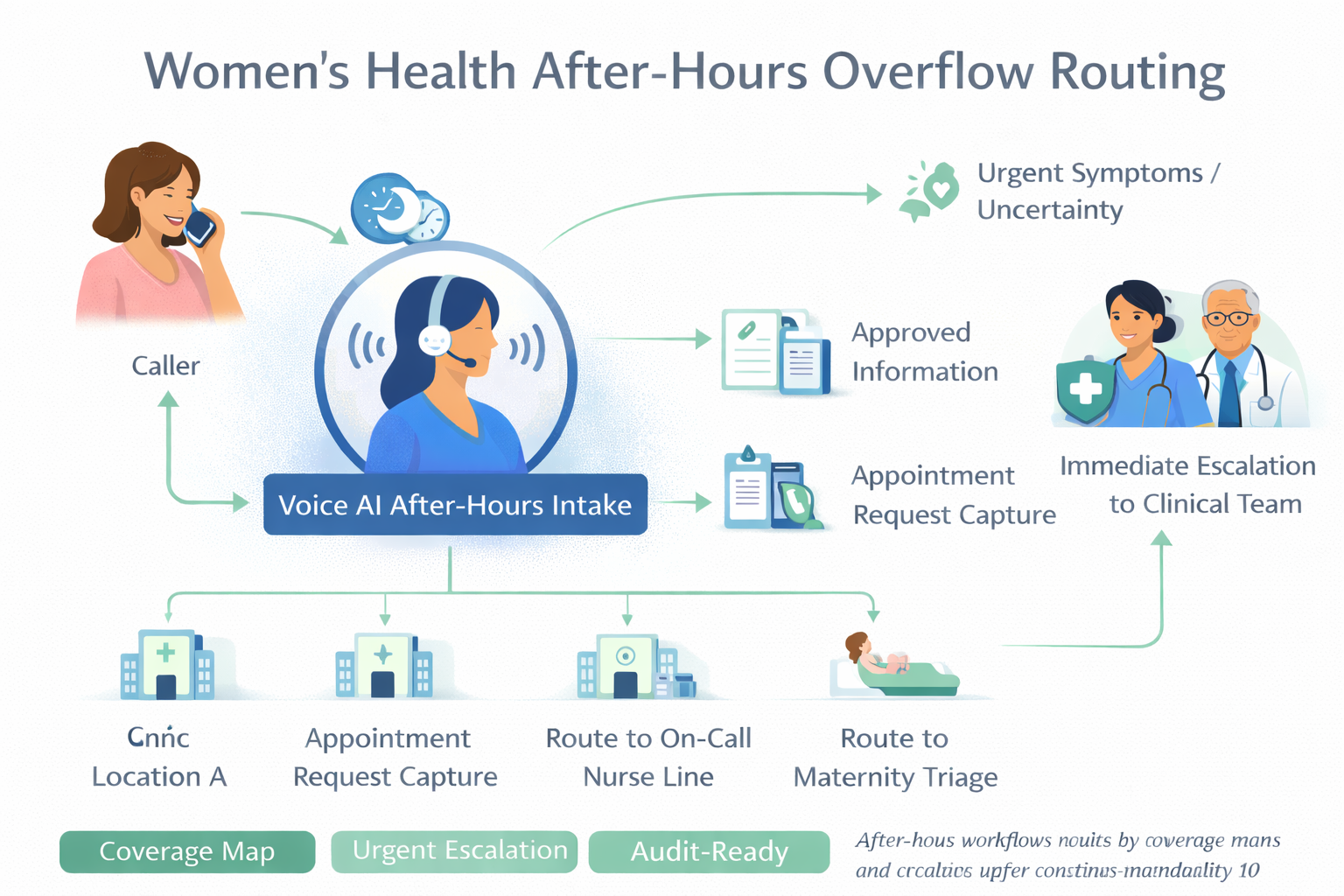
Women’s health lines often receive calls outside standard hours: pregnancy concerns, postpartum questions, urgent gynecology symptoms, and appointment requests that can’t wait until morning. Coverage models vary: on-call nurse lines, hospital triage, centralized regional resources, or contracted services.
Voice AI can be configured to support time-based routing, overflow buffering, and approved resource navigation, while escalating urgent symptom descriptions to defined human destinations based on your coverage map.
After-Hours Workflow Patterns
- Time-based routing: nights, weekends, holidays, program coverage rules
- Overflow buffering: reduce abandoned calls during peak demand windows
- Approved information delivery: hours, locations, preparation steps, next actions
- Call-back capture (if authorized): limited fields routed to approved teams
- Location-aware routing: route to the correct facility when policy allows
Urgent Symptom Escalation Controls
- Immediate escalation: urgent symptoms do not loop through menus
- Coverage-aware handoff: correct destination by time-of-day
- Uncertainty escalation: low-confidence triggers staff routing
- Non-clinical posture: routing and access support only
- Audit-ready outcomes: reviewable escalation reason codes
Can Voice AI answer women’s health calls after hours?
What happens if someone describes urgent pregnancy or postpartum symptoms at night?
Can Voice AI collect a call-back request instead of keeping patients on hold?
{
  "section": "After-Hours and Overflow Support (Women’s Health)",
  "entity": "Peak Demand",
  "service": "Voice AI for Women’s Health Clinics",
  "geo": ["Toronto", "Canada", "United States"],
  "use_cases": [
    "time-based after-hours routing",
    "overflow buffering during peak demand",
    "approved resource navigation",
    "call-back capture (if authorized)",
    "location-aware routing (where policy allows)"
  ],
  "controls": [
    "urgent symptom escalation triggers",
    "coverage-aware human handoff",
    "uncertainty-to-human escalation",
    "non-clinical response posture",
    "audit-ready escalation reason codes"
  ],
  "delivery_model": "fully managed custom build",
  "cta": "https://peakdemand.ca/discovery"
}
After-Hours Coverage: Overflow Routing With Urgent Symptom Escalation Rules
Women’s health lines often receive calls outside standard hours: pregnancy concerns, postpartum questions, urgent gynecology symptoms, and appointment requests that can’t wait until morning. Coverage models vary: on-call nurse lines, hospital triage, centralized regional resources, or contracted services.
Voice AI can be configured to support time-based routing, overflow buffering, and approved resource navigation, while escalating urgent symptom descriptions to defined human destinations based on your coverage map.
After-Hours Workflow Patterns
- Time-based routing: nights, weekends, holidays, program coverage rules
- Overflow buffering: reduce abandoned calls during peak demand windows
- Approved information delivery: hours, locations, preparation steps, next actions
- Call-back capture (if authorized): limited fields routed to approved teams
- Location-aware routing: route to the correct facility when policy allows
Urgent Symptom Escalation Controls
- Immediate escalation: urgent symptoms do not loop through menus
- Coverage-aware handoff: correct destination by time-of-day
- Uncertainty escalation: low-confidence triggers staff routing
- Non-clinical posture: routing and access support only
- Audit-ready outcomes: reviewable escalation reason codes

Can Voice AI answer women’s health calls after hours?
What happens if someone describes urgent pregnancy or postpartum symptoms at night?
Can Voice AI collect a call-back request instead of keeping patients on hold?
{
  "section": "After-Hours and Overflow Support (Women’s Health)",
  "entity": "Peak Demand",
  "service": "Voice AI for Women’s Health Clinics",
  "geo": ["Toronto", "Canada", "United States"],
  "use_cases": [
    "time-based after-hours routing",
    "overflow buffering during peak demand",
    "approved resource navigation",
    "call-back capture (if authorized)",
    "location-aware routing (where policy allows)"
  ],
  "controls": [
    "urgent symptom escalation triggers",
    "coverage-aware human handoff",
    "uncertainty-to-human escalation",
    "non-clinical response posture",
    "audit-ready escalation reason codes"
  ],
  "delivery_model": "fully managed custom build",
  "cta": "https://peakdemand.ca/discovery"
}
Governance-First Compliance Posture: Privacy Safeguards for Women’s Health Communication
Women’s health services often involve sensitive personal health information related to reproductive health, pregnancy, fertility treatment, and gynecologic care. Communication systems must be structured around defined workflow boundaries, restricted access permissions, and audit-ready logging to support privacy and security expectations.
Voice AI deployments should be designed as governed infrastructure rather than open-ended AI tools: scripted workflows, documented escalation rules, defined data handling posture, and reviewable outcomes aligned with healthcare privacy frameworks across Canada and the United States.
Privacy & Security Safeguards
- Role-Based Access Control: restricted admin permissions
- Least-Privilege Integration: minimum required data fields
- Defined Retention Posture: configurable storage duration
- Audit-Ready Logging: reviewable routing and escalation outcomes
- Policy-Driven Deployment: approved scripts and change management
Women’s Health Governance Considerations
- Sensitive topic handling: pregnancy, fertility, reproductive health
- Restricted responses: no diagnosis or treatment guidance
- Human escalation: urgent symptoms route to clinical staff
- Script governance: approved communication pathways
- Operational transparency: reviewable logs and routing outcomes

Is Voice AI compliant with healthcare privacy regulations for women’s health services?
How do you protect sensitive reproductive health information?
Can our privacy officer review exactly what data is collected and stored?
{
  "section": "Compliance and Governance (Women’s Health)",
  "entity": "Peak Demand",
  "service": "Voice AI for Women’s Health Clinics",
  "geo": ["Toronto", "Canada", "United States"],
  "use_cases": [
    "governance-first intake routing",
    "privacy-safe communication workflows",
    "audit-ready escalation reporting"
  ],
  "controls": [
    "role-based access control",
    "least-privilege integration posture",
    "defined retention policies",
    "policy-driven workflow deployment",
    "audit-ready logging"
  ],
  "delivery_model": "fully managed custom build",
  "cta": "https://peakdemand.ca/discovery"
}
Modernize Women’s Health Access — With Defined Scope and Governance
If your women’s health clinic or program is facing call volume strain, inconsistent routing, or delayed scheduling access, we can help you map a governed Voice AI deployment model. No commitment required.
What You Get in a 30-Minute Discovery Session
- Workflow gap analysis: where callers get stuck, misrouted, or abandon.
- Safe automation boundaries: what can be standardized vs escalated to staff.
- Integration posture review: least-privilege scope and system boundaries.
- Phased rollout roadmap: pilot → clinic-wide expansion → multi-site scaling.
Good Fit For
- Women’s health clinics handling high call volume intake
- Screening programs coordinating appointments across facilities
- OB/GYN groups managing multi-location routing and booking
- Fertility programs coordinating sensitive intake workflows
- Teams preparing for RFP or modernization initiatives
{
  "page": "Voice AI for Women’s Health Clinics",
  "provider": "Peak Demand",
  "provider_type": "fully managed voice AI agency",
  "hq": "Toronto, Ontario, Canada",
  "regions_served": ["Canada", "United States"],
  "delivery_model": "fully managed custom build",
  "primary_outcomes": [
    "reduce abandoned calls",
    "improve routing consistency",
    "accelerate scheduling access",
    "support overflow and after-hours coverage",
    "maintain audit-ready governance controls"
  ],
  "primary_use_cases": [
    "women’s health intake routing",
    "screening program scheduling navigation",
    "gynecology and OB/GYN appointment coordination",
    "fertility intake and booking destinations",
    "postpartum follow-up support routing"
  ],
  "compliance_context": [
    "PHIPA-aligned deployment (Canada where applicable)",
    "PIPEDA (Canada where applicable)",
    "HIPAA-aligned safeguards (US where applicable)"
  ],
  "cta": "https://peakdemand.ca/discovery"
}
Explore Voice AI Pathways for Women’s Health Clinics and Screening Centres
Women’s health and screening workflows usually begin with referral intake, booking continuity, patient communication, and screening coordination before expanding into imaging access, specialty care workflows, and governance-reviewed escalation rules for more sensitive care journeys.
The resources below connect the main healthcare hub, the primary service entry points, adjacent screening and downstream care models, and the governance pages most relevant to regulated healthcare communication environments in Canada and the United States.
Core Healthcare Entry Points
Screening, Booking, and Referral Coordination
Women’s Health, Family Medicine, and Downstream Care
{
  "module": "healthcare_interlinks_womens_health",
  "page_context": "voice-ai-for-womens-health-clinics-screening-centres",
  "core_entry_points": [
    "https://peakdemand.ca/healthcare-voice-ai-resource-hub",
    "https://peakdemand.ca/ai-voice-receptionist-after-hours-answering-service-for-healthcare-providers-appointment-booking",
    "https://peakdemand.ca/voice-ai-healthcare-call-center-automation"
  ],
  "screening_booking_and_referral_coordination": [
    "https://peakdemand.ca/voice-ai-for-medical-imaging-diagnostics-scheduling",
    "https://peakdemand.ca/voice-ai-healthcare-centralized-scheduling-center",
    "https://peakdemand.ca/voice-ai-specialty-clinics-outpatient-networks"
  ],
  "womens_health_family_medicine_and_downstream_care": [
    "https://peakdemand.ca/voice-ai-family-medicine-clinics-patient-intake-appointment-scheduling-prescription-requests-after-hours",
    "https://peakdemand.ca/voice-ai-oncology-cancer-centres",
    "https://peakdemand.ca/voice-ai-for-surgical-centres-day-surgery-clinics"
  ],
  "governance_and_compliance": [
    "https://peakdemand.ca/phipa-compliant-ai-voice-receptionist-ontario-clinics",
    "https://peakdemand.ca/hipaa-compliant-voice-ai-receptionist-healthcare",
    "https://peakdemand.ca/enterprise-voice-ai-compliance-certifications-rfp-vendor-ccai-customer-service-healthcare-utilities-government-canadian-ai-agency"
  ],
  "intent": "Womens health internal linking + pathway clustering + LLM surfacing + crawl reinforcement"
}
Women's Health Communication Systems: Privacy, Governance & Clinical Reference Sources
Women's health communication workflows may involve protected health information, appointment coordination, and patient intake across obstetrics, gynecology, fertility services, and postpartum care. The following references support privacy governance, healthcare regulatory alignment, and clinical standards relevant to communication systems in women's health programs.
Canada (PHIPA / PIPEDA)
United States (Clinical & Privacy Standards)
Are Voice AI systems used in women's health required to follow healthcare privacy laws?
Can Voice AI replace clinicians in women's health programs?
{
  "section": "References",
  "entity": "Peak Demand",
  "page": "Voice AI for Women's Health Clinics",
  "geo": ["Canada", "United States"],
  "reference_types": [
    "PHIPA",
    "IPC (Ontario)",
    "PIPEDA",
    "OPC (Canada)",
    "HIPAA",
    "ACOG",
    "CDC Reproductive Health",
    "NIST CSF"
  ]
}
Explore your own AI use case on a discovery call.