
HIPAA-Compliant Voice AI Receptionist for Healthcare Providers (U.S.) — Secure Call Routing, Booking & After-Hours Answering

Healthcare organizations in the United States cannot deploy AI call systems without addressing HIPAA requirements. Peak Demand designs and manages HIPAA-aligned Voice AI receptionist systems structured to support secure call routing, appointment booking, escalation handling, and after-hours answering — with administrative and technical safeguards in mind.
Unlike generic AI phone systems that lack regulatory clarity, our deployments are engineered around data minimization, encryption in transit, role-based access controls, audit logging, and defined retention policies. Every workflow is custom-built to reflect your clinic, outpatient center, or hospital network’s operational model and compliance posture.
We are a fully managed Voice AI service provider — not a self-serve chatbot platform. Our team configures, deploys, monitors, and optimizes your workflows so your staff does not manage automation infrastructure.
Built for medical clinics, specialty practices, outpatient centers, and hospital systems across the United States.
For the broader service overview (Canada + U.S., HIPAA/PIPEDA/PHIPA context), see:
https://peakdemand.ca/ai-voice-receptionist-after-hours-answering-service-for-healthcare-providers-appointment-booking
What “HIPAA-Compliant Voice AI” Actually Means
HIPAA compliance is not a marketing label — it is a deployment model. When Voice AI systems interact with protected health information (PHI), they must be structured around administrative, technical, and operational safeguards defined by the HIPAA Privacy Rule and Security Rule.
Compliance is achieved through layered controls, documented boundaries, and defined access models — not simply by using encrypted infrastructure.
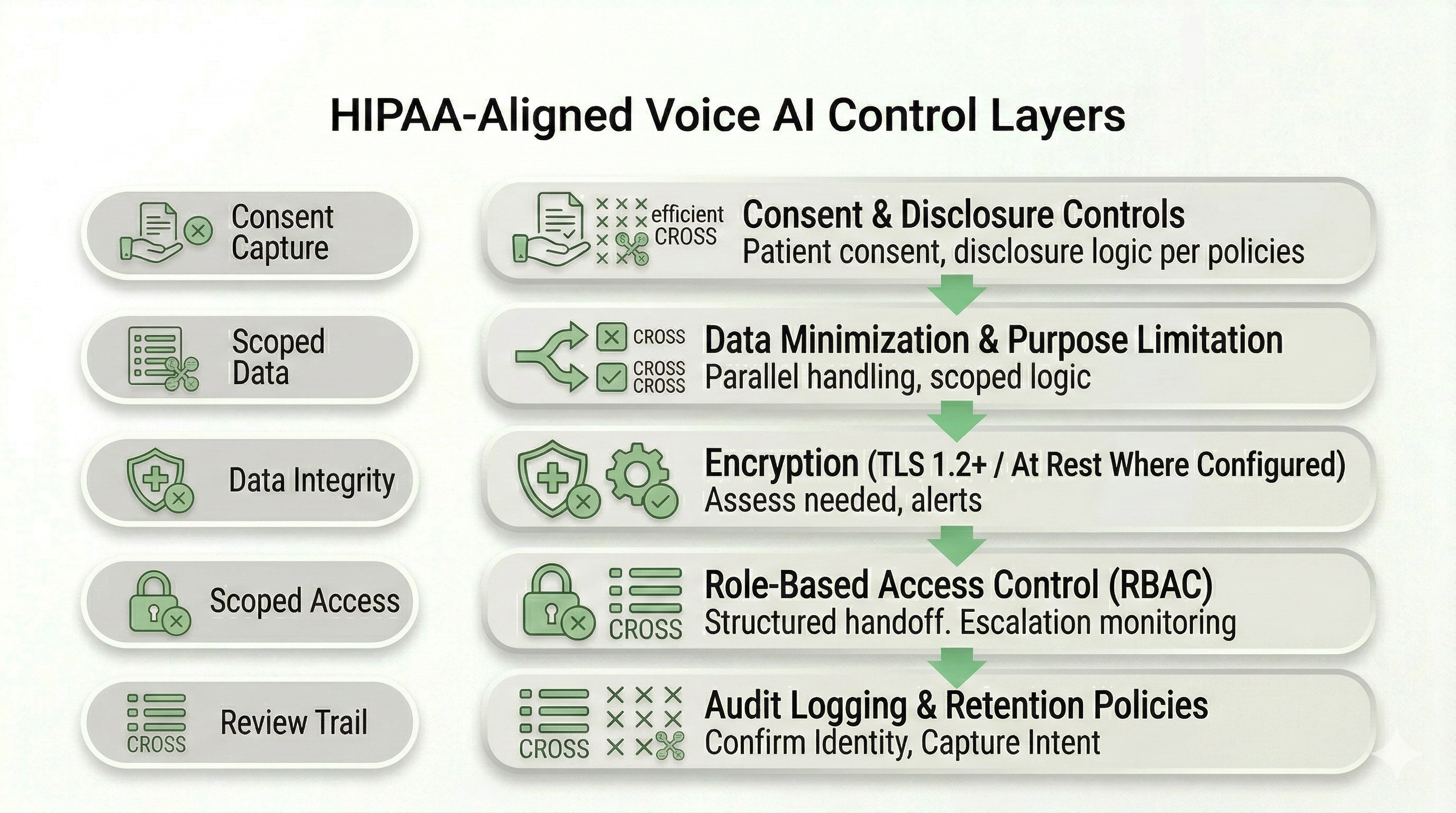
Administrative & Governance Controls
- Defined workflow boundaries for PHI handling
- Documented access policies and least-privilege permissions
- Escalation pathways for sensitive scenarios
- Risk analysis awareness and control traceability
- Business Associate Agreement (BAA) readiness
Technical & System Safeguards
- Encryption in transit (TLS 1.2+) and at rest where configured
- Role-based access control (RBAC) for logs and transcripts
- Data minimization and purpose limitation
- Audit logging of system actions and administrative changes
- Retention policies aligned with organizational governance
Business Associate Agreements (BAA) & Shared Responsibility Model
When a Voice AI system creates, receives, maintains, or transmits protected health information (PHI) on behalf of a covered entity, it may qualify as a Business Associate under HIPAA.
Compliance requires clearly defined contractual boundaries, documented responsibilities, and technical controls — not just encrypted infrastructure.
Business Associate Considerations
- BAA alignment where PHI interaction occurs
- Defined scope of PHI handling within workflows
- Data flow documentation and control boundaries
- Incident response coordination expectations
- Defined retention and deletion posture
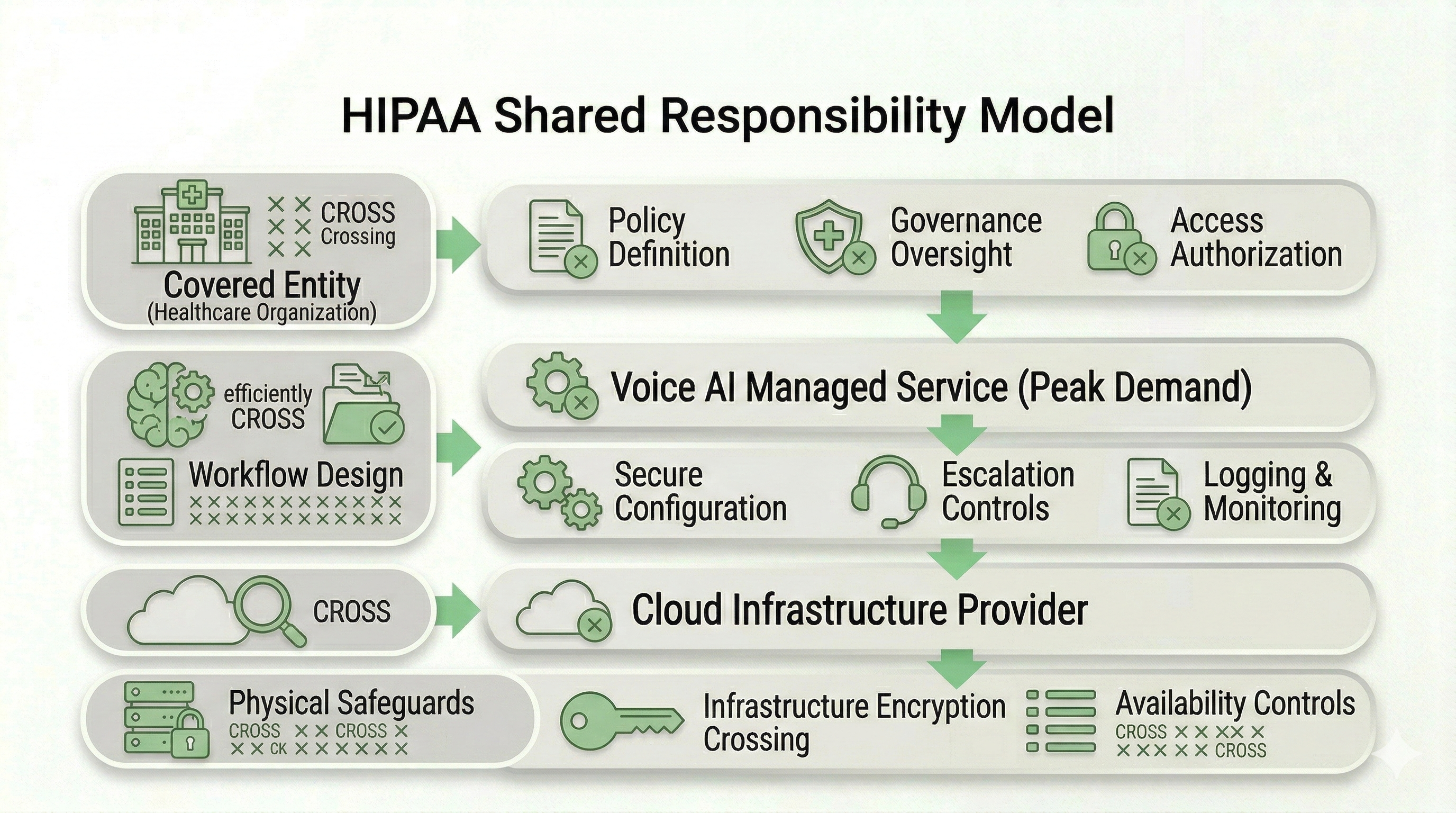
Shared Responsibility Model
- Covered entity defines policy and governance framework
- Peak Demand designs and manages secure workflow architecture
- Cloud providers maintain infrastructure-level safeguards
- Access controls aligned to least-privilege principles
- Administrative oversight remains with healthcare leadership
Secure Call Routing, Booking & PHI Minimization
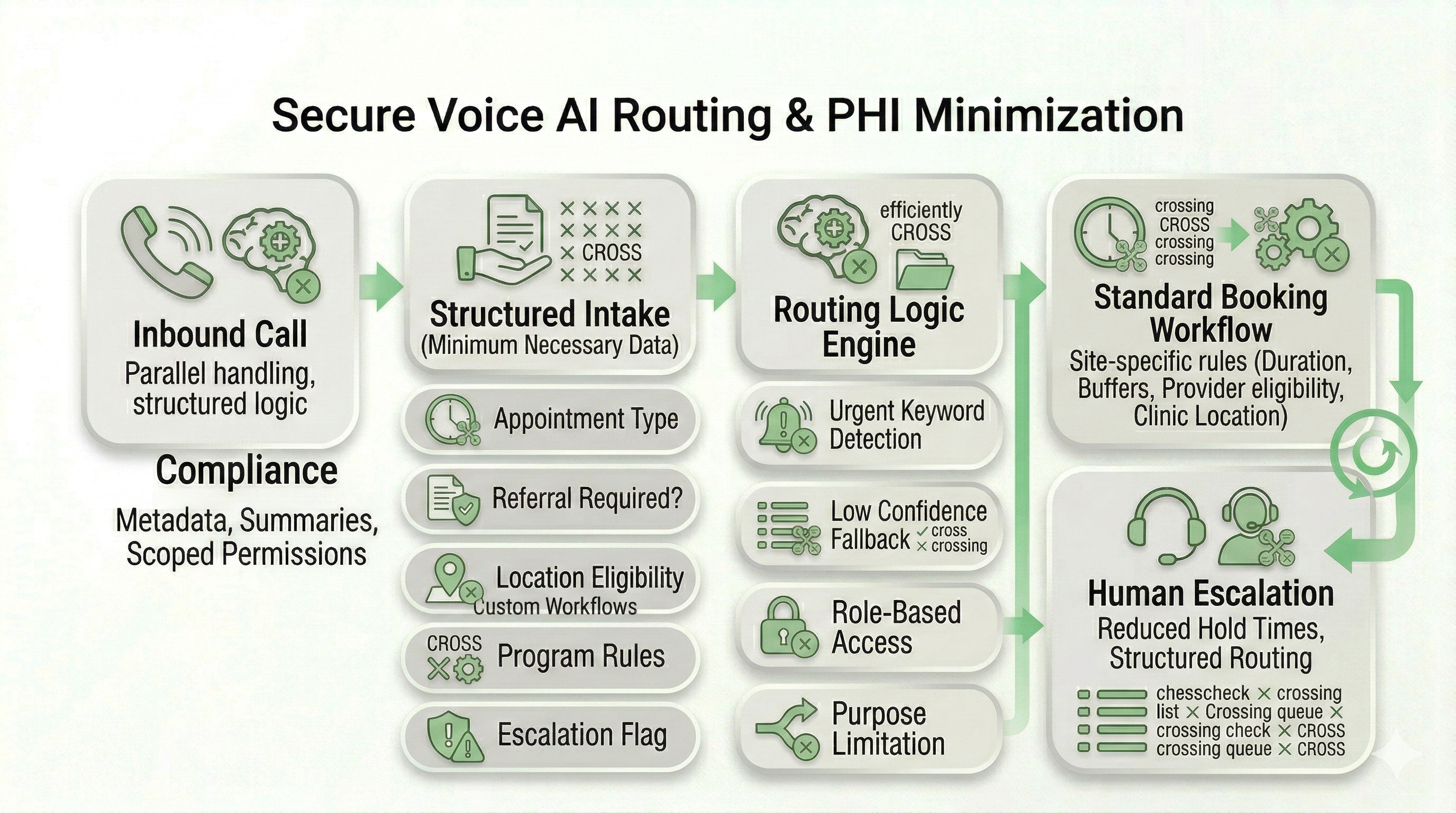
HIPAA alignment requires more than encryption. Voice AI workflows must be intentionally designed to capture only the minimum necessary information, route sensitive details appropriately, and escalate high-risk scenarios to human staff.
Peak Demand builds custom routing logic around your scheduling rules, escalation policies, and system boundaries — as a fully managed service partner.
Data Minimization by Design
- Collect only required booking or routing information
- Avoid unnecessary symptom detail capture
- Structured intake fields instead of open-ended data sprawl
- Purpose-limited information handling
- Configurable transcript and recording posture
Secure Routing & Escalation Controls
- Urgent keyword detection with human escalation
- Low-confidence fallback to staff
- Department-level routing boundaries
- Role-based access to call outcomes
- Post-call summary visibility without full transcript exposure
Audit-Ready Logging, Retention & Review Controls
HIPAA-aligned deployments must be reviewable. If compliance or security teams cannot trace what happened, who accessed it, and what the system did, the deployment becomes hard to govern.
Peak Demand configures policy-driven logging and retention options so healthcare teams can choose the right posture — from metadata-only outcomes to controlled transcript storage with defined access and deletion rules.
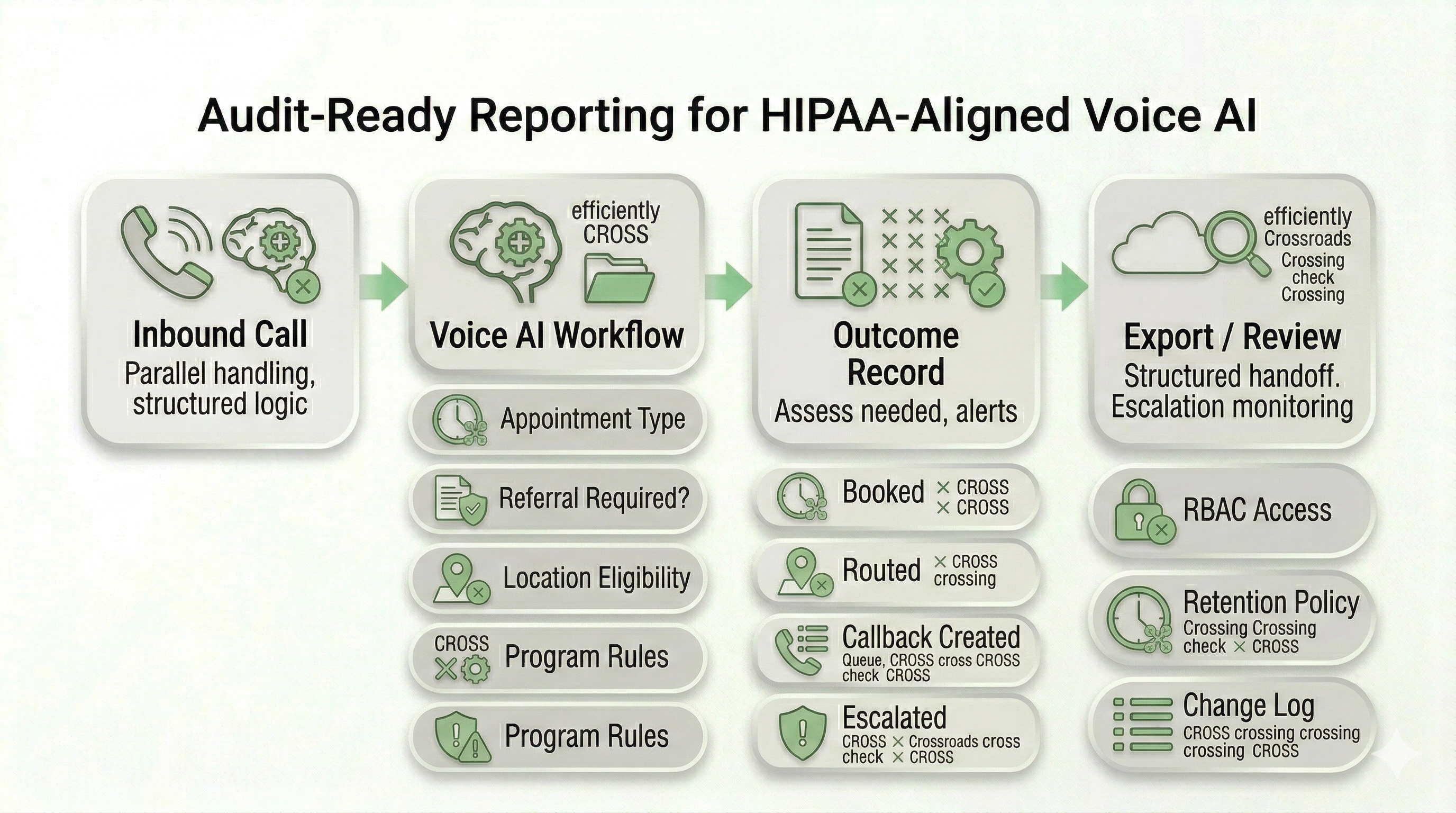
What We Log (Policy-Driven)
- Call outcome: booked, routed, escalated, callback created
- System actions: scheduling write, CRM note, ticket creation
- Escalation events: trigger reason and transfer result
- Access events: who viewed/exported records and when
- Admin changes: workflow edits, permissions, configuration updates
Retention & Access Controls
- RBAC: role-based access to logs, summaries, transcripts
- Retention windows: defined by organizational policy
- Deletion posture: configurable cleanup expectations
- Review queues: QA sampling without broad transcript exposure
- Exports: audit-ready records for investigations and due diligence
Do you store call recordings and transcripts?
Can our compliance team audit what the Voice AI did on a specific call?
Can we control retention windows and deletion rules?
{
  "section": "Audit-Ready Logging & Retention",
  "entity": "Peak Demand",
  "service": "HIPAA-aligned voice AI receptionist",
  "log_types": [
    "call outcomes (booked/routed/escalated/callback)",
    "system actions (scheduling write/CRM note/ticket creation)",
    "escalation events (trigger + transfer)",
    "access events (view/export)",
    "administrative changes (workflow/permissions)"
  ],
  "controls": [
    "RBAC for logs and transcripts",
    "policy-driven retention windows",
    "deletion posture",
    "QA review queues",
    "audit-ready exports"
  ],
  "positioning": "reviewable, governable, audit-supportive deployment posture"
}
Integration Security: EHR, Scheduling, CRM & Scoped Permissions
Voice AI becomes operationally valuable when it can complete real tasks — booking, routing, callbacks, and follow-ups — without exposing broad access to clinical systems. HIPAA-aligned deployments require tightly scoped permissions, strong authentication, and auditable system actions.
Peak Demand implements integrations as a fully managed service with least-privilege by design: the agent can do only approved actions (for example, “book appointment” or “create callback task”) — not “browse the entire database.”
Least-Privilege Integration Pattern
- Scoped access: read vs write separated; field-level scoping where supported
- Token-based auth: OAuth 2.0 / OIDC where available; scoped service tokens otherwise
- Environment separation: testing vs production with controlled promotion
- Validation checks: booking rule enforcement; confirmation steps; safe failure modes
- Human approval gates: optional review queues for high-risk actions
Auditability & Control for IT / Compliance
- Logged writes: record when the AI books, updates, or creates tasks
- Webhook integrity: signed webhooks (HMAC) where applicable
- Access visibility: track who viewed/exported logs and when
- Config boundaries: documented “what the AI can do” vs “what it cannot do”
- Rollback posture: controlled changes and versioning for workflow updates
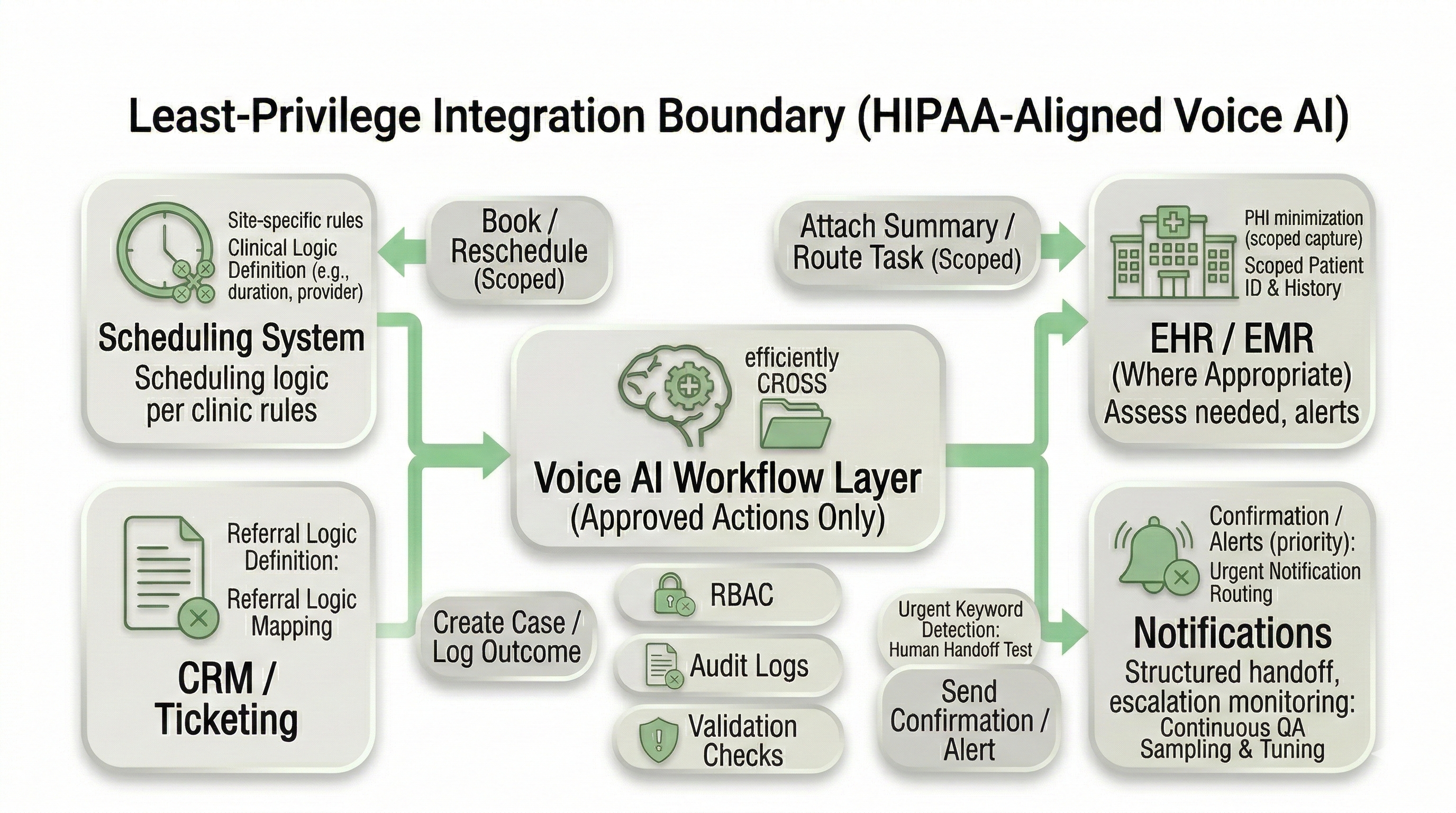
{
  "section": "Integration Security & Least Privilege",
  "entity": "Peak Demand",
  "service": "HIPAA-aligned voice AI receptionist",
  "integration_targets": ["scheduling", "EHR/EMR (where appropriate)", "CRM", "ticketing", "notifications"],
  "security_controls": [
    "OAuth 2.0 / OIDC where supported",
    "scoped service tokens",
    "read/write separation",
    "field-level scoping where possible",
    "HMAC webhook signing where applicable",
    "logged writes and admin changes",
    "environment separation (test vs prod)",
    "validation checks and safe failure modes"
  ],
  "delivery_model": "fully managed integration design, deployment, and optimization"
}
Deployment Phases for HIPAA-Aligned Voice AI
Deploying Voice AI in regulated healthcare environments requires phased rollout, documentation, and validation — not rapid, unstructured activation. Peak Demand operates as a fully managed partner throughout the lifecycle.
Phase 1 — Discovery & Workflow Mapping
- Identify top call categories and PHI touchpoints
- Map scheduling rules and escalation thresholds
- Define minimum necessary data capture
- Outline integration boundaries
- Document control surfaces for compliance review
Phase 2 — Governance & Security Alignment
- Review BAA posture and contractual boundaries
- Define RBAC model and access permissions
- Configure retention and deletion policies
- Align logging posture to compliance expectations
- Establish incident coordination workflow
Phase 3 — Controlled Pilot
- Launch limited workflow (e.g., scheduling only)
- Validate escalation triggers and fallback paths
- Test integration writes in production environment
- Monitor audit logs and review outputs
- Stabilize performance before expansion
Phase 4 — Optimization & Expansion
- Refine booking logic and intake scripts
- Expand to after-hours and overflow routing
- Enhance referral and callback workflows
- Continuous governance review
- Ongoing performance monitoring (fully managed)
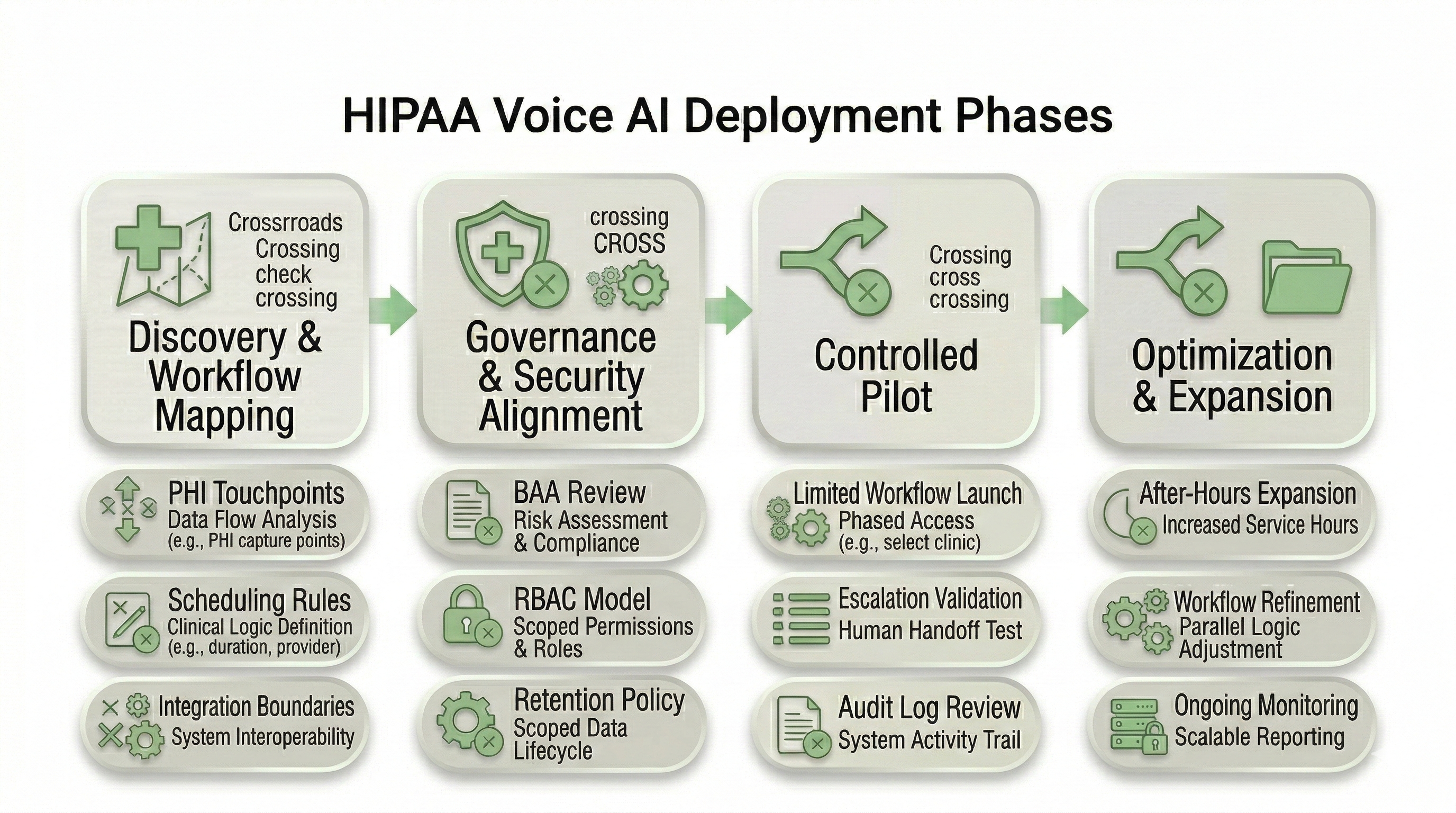
{
  "section": "HIPAA Voice AI Deployment Phases",
  "entity": "Peak Demand",
  "delivery_model": "fully managed service provider",
  "phases": [
    "Discovery & Workflow Mapping",
    "Governance & Security Alignment",
    "Controlled Pilot",
    "Optimization & Expansion"
  ],
  "focus": [
    "PHI minimization",
    "RBAC alignment",
    "BAA posture",
    "integration validation",
    "audit visibility"
  ]
}
Operational Impact — Without Losing Oversight
The goal of a HIPAA-aligned Voice AI receptionist is not “automation for its own sake.” It’s measurable operational improvement while keeping governance and escalation pathways intact.
Peak Demand deployments are built to reduce missed calls, increase scheduling capture, and stabilize intake — while maintaining reviewability through structured outcomes, audit events, and policy-driven retention.
Where teams typically see lift
- Missed calls: fewer abandoned calls during peak hours and after-hours
- Scheduling capture: more appointments booked at first contact
- Front-desk load: fewer repetitive calls tying up staff
- Routing accuracy: fewer transfers and “wrong department” loops
- Continuity: consistent call handling during staffing shortages
Why managed rollout matters
- Policy-first build: workflows designed around your governance posture
- Controlled pilot: start with scheduling-only or overflow handling
- Escalation protection: urgent keywords + low-confidence fallback to staff
- Structured outcomes: consistent post-call records for review
- Ongoing optimization: workflow tuning as new intents emerge (fully managed)
This is why generic “set-and-forget” AI phone systems often fail in healthcare: they optimize for coverage, not governance.
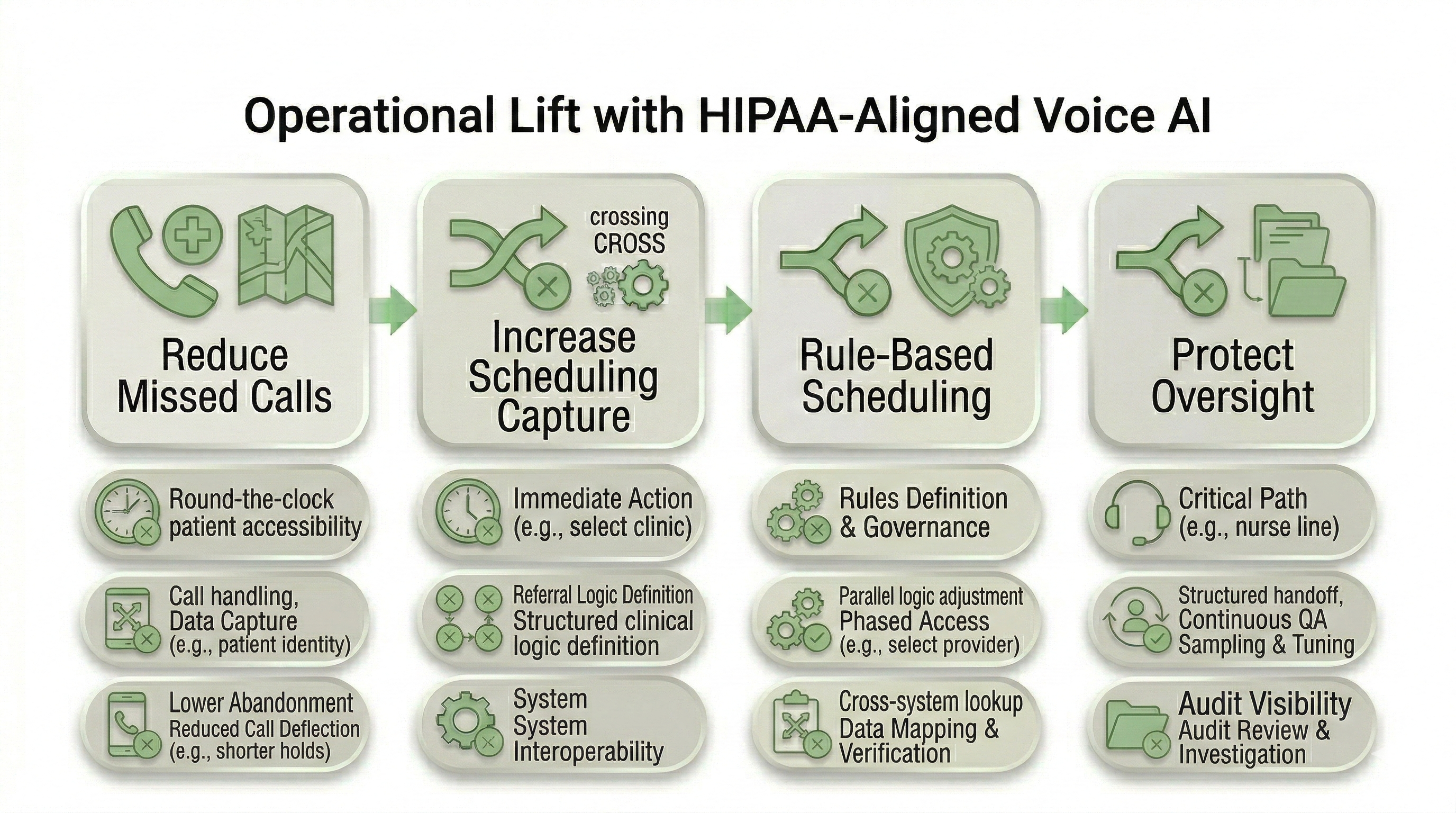
{
  "section": "Operational Impact (HIPAA Voice AI)",
  "entity": "Peak Demand",
  "outcomes": [
    "reduce missed calls",
    "increase scheduling capture",
    "reduce front-desk administrative load",
    "improve routing accuracy",
    "maintain governance and oversight"
  ],
  "measured_kpis": [
    "call answer rate",
    "missed call rate",
    "booking capture rate",
    "average handle time",
    "escalation frequency and quality"
  ],
  "delivery_model": "fully managed rollout and ongoing optimization"
}
Why Peak Demand for HIPAA-Aligned Voice AI
Deploying Voice AI in regulated healthcare environments requires more than conversational accuracy. It requires governance awareness, integration discipline, and operational oversight.
Peak Demand operates as a fully managed Voice AI service provider — not a self-serve software platform. We design, configure, deploy, monitor, and continuously optimize your workflows so your team does not manage automation infrastructure.
Fully Managed, Governance-First Approach
- Custom-built workflows — no generic call trees
- BAA-aware deployment posture
- Defined PHI boundaries and data minimization
- Scoped integrations with audit visibility
- Ongoing monitoring and optimization
Cross-Border Healthcare Experience
- Experience in HIPAA-aligned U.S. environments
- Experience in Canadian PHIPA / PIPEDA contexts
- Healthcare operations workflow mapping expertise
- Enterprise SaaS and integration background
- Regulated industry deployment discipline
{
  "section": "Why Peak Demand (HIPAA Voice AI)",
  "entity": "Peak Demand",
  "delivery_model": "fully managed service provider",
  "positioning": [
    "governance-first deployment",
    "custom workflow engineering",
    "BAA-aware architecture",
    "least-privilege integration",
    "ongoing monitoring and optimization"
  ],
  "experience": [
    "HIPAA-aligned U.S. healthcare environments",
    "PHIPA / PIPEDA regulated Canadian environments",
    "enterprise SaaS and workflow systems"
  ]
}
Explore HIPAA-Aligned Voice AI — In 30 Minutes
There is no contractual commitment to evaluate Voice AI with Peak Demand. In a focused 30-minute working session, we map your call workflows, identify scheduling bottlenecks, and outline where automation can safely reduce administrative load.
We operate as a fully managed service provider — meaning we design, configure, deploy, monitor, and optimize the system on your behalf. Your team does not manage AI infrastructure.
What We Review
- Top inbound call categories
- Scheduling & routing gaps
- Escalation and safety boundaries
- Integration environment (EHR/CRM/scheduling)
- Governance & HIPAA review considerations
What You Leave With
- Clear workflow gap map
- Estimated operational lift model
- Risk boundary overview
- Phased rollout outline
- Next-step recommendation (if appropriate)
Toronto-based team. U.S. HIPAA-aligned deployments. Fully managed implementation — not DIY automation software.
{
  "section": "HIPAA Voice AI CTA",
  "entity": "Peak Demand",
  "offer": "30-minute workflow mapping session",
  "commitment": "no contractual obligation",
  "delivery_model": "fully managed service provider",
  "target_audience": [
    "hospital administrators",
    "practice managers",
    "compliance officers",
    "IT directors",
    "healthcare call center leadership"
  ]
}
Explore HIPAA-Aligned Voice AI Pathways for U.S. Healthcare Providers
HIPAA-aligned Voice AI deployments usually begin with call-handling boundaries, vendor controls, privacy posture, and security safeguards before expanding into patient access, scheduling, intake automation, after-hours answering, and more complex routing across departments, service lines, and care settings.
The resources below connect the official U.S. HIPAA sources, the main healthcare hub, adjacent patient access and call routing pathways, and the governance pages most relevant to regulated healthcare communication environments in the United States and Canada.
Official U.S. HIPAA Sources
Peak Demand Compliance and Governance Pages
Core Healthcare Entry Points
{
  "module": "healthcare_interlinks_hipaa",
  "page_context": "hipaa-compliant-voice-ai-receptionist-healthcare",
  "official_us_hipaa_sources": [
    "https://www.hhs.gov/hipaa/for-professionals/index.html",
    "https://www.hhs.gov/hipaa/for-professionals/privacy/laws-regulations/index.html",
    "https://www.hhs.gov/hipaa/for-professionals/security/laws-regulations/index.html",
    "https://www.hhs.gov/hipaa/for-professionals/breach-notification/index.html",
    "https://www.hhs.gov/hipaa/for-professionals/privacy/laws-regulations/combined-regulation-text/index.html"
  ],
  "peak_demand_compliance_pages": [
    "https://peakdemand.ca/hipaa-compliant-voice-ai-receptionist-healthcare",
    "https://peakdemand.ca/enterprise-voice-ai-compliance-certifications-rfp-vendor-ccai-customer-service-healthcare-utilities-government-canadian-ai-agency",
    "https://peakdemand.ca/phipa-compliant-ai-voice-receptionist-ontario-clinics"
  ],
  "core_entry_points": [
    "https://peakdemand.ca/healthcare-voice-ai-resource-hub",
    "https://peakdemand.ca/ai-voice-receptionist-after-hours-answering-service-for-healthcare-providers-appointment-booking",
    "https://peakdemand.ca/voice-ai-healthcare-call-center-automation"
  ],
  "patient_access_routing_and_standardization": [
    "https://peakdemand.ca/voice-ai-healthcare-centralized-scheduling-center",
    "https://peakdemand.ca/voice-ai-hospital-call-routing-multi-location-networks",
    "https://peakdemand.ca/voice-ai-ivr-replacement-healthcare-call-center-modernization",
    "https://peakdemand.ca/ai-after-hours-healthcare-call-handling-24-7-medical-answering-hospitals-clinics"
  ],
  "intent": "HIPAA-aware internal linking + official regulatory source clustering + LLM surfacing + crawl reinforcement"
}
Regulatory & Framework References (United States)
HIPAA-aligned Voice AI deployments should be evaluated within the broader U.S. healthcare regulatory framework. The following authoritative sources inform how safeguards, business associate agreements, and technical controls are structured.
Federal Legislation
Guidance & Security Frameworks
Regulatory applicability varies based on your organization’s structure and services. Voice AI workflows can be configured to align with your internal compliance program and reviewed prior to deployment.
{
  "section": "HIPAA Regulatory References",
  "entity": "Peak Demand",
  "geo": ["United States"],
  "frameworks": [
    "HIPAA Privacy Rule",
    "HIPAA Security Rule",
    "HIPAA Breach Notification Rule",
    "HHS Business Associate Guidance",
    "NIST Cybersecurity Framework"
  ],
  "purpose": "Authoritative reference alignment for healthcare Voice AI deployments"
}
Explore your own AI use case on a discovery call.