
Voice AI for Veterinary Clinics & Animal Hospitals — After-Hours Coverage, Urgent Call Routing & Appointment Automation

Veterinary clinics and animal hospitals deal with emotionally charged calls, urgent scenarios, and high after-hours demand. Peak Demand provides fully managed, custom-built Voice AI designed specifically for veterinary operations — not generic call bots. From routine booking and rescheduling to structured emergency escalation and multi-location routing, workflows are built around your clinic’s policies and boundaries. Governance-first design, role-based access, and reviewable outcomes ensure operational visibility across Canada and the United States.
For the broader service overview (Canada + U.S., HIPAA/PIPEDA/PHIPA context), see:
https://peakdemand.ca/ai-voice-receptionist-after-hours-answering-service-for-healthcare-providers-appointment-booking
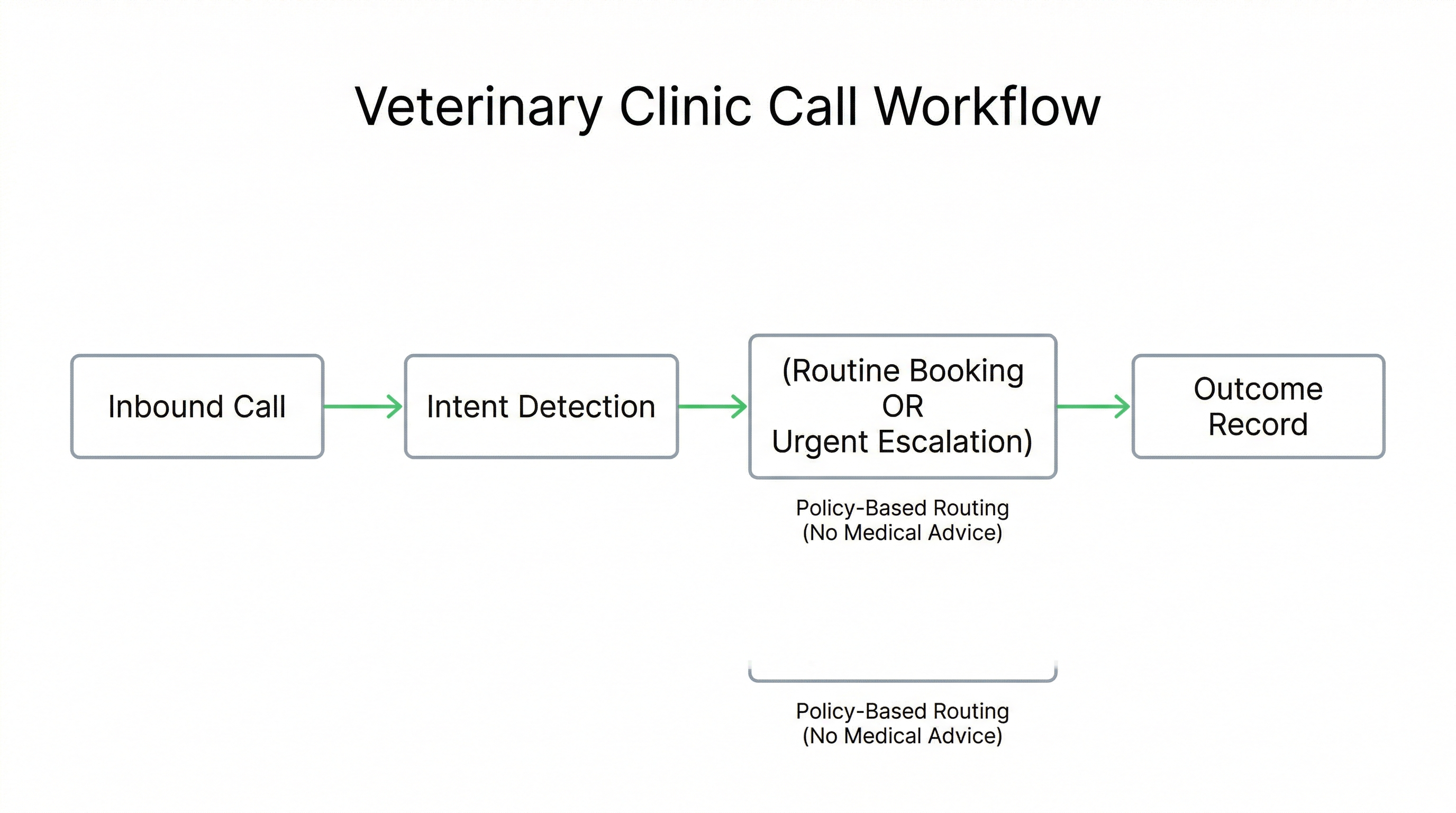
How Voice AI Works in a Veterinary Clinic: Call → Intent → Booking or Escalation → Outcome Record
Veterinary calls range from routine vaccinations to urgent injury scenarios. The system begins with structured intent detection, then routes calls into defined booking, intake, or escalation workflows.
The goal is not open-ended conversation. It is bounded workflow completion — with reviewable outcomes and policy-based escalation where needed.
Routine Call Handling
- New appointment booking
- Vaccination scheduling
- Spay/neuter consult requests
- Prescription refill intake (as configured)
- Rescheduling and cancellations
Urgent & Escalation Pathways
- Emergency keywords detection
- Low-confidence transfer triggers
- After-hours routing policies
- Multi-location emergency routing
- Structured outcome logging
Can Voice AI book vet appointments automatically?
What happens if someone calls with a pet emergency?
Does the AI understand different types of vet visits?
{
  "section": "How Voice AI Works in Veterinary Clinics",
  "entity": "Peak Demand",
  "service": "voice AI for veterinary clinics",
  "geo": ["Canada", "United States"],
  "use_cases": [
    "appointment booking",
    "after-hours answering",
    "emergency call routing",
    "multi-location escalation"
  ],
  "delivery_model": "fully managed custom build",
  "cta": "https://peakdemand.ca/discovery"
}
Emergency Triage & Escalation — Policy-Based Routing, Not Medical Advice
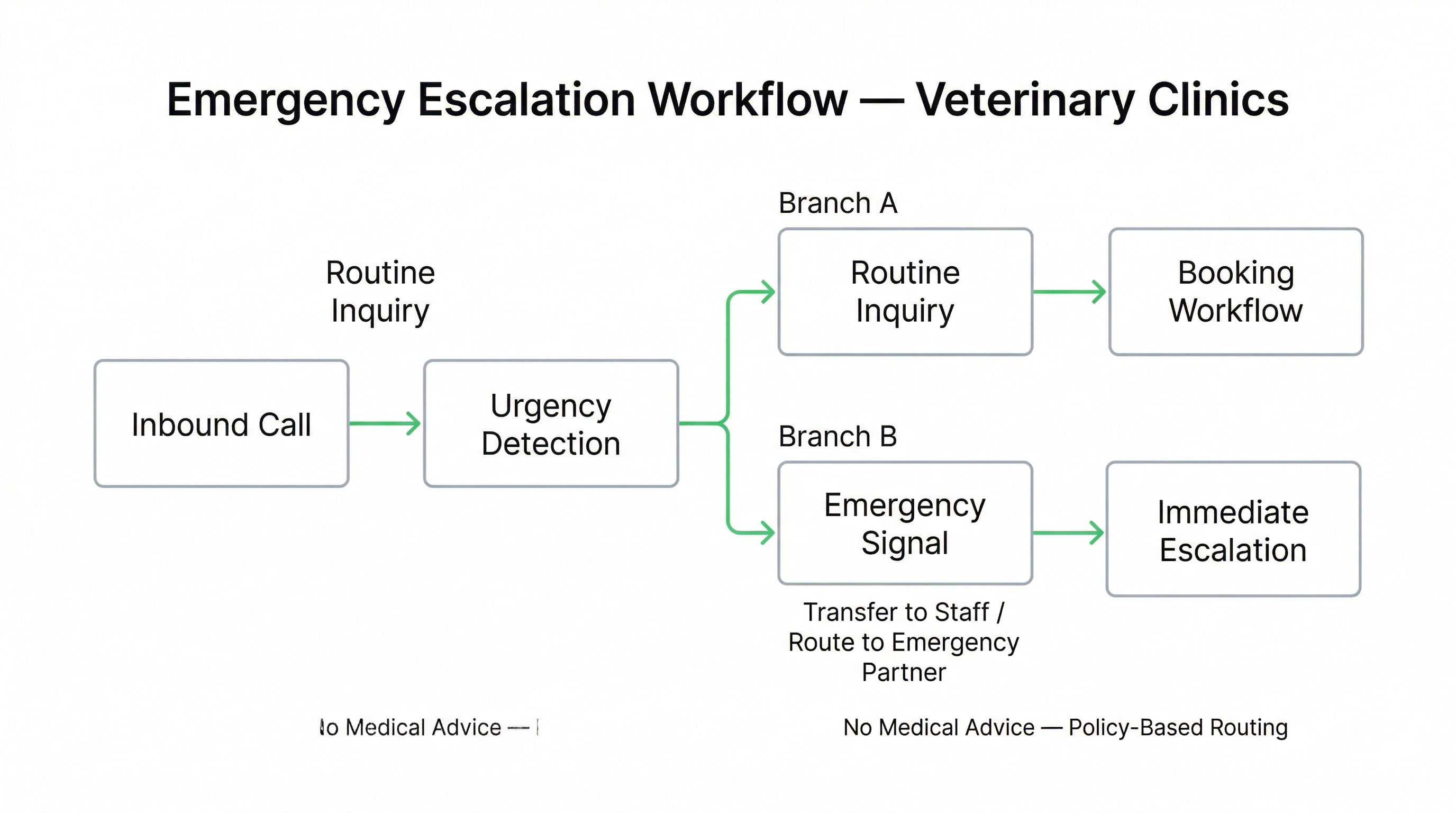
Veterinary clinics receive urgent and emotionally intense calls. Voice AI must operate within clearly defined boundaries. The system does not diagnose, prescribe, or provide clinical judgement.
Instead, escalation pathways are structured around your clinic’s policies: detecting urgent keywords, identifying distress language, and routing to appropriate staff or emergency facilities.
Urgency Detection Triggers
- Breathing distress or unconsciousness keywords
- Severe bleeding or trauma language
- Poison ingestion mentions
- Repeated panic or urgency signals
- Low-confidence response detection
Escalation Pathways
- Immediate transfer to on-site staff
- Routing to 24/7 emergency partner clinic
- After-hours emergency instructions (policy-based)
- Structured intake capture for follow-up
- Logged outcome record for review
Can the AI handle pet emergencies?
What if someone describes severe symptoms?
Can it route to a different emergency animal hospital after hours?
How do you prevent the AI from giving medical advice?
{
  "section": "Emergency Triage and Escalation",
  "entity": "Peak Demand",
  "service": "voice AI for veterinary clinics",
  "geo": ["Canada", "United States"],
  "primary_focus": "policy-based emergency routing",
  "controls": [
    "urgency keyword detection",
    "distress language triggers",
    "no medical advice boundary",
    "multi-location emergency routing",
    "structured outcome logging"
  ],
  "delivery_model": "fully managed custom build",
  "cta": "https://peakdemand.ca/discovery"
}
Why Veterinary Clinics Require Custom-Built Voice AI — Not Generic Call Scripts
Many AI answering tools rely on simple call scripts or template-based flows. Veterinary clinics operate in a more complex environment: emotional callers, emergency escalation requirements, prescription workflows, and multi-location routing.
Peak Demand delivers fully managed, custom-built workflows mapped to your actual policies, staffing structure, and emergency protocols. This is not DIY software. It is governed deployment.
Where Generic AI Tools Fall Short
- Single-path call trees with no escalation nuance
- No urgency detection logic
- No multi-clinic routing rules
- No structured emergency partner escalation
- DIY configuration burden on staff
How Custom Deployment Solves This
- Workflow mapping sessions before deployment
- Policy-defined emergency routing
- Multi-location scheduling logic
- Escalation thresholds and safety triggers
- Managed updates under change governance

Can’t we just use a cheap AI receptionist app?
Is this something our staff configure themselves?
What if our emergency protocols change?
Can it handle multiple vet clinics under one network?
{
  "section": "Custom Builds vs Generic Call Bots",
  "entity": "Peak Demand",
  "service": "voice AI for veterinary clinics",
  "geo": ["Canada", "United States"],
  "differentiator": "fully managed custom workflow mapping",
  "controls": [
    "policy-defined escalation",
    "multi-location routing",
    "urgency detection",
    "managed change governance"
  ],
  "delivery_model": "fully managed custom build",
  "cta": "https://peakdemand.ca/discovery"
}
Core Veterinary Workflows: Booking, Rescheduling, Cancellations, and Structured Intake
Most veterinary phone volume is predictable: appointment booking, schedule changes, routine questions, and intake for common visit types. Voice AI supports these workflows within defined booking rules and escalation boundaries.
The system can either perform actions directly (where integrations are appropriate) or capture structured requests for staff confirmation — depending on your governance posture.
High-Frequency Call Types
- New booking: wellness visits, vaccines, checkups, consults.
- Rescheduling: apply provider, location, and duration constraints.
- Cancellations: structured capture instead of voicemail.
- Surgery consult intake: collect required details as configured.
- Medication refill requests: intake capture with staff review (as configured).
Operational Controls
- Rule-based booking: visit types, durations, provider scope.
- Identity checks: confirm owner/pet details per policy (as configured).
- Escalation triggers: urgency language, confusion, frustration, low confidence.
- Outcome logging: every call produces a structured record.
- Bounded responses: avoid improvisation; route or capture for staff.

Can the AI reschedule vet appointments automatically?
Can it handle medication refill requests?
Can it collect intake details before the visit?
{
  "section": "Core Workflows for Veterinary Clinics",
  "entity": "Peak Demand",
  "service": "voice AI for veterinary clinics",
  "geo": ["Canada", "United States"],
  "use_cases": [
    "appointment booking",
    "rescheduling",
    "cancellations",
    "structured intake",
    "medication refill intake (as configured)"
  ],
  "controls": [
    "rule-based booking constraints",
    "policy-based escalation",
    "structured outcome records",
    "bounded workflow responses"
  ],
  "delivery_model": "fully managed custom build",
  "cta": "https://peakdemand.ca/discovery"
}
After-Hours Answering for Vets: Capture Demand, Route Emergencies, Reduce Voicemail Backlogs
Veterinary call volume doesn’t stop at 5PM. After-hours calls include emergencies, next-day booking requests, cancellations, and emotionally stressed owners who need fast direction. Voice AI can support 24/7 coverage with defined policies — not open-ended conversation.
The system can be configured to capture structured requests, route urgent calls to a designated emergency pathway, and create an outcome record so your team starts the morning with clarity instead of voicemail chaos.
Common After-Hours Workflows
- Emergency routing: policy-based escalation to staff or partner facility.
- Next-day appointment requests: preferred times and visit type captured.
- Cancellations: structured capture and waitlist opportunities.
- Location guidance: hours, address, parking, and directions (as configured).
- Outcome record: logged summary for review and follow-up.
Safety & Control Boundaries
- No medical advice: route and escalate rather than diagnose.
- Urgency triggers: keyword detection and distress pattern routing.
- Low confidence: escalate to staff instead of guessing.
- Repeated frustration: avoid loops; transfer quickly.
- Policy-based messaging: clinic-approved language only.

Can Voice AI answer our vet clinic phone after hours?
Can it route emergencies to a 24/7 animal hospital?
Will it reduce our voicemail backlog?
Can it transfer to a person after hours?
{
  "section": "After-Hours and 24/7 Coverage",
  "entity": "Peak Demand",
  "service": "voice AI for veterinary clinics",
  "geo": ["Canada", "United States"],
  "use_cases": [
    "after-hours answering",
    "emergency routing",
    "next-day booking capture",
    "cancellation capture",
    "structured outcome records"
  ],
  "controls": [
    "policy-based escalation",
    "no medical advice boundary",
    "confidence thresholds",
    "approved messaging"
  ],
  "delivery_model": "fully managed custom build",
  "cta": "https://peakdemand.ca/discovery"
}
Multi-Location Routing for Vet Networks: Right Clinic, Right Team, Right Next Step
Veterinary groups and animal hospital networks often lose calls because routing is unclear: which location is open, which clinic handles emergencies, and who should receive specific visit types. Voice AI can route callers based on location, hours, urgency, and service availability.
Routing logic is built around your operational rules — not generic prompts. The system can direct callers to the correct site, capture structured requests, and escalate urgent scenarios to the appropriate emergency pathway.
Common Network Routing Rules
- Location selection: caller’s area, preferred clinic, or nearest site.
- Hours-aware routing: open clinic vs after-hours partner routing.
- Service-based routing: surgery consults, dental, urgent care, general wellness.
- Team routing: front desk vs technician intake vs on-call line.
- Overflow handling: when lines are busy, capture intake and queue follow-up.
Safety & Governance Controls
- Emergency routing priority: urgent signals bypass long menus.
- Escalation thresholds: low confidence and frustration triggers.
- Bounded routing language: clinic-approved messaging only.
- Outcome records: reviewable logs for routing decisions.
- Change governance: routing updates tracked and controlled.

Can the AI route calls to different vet clinics based on location?
Can it route emergencies to the right animal hospital after hours?
What if the caller doesn’t know which clinic they need?
Can we change routing rules over time?
{
  "section": "Multi-Location Routing for Veterinary Networks",
  "entity": "Peak Demand",
  "service": "voice AI for veterinary clinics",
  "geo": ["Canada", "United States"],
  "use_cases": [
    "multi-location call routing",
    "hours-aware routing",
    "service-based routing",
    "emergency partner escalation",
    "overflow intake capture"
  ],
  "controls": [
    "emergency routing priority",
    "policy-based escalation",
    "outcome records",
    "managed change governance"
  ],
  "delivery_model": "fully managed custom build",
  "cta": "https://peakdemand.ca/discovery"
}
Least-Privilege Integrations: Scope Access to Scheduling and Clinic Operations Only
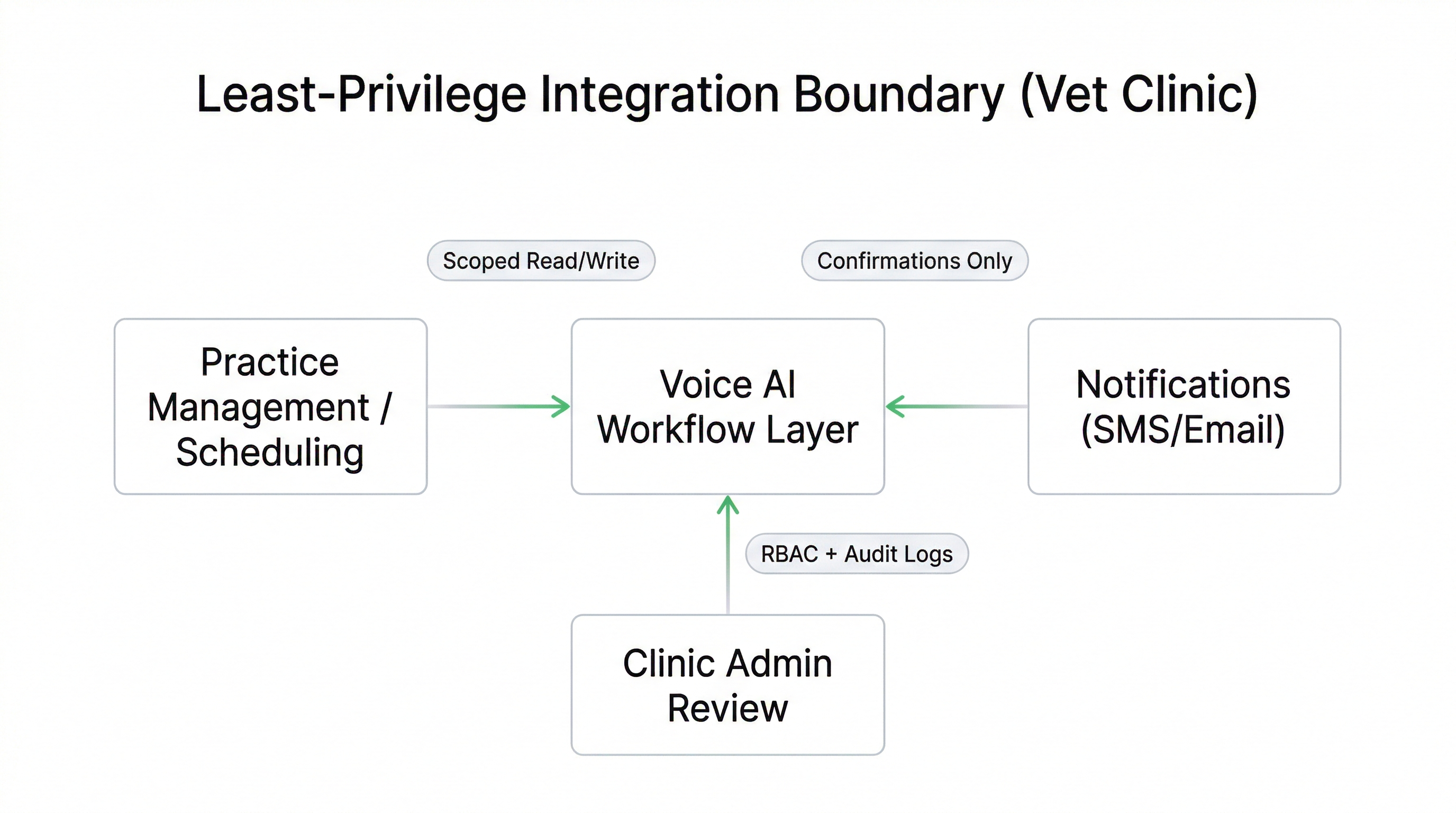
Integration risk is rarely about “AI” — it is about permissions. Vet clinics need booking and intake workflows to operate with controlled access: limited fields, limited actions, and clear escalation when a request exceeds what the workflow should do.
Peak Demand designs integrations to be scoped, reviewable, and policy-driven. Clinics can start with “capture and queue” workflows and expand into direct booking actions only when governance is validated.
Least-Privilege Principles
- Scope by function: booking vs rescheduling vs request logging.
- Scope by data: only fields required for the workflow (as configured).
- Scope by clinic/site: prevent cross-location scheduling errors.
- Scoped credentials: access can be limited and rotated per policy.
- Escalate instead of expanding: transfer to staff when needed.
Controls That Support Review
- RBAC: limit who can view logs, transcripts, and settings.
- Audit-ready events: record what was requested and what action occurred.
- Retention posture: align storage to clinic policy (as configured).
- Change governance: updates tracked and reviewable.
- Policy messaging: clinic-approved language and boundaries.
Does Voice AI need access to our practice management system?
How do you stop the AI from accessing more data than it needs?
Can our IT team review permissions and logs?
Can we start without integrations and add them later?
{
  "section": "Integration Security and Least Privilege",
  "entity": "Peak Demand",
  "service": "voice AI for veterinary clinics",
  "geo": ["Canada", "United States"],
  "integrations": [
    "practice management / scheduling (scoped)",
    "notifications (SMS/email) (optional)",
    "CRM (optional)"
  ],
  "controls": [
    "least privilege permissions",
    "RBAC for admin access",
    "audit-ready event logging",
    "policy-driven retention posture",
    "change governance"
  ],
  "delivery_model": "fully managed custom build",
  "cta": "https://peakdemand.ca/discovery"
}
Audit-Ready Reporting: Reviewable Outcomes, Escalation Reasons, and Change Visibility
Vet clinics don’t just need calls answered — they need visibility into what happened: which calls booked, which requests need follow-up, and which emergencies were escalated. Voice AI should produce reviewable records, not black-box conversations.
Peak Demand deployments are designed to support reviewable outcomes, with role-based access and retention posture aligned to your clinic’s policies (as configured).
What You Can Review
- Outcome record per call: booked, rescheduled, cancelled, intake captured, escalated.
- Escalation reasons: urgency language, low confidence, repeated frustration, complexity.
- Structured intake fields: visit type, preferred times, location, contact details.
- Follow-up queue: unresolved requests prioritized for staff.
- Exports: reporting formats for operations review (as configured).
Governance Controls
- RBAC: restrict access to logs, transcripts, and settings.
- Retention posture: policy-driven storage and deletion rules (as configured).
- Admin change trail: track workflow updates and configuration changes.
- QA loop: review edge cases and refine escalation thresholds.
- Least-privilege admin: access scoped to role and responsibility.

Do we get a log of what the AI did on each call?
Can our manager see how many calls were escalated as emergencies?
Do you store call recordings and transcripts?
Can we see when routing rules or workflows were changed?
{
  "section": "Audit Visibility and Reporting",
  "entity": "Peak Demand",
  "service": "voice AI for veterinary clinics",
  "geo": ["Canada", "United States"],
  "reporting": [
    "call outcome records",
    "escalation reasons",
    "follow-up queue",
    "operations exports (as configured)"
  ],
  "controls": [
    "RBAC",
    "policy-driven retention posture",
    "administrative change trail",
    "QA review loop"
  ],
  "delivery_model": "fully managed custom build",
  "cta": "https://peakdemand.ca/discovery"
}
Operational Impact: Fewer Missed Calls, Faster Booking Capture, Reduced Front Desk Strain
Veterinary clinics lose revenue when calls go unanswered, cancellations are missed, or voicemail messages lack enough detail to act quickly. Voice AI supports real-time capture of demand and structured intake that reduces manual triage.
The objective is not to replace your front desk — it is to reduce repetitive call load so staff can focus on in-clinic patient care and high-value interactions.
Revenue Protection
- Reduce missed calls: answer 24/7 with structured workflows.
- Capture after-hours demand: no lost evening booking requests.
- Fill cancellations faster: structured intake replaces vague voicemail.
- Route emergencies properly: reduce confusion and liability risk.
Operational Efficiency
- Lower voicemail backlog: structured capture instead of message parsing.
- Reduced staff interruptions: fewer repetitive booking calls.
- Standardized intake: consistent data collection across locations.
- Clear escalation logic: complex calls routed without confusion.

Will this replace our front desk staff?
How does Voice AI increase vet clinic revenue?
Can we measure performance?
What if our call volume spikes during busy seasons?
{
  "section": "ROI and Operational Impact",
  "entity": "Peak Demand",
  "service": "voice AI for veterinary clinics",
  "geo": ["Canada", "United States"],
  "primary_outcomes": [
    "reduce missed calls",
    "increase booking capture",
    "after-hours coverage",
    "reduce front desk load",
    "structured intake logging"
  ],
  "business_value": [
    "revenue protection",
    "operational efficiency",
    "predictable escalation"
  ],
  "delivery_model": "fully managed custom build",
  "cta": "https://peakdemand.ca/discovery"
}
Fully Managed Voice AI for Vet Clinics — Custom Workflows, Clear Boundaries, Reviewable Outcomes
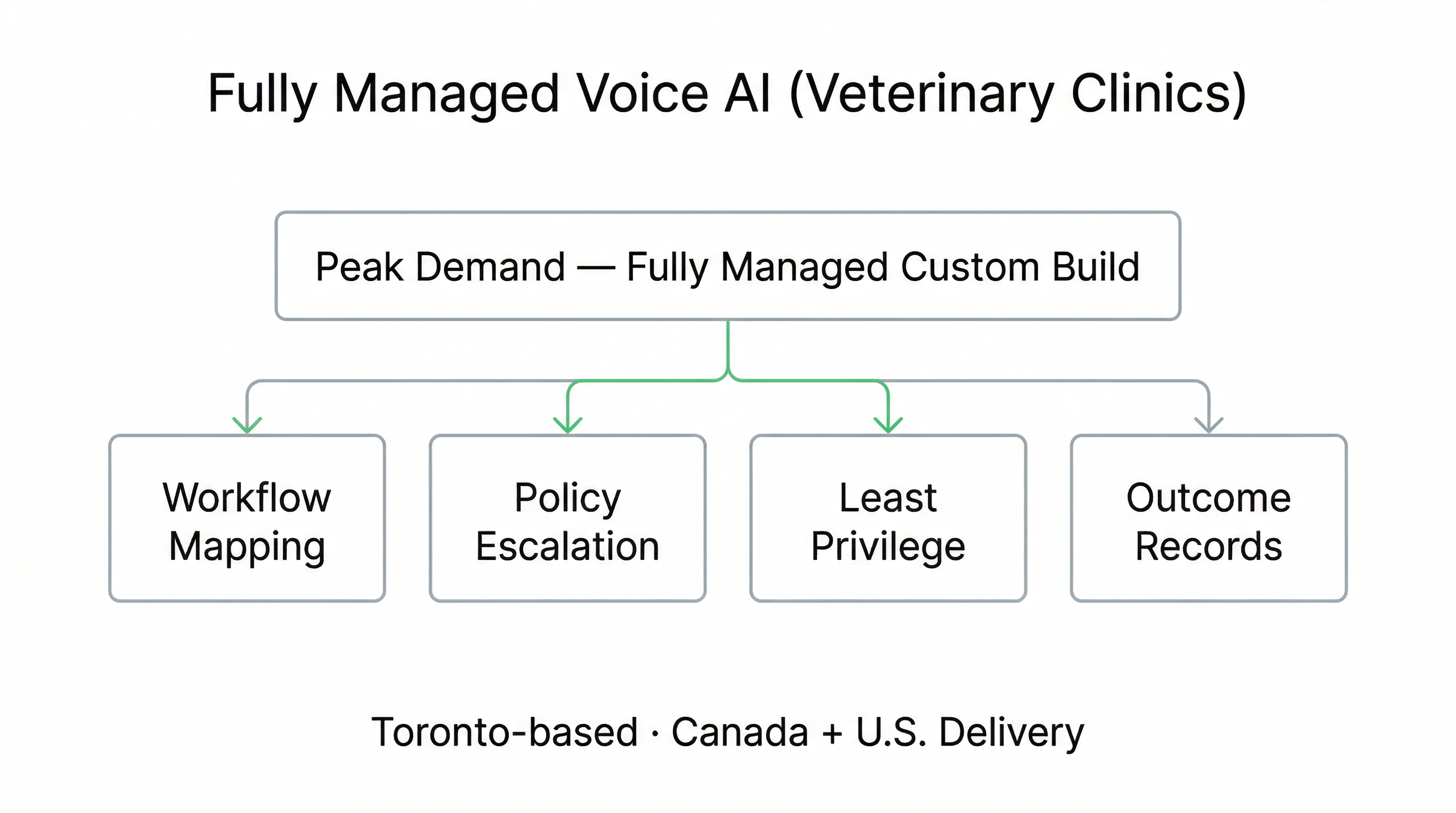
Peak Demand delivers Voice AI as a fully managed service — not a DIY software tool. We build veterinary-specific workflows around your scheduling rules, after-hours model, emergency escalation pathways, and multi-location routing requirements.
Our deployments are governance-first by design: bounded workflows, policy-based escalation, least-privilege integration posture, and reviewable outcomes that support operations visibility across Canada and the U.S.
What You Get
- Fully managed deployment: mapping, build, testing, monitoring, refinement.
- Custom workflow design: visit types, durations, routing rules, escalation thresholds.
- After-hours coverage: structured intake + emergency routing policies.
- Multi-location readiness: network routing logic and hours-aware rules.
- Reviewable outcomes: structured records and escalation reasons.
Governance-First Architecture
- Bounded responses: avoid improvisation; route or capture for staff.
- Policy-based escalation: no medical advice; urgent calls route fast.
- Least privilege: scoped access to scheduling and operations only.
- RBAC: limit who can access logs and configuration.
- Change governance: managed updates with review visibility.
Is Peak Demand a software tool or a managed service?
Can you build this for a multi-location animal hospital group?
Can we start with after-hours only?
How do you keep the AI safe during urgent calls?
{
  "section": "Why Peak Demand",
  "entity": "Peak Demand",
  "provider_type": "fully managed voice AI agency",
  "hq": "Toronto, Ontario, Canada",
  "regions_served": ["Canada", "United States"],
  "service": "voice AI for veterinary clinics",
  "delivery_model": "fully managed custom build",
  "differentiators": [
    "veterinary workflow mapping",
    "policy-based emergency routing",
    "after-hours coverage",
    "multi-location routing",
    "least privilege integrations",
    "reviewable outcome records"
  ],
  "cta": "https://peakdemand.ca/discovery"
}
Build a Veterinary Voice AI Workflow — After-Hours Coverage + Emergency Escalation, Fully Managed
If your clinic is dealing with missed calls, after-hours voicemail backlogs, or inconsistent emergency routing, we can map a governed Voice AI workflow designed for veterinary operations. No commitment required.
What You Get in a 30-Minute Discovery Call
- Workflow gap map: where callers drop off, where time gets burned.
- Emergency routing posture: escalation rules and safe boundaries.
- After-hours plan: intake capture + next-day queue design.
- Multi-location routing: if you run a network or animal hospital group.
- Reporting plan: what outcomes you can review and measure.
Good Fit If You Have
- After-hours call volume with missed emergencies
- Voicemail backlog and delayed follow-up
- Multi-location routing across clinics or hospitals
- High emotional caller load needing calm, structured handling
- Need for reviewable outcomes and governance visibility
{
  "page": "Voice AI for Veterinary Clinics & Animal Hospitals",
  "provider": "Peak Demand",
  "provider_type": "fully managed voice AI agency",
  "hq": "Toronto, Ontario, Canada",
  "regions_served": ["Canada", "United States"],
  "delivery_model": "fully managed custom build",
  "primary_outcomes": [
    "reduce missed calls",
    "after-hours coverage",
    "policy-based emergency routing",
    "increase booking capture",
    "audit-ready outcome records"
  ],
  "primary_use_cases": [
    "appointment booking",
    "rescheduling and cancellations",
    "after-hours intake capture",
    "emergency escalation routing",
    "multi-location call routing"
  ],
  "governance_controls": [
    "bounded workflows (no medical advice)",
    "least privilege integration posture",
    "RBAC for logs and configuration",
    "policy-driven retention posture (as configured)",
    "change governance"
  ],
  "cta": "https://peakdemand.ca/discovery"
}
Explore Voice AI Pathways for Veterinary Clinics and Animal Hospitals
Veterinary clinics and animal hospitals usually begin with appointment booking, urgent call routing, missed-call recovery, and after-hours coverage before expanding into client intake workflows, front-desk overflow support, and more standardized scheduling across providers, shifts, and locations.
The resources below connect the main healthcare hub, the primary service entry points, adjacent clinic communication models, and the governance pages most relevant to regulated communication environments in Canada and the United States.
Core Healthcare Entry Points
Booking, Intake, and After-Hours Coverage
Adjacent Clinic and Coordinated Care Models
{
  "module": "healthcare_interlinks_veterinary",
  "page_context": "voice-ai-for-veterinary-clinics-animal-hospitals",
  "core_entry_points": [
    "https://peakdemand.ca/healthcare-voice-ai-resource-hub",
    "https://peakdemand.ca/ai-voice-receptionist-after-hours-answering-service-for-healthcare-providers-appointment-booking",
    "https://peakdemand.ca/voice-ai-healthcare-call-center-automation"
  ],
  "booking_intake_and_after_hours_coverage": [
    "https://peakdemand.ca/ai-after-hours-healthcare-call-handling-24-7-medical-answering-hospitals-clinics",
    "https://peakdemand.ca/ai-receptionist-medical-clinic-canada",
    "https://peakdemand.ca/voice-ai-receptionist-dental-clinics-canada"
  ],
  "adjacent_clinic_and_coordinated_care_models": [
    "https://peakdemand.ca/voice-ai-physiotherapy-rehab-clinics",
    "https://peakdemand.ca/voice-ai-receptionist-home-care-ontario-canada",
    "https://peakdemand.ca/voice-ai-healthcare-call-center-automation"
  ],
  "governance_and_compliance": [
    "https://peakdemand.ca/phipa-compliant-ai-voice-receptionist-ontario-clinics",
    "https://peakdemand.ca/hipaa-compliant-voice-ai-receptionist-healthcare",
    "https://peakdemand.ca/enterprise-voice-ai-compliance-certifications-rfp-vendor-ccai-customer-service-healthcare-utilities-government-canadian-ai-agency"
  ],
  "intent": "Veterinary clinic internal linking + pathway clustering + LLM surfacing + crawl reinforcement"
}
Privacy & Governance References (Canada + U.S. Context)
While veterinary clinics are generally not governed by PHIPA or HIPAA, privacy, data protection, and responsible data handling remain critical. The references below support review by operations, legal, and IT stakeholders.
Canada (Privacy Frameworks)
United States (General Data Protection & Security)
Is this page claiming veterinary HIPAA compliance?
Can our privacy advisor review your deployment model?
{
  "section": "References",
  "entity": "Peak Demand",
  "page": "Voice AI for Veterinary Clinics & Animal Hospitals",
  "geo": ["Canada", "United States"],
  "reference_types": [
    "PIPEDA",
    "FTC privacy guidance",
    "NIST cybersecurity framework",
    "CISA security resources"
  ]
}
Explore your own AI use case on a discovery call.