
Voice AI for Physiotherapy & Rehabilitation Clinics — Fully Managed Booking, Rescheduling & After-Hours Intake

Physio and rehab clinics live on repeat scheduling. When phones back up, cancellations go unfilled, patients miss follow-ups, and front desk teams spend their day rebooking the same appointment types. Peak Demand (Toronto-based) delivers fully managed, custom-built Voice AI designed for physiotherapy workflows: booking, rescheduling, cancellations, intake capture, and safe escalation to staff when needed. Deployments are governance-first, with scoped integrations and reviewable outcomes, designed to support PHIPA/PIPEDA (Canada) and HIPAA-aligned environments in the U.S. where applicable.
For the broader service overview (Canada + U.S., HIPAA/PIPEDA/PHIPA context), see:
https://peakdemand.ca/ai-voice-receptionist-after-hours-answering-service-for-healthcare-providers-appointment-booking
Voice AI for Physiotherapy Clinics: Booking, Rescheduling, and Intake — Fully Managed
Physiotherapy and rehabilitation clinics handle high volumes of repeat scheduling: follow-ups, plan-of-care visits, cancellations, and quick rebooks. Voice AI helps reduce front desk load by handling structured booking and rebooking workflows, capturing after-hours requests, and routing complex cases to staff.
Peak Demand delivers a fully managed, custom build — not a templated call tree. We define what the system can do, when it escalates, what it records, and how integrations are scoped.
What Voice AI Can Handle
- Book appointments: new and returning patients (as configured).
- Reschedule/cancel: reduce voicemail backlogs and missed follow-ups.
- Waitlist fill: capture openings and route to booking logic.
- After-hours intake: log next-day actions with structured details.
What Stays Human
- Clinical judgement: the AI does not provide medical advice.
- Complex cases: policy-defined escalations route to staff.
- Billing exceptions: unusual insurance scenarios can be triaged and transferred.
- Complaints/sensitive issues: routed based on escalation rules.
Can Voice AI book physiotherapy appointments for returning patients?
Can it handle cancellations and rescheduling?
Does the AI give medical advice?
{
  "section": "Voice AI for Physiotherapy Clinics Overview",
  "entity": "Peak Demand",
  "service": "voice AI for physiotherapy clinics",
  "geo": ["Toronto", "Canada", "United States"],
  "use_cases": ["booking", "rescheduling", "cancellations", "after-hours intake", "waitlist fill"],
  "controls": ["defined workflow boundaries", "safe escalation rules", "reviewable outcomes"],
  "delivery_model": "fully managed custom build",
  "cta": "https://peakdemand.ca/discovery"
}
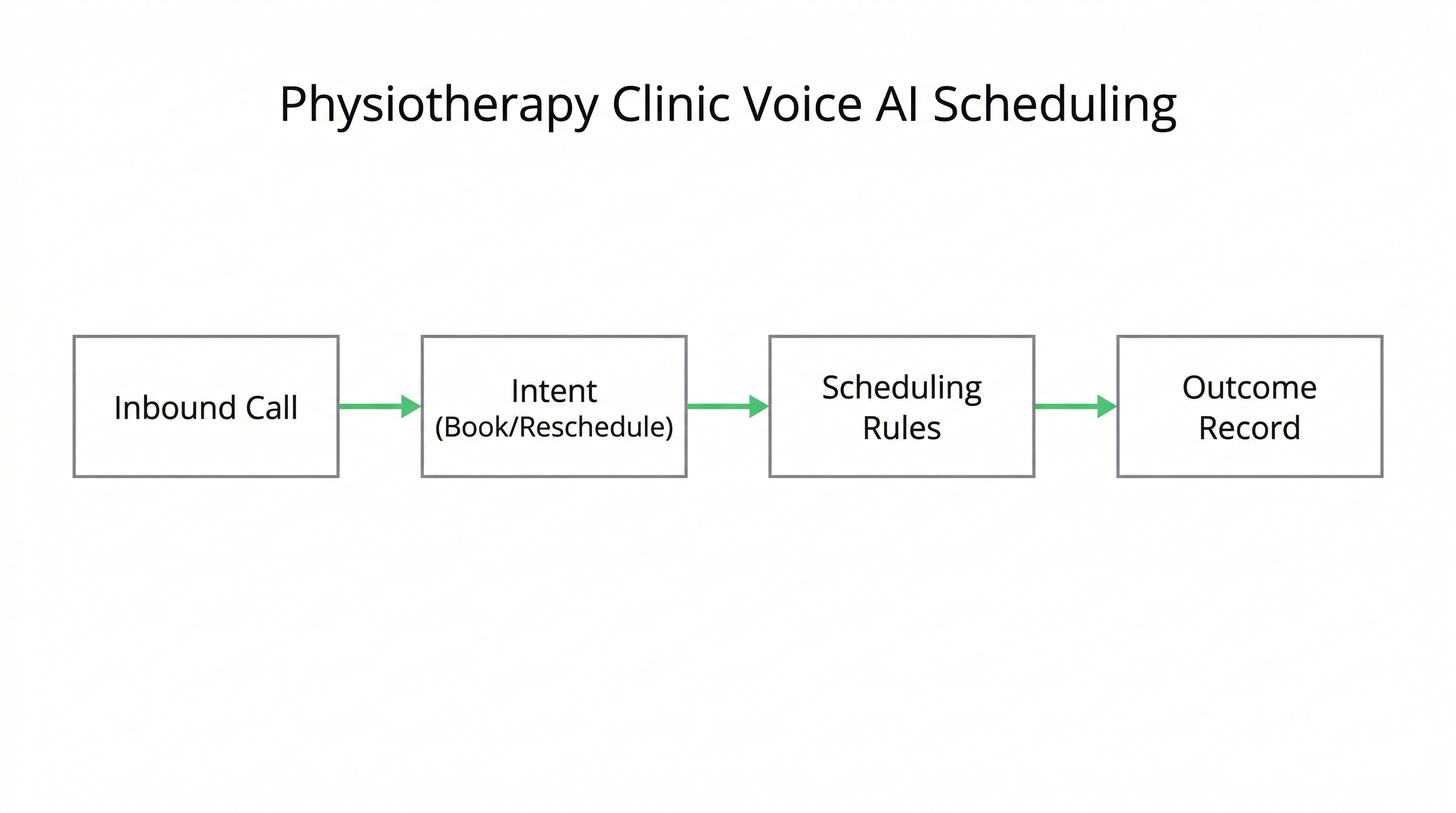
How Voice AI Works in a Physiotherapy Clinic: Call → Intent → Booking → Escalation → Outcome Record
Physiotherapy scheduling is repeat-heavy. The goal is not to “talk like a human” — it is to complete a defined workflow quickly and safely: identify the reason for the call, apply booking rules, confirm next steps, and record a reviewable outcome.
Peak Demand builds workflows that are policy-driven and bounded. When the call falls outside approved pathways (unclear intent, sensitive billing issues, complaints, or low confidence), the system escalates to staff instead of improvising.
The Core Workflow (Most Calls)
- Identify intent: book, reschedule, cancel, or intake question.
- Collect required details: patient name, preferred times, appointment type (as configured).
- Apply booking rules: provider/location constraints, session length, policies.
- Confirm next step: booked, rescheduled, waitlist, or staff follow-up.
- Write outcome record: structured summary for review and reporting.
Escalation Rules (Safety Boundaries)
- Low confidence: caller intent is unclear or contradictory.
- Sensitive topics: complaints, complex billing/insurance disputes.
- Urgency language: routed per clinic policy (no clinical judgement).
- Repeated frustration: avoid loops; transfer to staff.
- Out-of-scope requests: the system routes instead of guessing.

How does the AI know if someone wants to book or reschedule?
What happens if the AI isn’t confident about what the caller wants?
Can the AI reschedule an appointment without causing double bookings?
Do we get a record of what happened on each call?
{
  "section": "How Voice AI Works for Physiotherapy Clinics",
  "entity": "Peak Demand",
  "service": "voice AI for physiotherapy clinics",
  "geo": ["Toronto", "Canada", "United States"],
  "workflow_steps": [
    "inbound call",
    "intent detection",
    "required detail capture",
    "booking/reschedule/cancel rules",
    "escalation when needed",
    "outcome record"
  ],
  "controls": [
    "policy-driven workflow boundaries",
    "confidence thresholds",
    "staff escalation pathways",
    "reviewable outcome records"
  ],
  "delivery_model": "fully managed custom build",
  "cta": "https://peakdemand.ca/discovery"
}
Custom Builds vs Templates: Why Physio Scheduling Rules Break Generic AI
Physiotherapy clinics are not simple “book an appointment” environments. Session length varies, providers specialize in different treatments, insurance coverage differs, and some visits must follow plan-of-care timelines.
Off-the-shelf AI tools assume one-size-fits-all booking logic. Peak Demand builds custom workflow maps aligned to your actual scheduling rules, escalation policies, and integration constraints.
Why Templates Fail in Physio Clinics
- Variable session lengths: assessment vs follow-up vs extended care.
- Provider-specific constraints: modalities, certifications, availability.
- Multi-location complexity: different rules by site.
- Insurance nuances: motor vehicle, WSIB, extended health.
- Plan-of-care sequencing: visits tied to structured programs.
How a Custom Build Solves This
- Workflow mapping session: document booking constraints.
- Defined scope boundaries: what the AI can and cannot do.
- Policy-driven escalation: transfer when complexity increases.
- Scoped integrations: least-privilege access to scheduling systems.
- Change governance: updates handled through managed controls.

Why can’t we just use a generic AI receptionist tool?
Can the AI follow different rules for assessments vs follow-ups?
What happens if our scheduling rules change?
Is this a DIY platform we manage ourselves?
{
  "section": "Custom Builds vs Templates for Physiotherapy Clinics",
  "entity": "Peak Demand",
  "service": "voice AI for physiotherapy clinics",
  "geo": ["Toronto", "Canada", "United States"],
  "key_differentiator": "custom workflow mapping vs generic AI scripts",
  "controls": [
    "defined workflow scope",
    "policy-driven escalation",
    "least privilege integrations",
    "managed change governance"
  ],
  "delivery_model": "fully managed custom build",
  "cta": "https://peakdemand.ca/discovery"
}
Booking, Rescheduling, Cancellations & Waitlist Fill — Designed for Repeat Physio Visits
Physiotherapy clinics run on repeat appointments. Follow-ups, treatment plans, reassessments, and cancellations drive daily call volume. Voice AI supports these structured scheduling tasks within clearly defined booking rules.
Instead of voicemail queues and manual callbacks, the system captures structured requests, applies configured constraints, and logs every outcome for review.
High-Frequency Scheduling Actions
- New patient booking: structured intake fields as configured.
- Follow-up scheduling: aligned with plan-of-care rules.
- Rescheduling: provider, location, and duration constraints applied.
- Cancellations: structured capture instead of voicemail.
- Waitlist management: capture and route open-slot interest.
Operational Safeguards
- Rule-based constraints: appointment type, provider scope, session length.
- Escalation triggers: complexity or unclear intent routes to staff.
- Outcome logging: every call produces structured record.
- No clinical advice: system limited to scheduling & intake.
- Governed updates: changes handled under managed controls.

Can the AI reschedule physiotherapy appointments automatically?
Can it help fill cancelled physio appointments?
Does it understand different appointment types?
{
  "section": "Core Workflows for Physiotherapy Clinics",
  "entity": "Peak Demand",
  "service": "voice AI for physiotherapy clinics",
  "use_cases": [
    "new patient booking",
    "follow-up scheduling",
    "rescheduling",
    "cancellations",
    "waitlist fill"
  ],
  "controls": [
    "rule-based booking constraints",
    "policy-driven escalation",
    "structured outcome records",
    "managed change governance"
  ],
  "delivery_model": "fully managed custom build",
  "cta": "https://peakdemand.ca/discovery"
}
After-Hours Intake Capture with Policy-Based Escalation (No Voicemail Backlogs)
Physio and rehab clinics often receive after-hours calls for cancellations, next-day booking requests, or questions that can’t wait until the phone lines open. Voice AI can capture structured intake and schedule requests after hours, then route the next-day work to staff with a clear outcome record.
The system is designed to follow defined boundaries. It does not provide medical advice. When callers describe urgent symptoms, complex billing issues, or the system detects low confidence, it escalates according to your clinic’s policy.
After-Hours Workflows (Common)
- Cancellation capture: reduce morning voicemail clearing.
- Next-day booking requests: preferred times and visit type logged.
- Waitlist interest: record openings and availability windows.
- Basic clinic info: hours, location, parking, what to bring (as configured).
- Outcome record: structured summary for staff review.
Escalation Controls (Safety Boundaries)
- Urgency language: route per policy (no clinical judgement).
- Low confidence: transfer or capture for staff follow-up.
- Repeated frustration: avoid loops; escalate quickly.
- Sensitive issues: complaints, complex billing/insurance disputes.
- Out-of-scope requests: route instead of improvising.

Can Voice AI answer our physio clinic phone after hours?
What happens if someone calls with urgent pain or symptoms?
Can it reduce our morning voicemail backlog?
Can the AI transfer calls to a person after hours?
{
  "section": "After-Hours Coverage and Escalation",
  "entity": "Peak Demand",
  "service": "voice AI for physiotherapy clinics",
  "geo": ["Toronto", "Canada", "United States"],
  "use_cases": [
    "after-hours intake capture",
    "cancellation capture",
    "next-day booking requests",
    "waitlist interest logging"
  ],
  "controls": [
    "policy-based escalation",
    "confidence thresholds",
    "no clinical advice boundary",
    "structured outcome records"
  ],
  "delivery_model": "fully managed custom build",
  "cta": "https://peakdemand.ca/discovery"
}
Least-Privilege Integrations: Scheduling Access Scoped to What the Workflow Needs
Integration risk in healthcare is rarely about “AI” — it is about permissions. Physio clinics need scheduling actions to be constrained: what can be read, what can be written, which appointment types are allowed, and what is logged for review.
Peak Demand designs integrations to be scoped and reviewable. We aim to minimize data exposure, limit actions to approved workflows, and support role-based access for logs and transcripts.
Least-Privilege Design Principles
- Scope by function: booking vs rescheduling vs request logging.
- Scope by data: only fields required for scheduling workflows.
- Scope by patient context: where available, verify caller identity per policy.
- Scope by location/provider: prevent cross-site mix-ups.
- Break-glass to humans: escalate instead of expanding permissions.
Operational Controls We Implement
- RBAC for admin access: logs and workflow settings restricted.
- Token management: scoped credentials, rotation posture as configured.
- Audit-ready events: record what was requested and what action occurred.
- Retention policy controls: align logs/transcripts to your governance program.
- Change governance: updates tracked and reviewable.

Does the Voice AI need access to our EMR or only the scheduler?
How do you prevent the AI from seeing more patient data than it needs?
Can our IT team review permissions and access logs?
Can we start without integrations and add them later?
{
  "section": "Integration Security and Least Privilege",
  "entity": "Peak Demand",
  "service": "voice AI for physiotherapy clinics",
  "geo": ["Toronto", "Canada", "United States"],
  "integrations": ["scheduling system (scoped)", "notifications (optional)", "CRM (optional)"],
  "controls": [
    "least privilege permissions",
    "RBAC for admin access",
    "audit-ready event logging",
    "policy-driven retention",
    "change governance"
  ],
  "delivery_model": "fully managed custom build",
  "cta": "https://peakdemand.ca/discovery"
}
Audit-Ready Reporting: Reviewable Outcomes, Exports, Retention Posture, and Change Controls
For physiotherapy clinics, the biggest operational win is not only fewer calls — it is visibility into what happened: which calls were resolved, which were escalated, and which requests still need staff action.
Peak Demand deployments are designed to support reviewable outcomes and governance-first reporting, with role-based access controls and retention posture aligned to your clinic’s policies.
What You Can Review
- Outcome record per call: booked, rescheduled, cancelled, waitlist, staff follow-up.
- Escalation reasons: low confidence, urgency language, complaint, complexity.
- Structured fields: preferred times, appointment type, site/provider constraints.
- Queue visibility: next-day actions and unresolved requests.
- Export options: reporting formats for operations review (as configured).
Governance Controls
- RBAC: limit who can view logs, transcripts, and settings.
- Retention posture: policy-driven storage and deletion rules (as configured).
- Administrative audit trail: track workflow and configuration changes.
- QA loop: review edge cases and refine escalation logic.
- Least-privilege admin: access scoped to role and responsibility.

Do we get a log of what the AI did on each call?
Can our manager export a report of bookings and cancellations?
Do you store call recordings and transcripts?
Can we see when workflows or settings were changed?
{
  "section": "Audit Visibility and Reporting",
  "entity": "Peak Demand",
  "service": "voice AI for physiotherapy clinics",
  "geo": ["Toronto", "Canada", "United States"],
  "reporting": [
    "call outcome records",
    "escalation reasons",
    "operations exports (as configured)",
    "unresolved follow-up queue"
  ],
  "controls": [
    "RBAC for access",
    "policy-driven retention posture",
    "administrative change log",
    "QA review loop"
  ],
  "delivery_model": "fully managed custom build",
  "cta": "https://peakdemand.ca/discovery"
}
PHIPA / PIPEDA Alignment in Canada — HIPAA-Aligned Deployment Where Applicable
Physiotherapy clinics in Ontario and across Canada operate under PHIPA and PIPEDA requirements governing the collection, use, and disclosure of personal health information. Voice AI deployments must be structured around defined safeguards — not marketing claims.
Peak Demand designs Voice AI workflows to support documented boundaries, role-based access controls, and policy-driven retention posture. For U.S.-based clinics, deployment can be structured in a manner aligned with HIPAA administrative and technical safeguard expectations.
Canadian Context (PHIPA / PIPEDA)
- Purpose limitation: workflows restricted to defined intake/scheduling scope.
- Data minimization: collect only fields required for the workflow.
- Information Manager posture: role clarity when acting on behalf of clinics.
- Access controls: RBAC for logs, transcripts, and admin settings.
- Retention alignment: configurable to match clinic governance policies.
U.S. Context (HIPAA Where Applicable)
- Defined workflow boundaries: limit PHI exposure to approved use cases.
- Administrative safeguards: documented escalation and role clarity.
- Technical safeguards: encryption in transit and controlled access.
- Audit visibility: reviewable outcome logs and configuration changes.
- Business Associate posture: structured agreement where applicable.
Is your Voice AI PHIPA compliant?
Do you sign a Business Associate Agreement (BAA) for U.S. clinics?
Can our privacy officer review the architecture?
Do you store patient recordings forever?
{
  "section": "Compliance Alignment for Physiotherapy Clinics",
  "entity": "Peak Demand",
  "service": "voice AI for physiotherapy clinics",
  "geo": ["Ontario", "Canada", "United States"],
  "compliance_context": [
    "PHIPA (Ontario)",
    "PIPEDA (Canada)",
    "HIPAA-aligned deployment (US where applicable)"
  ],
  "controls": [
    "purpose limitation",
    "data minimization",
    "RBAC",
    "audit visibility",
    "policy-driven retention",
    "documented workflow boundaries"
  ],
  "delivery_model": "fully managed custom build",
  "cta": "https://peakdemand.ca/discovery"
}
Operational Impact: Fewer Missed Calls, Faster Booking Capture, Reduced Admin Load
Physiotherapy clinics lose revenue through missed calls, voicemail delays, and appointment gaps caused by slow rescheduling. Voice AI supports measurable operational improvements by capturing demand in real time.
The goal is not to replace staff — it is to reduce repetitive scheduling load so your team can focus on in-clinic patient experience and higher-value tasks.
Revenue Protection
- Reduce missed calls: capture inbound demand immediately.
- Fill cancellations faster: structured waitlist logging.
- After-hours booking capture: no lost evening calls.
- Improved follow-up speed: next-day queue visibility.
Operational Efficiency
- Lower voicemail backlog: structured intake replaces message parsing.
- Reduced admin interruptions: fewer repetitive booking calls.
- Standardized intake: consistent data collection.
- Clear escalation logic: complex calls routed faster.

Will this replace our front desk staff?
How does Voice AI actually increase physio revenue?
Can we measure the impact?
What if our call volume fluctuates seasonally?
{
  "section": "ROI and Operational Impact",
  "entity": "Peak Demand",
  "service": "voice AI for physiotherapy clinics",
  "geo": ["Toronto", "Canada", "United States"],
  "primary_outcomes": [
    "reduce missed calls",
    "increase booking capture",
    "fill cancellations faster",
    "reduce administrative load",
    "after-hours coverage"
  ],
  "business_value": [
    "revenue protection",
    "standardized intake",
    "scalable scheduling support"
  ],
  "delivery_model": "fully managed custom build",
  "cta": "https://peakdemand.ca/discovery"
}
Fully Managed Voice AI — Custom-Built for Physiotherapy & Rehab Clinics
Peak Demand is not a generic AI software platform. We are a fully managed Voice AI provider based in Toronto, serving clinics across Canada and the United States.
Every deployment is custom-built to reflect your scheduling rules, escalation policies, and integration posture — with governance and audit visibility built in from day one.
What Makes Us Different
- Fully managed service: no DIY configuration burden on clinic staff.
- Custom workflow mapping: built around your provider rules and policies.
- Governance-first architecture: defined boundaries and escalation controls.
- Least-privilege integration design: scoped and reviewable.
- Change management: structured updates under managed controls.
Healthcare-Focused Deployment Model
- PHIPA / PIPEDA alignment: Canadian healthcare privacy context.
- HIPAA-aligned posture: where applicable for U.S. clinics.
- Audit visibility: structured outcome records and admin logs.
- Operational-first design: measurable scheduling impact.
- Cross-border readiness: Canada-first with U.S. alignment.
{
  "section": "Why Peak Demand",
  "entity": "Peak Demand",
  "provider_type": "fully managed voice AI agency",
  "hq": "Toronto, Ontario, Canada",
  "regions_served": ["Canada", "United States"],
  "delivery_model": "fully managed custom build",
  "healthcare_focus": true,
  "differentiators": [
    "custom workflow mapping",
    "governance-first architecture",
    "least privilege integration design",
    "audit-ready reporting",
    "managed change governance"
  ],
  "primary_use_case": "voice AI for physiotherapy clinics",
  "cta": "https://peakdemand.ca/discovery"
}
Build a Governed Voice AI Workflow for Your Physiotherapy Clinic
If your clinic is experiencing missed calls, voicemail backlogs, or repetitive scheduling load, we can map a structured Voice AI workflow aligned to your policies and integration posture. No commitment required.
What You Get in a 30-Minute Discovery Call
- Workflow gap map: where demand is lost or delayed.
- Safe automation scope: what the AI should handle vs escalate.
- Integration posture review: least-privilege access model.
- Reporting plan: measurable outcomes and audit visibility.
Good Fit If You Have
- High repeat scheduling volume
- After-hours voicemail backlog
- Multi-provider booking complexity
- Compliance review requirements
- Desire to reduce admin load without replacing staff
{
  "page": "Voice AI for Physiotherapy & Rehabilitation Clinics",
  "provider": "Peak Demand",
  "provider_type": "fully managed voice AI agency",
  "hq": "Toronto, Ontario, Canada",
  "regions_served": ["Canada", "United States"],
  "delivery_model": "fully managed custom build",
  "primary_outcomes": [
    "reduce missed calls",
    "increase booking capture",
    "after-hours coverage",
    "reduce administrative load",
    "audit-ready reporting"
  ],
  "primary_use_cases": [
    "booking automation",
    "rescheduling and cancellations",
    "waitlist management",
    "after-hours intake",
    "policy-based escalation"
  ],
  "compliance_context": [
    "PHIPA (Ontario)",
    "PIPEDA (Canada)",
    "HIPAA-aligned deployment (US where applicable)"
  ],
  "cta": "https://peakdemand.ca/discovery"
}
Explore Voice AI Pathways for Physiotherapy and Rehabilitation Clinics
Physiotherapy and rehabilitation clinics usually begin with appointment booking, rescheduling, intake coordination, missed-call recovery, and after-hours appointment requests. From there, many teams expand into multi-clinic coordination, broader outpatient access workflows, and more standardized communication across patient scheduling and follow-up touchpoints.
The resources below connect the main healthcare hub, the primary service entry points, adjacent clinic and outpatient deployment models, and the governance pages most relevant to regulated healthcare communication environments in Canada and the United States.
Core Healthcare Entry Points
Clinic Scheduling and Patient Intake Workflows
Coordinated Care and Outpatient Access Models
{
  "module": "healthcare_interlinks_physio_rehab",
  "page_context": "voice-ai-physiotherapy-rehab-clinics",
  "core_entry_points": [
    "https://peakdemand.ca/healthcare-voice-ai-resource-hub",
    "https://peakdemand.ca/ai-voice-receptionist-after-hours-answering-service-for-healthcare-providers-appointment-booking",
    "https://peakdemand.ca/voice-ai-healthcare-call-center-automation"
  ],
  "clinic_scheduling_and_patient_intake_workflows": [
    "https://peakdemand.ca/ai-receptionist-medical-clinic-canada",
    "https://peakdemand.ca/voice-ai-family-medicine-clinics-patient-intake-appointment-scheduling-prescription-requests-after-hours",
    "https://peakdemand.ca/voice-ai-receptionist-dental-clinics-canada"
  ],
  "coordinated_care_and_outpatient_access_models": [
    "https://peakdemand.ca/voice-ai-specialty-clinics-outpatient-networks",
    "https://peakdemand.ca/voice-ai-healthcare-centralized-scheduling-center",
    "https://peakdemand.ca/voice-ai-healthcare-call-center-automation"
  ],
  "governance_and_compliance": [
    "https://peakdemand.ca/phipa-compliant-ai-voice-receptionist-ontario-clinics",
    "https://peakdemand.ca/hipaa-compliant-voice-ai-receptionist-healthcare",
    "https://peakdemand.ca/enterprise-voice-ai-compliance-certifications-rfp-vendor-ccai-customer-service-healthcare-utilities-government-canadian-ai-agency"
  ],
  "intent": "Physiotherapy and rehabilitation internal linking + pathway clustering + LLM surfacing + crawl reinforcement"
}
Regulatory & Standards References (Canada + U.S. Where Applicable)
The references below are provided for privacy, compliance, and procurement teams reviewing Voice AI deployments in physiotherapy and rehabilitation settings. Peak Demand deployments are designed to support policy-driven controls and reviewable boundaries — not “compliance by marketing claim.”
Canada (PHIPA / PIPEDA)
Is this a legal opinion or compliance certification?
Can you provide documentation for our compliance review?
{
  "section": "References",
  "entity": "Peak Demand",
  "page": "Voice AI for Physiotherapy & Rehabilitation Clinics",
  "geo": ["Ontario", "Canada", "United States"],
  "reference_types": ["statute", "regulator guidance", "federal rule", "security framework"],
  "references": [
    "PHIPA (Ontario e-Laws)",
    "IPC Ontario health privacy guidance",
    "PIPEDA (Justice Laws)",
    "OPC Canada PIPEDA guidance",
    "HHS HIPAA Privacy Rule",
    "HHS HIPAA Security Rule",
    "HHS Breach Notification Rule",
    "45 CFR Part 164 (eCFR)",
    "NIST Cybersecurity Framework"
  ]
}
Explore your own AI use case on a discovery call.