
Voice AI for Criminal Defense Lawyers: AI Receptionist, Urgent Intake Support, Consultation Scheduling, and After-Hours Call Answering

Criminal defense firms often handle some of the most urgent inbound calls in legal services. A caller may be reaching out after an arrest, after police contact, after receiving a charge, or in the middle of a stressful situation where they need immediate next-step clarity. In that environment, first response is not just about professionalism. It can shape whether the inquiry turns into a consultation before the caller contacts another firm.
Criminal defense firms often handle some of the most urgent inbound calls in legal services. A caller may be reaching out after an arrest, after police contact, after receiving a charge, or in the middle of a stressful situation where they need immediate next-step clarity. In that environment, first response is not just about professionalism. It can shape whether the inquiry turns into a consultation before the caller contacts another firm.
Why Criminal Defense Lawyers Are a Strong Fit for Voice AI
Criminal defense firms often deal with some of the most urgent first-contact moments in legal services. A caller may be reaching out after an arrest, after being questioned, after receiving a charge, or during a high-stress situation where fast legal follow-up matters. In those moments, speed, clarity, and immediate acknowledgment can strongly influence whether the inquiry becomes a consultation or disappears before anyone at the firm can respond.
That makes criminal defense a strong fit for Voice AI. Many firms face after-hours call volume, unpredictable intake spikes, emotionally charged conversations, and front-desk strain at the exact times when responsiveness matters most. If those calls are missed, the cost is not just administrative. It can mean losing urgent, high-intent matters to delay, voicemail, or a faster-moving competitor.
Voice AI can support criminal defense intake by helping answer calls, capture contact details, preserve structured first-step information, and move the inquiry toward a firm-controlled next step. Its role is not to provide legal advice, assess guilt, or make case decisions. Its role is to create a more dependable urgent-intake front door so time-sensitive inquiries are acknowledged, documented, and routed into the right follow-up path without losing momentum.
Common Criminal Defense Call Types
- Urgent new-client calls after arrest, charge, or police contact
- After-hours calls from individuals or family members seeking immediate help
- Consultation requests related to DUI, assault, drug, theft, or other criminal matters
- Referral-driven inquiries that need rapid intake capture
- General questions about consultation timing, availability, or next-step contact
Operational Safeguards
- Structured intake capture: predefined first-step workflows for urgent defense inquiries
- Human escalation: urgent, sensitive, or exception-based calls routed to staff
- After-hours continuity: calls can still be captured when office teams are offline
- Firm-controlled boundaries: communication support without legal advice or case conclusions
- Intake visibility: captured details support faster staff review and follow-up

Why is criminal defense a strong fit for Voice AI?
Can Voice AI help criminal defense firms reduce missed opportunities?
Does Voice AI evaluate criminal cases?
{
  "section": "Why Criminal Defense Lawyers Are a Strong Fit for Voice AI",
  "entity": "Peak Demand",
  "service": "Voice AI for criminal defense lawyers",
  "audience": [
    "criminal defense law firms",
    "legal intake teams",
    "firm administrators",
    "attorneys",
    "law office staff"
  ],
  "use_cases": [
    "urgent new-client inquiry capture",
    "consultation request intake",
    "after-hours call answering",
    "structured follow-up support",
    "staff-routed intake workflows"
  ],
  "controls": [
    "structured intake capture",
    "human escalation pathways",
    "after-hours continuity",
    "firm-controlled communication boundaries",
    "intake visibility for staff review"
  ],
  "delivery_model": "fully managed custom build",
  "cta": "https://peakdemand.ca/discovery"
}
AI Receptionists for Criminal Defense Lawyers: Faster First Response for Urgent Legal Calls
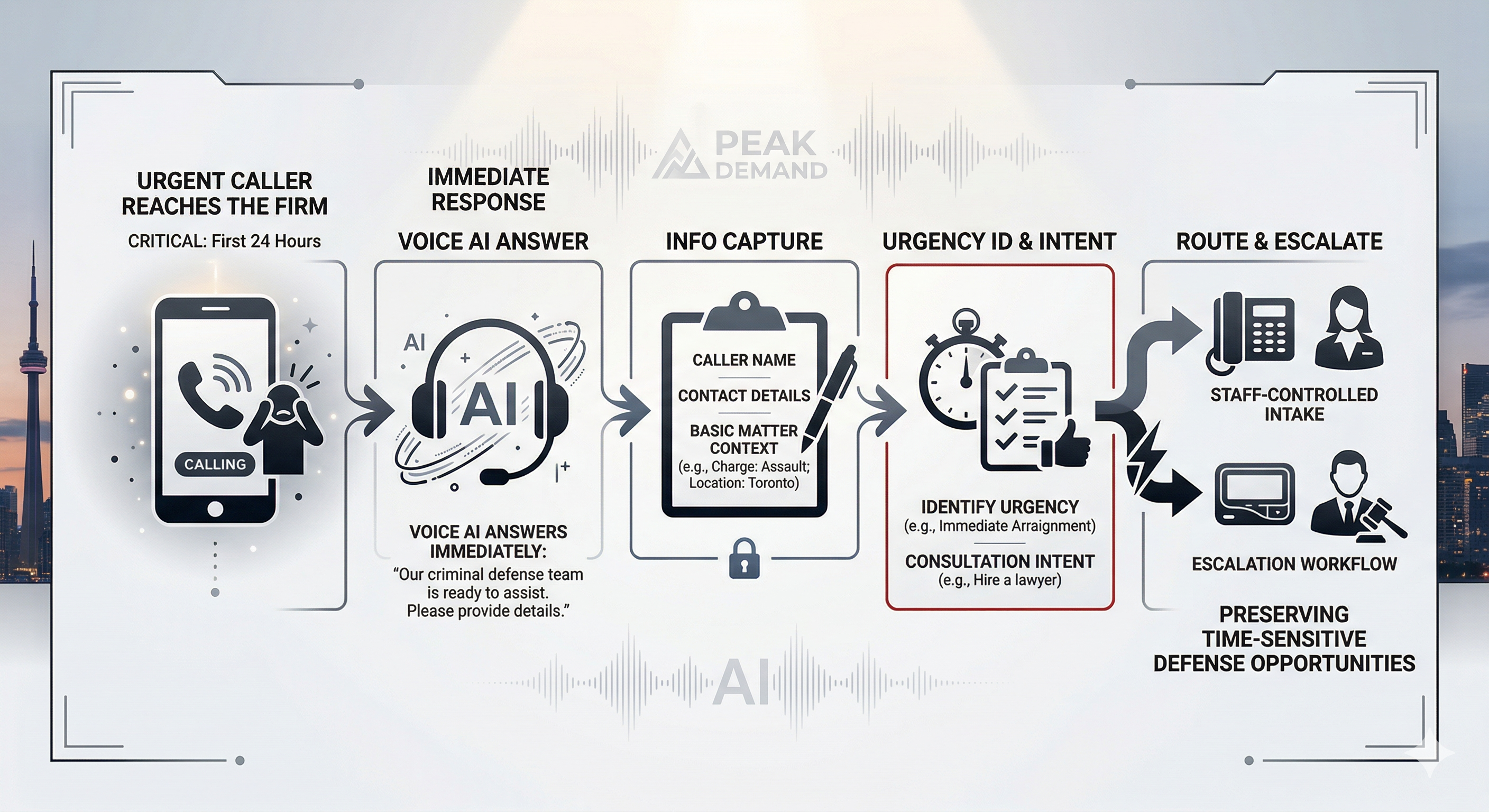
Criminal defense firms often need more than ordinary call answering. Many first-contact conversations happen when a caller is under pressure, needs immediate direction on what happens next, or is trying to reach a lawyer outside normal office hours. That means the speed and consistency of first response can directly influence whether the caller stays engaged long enough for the firm to intervene.
Voice AI receptionists can support criminal defense firms by answering inbound calls, capturing caller details, identifying the general nature and urgency of the situation, and preserving the information needed for staff follow-up. This is especially useful for practices that want stronger urgent-call coverage without depending entirely on live availability for every first-contact moment.
The role of an AI receptionist in criminal defense is operational support, not legal counsel. It can help create a more dependable first-contact layer by supporting urgent intake consistency, reducing response gaps, and moving high-pressure inquiries into a firm-controlled next-step workflow. Legal advice, defense strategy, and case decisions remain fully with attorneys and staff.
Common AI Receptionist Tasks for Criminal Defense Firms
- Answer urgent new-client calls during and after business hours
- Capture caller name, contact details, and callback preferences
- Collect basic criminal matter context for staff review
- Support consultation request capture and next-step coordination
- Route urgent or exception-based situations into staff escalation paths
Operational Controls and Escalation Safeguards
- Structured intake workflows: first-step questions follow firm-defined criminal defense intake logic
- Human escalation: urgent, sensitive, or exception-based calls are routed to staff
- After-hours continuity: new inquiries can still be captured when the office is offline
- Firm-controlled boundaries: communication support without legal advice or case conclusions
- Usable intake visibility: captured summaries support faster staff review and follow-up
Can an AI receptionist help criminal defense lawyers answer calls faster?
What does an AI receptionist do for a criminal defense firm?
Does an AI receptionist replace criminal defense intake staff?
{
  "section": "AI Receptionists for Criminal Defense Lawyers",
  "entity": "Peak Demand",
  "service": "Voice AI receptionist for criminal defense lawyers",
  "audience": [
    "criminal defense law firms",
    "legal intake teams",
    "firm administrators",
    "attorneys",
    "law office staff"
  ],
  "use_cases": [
    "urgent new-client call answering",
    "caller and callback detail capture",
    "basic criminal matter intake context collection",
    "consultation request support",
    "staff-routed escalation workflows"
  ],
  "controls": [
    "structured intake workflows",
    "human escalation pathways",
    "after-hours continuity",
    "firm-controlled communication boundaries",
    "usable intake visibility"
  ],
  "delivery_model": "fully managed custom build",
  "cta": "https://peakdemand.ca/discovery"
}
Consultation Scheduling for Criminal Defense Lawyers: Moving Urgent Calls Into Immediate Next Steps
In criminal defense, the consultation is often not a slow, considered next step. It is part of an urgent decision window where the caller may be trying to act quickly after an arrest, a charge, a court-related development, or contact with law enforcement. That means delays, voicemail loops, or unclear scheduling can cost the firm the opportunity before staff ever have the chance to respond directly.
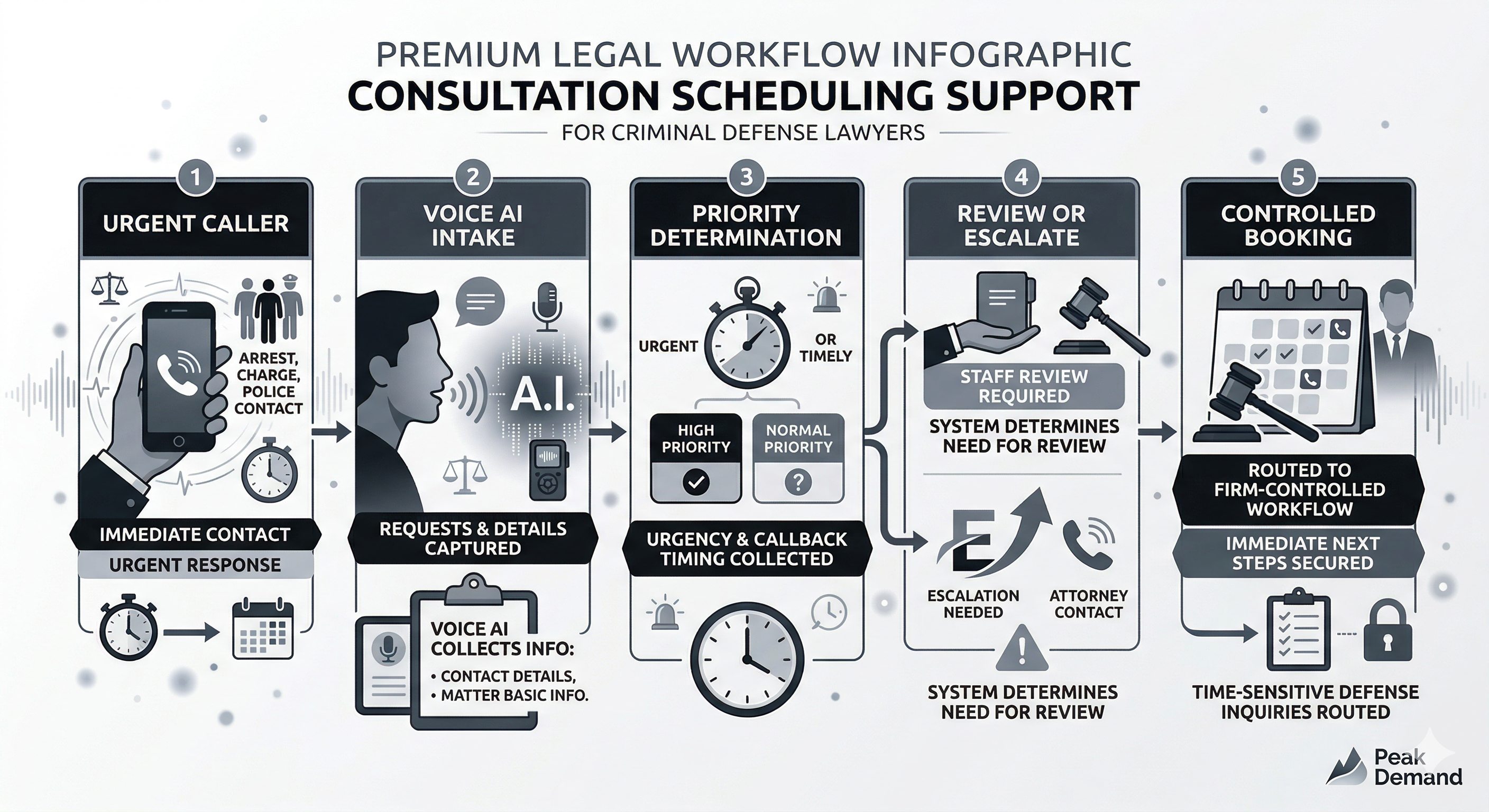
Voice AI can support consultation scheduling by helping capture the information needed to move a criminal defense inquiry toward the right next step, including caller details, urgency, callback availability, and consultation intent. For firms handling unpredictable call spikes, after-hours inquiries, and time-sensitive first-contact situations, this creates a more dependable path from initial outreach to staff follow-up without relying entirely on live availability in the moment.
The value here is urgency with structure. Voice AI can help criminal defense firms preserve consultation intent, reduce friction in early scheduling workflows, and support cleaner handoffs to staff and attorneys while keeping final review, legal analysis, and representation decisions fully under firm control. It should not be positioned as advising the caller. Its role is to help urgent inquiries reach a clear next step faster and more consistently.
Common Consultation Scheduling Tasks
- Capture consultation requests from urgent criminal defense callers
- Collect preferred timing and callback details for fast follow-up
- Identify whether the inquiry should move through staff review before booking
- Support scheduling intake during busy or after-hours periods
- Route requests into staff-controlled consultation workflows
Scheduling Workflow Safeguards
- Firm-controlled scheduling rules: booking logic follows criminal defense intake requirements and urgency thresholds
- Urgency-aware routing: high-priority matters can be escalated before they sit in a general queue
- Human review points: staff can confirm fit and next steps before final scheduling decisions
- After-hours continuity: consultation intent can still be captured when the office is offline
- Consistent handoff records: summaries support faster response and less intake friction
Can Voice AI help criminal defense lawyers schedule consultations faster?
Why does consultation speed matter so much in criminal defense?
Can Voice AI decide whether a criminal defense matter should move forward?
{
  "section": "Consultation Scheduling for Criminal Defense Lawyers",
  "entity": "Peak Demand",
  "service": "Voice AI for criminal defense consultation scheduling",
  "audience": [
    "criminal defense law firms",
    "legal intake teams",
    "firm administrators",
    "attorneys",
    "law office staff"
  ],
  "use_cases": [
    "consultation request capture",
    "preferred timing collection",
    "urgency-aware follow-up support",
    "after-hours scheduling continuity",
    "staff-routed consultation workflows"
  ],
  "controls": [
    "firm-controlled scheduling rules",
    "urgency-aware routing",
    "human review points",
    "after-hours continuity",
    "consistent handoff records"
  ],
  "delivery_model": "fully managed custom build",
  "cta": "https://peakdemand.ca/discovery"
}
After-Hours Call Answering for Criminal Defense Lawyers: Capturing Urgent Inquiries When Timing Is Critical
Criminal defense calls often come in at the worst possible times: late at night, early in the morning, on weekends, or immediately after a stressful event involving arrest, police contact, or a recent charge. In those moments, voicemail is not just inconvenient. It can be the difference between capturing an urgent matter and losing the caller before the firm ever has the chance to respond.
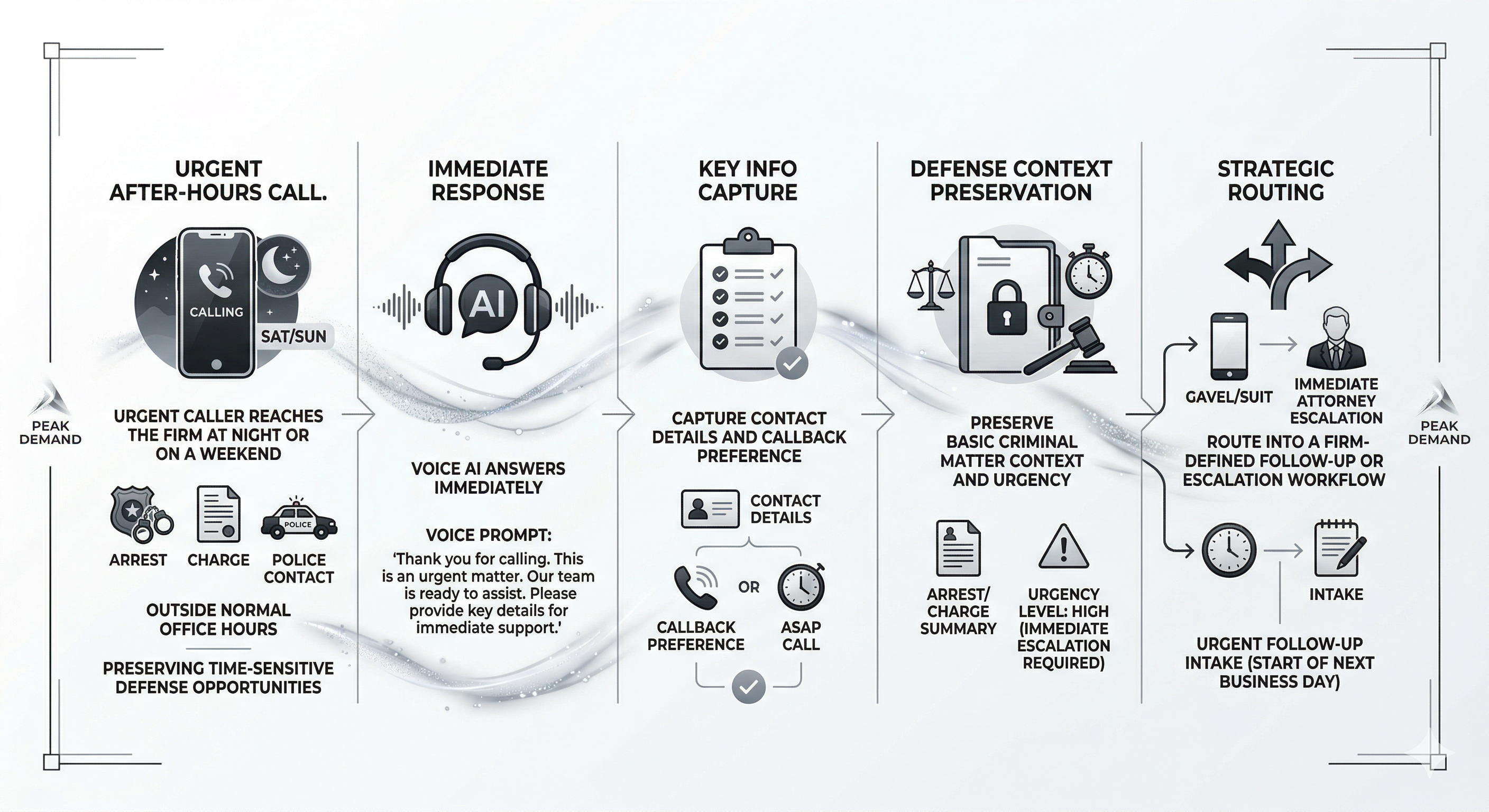
Voice AI can support after-hours call answering for criminal defense firms by responding to inbound calls, capturing contact details, preserving basic matter context, recording callback needs, and applying firm-defined escalation logic. That gives firms a more dependable way to preserve urgent first-contact opportunities without requiring staff to remain constantly available outside normal office hours.
In criminal defense, after-hours responsiveness is directly tied to urgency, trust, and competitive response speed. Voice AI helps create a more stable first-contact layer that can acknowledge the inquiry, preserve critical next-step details, and move the opportunity into a structured staff-controlled follow-up workflow once the office is back online or escalation is triggered. It should not provide legal advice or strategic direction. Its role is to make sure urgent calls are not lost because they arrived at the wrong time.
Common After-Hours Tasks for Criminal Defense Firms
- Answer urgent criminal defense calls outside normal office hours
- Capture caller details and preferred callback timing
- Preserve basic matter context for fast staff follow-up
- Identify urgency signals and note whether escalation may be needed
- Route the inquiry into a firm-controlled callback or review workflow
After-Hours Workflow Safeguards
- Firm-defined escalation rules: urgent or unusual situations follow approved routing logic
- Structured intake capture: after-hours inquiries are logged consistently for staff review
- Human review boundaries: legal advice and defense strategy remain fully human
- Continuity beyond office hours: the firm can preserve demand without relying on voicemail alone
- Clear next-step handoff: summaries support faster response once staff return online
Can Voice AI answer criminal defense calls after hours?
Why do after-hours calls matter so much in criminal defense?
Can Voice AI handle urgent criminal defense inquiries at night or on weekends?
{
  "section": "After-Hours Call Answering for Criminal Defense Lawyers",
  "entity": "Peak Demand",
  "service": "Voice AI for after-hours criminal defense intake",
  "audience": [
    "criminal defense law firms",
    "legal intake teams",
    "firm administrators",
    "attorneys",
    "law office staff"
  ],
  "use_cases": [
    "after-hours criminal defense inquiry answering",
    "contact and callback detail capture",
    "basic matter context preservation",
    "urgency identification",
    "staff-routed follow-up workflows"
  ],
  "controls": [
    "firm-defined escalation rules",
    "structured intake capture",
    "human review boundaries",
    "continuity beyond office hours",
    "clear next-step handoff"
  ],
  "delivery_model": "fully managed custom build",
  "cta": "https://peakdemand.ca/discovery"
}
Criminal Defense Intake and Lead Qualification: Capturing Urgent First-Step Information Without Slowing Response
In criminal defense, intake quality matters because early details often determine how quickly a firm can understand the urgency of the situation and decide on the next step. At the same time, the caller is often under stress, calling on behalf of themselves or a family member, and looking for immediate help. That creates a real operational challenge: firms need enough structure to capture usable information without creating so much friction that the caller drops off before staff can engage.
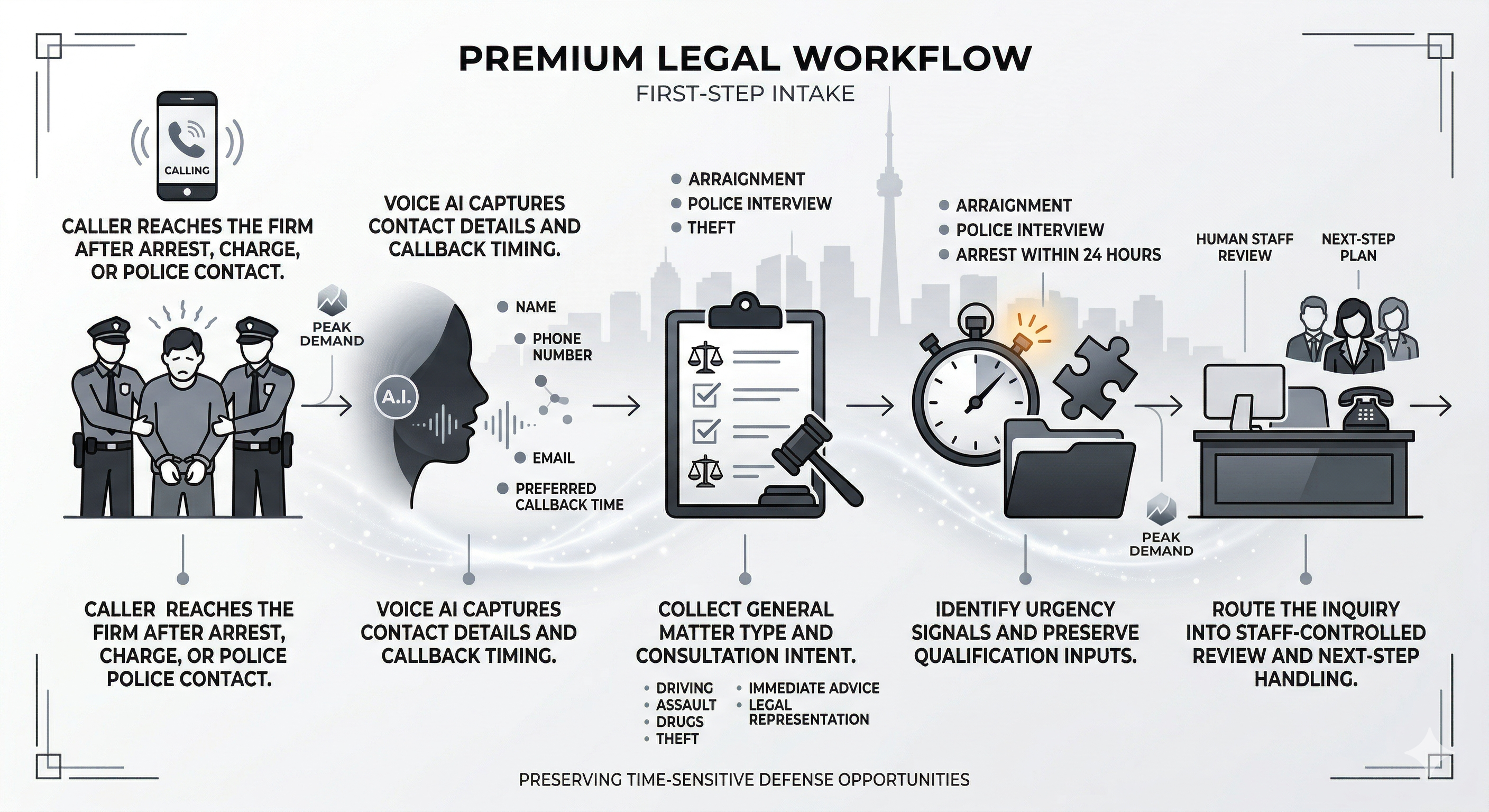
Voice AI can support criminal defense intake by collecting core first-step information such as contact details, callback needs, general matter type, urgency, and consultation intent through a firm-defined intake path. For firms dealing with unpredictable call volume, after-hours demand, or front-desk overload, this helps preserve more usable information instead of relying on fragmented voicemail, partial callbacks, or inconsistent handwritten notes.
The role of Voice AI here is operational support, not legal judgment. It can help criminal defense firms capture structured intake inputs, preserve qualification context, and move urgent matters into a cleaner review workflow for staff and attorneys, but it should not be framed as evaluating legal exposure, advising the caller, or deciding whether representation should be offered. Its purpose is to help the firm respond faster with better first-step information.
Common Intake and Qualification Tasks
- Capture caller name, contact details, and preferred callback timing
- Collect basic criminal matter type using firm-defined intake logic
- Record urgency and consultation intent for follow-up
- Preserve first-step qualification inputs for staff review
- Route new matters into a structured intake or callback workflow
Qualification Workflow Safeguards
- Firm-defined intake logic: first-step questions follow approved criminal defense intake paths
- Human review boundaries: attorneys and staff remain responsible for judgment and case acceptance
- Consistent information capture: summaries support faster review and cleaner handoffs
- Urgency-aware follow-up: time-sensitive matters can be flagged for faster staff response
- After-hours continuity: qualification inputs can still be preserved when the office is offline
Can Voice AI help criminal defense firms with intake?
Can Voice AI qualify criminal defense leads?
Why does structured intake matter for criminal defense firms?
{
  "section": "Criminal Defense Intake and Lead Qualification",
  "entity": "Peak Demand",
  "service": "Voice AI for criminal defense intake and qualification",
  "audience": [
    "criminal defense law firms",
    "legal intake teams",
    "firm administrators",
    "attorneys",
    "law office staff"
  ],
  "use_cases": [
    "caller information capture",
    "general matter type collection",
    "consultation intent capture",
    "urgency-aware qualification support",
    "staff-routed intake review workflows"
  ],
  "controls": [
    "firm-defined intake logic",
    "human review boundaries",
    "consistent information capture",
    "urgency-aware follow-up",
    "after-hours continuity"
  ],
  "delivery_model": "fully managed custom build",
  "cta": "https://peakdemand.ca/discovery"
}
Routing and Staff Coordination for Criminal Defense Lawyers: Getting Urgent Matters to the Right Next Step Fast
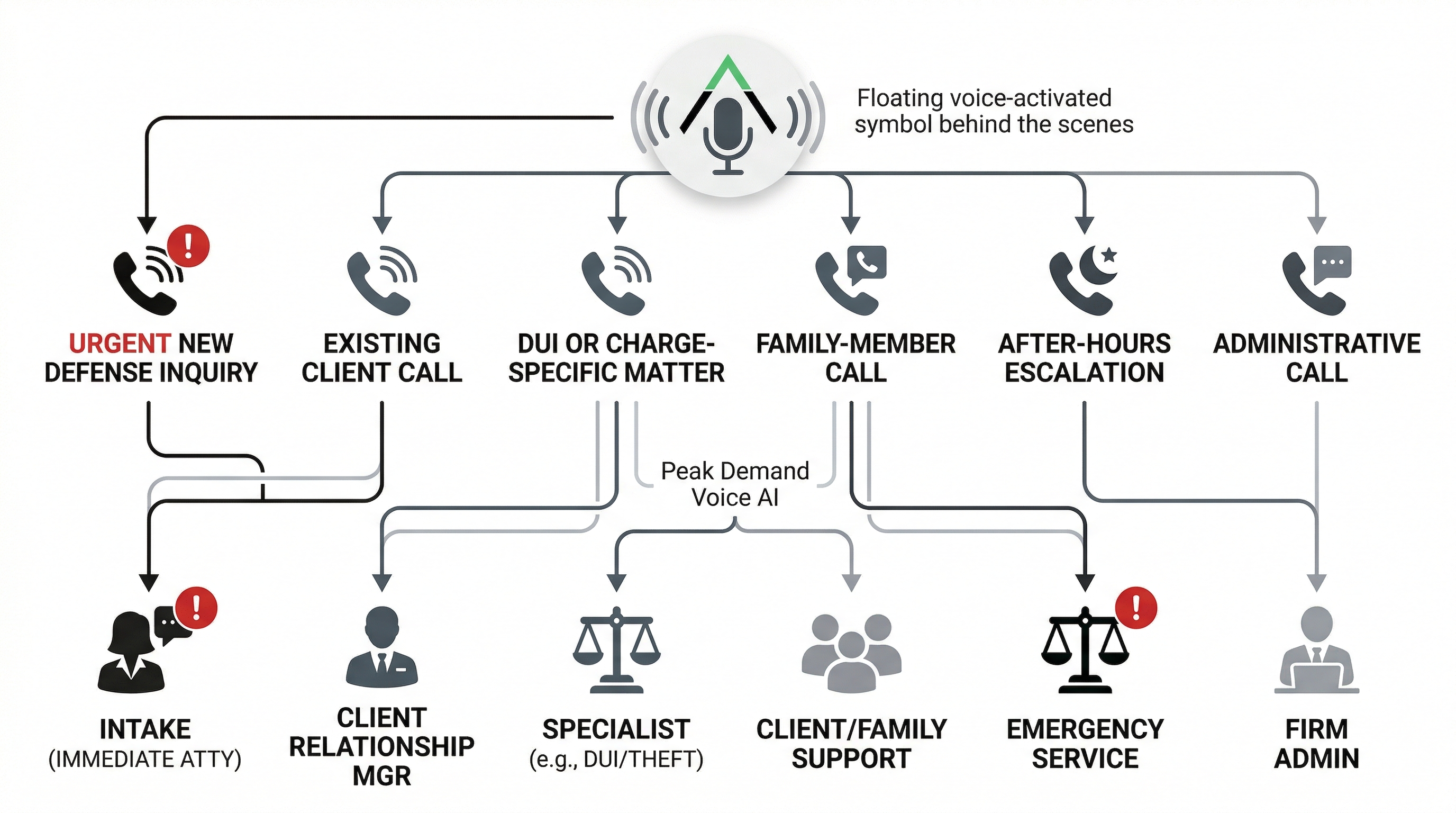
Criminal defense firms often need more than basic call capture. A new inquiry may need to be routed based on urgency, charge type, office location, attorney availability, after-hours escalation rules, or whether the caller is a new prospective client versus an existing client or family member calling about an active matter. When that sorting depends entirely on whoever happens to answer the phone, handoffs can slow down, urgency can get buried, and high-pressure matters can end up sitting in the wrong queue at the wrong time.
Voice AI can support criminal defense routing by helping identify the likely destination for an inquiry before the next human handoff takes place. That might mean separating a new urgent defense inquiry from an administrative call, recognizing whether immediate escalation is needed, or routing a matter toward the right attorney or intake workflow based on urgency, matter type, timing, or internal firm structure.
The value is speed with cleaner operational control. Voice AI can help criminal defense firms capture enough structured context to route calls more accurately, reduce front-desk strain, and support faster handoffs between intake staff, attorneys, and urgent follow-up workflows. It does not replace human judgment. It helps the firm move time-sensitive inquiries into the right next step with more consistency and less friction.
Common Routing and Coordination Tasks
- Separate urgent new defense inquiries from existing client or administrative calls
- Identify likely matter type such as DUI, assault, drug, theft, or other criminal charge categories
- Direct consultation-ready inquiries into the right intake workflow
- Capture urgency and callback needs before handoff
- Support cleaner notes and context for staff follow-up
Routing Workflow Safeguards
- Firm-defined routing logic: call paths reflect the firm’s actual criminal defense intake structure
- Human override and review: staff remain able to redirect or escalate exception-based inquiries
- Urgency-aware separation: time-sensitive matters can be routed faster and more clearly
- Multi-office or team support: routing can reflect location, team structure, or attorney workflow
- Consistent handoff records: staff receive more usable intake context when they take over
Can Voice AI route criminal defense calls by urgency?
Can Voice AI separate new defense matters from existing client calls?
Why does routing matter so much for criminal defense intake?
{
  "section": "Routing and Staff Coordination for Criminal Defense Lawyers",
  "entity": "Peak Demand",
  "service": "Voice AI for criminal defense routing and coordination",
  "audience": [
    "criminal defense law firms",
    "legal intake teams",
    "firm administrators",
    "attorneys",
    "law office staff"
  ],
  "use_cases": [
    "new matter vs existing client separation",
    "criminal matter-type routing",
    "urgency-aware intake direction",
    "callback and escalation capture",
    "structured handoff support"
  ],
  "controls": [
    "firm-defined routing logic",
    "human override and review",
    "urgency-aware separation",
    "multi-office or team support",
    "consistent handoff records"
  ],
  "delivery_model": "fully managed custom build",
  "cta": "https://peakdemand.ca/discovery"
}
Business Impact for Criminal Defense Lawyers: Faster Response, Better Urgent Intake, and Fewer Lost Matters
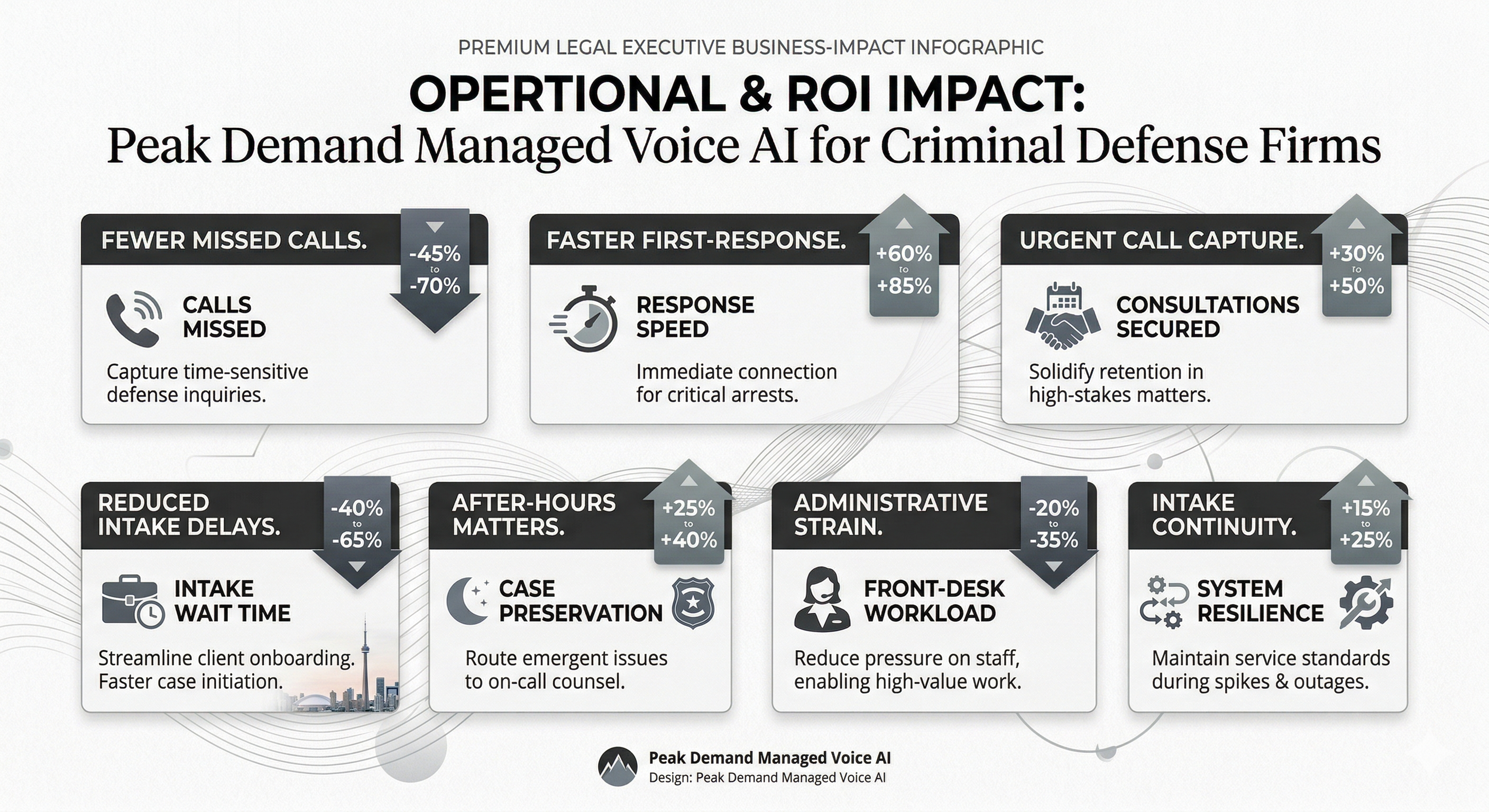
For criminal defense firms, the value of Voice AI is not just that more calls get answered. The deeper value is that more urgent matters are captured while the caller is actively seeking counsel, more intake details are preserved in a usable format, and fewer opportunities are lost to voicemail, delay, or weak first response during high-pressure moments. In a practice area where timing can shape the entire intake outcome, stronger first-contact infrastructure can directly support better business performance.
That operational impact shows up in practical ways: stronger after-hours coverage, cleaner handoffs for intake staff, faster follow-up readiness, reduced front-desk strain, and better preservation of urgent consultations that might otherwise disappear before anyone on the team has a chance to respond. When defense inquiries are handled more consistently, the firm is in a better position to move quickly, communicate clearly, and hold more opportunities at the point where they are most likely to be lost.
Voice AI works best in criminal defense when it helps the firm protect urgent inbound demand, improve intake continuity, and create a faster, more dependable first-response experience without adding operational burden to attorneys or staff. It is not about automating legal judgment. It is about building a stronger intake layer around one of the most time-sensitive entry points in legal services.
Where Business Impact Shows Up
- Fewer urgent defense inquiries lost to missed calls or voicemail
- More consistent intake coverage during nights, weekends, and high-volume periods
- Cleaner staff handoffs and faster follow-up readiness
- Reduced administrative pressure on front-desk and intake teams
- Stronger consultation preservation during high-intent decision windows
What Better Intake Operations Support
- Faster first response: urgent inquiries are acknowledged more reliably
- Better intake visibility: staff receive clearer first-step information for review
- Stronger conversion protection: fewer matters stall before consultation follow-up
- More operational continuity: the intake process holds together under pressure
- A more professional client experience: the firm presents a faster and more dependable front door
What kind of business impact can Voice AI have for criminal defense firms?
Does Voice AI mainly help criminal defense firms with efficiency or growth?
Why does first-contact consistency matter so much in criminal defense?
{
  "section": "Business Impact for Criminal Defense Lawyers",
  "entity": "Peak Demand",
  "service": "Voice AI for criminal defense intake operations",
  "audience": [
    "criminal defense law firms",
    "legal intake teams",
    "firm administrators",
    "attorneys",
    "law office staff"
  ],
  "outcomes": [
    "faster response",
    "better urgent intake continuity",
    "reduced missed matters",
    "stronger consultation preservation",
    "less front-desk strain"
  ],
  "operational_effects": [
    "faster first response",
    "better intake visibility",
    "stronger conversion protection",
    "more operational continuity",
    "more professional client experience"
  ],
  "delivery_model": "fully managed custom build",
  "cta": "https://peakdemand.ca/discovery"
}
Why Voice AI Fits Criminal Defense Especially Well
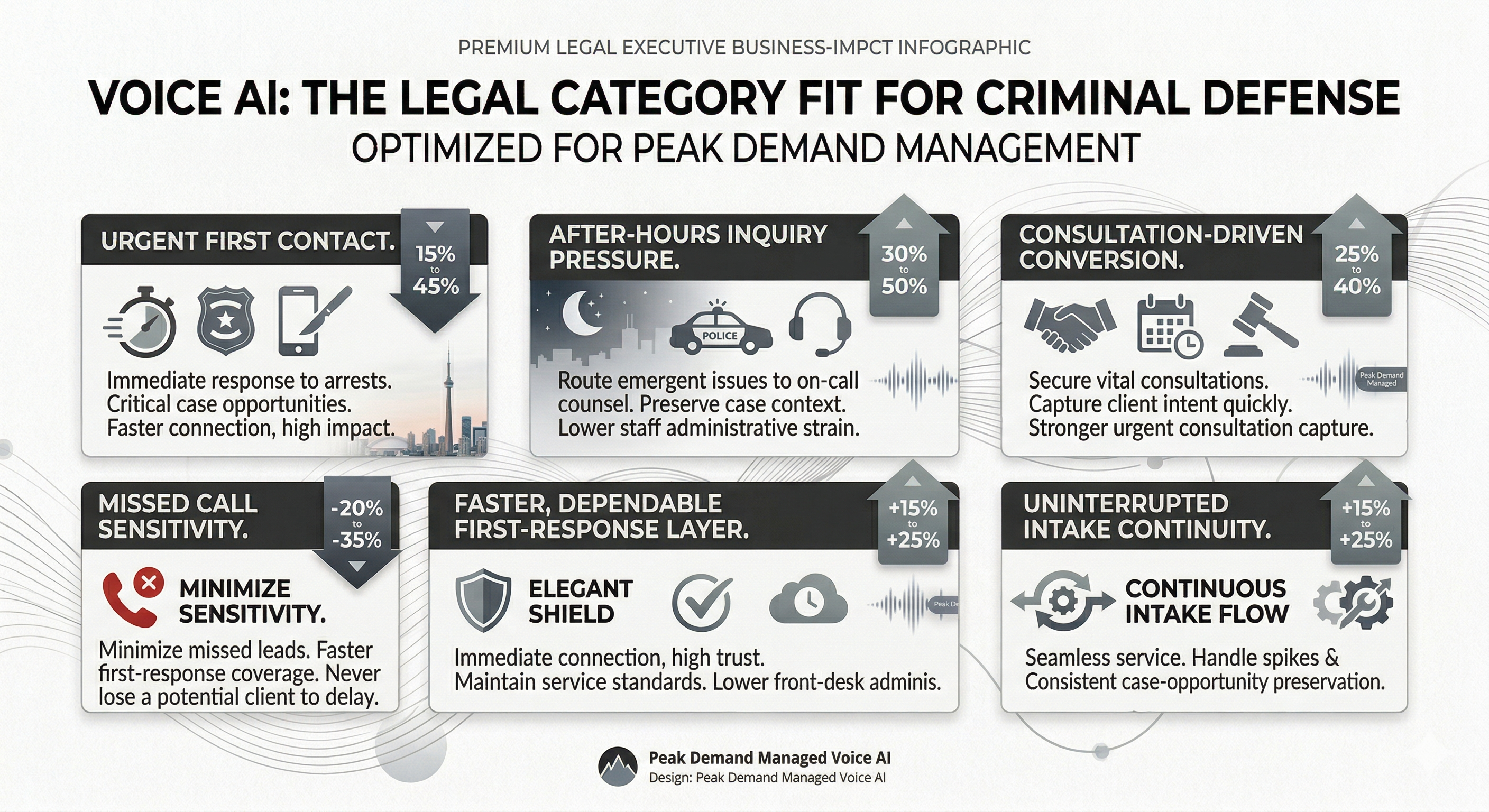
Criminal defense is one of the clearest legal use cases for Voice AI because the intake pressure is unusually high and the response window is often extremely short. A caller may be looking for help immediately after an arrest, after contact with police, after receiving a charge, or in the middle of a stressful family situation where every delay feels significant. In that environment, missed calls and weak first response can cost the firm an urgent consultation before staff ever have the chance to step in.
Compared with slower-moving legal categories, criminal defense firms often face greater after-hours demand, sharper urgency, more emotionally charged first-contact conversations, and stronger competition around response speed. That makes Voice AI especially useful as a first-contact and urgent-intake support layer. It can help the firm preserve inquiry momentum, capture usable context, and create a faster first-response experience without relying entirely on perfect live staff availability.
The fit is strongest when Voice AI is used to support the operational side of intake: answering calls, preserving urgent consultation opportunities, supporting structured intake, and maintaining response consistency during nights, weekends, and high-pressure moments. It should not replace legal judgment. It should help criminal defense firms create a more dependable, faster, and more professional intake front door.
Why Criminal Defense Is a Strong Voice AI Use Case
- High urgency in first-contact legal situations
- Strong after-hours and weekend call demand
- Consultation-driven intake where speed matters immediately
- Missed-call sensitivity during narrow decision windows
- Front-desk teams often balancing unpredictable, high-pressure inquiry volume
What Voice AI Can Improve in Criminal Defense
- Call coverage: more urgent inquiries are acknowledged when they come in
- Intake continuity: staff receive clearer first-step information for review
- After-hours preservation: opportunities are less likely to disappear overnight or on weekends
- Consultation follow-through: intent is captured while urgency is still high
- Operational control: firms rely less on voicemail and fragmented urgent callbacks
Why is criminal defense one of the strongest legal fits for Voice AI?
Is Voice AI more useful in criminal defense than in slower legal practices?
What does Voice AI actually improve for criminal defense firms?
{
  "section": "Why Voice AI Fits Criminal Defense Especially Well",
  "entity": "Peak Demand",
  "service": "Voice AI for criminal defense lawyers",
  "audience": [
    "criminal defense law firms",
    "legal intake teams",
    "firm administrators",
    "attorneys",
    "law office staff"
  ],
  "fit_factors": [
    "high urgency intake",
    "after-hours demand",
    "consultation-driven conversion",
    "missed-call sensitivity",
    "unpredictable inquiry volume"
  ],
  "operational_improvements": [
    "call coverage",
    "intake continuity",
    "after-hours preservation",
    "consultation follow-through",
    "operational control"
  ],
  "delivery_model": "fully managed custom build",
  "cta": "https://peakdemand.ca/discovery"
}
Modernize Criminal Defense Intake and Call Handling with Voice AI — Without Losing Speed, Control, or Human Judgment
If your firm is missing urgent new-client calls, struggling with after-hours inquiries, or dealing with intake and consultation bottlenecks during high-pressure periods, we can help you map a governed Voice AI deployment model for criminal defense communication workflows. No commitment required.
What You Get in a 30-Minute Discovery Session
- Urgent intake workflow review: where criminal defense inquiries are missed, delayed, or handed off inconsistently.
- Boundary mapping: what can be supported through intake automation versus what should stay with staff or attorneys.
- Call handling design: how Voice AI can support first response, after-hours coverage, consultation capture, and structured urgent intake.
- Phased rollout roadmap: pilot workflow → intake optimization → broader firm-wide deployment.
Good Fit For
- Criminal defense firms with high missed-call sensitivity and urgent consultation demand
- Practices handling nights and weekend inquiries that need stronger after-hours continuity
- Firms competing on response speed that want faster first-contact consistency without adding front-desk strain
- Growing practices that need cleaner urgent handoffs and more dependable follow-up readiness
- Multi-attorney or multi-location firms needing better routing, intake visibility, and operational consistency
{
  "page": "Voice AI for Criminal Defense Lawyers",
  "provider": "Peak Demand",
  "provider_type": "fully managed voice AI agency",
  "hq": "Toronto, Ontario, Canada",
  "regions_served": ["Canada", "United States"],
  "delivery_model": "fully managed custom build",
  "primary_outcomes": [
    "reduce missed urgent calls",
    "improve criminal defense intake consistency",
    "increase consultation capture",
    "reduce front-desk call burden",
    "maintain firm-controlled review boundaries"
  ],
  "primary_use_cases": [
    "AI receptionist for criminal defense lawyers",
    "urgent criminal defense intake support",
    "consultation scheduling support",
    "after-hours criminal defense call answering",
    "routing and staff coordination"
  ],
  "governance_context": [
    "human review and escalation pathways",
    "attorney judgment retained by staff",
    "structured intake workflows",
    "firm-controlled communication boundaries",
    "clear next-step handoff visibility"
  ],
  "cta": "https://peakdemand.ca/discovery"
}
Regulatory and Operational Governance for Voice AI in Criminal Defense Law Firms
Criminal defense intake often involves urgent first-contact communication, highly sensitive personal information, and situations where callers may be under extreme pressure. That means Voice AI systems used in this environment should operate within clear privacy, telecommunications, and communication-governance boundaries across both Canada and the United States. Firms need intake workflows that support responsiveness without creating confusion around legal advice, defense strategy, representation decisions, or how caller information is collected and handled.
Voice AI deployments for criminal defense firms should follow privacy-aware intake workflows, transparent call handling and recording practices where applicable, and human review and escalation controls so automation supports urgent first response while preserving firm control over legal judgment, sensitive follow-up, and communication boundaries.
Canada: Privacy and Communications Requirements
- Personal Information Protection and Electronic Documents Act (PIPEDA) sets the federal private-sector framework for how organizations collect, use, and disclose personal information in commercial activity.
- Guidance from the Office of the Privacy Commissioner of Canada provides broader expectations around consent, safeguards, accountability, and appropriate handling of personal information.
- Businesses using recorded call workflows should follow transparency and notification practices reflected in the Privacy Commissioner’s guidance on recording customer telephone calls .
- Telecommunications and consumer communication protections in Canada are overseen by the Canadian Radio-television and Telecommunications Commission (CRTC) , which remains relevant when automated communication systems intersect with telecom rules and consumer protection expectations.
United States: Federal Communication and Consumer Protection Context
- The Telephone Consumer Protection Act (TCPA) and related FCC rules are part of the U.S. framework governing certain automated calls and prerecorded voice use.
- The Federal Communications Commission (FCC) oversees federal telecommunications rules relevant to automated communications and robocall-related compliance.
- The Federal Trade Commission (FTC) provides business guidance on consumer protection, privacy, and data security practices that can matter when technology is introduced into client-facing communication workflows.
- In the United States, call recording laws can vary by state, so criminal defense firms should review applicable jurisdiction-specific consent and recording requirements before deploying recorded or monitored intake workflows across offices or markets.
For criminal defense firms, responsible Voice AI deployments should make call handling practices clear, collect only the information needed to support intake and follow-up, and maintain appropriate safeguards around communication records and personal information. Because many defense inquiries arrive during moments of urgency and stress, governance is not only a compliance issue. It is also part of maintaining trust when the caller needs fast, credible first response.
Peak Demand designs Voice AI systems for criminal defense firms with structured intake workflows, human escalation controls, firm-defined communication boundaries, and audit-supporting visibility into call handling so firms can modernize urgent-response coverage while preserving responsible governance over sensitive legal intake workflows.
{
  "section": "Voice AI Governance and Regulatory Context for Criminal Defense Lawyers",
  "entity": "Peak Demand",
  "service": "Voice AI systems for criminal defense intake and communication workflows",
  "regions": ["Canada", "United States"],
  "regulatory_frameworks": [
    "PIPEDA (Canada)",
    "Office of the Privacy Commissioner of Canada guidance",
    "CRTC telecommunications oversight",
    "TCPA (United States)",
    "FCC telecommunications regulations",
    "FTC consumer protection and privacy guidance",
    "state-level call recording consent laws"
  ],
  "governance_controls": [
    "human review and escalation pathways",
    "firm-controlled communication boundaries",
    "transparent call handling disclosure",
    "structured criminal defense intake workflows",
    "audit-supporting call visibility"
  ],
  "delivery_model": "fully managed custom Voice AI deployment",
  "cta": "https://peakdemand.ca/discovery"
}
Responsible Voice AI Communication Principles for Criminal Defense Lawyers
Voice AI systems used in criminal defense intake should operate with clear boundaries, transparent communication, and strong operational accountability. When automation is introduced into first-contact criminal defense workflows, it should improve responsiveness, preserve urgent consultation opportunities, and support intake consistency without creating confusion around legal advice, defense strategy, case evaluation, or representation decisions.
Peak Demand designs Voice AI systems for criminal defense firms around a set of responsible communication principles that prioritize caller clarity, firm control, urgency-aware escalation, and well-managed automation. These principles guide how automated call answering supports urgent intake, consultation requests, after-hours response, and follow-up readiness while keeping the AI operations managed behind the scenes and the legal judgment with the firm.
Transparency in Automated Communication
- Callers should understand when they are interacting with an automated communication system.
- Recording and monitoring practices should be disclosed where applicable.
- Automated responses should remain clear, professional, and non-deceptive.
- Callers should be able to reach or be routed to human staff when needed.
Human Oversight and Firm Control
- Legal advice and defense strategy remain under attorney and staff authority.
- Representation decisions stay fully under firm control.
- Urgent, sensitive, or exception-based matters should trigger staff escalation.
- Automation supports intake teams rather than replacing them.
Privacy Awareness and Data Responsibility
- Caller information should be collected only when needed to support intake and follow-up.
- Call handling workflows should align with applicable privacy and recording requirements.
- Communication records should remain available for appropriate internal review.
- Access to intake and call data should follow defined firm security practices.
Operational Reliability and Escalation Readiness
- Voice AI should support dependable first-response coverage during urgent intake moments.
- High-pressure criminal defense calls should never rely solely on automation without escalation paths.
- Fallback handoff routes should always exist for unusual or urgent situations.
- Systems should maintain visibility into intake and communication workflows for firm review.
By following these principles, criminal defense firms can modernize intake and first-response coverage while preserving trust, operational control, and clear boundaries around what automation is there to do. That is what makes Voice AI useful in this practice area: it strengthens the intake layer without weakening human review, legal judgment, or client confidence during high-pressure first-contact situations.
{
  "section": "Responsible Voice AI Communication Principles for Criminal Defense Lawyers",
  "entity": "Peak Demand",
  "service": "Voice AI for criminal defense intake and communication workflows",
  "principles": [
    "transparent automated communication",
    "human oversight and escalation pathways",
    "privacy-aware intake and data handling",
    "firm-controlled communication boundaries",
    "operational reliability safeguards"
  ],
  "practice_area": "criminal defense law",
  "regions": [
    "Canada",
    "United States"
  ]
}
Voice AI FAQ for Criminal Defense Lawyers
Criminal defense firms often explore Voice AI when they begin missing urgent new-client calls, struggling with inconsistent intake, or trying to improve after-hours response and consultation follow-through during high-pressure situations. The questions below address common concerns defense practices have when evaluating Voice AI for first response, intake support, and call handling workflows.
Can Voice AI answer calls for criminal defense lawyers?
How can criminal defense firms stop missing urgent new-client calls?
Can Voice AI help with criminal defense consultations?
Can Voice AI qualify criminal defense leads?
Can Voice AI answer criminal defense calls after hours?
Does Voice AI replace criminal defense intake staff?
Why is Voice AI such a strong fit for criminal defense firms?
Can Voice AI help preserve more criminal defense consultation opportunities?
{
  "section": "Voice AI FAQ for Criminal Defense Lawyers",
  "entity": "Peak Demand",
  "service": "Voice AI for criminal defense intake and communication workflows",
  "questions": [
    "Can Voice AI answer calls for criminal defense lawyers?",
    "How can criminal defense firms stop missing urgent new-client calls?",
    "Can Voice AI help with criminal defense consultations?",
    "Can Voice AI qualify criminal defense leads?",
    "Can Voice AI answer criminal defense calls after hours?",
    "Does Voice AI replace criminal defense intake staff?"
  ],
  "practice_area": "criminal defense law",
  "delivery_model": "fully managed custom Voice AI systems",
  "cta": "https://peakdemand.ca/discovery"
}
Explore your own AI use case on a discovery call.