
Healthcare Voice AI Resource Hub
Healthcare communication systems are under pressure from missed calls, overloaded phone lines, appointment demand, referral delays, after-hours gaps, and rising expectations around access. This hub is built to be the central healthcare Voice AI category page for Peak Demand: a structured place to understand the ecosystem, explore solution layers, evaluate governance considerations, and route into the right next page.
Whether you are assessing an AI receptionist for a clinic, a Voice AI layer for centralized scheduling, a call center modernization initiative, or a broader patient access integration architecture discussion, this hub is designed to help you move from category understanding to implementation-aware next steps.

Start With The Right Healthcare Voice AI Path
Healthcare Voice AI projects usually start from one of three places: front-desk overload, patient access pressure, or integration planning. Use this section to move into the path that best matches the operating problem you are trying to solve.
Clinic Or Front Desk Overload
For medical clinics, allied health providers, dental practices, veterinary clinics, home care teams, and smaller healthcare operators dealing with missed calls, voicemails, booking pressure, and after-hours gaps.
Hospital Or Patient Access Pressure
For hospitals, outpatient networks, centralized scheduling teams, public sector health lines, and high-volume patient access operations dealing with routing, queues, and call center demand.
Integration Or System Planning
For teams evaluating how Voice AI connects with EMR, EHR, scheduling, intake, patient access, dental, veterinary, rehab, wellness, or orchestration systems.
Who This Healthcare Voice AI Hub Is For
This hub is designed for healthcare operators who need more than a generic AI answering tool. It is written for the people responsible for patient access, staff workload, call handling, scheduling workflows, privacy review, and implementation risk.
What Voice AI Means In Healthcare
In healthcare, Voice AI should be understood as part of a communication system rather than a standalone answering tool. It can support patient calls, appointment workflows, routing, after-hours answering, overflow handling, intake pathways, and broader patient access operations when designed around real workflow boundaries.
Peak Demand built this page as a category hub rather than a thin sales page. It is meant to give clinic leaders, operations managers, patient access teams, hospital decision-makers, and compliance-aware stakeholders a structured way to understand the healthcare Voice AI ecosystem and move into the right next layer.
For Ontario clinics, planning may involve PHIPA-compliant AI receptionist workflows. For U.S. providers, the discussion may include HIPAA-compliant Voice AI receptionist design. Larger organizations, hospitals, public sector health systems, and regulated enterprise buyers may also need an enterprise Voice AI compliance review before deployment.
What This Hub Helps You Explore
- Where Healthcare Communication Systems Break Down
- How Voice AI Supports Patient Calls, Scheduling, Routing, And After-Hours Coverage
- Which Healthcare Environments Need Different Workflow Designs
- How Enterprise Infrastructure Changes The Buying Conversation
- Why Governance And Compliance Review Matter Early
- How Integrations Fit Into Healthcare Voice AI Architecture
Healthcare Voice AI Is Not A Generic Chatbot
In healthcare, the value is not simply that an AI system can answer the phone. The value comes from workflow boundaries, approved escalation paths, intake structure, scheduling logic, privacy-aware implementation, and the ability to connect the voice layer with the systems already used by the organization.
A clinic, hospital, dental group, veterinary practice, rehab provider, home care agency, or patient access team needs a communication layer that respects operational reality. That means mapping caller intent, escalation rules, system handoffs, jurisdiction-specific review, and staff workflows before treating automation as a production-ready front door.
Workflow-Aware
Built around real appointment types, intake questions, routing paths, provider rules, locations, and staff handoff requirements.
Governance-First
Designed with privacy, compliance, escalation, procurement, and operational risk considerations in mind before launch.
System-Aware
Planned around the EMR, EHR, scheduling, patient access, dental, veterinary, rehab, wellness, or orchestration systems that already shape the workflow.
Core Healthcare Communication Challenges
Healthcare communication strain usually shows up in clusters rather than isolated problems. Missed calls connect to front-desk overload. Scheduling pressure creates callbacks and delays. After-hours gaps create voicemails and unresolved demand. Referral friction slows patient access. Enterprise environments add routing and queue complexity on top of all of that.
Missed Patient Calls
High-intent patient calls are often missed when staff are stretched across phones, in-person workflows, and administrative interruptions.
Scheduling Bottlenecks
Routine booking and rescheduling demand can consume large portions of staff time and disrupt broader clinic operations.
Busy Lines And Long Hold Times
Patients may wait too long to reach the right person when demand outpaces staff coverage or routing is too rigid.
After-Hours Communication Gaps
When the office closes, patient demand does not disappear. Without structure, after-hours calls often become delays or dead ends.
Referral Coordination Delays
Referral workflows frequently break across intake, handoff, validation, patient outreach, and booking readiness.
Administrative Overload
Repetitive call handling, voicemails, and manual triage pull staff away from higher-value coordination work.
Voice AI Solution Layer
Healthcare Voice AI works best when it is framed as solution architecture. Different organizations may need different layers: an AI receptionist, after-hours answering, centralized scheduling support, call center overflow handling, departmental routing, switchboard modernization, or multi-location communication support.
Patient-Facing Communication Support
Best suited for clinic and outpatient environments where appointment calls, repetitive questions, rescheduling, after-hours demand, and front-desk overflow create access friction.
Operational Routing And Infrastructure Support
Best suited for hospitals, networks, regional lines, and patient access environments where switchboard logic, scheduling queues, overflow, and routing consistency matter.
Need the integration view? Move from solution categories into the healthcare systems, scheduling, intake, routing, and patient access architecture behind the Voice AI layer.
Explore Healthcare IntegrationsChoose A Healthcare Environment
Different healthcare environments require different communication logic, escalation pathways, staffing assumptions, compliance review, and implementation patterns. Use this section to move into the environment that best matches your operating context.
Primary Care And Medical Clinics
Specialty And Outpatient Care
Rehab Diagnostics And Allied Care
Dental Veterinary And Adjacent Care
Hospitals Networks And Health Systems
High-Acuity And Escalation-Sensitive Environments
Scheduling-Intensive Environments
Bilingual Healthcare Routing
Enterprise And System Infrastructure Layer
Enterprise healthcare buyers usually need more than front-desk relief. They need communication infrastructure that can support multiple locations, switchboard logic, scheduling complexity, call surges, queue management, intake standardization, departmental transfers, and broader patient access operations.
Call Center Modernization
Legacy IVR Replacement
Centralized Scheduling Infrastructure
Multi-Location Communication Systems
Regional Booking And Public Sector Lines
Compliance And Governance Layer
Healthcare Voice AI should be evaluated through governance, privacy review, workflow boundaries, escalation logic, implementation design, and jurisdiction-specific requirements. This section exists to reinforce that healthcare communication automation is not one-size-fits-all.
Governance-First Evaluation
Governance matters before go-live. Review how Peak Demand frames healthcare Voice AI around privacy, procurement, escalation boundaries, and regulated operating environments.
Review Enterprise ComplianceHow Healthcare Voice AI Fits Into The Communication Stack
The strongest healthcare Voice AI deployments are not isolated answering bots. They sit inside a communication stack that connects caller intent, routing rules, escalation boundaries, scheduling or intake workflows, and system-specific handoffs.
1. Patient Or Client Call
The caller may need booking, rescheduling, directions, triage routing, after-hours support, a department transfer, or a callback pathway.
2. Routing And Escalation Logic
Voice AI should follow approved pathways for urgent routing, human fallback, location selection, provider-specific rules, and department handoffs.
3. Scheduling, Intake, Or Patient Access Workflow
The operational value usually comes from how well calls move into booking, intake, referral coordination, queue handling, or patient access processes.
4. EMR, EHR, PMS, Or Workflow System
System-specific planning matters because each environment has different scheduling, intake, routing, documentation-adjacent, and patient communication constraints.
5. Human Review And Operational Boundaries
Escalation, staff review, callback queues, intake completion, and provider-specific exceptions should be designed before launch.
6. Reporting And Continuous Improvement
Once live, the system should be reviewed against call patterns, missed-call recovery, escalation quality, appointment workflows, and operational bottlenecks.
Healthcare Integrations Layer
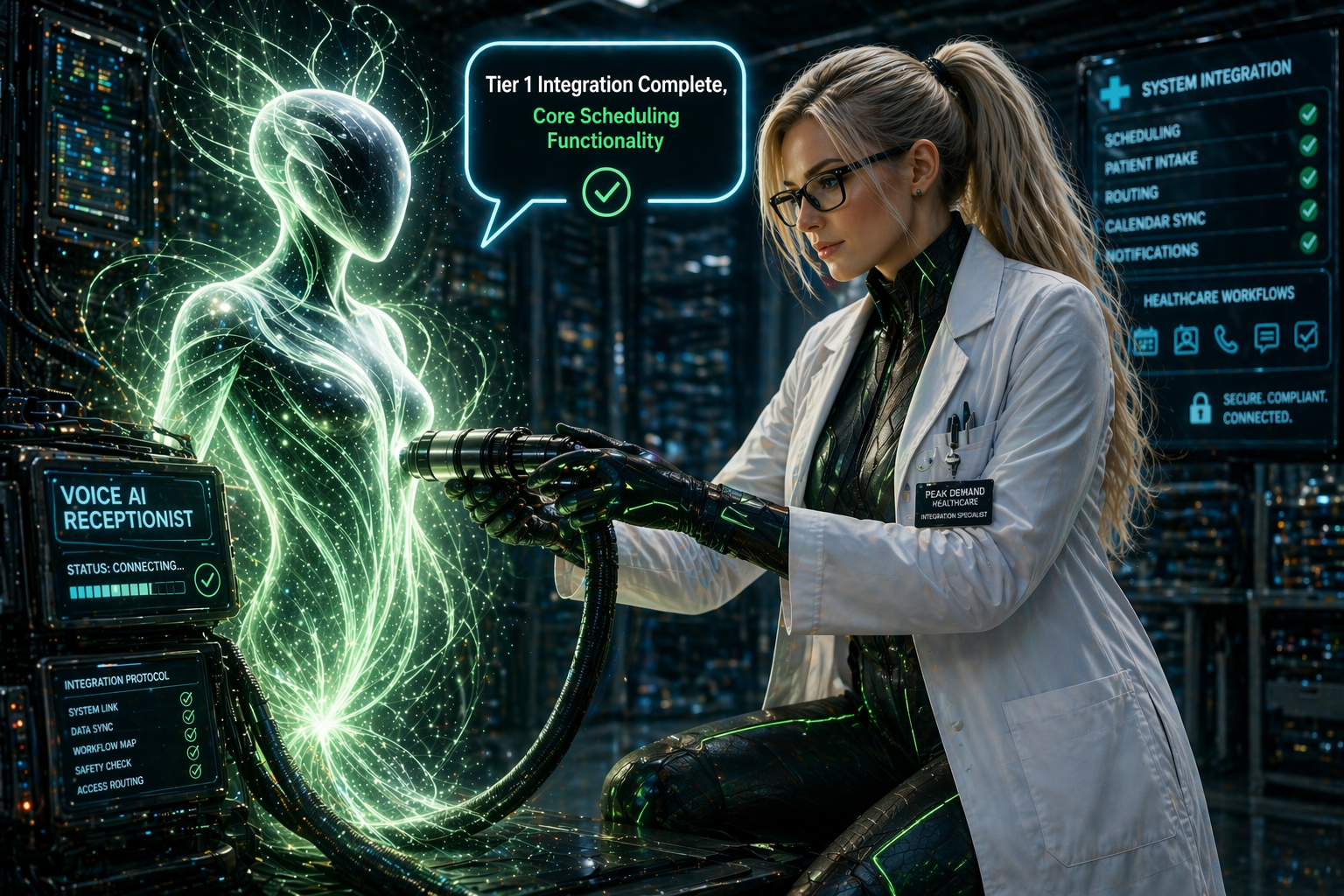
Integrations are a core part of healthcare Voice AI architecture. They shape how scheduling workflows connect, how intake information moves, how routing logic is structured, how communication systems fit into operational environments, and how a Voice AI layer becomes genuinely useful instead of isolated from the rest of the workflow.
For many healthcare teams, the integration question is where the conversation becomes more serious. It is one thing to understand what Voice AI can do at a category level. It is another to understand how that capability fits into EMR and EHR environments, scheduling systems, patient intake workflows, telephony infrastructure, routing logic, and broader operational communication design.
What healthcare integrations usually involve
- Medical and ambulatory EMR/EHR environments
- Scheduling, patient access, and orchestration systems
- Allied health, rehab, wellness, and intake workflows
- Telephony and call infrastructure
- Routing, escalation, and handoff logic
- System-specific workflow design by healthcare software environment
Explore the Healthcare Integrations page
The healthcare integrations page is the main destination for understanding how Voice AI fits into healthcare systems, software environments, and workflow architecture across scheduling, intake, routing, patient access, and communication operations.
Why this matters
For clinic owners, operators, patient access teams, and healthcare leadership, integrations often determine whether Voice AI stays superficial or becomes part of a more useful communication system. Stronger integration thinking helps align the Voice AI layer with the software, workflows, and operational realities that already shape how patients move through the organization.
Browse Healthcare Voice AI System Families
Healthcare Voice AI architecture becomes more useful when it is organized around the actual software environments clinics, hospitals, dental groups, rehab teams, veterinary practices, and patient access operations already use. These system-family pages group the individual integration pages so buyers can move from a broad healthcare workflow question into the right EMR, EHR, scheduling, dental, veterinary, allied health, or orchestration category.
Medical and Ambulatory EMR Systems
For medical clinics, family medicine, specialty care, outpatient groups, hospitals, and ambulatory providers using EMR or EHR systems for patient access, scheduling, documentation-adjacent workflows, and communication continuity.
Allied Health, Rehab, and Wellness Systems
For physiotherapy, rehab, therapy, wellness, nutrition, multidisciplinary clinics, and allied health teams that need appointment handling, intake, rescheduling, and front-desk workflow support.
Dental Systems
For dental practices and dental groups using practice management systems for appointment scheduling, new patient calls, emergency routing, intake, and front-desk communication workflows.
Veterinary Systems
For animal hospitals, veterinary clinics, mobile vets, and pet care teams managing client calls, urgent routing, appointment requests, reminders, and practice communication workflows.
Chiropractic and Specialty Rehab Systems
For chiropractic, specialty rehab, PT-adjacent, audiology, and musculoskeletal care workflows where scheduling, SOAP-note-adjacent handoffs, billing coordination, and front-desk continuity matter.
Scheduling, Patient Access, and Orchestration Systems
For centralized scheduling, referrals, patient engagement, care orchestration, telehealth continuity, booking workflows, secure messaging, intake forms, and patient access operations.
Need the full systems view? The Healthcare Integrations Hub is the next page to use when comparing EMR, EHR, scheduling, dental, veterinary, rehab, wellness, and patient access workflows.
Go To Healthcare Integrations HubHealthcare Knowledge Library
This library keeps the hub comprehensive without turning it into a wall of links. Each section groups related healthcare articles so visitors can drill into the exact communication, scheduling, patient access, governance, or modernization problem they are trying to solve.
- Why Hospitals Are Replacing IVR Systems
- Voice AI Vs IVR In Healthcare
- Why Hospital Call Centers Are Overwhelmed
- Why Hospital Scheduling Systems Are Failing
- How Healthcare Organizations Evaluate AI Vendors
- Why Healthcare Operations Teams Struggle To Scale
- Why Integrations Matter In Healthcare Voice AI
- What A Voice AI Rollout Looks Like In A Healthcare Organization
- Questions To Ask Before Implementing Voice AI In Healthcare
- What Makes A Healthcare AI Deployment Operationally Safe
- How Healthcare Teams Prepare For Voice AI Implementation
- How To Pilot Voice AI In A Clinic Or Hospital Environment
- How Escalation Logic Should Be Designed In Healthcare AI Systems
- Healthcare Voice AI Integrations Capstone
Healthcare Voice AI FAQ
These questions are written for both smaller healthcare leadership teams and larger enterprise buyers evaluating workflow fit, governance, and communication infrastructure.
Choose The Next Healthcare Voice AI Page
Use this routing section to move from the healthcare hub into the page that best matches your current evaluation path.
AI Voice Receptionist
For clinics, dental groups, veterinary teams, allied health providers, and after-hours call coverage.
Open PageHealthcare Call Center
For hospitals, outpatient networks, centralized scheduling, IVR replacement, and high-volume phone operations.
Open PageHealthcare Integrations
For teams evaluating EMR, EHR, scheduling, intake, routing, patient access, and workflow system connectivity.
Open PageCompliance Review
For HIPAA, PHIPA, PIPEDA, RFP, public sector, enterprise, and regulated deployment planning.
Open PageTalk Through The Right Healthcare Workflow
If you are evaluating healthcare Voice AI for a clinic, hospital, patient access team, or multi-location healthcare environment, the next useful step is usually a workflow conversation. That means reviewing how your current communication system handles demand, where it breaks down, and where Voice AI may fit operationally.
About Peak Demand
Peak Demand is a Toronto-based AI agency focused on Voice AI receptionists, communication automation, call handling systems, workflow automation, and operational AI infrastructure. In healthcare, Peak Demand positions its work around structured communication systems, workflow-aware implementation, healthcare integration architecture, and governance-first thinking.
Explore your own AI use case on a discovery call.