
Voice AI Receptionist Integrations for Scheduling, Patient Access, and Orchestration Systems
Scheduling and patient access systems are not just calendar tools. In healthcare, they often sit at the point where a patient request becomes a real workflow: booking, rescheduling, intake qualification, routing into the right queue, diagnostics scheduling, referral-adjacent coordination, and the handoff between first contact and the next operational owner.
This page is built for healthcare operators, patient access leaders, scheduling managers, administrators, and practice owners evaluating how a Voice AI receptionist fits into scheduling systems, intake platforms, patient access tools, and orchestration-layer workflows. It is designed to show why these environments require more than a simple booking connector and why structured workflow continuity matters more than a surface-level calendar integration.
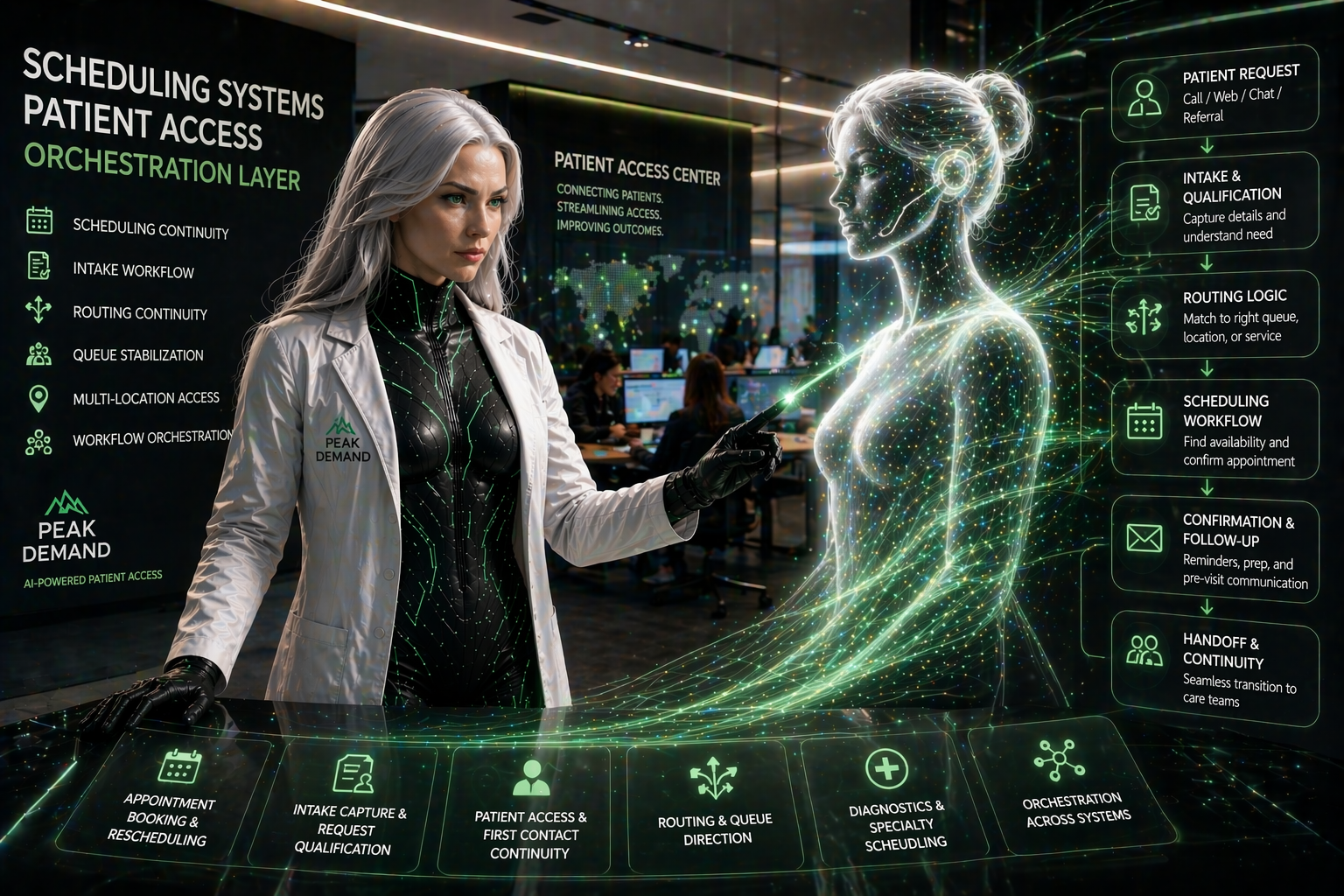
What these systems usually govern
This family usually sits around appointment infrastructure, intake capture, request qualification, routing direction, queue stability, location and service-line logic, centralized scheduling behavior, and broader patient access continuity. These systems often matter most when healthcare teams need structure between the first interaction and the downstream action that follows.
What this family represents operationally
This category covers the scheduling, intake, routing, and orchestration layer around healthcare access workflows. It is less about one clinic type and more about the operational systems that shape how requests move through the organization.
What these environments often have in common
- Appointment booking and rescheduling pressure across teams or locations
- Intake ambiguity that must be turned into structured workflow
- Routing decisions tied to service line, department, location, or queue
- Patient access continuity that affects the entire downstream experience
- Operational value that depends on usable handoff rather than just call completion
Where a Voice AI receptionist fits in scheduling and patient access workflows
In this family, a Voice AI receptionist is usually most valuable when it helps structure the path from request to action. That means supporting the booking flow, capturing enough intake detail, qualifying what the patient needs, directing the request into the right queue or service line, and preserving enough continuity that the next operational owner can act without rebuilding the entire interaction.
Appointment booking and rescheduling
Booking tools are only useful when the request is correctly shaped, the appointment type is understood, and the next available path reflects the real operating model of the organization.
Intake capture and request qualification
A stronger workflow captures what the patient needs, how urgent it is, and what service or next step is appropriate before staff ever need to touch the request.
Patient access and first-contact continuity
Patient access is often where multiple workflow layers meet, which is why clear communication structure matters more than a surface-level automation claim.
Routing and queue direction
Many requests are not just booking requests. They are direction problems that require the caller to be matched to the right queue, department, service line, or location.
Diagnostics and specialty scheduling handoff
Some environments need stronger coordination between referral intake, prerequisites, prep logic, insurance-adjacent steps, and actual scheduling availability.
Scheduling-team workload reduction
Repetitive booking traffic, qualification questions, intake ambiguity, and queue instability can consume a disproportionate amount of scheduling-team and front-desk attention.
Why these systems are about more than calendars
A weak integration approach often treats scheduling systems like simple calendars. In practice, healthcare scheduling and patient access environments are usually doing much more than placing someone into an open slot. They are helping classify the request, preserve context, support intake, direct the patient into the right workflow, and keep continuity intact between the first contact and the eventual handoff.
What strong workflow continuity usually preserves
- Caller intent and request type
- Appointment or service-line classification
- Intake detail that staff can actually use
- Routing and queue direction
- Clear next-step ownership after the interaction
Why this matters operationally
If the system only confirms a slot but does not preserve request quality, intake clarity, or routing direction, the organization still ends up doing manual cleanup. The strongest orchestration layers reduce that reconstruction burden and create cleaner downstream action.
Integration paths across scheduling and orchestration environments
These environments do not all support the same path. Some allow a more direct approach. Others are better served by a custom workflow pathway, bridge logic, or environment-specific design based on queue structure, permissions, and how the organization actually handles patient access.
Direct integration available
In some environments, API posture and surrounding workflow structure make it possible to support cleaner booking, intake, or routing continuity with fewer translation layers.
Custom integration pathway available
Many healthcare teams benefit from a custom workflow path when request qualification, routing logic, queue ownership, or patient access continuity matters more than a shallow booking connection.
Bridge-based or environment-dependent fit
Some scheduling and orchestration environments depend on deployment context, permissions, middleware strategy, or the structure of the broader operations layer before the strongest path becomes clear.
Workflow assessment recommended before deployment
The best starting point is usually a review of whether the real bottleneck is booking itself, request qualification, routing, intake structure, or continuity between the interaction and the downstream team.
Published system coverage in this family
This family page is live before the individual system-page cluster is fully built out. Published system pages for this family will be added here as they go live.
Current status
Family page is live. Individual system pages for this cluster are still being developed and published.
Coming soon
Additional system-specific coverage for scheduling, intake, patient access, and orchestration environments will be added here once those pages are published.
What strong scheduling and patient access architecture looks like
In this family, the real value usually comes from workflow architecture rather than feature lists. That means understanding what should happen during the conversation, what needs to be preserved for staff, what must be routed to the right queue or service line, and how continuity should be maintained from the first interaction through the next operational step.
What a stronger patient access workflow usually preserves
- Caller intent and the reason for the request
- Appointment type or service-line classification
- Usable intake detail for staff or scheduling teams
- Correct queue, department, or location direction
- Clear handoff ownership after the interaction
Illustrative scheduling orchestration workflow example
A simple example of the kind of structured handoff a scheduling and patient access environment may need is shown below. The purpose is to demonstrate operational clarity, not to imply one universal payload across every platform.
{
  "system_family": "scheduling_patient_access_orchestration",
  "workflow": "centralized_scheduling_request",
  "caller": {
    "first_name": "Avery",
    "last_name": "Morgan",
    "phone": "+1-416-555-0174",
    "request_source": "phone"
  },
  "request": {
    "type": "diagnostic_booking",
    "service_line": "medical_imaging",
    "preferred_location": "West Diagnostic Centre",
    "preferred_time_window": "weekday mornings",
    "urgency": "routine"
  },
  "qualification": {
    "summary": "Caller needs imaging appointment after referral from family physician.",
    "referral_on_hand": true,
    "insurance_question": false
  },
  "handoff": {
    "route_to": "diagnostic_scheduling_queue",
    "status": "ready_for_staff_action"
  }
}
What healthcare teams should evaluate first
Before choosing a path, it helps to review the communication environment the way patients and staff actually experience it rather than reducing the decision to a booking feature alone.
Is scheduling the real bottleneck, or is it intake and routing?
Many organizations discover the bigger issue is not open slots. It is request qualification, direction, and downstream ownership.
What part of the workflow actually owns the next step?
The clearer the downstream owner, the easier it becomes to design a useful orchestration flow.
Are requests being classified well enough before staff receive them?
If every request still requires manual interpretation, the system is probably not preserving enough workflow structure.
Which interactions must become structured workflow instead of just answered calls?
The highest-value workflows are often the ones that move from ambiguity to clear operational action.
What should happen with overflow, after-hours, or queue instability?
Stable patient access usually depends on a plan for what happens when demand exceeds immediate staff coverage.
Which actions need to happen in-system versus around-system?
Some environments need deeper direct scheduling behavior, while others work best with stronger workflow continuity around the orchestration layer.
Scheduling, patient access, and orchestration family FAQ
Talk through the right scheduling and patient access workflow
If you are evaluating a Voice AI receptionist around a scheduling, intake, or patient access environment, the best next step is usually a workflow conversation. That means reviewing where requests currently break down, how they should be classified and routed, and what kind of orchestration path makes the most sense for your operating reality.
About Peak Demand
Peak Demand is a Toronto-based AI agency focused on Voice AI receptionists, communication automation, workflow-aware implementation, and operational AI infrastructure. In healthcare, Peak Demand positions its work around communication systems that support scheduling, patient access, intake, routing, and governance-conscious deployment.
Explore your own AI use case on a discovery call.