
Voice AI for Probate Lawyers: AI Receptionist, Estate Intake Support, Consultation Scheduling, and After-Hours Call Answering

Probate lawyers often handle calls from executors, family members, beneficiaries, and prospective clients who are trying to understand what happens next after a death. Some inquiries relate to probate applications, estate administration, document requirements, timelines, or disputes between interested parties. Many of those calls come at emotionally difficult moments, and they often require a calm, organized first response. Voice AI can help probate law firms answer calls professionally, capture key intake details, route inquiries more efficiently, and reduce missed opportunities when staff are already managing active estate matters.
For Peak Demand, the opportunity is not to replace lawyers or legal staff. It is to give probate law firms a more dependable front line for call answering, intake support, consultation scheduling, after-hours coverage, and internal call routing. That matters in probate law because firms often manage emotionally sensitive conversations, document-heavy workflows, executor coordination, and time-sensitive administration issues at the same time. A stronger first-contact system helps the practice stay responsive, organized, and easier to work with when clarity and professionalism matter most.
Probate Law Firms Need a Calmer, More Structured Way to Handle Sensitive First-Contact Calls
Probate law inquiries often begin at a difficult moment. A caller may be an executor trying to understand what steps come next, a family member dealing with uncertainty after a death, or a beneficiary looking for guidance around estate administration, timelines, or possible disputes. These are not casual calls. They often carry grief, stress, confusion, and urgency all at once. That makes the quality of the first response especially important.
This is one reason probate law is such a strong fit for Voice AI. Firms need a reliable way to answer calls promptly, capture the basic nature of the estate matter, identify whether the caller is dealing with administration, probate applications, executor responsibilities, or dispute-related concerns, and move the inquiry toward the right next step without creating a rushed or disorganized experience. A well-deployed system helps bring more consistency to intake while keeping the tone respectful and appropriate for a sensitive legal category.
Peak Demand positions Voice AI here as front-line communication support, not legal judgment. The role is to help probate law firms manage call volume, support intake, assist with consultation booking, and preserve opportunities that might otherwise be missed after hours or during busy periods. For practices where empathy, clarity, and structured follow-up matter, that makes Voice AI especially practical.
Why the Workflow Fits
- Many inquiries begin with emotionally sensitive calls from executors, beneficiaries, or family members who need immediate acknowledgment.
- Probate matters often follow repeatable intake patterns that benefit from consistent information capture.
- Consultation-driven firms need stronger call handling before a matter is formally opened.
- After-hours inquiries can represent important estate matters that should not sit unattended until the next day.
What Firms Typically Need at First Contact
- Professional call answering that reflects the sensitivity of estate and probate matters.
- Basic intake support for issue type, estate context, urgency, and callback details.
- Clear routing for consultations, staff follow-up, or escalation when appropriate.
- More predictable coverage when front-desk staff are unavailable or occupied with active matters.

Why is probate law a strong fit for Voice AI?
Can Voice AI help with both estate administration and probate disputes?
Does this replace reception or intake staff?
{
  "section": "Why Probate Law Is a Strong Fit for Voice AI",
  "entity": "Peak Demand",
  "page": "Voice AI for Probate Lawyers",
  "focus": [
    "sensitive first-contact handling",
    "structured estate intake support",
    "consultation-driven workflow",
    "after-hours inquiry capture"
  ]
}
An AI Receptionist Helps Probate Law Firms Respond More Consistently During Sensitive Estate Inquiries
Probate law calls often come from people who are already dealing with grief, family stress, administrative uncertainty, or conflict around an estate. Some callers want to understand what probate involves. Some are executors trying to figure out their responsibilities. Some are beneficiaries or relatives who are unsure what comes next. In that environment, the first few moments of the call matter.
An AI receptionist gives the firm a more dependable way to answer inbound calls promptly, greet callers professionally, collect basic contact and matter information, and guide the interaction toward the right next step. Instead of relying entirely on whether someone is available the exact moment the phone rings, the firm gets a more stable front-line communication layer that helps reduce missed calls and keeps intake moving during busy periods.
For Peak Demand, the value is operational. The system can support probate law firms by handling routine first-response tasks, helping distinguish between common inquiry types, and making it easier for staff to review well-structured call information afterward. It does not replace legal staff, determine estate rights, or provide legal advice. It helps the practice create a more organized and respectful first-contact experience.
What an AI Receptionist Can Help Handle
- Answering inbound calls when staff are unavailable, busy, or already helping another caller.
- Capturing names, callback details, and a high-level description of the estate or probate issue.
- Helping route calls based on broad inquiry type, urgency, or next-step workflow.
- Supporting more reliable call coverage during lunch, meetings, court, or after-hours periods.
Why This Matters in Probate Law
- Callers often want prompt acknowledgment during a stressful and uncertain time.
- Many firms lose opportunities when front-desk coverage is inconsistent.
- Staff time can be protected by offloading repetitive first-response tasks.
- A more standardized intake handoff can improve follow-up quality and speed.

Can an AI receptionist answer calls for a probate law firm throughout the day?
Will callers feel like they are dealing with a generic phone tree?
Does this replace legal reception staff?
{
  "section": "AI Receptionist for Probate Law Firms",
  "entity": "Peak Demand",
  "page": "Voice AI for Probate Lawyers",
  "focus": [
    "inbound call answering",
    "front-desk support",
    "estate inquiry capture",
    "call routing assistance"
  ]
}
Probate Consultation Scheduling Works Best When Sensitivity, Estate Context, and Staff Coordination Stay Aligned
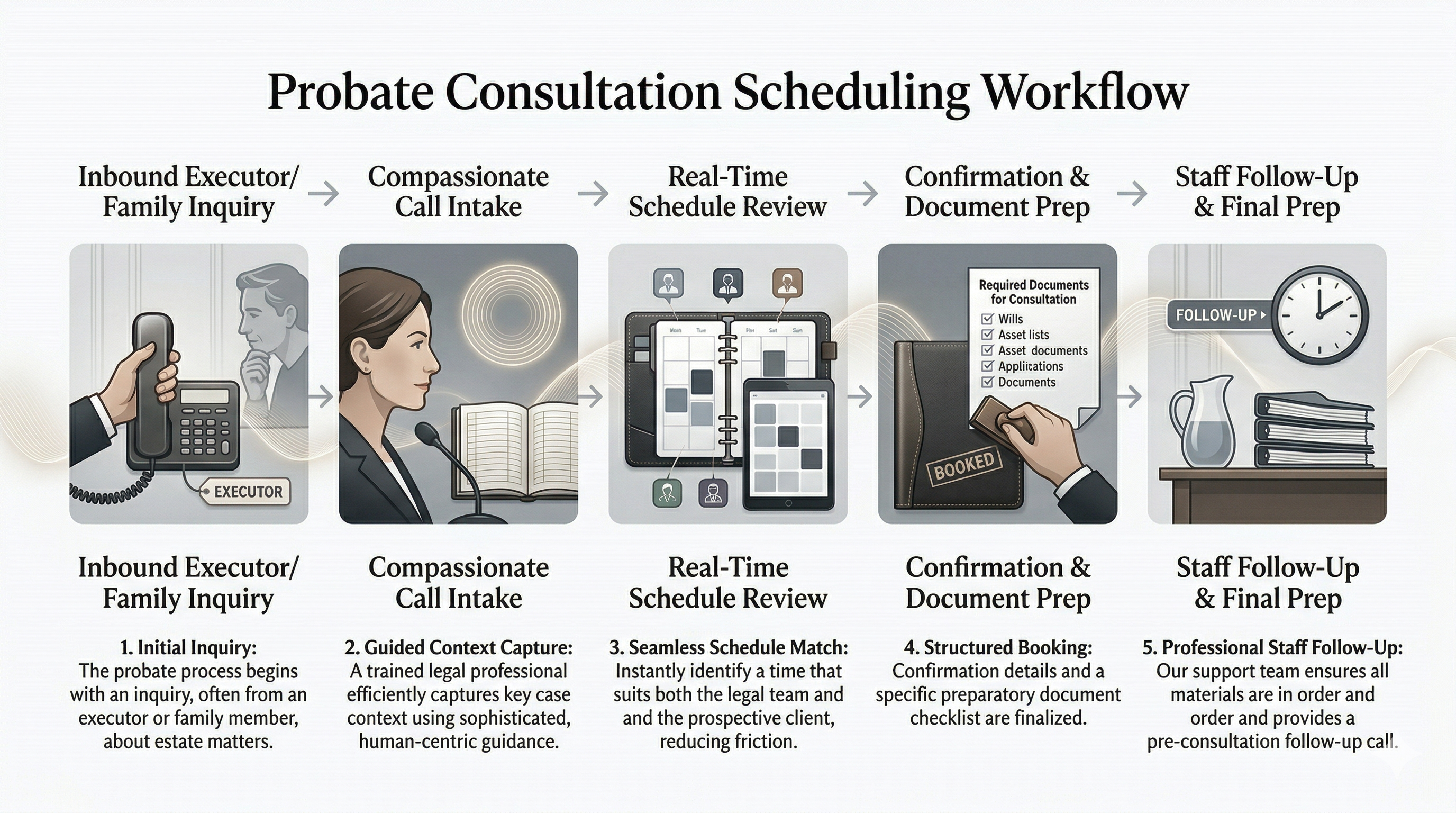
For many probate law firms, the consultation is where a new inquiry either moves forward or stalls out. A caller may be an executor trying to understand immediate next steps, a family member navigating uncertainty about estate administration, or a beneficiary looking for guidance on timelines, responsibilities, or possible disputes. Those callers are often not just looking for an appointment. They are looking for clarity and reassurance at a difficult moment. If scheduling is slow or disorganized, the firm can lose trust before the legal conversation even begins.
Voice AI can support consultation scheduling by helping collect core information, identifying whether the caller is seeking an initial consultation or a follow-up conversation, confirming preferred timing, and moving the inquiry into the correct booking workflow. This helps reduce back-and-forth for the firm while making the intake path feel more organized for the caller. It also gives staff a cleaner handoff instead of forcing them to reconstruct the purpose and urgency of the call from fragmented notes or voicemail.
In probate law, scheduling support is not just about calendar management. Some firms need different pathways for estate administration matters, probate applications, executor-support work, and estate disputes. Some need to separate paid consultations from general inquiries. Peak Demand positions Voice AI as a way to make that scheduling flow more consistent and easier to manage without allowing the system to make legal decisions or representation choices.
What Better Scheduling Support Looks Like
- Capturing the purpose of the call before staff step into the scheduling workflow.
- Identifying whether the caller is requesting an initial consultation, follow-up, or a more urgent callback.
- Supporting calendar coordination without forcing staff to handle every repetitive scheduling interaction live.
- Reducing lost opportunities caused by voicemail delays, callback gaps, or incomplete estate context.
Why This Matters in Probate Law
- Callers often reach out during emotionally difficult moments and need a more organized first response.
- Firms may need different booking logic for administration matters, disputes, and executor-related inquiries.
- Staff work more efficiently when scheduling requests arrive with clearer matter context.
- A structured scheduling path helps the practice look professional, calm, and responsive at first contact.
Can Voice AI help schedule probate law consultations?
Can firms use different scheduling workflows for different probate matters?
Does the system decide whether someone gets a consultation?
{
  "section": "Consultation Scheduling for Probate Law Firms",
  "entity": "Peak Demand",
  "page": "Voice AI for Probate Lawyers",
  "focus": [
    "consultation booking support",
    "estate-context capture",
    "administration and dispute workflow separation",
    "faster first-response scheduling"
  ]
}
Probate Law Firms Miss Fewer Opportunities When After-Hours Calls Are Captured in a Respectful, Structured Way
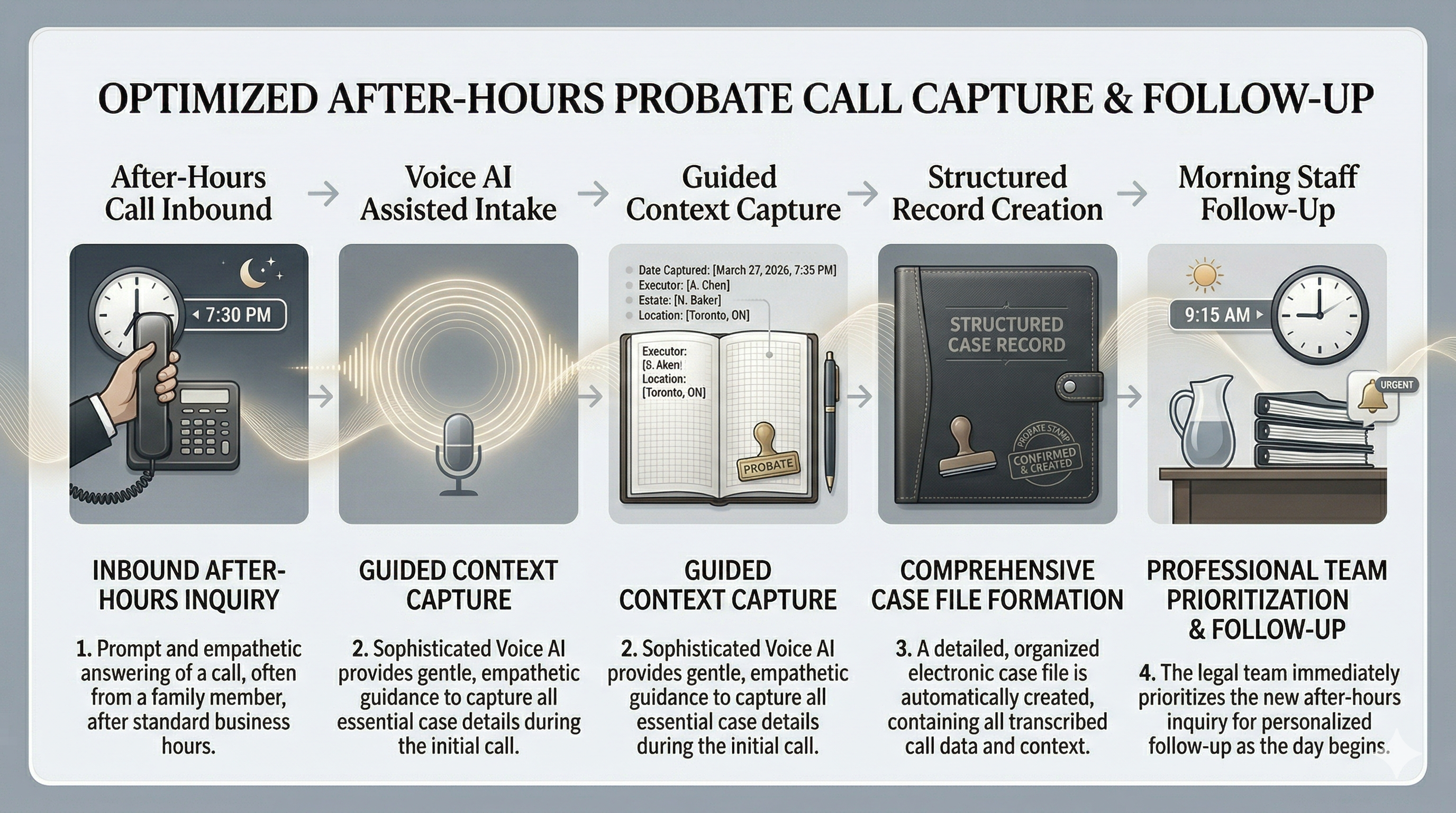
Probate and estate concerns do not arrive neatly during office hours. A family member may call in the evening after a death, an executor may finally have time to reach out after a long day of administrative obligations, or a beneficiary may decide to seek legal help outside the normal workday. If the only option is voicemail, the firm risks losing both trust and clarity before a human follow-up ever happens. After-hours responsiveness can directly affect whether an important inquiry stays with the firm.
Voice AI can support after-hours call answering by giving probate law firms a more reliable way to acknowledge callers, collect contact details, capture the broad nature of the matter, and prepare the inquiry for next-business-day review. This helps preserve opportunities that might otherwise disappear overnight while also giving the caller a more professional and respectful experience than an unanswered line or generic mailbox. For firms handling emotionally sensitive estate matters, it creates a steadier communication layer outside the standard workday.
In probate law, after-hours support should still stay within careful limits. The system should not provide legal advice, imply representation, or overstate urgency. Its role is to capture, organize, and route the communication so staff and lawyers can review it properly when they return to the workflow. Peak Demand positions this as an operations-strengthening function: better overnight and off-hours coverage, cleaner intake records, and fewer missed inquiries caused by timing alone.
What After-Hours Support Can Help Preserve
- Calls from prospective clients who reach out after a death or during a stressful family situation.
- Important estate details that are often lost when callers leave short or incomplete voicemail messages.
- Better next-day follow-up by giving staff structured information instead of fragmented messages.
- More consistent brand trust during evenings, mornings, weekends, and holiday periods.
Why This Matters for Probate Practices
- People often seek probate counsel when they finally have privacy or emotional space to act.
- Sensitive estate matters can lose momentum quickly if the firm feels unreachable.
- Not every important inquiry arrives during staffed business hours.
- Clean off-hours capture helps the firm start the next day with better intake visibility.
Can Voice AI answer probate law calls after hours?
Why are after-hours calls important for probate law firms?
Does after-hours support mean someone is represented immediately?
{
  "section": "After-Hours Call Answering for Probate Law Firms",
  "entity": "Peak Demand",
  "page": "Voice AI for Probate Lawyers",
  "focus": [
    "evening and weekend call capture",
    "off-hours intake support",
    "next-day follow-up readiness",
    "missed-opportunity reduction"
  ]
}
Probate Intake Works Better When Estate Details Are Captured Clearly and Routed Intentionally
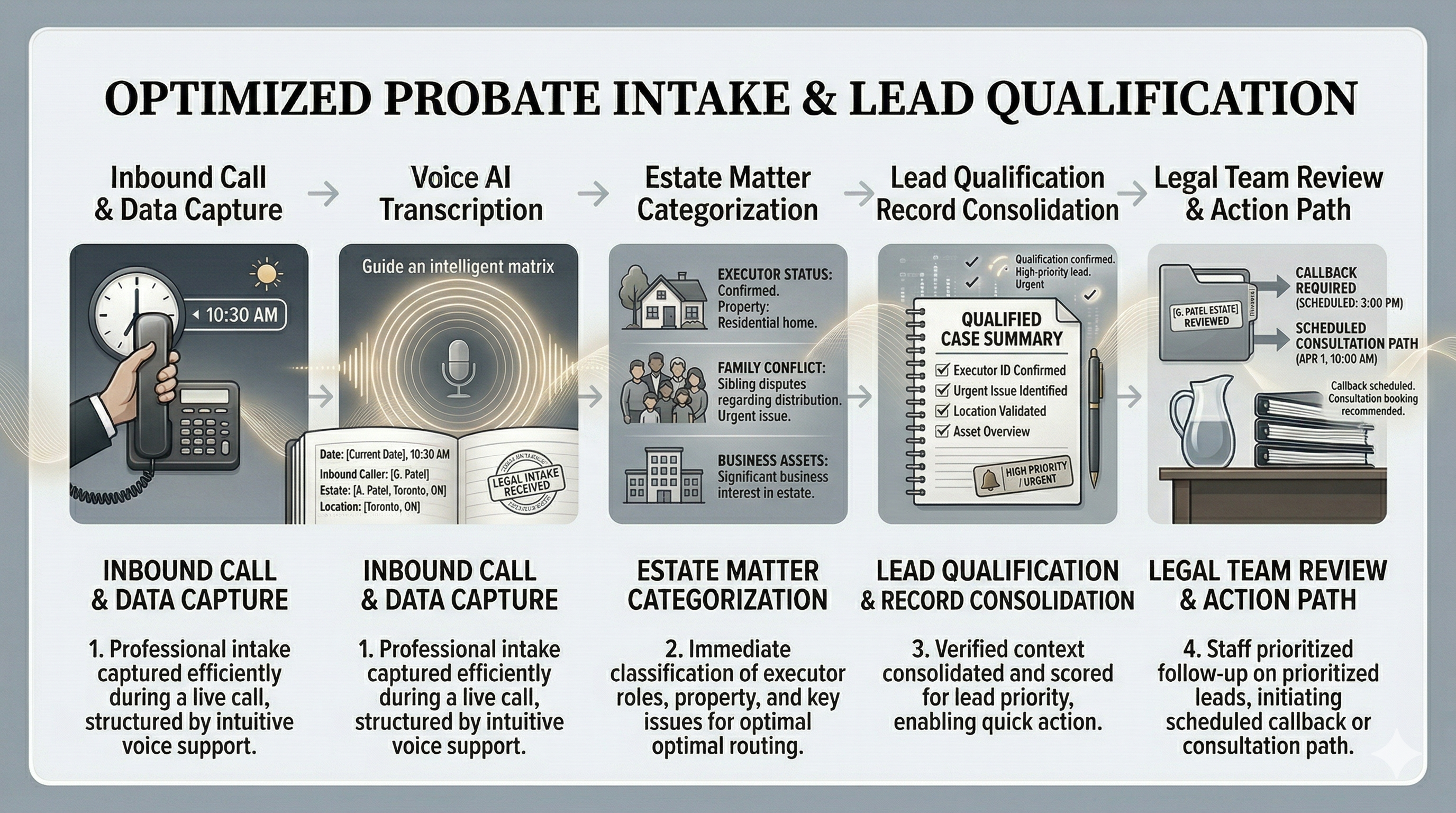
Probate law firms receive a wide range of first-contact inquiries that may sound similar at first but move into very different legal and operational paths. One caller may need help applying for probate. Another may be an executor trying to understand next steps in estate administration. Another may be dealing with questions around a will, a dispute between beneficiaries, or uncertainty about who has authority to act. When those calls are handled inconsistently, staff lose time re-asking basic questions and viable matters can get buried in a messy intake queue. The issue is not only call volume. It is intake clarity and estate context.
Voice AI can support intake and lead qualification by capturing core first-contact details such as who is calling, the broad nature of the probate or estate issue, whether the caller appears to be an executor, family member, or beneficiary, the stage of the matter, callback information, and whether the person is seeking a consultation, follow-up, or urgent response. This gives staff a more structured starting point for review and helps the firm separate routine first-response work from the legal assessment that must still happen internally. For probate practices, that cleaner handoff can improve both speed and consistency.
Peak Demand positions this as operational qualification support rather than legal screening. The system does not determine estate rights, assess dispute merit, interpret testamentary documents, or decide whether the firm should take the matter. It helps organize inquiries so staff and lawyers can review them more efficiently. In probate law, where good intake depends on balancing empathy, clarity, and structured information capture, that distinction matters.
What Better Intake Capture Can Support
- Clearer collection of names, contact details, estate context, and broad issue type.
- Better separation of probate applications, estate administration matters, disputes, and general follow-up.
- More organized review for staff who need structured information before taking the next step.
- Reduced friction caused by incomplete voicemails or inconsistent note-taking.
Why Qualification Support Matters in Probate Law
- Many inquiries are emotionally sensitive but still need disciplined internal review.
- Probate matters often follow recurring intake patterns that benefit from consistency.
- Firms need to protect staff time without lowering the quality of first-contact handling.
- Structured intake helps the practice respond faster without implying the system is making legal judgments.
Can Voice AI help qualify probate law leads?
What kind of intake details can be captured at first contact?
Is this the same as automated legal screening?
{
  "section": "Intake and Lead Qualification for Probate Law Firms",
  "entity": "Peak Demand",
  "page": "Voice AI for Probate Lawyers",
  "focus": [
    "structured intake capture",
    "lead qualification support",
    "workflow-ready handoff",
    "estate-matter organization"
  ]
}
Probate Call Routing Needs to Support the Right Handoff Without Creating More Administrative Drag
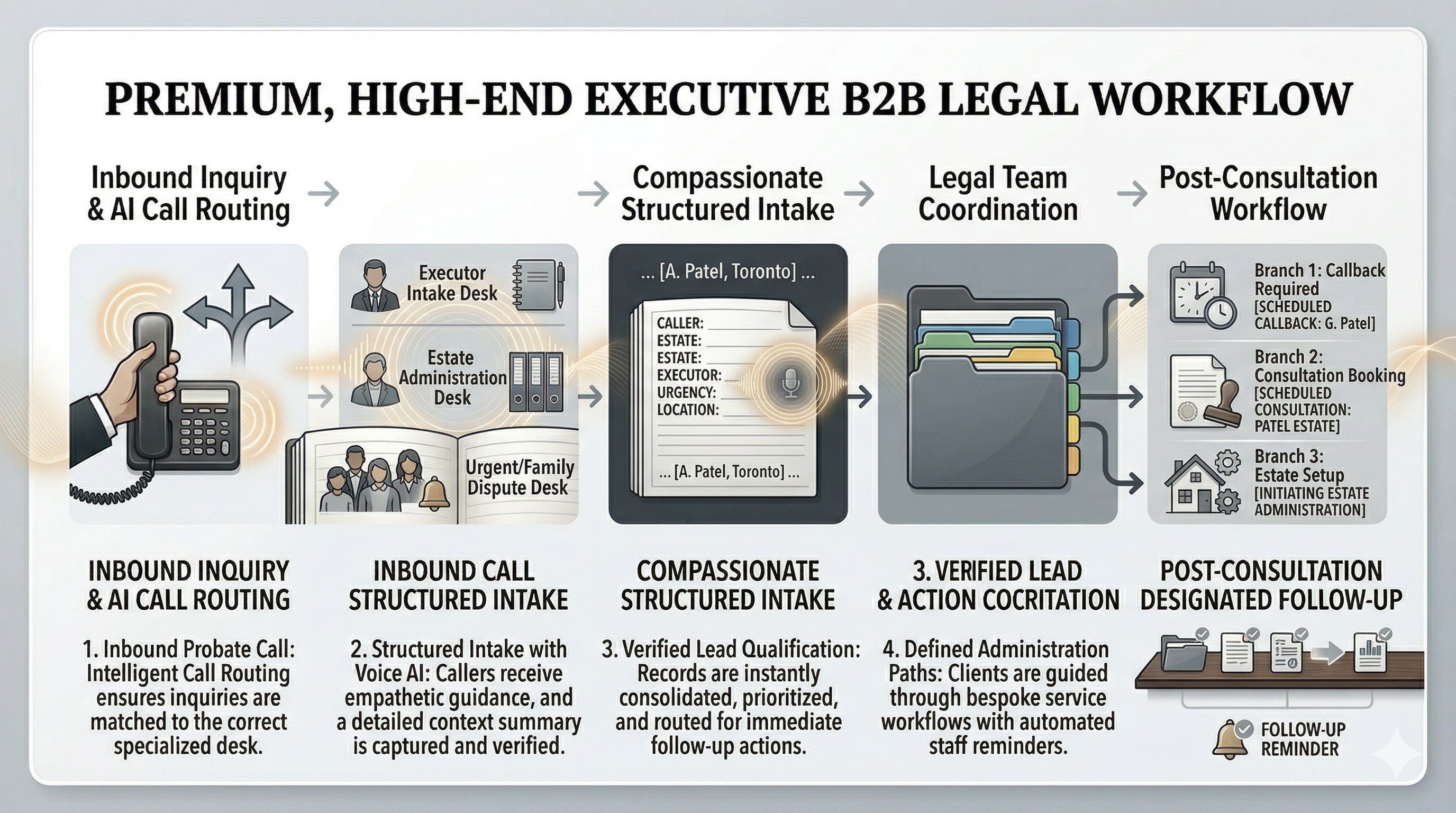
Once a probate law call is answered, the next challenge is making sure it reaches the right internal path. Some inquiries belong with intake staff. Some need consultation scheduling. Some require follow-up from a specific team member. Some may involve executors, beneficiaries, ongoing administration work, or disputes that need different handling. When routing rules are unclear or depend entirely on live staff availability, firms can end up with delayed callbacks, duplicate work, or internal confusion. Better routing is often what turns call capture into actual operational improvement.
Voice AI can support routing and staff coordination by helping direct inquiries based on broad workflow logic such as matter type, caller role, urgency level, and next-step requirements. This can make it easier for probate law firms to separate consultations from general inquiries, distinguish administration matters from dispute-related calls, and move calls toward the appropriate person or process without relying on improvised handoffs. For firms with lean teams, that structure can reduce friction throughout the day.
Peak Demand frames this as internal workflow support, not autonomous decision-making. The system is not deciding legal issues, interpreting testamentary documents, or making lawyer judgment calls. It is helping the firm apply clearer communication pathways so staff can act faster and with better information. In probate law, where inquiries often come in with emotional sensitivity and procedural complexity, that kind of routing discipline can materially improve responsiveness without sacrificing control.
What Smarter Routing Can Help Coordinate
- Separation of new inquiries, current-client calls, executor questions, beneficiary contacts, and dispute-related matters.
- Faster handoff to intake staff, scheduling workflows, or designated internal team members.
- More predictable handling of time-sensitive or priority follow-up situations.
- Cleaner internal coordination when staff are balancing multiple active estate matters and incoming calls.
Why This Matters for Probate Practices
- Probate inquiries often require different pathways depending on issue type and caller role.
- Small coordination gaps can create slower response times and a weaker first impression.
- Firms benefit when staff receive calls and notes in a more organized, workflow-ready format.
- Routing discipline helps preserve responsiveness without forcing lawyers into unnecessary front-line call handling.
Can Voice AI route probate law calls to the right workflow?
Can routing differ between estate administration and dispute-related matters?
Does routing automation remove staff oversight?
{
  "section": "Routing and Staff Coordination for Probate Law Firms",
  "entity": "Peak Demand",
  "page": "Voice AI for Probate Lawyers",
  "focus": [
    "workflow routing support",
    "staff coordination",
    "cleaner internal handoffs",
    "response-time improvement"
  ]
}
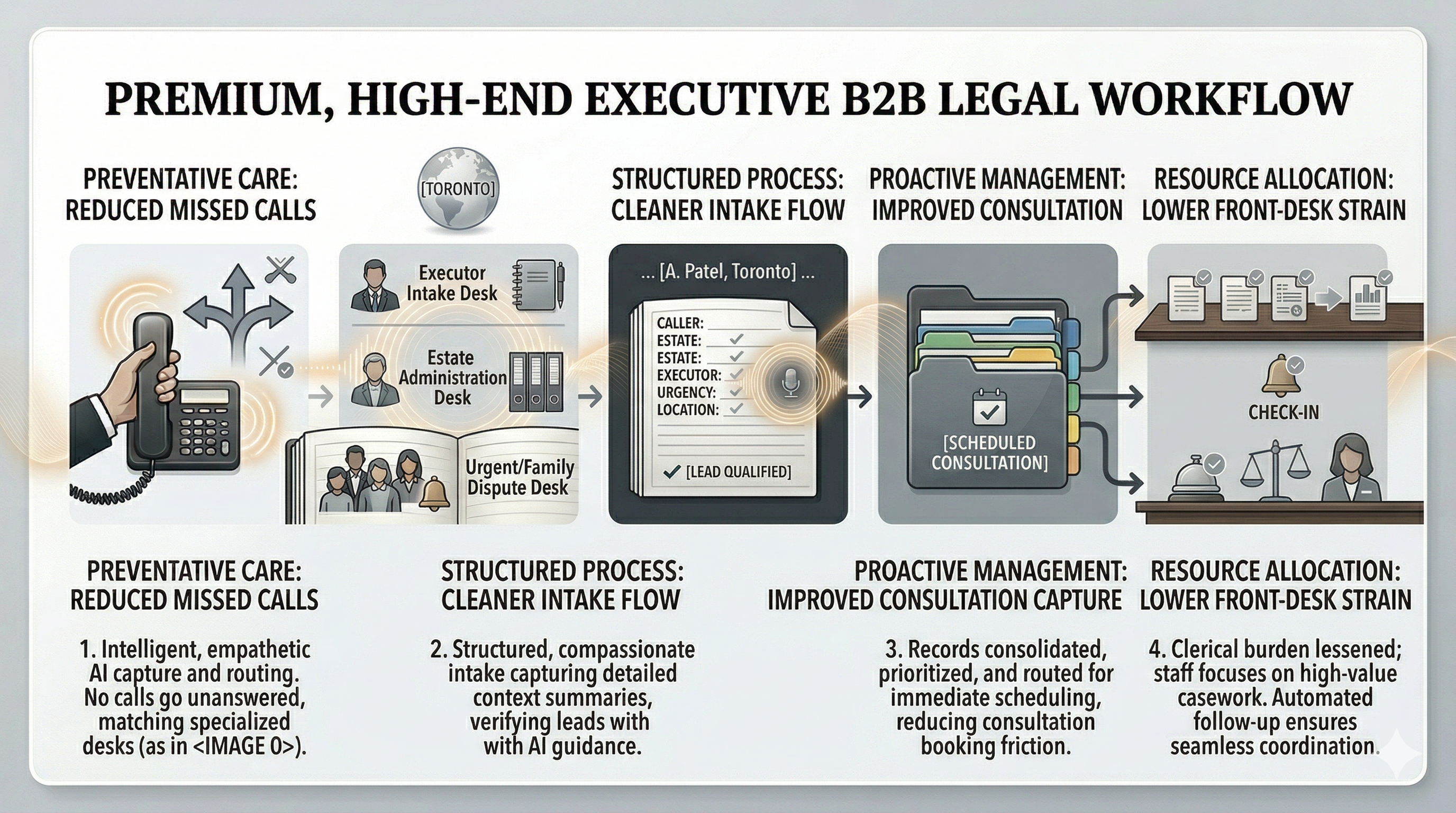
The Business Impact Comes From Fewer Missed Calls, Cleaner Intake, and Less Administrative Strain
For probate law firms, stronger call handling is not just a service improvement. It is also an operational and commercial one. When calls go unanswered, when intake details are incomplete, or when staff spend too much time reconstructing the basics of an estate matter, the firm absorbs the cost in lost consultations, slower response times, and unnecessary administrative drag. The operational gains compound when first-contact workflows become more consistent.
Voice AI can improve business performance by helping firms preserve more inbound opportunities, reduce front-desk overload, and give staff a more organized stream of estate-related inquiries to review. In probate law, that often means fewer missed executor and family-member consultations, cleaner handling of estate administration questions, and less day-to-day dependence on whether a specific person is available to answer the phone at the right moment. It also helps firms manage growth without immediately adding the same amount of administrative headcount.
Peak Demand frames the value in practical terms: stronger call coverage, more consistent intake support, improved scheduling flow, and better use of staff time. The return is not based on hype or abstract automation language. It comes from protecting revenue opportunities that would otherwise slip away and reducing the friction that slows down intake operations across the week.
Where Firms Typically Feel the Impact
- Fewer missed calls during busy periods, after hours, and staff coverage gaps.
- Cleaner intake records that reduce rework and improve next-step visibility.
- Less pressure on reception and intake staff handling repetitive first-response tasks.
- Better preservation of consultation opportunities that drive new matters.
Why the ROI Story Fits Probate Law
- Many new matters begin with sensitive, time-affected first-contact calls.
- Lost responsiveness can directly affect whether a caller stays with the firm.
- Administrative bottlenecks can slow intake even when demand is present.
- Operational consistency supports growth without forcing every improvement to come from new staffing alone.
What is the main business benefit of Voice AI for probate law firms?
Is the ROI only about saving staff time?
Does this mean firms stop needing intake staff?
{
  "section": "Business Impact for Probate Law Firms",
  "entity": "Peak Demand",
  "page": "Voice AI for Probate Lawyers",
  "focus": [
    "missed-call reduction",
    "consultation opportunity preservation",
    "administrative efficiency",
    "front-desk strain reduction"
  ]
}
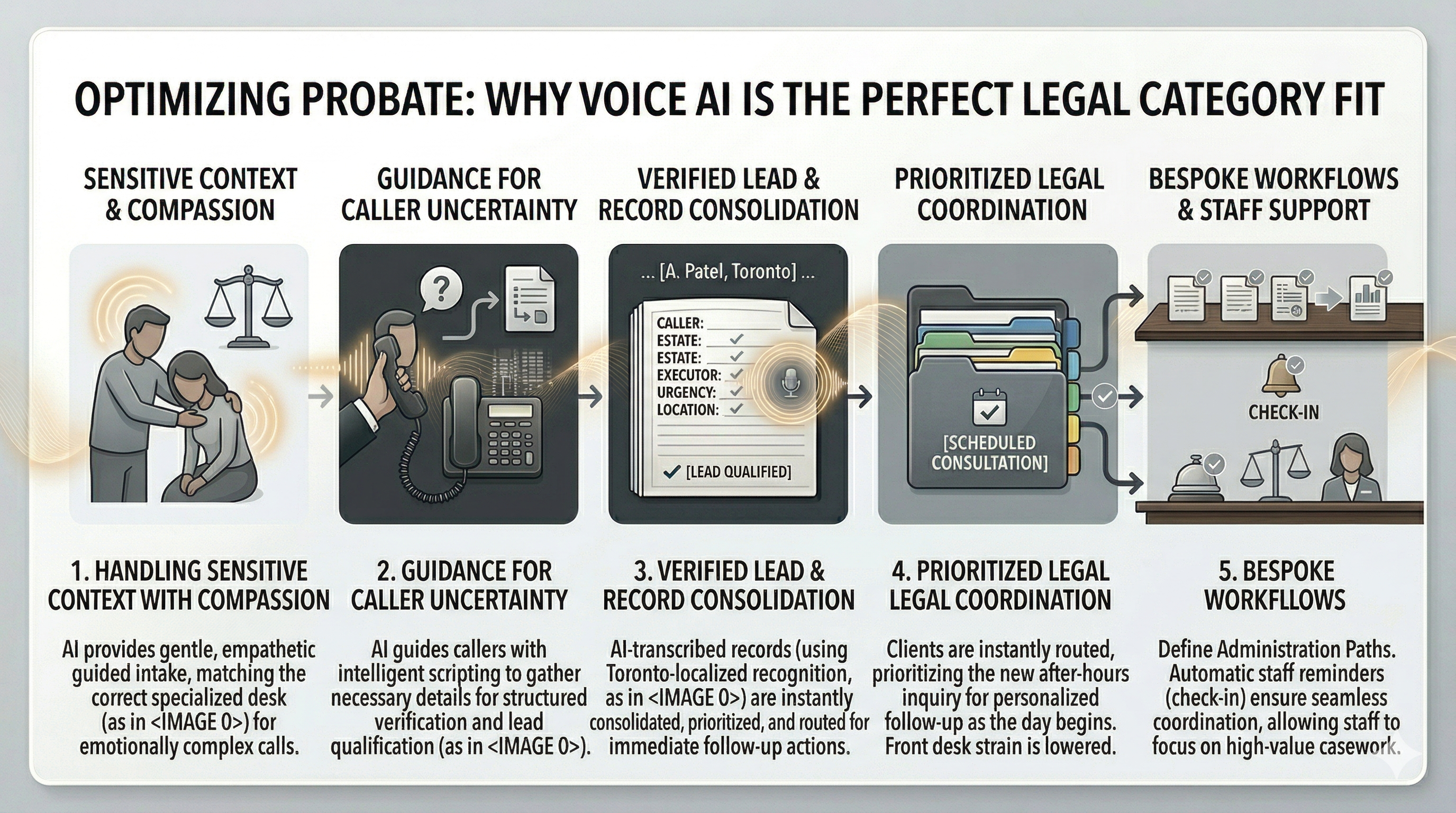
Probate Law Is an Especially Strong Fit Because the Work Sits at the Intersection of Sensitivity, Process, and Repeatable Intake Patterns
Some legal practice areas are a good fit for Voice AI because they have high call volume. Probate law goes further than that. It combines emotionally sensitive first-contact conversations with recurring intake themes, clear consultation pathways, and real consequences when firms respond slowly. A caller may be dealing with a recent death, uncertainty around an executor’s responsibilities, estate-administration delays, or a brewing dispute among beneficiaries. That mix of sensitivity and structure makes the category particularly well suited to a disciplined communication layer.
Probate law is also a practice area where callers often need a calm, credible first interaction before they are ready to share more. They may feel overwhelmed, uncertain, or emotionally drained. A strong Voice AI deployment helps firms meet that moment with consistency while still keeping legal judgment and relationship-building in human hands. That balance matters more here than in a category where the first call is mostly procedural.
Peak Demand sees probate law as a strong category fit because the operational use cases are clear: call answering, intake support, consultation scheduling, after-hours capture, and better routing across different inquiry types. The practice does not need flashy automation. It needs a more reliable front line that can support trust, clarity, and internal coordination without crossing into legal advice or representation decisions.
Why the Category Fits So Well
- Many first-contact calls combine emotional sensitivity with recurring intake structure.
- Consultation-driven workflows make responsiveness commercially important.
- Estate administration and dispute-related matters both benefit from cleaner routing and capture.
- After-hours and busy-period calls can carry meaningful revenue and relationship value.
What Probate Firms Usually Need Most
- A calmer and more consistent front line for callers in difficult situations.
- Better intake discipline without turning first contact into a cold script.
- Support for growth without overloading staff with repetitive call handling.
- Operational tools that stay within clear legal and ethical boundaries.
Why is probate law a better-than-average fit for Voice AI?
Does this fit only estate administration firms?
What makes the fit stronger than in some other legal categories?
{
  "section": "Why Voice AI Fits Probate Law Especially Well",
  "entity": "Peak Demand",
  "page": "Voice AI for Probate Lawyers",
  "focus": [
    "category fit",
    "sensitivity and structure",
    "repeatable intake patterns",
    "consultation-driven workflow"
  ]
}
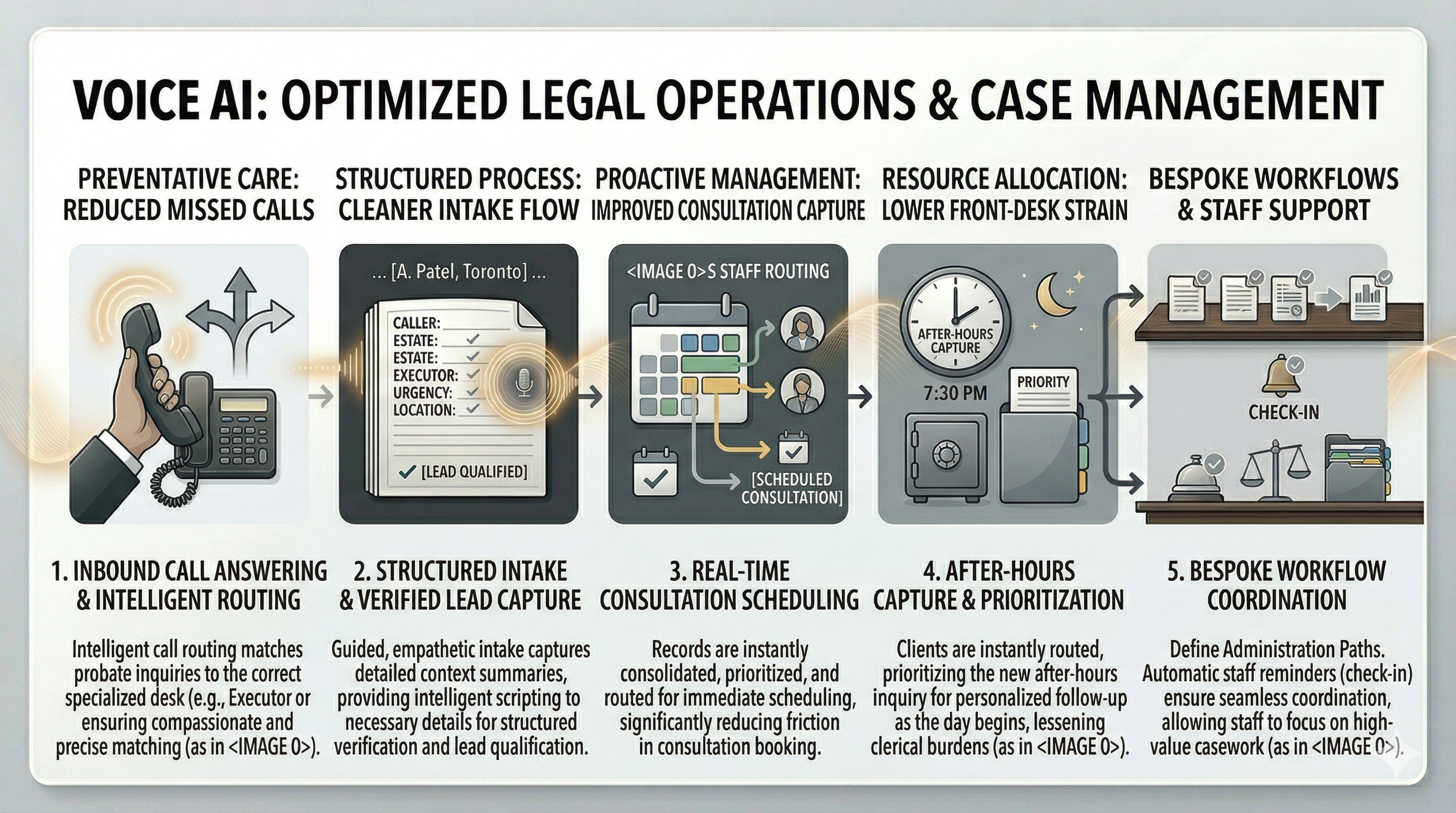
Probate Law Firms Can Use Voice AI Across Multiple First-Contact and Estate Intake Workflows
Voice AI in probate law is not limited to answering the phone. The stronger opportunity is to support a connected set of communication workflows that begin at first contact and continue through intake, scheduling, routing, and follow-up preparation. Different firms will use that support differently depending on whether they focus on probate applications, estate administration, executor support, or estate disputes. The common thread is operational consistency at the point where new matters first enter the practice.
Some firms may prioritize consultation booking and after-hours call capture. Others may care more about intake structure for estate administration, executor responsibilities, probate applications, beneficiary questions, or dispute-related matters. A well-configured Voice AI system can support these workflows without pretending that every probate call should be handled the same way or that estate matters can be reduced to a generic script.
Peak Demand approaches this category as a use-case stack rather than a single feature. The goal is to help probate law firms build a more dependable front line across the communication points that typically consume staff time and create missed opportunities. That makes Voice AI especially useful for firms trying to improve responsiveness while preserving control over legal review, matter assessment, and client communication standards.
Common Probate Law Use Cases
- Answering new inquiry calls during business hours and after hours.
- Supporting intake for probate applications, estate administration, executor support, and dispute-related matters.
- Helping book consultations and route calls into the correct scheduling path.
- Separating executors, beneficiaries, family members, current clients, and general inquiry workflows.
Operational Areas That Benefit Most
- Front-desk coverage during staff bottlenecks or emotionally heavy intake periods.
- Initial information capture before staff review and follow-up.
- Internal routing and handoff coordination across lean teams.
- Off-hours opportunity preservation when callers reach out outside the standard workday.
What are the main Voice AI use cases for probate law firms?
Can the use cases differ between estate administration and probate disputes?
Is Voice AI only useful for large probate law firms?
{
  "section": "Probate Law Voice AI Use Cases",
  "entity": "Peak Demand",
  "page": "Voice AI for Probate Lawyers",
  "focus": [
    "connected use cases",
    "intake and scheduling workflows",
    "executor and beneficiary routing",
    "operational workflow coverage"
  ]
}
Build a More Responsive Front Line for Your Probate Law Practice
If your probate law firm is missing calls, struggling with intake consistency, or feeling pressure around consultation scheduling and after-hours coverage, Voice AI can help create a more dependable first-contact workflow. The goal is not to replace lawyers or legal staff. It is to give your practice a stronger operational layer for answering inquiries, supporting intake, and moving calls into the right next step with more consistency.
Peak Demand helps law firms design Voice AI systems around real intake and communication workflows rather than generic scripts. That includes call answering, consultation support, routing logic, after-hours coverage, and structured first-contact handling that fits the realities of probate law. If you want a calmer, more organized intake operation without sacrificing professionalism, this is where the conversation starts.
The best deployment is one that reflects how your firm actually works: who handles what, which estate inquiries matter most, how consultations are scheduled, what needs escalation, and where staff time is getting pulled away by repetitive communication tasks. That is the level Peak Demand is built to support.
What Peak Demand Can Help You Improve
- Inbound call coverage during busy hours and after hours.
- First-contact structure for probate and estate-related inquiries.
- Consultation scheduling and intake handoff consistency.
- Routing logic that reflects your actual team and workflow model.
Why Firms Reach Out
- Missed calls are creating avoidable revenue leakage.
- Reception and intake teams are overloaded.
- Consultation booking feels slower than it should.
- After-hours inquiries are not being captured cleanly.
Is this only for high-volume probate law firms?
Does Peak Demand build around the firm’s specific workflow?
Will this replace legal staff?
{
  "section": "CTA",
  "entity": "Peak Demand",
  "page": "Voice AI for Probate Lawyers",
  "focus": [
    "commercial conversion",
    "workflow-fit positioning",
    "estate intake operations",
    "call coverage and consultation support"
  ]
}
Probate Law Voice AI Should Be Deployed Within a Clear Communications and Privacy Governance Framework
Probate law firms handle highly sensitive communications. Callers may disclose family conflict, executor concerns, beneficiary information, financial details, testamentary issues, estate administration status, or dispute-related context during the earliest stage of contact. That is why Voice AI deployment in this category should be treated as a governed communications workflow rather than a simple convenience layer. The operational upside only matters if the communication layer is configured responsibly.
For Canadian firms, that typically means thinking carefully about privacy and communications obligations under frameworks such as PIPEDA and guidance from the Office of the Privacy Commissioner of Canada, while also accounting for telecommunications and telemarketing rules where relevant. For firms serving U.S. callers or operating across borders, governance may also intersect with TCPA, FCC, FTC, and state-level call recording consent requirements. The right approach is not to turn this section into a law-school explainer. It is to recognize that intake automation touches regulated communication practices and should be structured accordingly.
Peak Demand frames governance here as a practical operating requirement: define what the system is allowed to do, what it must never do, how disclosures are handled, how call data is managed, when escalation occurs, and how staff maintain oversight. Probate law firms do not need speculative automation in sensitive first-contact conversations. They need disciplined implementation that respects privacy, communications rules, and the emotional and legal sensitivity of estate-related matters.
Governance Areas That Matter Most
- Privacy-aware handling of intake and caller information.
- Clear rules for disclosures, transparency, and communication boundaries.
- Review of call recording and consent requirements across relevant jurisdictions.
- Defined escalation logic and staff oversight for sensitive or high-priority interactions.
Operational Questions Firms Should Answer
- What information should be captured at first contact and what should not?
- When should the system escalate to a human instead of continuing the workflow?
- How are call records, transcripts, and intake notes stored and reviewed?
- Which privacy, telecommunications, and recording rules apply to the firm’s footprint?
Why does governance matter for probate law Voice AI?
Does this section suggest Voice AI handles compliance automatically?
What regulations are commonly relevant in this context?
{
  "section": "Governance and Regulatory Context",
  "entity": "Peak Demand",
  "page": "Voice AI for Probate Lawyers",
  "focus": [
    "privacy-aware communications",
    "operational governance",
    "recording and consent considerations",
    "staff oversight and escalation"
  ]
}
Responsible Voice AI in Probate Law Means Clear Limits, Human Oversight, and No Legal Advice
Probate law is not a category where firms can afford ambiguity about what AI is doing. The system should support communication, intake, scheduling, and routing. It should not provide legal advice, interpret wills, assess beneficiary rights, recommend litigation strategy, determine whether someone has a valid claim, or decide whether the firm will represent the caller. Those boundaries are central to responsible deployment.
A responsible Voice AI model for probate law keeps lawyers and staff in control of legal judgment, intake review, escalation, and representation decisions. The system can capture information, support first-response consistency, and prepare a cleaner handoff, but it must stay inside defined operational limits. That includes transparency about the nature of the interaction, careful handling of sensitive estate and family information, and escalation pathways when a situation requires human review.
Peak Demand positions responsible AI as a practical operating principle rather than a marketing slogan. The point is to make first-contact workflows more dependable without creating confusion about the role of the system. In probate law, trust is shaped early. Firms need an implementation that sounds professional, behaves predictably, and reinforces that lawyers and staff remain accountable for the legal relationship and all substantive decisions.
What Responsible Deployment Includes
- No legal advice, legal conclusions, or strategy recommendations from the system.
- No autonomous representation decisions or estate-rights determinations.
- Clear escalation paths when a caller needs human attention.
- Defined communication boundaries and reviewable workflow rules.
What Should Stay With the Firm
- Lawyer judgment and estate-specific legal analysis.
- Conflict checks, representation decisions, and engagement steps.
- Staff review of sensitive or high-priority intake situations.
- Oversight of privacy, communications, and client-experience standards.
Can Voice AI give legal advice in a probate law setting?
Can the system decide whether a caller has a strong probate matter?
What makes Voice AI use responsible in this practice area?
{
  "section": "Responsible AI for Probate Law Firms",
  "entity": "Peak Demand",
  "page": "Voice AI for Probate Lawyers",
  "focus": [
    "no legal advice",
    "human oversight",
    "clear operational boundaries",
    "responsible first-contact deployment"
  ]
}
Frequently Asked Questions About Voice AI for Probate Lawyers
Probate law firms tend to ask practical questions before adopting Voice AI. They want to know whether it can answer calls professionally, support estate intake without crossing legal lines, help with consultation scheduling, and reduce missed opportunities after hours. They also want to understand where the system stops and where staff and lawyers remain fully in control.
That is the right way to evaluate the category. Voice AI for probate law should be judged on operational usefulness, communication quality, and responsible deployment, not hype. The strongest implementation helps the firm respond faster and stay more organized without blurring the line between intake support and legal judgment.
The questions below cover the issues probate law firms most commonly think through when evaluating call answering, intake support, consultation flow, after-hours coverage, and governance.
What Firms Usually Want to Confirm
- Whether Voice AI can answer probate law calls in a professional and respectful tone.
- How it supports intake and scheduling without giving legal advice.
- Whether it helps reduce missed calls and off-hours opportunity loss.
- How staff oversight, escalation, and governance remain in place.
What This FAQ Reinforces
- Voice AI is an operational support layer, not a substitute for lawyers or staff.
- Probate law is a strong fit because sensitivity, process, and intake structure often overlap.
- Consultation flow, routing, and after-hours support are central use cases.
- Responsible deployment depends on clear limits, privacy awareness, and human review.
Can Voice AI answer calls for a probate law firm?
Can Voice AI help with probate law intake?
Can it help qualify probate law leads?
Can Voice AI schedule probate law consultations?
Can Voice AI answer calls after hours?
Does Voice AI replace reception or intake staff?
Can Voice AI give legal advice in a probate law setting?
Why is probate law such a strong fit for Voice AI?
Can Voice AI support both estate administration and probate disputes?
What should firms evaluate before deploying Voice AI for probate law?
{
  "section": "FAQ",
  "entity": "Peak Demand",
  "page": "Voice AI for Probate Lawyers",
  "focus": [
    "call answering",
    "intake support",
    "consultation scheduling",
    "after-hours coverage",
    "responsible deployment"
  ]
}
Explore your own AI use case on a discovery call.