
Voice AI for HVAC Companies: AI Receptionist, Emergency Call Handling, Scheduling and Dispatch

HVAC companies depend heavily on inbound phone calls to generate service bookings, coordinate technician dispatch, and respond to urgent heating and cooling failures.
When technicians are working in the field and office staff are managing scheduling and dispatch operations, incoming calls can go unanswered. During extreme weather periods—such as heat waves or winter cold snaps—call volumes often surge beyond what office teams can handle.
Missed calls frequently result in lost service opportunities. Customers experiencing heating or cooling emergencies rarely leave voicemail messages. Instead, they call another contractor who answers immediately.
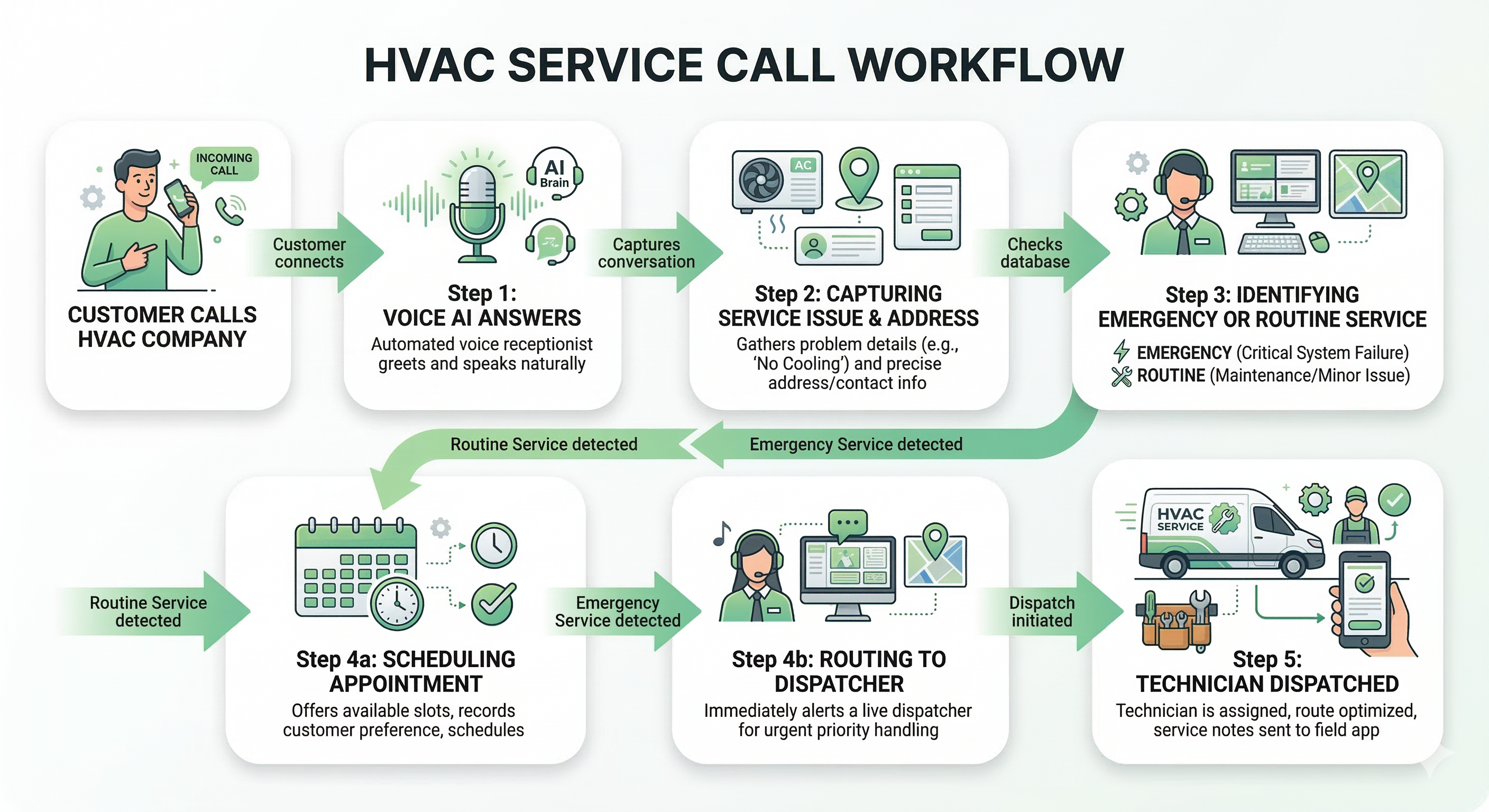
Voice AI communication systems can support HVAC contractors by answering inbound calls, capturing service request details, scheduling appointments, and routing emergency service calls to dispatch teams.
For HVAC businesses managing high seasonal call volume, automated communication infrastructure helps ensure customer requests are captured consistently and routed correctly.
Peak Demand designs Voice AI systems that support HVAC service intake workflows, technician dispatch coordination, and after-hours call handling while maintaining human oversight for operational decisions.
Voice AI for HVAC Call Intake and Customer Access
HVAC companies receive a high volume of inbound service calls from homeowners experiencing heating or cooling issues. Customers often contact contractors when systems fail during extreme weather conditions or when routine maintenance becomes urgent.
Managing these calls consistently can be difficult when technicians are already deployed to job sites and office teams are coordinating dispatch schedules. Voice AI systems can support HVAC communication workflows by handling structured service intake, appointment requests, emergency call routing, and customer information capture.
Common HVAC Customer Calls
- Emergency furnace failures during winter
- Air conditioning outages during heat waves
- Routine HVAC maintenance scheduling
- Installation quotes for new HVAC systems
- Thermostat or airflow troubleshooting requests
Operational Safeguards
- Structured intake routing: service requests categorized by job type
- Emergency escalation: urgent calls routed to dispatch staff
- Service-area validation: confirm customer location before booking
- Human oversight: final scheduling decisions remain with staff
- Audit visibility: captured call logs for operational review
{
  "section": "Voice AI for HVAC Call Intake",
  "entity": "Peak Demand",
  "industry": "HVAC",
  "service": "Voice AI receptionist",
  "use_cases": [
    "HVAC service request intake",
    "appointment scheduling",
    "emergency call escalation",
    "customer information capture",
    "dispatch support"
  ],
  "software_context": [
    "ServiceTitan",
    "Jobber",
    "Housecall Pro",
    "FieldEdge"
  ],
  "delivery_model": "fully managed custom Voice AI systems"
}
AI Receptionist for HVAC Companies: Answering Calls, Capturing Service Requests, and Routing Urgent Jobs
HVAC companies receive inbound calls across a wide range of customer needs, including no-cooling complaints, no-heat emergencies, seasonal tune-up requests, installation inquiries, thermostat issues, and follow-up scheduling questions. Because many of these calls arrive while technicians are on job sites and office teams are already coordinating dispatch, consistently answering every call can be difficult.
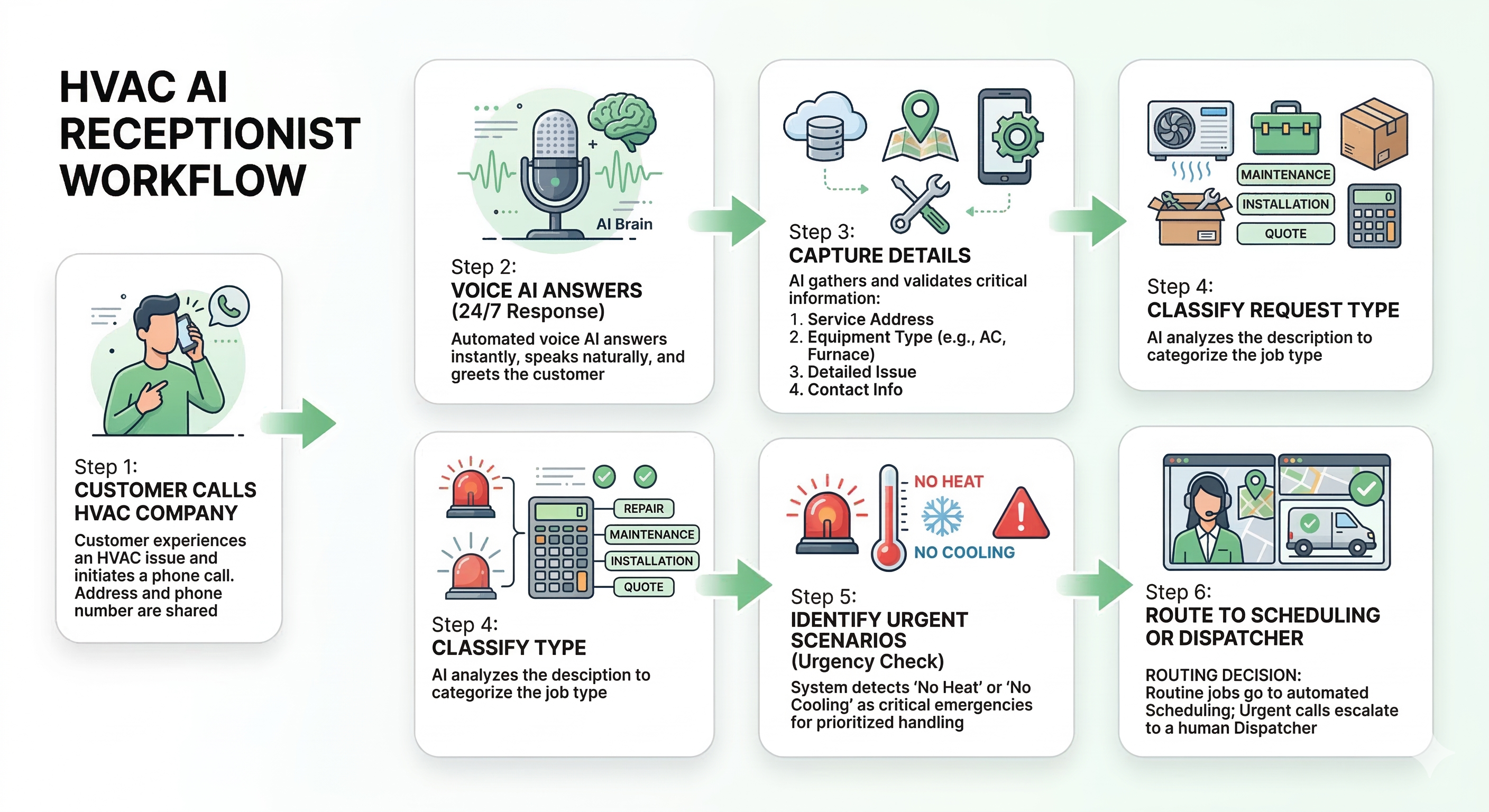
A Voice AI receptionist can support HVAC communication workflows by handling inbound call answering, structured service intake, basic service-area screening, issue classification, and escalation of urgent repair requests. This allows office staff to focus on dispatch decisions and technician coordination while ensuring new service opportunities are captured promptly.
For HVAC contractors, the purpose of an AI receptionist is not to replace dispatchers or customer service teams. It is to reduce missed calls, standardize intake quality, and improve the speed with which heating and cooling requests move into scheduling and field service workflows.
Common HVAC AI Receptionist Tasks
- Answer inbound calls for heating and cooling service requests
- Capture customer name, phone number, address, and equipment issue details
- Identify whether the call concerns repair, maintenance, installation, or a quote request
- Screen for emergency conditions such as no heat in winter or no cooling during extreme heat
- Route service requests into scheduling, dispatch, or after-hours escalation workflows
Operational Controls and Escalation Safeguards
- Structured intake logic: predefined flows for repair, maintenance, and install calls
- Urgency routing: emergency heating and cooling failures escalated differently from routine service
- Service-area validation: confirm whether the caller is within coverage before booking
- Human handoff: complex scheduling or dispatch exceptions transferred to staff
- Audit visibility: captured call summaries and routing outcomes preserved for review
Can AI answer calls for HVAC companies?
What does an AI receptionist do for HVAC contractors?
Does an HVAC AI receptionist replace office staff?
{
  "section": "AI Receptionist for HVAC Companies",
  "entity": "Peak Demand",
  "industry": "HVAC",
  "service": "Voice AI receptionist for HVAC contractors",
  "use_cases": [
    "HVAC call answering",
    "repair and maintenance request intake",
    "customer information capture",
    "emergency urgency screening",
    "routing to scheduling or dispatch"
  ],
  "controls": [
    "structured intake logic",
    "urgency-based escalation",
    "service-area validation",
    "human handoff pathways",
    "audit-ready call summaries"
  ],
  "software_context": [
    "ServiceTitan",
    "Jobber",
    "Housecall Pro",
    "FieldEdge"
  ],
  "delivery_model": "fully managed custom Voice AI systems"
}
Voice AI Scheduling for HVAC Service Appointments
Scheduling is one of the most important operational workflows in HVAC. Customers call to request emergency repairs, preventive maintenance visits, system inspections, estimate appointments, and equipment installations. Each request must be captured accurately so the business can match technician availability, geography, job type, and urgency.
HVAC scheduling becomes even more complex during seasonal surges, when contractor phone lines experience true peak demand during heat waves, cold snaps, and the first major weather shifts of the year. In these periods, office teams may struggle to answer every call, collect complete details, and keep the schedule moving without bottlenecks.
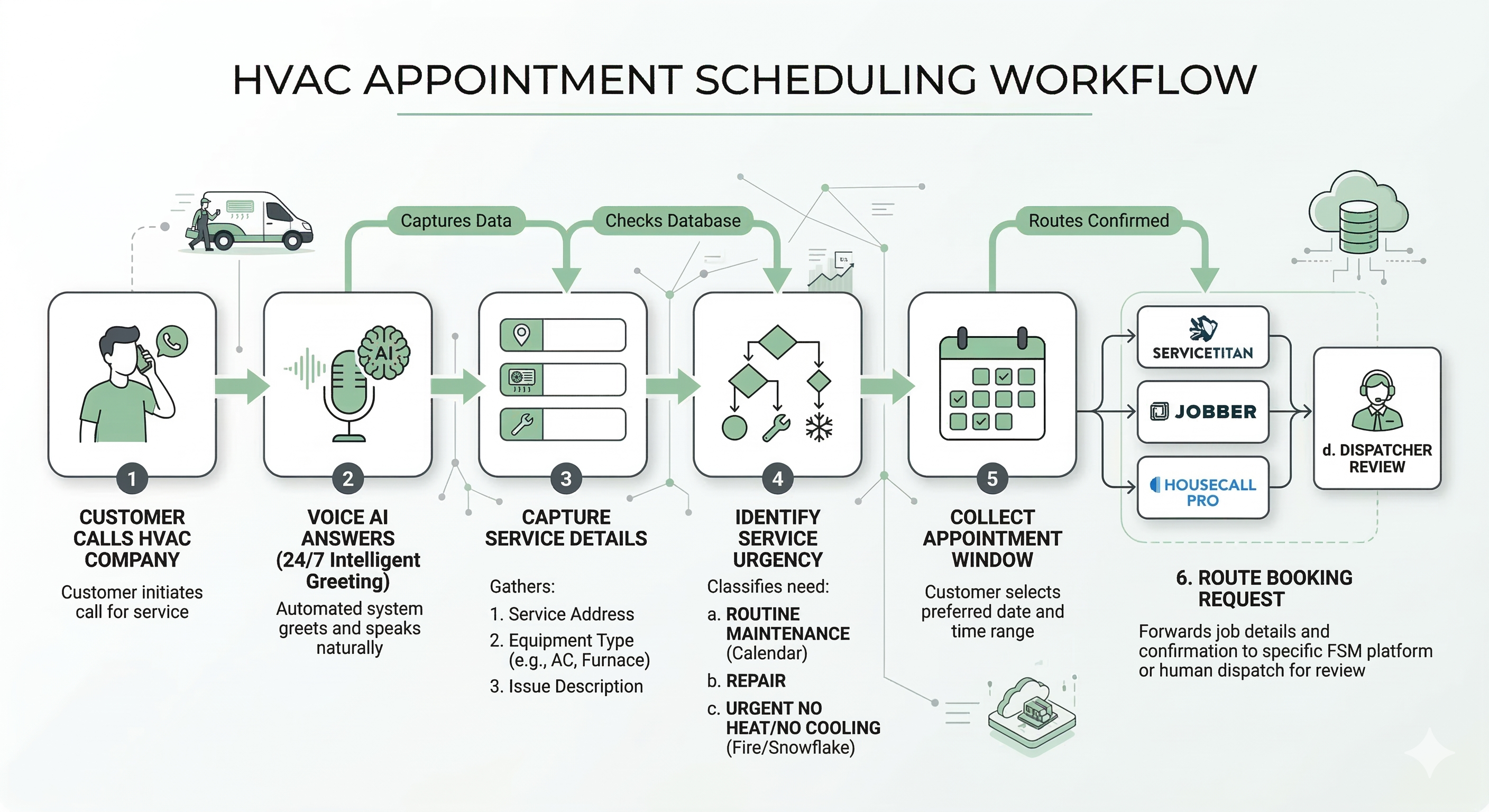
Voice AI can support HVAC scheduling by handling appointment request capture, address and equipment issue intake, preferred time window collection, and routing of urgent same-day jobs into approved scheduling and dispatch workflows. This helps contractors standardize intake quality while preserving human control over technician assignment and calendar decisions.
Common HVAC Scheduling Tasks
- Booking repair appointments for heating and cooling system failures
- Scheduling seasonal tune-ups and preventive maintenance visits
- Coordinating estimate appointments for new HVAC installations or replacements
- Collecting service address, unit type, and issue description before booking
- Handling reschedules, confirmations, and urgent same-day service requests
Scheduling Controls and Workflow Safeguards
- Structured booking logic: standardized intake steps for repair, maintenance, and install requests
- Urgency flagging: no-heat and no-cooling situations handled differently from routine maintenance
- Service-area validation: customer locations verified before scheduling
- Time-window capture: preferred appointment ranges documented consistently
- Human scheduling authority: final calendar and dispatch decisions remain with staff
Can Voice AI schedule HVAC service appointments?
Can AI help HVAC companies during seasonal call spikes?
Can Voice AI handle HVAC appointment rescheduling?
{
  "section": "Voice AI Scheduling for HVAC Service Appointments",
  "entity": "Peak Demand",
  "industry": "HVAC",
  "service": "Voice AI scheduling for HVAC contractors",
  "use_cases": [
    "repair appointment booking",
    "seasonal maintenance scheduling",
    "installation estimate scheduling",
    "address and issue intake",
    "urgent same day service routing"
  ],
  "controls": [
    "structured booking logic",
    "urgency flagging",
    "service-area validation",
    "preferred time window capture",
    "human scheduling authority"
  ],
  "software_context": [
    "ServiceTitan",
    "Jobber",
    "Housecall Pro",
    "FieldEdge"
  ],
  "seasonality_context": [
    "summer cooling demand",
    "winter heating demand",
    "weather-driven call spikes",
    "peak demand scheduling pressure"
  ],
  "delivery_model": "fully managed custom Voice AI systems"
}
Voice AI Dispatch Coordination for HVAC Companies
HVAC dispatch coordination depends on speed, accuracy, and clear prioritization. Once a customer call is answered, the business must determine whether the issue is routine maintenance, a same-day repair, a system replacement consultation, or an urgent no-heat or no-cooling failure. That decision affects technician assignment, arrival timing, route planning, and customer communication.
During busy service periods, dispatch teams often manage overlapping technician schedules, geographic routing constraints, parts availability, emergency interruptions, and changing customer availability windows. If inbound calls are captured inconsistently, dispatchers may receive incomplete job details, which can slow down response times and reduce field efficiency.
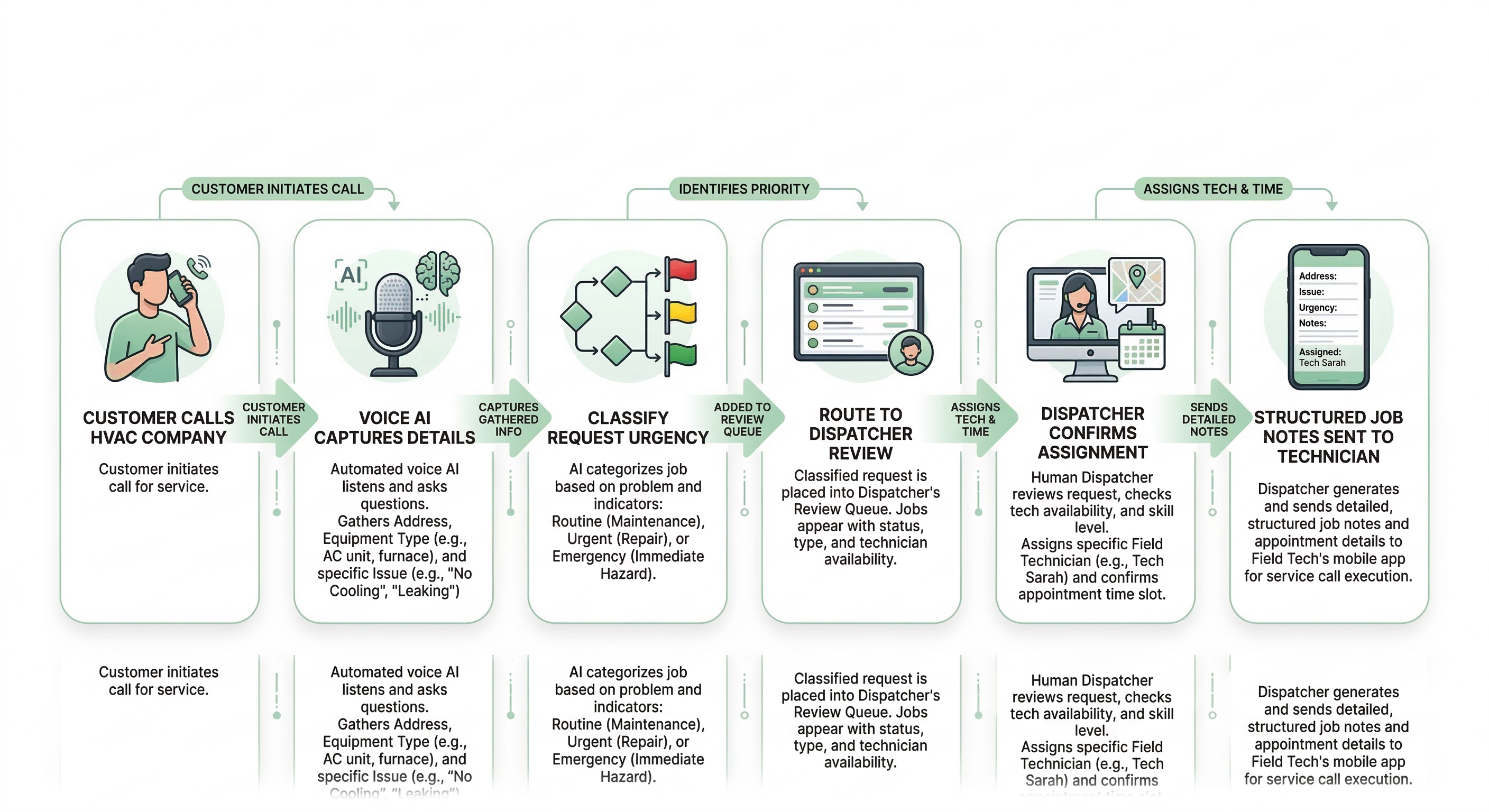
Voice AI can support HVAC dispatch workflows by handling structured issue intake, equipment problem classification, urgency identification, and dispatch-supporting handoff notes. The purpose is not to automate final technician assignment, but to make sure dispatch teams receive clear, standardized information before deciding how to route the job.
Common HVAC Dispatch Coordination Tasks
- Capturing whether the issue involves heating, cooling, airflow, thermostat, or system shutdown problems
- Identifying if the request is routine service, urgent repair, or emergency response
- Documenting address, equipment type, and customer availability before technician assignment
- Routing same-day calls into dispatcher review queues during high-demand periods
- Providing technicians with structured service notes before arrival
Dispatch Controls and Operational Safeguards
- Urgency classification: no-heat and no-cooling breakdowns handled differently from routine tune-ups
- Human dispatch authority: final technician assignment remains under staff control
- Structured handoff notes: issue summaries passed consistently into dispatch workflows
- Service-area and schedule alignment: requests validated before routing
- Audit visibility: dispatch-supporting call records retained for operational review
Can Voice AI help HVAC companies dispatch technicians?
Can AI tell whether an HVAC call is urgent?
Does Voice AI replace HVAC dispatchers?
{
  "section": "Voice AI Dispatch Coordination for HVAC Companies",
  "entity": "Peak Demand",
  "industry": "HVAC",
  "service": "Voice AI dispatch support for HVAC contractors",
  "use_cases": [
    "HVAC issue intake",
    "urgency identification",
    "dispatch review routing",
    "same day service escalation",
    "structured technician handoff notes"
  ],
  "controls": [
    "urgency classification",
    "human dispatch authority",
    "structured call handoff",
    "service area validation",
    "audit-ready intake records"
  ],
  "seasonality_context": [
    "summer cooling surges",
    "winter heating failures",
    "weather-driven dispatch pressure",
    "peak demand routing complexity"
  ],
  "software_context": [
    "ServiceTitan",
    "Jobber",
    "Housecall Pro",
    "FieldEdge"
  ],
  "delivery_model": "fully managed custom Voice AI systems"
}
Voice AI Emergency Call Handling for HVAC Companies
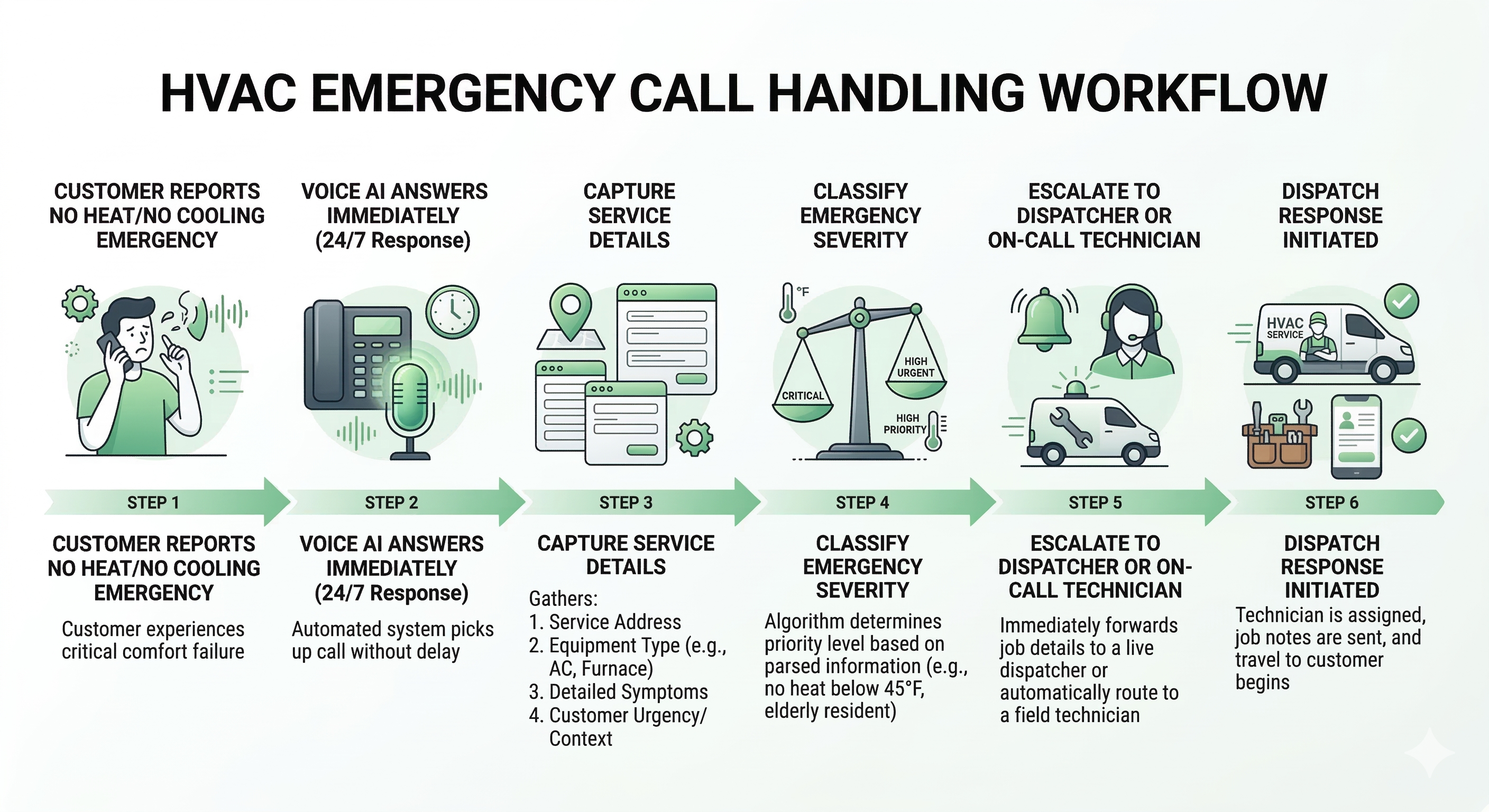
Emergency HVAC calls often happen when customers are under immediate pressure. A furnace can fail during a winter cold snap, an air conditioner can stop working during extreme summer heat, or a building occupant may report a complete loss of airflow, unusual burning smells, or a system shutdown affecting the entire property. In these cases, response speed matters.
HVAC companies frequently experience their highest operational strain during true peak demand periods, when weather-driven call spikes push office teams, dispatchers, and technicians to capacity. If emergency calls are missed, delayed, or captured inconsistently, contractors risk lost revenue, customer dissatisfaction, and slower response times during the most commercially important parts of the season.
Voice AI can support HVAC emergency intake by handling urgent call answering, structured problem capture, service location intake, emergency escalation, and dispatch-supporting handoff notes. The objective is to recognize urgent situations quickly, gather the details needed for operational response, and route the call into the correct dispatcher or on-call workflow.
Common HVAC Emergency Call Types
- No heat during freezing weather or overnight winter outages
- No cooling during extreme summer temperatures or heat waves
- Complete HVAC system shutdown affecting the home or building
- Urgent airflow, thermostat, or equipment failure reports
- After-hours emergency calls requiring dispatcher or on-call technician review
Emergency Intake Controls and Escalation Safeguards
- Urgency classification logic: emergency no-heat and no-cooling scenarios routed differently from routine calls
- Immediate escalation pathways: urgent calls handed to dispatch or on-call staff without delay
- Structured issue capture: address, equipment symptoms, and timing documented consistently
- Customer reassurance messaging: callers receive clear confirmation that the request is being routed
- Dispatch-ready notes: field teams receive concise summaries before responding
Can Voice AI identify HVAC emergency calls?
Can AI answer emergency HVAC calls after hours?
Does Voice AI replace HVAC dispatchers during emergencies?
{
  "section": "Voice AI Emergency Call Handling for HVAC Companies",
  "entity": "Peak Demand",
  "industry": "HVAC",
  "service": "Voice AI emergency intake for HVAC contractors",
  "use_cases": [
    "no heat emergency call intake",
    "no cooling emergency call intake",
    "after hours HVAC emergency escalation",
    "urgent service location capture",
    "dispatch supporting emergency handoff notes"
  ],
  "controls": [
    "urgency classification logic",
    "immediate escalation pathways",
    "structured emergency intake",
    "customer reassurance messaging",
    "dispatch ready service notes"
  ],
  "seasonality_context": [
    "winter cold snap emergencies",
    "summer heat wave emergencies",
    "weather driven peak demand surges",
    "after hours seasonal service pressure"
  ],
  "software_context": [
    "ServiceTitan",
    "Jobber",
    "Housecall Pro",
    "FieldEdge"
  ],
  "delivery_model": "fully managed custom Voice AI systems"
}
Voice AI After-Hours Call Handling for HVAC Companies
HVAC companies frequently receive calls outside normal business hours. Customers often discover heating failures late at night, air conditioning outages during weekends, or urgent comfort and safety issues when office staff are no longer available. These calls can be highly time-sensitive, especially during extreme temperatures.
Traditional voicemail systems often perform poorly in these situations because customers dealing with urgent heating or cooling issues may not wait for a callback. During periods of true peak demand—such as the first major cold snap of winter or a sustained summer heat wave— after-hours call volume can increase sharply, making missed calls especially costly for HVAC contractors.
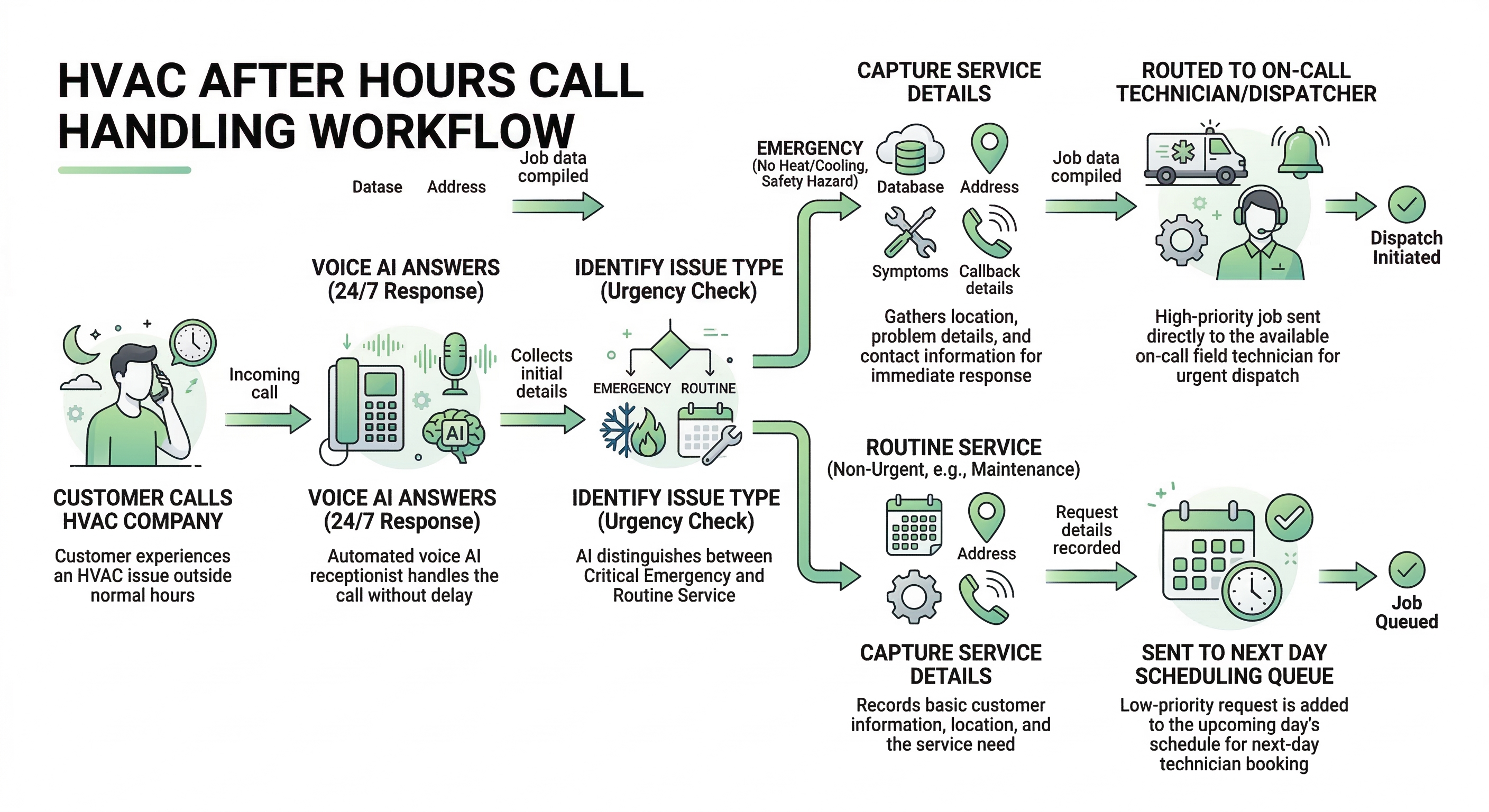
Voice AI can support after-hours HVAC communication by handling overnight and weekend call answering, emergency intake, non-urgent service request capture, and routing to on-call technician or next-day scheduling workflows. This helps contractors preserve service opportunities while maintaining clear escalation logic for urgent repair needs.
Common After-Hours HVAC Call Types
- No heat calls during evenings, weekends, and overnight periods
- No cooling complaints during summer nights and weekend heat events
- Customers requesting urgent next-day HVAC service appointments
- Equipment shutdown, airflow, or thermostat issues reported after office hours
- Routine maintenance or quote inquiries that need next-business-day follow-up
After-Hours Controls and Escalation Safeguards
- Emergency escalation logic: no-heat and no-cooling calls routed differently from routine inquiries
- On-call technician pathways: urgent jobs transferred into approved after-hours response workflows
- Structured call capture: service address, equipment issue, and callback details documented consistently
- Next-day scheduling queue: non-urgent calls preserved for business-hour follow-up
- Audit visibility: after-hours call outcomes logged for operational review
Can Voice AI answer HVAC calls after hours?
What happens to non-urgent HVAC calls after hours?
Can AI help HVAC contractors during overnight seasonal surges?
{
  "section": "Voice AI After Hours Call Handling for HVAC Companies",
  "entity": "Peak Demand",
  "industry": "HVAC",
  "service": "Voice AI after hours answering for HVAC contractors",
  "use_cases": [
    "overnight HVAC call answering",
    "weekend emergency intake",
    "on call technician escalation",
    "non urgent service request capture",
    "next day scheduling workflow support"
  ],
  "controls": [
    "emergency escalation logic",
    "on call routing pathways",
    "structured after hours call capture",
    "next day scheduling queues",
    "audit ready communication logs"
  ],
  "seasonality_context": [
    "winter overnight heating emergencies",
    "summer after hours cooling failures",
    "weather driven peak demand surges",
    "weekend and holiday service pressure"
  ],
  "software_context": [
    "ServiceTitan",
    "Jobber",
    "Housecall Pro",
    "FieldEdge"
  ],
  "delivery_model": "fully managed custom Voice AI systems"
}
Voice AI Integration with HVAC Field Service Management Software
Most HVAC contractors rely on field service management platforms to coordinate scheduling, technician routing, invoicing, and customer communication. These systems act as the operational backbone of the business, managing appointment calendars, dispatch boards, job records, and service histories.
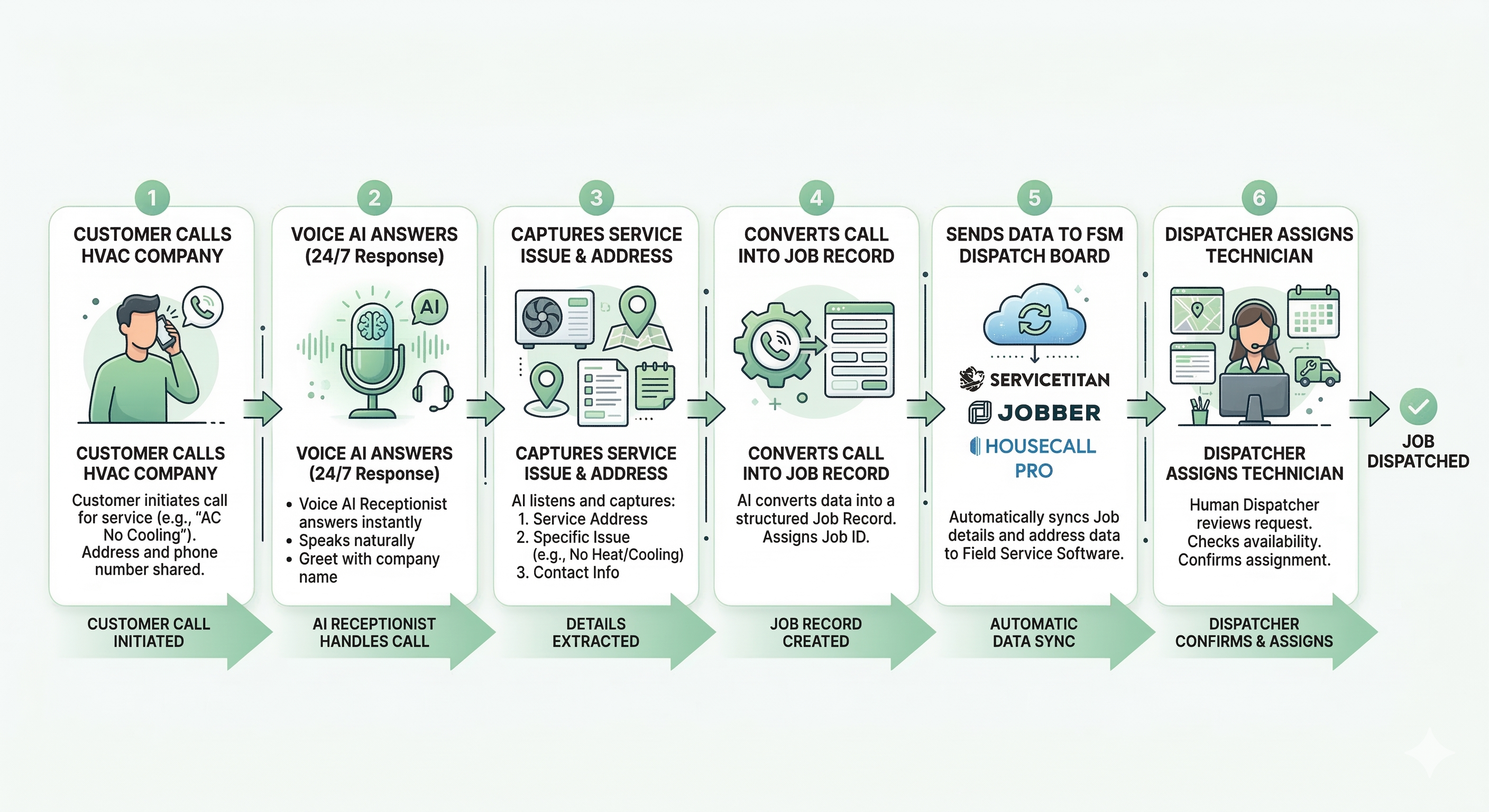
Voice AI communication systems can integrate with these platforms to ensure that captured call information flows directly into the contractor’s operational environment. Instead of relying on handwritten notes or incomplete voicemail messages, service requests can be recorded as structured job data that dispatchers can review immediately.
Integration allows HVAC contractors to maintain a single source of truth for scheduling and job management, while Voice AI supports the intake layer that feeds information into those systems during busy service periods, including true peak demand weather events when call volumes surge.
Common HVAC Field Service Platforms
- ServiceTitan — enterprise HVAC field service management platform used for scheduling, dispatch, and invoicing.
- Jobber — widely used contractor platform for job scheduling, quoting, and customer communication.
- Housecall Pro — field service software for booking jobs, dispatching technicians, and managing invoices.
- FieldEdge — HVAC-focused platform for dispatch boards, technician tracking, and service documentation.
- CRM systems such as Salesforce, HubSpot, or custom contractor databases used to manage customer records.
Voice AI Integration Capabilities
- Automated job intake: captured service calls converted into structured job requests
- Customer record matching: identify returning customers using phone numbers
- Scheduling workflow routing: appointment requests sent to dispatcher calendars
- Dispatch note creation: technicians receive summarized issue descriptions
- Communication logging: call transcripts and outcomes stored for operational review
{
  "section": "Voice AI Integration with HVAC Field Service Software",
  "entity": "Peak Demand",
  "industry": "HVAC",
  "service": "Voice AI communication automation",
  "integrations": [
    "ServiceTitan",
    "Jobber",
    "Housecall Pro",
    "FieldEdge",
    "Salesforce",
    "HubSpot"
  ],
  "use_cases": [
    "automated HVAC service request intake",
    "job creation from inbound calls",
    "customer record matching",
    "dispatch workflow routing",
    "call logging and service documentation"
  ],
  "seasonality_context": [
    "summer cooling demand surges",
    "winter heating emergencies",
    "weather driven peak demand call spikes"
  ],
  "delivery_model": "fully managed custom Voice AI systems"
}
ROI of Voice AI for HVAC Contractors During Peak Demand Seasons
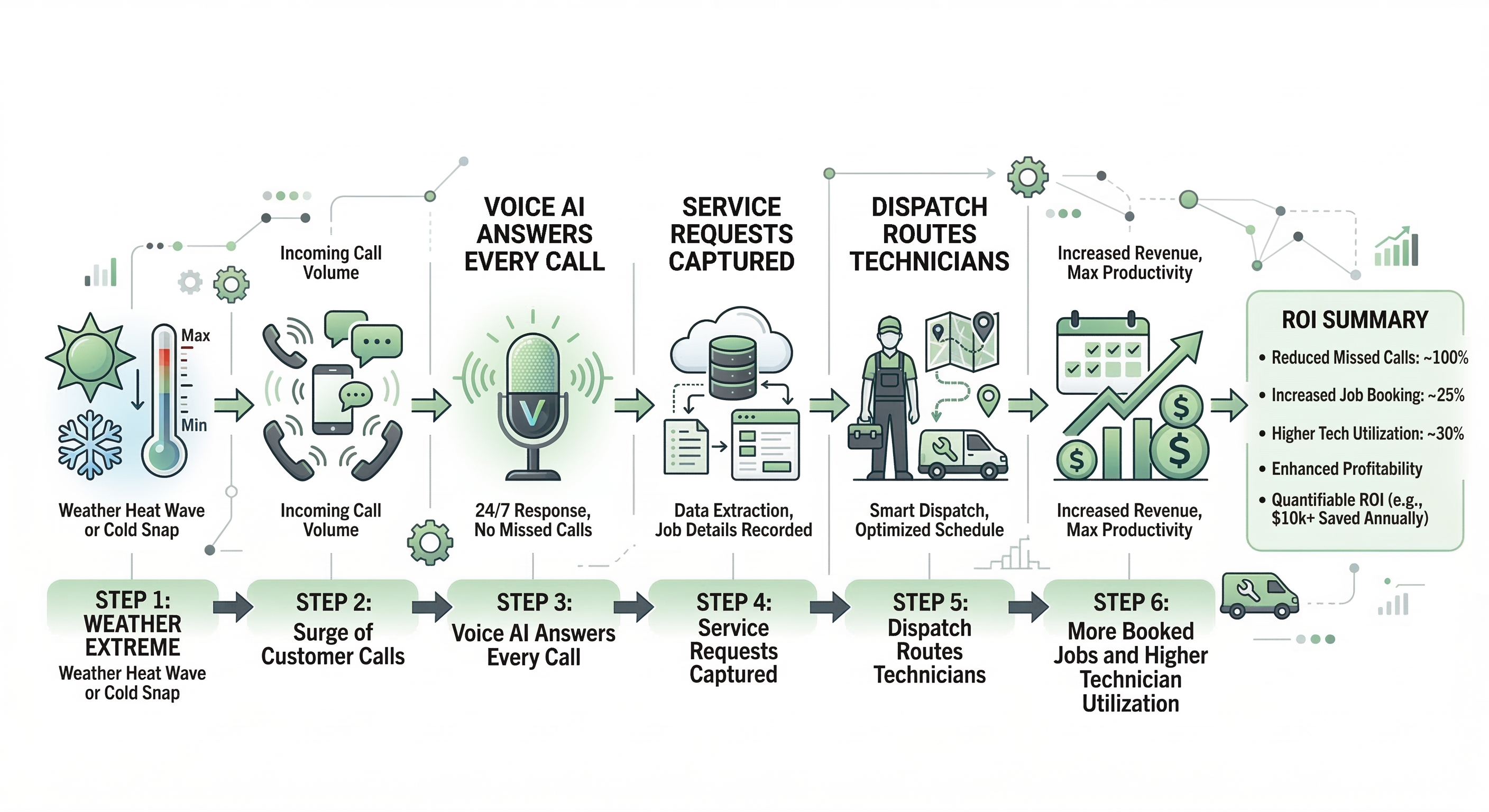
HVAC companies operate in one of the most seasonal service industries. Demand for heating and cooling repairs can rise dramatically during weather-driven events such as heat waves, cold snaps, and the first major seasonal temperature shifts. During these periods, contractors experience their highest call volume and their most valuable service opportunities.
Unfortunately, these same conditions can overwhelm office staff and dispatch teams. When technicians are already deployed and inbound calls spike rapidly, many contractors experience missed calls, incomplete service requests, and delayed scheduling responses. These operational gaps frequently occur during the very moments when customer demand—and potential revenue—is at its highest.
Voice AI communication systems help HVAC contractors manage these weather-driven surges by answering calls consistently, capturing service requests accurately, and routing urgent repair calls into dispatch workflows. By supporting intake and scheduling during true peak demand periods, automation helps contractors convert more inbound calls into scheduled jobs.
Revenue Impact Areas
- Missed call recovery: more inbound service opportunities captured
- Higher booking conversion: faster intake and scheduling response
- Improved technician utilization: clearer dispatch planning and job routing
- Emergency service capture: urgent repair calls routed correctly
- Seasonal revenue protection: fewer lost opportunities during weather surges
Operational Efficiency Improvements
- Reduced call handling strain: office teams focus on dispatch decisions
- Structured service intake: dispatch receives consistent job details
- Faster technician preparation: field teams receive clearer job summaries
- After-hours opportunity capture: overnight calls preserved
- Operational visibility: call logs provide insight into demand patterns
{
  "section": "ROI of Voice AI for HVAC Contractors",
  "entity": "Peak Demand",
  "industry": "HVAC",
  "service": "Voice AI communication automation",
  "value_drivers": [
    "missed call recovery",
    "higher service booking rates",
    "improved technician utilization",
    "dispatch workflow efficiency",
    "after hours service capture"
  ],
  "seasonality_context": [
    "summer cooling demand spikes",
    "winter heating emergencies",
    "weather driven peak demand periods",
    "seasonal call volume surges"
  ],
  "delivery_model": "fully managed custom Voice AI systems"
}
Voice AI FAQ for HVAC Contractors
HVAC contractors exploring Voice AI systems often have questions about how automated call answering, scheduling, and dispatch coordination work in real-world service environments. The following questions address common operational and technology considerations for heating and cooling businesses evaluating Voice AI communication systems.
Can Voice AI answer calls for HVAC companies?
Can AI schedule HVAC repair or maintenance appointments?
Can Voice AI help HVAC companies during peak demand seasons?
Can Voice AI handle emergency HVAC calls?
Does Voice AI replace HVAC dispatchers or office staff?
Can Voice AI integrate with HVAC scheduling software?
{
  "section": "Voice AI FAQ for HVAC Contractors",
  "entity": "Peak Demand",
  "industry": "HVAC",
  "service": "Voice AI for HVAC companies",
  "questions": [
    "Can Voice AI answer HVAC calls?",
    "Can AI schedule HVAC appointments?",
    "Can Voice AI handle emergency HVAC service requests?",
    "Can AI help HVAC contractors during peak demand seasons?",
    "Does Voice AI replace dispatchers?",
    "Can Voice AI integrate with ServiceTitan and Jobber?"
  ],
  "delivery_model": "fully managed custom Voice AI systems"
}
Prepare Your HVAC Business for Peak Demand — With Voice AI Call Automation
HVAC contractors often experience sudden call surges during heat waves, cold snaps, and seasonal temperature shifts. If your team struggles to answer every call during these peak demand periods, Voice AI systems can help capture service requests, route urgent repairs, and protect valuable revenue opportunities.
Peak Demand helps HVAC companies design Voice AI communication systems that integrate with dispatch workflows, scheduling platforms, and after-hours escalation pathways. No commitment required.
What You Get in a 30-Minute Discovery Session
- Call workflow review: where HVAC calls are missed or misrouted
- Seasonal demand planning: automation strategies for weather-driven call spikes
- Scheduling and dispatch mapping: integration with field service software
- Deployment roadmap: pilot → service area rollout → multi-location scaling
Good Fit For
- HVAC repair companies experiencing seasonal service call spikes
- Heating contractors handling winter no-heat emergencies
- Cooling specialists responding to summer AC failures
- Multi-technician HVAC teams coordinating dispatch and scheduling
- Contractors modernizing answering services or voicemail systems
{
  "page": "Voice AI for HVAC Companies",
  "provider": "Peak Demand",
  "provider_type": "fully managed voice AI agency",
  "hq": "Toronto, Ontario, Canada",
  "regions_served": ["Canada", "United States"],
  "delivery_model": "fully managed custom build",
  "primary_outcomes": [
    "reduce missed HVAC service calls",
    "capture emergency repair requests",
    "improve dispatch coordination",
    "increase booked service appointments",
    "handle seasonal peak demand call surges"
  ],
  "primary_use_cases": [
    "AI answering service for HVAC companies",
    "HVAC appointment scheduling",
    "emergency heating and cooling call intake",
    "dispatch coordination support",
    "after-hours HVAC call answering"
  ],
  "cta": "https://peakdemand.ca/discovery"
}
Recommended Voice AI Pathways for HVAC Companies
HVAC businesses often need Voice AI for emergency call intake, seasonal scheduling surges, technician dispatch coordination, and missed-call recovery. These pathways connect HVAC operations to closely related contractor trades, urgent service workflows, and adjacent booking models across home services.
Pathway A — Core Contractor Trades
Pathway B — Emergency and Dispatch-Heavy Services
Pathway C — Recurring and Seasonal Service Workflows
Regulatory and Operational Governance for HVAC Voice AI Systems in North America
HVAC companies using Voice AI for customer communication should operate within applicable privacy, telecommunications, and consumer protection rules across Canada and the United States. Because HVAC service requests often include customer names, addresses, phone numbers, call recordings, and service history details, automated communication systems should be deployed with clear disclosure, controlled data handling, and defined human escalation pathways.
For HVAC contractors, governance is not only a legal issue. It is also an operational requirement. During extreme weather events and seasonal peak demand periods, communication systems must remain transparent, auditable, and aligned with business rules for scheduling, emergency escalation, and after-hours technician response.
Canada: Privacy and Telecommunications Context
- PIPEDA establishes the federal private-sector rules for collecting, using, and disclosing personal information in commercial activities.
- The Office of the Privacy Commissioner of Canada provides privacy guidance relevant to customer communications and data handling.
- The OPC’s guidance on recording customer telephone calls is particularly relevant where HVAC businesses record calls for quality, training, or dispute resolution.
- The CRTC oversees telecommunications regulation, and its Unsolicited Telecommunications Rules include telemarketing and automatic dialing-announcing device requirements.
United States: Federal Communication and Consumer Protection Context
- The TCPA and broader FCC rules are relevant to automated and prerecorded calling practices.
- The FCC has stated that AI-generated voices in robocalls are treated as “artificial” under the TCPA , which is important context for any AI voice deployment strategy.
- The FTC remains relevant for deceptive or unfair business practices, including misleading automation or AI-related claims.
- U.S. call-recording consent rules vary by state, so HVAC companies operating across multiple states should review applicable state-level requirements before recording or storing customer calls.
Operational Governance Safeguards for HVAC Voice AI
- Transparent call handling: customers should understand when they are interacting with an automated system.
- Recording disclosure: recording and monitoring practices should be disclosed where applicable.
- Human escalation pathways: urgent no-heat, no-cooling, or after-hours emergencies should route to human staff or on-call teams.
- Dispatch authority retained: technician assignment and emergency prioritization remain under human operational control.
- Audit-ready logs: call outcomes, routing actions, and summaries should be preserved for operational visibility.
Why This Matters for HVAC Contractors
- HVAC calls often involve urgent residential comfort and safety concerns.
- Peak demand seasons create pressure to answer every call quickly and consistently.
- Customer trust depends on clear communication and accurate routing.
- Recorded call data may contain personal information that requires responsible handling.
- Cross-border or multi-state operations require governance that can scale across jurisdictions.
{
  "section": "Regulatory and Operational Governance for HVAC Voice AI Systems",
  "entity": "Peak Demand",
  "industry": "HVAC",
  "service": "Voice AI communication systems",
  "regions": [
    "Canada",
    "United States"
  ],
  "regulatory_frameworks": [
    "PIPEDA",
    "Office of the Privacy Commissioner of Canada guidance",
    "CRTC telecommunications oversight",
    "TCPA",
    "FCC communications rules",
    "FTC consumer protection oversight",
    "state call recording consent rules"
  ],
  "governance_controls": [
    "transparent call handling disclosure",
    "recording disclosure where applicable",
    "human escalation pathways",
    "dispatch authority retained by staff",
    "audit-ready communication logs"
  ],
  "seasonality_context": [
    "summer cooling demand spikes",
    "winter heating emergencies",
    "weather-driven peak demand call surges"
  ],
  "delivery_model": "fully managed custom Voice AI systems"
}
Responsible Voice AI Communication Principles for HVAC Companies
Voice AI communication systems should support HVAC contractors in managing customer inquiries, service requests, and emergency calls while maintaining transparency, accountability, and operational reliability. Because heating and cooling failures often occur during stressful circumstances—such as extreme weather events or equipment breakdowns— communication systems must be designed with clear boundaries and responsible operational controls.
Responsible Voice AI deployments emphasize clear disclosure, accurate routing, human escalation pathways, and operational audit visibility. These principles help HVAC businesses maintain customer trust while ensuring that urgent repair requests and seasonal peak demand call volumes are handled consistently.
Customer Communication Principles
- Transparency: callers understand they are interacting with an automated system.
- Clear escalation: urgent heating or cooling failures can transfer to human staff.
- Consistent intake: service requests are captured using structured workflows.
- Respectful messaging: communication remains professional and customer-focused.
- Customer reassurance: callers receive confirmation that their request is being handled.
Operational Safeguards for HVAC Voice AI
- Human dispatch authority: technician assignment remains under dispatcher control.
- Emergency escalation logic: no-heat or no-cooling calls routed appropriately.
- Call logging: routing outcomes and summaries preserved for operational review.
- Workflow boundaries: AI handles intake and routing but not repair advice.
- Peak demand resilience: systems designed to remain stable during seasonal call surges.
These principles help ensure that Voice AI systems act as communication infrastructure that supports HVAC operations, rather than replacing experienced technicians, dispatchers, or service managers. When deployed responsibly, Voice AI allows contractors to answer more calls, capture service opportunities during weather-driven peak demand periods, and maintain consistent customer communication standards.
{
  "section": "Responsible Voice AI Communication Principles for HVAC Companies",
  "entity": "Peak Demand",
  "industry": "HVAC",
  "service": "Voice AI communication systems",
  "principles": [
    "transparent automated call disclosure",
    "clear human escalation pathways",
    "structured intake workflows",
    "dispatch authority retained by staff",
    "audit-ready communication logging"
  ],
  "operational_focus": [
    "emergency HVAC call routing",
    "service request intake",
    "seasonal peak demand communication stability",
    "after-hours call answering"
  ],
  "delivery_model": "fully managed custom Voice AI systems"
}
Explore your own AI use case on a discovery call.