
Bilingual Legal Intake AI: Multilingual Intake Support, Voice AI Call Handling, Better Inquiry Clarity, and Stronger Follow-Up

Law firms lose opportunities when a prospective client is ready to call but language becomes an immediate barrier at the first point of contact. In many firms, multilingual inquiries create friction because staff availability, callback speed, and intake consistency vary depending on who answers the phone and what language support is available in that moment. Bilingual Legal Intake AI helps create a more dependable first-contact experience so firms can support callers more clearly, reduce avoidable confusion, and preserve more viable opportunities across language preferences.
For Peak Demand, bilingual legal intake is not just a translation problem. It is an intake, trust, and routing workflow. A stronger bilingual intake system helps law firms support multilingual callers, capture first-contact details more consistently, improve inquiry clarity, and move people into the right next step with less friction. The goal is not to let AI provide legal advice or replace bilingual legal staff. It is to give firms a more dependable multilingual communication layer that improves accessibility, responsiveness, and intake structure while keeping legal judgment, representation decisions, and substantive review firmly in human hands.
Voice AI for Bilingual Legal Intake Helps Law Firms Reduce Language Friction at the First Point of Contact
For many law firms, the intake problem is not just missed calls or weak follow-up. It is also what happens when a prospective client reaches out in another language and the firm cannot respond with enough clarity in the moment. Voice AI for bilingual legal intake helps law firms create a stronger first-contact experience when language barriers would otherwise weaken trust, momentum, and intake quality before deeper review even begins.
This is why bilingual legal intake AI is such a strong operational fit for law firms. Voice AI can support multilingual first-contact communication, preserve clearer intake details, and reduce the inconsistency that happens when language support depends entirely on which staff member happens to be available at that moment. A stronger bilingual Voice AI workflow helps the firm create a more accessible, more organized, and more confidence-building first impression across language preferences.
Peak Demand positions Voice AI here as workflow support, not legal advice or substitute legal staffing. The role of bilingual legal intake AI is to help firms support multilingual communication, reduce language-related intake friction, improve inquiry clarity, and move callers into the right next step with better structure. For firms serving diverse communities, Voice AI makes this especially practical because the first-contact challenge is often about clarity, trust, and accessibility before anything else.
Why Voice AI Fits This Workflow
- Many firms serve callers whose strongest language is not the firm’s default intake language.
- Voice AI can help reduce first-contact confusion when multilingual support is not always immediately available.
- Language friction can weaken trust and slow intake before the real issue is even understood.
- Bilingual intake needs more structure before the inquiry reaches deeper legal review.
What Firms Typically Need From Bilingual Voice AI
- Clearer support for callers who want to explain their issue in another language.
- More consistent intake quality across language preferences.
- Cleaner movement into callback, consultation, or another next-step workflow.
- Less confusion and less avoidable drop-off at the first point of contact.

Why is Voice AI such a strong fit for bilingual legal intake?
Does this only matter for firms with very high call volume?
Does bilingual legal intake Voice AI replace bilingual staff?
{
  "section": "Why Bilingual Intake Is a Strong Fit",
  "entity": "Peak Demand",
  "page": "Bilingual Legal Intake AI",
  "focus": [
    "Voice AI",
    "multilingual intake support",
    "first-contact clarity",
    "accessibility improvement",
    "language-friction reduction"
  ]
}
Voice AI for Bilingual Legal Intake Helps Law Firms Capture Clearer Inquiry Details Across Language Preferences
Bilingual legal intake AI gives a law firm a more dependable way to manage what happens when a caller wants to communicate in more than one language. Voice AI helps create a more structured multilingual intake layer so the firm can preserve clearer first-contact information, reduce avoidable misunderstandings, and move the inquiry into the correct next step with stronger context. That matters because intake quality often drops quickly when language support is inconsistent at the exact moment a caller is ready to explain why they need help.
For law firms, the value of Voice AI here is not just accessibility. It is also consistency. Bilingual Voice AI intake support can help standardize how names, callback details, broad issue context, language preference, urgency, and likely next-step needs are captured across different callers. Some people may need a consultation. Some may need a callback from the appropriate team. Some may need routing into a different internal path based on the matter type and language support required. A stronger Voice AI workflow helps the firm manage those situations more confidently without making the interaction feel stiff or mechanical.
Peak Demand frames bilingual legal intake AI as operational infrastructure rather than substitute legal work. Voice AI does not give legal advice, decide representation, or replace bilingual legal professionals. It supports the communication, intake, and routing tasks that sit in front of legal review. That makes Voice AI especially valuable for firms that want stronger multilingual accessibility without adding more front-desk pressure or inconsistent callback handling.
What Voice AI Can Help Handle
- Supporting multilingual first-contact communication more consistently.
- Capturing names, callback details, issue context, and language preference with more clarity.
- Helping move callers into consultation, callback, or another next-step workflow with better context.
- Reducing intake confusion caused by inconsistent language support availability.
Why Voice AI Matters Across Law Firms
- Many firms serve multilingual communities but handle language support inconsistently.
- First-contact confusion can weaken both trust and follow-up quality.
- Staff time is often drained by repetitive clarification and intake cleanup.
- A more standardized multilingual handoff improves response quality across the team.

What does bilingual legal intake Voice AI actually do?
Can Voice AI support both consultations and callbacks?
Does this replace bilingual legal staff?
{
  "section": "What Bilingual Legal Intake AI Does",
  "entity": "Peak Demand",
  "page": "Bilingual Legal Intake AI",
  "focus": [
    "Voice AI",
    "multilingual communication support",
    "intake consistency",
    "workflow movement",
    "front-end legal operations"
  ]
}
Voice AI for Bilingual Legal Intake Helps Law Firms Move Multilingual Inquiries Toward Consultation With Better Clarity
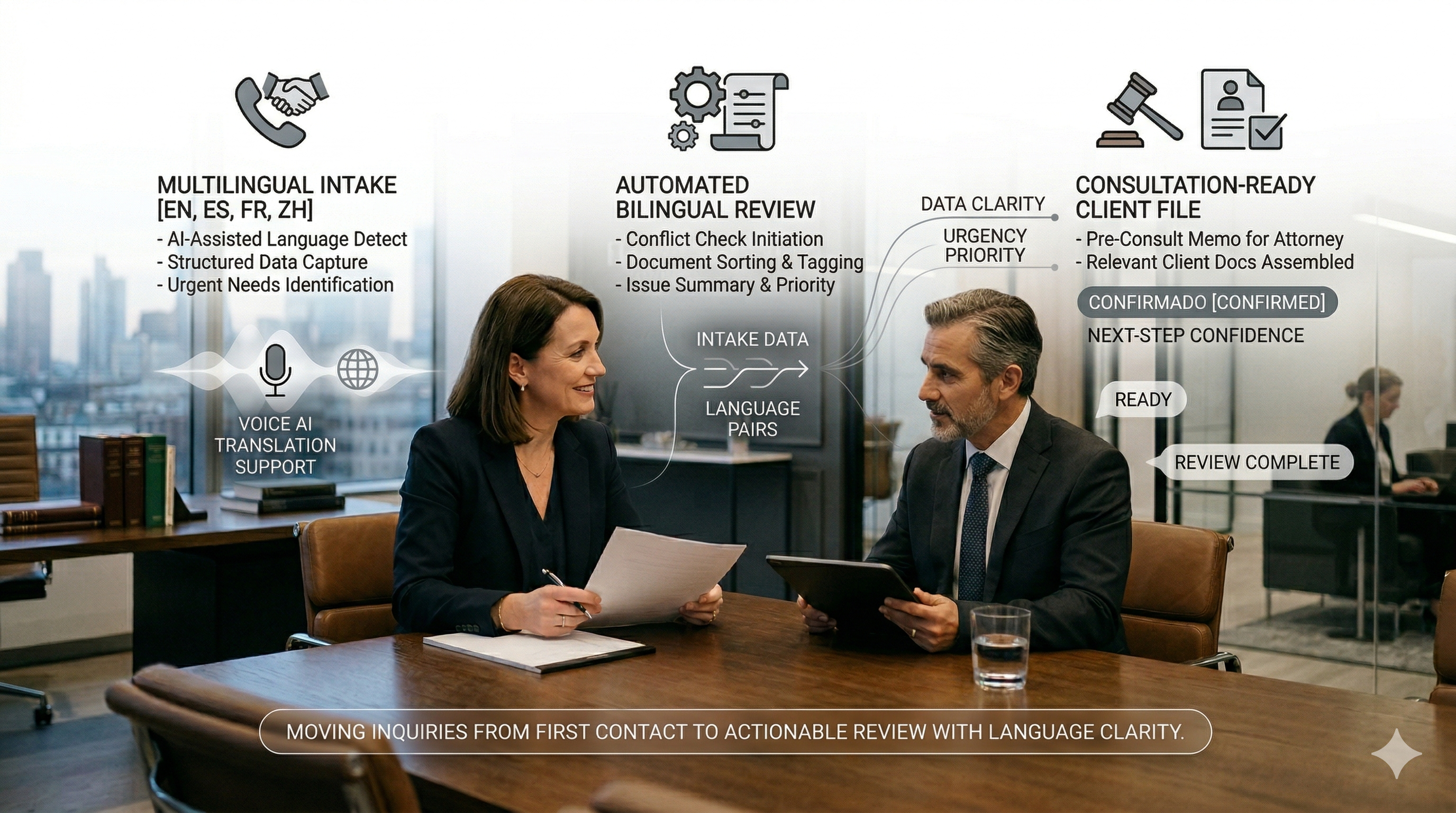
When a caller is trying to explain a legal issue in a preferred language, the first challenge is often not booking. It is being understood clearly enough for the firm to decide what should happen next. Voice AI for bilingual legal intake helps create stronger consultation readiness by preserving multilingual first-contact context before language friction weakens the opportunity. Without that structure, promising inquiries can stall simply because staff do not have enough confidence in what was captured during the first interaction.
Bilingual legal intake AI can support consultation readiness by preserving names, callback details, language preference, broad issue type, urgency, and likely next-step needs in a more structured format. That gives staff a better basis for deciding whether the caller appears ready for consultation, needs a callback from the appropriate team, or should move through another internal path first. Voice AI does not make legal judgments here. It supports multilingual intake clarity so consultation-related decisions begin with stronger context.
Peak Demand treats this as workflow support rather than automated legal screening. Voice AI does not decide whether someone becomes a client or whether the matter has merit. It helps law firms preserve stronger multilingual inquiry context so staff can move more confidently, prioritize more intelligently, and reduce the risk that language barriers cause consultation opportunities to cool off before follow-up begins.
What Better Consultation Readiness Looks Like
- Capturing broad matter context clearly even when the caller prefers another language.
- Preserving urgency and timing signals that support faster prioritization.
- Supporting cleaner handoffs into consultation, callback, or deeper intake review.
- Reducing delay caused by first-contact confusion and language-related intake gaps.
Why Voice AI Matters Here
- Multilingual inquiries are easier to move forward when staff begin with better context.
- Consultation conversion improves when bilingual intake creates less friction.
- Teams lose less time when they do not need to reconstruct basic facts before deciding next steps.
- Better readiness helps protect both responsiveness and caller confidence.
Can bilingual legal intake Voice AI improve consultation readiness?
What kind of information helps before a consultation is considered?
Does Voice AI decide who gets a consultation?
{
  "section": "Consultation Readiness Across Languages",
  "entity": "Peak Demand",
  "page": "Bilingual Legal Intake AI",
  "focus": [
    "Voice AI",
    "consultation readiness",
    "multilingual inquiry context",
    "stronger next-step clarity"
  ]
}
Voice AI for Bilingual Legal Intake Still Matters After Hours When Language Support Is Harder to Provide Consistently
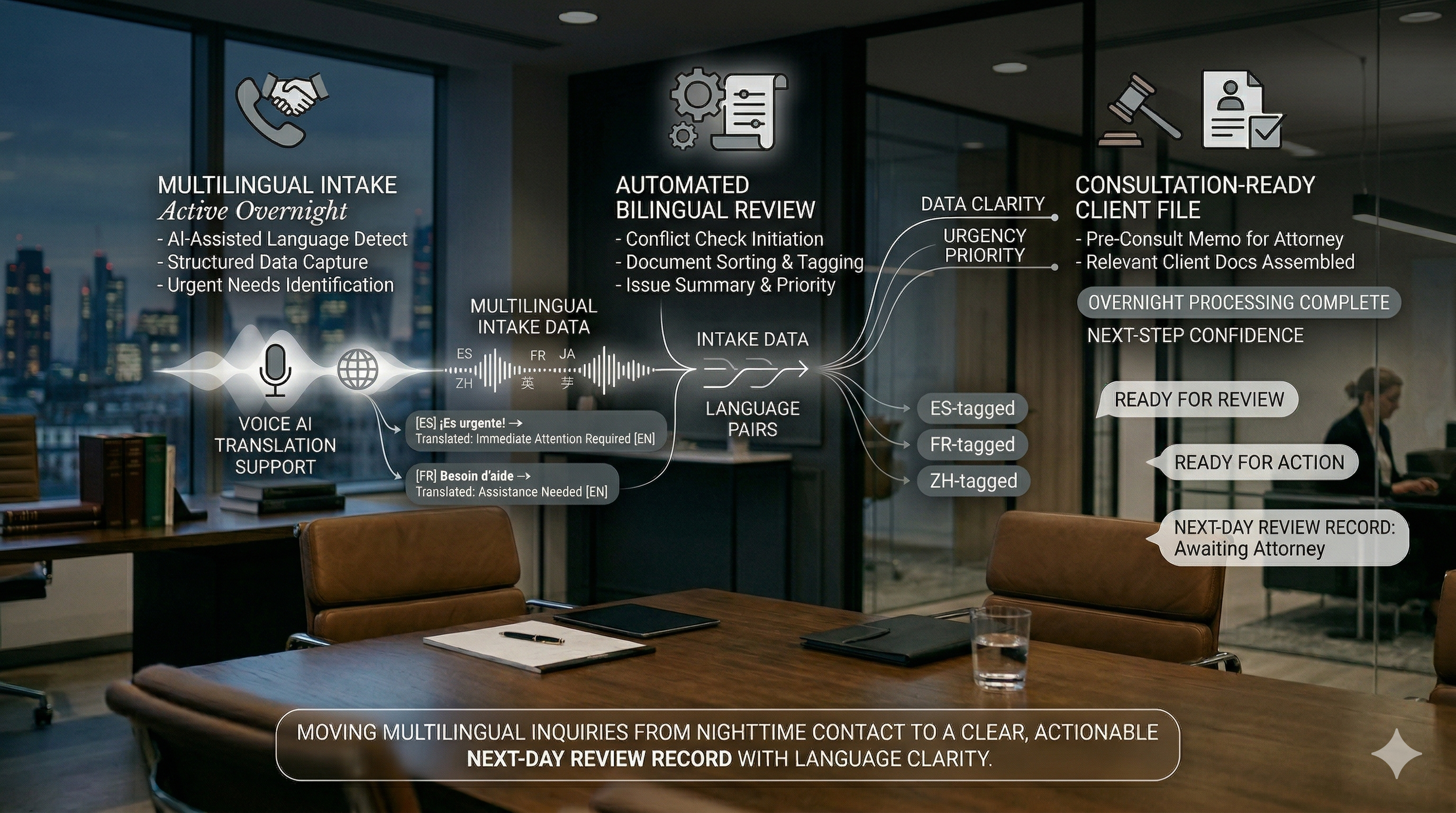
Many multilingual legal inquiries do not arrive at perfect times. They come in during evenings, early mornings, or weekends, when bilingual staff may be unavailable and the firm is more likely to fall back on voicemail or a weak callback promise. Voice AI for bilingual legal intake helps preserve multilingual inquiry quality after hours so the firm does not lose clarity, trust, and opportunity while the office is closed.
Bilingual legal intake AI can support after-hours workflows by preserving caller details, preferred language, broad matter type, urgency, timing context, and likely next-step needs while live staff are unavailable. That gives the firm a much stronger starting point than a missed call or vague voicemail in the wrong language. Voice AI helps create a cleaner multilingual record for next-day review and makes it easier for staff to prioritize promising inquiries more effectively once the business day begins.
Peak Demand treats this as off-hours workflow support rather than overnight legal review. Voice AI should not provide legal advice, imply case assessment, or overstate what has happened. Its role is to preserve stronger multilingual first-contact signals so the firm can make better internal decisions once staff are back online. That makes after-hours bilingual intake one of the most practical ways to reduce missed-opportunity leakage across multilingual communities.
What Better After-Hours Bilingual Intake Can Preserve
- Calls from multilingual prospective clients who reach out outside the standard workday.
- Stronger inquiry context than a typical voicemail often provides.
- Better next-day prioritization through cleaner multilingual intake signals.
- More consistent responsiveness during evenings, mornings, weekends, and holidays.
Why Voice AI Matters After Hours
- Many viable matters begin with a call that happens when bilingual staff are unavailable.
- Weak off-hours capture creates weaker qualification and slower callbacks.
- Potential clients often reach out when they finally have time, privacy, or urgency to act.
- Better overnight multilingual intake helps firms start the next day with a stronger response queue.
Can bilingual legal intake Voice AI work after hours?
Why is after-hours bilingual intake important for law firms?
Does after-hours multilingual intake mean the firm is assessing the case overnight?
{
  "section": "After-Hours Bilingual Intake",
  "entity": "Peak Demand",
  "page": "Bilingual Legal Intake AI",
  "focus": [
    "Voice AI",
    "evening and weekend multilingual intake",
    "off-hours inquiry context",
    "next-day prioritization readiness"
  ]
}
Voice AI for Bilingual Legal Intake Helps Law Firms Create More Consistent Intake Across Different Languages
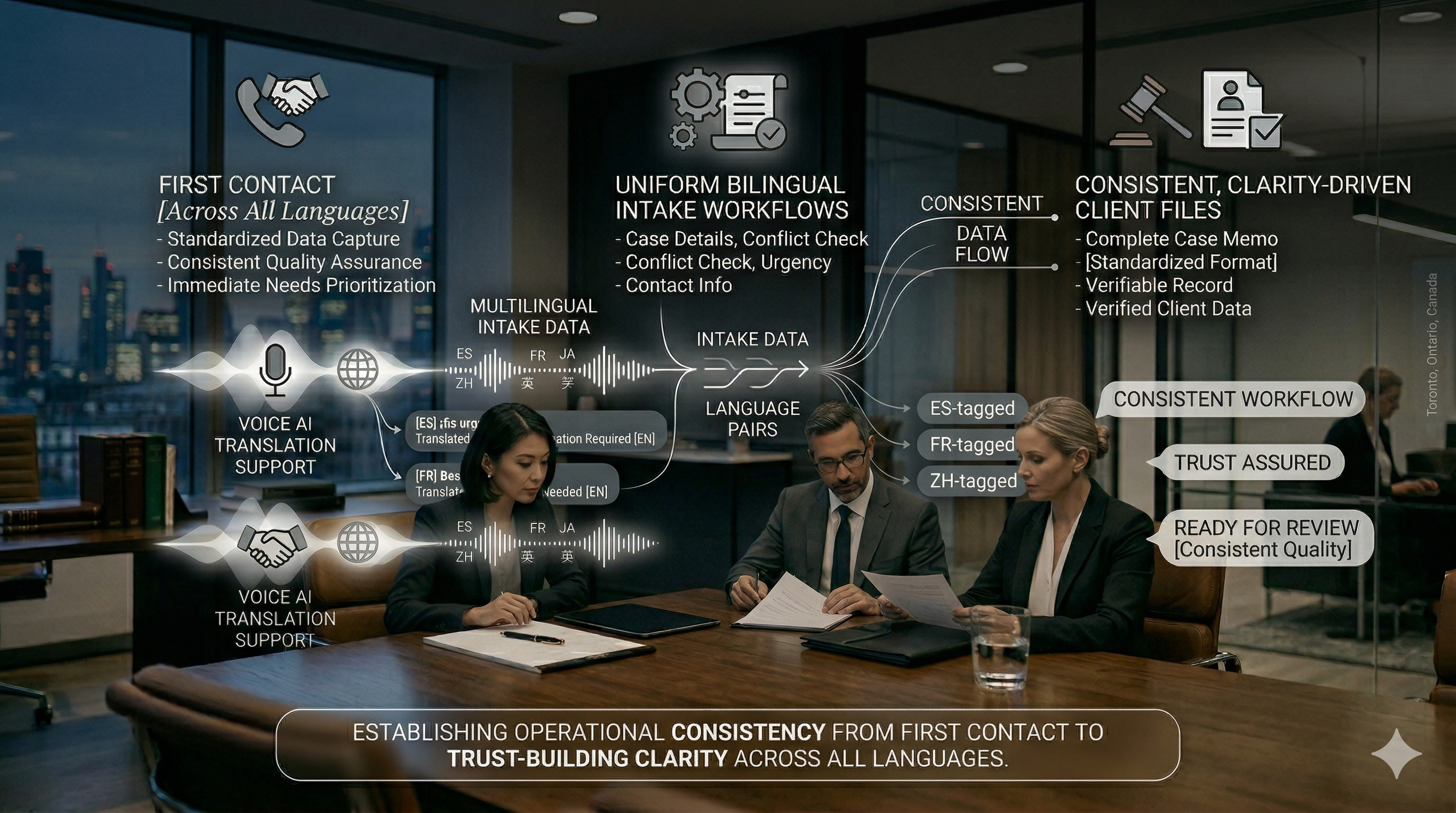
One of the biggest problems in multilingual intake is inconsistency. The quality of the first interaction can change dramatically depending on who answers the phone, whether bilingual support is immediately available, and how comfortable the caller feels explaining the issue in a non-default language. Voice AI helps law firms reduce that inconsistency by creating a more structured bilingual intake process across language preferences.
Bilingual legal intake AI can help preserve the same kinds of first-contact details across different languages: caller identity, callback information, broad issue type, urgency, timing, and likely next-step needs. That does not mean every conversation becomes scripted or generic. It means the firm is more likely to receive clearer, more usable intake information regardless of whether the caller prefers English, French, or another supported language path. Voice AI supports this consistency without pretending to replace the human nuance required in legal communication.
Peak Demand treats multilingual consistency as an operational advantage, not a substitute for bilingual legal professionals. Voice AI is there to improve structure, reduce information loss, and help law firms create a more dependable first-response system. That matters because when intake quality varies too much by language, both accessibility and conversion suffer.
What More Consistent Bilingual Intake Can Improve
- Stronger first-contact records across different language preferences.
- Cleaner capture of names, callback details, issue type, and urgency.
- Less variation in intake quality based on staff availability alone.
- More dependable handoffs into callback, consultation, or review workflows.
Why Voice AI Matters for Consistency
- Multilingual firms often struggle when language support changes by shift or staff member.
- Inconsistent intake quality leads to slower follow-up and more clarification work.
- Better first-contact structure improves both accessibility and team efficiency.
- Consistency helps protect caller confidence during a trust-sensitive first interaction.
Why is consistency such a challenge in bilingual legal intake?
Does bilingual legal intake Voice AI make every conversation feel scripted?
What kind of consistency improvements matter most?
{
  "section": "More Consistent Intake Across Languages",
  "entity": "Peak Demand",
  "page": "Bilingual Legal Intake AI",
  "focus": [
    "Voice AI",
    "multilingual intake consistency",
    "cleaner first-contact records",
    "language support structure"
  ]
}
Voice AI for Bilingual Legal Intake Helps Law Firms Route Multilingual Inquiries With Better Clarity and Less Friction
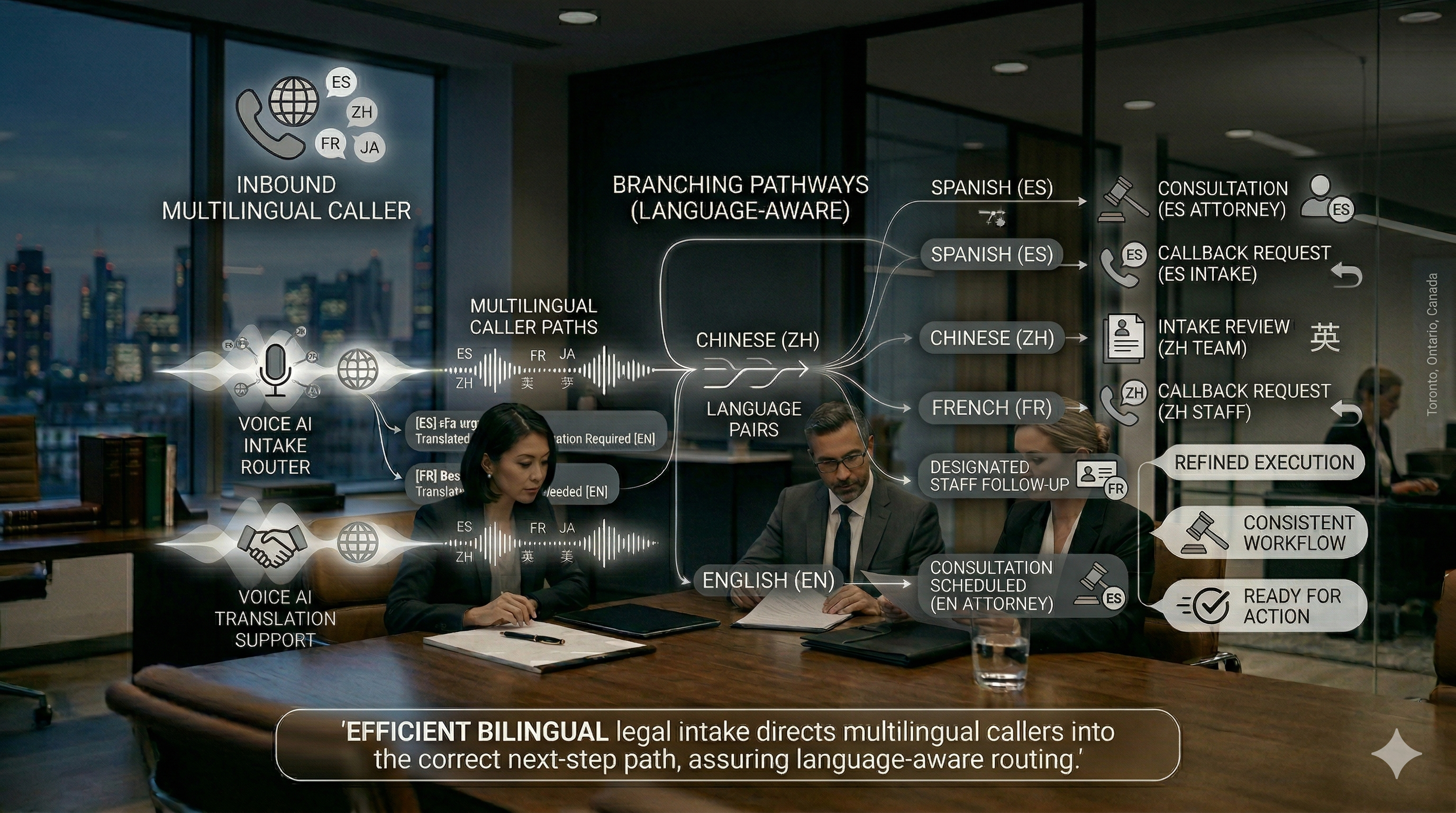
Language support is only part of the intake problem. The firm also needs to decide what should happen next once the caller has been understood. Voice AI for bilingual legal intake helps law firms route multilingual inquiries more effectively by preserving language preference, broad issue context, urgency, and next-step signals in a way staff can act on faster. Without that structure, multilingual callers can end up waiting longer, being transferred more often, or getting weaker first follow-up simply because the routing logic started with less clarity.
Bilingual legal intake AI can support routing into consultations, callbacks, intake review, or another internal path depending on the firm’s workflow and the nature of the inquiry. That does not mean Voice AI is making legal determinations or deciding representation. It means multilingual callers are less likely to be slowed down by first-contact confusion, and staff are more likely to receive a cleaner record that helps them respond appropriately in the right language context.
Peak Demand treats routing as a workflow coordination problem rather than a translation-only problem. Voice AI improves the operational path between first contact and human follow-up by helping the firm preserve enough multilingual context to move the inquiry into the correct lane. For firms serving different language communities, that can materially improve both intake discipline and caller confidence.
What Better Multilingual Routing Can Support
- Cleaner movement into consultation, callback, or intake-review workflows.
- Better preservation of language preference alongside matter context.
- Fewer unnecessary transfers caused by weak first-contact direction.
- More relevant follow-up because staff receive stronger multilingual intake records.
Why Voice AI Matters for Routing
- Multilingual callers should not lose momentum because routing begins with uncertainty.
- Stronger directional context reduces follow-up confusion and internal rework.
- Teams respond faster when inquiry records are clearer from the start.
- Better routing improves both accessibility and operational consistency.
Can bilingual legal intake Voice AI help route inquiries more effectively?
Does Voice AI decide what legal path the caller should take?
Why does routing matter so much in multilingual intake?
{
  "section": "Routing Multilingual Inquiries to the Right Next Step",
  "entity": "Peak Demand",
  "page": "Bilingual Legal Intake AI",
  "focus": [
    "Voice AI",
    "multilingual routing",
    "language-aware next steps",
    "cleaner internal handoffs"
  ]
}
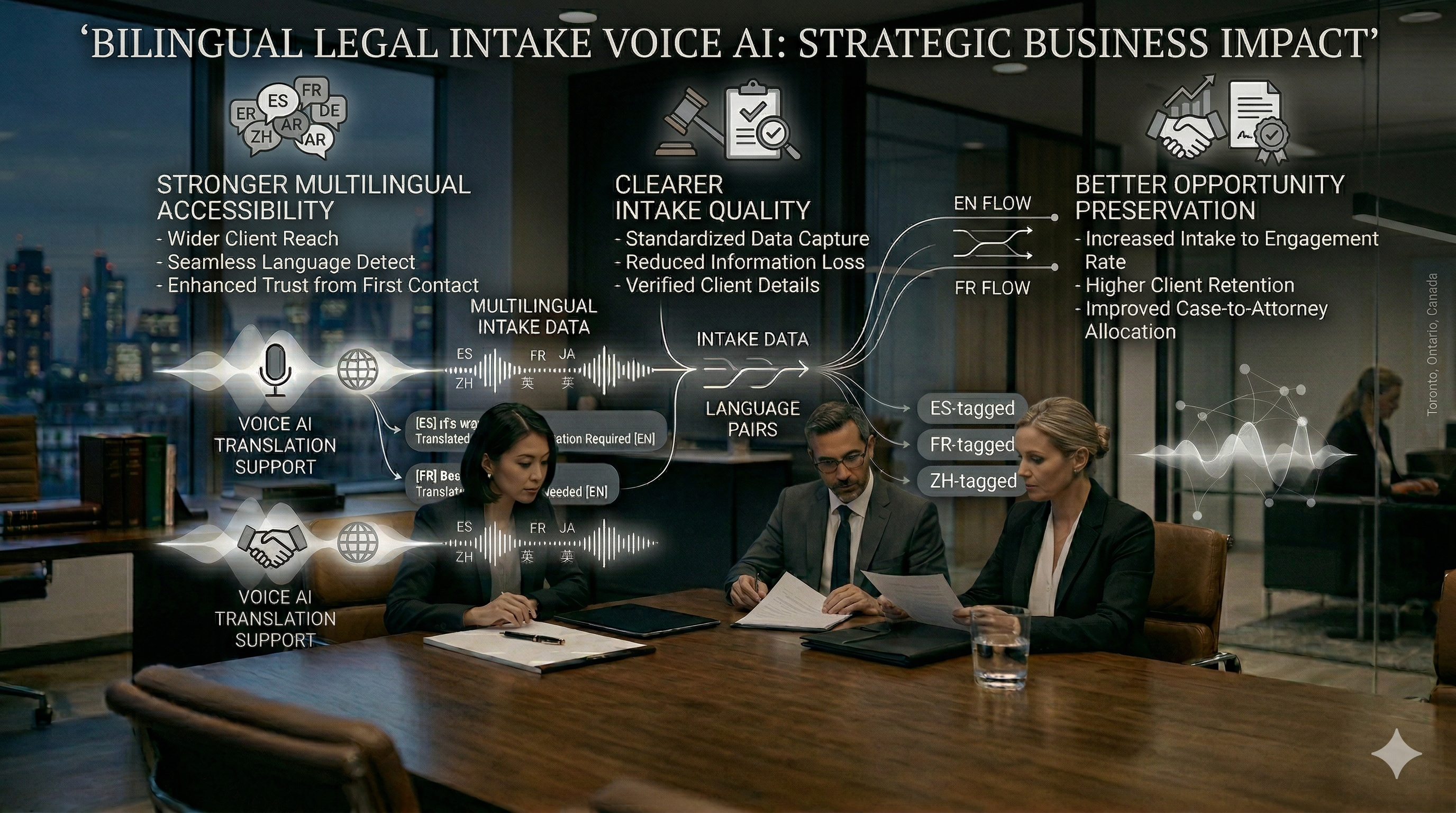
The Business Impact of Voice AI for Bilingual Legal Intake Comes From Better Accessibility, Clearer Intake, and Stronger Opportunity Preservation
For law firms, bilingual intake is not only an accessibility improvement. It also has direct commercial consequences. When multilingual callers cannot explain their issue clearly, when staff need multiple follow-up attempts just to capture the basics, or when language friction makes the firm feel hard to reach, viable opportunities can disappear before deeper intake even begins. Voice AI for bilingual legal intake protects value at the moment where trust, clarity, and responsiveness first overlap.
Bilingual legal intake AI improves business performance by helping firms reduce language-related drop-off, preserve more usable first-contact records, and give staff a cleaner multilingual intake queue to work from. In practical terms, that often means fewer lost opportunities caused by confusion, faster follow-up with better context, less intake cleanup, and stronger consultation readiness across language preferences. The gain is not just better communication. It is stronger operational control over a part of intake that many firms handle inconsistently.
Peak Demand frames the return in practical terms: stronger accessibility, cleaner multilingual intake, better first-response consistency, and reduced friction across callbacks and follow-up. The payoff comes from protecting real opportunities and making multilingual intake feel more dependable, not from treating Voice AI like a novelty feature.
Where Firms Typically Feel the Impact
- Fewer multilingual inquiries lost to first-contact confusion or weak language support.
- Cleaner intake records that reduce rework and improve next-step visibility.
- Less pressure on staff handling repetitive clarification and callback coordination.
- Better preservation of consultation opportunities across language preferences.
Why the ROI Story Fits Bilingual Voice AI
- Many firms already serve multilingual communities but do so inconsistently.
- Clearer intake can directly improve follow-up quality and opportunity retention.
- Administrative bottlenecks create avoidable delay before deeper legal review begins.
- Operational consistency supports growth without making every improvement dependent on more staff coverage.
What is the main business benefit of bilingual legal intake Voice AI?
Is the ROI only about better client experience?
Does this replace the need for human multilingual support?
{
  "section": "Business Impact",
  "entity": "Peak Demand",
  "page": "Bilingual Legal Intake AI",
  "focus": [
    "Voice AI",
    "multilingual accessibility",
    "reduced intake friction",
    "administrative efficiency"
  ]
}
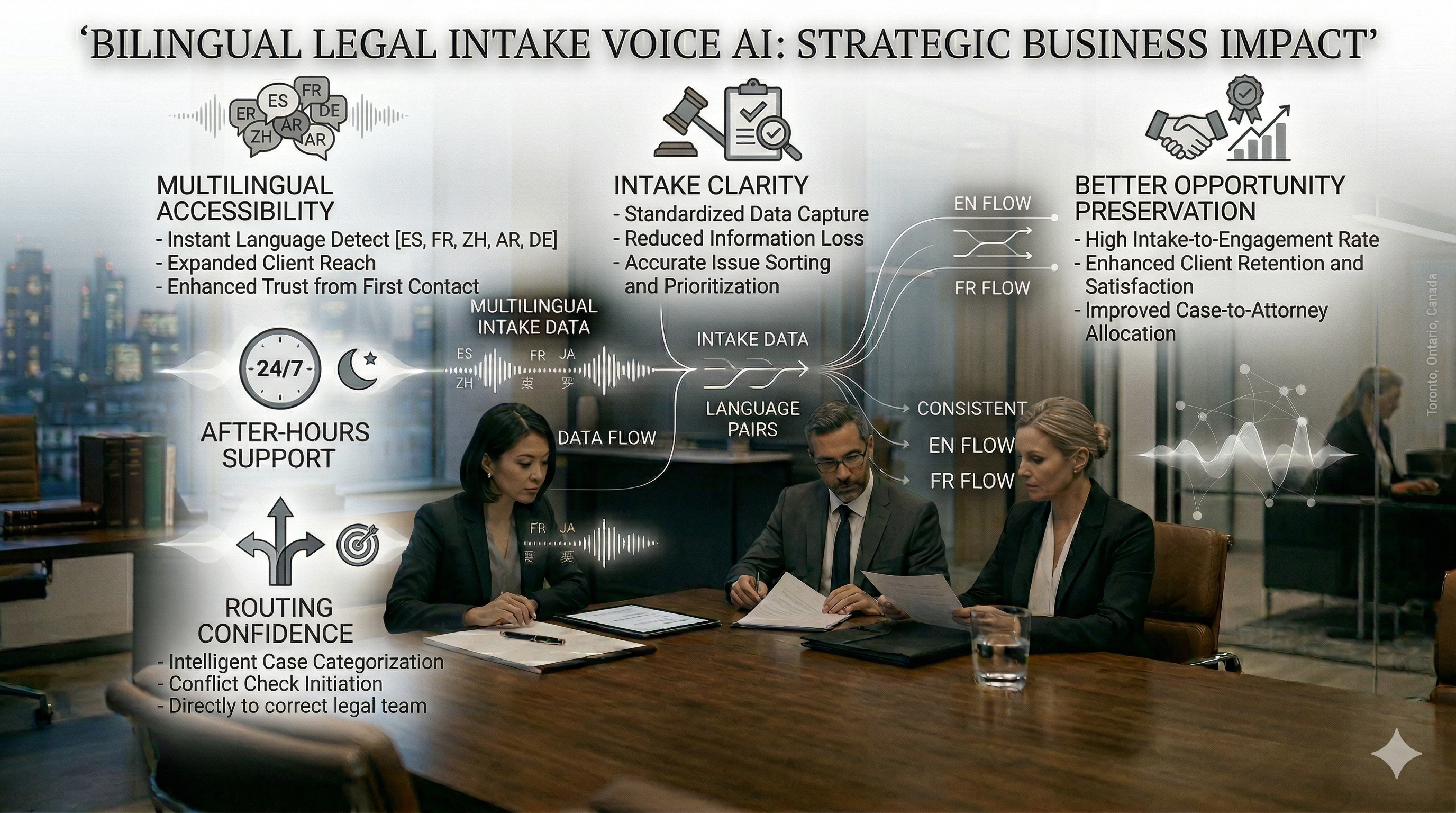
Voice AI Is an Especially Strong Fit for Bilingual Legal Intake Because Language Clarity Shapes Trust at the Earliest Stage
Some firms can tolerate friction at first contact longer than law firms can. Legal inquiries often carry urgency, emotional weight, privacy concerns, and a high need for clarity from the very first conversation. When language support breaks down at that point, the firm does not just lose efficiency. It risks losing trust and opportunity before the real intake process has even started. That makes Voice AI especially valuable here because it improves the communication layer where legal accessibility and first-response quality matter most.
This category is a strong fit because the front-end multilingual tasks themselves are highly repeatable even though the legal work is not. Supporting callers across language preferences, preserving first-contact clarity, capturing core intake details, identifying urgency, and routing the inquiry into the right next step are all operational tasks that benefit from stronger structure. Voice AI helps firms standardize that process without pretending the system is acting like a lawyer or making substantive legal decisions.
Peak Demand sees bilingual legal intake AI as a category fit because the use cases are clear across many practice areas: stronger multilingual accessibility, better intake clarity, cleaner consultation readiness, better after-hours preservation, and more dependable routing. The value is not novelty. It is the ability to make one of the most fragile parts of legal intake far more dependable across language preferences.
Why Voice AI Fits So Well Here
- Many law firms serve multilingual communities where first-contact clarity has real commercial and trust consequences.
- Language barriers can create operational and conversion problems before deeper intake begins.
- Multilingual front-end tasks are repeatable even though legal matters vary by practice area.
- After-hours and busy-period inquiries often need stronger language support rather than more manual process.
What Law Firms Usually Need Most
- More reliable first-contact communication across different language preferences.
- Better intake clarity without making interactions feel rigid or impersonal.
- Support for growth without overwhelming bilingual staff coverage.
- Operational tools that stay within clear legal and professional boundaries.
Why is Voice AI a better-than-average fit for bilingual legal intake?
Does this fit only firms with very large multilingual client bases?
What makes this fit stronger than in some other categories?
{
  "section": "Why the Category Fits So Well",
  "entity": "Peak Demand",
  "page": "Bilingual Legal Intake AI",
  "focus": [
    "Voice AI",
    "category fit",
    "multilingual accessibility",
    "front-end intake improvement"
  ]
}
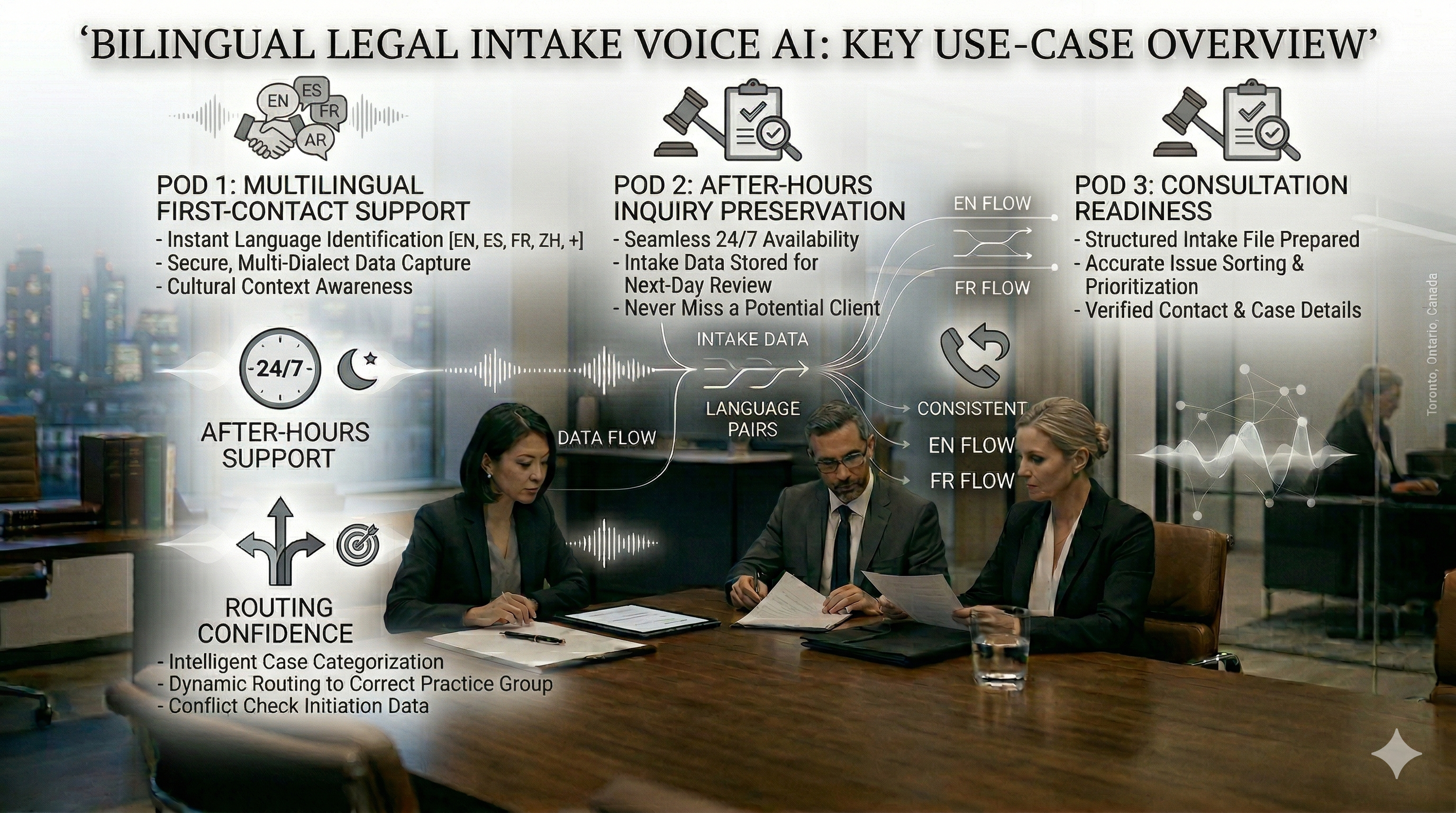
Law Firms Can Use Voice AI for Bilingual Legal Intake Across Intake, Callback, Consultation, and Routing Workflows
Voice AI for bilingual legal intake becomes most valuable when it improves more than one isolated interaction. The stronger opportunity is to create a connected multilingual workflow that begins when a caller first reaches the firm and continues through intake clarity, consultation readiness, callback handling, after-hours support, and routing into the correct next step. The shared goal is not just language support in theory. It is a more dependable multilingual intake system that protects trust and reduces friction across the first-response experience.
Some firms may focus on multilingual first-contact clarity. Others may care more about after-hours support, bilingual callback handling, stronger intake consistency, or cleaner routing once the caller’s preferred language is known. Firms serving communities with mixed language preferences often benefit most from reducing the variation that comes from uneven staff coverage. Voice AI helps create stronger multilingual workflow continuity without forcing the firm into a rigid or generic intake experience.
Peak Demand approaches bilingual legal intake AI as a workflow system rather than a translation gimmick. The objective is to help law firms build a more dependable multilingual intake layer across the parts of first response that most often create confusion, delay, and missed opportunity. That is what makes Voice AI especially useful for firms that want stronger accessibility and stronger intake discipline at the same time.
Common Bilingual Legal Intake Voice AI Use Cases
- Supporting multilingual first-contact communication when callers prefer a non-default language.
- Capturing clearer intake details before staff begin deeper review or follow-up.
- Preserving after-hours multilingual inquiries for stronger next-day response.
- Helping route callers into consultation, callback, or another internal path with better context.
Operational Areas That Benefit Most
- Front-end intake for firms serving multilingual communities.
- Initial information capture before consultation or callback begins.
- Internal routing and handoffs where language preference affects next steps.
- Reduction of missed-opportunity leakage caused by weak multilingual support.
What are the main use cases for bilingual legal intake Voice AI?
Can the use cases vary by firm?
Is bilingual legal intake Voice AI only useful for larger firms?
{
  "section": "Common Use Cases",
  "entity": "Peak Demand",
  "page": "Bilingual Legal Intake AI",
  "focus": [
    "Voice AI",
    "multilingual use cases",
    "consultation and callback support",
    "front-end workflow coverage"
  ]
}
Build a More Dependable Bilingual Legal Intake Workflow With Voice AI
If your law firm is struggling with language-related intake friction, inconsistent multilingual support, weak after-hours communication, or too much variation in first-contact quality across different languages, Voice AI for bilingual legal intake can help create a more dependable front-end workflow. The goal is not to replace lawyers, bilingual staff, or legal judgment. It is to give your firm a stronger system for supporting multilingual callers, preserving first-contact clarity, and moving people into the right next step with more consistency.
Peak Demand helps law firms design bilingual legal intake Voice AI workflows around real legal communication and intake operations rather than generic translation scripts. That includes multilingual first-contact support, consultation readiness, callback handling, after-hours preservation, and routing logic that fits how legal practices actually work. If you want stronger multilingual accessibility without sacrificing professionalism, this is where the conversation starts.
The best deployment is one that reflects how your firm actually works: which language paths matter most, what intake details need to be preserved early, how after-hours multilingual inquiries should be handled, what requires staff escalation, and where your team is losing time to preventable communication friction. That is the level Peak Demand is built to support.
What Peak Demand Can Help You Improve
- Multilingual first-contact clarity and cleaner intake support.
- Stronger structure for bilingual consultation, callback, and routing workflows.
- After-hours multilingual inquiry preservation and follow-up readiness.
- Voice AI logic that reflects your real communication and intake model.
Why Firms Reach Out
- Multilingual callers are experiencing weak first-contact clarity.
- Bilingual staff coverage is inconsistent across different times of day.
- Language-related friction is slowing consultations and callbacks.
- After-hours multilingual inquiries are not being preserved cleanly enough.
Is this only for firms with very large multilingual intake volume?
Does Peak Demand build around the firm’s specific bilingual intake workflow?
Will this replace bilingual legal staff?
{
  "section": "CTA",
  "entity": "Peak Demand",
  "page": "Bilingual Legal Intake AI",
  "focus": [
    "Voice AI",
    "commercial conversion",
    "multilingual intake operations",
    "callback and routing support"
  ]
}
Voice AI for Bilingual Legal Intake Should Operate Within a Clear Communications, Privacy, and Workflow Governance Framework
Bilingual intake in a law firm often involves sensitive information being shared across language preferences before a lawyer has formally reviewed the matter. A caller may disclose family conflict, criminal allegations, immigration concerns, employment issues, estate matters, financial disputes, or other confidential facts while simply trying to be understood clearly. That is why Voice AI for bilingual legal intake should be treated as a governed workflow rather than a convenience feature.
For Canadian firms, that generally means thinking carefully about privacy and communications obligations under frameworks such as PIPEDA and guidance from the Office of the Privacy Commissioner of Canada, while also accounting for telecommunications and telemarketing rules where relevant. For firms serving U.S. callers or operating across borders, governance may also intersect with TCPA, FCC, FTC, and state-level call recording consent requirements. The point is not to turn multilingual intake into a legal treatise. It is to recognize that Voice AI-supported bilingual communication still touches regulated communication practices and should be designed accordingly.
Peak Demand frames governance here as a practical operating requirement: define what information should be captured, how multilingual disclosures are handled, how intake records and call notes are stored, when escalation occurs, and how staff maintain oversight. Law firms do not need vague multilingual automation. They need disciplined implementation that respects privacy, communications rules, and the seriousness of legal inquiries across language preferences.
Governance Areas That Matter Most
- Privacy-aware handling of multilingual first-contact and intake information.
- Clear rules for disclosures, transparency, and communication boundaries.
- Review of call recording and consent requirements across relevant jurisdictions.
- Defined escalation logic and staff oversight for sensitive or high-priority inquiries.
Operational Questions Firms Should Answer
- What intake information should be captured early and what should wait?
- How should multilingual disclosures be communicated at first contact?
- How are bilingual intake records, transcripts, and notes stored and reviewed?
- Which privacy, telecommunications, and recording rules apply to the firm’s footprint?
Why does governance matter for bilingual legal intake Voice AI?
Does this mean the system handles compliance automatically?
What regulations are commonly relevant in this context?
{
  "section": "Governance and Regulatory Context",
  "entity": "Peak Demand",
  "page": "Bilingual Legal Intake AI",
  "focus": [
    "Voice AI",
    "privacy-aware multilingual intake",
    "operational governance",
    "recording and consent considerations"
  ]
}
Responsible Voice AI for Bilingual Legal Intake Needs Clear Limits, Human Oversight, and No Legal Advice
Law firms cannot afford ambiguity about what Voice AI is doing in a bilingual intake workflow. The system should support multilingual first-contact communication, intake clarity, callback readiness, consultation movement, and routing. It should not provide legal advice, assess claim strength, recommend legal strategy, determine whether a caller has a valid case, decide whether the firm should represent the person, or imply that a legal conclusion has already been reached simply because the conversation was handled smoothly in the caller’s preferred language. Those boundaries are central to responsible deployment.
A responsible bilingual legal intake AI model keeps lawyers and staff in control of legal judgment, intake review, escalation, and representation decisions. Voice AI can preserve multilingual first-contact information, improve consistency across language preferences, and prepare cleaner handoffs, but it must stay inside defined operational limits. That includes transparency about the nature of the interaction, careful handling of sensitive intake details, and escalation pathways when a multilingual caller needs human review before any next step should be assumed.
Peak Demand positions responsible AI as a practical operating principle rather than a marketing slogan. The goal is to make bilingual legal intake more dependable without creating confusion about the role of the system. In legal services, trust is shaped early, and that trust becomes even more sensitive when language support is part of the interaction. Firms need Voice AI implementation that sounds professional, behaves predictably, and reinforces that lawyers and staff remain accountable for the legal relationship and every substantive decision.
What Responsible Deployment Includes
- No legal advice, legal conclusions, or strategy recommendations from Voice AI.
- No autonomous representation decisions or matter-merit determinations.
- Clear escalation paths when a multilingual inquiry needs human attention before moving forward.
- Defined communication boundaries and reviewable workflow rules.
What Should Stay With the Firm
- Lawyer judgment and matter-specific legal analysis.
- Conflict checks, representation decisions, and engagement steps.
- Staff review of sensitive, unusual, or higher-priority multilingual inquiries.
- Oversight of privacy, communications, and caller-experience standards.
Can bilingual legal intake Voice AI give legal advice?
Can the system decide whether a matter is legally strong?
What makes bilingual legal intake Voice AI responsible in a law firm setting?
{
  "section": "Responsible AI for Multilingual Legal Communication",
  "entity": "Peak Demand",
  "page": "Bilingual Legal Intake AI",
  "focus": [
    "Voice AI",
    "no legal advice",
    "human oversight",
    "clear operational boundaries",
    "responsible multilingual intake deployment"
  ]
}
Frequently Asked Questions About Bilingual Legal Intake AI and Voice AI for Law Firms
Law firms usually ask practical questions before improving bilingual legal intake. They want to know whether Voice AI can help multilingual callers communicate more clearly, preserve stronger first-contact details, improve consultation readiness, reduce weak after-hours capture, and support cleaner routing without crossing legal lines. They also want clarity on where the system stops and where staff and lawyers remain fully in control.
That is the right way to evaluate the category. Bilingual legal intake AI should be judged on communication quality, operational usefulness, and responsible deployment rather than novelty. The strongest Voice AI implementation helps the firm support multilingual callers more clearly and move stronger opportunities forward without blurring the line between workflow support and legal judgment.
The questions below cover the issues law firms most commonly think through when evaluating multilingual intake, consultation readiness, after-hours bilingual support, routing, and governance.
What Firms Usually Want to Confirm
- Whether bilingual legal intake Voice AI can help multilingual callers explain their needs more clearly.
- How it supports intake and routing without giving legal advice.
- Whether it helps reduce missed opportunities caused by language-related friction.
- How staff oversight, escalation, and governance remain in place.
What This FAQ Reinforces
- Bilingual legal intake AI is an operational support layer, not a substitute for lawyers or staff.
- Law firms are a strong fit because language clarity, trust, and first-response quality often overlap.
- Consultation readiness, after-hours support, routing, and intake consistency are core use cases.
- Responsible deployment depends on clear limits, privacy awareness, and human review.
What does bilingual legal intake Voice AI actually do?
Can it help multilingual callers move toward consultation faster?
Can bilingual legal intake Voice AI help after hours?
Does bilingual legal intake AI replace bilingual staff?
Can Voice AI give legal advice or decide whether the firm should take the matter?
Why is bilingual legal intake AI such a strong fit for law firms?
Can it support different follow-up paths depending on the caller and language context?
What should firms evaluate before deploying bilingual legal intake Voice AI?
{
  "section": "FAQ",
  "entity": "Peak Demand",
  "page": "Bilingual Legal Intake AI",
  "focus": [
    "Voice AI",
    "multilingual intake",
    "consultation readiness",
    "after-hours support",
    "routing",
    "responsible deployment"
  ]
}
Explore your own AI use case on a discovery call.