
Legal Intake Automation: Voice AI Intake Support, Lead Qualification, Consultation Scheduling, and Faster First-Response Workflows

Legal intake breaks down when inquiries come in faster than staff can respond, when basic matter details are captured inconsistently, or when callbacks and consultation follow-up start piling up across the day. For many firms, that means lost opportunities, slower response times, weaker handoffs, and front-desk teams spending too much time on repetitive first-response work instead of moving qualified inquiries into the right next step. Legal intake automation helps create a more structured, dependable intake process from the very first call.
For Peak Demand, legal intake automation is not about replacing lawyers or turning client acquisition into a cold workflow. It is about helping law firms capture inquiries more consistently, support lead qualification, improve consultation scheduling, strengthen routing, and reduce missed opportunities during busy hours and after-hours periods. A better intake system helps firms respond faster, stay more organized, and protect revenue opportunities while keeping legal judgment, matter review, and representation decisions firmly in human hands.
Law Firms Need a More Structured Way to Capture, Organize, and Move New Inquiries Forward
Many law firms do not lose opportunities because there is no demand. They lose them because intake is inconsistent. A prospective client calls, leaves partial information, waits too long for a callback, or reaches the wrong person. Staff may gather different details depending on who answers. Consultations may be delayed because the intake path is fragmented. When intake is disorganized, the firm pays for it in slower response times, weaker handoffs, and missed revenue opportunities.
This is why legal intake automation is such a strong operational fit for law firms. Firms need a more dependable way to capture first-contact details, identify the broad reason for the inquiry, support qualification, and move the caller into the right next step without relying entirely on live staff availability or inconsistent manual processes. A well-structured intake workflow helps create faster response, cleaner information capture, and better coordination across intake, scheduling, and follow-up.
Peak Demand positions legal intake automation as workflow support, not legal judgment. The role is to help firms capture inquiries more consistently, reduce intake friction, support consultation flow, and preserve opportunities that might otherwise disappear during busy periods or after hours. Across legal practice areas, that makes intake automation especially practical because the operational intake problem is often similar even when the legal matters themselves differ.
Why the Workflow Fits
- Many legal inquiries begin with repeatable first-contact information that should be captured consistently.
- Law firms often depend too heavily on manual note-taking and live staff availability during intake.
- Consultation-driven practices need stronger structure before a matter is formally opened.
- After-hours or missed inquiries can represent viable matters that never make it into the firm’s pipeline properly.
What Firms Typically Need From Intake
- Clear collection of caller details, issue type, timing, and next-step needs.
- More consistent qualification support before staff review the matter.
- Cleaner routing into scheduling, callback, or internal follow-up workflows.
- Less administrative friction across intake, reception, and consultation coordination.

Why is legal intake automation such a strong fit for law firms?
Does intake automation only help high-volume firms?
Does this replace intake staff?
{
  "section": "Why Legal Intake Automation Is a Strong Fit",
  "entity": "Peak Demand",
  "page": "Legal Intake Automation",
  "focus": [
    "structured inquiry capture",
    "cleaner intake workflows",
    "consultation-driven process",
    "missed-opportunity reduction"
  ]
}
Legal Intake Automation Helps Law Firms Capture Better Information, Support Qualification, and Move Inquiries Faster
Legal intake automation gives a firm a more dependable way to manage what happens between the first call and the first real internal review. Instead of relying entirely on voicemail, scattered notes, or whoever happens to answer the phone, the firm gets a more structured intake layer that can capture key information, identify the broad purpose of the inquiry, support qualification, and prepare the interaction for the right next step. That matters because strong intake is often what determines whether a firm responds quickly and professionally or loses momentum before follow-up even begins.
For law firms, the value is not only speed. It is also consistency. Intake automation can help standardize how first-contact details are collected, reduce incomplete or fragmented handoffs, support more organized consultation scheduling, and create a cleaner flow into routing and follow-up. Some callers need a consultation. Some need a callback. Some need to be routed elsewhere. A better intake system helps the firm manage those paths more predictably without turning intake into a robotic experience.
Peak Demand frames legal intake automation as operational infrastructure rather than substitute legal work. The system does not assess legal merit, recommend strategy, or decide representation. It supports the early communication and information-capture tasks that sit in front of legal review. That makes it especially valuable for firms that want stronger intake quality without adding more front-desk pressure or administrative sprawl.
What Legal Intake Automation Can Help Handle
- Capturing names, callback details, issue type, timing, and broad next-step needs.
- Supporting more consistent intake before staff review the inquiry.
- Helping move inquiries into consultation, callback, routing, or follow-up workflows.
- Reducing missed information caused by voicemail, rushed notes, or inconsistent front-desk handling.
Why This Matters Across Law Firms
- Many firms lose opportunities because intake arrives incomplete or too late.
- Staff time is often drained by repetitive first-response and intake cleanup work.
- Missed or disorganized intake can hurt both conversion and client confidence.
- A more standardized intake handoff improves follow-up quality across the team.

What does legal intake automation actually do?
Can it support both consultations and callbacks?
Does intake automation replace legal staff?
{
  "section": "What Legal Intake Automation Does",
  "entity": "Peak Demand",
  "page": "Legal Intake Automation",
  "focus": [
    "intake capture",
    "qualification support",
    "workflow movement",
    "front-end legal operations"
  ]
}
Legal Intake Automation Helps Law Firms Move Qualified Inquiries Into Consultation Workflows Faster
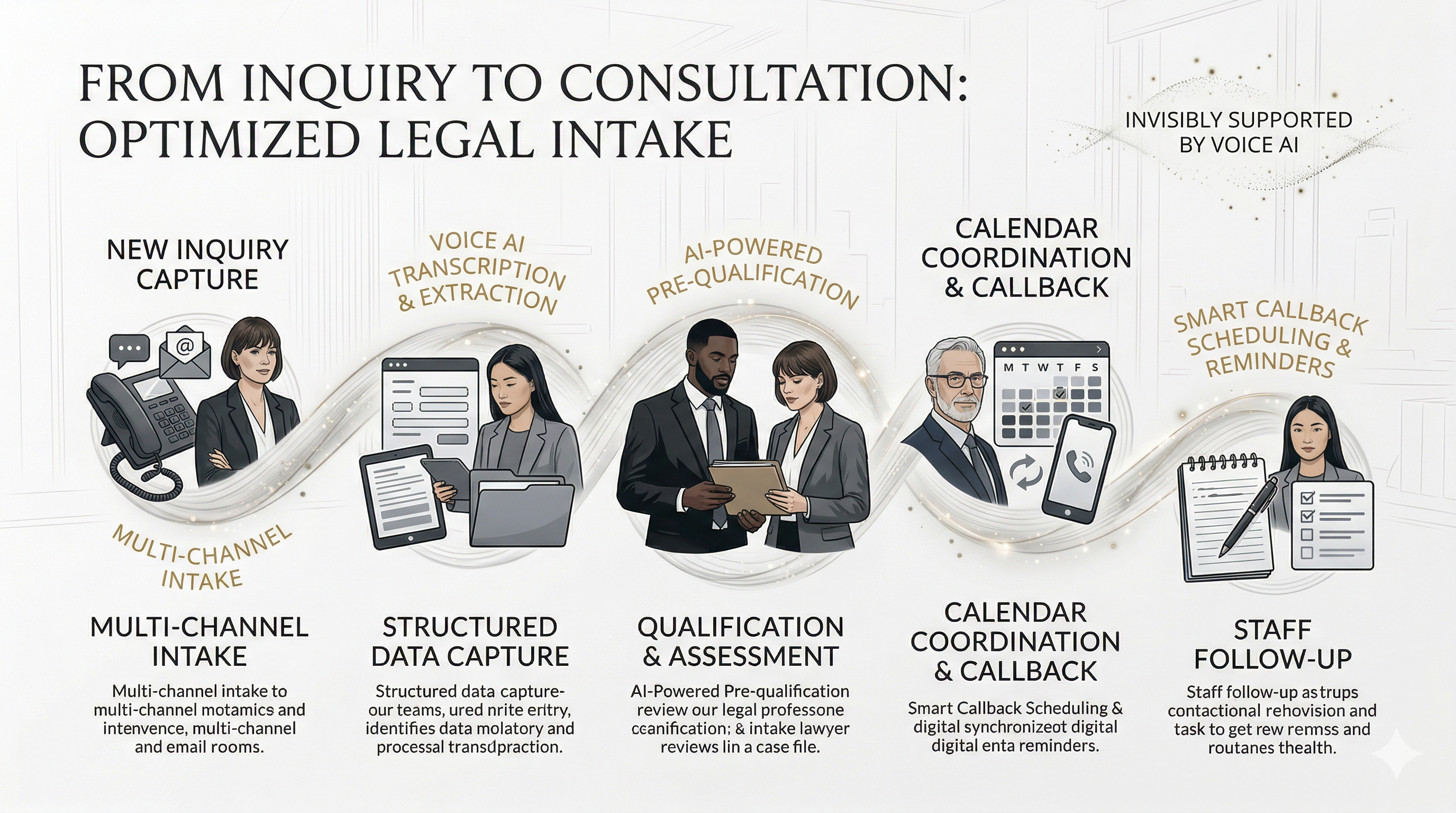
For many firms, intake and consultation scheduling are tightly linked. The problem is that scheduling often starts before the firm has enough context, or it starts too late because intake details are incomplete and staff have to reconstruct the situation first. That slows down the path from inquiry to appointment and creates unnecessary friction for both the firm and the prospective client. A stronger intake process makes consultation scheduling easier because the workflow begins with better information.
Legal intake automation can support consultation flow by collecting the purpose of the inquiry, confirming contact details, capturing timing and urgency, and helping determine whether the person appears to need an initial consultation, a callback, or another next step. This creates a cleaner bridge between first contact and calendar coordination. Instead of asking staff to start from scratch after every missed call or incomplete handoff, the firm gets a more structured intake record that supports faster follow-up.
Peak Demand positions this as intake-to-scheduling support rather than automated client acceptance. The system does not decide whether the firm should take the matter or whether a consultation should be approved. It helps create a better operational path so qualified inquiries move forward faster and staff can coordinate scheduling with better context and less administrative drag.
What Better Intake-to-Scheduling Support Looks Like
- Capturing the purpose of the inquiry before staff begin the booking process.
- Identifying whether the caller is seeking an initial consultation, callback, or another type of follow-up.
- Supporting cleaner handoffs into calendar coordination and consultation review.
- Reducing delays caused by voicemail gaps, incomplete notes, or fragmented intake workflows.
Why This Matters in Legal Intake
- Many firms depend on speed at the moment a prospective client is deciding whether to move forward.
- Scheduling teams work better when intake arrives with more context and less ambiguity.
- Better intake structure protects conversion without making the process feel impersonal.
- Consultation flow improves when the firm separates information capture from legal review more effectively.
Can legal intake automation help with consultation scheduling?
Does intake automation book consultations automatically?
Why does better intake improve scheduling?
{
  "section": "Consultation Scheduling Through Intake Automation",
  "entity": "Peak Demand",
  "page": "Legal Intake Automation",
  "focus": [
    "intake-to-calendar coordination",
    "qualified inquiry movement",
    "cleaner staff handoffs",
    "faster consultation workflow"
  ]
}
Legal Intake Automation Helps Law Firms Capture Better Information Even When the Office Is Closed
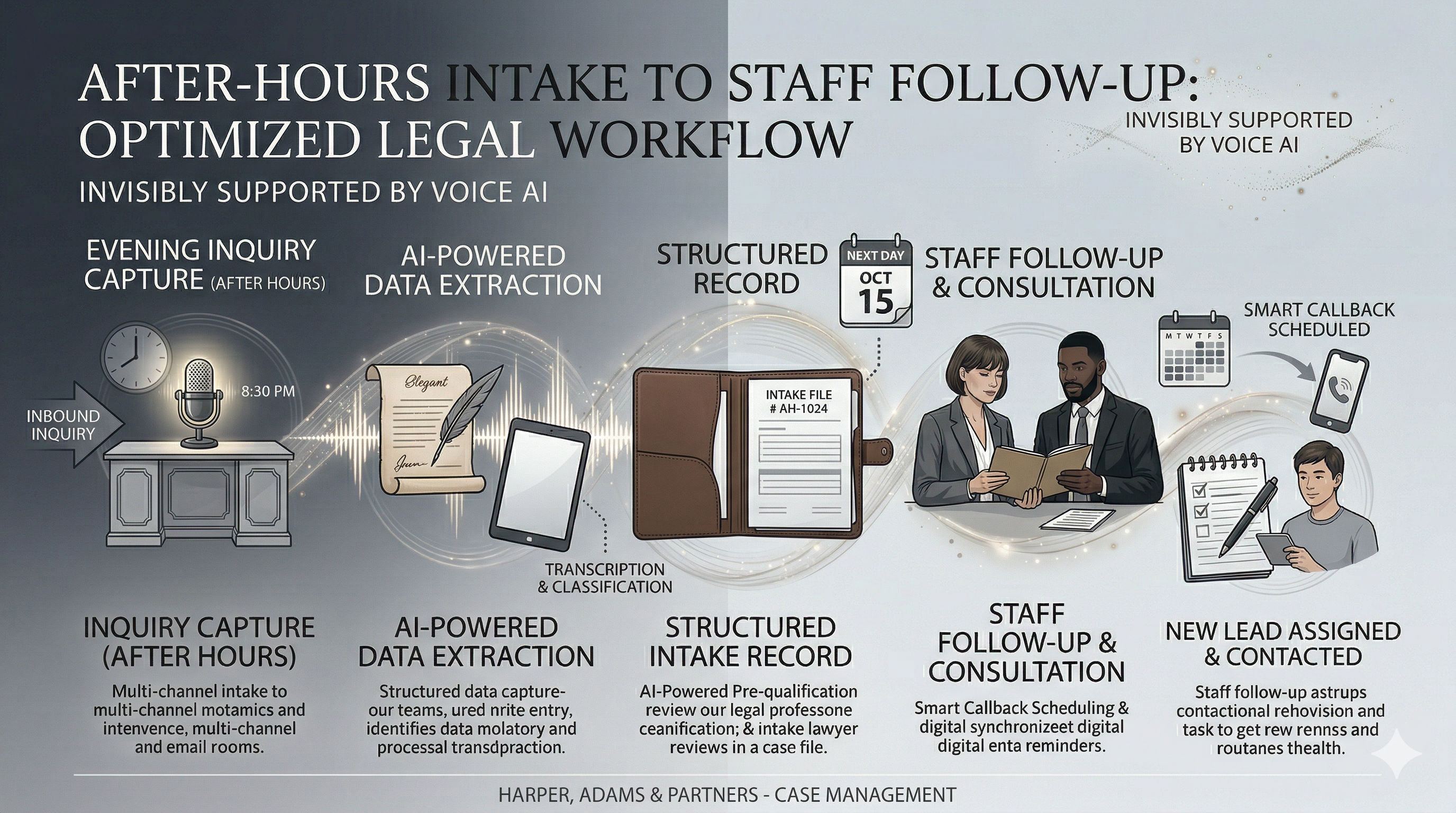
Many legal inquiries arrive outside normal business hours, and those calls are often some of the most vulnerable to being lost. A prospective client reaches out in the evening, leaves partial information, and never hears back quickly enough. Or they decide not to leave a voicemail at all. When after-hours intake is weak, firms do not just miss a phone call. They miss the chance to capture enough information to follow up effectively the next day. That makes after-hours intake quality a core part of revenue protection.
Legal intake automation can support after-hours workflows by helping the firm gather contact details, the broad nature of the matter, timing context, and next-step needs while the office is closed or staff are unavailable. That gives the intake team something more useful than a short voicemail or a missed-call log. It creates a cleaner record for review and allows the firm to begin the next day with better visibility into what came in overnight.
Peak Demand treats this as an operational extension of intake rather than a substitute for legal follow-up. The system should not provide legal advice, imply representation, or make promises about outcomes. Its role is to capture and organize the inquiry so staff can review it properly when they return to the workflow. That makes after-hours intake automation one of the most practical ways to reduce missed-opportunity leakage across the intake system.
What Better After-Hours Intake Can Preserve
- Calls from prospective clients who reach out outside the standard workday.
- More complete contact and issue information than a typical voicemail often provides.
- Stronger next-day follow-up through cleaner intake records and context.
- More consistent responsiveness during evenings, mornings, weekends, and holidays.
Why This Matters in Legal Intake
- Many viable matters begin with a call that happens when staff are unavailable.
- Unstructured after-hours capture creates weak handoffs and slower callbacks.
- Potential clients often reach out when they finally have time, privacy, or urgency to act.
- Better overnight intake visibility helps firms start the next day with a stronger response queue.
Can legal intake automation work after hours?
Why is after-hours intake so important for law firms?
Does after-hours intake automation mean the firm is taking action immediately?
{
  "section": "After-Hours Intake Capture",
  "entity": "Peak Demand",
  "page": "Legal Intake Automation",
  "focus": [
    "evening and weekend intake capture",
    "off-hours inquiry support",
    "next-day follow-up readiness",
    "missed-opportunity reduction"
  ]
}
Legal Intake Automation Helps Law Firms Organize Qualified Inquiries Before Staff Review the Matter
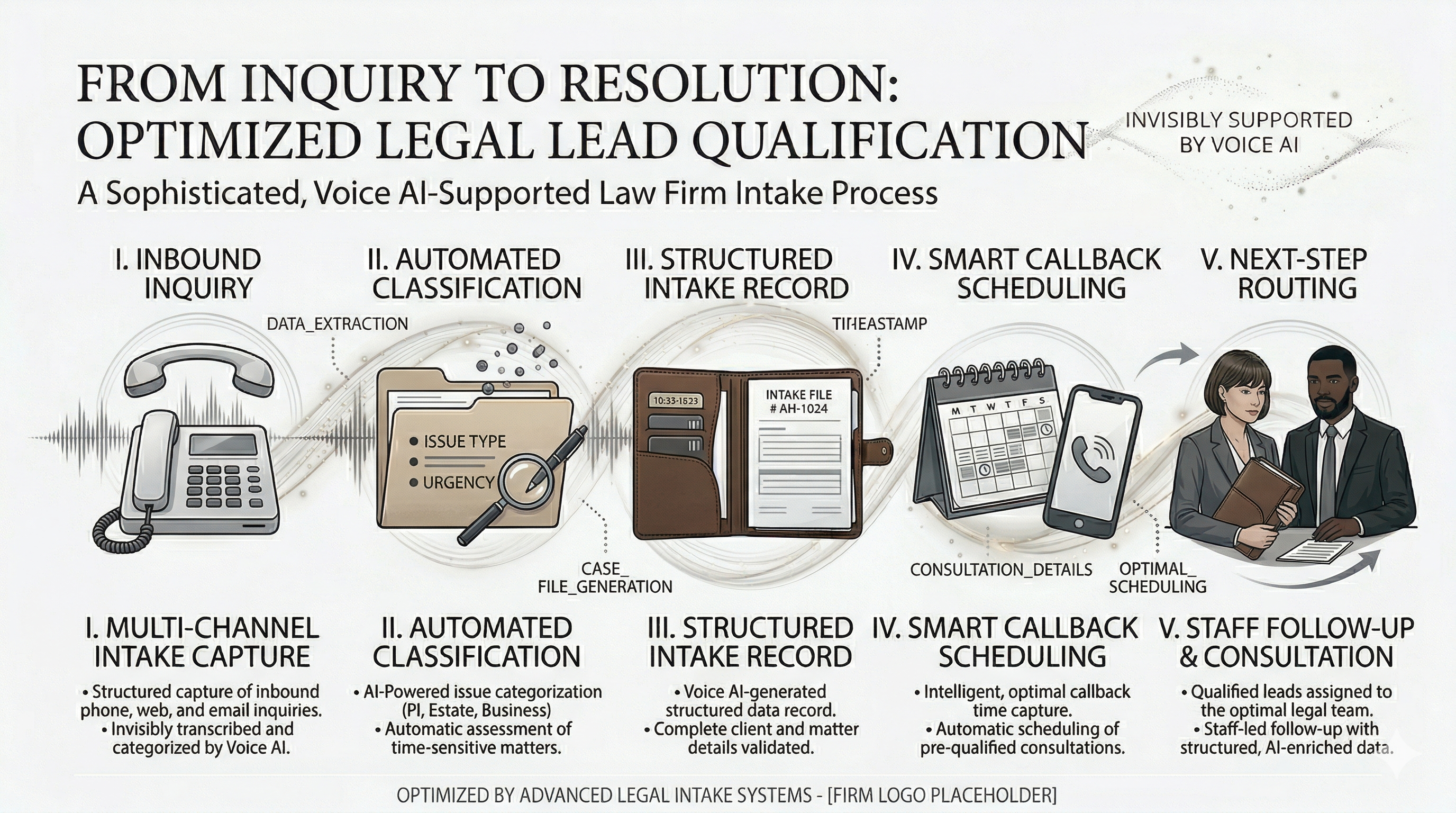
A legal inquiry is not useful to the firm just because it made contact. The firm still needs enough structure around that inquiry to understand what kind of follow-up is needed, whether the matter appears to fit the practice, how urgent the response may be, and what next step should happen internally. When qualification depends entirely on scattered notes, inconsistent call handling, or a rushed callback later, firms lose time and clarity. Qualification improves when intake arrives in a cleaner, more reviewable format.
Legal intake automation can support qualification by helping capture the caller’s details, the broad issue type, timing context, urgency signals, and whether the person appears to be seeking a consultation, a callback, or another type of response. This does not mean the system decides merit or representation. It means the intake team starts from a stronger operational baseline. Instead of chasing missing facts, staff can review more structured information and move the inquiry into the right next-step workflow faster.
Peak Demand positions this as qualification support rather than automated legal screening. The system does not decide whether a claim is strong, whether the matter should be accepted, or what legal strategy applies. It helps the firm collect, organize, and present first-contact information in a way that supports better internal triage and better staff coordination. That is especially valuable when intake volume is uneven and response quality matters commercially.
What Better Qualification Support Can Capture
- Caller identity, callback details, and broad matter category.
- Timing context, urgency indicators, and next-step expectations.
- Cleaner separation between consultation-driven inquiries and other call types.
- More consistent intake records before staff begin review and follow-up.
Why This Matters in Legal Intake
- Staff review works better when the intake record is more structured from the start.
- Firms lose time when they have to reconstruct basic inquiry details manually.
- Qualification support improves responsiveness without crossing into legal advice.
- Cleaner triage helps the firm protect both conversion and operational discipline.
Can legal intake automation help qualify leads?
What kind of information helps with qualification?
Is this the same as automated legal screening?
{
  "section": "Lead Qualification Through Intake Automation",
  "entity": "Peak Demand",
  "page": "Legal Intake Automation",
  "focus": [
    "qualification support",
    "structured inquiry review",
    "cleaner triage",
    "workflow-ready handoff"
  ]
}
Legal Intake Automation Helps Law Firms Route New Inquiries Into the Right Workflow With Less Friction
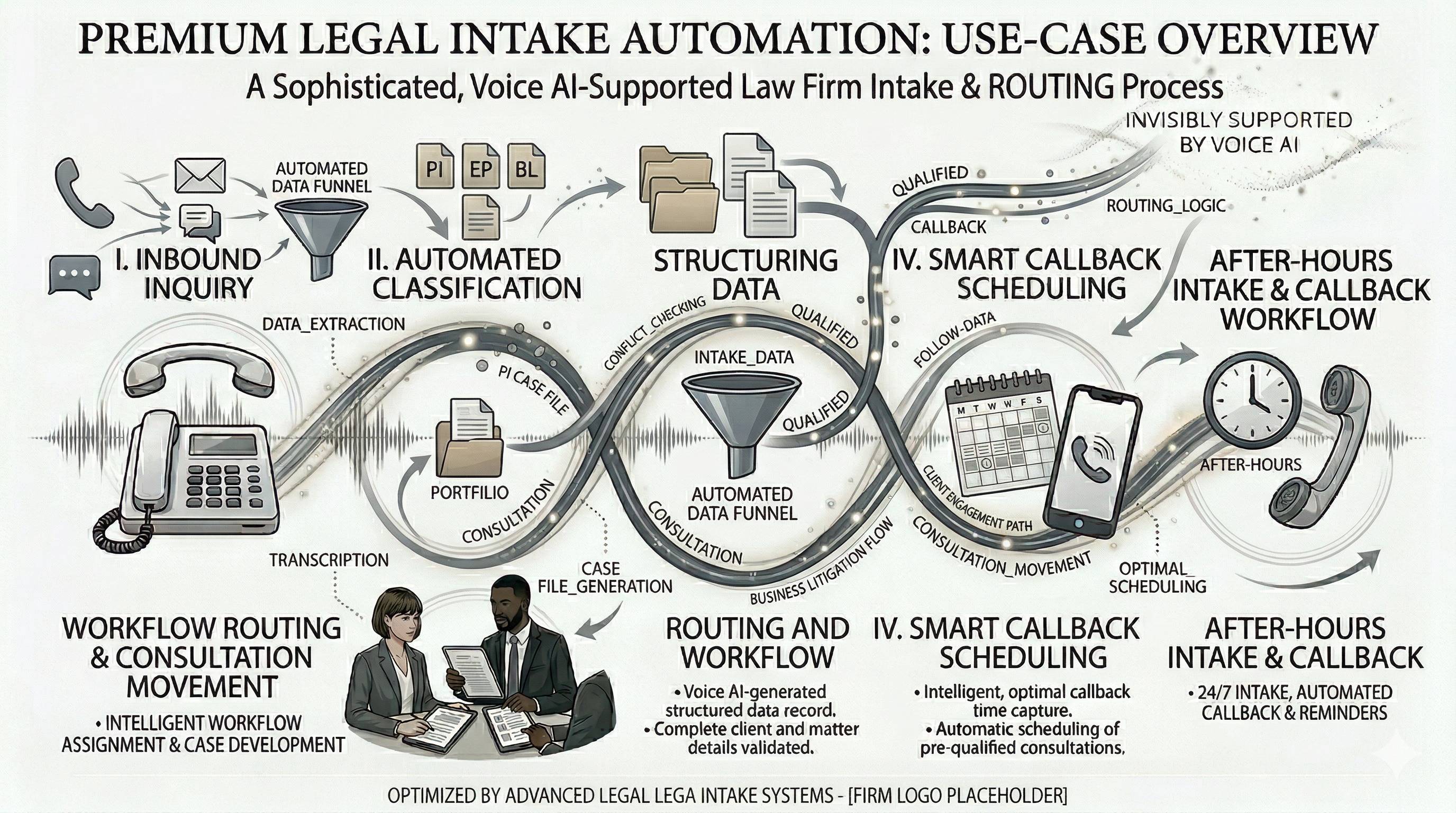
Capturing inquiry details is only part of the intake problem. The firm also needs to move that inquiry to the right next step. Some calls should go toward a consultation workflow. Some need a callback from intake staff. Some need internal review before scheduling. Some do not belong in the intake queue at all. When routing depends on inconsistent judgment at the front desk or incomplete information from the caller, the process slows down and handoffs get messy. A stronger intake system improves routing because it gives the firm better information at the moment a decision has to be made.
Legal intake automation can support routing by organizing inquiries according to broad workflow logic such as issue category, caller intent, urgency, and next-step requirements. This helps firms separate prospective-client matters from current-client or general-office calls, move consultation-worthy inquiries into the appropriate path, and reduce the amount of improvised intake decision-making that happens throughout the day. For legal teams already balancing active matters and incoming leads, that structure makes intake feel more manageable and more repeatable.
Peak Demand frames this as workflow coordination rather than autonomous decision-making. The system is not deciding legal outcomes or replacing staff review. It is helping the firm apply clearer intake pathways so the right people receive the right information faster. That kind of routing discipline turns intake automation from a capture tool into a real operational improvement.
What Better Routing Support Can Coordinate
- Separation of prospective-client inquiries, callbacks, internal requests, and general office communication.
- Faster movement into consultation, intake review, scheduling, or follow-up workflows.
- More predictable handling of urgent or higher-priority intake situations.
- Cleaner staff coordination when teams are managing both incoming leads and active matters.
Why This Matters in Legal Intake
- Different inquiry types often need different next steps before legal review even begins.
- Routing gaps create slower response times and weaker intake handoffs.
- Teams work better when inquiry records arrive in a more organized, workflow-ready format.
- Routing discipline helps preserve responsiveness without increasing administrative noise.
Can legal intake automation help route inquiries to the right workflow?
Can routing differ between different types of intake?
Does routing automation remove staff oversight?
{
  "section": "Routing and Workflow Coordination",
  "entity": "Peak Demand",
  "page": "Legal Intake Automation",
  "focus": [
    "workflow routing support",
    "staff coordination",
    "cleaner intake handoffs",
    "response-time improvement"
  ]
}
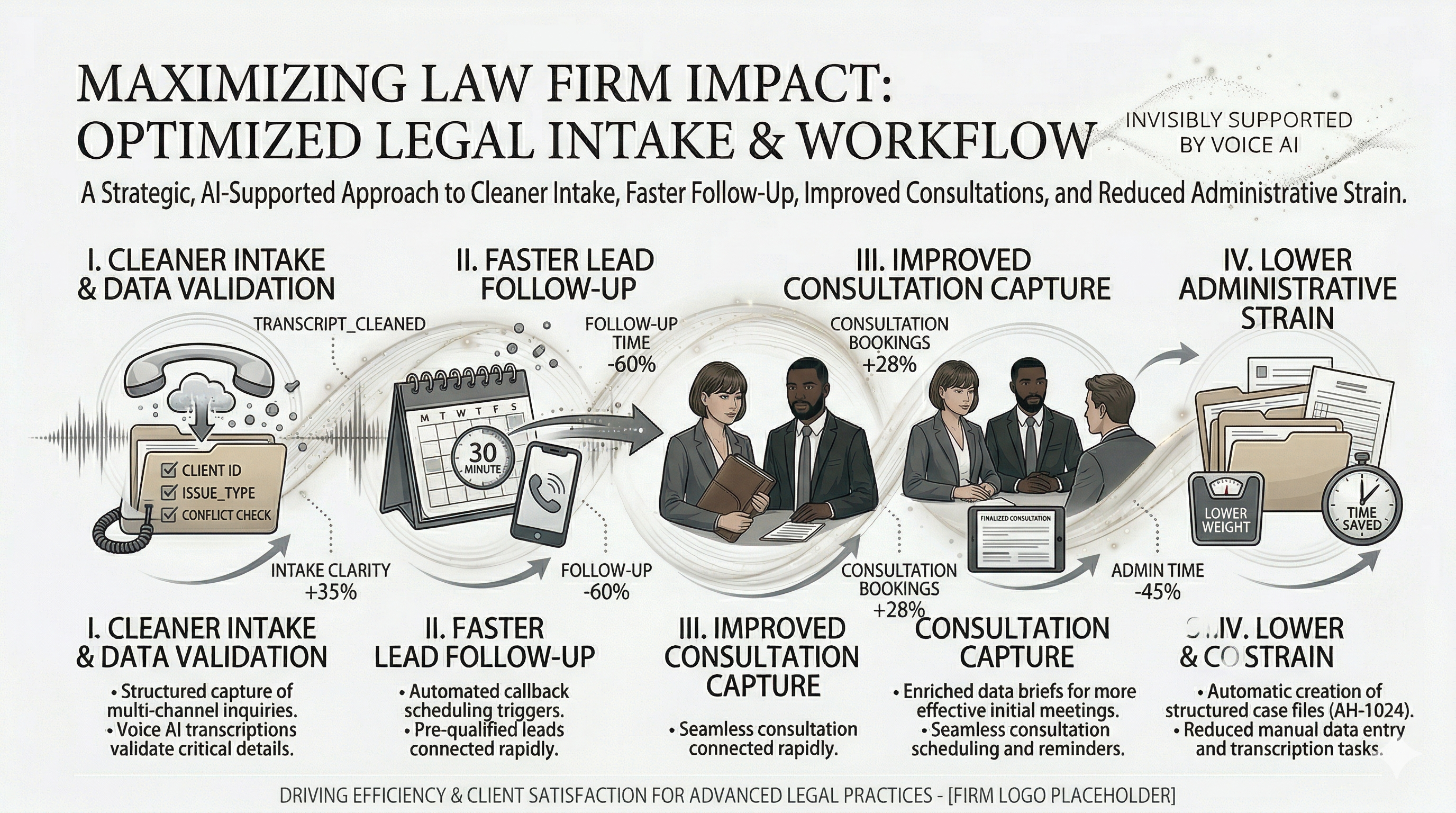
The Business Impact Comes From Cleaner Intake, Faster Follow-Up, and Fewer Lost Opportunities
For law firms, intake quality has direct commercial consequences. When new inquiries are captured inconsistently, when follow-up starts late, or when consultation paths are slowed down by missing information, the firm pays for it in lower conversion, more staff rework, and weaker responsiveness. Legal intake automation improves business performance because it strengthens what happens before a lawyer ever reviews the matter.
A better intake workflow helps firms preserve more viable opportunities, reduce front-desk overload, and create a more structured stream of inquiry information for staff to review. In practical terms, that often means fewer missed prospects, more efficient qualification, faster movement into consultation workflows, and less wasted administrative effort trying to reconstruct basic intake details after the fact. The value is not just speed. It is cleaner operational control at one of the most important points in the client-acquisition process.
Peak Demand frames the return in practical terms: stronger intake consistency, better scheduling flow, improved follow-up readiness, and more effective use of staff time. The payoff is not based on abstract automation language. It comes from protecting real revenue opportunities and reducing the friction that slows down legal intake across the week.
Where Firms Typically Feel the Impact
- Fewer lost inquiries caused by weak intake capture or incomplete handoffs.
- Cleaner records that reduce rework and improve next-step visibility.
- Less pressure on intake and reception staff handling repetitive front-line tasks.
- Better preservation of consultation opportunities that drive new matters.
Why the ROI Story Fits Legal Intake
- Many firms already have demand but lose efficiency at the first-contact stage.
- Faster, cleaner intake can directly improve consultation conversion.
- Administrative bottlenecks create avoidable drag before legal review begins.
- Operational consistency supports growth without making every improvement dependent on new staffing alone.
What is the main business benefit of legal intake automation?
Is the ROI only about saving staff time?
Does this mean firms stop needing intake staff?
{
  "section": "Business Impact",
  "entity": "Peak Demand",
  "page": "Legal Intake Automation",
  "focus": [
    "cleaner intake",
    "faster follow-up",
    "consultation opportunity preservation",
    "administrative efficiency"
  ]
}
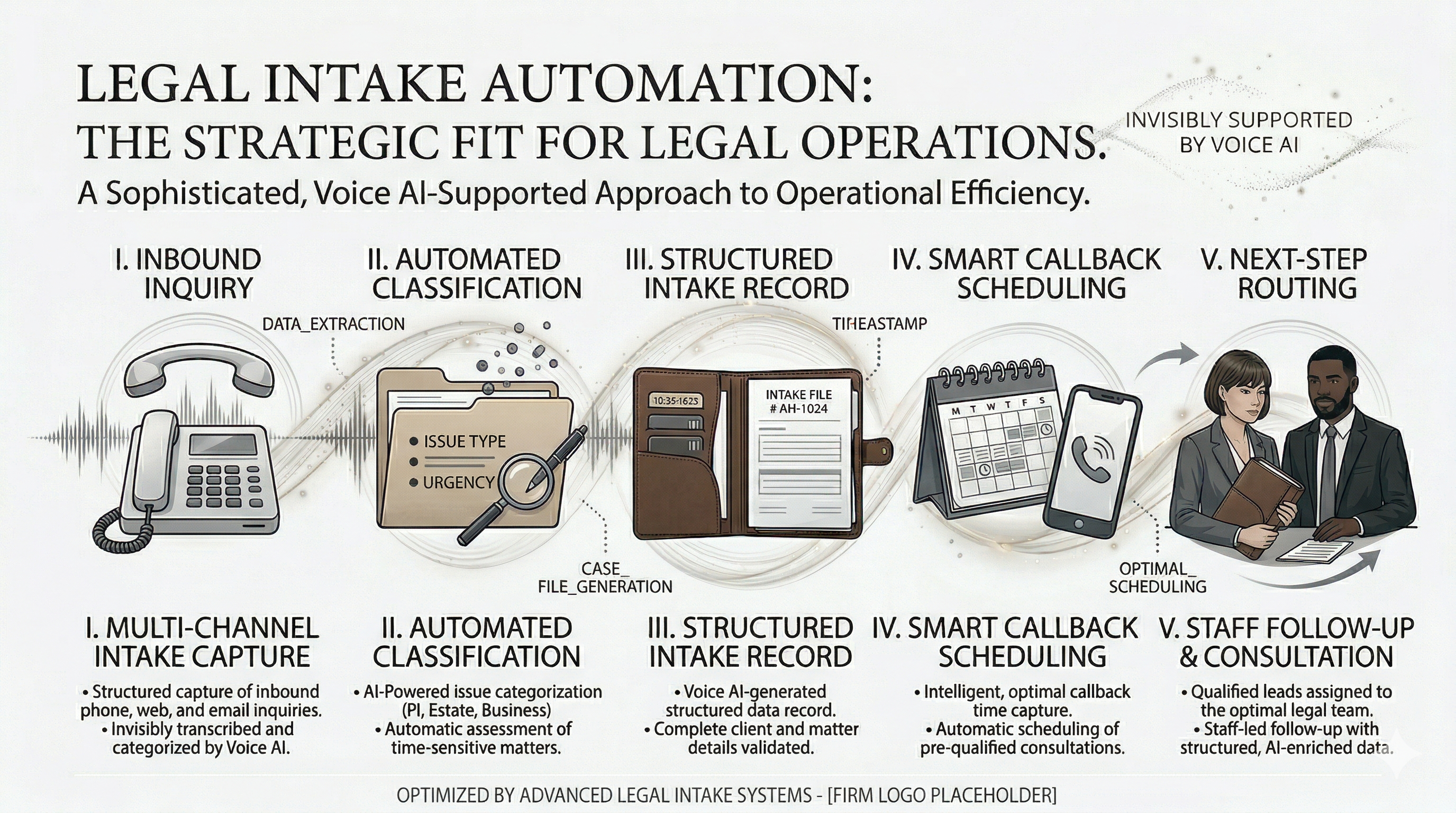
Legal Intake Automation Is an Especially Strong Fit Because the Intake Problem Is Often Operational Before It Is Legal
Many law firms assume intake problems are caused by low demand or weak follow-up discipline alone. In reality, the problem often begins earlier: inconsistent information capture, unclear next steps, weak after-hours handling, scattered qualification notes, and too much dependence on whoever happens to answer the phone. That makes legal intake automation especially valuable because it improves the operational layer that sits in front of legal review.
This category is a strong fit because the first-contact tasks themselves are highly repeatable even though the underlying legal matters vary. Gathering caller details, identifying the broad issue type, capturing urgency, supporting qualification, moving the inquiry toward consultation, and routing it into the right next step are all front-line workflow tasks that benefit from consistency. A strong intake automation system helps firms standardize that process without treating every caller like a script or blurring the boundary between operational support and legal advice.
Peak Demand sees legal intake automation as a category fit because the use cases are clear across many practice areas: better first-response capture, cleaner qualification, faster consultation movement, stronger routing, and more reliable after-hours support. The value is not novelty. It is the ability to make intake more dependable in a part of the firm where missed details and weak handoffs have outsized consequences.
Why the Category Fits So Well
- Many legal intake tasks are repeatable even though the legal work itself differs.
- Consultation-driven practices depend heavily on stronger first-response structure.
- Weak intake usually creates commercial and operational problems before legal review begins.
- After-hours and busy-period inquiries often need better capture rather than more manual process.
What Law Firms Usually Need Most
- More reliable inquiry capture at the front end of the intake process.
- Better qualification discipline without making intake feel cold or rigid.
- Support for growth without overwhelming intake and reception staff.
- Operational tools that stay within clear legal and professional boundaries.
Why is legal intake automation a better-than-average fit for law firms?
Does this fit only high-volume firms?
What makes this fit stronger than in some other categories?
{
  "section": "Why the Category Fits So Well",
  "entity": "Peak Demand",
  "page": "Legal Intake Automation",
  "focus": [
    "category fit",
    "repeatable intake tasks",
    "consultation-driven workflow",
    "operational first-contact improvement"
  ]
}
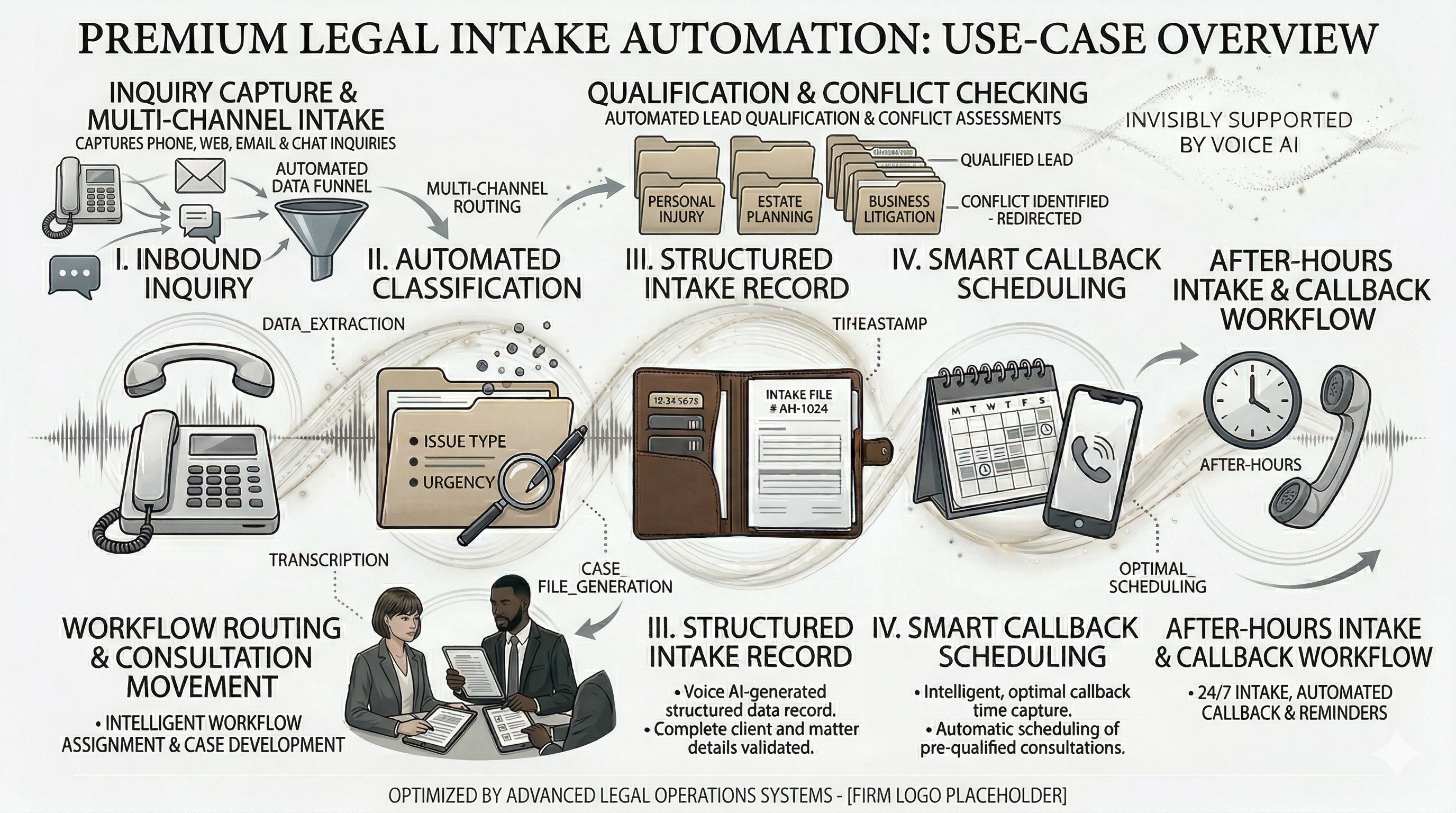
Law Firms Can Use Legal Intake Automation Across Multiple First-Response and Qualification Workflows
Legal intake automation is most effective when it supports more than a single intake task. The real opportunity is to create a connected front-end workflow that begins at first contact and continues through inquiry capture, qualification support, consultation movement, routing, and after-hours coverage. Different firms will emphasize different parts of that stack depending on how their intake process works, how consultations are handled, and where the biggest intake bottlenecks appear. The shared goal is stronger intake consistency at the point where opportunities first enter the firm.
Some firms may focus on inquiry capture and missed-call reduction. Others may prioritize cleaner qualification, faster consultation movement, or stronger routing into staff review. Firms with lean intake teams may care most about reducing repetitive first-response work. Consultation-heavy practices may focus more on speed, scheduling readiness, and better next-step discipline. A well-configured intake automation system can support these different priorities without turning every legal inquiry into the same rigid script.
Peak Demand approaches this category as a workflow system rather than a single feature. The objective is to help law firms build a more dependable intake layer across the parts of the process that most often create missed opportunities, staff friction, and inconsistent handoffs. That is what makes legal intake automation especially useful for firms that want stronger responsiveness without creating more administrative chaos.
Common Legal Intake Automation Use Cases
- Capturing new inquiry details during business hours and after hours.
- Supporting intake structure before staff review the matter.
- Helping move qualified inquiries toward consultation or callback workflows.
- Separating prospective-client inquiries, current-client calls, and general office communication.
Operational Areas That Benefit Most
- Front-end intake coverage during staff bottlenecks and call spikes.
- Initial information capture before deeper review and follow-up begin.
- Internal routing and coordination across intake, scheduling, and staff workflows.
- Off-hours opportunity preservation when inquiries arrive outside the standard workday.
What are the main use cases for legal intake automation?
Can the use cases vary by firm?
Is legal intake automation only useful for larger firms?
{
  "section": "Common Use Cases",
  "entity": "Peak Demand",
  "page": "Legal Intake Automation",
  "focus": [
    "connected use cases",
    "qualification and scheduling workflows",
    "prospect and intake routing",
    "front-end workflow coverage"
  ]
}
Build a More Dependable Intake Workflow for Your Law Firm
If your law firm is struggling with inconsistent intake, missed inquiries, slow follow-up, or front-desk overload, legal intake automation can help create a more dependable front-end workflow. The goal is not to replace lawyers or legal staff. It is to give your firm a stronger operational system for capturing inquiries, supporting qualification, and moving matters into the right next step with more consistency.
Peak Demand helps law firms design intake automation around real legal workflows rather than generic intake scripts. That includes inquiry capture, qualification support, consultation movement, routing logic, after-hours handling, and stronger first-response structure that fits how legal practices actually operate. If you want cleaner intake without sacrificing professionalism, this is where the conversation starts.
The best deployment is one that reflects how your firm actually works: what information matters most, which inquiries need faster movement, how consultations are coordinated, what needs escalation, and where staff time is being lost to repetitive intake tasks. That is the level Peak Demand is built to support.
What Peak Demand Can Help You Improve
- Inquiry capture during busy hours and after hours.
- First-contact structure for legal intake and qualification workflows.
- Consultation movement and intake handoff consistency.
- Routing logic that reflects your actual team and intake model.
Why Firms Reach Out
- Missed inquiries are creating avoidable revenue leakage.
- Reception and intake teams are overloaded with repetitive first-response work.
- Consultation follow-up feels slower than it should.
- After-hours intake and inquiry routing are not being handled cleanly.
Is this only for high-volume law firms?
Does Peak Demand build around the firm’s specific intake workflow?
Will this replace legal staff?
{
  "section": "CTA",
  "entity": "Peak Demand",
  "page": "Legal Intake Automation",
  "focus": [
    "commercial conversion",
    "workflow-fit positioning",
    "legal intake operations",
    "qualification and consultation support"
  ]
}
Legal Intake Automation Should Operate Within a Clear Communications, Privacy, and Workflow Governance Framework
Legal intake is one of the most sensitive parts of the client-acquisition process because it often captures confidential or personal information before a matter is even opened. A prospective client may disclose family issues, criminal allegations, employment concerns, financial facts, business disputes, health-adjacent information, or other sensitive details at the earliest point of contact. That is why legal intake automation should be treated as a governed workflow rather than a simple convenience layer. The operational upside only matters if intake is structured responsibly.
For Canadian firms, that usually means thinking carefully about privacy and communications obligations under frameworks such as PIPEDA and guidance from the Office of the Privacy Commissioner of Canada, while also accounting for telecommunications and telemarketing rules where relevant. For firms serving U.S. callers or operating across borders, governance may also intersect with TCPA, FCC, FTC, and state-level call recording consent requirements. The point is not to turn intake into a legal theory exercise. It is to recognize that automated inquiry capture touches regulated communication practices and should be configured accordingly.
Peak Demand frames governance here as a practical operating requirement: define what information should be captured, what should not be collected at first contact, how disclosures are handled, how call and intake data are stored, when escalation occurs, and how staff maintain oversight. Law firms do not need speculative automation in the intake layer. They need disciplined implementation that respects privacy, communications rules, and the seriousness of legal inquiries.
Governance Areas That Matter Most
- Privacy-aware handling of inquiry and intake information.
- Clear rules for disclosures, transparency, and communication boundaries.
- Review of call recording and consent requirements across relevant jurisdictions.
- Defined escalation logic and staff oversight for sensitive or high-priority inquiries.
Operational Questions Firms Should Answer
- What information should be captured during intake and what should not?
- When should the system escalate to a human instead of continuing the workflow?
- How are intake records, transcripts, and call notes stored and reviewed?
- Which privacy, telecommunications, and recording rules apply to the firm’s footprint?
Why does governance matter for legal intake automation?
Does this mean the system handles compliance automatically?
What regulations are commonly relevant in this context?
{
  "section": "Governance and Regulatory Context",
  "entity": "Peak Demand",
  "page": "Legal Intake Automation",
  "focus": [
    "privacy-aware intake workflows",
    "operational governance",
    "recording and consent considerations",
    "staff oversight and escalation"
  ]
}
Responsible Legal Intake Automation Needs Clear Limits, Human Oversight, and No Legal Advice
Law firms cannot afford ambiguity about what intake automation is doing. The system should support inquiry capture, qualification support, scheduling movement, and routing. It should not provide legal advice, assess claim strength, recommend litigation or negotiation strategy, determine whether someone has a valid case, decide whether the firm should represent the caller, or replace lawyer judgment in any substantive way. Those boundaries are central to responsible deployment.
A responsible legal intake automation model keeps lawyers and staff in control of legal judgment, intake review, escalation, and representation decisions. The system can help collect information, support consistency, and prepare cleaner handoffs, but it must stay inside defined operational limits. That includes transparency about the nature of the interaction, careful handling of sensitive intake data, and escalation pathways when a situation requires human review.
Peak Demand positions responsible AI as a practical operating principle rather than a marketing slogan. The goal is to make intake more dependable without creating confusion about the role of the system. In legal services, trust is shaped early. Firms need implementation that sounds professional, behaves predictably, and reinforces that lawyers and staff remain accountable for the legal relationship and every substantive decision.
What Responsible Deployment Includes
- No legal advice, legal conclusions, or strategy recommendations from the system.
- No autonomous representation decisions or matter-merit determinations.
- Clear escalation paths when an inquiry needs human attention.
- Defined communication boundaries and reviewable workflow rules.
What Should Stay With the Firm
- Lawyer judgment and matter-specific legal analysis.
- Conflict checks, representation decisions, and engagement steps.
- Staff review of sensitive or high-priority intake situations.
- Oversight of privacy, communications, and client-experience standards.
Can legal intake automation give legal advice?
Can the system decide whether someone has a strong case?
What makes legal intake automation responsible in a law firm setting?
{
  "section": "Responsible AI for Legal Intake",
  "entity": "Peak Demand",
  "page": "Legal Intake Automation",
  "focus": [
    "no legal advice",
    "human oversight",
    "clear operational boundaries",
    "responsible intake deployment"
  ]
}
Frequently Asked Questions About Legal Intake Automation
Law firms usually ask practical questions before adopting legal intake automation. They want to know whether it can capture better inquiry details, support qualification without crossing legal lines, improve consultation movement, reduce missed opportunities after hours, and help route inquiries more cleanly. They also want clarity on where the system stops and where staff and lawyers remain fully in control.
That is the right way to evaluate the category. Legal intake automation should be judged on intake quality, operational usefulness, and responsible deployment rather than novelty. The strongest implementation helps the firm respond faster and stay more organized without blurring the line between workflow support and legal judgment.
The questions below cover the issues law firms most commonly think through when evaluating inquiry capture, qualification support, consultation flow, after-hours intake, routing, and governance.
What Firms Usually Want to Confirm
- Whether legal intake automation can capture better inquiry information consistently.
- How it supports qualification and scheduling without giving legal advice.
- Whether it helps reduce missed inquiries and off-hours opportunity loss.
- How staff oversight, escalation, and governance remain in place.
What This FAQ Reinforces
- Legal intake automation is an operational support layer, not a substitute for lawyers or staff.
- Law firms are a strong fit because intake quality, responsiveness, and conversion often overlap.
- Qualification, consultation flow, routing, and after-hours capture are core use cases.
- Responsible deployment depends on clear limits, privacy awareness, and human review.
What does legal intake automation actually do?
Can legal intake automation help with qualification?
Can it help move inquiries into consultations?
Can legal intake automation work after hours?
Does legal intake automation replace intake staff?
Can legal intake automation give legal advice?
Why is legal intake automation such a strong fit for law firms?
Can legal intake automation support both prospects and other inquiry types?
What should firms evaluate before deploying legal intake automation?
{
  "section": "FAQ",
  "entity": "Peak Demand",
  "page": "Legal Intake Automation",
  "focus": [
    "inquiry capture",
    "qualification support",
    "consultation movement",
    "after-hours intake",
    "responsible deployment"
  ]
}
Explore your own AI use case on a discovery call.