Voice AI Call Center for Healthcare — Hospitals, Patient Access, Scheduling & High-Volume Call Automation
Peak Demand builds custom, fully managed Voice AI call center systems for hospitals, outpatient networks, centralized scheduling teams, and high-volume healthcare patient-access operations. The system can answer multiple callers in parallel, classify intent, support booking and intake workflows, route referrals, records, billing and general inquiries, absorb after-hours overflow, and escalate sensitive scenarios to humans — while deterministic software governs permissions, validation, routing authority, and approved system actions.
Absorb peak inbound demand in parallel instead of forcing every caller into a sequential queue.
Booking, rescheduling, cancellations, waitlists and policy-based appointment handling.
Intent-based navigation for referrals, billing, records, results, clinics, locations and service lines.
Urgent, sensitive, low-confidence and explicitly requested human handoffs remain protected.
Workflow mapping, integrations, QA, reporting, monitoring and ongoing production refinement.
A Healthcare Call Center System Needs More Than a Conversational Model
The language model should handle what it is good at: understanding natural speech, recognizing intent, handling ambiguity, extracting structured information, and maintaining a natural conversation. It should not have unrestricted authority over scheduling systems, patient records, transfer destinations, or high-consequence workflow decisions.
Peak Demand surrounds the conversational layer with deterministic middleware and explicit business rules. That software layer validates identity and inputs where required, controls permissions, enforces appointment and routing rules, determines which actions are allowed, logs outcomes, and prevents the model from overriding policy. This separation is what turns Voice AI from a demo into a production healthcare communication system.
What the AI layer handles
- Caller language and conversational variation.
- Intent classification and clarification.
- Structured extraction from natural speech.
- Flexible explanation of approved information.
- Conversation continuity when callers change direction.
What deterministic software controls
- Identity and authorization checks where required.
- Which department, clinic, queue, or provider can receive the caller.
- What appointment types or workflow actions are permitted.
- Required fields, validation rules, and system writes.
- Escalation, fallback, logging, and high-consequence boundaries.
{
  "section": "Healthcare Voice AI Production Architecture",
  "entity": "Peak Demand",
  "architecture": {
    "conversational_ai": ["natural language", "intent classification", "ambiguity handling", "structured extraction"],
    "deterministic_middleware": ["identity", "permissions", "validation", "business rules", "routing authority", "system action controls"],
    "integrations": ["telephony", "scheduling", "CRM", "ticketing", "directories", "notifications", "APIs"],
    "operations": ["QA", "outcome logging", "reporting", "change control", "ongoing optimization"]
  },
  "positioning": "AI handles language; deterministic software governs authority and high-consequence actions"
}
High-Volume Healthcare Call Handling — Queue Stability & Parallel Conversations
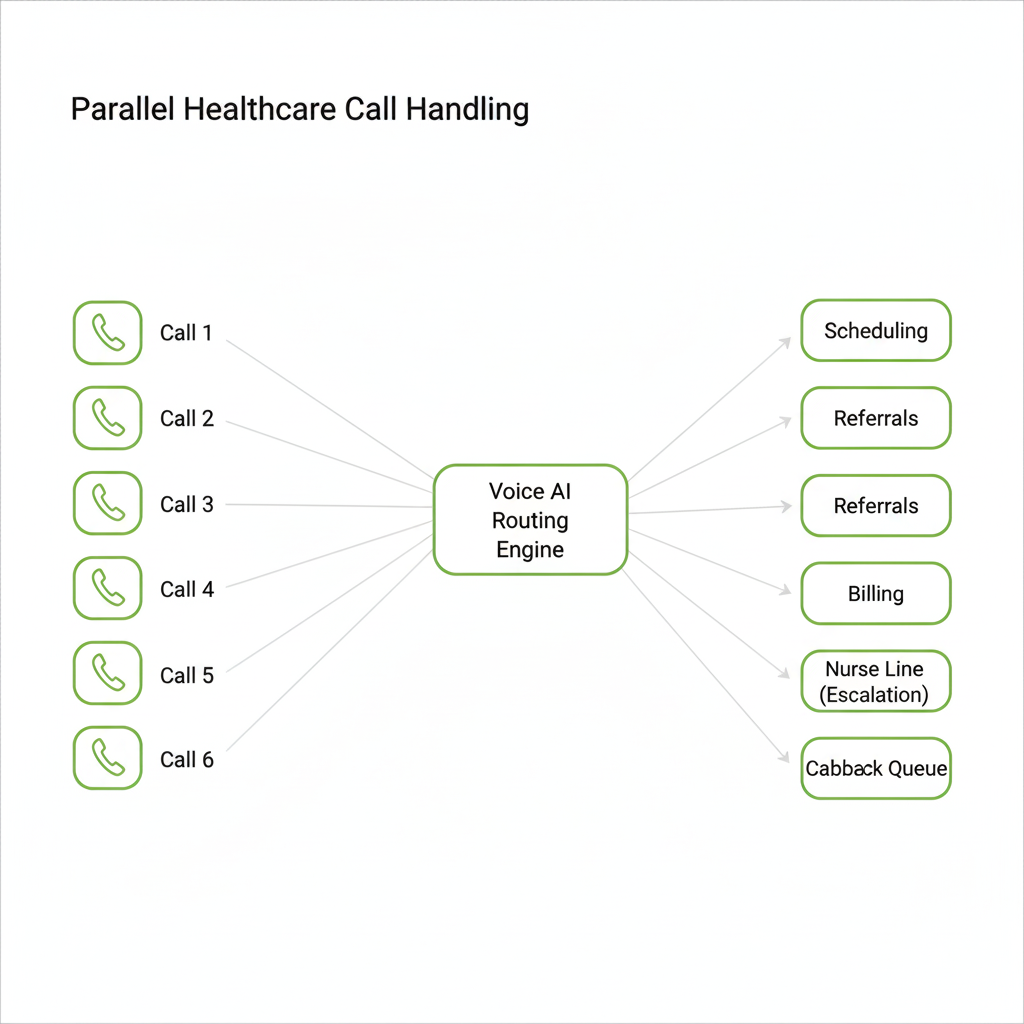
Hospitals and centralized healthcare call centres experience unpredictable volume spikes — seasonal surges, referral waves, billing cycles, public health events, and after-hours overflow. Traditional call queues process callers sequentially. Voice AI processes them in parallel.
Peak Demand designs Voice AI healthcare call centre systems that answer immediately, classify intent, and route accurately — without increasing administrative headcount. Each inbound call is handled concurrently through structured routing logic and defined escalation pathways.
High-volume call centre capabilities
- Parallel call handling: multiple inbound calls processed simultaneously without queue collapse.
- Intent classification: scheduling, referrals, billing, nurse line, records, or general inquiries identified early.
- Priority routing: urgent or high-risk categories escalate immediately under defined policy.
- Overflow protection: absorb peak demand before transferring to live agents.
- Callback queue creation: structured summaries generated for follow-up.
- After-hours stabilization: 24/7 intake without voicemail accumulation.
- Abandonment reduction: fewer dropped calls caused by hold-time fatigue.
The result is operational stability. Routing remains structured, traceable, and reviewable — with human agents stepping in when policy, escalation thresholds, or governance rules require intervention.
This is engineered queue logic designed specifically for healthcare environments where routing accuracy, escalation safety, and audit visibility matter.
{
  "section": "Healthcare Call Center High Concurrency",
  "entity": "Peak Demand",
  "service": "Voice AI healthcare call center automation",
  "capabilities": ["parallel call handling","intent detection","priority escalation","overflow absorption","callback queue generation","after-hours intake"],
  "outcomes": ["reduced abandonment","stabilized queues","structured routing"]
}
Scheduling Centre Automation — Booking, Rescheduling, Waitlists & Policy Rules
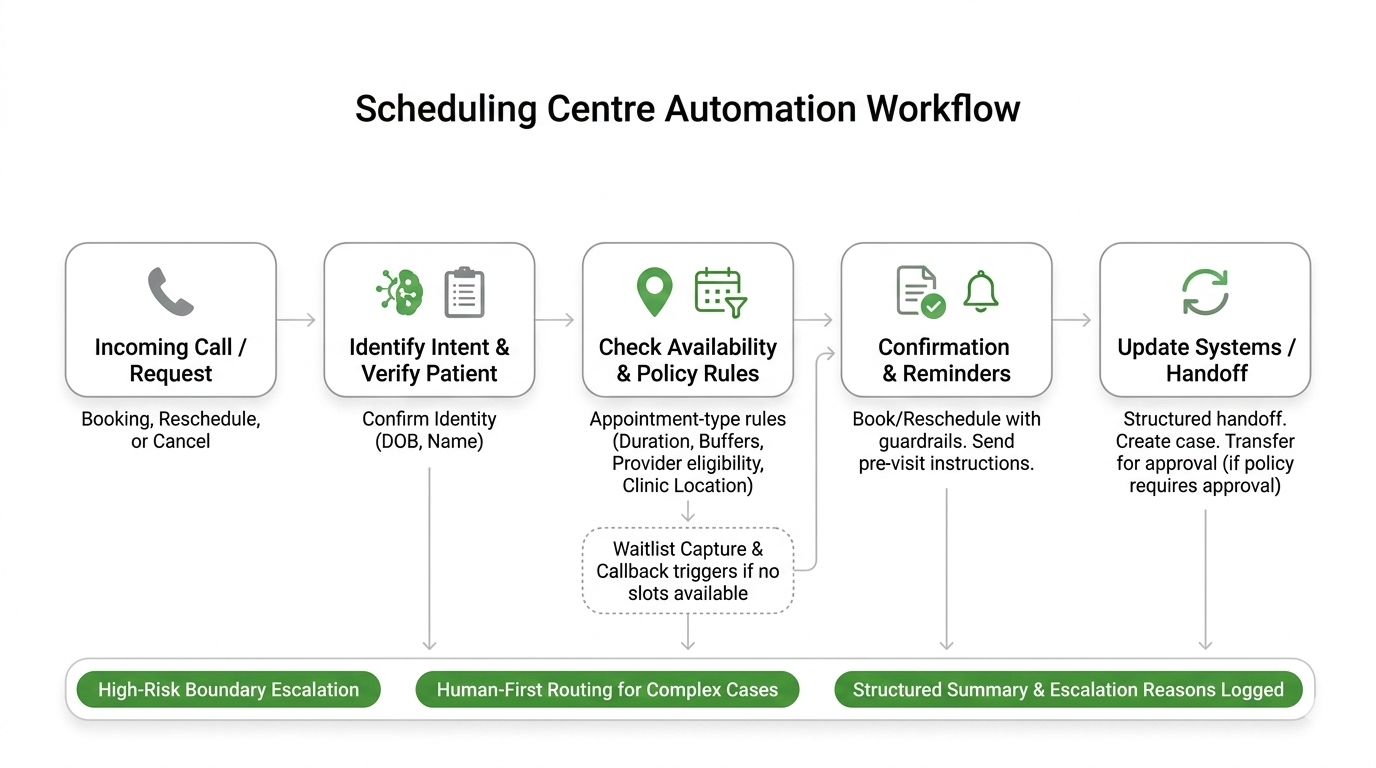
Centralized scheduling centres are one of the highest-volume pressure points in healthcare. Voice AI becomes valuable when it can complete real scheduling work — not just answer questions. Peak Demand builds workflow-driven scheduling automation that supports booking, rescheduling, cancellations, and waitlist handling while protecting appointment policies.
The goal is fewer back-and-forth calls and less staff cleanup. Scheduling logic is configured around appointment types, provider rules, clinic locations, hours, buffers, prerequisites, and escalation boundaries — so the AI can only take actions you approve.
What Voice AI can handle in scheduling centres
- Book appointments: confirm service type, location, provider, and time windows.
- Reschedule & cancel: policy-safe changes with confirmations and guardrails.
- Waitlists: capture availability preferences and trigger callbacks when slots open.
- Pre-visit requirements: communicate approved prep instructions and prerequisites.
- Multi-location logic: route to the right campus or clinic based on patient location and service line.
- Fallback & escalation: transfer to staff when confidence is low or policy requires approval.
Scheduling rules that reduce chaos
- Appointment-type rules: durations, buffers, prerequisites, and provider eligibility.
- Site-specific schedules: different hours, providers, and services per location.
- High-risk boundaries: sensitive topics trigger human-first escalation.
- Confirmation logic: verify details before committing changes.
- Structured handoff: when staff review is required, summaries are generated consistently.
This is where out-of-the-box solutions often fail: they can talk, but they cannot reliably respect real scheduling policy. Peak Demand builds the deterministic rule and integration layer around the conversational system so scheduling centres get relief without creating downstream booking errors.
Can the AI book appointments directly, or does staff have to confirm everything?
Can it handle multiple clinic locations with different schedules?
What if the AI is not confident it should schedule a specific case?
{
  "section": "Scheduling Centre Automation",
  "entity": "Peak Demand",
  "service": "Voice AI healthcare call center scheduling",
  "workflows": ["book appointments","reschedule and cancel","waitlist capture","multi-location scheduling logic","policy checks and confirmations","human escalation and structured handoffs"],
  "design_principle": "permissioned actions only",
  "outcomes": ["reduced call backlog","fewer scheduling errors","less staff cleanup work"]
}
Referrals, Results, Records & Billing — Structured Department Routing Without Transfer Loops
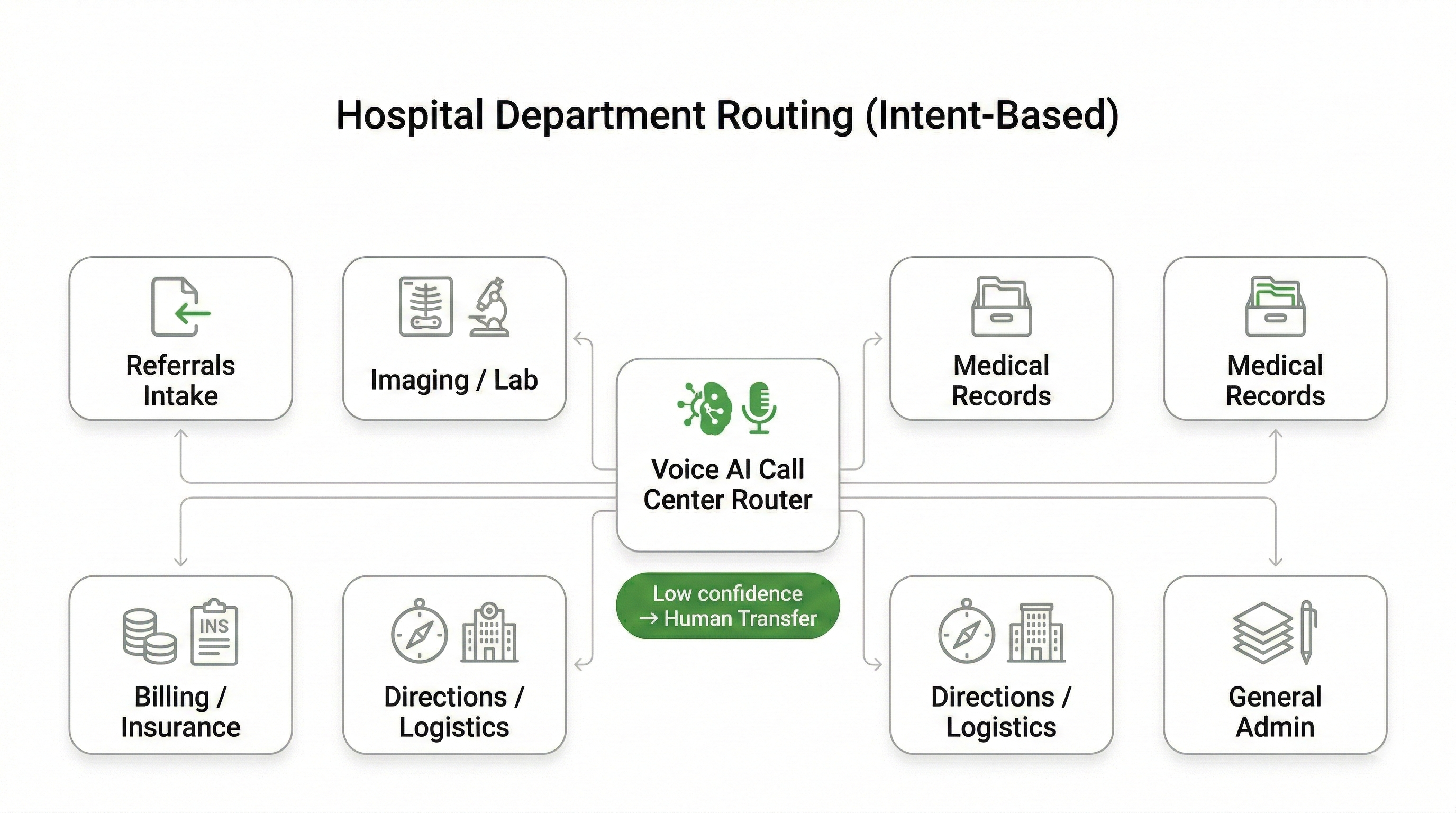
A major source of call centre congestion is not simply too many calls — it is misrouted calls. Patients get bounced between departments, transferred repeatedly, or told to call a different number. Peak Demand builds Voice AI routing that classifies intent early and directs callers to the correct department, queue, or workflow on the first pass.
This is especially useful for high-friction categories such as referrals, test results, medical records, billing and insurance questions, eligibility, and general administrative requests. Voice AI can capture structured details, route appropriately, and generate consistent handoffs when staff follow-up is required.
Common healthcare call centre routes
- Referrals: confirm clinic or service line, capture approved referral-routing details, and route to intake.
- Imaging & lab: route results or status questions to the correct department pathway.
- Medical records: route release-of-information requests with policy-safe intake fields.
- Billing & insurance: route payment, eligibility, or administrative questions.
- Directions & logistics: facility location, clinic hours, parking, and arrival information.
- General administration: operator-to-department routing without repeated transfers.
How we reduce transfer loops
- Early clarification: confirm location, clinic, and service line before routing.
- Structured capture: collect only required routing fields.
- Policy boundaries: sensitive items escalate instead of being guessed at.
- Consistent handoffs: summaries go to the correct queue when staff action is needed.
- Fallback routing: human override for ambiguous or frustrated callers.
Can Voice AI reduce transfer loops in a hospital call centre?
Can it handle medical records requests without collecting too much information?
What happens if the request does not match a clear category?
{
  "section": "Department Routing",
  "entity": "Peak Demand",
  "service": "Voice AI healthcare call center routing",
  "routing_categories": ["referrals intake","imaging and lab routing","medical records requests","billing and insurance questions","logistics and directions","general administrative routing"],
  "outcomes": ["fewer transfer loops","faster correct routing","reduced call centre congestion"]
}
Nurse Line & Sensitive Scenario Escalation — Human-First Safety Boundaries
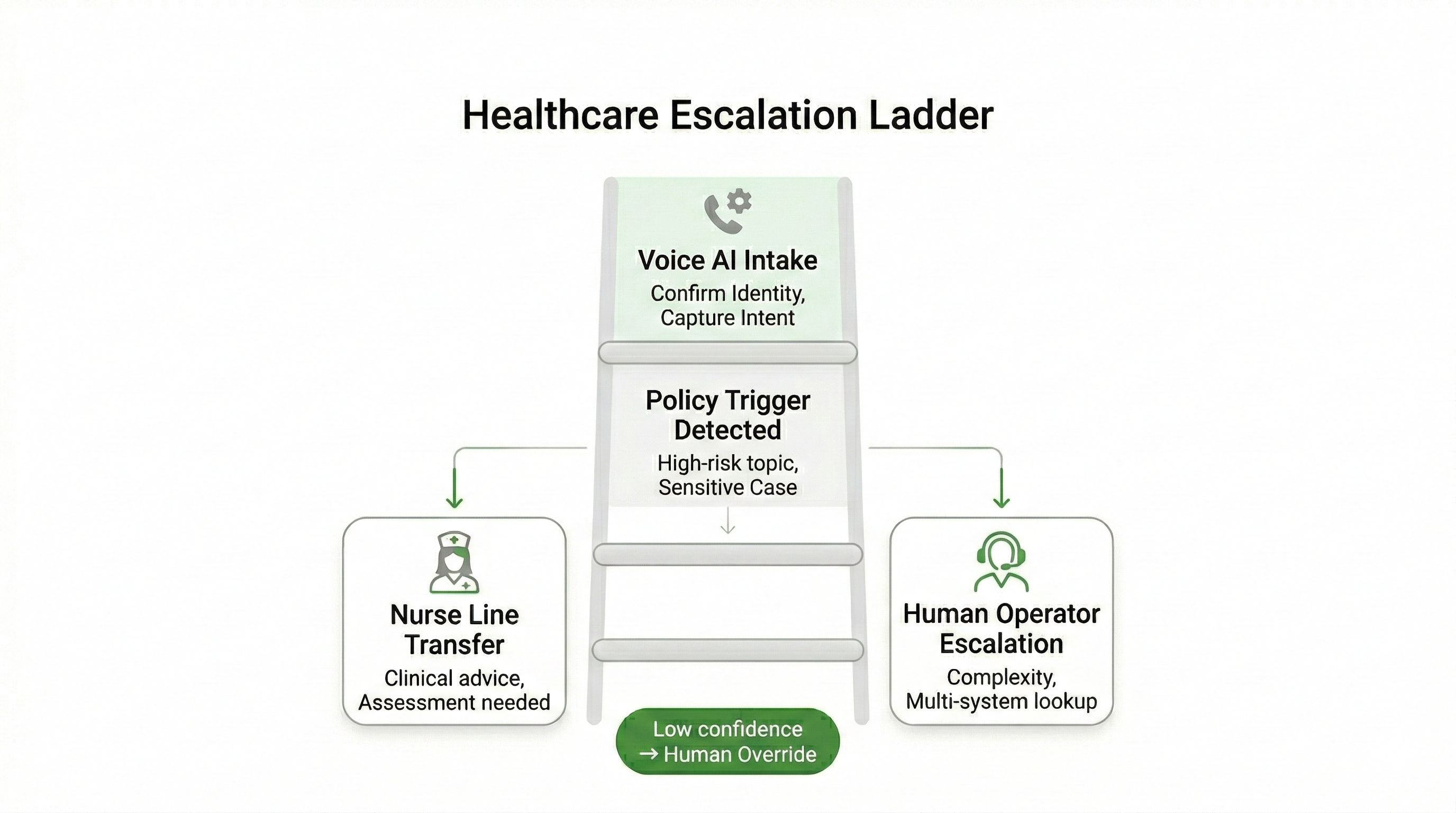
Healthcare call centres cannot treat every inquiry the same. Certain intents — symptom concerns, urgent follow-ups, medication confusion, or emotionally distressed callers — require immediate human involvement. Voice AI must be built with clear escalation boundaries, not improvisation.
Peak Demand designs escalation logic that identifies configured high-risk keywords, low-confidence responses, and policy-triggering scenarios. Instead of attempting to resolve sensitive medical situations, the system routes to the appropriate nurse line, department, or emergency instruction pathway defined by the healthcare organization.
Escalation triggers we configure
- Symptom-related keywords: configured terms such as chest pain, severe bleeding, or breathing issues.
- Medication confusion: dosage or adverse-reaction concerns routed to approved staff pathways.
- Emotional distress: high-risk language or defined escalation signals.
- Low confidence: unclear intent or contradictory responses.
- Repeated frustration: caller requests staff or uses an override option.
Human-first design principles
- No clinical advice: operational routing, not diagnosis or treatment guidance.
- Immediate transfer pathways: predefined nurse or escalation queues.
- Override access: callers can request staff directly where configured.
- Structured summaries: staff receive context at handoff.
- Audit visibility: escalation events can be logged and reviewed.
{
  "section": "Nurse Line & Sensitive Escalation",
  "entity": "Peak Demand",
  "service": "Voice AI healthcare call center",
  "escalation_triggers": ["configured symptom keywords","medication confusion","emotional distress","low-confidence detection","caller override requests"],
  "design_principles": ["no clinical advice","immediate human transfer","structured handoff summaries","audit logging"],
  "objective": "reduce workload without increasing clinical risk"
}
Healthcare Call Centre Integrations — CRM, Ticketing, Notifications & Secure Boundaries
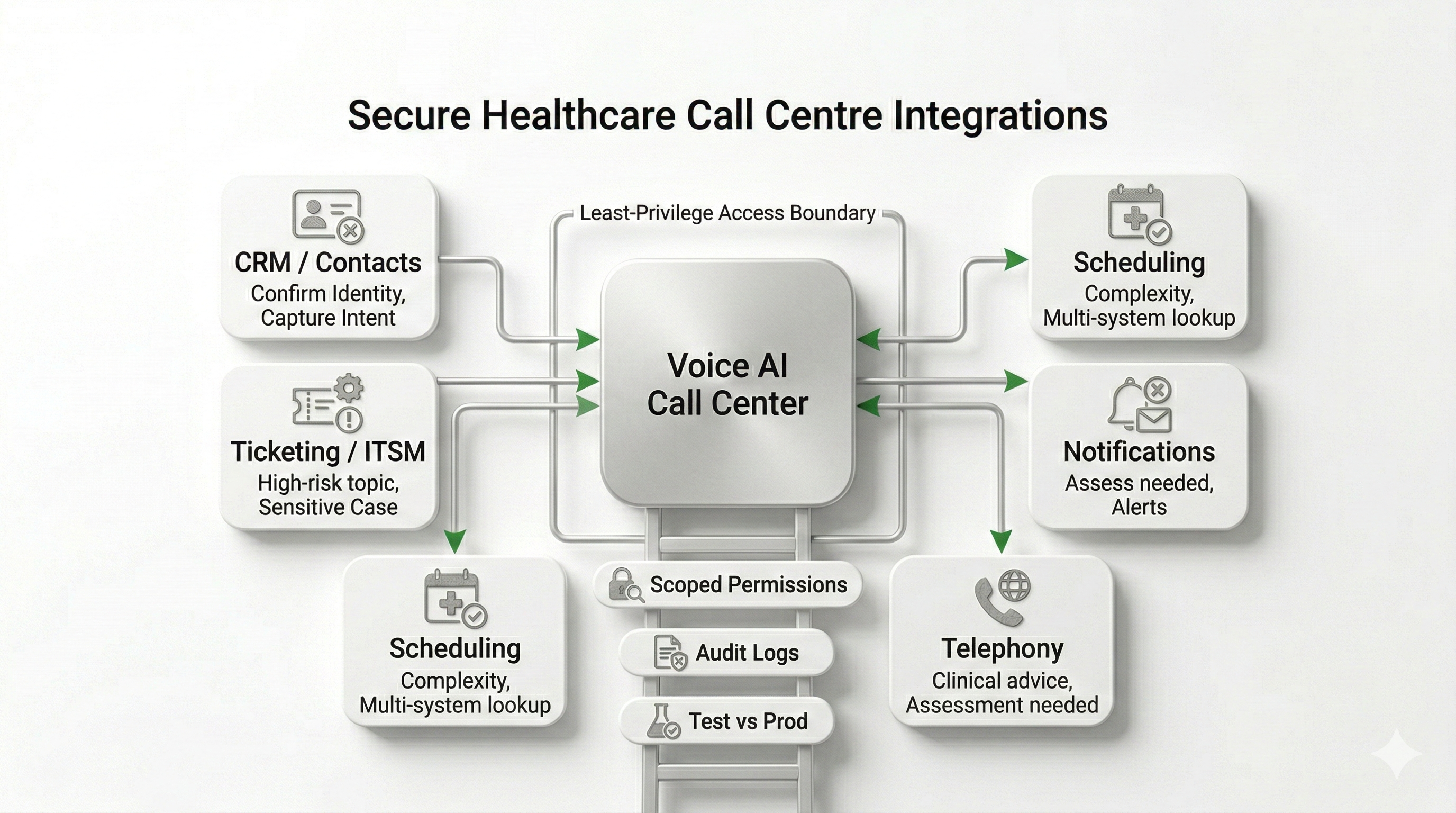
Voice AI becomes operationally useful when it can write approved outcomes into the systems around the call — without exposing an entire patient or enterprise database. Peak Demand implements secure, least-privilege integrations so the AI can create a case, update an approved contact record, open a ticket, trigger a notification, or push a structured summary to the right queue.
Integrations are scoped to approved actions only. Deterministic middleware handles permissions, validation, identity, and system authority while the conversational layer handles language and intent.
What healthcare call centres commonly connect
- CRM / contact systems: create or update approved records, log call outcome, tag intent, and assign follow-up.
- Ticketing / ITSM: open a case, route to a queue, and track follow-up.
- Scheduling tools: approved booking actions or staff-reviewed scheduling requests.
- Directory / routing tables: location, department, service line, and hours logic.
- Notifications: email, SMS, Teams, Slack, or other approved alerts.
- Telephony: IVR replacement, call transfers, queue routing, and voicemail reduction.
Security controls for integration review
- Scoped permissions: least privilege and read/write separation where possible.
- Token-based authentication: OAuth/OIDC where supported; scoped service credentials otherwise.
- Transport security: encrypted API and webhook traffic.
- Integrity checks: signed webhooks where applicable.
- Auditability: log writes, transfers, escalations, exports, and admin changes as required.
- Environment separation: test and production separation to reduce rollout risk.
Can Voice AI create a callback task or ticket when staff need to follow up?
How do you prevent the AI from accessing the whole patient database?
Can everything be tested before production?
{
  "section": "Healthcare Call Center Integrations",
  "entity": "Peak Demand",
  "service": "Voice AI call center automation (healthcare)",
  "systems_connected": ["CRM / contact systems","ticketing / ITSM","scheduling tools","routing directories","notifications","telephony"],
  "security_controls": ["least privilege scopes","token-based authentication","encrypted transport","signed webhooks where applicable","audit logs","test vs production separation"],
  "positioning": "approved actions only, with deterministic middleware governing authority"
}
Audit-Ready Call Center Reporting — Outcomes, Escalations, QA Sampling & Exports
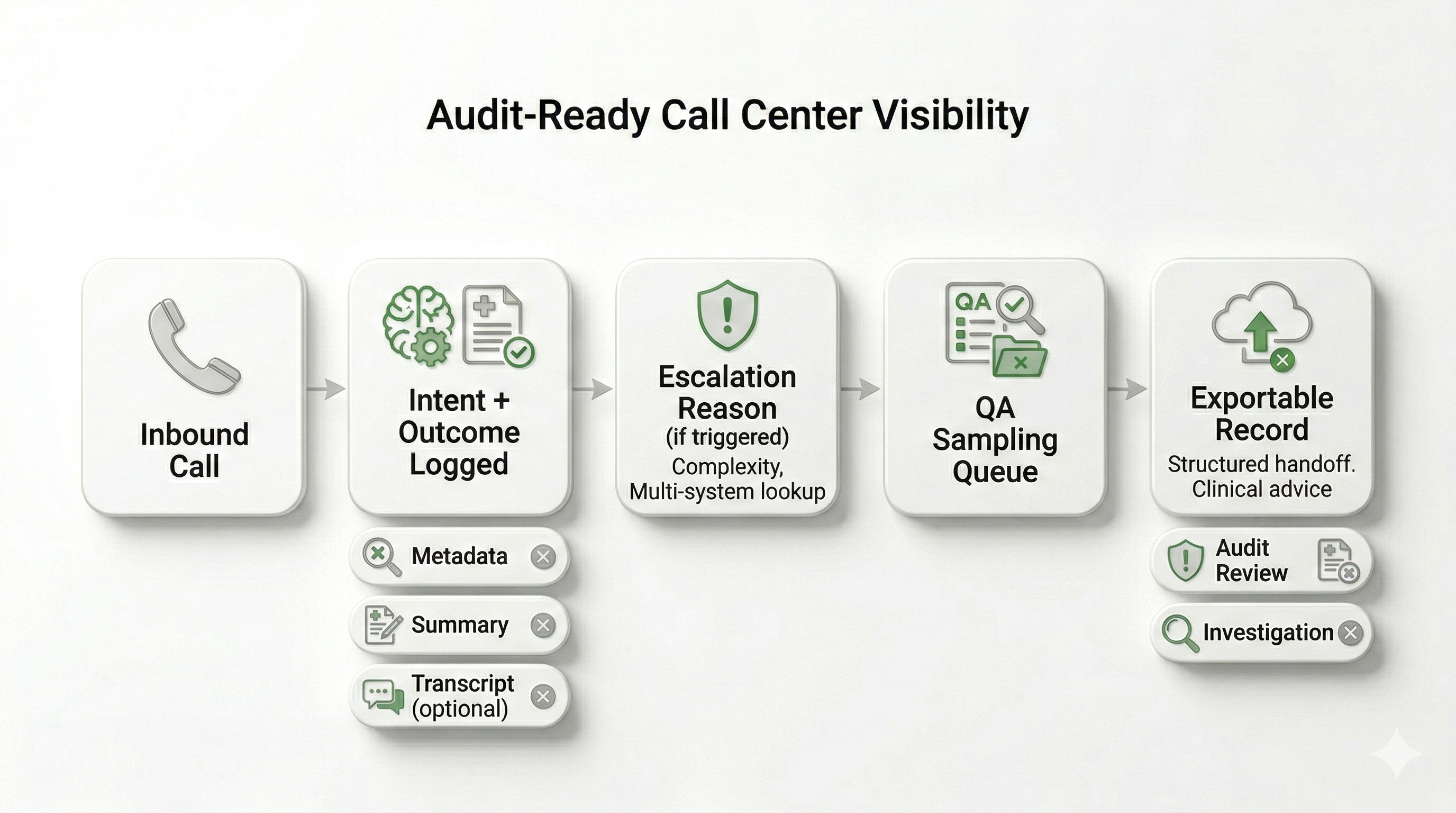
Healthcare call centres need more than call recordings. They need reviewable outcomes: what the caller wanted, which route was selected, what actions occurred, and when a human escalation was triggered. If the organization cannot see what happened, it cannot govern it.
Peak Demand configures reporting to match the organization’s risk posture — from metadata-only logs to controlled summaries and, where policy permits, transcripts or recordings with defined retention and role-based access.
What teams can receive
- Call outcome logs: intent category, destination queue, booked versus callback, and escalation reason.
- Escalation trail: configured keyword, low confidence, override request, or other policy trigger.
- Structured summaries: consistent recaps delivered to approved queues.
- QA sampling: review a defined slice of calls rather than storing everything indefinitely.
- Exports: structured records for investigations, vendor review, and governance support.
Typical audit events
- Routing decisions: which path was selected and why.
- System actions: ticket created, notification sent, scheduling request created.
- Access events: who viewed or exported logs where configured.
- Admin changes: flow edits, threshold changes, and escalation policy updates.
- Retention posture: policy windows and deletion expectations by workflow.
{
  "section": "Healthcare Call Center Reporting & Auditability",
  "entity": "Peak Demand",
  "service": "Voice AI healthcare call center",
  "reporting_outputs": ["call outcome logs","escalation trail","structured summaries","QA sampling queues","exportable records"],
  "governance_controls": ["policy-driven logging depth","role-based access where configured","retention windows","admin change visibility"],
  "positioning": "reviewability without unnecessary data collection"
}
Healthcare Call Center ROI — Reduced Hold Times, Stabilized Queues & Measurable Operational Lift
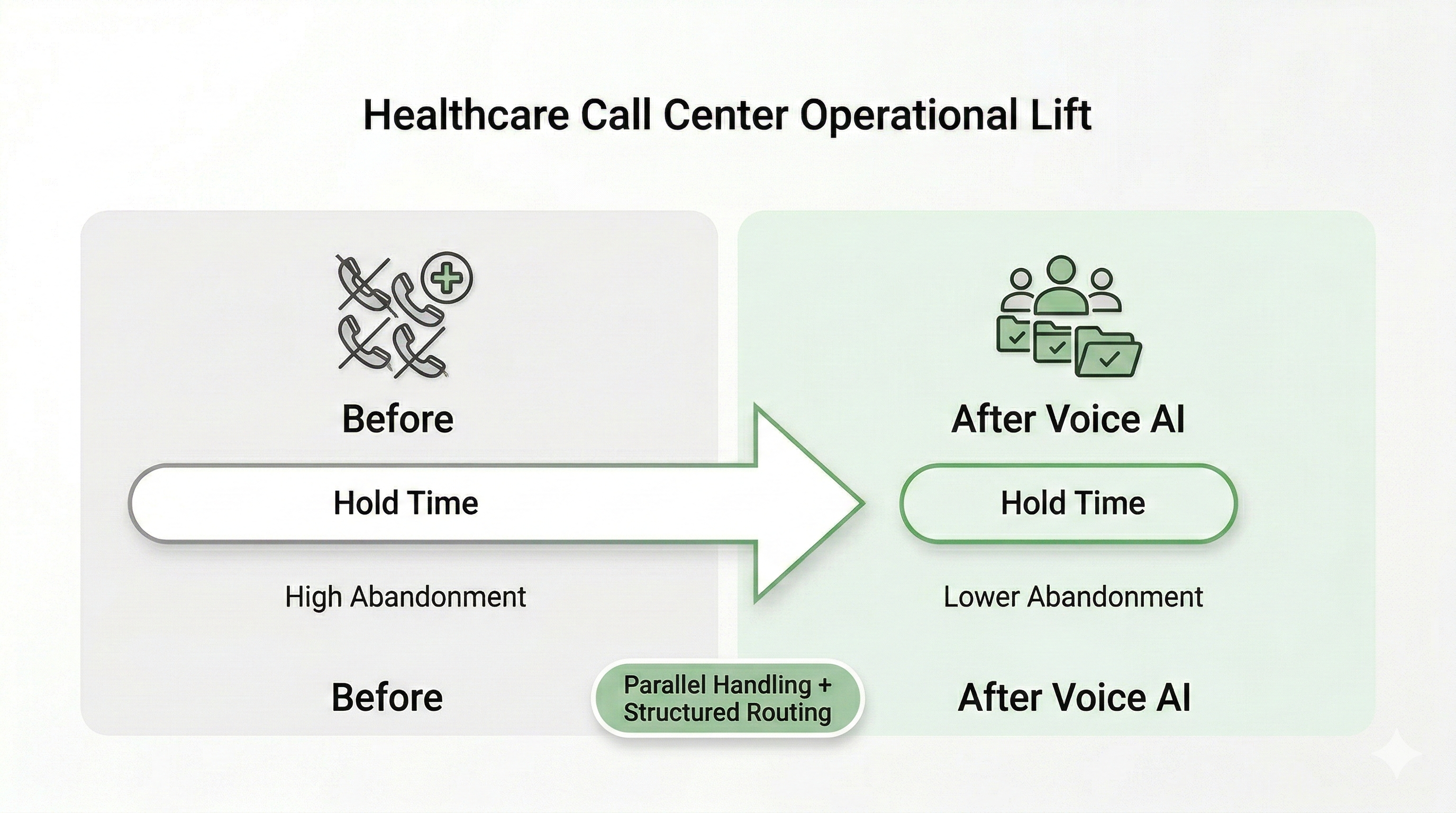
Voice AI in a healthcare call centre is not simply about replacing agents or cutting costs. It is about stabilizing operations under volume pressure. When high-volume lines are absorbed in parallel, routing becomes more consistent, and escalation rules are enforced automatically, the communication layer becomes more predictable.
Hospitals and multi-location networks typically measure impact in queue stability, reduced abandonment, staff workload relief, after-hours capture, and improved service-level adherence.
Operational performance improvements
- Hold time reduction: parallel handling prevents queue bottlenecks.
- Abandonment reduction: fewer callers drop before reaching support.
- Agent load balancing: overflow is absorbed before it reaches live staff.
- Escalation consistency: urgent calls are prioritized according to defined triggers.
- After-hours capture: fewer voicemail backlogs and missed intake opportunities.
- Routing consistency: fewer transfer loops and misdirected calls.
Common KPIs healthcare teams track
- Average Speed of Answer (ASA)
- Call abandonment rate
- Escalation volume
- Queue depth during peak periods
- After-hours call capture
- Staff handle-time or interruption reduction
The goal is not to automate blindly. It is to create a structured communication layer that absorbs predictable demand, protects escalation pathways, and improves patient access while keeping human teams focused on higher-complexity interactions.
{
  "section": "Healthcare Call Center ROI & Operational Lift",
  "entity": "Peak Demand",
  "service": "Voice AI healthcare call center automation",
  "measured_outcomes": ["reduced hold times","lower abandonment rates","queue stabilization","after-hours call capture","staff workload relief"],
  "tracked_kpis": ["average speed of answer","call abandonment rate","queue depth","escalation volume","handle-time or interruption reduction"],
  "positioning": "operational stabilization rather than simple cost cutting"
}
Enterprise Deployment Model — Discovery, Governance Review & Phased Rollout
Healthcare call centre automation should not be deployed casually. Peak Demand implements structured, reviewable rollouts that align operational leadership, IT, privacy, security, and frontline teams before go-live.
Every deployment is custom-built around routing architecture, escalation policy, integration boundaries, and governance expectations — not a one-click SaaS activation.
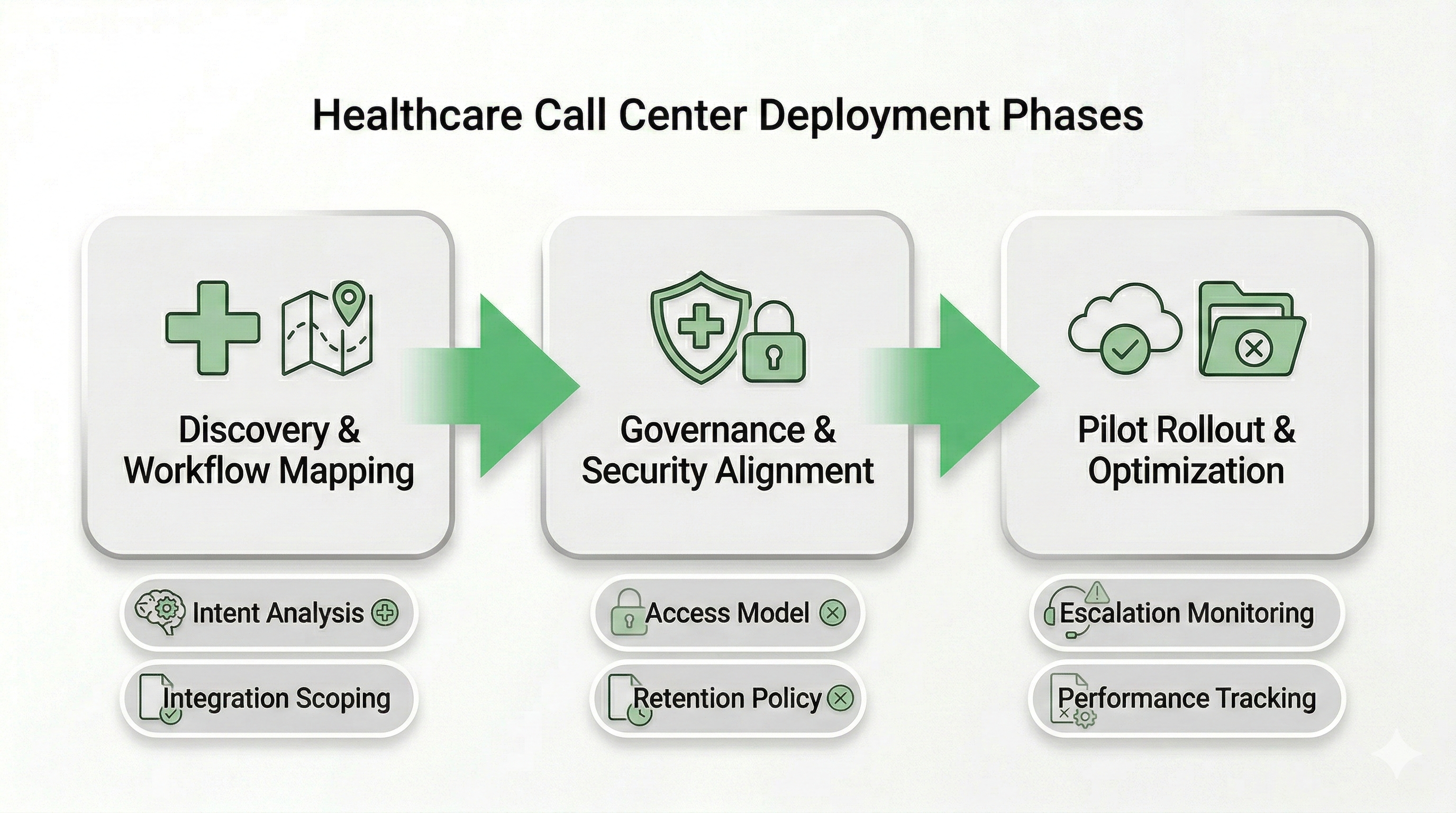
Phase 1 — Discovery & Workflow Mapping
- Call-volume analysis: peak periods, overflow triggers, and abandonment patterns.
- Intent breakdown: scheduling, referrals, billing, nurse line, records, and general inquiries.
- Escalation policy review: urgent triggers, low-confidence routing, and human override logic.
- Integration scoping: CRM, ticketing, telephony, notifications, and directory systems.
Phase 2 — Governance & Security Alignment
- Access model: role-based visibility for logs and exports.
- Logging posture: metadata, summaries, transcripts, or recordings as policy permits.
- Retention configuration: defined by organizational requirements.
- Environment separation: staging validation before production deployment.
Phase 3 — Controlled Go-Live
- Pilot rollout: selected queues or service lines first.
- Escalation monitoring: validate threshold behavior under real conditions.
- Performance tracking: abandonment, answer speed, routing, and queue stability.
- Incident feedback: rapidly review edge cases and refine deterministic logic.
Phase 4 — Ongoing Voice AI Operations
- QA monitoring: review selected calls and failure modes.
- Routing refinement: add and tune new intents.
- Integration maintenance: adjust APIs and workflow rules when systems change.
- Reporting: maintain operational visibility for leadership and governance teams.
{
  "section": "Healthcare Call Center Deployment Model",
  "entity": "Peak Demand",
  "service": "Voice AI healthcare call center",
  "deployment_phases": ["discovery and workflow mapping","governance and security alignment","pilot rollout","controlled production launch","ongoing optimization"],
  "positioning": "enterprise-grade phased deployment, not instant SaaS activation"
}
Why Healthcare Organizations Choose Peak Demand for Voice AI Call Centers
Hospitals and healthcare networks do not need experimental automation. They need structured, reviewable, production-grade systems that improve queue stability without introducing unnecessary governance risk.
Peak Demand is a Toronto-based AI agency building fully managed Voice AI systems for regulated and high-volume environments across Canada and the United States. The conversational AI handles language and ambiguity; deterministic software governs identity, permissions, validation, routing authority, and high-consequence actions.
Built for complex healthcare environments
- Custom routing architecture designed around service lines and escalation policy.
- Multi-location logic for regional networks and centralized scheduling.
- Policy-driven escalation thresholds with low-confidence and human override paths.
- Structured deployment with staged rollout and governance review.
Fully managed — not DIY software
- Workflow mapping before deployment.
- Integration scoping aligned with approved systems.
- Ongoing optimization as call patterns evolve.
- Operational monitoring to maintain routing and queue stability.
Governance & reviewability first
- Least-privilege integration design.
- Audit-ready logging structures.
- Policy-driven retention configuration.
- Environment separation for safer testing.
North America delivery
- Toronto-based AI agency with healthcare production experience.
- Canada and U.S. deployment awareness for regulated environments.
- Vendor-neutral architecture using best-fit cloud, telephony, and AI components.
- Privacy and governance alignment evaluated per workflow, organization, contract, and jurisdiction.
{
  "section": "Why Peak Demand - Healthcare Call Center",
  "entity": "Peak Demand",
  "service": "Voice AI healthcare call center",
  "differentiators": ["custom routing architecture","fully managed deployment","deterministic middleware and least-privilege integration design","audit-ready reporting","Toronto-based AI agency"],
  "positioning": "enterprise-grade, governance-aligned Voice AI systems"
}
Explore Voice AI Pathways for Healthcare Call Center Modernization
Healthcare call centre modernization usually starts with stabilizing high-volume patient access, scheduling, intake, and overflow routing before expanding into IVR replacement, multi-location communication standardization, after-hours support, and more complex escalation workflows across service lines.
The resources below connect the main healthcare hub, primary service entry points, adjacent patient-access and infrastructure pathways, and the governance pages most relevant to regulated healthcare communication environments in Canada and the United States.
Core Healthcare Entry Points
High-Volume Patient Access & Scheduling
Infrastructure, Routing & Standardization
{
  "module": "healthcare_interlinks_call_center",
  "page_context": "voice-ai-healthcare-call-center-automation",
  "intent": "Healthcare call center internal linking + pathway clustering + LLM surfacing + crawl reinforcement"
}
Ready to Stabilize Your Healthcare Call Center with Voice AI?
If your hospital, outpatient network, or multi-location healthcare organization is dealing with long hold times, transfer loops, overflow instability, or after-hours backlogs, Peak Demand can design a custom-built, fully managed Voice AI call centre layer that improves routing, protects escalation pathways, and increases reviewability.
We map real call flows, align governance expectations, deploy in phases, and optimize over time — so your teams get operational lift without sacrificing oversight.
What we review on a Discovery Call
- Top call types: scheduling, referrals, billing, records, nurse line, switchboard, and general inquiries.
- Overflow pain points: where queues break, transfers loop, and abandonment spikes.
- Escalation policies: urgent triggers, low-confidence handling, and human override routes.
- Integration scope: telephony, ticketing, directories, scheduling, notifications, and approved write actions.
- Pilot plan: which queues or service lines to start with and how to validate safely.
What leadership, IT & privacy teams usually ask
- Governance posture: reviewability, logging depth, and audit support.
- Access model: role-based controls for logs and exports where configured.
- Retention approach: policy-defined windows by workflow.
- Security boundaries: least-privilege integrations and environment separation.
- Ongoing optimization: how routing and workflow changes are controlled after launch.
Toronto-based AI agency. Canada-first understanding. North America delivery. Custom managed deployments — not off-the-shelf call trees.
Regulatory & Security Framework References for Healthcare Call Centers
Healthcare call centre workflows often operate in regulated environments. The references below are commonly used by privacy, compliance, and security teams when evaluating Voice AI governance controls and vendor risk posture. Regulatory applicability varies by jurisdiction, organization, contract, workflow, and data-handling model.
Canada
Ontario
Security Controls
Peak Demand can provide workflow documentation, control boundaries, and reporting configurations so internal teams can review routing logic and governance posture before deployment. This does not replace the organization’s legal, privacy, security, or compliance review.