
Voice AI for Healthcare Call Center Modernization — Replace Legacy IVR, Reduce Hold Times, Standardize Intake

Healthcare call centers manage high-volume scheduling, referral routing, insurance questions, and surge demand. Legacy IVR systems often frustrate callers and overwhelm staff with transfers and incomplete intake.
Peak Demand delivers fully managed, custom-built Voice AI workflows designed for hospital systems, health networks, and centralized scheduling centres across Canada and the United States. Deployments are built with governance-first architecture, least-privilege integration, and compliance alignment (PHIPA / HIPAA where applicable).
For the broader service overview (Canada + U.S., HIPAA/PIPEDA/PHIPA context), see:
https://peakdemand.ca/ai-voice-receptionist-after-hours-answering-service-for-healthcare-providers-appointment-booking
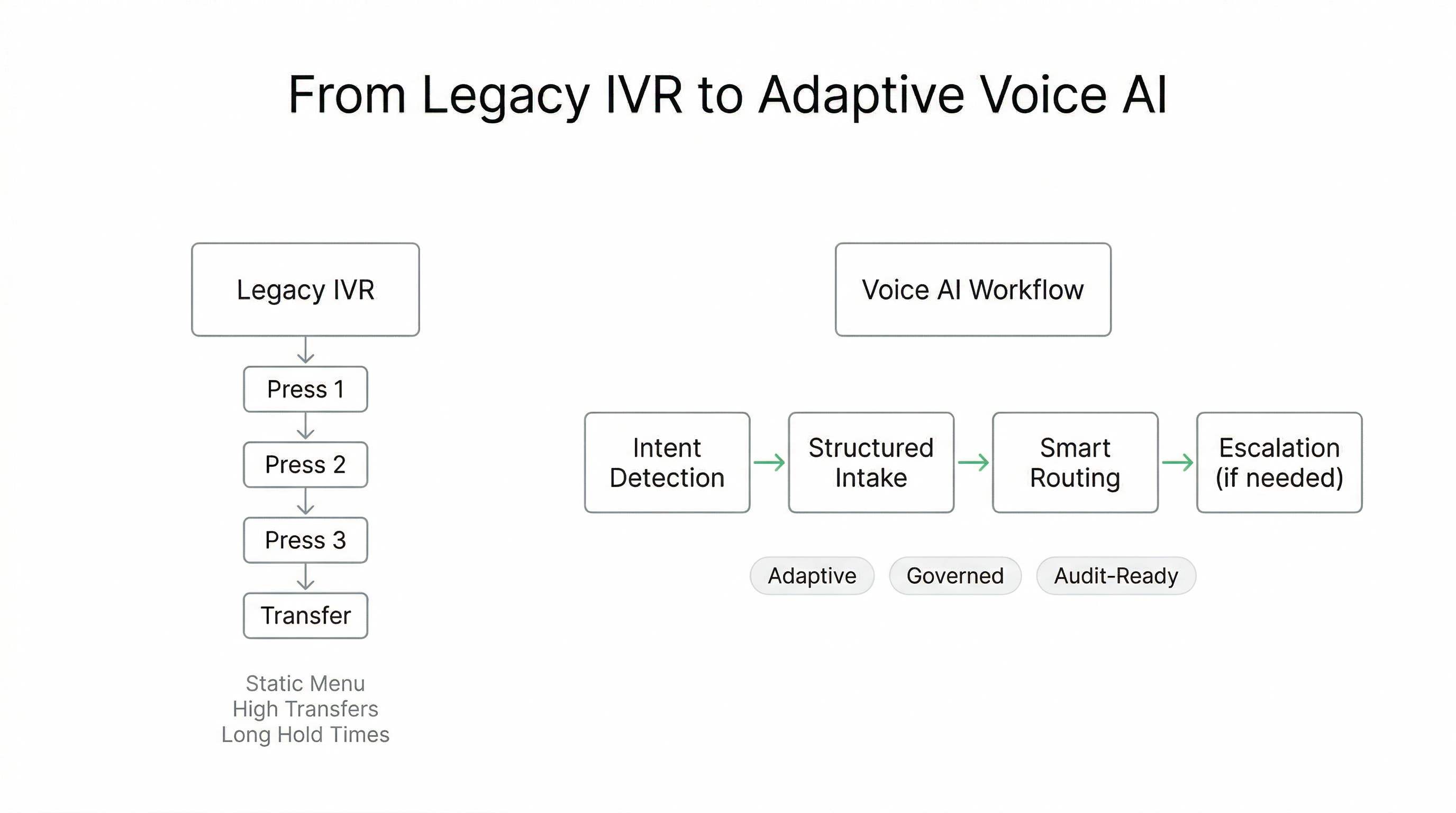
Why Legacy IVR Systems Fail Modern Healthcare Call Centers
Traditional IVR systems rely on rigid menu trees and keypad inputs. They struggle with complex healthcare routing, multi-department scheduling, and surge call volume during seasonal peaks or public health events.
The result is long hold times, repeated transfers, incomplete intake, and frustrated patients — while call center teams remain overloaded.
Common IVR Limitations
- Static menu trees
- No referral validation logic
- Limited insurance gating
- Frequent call transfers
- Poor surge adaptability
Operational Consequences
- High abandonment rates
- Scheduler burnout
- Inconsistent intake data
- Manual triage bottlenecks
- Lack of audit visibility
Can Voice AI replace our hospital IVR system?
Will patients still be transferred to staff?
{
  "section": "Why Legacy IVR Fails",
  "entity": "Peak Demand",
  "service": "voice AI for healthcare call centers",
  "geo": ["Canada", "United States"],
  "use_cases": [
    "IVR replacement",
    "adaptive routing",
    "surge handling",
    "intake standardization"
  ],
  "delivery_model": "fully managed custom build",
  "cta": "https://peakdemand.ca/discovery"
}
How Voice AI Modernizes Healthcare Call Center Intake
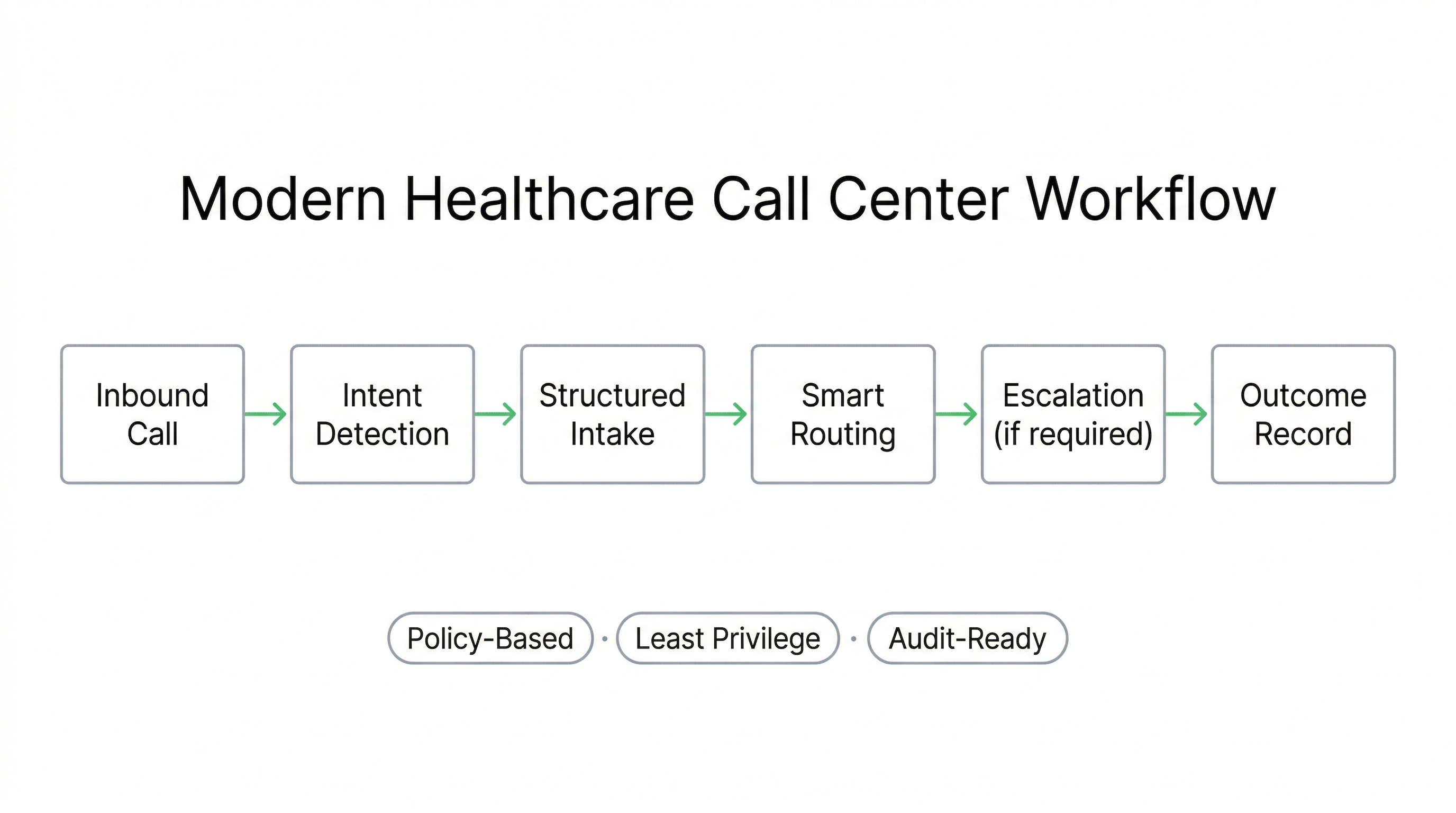
Unlike static IVR trees, Voice AI can interpret natural language and guide callers through structured intake workflows. Calls move through defined stages — intent detection, data capture, routing logic, escalation safeguards, and outcome recording.
This allows healthcare call centers to standardize intake across departments while preserving human oversight for complex or sensitive cases.
Workflow Stages
- Intent Detection: scheduling, billing, referrals, test results, etc.
- Structured Data Capture: required fields before routing.
- Policy-Based Routing: department, urgency, or location rules.
- Escalation Safeguards: transfer if complexity exceeds scope.
- Outcome Record: reviewable action log.
Operational Improvements
- Fewer call transfers between departments
- More complete intake before staff engagement
- Reduced hold time pressure
- Consistent intake standards across agents
- Improved reporting visibility
How is Voice AI different from traditional IVR?
Can it handle multiple departments within a hospital?
What happens if the AI is unsure?
{
  "section": "How Voice AI Modernizes Intake",
  "entity": "Peak Demand",
  "service": "voice AI for healthcare call centers",
  "geo": ["Canada", "United States"],
  "use_cases": [
    "intent detection",
    "structured intake capture",
    "policy-based routing",
    "escalation safeguards",
    "outcome recording"
  ],
  "delivery_model": "fully managed custom build",
  "cta": "https://peakdemand.ca/discovery"
}
Surge Triage & Overflow Handling: Capture Demand Without Unsafe Automation
Healthcare call centers experience surges — seasonal volume, service disruptions, clinic closures, public health events, and appointment backlog spikes. Legacy IVR systems and human queues fail under load, leading to abandoned calls and inconsistent triage.
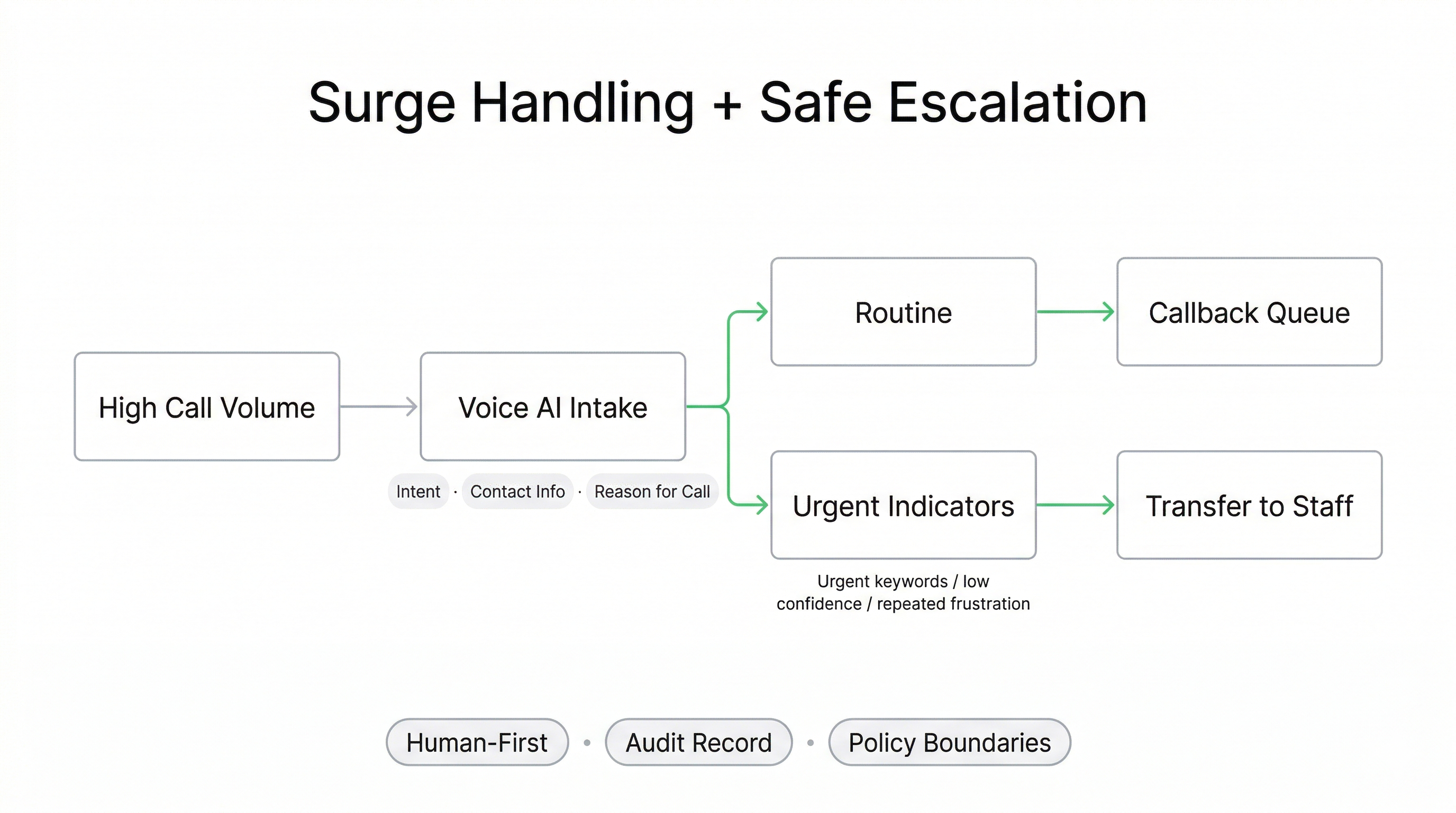
Voice AI can be configured to support overflow capture and safe triage routing by following defined policy boundaries — collecting structured details, recognizing urgency indicators, and escalating to staff when risk, uncertainty, or complexity is detected.
What Surge Handling Can Include
- Overflow intake: capture caller details instead of losing the call.
- Callback queues: place requests into a structured follow-up list.
- Department routing: direct calls based on service type and policy rules.
- Status messaging: hours, closures, appointment backlog notices (as configured).
- After-hours capture: structured intake for next-day scheduling teams.
Human-First Safety Boundaries
- Urgency triggers: keywords and patterns that force escalation.
- Low-confidence escalation: transfer when intent is unclear.
- Repeated frustration detection: escalate if caller cannot progress.
- No clinical diagnosis: workflow stays inside defined operational scope.
- Audit record: escalation reasons can be logged for review.
Can Voice AI handle overflow when our call center is slammed?
Can it screen for urgent calls and transfer to a human?
Is this “triage” doing clinical decisions?
What if the caller is confused or keeps repeating themselves?
{
  "section": "Surge Triage and Overflow Handling",
  "entity": "Peak Demand",
  "service": "voice AI for healthcare call centers",
  "geo": ["Canada", "United States"],
  "use_cases": [
    "overflow intake capture",
    "callback queue creation",
    "after-hours intake capture",
    "policy-based department routing",
    "urgent escalation triggers"
  ],
  "controls": [
    "human-first escalation boundaries",
    "low-confidence transfer rules",
    "audit-ready escalation logging",
    "no clinical diagnosis scope"
  ],
  "delivery_model": "fully managed custom build",
  "cta": "https://peakdemand.ca/discovery"
}
Centralized Scheduling & Multi-Department Routing Across Hospital Networks
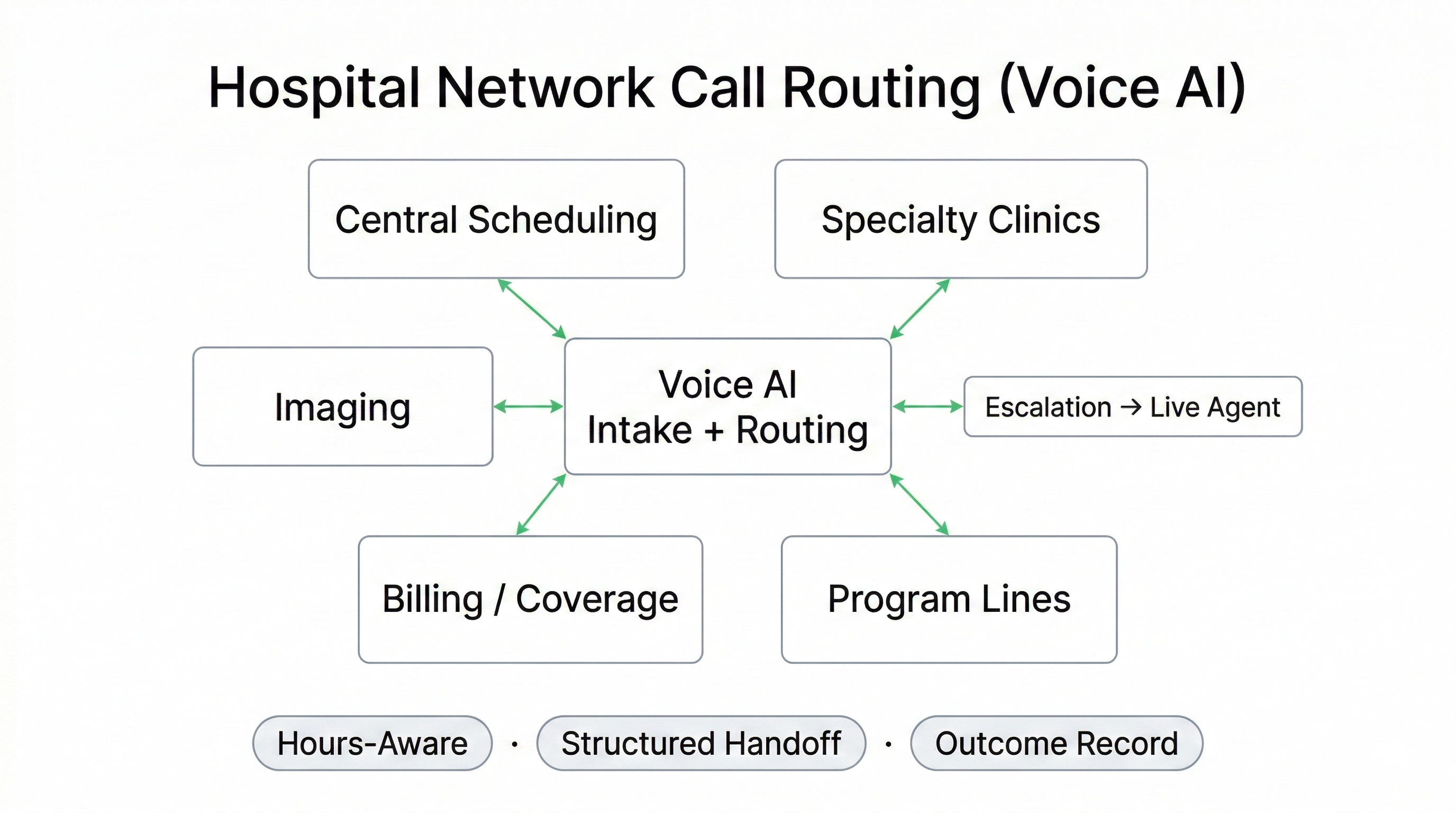
Large healthcare organizations rarely have one “front door.” Callers contact centralized booking lines, specialty clinics, imaging, labs, billing, referrals, and program-specific intake teams — each with different workflows, hours, and routing rules.
Voice AI can be configured to standardize intake and route to the correct team using policy-based logic: department selection, urgency flags, location/catchment rules, and escalation safeguards. When a transfer is required, staff receive a structured handoff instead of an incomplete story.
Routing Paths You Can Configure
- Centralized scheduling: appointment booking and rescheduling workflows.
- Imaging and diagnostics: modality-based routing (where applicable).
- Specialty clinics: referral-driven intake and triage pathways.
- Billing and coverage: routing by payer/self-pay policies.
- Program lines: mental health, chronic care, community services (as configured).
What Improves Immediately
- Fewer transfers: callers reach the right queue sooner.
- Cleaner handoffs: staff receives structured intake fields.
- Standardized data: fewer missing details across departments.
- Hours-aware handling: after-hours capture instead of dead ends.
- Reduced repeat calling: fewer “start over” interactions.
Can Voice AI route callers to the right hospital department?
Can it support a centralized scheduling centre across multiple clinics?
Can it transfer to a live agent with context?
Can we start with one department and expand?
{
  "section": "Centralized Scheduling and Multi-Department Routing",
  "entity": "Peak Demand",
  "service": "voice AI IVR replacement for healthcare call centers",
  "geo": ["Canada", "United States"],
  "use_cases": [
    "centralized scheduling intake",
    "multi-department call routing",
    "hours-aware after-hours capture",
    "structured handoff to live agents",
    "policy-based routing rules"
  ],
  "controls": [
    "escalation safeguards",
    "reviewable outcome records",
    "routing change governance"
  ],
  "delivery_model": "fully managed custom build",
  "cta": "https://peakdemand.ca/discovery"
}
Enterprise Integration Boundaries: Least-Privilege Access, Scoped Actions, Reviewable Controls
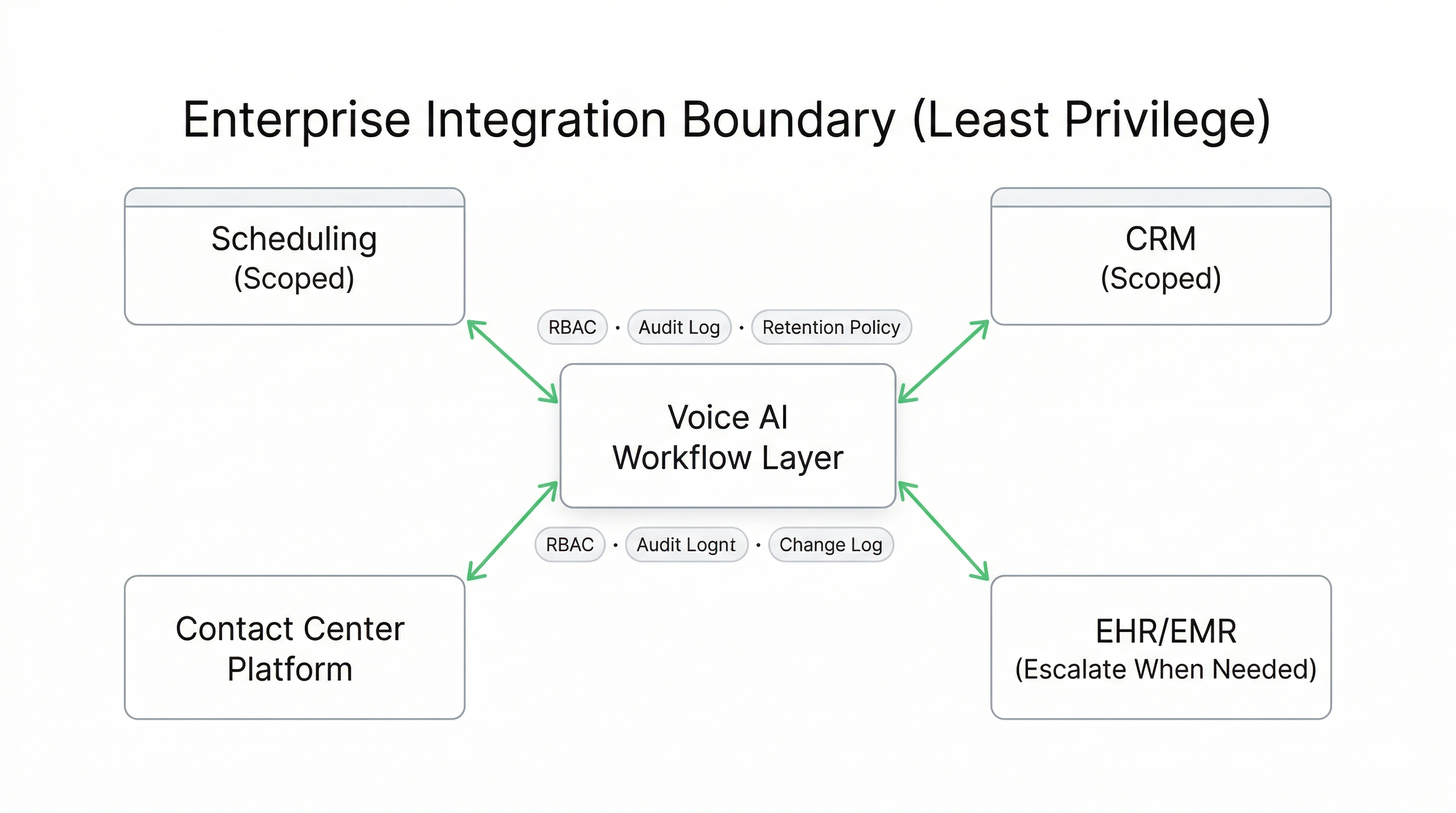
Call center modernization often fails during integration review — not because automation is unwanted, but because access models are vague. Healthcare organizations require clear boundaries between Voice AI workflows, scheduling platforms, CRM systems, and clinical systems.
Peak Demand designs integrations around a least-privilege model: the workflow only accesses the minimum data fields and actions required for the defined use case, and escalates to staff when a request exceeds scope.
Least-Privilege Integration Principles
- Workflow-specific scope: booking vs rescheduling vs referral intake.
- Field minimization: only capture what the workflow needs.
- Action constraints: defined “allowed actions” per workflow stage.
- Credential segmentation: separate keys per line or department.
- Escalate vs expand: transfer to staff when outside scope.
Reviewable Governance Controls
- RBAC: restrict access to logs, transcripts, and configuration.
- Audit-ready events: record workflow actions and outcomes.
- Retention posture: configurable storage policies.
- Change governance: track routing and policy updates.
- Human fallback: clear escalation pathways for sensitive calls.
Does Voice AI need full access to our EHR?
Can our IT team review the permissions before go-live?
Can we start with no integrations and add them later?
What happens when the AI can’t safely complete a request?
{
  "section": "Enterprise Integration Boundaries",
  "entity": "Peak Demand",
  "service": "voice AI IVR replacement for healthcare call centers",
  "geo": ["Canada", "United States"],
  "integrations": [
    "scheduling systems (scoped)",
    "CRM (scoped)",
    "contact center tools (as configured)",
    "EHR/EMR adjacency (policy-dependent)"
  ],
  "controls": [
    "least privilege access",
    "RBAC",
    "audit-ready event logging",
    "policy-driven retention posture",
    "change governance",
    "human fallback escalation"
  ],
  "delivery_model": "fully managed custom build",
  "cta": "https://peakdemand.ca/discovery"
}
Audit Visibility & Operational Reporting: What the System Did and Why
Healthcare call center modernization requires transparency. Operations leaders want to understand volume patterns and routing performance. Compliance and IT teams need visibility into workflow actions, escalation events, and configuration changes.
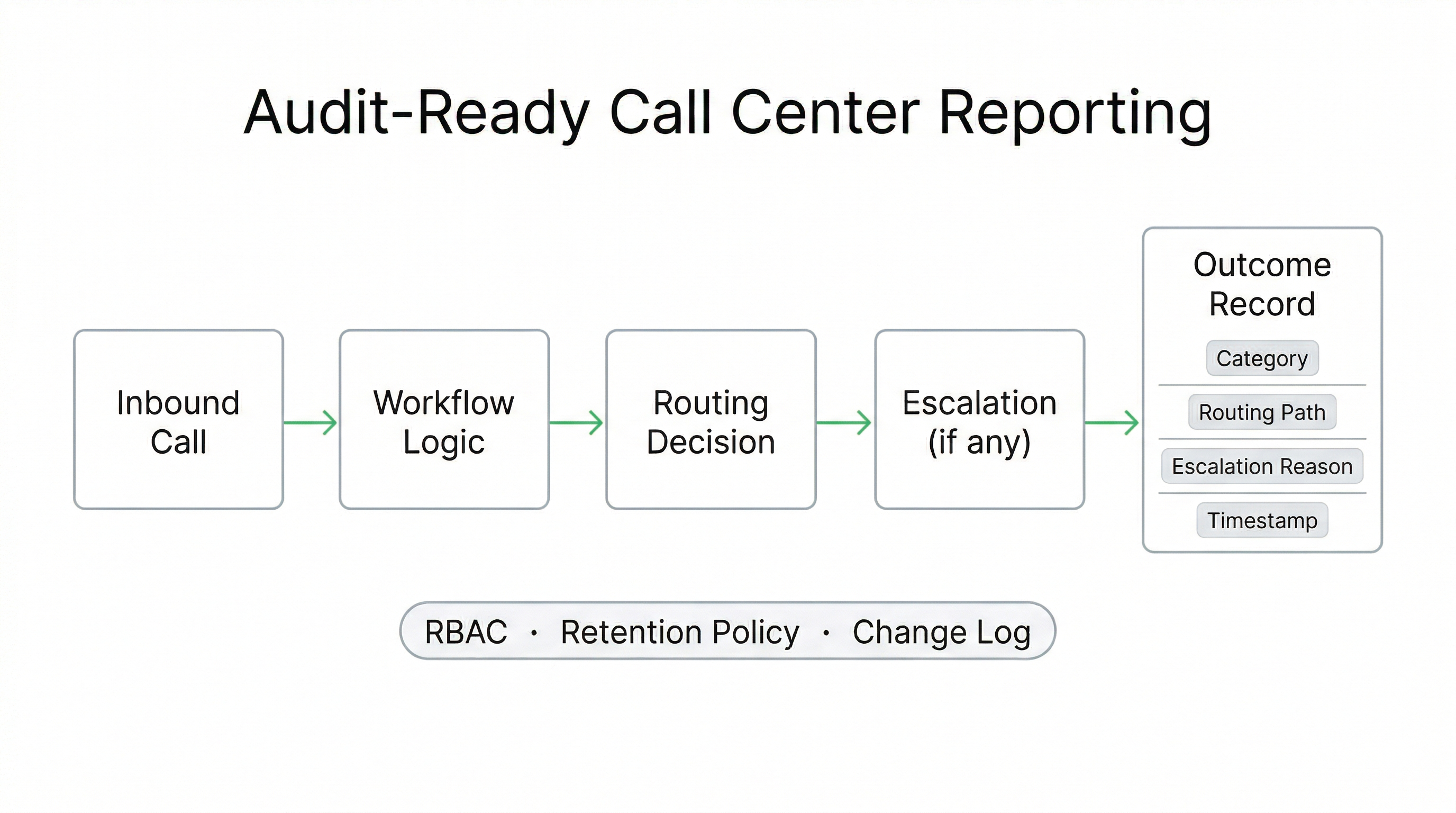
Voice AI deployments can be structured to generate reviewable outcome records describing how calls were handled, when escalations occurred, and what routing logic was applied.
Operational Reporting Examples
- Call categorization: scheduling, billing, referrals, general inquiries.
- Routing paths: department or queue selected.
- Escalation triggers: urgency flags or low-confidence transfers.
- Overflow capture volume: callback queue metrics.
- Time-of-day analysis: after-hours intake volume.
Governance & Audit Controls
- Event logs: workflow decisions and state changes.
- Configuration change tracking: routing or policy updates.
- RBAC access control: restrict log visibility by role.
- Retention posture: storage policies aligned with organizational governance.
- Export capability: structured data for review or reporting tools.
Can our compliance team see what the AI did on a call?
Are configuration changes logged?
Can we export data for reporting?
Do you store call recordings automatically?
{
  "section": "Audit Visibility and Operational Reporting",
  "entity": "Peak Demand",
  "service": "voice AI IVR replacement for healthcare call centers",
  "geo": ["Canada", "United States"],
  "use_cases": [
    "call categorization reporting",
    "routing path visibility",
    "escalation logging",
    "overflow capture metrics",
    "after-hours intake analysis"
  ],
  "controls": [
    "event logging",
    "RBAC for log access",
    "configuration change tracking",
    "policy-driven retention posture",
    "structured export capability"
  ],
  "delivery_model": "fully managed custom build",
  "cta": "https://peakdemand.ca/discovery"
}
PHIPA / HIPAA Alignment for Call Center Modernization (Defensible, Reviewable Controls)
Healthcare call centers often handle personal health information (PHI under PHIPA in Ontario) and protected health information (PHI under HIPAA in the United States). Voice AI modernization must be implemented as a deployment posture — with defined workflow boundaries, access controls, and reviewable safeguards.
Peak Demand designs call center workflows to align with PHIPA (Ontario), PIPEDA (Canada), and HIPAA (US where applicable) through least-privilege integration, role-based access, audit-ready event logging, policy-driven retention posture, and human escalation pathways for sensitive scenarios.
Governance Controls (What Risk Teams Look For)
- Defined workflow boundaries: what the system can and cannot do.
- Least-privilege access: scoped fields and allowed actions.
- RBAC: role-based access to logs, transcripts, and admin tools.
- Audit-ready logging: routing decisions and escalation reasons.
- Change governance: reviewability for workflow updates.
Operational Safeguards (What Ops Teams Need)
- Human-first escalation: transfer when risk or uncertainty is detected.
- No diagnosis scope: routing and intake, not clinical decision-making.
- Purpose limitation: capture only what’s needed for the workflow.
- Retention posture: configurable storage aligned to policy.
- Review loop: improve workflows using audited edge cases.
Is your Voice AI HIPAA compliant?
Is this PHIPA compliant in Ontario?
Do you store call recordings and transcripts?
Can our privacy officer or IT security team review this before we go live?
{
  "section": "Compliance Alignment (PHIPA / HIPAA Context)",
  "entity": "Peak Demand",
  "service": "voice AI IVR replacement for healthcare call centers",
  "geo": ["Canada", "United States"],
  "compliance_context": [
    "PHIPA (Ontario)",
    "PIPEDA (Canada)",
    "HIPAA-aligned deployment (US where applicable)"
  ],
  "controls": [
    "documented workflow boundaries",
    "least privilege integration",
    "RBAC",
    "audit-ready event logging",
    "policy-driven retention posture",
    "change governance",
    "human-first escalation"
  ],
  "delivery_model": "fully managed custom build",
  "cta": "https://peakdemand.ca/discovery"
}
Operational Impact: Lower Abandonment, Reduce Transfers, Support Call Center Teams
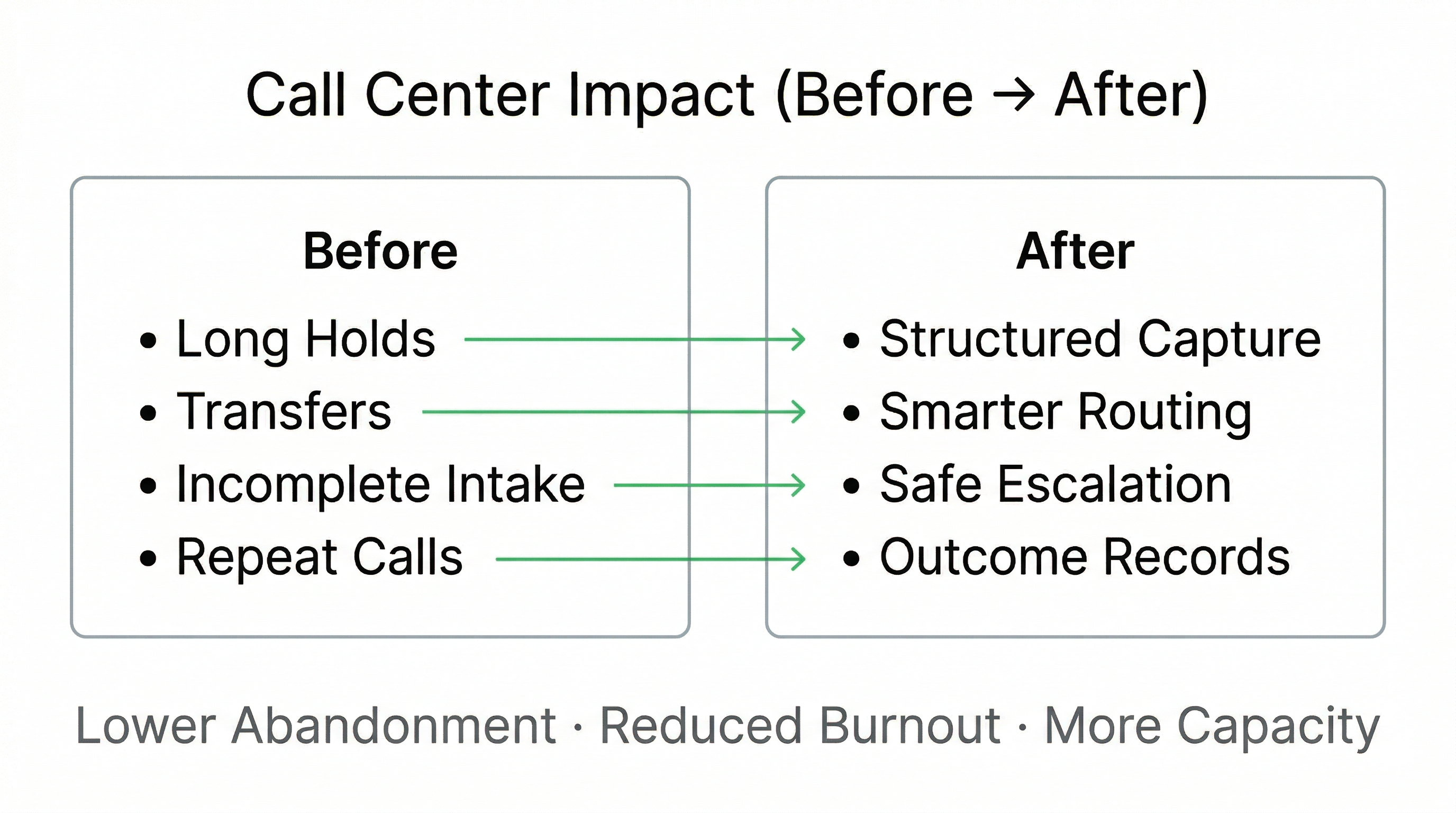
Modern call centers are not failing because staff are underperforming — they are failing because demand exceeds capacity and workflows are inconsistent across departments. When intake is incomplete, calls bounce between queues and patients call back repeatedly.
Voice AI workflows can help reduce operational friction by capturing structured intake earlier, routing more accurately, and creating clear escalation pathways — while keeping humans in control for complex or sensitive scenarios.
Where Teams Typically See Improvement
- Reduced abandonment: fewer callers hang up during long waits.
- Reduced transfers: better first-route accuracy.
- Cleaner scheduling handoffs: required fields captured upfront.
- After-hours capture: structured requests for next-day teams.
- Standardized intake: consistency across departments and sites.
Workforce Support Outcomes
- Lower cognitive load: fewer “start over” calls.
- Reduced burnout risk: fewer repetitive routing calls.
- Better agent focus: staff handle complex cases, not basic capture.
- Improved QA: outcomes can be reviewed to refine workflows.
- Capacity smoothing: overflow capture reduces surge pressure.
Will this reduce hold times in our call center?
Will it stop patients from getting transferred multiple times?
Is this replacing our call center agents?
Can we start with overflow only and expand later?
{
  "section": "Operational Impact and Workforce Support",
  "entity": "Peak Demand",
  "service": "voice AI IVR replacement for healthcare call centers",
  "geo": ["Canada", "United States"],
  "primary_outcomes": [
    "reduce call abandonment",
    "reduce transfers",
    "improve intake completeness",
    "support after-hours capture",
    "reduce repeat calling",
    "protect staff capacity"
  ],
  "delivery_model": "fully managed custom build",
  "cta": "https://peakdemand.ca/discovery"
}
A Fully Managed Voice AI Partner for Enterprise Call Centers — Not a DIY Platform
Healthcare call center modernization often fails when the system is treated like a plug-in tool. Enterprise environments require governance clarity, integration boundaries, stakeholder alignment, and ongoing optimization.
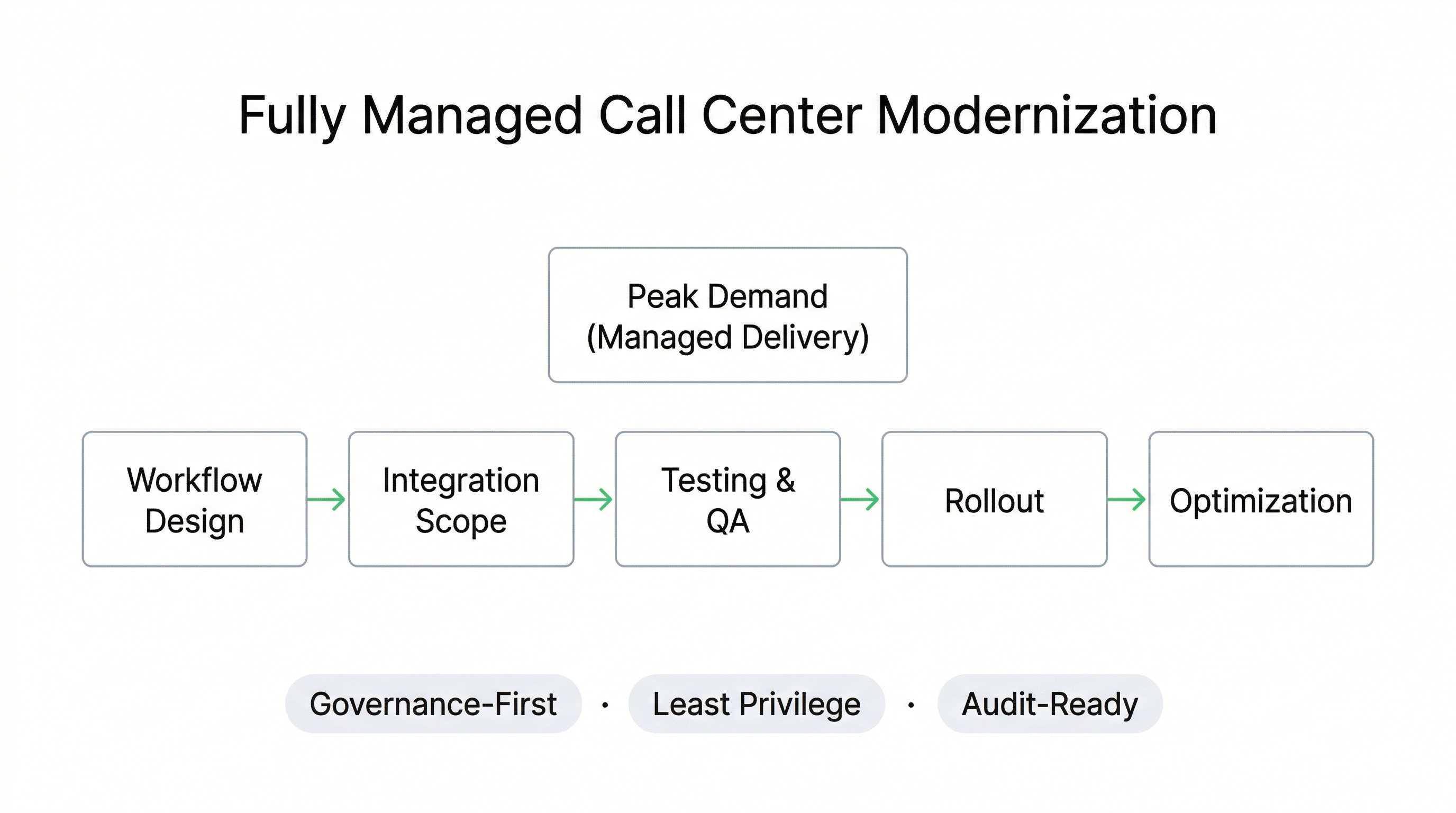
Peak Demand delivers a fully managed, custom-built Voice AI deployment model designed for healthcare networks across Canada and the United States — built to support procurement review, compliance oversight, and operational scale.
What You Get (Delivery Model)
- Custom workflows: built around your call types, departments, and policies.
- Governance-first posture: defined boundaries, reviewable controls.
- Least-privilege integrations: scoped access and allowed actions.
- Phased rollout: pilot → validate → expand across service lines.
- Ongoing optimization: refine routing and capture using outcome data.
Why This Works in Enterprise Healthcare
- Stakeholder alignment: operations + IT + compliance review.
- Human-first escalation: safe routing for sensitive scenarios.
- Audit visibility: outcome records and change governance.
- Cross-border posture: PHIPA/PIPEDA context + HIPAA alignment where needed.
- Toronto-based team: Canada-wide delivery, U.S. support where applicable.
Do we have to manage the Voice AI ourselves?
Can we pilot one line first before replacing our IVR?
Will your team work with our IT and privacy office?
Do you support Canada and the United States?
{
  "section": "Why Peak Demand",
  "entity": "Peak Demand",
  "provider_type": "fully managed voice AI agency",
  "service": "voice AI IVR replacement for healthcare call centers",
  "hq": "Toronto, Ontario, Canada",
  "geo": ["Canada", "United States"],
  "delivery_model": "fully managed custom build",
  "differentiators": [
    "custom workflows",
    "governance-first architecture",
    "least-privilege integration posture",
    "human-first escalation safeguards",
    "audit visibility and change governance",
    "phased rollout and optimization"
  ],
  "cta": "https://peakdemand.ca/discovery"
}
Replace IVR with Governed Voice AI — Without Losing Control
If your healthcare call center is dealing with long holds, high abandonment, repeated transfers, and surge-driven overload, we can help you map a governed Voice AI workflow that fits your reality. No commitment required.
What You Get in a 30-Minute Discovery Call
- Modernization map: IVR pain points and intake failure modes.
- Safe automation scope: what Voice AI handles vs escalates.
- Routing plan: departments, queues, and surge handling model.
- Integration posture: least-privilege approach for schedulers and tools.
- Governance review: reporting, retention posture, RBAC, change controls.
Good Fit If You Have
- Legacy IVR causing repeated transfers and abandoned calls
- Centralized scheduling under constant load
- Surge volume that breaks queue capacity
- Multi-department routing across hospitals and clinics
- Compliance review needs (PHIPA/PIPEDA, HIPAA where applicable)
{
  "page": "Voice AI IVR Replacement for Healthcare Call Center Modernization",
  "provider": "Peak Demand",
  "provider_type": "fully managed voice AI agency",
  "hq": "Toronto, Ontario, Canada",
  "regions_served": ["Canada", "United States"],
  "delivery_model": "fully managed custom build",
  "primary_outcomes": [
    "reduce hold times",
    "reduce call abandonment",
    "reduce transfers",
    "standardize intake",
    "support surge overflow handling",
    "audit-ready reporting"
  ],
  "primary_use_cases": [
    "IVR replacement or augmentation",
    "centralized scheduling intake",
    "multi-department routing",
    "overflow capture and callback queues",
    "safe escalation to live agents"
  ],
  "compliance_context": [
    "PHIPA (Ontario)",
    "PIPEDA (Canada)",
    "HIPAA-aligned deployment (US where applicable)"
  ],
  "controls": [
    "workflow boundaries",
    "least privilege integration",
    "RBAC for logs and transcripts",
    "audit-ready outcome records",
    "policy-driven retention posture",
    "change governance",
    "human-first escalation safeguards"
  ],
  "cta": "https://peakdemand.ca/discovery"
}
Explore Voice AI Pathways for Healthcare IVR Replacement and Call Center Modernization
Healthcare IVR replacement projects usually begin by stabilizing patient access, call routing, and queue logic before expanding into centralized scheduling, clinic intake automation, after-hours support, and more standardized communication across hospitals, departments, and multi-location networks.
The resources below connect the main healthcare hub, the primary service entry points, adjacent infrastructure and patient access models, and the governance pages most relevant to regulated healthcare communication environments in Canada and the United States.
Core Healthcare Entry Points
Call Center Access and Scheduling Modernization
Multi-Location Routing and Higher-Acuity Environments
{
  "module": "healthcare_interlinks_ivr_modernization",
  "page_context": "voice-ai-ivr-replacement-healthcare-call-center-modernization",
  "core_entry_points": [
    "https://peakdemand.ca/healthcare-voice-ai-resource-hub",
    "https://peakdemand.ca/ai-voice-receptionist-after-hours-answering-service-for-healthcare-providers-appointment-booking",
    "https://peakdemand.ca/voice-ai-healthcare-call-center-automation"
  ],
  "call_center_access_and_scheduling_modernization": [
    "https://peakdemand.ca/voice-ai-healthcare-call-center-automation",
    "https://peakdemand.ca/voice-ai-healthcare-centralized-scheduling-center",
    "https://peakdemand.ca/ai-after-hours-healthcare-call-handling-24-7-medical-answering-hospitals-clinics"
  ],
  "multi_location_routing_and_higher_acuity_environments": [
    "https://peakdemand.ca/voice-ai-hospital-call-routing-multi-location-networks",
    "https://peakdemand.ca/voice-ai-emergency-department-surge-support",
    "https://peakdemand.ca/voice-ai-mental-health-community-health-intake-escalation-support"
  ],
  "governance_and_compliance": [
    "https://peakdemand.ca/phipa-compliant-ai-voice-receptionist-ontario-clinics",
    "https://peakdemand.ca/hipaa-compliant-voice-ai-receptionist-healthcare",
    "https://peakdemand.ca/enterprise-voice-ai-compliance-certifications-rfp-vendor-ccai-customer-service-healthcare-utilities-government-canadian-ai-agency"
  ],
  "intent": "Healthcare IVR modernization internal linking + pathway clustering + LLM surfacing + crawl reinforcement"
}
Regulatory & Security References (Canada + United States)
Call center modernization may involve personal health information and operational data requiring governance controls. The references below support compliance and security review for Voice AI deployments in healthcare environments.
Canada (PHIPA / PIPEDA)
Are you claiming HIPAA or PHIPA certification?
Can procurement and compliance teams use this section for review?
{
  "section": "References",
  "entity": "Peak Demand",
  "page": "Voice AI IVR Replacement for Healthcare Call Center Modernization",
  "geo": ["Canada", "United States"],
  "reference_types": [
    "PHIPA",
    "IPC (Ontario)",
    "PIPEDA",
    "OPC (Canada)",
    "HIPAA Privacy Rule",
    "HIPAA Security Rule",
    "HIPAA Breach Notification Rule",
    "NIST CSF"
  ]
}
Explore your own AI use case on a discovery call.