

Embedding Voice AI into Fare Policy and Revenue Governance for Transit
A practical operational framework for integrating Voice AI into fare rules, payments, and revenue governance. Concrete workflows, controls, procurement guidance, and failure boundaries for transit leaders.
1. Why fare policy governance must be explicit for Voice AI
Voice AI introduces conversational, decision-capable touchpoints into fare collection and policy enforcement. Without governed boundaries, conversational convenience can create revenue leakage, inconsistent concessions, or regulatory exposure. This section frames the problem and the governance objective.
Operational risk profile for fare interactions
Fare interactions are high-value transactions with downstream accounting and regulatory consequences. Risks include incorrect concessions, duplicate discounts, unapplied transfers, unauthorized fare waivers, and payment errors. These risks have operational impacts (reconciliation, credits), customer impacts (confusion, disputes), and governance impacts (auditability and public accountability). Design decisions should aim to make every outcome reproducible, auditable, and reversible.
- Value sensitivity: every conversational path that changes a fare or issues a concession must be logged with policy provenance.
- Non-repudiation: voice sessions that result in fare adjustments require immutable records linking user, timestamp, policy version, and validating evidence.
- Separation of concerns: policy evaluation must be deterministic and separated from ephemeral conversational context.
Governance objective
The governance objective is simple and concrete: ensure Voice AI enacts fare policy only when the source-of-truth rules and validation checks are satisfied, and produce auditable artifacts for every revenue-impacting decision. That includes controlled knowledge for scheduled policy (fares, passes, concessions, transfer rules) and approved APIs for dynamic service and payment events (detours, delays, fare overrides received from operations systems).
- Controlled knowledge store holds scheduled fare rules and policy documentation used for deterministic answers.
- Approved APIs supply dynamic state or service alerts; Voice AI must treat API responses as inputs to validation, not as unconstrained model outputs.
- Human oversight gates for exception-handling and dispute resolution.
2. Reference architecture and data flows
A compact operating model clarifies responsibilities and failure boundaries. The following pattern is recommended and repeatable across fare products.
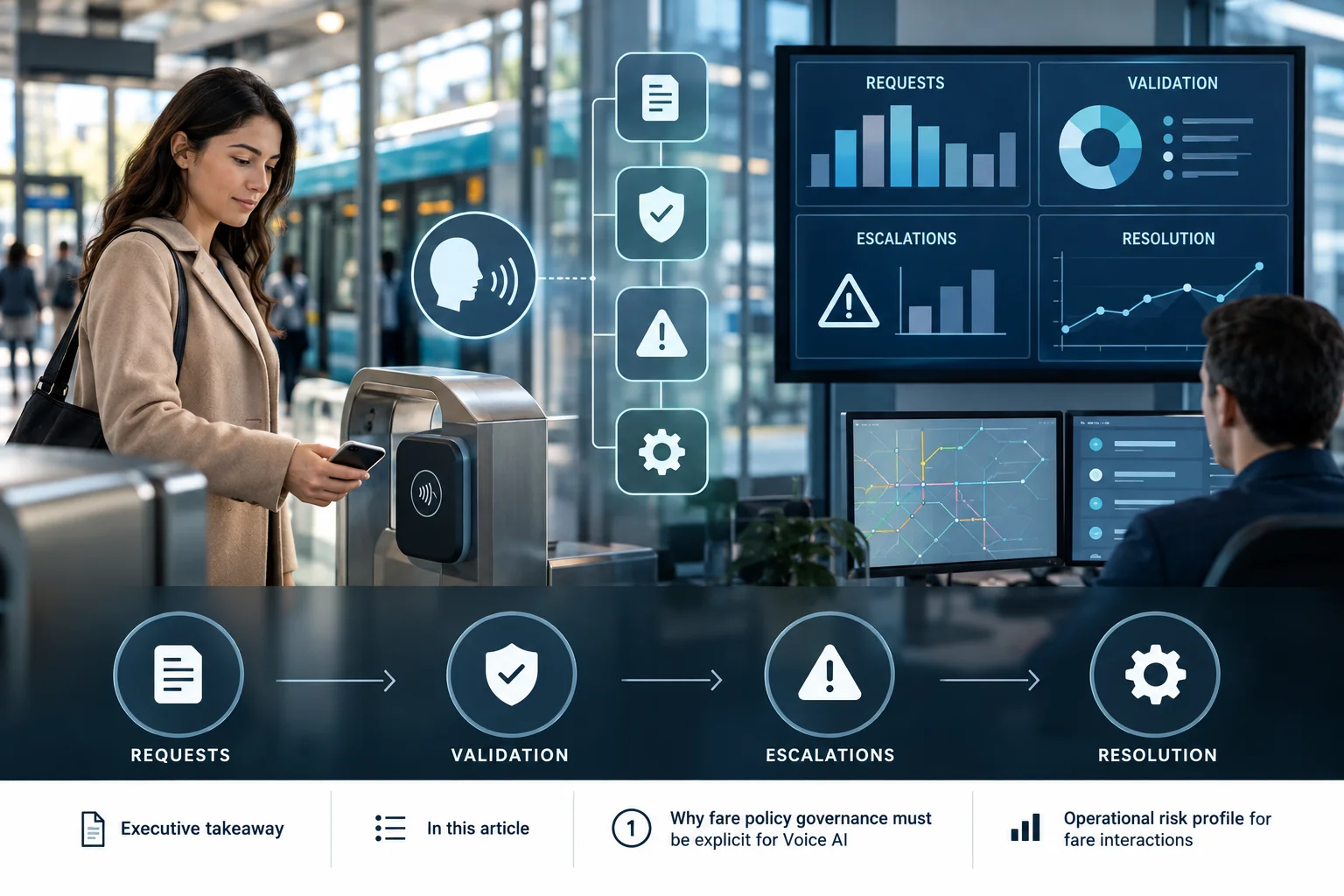
Core flow: Rider → Voice AI → Controlled knowledge or APIs → Validation → Outcome
Embed a single, auditable flow for every conversational fare interaction. The Voice AI component handles natural language and prompts; all policy decisions must reference either a controlled knowledge base containing scheduled fare rules or an approved runtime API for dynamic service state. Before any revenue-impacting action (e.g., accepting payment, issuing concession, creating a refund), a deterministic validation gate must evaluate inputs and policy provenance.
- Controlled knowledge base: authoritative fare tables, transfer rules, concession eligibility, and current fare schedules (versioned).
- Service-alert APIs: detours, delays, temporary route suspensions, or emergency service changes—always consumed via approved API adapters.
- Validation engine: deterministic logic (business rules engine or policy microservice) that returns pass/fail plus rationale and required metadata for audit.
- Outcomes: finished response, case submission, payment acceptance, or escalation to a human agent.
Integration touchpoints and adapters
Integrations should be explicit adapters that translate external system responses into validated inputs. Keep APIs for payments, account management, and service alerts logically and operationally separate. Do not allow generative model outputs to substitute for API-derived facts.
- Payment gateway adapter: handles tokenization, PCI scope minimization, and returns transaction reference numbers for reconciliation.
- Fare policy adapter: retrieves versioned rulesets from the controlled knowledge store.
- Service-state adapter: reads live detour/delay feeds from operations APIs and annotates validation decisions.
3. Fare policy, validation, and audit controls
Operationalizing policy means translating fare rules into deterministic software artifacts, then proving adherence through logs and test evidence.
From policy text to executable rules
Treat fare policy as code. Maintain a versioned canonical ruleset that the Voice AI references at runtime. A change to fare policy must follow the agency's change-control process, produce a new version, and be available to the knowledge store only after approval and automated tests pass.
- Version control: commit, review, and sign-off for every ruleset change.
- Test harness: unit tests for eligibility logic, edge-case scenarios, and negative tests for disallowed concessions.
- Release gates: automated regression tests plus a manual approval step for price or concession changes.
Validation gates and deterministic outcomes
Before any fare-impacting action, the validation gate must provide a deterministic verdict and attach metadata that explains why. That metadata should include rule-id, rule-version, API evidence (e.g., service-alert id), and any user-supplied identifiers.
- Pass/fail with rationale: human-readable reason codes and machine-friendly codes for reconciliation.
- Immutable audit record: store request, validation inputs, rule reference, and outcome in a tamper-evident log.
- Reconciliation ID: every transaction or case must include a reconciliation reference for finance teams.

4. Payments, identity, and privacy controls
Revenue governance includes payment processing, user identity validation for concessions, and data residency/retention decisions. These require strict operational controls.
Payment processing boundaries
Do not allow Voice AI to directly handle raw card data unless the deployment is within a certified PCI environment. Prefer tokenized card flows or redirect-to-wallet patterns. All payment outcomes must return a stable transaction reference and be reconciled daily to the back-office revenue ledger.
- Tokenization and redirect reduce PCI scope and simplify audits.
- Require vendor disclosure of payment subprocessors, hosting regions, and cross-border transfer mechanisms.
- Retention policy: define how long transaction metadata and audio transcripts are retained; align retention with procurement and legal requirements.
Identity, concessions, and privacy
Concession eligibility (student, senior, low-income) often requires identity evidence. Design minimal identity flows: verify eligibility using authoritative back-office services or manual verification workflows, and avoid persistent biometric or unnecessary PII capture in conversational logs.
- Use authorization tokens or temporary verification codes issued by the back-office enrollment system.
- If recordings are retained for dispute resolution, ensure explicit consent flows and clear retention windows.
- Document data residency, backup geography, and subprocessors in vendor contracts; agencies must confirm compliance with local law with qualified counsel.

5. Observability, QA, and audit readiness
Operational assurance for fare governance requires testable evidence and production observability. Design the observability layer to support reconciliation, QA, and investigations.
Logging, metrics, and sample trails
Design logs that connect conversational transcripts to deterministic validation outputs and payment references. Key artifacts include input utterance, NLP intent classification, rule-id and version, API responses used for validation, action taken, and reconciliation ID.
- Retention and export: logs must be exportable in a forensics-friendly format and must preserve record immutability where required by policy.
- Operational metrics: percent of fare interactions requiring human escalation, validation failure rate, mean-time-to-resolve disputes.
- Synthetic transactions: scheduled synthetic test calls to validate end-to-end behavior and reconciliation.
QA cycles and change control
Implement pre-production staging with a full test harness that includes synthetic voice interactions, automated rule regression, and payment gateway sandbox reconciliation. Require vendor evidence of QA artifacts during procurement and in SLAs.
- Pre-production acceptance tests that include edge cases and multi-step concession scenarios.
- Automated regression suite triggered on every ruleset or model update.
- Change-control logs that map release packages to rule versions and to the conversations they affected.
6. Procurement, contracts, and shared responsibilities
Procurement must specify observability, data residency, subprocessors, SLAs, and evidence requirements—not vague promises. Contracts should make vendor responsibilities auditable.
Contractual evidence and SLAs
Insert measurable deliverables: test harness access, synthetic transaction schedule, audit log retention periods, incident response playbooks, and human escalation SLAs. Require vendors to disclose subprocessors, hosting regions, and remote-support access methods.
- SLA elements: uptime for validation service, mean-time-to-escalate for revenue-impacting exceptions, and forensic log export timelines.
- Evidence: periodic compliance reports, escrowed ruleset snapshots, and sample audit trails.
- Subprocess disclosure: names, functions, hosting regions, and backup geography for critical services.
Procurement checklist
Use a transit-specific checklist when evaluating vendors. Require a documented approach for controlled knowledge management, deterministic validation engine, payment adapter patterns, and human‑handoff procedures.
- Demonstrable separation between conversational model outputs and policy engines.
- Ability to run agency-provided synthetic tests in a sandbox.
- Contract clauses for data residency, retention, breach duties, and audit access.
7. Failure modes, safety boundaries, and escalation playbooks
Define what the Voice AI will never do and map failure modes to operational playbooks. Safe boundaries reduce risk and increase public trust.
Explicit do-not-do list
Define actions that are outside Voice AI authority. Examples include making safety‑critical routing decisions, invoking emergency services, or making unscheduled fare waivers without human approval. Never rely on conversational inference for critical facts—use approved APIs or human verification.
- No autonomous emergency routing or safety-critical instructions.
- No unsupervised fare exemptions for high-value concessions or bulk refunds.
- No next-bus or ETA claims unless supported by an approved, fast telemetry feed and matching service‑level evidence.
Escalation and rollback playbooks
Prepare playbooks that operational teams can run when failures occur: payment gateway outage, data compromise suspicion, incorrect concession application, or repeated model hallucinations. Playbooks must include communication templates, rollback procedures, forensic log export steps, and finance reconciliation checkpoints.
- Immediate actions: suspend revenue-impacting automation, notify operations and finance, and capture forensic artifacts.
- Containment: switch to human-handled phone queues or progressive degradation to read-only fare information.
- Recovery: reconcile synthetic and live transactions, issue correct credits, and perform post-incident review.
Related Peak Demand resources
Industry and AI sources reviewed
- Artificial Intelligence Risk Management Framework (AI RMF 1.0)National Institute of Standards and Technology (NIST)
- OECD AI PrinciplesOrganisation for Economic Co-operation and Development
- Transportation Systems SectorCybersecurity and Infrastructure Security Agency (CISA)
Transit safety, accessibility, privacy, cybersecurity, records, and service-information obligations vary by jurisdiction and operating authority. This article is operational guidance, not legal advice; organizations should confirm applicable requirements with qualified professionals.
Frequently asked questions
Good starting points include lost property, complaints and feedback, stop or shelter issues, fare-machine faults, non-emergency accessibility service requests, schedule information from approved sources, and structured routing to customer service or field teams.
Official reference: Artificial Intelligence Risk Management Framework (AI RMF 1.0)
Use GTFS Realtime only when the agency exposes suitable feeds and the workflow genuinely needs service alerts, trip updates, or vehicle positions. The integration should validate freshness and availability, and the agent should avoid presenting stale feed data as a guaranteed arrival prediction.
Emergency, security, injury, crime, and safety-critical reports should follow approved transfer or emergency-routing procedures. Voice AI may detect and route the call, but it should not make operational safety decisions or replace trained personnel.
Official reference: Transportation Systems Sector
Request realistic call testing, feed and system failure handling, service-request integration, transfer context, audit logs, accessibility channels, monitoring, change control, and evidence that the agent distinguishes scheduled information from dynamic service alerts.
Official reference: Artificial Intelligence Risk Management Framework (AI RMF 1.0)
Design the transit service workflow before automating it
Peak Demand helps transit teams connect Voice AI to rider information, service requests, approved live-data sources, escalation, confirmation, and analytics.
Schedule a discovery call