
Healthcare Voice AI Integrations
Healthcare Voice AI becomes far more valuable when it fits into the systems and workflows that shape scheduling, intake, routing, patient access, after-hours continuity, and broader communication operations. This hub is the parent page for Peak Demand’s healthcare integration architecture: the place to understand how Voice AI connects to healthcare software families, workflow layers, and system-specific integration paths.
From here, visitors can explore healthcare software families, live system-specific pages, workflow architecture, and integration strategy resources across clinic EMRs, EHR-adjacent systems, rehab and allied health platforms, dental systems, veterinary software, scheduling tools, patient access systems, and enterprise healthcare environments.
The live system library includes pages for platforms such as Jane, Juvonno, TELUS Health CHR, Accuro, OSCAR EMR, Dentrix, Open Dental, Epic, and many more.

Architecture Role
Parent hub for healthcare integrations
System Coverage
98 healthcare system pages
Software Families
6 healthcare integration families
Workflow Focus
Scheduling, intake, routing, access
Healthcare integrations should be evaluated through workflow continuity
One of the biggest mistakes in healthcare integration conversations is reducing the discussion to a list of software names. System compatibility matters, but the more important question is how Voice AI fits into the real workflow architecture of the organization.
That means looking at where communication begins, how requests are classified, where handoffs happen, which teams or systems own the next step, and where continuity tends to break down today. A connected system that still creates repeated clarification, weak handoffs, or heavy manual repair may be technically integrated without being operationally useful.
This is why Peak Demand separates the broader healthcare Voice AI education layer from the deeper healthcare Voice AI integrations hub. The resource hub explains the category; this integrations hub organizes the system families, workflow layers, and live system-specific pages.
Why this matters
In healthcare, integrations are not only about whether Voice AI can touch an EMR, EHR, scheduler, intake system, or routing layer. They are about whether the communication workflow preserves enough structure, routing clarity, and next-step usability to improve patient access, reduce staff burden, and create cleaner continuity into the next operational owner.
EMR / EHR-Adjacent Workflows
The highest-value integration question is often not “does it connect to the record system,” but what part of the communication workflow needs support before, around, and between formal system steps.
- Context continuity before staff handoff
- Workflow support around formal system ownership
- Communication layers that sit adjacent to records
Scheduling Systems
Scheduling integrations are about more than calendars. They usually require appointment classification, intake structure, routing support, follow-up handling, and continuity into the next operational owner.
- Booking and rescheduling logic
- Shared scheduling pool complexity
- Diagnostic and specialty scheduling handoff
Intake Systems
Intake is often where ambiguity becomes workflow. Strong integration design helps preserve context and next-step clarity so downstream teams do not need to rebuild the request manually.
- Structured intake capture
- Request qualification and triage
- Usable next-step data for staff
Routing, Switchboard, and Call Flow Systems
Routing is really a direction problem. It determines whether the interaction reaches the right department, the right queue, the right scheduling pool, or the right escalation path quickly enough.
- Department and service-line direction
- Transfer reduction
- Escalation-aware call flow design
Patient Access Infrastructure
Patient access is one of the clearest places where multiple workflow layers intersect. Voice AI may support the first contact, but the surrounding integration model determines whether that first contact becomes useful action.
- Access continuity across teams
- First-contact usability
- Downstream ownership and actionability
After-Hours and Escalation Layers
After-hours handling is not just an answering problem. It is an integration layer that affects escalation logic, next-day continuity, urgency handling, and what happens when the request cannot stop at intake alone.
- Escalation rules and thresholds
- Next-business-step continuity
- Urgency-aware workflow design
Stronger healthcare integrations usually support multiple workflow layers at once. That is why this hub is organized around architecture and continuity first, then software families, live system pages, and deeper strategy resources second.
Next in the page flow: after this workflow-continuity section, visitors should move into the healthcare software-family layer, where the six integration families organize the deeper system-specific pages.
Browse Healthcare Software Families
Fortuna: AI Advisor for Construction Executives During A Recession with Data-Driven Decision-Making
"Unlock the power of 24/7 access to AI wisdom through email or text and revolutionize your path to better decisions for your business."
Watch the AI assistant in action below.
Introducing Fortuna: Your 24/7 AI Advisor for Execs On The Go

In today's fast-paced and data-driven business landscape, making informed decisions is paramount to success. That's where "Fortuna," an AI chatbot, steps in as your trusted advisor. The Peak Demand team, who built this innovative tool, aptly named it Fortuna because the name fittingly encapsulates the essence of wisdom and insights that this AI assistant brings to the table.
In an era where every decision counts, Fortuna stands as an example of how AI can revolutionize data-driven decision-making. Unlike traditional advisors, Fortuna operates at the intersection of artificial intelligence and your unique data inputs. It's not about accessing real-time market data; it's about leveraging the power of your information to derive valuable insights.
Imagine having a virtual companion that not only understands your industry but also comprehends the intricate relationships between various market factors. Fortuna, as an example, is that companion, always ready to assist C-suite executives like you in navigating the complexities of decision-making.
The Meaning of "Fortuna":

The name "Fortuna" isn't just a mere label; it's a carefully chosen moniker that embodies the core essence of our AI advisor and the vision behind it. When the Peak Demand team crafted this innovative AI tool, the name Fortuna was a natural choice, representing the marriage of wisdom and insights that this digital assistant offers.
Embracing the Spirit of Fortuna:
In Roman mythology, Fortuna was the goddess of luck, fortune, and fate. She was believed to bring both good and ill luck to individuals. However, beyond the notion of randomness, Fortuna symbolized something profound — the idea that success and prosperity are often guided by calculated decisions, backed by wisdom and informed choices.
Our team envisioned Fortuna as an example of how AI can be harnessed to provide invaluable insights, making it easier for C-suite executives to navigate the complex landscape of decision-making. We believe that luck favors the prepared, and Fortuna is here to empower you with the preparation you need.
The Wisdom Within Fortuna:
The choice of Fortuna as our AI advisor's name signifies that, like the goddess herself, this digital companion is dedicated to helping you make strategic, informed decisions that lead to success. It brings the wisdom and insights of a seasoned advisor, combined with the precision and data-processing capabilities of cutting-edge technology.
As we explore the functionalities and capabilities of Fortuna further in this article, remember that the name Fortuna isn't just a label; it's a symbol of our commitment to providing you with a tool that can enhance your decision-making process.
How Fortuna Can Assist C-suite Executives:

In the world of modern business, data is undeniably king. Every decision, from strategic planning to tactical execution, relies on the insights derived from a sea of information. Fortuna, created by the Peak Demand team, excels in this domain, with a unique ability to transform your data into actionable insights.
Leveraging Your Data for Insights:
It's important to note that Fortuna, while a powerful AI advisor, doesn't have access to real-time data. Instead, it excels in making the most of the information you provide. This distinction is crucial because it means that the data you input through text or email becomes the cornerstone of Fortuna's analytical prowess.
C-suite executives often find themselves in the midst of a complex web of market factors, economic indicators, and industry trends. Fortuna simplifies this complexity, providing you with a clear understanding of how these factors interrelate. It's like having a dedicated advisor who can navigate this intricate web and present you with concise, relevant insights.
Tailored Insights for Your Needs:
One size doesn't fit all, especially in the C-suite. Fortuna understands this, which is why it tailors its insights to your specific needs. By providing relevant data inputs via text or email, you empower Fortuna to analyze, interpret, and present insights that align precisely with your objectives.
Imagine being able to have a conversation with an AI advisor that not only understands your industry but also comprehends your unique challenges and goals. Fortuna, crafted by the Peak Demand team, is designed to do just that. It adapts its analysis based on your inputs, ensuring that the information it provides is not just insightful but also highly relevant to your decision-making process.
Empowering Executives for Informed Choices:
Fortuna's mission is clear — to empower C-suite executives like you with data-driven insights and strategies needed to make informed choices. By offering a unique blend of artificial intelligence and your own data, Fortuna is a digital companion that can revolutionize the way decisions are made at the highest levels of your organization.
As we progress through this article, we'll delve deeper into how Fortuna, as an example of AI excellence from the Peak Demand team, can provide assistance in comprehending market interactions, mitigating risks, optimizing portfolios, and continuously learning and adapting. The world of data-driven decision-making is at your fingertips, and Fortuna is your guide on this transformative journey.
So, let's continue our exploration and discover how Fortuna can unlock the full potential of your data for more informed and confident decision-making in the C-suite, all through the data inputs you provide.
Data-Driven Decision Support:

In the world of construction, economic downturns can bring a host of challenges, from fluctuating interest rates for mortgages to shortages of skilled labor. The questions that often plague C-suite executives during such times are nuanced and critical to decision-making. Here's where Fortuna steps in with laser-focused insights:
Navigating Mortgage Rates During a Recession:
Imagine you're a construction company executive pondering the impact of high-interest rates on your upcoming projects. Fortuna, your AI advisor, can swiftly analyze historical data and current economic indicators to provide guidance. By inputting your specific scenario, you could receive data-backed recommendations on whether to proceed with a project, adjust financing strategies, or explore alternative approaches.
Mitigating Skilled Labor Shortages:
The shortage of skilled construction labor is a perennial concern. Fortuna, with its adaptive learning capabilities, can offer strategies to address this challenge. Whether it's workforce optimization, training initiatives, or subcontracting solutions, Fortuna tailors its recommendations to your company's unique circumstances and goals.
Predicting Market Trends During a Recession:
Construction companies often grapple with uncertainty during economic downturns. Fortuna's ability to analyze market sentiment, historical data, and macroeconomic factors enables it to provide valuable insights. Executives can pose questions about expected industry trends and receive forecasts that guide resource allocation, project planning, and risk management.
Fortuna in Action:
For instance, let's consider a hypothetical question posed to Fortuna during a recession: "Given the current economic climate and interest rate hikes, how should our construction company adapt its financing strategy for upcoming projects?"
Fortuna, drawing from its vast data analysis capabilities, may respond: "Considering the prevailing high-interest rates, we recommend exploring fixed-rate financing options to mitigate interest rate risk. Additionally, optimizing project timelines and budgets can enhance cost-efficiency in the current market conditions."
By utilizing Fortuna, C-suite executives gain not just answers but data-driven strategies tailored to their immediate concerns. Fortuna is your virtual partner in decision-making, providing actionable insights based on your specific data inputs.
In the upcoming sections, we'll delve deeper into how Fortuna aids in risk analysis and mitigation, portfolio optimization, and continuous learning and adaptation. The journey to data-driven decision-making continues, with Fortuna as your steadfast partner in this transformative process.
So, let's proceed and uncover how Fortuna's data-driven decision support can provide real-world solutions to the challenges faced by construction industry executives during economic downturns.
Providing Input for Better Insights:

In the realm of data-driven decision-making, the old adage "garbage in, garbage out" holds true. To extract the most valuable insights from Fortuna, it's essential to provide relevant, high-quality data inputs. Here, we explore the critical role that data plays in maximizing Fortuna's capabilities:
The Power of Relevant Data:
Fortuna's prowess lies in its ability to analyze and interpret data to provide actionable insights. The quality and relevance of the data you provide directly impact the value of the insights you receive. It's akin to feeding a machine; the better the ingredients, the finer the output.
C-suite executives often possess a wealth of industry-specific data, ranging from financial reports to project metrics. By sharing this information with Fortuna, you enable it to offer tailored recommendations and strategies. It's not a one-size-fits-all approach; Fortuna adapts to your data inputs, ensuring that its responses align precisely with your goals.
Streamlining Decision-Making:
Consider a scenario where you're a construction company executive seeking guidance on project feasibility during a recession. The data you provide, such as historical project performance, market conditions, and financial metrics, serve as the building blocks for Fortuna's analysis.
The result? Actionable insights that directly address your concerns. Fortuna may recommend project prioritization based on profitability analysis, identify cost-saving measures, or suggest alternative financing strategies, all grounded in the data you've provided.
Collaborative Decision-Making:
Fortuna operates as a collaborative partner in your decision-making process. It doesn't replace human judgment but enhances it with data-driven intelligence. This synergy between human expertise and AI-driven insights is where the true power of Fortuna lies.
By actively engaging with Fortuna and providing relevant data, you create a symbiotic relationship that empowers you to make more informed, strategic decisions. It's not just a tool; it's a trusted ally in the C-suite.
Fortuna's Data-Driven Guidance:
As an example, let's delve into a specific query: "Given our historical project data and the current market conditions, how can we optimize project timelines to maximize profitability during a recession?"
Fortuna, leveraging your provided data, may respond: "Based on the historical project data you've shared and the current economic climate, we recommend a phased project approach to minimize upfront costs and enhance project financing options. This strategy aligns with your historical success rates and mitigates risks during economic uncertainty."
The key takeaway here is that Fortuna's insights are only as robust as the data you feed it. By actively participating in the data-sharing process, C-suite executives ensure that Fortuna becomes a true partner in their decision-making journey.
In the subsequent sections, we'll delve into how Fortuna aids in risk analysis and mitigation, portfolio optimization, and continuous learning and adaptation. The journey to data-driven decision-making continues, with Fortuna as your steadfast collaborator, transforming raw data inputs into actionable strategies.
So, let's proceed and explore how your data can fuel Fortuna's capabilities for more effective decision-making in the C-suite.
Risk Analysis and Mitigation:

In the world of construction, navigating risk is an inherent part of the journey. Economic fluctuations, market uncertainties, and unforeseen challenges can impact projects and profitability. Fortuna, your AI advisor, steps in as a valuable ally in identifying and mitigating these risks:
Proactive Risk Management:
Successful decision-making often hinges on the ability to foresee potential risks and take proactive measures to mitigate them. Fortuna excels in this aspect by continuously analyzing market data, historical trends, and your provided data inputs.
Consider a common scenario: a construction company executive concerned about the financial stability of subcontractors during an economic downturn. Fortuna can assess subcontractor financial data, market conditions, and historical risk indicators to provide recommendations on risk mitigation strategies. This proactive approach can prevent costly disruptions and project delays.
Data-Driven Risk Assessment:
Fortuna's strength lies in its data-driven approach to risk assessment. By analyzing a wide array of variables, it can pinpoint potential areas of concern. For instance, if you're expanding into new markets or embarking on a large-scale project, Fortuna can evaluate the associated risks, such as regulatory challenges or supply chain vulnerabilities, and provide strategies to address them.
Tailored Risk Mitigation Strategies:
What sets Fortuna apart is its ability to offer tailored risk mitigation strategies. It doesn't provide generic advice but rather presents recommendations that align with your specific circumstances and objectives. Whether it's diversifying project portfolios, enhancing insurance coverage, or adjusting project timelines, Fortuna's guidance is rooted in the unique data inputs you provide.
Fortuna in Action:
Let's consider a practical scenario: "Given the current economic instability, how can we proactively mitigate project-related risks and ensure project completion?"
Fortuna, drawing from your data inputs, might respond: "Based on your project portfolio data and market volatility indicators, we recommend diversifying your projects across different markets and staggering project timelines. This strategy can help spread risks and enhance your ability to weather economic fluctuations."
By actively engaging with Fortuna and providing relevant data, C-suite executives can leverage its data-driven insights to proactively manage risks and make informed decisions that safeguard their organization's financial health.
In the subsequent sections, we'll explore how Fortuna aids in portfolio optimization and continuous learning and adaptation. The journey to data-driven decision-making continues, with Fortuna as your vigilant partner in risk management.
So, let's proceed and uncover how Fortuna's risk analysis and mitigation capabilities can empower you to navigate the construction industry's ever-evolving landscape with confidence and foresight.
Optimizing Portfolio Strategies:

In the world of construction, managing a portfolio of projects efficiently can be the difference between success and setbacks. Fortuna, your AI advisor, extends its capabilities to assist C-suite executives in optimizing their project portfolios through data-driven strategies:
Strategic Portfolio Insights:
Fortuna's data analysis prowess comes into play when crafting strategies to optimize your project portfolio. By evaluating your existing project data, market conditions, and financial objectives, Fortuna can provide recommendations on project prioritization, resource allocation, and risk diversification.
Imagine being able to make well-informed decisions on which projects to pursue, based on a comprehensive assessment of market dynamics and potential returns. Fortuna's insights guide you in shaping a project portfolio that aligns perfectly with your organizational goals.
Maximizing Efficiency:
Efficiency is the cornerstone of a successful project portfolio. Fortuna identifies inefficiencies and bottlenecks by analyzing project timelines, resource allocation, and budgetary constraints. It offers strategies to enhance project management, reduce costs, and improve overall project performance.
Adaptive Strategies:
One of Fortuna's key attributes is adaptability. It doesn't just provide a one-time solution; it evolves alongside your business. As you input more data and Fortuna gains a deeper understanding of your industry, it refines its strategies to keep your project portfolio optimized and agile.
Fortuna in Action:
Let's consider a practical scenario: "How can we optimize our project portfolio to achieve better ROI and reduce project delays?"
Fortuna, drawing from your project data and market trends, might respond: "Based on your project portfolio analysis, we recommend prioritizing projects with shorter timelines and higher profit margins. Additionally, consider allocating additional resources to critical path projects to reduce delays and maximize ROI."
By harnessing Fortuna's data-driven insights, C-suite executives can fine-tune their project portfolios for maximum efficiency and profitability, all while minimizing risks.
Now, let's move on to the final section:
Adaptive Learning and Continuous Improvement:

Fortuna's journey doesn't end with its initial deployment. It's a dynamic AI advisor that thrives on learning and adaptation:
Learning from Data:
Fortuna continuously processes and analyzes the data you provide. This ongoing learning process allows it to refine its recommendations and insights over time. The more data it receives, the sharper its analytical capabilities become.
Evolutionary Insights:
As Fortuna adapts and evolves, so do its insights. It stays updated with market trends, emerging industry dynamics, and shifts in economic conditions. This ensures that the recommendations it provides remain relevant and aligned with the ever-changing landscape of the construction industry.
Your Trusted Partner:
In the fast-paced world of business, having a partner that grows with you is invaluable. Fortuna, as your AI advisor, is committed to being that partner. It's not just a tool; it's a companion on your journey to data-driven decision-making.
Embrace the Future: Fortuna's Promise in the C-suite

In conclusion, Fortuna exemplifies the power of artificial intelligence when applied to the unique needs of C-suite executives in the construction industry. It's not merely an AI chatbot; it's a data-driven advisor that empowers you to navigate economic challenges, mitigate risks, optimize portfolios, and make informed decisions based on your specific data inputs.
The construction industry's future is increasingly data-driven, and Fortuna stands ready to help you seize the opportunities and navigate the complexities of this transformative era. By actively engaging with Fortuna and providing relevant data, you unlock a world of insights that can drive your organization's success.
Embrace the potential of AI in the C-suite, and let Fortuna be your guide to data-driven decision-making. The journey to a more efficient, profitable, and agile construction business begins with the data you provide and the insights Fortuna delivers.
So, why wait? Harness the power of Fortuna today and embark on a journey of informed and confident decision-making in the construction industry.

FAQ About Artifical Intelligence Used To Enhance Decision Making for C-Suite Execs
Q: What is an AI bot, and how does it work in the context of decision making?
A: An AI bot, short for Artificial Intelligence bot, is a computer program designed to simulate human-like interactions and tasks. In the realm of decision making, AI bots are trained to analyze data, identify patterns, and provide insights or recommendations to aid in the decision-making process. They leverage machine learning algorithms to continuously improve their performance.
Q: How can AI bots benefit C-suite executives in decision making?
A: AI bots like Fortuna offer several benefits to C-suite executives:
Data Analysis: They can analyze vast amounts of data quickly, helping executives make data-driven decisions.
Speed and Efficiency: AI bots work rapidly, saving time in gathering information and generating insights.
Risk Mitigation: They can identify potential risks and suggest mitigation strategies.
Personalization: AI bots tailor their insights to the specific needs and goals of the executive.
Continuous Learning: AI bots adapt and improve over time as they receive more data.
Q: Are AI bots a replacement for human decision-making?
A: No, AI bots are not a replacement but rather a complement to human decision-making. They enhance decision-making by providing data-driven insights, but the final decisions are still made by humans who consider a broader range of factors, including ethical, social, and strategic considerations.
Q: Can AI bots access real-time data, and is it necessary for their effectiveness?
A: AI bots like Fortuna can provide valuable insights without real-time data access. They excel in analyzing data inputs provided to them. While real-time data can be useful, it's not always necessary for making informed decisions. The focus should be on leveraging the data you provide to the bot.
Q: How do AI bots ensure data security and privacy?
A: AI bots follow strict security and privacy protocols. They use encryption and access controls to protect data. Additionally, they anonymize and aggregate data to ensure confidentiality. It's essential to choose AI bots that comply with data protection regulations and industry standards.
Q: What types of decisions can AI bots assist with in the C-suite?
A: AI bots can assist with a wide range of decisions, including financial planning, risk assessment, project prioritization, resource allocation, market trend analysis, and more. Their versatility makes them valuable across various aspects of C-suite decision making.
Q: How can C-suite executives start using AI bots like Fortuna?
A: To start using an AI bot like Fortuna, executives can:
Identify specific decision-making challenges they want to address.
Gather relevant data related to those challenges.
Input the data to the AI bot.
Engage with the AI bot to receive insights and recommendations.
Continuously provide feedback and additional data to enhance the bot's performance.
Q: Are AI bots like Fortuna accessible for all sizes of businesses and industries?
A: Yes, AI bots are becoming increasingly accessible across industries and business sizes. Many AI solutions, including Fortuna, are designed to be scalable and customizable to meet the unique needs of different organizations.
Q: What is the learning curve for C-suite executives in using AI bots effectively?
A: The learning curve for using AI bots varies depending on the individual and the complexity of the decisions involved. However, AI bots are designed to be user-friendly and intuitive. C-suite executives can quickly become proficient with the assistance of training and support resources.
Q: How can C-suite executives ensure the ethical use of AI bots in decision making?
A: Ethical use of AI bots involves ensuring transparency, fairness, and accountability. Executives should:
Be aware of the data sources and algorithms used by the AI bot.
Regularly review and audit the bot's recommendations.
Consider the ethical implications of decisions based on AI insights.
Promote ethical AI practices within their organizations.
AI bots like Fortuna are powerful tools for enhancing decision making in the C-suite. By understanding their capabilities and best practices, executives can leverage AI to make more informed and strategic decisions.

Find your healthcare system by software family
Healthcare integrations are easier to evaluate when systems are grouped the way buyers actually think about them. Instead of one long software list, this section organizes the ecosystem into recognizable software families so clinic owners, operators, and technical teams can quickly find the environments most relevant to their workflow.
Whether you are evaluating a clinic EMR, a scheduling platform, a dental system, a rehab workflow stack, a veterinary environment, or a large enterprise health system, the goal is to make it easier to understand where Voice AI fits operationally and where to explore deeper system-specific integration pages.
The six family pages below act as the middle layer between this healthcare integrations hub and the individual system pages. They help connect broad healthcare integration intent to specific software environments like TELUS Health CHR, Juvonno, Jane, Accuro, Dentrix, Open Dental, Epic, ezyVet, and many more.

Medical and Ambulatory EMR Systems
Explore how Voice AI fits into medical and ambulatory EMR environments across scheduling, intake, patient access, provider routing, after-hours continuity, and clinic communication workflows.
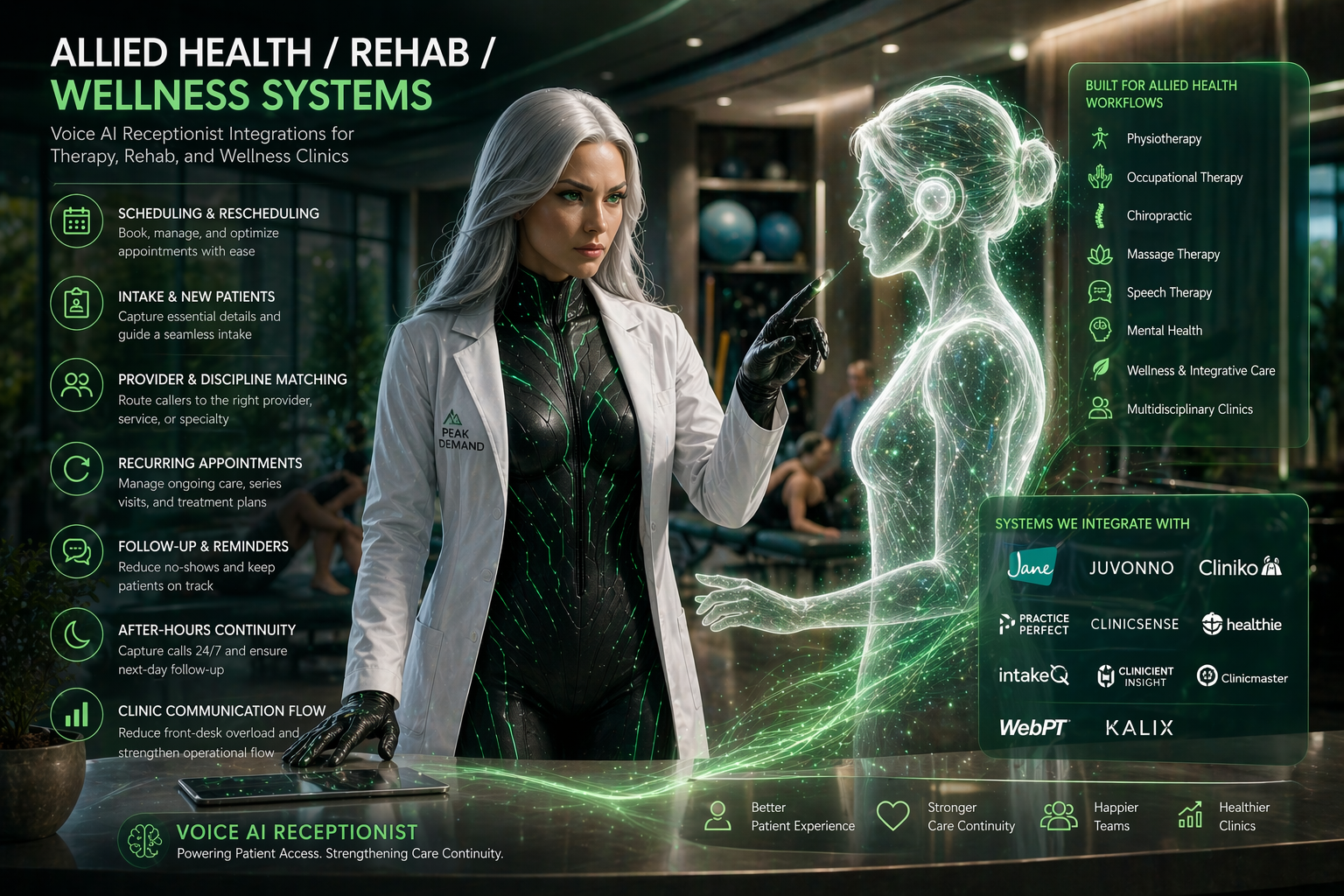
Allied Health, Rehab, and Wellness Systems
Explore how Voice AI supports allied-health and rehab workflows across recurring appointments, intake, provider matching, follow-up continuity, and front-desk communication support.
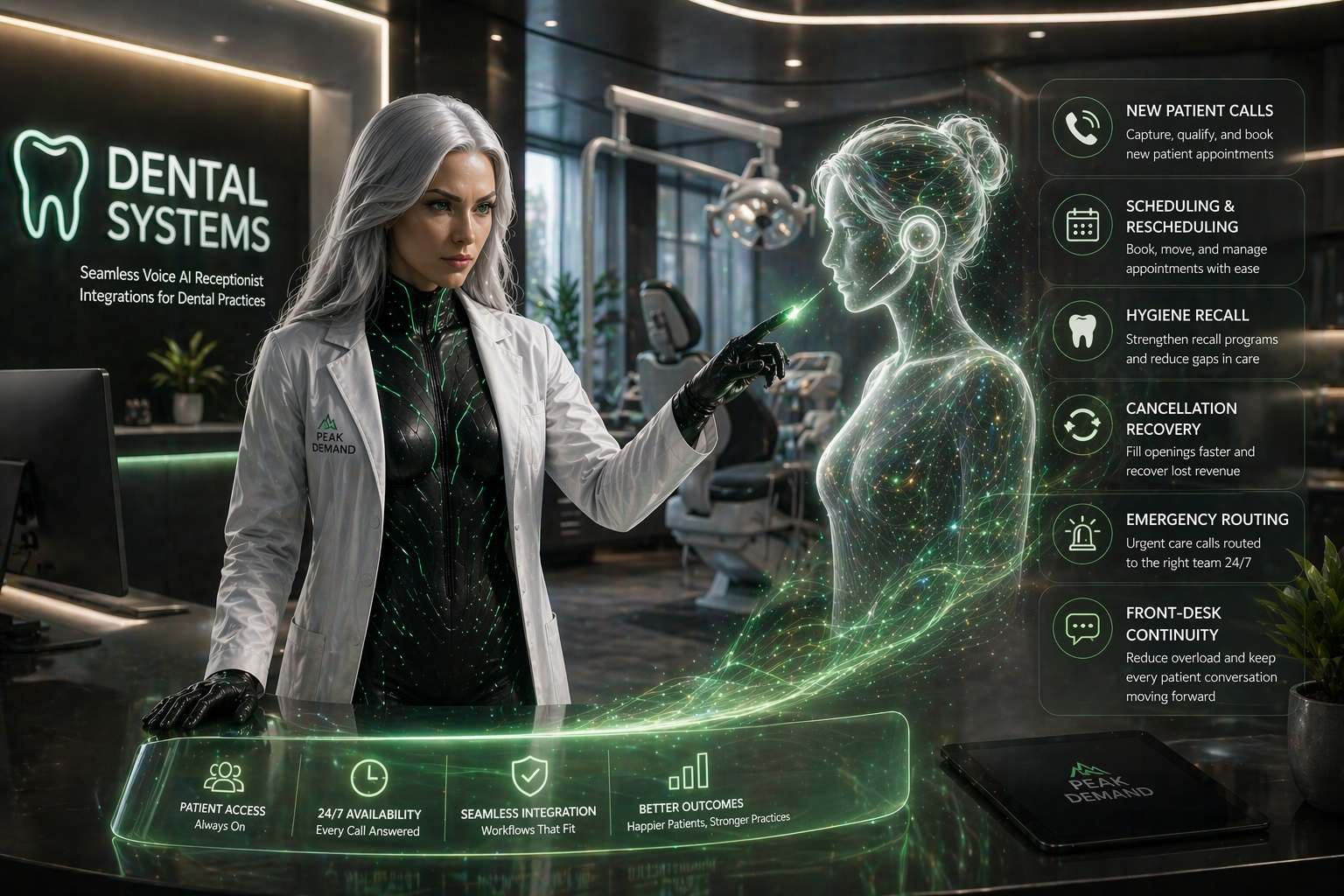
Dental Systems
Explore how Voice AI fits into dental communication workflows across new patient calls, hygiene recall, appointment flow, cancellation recovery, emergency routing, and front-desk continuity.
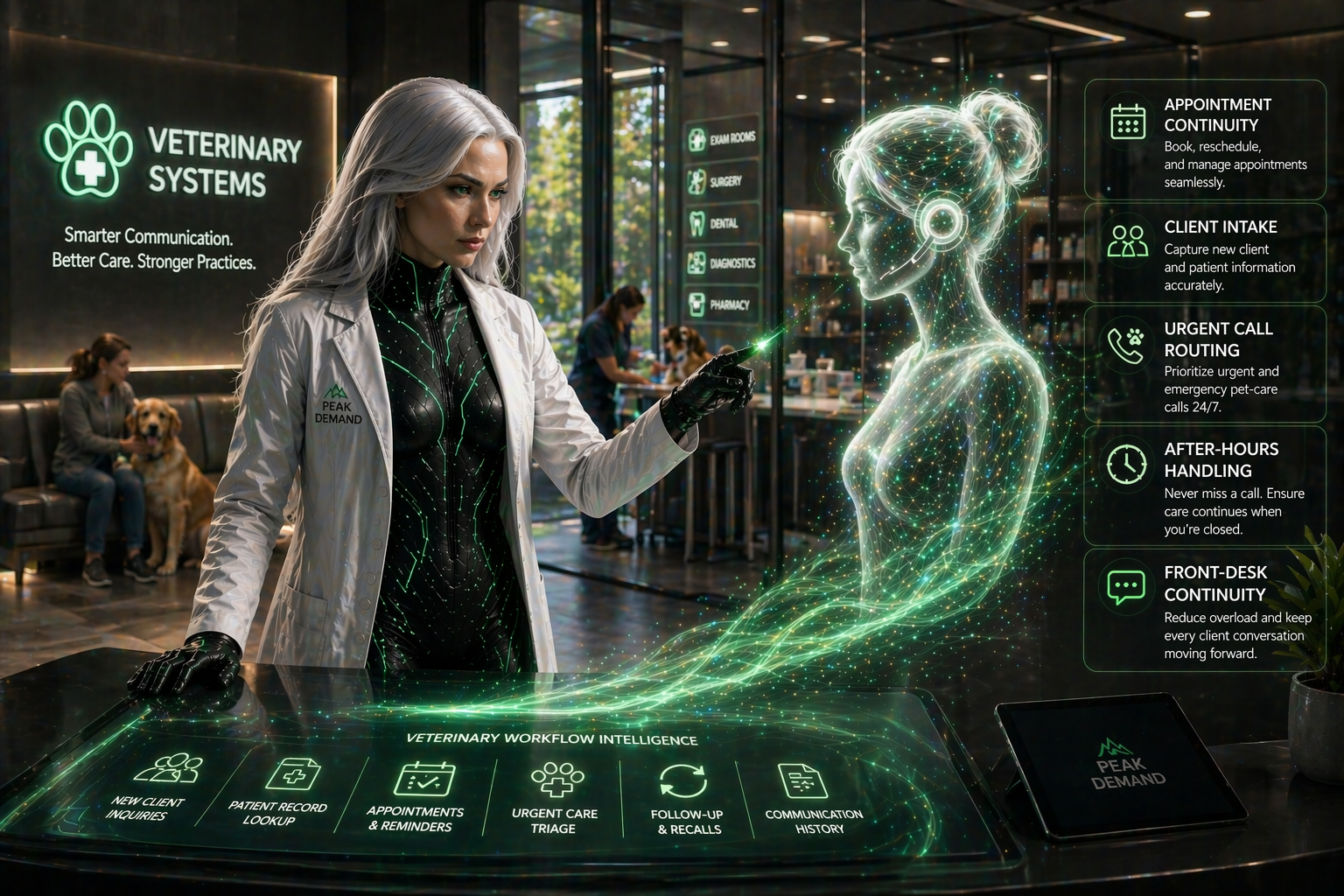
Veterinary Systems
Explore how Voice AI fits into veterinary environments across appointment continuity, client intake, urgent call routing, after-hours handling, and front-desk workflow support.
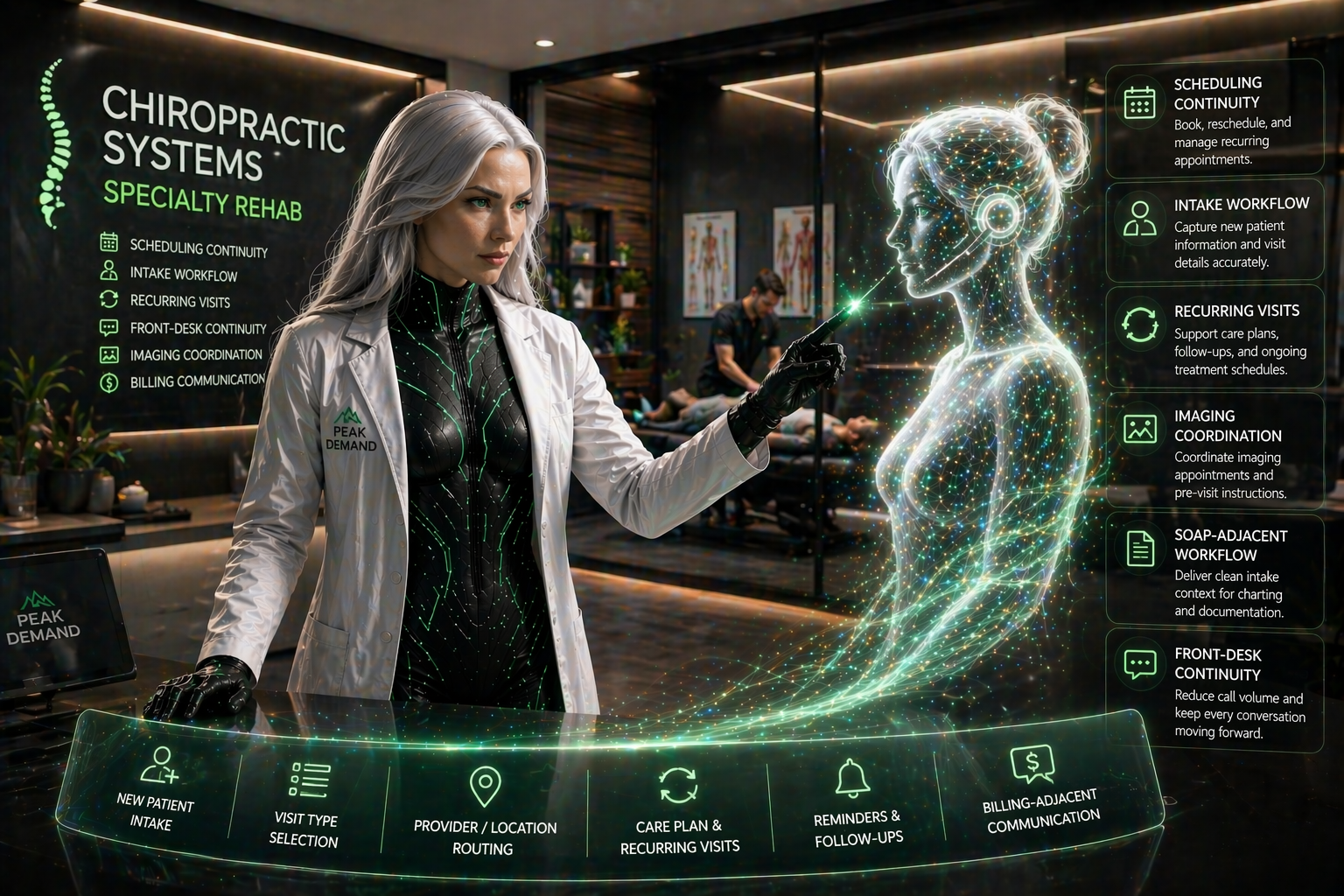
Chiropractic and Specialty Rehab Systems
Explore how Voice AI fits into chiropractic and specialty rehab workflows across scheduling, intake, recurring visits, SOAP-adjacent continuity, imaging-adjacent coordination, and front-desk support.
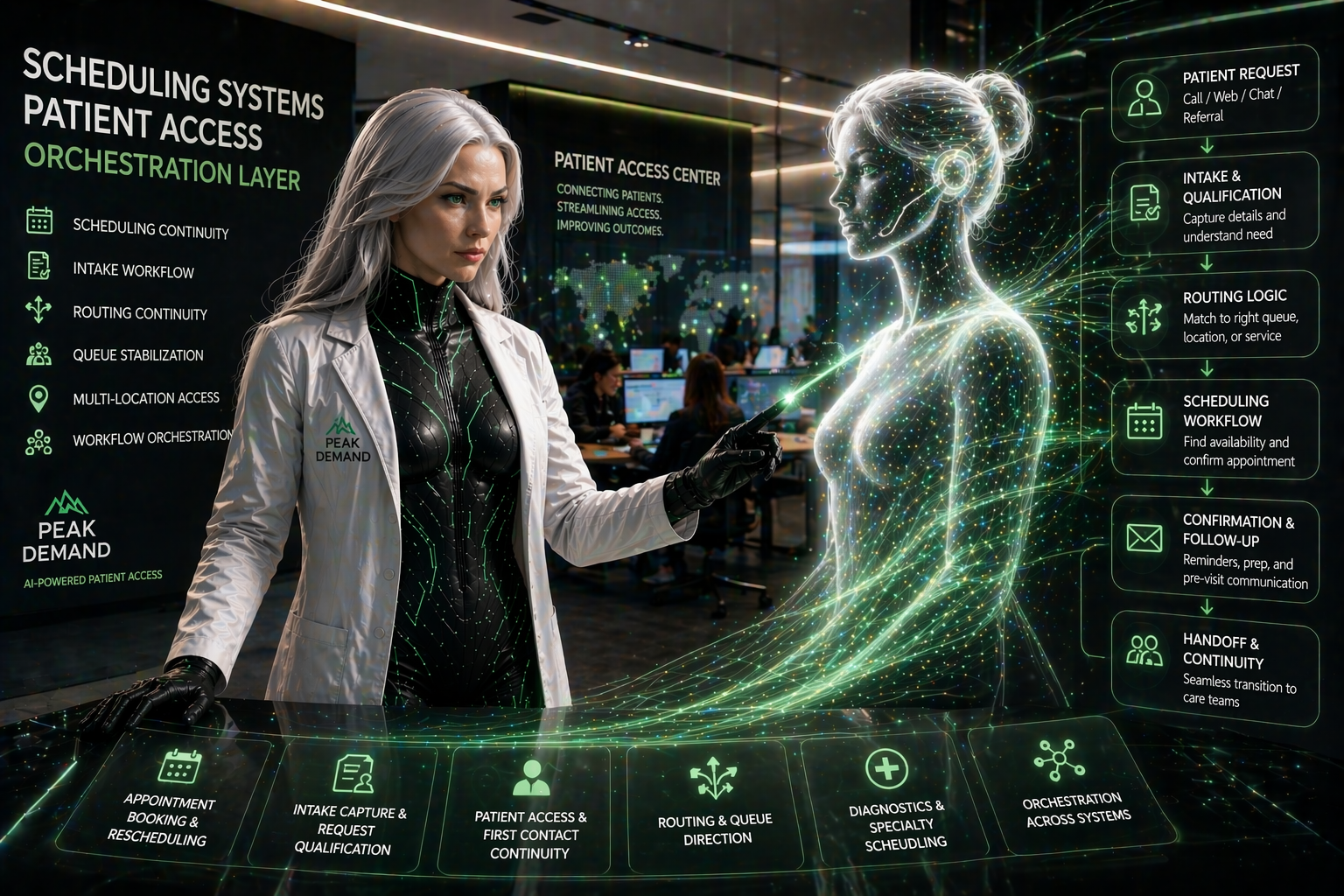
Scheduling, Patient Access, and Orchestration Systems
Explore how Voice AI supports scheduling and patient access architecture across intake, routing, queue stabilization, diagnostics scheduling, and workflow continuity between first contact and next action.
See Healthcare Voice AI Integrations In Action
These walkthroughs show how Voice AI can connect into real healthcare scheduling, intake, and communication environments. Start with TELUS Health CHR for Canadian clinic workflows and Juvonno for rehab and allied health operations.
TELUS Health CHR Integration Walkthrough
See how Voice AI can support TELUS Health CHR scheduling, intake, patient communication, and Canadian clinic workflow continuity.
Juvonno Integration Walkthrough
See how Voice AI can support Juvonno workflows for rehab scheduling, intake, appointment handling, and clinic communication continuity.
Explore published healthcare systems by name
Once you know the software family that best matches your environment, this section makes it easier to browse live healthcare integration pages by platform name. Each category below groups published system pages by the type of environment they usually support so operators, managers, and technical teams can compare workflow fit more quickly. A fuller alphabetical directory appears farther down the page.
Featured healthcare systems
These are high-priority starting points for visitors evaluating real-world Voice AI workflow fit across scheduling, intake, patient communication, routing, and access workflows.
Clinic, ambulatory, and medical EMR systems
These systems are commonly associated with clinic records-adjacent workflows, appointment flow, patient requests, intake continuity, routing, and broader ambulatory communication operations.
Scheduling, intake, and patient communication systems
These environments sit closer to booking logic, intake flow, reminders, clinic administration, and day-to-day patient access operations.
Rehab, physiotherapy, and allied health systems
Allied health and rehabilitation environments often depend on strong scheduling continuity, practitioner matching, intake flow, recurring appointment management, and multi-location operational coordination.
Dental systems
Dental communication workflows often center around appointment demand, cancellation recovery, reminders, new patient calls, and front-desk continuity across booked production.
Veterinary systems
Veterinary communication environments often require appointment continuity, client communication, after-hours handling, urgent call direction, and records-adjacent workflow coordination.
Healthcare organizations rarely evaluate integrations in a vacuum. Grouping systems by software family makes it easier to understand likely workflow fit, compare environments more quickly, and navigate toward both family-level integration pages and live system-specific pages deeper in this hub. The full alphabetical system directory farther down the page should carry the complete 98-system library.
Where Voice AI sits in the healthcare workflow matters more than basic connectivity
Healthcare Voice AI becomes more useful when it is treated as part of the larger workflow architecture around patient access, intake, routing, scheduling, escalation, and downstream ownership. The question is not only whether a system connects. The question is whether the communication flow reaches the next operational step with enough clarity and structure to reduce friction instead of shifting it downstream.
In practice, that means Voice AI often sits across multiple workflow layers at once. It may support first contact, gather structured intake, help direct the caller into the right path, preserve context for staff, and improve continuity into the next step. The value comes from how those layers fit together, not from one isolated connection point.
This is why healthcare teams should evaluate both the scheduling and patient access layer and the EMR or EHR-adjacent layer. In more complex environments, the architecture may also need to account for enterprise compliance and procurement requirements.
Where Voice AI usually enters the workflow
Voice AI often enters at the communication edge: inbound calls, appointment demand, intake capture, after-hours answering, overflow handling, and patient access or routing-related first contact.
Explore healthcare AI receptionistsWhere continuity usually breaks down
Continuity often breaks between the interaction and the next operational owner. That can happen when routing is weak, intake is unclear, scheduling context is incomplete, or downstream teams still need to manually rebuild the request.
Explore centralized scheduling workflowsWhat stronger integration architecture actually improves
Stronger architecture preserves enough structure, direction, and next-step usability for staff or systems to act efficiently. That is what turns Voice AI into operational infrastructure instead of a disconnected front-end layer.
Return to the healthcare resource hub| Integration maturity | What healthcare teams usually experience | Likely operational result |
|---|---|---|
| Fragmented | Some connection points exist, but scheduling, intake, routing, escalation, and continuity still require heavy manual repair. | Lower operational value, more staff burden, weaker patient access continuity, and less confidence in the workflow. |
| Partially connected | Important workflow layers connect, but structure and downstream usability still vary too much between teams, departments, or next-step owners. | Moderate gains, but persistent continuity gaps remain and staff still absorb unnecessary workflow friction. |
| Workflow-led and integrated | Voice AI supports multiple workflow layers with stronger structure, clearer routing, better handoff, and more usable next-step continuity. | Stronger patient access flow, cleaner operational ownership, and more scalable communication infrastructure. |
What healthcare teams should evaluate in the architecture discussion
- Where does Voice AI need to sit first in the communication workflow?
- Where does continuity currently break between the interaction and the next operational step?
- Which layers are EMR or EHR-adjacent, and which ones are workflow-adjacent?
- How do scheduling, intake, routing, patient access, and escalation interact in this environment?
- Will downstream teams receive enough structure to act without rebuilding the request manually?
- Is the integration design workflow-led or just feature-led?
- Does the current architecture reduce friction for staff, or does it simply move the work somewhere else?
Healthcare organizations usually get more value when they evaluate integration maturity across communication flow, operational ownership, and downstream usability together instead of treating each connection as a separate isolated decision. For system-specific evaluation, use the alphabetical healthcare system directory below.
Evaluating software families?
Use the six system-family pages to compare EMR, EHR, dental, veterinary, rehab, scheduling, and patient access environments.
Browse Software FamiliesEvaluating specific systems?
Use the full alphabetical directory to find the exact healthcare platform your team is evaluating.
Open System DirectoryEvaluating enterprise readiness?
Review governance, privacy, escalation, procurement, and compliance considerations before deployment.
Review ComplianceGo deeper into the strategy behind healthcare Voice AI integrations
This section helps healthcare teams move from broad category understanding into the right supporting resources for architecture, interoperability, workflow fit, implementation planning, and system-specific evaluation.
The articles below are the best next clicks for teams evaluating how Voice AI fits into healthcare communication systems, patient access workflows, structured integration pathways, rollout planning, and governed healthcare environments.
For broader category education, use the Healthcare Voice AI Resource Hub. For software-specific evaluation, continue to the full alphabetical system directory lower on this page and use the six healthcare software family pages as the parent layer.
Need system-family pages?
Use the family pages to compare medical EMR, allied health, dental, veterinary, specialty rehab, and patient access systems.
Browse Software FamiliesNeed a specific platform?
Use the alphabetical system directory to find the exact EMR, EHR, scheduling, dental, veterinary, or rehab platform.
Open System DirectoryNeed compliance context?
Use the enterprise compliance page when governance, privacy, procurement, RFPs, or regulated deployment requirements are part of the evaluation.
Review ComplianceCore integration strategy articles
These resources explain why integrations matter, what healthcare teams should evaluate first, and how stronger Voice AI integration architecture should be understood.
Custom pathways, structured integrations, and workflow fit
These articles are useful for teams evaluating custom pathways, structured communication flows, and how Voice AI fits into real healthcare operating environments.
Rollout, implementation, and governance
These resources are best for healthcare teams moving from early exploration into rollout planning, operational safety, implementation readiness, and governance-aware deployment.
Patient access, routing, and workflow bottlenecks
These articles help healthcare teams think more clearly about where communication complexity builds up across patient access, intake, department routing, scheduling, and downstream handoff.
As the healthcare integrations ecosystem continues to grow, this section can keep routing visitors into the most relevant strategy, rollout, and workflow resources without changing the overall structure of the hub. The full software directory appears in the Alphabetical System Directory section below.
Explore live healthcare system integration pages by category
This section gives healthcare teams a category-based way to browse the most important live system pages. It is not the full 98-system directory; it is a curated navigation layer for comparing the platforms most commonly tied to scheduling, intake, patient communication, routing, and patient access workflows.
Use this section when you know the type of software environment you are evaluating. Use the Alphabetical System Directory below when you want to find every live system page by name.
Need the family layer?
Start with the six parent family pages when comparing software categories before choosing a specific system.
Browse Software FamiliesNeed every system?
Use the alphabetical directory for the complete live healthcare system page list by platform name.
Open Alphabetical DirectoryNeed workflow context?
Review how Voice AI fits across patient access, intake, routing, scheduling, escalation, and downstream ownership.
Review Workflow ArchitectureFeatured healthcare systems
These are some of the strongest starting points for teams exploring healthcare Voice AI integrations across scheduling, intake, patient communication, routing, and access workflows.
Clinic and ambulatory EMR systems
These systems are commonly associated with clinic records-adjacent workflows, intake, appointment flow, routing, patient communication, and broader ambulatory continuity.
Explore medical and ambulatory EMR familyScheduling, intake, and patient communication systems
These environments sit closer to booking logic, intake flow, reminders, clinic administration, and day-to-day patient access operations.
Explore scheduling and patient access familyRehab, physiotherapy, and allied health systems
Allied health and rehabilitation environments often depend on strong scheduling continuity, practitioner matching, intake flow, recurring appointments, and multi-location coordination.
Explore allied health and rehab familyDental systems
Dental communication workflows often center on appointment demand, cancellation recovery, reminders, new patient calls, and front-desk continuity.
Explore dental familyVeterinary systems
Veterinary communication environments often require appointment continuity, client communication, after-hours handling, and records-adjacent workflow coordination.
Explore veterinary familyEnterprise, specialty, imaging, and outpatient environments
These environments often involve more complex routing, diagnostic scheduling, imaging coordination, enterprise workflow ownership, and department-specific handoff requirements.
Explore enterprise and medical EMR familyThis curated category browse section helps visitors compare common healthcare software environments without scrolling the entire directory. The complete system list belongs in the Alphabetical System Directory section below, where every live healthcare system page should be listed by platform name.
Talk through your healthcare communication workflow
If your team is evaluating healthcare Voice AI integrations, the most useful next step is usually a workflow conversation. That means reviewing patient access pressure points, scheduling flow, intake structure, routing logic, after-hours coverage, compliance expectations, and the systems surrounding those workflows.
Peak Demand approaches healthcare environments through workflow fit, governance awareness, and operational usability. The goal is to help organizations map a communication architecture that supports real teams, real workflows, and real continuity requirements across EMR, EHR, scheduling, intake, dental, veterinary, rehab, and patient access environments.
Need software families?
Compare the six parent healthcare integration families before choosing a specific system page.
Browse software familiesNeed workflow context?
Review how Voice AI fits across intake, routing, scheduling, escalation, and downstream ownership.
Review workflow architectureNeed compliance review?
Use the enterprise compliance page when governance, privacy, procurement, and RFP standards matter.
Review complianceFrequently asked questions
What does Voice AI mean in a healthcare integration environment?
Can Voice AI work with EMR, EHR, scheduling, intake, and routing workflows?
Are healthcare Voice AI integrations always direct?
Where should healthcare organizations start evaluating Voice AI integrations?
How should compliance and governance fit into the evaluation?
What is the role of this integrations hub?
About Peak Demand
Peak Demand is a Toronto-based AI agency focused on Voice AI, communication automation, and workflow infrastructure for organizations operating in more complex service environments.
In healthcare, the focus is not just on call handling. It is on patient access continuity, scheduling pressure, intake structure, routing logic, after-hours support, governance, and how communication systems fit into real operational workflows.
- Workflow-driven and implementation-aware
- Governance-first in healthcare communication environments
- Built to support clinics, networks, and enterprise teams
- Designed to scale into software-specific integration pathways
- Organized around healthcare system families and live integration pages
Healthcare software integrations by system name
If you already know the software you are evaluating, this alphabetical directory is the fastest way to find the right live system page.
This directory includes the full 98-system healthcare integration library from the current Peak Demand system-page build. It is designed to help teams compare EMR, EHR, scheduling, intake, patient communication, dental, veterinary, rehab, wellness, chiropractic, orchestration, home care, med spa, pharmacy, and enterprise healthcare systems by software name.
For category-level browsing, use the software family section. For workflow context, use the workflow architecture section. This section is the full alphabetical browse layer.
Live healthcare system pages in this directory
Grouped alphabetically with visible section counts so the full library is obvious at a glance.
A–C
34 systemsABELMed through Curve Dental.
D–H
20 systemsDentrix through Helios Software.
I–M
15 systemsIDEXX Cornerstone through MRX Solutions.
N–O
11 systemsNextech through Owl Practice.
P–R
8 systemsPabau through RXNT.
Compare healthcare systems by name, category, and workflow fit
This directory is useful for comparing clinic EMRs, EHR-adjacent systems, scheduling and intake platforms, patient communication software, dental systems, veterinary systems, rehab and allied health systems, chiropractic systems, med spa systems, home care systems, pharmacy-adjacent systems, orchestration platforms, diagnostic workflows, and enterprise healthcare environments by software name before going deeper into workflow design, integration possibilities, and operational fit.
Explore your own AI use case on a discovery call.