
Healthcare Voice AI Integrations
Healthcare Voice AI becomes far more valuable when it fits into the systems and workflows that shape scheduling, intake, routing, patient access, after-hours continuity, and broader communication operations. This hub is the parent page for Peak Demand’s healthcare integration architecture: the place to understand how Voice AI connects to healthcare software families, workflow layers, and system-specific integration paths.
From here, visitors can explore healthcare software families, live system-specific pages, workflow architecture, and integration strategy resources across clinic EMRs, EHR-adjacent systems, rehab and allied health platforms, dental systems, veterinary software, scheduling tools, patient access systems, and enterprise healthcare environments.
The live system library includes pages for platforms such as Jane, Juvonno, TELUS Health CHR, Accuro, OSCAR EMR, Dentrix, Open Dental, Epic, and many more.

Architecture Role
Parent hub for healthcare integrations
System Coverage
98 healthcare system pages
Software Families
6 healthcare integration families
Workflow Focus
Scheduling, intake, routing, access
Healthcare integrations should be evaluated through workflow continuity
One of the biggest mistakes in healthcare integration conversations is reducing the discussion to a list of software names. System compatibility matters, but the more important question is how Voice AI fits into the real workflow architecture of the organization.
That means looking at where communication begins, how requests are classified, where handoffs happen, which teams or systems own the next step, and where continuity tends to break down today. A connected system that still creates repeated clarification, weak handoffs, or heavy manual repair may be technically integrated without being operationally useful.
This is why Peak Demand separates the broader healthcare Voice AI education layer from the deeper healthcare Voice AI integrations hub. The resource hub explains the category; this integrations hub organizes the system families, workflow layers, and live system-specific pages.
Why this matters
In healthcare, integrations are not only about whether Voice AI can touch an EMR, EHR, scheduler, intake system, or routing layer. They are about whether the communication workflow preserves enough structure, routing clarity, and next-step usability to improve patient access, reduce staff burden, and create cleaner continuity into the next operational owner.
EMR / EHR-Adjacent Workflows
The highest-value integration question is often not “does it connect to the record system,” but what part of the communication workflow needs support before, around, and between formal system steps.
- Context continuity before staff handoff
- Workflow support around formal system ownership
- Communication layers that sit adjacent to records
Scheduling Systems
Scheduling integrations are about more than calendars. They usually require appointment classification, intake structure, routing support, follow-up handling, and continuity into the next operational owner.
- Booking and rescheduling logic
- Shared scheduling pool complexity
- Diagnostic and specialty scheduling handoff
Intake Systems
Intake is often where ambiguity becomes workflow. Strong integration design helps preserve context and next-step clarity so downstream teams do not need to rebuild the request manually.
- Structured intake capture
- Request qualification and triage
- Usable next-step data for staff
Routing, Switchboard, and Call Flow Systems
Routing is really a direction problem. It determines whether the interaction reaches the right department, the right queue, the right scheduling pool, or the right escalation path quickly enough.
- Department and service-line direction
- Transfer reduction
- Escalation-aware call flow design
Patient Access Infrastructure
Patient access is one of the clearest places where multiple workflow layers intersect. Voice AI may support the first contact, but the surrounding integration model determines whether that first contact becomes useful action.
- Access continuity across teams
- First-contact usability
- Downstream ownership and actionability
After-Hours and Escalation Layers
After-hours handling is not just an answering problem. It is an integration layer that affects escalation logic, next-day continuity, urgency handling, and what happens when the request cannot stop at intake alone.
- Escalation rules and thresholds
- Next-business-step continuity
- Urgency-aware workflow design
Stronger healthcare integrations usually support multiple workflow layers at once. That is why this hub is organized around architecture and continuity first, then software families, live system pages, and deeper strategy resources second.
Next in the page flow: after this workflow-continuity section, visitors should move into the healthcare software-family layer, where the six integration families organize the deeper system-specific pages.
Browse Healthcare Software Families
Top 10 Mistakes Healthcare and Service Businesses Make After a Receptionist Quits and How to Avoid Them
Receptionist Quits: Unexpected Crisis for Healthcare and Service Businesses

When a receptionist quits unexpectedly, it creates a high-risk service gap—especially in healthcare and other inbound phone–dependent businesses. Clinics, dental offices, veterinary practices, urgent care centers, and similar service providers rely on every call. Lost calls become lost appointments, eroded trust, and leaking revenue.
This article walks through the top 10 mistakes organizations make after a receptionist quits and exactly how to avoid each one. You’ll get a rapid-response mental model so the next quit doesn’t turn into a crisis.
What you’ll learn:
Why silence or delay costs more than you think
How to keep calls answered instantly (human + AI fallback)
How to capture and recover leads before they disappear
How to communicate clearly to patients/clients during the gap
Ways to build redundancy so future quits are non-events
Read on to turn a sudden departure into operational resilience and keep your front desk functioning—no matter who’s gone.
1. No Documented Emergency Coverage Plan after Receptionist Quits

The mistake: Relying on improvisation or memory when your receptionist quits instead of having a predefined, written backup process.
Why it hurts:
Wasted time deciding who covers phones, what to say, and how to route calls.
Inconsistent responses that confuse patients/clients.
Missed opportunities—appointments, leads, urgent inquiries—while the team scrambles.
Stress cascades across staff, degrading trust internally and externally.
What to do instead:
Build and maintain a formal Emergency Coverage Playbook that can be activated the moment a receptionist quits. Key components:
Activation Trigger & Owner
• Define who is responsible for “flipping the switch” when the receptionist quits (clinic manager, operations lead, etc.).
• Include a clear trigger (e.g., resignation received, no-show on first day of coverage gap).Immediate Coverage Pathways
• Pre-authorize an AI voice receptionist or after-hours answering service to turn on instantly.
• List human fallback options (cross-trained staff, on-call temps) with contact/step-by-step activation instructions.Scripted Call Flows & Templates
• Emergency front-desk script for incoming callers (“Our front desk is temporarily adjusting; we’re covering your call with backup support—how can I help?”).
• Triage questions, escalation rules, and key phrases to capture intent and urgency.Lead Capture & Handoff Protocol
• Ensure incoming call details are logged automatically (via AI system or structured manual notes) and synced to your CRM/EHR.
• Define how follow-ups are assigned and tracked during the gap.Communication Plan
• Prewritten messaging for patients/clients: phone hold messages, website banner copy, and outbound appointment reminder updates explaining the temporary shift in coverage.Role & Responsibility Matrix
• Who monitors the temporary system? Who escalates failures? Who transitions to the permanent replacement?Rehearsal & Update Cadence
• Regularly test the playbook with tabletop exercises (e.g., simulate a quit).
• Review and revise quarterly or after any real activation.
Quick Emergency Playbook Checklist:
Coverage owner & activation trigger identified
AI receptionist / answering service pre-configured and ready
Backup human contacts (cross-trained/internal) listed
Call scripts and escalation rules documented
Lead capture + logging mechanism in place
Patient/client communication templates prepared
Responsibilities assigned for monitoring and handoff
Scheduled test of the playbook
By codifying this plan ahead of time, a receptionist quitting becomes a momentary bump—not a breakdown.
2. Wasting Time Searching for a Solution or Delaying Activation on AI Voice systems after Receptionist Quits

The mistake: Spending hours or days debating, hunting for temporary coverage, or waiting on approvals instead of turning on an immediate fallback when your receptionist quits.
Why it hurts:
Every hour of delay means unanswered calls, lost appointments, and slipping leads.
Patients/clients assume the practice is unavailable or disorganized.
Momentum and trust erode while staff scramble, creating unnecessary stress and reactive firefighting.
Opportunity cost compounds: the longer the gap, the harder recovery becomes.
What to do instead:
Pre-authorize instant backups: Have an AI voice receptionist or after-hours answering service pre-configured and ready to activate with a single decision.
Keep credentials & scripts accessible: Store login info, call flows, and fallback messaging in a known “emergency inbox” or operations toolkit so activation doesn’t require hunting through emails.
Define a decision tree: Include a clear “if receptionist quits, then…” checklist in your playbook—who flips the switch, which system comes online first, who communicates outward.
Maintain an on-call short-term human roster: Have pre-vetted temp/replacement contacts (cross-trained staff or contractors) with a rapid briefing kit so they can step in same-day if needed.
Automate the trigger: Tie resignations or coverage failures to automatic workflows (e.g., a notification from HR or scheduling system that triggers the AI fallback to go live immediately).
Use templated emergency scripts: Ready-to-use messaging for staff and patients so responses are immediate—no writing from scratch under pressure.
Quick action checklist:
AI/overflow system pre-configured and activation procedure known
Emergency credentials & call scripts bookmarked and accessible
Decision owner identified and empowered to flip the switch
Temp/backup human list with briefing kit ready
Automatic or manual trigger path documented for immediate activation
Turning a receptionist quits moment into a near-instant switch-over dramatically reduces lost volume and keeps your front desk visible, responsive, and trusted.
3. Letting Inbound Calls Go Unanswered after Receptionist Quits

The mistake: Leaving the phone silent or sending callers to dead voicemail during the gap after a receptionist quits.
Why it hurts:
Missed appointments and lost revenue from leads who never get a response.
Frustrated patients/clients assume the practice is closed or unreliable.
Brand damage accumulates as word-of-mouth spreads about poor availability.
Recovery becomes harder the longer the silence persists—cold leads decay fast.
What to do instead:
Immediate call rerouting: Automatically divert incoming calls to a preconfigured backup system (AI voice receptionist, overflow answering service, or cross-trained staff).
Fallback scripts & IVR prompts: If the primary line is unmanned, play a brief message explaining temporary coverage and offer options: “Press 1 to book, 2 to leave a callback request, 3 to speak to on-call support.”
Layered redundancy: Combine AI pickup with human escalation—AI answers basics instantly and flags/forwards complex or urgent calls to live staff.
Real-time monitoring: Have someone (or a dashboard) watching call volume and abandonment rates so gaps are noticed and corrected immediately.
Callback automation: If a caller leaves a message, trigger an automated confirmation (SMS/email) that their request was received and indicate expected follow-up time.
Visible availability indicators: Update website, phone hold messaging, and appointment portals to reflect that backup coverage is active—reducing caller anxiety.
Quick action checklist:
Calls auto-reroute to backup AI or overflow system
Emergency IVR/hold message in place explaining temporary coverage
Escalation path defined for complex calls
Callback acknowledgments automated
Monitoring dashboard or person tracking missed/abandoned calls
Ensuring no inbound call goes unanswered turns a potential blackout into a seamless bridge, preserving appointments, trust, and revenue.
4. Losing Leads from Failure to Capture and Follow Up after Receptionist Quits

The mistake: Letting caller intent disappear—no structured capture, no persistence, and no automated follow-up when your receptionist quits.
Why it hurts:
Potential patients and clients fall out of the funnel and never return.
Revenue leaks as missed or half-handled inquiries decay into silence.
Staff waste time chasing fragmented or forgotten context.
The practice appears unresponsive, weakening trust and referral momentum.
What to do instead:
Real-time lead capture: Every inbound call (answered by backup human, AI receptionist, or overflow service) must log caller name, contact info, reason for calling, and urgency. Use systems that auto-populate this into your CRM/EHR or a temporary structured intake form.
Automated immediate follow-up: Trigger an acknowledgment via SMS, email, or voice: “We received your request about [topic]; someone will follow up within X hours.” Include next-step instructions or a quick scheduling link.
Fallback manual logging: If the primary system isn’t live yet, have a simple digital form or shared spreadsheet template frontline staff or interim cover can fill out instantly. Later sync or batch-import into the master system.
AI-assisted transcription & intent tagging: Use the AI receptionist to transcribe calls, extract key intents (e.g., appointment request, prescription refill, urgent symptom), and surface red flags for prioritized follow-up.
Lead scoring & prioritization: Assign scores based on urgency, patient value (new vs. returning), and contact behavior so high-impact leads get fast human attention.
Persistent recovery workflows: Unanswered or unconverted leads automatically roll into nurturing sequences: reminder nudges, second outreach, and escalation if unresponsive after predefined intervals.
Scripted follow-up touchpoints: Provide templates for interim staff or AI to use:
• “Hi [Name], we missed your call about [issue]. Can we reschedule your appointment for [proposed times]?”
• “Just checking in—did you still want to book your follow-up visit? Reply YES to confirm.”
Quick action checklist:
Lead capture system active (AI/overflow/manual fallback)
CRM/EHR integration or temporary structured intake ready
Automated acknowledgment messages configured
Call transcription and intent tagging enabled if using AI
Lead scoring rules defined for prioritization
Recovery sequences in place for unconverted leads
Follow-up scripts/templates available to cover staff
Capturing and following up on leads immediately turns a receptionist quits event from a potential loss into an opportunity for recovery and increased loyalty.
5. Single Point of Failure / No Redundancy after Receptionist Quits

The mistake: Relying on one person (the receptionist) to hold all operational knowledge, call scripts, escalation rules, and fallback procedures.
Why it hurts:
When that person quits, institutional knowledge disappears overnight.
Recovery slows dramatically because no one else knows the nuances, scripts, or priority calls.
Mistakes multiply: inconsistent caller handling, missed escalations, lost context.
The practice becomes brittle—future quits or absences cause the same disruption repeatedly.
What to do instead:
Cross-train backups: Ensure at least one other staff member (or two) is familiar with front-desk call flows, triage logic, scheduling quirks, and escalation paths.
Shared, living documentation: Maintain a centralized, concise “front desk handbook” with scripts, common scenarios, key contacts, and emergency procedures. Keep it accessible (cloud/shared drive, operations dashboard).
Layer in AI redundancy: Deploy an AI receptionist or voice-AI fallback as a shadow system that mirrors real workflows—ready to pick up automatically when human coverage gaps occur.
Hybrid handoff architecture: Combine human and AI coverage so no single actor is the only path—AI handles routine and after-hours volume while humans take over complex or empathy-heavy calls.
Regular redundancy drills: Simulate a receptionist quitting or being unavailable to ensure backups and AI systems activate seamlessly and staff know their temporary roles.
Quick action checklist:
At least one cross-trained human backup assigned
Updated shared documentation (scripts, escalation, scheduling) accessible
AI receptionist / voice-AI shadow system running or preconfigured
Defined hybrid coverage model (who handles what when primary is gone)
Scheduled drills/testing of redundancy plan
Eliminating single points of failure turns a receptionist quitting from a catastrophic outage into a manageable staff transition.
6. Poor Communication to Patients/Clients About the Change after Receptionist Quits

The mistake: Staying silent or sending vague signals after the receptionist quits instead of proactively informing patients/clients about the temporary disruption and coverage plan.
Why it hurts:
Clients assume the practice is understaffed, unorganized, or closed.
Trust erodes quickly when people feel left in the dark.
Confusion leads to repeat inquiries, double-booking, and unnecessary escalations.
The gap amplifies perception of service breakdown, making recovery harder even after coverage is restored.
What to do instead:
Deploy clear, consistent messaging immediately across all touchpoints so patients/clients know what’s happening and that coverage is active.
• Phone system announcement/hold message: “Our front desk team is temporarily adjusting. We’ve activated backup coverage—please hold or press 1 to schedule, 2 to leave a callback request.”
• Website banner or pop-up: “Receptionist has recently left; we’re covering your calls with our backup system. Appointment booking and inquiries are still being handled in real time.”
• Email/SMS broadcast to recent or upcoming patients: “Heads up: Our front desk is using temporary support this week. If you called and didn’t reach us, we’ve got you covered—reply or click here to confirm your visit.”
• Social or portal notice: “Temporary front-desk update—calls are being answered via our emergency coverage system. Thanks for your patience.”Set expectations clearly: Include estimated timelines (“We expect normal front-desk staffing to resume by [date]”) and provide alternative contact paths (AI receptionist, direct scheduling link, escalation for urgent issues).
Use empathetic language: Acknowledge inconvenience (“We know changes can be frustrating”) and reassure continuity (“Your care isn’t interrupted; here’s how we’re handling it”).
Train interim staff or AI scripts to echo the same messaging so every caller hears the same explanation and knows what to expect next.
Offer a quick FAQ snippet on common questions: “Is the clinic open?” “How do I book?” “Who do I talk to for urgent matters?”
Quick action checklist:
Update phone hold/announcement script with temporary coverage message
Publish website banner or front-page alert
Send templated email/SMS to affected patients/clients
Post notice on patient portal and relevant social channels
Ensure interim human or AI scripts use consistent, empathetic language
Provide an FAQ section or auto-reply addressing top concerns
Include expected timeline and alternative contact options
Proactive, transparent communication turns a potential trust gap into a moment of reliability—patients notice when you manage disruption with clarity instead of silence.
7. Slow or Inadequate Deployment of Temporary or AI Backup after Receptionist Quits

The mistake: Hesitating, fumbling, or misconfiguring fallback coverage after a receptionist quits—taking too long to get temporary human support or AI systems fully live.
Why it hurts:
Gaps widen while calls go unanswered and leads cool off.
Setup friction (wrong scripts, missing credentials, broken integrations) delays recovery even when a backup is theoretically available.
Staff waste time manually patching solutions instead of executing a ready plan.
First impressions worsen if the interim system feels half-baked or inconsistent.
What to do instead:
Pre-provision backup systems: Have your AI receptionist(s) and overflow answering services already configured with default scripts, authentication, and integration hooks so they can be toggled on instantly.
Maintain a hot standby human roster: Keep a vetted list of cross-trained internal backups or pre-contracted temps with a one-click briefing kit ready to deploy.
Automate activation triggers: Tie receptionist departure signals (HR notification, schedule gap detection, missed shift alert) to workflows that automatically enable AI voice coverage and notify the fallback team.
Use configuration templates: Store versioned call-flow templates, escalation rules, and messaging presets so temporary or AI coverage always uses consistent, approved language.
Health checks & real-time validation: Immediately after backup spins up, verify it’s working—test inbound calls, confirm lead capture/logging, and surface any integration errors to a responsible owner.
Fallback rollback & augmentation: If the first-tier backup underperforms, have secondary options (alternate AI persona, second temp, manual triage escalation) ready without delay.
Routine readiness drills: Regularly simulate a receptionist quitting to practice activation, reduce friction, and surface hidden failure points before real incidents.
Quick action checklist:
AI receptionist/answering service pre-configured with scripts and credentials
Backup human list with one-click onboarding kit available
Automated trigger workflow defined and active for immediate switchover
Configuration templates for call flows and escalation available
Post-activation health check procedure in place
Secondary fallback options prepped (e.g., alternate AI flow or additional temp)
Scheduled simulations to test readiness
Fast, reliable deployment of temporary or AI backup turns a sudden receptionist quit from a service gap into an almost invisible handoff—preserving calls, leads, and trust.
8. Failure to Transfer Knowledge or Train Interim Staff after Receptionist Quits

The mistake: Throwing interim or temporary cover into the front line with no context, scripts, or quick onboarding after the receptionist quits.
Why it hurts:
Longer call handling times and inconsistent answers.
Escalation confusion when interim staff don’t know priorities or thresholds.
Loss of caller trust due to mixed messaging or repeated questions.
Increased errors and dropped follow-ups because context wasn’t handed off.
What to do instead:
Maintain a “Front Desk Briefing Kit” that’s always up to date and instantly shareable. Include:
• Standard call scripts (appointment booking, cancellations, urgent triage)
• Escalation rules and red-flag keywords
• Key contact list (clinicians on call, billing, technical support)
• Common FAQs and how to answer them
• Login credentials or access paths (securely stored)Create a 5–10 minute quick-start onboarding summary (document or short video) that any interim staff or temp can consume before taking a call.
Use templated annotation: If the departing receptionist can, have them annotate recent unusual cases, hot leads, or in-flight appointments in a shared dashboard or handoff note.
Shadow and pair briefly: If possible, have the interim person listen in or co-handle the first few calls (even virtually) to absorb tone and flow.
Leverage AI to surface context: If using an AI receptionist or voice agent, ensure its summaries/transcripts are available to interim humans so they inherit the prior conversation context immediately.
Quick action checklist:
Up-to-date front desk briefing kit accessible
Quick-start onboarding summary ready for temps/interim staff
Standard call scripts and escalation rules documented
Key contacts and urgent paths clearly listed
Recent critical cases annotated or summarized for handoff
Interim staff given access to AI-generated call summaries/transcripts (if applicable)
Brief shadowing or pairing session arranged where feasible
Proper knowledge transfer and rapid training make interim coverage smooth, reducing friction and preserving the integrity of patient/client interactions.
9. Ignoring After-Hours and Peak Demand Call Handling after Receptionist Quits

The mistake: Treating the receptionist gap as a daytime-only problem and failing to extend coverage into nights, weekends, or surge periods.
Why it hurts:
Critical inquiries outside normal hours go unanswered, leading to lost appointments and emergency escalation delays.
Opportunity windows (late-night scheduling, urgent customer needs) vanish because no one is available to pick up.
Patient/client frustration grows when they can’t reach anyone during peak or off hours, damaging loyalty and referrals.
The “quiet” periods mask underlying demand spikes—failure to plan means the next surge overwhelms the understaffed fallback.
What to do instead:
Deploy after-hours answering service or AI voice receptionist that automatically handles inbound calls 24/7, capturing intent and triaging urgency.
Configure surge-aware fallback logic: Predefine rules that increase responsiveness during known peak times (seasonal flu, billing cycles, promotional campaigns) so coverage scales without manual intervention.
Use layered coverage: Combine AI for immediate pickup with human follow-up during transitions (early morning handoff, next-day callbacks) to keep continuity.
Extend scripts for off-hour scenarios: Ensure call flows include clear options for urgent issues, scheduling next available slots, and leaving secure messages that trigger rapid recovery workflows.
Real-time alerting: Notify on-call staff or managers when after-hours volume or abandonment rates spike so temporary adjustments (e.g., adding live backup) can be made quickly.
Predictive staffing triggers: Use historical call data to anticipate peak demand windows and pre-activate additional AI personas or on-call humans before the surge hits.
Quick action checklist:
After-hours AI receptionist or answering service active and tested
Surge rules defined and tied to automated escalation/resourcing
Hybrid handoff plan between AI (immediate) and humans (next-step) in place
Off-hour call scripts include triage options and clear next steps
Monitoring alerts set for volume spikes and abandonment
Historical data reviewed to forecast upcoming peak periods
Handling after-hours and peak demand proactively ensures that a receptionist quitting doesn’t turn into a blackout—patients and clients always have a reliable, responsive voice on the line.
10. Neglecting Data Logging and Skipping Exit Learning after Receptionist Quits

The mistake: Failing to record what happened during the gap and not extracting lessons from the receptionist quitting—no audit trail, no structured feedback, and no updates to prevent recurrence.
Why it hurts:
Repeated vulnerabilities: the same gaps happen again because root causes aren’t addressed.
Loss of context: interim staff, AI systems, or replacements operate blind without understanding what failed, making handoffs clunky.
Missed improvement opportunities: quitting triggers reveal systemic pain points that go unexamined.
Accountability gaps: without logs or post-mortem insights, it's impossible to measure impact or justify investments in resilience.
What to do instead:
Enforce automatic data logging: Every inbound interaction during the gap—calls, messages, escalations—should be timestamped, transcribed (if voice), tagged with intent, and appended to the patient/client record or CRM.
Capture failure metrics: Track unanswered calls, lead loss, recovery rates, average response time, and any misrouted or dropped handoffs during the disruption window.
Conduct a structured exit review: Whether the receptionist quit abruptly or gave notice, do a rapid “exit learning” session: ask what broke, what was painful, what was missing in training or tooling, and why they left (if possible).
Run a post-event debrief: Convene operations, front-desk backups, and tech owners to compare what was supposed to happen vs. what actually occurred. Identify friction points in activation, escalation, communication, and lead recovery.
Update the playbook and onboarding: Feed findings into the emergency coverage playbook, training kits, and redundancy documentation. Adjust scripts, triggers, and backup roles based on real-world failure modes.
Close the loop with metrics: After changes, monitor whether similar future events recover faster or lose fewer leads—use the data to validate improvements and refine again.
Quick action checklist:
All gap-period interactions logged and archived (calls, messages, escalations)
Key failure metrics collected and reviewed (missed calls, lead loss, response lag)
Exit learning session conducted with departing receptionist if possible
Post-mortem debrief held with stakeholders
Playbook, scripts, and training materials updated based on findings
Follow-up tracking in place to validate that changes improved resilience
Capturing what went wrong—and why—turns a chaotic “receptionist quits” event into a catalyst for a more durable, smarter front-desk operation.
Conclusion & Next Steps: Turning a Receptionist Quits Moment into Operational Resilience
A receptionist quitting doesn’t have to become a disaster—if you act fast, learn deliberately, and bake redundancy into your operation. The real difference between a temporary hiccup and a cascading failure is preparation and execution.
What to do now (prioritized rapid-response checklist):
Activate backup coverage immediately: Flip on your preconfigured AI receptionist or overflow answering service.
Reroute and capture every call: Ensure all inbound intent is logged, acknowledged, and fed into follow-up workflows.
Communicate clearly: Notify patients/clients about temporary front-desk adjustments with transparent, empathetic messaging.
Bring interim staff up to speed: Deliver the front desk briefing kit and contextual summaries so they can handle calls with confidence.
Monitor gaps in real time: Watch call volumes, abandonment, and lead recovery metrics; adjust escalation as needed.
Conduct exit learning & debrief: Capture what broke, why the receptionist quit (if possible), and where the playbook failed.
Update documentation: Feed lessons into your emergency coverage playbook, training kits, and redundancy plan.
Institutionalize hybrid resilience: Combine human and AI layers so the next quit triggers a seamless handoff instead of a breakdown.
Longer-term resilience moves:
Schedule regular drills to simulate coverage gaps.
Maintain cross-trained backups and always-on AI shadow systems.
Use data from disruptions to refine lead recovery, escalation criteria, and communication scripts.
Turning a “receptionist quits” event into operational resilience means shifting from reactive firefighting to proactive redundancy. For clinics and service businesses serious about continuity, the next step is to codify this hybrid human+AI model and test it in a controlled pilot—so the next departure barely causes a ripple.
Learn more about the technology we employ.

Try Our AI Receptionist for Healthcare Providers. A cost effective alternative to an After Hours Answering Service For Healthcare

Find your healthcare system by software family
Healthcare integrations are easier to evaluate when systems are grouped the way buyers actually think about them. Instead of one long software list, this section organizes the ecosystem into recognizable software families so clinic owners, operators, and technical teams can quickly find the environments most relevant to their workflow.
Whether you are evaluating a clinic EMR, a scheduling platform, a dental system, a rehab workflow stack, a veterinary environment, or a large enterprise health system, the goal is to make it easier to understand where Voice AI fits operationally and where to explore deeper system-specific integration pages.
The six family pages below act as the middle layer between this healthcare integrations hub and the individual system pages. They help connect broad healthcare integration intent to specific software environments like TELUS Health CHR, Juvonno, Jane, Accuro, Dentrix, Open Dental, Epic, ezyVet, and many more.

Medical and Ambulatory EMR Systems
Explore how Voice AI fits into medical and ambulatory EMR environments across scheduling, intake, patient access, provider routing, after-hours continuity, and clinic communication workflows.
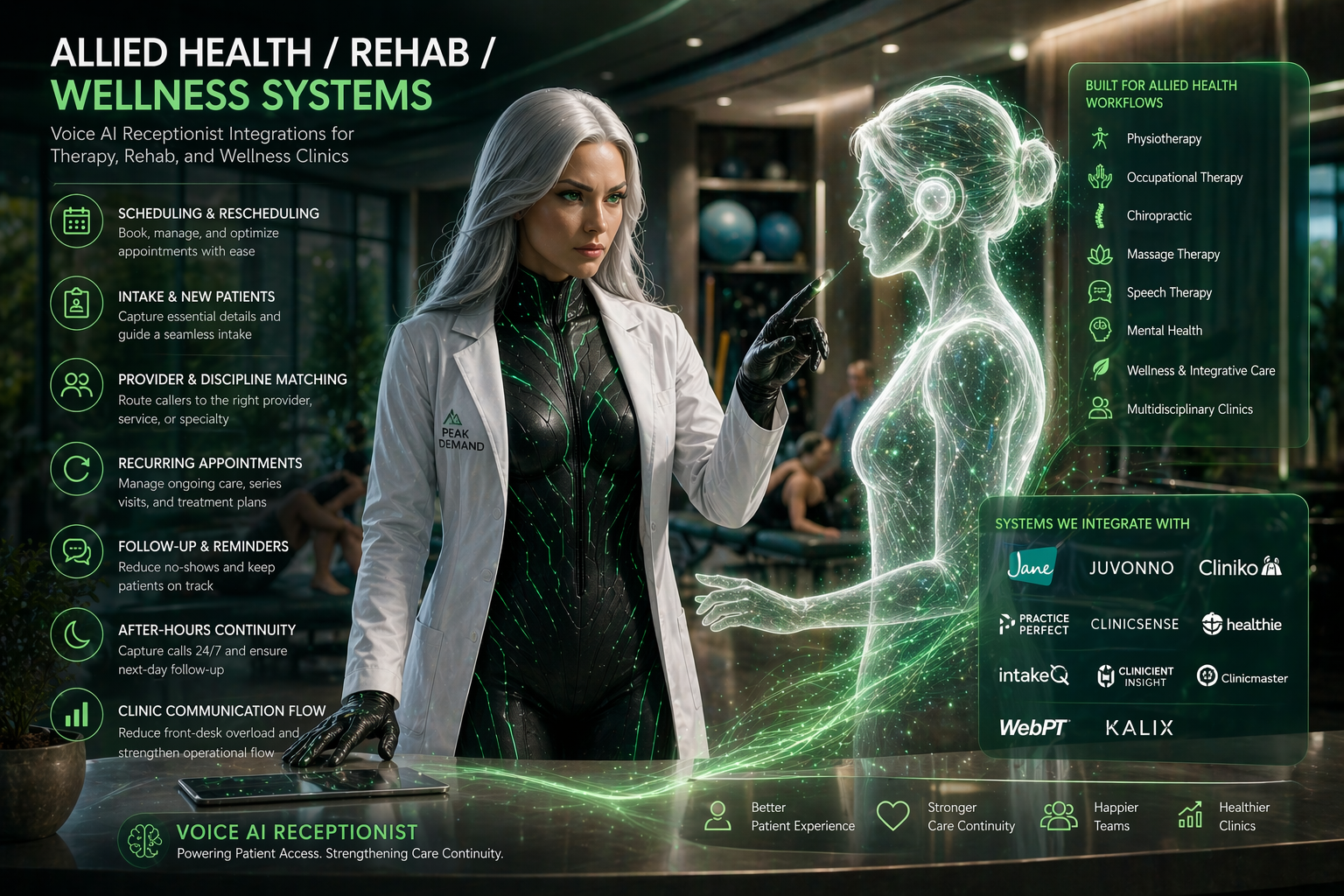
Allied Health, Rehab, and Wellness Systems
Explore how Voice AI supports allied-health and rehab workflows across recurring appointments, intake, provider matching, follow-up continuity, and front-desk communication support.
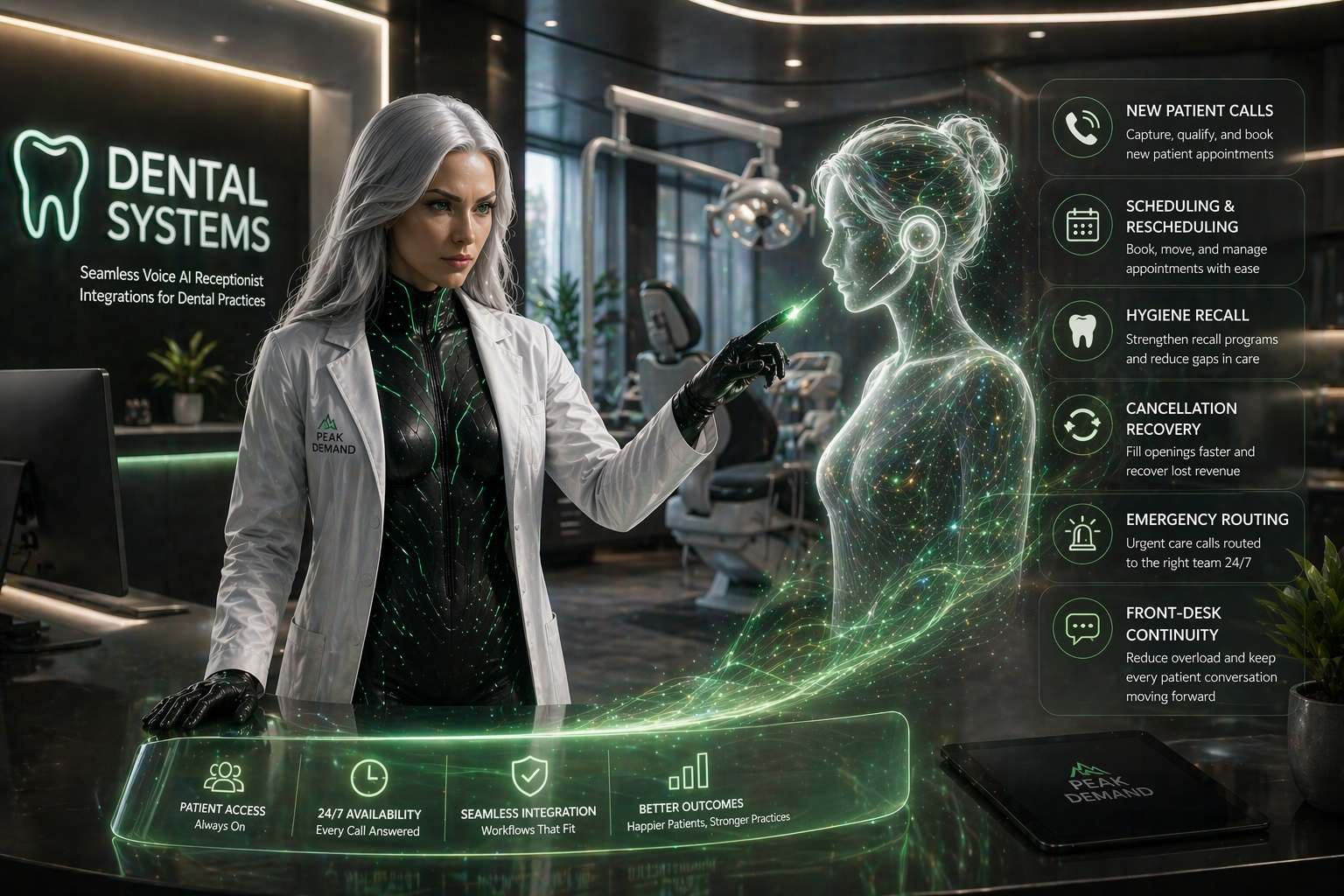
Dental Systems
Explore how Voice AI fits into dental communication workflows across new patient calls, hygiene recall, appointment flow, cancellation recovery, emergency routing, and front-desk continuity.
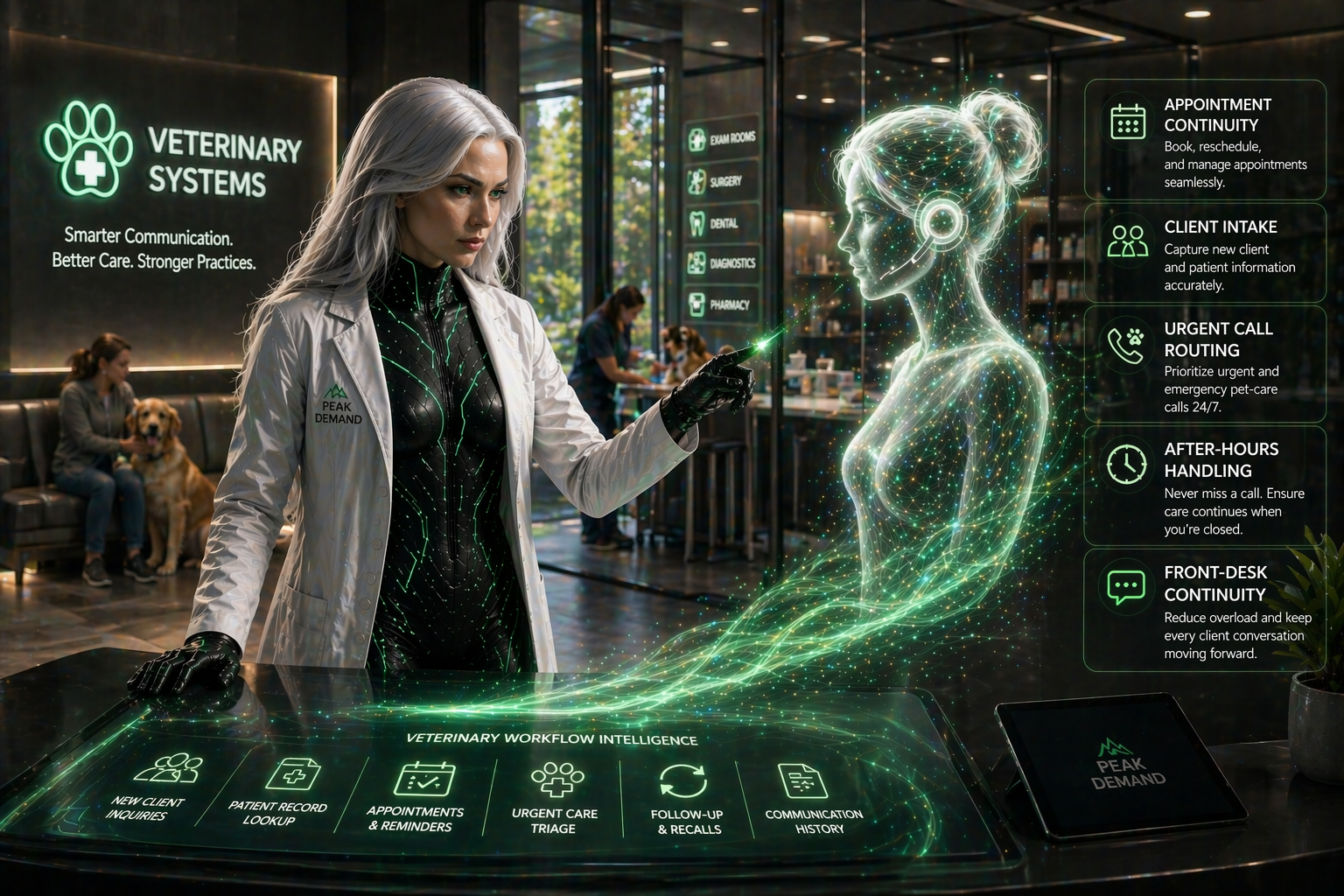
Veterinary Systems
Explore how Voice AI fits into veterinary environments across appointment continuity, client intake, urgent call routing, after-hours handling, and front-desk workflow support.

Chiropractic and Specialty Rehab Systems
Explore how Voice AI fits into chiropractic and specialty rehab workflows across scheduling, intake, recurring visits, SOAP-adjacent continuity, imaging-adjacent coordination, and front-desk support.
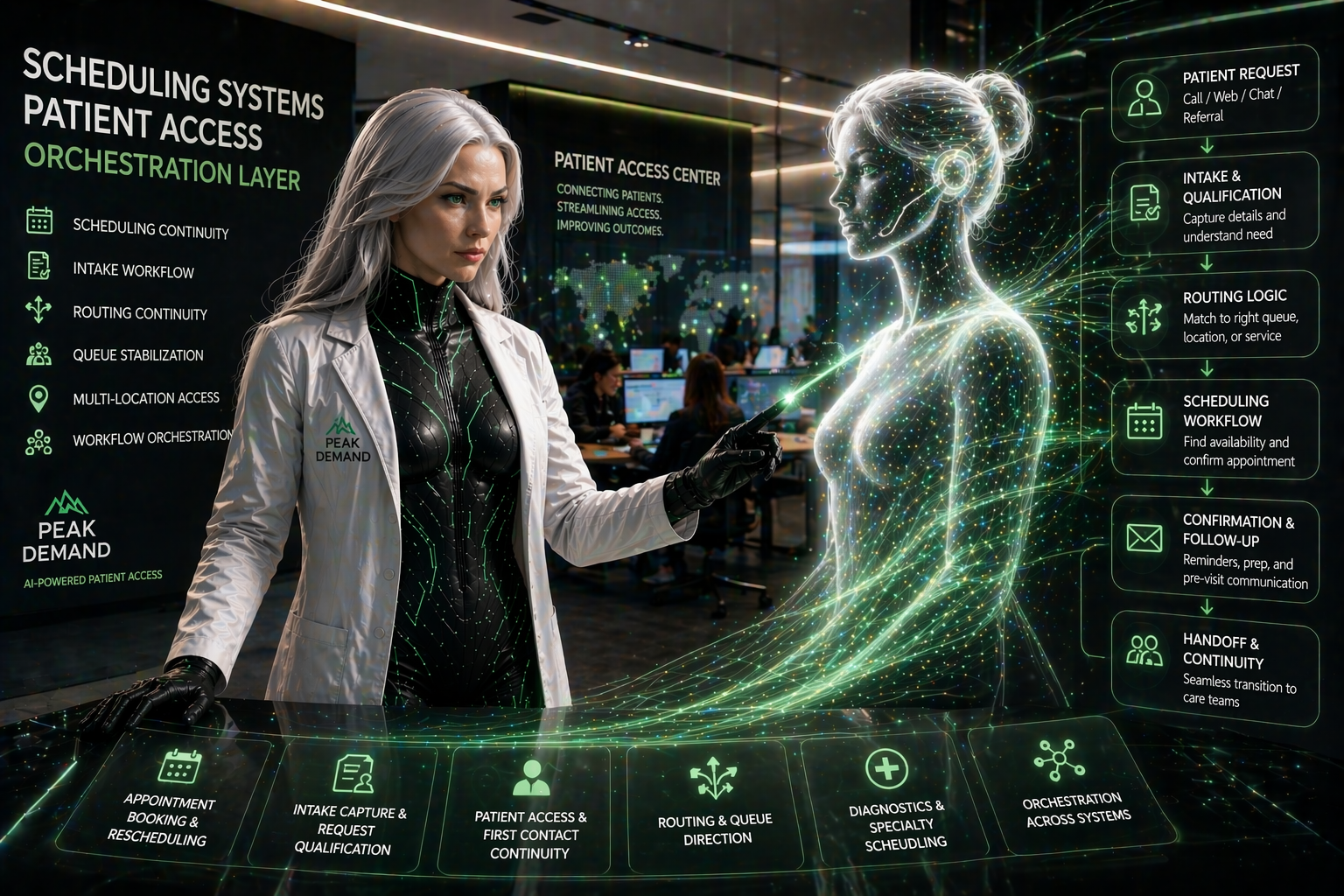
Scheduling, Patient Access, and Orchestration Systems
Explore how Voice AI supports scheduling and patient access architecture across intake, routing, queue stabilization, diagnostics scheduling, and workflow continuity between first contact and next action.
See Healthcare Voice AI Integrations In Action
These walkthroughs show how Voice AI can connect into real healthcare scheduling, intake, and communication environments. Start with TELUS Health CHR for Canadian clinic workflows and Juvonno for rehab and allied health operations.
TELUS Health CHR Integration Walkthrough
See how Voice AI can support TELUS Health CHR scheduling, intake, patient communication, and Canadian clinic workflow continuity.
Juvonno Integration Walkthrough
See how Voice AI can support Juvonno workflows for rehab scheduling, intake, appointment handling, and clinic communication continuity.
Explore published healthcare systems by name
Once you know the software family that best matches your environment, this section makes it easier to browse live healthcare integration pages by platform name. Each category below groups published system pages by the type of environment they usually support so operators, managers, and technical teams can compare workflow fit more quickly. A fuller alphabetical directory appears farther down the page.
Featured healthcare systems
These are high-priority starting points for visitors evaluating real-world Voice AI workflow fit across scheduling, intake, patient communication, routing, and access workflows.
Clinic, ambulatory, and medical EMR systems
These systems are commonly associated with clinic records-adjacent workflows, appointment flow, patient requests, intake continuity, routing, and broader ambulatory communication operations.
Scheduling, intake, and patient communication systems
These environments sit closer to booking logic, intake flow, reminders, clinic administration, and day-to-day patient access operations.
Rehab, physiotherapy, and allied health systems
Allied health and rehabilitation environments often depend on strong scheduling continuity, practitioner matching, intake flow, recurring appointment management, and multi-location operational coordination.
Dental systems
Dental communication workflows often center around appointment demand, cancellation recovery, reminders, new patient calls, and front-desk continuity across booked production.
Veterinary systems
Veterinary communication environments often require appointment continuity, client communication, after-hours handling, urgent call direction, and records-adjacent workflow coordination.
Healthcare organizations rarely evaluate integrations in a vacuum. Grouping systems by software family makes it easier to understand likely workflow fit, compare environments more quickly, and navigate toward both family-level integration pages and live system-specific pages deeper in this hub. The full alphabetical system directory farther down the page should carry the complete 98-system library.
Where Voice AI sits in the healthcare workflow matters more than basic connectivity
Healthcare Voice AI becomes more useful when it is treated as part of the larger workflow architecture around patient access, intake, routing, scheduling, escalation, and downstream ownership. The question is not only whether a system connects. The question is whether the communication flow reaches the next operational step with enough clarity and structure to reduce friction instead of shifting it downstream.
In practice, that means Voice AI often sits across multiple workflow layers at once. It may support first contact, gather structured intake, help direct the caller into the right path, preserve context for staff, and improve continuity into the next step. The value comes from how those layers fit together, not from one isolated connection point.
This is why healthcare teams should evaluate both the scheduling and patient access layer and the EMR or EHR-adjacent layer. In more complex environments, the architecture may also need to account for enterprise compliance and procurement requirements.
Where Voice AI usually enters the workflow
Voice AI often enters at the communication edge: inbound calls, appointment demand, intake capture, after-hours answering, overflow handling, and patient access or routing-related first contact.
Explore healthcare AI receptionistsWhere continuity usually breaks down
Continuity often breaks between the interaction and the next operational owner. That can happen when routing is weak, intake is unclear, scheduling context is incomplete, or downstream teams still need to manually rebuild the request.
Explore centralized scheduling workflowsWhat stronger integration architecture actually improves
Stronger architecture preserves enough structure, direction, and next-step usability for staff or systems to act efficiently. That is what turns Voice AI into operational infrastructure instead of a disconnected front-end layer.
Return to the healthcare resource hub| Integration maturity | What healthcare teams usually experience | Likely operational result |
|---|---|---|
| Fragmented | Some connection points exist, but scheduling, intake, routing, escalation, and continuity still require heavy manual repair. | Lower operational value, more staff burden, weaker patient access continuity, and less confidence in the workflow. |
| Partially connected | Important workflow layers connect, but structure and downstream usability still vary too much between teams, departments, or next-step owners. | Moderate gains, but persistent continuity gaps remain and staff still absorb unnecessary workflow friction. |
| Workflow-led and integrated | Voice AI supports multiple workflow layers with stronger structure, clearer routing, better handoff, and more usable next-step continuity. | Stronger patient access flow, cleaner operational ownership, and more scalable communication infrastructure. |
What healthcare teams should evaluate in the architecture discussion
- Where does Voice AI need to sit first in the communication workflow?
- Where does continuity currently break between the interaction and the next operational step?
- Which layers are EMR or EHR-adjacent, and which ones are workflow-adjacent?
- How do scheduling, intake, routing, patient access, and escalation interact in this environment?
- Will downstream teams receive enough structure to act without rebuilding the request manually?
- Is the integration design workflow-led or just feature-led?
- Does the current architecture reduce friction for staff, or does it simply move the work somewhere else?
Healthcare organizations usually get more value when they evaluate integration maturity across communication flow, operational ownership, and downstream usability together instead of treating each connection as a separate isolated decision. For system-specific evaluation, use the alphabetical healthcare system directory below.
Evaluating software families?
Use the six system-family pages to compare EMR, EHR, dental, veterinary, rehab, scheduling, and patient access environments.
Browse Software FamiliesEvaluating specific systems?
Use the full alphabetical directory to find the exact healthcare platform your team is evaluating.
Open System DirectoryEvaluating enterprise readiness?
Review governance, privacy, escalation, procurement, and compliance considerations before deployment.
Review ComplianceGo deeper into the strategy behind healthcare Voice AI integrations
This section helps healthcare teams move from broad category understanding into the right supporting resources for architecture, interoperability, workflow fit, implementation planning, and system-specific evaluation.
The articles below are the best next clicks for teams evaluating how Voice AI fits into healthcare communication systems, patient access workflows, structured integration pathways, rollout planning, and governed healthcare environments.
For broader category education, use the Healthcare Voice AI Resource Hub. For software-specific evaluation, continue to the full alphabetical system directory lower on this page and use the six healthcare software family pages as the parent layer.
Need system-family pages?
Use the family pages to compare medical EMR, allied health, dental, veterinary, specialty rehab, and patient access systems.
Browse Software FamiliesNeed a specific platform?
Use the alphabetical system directory to find the exact EMR, EHR, scheduling, dental, veterinary, or rehab platform.
Open System DirectoryNeed compliance context?
Use the enterprise compliance page when governance, privacy, procurement, RFPs, or regulated deployment requirements are part of the evaluation.
Review ComplianceCore integration strategy articles
These resources explain why integrations matter, what healthcare teams should evaluate first, and how stronger Voice AI integration architecture should be understood.
Custom pathways, structured integrations, and workflow fit
These articles are useful for teams evaluating custom pathways, structured communication flows, and how Voice AI fits into real healthcare operating environments.
Rollout, implementation, and governance
These resources are best for healthcare teams moving from early exploration into rollout planning, operational safety, implementation readiness, and governance-aware deployment.
Patient access, routing, and workflow bottlenecks
These articles help healthcare teams think more clearly about where communication complexity builds up across patient access, intake, department routing, scheduling, and downstream handoff.
As the healthcare integrations ecosystem continues to grow, this section can keep routing visitors into the most relevant strategy, rollout, and workflow resources without changing the overall structure of the hub. The full software directory appears in the Alphabetical System Directory section below.
Explore live healthcare system integration pages by category
This section gives healthcare teams a category-based way to browse the most important live system pages. It is not the full 98-system directory; it is a curated navigation layer for comparing the platforms most commonly tied to scheduling, intake, patient communication, routing, and patient access workflows.
Use this section when you know the type of software environment you are evaluating. Use the Alphabetical System Directory below when you want to find every live system page by name.
Need the family layer?
Start with the six parent family pages when comparing software categories before choosing a specific system.
Browse Software FamiliesNeed every system?
Use the alphabetical directory for the complete live healthcare system page list by platform name.
Open Alphabetical DirectoryNeed workflow context?
Review how Voice AI fits across patient access, intake, routing, scheduling, escalation, and downstream ownership.
Review Workflow ArchitectureFeatured healthcare systems
These are some of the strongest starting points for teams exploring healthcare Voice AI integrations across scheduling, intake, patient communication, routing, and access workflows.
Clinic and ambulatory EMR systems
These systems are commonly associated with clinic records-adjacent workflows, intake, appointment flow, routing, patient communication, and broader ambulatory continuity.
Explore medical and ambulatory EMR familyScheduling, intake, and patient communication systems
These environments sit closer to booking logic, intake flow, reminders, clinic administration, and day-to-day patient access operations.
Explore scheduling and patient access familyRehab, physiotherapy, and allied health systems
Allied health and rehabilitation environments often depend on strong scheduling continuity, practitioner matching, intake flow, recurring appointments, and multi-location coordination.
Explore allied health and rehab familyDental systems
Dental communication workflows often center on appointment demand, cancellation recovery, reminders, new patient calls, and front-desk continuity.
Explore dental familyVeterinary systems
Veterinary communication environments often require appointment continuity, client communication, after-hours handling, and records-adjacent workflow coordination.
Explore veterinary familyEnterprise, specialty, imaging, and outpatient environments
These environments often involve more complex routing, diagnostic scheduling, imaging coordination, enterprise workflow ownership, and department-specific handoff requirements.
Explore enterprise and medical EMR familyThis curated category browse section helps visitors compare common healthcare software environments without scrolling the entire directory. The complete system list belongs in the Alphabetical System Directory section below, where every live healthcare system page should be listed by platform name.
Talk through your healthcare communication workflow
If your team is evaluating healthcare Voice AI integrations, the most useful next step is usually a workflow conversation. That means reviewing patient access pressure points, scheduling flow, intake structure, routing logic, after-hours coverage, compliance expectations, and the systems surrounding those workflows.
Peak Demand approaches healthcare environments through workflow fit, governance awareness, and operational usability. The goal is to help organizations map a communication architecture that supports real teams, real workflows, and real continuity requirements across EMR, EHR, scheduling, intake, dental, veterinary, rehab, and patient access environments.
Need software families?
Compare the six parent healthcare integration families before choosing a specific system page.
Browse software familiesNeed workflow context?
Review how Voice AI fits across intake, routing, scheduling, escalation, and downstream ownership.
Review workflow architectureNeed compliance review?
Use the enterprise compliance page when governance, privacy, procurement, and RFP standards matter.
Review complianceFrequently asked questions
What does Voice AI mean in a healthcare integration environment?
Can Voice AI work with EMR, EHR, scheduling, intake, and routing workflows?
Are healthcare Voice AI integrations always direct?
Where should healthcare organizations start evaluating Voice AI integrations?
How should compliance and governance fit into the evaluation?
What is the role of this integrations hub?
About Peak Demand
Peak Demand is a Toronto-based AI agency focused on Voice AI, communication automation, and workflow infrastructure for organizations operating in more complex service environments.
In healthcare, the focus is not just on call handling. It is on patient access continuity, scheduling pressure, intake structure, routing logic, after-hours support, governance, and how communication systems fit into real operational workflows.
- Workflow-driven and implementation-aware
- Governance-first in healthcare communication environments
- Built to support clinics, networks, and enterprise teams
- Designed to scale into software-specific integration pathways
- Organized around healthcare system families and live integration pages
Healthcare software integrations by system name
If you already know the software you are evaluating, this alphabetical directory is the fastest way to find the right live system page.
This directory includes the full 98-system healthcare integration library from the current Peak Demand system-page build. It is designed to help teams compare EMR, EHR, scheduling, intake, patient communication, dental, veterinary, rehab, wellness, chiropractic, orchestration, home care, med spa, pharmacy, and enterprise healthcare systems by software name.
For category-level browsing, use the software family section. For workflow context, use the workflow architecture section. This section is the full alphabetical browse layer.
Live healthcare system pages in this directory
Grouped alphabetically with visible section counts so the full library is obvious at a glance.
A–C
34 systemsABELMed through Curve Dental.
D–H
20 systemsDentrix through Helios Software.
I–M
15 systemsIDEXX Cornerstone through MRX Solutions.
N–O
11 systemsNextech through Owl Practice.
P–R
8 systemsPabau through RXNT.
Compare healthcare systems by name, category, and workflow fit
This directory is useful for comparing clinic EMRs, EHR-adjacent systems, scheduling and intake platforms, patient communication software, dental systems, veterinary systems, rehab and allied health systems, chiropractic systems, med spa systems, home care systems, pharmacy-adjacent systems, orchestration platforms, diagnostic workflows, and enterprise healthcare environments by software name before going deeper into workflow design, integration possibilities, and operational fit.
Explore your own AI use case on a discovery call.