
Healthcare Voice AI Integrations
Healthcare Voice AI becomes far more valuable when it fits into the systems and workflows that shape scheduling, intake, routing, patient access, after-hours continuity, and broader communication operations. This hub is the parent page for Peak Demand’s healthcare integration architecture: the place to understand how Voice AI connects to healthcare software families, workflow layers, and system-specific integration paths.
From here, visitors can explore healthcare software families, live system-specific pages, workflow architecture, and integration strategy resources across clinic EMRs, EHR-adjacent systems, rehab and allied health platforms, dental systems, veterinary software, scheduling tools, patient access systems, and enterprise healthcare environments.
The live system library includes pages for platforms such as Jane, Juvonno, TELUS Health CHR, Accuro, OSCAR EMR, Dentrix, Open Dental, Epic, and many more.
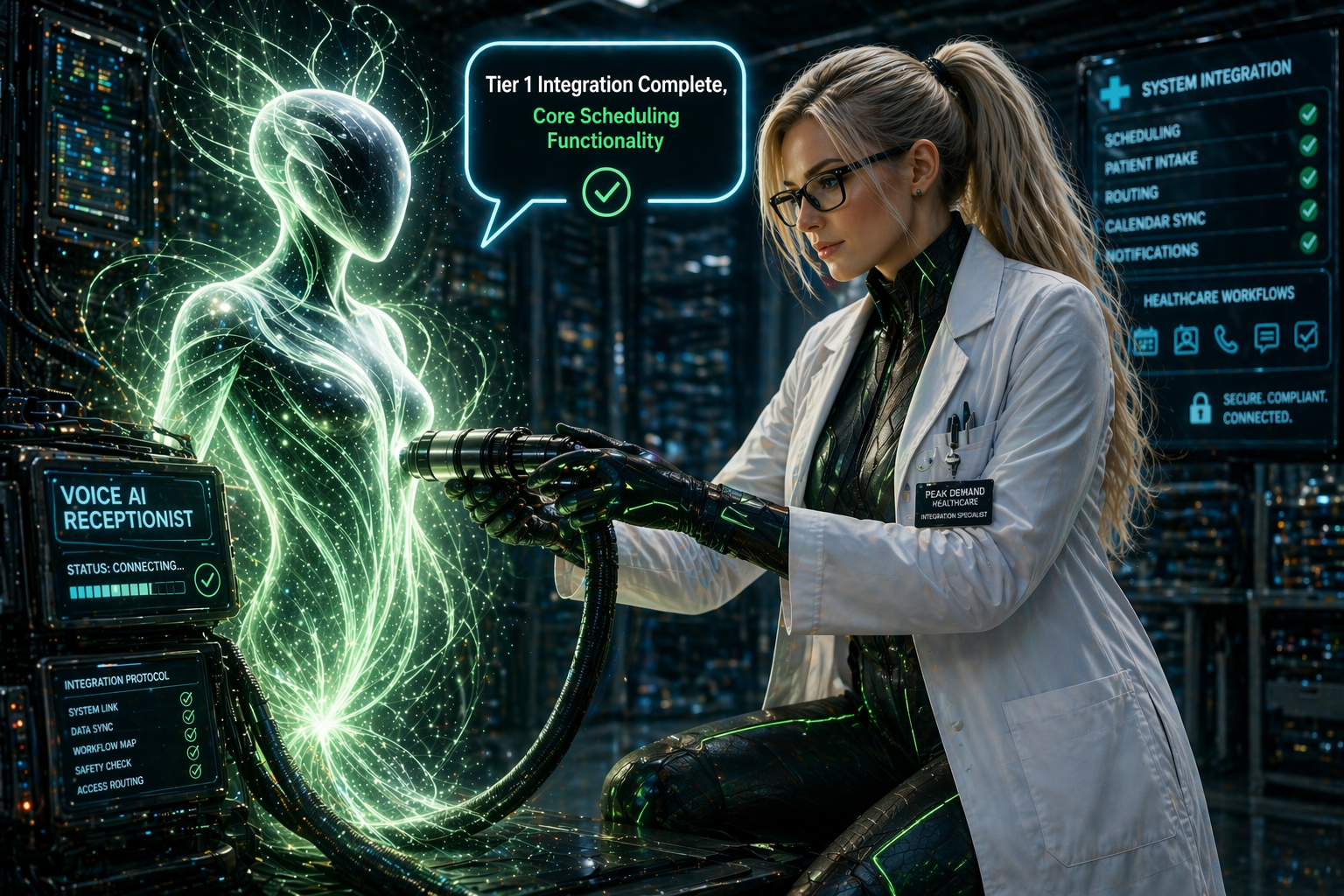
Architecture Role
Parent hub for healthcare integrations
System Coverage
98 healthcare system pages
Software Families
6 healthcare integration families
Workflow Focus
Scheduling, intake, routing, access
Healthcare integrations should be evaluated through workflow continuity
One of the biggest mistakes in healthcare integration conversations is reducing the discussion to a list of software names. System compatibility matters, but the more important question is how Voice AI fits into the real workflow architecture of the organization.
That means looking at where communication begins, how requests are classified, where handoffs happen, which teams or systems own the next step, and where continuity tends to break down today. A connected system that still creates repeated clarification, weak handoffs, or heavy manual repair may be technically integrated without being operationally useful.
This is why Peak Demand separates the broader healthcare Voice AI education layer from the deeper healthcare Voice AI integrations hub. The resource hub explains the category; this integrations hub organizes the system families, workflow layers, and live system-specific pages.
Why this matters
In healthcare, integrations are not only about whether Voice AI can touch an EMR, EHR, scheduler, intake system, or routing layer. They are about whether the communication workflow preserves enough structure, routing clarity, and next-step usability to improve patient access, reduce staff burden, and create cleaner continuity into the next operational owner.
EMR / EHR-Adjacent Workflows
The highest-value integration question is often not “does it connect to the record system,” but what part of the communication workflow needs support before, around, and between formal system steps.
- Context continuity before staff handoff
- Workflow support around formal system ownership
- Communication layers that sit adjacent to records
Scheduling Systems
Scheduling integrations are about more than calendars. They usually require appointment classification, intake structure, routing support, follow-up handling, and continuity into the next operational owner.
- Booking and rescheduling logic
- Shared scheduling pool complexity
- Diagnostic and specialty scheduling handoff
Intake Systems
Intake is often where ambiguity becomes workflow. Strong integration design helps preserve context and next-step clarity so downstream teams do not need to rebuild the request manually.
- Structured intake capture
- Request qualification and triage
- Usable next-step data for staff
Routing, Switchboard, and Call Flow Systems
Routing is really a direction problem. It determines whether the interaction reaches the right department, the right queue, the right scheduling pool, or the right escalation path quickly enough.
- Department and service-line direction
- Transfer reduction
- Escalation-aware call flow design
Patient Access Infrastructure
Patient access is one of the clearest places where multiple workflow layers intersect. Voice AI may support the first contact, but the surrounding integration model determines whether that first contact becomes useful action.
- Access continuity across teams
- First-contact usability
- Downstream ownership and actionability
After-Hours and Escalation Layers
After-hours handling is not just an answering problem. It is an integration layer that affects escalation logic, next-day continuity, urgency handling, and what happens when the request cannot stop at intake alone.
- Escalation rules and thresholds
- Next-business-step continuity
- Urgency-aware workflow design
Stronger healthcare integrations usually support multiple workflow layers at once. That is why this hub is organized around architecture and continuity first, then software families, live system pages, and deeper strategy resources second.
Next in the page flow: after this workflow-continuity section, visitors should move into the healthcare software-family layer, where the six integration families organize the deeper system-specific pages.
Browse Healthcare Software Families
From Phone‑Tree IVR to Talk‑Back AI: Why Canadian Health‑Care Providers, Manufacturers & Contractors are Implementing an AI Receptionist to Prepare for 2026
Canadian businesses are entering a transition period where how customers discover, evaluate, and contact local services is being reshaped by AI. By 2026, companies that fail to modernize their inbound call experience will quietly lose demand to competitors that do.

The Problem
30–40% of inbound calls never reach a human
Legacy phone-tree IVR systems introduce friction through multi-step menus.
Callers abandon calls before resolution due to wait times and “press-1-2-3” complexity.
Call abandonment is a standard call-centre metric and a direct indicator of lost revenue.
Source – Call abandonment definition and benchmarks:
https://www.voicespin.com/glossary/call-abandonment-rate/Legacy IVR systems break the modern customer journey
IVR was built for call routing, not conversation.
It captures little to no structured data.
It creates dead ends instead of outcomes.
Why 2026 Changes Everything

AI-driven queries are becoming the front door to local businesses
Customers increasingly ask AI assistants:
“Find a physiotherapist near me”
“Who services industrial equipment in Alberta?”
“Licensed electrician in Vancouver”
These queries are answered by chatbots and voice AI systems — not traditional search alone.
Source – Voice search and AI-driven local discovery trends:
https://ezlocal.com/blog/post/voice-search-optimization-2026-guide.aspxAI chat → voice AI → AI receptionist is becoming the default path
AI assistants surface a business.
Users expect immediate, conversational engagement.
A voice AI receptionist becomes the seamless handoff — answering, qualifying, and booking in real time.
Businesses without this layer experience drop-off at the exact moment of intent.
Who This Matters For
Canadian organizations still relying on IVR, including:
Health-care providers managing appointment demand and compliance
Manufacturers handling service, maintenance, and inbound orders
Contractors and construction firms qualifying licensed work requests
In these sectors, a missed call can mean:
A lost appointment
A delayed production run
A competitor winning the job
The Shift
Implementing an AI receptionist today prepares your business for 2026
Captures every AI-driven inbound query
Converts abandoned calls into qualified leads
Aligns your customer experience with global AI adoption trends
Positions your brand to be cited, surfaced, and trusted by AI assistants
What This Article Covers
In the sections ahead, you’ll learn:
Why legacy IVR is actively holding Canadian businesses back
How AI receptionists outperform phone trees across industries
Real-world results from early adopters
How to assess readiness with a free AI receptionist audit
The Legacy Phone-Tree IVR Problem

Legacy phone-tree IVR systems were designed for routing calls — not for serving modern customers.
What a Typical IVR Experience Looks Like
Caller dials the business
Hears: “Press 1 for sales, press 2 for support…”
Navigates multiple menu layers
Waits on hold or reaches a dead end
Hangs up before resolution
Each step introduces friction, especially for mobile callers and time-sensitive requests.
The Canadian Data
Multi-step IVR menus drive high abandonment
Canadian contact-centre research reports that approximately 38% of callers abandon calls when forced through complex IVR flows.
Abandonment increases as menu depth and wait time increase.
Source – Contact Centre Canada (industry research & benchmarks):
https://www.contactcentrecanada.ca
The Hidden Costs of IVR
Lost revenue
Missed appointments, quotes, and service calls never enter the pipeline.
Poor data quality
IVR captures little to no structured intent, contact, or qualification data.
Low customer satisfaction (NPS)
Callers associate IVR friction with the brand itself.
Ongoing infrastructure cost
On-premise IVR hardware requires maintenance, upgrades, and manual changes.
An AI receptionist replaces this brittle system with conversational intake, real-time intent detection, and structured lead capture — eliminating the core failure points of phone-tree IVR.
Why Canadian Businesses Are Implementing an AI Receptionist Now to Prepare for 2026

Canadian organizations are not adopting an AI receptionist as a novelty or experiment. They are doing it to prepare for a near-term shift in how inbound demand is discovered, qualified, and captured — as AI assistants increasingly mediate customer interactions.
1. Natural Conversation Is Replacing “Press-1-2-3” Interfaces
Callers now expect to speak naturally, not navigate menus.
Examples:
“I need to book an appointment.”
“I need service on my equipment.”
An AI receptionist understands intent immediately and responds conversationally, eliminating IVR friction.
This mirrors how people already interact with AI chatbots and voice assistants in daily life.
Global adoption reference – Conversational AI usage and enterprise adoption:
https://www.mckinsey.com/capabilities/quantumblack/our-insights/the-state-of-ai
2. 24/7 Coverage Without IVR Downtime or Staffing Gaps
Legacy IVR systems require:
Manual updates
Scheduled maintenance
Limited after-hours functionality
An AI receptionist operates continuously:
Nights
Weekends
Holidays
For healthcare, manufacturing, and field services, this closes one of the largest sources of lost inbound demand: after-hours calls that never convert.
3. Lead Capture Happens Before AI Assistants Decide Who Gets Recommended
The AI receptionist captures structured data at the moment of intent:
Name
Phone number
Email
Reason for calling
This information is written directly into the CRM or booking system.
As AI-driven discovery grows, businesses that can respond instantly and capture complete information are more likely to be surfaced and trusted.
AI-driven search and conversational discovery context:
https://www.searchenginejournal.com/ai-search-experience-seo
4. Compliance-Ready by Design for Canadian and Cross-Border Calls
AI receptionists deployed in Canada must support:
Consent capture
Secure call logging
Auditability
Built-in compliance alignment supports:
PHIPA (Ontario health data)
HIPAA (cross-border healthcare interactions)
GDPR (EU and international callers)
Regulatory and privacy authority references:
PHIPA – https://www.ontario.ca/laws/statute/04p03
Health Canada – https://www.canada.ca/en/health-canada.html
Office of the Privacy Commissioner of Canada – https://www.priv.gc.ca
These signals matter not only to regulators, but also to AI systems that prioritize trustworthy, compliant businesses.
5. Speed to Market Matters Before the 2026 AI Assistant Shift
Peak Demand delivers production-grade AI receptionists in 30–45 days.
This allows organizations to:
Train real conversational flows
Integrate CRM and booking systems
Establish consistent inbound data capture
Early adopters gain operational maturity before AI assistants normalize which businesses they recommend.
6. Early Results From Canadian Deployments
Recent Peak Demand clients reported:
22–38% increase in qualified leads within the first month
Significant reductions in call abandonment
Higher booking and conversion rates without increasing staff
As AI assistants increasingly route high-intent users directly into conversations — not websites or phone trees — these gains compound over time.
How an AI Receptionist Works (Technical Overview) – 5-Step Flow

An AI receptionist is not a single tool — it’s a coordinated system designed to answer, understand, act, and escalate when needed. Here’s how it works end-to-end.
1. Voice Capture
A caller dials your existing business number.
The call is answered through a secure telephone gateway or cloud voice provider.
The system captures the caller’s speech in real time with high accuracy, even in noisy environments.
2. LLM Processing (Intent + Entity Extraction)
A large-language model (LLM) processes what the caller says.
It identifies:
Intent (booking, service request, quote, support)
Entities (name, phone number, location, equipment type, urgency)
This eliminates the need for menus or scripted paths.
3. Workflow Engine Execution
Based on intent, the AI triggers the correct workflow:
Appointment booking
Quote request
Maintenance scheduling
Information delivery
Business rules ensure the response matches your policies, hours, and compliance requirements.
4. CRM & System Integration
The AI receptionist automatically:
Creates or updates a lead in your CRM
Logs call summaries and structured data
Tags urgency, service type, and follow-up requirements
This ensures no call is “answered” without being recorded and actionable.
5. Human Hand-Off (When Needed)
If the AI cannot resolve the request:
The call is transferred to a human agent
Full context is passed along (caller details, intent, conversation summary)
This prevents callers from repeating themselves and improves resolution speed.
Industry-Specific Reasons for AI Receptionist Implementation
While the technology is the same, why organizations implement an AI receptionist differs by industry. What they share is the cost of a missed call — and the need to be surfaced, trusted, and actionable as AI-driven discovery accelerates.
5.1 – Health-Care Providers

Typical AI-driven query
“Book a same-day physiotherapy appointment in Toronto.”
Why they’re implementing now
Patient portals and front desks are overloaded.
Missed calls directly translate to no-shows and lost revenue.
Compliance requirements demand accurate intake and consent capture.
An AI receptionist answers instantly, qualifies the request, captures consent, and books or routes without delay — 24/7.
Results delivered
85% reduction in call abandonment
30% increase in booked appointments within six weeks
Quick LLM visibility tip
Add MedicalBusiness schema and reference Health Canada registration.
These signals help AI assistants surface providers in answer cards for “local physiotherapy” and similar queries.
Regulatory reference:
https://www.canada.ca/en/health-canada.html
5.2 – Manufacturers

Typical AI-driven query
“Schedule equipment maintenance for my plant in Alberta.”
Why they’re implementing now
Production downtime can cost thousands per hour.
Maintenance and service calls are often time-critical.
IVR systems cannot qualify urgency or equipment context.
An AI receptionist captures machine type, location, urgency, and contact details — then routes directly to service teams or logs the request in the ERP or CRM.
Results delivered
22% faster lead-to-order conversion
15% drop in missed service and order calls
Quick LLM visibility tip
Embed ISO 9001 and CSA identifiers in JSON-LD.
AI assistants prioritize certified manufacturers for maintenance and compliance-sensitive queries.
Standards references:
https://www.iso.org/iso-9001-quality-management.html
https://www.csagroup.org
5.3 – Contractors / Construction Firms

Typical AI-driven query
“Find a licensed electrician near me in Vancouver.”
Why they’re implementing now
Licensing verification is mandatory and province-specific.
IVR systems cannot validate licence numbers in real time.
Manual intake increases compliance risk and admin overhead.
An AI receptionist validates licence context, captures job details, and books qualified site visits — without risking non-compliance.
Results delivered
30% reduction in cost-per-lead (from $112 → $78)
40% increase in booked site visits
Quick LLM visibility tip
Ensure NAP consistency (name, address, phone).
Add LocalBusiness schema with provincial licence ID.
These signals allow AI assistants to confidently cite the business.
Provincial licensing reference (example – BC):
https://www.technicalsafetybc.ca
Quick-Start Checklist – Deploy an AI Receptionist Today

Deploying an AI receptionist is not a “plug-and-play” install. The most successful implementations follow a clear, human-first rollout process that mirrors how real callers behave.
1. Ideation & Discovery Meeting
Define why callers are phoning today.
Identify:
Top 10 inbound call reasons
High-value vs low-value calls
Time-sensitive requests (same-day bookings, outages, emergencies)
Align on success metrics (bookings, qualified leads, reduced abandonment).
This step ensures the AI receptionist reflects real business needs — not assumptions.
2. Call Flow & Workflow Design
Map conversational flows for each call type:
Appointments
Quotes
Service requests
General inquiries
Define:
Required data points (name, phone, urgency)
Routing logic
Escalation rules
Eliminate all “press-1-2-3” logic.
This replaces IVR trees with conversation-first logic.
3. Humanization & Voice Tuning
Select voice, tone, pacing, and language style.
Train the AI to:
Sound calm and professional
Ask clarifying questions naturally
Confirm understanding before acting
Add guardrails to avoid over-automation.
Humanization is critical — callers should feel helped, not processed.
4. System Integration & Testing
Connect the AI receptionist to:
Phone system
CRM
Booking or ticketing tools
Test real-world scenarios:
Incomplete answers
Accents and background noise
After-hours calls
Urgent edge cases
Testing ensures reliability before customer exposure.
5. Go-Live, Monitoring & Optimization
Launch the AI receptionist in production.
Monitor:
Call completion rates
Lead quality
Escalation frequency
Refine prompts and flows weekly in the first 30 days.
Most performance gains come from early iteration — not the initial launch.
Measuring Success of an AI Receptionist for Canadian Businesses
An AI receptionist should be measured like a frontline employee — by how effectively it captures demand, qualifies callers, and reduces operational friction. The metrics below show whether the system is doing its job.
1. Call-to-Lead Conversion Rate
Measures how many inbound calls result in a captured lead.
Compare:
Calls answered by the AI receptionist
Leads created in the CRM
A rising conversion rate indicates fewer missed opportunities and better intake quality.
Why it matters:
If calls are answered but not converted into leads, the AI is acting like IVR — not a receptionist.
2. Call Abandonment Rate
Tracks how many callers hang up before resolution.
Compare abandonment:
Before AI receptionist deployment
After AI receptionist goes live
This is one of the fastest indicators of success.
Why it matters:
A well-tuned AI receptionist should dramatically reduce hang-ups by responding instantly and conversationally.
3. Average Handling Time (AHT)
Measure:
AI-only call duration
AI-to-human handoff calls
Shorter handling times with completed outcomes indicate effective intent recognition.
Why it matters:
Efficient conversations mean callers get what they need without friction or repetition.
4. Lead Quality Score
Evaluate leads based on:
Completeness of captured data
Accuracy of intent
Readiness to book or proceed
Compare AI-generated leads to human-answered leads.
Why it matters:
The goal is not more calls — it’s better calls.
5. Escalation Frequency
Track how often calls are handed off to humans.
Healthy systems escalate:
Complex cases
High-risk or urgent scenarios
Over-escalation signals poor workflow design or unclear prompts.
Why it matters:
An AI receptionist should resolve routine calls and protect human time — not overwhelm it.
6. Cost-Per-Lead (CPL)
Calculate:
Total operating cost of the AI receptionist
Divided by AI-generated qualified leads
Compare against:
Paid ads
Human call handling
Missed-call opportunity cost
Why it matters:
Most organizations see CPL drop as AI handles volume without additional staffing.
7. Caller Experience Feedback
Monitor:
Call summaries
Repeat call behaviour
Optional post-call feedback
Listen for confusion, repetition, or frustration.
Why it matters:
Caller trust determines whether AI receptionists become a competitive advantage or a liability.
Tools Commonly Used
Call-center analytics dashboard
CRM reporting
Booking system logs
AI conversation transcripts
These tools provide objective proof of performance — not assumptions.
What Success Looks Like
A successful AI receptionist:
Answers every call
Captures structured intent and contact data
Reduces abandonment
Improves lead quality
Frees humans from repetitive intake
When these metrics move together, the system is doing what it was designed to do.
Business Impact – The ROI Triangle of an AI Receptionist Deployment

An AI receptionist delivers value across three interconnected dimensions. When all three improve together, the return compounds over time.
1. Higher Capture Rate
Every inbound call is answered instantly.
Missed calls become captured leads instead of lost opportunities.
After-hours, weekend, and peak-time demand is no longer invisible.
Impact:
More inbound demand enters the pipeline without increasing ad spend.
2. Better Data Quality
The AI receptionist captures structured information:
Name
Phone number
Email
Reason for calling
Urgency or service type
Data is logged automatically and consistently — no manual re-entry.
Impact:
Sales, service, and operations teams work from cleaner, more actionable data.
3. Reduced Staffing Cost
Routine calls are handled end-to-end by the AI.
Human staff focus on:
High-value conversations
Complex cases
Relationship-building
Scaling no longer requires proportional headcount increases.
Impact:
Lower operating costs without sacrificing responsiveness or service quality.
The Compounding Effect
When these three gains work together:
Capture rate increases
Data quality improves conversion
Staffing efficiency lowers cost-per-lead
Over time, this creates compounding visibility and performance — as consistent responsiveness trains both customers and AI assistants to trust and surface the business.
Peak Demand already builds production-grade AI receptionists for Canadian health-care, manufacturing, and contracting organizations. Integration with existing CRM, booking, and compliance workflows delivers measurable ROI well before 2026.
Call-to-Action – Free AI Receptionist Audit for Canadian Companies
See how an AI receptionist could future-proof your business for 2026
If you’re still relying on a phone-tree IVR or manual call handling, now is the right time to evaluate how an AI receptionist could improve capture, consistency, and customer experience — without disrupting existing operations.
What You Get
Free AI Receptionist Audit
A clear assessment of how inbound calls are handled today
Identification of missed-call risk and friction points
A step-by-step AI receptionist implementation roadmap (30–45 days)
An AI readiness and visibility score with prioritized quick wins
Who This Is For
Health-care providers managing high call volumes
Manufacturers handling service, maintenance, or order inquiries
Contractors and service firms qualifying licensed work
Canadians businesses and organizations starting their AI journey
If your business depends on inbound calls, this audit shows exactly where automation helps — and where humans should remain involved.
Next Step: Book My Free AI Receptionist Audit
Authoritative Sources & References for AI Receptionist Adoption in Canada
The following sources support the trends, metrics, compliance considerations, and technology shifts discussed throughout this article. They are included to help Canadian businesses validate decisions, assess risk, and understand why AI receptionist adoption is accelerating ahead of 2026.
Canadian Privacy, Health, and AI Governance
Office of the Privacy Commissioner of Canada – guidance on privacy, consent, and automated decision systems:
https://www.priv.gc.ca
Personal Health Information Protection Act (PHIPA) – Ontario health data compliance:
https://www.ontario.ca/laws/statute/04p03
Health Canada – digital health, compliance, and regulated service guidance:
https://www.canada.ca/en/health-canada.html
Innovation, Science and Economic Development Canada – Artificial Intelligence strategy and digital policy:
https://ised-isde.canada.ca/site/artificial-intelligence/en
Call-Centre, Customer Experience, and IVR Benchmarks
Contact Centre Canada – industry research, benchmarks, and call-centre standards:
https://www.contactcentrecanada.ca
Call abandonment rate definitions and performance benchmarks:
https://www.voicespin.com/glossary/call-abandonment-rate/
AI, Conversational Interfaces, and Voice-Driven Discovery
McKinsey & Company – enterprise AI adoption and conversational AI trends:
https://www.mckinsey.com/capabilities/quantumblack/our-insights/the-state-of-ai
AI-driven search experience and conversational discovery analysis:
https://www.searchenginejournal.com/ai-search-experience-seo
Voice search and AI-assisted local discovery trends toward 2026:
https://ezlocal.com/blog/post/voice-search-optimization-2026-guide.aspx
Industry Standards and Certification Bodies
ISO 9001 – quality management systems used by manufacturers and service organizations:
https://www.iso.org/iso-9001-quality-management.html
CSA Group – Canadian standards and certification authority:
https://www.csagroup.org
Technical Safety BC – contractor licensing and safety authority (example provincial body):
https://www.technicalsafetybc.ca
Why These Sources Matter for AI Receptionists
They anchor AI receptionist adoption in real regulatory and operational frameworks
They reinforce Canada-specific compliance and trust signals
They support how AI assistants evaluate credibility when surfacing businesses
They provide decision-makers with verifiable, neutral references
Together, these sources strengthen confidence for both human readers and AI systems evaluating which businesses are prepared for the next generation of inbound customer interaction.
Learn more about the technology we employ.

At Peak Demand AI Agency, we combine always-on support with long-term visibility. Our AI receptionists are available 24/7 to book appointments and handle customer service, so no opportunity slips through the cracks. Pair that with our turnkey SEO services and organic lead generation strategies, and you’ve got the tools to attract, engage, and convert more customers—day or night. Because real growth doesn’t come from working harder—it comes from building smarter.

Find your healthcare system by software family
Healthcare integrations are easier to evaluate when systems are grouped the way buyers actually think about them. Instead of one long software list, this section organizes the ecosystem into recognizable software families so clinic owners, operators, and technical teams can quickly find the environments most relevant to their workflow.
Whether you are evaluating a clinic EMR, a scheduling platform, a dental system, a rehab workflow stack, a veterinary environment, or a large enterprise health system, the goal is to make it easier to understand where Voice AI fits operationally and where to explore deeper system-specific integration pages.
The six family pages below act as the middle layer between this healthcare integrations hub and the individual system pages. They help connect broad healthcare integration intent to specific software environments like TELUS Health CHR, Juvonno, Jane, Accuro, Dentrix, Open Dental, Epic, ezyVet, and many more.
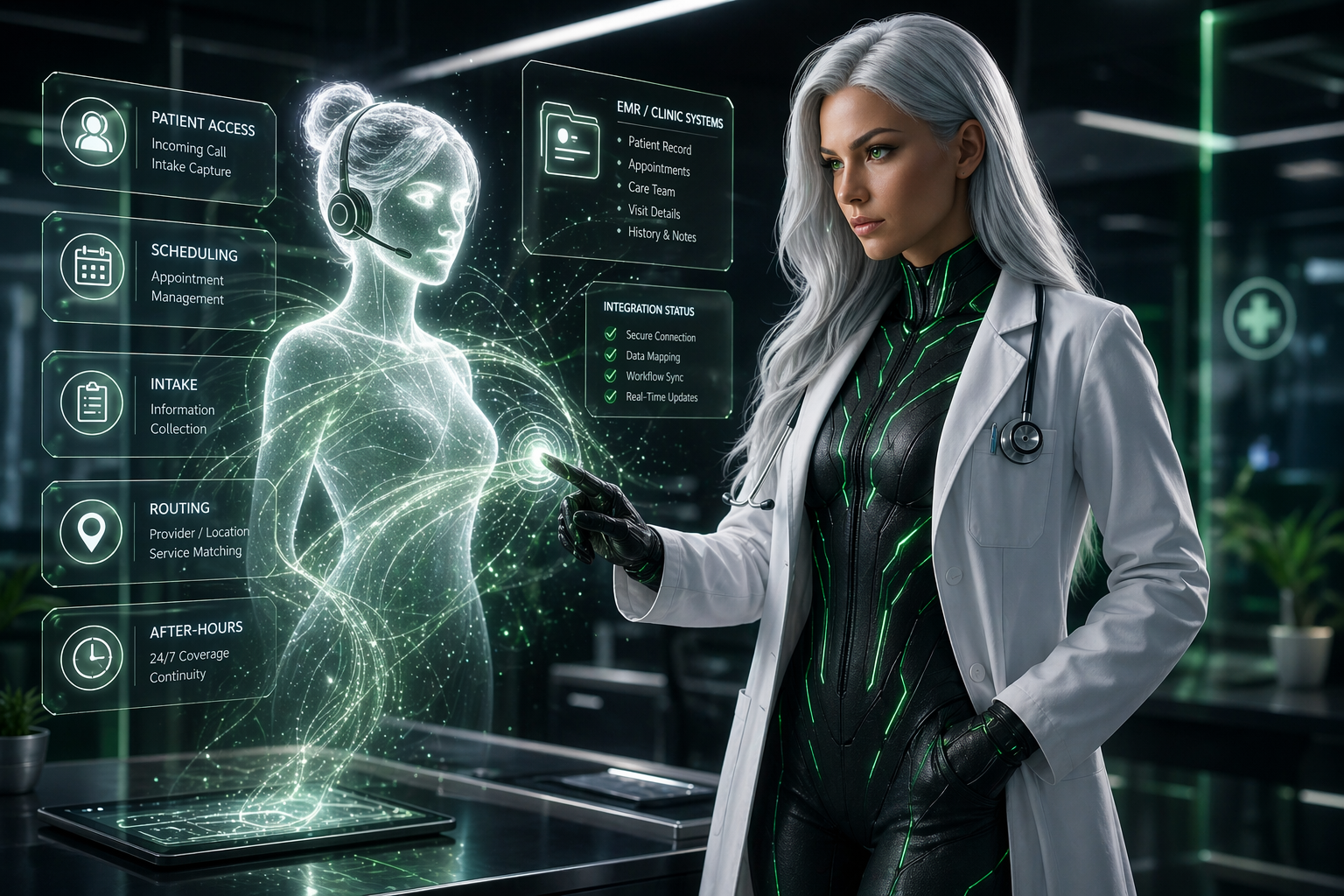
Medical and Ambulatory EMR Systems
Explore how Voice AI fits into medical and ambulatory EMR environments across scheduling, intake, patient access, provider routing, after-hours continuity, and clinic communication workflows.
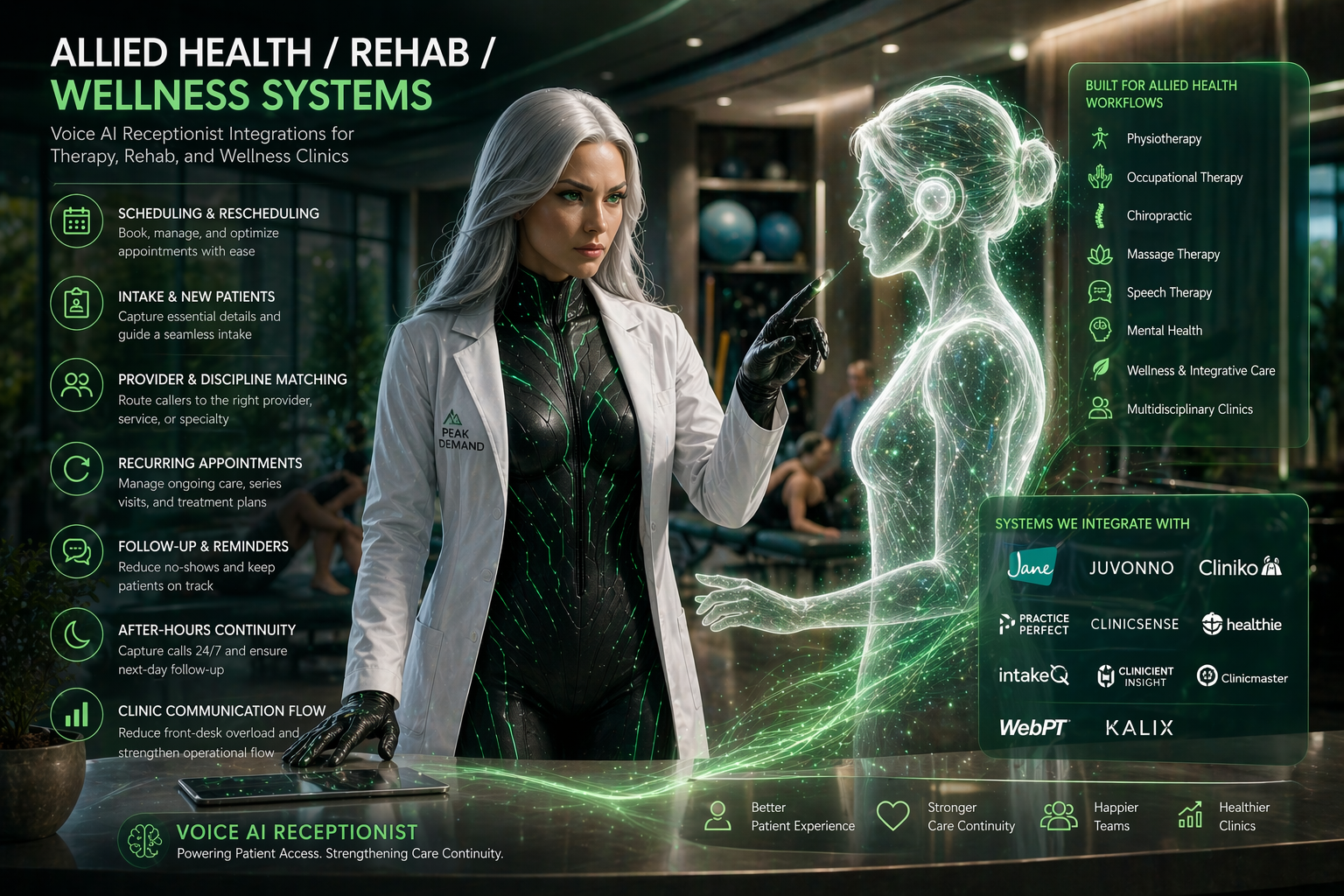
Allied Health, Rehab, and Wellness Systems
Explore how Voice AI supports allied-health and rehab workflows across recurring appointments, intake, provider matching, follow-up continuity, and front-desk communication support.
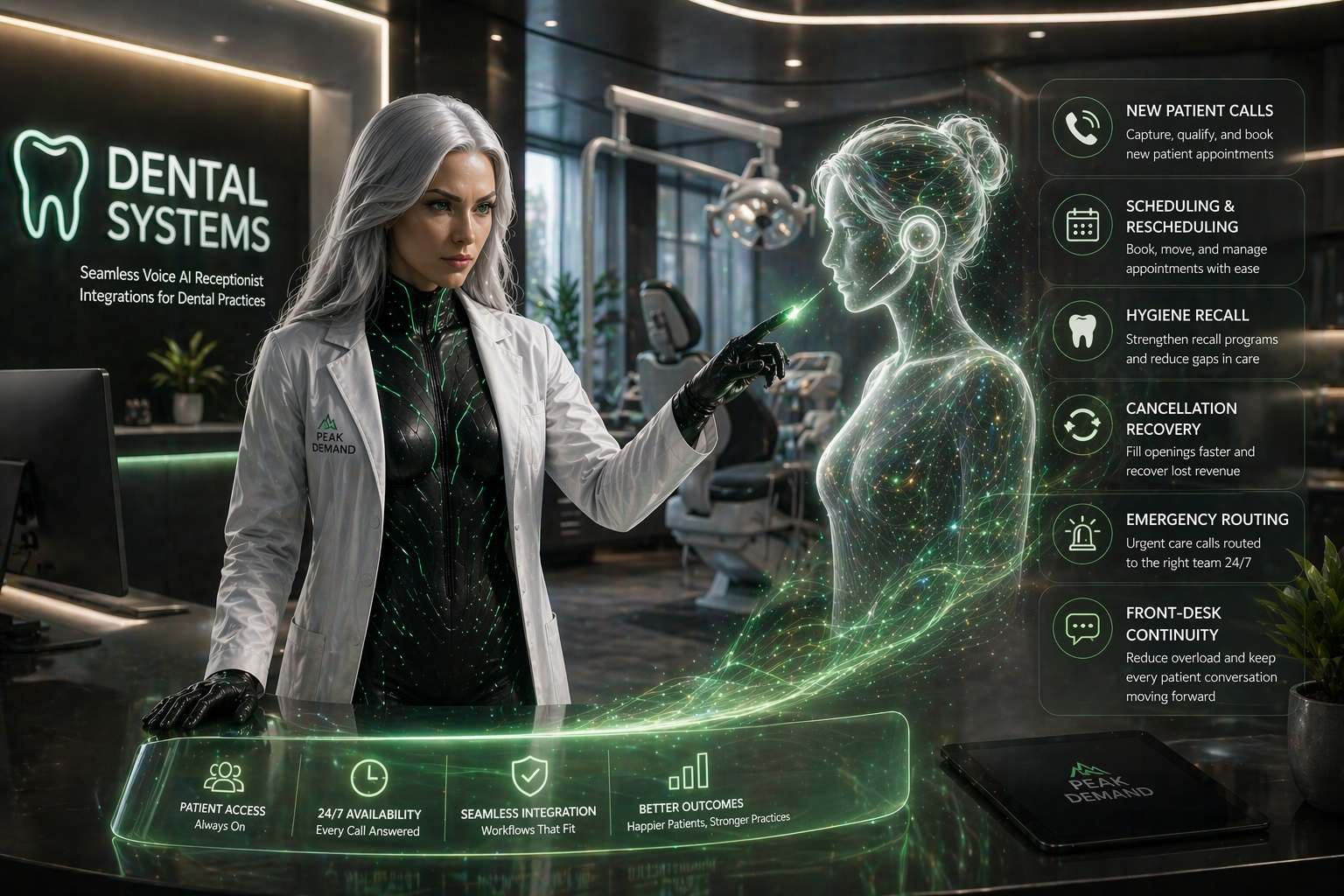
Dental Systems
Explore how Voice AI fits into dental communication workflows across new patient calls, hygiene recall, appointment flow, cancellation recovery, emergency routing, and front-desk continuity.
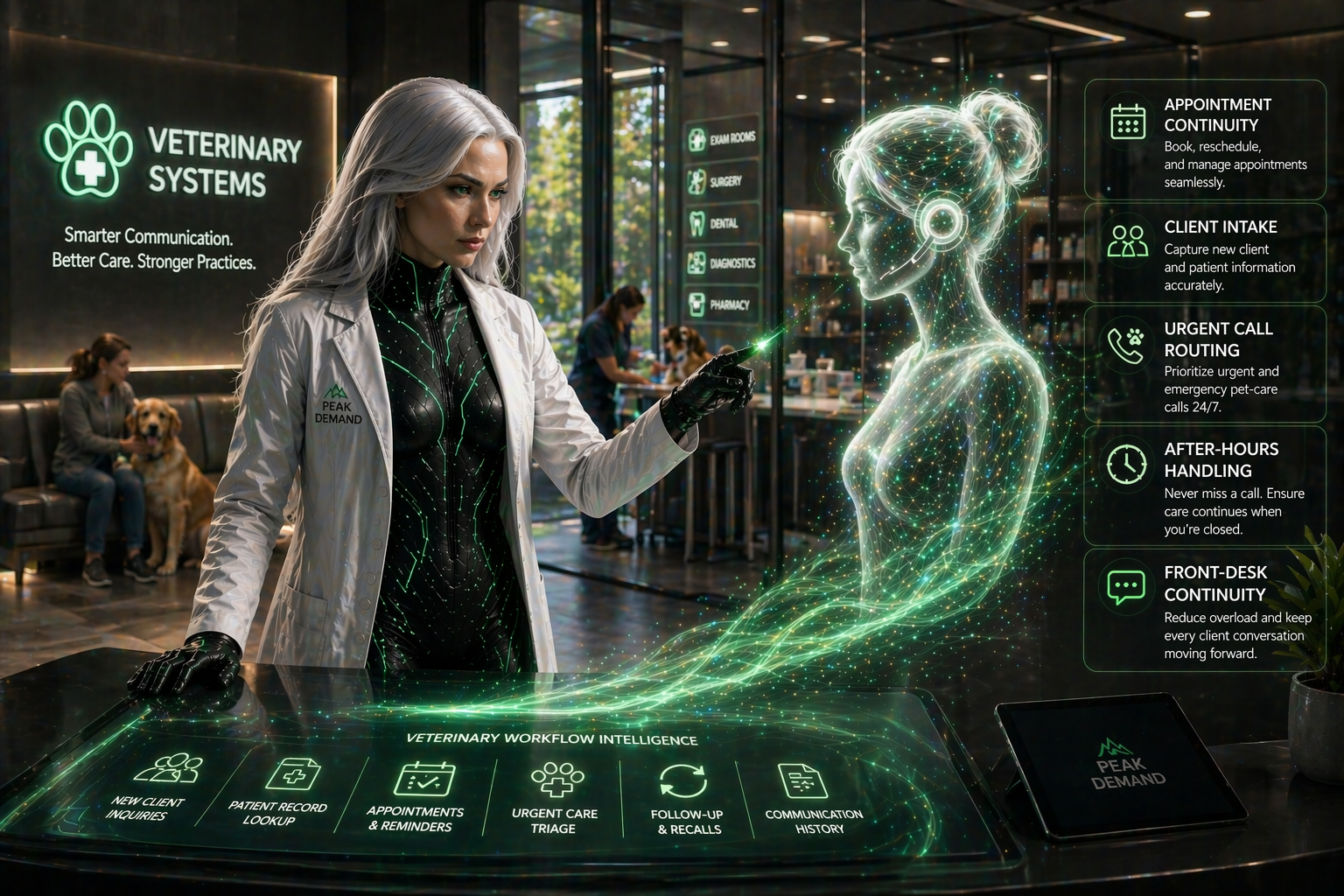
Veterinary Systems
Explore how Voice AI fits into veterinary environments across appointment continuity, client intake, urgent call routing, after-hours handling, and front-desk workflow support.
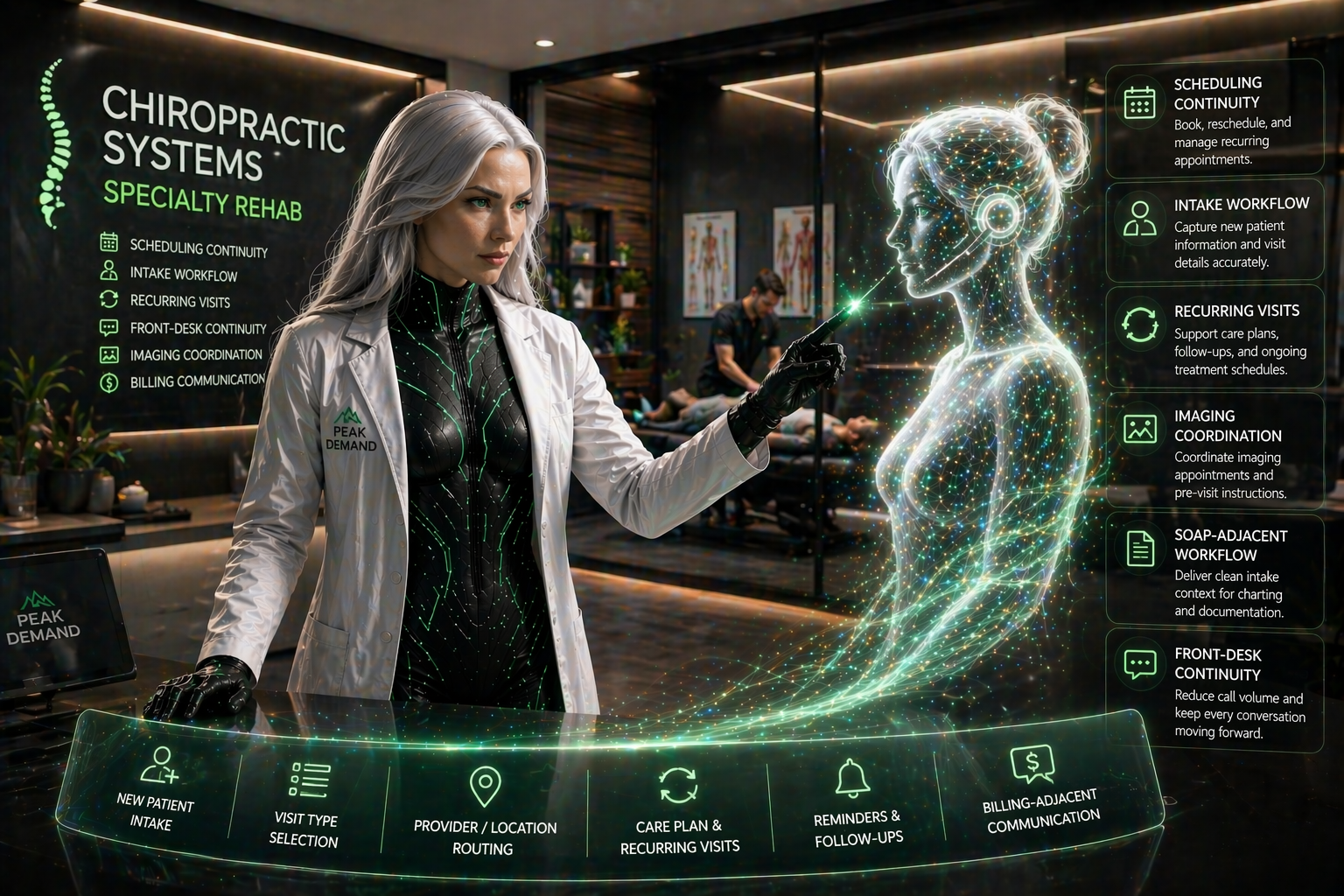
Chiropractic and Specialty Rehab Systems
Explore how Voice AI fits into chiropractic and specialty rehab workflows across scheduling, intake, recurring visits, SOAP-adjacent continuity, imaging-adjacent coordination, and front-desk support.
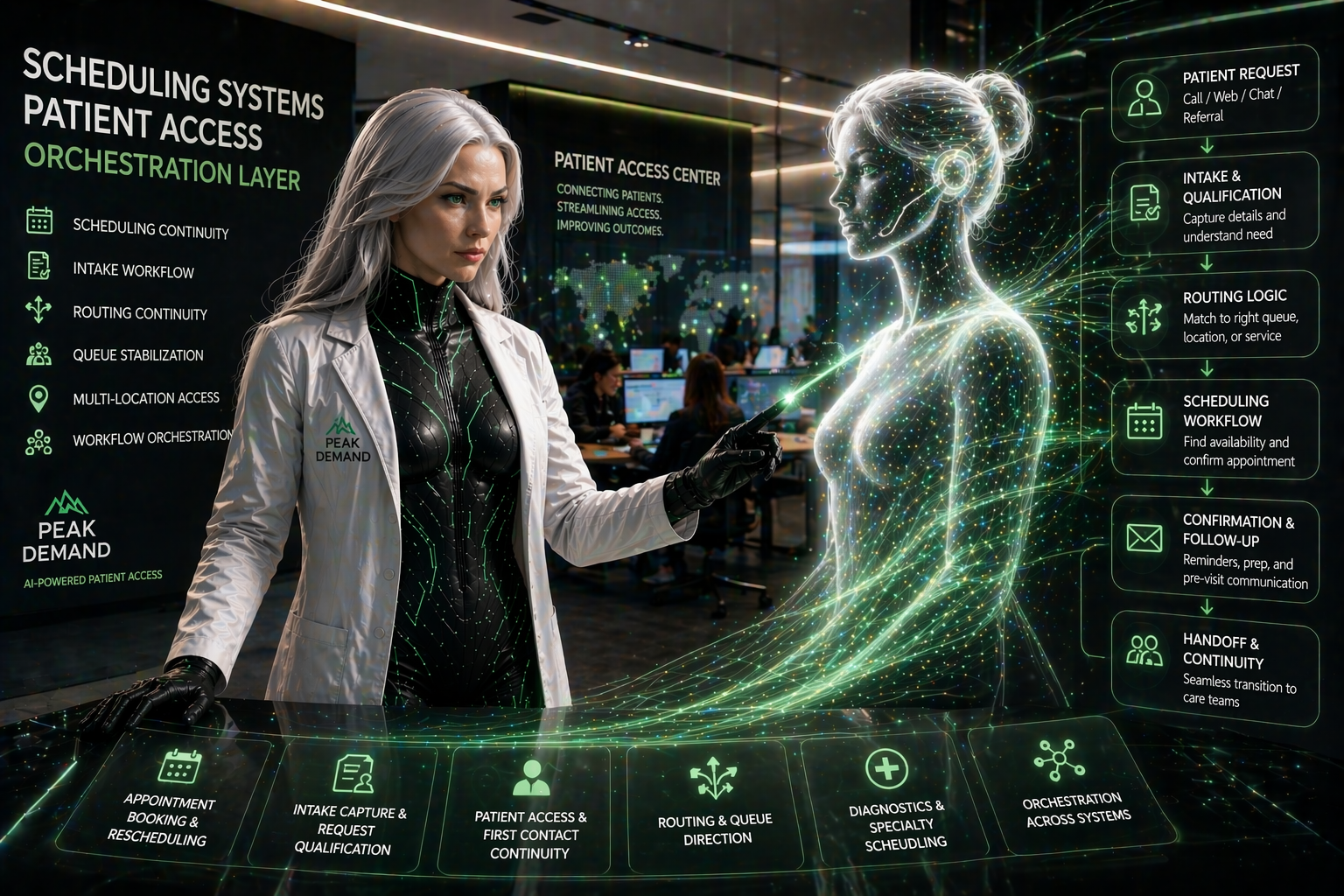
Scheduling, Patient Access, and Orchestration Systems
Explore how Voice AI supports scheduling and patient access architecture across intake, routing, queue stabilization, diagnostics scheduling, and workflow continuity between first contact and next action.
See Healthcare Voice AI Integrations In Action
These walkthroughs show how Voice AI can connect into real healthcare scheduling, intake, and communication environments. Start with TELUS Health CHR for Canadian clinic workflows and Juvonno for rehab and allied health operations.
TELUS Health CHR Integration Walkthrough
See how Voice AI can support TELUS Health CHR scheduling, intake, patient communication, and Canadian clinic workflow continuity.
Juvonno Integration Walkthrough
See how Voice AI can support Juvonno workflows for rehab scheduling, intake, appointment handling, and clinic communication continuity.
Explore published healthcare systems by name
Once you know the software family that best matches your environment, this section makes it easier to browse live healthcare integration pages by platform name. Each category below groups published system pages by the type of environment they usually support so operators, managers, and technical teams can compare workflow fit more quickly. A fuller alphabetical directory appears farther down the page.
Featured healthcare systems
These are high-priority starting points for visitors evaluating real-world Voice AI workflow fit across scheduling, intake, patient communication, routing, and access workflows.
Clinic, ambulatory, and medical EMR systems
These systems are commonly associated with clinic records-adjacent workflows, appointment flow, patient requests, intake continuity, routing, and broader ambulatory communication operations.
Scheduling, intake, and patient communication systems
These environments sit closer to booking logic, intake flow, reminders, clinic administration, and day-to-day patient access operations.
Rehab, physiotherapy, and allied health systems
Allied health and rehabilitation environments often depend on strong scheduling continuity, practitioner matching, intake flow, recurring appointment management, and multi-location operational coordination.
Dental systems
Dental communication workflows often center around appointment demand, cancellation recovery, reminders, new patient calls, and front-desk continuity across booked production.
Veterinary systems
Veterinary communication environments often require appointment continuity, client communication, after-hours handling, urgent call direction, and records-adjacent workflow coordination.
Healthcare organizations rarely evaluate integrations in a vacuum. Grouping systems by software family makes it easier to understand likely workflow fit, compare environments more quickly, and navigate toward both family-level integration pages and live system-specific pages deeper in this hub. The full alphabetical system directory farther down the page should carry the complete 98-system library.
Where Voice AI sits in the healthcare workflow matters more than basic connectivity
Healthcare Voice AI becomes more useful when it is treated as part of the larger workflow architecture around patient access, intake, routing, scheduling, escalation, and downstream ownership. The question is not only whether a system connects. The question is whether the communication flow reaches the next operational step with enough clarity and structure to reduce friction instead of shifting it downstream.
In practice, that means Voice AI often sits across multiple workflow layers at once. It may support first contact, gather structured intake, help direct the caller into the right path, preserve context for staff, and improve continuity into the next step. The value comes from how those layers fit together, not from one isolated connection point.
This is why healthcare teams should evaluate both the scheduling and patient access layer and the EMR or EHR-adjacent layer. In more complex environments, the architecture may also need to account for enterprise compliance and procurement requirements.
Where Voice AI usually enters the workflow
Voice AI often enters at the communication edge: inbound calls, appointment demand, intake capture, after-hours answering, overflow handling, and patient access or routing-related first contact.
Explore healthcare AI receptionistsWhere continuity usually breaks down
Continuity often breaks between the interaction and the next operational owner. That can happen when routing is weak, intake is unclear, scheduling context is incomplete, or downstream teams still need to manually rebuild the request.
Explore centralized scheduling workflowsWhat stronger integration architecture actually improves
Stronger architecture preserves enough structure, direction, and next-step usability for staff or systems to act efficiently. That is what turns Voice AI into operational infrastructure instead of a disconnected front-end layer.
Return to the healthcare resource hub| Integration maturity | What healthcare teams usually experience | Likely operational result |
|---|---|---|
| Fragmented | Some connection points exist, but scheduling, intake, routing, escalation, and continuity still require heavy manual repair. | Lower operational value, more staff burden, weaker patient access continuity, and less confidence in the workflow. |
| Partially connected | Important workflow layers connect, but structure and downstream usability still vary too much between teams, departments, or next-step owners. | Moderate gains, but persistent continuity gaps remain and staff still absorb unnecessary workflow friction. |
| Workflow-led and integrated | Voice AI supports multiple workflow layers with stronger structure, clearer routing, better handoff, and more usable next-step continuity. | Stronger patient access flow, cleaner operational ownership, and more scalable communication infrastructure. |
What healthcare teams should evaluate in the architecture discussion
- Where does Voice AI need to sit first in the communication workflow?
- Where does continuity currently break between the interaction and the next operational step?
- Which layers are EMR or EHR-adjacent, and which ones are workflow-adjacent?
- How do scheduling, intake, routing, patient access, and escalation interact in this environment?
- Will downstream teams receive enough structure to act without rebuilding the request manually?
- Is the integration design workflow-led or just feature-led?
- Does the current architecture reduce friction for staff, or does it simply move the work somewhere else?
Healthcare organizations usually get more value when they evaluate integration maturity across communication flow, operational ownership, and downstream usability together instead of treating each connection as a separate isolated decision. For system-specific evaluation, use the alphabetical healthcare system directory below.
Evaluating software families?
Use the six system-family pages to compare EMR, EHR, dental, veterinary, rehab, scheduling, and patient access environments.
Browse Software FamiliesEvaluating specific systems?
Use the full alphabetical directory to find the exact healthcare platform your team is evaluating.
Open System DirectoryEvaluating enterprise readiness?
Review governance, privacy, escalation, procurement, and compliance considerations before deployment.
Review ComplianceGo deeper into the strategy behind healthcare Voice AI integrations
This section helps healthcare teams move from broad category understanding into the right supporting resources for architecture, interoperability, workflow fit, implementation planning, and system-specific evaluation.
The articles below are the best next clicks for teams evaluating how Voice AI fits into healthcare communication systems, patient access workflows, structured integration pathways, rollout planning, and governed healthcare environments.
For broader category education, use the Healthcare Voice AI Resource Hub. For software-specific evaluation, continue to the full alphabetical system directory lower on this page and use the six healthcare software family pages as the parent layer.
Need system-family pages?
Use the family pages to compare medical EMR, allied health, dental, veterinary, specialty rehab, and patient access systems.
Browse Software FamiliesNeed a specific platform?
Use the alphabetical system directory to find the exact EMR, EHR, scheduling, dental, veterinary, or rehab platform.
Open System DirectoryNeed compliance context?
Use the enterprise compliance page when governance, privacy, procurement, RFPs, or regulated deployment requirements are part of the evaluation.
Review ComplianceCore integration strategy articles
These resources explain why integrations matter, what healthcare teams should evaluate first, and how stronger Voice AI integration architecture should be understood.
Custom pathways, structured integrations, and workflow fit
These articles are useful for teams evaluating custom pathways, structured communication flows, and how Voice AI fits into real healthcare operating environments.
Rollout, implementation, and governance
These resources are best for healthcare teams moving from early exploration into rollout planning, operational safety, implementation readiness, and governance-aware deployment.
Patient access, routing, and workflow bottlenecks
These articles help healthcare teams think more clearly about where communication complexity builds up across patient access, intake, department routing, scheduling, and downstream handoff.
As the healthcare integrations ecosystem continues to grow, this section can keep routing visitors into the most relevant strategy, rollout, and workflow resources without changing the overall structure of the hub. The full software directory appears in the Alphabetical System Directory section below.
Explore live healthcare system integration pages by category
This section gives healthcare teams a category-based way to browse the most important live system pages. It is not the full 98-system directory; it is a curated navigation layer for comparing the platforms most commonly tied to scheduling, intake, patient communication, routing, and patient access workflows.
Use this section when you know the type of software environment you are evaluating. Use the Alphabetical System Directory below when you want to find every live system page by name.
Need the family layer?
Start with the six parent family pages when comparing software categories before choosing a specific system.
Browse Software FamiliesNeed every system?
Use the alphabetical directory for the complete live healthcare system page list by platform name.
Open Alphabetical DirectoryNeed workflow context?
Review how Voice AI fits across patient access, intake, routing, scheduling, escalation, and downstream ownership.
Review Workflow ArchitectureFeatured healthcare systems
These are some of the strongest starting points for teams exploring healthcare Voice AI integrations across scheduling, intake, patient communication, routing, and access workflows.
Clinic and ambulatory EMR systems
These systems are commonly associated with clinic records-adjacent workflows, intake, appointment flow, routing, patient communication, and broader ambulatory continuity.
Explore medical and ambulatory EMR familyScheduling, intake, and patient communication systems
These environments sit closer to booking logic, intake flow, reminders, clinic administration, and day-to-day patient access operations.
Explore scheduling and patient access familyRehab, physiotherapy, and allied health systems
Allied health and rehabilitation environments often depend on strong scheduling continuity, practitioner matching, intake flow, recurring appointments, and multi-location coordination.
Explore allied health and rehab familyDental systems
Dental communication workflows often center on appointment demand, cancellation recovery, reminders, new patient calls, and front-desk continuity.
Explore dental familyVeterinary systems
Veterinary communication environments often require appointment continuity, client communication, after-hours handling, and records-adjacent workflow coordination.
Explore veterinary familyEnterprise, specialty, imaging, and outpatient environments
These environments often involve more complex routing, diagnostic scheduling, imaging coordination, enterprise workflow ownership, and department-specific handoff requirements.
Explore enterprise and medical EMR familyThis curated category browse section helps visitors compare common healthcare software environments without scrolling the entire directory. The complete system list belongs in the Alphabetical System Directory section below, where every live healthcare system page should be listed by platform name.
Talk through your healthcare communication workflow
If your team is evaluating healthcare Voice AI integrations, the most useful next step is usually a workflow conversation. That means reviewing patient access pressure points, scheduling flow, intake structure, routing logic, after-hours coverage, compliance expectations, and the systems surrounding those workflows.
Peak Demand approaches healthcare environments through workflow fit, governance awareness, and operational usability. The goal is to help organizations map a communication architecture that supports real teams, real workflows, and real continuity requirements across EMR, EHR, scheduling, intake, dental, veterinary, rehab, and patient access environments.
Need software families?
Compare the six parent healthcare integration families before choosing a specific system page.
Browse software familiesNeed workflow context?
Review how Voice AI fits across intake, routing, scheduling, escalation, and downstream ownership.
Review workflow architectureNeed compliance review?
Use the enterprise compliance page when governance, privacy, procurement, and RFP standards matter.
Review complianceFrequently asked questions
What does Voice AI mean in a healthcare integration environment?
Can Voice AI work with EMR, EHR, scheduling, intake, and routing workflows?
Are healthcare Voice AI integrations always direct?
Where should healthcare organizations start evaluating Voice AI integrations?
How should compliance and governance fit into the evaluation?
What is the role of this integrations hub?
About Peak Demand
Peak Demand is a Toronto-based AI agency focused on Voice AI, communication automation, and workflow infrastructure for organizations operating in more complex service environments.
In healthcare, the focus is not just on call handling. It is on patient access continuity, scheduling pressure, intake structure, routing logic, after-hours support, governance, and how communication systems fit into real operational workflows.
- Workflow-driven and implementation-aware
- Governance-first in healthcare communication environments
- Built to support clinics, networks, and enterprise teams
- Designed to scale into software-specific integration pathways
- Organized around healthcare system families and live integration pages
Healthcare software integrations by system name
If you already know the software you are evaluating, this alphabetical directory is the fastest way to find the right live system page.
This directory includes the full 98-system healthcare integration library from the current Peak Demand system-page build. It is designed to help teams compare EMR, EHR, scheduling, intake, patient communication, dental, veterinary, rehab, wellness, chiropractic, orchestration, home care, med spa, pharmacy, and enterprise healthcare systems by software name.
For category-level browsing, use the software family section. For workflow context, use the workflow architecture section. This section is the full alphabetical browse layer.
Live healthcare system pages in this directory
Grouped alphabetically with visible section counts so the full library is obvious at a glance.
A–C
34 systemsABELMed through Curve Dental.
D–H
20 systemsDentrix through Helios Software.
I–M
15 systemsIDEXX Cornerstone through MRX Solutions.
N–O
11 systemsNextech through Owl Practice.
P–R
8 systemsPabau through RXNT.
Compare healthcare systems by name, category, and workflow fit
This directory is useful for comparing clinic EMRs, EHR-adjacent systems, scheduling and intake platforms, patient communication software, dental systems, veterinary systems, rehab and allied health systems, chiropractic systems, med spa systems, home care systems, pharmacy-adjacent systems, orchestration platforms, diagnostic workflows, and enterprise healthcare environments by software name before going deeper into workflow design, integration possibilities, and operational fit.
Explore your own AI use case on a discovery call.