Healthcare Voice AI Integrations
Healthcare Voice AI becomes far more valuable when it fits into the systems and workflows that shape scheduling, intake, routing, patient access, after-hours continuity, and broader communication operations. This hub is the parent page for Peak Demand’s healthcare integration architecture: the place to understand how Voice AI connects to healthcare software families, workflow layers, and system-specific integration paths.
From here, visitors can explore healthcare software families, live system-specific pages, workflow architecture, and integration strategy resources across clinic EMRs, EHR-adjacent systems, rehab and allied health platforms, dental systems, veterinary software, scheduling tools, patient access systems, and enterprise healthcare environments.
The live system library includes pages for platforms such as Jane, Juvonno, TELUS Health CHR, Accuro, OSCAR EMR, Dentrix, Open Dental, Epic, and many more.

Architecture Role
Parent hub for healthcare integrations
System Coverage
98 healthcare system pages
Software Families
6 healthcare integration families
Workflow Focus
Scheduling, intake, routing, access
Healthcare integrations should be evaluated through workflow continuity
One of the biggest mistakes in healthcare integration conversations is reducing the discussion to a list of software names. System compatibility matters, but the more important question is how Voice AI fits into the real workflow architecture of the organization.
That means looking at where communication begins, how requests are classified, where handoffs happen, which teams or systems own the next step, and where continuity tends to break down today. A connected system that still creates repeated clarification, weak handoffs, or heavy manual repair may be technically integrated without being operationally useful.
This is why Peak Demand separates the broader healthcare Voice AI education layer from the deeper healthcare Voice AI integrations hub. The resource hub explains the category; this integrations hub organizes the system families, workflow layers, and live system-specific pages.
Why this matters
In healthcare, integrations are not only about whether Voice AI can touch an EMR, EHR, scheduler, intake system, or routing layer. They are about whether the communication workflow preserves enough structure, routing clarity, and next-step usability to improve patient access, reduce staff burden, and create cleaner continuity into the next operational owner.
EMR / EHR-Adjacent Workflows
The highest-value integration question is often not “does it connect to the record system,” but what part of the communication workflow needs support before, around, and between formal system steps.
- Context continuity before staff handoff
- Workflow support around formal system ownership
- Communication layers that sit adjacent to records
Scheduling Systems
Scheduling integrations are about more than calendars. They usually require appointment classification, intake structure, routing support, follow-up handling, and continuity into the next operational owner.
- Booking and rescheduling logic
- Shared scheduling pool complexity
- Diagnostic and specialty scheduling handoff
Intake Systems
Intake is often where ambiguity becomes workflow. Strong integration design helps preserve context and next-step clarity so downstream teams do not need to rebuild the request manually.
- Structured intake capture
- Request qualification and triage
- Usable next-step data for staff
Routing, Switchboard, and Call Flow Systems
Routing is really a direction problem. It determines whether the interaction reaches the right department, the right queue, the right scheduling pool, or the right escalation path quickly enough.
- Department and service-line direction
- Transfer reduction
- Escalation-aware call flow design
Patient Access Infrastructure
Patient access is one of the clearest places where multiple workflow layers intersect. Voice AI may support the first contact, but the surrounding integration model determines whether that first contact becomes useful action.
- Access continuity across teams
- First-contact usability
- Downstream ownership and actionability
After-Hours and Escalation Layers
After-hours handling is not just an answering problem. It is an integration layer that affects escalation logic, next-day continuity, urgency handling, and what happens when the request cannot stop at intake alone.
- Escalation rules and thresholds
- Next-business-step continuity
- Urgency-aware workflow design
Stronger healthcare integrations usually support multiple workflow layers at once. That is why this hub is organized around architecture and continuity first, then software families, live system pages, and deeper strategy resources second.
Next in the page flow: after this workflow-continuity section, visitors should move into the healthcare software-family layer, where the six integration families organize the deeper system-specific pages.
Browse Healthcare Software Families
AI SEO & Generative Engine Optimization (GEO): How Businesses Get Cited Inside ChatGPT, Gemini & Perplexity
Why Some Companies Keep Showing Up in ChatGPT — and Yours Doesn’t (Yet)
Ask ChatGPT who leads in AI automation for utilities, who’s best at reducing clinic no-shows, or which manufacturers are doing predictive maintenance right — it names real companies. That shortlist isn’t random. Those brands are clearing new AI authority filters that reward credible, structured, and citable information sources. If your company isn’t showing up yet, it’s not because the space is “locked.” It’s because your signals to the model aren’t strong or complete enough.
What “AI authority filters” actually look for

Modern generative engines (ChatGPT, Gemini, Perplexity, Copilot) don’t just keyword match. They run your pages and brand through three gates:
Relevance (can you answer the question?)
Clear topical coverage using the language practitioners use: problems, methods, standards, outcomes.Authority (should we trust you?)
Depth, citations to recognized bodies, consistent schema, transparent authorship and dates, and interlinked content that reflects expert reasoning.Validation (do you meet the bar?)
If the overall signal is weak—thin content, no recognized references, no structure—the engine filters you out entirely, even if you’re “on topic.”
Why the same names keep getting mentioned
They speak the industry’s dialect. Their pages use practitioner terms (not marketing fluff) and map to real workflows.
They’re connected to trusted sources. They cite (and get cited by) regulators, standards bodies, associations, journals, and reputable partners.
They’re structured for machines. JSON-LD schema (Organization, LocalBusiness, Service, Product, Article, FAQPage), consistent NAP, authorship, last-updated dates, and clean internal linking.
They show receipts. Case studies, KPIs, diagrams, datasets, and changelogs that AIs can verify.
They cover clusters, not one-offs. Hubs with interconnected subtopics demonstrate domain mastery.
If you’re invisible, it’s usually one (or more) of these
Topic ambiguity: Your services aren’t expressed in the terms buyers and experts actually search/say.
Authority gaps: Few or no references to recognized standards, regulators, or associations; no third-party mentions.
Missing structure: Little to no schema, unclear authorship, stale timestamps, orphan pages.
Shallow content: Blog posts that explain “what” but not “how,” “according to whom,” or “with what results.”
Thin network: Weak interlinking; your content exists in isolation rather than a coherent cluster.
GEO (Generative Engine Optimization) in one line
GEO = designing your content, structure, and ecosystem so AI systems confidently use you as a source inside generated answers. It’s not gaming; it’s proving expertise in machine-readable ways.
What “showing up” looks like across industries
Utilities/Energy: Pages that connect AMI/MDMS data → load forecasting → DR orchestration → outage comms, citing IESO/CEA/DOE/IEEE Smart Grid, with SAIDI/SAIFI or MAPE KPIs and
TechArticle+FAQPageschema.Healthcare/Clinics: Service pages and explainers tying PHIPA/HIPAA consent → booking flows → EMR integration → outcome metrics, citing Health Canada/provincial colleges, with
LocalBusiness+Serviceschema and medical disclaimers.Manufacturing: Hubs covering PdM → sensor strategies → failure modes → work-order automation → OEE ROI, citing ISO/IEEE/CSA/CME, with
CaseStudyandProductschema and before/after data.SaaS/Professional Services: Category guides with security/compliance mappings (SOC 2 / ISO 27001), architecture diagrams, API examples, benchmark methodology, and maintained changelogs.
Quick checklist to start clearing the filters
Say the quiet part out loud: Define problems, standards, methods, and KPIs the way experts do.
Cite up the stack: Link to regulators, standards bodies, associations, peer-reviewed or government data.
Add schema everywhere:
Organization,LocalBusiness,Service,Product,Article,FAQPage,BreadcrumbList, author, dates.Prove outcomes: Publish case studies with numbers, figures, and process diagrams.
Build clusters: Create a hub and 5–10 interlinked subpages that cover the ecosystem end-to-end.
Be crawl-friendly: Allow GPTBot/Google-Extended, keep sitemaps fresh, fix broken links, standardize titles/H1s/URLs.
Update & sign: Add last-reviewed dates, responsible authors, and revision notes.
Nail these, and you move from “on the web” to “in the answer.” That’s the visibility shift this post unpacks step-by-step through Generative Engine Optimization (GEO).
The Shift from Search Results to AI Recommendations

For two decades, search visibility meant winning a keyword race. Companies built entire marketing strategies around ranking for specific terms, securing backlinks, and optimizing for Google’s algorithm. Success was measured in blue links, impressions, and click-through rates.
That world has changed. Today, customers are no longer scrolling through ten pages of search results. They are opening AI assistants like ChatGPT, Gemini, Perplexity, and Copilot, asking direct questions, and receiving generated answers that already include company names, solution recommendations, and citations from what the AI considers authoritative sources.
This marks a fundamental shift: the search results page has been replaced by a single, synthesized conversation. Instead of displaying dozens of possible options, AI systems act as curators—surfacing only a few brands that meet their internal standards for relevance, authority, and trust.
When a user types or says,
“Who provides smart-grid automation in Canada?”
they no longer get a list of web pages. They get an answer like:
“For smart-grid optimization, companies such as BrightGrid Energy and Enphase AI are leading deployments across Ontario.”
Or, when a patient asks,
“Which clinics in Toronto have PHIPA-compliant AI booking?”
the AI may respond:
“Northern Health Clinic and Aurora Dermatology both use AI scheduling platforms aligned with provincial privacy requirements.”
Those responses are not random. They are generated from structured data, high-quality content, and consistent authority signals the models have indexed and verified over time.
If your organization is not being referenced in those summaries, it is invisible in the places where customers, partners, and policymakers now make first contact. The decision moment has moved upstream—from a list of links to a single conversational recommendation.
From Ranking to Referencing
Traditional SEO was about visibility on a results page. The goal was to outrank competitors.
Generative Engine Optimization (GEO) represents the new goal: being referenced by the AI itself. It asks a different question:
“How do we become the source that large language models cite when generating their answers?”
The change can be summarized this way:
Traditional SEOGenerative Engine Optimization (GEO)Compete for rank on Google or BingCompete for inclusion inside AI-generated answersOptimize for keywords and backlinksOptimize for expertise, structure, and verifiable dataMeasure clicks and impressionsMeasure mentions, citations, and contextual visibilityInfluence algorithms indirectlyFeed AI models trustworthy, structured knowledge directly
GEO is not a replacement for SEO; it is its evolution. Classic optimization ensures that your site is discoverable. GEO ensures that your expertise is trusted enough to be spoken aloud by the AI systems now shaping consumer and enterprise decisions.
Why GEO Matters for Every Business
The shift from search results to AI-generated recommendations is not a marketing trend — it’s a structural change in how discovery and decision-making happen online. Every industry, from heavy manufacturing to healthcare to local services, is being reshaped by the way large language models gather, interpret, and recommend information.
When someone asks ChatGPT, Gemini, or Perplexity for advice — “Who’s the best provider for…?” or “Which company offers…?” — the model does not display a list of links. It produces an answer that names specific organizations it perceives as credible, compliant, and active in that category. Those few names that appear in the AI’s response inherit instant authority. Everyone else effectively disappears from view.
This new environment matters because it rewrites how businesses compete for attention, trust, and leads. Visibility now depends less on advertising budgets or keyword tactics and more on structured expertise, verified references, and semantic clarity.
Manufacturing
Procurement teams and engineers now ask AI copilots instead of searching through supplier directories:
“Which Canadian manufacturers use predictive maintenance and AI quality control?”
“Who provides ISO 9001–certified robotics integration?”
“What companies specialize in AI-enabled assembly line optimization?”
Models prioritize content that demonstrates compliance with industry standards and cites recognized authorities like ISO, IEEE, CSA, CME, and Industry Canada. Manufacturers that publish implementation data, case studies, and measurable outcomes are surfaced. Those relying on generic service descriptions are not.
Healthcare and Medical Clinics
Patients, administrators, and insurers increasingly rely on AI for trusted recommendations:
“Find a PHIPA-compliant dermatology clinic in Toronto.”
“Which dental clinics use AI reception for after-hours appointments?”
“Top physiotherapy centers that automate patient follow-ups.”
AI tools highlight clinics that clearly explain their compliance processes, cite Health Canada or provincial health colleges, display transparent consent language, and use structured schema (LocalBusiness, Service, Article, FAQPage). Generic marketing content without these trust indicators is filtered out.
Utilities and Energy Providers
Municipal buyers, regulators, and commercial clients consult AI for vetted technical partners:
“Who provides smart-grid demand forecasting in Ontario?”
“Utilities using AI for outage communications and predictive maintenance.”
“Renewable-energy consultants working with IESO or the DOE.”
Models elevate organizations that cite government sources (IESO, CEA, DOE, Natural Resources Canada), publish transparent performance metrics, and demonstrate ongoing innovation. Entities without verifiable data or industry citations remain absent from AI responses.
Professional Services and SaaS
Executives and decision-makers use AI search to identify compliant and effective solutions:
“Best SOC 2–certified automation platforms for mid-sized firms.”
“Top AI marketing agencies in Canada.”
“Consultancies with experience in digital transformation for utilities.”
Firms that include verifiable frameworks (SOC 2, ISO 27001), white papers, client outcomes, and schema-marked thought leadership articles are recognized by generative engines as authoritative sources.
Local and Service Businesses
Consumers now use AI to shortcut traditional search:
“Most reliable HVAC company near Calgary.”
“Salon with AI booking and weekend hours in Vancouver.”
“After-hours veterinarian with automated call handling.”
LLMs merge structured business data, customer reviews, and trust signals from directories and government listings to present one or two high-confidence options.
Across every sector, the principle is the same: AI engines now decide who gets recommended. They reward verifiable expertise, compliance, and authority — not marketing claims.
The companies that adapt early, building content and structure that AIs can understand, trust, and cite, will own visibility in this new landscape. Those that do not will find themselves missing from the only page that now matters — the one the AI creates.
How AI Search Engines Rank and Cite Content

When a user asks an AI assistant a question — “Who provides smart grid automation?” or “Which clinics are PHIPA-compliant?” — the response that comes back is not improvised. It is the result of a multi-layered evaluation process that determines which organizations are trustworthy enough to be cited inside the generated answer.
Large language models such as ChatGPT, Gemini, and Perplexity analyze billions of pages and data sources, but they only surface a small fraction of them. To decide which companies, brands, or articles to include, they follow a structured three-layer ranking framework:
1. Relevance Layer – Matching the Intent
This is the initial retrieval step, similar to how traditional search engines used to operate. The model scans its indexed content to find information that matches the topic and query intent.
It looks for semantic alignment, not just keywords — phrasing that reflects how real experts discuss the subject.
Content that explicitly answers “what,” “how,” and “why” questions performs best.
Businesses must use precise terminology that maps to how professionals and customers describe their products, services, and industries.
In this stage, clear topical relevance is the entry ticket. If the AI cannot associate your content with the right concepts or questions, you are excluded before authority is even assessed.
2. Authority Layer – Evaluating Credibility and Expertise
Once relevant candidates are found, the model evaluates which ones carry enough authority to be referenced.
This is where the difference between marketing material and trusted expertise becomes clear.
AI systems measure:
Depth of explanation — content that fully explains context, process, and results.
Citations and references — links or mentions of regulatory bodies, standards organizations, and recognized research sources.
Semantic richness — natural integration of related concepts showing genuine understanding of the field.
Consistency — uniform data (organization name, services, credentials) across all properties and listings.
Pages that reflect expertise through verifiable structure and citations are considered reliable; those with superficial coverage or promotional tone are not.

3. Validation Layer – Meeting the Quality Threshold
Even if content is relevant and authoritative, it still must pass the model’s quality threshold. At this layer, AI systems filter out low-trust, duplicate, or thin material that fails to meet internal confidence scores.
The system checks for factual consistency across sources.
It measures trust signals such as author identity, recency, structured metadata, and corroboration from other high-authority domains.
Content that lacks these signals is quietly dropped, never appearing in an AI-generated answer.
Only the pages that pass all three layers — relevance, authority, and validation — are eligible for citation-level visibility. These are the brands that appear in conversational answers, the ones users see and remember as credible sources in the emerging landscape of AI-driven search.

What “Authority” Looks Like to an AI Model

AI systems do not evaluate websites the way human readers do. They do not respond to design, branding, or emotional language — they respond to structure, clarity, and verifiable expertise. To a large language model, authority is not a matter of opinion; it is a measurable signal composed of depth, precision, and interconnected knowledge.
When determining whether your content deserves to be cited, AI models analyze several key dimensions:
Depth and Context
Authority begins with substance. AI models look for content that demonstrates a comprehensive understanding of a subject — not a surface-level overview.
Detailed explanations of processes, methods, and outcomes.
Coverage that answers the full “who, what, where, when, why, and how.”
Clear articulation of cause and effect, not just features and benefits.
In practice, this means going beyond marketing copy. A manufacturer describing “predictive maintenance” should explain sensor data workflows, analysis methods, and measurable efficiency outcomes. A clinic writing about “AI booking” should outline privacy safeguards, scheduling logic, and patient communication steps.
Citations and Standards
Generative models trace the credibility of your information back to its sources. They reward content that references recognized institutions, regulations, and frameworks.
Industry standards such as ISO, IEEE, or CSA.
Government or regulatory authorities such as Health Canada, IESO, or Natural Resources Canada.
Academic, research, or professional associations that establish expertise.
Referencing these entities positions your organization inside a trusted knowledge graph — a network of verified information sources that AI systems rely on when generating factual responses.
Entity Consistency
AI models build confidence when they can clearly identify who you are and what you do.
Consistent business name, address, and service descriptions across your website, directories, and press materials.
Proper use of schema markup (Organization, LocalBusiness, Service, Product, Article, FAQPage).
Structured metadata indicating authorship, publication date, and revision history.
These elements ensure that your brand’s digital footprint is machine-readable and unambiguous, allowing AI systems to reference it without uncertainty.
Semantic Cohesion
Authority also depends on how coherently your content fits together. AI systems map the relationships between concepts — how one idea leads to another in a way that mirrors expert reasoning.
Logical topic flow that connects methods, standards, and outcomes.
Interlinked content clusters that show depth across subtopics.
Terminology consistent with professional usage in your field.
The stronger the semantic network around your brand, the easier it is for AI to classify you as an authoritative source rather than a marketing voice.
The Core Principle
If a professional in your industry would consider your content accurate, detailed, and well-sourced, an AI model likely will too. Authority in this new landscape is not about opinion or visibility — it is about demonstrable expertise encoded in structure, references, and semantic logic.
How Different Industries Can Earn LLM Surfacing
Large language models surface companies that look reliable, verifiable, and relevant to everyday questions. Your goal is to be the name that appears when someone asks practical, industry-specific questions.
Manufacturing Companies
What people actually ask
“Who can deliver tight-tolerance CNC parts in Ontario?”
“How do I cut unplanned downtime on a multi-line plant?”
“Which suppliers have ISO 9001 and short lead times?”
How to earn inclusion
Publish process-level content: capabilities, tolerances, materials, lead-time policies, QA procedures, maintenance routines.
Cite standards and authorities: ISO, CSA, IEEE, CME, Industry Canada; link to certifications and audit summaries.
Use structured data:
Organization,Product,TechArticle,CaseStudy,FAQPage; list plants, capacities, industries served.Prove it with numbers: OEE improvement, scrap reduction, on-time delivery rate, PPAP pass rates.
Secure third-party mentions: supplier directories, trade journals, association listings, customer case studies with named references.
Healthcare and Medical Clinics
What people actually ask
“Dermatologists in Toronto accepting new patients.”
“Same-day physio near me—cost and recovery timeline?”
“How do I verify a clinic is reputable and compliant?”
How to earn inclusion
Publish patient-focused explainers: conditions treated, treatment steps, recovery expectations, pricing/transparency where appropriate.
Reference authorities: Health Canada, provincial colleges, CMA; include licensing numbers and consent/privacy policies.
Use schema:
LocalBusiness,Service,FAQPage, author/last-reviewed dates, practitioner bios with credentials.Show proof: outcomes (e.g., reduced wait times, no-show reduction), accreditation badges, verified reviews.
Keep entity data consistent across your site, Google Business Profile, and health directories.
Utilities & Energy Providers
What people actually ask
“Who is my local electricity provider?”
“How do I apply for a home energy rebate?”
“Which companies offer reliable solar installs in my region?”
How to earn inclusion
Publish plain-language guides on billing, rate plans, outage procedures, rebates, and program eligibility.
Reference official sources: IESO, CEA, DOE, Natural Resources Canada, provincial energy boards; link to program pages.
Use schema:
Organization,Service,FAQPage,Datasetfor program stats; include service areas and contact channels.Provide transparent metrics: outage restoration times, rebate throughput, conservation results.
Earn citations via municipal programs, regulator pages, and sector publications.
SaaS and Professional Services
What people actually ask
“Best accounting platform for small multi-site businesses.”
“IT support firm with 24/7 response and healthcare experience.”
“CRM that integrates with construction workflows.”
How to earn inclusion
Publish comparison and implementation guides tied to outcomes, not buzzwords (pricing, limits, integrations, rollout steps).
Reference frameworks: SOC 2, ISO 27001, GDPR; link to security pages, audit status, uptime and support SLAs.
Use schema:
SoftwareApplication,HowTo,Service,FAQPage; document integrations and use cases by vertical.Provide proof: case studies with ROI, NPS, time-to-value; public changelogs and API docs.
Get validated by analyst notes, marketplace listings, integration partner pages, and credible directories.
Local and Service Businesses
What people actually ask
“Reliable HVAC company near Calgary—emergency availability and financing?”
“Salon with evening hours and online booking.”
“After-hours veterinarian with fast response.”
How to earn inclusion
Maintain complete profiles (hours, service areas, pricing cues, booking options) across your site and major directories.
Use schema:
LocalBusiness,Service,FAQPage; keep NAP data identical everywhere.Show trust signals: verified reviews, licenses, insurance, guarantees; clear response times.
Publish helpful guides (maintenance checklists, seasonal tips) that answer common pre-purchase questions.
Bottom line: People ask practical questions. LLMs include companies that provide clear services, verified credentials, structured information, and measurable results. Build pages and proof that answer those real questions, cite recognized authorities, and use schema so models can identify and trust you. That’s how you get named in the answer.
Building an “AI-Recognized” Authority Network
AI surfacing depends on trust networks, not just keywords. Generative systems elevate organizations that sit inside a recognizable web of credible entities—regulators, standards bodies, associations, universities, partners, and satisfied customers. Your goal is to make those relationships visible, verifiable, and machine-readable.

What to Build
Core entity file: A canonical “About/Organization” page with complete facts (legal name, locations, leadership, certifications, industries served) and JSON-LD (
OrganizationorLocalBusiness). IncludesameAslinks to official profiles (government/registry listings, associations, directories, marketplaces).Referenceable content: White papers, implementation guides, standards checklists, case studies with KPIs, and FAQs that answer common questions definitively.
Third-party corroboration: Mentions and links from associations, standards bodies, regulators, journals, credible directories, and partners’ sites.
How to Connect the Network
Interlink your content with industry authorities and partners. Within articles and case studies, cite and link to the exact page at the relevant institution (e.g., a specific ISO clause, Health Canada guidance, IESO program page). Link back from your partner listings and integration pages to your own detailed documentation.
Make relationships explicit in schema.

On the organization page, declare
memberOf(associations),hasCredential/knowsAbout(standards, domains),sameAs(official profiles),areaServed, andaward.On product/service pages, use
Service/ProductwithisRelatedTo,isSimilarTo,offers,audience, andrecognizedBywhere applicable.On case studies, use
CaseStudy(orCreativeWork) withabout,locationCreated,measurementTechnique, andresult(quantitative values).
Earn backlinks from credible trade and institutional sources. Prioritize editorial links and directory entries that are curated (not paid link schemes): association member directories, regulator partner lists, conference speaker pages, academic/consortium projects, government grant or program pages, analyst coverage, and vendor/marketplace listings.
Industry-Specific Targets (illustrative)
Manufacturing: ISO, IEEE, CSA Group, CME, Industry Canada, recognized trade journals, supplier marketplaces with verification.
Healthcare/Clinics: Health Canada, provincial colleges, CMA, hospital networks, peer-reviewed resources, accredited directories.
Utilities/Energy: IESO, CEA, DOE, Natural Resources Canada, provincial energy boards, municipal innovation program pages.
SaaS/Services: Compliance frameworks (SOC 2, ISO 27001, GDPR), cloud marketplaces, analyst reports, integration partner galleries.
Evidence the Model Can Verify

Quantified results: Downtime reduction, on-time delivery, wait-time reduction, forecast accuracy, NPS—expressed as numbers with methodology.
Provenance: Author names, credentials, and last-reviewed dates on expert content.
Datasets and diagrams: Publish summary tables or downloadable CSVs where appropriate and describe methods (
measurementTechniquein schema).Policies: Public security, privacy, and compliance pages that reference the governing standard or regulator.
Governance and Consistency
Entity consistency: Maintain identical name, address, categories, and descriptions across your site, Google Business Profile, industry directories, and partner listings.
Crawlability: Allow GPTBot/Google-Extended where acceptable, keep sitemaps current, and avoid parameter bloat or blocked resources.
Content freshness: Review authoritative pages quarterly; update dates and changelogs to signal recency.
What to Avoid
Link exchanges and paid link farms, generic guest posts without editorial oversight, and vague claims without sources or numbers. These weaken trust scores and can suppress inclusion in AI answers.
Measurement and Iteration
Inclusion signals: Track mentions/citations in AI answers (e.g., appearing in “Sources” or web result cards), growth in branded and entity-related queries, and referral traffic from association/regulator domains.
Graph coverage: Audit
sameAs/memberOf/recognizedBylinks and ensure every critical relationship is both on-page and in schema.Content diagnostics: Identify high-traffic questions in your sector and confirm you have a definitive, citable page for each, with outbound citations to the appropriate authority.
30/60/90 Plan
Days 1–30: Publish the canonical organization page with full schema; standardize NAP across directories; create a citations list (regulators, standards, associations) mapped to your services.
Days 31–60: Ship two to four reference assets (one standards checklist, one case study with KPIs, one FAQ hub); add explicit links to authoritative sources; pursue two curated directory or association listings.
Days 61–90: Secure at least three third-party mentions (association newsletter, partner integration page, conference bio or paper); add
CaseStudyschema with results; review inclusion signals and fill any gaps.
Together, these steps demonstrate to AI systems that your brand is embedded in the trusted information graph for your sector—improving the likelihood that you are cited by name in generated answers.
Semantic Depth: Connecting Topics the Way Experts Do
Large language models reward content that reflects how professionals think: concepts are defined, related, and sequenced into end-to-end workflows. This is more than using the right terms; it is demonstrating conceptual coverage and logical dependency across a topic. The practical way to achieve this is by building content clusters—a hub page with linked subpages that each cover a necessary subtopic, together forming a coherent knowledge map.
What “semantic depth” means in practice
Completeness: You address prerequisites, methods, standards, edge cases, and outcomes—not just definitions.
Relations: Pages explicitly reference each other (and authoritative sources) to show cause–effect and part–whole relationships.
Order: Subtopics are arranged in the sequence a practitioner would follow (assessment → design → implementation → measurement → iteration).
Evidence: Each subtopic includes data, procedures, and references that the model can verify.
Core structure of a content cluster
Hub (pillar) page: Defines the problem space, outlines the operating model, and links to every subtopic.
Subtopic pages: Deep dives that each answer a distinct practitioner question (“how to,” “standards to follow,” “metrics to track,” “integration steps”).
Crosslinks: Every subtopic links back to the hub and to adjacent steps (previous/next), forming a bidirectional graph.
Schema: Use
Article/TechArticlefor deep dives,FAQPagefor common objections,HowTofor procedural steps, and addBreadcrumbListon all pages.Signals: Authorship, last-reviewed dates, tables/figures with captions, and citations to standards/regulators.
Example clusters by industry

Manufacturing (Operational Reliability and ROI)
Hub: Smart Factory Reliability: From Condition Monitoring to Financial Impact
Subtopics:
Sensor Strategy and Data Collection (standards, sampling, failure modes)
Predictive Maintenance Models (methods, thresholds, work-order triggers)
Downtime Analytics and Root Cause (MTBF/MTTR, Pareto, SPC)
Quality and OEE Interactions (scrap, rework, line balance)
Change Management and Skills (training, SOP updates)
ROI Model and Business Case (baseline → savings → payback)
Flow: Manufacturing → Predictive Maintenance → Downtime Analytics → ROI Metrics
Proof: Before/after OEE, scrap rate, unplanned downtime; citations to ISO/IEEE/CSA.
Clinics (Access, Safety, and Continuity of Care)
Hub: Modern Clinic Operations: Booking, Consent, and Continuity of Care
Subtopics:
Reception and Booking Workflows (channels, triage, hours)
PHIPA/HIPAA Consent (policy, consent text, audit trails)
EMR Integration (encounter types, notes, codes)
Reminders and No-Show Reduction (cadence, message templates, KPIs)
Privacy and Security Safeguards (retention, access controls)
Patient Education and Expectations (prep, recovery, billing)
Flow: Clinics → Reception/Booking → PHIPA Consent → EMR Integration
Proof: Wait-time reduction, no-show delta, accreditation; citations to Health Canada and provincial colleges.
Utilities (Grid Operations and Customer Outcomes)
Hub: Grid Performance: Forecasting, Events, and Customer Communication
Subtopics:
AMI/MDMS Data Foundations (quality, latency, governance)
Load Forecasting Methods (features, accuracy metrics such as MAPE)
Demand Response Orchestration (enrolment, baselines, events)
Outage Communications (channels, SLAs, accessibility)
Sustainability and Reporting (emissions, conservation impacts)
Regulatory Alignment and Programs (program eligibility, filings)
Flow: Utilities → Smart Grid → Load Forecasting → Sustainability Optimization
Proof: SAIDI/SAIFI, forecast accuracy, DR uplift; citations to IESO/CEA/DOE/NRCan.
Writing and linking patterns that signal depth
Problem → Method → Standard → Metric: Introduce the problem, describe the method, cite the standard, define the metric used to verify success.
Prerequisites callouts: At the top of each page, link to required knowledge (“Before this, see Data Foundations”).
Lateral links: Connect related pages (e.g., PdM ↔ Quality) to show multi-disciplinary awareness.
FAQ modules: Address objections and edge cases that practitioners actually raise; mark with
FAQPage.Evidence blocks: Inline tables/figures with labeled units, timeframes, and methodology notes (
measurementTechniquein JSON-LD where applicable).
Checklist to build semantic depth this month
Create one hub page and at least five subtopics that together cover the lifecycle from setup to outcomes.
Add breadcrumb navigation and a “Related Topics” section to every page.
Ensure each page has 2–4 authoritative citations (standards, regulators, associations) and at least one internal crosslink to a sibling topic.
Publish one case study per cluster with quantified results and
CaseStudyschema.Add authorship, credentials, and last-reviewed dates; set a quarterly review cadence.
When your site reflects expert workflows and their dependencies—supported by citations, structure, and measurable results—LLMs can recognize genuine expertise. That recognition is what turns topical coverage into citation-level visibility inside generated answers.
The GEO Implementation Framework
Generative Engine Optimization isn’t a single tactic — it’s a staged transformation of your digital footprint from keyword visibility to machine-readable authority. This framework breaks the process into three practical phases your team can execute over the course of a year.
Phase 1: Foundation (Months 1–3)
The first step is to make your organization’s digital identity unambiguous and verifiable. AI systems must clearly recognize who you are, what you do, and whether you belong in the professional network of your industry.
Key Actions:
Audit existing content for missing citations, broken links, and incomplete metadata.
Add references to government, regulatory, or trade organizations — these are trust anchors that models rely on.
Implement foundational schema markup (
Organization,LocalBusiness,Service,Product) to define your entity and its relationships.Verify entity clarity: consistent business name, address, category, and industry descriptors across all profiles and listings.
Publish or update an “About” page that links to verified directories, memberships, and certifications.
Outcome: A clean, structured, and recognizable entity that search and AI systems can confidently identify.
Phase 2: Optimization (Months 4–6)
Once your foundation is clear, the next step is to establish topical authority. AI assistants surface companies that demonstrate comprehensive expertise across entire subject areas — not one-off pages or promotional blurbs.
Key Actions:
Build deep topic hubs that fully cover your niche (e.g., predictive maintenance for manufacturers, data privacy for clinics, grid modernization for utilities).
Use structured schema types such as
Article,FAQPage, andServiceto make the content discoverable and machine-parsable.Crosslink related content to form semantic clusters that mirror expert reasoning pathways.
Expand your internal linking strategy to connect services, case studies, and educational resources.
Add author credentials, publication dates, and references to authoritative institutions in every major content piece.
Outcome: Rich, semantically interconnected content that positions your brand as an expert source in its domain.
Phase 3: Authority Expansion (Months 6–12)
With your foundation and content structure in place, you can start building external validation — the signal layer that AI systems use to confirm that others also trust your expertise.
Key Actions:
Collaborate with associations and industry organizations: publish research, contribute insights, and participate in working groups.
Release whitepapers, data reports, and thought leadership content tied to new regulations, emerging technologies, or market shifts.
Pursue editorial backlinks and mentions from authoritative domains — trade journals, government databases, or recognized professional bodies.
Integrate data transparency: publish case studies with quantifiable results, and provide downloadable summaries or datasets where appropriate.
Keep all core content updated quarterly to show ongoing expertise and recency.
Outcome: Your company becomes a recognized authority node in the industry’s trust graph — cited, referenced, and surfaced in LLM-generated answers.

By following this framework, your business evolves from being indexed on the web to being understood, trusted, and cited by generative engines — the new gatekeepers of digital discovery.
Quick Wins for Faster AI Visibility
You don’t have to rebuild your entire website to start earning visibility in AI-generated results. A few focused actions can immediately make your content more readable, verifiable, and trustworthy to large language models.

1. Add FAQ Schema to Every Service Page
Implement FAQPage schema under each core service or solution page. This helps AI systems understand your offerings in question-and-answer form — the same structure users rely on when speaking to assistants like ChatGPT or Perplexity.
Example: “How long does installation take?” → “Most installations are completed within 2–3 business days.”
Bonus: It improves both Google visibility and AI comprehension simultaneously.
2. Use Author Bios and Timestamps to Show Accountability
Every article, whitepaper, or guide should clearly list:
The author’s name and credentials
A publication date and “last reviewed” timestamp
A short biography or team profile
This transparency signals expertise, recency, and trust — three of the strongest authority indicators in AI ranking systems.
3. Allow GPTBot and Google-Extended Access
Ensure your robots.txt file allows access for GPTBot (OpenAI’s crawler) and Google-Extended (used by Gemini). Blocking these bots prevents your pages from being included in AI training corpora or referenced in generated answers.
✅
User-agent: GPTBotAllow: /✅
User-agent: Google-ExtendedAllow: /
4. Include Verifiable Statistics and References
AI systems prioritize content that includes quantitative data and traceable sources.
Add stats with context (“Reduced unplanned downtime by 18%”) and cite the source.
Link to reputable organizations — government sites, associations, standards bodies, research institutions.
Reference public reports or datasets rather than making unverified claims.
5. Keep Tone Factual and Professional
Avoid marketing fluff, slogans, or exaggerated claims. AI models weigh clarity, accuracy, and neutrality more heavily than persuasion. Use confident but evidence-based language.
Instead of “We’re the best in the industry,” say “Accredited by CSA and recognized by CME for process quality.”
Keep paragraphs short, structured, and logically ordered — it improves readability for both humans and algorithms.
These simple but strategic adjustments help your content meet the minimum authority thresholds that AI models use before citing a source. Within weeks, you can move from being indexed but invisible to being eligible for inclusion in the next generation of AI-powered search results.
Measuring Success in the AI Search Era

Traditional rank reports no longer capture how people discover brands. In the generative search era, visibility is about being referenced, summarized, and trusted inside AI-generated responses — not just appearing in blue links.
Here’s how to measure real progress toward AI surfacing and generative visibility.
1. Mentions and Citations in AI Answers
Watch where your company is being named or linked inside AI platforms.
Check Perplexity’s “Sources” section to see if your site appears when users ask questions relevant to your field.
In ChatGPT’s web-browsing mode, see if your content shows up in the “Web Results” citations under generated answers.
Track which topics trigger citations — these are the queries where your authority is already recognized.
2. Referral Traffic from AI-Powered Engines
AI-driven browsers (Perplexity, You.com, Copilot, Bing Chat) can drive highly qualified visits.
Add UTM tags to key content links to identify traffic from these referrers in Google Analytics or Matomo.
Review average session duration and conversions — AI-referred visitors are often further along the decision path.
3. Brand Representation Inside AI Summaries
Ask AI assistants how they describe your company or competitors.
Prompt: “Who are reliable [industry] providers in [region]?”
Note how your brand is phrased — terms like “trusted,” “certified,” or “compliance-focused” reflect what the model has learned from your public footprint.
Adjust metadata, page copy, and schema to reinforce the reputation you want AI systems to repeat.
4. Structural and Content Health Indicators
You can measure your readiness for AI surfacing with tangible, on-site signals:
Schema coverage: How many of your core pages (services, products, locations) include structured data (
Organization,Service,FAQPage, etc.).Entity consistency: Check that your business name, address, category, and descriptions match across your site, Google Business Profile, LinkedIn, and directories.
Citation footprint: Count references from credible organizations, associations, or regulatory sites — these are major trust signals for LLMs.
Content depth: Evaluate whether each main topic area has supporting subpages, FAQs, or case studies connected to it (semantic clustering).
5. Emerging Visibility Signals
Because generative engines are new, success looks different from SEO benchmarks:
Being named in summaries when users ask high-intent questions.
Seeing traffic spikes from AI browsers and embedded assistants.
Receiving inbound mentions from journalists or researchers who discovered you through AI queries.

The Bottom Line
In the AI discovery era, the metric that matters most is inclusion — being cited, quoted, or summarized when people ask for expertise in your domain.
Your content’s structure, authority, and consistency determine whether you’re part of the conversation — or left out of it entirely.
The Business Impact of GEO
Generative Engine Optimization (GEO) turns passive findability into active recommendation. When your company is named inside an AI-generated answer, the buying journey starts with third-party validation, not a cold click.
What changes when you’re cited in AI answers
Pre-qualified trust. Being referenced by an assistant (ChatGPT, Gemini, Perplexity, Copilot) frames your brand as a credible option before the user reaches your site. This shortens evaluation cycles and reduces comparison shopping.
Higher intent traffic. Visitors arriving from AI citations have already seen your positioning, proof points, or use cases in the summary. Expect stronger engagement (time on page, demo requests, bookings) and lower bounce.
Shorter sales cycles. Prospects begin with clearer problem definition and vendor context, improving conversion rates across contact, quote, and purchase stages.
Downstream revenue effects you can expect
Lift in direct and branded demand. More branded queries, direct visits, and form fills from prospects who “heard your name in ChatGPT.”
Improved close rates. Prospects arrive with implicit third-party endorsement, reducing objections and procurement friction.
Category authority compounding. Frequent inclusion in answers strengthens future inclusion (models learn repeated associations), increasing share of recommendations over time.
How GEO compounds with voice and follow-up automation
Seamless handoff from discovery to booking. Pair citation-driven traffic with clear calls-to-action (call, book, request quote) and automated reception to capture demand immediately.
After-hours coverage. Voice intake ensures AI-generated interest converts even when teams are offline, reducing lead loss.
Structured follow-ups. Automated reminders and nurture sequences convert inquiries that don’t book on first touch, improving lead-to-appointment ratio.
Practical outcomes by sector
Manufacturing: More RFQs from qualified buyers who saw capabilities and certifications summarized in AI answers; faster movement from inquiry to plant visit with published KPIs (OEE, scrap reduction).
Clinics: Increase in booked appointments from patients who read your compliance and care workflows in AI summaries; measurable drops in no-shows with automated reminders.
Utilities/Energy: Higher program enrollment or partner inquiries after your metrics (forecast accuracy, SAIDI/SAIFI improvements) are cited; smoother stakeholder approvals due to visible regulator alignment.
SaaS/Services: More demo requests and shorter proof-of-concept timelines because security/compliance posture and integration fit are pre-framed in the AI narrative.
How to attribute impact
Track AI referral sources (Perplexity, Bing/Copilot, You.com) and add UTM parameters to key pages.
Log “How did you hear about us?” with an option for “ChatGPT/Gemini/Perplexity.”
Monitor brand phrasing in AI summaries monthly and align on-site language to reinforce desired positioning.
Compare conversion rates for AI-referred sessions vs. organic search to quantify lift.
Bottom line: GEO moves your brand from “eligible to be found” to “chosen and cited.” That shift raises trust at first contact, increases qualified demand, and—when paired with responsive intake and follow-up—turns AI discovery into booked revenue.
Get Your Business Cited by AI
Offer: Free AI SEO & GEO Audit for manufacturers, healthcare providers, utilities, and energy companies.
Find out exactly how large language models describe — or overlook — your business, and learn what’s preventing you from being cited in AI-generated answers.
Call to Action
See how ChatGPT describes your business — and learn how to fix it.
Book your 20-minute AI Visibility Audit and find out if you meet the new authority thresholds for AI-based discovery.
This short consultation reveals:
How your content appears (or fails to appear) in generative search results.
Which credibility signals your site is missing.
What structural, citation, and schema updates will make your business reference-ready for ChatGPT, Gemini, and Perplexity.
CODE BLOCK FOR FAQ AND JSON
Learn more about the technology we employ.

At Peak Demand AI Agency, we combine always-on support with long-term visibility. Our AI receptionists are available 24/7 to book appointments and handle customer service, so no opportunity slips through the cracks. Pair that with our turnkey SEO services and organic lead generation strategies, and you’ve got the tools to attract, engage, and convert more customers—day or night. Because real growth doesn’t come from working harder—it comes from building smarter.

Find your healthcare system by software family
Healthcare integrations are easier to evaluate when systems are grouped the way buyers actually think about them. Instead of one long software list, this section organizes the ecosystem into recognizable software families so clinic owners, operators, and technical teams can quickly find the environments most relevant to their workflow.
Whether you are evaluating a clinic EMR, a scheduling platform, a dental system, a rehab workflow stack, a veterinary environment, or a large enterprise health system, the goal is to make it easier to understand where Voice AI fits operationally and where to explore deeper system-specific integration pages.
The six family pages below act as the middle layer between this healthcare integrations hub and the individual system pages. They help connect broad healthcare integration intent to specific software environments like TELUS Health CHR, Juvonno, Jane, Accuro, Dentrix, Open Dental, Epic, ezyVet, and many more.

Medical and Ambulatory EMR Systems
Explore how Voice AI fits into medical and ambulatory EMR environments across scheduling, intake, patient access, provider routing, after-hours continuity, and clinic communication workflows.
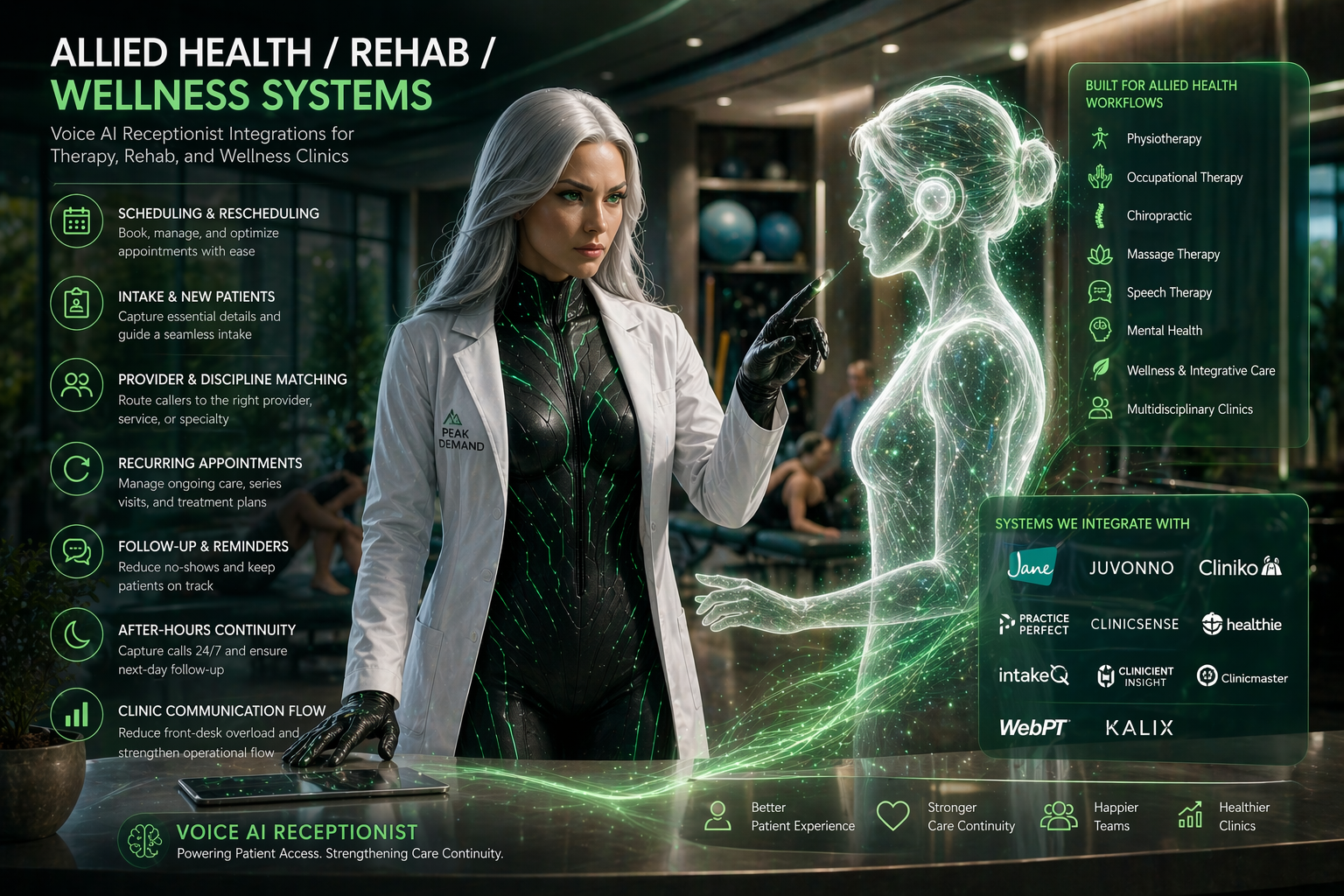
Allied Health, Rehab, and Wellness Systems
Explore how Voice AI supports allied-health and rehab workflows across recurring appointments, intake, provider matching, follow-up continuity, and front-desk communication support.
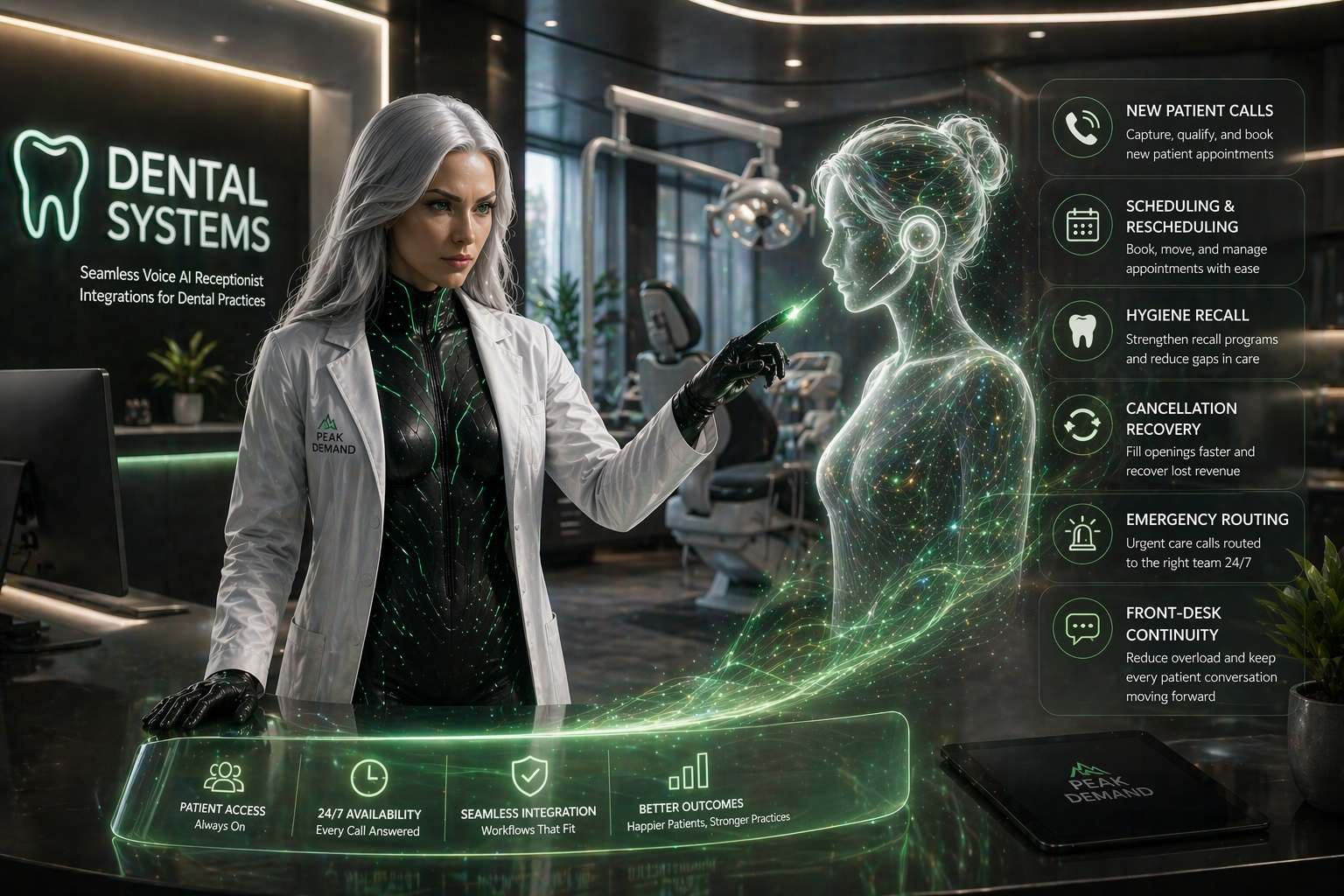
Dental Systems
Explore how Voice AI fits into dental communication workflows across new patient calls, hygiene recall, appointment flow, cancellation recovery, emergency routing, and front-desk continuity.

Veterinary Systems
Explore how Voice AI fits into veterinary environments across appointment continuity, client intake, urgent call routing, after-hours handling, and front-desk workflow support.

Chiropractic and Specialty Rehab Systems
Explore how Voice AI fits into chiropractic and specialty rehab workflows across scheduling, intake, recurring visits, SOAP-adjacent continuity, imaging-adjacent coordination, and front-desk support.
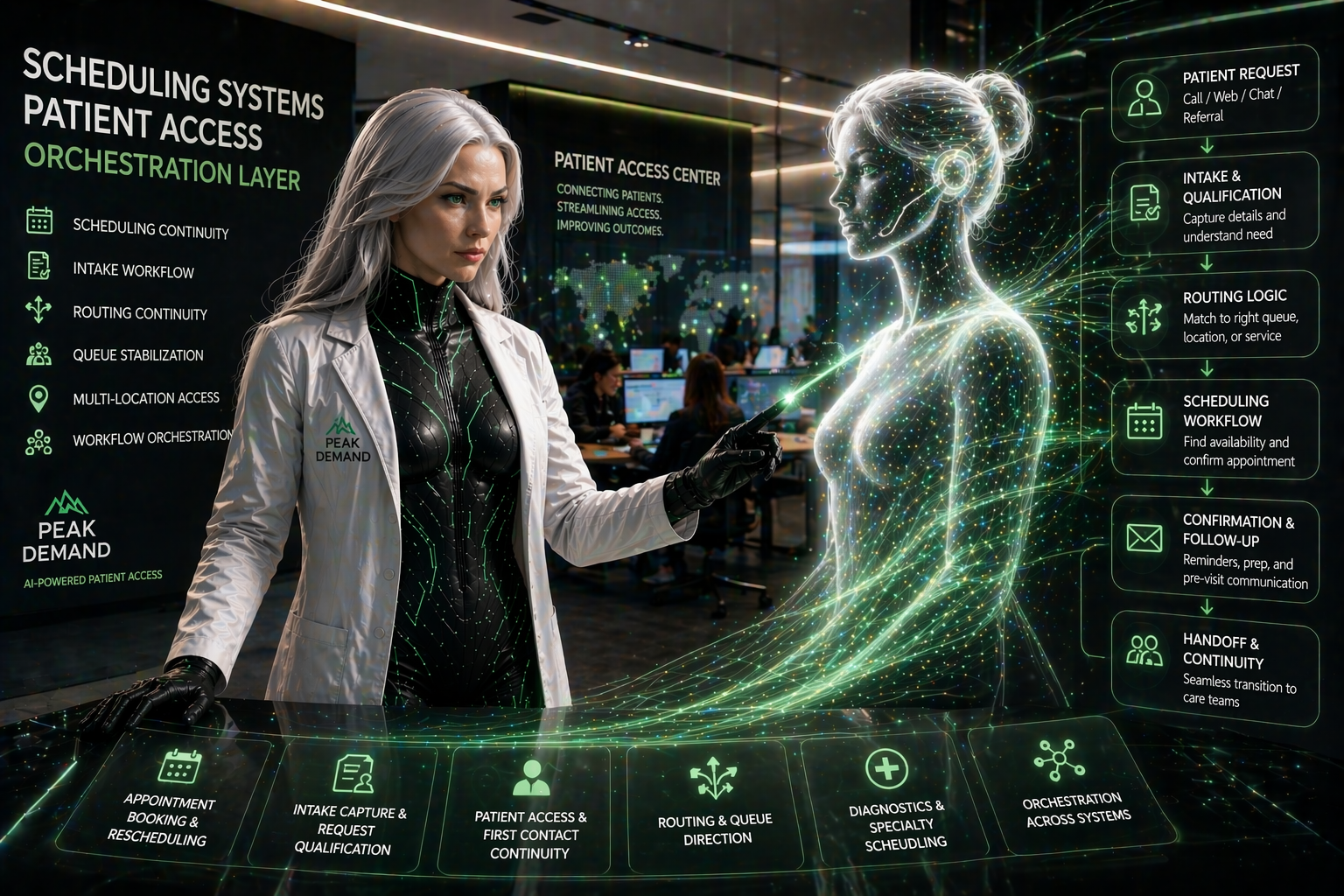
Scheduling, Patient Access, and Orchestration Systems
Explore how Voice AI supports scheduling and patient access architecture across intake, routing, queue stabilization, diagnostics scheduling, and workflow continuity between first contact and next action.
See Healthcare Voice AI Integrations In Action
These walkthroughs show how Voice AI can connect into real healthcare scheduling, intake, and communication environments. Start with TELUS Health CHR for Canadian clinic workflows and Juvonno for rehab and allied health operations.
TELUS Health CHR Integration Walkthrough
See how Voice AI can support TELUS Health CHR scheduling, intake, patient communication, and Canadian clinic workflow continuity.
Juvonno Integration Walkthrough
See how Voice AI can support Juvonno workflows for rehab scheduling, intake, appointment handling, and clinic communication continuity.
Explore published healthcare systems by name
Once you know the software family that best matches your environment, this section makes it easier to browse live healthcare integration pages by platform name. Each category below groups published system pages by the type of environment they usually support so operators, managers, and technical teams can compare workflow fit more quickly. A fuller alphabetical directory appears farther down the page.
Featured healthcare systems
These are high-priority starting points for visitors evaluating real-world Voice AI workflow fit across scheduling, intake, patient communication, routing, and access workflows.
Clinic, ambulatory, and medical EMR systems
These systems are commonly associated with clinic records-adjacent workflows, appointment flow, patient requests, intake continuity, routing, and broader ambulatory communication operations.
Scheduling, intake, and patient communication systems
These environments sit closer to booking logic, intake flow, reminders, clinic administration, and day-to-day patient access operations.
Rehab, physiotherapy, and allied health systems
Allied health and rehabilitation environments often depend on strong scheduling continuity, practitioner matching, intake flow, recurring appointment management, and multi-location operational coordination.
Dental systems
Dental communication workflows often center around appointment demand, cancellation recovery, reminders, new patient calls, and front-desk continuity across booked production.
Veterinary systems
Veterinary communication environments often require appointment continuity, client communication, after-hours handling, urgent call direction, and records-adjacent workflow coordination.
Healthcare organizations rarely evaluate integrations in a vacuum. Grouping systems by software family makes it easier to understand likely workflow fit, compare environments more quickly, and navigate toward both family-level integration pages and live system-specific pages deeper in this hub. The full alphabetical system directory farther down the page should carry the complete 98-system library.
Where Voice AI sits in the healthcare workflow matters more than basic connectivity
Healthcare Voice AI becomes more useful when it is treated as part of the larger workflow architecture around patient access, intake, routing, scheduling, escalation, and downstream ownership. The question is not only whether a system connects. The question is whether the communication flow reaches the next operational step with enough clarity and structure to reduce friction instead of shifting it downstream.
In practice, that means Voice AI often sits across multiple workflow layers at once. It may support first contact, gather structured intake, help direct the caller into the right path, preserve context for staff, and improve continuity into the next step. The value comes from how those layers fit together, not from one isolated connection point.
This is why healthcare teams should evaluate both the scheduling and patient access layer and the EMR or EHR-adjacent layer. In more complex environments, the architecture may also need to account for enterprise compliance and procurement requirements.
Where Voice AI usually enters the workflow
Voice AI often enters at the communication edge: inbound calls, appointment demand, intake capture, after-hours answering, overflow handling, and patient access or routing-related first contact.
Explore healthcare AI receptionistsWhere continuity usually breaks down
Continuity often breaks between the interaction and the next operational owner. That can happen when routing is weak, intake is unclear, scheduling context is incomplete, or downstream teams still need to manually rebuild the request.
Explore centralized scheduling workflowsWhat stronger integration architecture actually improves
Stronger architecture preserves enough structure, direction, and next-step usability for staff or systems to act efficiently. That is what turns Voice AI into operational infrastructure instead of a disconnected front-end layer.
Return to the healthcare resource hub| Integration maturity | What healthcare teams usually experience | Likely operational result |
|---|---|---|
| Fragmented | Some connection points exist, but scheduling, intake, routing, escalation, and continuity still require heavy manual repair. | Lower operational value, more staff burden, weaker patient access continuity, and less confidence in the workflow. |
| Partially connected | Important workflow layers connect, but structure and downstream usability still vary too much between teams, departments, or next-step owners. | Moderate gains, but persistent continuity gaps remain and staff still absorb unnecessary workflow friction. |
| Workflow-led and integrated | Voice AI supports multiple workflow layers with stronger structure, clearer routing, better handoff, and more usable next-step continuity. | Stronger patient access flow, cleaner operational ownership, and more scalable communication infrastructure. |
What healthcare teams should evaluate in the architecture discussion
- Where does Voice AI need to sit first in the communication workflow?
- Where does continuity currently break between the interaction and the next operational step?
- Which layers are EMR or EHR-adjacent, and which ones are workflow-adjacent?
- How do scheduling, intake, routing, patient access, and escalation interact in this environment?
- Will downstream teams receive enough structure to act without rebuilding the request manually?
- Is the integration design workflow-led or just feature-led?
- Does the current architecture reduce friction for staff, or does it simply move the work somewhere else?
Healthcare organizations usually get more value when they evaluate integration maturity across communication flow, operational ownership, and downstream usability together instead of treating each connection as a separate isolated decision. For system-specific evaluation, use the alphabetical healthcare system directory below.
Evaluating software families?
Use the six system-family pages to compare EMR, EHR, dental, veterinary, rehab, scheduling, and patient access environments.
Browse Software FamiliesEvaluating specific systems?
Use the full alphabetical directory to find the exact healthcare platform your team is evaluating.
Open System DirectoryEvaluating enterprise readiness?
Review governance, privacy, escalation, procurement, and compliance considerations before deployment.
Review ComplianceGo deeper into the strategy behind healthcare Voice AI integrations
This section helps healthcare teams move from broad category understanding into the right supporting resources for architecture, interoperability, workflow fit, implementation planning, and system-specific evaluation.
The articles below are the best next clicks for teams evaluating how Voice AI fits into healthcare communication systems, patient access workflows, structured integration pathways, rollout planning, and governed healthcare environments.
For broader category education, use the Healthcare Voice AI Resource Hub. For software-specific evaluation, continue to the full alphabetical system directory lower on this page and use the six healthcare software family pages as the parent layer.
Need system-family pages?
Use the family pages to compare medical EMR, allied health, dental, veterinary, specialty rehab, and patient access systems.
Browse Software FamiliesNeed a specific platform?
Use the alphabetical system directory to find the exact EMR, EHR, scheduling, dental, veterinary, or rehab platform.
Open System DirectoryNeed compliance context?
Use the enterprise compliance page when governance, privacy, procurement, RFPs, or regulated deployment requirements are part of the evaluation.
Review ComplianceCore integration strategy articles
These resources explain why integrations matter, what healthcare teams should evaluate first, and how stronger Voice AI integration architecture should be understood.
Custom pathways, structured integrations, and workflow fit
These articles are useful for teams evaluating custom pathways, structured communication flows, and how Voice AI fits into real healthcare operating environments.
Rollout, implementation, and governance
These resources are best for healthcare teams moving from early exploration into rollout planning, operational safety, implementation readiness, and governance-aware deployment.
Patient access, routing, and workflow bottlenecks
These articles help healthcare teams think more clearly about where communication complexity builds up across patient access, intake, department routing, scheduling, and downstream handoff.
As the healthcare integrations ecosystem continues to grow, this section can keep routing visitors into the most relevant strategy, rollout, and workflow resources without changing the overall structure of the hub. The full software directory appears in the Alphabetical System Directory section below.
Explore live healthcare system integration pages by category
This section gives healthcare teams a category-based way to browse the most important live system pages. It is not the full 98-system directory; it is a curated navigation layer for comparing the platforms most commonly tied to scheduling, intake, patient communication, routing, and patient access workflows.
Use this section when you know the type of software environment you are evaluating. Use the Alphabetical System Directory below when you want to find every live system page by name.
Need the family layer?
Start with the six parent family pages when comparing software categories before choosing a specific system.
Browse Software FamiliesNeed every system?
Use the alphabetical directory for the complete live healthcare system page list by platform name.
Open Alphabetical DirectoryNeed workflow context?
Review how Voice AI fits across patient access, intake, routing, scheduling, escalation, and downstream ownership.
Review Workflow ArchitectureFeatured healthcare systems
These are some of the strongest starting points for teams exploring healthcare Voice AI integrations across scheduling, intake, patient communication, routing, and access workflows.
Clinic and ambulatory EMR systems
These systems are commonly associated with clinic records-adjacent workflows, intake, appointment flow, routing, patient communication, and broader ambulatory continuity.
Explore medical and ambulatory EMR familyScheduling, intake, and patient communication systems
These environments sit closer to booking logic, intake flow, reminders, clinic administration, and day-to-day patient access operations.
Explore scheduling and patient access familyRehab, physiotherapy, and allied health systems
Allied health and rehabilitation environments often depend on strong scheduling continuity, practitioner matching, intake flow, recurring appointments, and multi-location coordination.
Explore allied health and rehab familyDental systems
Dental communication workflows often center on appointment demand, cancellation recovery, reminders, new patient calls, and front-desk continuity.
Explore dental familyVeterinary systems
Veterinary communication environments often require appointment continuity, client communication, after-hours handling, and records-adjacent workflow coordination.
Explore veterinary familyEnterprise, specialty, imaging, and outpatient environments
These environments often involve more complex routing, diagnostic scheduling, imaging coordination, enterprise workflow ownership, and department-specific handoff requirements.
Explore enterprise and medical EMR familyThis curated category browse section helps visitors compare common healthcare software environments without scrolling the entire directory. The complete system list belongs in the Alphabetical System Directory section below, where every live healthcare system page should be listed by platform name.
Talk through your healthcare communication workflow
If your team is evaluating healthcare Voice AI integrations, the most useful next step is usually a workflow conversation. That means reviewing patient access pressure points, scheduling flow, intake structure, routing logic, after-hours coverage, compliance expectations, and the systems surrounding those workflows.
Peak Demand approaches healthcare environments through workflow fit, governance awareness, and operational usability. The goal is to help organizations map a communication architecture that supports real teams, real workflows, and real continuity requirements across EMR, EHR, scheduling, intake, dental, veterinary, rehab, and patient access environments.
Need software families?
Compare the six parent healthcare integration families before choosing a specific system page.
Browse software familiesNeed workflow context?
Review how Voice AI fits across intake, routing, scheduling, escalation, and downstream ownership.
Review workflow architectureNeed compliance review?
Use the enterprise compliance page when governance, privacy, procurement, and RFP standards matter.
Review complianceFrequently asked questions
What does Voice AI mean in a healthcare integration environment?
Can Voice AI work with EMR, EHR, scheduling, intake, and routing workflows?
Are healthcare Voice AI integrations always direct?
Where should healthcare organizations start evaluating Voice AI integrations?
How should compliance and governance fit into the evaluation?
What is the role of this integrations hub?
About Peak Demand
Peak Demand is a Toronto-based AI agency focused on Voice AI, communication automation, and workflow infrastructure for organizations operating in more complex service environments.
In healthcare, the focus is not just on call handling. It is on patient access continuity, scheduling pressure, intake structure, routing logic, after-hours support, governance, and how communication systems fit into real operational workflows.
- Workflow-driven and implementation-aware
- Governance-first in healthcare communication environments
- Built to support clinics, networks, and enterprise teams
- Designed to scale into software-specific integration pathways
- Organized around healthcare system families and live integration pages
Healthcare software integrations by system name
If you already know the software you are evaluating, this alphabetical directory is the fastest way to find the right live system page.
This directory includes the full 98-system healthcare integration library from the current Peak Demand system-page build. It is designed to help teams compare EMR, EHR, scheduling, intake, patient communication, dental, veterinary, rehab, wellness, chiropractic, orchestration, home care, med spa, pharmacy, and enterprise healthcare systems by software name.
For category-level browsing, use the software family section. For workflow context, use the workflow architecture section. This section is the full alphabetical browse layer.
Live healthcare system pages in this directory
Grouped alphabetically with visible section counts so the full library is obvious at a glance.
A–C
34 systemsABELMed through Curve Dental.
D–H
20 systemsDentrix through Helios Software.
I–M
15 systemsIDEXX Cornerstone through MRX Solutions.
N–O
11 systemsNextech through Owl Practice.
P–R
8 systemsPabau through RXNT.
Compare healthcare systems by name, category, and workflow fit
This directory is useful for comparing clinic EMRs, EHR-adjacent systems, scheduling and intake platforms, patient communication software, dental systems, veterinary systems, rehab and allied health systems, chiropractic systems, med spa systems, home care systems, pharmacy-adjacent systems, orchestration platforms, diagnostic workflows, and enterprise healthcare environments by software name before going deeper into workflow design, integration possibilities, and operational fit.
Explore your own AI use case on a discovery call.