
Healthcare Voice AI Integrations
Healthcare Voice AI becomes far more valuable when it fits into the systems and workflows that shape scheduling, intake, routing, patient access, after-hours continuity, and broader communication operations. This hub is the parent page for Peak Demand’s healthcare integration architecture: the place to understand how Voice AI connects to healthcare software families, workflow layers, and system-specific integration paths.
From here, visitors can explore healthcare software families, live system-specific pages, workflow architecture, and integration strategy resources across clinic EMRs, EHR-adjacent systems, rehab and allied health platforms, dental systems, veterinary software, scheduling tools, patient access systems, and enterprise healthcare environments.
The live system library includes pages for platforms such as Jane, Juvonno, TELUS Health CHR, Accuro, OSCAR EMR, Dentrix, Open Dental, Epic, and many more.

Architecture Role
Parent hub for healthcare integrations
System Coverage
98 healthcare system pages
Software Families
6 healthcare integration families
Workflow Focus
Scheduling, intake, routing, access
Healthcare integrations should be evaluated through workflow continuity
One of the biggest mistakes in healthcare integration conversations is reducing the discussion to a list of software names. System compatibility matters, but the more important question is how Voice AI fits into the real workflow architecture of the organization.
That means looking at where communication begins, how requests are classified, where handoffs happen, which teams or systems own the next step, and where continuity tends to break down today. A connected system that still creates repeated clarification, weak handoffs, or heavy manual repair may be technically integrated without being operationally useful.
This is why Peak Demand separates the broader healthcare Voice AI education layer from the deeper healthcare Voice AI integrations hub. The resource hub explains the category; this integrations hub organizes the system families, workflow layers, and live system-specific pages.
Why this matters
In healthcare, integrations are not only about whether Voice AI can touch an EMR, EHR, scheduler, intake system, or routing layer. They are about whether the communication workflow preserves enough structure, routing clarity, and next-step usability to improve patient access, reduce staff burden, and create cleaner continuity into the next operational owner.
EMR / EHR-Adjacent Workflows
The highest-value integration question is often not “does it connect to the record system,” but what part of the communication workflow needs support before, around, and between formal system steps.
- Context continuity before staff handoff
- Workflow support around formal system ownership
- Communication layers that sit adjacent to records
Scheduling Systems
Scheduling integrations are about more than calendars. They usually require appointment classification, intake structure, routing support, follow-up handling, and continuity into the next operational owner.
- Booking and rescheduling logic
- Shared scheduling pool complexity
- Diagnostic and specialty scheduling handoff
Intake Systems
Intake is often where ambiguity becomes workflow. Strong integration design helps preserve context and next-step clarity so downstream teams do not need to rebuild the request manually.
- Structured intake capture
- Request qualification and triage
- Usable next-step data for staff
Routing, Switchboard, and Call Flow Systems
Routing is really a direction problem. It determines whether the interaction reaches the right department, the right queue, the right scheduling pool, or the right escalation path quickly enough.
- Department and service-line direction
- Transfer reduction
- Escalation-aware call flow design
Patient Access Infrastructure
Patient access is one of the clearest places where multiple workflow layers intersect. Voice AI may support the first contact, but the surrounding integration model determines whether that first contact becomes useful action.
- Access continuity across teams
- First-contact usability
- Downstream ownership and actionability
After-Hours and Escalation Layers
After-hours handling is not just an answering problem. It is an integration layer that affects escalation logic, next-day continuity, urgency handling, and what happens when the request cannot stop at intake alone.
- Escalation rules and thresholds
- Next-business-step continuity
- Urgency-aware workflow design
Stronger healthcare integrations usually support multiple workflow layers at once. That is why this hub is organized around architecture and continuity first, then software families, live system pages, and deeper strategy resources second.
Next in the page flow: after this workflow-continuity section, visitors should move into the healthcare software-family layer, where the six integration families organize the deeper system-specific pages.
Browse Healthcare Software Families
AI Data Readiness Checklist: Prepare Your Business for Automation
Most businesses want to automate. Very few have the data quality needed for automation to work reliably. When data is incomplete, inconsistent, or unstructured, AI systems fail, misroute tasks, or produce inaccurate results. The AI data readiness checklist gives you a simple way to evaluate your data quality and fix gaps before deploying automation or Voice AI.
Why this matters right now
AI assistants (ChatGPT, Gemini, Perplexity, Copilot) are becoming the primary interface between customers and businesses. These systems will only reference companies that demonstrate:
Clean data
Clear structure
Compliance alignment
Reliable signals
Consistent information across systems
If your data fails any of these, AI engines filter you out.
How this impacts different industries
Clean, structured data is now a requirement across every sector:
Healthcare / Clinics
Accurate patient contact data
PHIPA/HIPAA-compliant fields
Proper consent and intake records
HVAC / Local Services
Clean customer histories
Standardized job types
Consistent service area data
Utilities / Field Service
Normalized outage codes
Clean asset registry
Clear service territory boundaries
Manufacturing
ISO-aligned process data
Organized equipment and maintenance records
Accurate MTTR/MTBF/OEE inputs
What this guide will help you do
By the end of this article, you will be able to:
Identify data issues that prevent automation
Apply the AI data readiness checklist to your CRM/EMR systems
Fix high-impact data problems quickly
Prepare your business for Voice AI, workflow automation, and GEO
Improve your visibility inside AI assistants
This is your starting point for building AI-ready infrastructure—clean, structured, reliable data that automation can trust.
The Industry Shift: Why Data Quality Now Determines AI Accuracy, Precision, and Visibility

AI has fundamentally changed how customers find, evaluate, and interact with businesses. Instead of searching manually, people now ask AI assistants questions such as:
“Book me a skin treatment near me.”
“Find an HVAC company available today.”
“Who handles emergency electrical service?”
“Which manufacturer offers the shortest lead times?”
“Which utility has the best response times?”
To answer these questions accurately—and to avoid hallucinating incorrect information—AI systems depend on clean, consistent, structured, and verifiable data. If your data is messy, incomplete, or conflicting, AI cannot determine whether your business is trustworthy, so it simply does not reference you.
This is the core shift:
Visibility, accuracy, and automation performance now depend on data quality—not marketing.
Why AI Systems Now Demand Higher Accuracy and Precision
Search engines were built to handle imperfect data. Humans could interpret partial information, fill in gaps, and correct errors. AI systems cannot take those risks.
AI models must avoid:
Wrong business hours
Wrong addresses
Incorrect service areas
Conflicting pricing
Duplicate business names
Incorrect medical or technical details
Outdated regulatory information
Conflicting contact records
Publishing or recommending the wrong business creates AI hallucinations, which directly harms user trust.
To prevent this, AI now filters aggressively based on:
1. Data cleanliness
2. Consistency across platforms
3. Schema and structured fields
4. Compliance alignment
5. Internal cross-system accuracy
If your data fails these filters, AI will not include you in its responses.
How AI Assistants Choose Which Businesses to Show

LLMs run your business through three accuracy layers before they will ever reference you:
1. Relevance Layer — Does your data clearly state what you do?
AI examines:
Service descriptions
Industry terminology
Location metadata
Booking or availability signals
If your descriptions are vague, inconsistent, or conflicting, the model will not guess—it will exclude you.
2. Authority Layer — Are you a reliable source?
AI checks:
Your website
Your CRM/EMR
Google Business Profile
Third-party listings
Schema markup
Regulatory alignment
Structured service definitions
If these do not match, the model assumes your information is unreliable and avoids referencing it.
3. Validation Layer — Does your data hold up under scrutiny?
AI validates against:
Recency
Completeness
Structured metadata
Cross-source consistency
Duplicate detection
Compliance indicators (PHIPA, HIPAA, ISO, SOC 2)
Clear field definitions
Failure at this stage means the AI cannot trust your data—and will not risk using it.
Internal AI Agents Depend on the Same Data Standards
The same accuracy requirements apply to internal AI agents that businesses now use for operations. These include:
AI receptionists
Voice AI scheduling agents
Patient intake agents
Lead qualification agents
Dispatch and routing agents
AI customer service assistants
Follow-up and reactivation agents
These systems rely on your CRM, EMR, or operational databases. When the underlying data is messy, these agents behave unpredictably—and sometimes dangerously.
Poor data creates operational errors such as:
Wrong patient instructions
Incorrect appointment types
Misrouted calls
Incorrect technician assignments
Wrong service area detection
Duplicated or fragmented customer histories
Failed booking confirmations
Incorrect pricing or service codes
Conflicting compliance signals
Inaccurate maintenance or outage classification
AI is only as accurate as the data it receives. If the inputs are inconsistent, the AI will either hallucinate or fail.
Internal AI accuracy depends on:
Standardized field names
Normalized service or treatment codes
Clean historical records
Validated contact information
Accurate geolocation and service territory data
Clear status and lifecycle definitions
Proper consent tracking and compliance fields
Internal AI safety also depends on predictable data.
Hallucinations happen when:
Fields conflict
Values are missing
Data is duplicated
Terminology varies across systems
Historical data is unstructured
Multiple platforms disagree about the same record
Clean, standardized data dramatically reduces these risks.
When the data is correct, internal AI agents become:
More accurate
More predictable
More compliant
Easier to audit
Safer to operate
More likely to produce consistent results
This is why data readiness matters before implementing automation—your internal AI depends on the same data quality required by public LLMs.
Industry Examples Showing How Data Hygiene Impacts AI Accuracy
Healthcare & Clinics
AI must avoid:
Incorrect patient instructions
Wrong clinic addresses
Incorrect practitioner availability
Wrong treatment names
Invalid consent data
Messy data is treated as a PHIPA/HIPAA risk, so AI avoids the clinic entirely.
HVAC & Local Services
AI depends on:
Clean service territories
Standardized job types
Equipment age and model consistency
Normalized pricing
Accurate call outcome tagging
Poor data leads to hallucinated coverage areas, wrong dispatching, and failed bookings.
Manufacturing
AI must interpret:
SKU structures
Lead-time calculations
Maintenance schedules
Part identification
ISO/CSA-aligned terminology
Unstructured or conflicting manufacturing data can produce unsafe automation recommendations.
Utilities & Field Service
AI relies on:
Outage codes
Asset IDs
Territory metadata
SAIDI/SAIFI metrics
Regulatory classifications (IESO, CEA, NRCan)
Messy data produces false outage status, incorrect restoration estimates, and hallucinated asset relationships.
Why Data Quality Is Now the Foundation of AI Precision and Automation
When data is inconsistent:
AI accuracy drops
AI precision weakens
Hallucination risk increases
Workflows break
Public LLMs exclude your business
Internal agents produce operational errors
When data is clean:
AI answers confidently
Public LLMs surface the business
Internal agents execute tasks reliably
Compliance risk decreases
Automation can scale
Customer trust increases
Clean data is the new requirement for both AI visibility and operational automation.
Data quality is now a direct determinant of whether AI systems can reference, trust, and correctly represent your business. Clean, structured, and validated data enables AI assistants—and your own internal AI agents—to deliver accurate, safe, and reliable outputs. Messy data forces AI systems to exclude you from results or generate incorrect responses.
Every industry experiences this impact differently, but the root cause is always the same:
AI cannot operate on assumptions. It can only operate on clean, predictable data.
How Manufacturing Is Affected
Manufacturers rely on AI for scheduling, quoting, inventory accuracy, maintenance, and operational forecasting. Poorly structured production or equipment data prevents AI from producing precise, reliable outputs.
AI needs:
Clear SKU structures
Normalized part IDs
Accurate lead-time data
Documented ISO/CSA terminology
Consistent equipment maintenance records
When the data is inconsistent, AI produces:
Wrong lead-time estimates
Incorrect material requirements
Faulty OEE, MTTR, MTBF analysis
Unsafe or non-compliant recommendations
Manufacturers with structured operational data become dramatically more visible, more accurate, and more trustworthy to AI engines.
How Healthcare and Clinics Are Affected
Healthcare AI must prioritize safety, compliance, and accuracy. In this environment, messy or inconsistent data is treated as a PHIPA/HIPAA compliance risk, and AI systems avoid referencing clinics with questionable inputs.
AI looks for:
Verified patient contact details
Standardized treatment or service names
Symptom or intake consistency
Accurate practitioner availability
Clear consent and compliance fields
When the data is unclear, AI risks:
Hallucinating instructions
Misinterpreting the patient profile
Selecting the wrong service or practitioner
Generating unsafe follow-up recommendations
Clinics with high-quality data earn more accurate representation and safer automation workflows.
How Utilities and Field Service Are Affected
Utilities depend heavily on accuracy, precision, and predictable classification. AI-driven outage reports, asset management systems, and dispatch workflows all require clean data.
AI relies on:
Standardized outage codes
Clean asset registries
Validated location and territory metadata
Accurate SAIDI/SAIFI measurements
Regulatory alignment (IESO, CEA, NRCan)
Dirty utility data leads to:
Wrong outage status
Incorrect asset classification
Faulty restoration timelines
Misrouted crews
Unsafe automation behaviour
Clean data increases operational accuracy and makes the utility more citeable by AI systems.
How SaaS and Professional Services Are Affected
SaaS companies increasingly rely on AI to interpret support tickets, classify customer issues, route leads, and analyze product usage. If their data is inconsistent, AI models generate unreliable or misleading outputs.
AI expects:
Clear lifecycle stage definitions
Clean customer success notes
Accurate API metadata
Normalized usage fields
SOC 2 / ISO 27001-aligned record structures
Poor data creates:
Wrong lead routing
Incorrect churn predictions
Faulty ticket categorization
Misinterpreted product behaviour
SaaS companies with strong data hygiene earn more visibility in AI results and deliver more reliable automated support.
How Local Service Businesses Are Affected
Local services—HVAC, plumbers, electricians, landscapers, med spas, and other home/field-based businesses—depend heavily on accurate geographic and service data.
AI needs:
Clean service area boundaries
Consistent job-type definitions
Reliable location metadata
Accurate equipment or asset histories
Standardized call outcome tags
When this data is messy, AI models misclassify the business, misunderstand service coverage, or hallucinate availability. Businesses with clean data gain more exposure in AI-generated recommendations.
Why Every Industry Feels the Same Pressure
Although each sector has its own challenges, the reason they all experience AI failures is identical:
AI cannot interpret vague records
AI cannot infer missing data
AI cannot reconcile conflicting values
AI cannot risk presenting incorrect information
AI cannot take actions when fields are incomplete
Clean data becomes the single most important prerequisite for:
AI precision
Reliable automation
Higher LLM visibility
Accurate operational workflows
Strong compliance posture
Safe internal agent performance
The businesses that invest in data readiness will see faster AI adoption, more accurate results, and far greater visibility across all AI platforms.
The Five-Part Framework for AI Data Readiness
Every successful AI automation project—whether it involves scheduling, triage, lead qualification, internal agents, or full workflow orchestration—depends on a foundation of clean, structured, predictable data. To help businesses evaluate and upgrade their data quality, Peak Demand uses a clear five-part framework that applies across all industries.
This framework ensures that your data can be interpreted accurately, minimizes hallucination risk, improves visibility inside AI assistants, and supports reliable internal automation.
Data Consistency
Data must be structured, named, and formatted the same way across every system. Inconsistencies introduce confusion for AI models and directly degrade accuracy.
AI expects:
Consistent field names
Standardized phone and email formats
Unified naming conventions for services and products
Clean location and territory data
Aligned tags and lifecycle statuses in CRM or EMR systems
When data is inconsistent, AI struggles to interpret meaning. This leads to incorrect recommendations, wrong routing, scheduling errors, and reduced visibility in LLM-generated results. Ensuring consistency is the first and most fundamental step.
Data Completeness
Automation requires complete records, not partial ones. Missing fields force AI models to guess, which increases error rates and hallucination risk.
Critical completeness indicators include:
Full customer/patient profiles
Accurate service or treatment histories
Verified contact information
Completed intake or diagnostic fields
Complete equipment or asset metadata
Recorded service territories or locations
AI performs best when every required field is present. Businesses with incomplete data see the highest rates of automation failures.
Data Accuracy and Verification
AI systems evaluate the trustworthiness of your data. They check for correctness, contradictions, and alignment with external sources. If AI finds conflicting values, it avoids referencing your business.
Accuracy requires:
Verified contact details
Deduplicated customer or patient records
Correct job or service classifications
Accurate timestamps and history logs
Up-to-date compliance and consent fields
Cross-system alignment (CRM ↔ EMR ↔ ERP ↔ scheduling tools)
Verified, error-free data increases AI confidence and improves model precision.
Structure and Schema Alignment

AI relies on structure to understand, categorize, and interpret your information. Unstructured or poorly structured data limits the model’s ability to extract meaning.
Strong structure includes:
Clear field types and definitions
Normalized taxonomies
JSON-friendly formatting
Schema markup on your website
Correct metadata for services, locations, hours, and pricing
Aligned terminology across CRM/EMR/ERP
Structured data makes your business easier for AI assistants to cite and easier for internal agents to navigate. Schema also strengthens validation and reduces hallucination risk.
Governance, Access, and Compliance
Data governance is what keeps your automation accurate, safe, and compliant over time. Without proper governance, even clean systems drift back into inconsistency.
Governance includes:
Clear rules for data entry
User permissions and access controls
Audit trails
Version control for records
Retention and deletion policies
Industry compliance (PHIPA, HIPAA, ISO 9001, SOC 2, CEA, IESO)
AI agents—both internal and external—must access controlled, accurate data to perform tasks safely. Strong governance prevents data corruption and ensures long-term automation reliability.
The AI Data Readiness Checklist

This checklist helps businesses measure how prepared their data is for AI automation, internal AI agents, and LLM-based visibility. Each category includes clear criteria and scoring guidance so you can evaluate your current systems and identify high-impact gaps. A fully AI-ready business demonstrates clean, complete, accurate, and well-governed data across all fields and operational systems.
At the end of this section, your business should be able to assign itself a score out of 100—a baseline that can evolve into a full AI Data Trust Score.
Contact Data Quality
Accurate contact information is foundational for automation workflows, scheduling, follow-ups, routing, and AI-driven communication. Missing or inconsistent contact data produces the highest rate of AI errors and hallucinations.
AI expects:
Validated phone numbers (consistent formats)
Clean email addresses
No duplicates
Standardized name formatting
Updated communication preferences
Correct customer/patient identifiers
Score Guidance:
0–10 points depending on completeness, consistency, and duplicate rate.
Customer or Patient Records
AI relies on clear, structured records to interpret history, preferences, needs, and eligibility. Partial or unstructured records cause internal agents—and external LLMs—to misinterpret your business.
AI expects:
Standardized profiles
Complete demographic or account fields
Transaction, visit, or appointment history
Consent and compliance fields
Clean notes or relevant history
Unified records (no fragmentation across systems)
Score Guidance:
0–10 points depending on completeness and unification across systems.
Service History and Activity Data
Service records enable AI to understand patterns, classify past work, predict future needs, and deliver accurate recommendations.
AI expects:
Clear job, appointment, or service types
Consistent service codes or treatment names
Accurate timestamps
Structured outcomes (completed, cancelled, no-show, follow-up required)
Detailed notes that follow a consistent format
Full lifecycle visibility
Score Guidance:
0–10 points based on structure, standardization, and accuracy of past activity.
Asset or Equipment Data
Industries such as HVAC, manufacturing, utilities, construction, and healthcare rely on equipment or asset-level data to inform service workflows and automation decisions.
AI expects:
Normalized asset or equipment IDs
Correct make, model, serial number fields
Accurate maintenance history
Standardized condition/status fields
Date of install, service, or inspection
Cross-system alignment
Score Guidance:
0–10 points based on accuracy and degree of structure in asset data.
Locations and Service Areas
AI needs clean geographic metadata to determine service eligibility, assign resources, map routes, and provide accurate recommendations. Poor geographic data produces high hallucination risk.
AI expects:
Clean, standardized addresses
Accurate postal codes or geocodes
Defined service territories
Updated coverage boundaries
Clear multi-location or multi-facility structure
Score Guidance:
0–10 points based on geographic accuracy and clarity.
CRM/EMR Structure and Field Alignment
AI can only operate reliably when the underlying system fields are predictable, well-labeled, and free from ambiguity. Loose or unstructured CRM setups are one of the biggest causes of automation failure.
AI expects:
Clear field definitions
Standardized dropdowns and picklists
Unified naming conventions
Consistent status pipelines
Logical lifecycle stages
No free-text fields where structured fields are required
Score Guidance:
0–10 points based on structural clarity and field governance.
Permissions and Access Control
AI agents—internal and external—must interact with data in a controlled, compliant manner. If permissions are not clear, audits, visibility, and workflow integrity all suffer.
AI expects:
Defined role-based access controls
Standardized user permissions
Audit trails
Clear ownership of records
Version tracking for sensitive fields
Compliance alignment (PHIPA, HIPAA, ISO, SOC 2)
Score Guidance:
0–10 points based on access control and compliance posture.
API Connections and System Integrations
AI automation depends on clean, reliable data flows between systems. Broken integrations or inconsistent field mapping cause errors, conflicts, and unpredictable results.
AI expects:
Accurate field mapping
Real-time or near-real-time syncing
Error logging and monitoring
Clear rules for conflict resolution
Clean, normalized payload formats
Version-controlled integration logic
Score Guidance:
0–10 points based on integration health and sync reliability.
Data Lifecycle and Governance
Long-term accuracy requires active governance—not just cleanup. Companies with strong governance retain clean, AI-usable data over time rather than slipping back into operational chaos.
AI expects:
Defined data entry rules
Record maintenance policies
Duplicate prevention processes
Retention and deletion standards
Compliance audits
Cross-system alignment reviews
Score Guidance:
0–10 points based on governance maturity and auditability.
Your AI Data Readiness Score

Add up your points from all categories:
/100 total
80–100: AI-ready foundation
60–79: Needs moderate cleanup before automation
40–59: High risk of AI errors or hallucinations
0–39: Unsafe for automation or internal AI agents
This score acts as the baseline for a future AI Data Trust Score, which can become a standardized measurement for AI preparedness across all industries.
Industry-Specific Deep Dives

AI interprets every industry through the lens of structure, compliance, and operational clarity. Businesses that maintain clean, standardized, and audit-ready data are rewarded with higher accuracy, safer internal automation, and greater visibility inside AI-generated recommendations. The examples below show how AI evaluates data quality across four major sectors—and how to fix the gaps that hold companies back.
Healthcare (Clinics, Medical Spas, Allied Health)
Healthcare data has strict privacy, compliance, and accuracy requirements. AI systems avoid referencing clinics that appear risky, inconsistent, or misaligned with regulatory expectations.
What AI sees:
PHIPA/HIPAA-compliant fields
Clean EMR/CRM structures
Standardized treatment names
Verified patient contact information
Clear availability and provider metadata
Consent and audit trail alignment
Compliance indicators from Health Canada and provincial colleges
What AI ignores:
Free-text treatment notes without structure
Duplicate patient profiles
Conflicting appointment, availability, or location data
Missing consent fields
Unverified or outdated practitioner information
Nonstandard or informal treatment naming
How to fix gaps:
Standardize EMR/CRM field names and picklists
Use consistent treatment, program, and service naming
Enforce consent tracking and verification workflows
Remove duplicates and merge fragmented patient histories
Align metadata with Health Canada terminology
Map data between EMR ↔ CRM to eliminate inconsistencies
Clean, PHIPA-aligned data improves AI accuracy, strengthens safety, and increases your clinic’s chances of being referenced by LLMs.
Manufacturing
Manufacturers rely on structured operational data—often governed by global standards. AI must be able to interpret SKU data, maintenance history, work orders, and machine metrics without guessing.
What AI sees:
ISO 9001-aligned documentation
Standardized CSA/IEEE equipment fields
Clear maintenance logs and timestamps
MTTR, MTBF, and OEE calculations
Structured BOMs and SKU definitions
Normalized work order categories
What AI ignores:
Unstructured maintenance notes
Conflicting SKU or part identifiers
Inconsistent naming across product lines
Missing timestamps or incomplete work orders
Informal machine labels or undefined categories
Outdated certification or compliance metadata
How to fix gaps:
Normalize all SKU and part definitions
Align documentation with ISO, CSA, and IEEE standards
Use standardized maintenance coding (failure mode, condition, action taken)
Add timestamps, status fields, and lifecycle definitions to every work order
Formalize OEE, MTTR, and MTBF calculations
Create structured, version-controlled logs for audits
Structured manufacturing data helps AI produce accurate quotes, safe recommendations, and precise internal automation.
Utilities, Energy, and Field Service
Utilities operate under strict regulatory oversight, and AI depends on precise classification to avoid safety risks. Incorrect outage, asset, or territory data creates serious operational consequences.
What AI sees:
Standardized outage codes
Accurate, validated asset registries
Clean territory and feeder metadata
Regulatory alignment with IESO, CEA, NRCan
SAIDI/SAIFI performance metrics
Real-time or near-real-time update structures
What AI ignores:
Inconsistent outage terminology
Outdated or duplicated asset IDs
Unclear service territory boundaries
Missing timestamps or restoration details
Nonstandard internal codes or tagging
Unverified reliability metrics
How to fix gaps:
Normalize outage codes and event categories
Clean and deduplicate asset registries
Define precise service area polygons and feeder mappings
Align reliability data with CEA and IESO standards
Add structured SAIDI/SAIFI fields and timestamp rules
Create a unified asset metadata dictionary
Utilities with structured operational data experience higher AI accuracy, more reliable internal agent performance, and cleaner automated reporting.
Local Services, HVAC, and Trades
Local service businesses rely heavily on geographic, service-type, and booking data. AI-generated search results depend on clarity, consistency, and service eligibility signals.
What AI sees:
Clean NAP (Name, Address, Phone) consistency
Defined service area polygons
Standardized job types and service codes
Structured equipment or asset histories
Clear lead source tracking
Geographic relevance signals
What AI ignores:
Conflicting business hours across platforms
Duplicated customer or job records
Vague service descriptions
Free-text job categories with no structure
Outdated coverage zones
Missing or inconsistent lead status fields
How to fix gaps:
Enforce NAP consistency across all listings and platforms
Define service areas with polygons or postal-code rules
Standardize job types, equipment tags, and service codes
Create structured lead statuses and outcome categories
Clean routing data and remove conflicting address formats
Ensure service descriptions match schema and CRM fields
Structured job, service, and geographic data increases AI precision and helps local businesses appear in LLM-based recommendations with far greater reliability.
Measurement & Verification

Strong data readiness must translate into measurable improvements across search visibility, AI assistant behavior, automation reliability, and operational outcomes. Tracking the right metrics ensures that your AI initiatives are working and that your data remains accurate, complete, and automation-ready over time. The following measurement areas help you verify whether your business is becoming more “AI-visible,” more automation-ready, and more operationally efficient.
Traditional SEO Performance
Even in the AI era, traditional SEO remains a key visibility signal—and clean, structured data enhances indexation and relevance. Measuring SEO outcomes ensures your foundational web presence is aligned with AI-driven discovery.
Key metrics to track:
Indexation: How many pages are actually indexed by Google
Ranking improvements: Movement for core service/treatment keywords
Conversions: Form submissions, calls, bookings, or quote requests
Organic click-through rate: Whether search users are selecting your result
Structured data validation: Confirmation that schema is error-free
Healthy SEO metrics correlate with stronger LLM validation and cross-source consistency.
AI Assistant Visibility
As AI becomes the dominant discovery layer, your business must appear accurately inside ChatGPT, Gemini, Perplexity, Copilot, and domain-specific AI tools. Measuring AI visibility is crucial.
Key metrics to track:
ChatGPT/Gemini brand mentions: Does the model reference your business?
Presence in intent-based queries: e.g., “best HVAC company near me,” “skin clinic in Toronto,” “electrician open now.”
Answer accuracy: Whether the model describes your services correctly
Hallucination reduction: Whether incorrect or outdated information decreases
Citation frequency: How often LLMs choose your business over competitors
These measurements directly reflect how AI interprets your data quality, consistency, and authority.
Data Quality Metrics
Strong data readiness requires continuous measurement. These indicators verify whether your CRM/EMR/operational systems are becoming cleaner, more consistent, and more reliable.
Key metrics to track:
Data completeness score: Percentage of required fields filled
Duplicate rate: Number of duplicated records across systems
Error rate: Invalid entries, formatting errors, or missing values
Field consistency: Alignment across CRM ↔ EMR ↔ ERP ↔ scheduling tools
Sync failures: Failed API pushes, mismatched payloads, or outdated records
Terminology alignment: Standardized labels for services, treatments, job types
Improving these metrics increases AI precision and reduces hallucination risk.
Workflow Automation Success
Internal AI agents—schedulers, intake bots, dispatch systems, and triage flows—depend on data accuracy. Measuring workflow performance shows whether your automation is achieving predictable, reliable results.
Key metrics to track:
Task completion rate: Whether the AI can complete full workflow actions
Booking accuracy: Correct appointment or job type → correct resource → correct time
Dispatch accuracy: Whether the right technician/resource is assigned
Follow-up reliability: Correct tagging, messaging, and sequencing
Error-free handoffs: Smooth transitions between AI agents and human teams
Workflow exceptions: Reduced human intervention required
Automation success increases as data quality improves.
Business Impact
Ultimately, AI data readiness must improve real-world business performance. These outcomes demonstrate whether your investment in data structure, governance, and cleanup is paying off at the operational level.
Key metrics to track:
Reduced manual work: Fewer hours spent correcting data or doing repetitive tasks
Lower call volume: As Voice AI handles intake, routing, or triage
Higher booking reliability: Fewer no-shows, fewer errors, more accurate scheduling
Faster response times: AI-enabled routing and triage improve speed
Higher customer satisfaction: More accurate answers, fewer miscommunications
Increased revenue capture: More bookings, more follow-ups, fewer missed leads
Businesses that perform well across all five measurement areas demonstrate high AI readiness and strong long-term automation potential.
Business Impact: Why Data Readiness Compounds Over Time
Data readiness is not a one-time cleanup exercise. It is a compounding advantage that improves every part of your business—from automation accuracy to AI visibility to customer experience and revenue capture. Clean, structured, verified data becomes a long-term asset that strengthens AI performance across every system you use.
Businesses that invest early in data readiness see exponentially greater returns as AI continues to expand into search, operations, customer service, and workflow automation.
Reliable Automation Reduces Human Error
AI agents—including schedulers, intake bots, dispatch systems, and triage flows—perform best when they can make decisions from clean, predictable data. When fields are inconsistent or incomplete, these agents hesitate, escalate tasks unnecessarily, or produce incorrect outputs.
Data readiness improves:
Booking accuracy
Routing precision
Eligibility logic
Availability detection
Workflow completion rates
Fewer errors mean fewer corrections by staff and more trust in automated workflows.
Improved Trust Signals Increase AI Citation Likelihood
AI systems reference businesses only when they are confident the information is accurate. Clean data creates stronger trust signals across:
Website schema
Google Business Profile
CRM/EMR/ERP systems
Industry directories
Compliance fields
Operational metadata
When AI sees consistency, structure, and authority, it becomes more comfortable citing your business in answer summaries and recommendations.
Higher AI Citations Lead to Higher Conversions
When AI consistently references your business in:
“Who should I book with?”
“Who is the best near me?”
“Which company handles this service?”
“Where can I go for treatment X?”
…your conversion rate increases. Customers trust AI recommendations because they are perceived as neutral and data-driven. Appearing in these responses gives your brand a massive advantage over competitors.
Strong citations also reduce misrepresentation and hallucinations, leading to more accurate traffic and more qualified inbound leads.
Higher Conversions Lower Customer Acquisition Cost (CAC)
Better visibility means:
More bookings
More quote requests
More calls
More completed forms
More direct inbound traffic
When conversions rise without increasing ad spend, CAC drops—significantly. Clean, AI-ready data improves discoverability and accuracy, allowing you to acquire customers at a fraction of the traditional cost.
This creates a sustainable advantage as advertising costs rise and AI-powered discovery becomes the dominant channel.
Clean Data Makes AI Agents More Accurate and Easier to Train
Internal AI agents learn faster and perform better when their training environment is predictable. Clean data enables:
Faster model adaptation
More stable workflows
More reliable decision-making
Better context retention
Fewer edge-case failures
Lower hallucination rates
Higher safety and compliance alignment
Every improvement in data structure reduces the amount of instruction, reinforcement, and correction required to maintain high-performing AI agents.
Over time, this builds a compounding loop:
Cleaner data → smarter agents → fewer errors → even cleaner data.
How Data Readiness Connects to Peak Demand’s Integrated Funnel
Peak Demand integrates SEO, GEO, and Voice AI into a single system that amplifies your visibility and automates your operations. Data readiness strengthens each part of this funnel:
SEO improves because your site, schema, and listings become more consistent and crawlable.
GEO improves because LLMs trust your structured, validated information and cite your business more frequently.
Voice AI improves because internal agents work from predictable, accurate data and execute workflows correctly.
Together, these three pillars create a closed loop:
Clean Data → Better SEO → Stronger GEO → More AI Citations → More Leads → Better Voice AI Performance → Higher Conversion → Lower CAC
This flywheel accelerates over time and becomes one of your most defensible competitive advantages.
Free AI Automation, Data Quality & LLM Visibility Audit for Your Business
If you want to understand how well your business is positioned for AI automation, internal AI agents, and visibility inside large language models, you can request a Free AI Automation, Data Quality & LLM Visibility Audit from Peak Demand. This assessment gives you a clear, evidence-based snapshot of how AI-ready your data and workflows are—and where the highest-impact improvements can be made.
As part of this audit, you’ll receive a Data Readiness Score, showing how clean, complete, and structurally sound your operational data is. This score provides a baseline for building reliable automation, improving LLM-generated accuracy, and increasing customer conversions.
You’ll also get a real-world view into how AI already perceives your business:
“See how ChatGPT currently describes your business.”
Most organizations discover that AI-generated descriptions are incomplete, outdated, or incorrect—usually because the underlying data is inconsistent or unstructured.
Your free audit includes:
CRM/EMR field analysis
Review of accuracy, completeness, naming conventions, field types, and structural alignment.NAP signal check
Verification of Name, Address, and Phone consistency across your website, listings, and directories.Schema markup review
Assessment of structured data, errors, depth of schema usage, and alignment with LLM validation layers.AI assistant visibility scan
Analysis of your present-day visibility inside ChatGPT, Gemini, Perplexity, and search-integrated AI models.Data hygiene evaluation
Duplicate detection, formatting inconsistencies, incomplete records, and cross-system contradictions.Automation opportunities
Identification of where AI agents (reception, intake, scheduling, triage, dispatch, follow-up) can be deployed safely and reliably.
The audit delivers a practical roadmap for improving your AI foundation, strengthening your automation capabilities, and increasing your presence inside the next generation of AI-driven discovery systems.
Learn more about the technology we employ.

At Peak Demand AI Agency, we combine always-on support with long-term visibility. Our AI receptionists are available 24/7 to book appointments and handle customer service, so no opportunity slips through the cracks. Pair that with our turnkey SEO services and organic lead generation strategies, and you’ve got the tools to attract, engage, and convert more customers—day or night. Because real growth doesn’t come from working harder—it comes from building smarter.

Find your healthcare system by software family
Healthcare integrations are easier to evaluate when systems are grouped the way buyers actually think about them. Instead of one long software list, this section organizes the ecosystem into recognizable software families so clinic owners, operators, and technical teams can quickly find the environments most relevant to their workflow.
Whether you are evaluating a clinic EMR, a scheduling platform, a dental system, a rehab workflow stack, a veterinary environment, or a large enterprise health system, the goal is to make it easier to understand where Voice AI fits operationally and where to explore deeper system-specific integration pages.
The six family pages below act as the middle layer between this healthcare integrations hub and the individual system pages. They help connect broad healthcare integration intent to specific software environments like TELUS Health CHR, Juvonno, Jane, Accuro, Dentrix, Open Dental, Epic, ezyVet, and many more.

Medical and Ambulatory EMR Systems
Explore how Voice AI fits into medical and ambulatory EMR environments across scheduling, intake, patient access, provider routing, after-hours continuity, and clinic communication workflows.
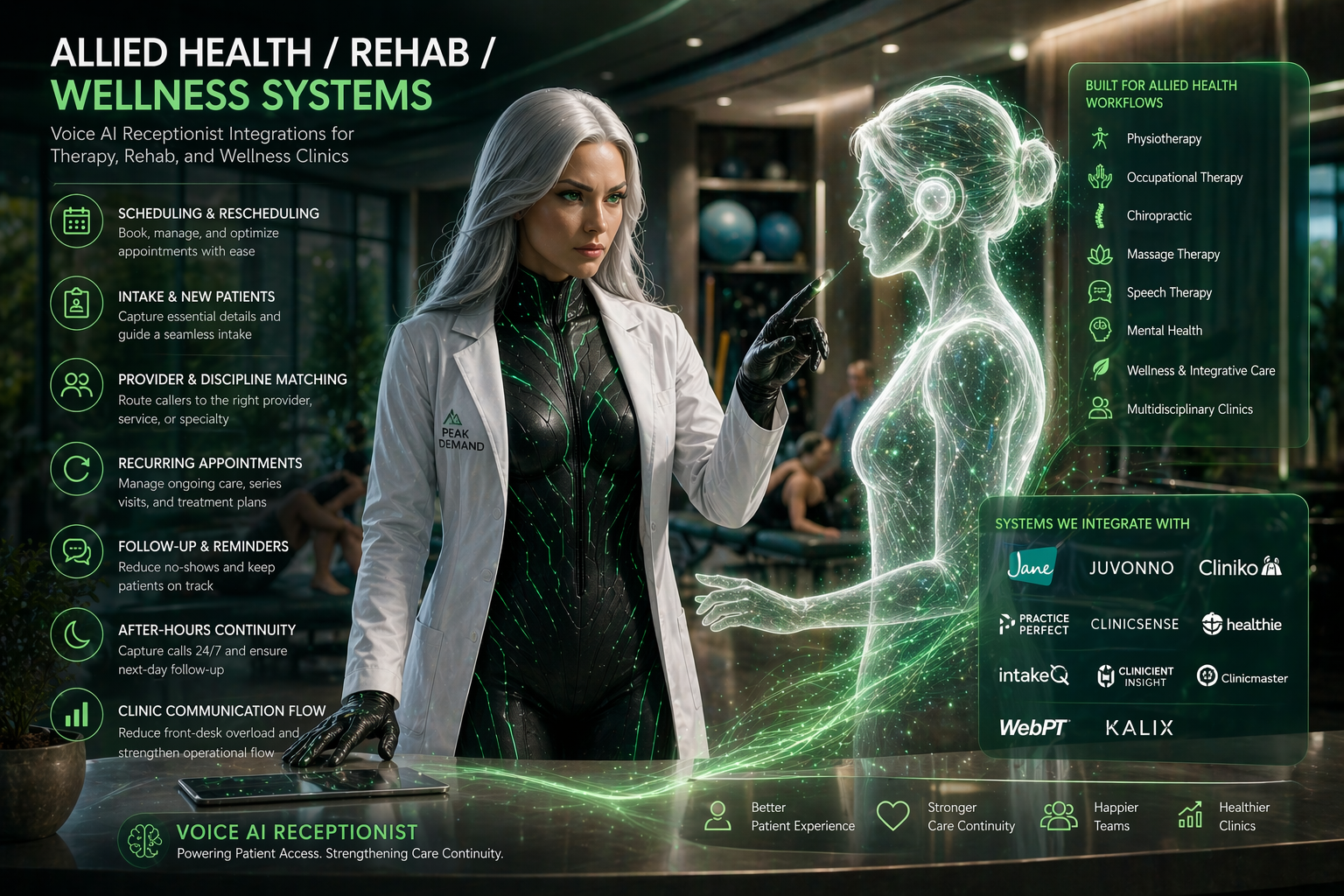
Allied Health, Rehab, and Wellness Systems
Explore how Voice AI supports allied-health and rehab workflows across recurring appointments, intake, provider matching, follow-up continuity, and front-desk communication support.
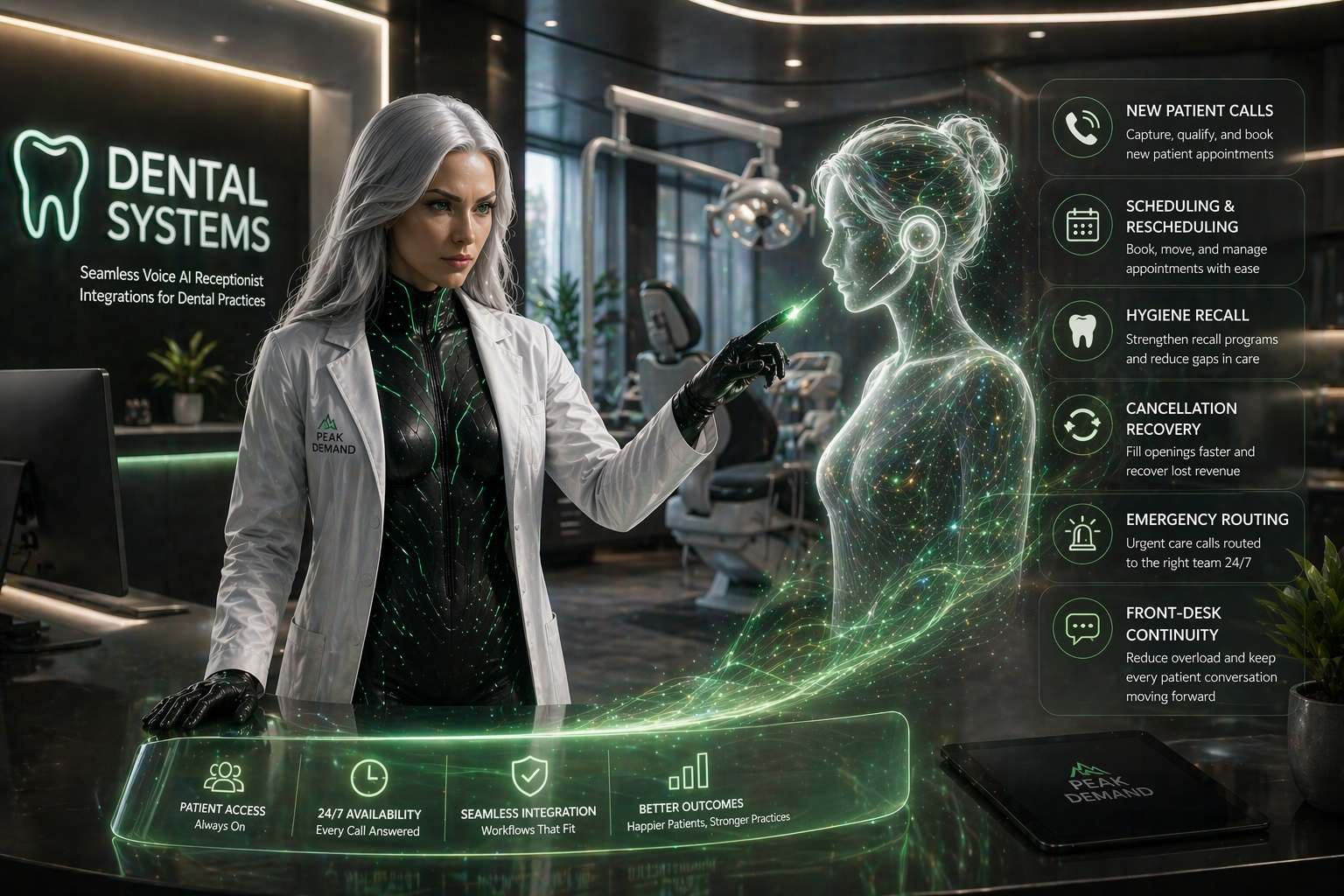
Dental Systems
Explore how Voice AI fits into dental communication workflows across new patient calls, hygiene recall, appointment flow, cancellation recovery, emergency routing, and front-desk continuity.

Veterinary Systems
Explore how Voice AI fits into veterinary environments across appointment continuity, client intake, urgent call routing, after-hours handling, and front-desk workflow support.

Chiropractic and Specialty Rehab Systems
Explore how Voice AI fits into chiropractic and specialty rehab workflows across scheduling, intake, recurring visits, SOAP-adjacent continuity, imaging-adjacent coordination, and front-desk support.
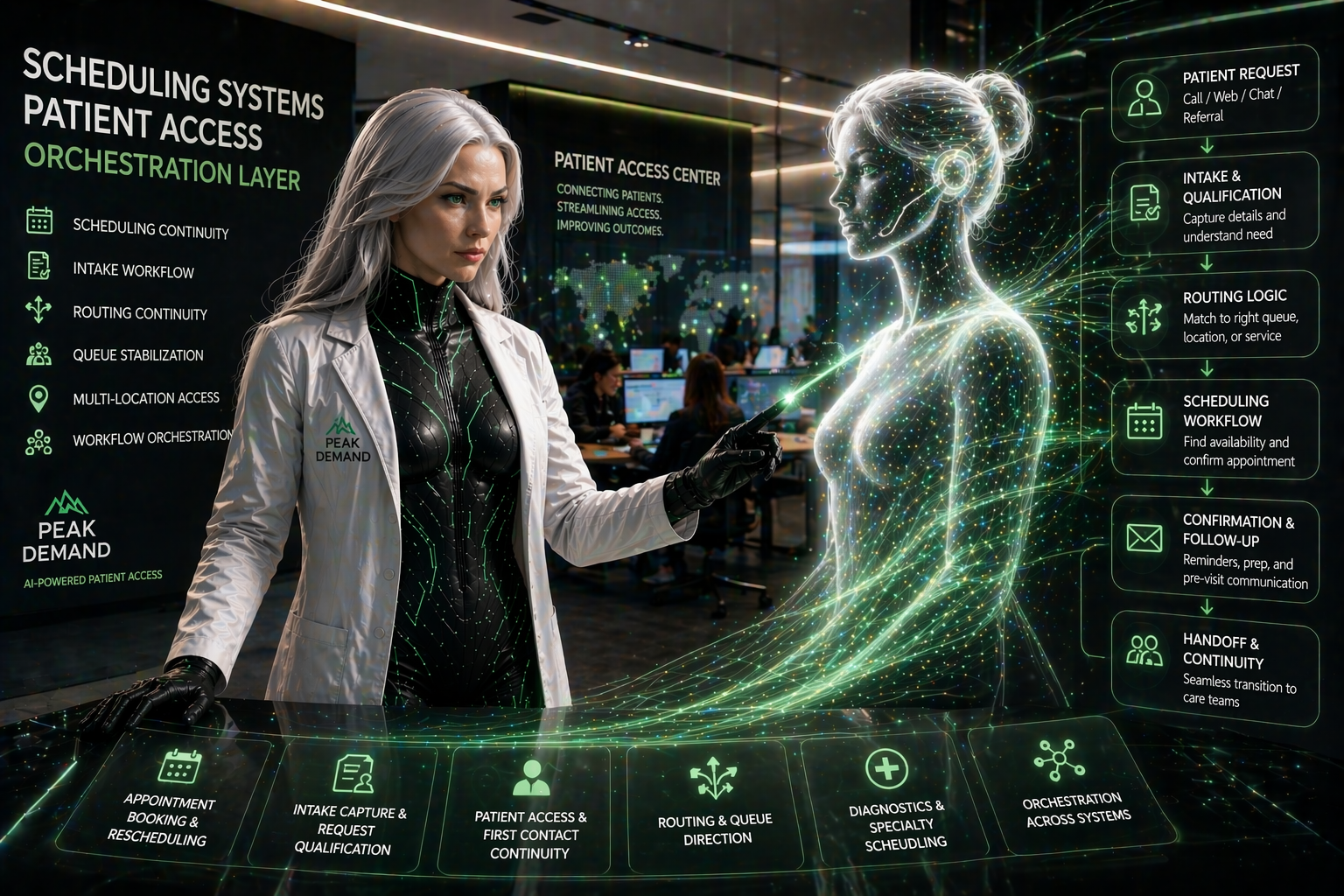
Scheduling, Patient Access, and Orchestration Systems
Explore how Voice AI supports scheduling and patient access architecture across intake, routing, queue stabilization, diagnostics scheduling, and workflow continuity between first contact and next action.
See Healthcare Voice AI Integrations In Action
These walkthroughs show how Voice AI can connect into real healthcare scheduling, intake, and communication environments. Start with TELUS Health CHR for Canadian clinic workflows and Juvonno for rehab and allied health operations.
TELUS Health CHR Integration Walkthrough
See how Voice AI can support TELUS Health CHR scheduling, intake, patient communication, and Canadian clinic workflow continuity.
Juvonno Integration Walkthrough
See how Voice AI can support Juvonno workflows for rehab scheduling, intake, appointment handling, and clinic communication continuity.
Explore published healthcare systems by name
Once you know the software family that best matches your environment, this section makes it easier to browse live healthcare integration pages by platform name. Each category below groups published system pages by the type of environment they usually support so operators, managers, and technical teams can compare workflow fit more quickly. A fuller alphabetical directory appears farther down the page.
Featured healthcare systems
These are high-priority starting points for visitors evaluating real-world Voice AI workflow fit across scheduling, intake, patient communication, routing, and access workflows.
Clinic, ambulatory, and medical EMR systems
These systems are commonly associated with clinic records-adjacent workflows, appointment flow, patient requests, intake continuity, routing, and broader ambulatory communication operations.
Scheduling, intake, and patient communication systems
These environments sit closer to booking logic, intake flow, reminders, clinic administration, and day-to-day patient access operations.
Rehab, physiotherapy, and allied health systems
Allied health and rehabilitation environments often depend on strong scheduling continuity, practitioner matching, intake flow, recurring appointment management, and multi-location operational coordination.
Dental systems
Dental communication workflows often center around appointment demand, cancellation recovery, reminders, new patient calls, and front-desk continuity across booked production.
Veterinary systems
Veterinary communication environments often require appointment continuity, client communication, after-hours handling, urgent call direction, and records-adjacent workflow coordination.
Healthcare organizations rarely evaluate integrations in a vacuum. Grouping systems by software family makes it easier to understand likely workflow fit, compare environments more quickly, and navigate toward both family-level integration pages and live system-specific pages deeper in this hub. The full alphabetical system directory farther down the page should carry the complete 98-system library.
Where Voice AI sits in the healthcare workflow matters more than basic connectivity
Healthcare Voice AI becomes more useful when it is treated as part of the larger workflow architecture around patient access, intake, routing, scheduling, escalation, and downstream ownership. The question is not only whether a system connects. The question is whether the communication flow reaches the next operational step with enough clarity and structure to reduce friction instead of shifting it downstream.
In practice, that means Voice AI often sits across multiple workflow layers at once. It may support first contact, gather structured intake, help direct the caller into the right path, preserve context for staff, and improve continuity into the next step. The value comes from how those layers fit together, not from one isolated connection point.
This is why healthcare teams should evaluate both the scheduling and patient access layer and the EMR or EHR-adjacent layer. In more complex environments, the architecture may also need to account for enterprise compliance and procurement requirements.
Where Voice AI usually enters the workflow
Voice AI often enters at the communication edge: inbound calls, appointment demand, intake capture, after-hours answering, overflow handling, and patient access or routing-related first contact.
Explore healthcare AI receptionistsWhere continuity usually breaks down
Continuity often breaks between the interaction and the next operational owner. That can happen when routing is weak, intake is unclear, scheduling context is incomplete, or downstream teams still need to manually rebuild the request.
Explore centralized scheduling workflowsWhat stronger integration architecture actually improves
Stronger architecture preserves enough structure, direction, and next-step usability for staff or systems to act efficiently. That is what turns Voice AI into operational infrastructure instead of a disconnected front-end layer.
Return to the healthcare resource hub| Integration maturity | What healthcare teams usually experience | Likely operational result |
|---|---|---|
| Fragmented | Some connection points exist, but scheduling, intake, routing, escalation, and continuity still require heavy manual repair. | Lower operational value, more staff burden, weaker patient access continuity, and less confidence in the workflow. |
| Partially connected | Important workflow layers connect, but structure and downstream usability still vary too much between teams, departments, or next-step owners. | Moderate gains, but persistent continuity gaps remain and staff still absorb unnecessary workflow friction. |
| Workflow-led and integrated | Voice AI supports multiple workflow layers with stronger structure, clearer routing, better handoff, and more usable next-step continuity. | Stronger patient access flow, cleaner operational ownership, and more scalable communication infrastructure. |
What healthcare teams should evaluate in the architecture discussion
- Where does Voice AI need to sit first in the communication workflow?
- Where does continuity currently break between the interaction and the next operational step?
- Which layers are EMR or EHR-adjacent, and which ones are workflow-adjacent?
- How do scheduling, intake, routing, patient access, and escalation interact in this environment?
- Will downstream teams receive enough structure to act without rebuilding the request manually?
- Is the integration design workflow-led or just feature-led?
- Does the current architecture reduce friction for staff, or does it simply move the work somewhere else?
Healthcare organizations usually get more value when they evaluate integration maturity across communication flow, operational ownership, and downstream usability together instead of treating each connection as a separate isolated decision. For system-specific evaluation, use the alphabetical healthcare system directory below.
Evaluating software families?
Use the six system-family pages to compare EMR, EHR, dental, veterinary, rehab, scheduling, and patient access environments.
Browse Software FamiliesEvaluating specific systems?
Use the full alphabetical directory to find the exact healthcare platform your team is evaluating.
Open System DirectoryEvaluating enterprise readiness?
Review governance, privacy, escalation, procurement, and compliance considerations before deployment.
Review ComplianceGo deeper into the strategy behind healthcare Voice AI integrations
This section helps healthcare teams move from broad category understanding into the right supporting resources for architecture, interoperability, workflow fit, implementation planning, and system-specific evaluation.
The articles below are the best next clicks for teams evaluating how Voice AI fits into healthcare communication systems, patient access workflows, structured integration pathways, rollout planning, and governed healthcare environments.
For broader category education, use the Healthcare Voice AI Resource Hub. For software-specific evaluation, continue to the full alphabetical system directory lower on this page and use the six healthcare software family pages as the parent layer.
Need system-family pages?
Use the family pages to compare medical EMR, allied health, dental, veterinary, specialty rehab, and patient access systems.
Browse Software FamiliesNeed a specific platform?
Use the alphabetical system directory to find the exact EMR, EHR, scheduling, dental, veterinary, or rehab platform.
Open System DirectoryNeed compliance context?
Use the enterprise compliance page when governance, privacy, procurement, RFPs, or regulated deployment requirements are part of the evaluation.
Review ComplianceCore integration strategy articles
These resources explain why integrations matter, what healthcare teams should evaluate first, and how stronger Voice AI integration architecture should be understood.
Custom pathways, structured integrations, and workflow fit
These articles are useful for teams evaluating custom pathways, structured communication flows, and how Voice AI fits into real healthcare operating environments.
Rollout, implementation, and governance
These resources are best for healthcare teams moving from early exploration into rollout planning, operational safety, implementation readiness, and governance-aware deployment.
Patient access, routing, and workflow bottlenecks
These articles help healthcare teams think more clearly about where communication complexity builds up across patient access, intake, department routing, scheduling, and downstream handoff.
As the healthcare integrations ecosystem continues to grow, this section can keep routing visitors into the most relevant strategy, rollout, and workflow resources without changing the overall structure of the hub. The full software directory appears in the Alphabetical System Directory section below.
Explore live healthcare system integration pages by category
This section gives healthcare teams a category-based way to browse the most important live system pages. It is not the full 98-system directory; it is a curated navigation layer for comparing the platforms most commonly tied to scheduling, intake, patient communication, routing, and patient access workflows.
Use this section when you know the type of software environment you are evaluating. Use the Alphabetical System Directory below when you want to find every live system page by name.
Need the family layer?
Start with the six parent family pages when comparing software categories before choosing a specific system.
Browse Software FamiliesNeed every system?
Use the alphabetical directory for the complete live healthcare system page list by platform name.
Open Alphabetical DirectoryNeed workflow context?
Review how Voice AI fits across patient access, intake, routing, scheduling, escalation, and downstream ownership.
Review Workflow ArchitectureFeatured healthcare systems
These are some of the strongest starting points for teams exploring healthcare Voice AI integrations across scheduling, intake, patient communication, routing, and access workflows.
Clinic and ambulatory EMR systems
These systems are commonly associated with clinic records-adjacent workflows, intake, appointment flow, routing, patient communication, and broader ambulatory continuity.
Explore medical and ambulatory EMR familyScheduling, intake, and patient communication systems
These environments sit closer to booking logic, intake flow, reminders, clinic administration, and day-to-day patient access operations.
Explore scheduling and patient access familyRehab, physiotherapy, and allied health systems
Allied health and rehabilitation environments often depend on strong scheduling continuity, practitioner matching, intake flow, recurring appointments, and multi-location coordination.
Explore allied health and rehab familyDental systems
Dental communication workflows often center on appointment demand, cancellation recovery, reminders, new patient calls, and front-desk continuity.
Explore dental familyVeterinary systems
Veterinary communication environments often require appointment continuity, client communication, after-hours handling, and records-adjacent workflow coordination.
Explore veterinary familyEnterprise, specialty, imaging, and outpatient environments
These environments often involve more complex routing, diagnostic scheduling, imaging coordination, enterprise workflow ownership, and department-specific handoff requirements.
Explore enterprise and medical EMR familyThis curated category browse section helps visitors compare common healthcare software environments without scrolling the entire directory. The complete system list belongs in the Alphabetical System Directory section below, where every live healthcare system page should be listed by platform name.
Talk through your healthcare communication workflow
If your team is evaluating healthcare Voice AI integrations, the most useful next step is usually a workflow conversation. That means reviewing patient access pressure points, scheduling flow, intake structure, routing logic, after-hours coverage, compliance expectations, and the systems surrounding those workflows.
Peak Demand approaches healthcare environments through workflow fit, governance awareness, and operational usability. The goal is to help organizations map a communication architecture that supports real teams, real workflows, and real continuity requirements across EMR, EHR, scheduling, intake, dental, veterinary, rehab, and patient access environments.
Need software families?
Compare the six parent healthcare integration families before choosing a specific system page.
Browse software familiesNeed workflow context?
Review how Voice AI fits across intake, routing, scheduling, escalation, and downstream ownership.
Review workflow architectureNeed compliance review?
Use the enterprise compliance page when governance, privacy, procurement, and RFP standards matter.
Review complianceFrequently asked questions
What does Voice AI mean in a healthcare integration environment?
Can Voice AI work with EMR, EHR, scheduling, intake, and routing workflows?
Are healthcare Voice AI integrations always direct?
Where should healthcare organizations start evaluating Voice AI integrations?
How should compliance and governance fit into the evaluation?
What is the role of this integrations hub?
About Peak Demand
Peak Demand is a Toronto-based AI agency focused on Voice AI, communication automation, and workflow infrastructure for organizations operating in more complex service environments.
In healthcare, the focus is not just on call handling. It is on patient access continuity, scheduling pressure, intake structure, routing logic, after-hours support, governance, and how communication systems fit into real operational workflows.
- Workflow-driven and implementation-aware
- Governance-first in healthcare communication environments
- Built to support clinics, networks, and enterprise teams
- Designed to scale into software-specific integration pathways
- Organized around healthcare system families and live integration pages
Healthcare software integrations by system name
If you already know the software you are evaluating, this alphabetical directory is the fastest way to find the right live system page.
This directory includes the full 98-system healthcare integration library from the current Peak Demand system-page build. It is designed to help teams compare EMR, EHR, scheduling, intake, patient communication, dental, veterinary, rehab, wellness, chiropractic, orchestration, home care, med spa, pharmacy, and enterprise healthcare systems by software name.
For category-level browsing, use the software family section. For workflow context, use the workflow architecture section. This section is the full alphabetical browse layer.
Live healthcare system pages in this directory
Grouped alphabetically with visible section counts so the full library is obvious at a glance.
A–C
34 systemsABELMed through Curve Dental.
D–H
20 systemsDentrix through Helios Software.
I–M
15 systemsIDEXX Cornerstone through MRX Solutions.
N–O
11 systemsNextech through Owl Practice.
P–R
8 systemsPabau through RXNT.
Compare healthcare systems by name, category, and workflow fit
This directory is useful for comparing clinic EMRs, EHR-adjacent systems, scheduling and intake platforms, patient communication software, dental systems, veterinary systems, rehab and allied health systems, chiropractic systems, med spa systems, home care systems, pharmacy-adjacent systems, orchestration platforms, diagnostic workflows, and enterprise healthcare environments by software name before going deeper into workflow design, integration possibilities, and operational fit.
Explore your own AI use case on a discovery call.