

Healthcare Integrations Hub

Healthcare Voice AI Integrations

Healthcare Voice AI becomes far more valuable when it fits into the systems and workflows that shape scheduling, intake, routing, patient access, after-hours continuity, and broader communication operations. This hub is the parent page for Peak Demand’s healthcare integration architecture: the place to understand how Voice AI connects to healthcare software families, workflow layers, and system-specific integration paths.

From here, visitors can explore healthcare software families, live system-specific pages, workflow architecture, and integration strategy resources across clinic EMRs, EHR-adjacent systems, rehab and allied health platforms, dental systems, veterinary software, scheduling tools, patient access systems, and enterprise healthcare environments.

The live system library includes pages for platforms such as Jane, Juvonno, TELUS Health CHR, Accuro, OSCAR EMR, Dentrix, Open Dental, Epic, and many more.

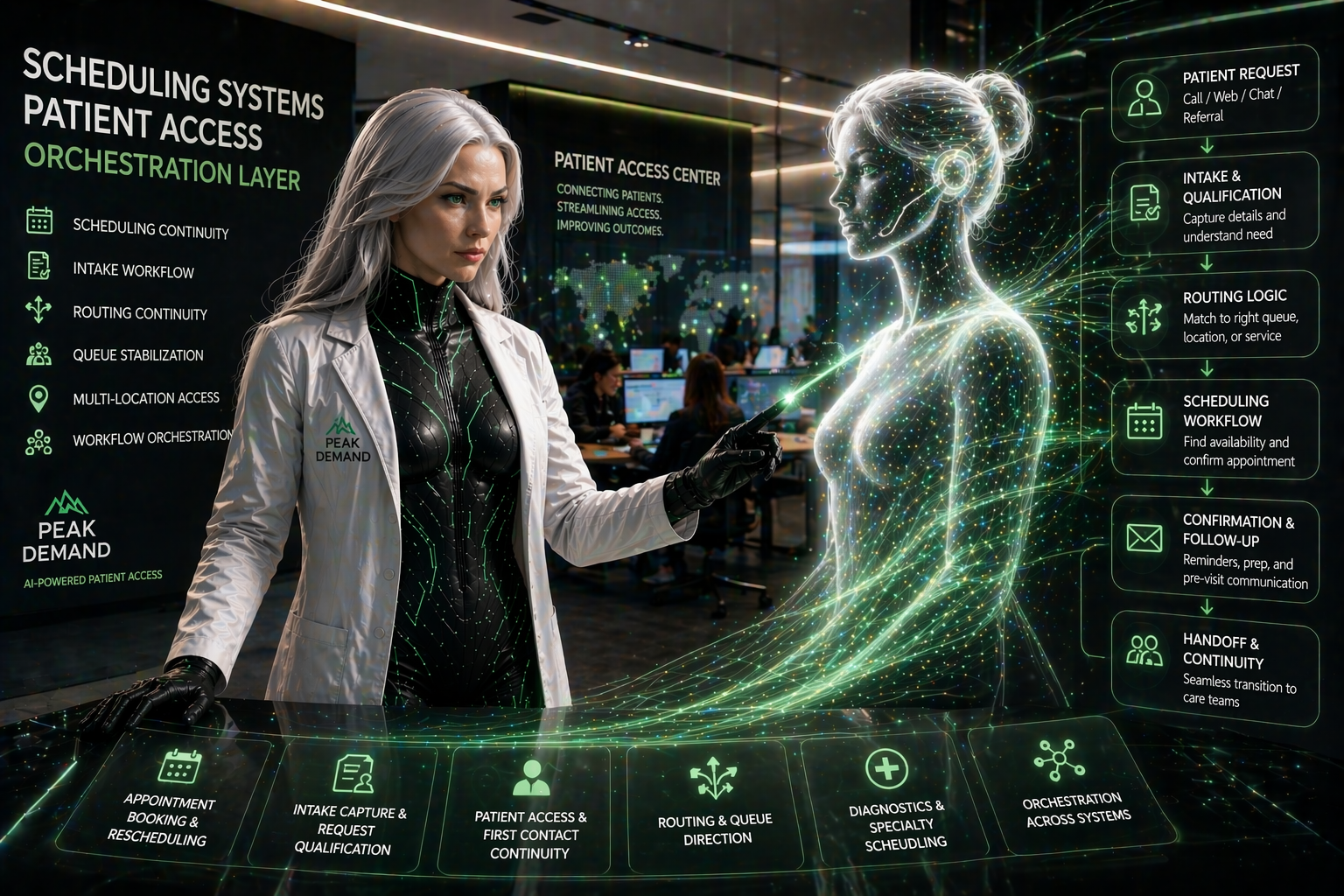
Healthcare Voice AI integrations hub visual showing virtual AI agents connecting healthcare systems workflows scheduling intake routing and patient access infrastructure

Architecture Role

Parent hub for healthcare integrations

System Coverage

98 healthcare system pages

Software Families

6 healthcare integration families

Workflow Focus

Scheduling, intake, routing, access

What Integrations Actually Mean

Healthcare integrations should be evaluated through workflow continuity

One of the biggest mistakes in healthcare integration conversations is reducing the discussion to a list of software names. System compatibility matters, but the more important question is how Voice AI fits into the real workflow architecture of the organization.

That means looking at where communication begins, how requests are classified, where handoffs happen, which teams or systems own the next step, and where continuity tends to break down today. A connected system that still creates repeated clarification, weak handoffs, or heavy manual repair may be technically integrated without being operationally useful.

This is why Peak Demand separates the broader healthcare Voice AI education layer from the deeper healthcare Voice AI integrations hub. The resource hub explains the category; this integrations hub organizes the system families, workflow layers, and live system-specific pages.

Why this matters

In healthcare, integrations are not only about whether Voice AI can touch an EMR, EHR, scheduler, intake system, or routing layer. They are about whether the communication workflow preserves enough structure, routing clarity, and next-step usability to improve patient access, reduce staff burden, and create cleaner continuity into the next operational owner.

Layer 1

EMR / EHR-Adjacent Workflows

The highest-value integration question is often not “does it connect to the record system,” but what part of the communication workflow needs support before, around, and between formal system steps.

  • Context continuity before staff handoff
  • Workflow support around formal system ownership
  • Communication layers that sit adjacent to records
Layer 2

Scheduling Systems

Scheduling integrations are about more than calendars. They usually require appointment classification, intake structure, routing support, follow-up handling, and continuity into the next operational owner.

  • Booking and rescheduling logic
  • Shared scheduling pool complexity
  • Diagnostic and specialty scheduling handoff
Layer 3

Intake Systems

Intake is often where ambiguity becomes workflow. Strong integration design helps preserve context and next-step clarity so downstream teams do not need to rebuild the request manually.

  • Structured intake capture
  • Request qualification and triage
  • Usable next-step data for staff
Layer 4

Routing, Switchboard, and Call Flow Systems

Routing is really a direction problem. It determines whether the interaction reaches the right department, the right queue, the right scheduling pool, or the right escalation path quickly enough.

  • Department and service-line direction
  • Transfer reduction
  • Escalation-aware call flow design
Layer 5

Patient Access Infrastructure

Patient access is one of the clearest places where multiple workflow layers intersect. Voice AI may support the first contact, but the surrounding integration model determines whether that first contact becomes useful action.

  • Access continuity across teams
  • First-contact usability
  • Downstream ownership and actionability
Layer 6

After-Hours and Escalation Layers

After-hours handling is not just an answering problem. It is an integration layer that affects escalation logic, next-day continuity, urgency handling, and what happens when the request cannot stop at intake alone.

  • Escalation rules and thresholds
  • Next-business-step continuity
  • Urgency-aware workflow design

Stronger healthcare integrations usually support multiple workflow layers at once. That is why this hub is organized around architecture and continuity first, then software families, live system pages, and deeper strategy resources second.

Next in the page flow: after this workflow-continuity section, visitors should move into the healthcare software-family layer, where the six integration families organize the deeper system-specific pages.

Browse Healthcare Software Families
Sasha with Cresta in a Peak Demand Voice AI system profile illustrating Contact-center AI agents

Cresta Enterprise Voice AI: Capabilities, Integrations & Implementation

August 14, 2026
CrestaIndependent Voice AI System Profile
Voice AI Platform Profile • Cresta

Cresta Voice AI: Enterprise Capabilities, Integrations & Implementation Architecture

Cresta is an enterprise contact-center AI platform delivering real-time AI Agents, Agent Assist, Conversation Intelligence, no-code orchestration and test-and-deploy tooling. Vendor materials emphasize API-based integrations to telephony, CRM and knowledge systems while leaving low-level telephony and media transport details outside the supplied docs.

Peak Demand evaluates the platform in the context of telephony, APIs, business rules, integrations, QA, monitoring, and the operating environment around the agent.

Discuss a Cresta Deployment
Quick Answer

What Is Cresta?

Cresta is an enterprise contact-center AI platform focused on real-time AI Agents and Agent Assist across voice and digital channels, with no-code orchestration (Conductor), conversation intelligence, integrated testing/simulation, and documented API-based function calling for integrations. The supplied vendor pages describe telephony as an integration point but do not publish low-level SIP/trunking or PSTN API details in the reviewed corpus.

Platform at a Glance

Cresta Platform Profile

Cresta

Enterprise platform • Contact-center AI agents

Primary roleEnterprise platform / Contact-center AI agents
Peak Demand fitEnterprise choice
Technology layerEnterprise platform
Template familyenterprise voice ai
Official platformOfficial site
Last researched2026-08-14
Independent implementation profile. Third-party product and company names are trademarks of their respective owners. Peak Demand is an independent implementation and integration provider unless otherwise stated.
Sasha with Cresta in a Peak Demand Voice AI system profile illustrating Contact-center AI agents
Cresta • Peak Demand System ProfileCustom platform visual
Platform Role

Where Cresta Fits in a Voice AI Technology Stack

Best fit for large contact centers and regulated enterprises deploying AI agents across voice, chat and SMS; also suited to teams that require integrated testing, synthetic-customer simulation and governance controls. Less fit for teams seeking a standalone SIP trunking provider or public developer SDKs/pricing in the supplied documentation.

Reference Architecture

A Typical Cresta Production Architecture

The exact architecture depends on the business environment, but Peak Demand evaluates the platform as one layer inside a connected production system.

CallerInbound or outbound interaction
Telephony / MediaPhone, SIP, CPaaS or realtime transport
CrestaEnterprise platform / Contact-center AI agents
Peak Demand Control LayerRules, APIs, auth, middleware
Business SystemsCRM, scheduling, database, industry software
OutcomeBooking, routing, update, support or handoff
Capability Profile

Cresta Capabilities Relevant to Production Voice AI

CapabilityCurrent positionScopeImplementation context
Inbound callingLimited / conditionalPlatform-familyPlatform materials describe real-time voice conversations and telephony integrations for customer interactions and omnichannel voice support, but the supplied documentation does not publish low-level inbound call APIs or PSTN endpoints—telephony is described as an integration point of the platform.
Outbound callingLimited / conditionalPlatform-familyCresta AI Agent is described as initiating outreach (e.g., collections outreach, follow-ups) and managing negotiations, indicating outbound contact capabilities; details on telephony transport or outbound dialing APIs are not documented in the supplied corpus.
Telephony / phone routingNot found in reviewed official docsNot applicable / unresolvedNot found in the official documentation reviewed for this profile; this is not a claim that the capability is unsupported.
SIP / trunkingNot found in reviewed official docsNot applicable / unresolvedNot found in the official documentation reviewed for this profile; this is not a claim that the capability is unsupported.
Webhooks / callbacksNot found in reviewed official docsNot applicable / unresolvedNot found in the official documentation reviewed for this profile; this is not a claim that the capability is unsupported.
Public APIsEstablishedPlatform-familyDocs reference secure API-based function calling and standardized tool access for AI agents to connect to CRM, billing, scheduling, and other systems, establishing the presence of API-based integration primitives at the platform level.
SDKs / developer librariesNot found in reviewed official docsNot applicable / unresolvedNot found in the official documentation reviewed for this profile; this is not a claim that the capability is unsupported.
Tool / function callsEstablishedPlatform-familyCresta documents secure API-based function calling and MCP support, and states the platform standardizes tool access to reduce integration complexity for automation and real-time actions.
Transfers / forwarding / handoffEstablishedProduct-nativeProduct materials state shared memory ensures context is preserved across channels and handoffs, including handoffs between human and AI agents, indicating built-in handoff/transfer semantics in the AI Agent experience.
Conference / queue primitivesNot found in reviewed official docsNot applicable / unresolvedNot found in the official documentation reviewed for this profile; this is not a claim that the capability is unsupported.
Appointment bookingNot found in reviewed official docsExternal integrationNot found in the official documentation reviewed for this profile; this is not a claim that the capability is unsupported.
Calendar integrationNot found in reviewed official docsExternal integrationNot found in the official documentation reviewed for this profile; this is not a claim that the capability is unsupported.
Knowledge bases / retrievalEstablishedProduct-nativeCresta documents real-time knowledge to equip agents with instant access to the right information and processes, and references Knowledge Agent, AI Summaries, and pushing answers into agent workflows.
Workflow automationEstablishedProduct-nativePlatform overview describes a no-code orchestration engine to design dynamic AI workflows, fine-tune models, and operationalize AI across CX; Conductor provides natural-language orchestration for the agent lifecycle.
Integrations / connectorsEstablishedProduct-nativeAn Integrations page and platform materials document seamless integration with telephony, chat, knowledge, CRM/CEC, marketing, and data systems to connect conversations, data, knowledge and outcomes.
Call recordingLimited / conditionalProduct-nativeConversation Intelligence and other materials reference capturing conversations, transcripts, and pushing AI-generated summaries; the supplied corpus does not include detailed recording controls, retention policies, or implementation specifics.
Transcription / speech-to-textEstablishedProduct-nativeAI Analyst and Conversation Intelligence reference analyzing conversation transcripts and reasoning across transcripts, indicating speech-to-text transcription is part of the platform's product capabilities.
Text-to-speech / voicesEstablishedProduct-nativeDocumentation states Cresta helps configure voice, pacing, pronunciation, and that AI Agents deliver human-like conversations—indicating TTS/voice configuration capabilities are provided for voice channels.
Realtime audio / media streamingLimited / conditionalProduct-nativeCresta emphasizes real-time voice conversations and real-time generative AI for live guidance and omnichannel interactions; the supplied corpus does not publish low-level streaming/media transport APIs or SDKs for raw media streaming.
DTMF / speech gatherNot found in reviewed official docsNot applicable / unresolvedNot found in the official documentation reviewed for this profile; this is not a claim that the capability is unsupported.
Call logs / analytics / observabilityEstablishedProduct-nativeConversation Intelligence, AI Analyst, Real-Time Trends and other features provide analytics, trending, outcome insights, and observability across conversations and agent performance.
Testing / simulationEstablishedProduct-nativeA dedicated Test & Deploy product page documents synthetic customer simulation, LLM evaluators, test coverage generation, A/B testing, staging, versioning/rollbacks, and Conductor-driven evals.
Language supportEstablishedProduct-nativeCresta states AI agents deliver consistent experiences across voice, chat and SMS in more than 30 languages.
Security / complianceEstablishedPlatform-familyTrust materials document enterprise security practices (SDLC, penetration testing, continuous monitoring), certifications and standards references (ISO/IEC 42001, PCI-DSS, ISO 27701) and responsible AI governance.
Pricing / billing modelNot found in reviewed official docsNot applicable / unresolvedNot found in the official documentation reviewed for this profile; this is not a claim that the capability is unsupported.

Capabilities marked “Not found in reviewed official docs” were not located in the official documentation corpus reviewed for this profile; that status does not mean the capability is unsupported.

Integration Pathway

How Cresta Can Connect to Business Systems

Cresta documents platform-level integrations via secure API-based function calling to CRM, billing, scheduling and knowledge systems, and lists telephony and chat as integration targets. These vendor materials present integrations as first-class platform points but do not include low-level telephony transport (SIP/trunking/PSTN dialing) or published webhook/streaming API specs in the supplied pages.

01

Cresta documents integration with telephony, chat, knowledge systems, CRM/CEC, billing and scheduling via secure API-based function calling—these are framed as platform integration points rather than published low-level telephony/SIP specs (sources: 2, 4, 9).

02

For appointment booking and calendar tasks, Cresta describes connecting to scheduling systems via API calls but does not document a native calendar engine in the supplied corpus (sources: 2, 4).

Good integration is more than making an API call. Production architecture should validate data, enforce business rules, protect credentials, handle failures, log outcomes, and define human escalation.
Workflow Fit

Common Cresta Use Cases

The platform includes a no-code orchestration engine (Conductor) and builder tooling to design AI workflows, fine-tune agent behavior, run natural-language driven edits, and operationalize versions. Workflows can be tested using built-in simulation and LLM-based evaluators before deployment.

01

AI Agents for inbound and outbound customer conversations including collections outreach

02

Agent Assist for real-time guidance, summaries, and workflow automation

03

Conversation Intelligence and AI Analyst for CX research, QA, and insights

04

Automation Discovery to prioritize and export agent flows into agent builder

Strengths

Where Cresta May Be Particularly Strong

Key strengths documented in vendor materials:

Strength 1

Real-time voice and omnichannel AI agents and Agent Assist (multi-channel, >30 languages)

Strength 2

Conversation Intelligence and AI Analyst for transcript-driven insights

Strength 3

No-code orchestration and natural-language build/test/deploy tooling (Conductor)

Strength 4

Enterprise security and compliance posture (certifications and governance cited)

Strength 5

Built-in testing, simulation (Synthetic Customers), and LLM-based evaluators for safe deployments

Tradeoffs

Where Cresta May Not Be the Best Fit

Technical tradeoffs and documentation gaps surfaced in the reviewed materials:

Consideration 1

Vendor materials emphasize platform integrations for telephony but do not document low-level SIP/trunking or PSTN APIs in the supplied corpus

Consideration 2

Details about recording retention controls, media streaming APIs, SDKs, and webhook endpoints are not present in the reviewed docs

Peak Demand Selection View

When Peak Demand May Choose Cresta

Choose Cresta when you need enterprise-grade conversation AI with integrated testing and governance; evaluate additional vendor docs if your project requires published telephony transport specs, raw media streaming APIs, or explicit developer SDKs.

Best-fit pattern 1

Large contact centers and enterprises deploying AI agents across voice, chat, and SMS

Best-fit pattern 2

Regulated industries requiring governance (banking, healthcare, insurance) as cited in trust materials

Best-fit pattern 3

Organizations that require integrated testing and simulation for agent deployments

When another platform may deserve a closer look

Evaluate alternatives when 1

Teams seeking a standalone SIP trunking provider or explicit low-level telephony routing/trunk management (not documented in reviewed corpus)

Evaluate alternatives when 2

Projects requiring published public pricing or developer SDKs (not found in supplied sources)

Security & Data

Security, Data Handling & Compliance Considerations

Cresta's trust materials describe enterprise security practices (SDLC controls, static analysis, dependency scanning, access controls, continuous monitoring, penetration testing) and reference certifications/standards (ISO/IEC 42001 for AI governance plus PCI-DSS and ISO 27701 references). The supplier also documents responsible-AI practices such as PII redaction and model monitoring.

01

Security and privacy materials claim enterprise-grade controls: SDLC, static analysis, dependency scanning, access controls, continuous monitoring, third-party penetration testing, and a vulnerability disclosure process (source: 8).

02

Cresta references ISO/IEC 42001 certification for AI governance and compliance with PCI-DSS and ISO 27701 in the supplied trust materials (source: 8).

03

Platform materials emphasize privacy-by-design, PII redaction, and model monitoring as part of responsible AI practices (source: 8).

Platform claims do not automatically make an implementation compliant. The end-to-end workflow still needs appropriate consent, permissions, retention, access controls, downstream-system safeguards, and applicable legal review.
Pricing & Cost Model

How Cresta Pricing Should Be Evaluated

No public pricing or billing model details were present in the supplied official pages; vendor CTAs route to sales/demo engagement. Contact Cresta for detailed pricing, licensing and deployment options.

01

No public pricing or billing model details were present in the supplied official pages; contact/demo CTAs are used for sales engagement (sources: 1, 2, 11).

Testing & Operations

Testing the Platform Before Production

The platform includes a dedicated Test & Deploy capability: synthetic customer simulation, LLM-based evaluators, test coverage generation, A/B testing, staging, versioning and rollback controls. These features are documented as part of an enterprise-safe agent rollout workflow.

Peak Demand Implementation Layer

What Peak Demand Adds Around Cresta

Practical implementation notes based on the reviewed corpus: Cresta standardizes tool/function access for agents and documents API-based integration patterns for CRM, scheduling and knowledge systems. Telephony is referenced as an integration point for voice and omnichannel interactions; however, low-level transport details (SIP/trunking), raw media streaming APIs, webhook endpoints and recording retention controls were not present in the supplied documentation and will likely require deeper technical documentation or partner integration planning.

Discovery & Platform Fit

Determine whether the platform is actually the right choice for the workflow before building around it.

Conversation & Agent Architecture

Design prompts, flows, variables, tools, validation, escalation and business logic.

Telephony & Realtime Infrastructure

Configure the appropriate phone, SIP, CPaaS or realtime transport layer for the deployment.

Middleware & APIs

Build controlled AWS, Cloudflare, API, webhook or middleware layers where systems require additional validation and orchestration.

Business-System Integration

Connect CRM, scheduling, EMR/EHR, ERP, databases, helpdesk, ordering, field-service or proprietary software where suitable integration surfaces exist.

QA & Managed Operations

Test workflows, monitor production behavior, review failures, measure outcomes and refine the implementation over time.

FAQ

Cresta Questions

Does Cresta provide real-time voice AI and Agent Assist?

Yes — vendor materials describe real-time voice AI Agents and Agent Assist that operate across voice, chat and SMS, providing live guidance, summaries and agent handoffs.

Are there published APIs for integrations?

Cresta documents secure API-based function calling and standardized tool access for integrations to CRM, knowledge, billing and scheduling systems; the reviewed pages indicate API-based integration primitives at the platform level.

Are low-level telephony (SIP/trunking/PSTN) details available in the supplier docs?

Not found in reviewed official docs: the supplied corpus repeatedly references telephony as an integration point but does not publish SIP/trunking, trunk management, or PSTN dialing API specifications.

Can Cresta initiate outbound calling or support collections outreach?

Vendor materials describe outbound outreach scenarios (for example collections and follow-ups) and AI Agents that manage negotiations, indicating outbound contact capabilities in the platform narrative; underlying transport and dialing API details were not documented in the supplied pages.

How does Cresta handle call recording and retention controls?

The platform documents conversation capture, transcripts and AI-generated summaries as part of Conversation Intelligence, but detailed recording controls, retention policy settings and media-encryption-at-rest specifics were not present in the reviewed materials.

Does Cresta provide media streaming or raw audio transport APIs for integrations?

Limited / conditional: Cresta emphasizes real-time audio and live generative AI, but the supplied corpus does not publish low-level streaming or media transport APIs and SDKs. Obtain technical integration docs from the vendor for media-level integration details.

What testing and deployment tooling does Cresta include?

The vendor documents a Test & Deploy product with synthetic customer simulation, LLM-based evaluators, test coverage generation, A/B testing, staging environments, versioning and rollback — all intended to validate agent behavior prior to production rollouts.

Also Evaluating Voice AI Platforms?

Explore Retell AI

Retell AI is one of the full-stack Voice AI platforms Peak Demand evaluates for phone-first deployments, custom integrations, telephony, APIs, and managed production workflows.

Explore Retell AI

Peak Demand may earn a commission from this link.

Cresta Implementation

Planning a Cresta Deployment?

Peak Demand can help evaluate platform fit, design the architecture, connect telephony and business systems, implement controlled tools and integrations, test edge cases, and manage the operational layer after launch.

Discuss a Cresta Deployment
Research Sources

Official Cresta Sources Reviewed

This profile is maintained using official or first-party vendor sources. Current vendor documentation remains the source of truth for an active production decision.

Last researched: 2026-08-14
Next recommended review: 2026-11-12

Third-party product and company names are trademarks of their respective owners. Peak Demand is an independent implementation and integration provider unless otherwise stated.
CrestaCresta integrationCresta voice AICresta APICresta implementation
blog author image

Peak Demand

At Peak Demand, we build and manage custom AI systems for organizations operating in complex, high-volume, and highly regulated environments. Based in Toronto, Canada, our work focuses on Voice AI, intelligent customer service automation, and the infrastructure required to connect AI agents with real business systems. We design AI voice agents that can handle customer inquiries, appointment booking, intake, routing, follow-up, service requests, and other operational workflows. These solutions are supported by custom integrations with scheduling platforms, CRMs, healthcare systems, APIs, and internal tools, allowing organizations to move beyond basic conversational AI and automate meaningful work. Our experience spans healthcare, municipal and transit services, utilities, manufacturing, real estate, and other operationally complex industries. We also provide managed Voice AI services, helping clients plan, deploy, monitor, test, and continuously improve their systems after launch. Alongside our Voice AI work, Peak Demand develops AI SEO and digital visibility strategies designed to help organizations become easier to discover across traditional search and emerging AI-powered platforms. What sets us apart is our ability to combine AI strategy, custom infrastructure, systems integration, and ongoing operational management. We build practical AI solutions that improve service delivery, reduce administrative workload, and create more efficient customer experiences.

Back to Blog
Explore Healthcare Software Families

Find your healthcare system by software family

Healthcare integrations are easier to evaluate when systems are grouped the way buyers actually think about them. Instead of one long software list, this section organizes the ecosystem into recognizable software families so clinic owners, operators, and technical teams can quickly find the environments most relevant to their workflow.

Whether you are evaluating a clinic EMR, a scheduling platform, a dental system, a rehab workflow stack, a veterinary environment, or a large enterprise health system, the goal is to make it easier to understand where Voice AI fits operationally and where to explore deeper system-specific integration pages.

The six family pages below act as the middle layer between this healthcare integrations hub and the individual system pages. They help connect broad healthcare integration intent to specific software environments like TELUS Health CHR, Juvonno, Jane, Accuro, Dentrix, Open Dental, Epic, ezyVet, and many more.

Explore the integration ecosystem by family
Voice AI receptionist integrations for medical and ambulatory EMR systems

Medical and Ambulatory EMR Systems

Explore how Voice AI fits into medical and ambulatory EMR environments across scheduling, intake, patient access, provider routing, after-hours continuity, and clinic communication workflows.

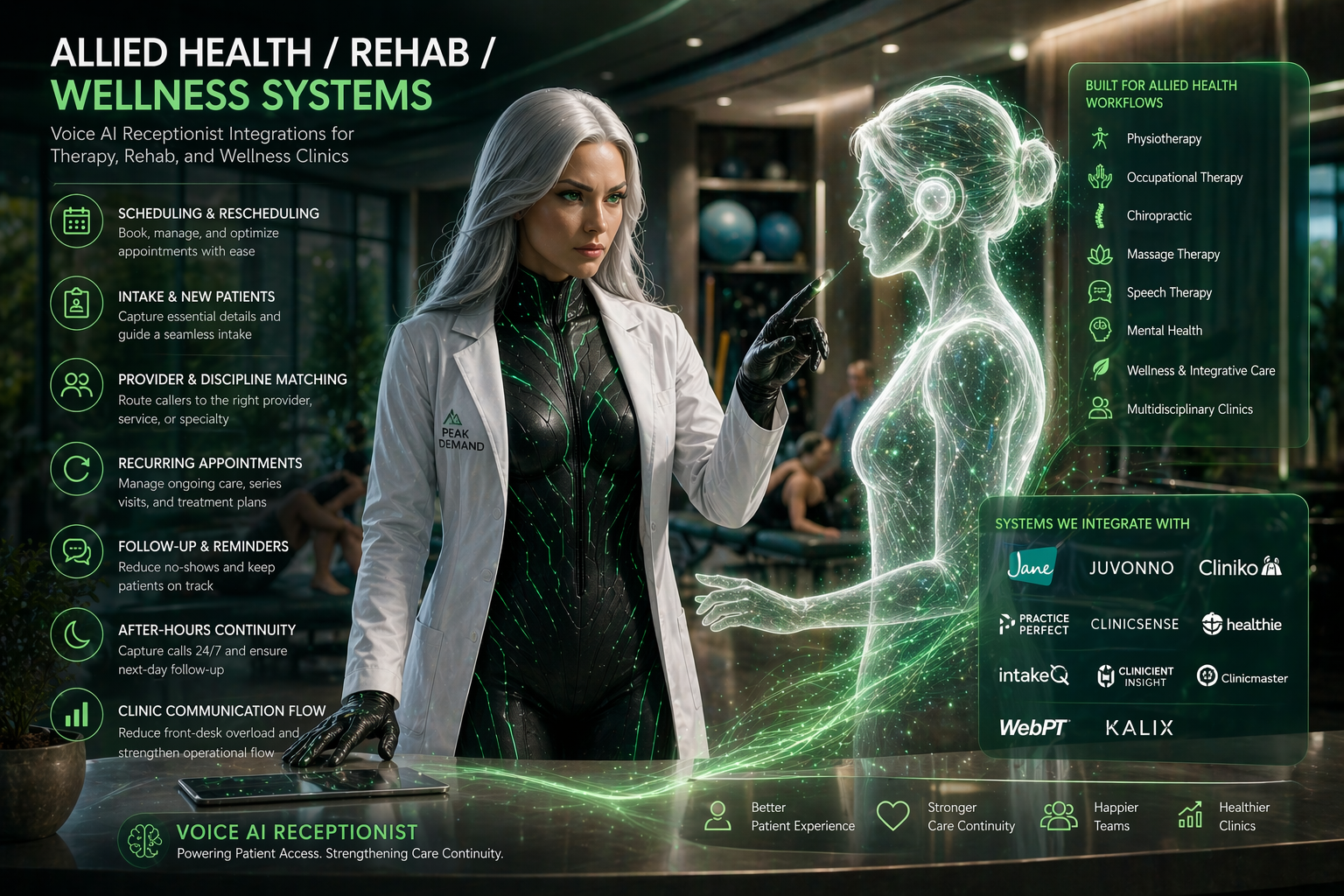
Voice AI receptionist integrations for allied health rehab and wellness systems

Allied Health, Rehab, and Wellness Systems

Explore how Voice AI supports allied-health and rehab workflows across recurring appointments, intake, provider matching, follow-up continuity, and front-desk communication support.

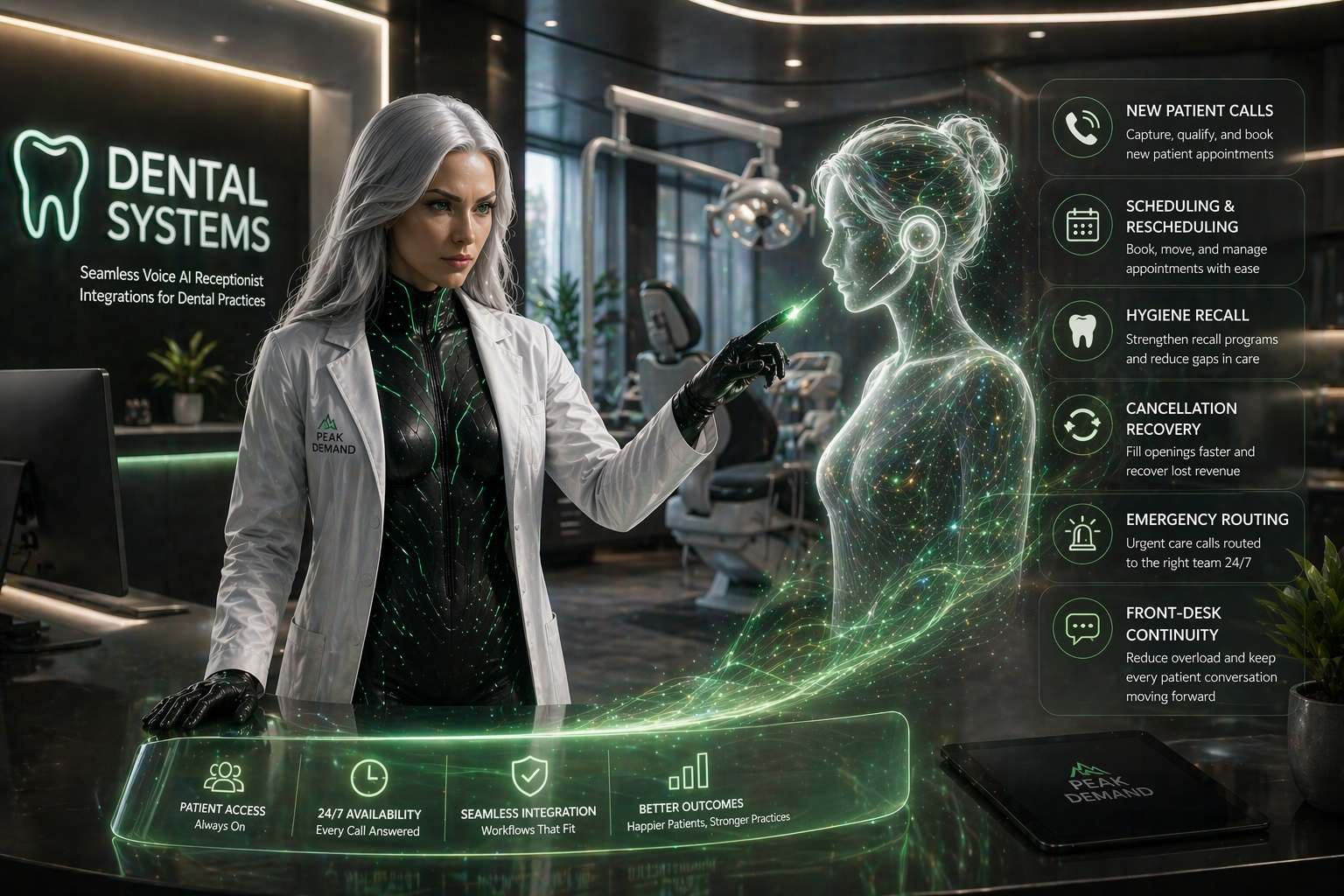
Voice AI receptionist integrations for dental systems

Dental Systems

Explore how Voice AI fits into dental communication workflows across new patient calls, hygiene recall, appointment flow, cancellation recovery, emergency routing, and front-desk continuity.

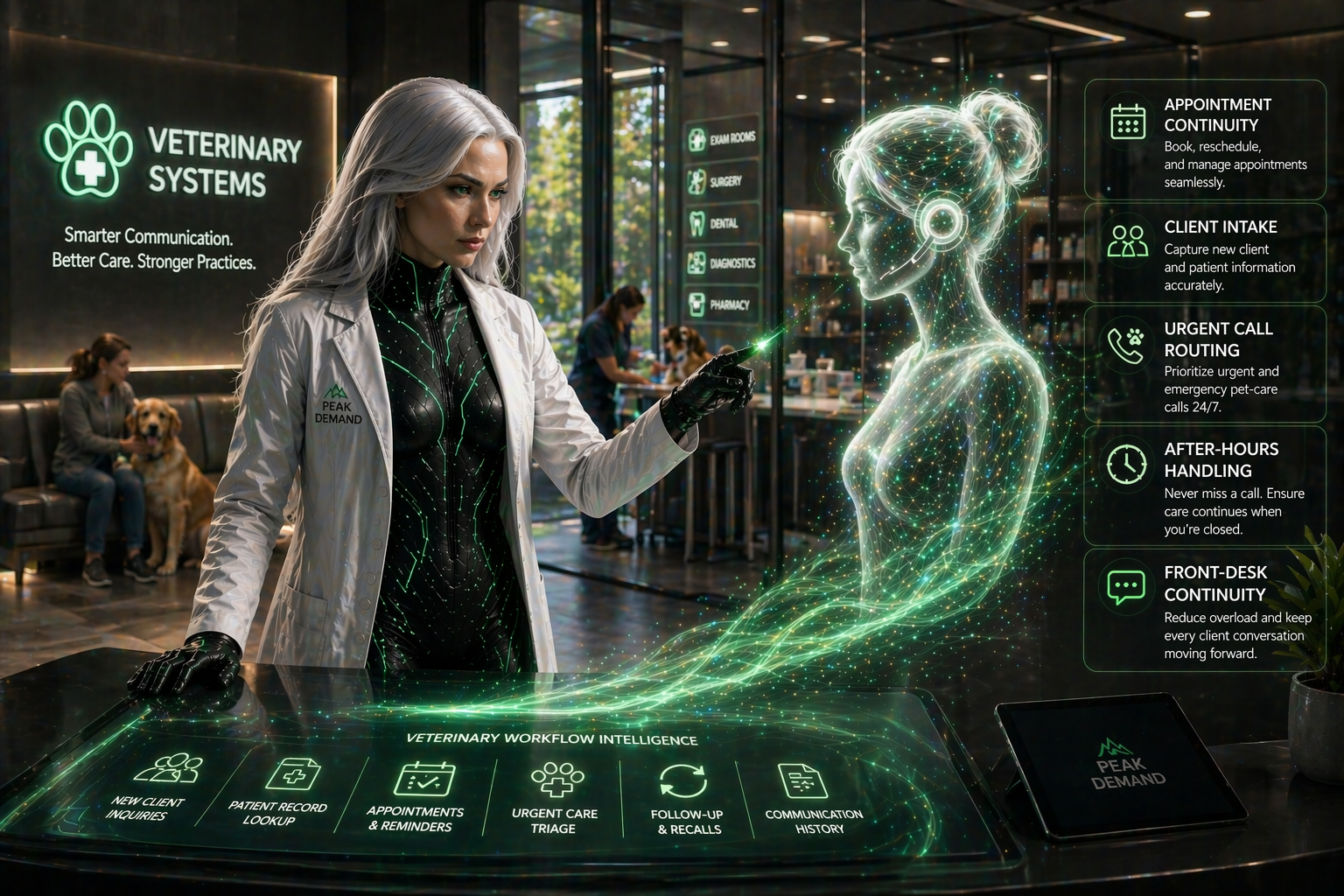
Voice AI receptionist integrations for veterinary systems

Veterinary Systems

Explore how Voice AI fits into veterinary environments across appointment continuity, client intake, urgent call routing, after-hours handling, and front-desk workflow support.

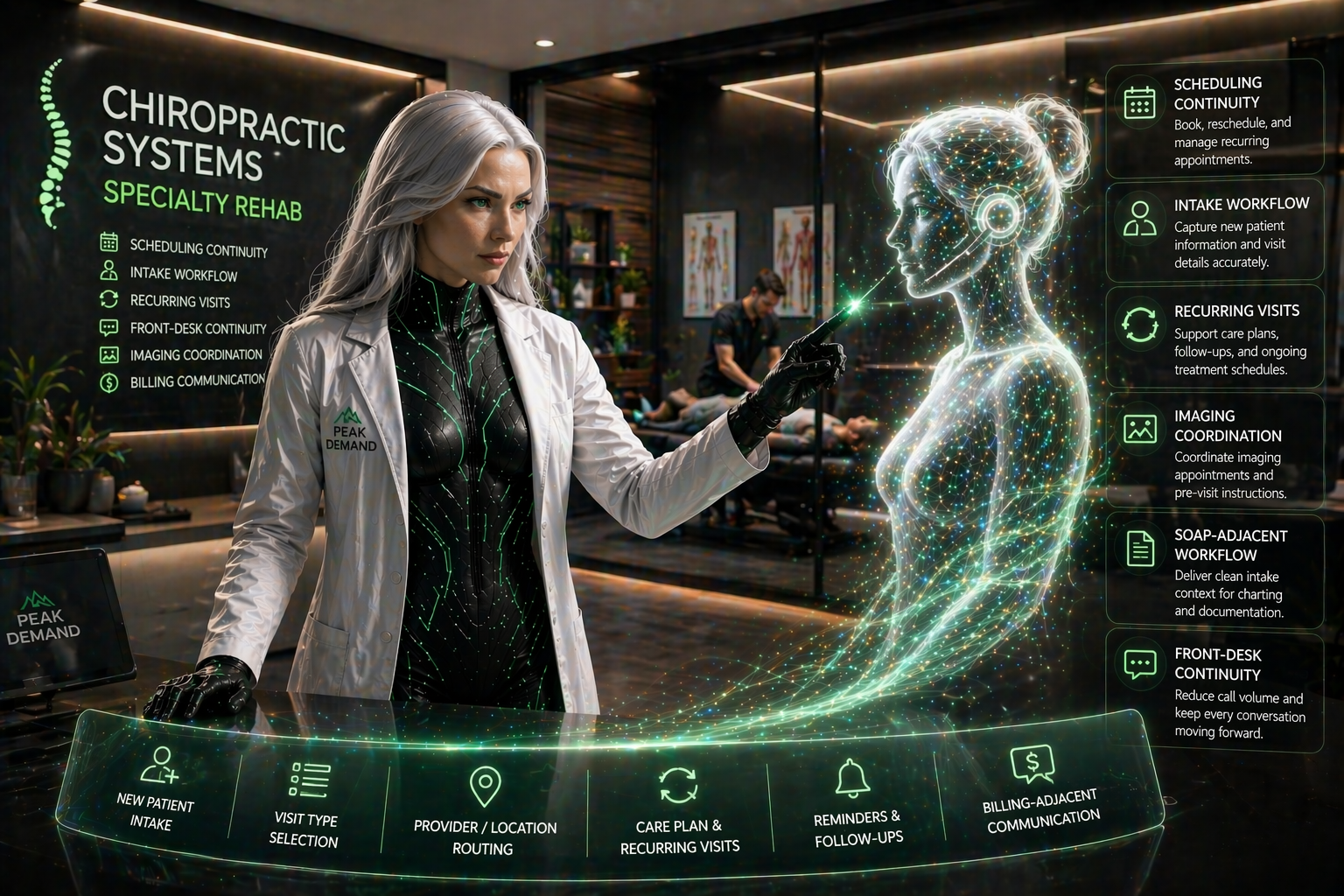
Voice AI receptionist integrations for chiropractic and specialty rehab systems

Chiropractic and Specialty Rehab Systems

Explore how Voice AI fits into chiropractic and specialty rehab workflows across scheduling, intake, recurring visits, SOAP-adjacent continuity, imaging-adjacent coordination, and front-desk support.

Voice AI receptionist integrations for scheduling patient access and orchestration systems

Scheduling, Patient Access, and Orchestration Systems

Explore how Voice AI supports scheduling and patient access architecture across intake, routing, queue stabilization, diagnostics scheduling, and workflow continuity between first contact and next action.

Integration Walkthroughs

See Healthcare Voice AI Integrations In Action

These walkthroughs show how Voice AI can connect into real healthcare scheduling, intake, and communication environments. Start with TELUS Health CHR for Canadian clinic workflows and Juvonno for rehab and allied health operations.

TELUS Health CHR Integration Walkthrough

See how Voice AI can support TELUS Health CHR scheduling, intake, patient communication, and Canadian clinic workflow continuity.

Juvonno Integration Walkthrough

See how Voice AI can support Juvonno workflows for rehab scheduling, intake, appointment handling, and clinic communication continuity.

Explore published healthcare systems by name

Once you know the software family that best matches your environment, this section makes it easier to browse live healthcare integration pages by platform name. Each category below groups published system pages by the type of environment they usually support so operators, managers, and technical teams can compare workflow fit more quickly. A fuller alphabetical directory appears farther down the page.

Featured healthcare systems

These are high-priority starting points for visitors evaluating real-world Voice AI workflow fit across scheduling, intake, patient communication, routing, and access workflows.

Clinic, ambulatory, and medical EMR systems

These systems are commonly associated with clinic records-adjacent workflows, appointment flow, patient requests, intake continuity, routing, and broader ambulatory communication operations.

Scheduling, intake, and patient communication systems

These environments sit closer to booking logic, intake flow, reminders, clinic administration, and day-to-day patient access operations.

Rehab, physiotherapy, and allied health systems

Allied health and rehabilitation environments often depend on strong scheduling continuity, practitioner matching, intake flow, recurring appointment management, and multi-location operational coordination.

Dental systems

Dental communication workflows often center around appointment demand, cancellation recovery, reminders, new patient calls, and front-desk continuity across booked production.

Veterinary systems

Veterinary communication environments often require appointment continuity, client communication, after-hours handling, urgent call direction, and records-adjacent workflow coordination.

Healthcare organizations rarely evaluate integrations in a vacuum. Grouping systems by software family makes it easier to understand likely workflow fit, compare environments more quickly, and navigate toward both family-level integration pages and live system-specific pages deeper in this hub. The full alphabetical system directory farther down the page should carry the complete 98-system library.

Healthcare Workflow Architecture

Where Voice AI sits in the healthcare workflow matters more than basic connectivity

Healthcare Voice AI becomes more useful when it is treated as part of the larger workflow architecture around patient access, intake, routing, scheduling, escalation, and downstream ownership. The question is not only whether a system connects. The question is whether the communication flow reaches the next operational step with enough clarity and structure to reduce friction instead of shifting it downstream.

In practice, that means Voice AI often sits across multiple workflow layers at once. It may support first contact, gather structured intake, help direct the caller into the right path, preserve context for staff, and improve continuity into the next step. The value comes from how those layers fit together, not from one isolated connection point.

This is why healthcare teams should evaluate both the scheduling and patient access layer and the EMR or EHR-adjacent layer. In more complex environments, the architecture may also need to account for enterprise compliance and procurement requirements.

Where Voice AI usually enters the workflow

Voice AI often enters at the communication edge: inbound calls, appointment demand, intake capture, after-hours answering, overflow handling, and patient access or routing-related first contact.

Explore healthcare AI receptionists

Where continuity usually breaks down

Continuity often breaks between the interaction and the next operational owner. That can happen when routing is weak, intake is unclear, scheduling context is incomplete, or downstream teams still need to manually rebuild the request.

Explore centralized scheduling workflows

What stronger integration architecture actually improves

Stronger architecture preserves enough structure, direction, and next-step usability for staff or systems to act efficiently. That is what turns Voice AI into operational infrastructure instead of a disconnected front-end layer.

Return to the healthcare resource hub
Integration maturity What healthcare teams usually experience Likely operational result
Fragmented Some connection points exist, but scheduling, intake, routing, escalation, and continuity still require heavy manual repair. Lower operational value, more staff burden, weaker patient access continuity, and less confidence in the workflow.
Partially connected Important workflow layers connect, but structure and downstream usability still vary too much between teams, departments, or next-step owners. Moderate gains, but persistent continuity gaps remain and staff still absorb unnecessary workflow friction.
Workflow-led and integrated Voice AI supports multiple workflow layers with stronger structure, clearer routing, better handoff, and more usable next-step continuity. Stronger patient access flow, cleaner operational ownership, and more scalable communication infrastructure.

What healthcare teams should evaluate in the architecture discussion

  • Where does Voice AI need to sit first in the communication workflow?
  • Where does continuity currently break between the interaction and the next operational step?
  • Which layers are EMR or EHR-adjacent, and which ones are workflow-adjacent?
  • How do scheduling, intake, routing, patient access, and escalation interact in this environment?
  • Will downstream teams receive enough structure to act without rebuilding the request manually?
  • Is the integration design workflow-led or just feature-led?
  • Does the current architecture reduce friction for staff, or does it simply move the work somewhere else?

Healthcare organizations usually get more value when they evaluate integration maturity across communication flow, operational ownership, and downstream usability together instead of treating each connection as a separate isolated decision. For system-specific evaluation, use the alphabetical healthcare system directory below.

Evaluating software families?

Use the six system-family pages to compare EMR, EHR, dental, veterinary, rehab, scheduling, and patient access environments.

Browse Software Families

Evaluating specific systems?

Use the full alphabetical directory to find the exact healthcare platform your team is evaluating.

Open System Directory

Evaluating enterprise readiness?

Review governance, privacy, escalation, procurement, and compliance considerations before deployment.

Review Compliance
Integration Strategy Resources

Go deeper into the strategy behind healthcare Voice AI integrations

This section helps healthcare teams move from broad category understanding into the right supporting resources for architecture, interoperability, workflow fit, implementation planning, and system-specific evaluation.

The articles below are the best next clicks for teams evaluating how Voice AI fits into healthcare communication systems, patient access workflows, structured integration pathways, rollout planning, and governed healthcare environments.

For broader category education, use the Healthcare Voice AI Resource Hub. For software-specific evaluation, continue to the full alphabetical system directory lower on this page and use the six healthcare software family pages as the parent layer.

Need system-family pages?

Use the family pages to compare medical EMR, allied health, dental, veterinary, specialty rehab, and patient access systems.

Browse Software Families

Need a specific platform?

Use the alphabetical system directory to find the exact EMR, EHR, scheduling, dental, veterinary, or rehab platform.

Open System Directory

Need compliance context?

Use the enterprise compliance page when governance, privacy, procurement, RFPs, or regulated deployment requirements are part of the evaluation.

Review Compliance

Core integration strategy articles

These resources explain why integrations matter, what healthcare teams should evaluate first, and how stronger Voice AI integration architecture should be understood.

Custom pathways, structured integrations, and workflow fit

These articles are useful for teams evaluating custom pathways, structured communication flows, and how Voice AI fits into real healthcare operating environments.

Rollout, implementation, and governance

These resources are best for healthcare teams moving from early exploration into rollout planning, operational safety, implementation readiness, and governance-aware deployment.

Patient access, routing, and workflow bottlenecks

These articles help healthcare teams think more clearly about where communication complexity builds up across patient access, intake, department routing, scheduling, and downstream handoff.

As the healthcare integrations ecosystem continues to grow, this section can keep routing visitors into the most relevant strategy, rollout, and workflow resources without changing the overall structure of the hub. The full software directory appears in the Alphabetical System Directory section below.

Live System Pages

Explore live healthcare system integration pages by category

This section gives healthcare teams a category-based way to browse the most important live system pages. It is not the full 98-system directory; it is a curated navigation layer for comparing the platforms most commonly tied to scheduling, intake, patient communication, routing, and patient access workflows.

Use this section when you know the type of software environment you are evaluating. Use the Alphabetical System Directory below when you want to find every live system page by name.

Need the family layer?

Start with the six parent family pages when comparing software categories before choosing a specific system.

Browse Software Families

Need every system?

Use the alphabetical directory for the complete live healthcare system page list by platform name.

Open Alphabetical Directory

Need workflow context?

Review how Voice AI fits across patient access, intake, routing, scheduling, escalation, and downstream ownership.

Review Workflow Architecture

Clinic and ambulatory EMR systems

These systems are commonly associated with clinic records-adjacent workflows, intake, appointment flow, routing, patient communication, and broader ambulatory continuity.

Explore medical and ambulatory EMR family

Scheduling, intake, and patient communication systems

These environments sit closer to booking logic, intake flow, reminders, clinic administration, and day-to-day patient access operations.

Explore scheduling and patient access family

Rehab, physiotherapy, and allied health systems

Allied health and rehabilitation environments often depend on strong scheduling continuity, practitioner matching, intake flow, recurring appointments, and multi-location coordination.

Explore allied health and rehab family

Dental systems

Dental communication workflows often center on appointment demand, cancellation recovery, reminders, new patient calls, and front-desk continuity.

Explore dental family

Veterinary systems

Veterinary communication environments often require appointment continuity, client communication, after-hours handling, and records-adjacent workflow coordination.

Explore veterinary family

Enterprise, specialty, imaging, and outpatient environments

These environments often involve more complex routing, diagnostic scheduling, imaging coordination, enterprise workflow ownership, and department-specific handoff requirements.

Explore enterprise and medical EMR family

This curated category browse section helps visitors compare common healthcare software environments without scrolling the entire directory. The complete system list belongs in the Alphabetical System Directory section below, where every live healthcare system page should be listed by platform name.

Next Step

Talk through your healthcare communication workflow

If your team is evaluating healthcare Voice AI integrations, the most useful next step is usually a workflow conversation. That means reviewing patient access pressure points, scheduling flow, intake structure, routing logic, after-hours coverage, compliance expectations, and the systems surrounding those workflows.

Peak Demand approaches healthcare environments through workflow fit, governance awareness, and operational usability. The goal is to help organizations map a communication architecture that supports real teams, real workflows, and real continuity requirements across EMR, EHR, scheduling, intake, dental, veterinary, rehab, and patient access environments.

Need software families?

Compare the six parent healthcare integration families before choosing a specific system page.

Browse software families

Need workflow context?

Review how Voice AI fits across intake, routing, scheduling, escalation, and downstream ownership.

Review workflow architecture

Need compliance review?

Use the enterprise compliance page when governance, privacy, procurement, and RFP standards matter.

Review compliance

Frequently asked questions

What does Voice AI mean in a healthcare integration environment?
In a healthcare integration environment, Voice AI is the communication layer that can support inbound calls, scheduling flow, intake capture, routing, after-hours handling, and related patient access workflows. The value depends on how well that layer connects to real workflow ownership, not just whether the technology can answer a call.
Can Voice AI work with EMR, EHR, scheduling, intake, and routing workflows?
Yes, but the right architecture depends on the system, permissions, workflow design, and operating environment. Some teams need EMR or EHR-adjacent support. Others need scheduling, intake, routing, or patient access workflow support first. Start with the software family section and then use the alphabetical system directory to find specific platforms.
Are healthcare Voice AI integrations always direct?
Not always. Some healthcare environments support direct integration pathways, while others require a custom, bridge-based, semi-automated, or workflow-adjacent approach depending on permissions, APIs, operating context, governance requirements, and workflow design.
Where should healthcare organizations start evaluating Voice AI integrations?
Start with workflow pressure points rather than a software list. Look at missed calls, scheduling bottlenecks, intake friction, department routing, after-hours communication, patient access delays, and where continuity tends to break between the conversation and the next operational step. Then use the workflow architecture section to evaluate fit.
How should compliance and governance fit into the evaluation?
Healthcare AI communication systems should be evaluated through the privacy, governance, escalation, and workflow requirements of the environment they serve. Requirements vary by organization, region, and deployment model, so governance should be part of architecture planning from the beginning. For larger buyers, review the enterprise Voice AI compliance page.
What is the role of this integrations hub?
This hub is the parent page for Peak Demand’s healthcare integration architecture. It helps visitors understand the healthcare Voice AI integration landscape, find relevant family pages, navigate live system pages, compare workflow categories, and move into the right software-specific integration pages.

About Peak Demand

Peak Demand is a Toronto-based AI agency focused on Voice AI, communication automation, and workflow infrastructure for organizations operating in more complex service environments.

In healthcare, the focus is not just on call handling. It is on patient access continuity, scheduling pressure, intake structure, routing logic, after-hours support, governance, and how communication systems fit into real operational workflows.

  • Workflow-driven and implementation-aware
  • Governance-first in healthcare communication environments
  • Built to support clinics, networks, and enterprise teams
  • Designed to scale into software-specific integration pathways
  • Organized around healthcare system families and live integration pages
Peak Demand works with organizations that need communication systems to be structured, scalable, and operationally useful across real healthcare workflows.
Alphabetical System Directory

Healthcare software integrations by system name

If you already know the software you are evaluating, this alphabetical directory is the fastest way to find the right live system page.

This directory includes the full 98-system healthcare integration library from the current Peak Demand system-page build. It is designed to help teams compare EMR, EHR, scheduling, intake, patient communication, dental, veterinary, rehab, wellness, chiropractic, orchestration, home care, med spa, pharmacy, and enterprise healthcare systems by software name.

For category-level browsing, use the software family section. For workflow context, use the workflow architecture section. This section is the full alphabetical browse layer.

98

Live healthcare system pages in this directory

Grouped alphabetically with visible section counts so the full library is obvious at a glance.

34A–C
20D–H
15I–M
11N–O
8P–R
6S–T
4U–Z
6Families

Compare healthcare systems by name, category, and workflow fit

This directory is useful for comparing clinic EMRs, EHR-adjacent systems, scheduling and intake platforms, patient communication software, dental systems, veterinary systems, rehab and allied health systems, chiropractic systems, med spa systems, home care systems, pharmacy-adjacent systems, orchestration platforms, diagnostic workflows, and enterprise healthcare environments by software name before going deeper into workflow design, integration possibilities, and operational fit.

Explore your own AI use case on a discovery call.

Peak Demand Inc. Logo Canadian AI Agency

Peak Demand

Canadian AI agency delivering managed Voice AI services, AI call center workflows, secure API integrations, and GEO / AEO / LLM lead surfacing for business and government across Canada and the U.S.

What we do: production-grade voice workflows, integrations to your systems of record, and measurable conversion outcomes.
Call our AI assistant Sasha:
381 King St. W., Toronto, Ontario, Canada

Managed Voice AI

Explore Peak Demand’s managed Voice AI service layer for enterprise call operations, inbound and outbound workflows, AI receptionists, call center automation, reporting, QA, integrations, and multi-location deployment.

Industries

Healthcare Expansion

Voice AI for Medical, Clinic, Hospital, and Patient Access Workflows

Explore healthcare voice AI pages across reception, booking, intake, after-hours answering, compliance, specialty care, regional scheduling, bilingual clinic support, wellness operations, and healthcare system integrations across EMR, EHR, dental, allied health, veterinary, rehab, and scheduling platforms.

Home Services Expansion

Voice AI for Scheduling, Dispatch Coordination, Emergency Calls, and After-Hours Service Intake

Explore home services voice AI pages across receptionist workflows, scheduling automation, emergency response routing, dispatch coordination, and after-hours call handling.

Manufacturing

Voice AI for Quotes, Order Status, Production Communication, and Support Flows

Manufacturing is ready for the same full-width expansion pattern as you build more sector pages.

Manufacturing Page

Hospitality

Voice AI for Guest Support, Reservations, Routing, and Service Coordination

Hospitality can expand into hotels, restaurants, venues, airports, and event support as you add more pages.

Hospitality Page

Utilities / Energy

Voice AI for Booking, Lead Qualification, Dispatch-Adjacent Routing, and Customer Service

Utilities and energy can follow the same system once you add more pages for power, HVAC, solar, and service operations.

Utilities / Energy Page

Real Estate

Voice AI for Lead Qualification, Appointment Booking, and Follow-Up Workflows

Real estate is set up to expand the same way as the healthcare panel whenever you need it.

Real Estate Page

Transit / Public Sector

Voice AI for Public-Facing Routing, Rider Information, and Service Communications

Transit and public sector can expand into agency-specific service pages as your footprint grows.

Transit / Public Sector Page

© Peak Demand — All rights reserved. | Privacy Policy | Terms of Service
This website is powered by and built on Peak Demand.