
Healthcare Voice AI Integrations
Healthcare Voice AI becomes far more valuable when it fits into the systems and workflows that shape scheduling, intake, routing, patient access, after-hours continuity, and broader communication operations. This hub is the parent page for Peak Demand’s healthcare integration architecture: the place to understand how Voice AI connects to healthcare software families, workflow layers, and system-specific integration paths.
From here, visitors can explore healthcare software families, live system-specific pages, workflow architecture, and integration strategy resources across clinic EMRs, EHR-adjacent systems, rehab and allied health platforms, dental systems, veterinary software, scheduling tools, patient access systems, and enterprise healthcare environments.
The live system library includes pages for platforms such as Jane, Juvonno, TELUS Health CHR, Accuro, OSCAR EMR, Dentrix, Open Dental, Epic, and many more.

Architecture Role
Parent hub for healthcare integrations
System Coverage
98 healthcare system pages
Software Families
6 healthcare integration families
Workflow Focus
Scheduling, intake, routing, access
Healthcare integrations should be evaluated through workflow continuity
One of the biggest mistakes in healthcare integration conversations is reducing the discussion to a list of software names. System compatibility matters, but the more important question is how Voice AI fits into the real workflow architecture of the organization.
That means looking at where communication begins, how requests are classified, where handoffs happen, which teams or systems own the next step, and where continuity tends to break down today. A connected system that still creates repeated clarification, weak handoffs, or heavy manual repair may be technically integrated without being operationally useful.
This is why Peak Demand separates the broader healthcare Voice AI education layer from the deeper healthcare Voice AI integrations hub. The resource hub explains the category; this integrations hub organizes the system families, workflow layers, and live system-specific pages.
Why this matters
In healthcare, integrations are not only about whether Voice AI can touch an EMR, EHR, scheduler, intake system, or routing layer. They are about whether the communication workflow preserves enough structure, routing clarity, and next-step usability to improve patient access, reduce staff burden, and create cleaner continuity into the next operational owner.
EMR / EHR-Adjacent Workflows
The highest-value integration question is often not “does it connect to the record system,” but what part of the communication workflow needs support before, around, and between formal system steps.
- Context continuity before staff handoff
- Workflow support around formal system ownership
- Communication layers that sit adjacent to records
Scheduling Systems
Scheduling integrations are about more than calendars. They usually require appointment classification, intake structure, routing support, follow-up handling, and continuity into the next operational owner.
- Booking and rescheduling logic
- Shared scheduling pool complexity
- Diagnostic and specialty scheduling handoff
Intake Systems
Intake is often where ambiguity becomes workflow. Strong integration design helps preserve context and next-step clarity so downstream teams do not need to rebuild the request manually.
- Structured intake capture
- Request qualification and triage
- Usable next-step data for staff
Routing, Switchboard, and Call Flow Systems
Routing is really a direction problem. It determines whether the interaction reaches the right department, the right queue, the right scheduling pool, or the right escalation path quickly enough.
- Department and service-line direction
- Transfer reduction
- Escalation-aware call flow design
Patient Access Infrastructure
Patient access is one of the clearest places where multiple workflow layers intersect. Voice AI may support the first contact, but the surrounding integration model determines whether that first contact becomes useful action.
- Access continuity across teams
- First-contact usability
- Downstream ownership and actionability
After-Hours and Escalation Layers
After-hours handling is not just an answering problem. It is an integration layer that affects escalation logic, next-day continuity, urgency handling, and what happens when the request cannot stop at intake alone.
- Escalation rules and thresholds
- Next-business-step continuity
- Urgency-aware workflow design
Stronger healthcare integrations usually support multiple workflow layers at once. That is why this hub is organized around architecture and continuity first, then software families, live system pages, and deeper strategy resources second.
Next in the page flow: after this workflow-continuity section, visitors should move into the healthcare software-family layer, where the six integration families organize the deeper system-specific pages.
Browse Healthcare Software Families
Voice AI for Restaurants: Stop Revenue Lost to Missed Calls
Voice AI Receptionist for Restaurants: The Hidden Cost of Missed Calls
Most restaurant owners don’t realize how much revenue quietly slips away every time the phone rings during a busy shift — and no one picks up. Missed phone calls for pickup, takeout, and reservations aren’t just an inconvenience; they’re a measurable operational drain. And with rising demand for direct ordering, voice AI for restaurants is emerging as one of the most reliable ways to stop the leak in 2025.
Today’s diners still reach for the phone before anything else. Even with online ordering and delivery apps, a significant percentage of customers prefer to call the restaurant directly. Industry reports confirm this trend, especially among guests who want customizations, allergy requests, menu clarification, or faster service than third-party platforms can provide. See sources:
National Restaurant Association consumer behaviour insights: https://restaurant.org/research-and-media/research/
“40% of consumers prefer ordering directly from restaurants,” Restaurant Business: https://www.restaurantbusinessonline.com/technology
At the same time, third-party delivery fees and commissions continue to erode margins. This pushes restaurants to encourage direct ordering again — yet the direct channel only works when someone answers the phone. Meanwhile, customer expectations have shifted dramatically. Whether someone finds you through Google Search or asks an AI assistant like ChatGPT or Gemini, they expect instant, reliable responses and clear information. When they call and get voicemail, silence, or long holds, they don’t try again — they simply choose another restaurant.
This is the core shift every restaurant operator needs to understand:

From: “The phone rings in the background during service.”
To: “The phone is a measurable revenue channel that influences your local rankings, your AI visibility, and your ability to convert demand.”
Over the next sections, you’ll learn:
A simple way to estimate how much money you’re losing to missed calls
A proven framework for capturing every call using Voice AI
Concrete steps to improve your Google visibility and appear more often in AI-generated recommendations

By the end, you’ll see why the restaurants that answer more calls — whether by staff or automation — don’t just provide better service. They compound revenue, strengthen local SEO, boost GEO (Generative Engine Optimization), and become the restaurants that AI assistants recommend first when diners ask, “Where should I order tonight?”
Why Restaurant Phone Calls Still Matter: Turning Chaos Into a Voice AI Revenue Channel
Why the Phone Still Matters in a Digital World
Even in 2025 — with apps, online ordering platforms, and automated systems — diners continue to rely heavily on the phone. For many restaurants, restaurant phone orders remain a major source of revenue, yet they are also one of the most frequently overlooked channels when diagnosing revenue loss or poor customer experience.
Guests still call restaurants to:
Place takeout or pickup orders
Ask menu questions or clarify ingredient details
Make or modify reservations
Check wait times, hours, or same-day availability

Industry research consistently shows that customers still rely on phone calls even when digital alternatives are available. Examples include:
UpFirst.ai article discussing continued reliance on restaurant phone ordering:
https://upfirst.ai/blog/do-restaurants-still-take-phone-orders?utm_source=chatgpt.comRestaurant Dive reporting that customers prefer ordering directly from restaurants rather than using delivery apps:
https://www.restaurantdive.com/news/majority-customers-prefer-ordering-delivery-direct-restaurant-ncr-voyix/738397/?utm_source=chatgpt.comRestaurant Business coverage on how restaurants can encourage direct ordering:
https://www.restaurantbusinessonline.com/technology/how-restaurants-can-get-more-customers-order-direct?utm_source=chatgpt.comForbes Council commentary highlighting how phone ordering supports upsells and guest personalization:
https://www.forbes.com/councils/forbescommunicationscouncil/2020/12/16/phone-and-online-ordering-how-restaurants-can-upsell-customers/?utm_source=chatgpt.com
Why Direct Phone Orders Matter More Than Ever
Direct restaurant phone orders often generate:
Higher-margin tickets compared to third-party delivery orders
Better repeat business and loyalty, since the restaurant controls the guest interaction
More customization-friendly experiences, which are difficult to manage in rigid delivery app interfaces
More trust — especially for older guests, families, and people with dietary or allergy needs
Every missed call means:
A likely lost order
A potential lost customer
A negative digital footprint, as frustrated customers leave reviews citing “restaurant never answers the phone”
These outcomes not only hurt same-day revenue but also undermine restaurant phone answering, SEO signals, and GEO (Generative Engine Optimization) visibility.
The SEO + GEO Connection
Phone performance now directly influences how both search engines and AI assistants perceive your restaurant.
When consumers leave reviews referencing missed calls, long holds, or inconsistent phone answering, Google treats this as a negative service signal.
When guests mention “easy to call”, “fast phone ordering”, or “always answers the phone”, it strengthens your restaurant’s local relevance, prominence, and trustworthiness.
AI assistants (ChatGPT, Gemini, Perplexity) lean on this public footprint to determine which restaurants to recommend when users ask:
“Where can I order takeout by phone?”
“Which nearby restaurant actually answers the phone?”
Consistent, reliable phone handling — whether by staff or voice AI for restaurants — supports both:
SEO visibility in Google Maps and Google Search
GEO visibility inside AI assistants and AI-powered search experiences
The C.A.L.L. Revenue Model: Quantifying Missed Calls With a Voice AI Receptionist
Overview of the C.A.L.L. Revenue Model
Most restaurants know the phone is busy — but very few can quantify what the ringing actually means in daily or monthly revenue terms. The C.A.L.L. Revenue Model breaks the chaos into a simple, measurable sequence:
Call Volume → Answer Rate → Line Value → Lifetime Value
This model turns phone activity from “background noise during service” into plain, predictable maths. Once you see the numbers clearly, the business case for improving your phone channel — especially with automation — becomes undeniable.
Restaurants that track these four inputs almost always discover the same pattern: the revenue being lost to missed calls is far higher than expected, and fixing the problem delivers some of the fastest ROI in the industry.
Step 1 – Call Volume
The first step is understanding how many calls your restaurant actually receives. Many operators underestimate this dramatically.
How to get a realistic estimate:
Pull call logs from:
Your VoIP system
Your phone provider
Your call-tracking tool (if installed)
If no logs exist:
Run a simple one-week manual tally
Capture total calls by hour of day
Note which calls were answered vs missed
Important distinctions to capture:
Daytime vs evening traffic
Dinner rush usually carries the highest call volume.
Weekday vs weekend patterns
Weekends often show spikes in large family orders and event-night inquiries.
Industry reference supporting ongoing high call volume:
UpFirst.ai analysis confirming continued reliance on restaurant phone interactions:
https://upfirst.ai/blog/do-restaurants-still-take-phone-orders?utm_source=chatgpt.com
GEO tie-in:
High call volume is a sign of strong local intent demand. When diners frequently look you up, call you, or search for your info, those behavioural signals reinforce your restaurant’s relevance to both Google Search and AI models like ChatGPT or Gemini. High demand + good digital signals = more visibility.
Step 2 – Answer Rate
Once you know how many calls come in, the next question is: How many do you actually answer?
Answer rate formula:
Answered calls ÷ Total inbound calls
Most restaurants are shocked when they calculate this for the first time. During peak service, answer rates often drop sharply, sometimes falling below 50%.
Typical patterns across restaurants:
Lunch rush: Lower staffing means more missed calls.
Dinner rush: Staff are occupied with tables; the phone is a secondary priority.
After-hours: Calls go unanswered even though many diners try to place next-day or future reservations outside operating hours.
Why this matters:
Missed calls are not neutral — they directly convert into lost orders, lost guests, and lost loyalty.
Call abandonment explained:
Call abandonment is the percentage of guests who hang up before reaching a person or automated system. Many diners abandon after 20–40 seconds — especially if they hear ringing without a greeting.

Industry insight:
Restaurant Business reporting on consumer preference for ordering direct rather than through apps — meaning more callers and more potential abandonments if phones aren’t answered:
https://www.restaurantbusinessonline.com/technology/how-restaurants-can-get-more-customers-order-direct?utm_source=chatgpt.com
GEO tie-in:
Reliable phone answering produces:
More positive reviews
Fewer complaints like “they never answer the phone”
Stronger authority and trust signals
Better alignment with what AI models look for when recommending local restaurants
AI assistants rely on digital reputation footprints. A poor phone experience often appears in reviews — which indirectly reduces your chances of being recommended.
Step 3 – Line Value (Average Order Value per Call)
Not all orders are created equal. Restaurant takeout phone orders often have higher value than dine-in or app-based orders.
Use POS data to estimate:
Average order value (AOV) for:
Small individual meals
Family-size takeout orders
Catering or multi-item orders
Compare:
Dine-in AOV vs phone-based AOV
Phone AOV vs third-party delivery AOV
Why phone orders often have higher value:
Customers placing large family or group orders prefer speaking to a person to ensure accuracy.
Many diners call for special requests or customizations that apps don’t support.
Large weekend or event-night orders often arrive via phone, not apps.
Supporting reference on direct-order value and margin protection:
Restaurant Dive reporting on consumer preference for direct over third-party platforms (better margins, better experience):
https://www.restaurantdive.com/news/majority-customers-prefer-ordering-delivery-direct-restaurant-ncr-voyix/738397/?utm_source=chatgpt.com
SEO tie-in:
Language like “higher-value phone orders”, “restaurant takeout phone orders”, and “direct phone ordering” naturally strengthens your topical relevance around:
takeout,
reservations,
direct ordering,
local intent keywords.
Step 4 – Lifetime Value of Phone Customers

A phone order is rarely just one order. Many phone customers are:
Weekly regulars
Families that order together
People who host gatherings
Diners who trust your restaurant with dietary needs
Repeat customers who prefer human (or AI-driven) communication over apps
If you miss the very first call from one of these customers:
They may shift permanently to a competitor
You lose months (or years) of repeat business
You risk losing multiple future high-value orders
Reference on consumer reinforcement of direct, repeat behaviour:
Forbes Communications Council article on phone and online ordering habits and customer behavior:
https://www.forbes.com/councils/forbescommunicationscouncil/2020/12/16/phone-and-online-ordering-how-restaurants-can-upsell-customers/?utm_source=chatgpt.com
GEO tie-in:
AI systems monitor long-term patterns. Repeat customers who call frequently, leave positive reviews, and interact with your business online:
Strengthen your entity profile
Improve your “trust score” in AI systems
Make it more likely that ChatGPT, Gemini, Perplexity, and other models will recommend your restaurant when someone asks:
“Where can I order takeout by phone near me?”
Step 5 – Example Calculation: A Typical Neighbourhood Restaurant
Let’s walk through a simplified but realistic example.
Daily call volume:
120 inbound calls per day
Missed call percentage:
35% (very common during peak hours)
Average takeout order value:
$38
Repeat rate:
A typical phone customer orders 3–5 times per month
Now let’s quantify what missed calls mean.

1. Daily Revenue Leak
120 calls × 35% missed = 42 missed calls
42 missed calls × $38 = $1,596 lost per day
2. Monthly Revenue Leak
$1,596 × 30 days = $47,880 lost per month
Even if only 50% of those callers would have become customers, you’re still losing $23,940 per month.
3. Annual Revenue Leak
$47,880 × 12 months = $574,560 lost per year
Even a conservative reduction of 70% makes this:
$574,560 × 0.30 = $172,368 in annual preventable loss
4. Lifetime Value Impact
If just 10 of those missed callers per week were potential regulars ordering 3–5 times per month:
10 customers × 4 orders/month × $38 = $1,520 per month
Over 12 months: $18,240 lost from just 10 missed relationships
Final Takeaway
If you don’t measure this, you’re guessing — and the guess is usually wrong.
Restaurants routinely underestimate missed calls and the resulting revenue loss. Once quantified, improving answer rates — especially with AI-powered call handling — becomes one of the highest-ROI improvements a restaurant can make.
SEO & GEO Impact: How Missed Calls Hurt Your Visibility Until Voice AI Fixes It
How Missed Calls Show Up in SEO Signals

Missed calls don’t only cost revenue — they quietly erode your search visibility. Every unanswered phone call that results in frustration eventually appears in the places Google monitors most closely:
Direct impacts on SEO:
More frustrated diners → more negative reviews mentioning the phone
Diners often leave feedback like “They never answer the phone” or “Tried calling three times, gave up.”
Google’s review corpus directly influences both your rating and your prominence signal in local ranking systems.
For Google’s documentation on local ranking factors:
https://support.google.com/business/answer/7091?hl=enFewer happy experiences → fewer positive reviews
When phone orders go smoothly, customers often praise speed, convenience, and helpfulness. But if most callers never reach you, those positive touchpoints disappear.
Indirect impacts on SEO:
Lower local engagement and fewer repeat visits
Consistent phone friction reduces long-term loyalty — which means fewer branded searches, fewer direct navigation visits, and fewer calls from search results. These are all behaviour signals Google interprets as declining relevance.Lower click-through and interactions with your Google Business Profile (GBP)
When people attempt to call from your GBP listing and experience poor service, they abandon and choose competitors. Lower satisfaction and lower repeated engagement harm your profile’s performance over time.
Google’s local algorithm considers three core factors:
Relevance – How well your business matches search intent
Distance – How close you are to the user
Prominence – Review quality, review volume, engagement, overall reputation
Missed calls damage prominence, which is often the deciding factor when multiple restaurants are nearby and relevant.
The 3-Layer GEO Model for Restaurants
This is where we connect missed calls to Generative Engine Optimization (GEO) — how your restaurant appears inside AI assistants like ChatGPT, Gemini, Perplexity, Claude, or Microsoft Copilot.
GEO determines whether your restaurant is the one AI tools recommend when someone asks:
“Where can I order takeout by phone near me?”
“Which restaurants nearby answer the phone reliably?”
The 3-layer model explains how missed calls weaken your standing — and how voice AI for restaurants strengthens it.
Relevance Layer
AI systems evaluate the clarity of your business identity.
To strengthen relevance:
Maintain accurate NAP (Name, Address, Phone) across your website, Google Business Profile, Facebook Page, Instagram, Yelp, and any delivery platforms.
Explicitly mention on your website that customers can place phone orders, order takeout by phone, or call for reservations.
Add structured schema to your site:
RestaurantorLocalBusinessschematelephoneopeningHoursmenuaddress
Official schema reference:
https://schema.org/Restaurant
When LLMs crawl your site, they need to see:
A clear phone number
Clean opening hours
Obvious ordering instructions
A predictable entity structure
If any of these are missing or inconsistent, AI models lower your relevance score for phone-order-related questions.
Authority Layer
Authority comes from third-party signals, especially user-generated content and interlinked information.
To strengthen authority in GEO:
Encourage reviews that mention:
“Easy to call”
“Always picks up the phone”
“Great for last-minute takeout by phone”
Create interlinked content on your website:
A blog post explaining how to order by phone for takeout
A page about phone ordering vs online ordering
A short FAQ page answering:
“Do you accept phone orders?”
“Can I place a takeout order by phone?”
“How fast do you answer the phone?”
Review signals matter deeply. Google explicitly states that review sentiment and review volume affect prominence:
https://support.google.com/business/answer/7091?hl=en
AI systems pick up these signals too.
If reviews frequently mention missed calls, long holds, or poor responsiveness, authority lowers.
If reviews mention positive phone experiences, authority strengthens.
Validation Layer
Validation ensures AI systems see current, consistent information everywhere, reducing uncertainty.
To strengthen validation:
Update hours on:
Website
Google Business Profile
Facebook Page
Delivery platforms
Reservation platforms
Keep the same phone number across all listings
Maintain consistent business descriptions and menus
Additionally:
Ensure robots.txt allows GPTBot and Google-Extended to access your site unless you deliberately choose otherwise.
GPTBot info:
https://platform.openai.com/docs/gptbot
Google-Extended info:
https://developers.google.com/search/docs/crawling-indexing/google-extended
Voice AI helps here by:
Reducing review complaints
Increasing positive customer interactions
Ensuring callers get consistent information about hours, availability, and ordering workflow
This stabilizes your entity data, which is crucial for AI-generated responses.
How AI Assistants Decide Whom to Recommend for Phone Orders
When a diner asks an AI assistant:
“Where can I order pizza by phone near me?”
“Which restaurant nearby answers the phone?”

The AI assistant must determine which restaurants:
Actually accept phone orders
Answer reliably
Are open at that moment
Have positive public phone-related reputation
Provide consistent information across the web
AI models heavily rely on:
Your Google Business Profile
Your website schema
Reviews mentioning the phone experience
Hours of operation
Call availability patterns
Consistent digital identity across all platforms
Voice AI’s role:
By answering every call — even during rush or after-hours — voice AI for restaurants ensures that your digital footprint looks stable and trustworthy:
Clear phone number
Consistent opening hours
Fewer complaints
More positive engagement
Higher prominence signals
Better alignment with user intent (“order by phone”)
This increases your chance of being the restaurant AI assistants actually recommend instead of competitors.
From Missed Calls to Full Coverage: Operational Fixes Using a Voice AI Receptionist
Mapping Your Current Phone Journey
Before fixing missed calls, you need to see the current phone experience clearly. Most restaurants operate with an invisible, unstructured system that looks something like this:

Caller dials → phone rings at bar or host stand → staff are mid-service → caller waits → caller hangs up
OR
Caller dials → phone rings → staff picks up hurriedly → rushed interaction → errors or incomplete orders
OR
Caller dials → voicemail → no order placed
This “default workflow” is never intentionally designed — it simply emerges from the realities of restaurant service.
To find the friction points, identify:
Time windows where calls spike
Often 11:30 AM–1:30 PM and 5 PM–8 PM
Specific days
Fridays, Saturdays, holidays, game days, or local events
After-hours periods
When callers want to place next-day orders, check availability, or confirm hours
A simple one-page “phone journey map” is one of the most powerful tools you can create. It should outline:
When calls arrive
Who currently answers (if anyone)
What happens when they’re busy
What the caller hears
Common failure outcomes (voicemail, long wait, abandoned call)
This map becomes the blueprint for deciding where automation, call routing, or process changes will have the greatest immediate impact.
What Voice AI for Restaurants Actually Does
Restaurant owners often imagine Voice AI as something abstract or overly technical. In reality, voice AI for restaurants is a highly practical upgrade to the phone — designed to answer calls exactly when staff can’t and follow a clear, branded script every time.

In everyday language, Voice AI can:
Answer calls within a fixed number of rings
Typically 1–2 rings, reducing abandonment
Greet callers with your branded script
“Thanks for calling Bella’s Kitchen — how can I help you place your order?”
Take complete orders from your menu
Capture item selections
Ask follow-up questions
Handle modifications and common substitutions
Confirm items and order totals
Repeat orders back to reduce mistakes
Route complex, emotional, or VIP calls to humans
Complaints
Catering questions
Reservations requiring special handling
Voice AI connects seamlessly to:
Your POS
To send orders directly and reduce manual entry errors
Your online menu
For real-time item availability
Order throttling and prep times
So AI doesn’t overload the kitchen during peak hours

References supporting AI ordering and automation in restaurant operations:
Restaurant Dive analysis on reducing phone burden and improving direct ordering:
https://www.restaurantdive.com/news/majority-customers-prefer-ordering-delivery-direct-restaurant-ncr-voyix/738397/?utm_source=chatgpt.comForbes Council article on using automation for phone and online ordering efficiency:
https://www.forbes.com/councils/forbescommunicationscouncil/2020/12/16/phone-and-online-ordering-how-restaurants-can-upsell-customers/?utm_source=chatgpt.com
Hybrid Model: AI First, Humans When Needed
The most successful restaurants don’t “replace” their staff with AI — they use AI to filter, handle, and triage calls so humans can focus on hospitality.

Design the system like this:
AI answers by default
Handles all basic to mid-complexity orders
Prevents missed calls
Eliminates hold times and voicemail
Staff step in for human-sensitive moments
Special requests
Customer complaints
High-value catering orders
VIP customers or loyal regulars
This creates a balanced system where:
Phones are always covered
Whether it’s a lunch rush or a slow afternoon
Staff stay focused on what humans do best
Hospitality
Table service
In-person upselling
Guests get the best of both worlds
Instant phone response
Human warmth when needed
This hybrid structure mirrors how top-performing restaurants handle delivery and reservation channels — automation for the routine, humans for the exceptional.
Reducing After-Hours Missed Calls
A significant number of restaurant calls occur outside business hours — especially for:
Next-day takeout
Catering enquiries
Reservation changes
Questions about hours, parking, or location

Without automation, these after-hours calls usually lead to:
Voicemails that never get checked
Messages that staff forget to respond to
Lost next-day business
Poor reviews from frustrated callers
Voice AI for restaurants can eliminate this friction by:
Accepting next-day or future-dated orders
Logging them in the POS or sending them to a staff queue
Capturing catering requests with name, date, headcount, and callback details
Providing accurate hours and directions
Deflecting unnecessary calls
People calling just to ask “Are you open?” or “Do you have parking?”
This creates a consistent, reliable after-hours experience — even while your staff sleep.
GEO angle:
When your after-hours message is always correct, clear, and consistent, it prevents mismatches between:
Website
Google Business Profile
Social media
Delivery platforms
AI assistant interpretations
Consistent information across platforms strengthens your Validation Layer in GEO, making AI systems more confident recommending your restaurant.
Quick Wins for Restaurants: Revenue, SEO & GEO Improvements With Voice AI Phone Answering
This one-page checklist gives restaurants fast, high-impact improvements that strengthen phone performance, local SEO, and GEO visibility inside AI assistants. Every item below can be completed without a full overhaul — and most take less than an hour to implement.
Make your phone number impossible to miss
Place the phone number on every page of your website (header + footer recommended).
Enable click-to-call for mobile visitors.
Google’s usability guidance emphasizes mobile-first design for local businesses:
https://developers.google.com/search/docs/fundamentals/seo-starter-guide
When the phone number is easy to access, diners call more confidently — and your answer rate becomes a direct revenue lever.
Ensure complete NAP consistency everywhere
Your Name, Address, Phone (NAP) must match exactly across:
Website
Google Business Profile
Facebook Page
Instagram bio
Yelp listing
Delivery platforms (DoorDash, Uber Eats, SkipTheDishes, etc.)
Any reservation or event platforms you use

Google’s official documentation on local ranking signals confirms NAP consistency as a relevance factor:
https://support.google.com/business/answer/7091?hl=en
Also verify:
Correct opening hours
Holiday hours
Special closures
AI assistants depend on this accuracy when they decide whether your restaurant is open, reachable, and recommended for phone orders.
Add structured schema for clarity and trust
Implement Restaurant or LocalBusiness schema that includes:
telephoneopeningHoursmenuaddressgeo(optional but helpful)
Schema reference:
https://schema.org/Restaurant
Structured data makes your restaurant machine-readable, improving both SEO and GEO outcomes.
Add an FAQ section about phone ordering (with FAQ schema)
Create a short FAQ block addressing:
“Do you accept phone orders?”
“How do I place a takeout order by phone?”
“How fast do you answer the phone?”
“Can I make reservations by phone?”
Then wrap it in FAQ schema:
https://schema.org/FAQPage
This helps:
Google understand your phone-ordering process
AI assistants surface you for queries like
“Where can I order takeout by phone near me?”
Configure robots.txt to support AI visibility
Add explicit permissions (unless you have a reason not to) for:
These settings tell AI crawlers they’re allowed to use your publicly available content to understand your business — strengthening GEO performance.
Turn on call logging for 2–4 weeks
Before improving anything, measure your baseline:
Total inbound calls
Answered vs missed
Peak times
Duration
After-hours behavior
Manual logging works fine if no analytics system is installed.
This data will be essential when calculating missed-call revenue and deciding where Voice AI should step in first.
Pilot voice AI for restaurants in high-impact windows
Start where the greatest number of calls are being missed:
Dinner rush
Lunch rush
Fridays and Saturdays
After-hours periods
Then expand to full coverage once the system proves itself.
This staged rollout:
Prevents overwhelming staff
Shows immediate revenue impact
Improves customer experience
Stabilizes review sentiment
Enhances SEO & GEO signals automatically
Measuring the Impact: How a Voice AI Receptionist Reduces Missed Calls and Recovers Revenue
Measurement is where the business case becomes undeniable. Restaurants that track even a few basic metrics almost always discover that missed calls were hiding thousands of dollars per week in preventable losses. By measuring before and after implementing voice AI for restaurants, you can clearly show improvements in revenue, visibility, staff workload, and customer satisfaction.
Before-and-After Call Metrics
Start with the core operational metrics that define phone performance.
Track the following every week:
Total inbound calls
Answered vs. missed calls
Call abandonment rate
How many callers hang up before someone (human or AI) answers
Average handle time
How long calls last when handled by staff vs AI
Number of completed orders
A key indicator that calls are being monetized
The most reliable method is to compare:
4 weeks before implementing Voice AI
versus
4 weeks after implementation
This creates a clean, evidence-based timeline showing:
Reduction in missed calls
Higher answer rates
Lower abandonment
More completed orders
When documented properly, these metrics form the backbone of your ROI analysis.
Industry reference for call abandonment and customer experience impact:
https://www.forbes.com/councils/forbescommunicationscouncil/2020/12/16/phone-and-online-ordering-how-restaurants-can-upsell-customers/?utm_source=chatgpt.com
Revenue Metrics
Once call-handling performance improves, revenue uplift becomes much easier to quantify.

Track improvements in:
Average order value (AOV) for phone orders
Family meals, multi-item orders, and custom requests often push AOV higher than app-based or dine-in orders
Phone orders per day
Once calls are answered consistently, you’ll see the true demand reveal itself
Total phone-order revenue month over month
The most important number for understanding your ROI
Then calculate:
Recovered revenue vs baseline
Incremental revenue added by Voice AI
Projected annualized gain
Reference reinforcing the value of direct ordering over third-party platforms:
https://www.restaurantdive.com/news/majority-customers-prefer-ordering-delivery-direct-restaurant-ncr-voyix/738397/?utm_source=chatgpt.com
When shown in simple graphs, these numbers demonstrate that improving the phone channel produces faster ROI than nearly any other operational upgrade.
SEO & GEO Metrics
Because missed calls affect customer satisfaction and review sentiment, they also influence SEO (search visibility) and GEO (Generative Engine Optimization — visibility inside AI assistants).
Track the following SEO improvements:
Changes in local organic ranking for keywords like:
“takeout near me”
“order by phone near me”
“best [cuisine] takeout [city]”
Changes in Google Business Profile performance:
Profile views
Clicks-to-call
Website visits
Direction requests
Resource: Google documentation on local ranking factors:
https://support.google.com/business/answer/7091?hl=en
Track GEO improvements by testing queries inside AI assistants:
Ask:
“Which restaurants nearby can I call to place an order?”
“What restaurant answers the phone quickly in [city]?”
“Where can I order takeout by phone?”
Check for:
Mentions of your restaurant
Whether AI lists your phone number
Whether AI confirms your ordering methods
The tone and accuracy of descriptions
Monitor your digital footprint over time:
Do reviews mention improved phone service?
Does AI describe your restaurant more accurately?
Does it mention that you take phone orders?
Are competitors being recommended less frequently?
This is how you measure the effect of voice AI for restaurants on your GEO visibility — the new frontier for discovery.
Staff and Guest Experience Metrics
Voice AI does more than improve metrics — it improves morale and customer satisfaction.

Staff feedback to track:
Perceived stress during lunch rush and dinner rush
Interruptions from phone calls before vs after AI
Ability to focus on hospitality and table service
Error rate or miscommunication during busy periods
Guest signals to track:
Fewer complaints about unanswered phones
More reviews praising:
“Easy to order by phone”
“Fast response”
“They always pick up”
Improved sentiment in Google reviews, Yelp, and social platforms
More direct phone orders from repeat guests
Reviews and staff feedback tie directly into SEO prominence, GEO authority, and ultimately revenue stability.
Strategic Business Impact: Lower CAC and Higher Visibility Through Voice AI for Restaurants

The Compounding Effect of Captured Calls
When restaurants improve their answer rate — even modestly — the impact compounds across multiple dimensions of the business. Most owners underestimate how interconnected the phone channel is with revenue, reputation, and visibility.
Even a small improvement (for example, increasing answer rate from 55% to 70%) leads to:
More orders captured every day
Higher takeout revenue and repeat business
Fewer negative reviews about the phone
More positive reviews praising reliability and service
Higher local search visibility due to stronger reputation signals
Because each captured call often represents a high-margin, direct, repeatable ordering cycle, the revenue lift grows steadily month over month.
And it doesn’t stop there — the benefits reinforce each other:
Saved revenue strengthens profit margins
Better reviews improve SEO prominence (per Google’s local ranking documentation: https://support.google.com/business/answer/7091?hl=en)
Improved AI visibility boosts the likelihood of being recommended by ChatGPT, Gemini, Perplexity, and other AI assistants
More recommendations bring more direct calls
More calls answered increase revenue again
This is a self-reinforcing loop:
More answered calls → better reputation → higher visibility → more calls → more revenue.
Restaurants that fix their phone channel consistently outperform competitors who still treat calls as background noise during service.
Lower CAC Through Existing Demand

Most restaurants spend thousands on:
Paid ads
Boosted social posts
Discount-based promotions
Third-party delivery platforms with heavy commission fees
But none of this makes sense if the restaurant is still losing 20–40% of inbound calls.
Recapturing missed-call revenue is:
Cheaper than new advertising
Safer than discounting (which kills margins)
More predictable than social engagement
More controllable than delivery apps
Faster ROI than any marketing initiative
Using voice AI for restaurants doesn’t create new demand — it transforms existing demand into revenue.
Voice AI strengthens every conversion point:
SEO brings diners searching for takeout
GEO ensures AI assistants recommend you
Word-of-mouth sends callers your way
Voice AI makes sure those calls actually convert
When you stop losing callers, your customer acquisition cost (CAC) drops immediately — without spending an extra dollar on advertising.
Where Peak Demand Fits
Fixing the phone channel isn’t just about installing technology — it requires a strategy, a funnel, and a system that works together every day. This is exactly where Peak Demand fits.

Peak Demand is the partner that:
Designs your phone funnels
How calls are greeted
What callers hear
How orders flow into your operations
Builds your call flows
Voice scripts
Menu logic
Intelligent routing rules
Optimizes your SEO + GEO structure
Schema
Local relevance
Entity consistency
Review strategy
AI assistant visibility factors
Configures and trains your Voice AI receptionist
Menu syncing
POS integration
Order throttling
After-hours handling
Complex order handoffs
Bilingual or multilingual support when needed
The real power comes from integration:
AI SEO brings high-intent diners to your website
GEO makes your restaurant visible and trustworthy inside AI models
Voice AI phone reception ensures every caller becomes a customer
Together, these create a single, unified funnel that stops revenue leakage, strengthens visibility, and improves guest experience — all with measurable ROI.
CTA: Free AI SEO + GEO + Voice Call Audit for Restaurants Using Voice AI Receptionists
See How Many Phone Orders You’re Leaving on the Table
If your restaurant is missing even a handful of calls each day, you’re likely losing thousands of dollars every month — often without realizing it. The fastest way to uncover the real number is to book a Free AI SEO & GEO Audit + Voice Call Review specifically designed for restaurants.
This audit shows you exactly how much revenue is leaking through the phone channel, how your restaurant appears inside Google and AI assistants, and what steps will create immediate improvement.
What You Get in the Free Audit
1. Missed-Call Revenue Estimate
We calculate how many calls you’re losing per day, what those calls are worth, and the monthly and annual revenue impact.
2. Local SEO Snapshot
A clear, simplified breakdown of:
How your restaurant ranks locally
Whether your Google Business Profile is optimized
Whether NAP data is consistent across the web (Google reference for local ranking factors:
https://support.google.com/business/answer/7091?hl=en)
3. Schema & GEO Readiness Overview
We check whether search engines and AI assistants can properly understand your:
Restaurant schema
Menu structure
Phone ordering instructions
Opening hours
Entity consistency across platforms
We also review whether your robots.txt permits crawling from:
4. Voice AI Rollout Plan for Restaurants
A simple, actionable plan covering:
Which hours to automate first (usually lunch and dinner rush)
Script design and call flow structure
Menu syncing and POS integration priorities
Routing rules for handing off complex calls to human staff
After-hours configuration and scheduling
This is not generic advice — it’s a tailored strategy for your restaurant.
“See How ChatGPT Describes Your Restaurant” (Bring It to the Audit)
Before the audit, try asking:
“Where can I order takeout by phone in [your city]?”
“Which [cuisine] restaurants nearby answer the phone?”
“What does ChatGPT know about [your restaurant name]?”
“Is [your restaurant] a good place to order by phone?”
AI assistants answer these questions using the data they find about your restaurant across the web — reviews, schema, site content, NAP consistency, phone reliability signals, and entity data.
Bring those answers to the audit.
We’ll show you:
Why the AI responded the way it did
Where the output is correct or incorrect
What needs to be fixed for better AI visibility
How to strengthen your restaurant’s presence in both SEO and GEO
How to ensure AI assistants recommend your restaurant — not your competitors
This is one of the fastest ways to uncover hidden weaknesses in your online presence and phone-handling systems.
Learn more about the technology we employ.


Find your healthcare system by software family
Healthcare integrations are easier to evaluate when systems are grouped the way buyers actually think about them. Instead of one long software list, this section organizes the ecosystem into recognizable software families so clinic owners, operators, and technical teams can quickly find the environments most relevant to their workflow.
Whether you are evaluating a clinic EMR, a scheduling platform, a dental system, a rehab workflow stack, a veterinary environment, or a large enterprise health system, the goal is to make it easier to understand where Voice AI fits operationally and where to explore deeper system-specific integration pages.
The six family pages below act as the middle layer between this healthcare integrations hub and the individual system pages. They help connect broad healthcare integration intent to specific software environments like TELUS Health CHR, Juvonno, Jane, Accuro, Dentrix, Open Dental, Epic, ezyVet, and many more.

Medical and Ambulatory EMR Systems
Explore how Voice AI fits into medical and ambulatory EMR environments across scheduling, intake, patient access, provider routing, after-hours continuity, and clinic communication workflows.
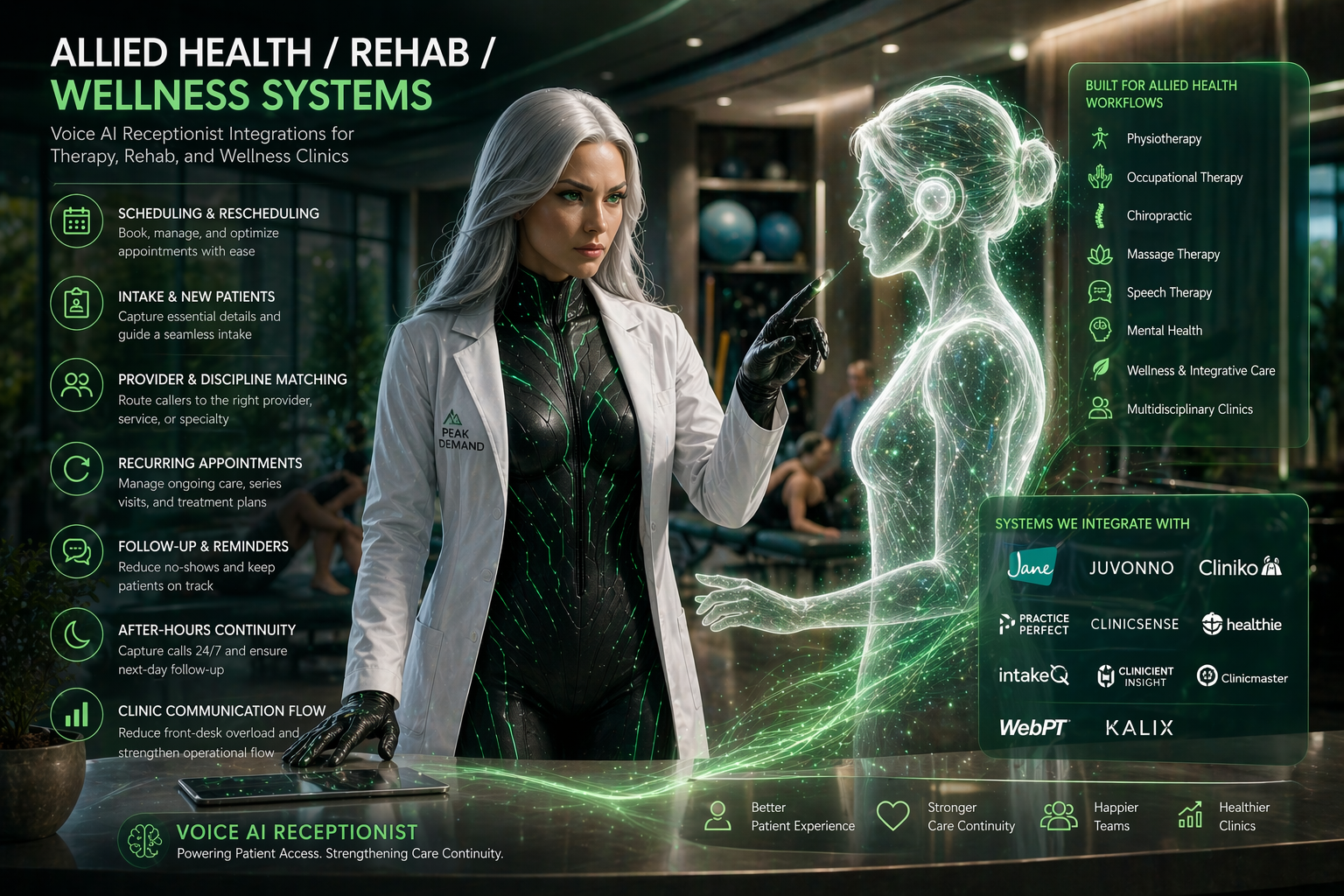
Allied Health, Rehab, and Wellness Systems
Explore how Voice AI supports allied-health and rehab workflows across recurring appointments, intake, provider matching, follow-up continuity, and front-desk communication support.

Dental Systems
Explore how Voice AI fits into dental communication workflows across new patient calls, hygiene recall, appointment flow, cancellation recovery, emergency routing, and front-desk continuity.

Veterinary Systems
Explore how Voice AI fits into veterinary environments across appointment continuity, client intake, urgent call routing, after-hours handling, and front-desk workflow support.
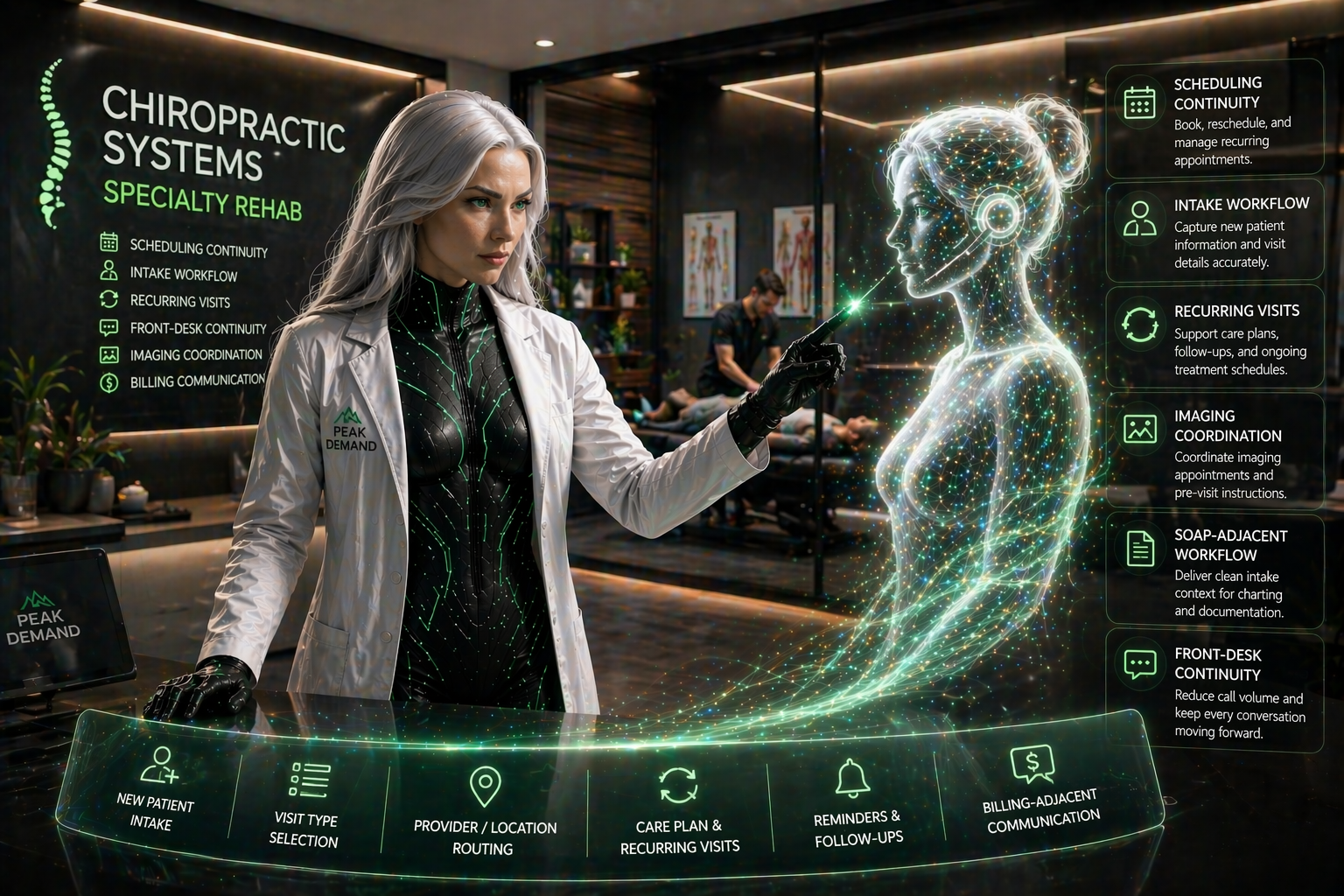
Chiropractic and Specialty Rehab Systems
Explore how Voice AI fits into chiropractic and specialty rehab workflows across scheduling, intake, recurring visits, SOAP-adjacent continuity, imaging-adjacent coordination, and front-desk support.
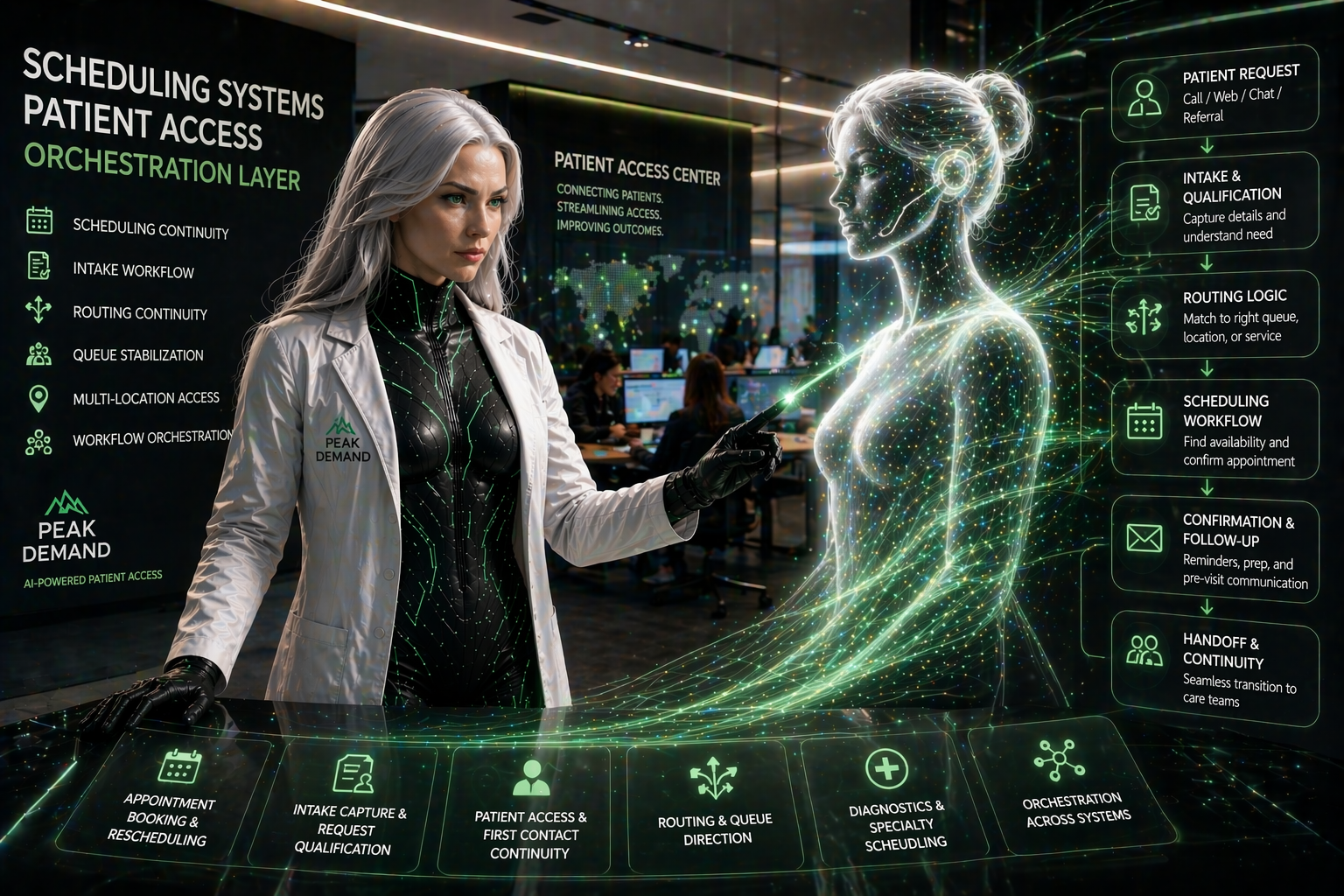
Scheduling, Patient Access, and Orchestration Systems
Explore how Voice AI supports scheduling and patient access architecture across intake, routing, queue stabilization, diagnostics scheduling, and workflow continuity between first contact and next action.
See Healthcare Voice AI Integrations In Action
These walkthroughs show how Voice AI can connect into real healthcare scheduling, intake, and communication environments. Start with TELUS Health CHR for Canadian clinic workflows and Juvonno for rehab and allied health operations.
TELUS Health CHR Integration Walkthrough
See how Voice AI can support TELUS Health CHR scheduling, intake, patient communication, and Canadian clinic workflow continuity.
Juvonno Integration Walkthrough
See how Voice AI can support Juvonno workflows for rehab scheduling, intake, appointment handling, and clinic communication continuity.
Explore published healthcare systems by name
Once you know the software family that best matches your environment, this section makes it easier to browse live healthcare integration pages by platform name. Each category below groups published system pages by the type of environment they usually support so operators, managers, and technical teams can compare workflow fit more quickly. A fuller alphabetical directory appears farther down the page.
Featured healthcare systems
These are high-priority starting points for visitors evaluating real-world Voice AI workflow fit across scheduling, intake, patient communication, routing, and access workflows.
Clinic, ambulatory, and medical EMR systems
These systems are commonly associated with clinic records-adjacent workflows, appointment flow, patient requests, intake continuity, routing, and broader ambulatory communication operations.
Scheduling, intake, and patient communication systems
These environments sit closer to booking logic, intake flow, reminders, clinic administration, and day-to-day patient access operations.
Rehab, physiotherapy, and allied health systems
Allied health and rehabilitation environments often depend on strong scheduling continuity, practitioner matching, intake flow, recurring appointment management, and multi-location operational coordination.
Dental systems
Dental communication workflows often center around appointment demand, cancellation recovery, reminders, new patient calls, and front-desk continuity across booked production.
Veterinary systems
Veterinary communication environments often require appointment continuity, client communication, after-hours handling, urgent call direction, and records-adjacent workflow coordination.
Healthcare organizations rarely evaluate integrations in a vacuum. Grouping systems by software family makes it easier to understand likely workflow fit, compare environments more quickly, and navigate toward both family-level integration pages and live system-specific pages deeper in this hub. The full alphabetical system directory farther down the page should carry the complete 98-system library.
Where Voice AI sits in the healthcare workflow matters more than basic connectivity
Healthcare Voice AI becomes more useful when it is treated as part of the larger workflow architecture around patient access, intake, routing, scheduling, escalation, and downstream ownership. The question is not only whether a system connects. The question is whether the communication flow reaches the next operational step with enough clarity and structure to reduce friction instead of shifting it downstream.
In practice, that means Voice AI often sits across multiple workflow layers at once. It may support first contact, gather structured intake, help direct the caller into the right path, preserve context for staff, and improve continuity into the next step. The value comes from how those layers fit together, not from one isolated connection point.
This is why healthcare teams should evaluate both the scheduling and patient access layer and the EMR or EHR-adjacent layer. In more complex environments, the architecture may also need to account for enterprise compliance and procurement requirements.
Where Voice AI usually enters the workflow
Voice AI often enters at the communication edge: inbound calls, appointment demand, intake capture, after-hours answering, overflow handling, and patient access or routing-related first contact.
Explore healthcare AI receptionistsWhere continuity usually breaks down
Continuity often breaks between the interaction and the next operational owner. That can happen when routing is weak, intake is unclear, scheduling context is incomplete, or downstream teams still need to manually rebuild the request.
Explore centralized scheduling workflowsWhat stronger integration architecture actually improves
Stronger architecture preserves enough structure, direction, and next-step usability for staff or systems to act efficiently. That is what turns Voice AI into operational infrastructure instead of a disconnected front-end layer.
Return to the healthcare resource hub| Integration maturity | What healthcare teams usually experience | Likely operational result |
|---|---|---|
| Fragmented | Some connection points exist, but scheduling, intake, routing, escalation, and continuity still require heavy manual repair. | Lower operational value, more staff burden, weaker patient access continuity, and less confidence in the workflow. |
| Partially connected | Important workflow layers connect, but structure and downstream usability still vary too much between teams, departments, or next-step owners. | Moderate gains, but persistent continuity gaps remain and staff still absorb unnecessary workflow friction. |
| Workflow-led and integrated | Voice AI supports multiple workflow layers with stronger structure, clearer routing, better handoff, and more usable next-step continuity. | Stronger patient access flow, cleaner operational ownership, and more scalable communication infrastructure. |
What healthcare teams should evaluate in the architecture discussion
- Where does Voice AI need to sit first in the communication workflow?
- Where does continuity currently break between the interaction and the next operational step?
- Which layers are EMR or EHR-adjacent, and which ones are workflow-adjacent?
- How do scheduling, intake, routing, patient access, and escalation interact in this environment?
- Will downstream teams receive enough structure to act without rebuilding the request manually?
- Is the integration design workflow-led or just feature-led?
- Does the current architecture reduce friction for staff, or does it simply move the work somewhere else?
Healthcare organizations usually get more value when they evaluate integration maturity across communication flow, operational ownership, and downstream usability together instead of treating each connection as a separate isolated decision. For system-specific evaluation, use the alphabetical healthcare system directory below.
Evaluating software families?
Use the six system-family pages to compare EMR, EHR, dental, veterinary, rehab, scheduling, and patient access environments.
Browse Software FamiliesEvaluating specific systems?
Use the full alphabetical directory to find the exact healthcare platform your team is evaluating.
Open System DirectoryEvaluating enterprise readiness?
Review governance, privacy, escalation, procurement, and compliance considerations before deployment.
Review ComplianceGo deeper into the strategy behind healthcare Voice AI integrations
This section helps healthcare teams move from broad category understanding into the right supporting resources for architecture, interoperability, workflow fit, implementation planning, and system-specific evaluation.
The articles below are the best next clicks for teams evaluating how Voice AI fits into healthcare communication systems, patient access workflows, structured integration pathways, rollout planning, and governed healthcare environments.
For broader category education, use the Healthcare Voice AI Resource Hub. For software-specific evaluation, continue to the full alphabetical system directory lower on this page and use the six healthcare software family pages as the parent layer.
Need system-family pages?
Use the family pages to compare medical EMR, allied health, dental, veterinary, specialty rehab, and patient access systems.
Browse Software FamiliesNeed a specific platform?
Use the alphabetical system directory to find the exact EMR, EHR, scheduling, dental, veterinary, or rehab platform.
Open System DirectoryNeed compliance context?
Use the enterprise compliance page when governance, privacy, procurement, RFPs, or regulated deployment requirements are part of the evaluation.
Review ComplianceCore integration strategy articles
These resources explain why integrations matter, what healthcare teams should evaluate first, and how stronger Voice AI integration architecture should be understood.
Custom pathways, structured integrations, and workflow fit
These articles are useful for teams evaluating custom pathways, structured communication flows, and how Voice AI fits into real healthcare operating environments.
Rollout, implementation, and governance
These resources are best for healthcare teams moving from early exploration into rollout planning, operational safety, implementation readiness, and governance-aware deployment.
Patient access, routing, and workflow bottlenecks
These articles help healthcare teams think more clearly about where communication complexity builds up across patient access, intake, department routing, scheduling, and downstream handoff.
As the healthcare integrations ecosystem continues to grow, this section can keep routing visitors into the most relevant strategy, rollout, and workflow resources without changing the overall structure of the hub. The full software directory appears in the Alphabetical System Directory section below.
Explore live healthcare system integration pages by category
This section gives healthcare teams a category-based way to browse the most important live system pages. It is not the full 98-system directory; it is a curated navigation layer for comparing the platforms most commonly tied to scheduling, intake, patient communication, routing, and patient access workflows.
Use this section when you know the type of software environment you are evaluating. Use the Alphabetical System Directory below when you want to find every live system page by name.
Need the family layer?
Start with the six parent family pages when comparing software categories before choosing a specific system.
Browse Software FamiliesNeed every system?
Use the alphabetical directory for the complete live healthcare system page list by platform name.
Open Alphabetical DirectoryNeed workflow context?
Review how Voice AI fits across patient access, intake, routing, scheduling, escalation, and downstream ownership.
Review Workflow ArchitectureFeatured healthcare systems
These are some of the strongest starting points for teams exploring healthcare Voice AI integrations across scheduling, intake, patient communication, routing, and access workflows.
Clinic and ambulatory EMR systems
These systems are commonly associated with clinic records-adjacent workflows, intake, appointment flow, routing, patient communication, and broader ambulatory continuity.
Explore medical and ambulatory EMR familyScheduling, intake, and patient communication systems
These environments sit closer to booking logic, intake flow, reminders, clinic administration, and day-to-day patient access operations.
Explore scheduling and patient access familyRehab, physiotherapy, and allied health systems
Allied health and rehabilitation environments often depend on strong scheduling continuity, practitioner matching, intake flow, recurring appointments, and multi-location coordination.
Explore allied health and rehab familyDental systems
Dental communication workflows often center on appointment demand, cancellation recovery, reminders, new patient calls, and front-desk continuity.
Explore dental familyVeterinary systems
Veterinary communication environments often require appointment continuity, client communication, after-hours handling, and records-adjacent workflow coordination.
Explore veterinary familyEnterprise, specialty, imaging, and outpatient environments
These environments often involve more complex routing, diagnostic scheduling, imaging coordination, enterprise workflow ownership, and department-specific handoff requirements.
Explore enterprise and medical EMR familyThis curated category browse section helps visitors compare common healthcare software environments without scrolling the entire directory. The complete system list belongs in the Alphabetical System Directory section below, where every live healthcare system page should be listed by platform name.
Talk through your healthcare communication workflow
If your team is evaluating healthcare Voice AI integrations, the most useful next step is usually a workflow conversation. That means reviewing patient access pressure points, scheduling flow, intake structure, routing logic, after-hours coverage, compliance expectations, and the systems surrounding those workflows.
Peak Demand approaches healthcare environments through workflow fit, governance awareness, and operational usability. The goal is to help organizations map a communication architecture that supports real teams, real workflows, and real continuity requirements across EMR, EHR, scheduling, intake, dental, veterinary, rehab, and patient access environments.
Need software families?
Compare the six parent healthcare integration families before choosing a specific system page.
Browse software familiesNeed workflow context?
Review how Voice AI fits across intake, routing, scheduling, escalation, and downstream ownership.
Review workflow architectureNeed compliance review?
Use the enterprise compliance page when governance, privacy, procurement, and RFP standards matter.
Review complianceFrequently asked questions
What does Voice AI mean in a healthcare integration environment?
Can Voice AI work with EMR, EHR, scheduling, intake, and routing workflows?
Are healthcare Voice AI integrations always direct?
Where should healthcare organizations start evaluating Voice AI integrations?
How should compliance and governance fit into the evaluation?
What is the role of this integrations hub?
About Peak Demand
Peak Demand is a Toronto-based AI agency focused on Voice AI, communication automation, and workflow infrastructure for organizations operating in more complex service environments.
In healthcare, the focus is not just on call handling. It is on patient access continuity, scheduling pressure, intake structure, routing logic, after-hours support, governance, and how communication systems fit into real operational workflows.
- Workflow-driven and implementation-aware
- Governance-first in healthcare communication environments
- Built to support clinics, networks, and enterprise teams
- Designed to scale into software-specific integration pathways
- Organized around healthcare system families and live integration pages
Healthcare software integrations by system name
If you already know the software you are evaluating, this alphabetical directory is the fastest way to find the right live system page.
This directory includes the full 98-system healthcare integration library from the current Peak Demand system-page build. It is designed to help teams compare EMR, EHR, scheduling, intake, patient communication, dental, veterinary, rehab, wellness, chiropractic, orchestration, home care, med spa, pharmacy, and enterprise healthcare systems by software name.
For category-level browsing, use the software family section. For workflow context, use the workflow architecture section. This section is the full alphabetical browse layer.
Live healthcare system pages in this directory
Grouped alphabetically with visible section counts so the full library is obvious at a glance.
A–C
34 systemsABELMed through Curve Dental.
D–H
20 systemsDentrix through Helios Software.
I–M
15 systemsIDEXX Cornerstone through MRX Solutions.
N–O
11 systemsNextech through Owl Practice.
P–R
8 systemsPabau through RXNT.
Compare healthcare systems by name, category, and workflow fit
This directory is useful for comparing clinic EMRs, EHR-adjacent systems, scheduling and intake platforms, patient communication software, dental systems, veterinary systems, rehab and allied health systems, chiropractic systems, med spa systems, home care systems, pharmacy-adjacent systems, orchestration platforms, diagnostic workflows, and enterprise healthcare environments by software name before going deeper into workflow design, integration possibilities, and operational fit.
Explore your own AI use case on a discovery call.