
Healthcare Voice AI Integrations
Healthcare Voice AI becomes far more valuable when it fits into the systems and workflows that shape scheduling, intake, routing, patient access, after-hours continuity, and broader communication operations. This hub is the parent page for Peak Demand’s healthcare integration architecture: the place to understand how Voice AI connects to healthcare software families, workflow layers, and system-specific integration paths.
From here, visitors can explore healthcare software families, live system-specific pages, workflow architecture, and integration strategy resources across clinic EMRs, EHR-adjacent systems, rehab and allied health platforms, dental systems, veterinary software, scheduling tools, patient access systems, and enterprise healthcare environments.
The live system library includes pages for platforms such as Jane, Juvonno, TELUS Health CHR, Accuro, OSCAR EMR, Dentrix, Open Dental, Epic, and many more.
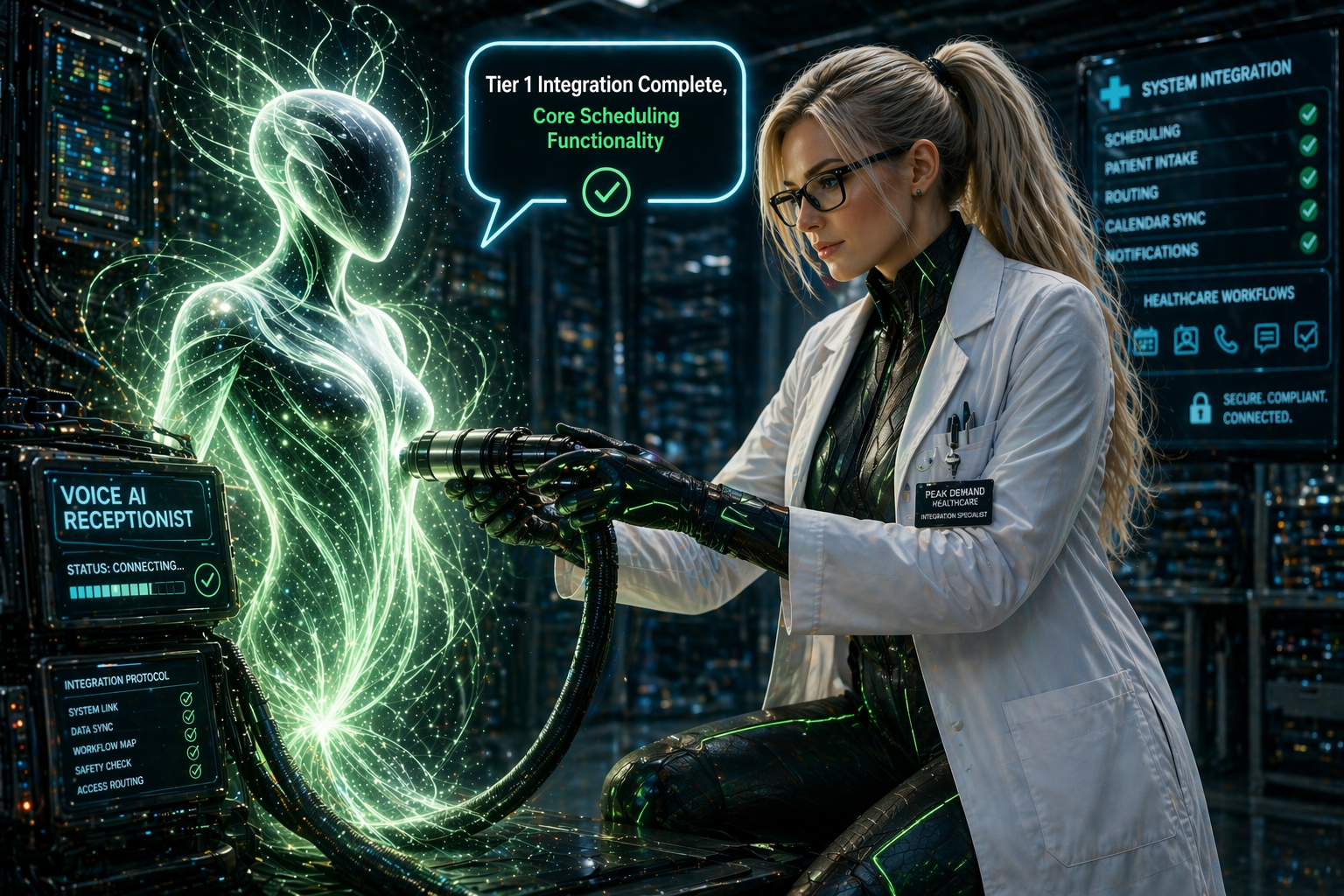
Architecture Role
Parent hub for healthcare integrations
System Coverage
98 healthcare system pages
Software Families
6 healthcare integration families
Workflow Focus
Scheduling, intake, routing, access
Healthcare integrations should be evaluated through workflow continuity
One of the biggest mistakes in healthcare integration conversations is reducing the discussion to a list of software names. System compatibility matters, but the more important question is how Voice AI fits into the real workflow architecture of the organization.
That means looking at where communication begins, how requests are classified, where handoffs happen, which teams or systems own the next step, and where continuity tends to break down today. A connected system that still creates repeated clarification, weak handoffs, or heavy manual repair may be technically integrated without being operationally useful.
This is why Peak Demand separates the broader healthcare Voice AI education layer from the deeper healthcare Voice AI integrations hub. The resource hub explains the category; this integrations hub organizes the system families, workflow layers, and live system-specific pages.
Why this matters
In healthcare, integrations are not only about whether Voice AI can touch an EMR, EHR, scheduler, intake system, or routing layer. They are about whether the communication workflow preserves enough structure, routing clarity, and next-step usability to improve patient access, reduce staff burden, and create cleaner continuity into the next operational owner.
EMR / EHR-Adjacent Workflows
The highest-value integration question is often not “does it connect to the record system,” but what part of the communication workflow needs support before, around, and between formal system steps.
- Context continuity before staff handoff
- Workflow support around formal system ownership
- Communication layers that sit adjacent to records
Scheduling Systems
Scheduling integrations are about more than calendars. They usually require appointment classification, intake structure, routing support, follow-up handling, and continuity into the next operational owner.
- Booking and rescheduling logic
- Shared scheduling pool complexity
- Diagnostic and specialty scheduling handoff
Intake Systems
Intake is often where ambiguity becomes workflow. Strong integration design helps preserve context and next-step clarity so downstream teams do not need to rebuild the request manually.
- Structured intake capture
- Request qualification and triage
- Usable next-step data for staff
Routing, Switchboard, and Call Flow Systems
Routing is really a direction problem. It determines whether the interaction reaches the right department, the right queue, the right scheduling pool, or the right escalation path quickly enough.
- Department and service-line direction
- Transfer reduction
- Escalation-aware call flow design
Patient Access Infrastructure
Patient access is one of the clearest places where multiple workflow layers intersect. Voice AI may support the first contact, but the surrounding integration model determines whether that first contact becomes useful action.
- Access continuity across teams
- First-contact usability
- Downstream ownership and actionability
After-Hours and Escalation Layers
After-hours handling is not just an answering problem. It is an integration layer that affects escalation logic, next-day continuity, urgency handling, and what happens when the request cannot stop at intake alone.
- Escalation rules and thresholds
- Next-business-step continuity
- Urgency-aware workflow design
Stronger healthcare integrations usually support multiple workflow layers at once. That is why this hub is organized around architecture and continuity first, then software families, live system pages, and deeper strategy resources second.
Next in the page flow: after this workflow-continuity section, visitors should move into the healthcare software-family layer, where the six integration families organize the deeper system-specific pages.
Browse Healthcare Software Families
Why Hire Customer Service Reps? Use an AI Call Center Agency Instead
Why Small Business Owners and Department Leaders Should Consider an AI Call Center Agency

For small business owners, mid-market companies, and government leaders, managing customer service can be a huge challenge. You need to keep response times short, maintain high-quality service, and meet the growing demands of customers who expect help at all hours. But the cost and logistics of staffing a full customer service team, training them, and ensuring consistent performance can stretch your resources to the limit.
This is where an AI Call Center Agency offers a real solution. By leveraging AI-driven technology, you can handle customer inquiries more efficiently, reduce the burden on your team, and keep your service running 24/7. AI systems can answer questions, route calls, and even provide personalized support, all without needing additional manpower.
Here’s why more businesses are turning to AI Call Center Agencies:
Lower Costs: AI reduces the need for large customer service teams, cutting staffing costs significantly while still ensuring great service.
24/7 Availability: AI systems don’t sleep. They provide round-the-clock support, making sure your customers get the help they need—whether it’s 2 p.m. or 2 a.m.
Improved Customer Experience: AI-driven responses are fast, accurate, and consistent. This means fewer errors, shorter wait times, and better service overall.
Scalability: As your business grows or demand increases, AI scales effortlessly. You don’t have to worry about hiring more people to handle the extra load.
At Peak Demand, we’ve helped small businesses, mid-market companies, and government organizations integrate AI solutions that revolutionize their customer service. Our expertise in building AI-powered call centers allows businesses to streamline their operations, save money, and deliver top-notch support around the clock.
In this article, we’ll explore how an AI Call Center Agency works, the benefits it brings, and why it’s the right choice for businesses looking to stay competitive in today’s market.
Understanding the Role of AI in an AI Call Center Agency

AI is transforming customer service in ways that make it easier for businesses to manage support without the need for large, expensive teams. AI Call Center Agencies use advanced technology to handle tasks traditionally managed by human agents, allowing businesses to provide 24/7 customer support without the headaches of staffing or scheduling issues.
But how does AI actually work in a call center? Let’s look at some straightforward examples that any business owner or department leader can understand:
Natural Language Processing (NLP): This is what allows AI to understand and respond to customers like a human would. Whether a customer is calling, chatting, or sending an email, the AI can interpret what they’re asking and give a clear, natural response. It’s like having a customer service agent who never sleeps, never gets tired, and always gives accurate information.
Voice Recognition and AI Voice Agents: AI-powered voice agents can handle phone calls just like human reps. When a customer calls in, these voice agents can understand their questions and provide answers in real time. Whether it’s a question about business hours or a detailed inquiry about a service, the AI voice agent is available 24/7 to assist. This can be a game-changer for businesses that deal with a lot of calls but can’t afford to staff a full-time team around the clock.
Automated Call Routing: AI can automatically direct customers to the right department or agent. If a customer has a simple question, the AI can handle it entirely. If the inquiry is more complex, the AI knows to route the call to the appropriate human agent. This helps reduce wait times and ensures that customers always get to the right person or solution quickly.
AI for FAQ Handling: Instead of having your team answer the same questions over and over (like “What’s your return policy?” or “How do I reset my password?”), AI can handle these routine inquiries. This frees up your team to focus on more important, personalized customer interactions while the AI takes care of the repetitive stuff.
These technologies make it easier for businesses to provide fast, efficient customer service without needing a huge team of agents. Whether it’s answering common questions, routing calls to the right place, or handling voice interactions, AI in a call center can do it all—and it’s available anytime, day or night.
At Peak Demand, we help businesses of all sizes implement these AI solutions to simplify their customer service. Whether you're running a small business or leading a government department, we can help you create a smarter, more efficient call center that delivers great service to your customers 24/7.
In the next section, we’ll dive into the benefits of hiring an AI Call Center Agency and how it can help you save costs while improving service.
5 Benefits of Hiring an AI Call Center Agency for Small Businesses

For small businesses, managing customer service can be a costly and time-consuming challenge. Between hiring, training, and maintaining a team of customer service reps, the overhead alone can eat into your bottom line. And if you need to provide 24/7 support, the costs skyrocket even more. This is where an AI Call Center Agency can provide a huge advantage.
Here are the key benefits that small businesses can gain from hiring an AI Call Center Agency:
1. Cost-Effectiveness
Running a traditional call center requires hiring full-time staff, managing shifts, and paying for overtime or night shifts. With an AI-driven call center, those costs drop dramatically. AI systems can handle many of the routine tasks that human agents typically do—answering common questions, routing calls, and providing basic information—without needing breaks, overtime, or salaries. This means you can keep your business running smoothly and support your customers 24/7 at a fraction of the cost.
2. Scalability
Small businesses often face fluctuations in customer inquiries, especially during busy seasons or promotional periods. An AI Call Center Agency allows you to scale your customer service seamlessly. Whether you get 10 calls or 100 in an hour, AI systems can handle the volume without needing additional staff. This flexibility means your customer service will never feel overwhelmed, even during peak times.
3. Specialized Skills and Cutting-Edge Technology
When you partner with an AI Call Center Agency, you’re not just getting a piece of software—you’re getting access to specialized expertise. AI agencies know how to implement the latest technology to make sure your customer service operations run efficiently. For example, at Peak Demand, we customize AI solutions to fit the unique needs of your business, ensuring that the technology works in harmony with your existing systems and processes.
4. Enhanced Customer Service
One of the biggest advantages of AI is its ability to provide fast, consistent service. AI doesn’t get tired, frustrated, or overwhelmed. Whether your customers are reaching out at noon or 2 a.m., they’ll receive the same high-quality service. This means no more long hold times or frustrated customers waiting for answers. AI can handle multiple inquiries at once and respond instantly, improving customer satisfaction.
5. Focus on High-Value Interactions
By automating routine tasks like answering FAQs or routing calls, an AI Call Center Agency frees up your human agents to focus on more complex, high-value interactions. Your team can spend their time addressing issues that require a personal touch or expertise, leaving the repetitive tasks to AI. This not only boosts productivity but also ensures your customers get the best service possible when they need it most.
Hiring an AI Call Center Agency like Peak Demand allows you to streamline your customer service, save on operational costs, and ensure you’re delivering exceptional service around the clock. Whether you’re a small business looking to grow or an established company needing to scale your operations, AI can help you meet the challenge.
In the next section, we’ll dive deeper into how an AI Call Center Agency optimizes your day-to-day operations.
How an AI Call Center Agency Optimizes Operations
One of the most significant advantages of working with an AI Call Center Agency is how it can streamline and optimize your daily operations. By using advanced technology, AI call centers can improve efficiency, reduce response times, and ensure that every customer interaction is handled smoothly—whether it's a simple inquiry or a complex issue.
Here’s how an AI Call Center Agency can optimize your business’s customer service operations:
1. Automated Call Routing
AI can automatically sort and route calls based on the nature of the inquiry, ensuring that customers are always directed to the right department or agent. This eliminates the frustration customers often feel when they’re bounced between departments or placed on hold for too long. For instance, a call about billing can be immediately routed to the accounting team, while a service inquiry can be handled by the AI itself, all in real-time. This keeps operations flowing smoothly and improves customer satisfaction.
2. Faster Response Times
Speed is everything in customer service. With an AI-powered system, inquiries can be handled instantly. Whether a customer is contacting you via phone, chat, or email, the AI can process their request, provide answers, or escalate more complex issues to a human agent—all without any delay. This means your customers get the help they need quickly, cutting down on wait times and improving their overall experience.
3. Enhanced Customer Interaction Management
AI doesn’t just handle calls; it manages the entire customer interaction process. From the moment a customer reaches out, AI can track their request, respond based on the specific context of their inquiry, and even follow up if necessary. This ensures that no customer request is lost or overlooked, and that every interaction is resolved as efficiently as possible.
4. Consistent and Reliable Service
One of the major challenges in running a traditional call center is ensuring consistent service quality, especially across different shifts or during busy periods. AI provides a solution to this by delivering the same level of quality and attention to every customer, regardless of the time of day or the number of inquiries being handled. Your customers receive the same high-quality service whether it’s a peak business hour or the middle of the night.
5. Data-Driven Insights
Another way AI optimizes operations is by collecting and analyzing customer data in real-time. AI can track common customer issues, identify areas for improvement, and provide insights into trends that human agents might miss. These data-driven insights can help you make informed decisions about your customer service strategy, from updating FAQs to identifying where additional support may be needed.
Real-Life Scenarios: AI Call Center Agency Success Stories

To truly understand how an AI Call Center Agency improves customer service, let’s look at a few real-life scenarios comparing human agents to AI agents. These examples will showcase how AI can provide immediate answers or guide customers through solutions, often faster and more efficiently than a human agent.
Scenario 1: Human Agent Handling a Routine Inquiry for an E-Commerce Business
Inquiry: A customer calls in to ask about tracking their order.
Human Agent: The agent asks for the order number, looks it up in the system, and provides the customer with a tracking link. This process takes a few minutes, especially if the agent is handling multiple calls.
AI Agent: Instead of retrieving order information, the AI agent immediately directs the customer to the online tracking tool. The AI provides simple instructions, guiding the customer through checking their order status by themselves, all in a matter of seconds.
Advantage: The AI agent offers an instant, self-service solution, allowing the customer to get their answer quickly without having to wait for an agent to look up their information.
Scenario 2: Human Agent Resolving a Billing Question for an Insurance Company
Inquiry: A customer calls in to ask about a confusing charge on their bill.
Human Agent: The agent must look up the customer’s billing history, listen to their concerns, and explain the charge in detail, which can take time depending on the complexity of the issue.
AI Agent: The AI doesn’t need to search the system. Instead, it quickly provides an explanation of typical billing charges or guides the customer through how to review and understand their bill online. The AI helps the customer understand common billing structures and offers simple instructions to resolve most questions without needing to access personal account details.
Advantage: AI can resolve routine billing inquiries by offering immediate explanations and guidance, minimizing wait times for customers and freeing up human agents for more complex issues.
Scenario 3: Human Agent Managing an Upset Customer in a Retail Setting
Inquiry: A customer is upset about receiving the wrong product and demands a refund.
Human Agent: The agent listens to the complaint, checks the system to verify the order, and then processes the refund. Depending on the complexity of the issue and the customer’s frustration level, this interaction can take several minutes, and the resolution depends on the agent’s ability to de-escalate the situation.
AI Agent: The AI agent doesn’t need to verify order details; it immediately offers step-by-step instructions on how the customer can initiate a return online or through the retailer’s app. If the customer remains upset or the issue becomes more complex, the AI quickly transfers them to a human agent while assuring them that their concern is being handled.
Advantage: The AI agent provides instant guidance on how to initiate the return process, reducing frustration and resolving routine inquiries faster. For more emotional or difficult cases, the AI still ensures the customer is transferred to a human agent quickly.
Scenario 4: AI Agent Handling Frequently Asked Questions for a Government Service
Inquiry: A citizen calls to ask how they can get a replacement ID.
Human Agent: The agent explains the process, including the necessary forms and where to submit them. This takes several minutes, especially if the caller has additional questions.
AI Agent: The AI immediately provides clear instructions, explaining where the citizen can find the forms online and how to complete the process. The AI also offers a direct link to the online portal, saving time and ensuring the caller has all the necessary information.
Advantage: The AI provides quick, step-by-step guidance, reducing the need for citizens to rely on human agents for basic questions.
Scenario 5: AI Agent Offering After-Hours Support for a Mid-Market Software Company
Inquiry: A customer calls late at night needing help with resetting their software password.
Human Agent: If after hours, the customer is likely to be routed to a voicemail or outsourced service, and they’ll have to wait until the next business day for assistance.
AI Agent: The AI instantly provides step-by-step instructions on how the customer can reset their password through the company’s self-service tool. No human intervention is required, and the issue is resolved in minutes, even outside of business hours.
Advantage: AI enables 24/7 support for simple issues like password resets, ensuring customers don’t have to wait for help during off-hours.
Scenario 6: AI Agent Handling High Call Volumes for a Healthcare Provider
Inquiry: A patient calls in to ask for clinic hours or how to book an appointment.
Human Agent: During high call volumes, the human agents may be overwhelmed, resulting in long wait times and frustrated patients.
AI Agent: The AI instantly provides clinic hours and offers a link to the online booking portal, allowing the patient to schedule their appointment immediately. The AI can handle an unlimited number of inquiries simultaneously, ensuring no one has to wait on hold.
Advantage: AI scales easily to manage high call volumes, giving patients immediate access to information and booking options, even during peak times.
Key Takeaways
In each of these scenarios, AI agents were able to provide immediate answers or instructions to guide customers through self-service solutions. While human agents are essential for handling complex or emotional cases, AI can quickly resolve routine inquiries by providing clear directions, reducing wait times, and ensuring a smooth customer experience.
At Peak Demand, we help businesses implement AI solutions that enable faster, more efficient customer interactions. By combining AI’s ability to deliver quick resolutions with human agents for more complex issues, your business can provide a seamless and satisfying service experience.
In the next section, we’ll explore which departments and businesses can benefit most from AI Call Center Agency services.
Top 5 Departments or Businesses That Benefit Most from AI Call Center Agency Services

AI call center solutions aren’t limited to just one industry or department—they offer benefits across a wide range of business types and sectors. Whether you're running a small business or overseeing operations at a larger organization, certain departments and industries can especially gain from AI-driven customer service. Here are five examples of areas where an AI Call Center Agency can make the most significant impact.
1. Customer Support and Help Desks
Businesses with customer service departments that handle frequent inquiries—whether for troubleshooting, product support, or basic information—are ideal candidates for AI. An AI call center can handle routine support questions, such as providing troubleshooting steps for software issues or guiding customers through FAQs, allowing human agents to focus on more complex issues. AI ensures quick responses, consistent answers, and reduced wait times, all while operating 24/7.
Who benefits?: Software companies, tech support services, and consumer electronics businesses that handle high volumes of support inquiries.
2. E-commerce and Retail
AI call centers are a natural fit for e-commerce and retail businesses, which often handle a flood of customer inquiries, especially during sales events, holidays, or product launches. AI can guide customers through order tracking, returns, and basic product questions, all in real-time. This allows e-commerce businesses to provide fast, efficient service without the need to staff additional agents during busy periods.
Who benefits?: Online stores, clothing retailers, and large e-commerce platforms that need to manage inquiries about shipping, returns, and product availability.
3. Healthcare Providers
Healthcare is another sector where AI call center services offer major advantages. From providing patients with clinic hours, answering insurance coverage questions, or directing them to self-service appointment booking, AI can ease the load on overburdened staff while ensuring patients get the information they need quickly. AI also offers 24/7 availability, making it easier for patients to access support outside normal business hours.
Who benefits?: Clinics, hospitals, and healthcare providers that deal with high patient inquiries and scheduling requests.
4. Government and Public Services
Government agencies and public service departments often face high volumes of routine inquiries, such as asking about city services, reporting issues, or applying for permits. AI-powered call centers can handle common citizen inquiries, direct people to online resources, or route complex requests to the appropriate department. This saves time for both citizens and government staff, making public services more efficient.
Who benefits?: Municipal offices, public utility companies, and transit systems that manage citizen inquiries and service requests.
5. Financial Services
Financial institutions are constantly handling customer inquiries about account balances, transactions, or loan applications. AI can quickly assist customers with these routine tasks, provide answers to common banking questions, and guide customers through simple financial transactions. By automating these processes, financial institutions can reduce the pressure on human agents and improve customer satisfaction by offering real-time support.
Who benefits?: Banks, credit unions, and insurance companies that deal with routine inquiries about accounts, billing, and transactions.
Key Takeaways
These departments and industries stand to gain the most from AI call center services due to the high volume of routine inquiries and the need for consistent, reliable responses. By adopting AI-powered solutions, businesses in these sectors can improve efficiency, reduce costs, and ensure they provide fast, accurate service to their customers 24/7.
At Peak Demand, we work with businesses and organizations across these industries to help them implement AI-driven call centers that are tailored to their unique needs. Whether you’re looking to streamline customer support or provide more efficient public services, we can help you deploy AI solutions that keep your operations running smoothly.
In the next section, we’ll explore the future trends shaping AI Call Center Agency services and how businesses can prepare for these innovations.
Future Trends in AI Call Center Agency Services

As AI technology continues to evolve, AI Call Center Agencies are set to deliver even more sophisticated and innovative solutions for businesses. By staying ahead of these trends, businesses can further enhance their customer service operations and ensure they are offering cutting-edge support to their clients. Here are some key trends shaping the future of AI call centers:
1. AI and Emotional Intelligence
In the future, AI systems will become more adept at recognizing and responding to customer emotions during interactions. While AI has already made strides in understanding language, the next wave of AI advancements will focus on detecting emotional cues—such as frustration or confusion—and adjusting responses accordingly. This means that AI can offer more empathetic support, and when necessary, escalate sensitive or emotional issues to human agents for a personal touch.
What this means: Businesses will be able to provide not only fast, accurate answers but also more emotionally sensitive service, creating a better overall customer experience.
2. Increased Personalization
AI will continue to evolve in its ability to provide real-time personalization based on customer preferences and the nature of their inquiries. Instead of just providing generic answers, AI systems will be able to tailor responses based on the specific needs and context of each customer interaction. For instance, if a customer is calling about a frequently purchased product, AI could offer recommendations or reminders specific to their past interactions without needing customer history.
What this means: Businesses can deliver more relevant and engaging customer interactions, improving loyalty and satisfaction.
3. Integration with AI-Driven Analytics
Future AI call centers will not just answer customer questions—they will also gather valuable insights from every interaction. These AI-driven analytics will help businesses better understand customer behavior, preferences, and emerging trends. This data can then be used to refine customer service strategies, predict demand, and offer more proactive support.
What this means: Businesses will have access to actionable data, helping them stay ahead of customer needs and improve their overall service delivery.
4. Voice and Multimodal Interactions
As voice recognition technology improves, AI systems will handle more complex voice interactions, providing smoother conversations that feel more natural to the customer. In addition, AI will integrate with multimodal systems, allowing customers to switch seamlessly between voice, chat, and email without losing context. For example, a customer could start a conversation through a voice call and switch to chat or email without needing to repeat their inquiry.
What this means: Customers will enjoy a seamless and flexible service experience across multiple channels, increasing convenience and engagement.
5. AI-Powered Proactive Support
AI systems will increasingly focus on proactive support, where they predict potential customer issues before they arise. For instance, AI can monitor patterns in customer behavior, such as frequent visits to a troubleshooting page, and offer assistance before the customer even reaches out. This proactive approach can prevent problems from escalating and reduce the overall number of inquiries.
What this means: Businesses can reduce customer frustrations by solving problems before they become issues, boosting customer satisfaction and retention.
6. Hybrid AI and Human Teams
As AI call centers become more advanced, the integration of hybrid systems—where AI and human agents work together—will become even more seamless. AI will handle the routine, repetitive tasks, while human agents will take over for complex or emotionally charged situations. The future of AI in call centers isn’t about replacing humans but enhancing the overall customer service experience by making both AI and human teams more efficient.
What this means: Businesses will offer faster, more efficient service, while human agents focus on providing empathy and personal interaction when needed.
Preparing for the Future with Peak Demand
The future of AI call centers is bright, with new technologies enhancing how businesses engage with customers. At Peak Demand, we are dedicated to staying ahead of these trends and ensuring our clients benefit from the latest advancements in AI-powered customer service.
By partnering with an AI Call Center Agency like Peak Demand, businesses can take advantage of cutting-edge technologies that provide faster, smarter, and more personalized service. Whether it’s implementing AI-driven analytics, offering real-time emotional intelligence, or integrating multimodal interactions, we ensure your business stays competitive as AI continues to evolve.
In the final section, we’ll summarize the key benefits of partnering with an AI Call Center Agency and how it can transform your business’s customer service strategy.
Making The Decision to Partner with an AI Call Center Agency

In today’s fast-paced world, customers expect immediate, efficient, and personalized support—whether they reach out at noon or midnight. For small businesses, mid-market companies, and government organizations, meeting these demands can be a challenge with traditional customer service teams. That’s why more businesses are turning to AI Call Center Agencies to streamline their operations and enhance the customer experience.
Partnering with an AI Call Center Agency offers several key advantages:
Cost Savings: By reducing the need for large customer service teams, businesses can save on staffing costs while still delivering high-quality support around the clock.
24/7 Availability: AI ensures your business is always ready to assist customers, regardless of time zones or operating hours.
Scalability: AI call centers can handle fluctuations in demand effortlessly, ensuring your service levels stay high even during peak periods.
Consistent and Accurate Service: AI provides fast, reliable responses to customer inquiries, ensuring consistent service quality and minimizing errors.
Improved Customer Experience: With AI taking care of routine tasks, human agents can focus on more complex issues, providing a more personalized experience when it’s needed most.
At Peak Demand, we specialize in helping businesses implement AI-powered call centers that are designed to meet their unique needs. Whether you’re a small business looking to manage after-hours inquiries or a government agency handling public service requests, our AI solutions can help you streamline operations, cut costs, and deliver top-tier customer support.
Call to Action
Are you ready to transform your customer service operations with AI? Partner with Peak Demand and see how our AI Call Center Agency services can enhance your business’s efficiency and customer satisfaction. Schedule a consultation today at peakdemand.ca/discovery to learn more about how we can customize AI solutions for your business needs.
Learn more about the technology we employ.
Watch Video of AI Use Cases on our Youtube Channel

(FAQ) Frequently Asked Questions About Partnering with an AI Call Center Agency
What exactly is an AI Call Center Agency, and how can it help my business?
An AI Call Center Agency provides businesses with AI-driven customer service solutions that automate routine tasks such as answering frequently asked questions, routing calls, and providing support 24/7. By partnering with an AI Call Center Agency, your business can improve efficiency, reduce staffing costs, and ensure consistent, high-quality customer service without needing a large customer service team.
Will AI replace all of my human customer service agents?
No, AI is designed to work alongside your human agents. It handles routine and repetitive inquiries, freeing up your staff to focus on more complex or sensitive customer interactions. This hybrid approach enhances overall efficiency while maintaining a personal touch when needed.
What types of tasks can AI handle for my customer service team?
AI can handle a wide range of tasks, including:
Answering frequently asked questions (e.g., order status, billing inquiries)
Routing calls to the right department or human agent
Providing 24/7 support for routine tasks like password resets or product returns
Managing appointment scheduling and customer inquiries
Offering guidance on how to complete tasks through self-service tools (e.g., booking systems)
How does AI improve the customer experience?
AI provides immediate responses to customer inquiries, which reduces wait times and improves customer satisfaction. It delivers consistent and accurate answers every time, and when more complex issues arise, AI can transfer the customer to a human agent quickly and efficiently, ensuring a seamless experience.
What are the cost benefits of using an AI Call Center Agency?
Partnering with an AI Call Center Agency can significantly reduce operational costs by minimizing the need for a large customer service staff. AI solutions operate 24/7, without the need for breaks, overtime pay, or additional hires during busy seasons. This allows businesses to provide full-time customer service at a fraction of the cost of a traditional call center.
Is AI flexible enough to scale with my business as we grow?
Absolutely. One of the major advantages of AI is its scalability. Whether your business is experiencing a surge in customer inquiries or is expanding to serve more clients, AI systems can scale effortlessly to handle the increased volume without requiring additional resources or staff.
What kind of businesses benefit the most from an AI Call Center Agency?
AI call centers benefit a wide range of industries, including:
E-commerce and retail: Handling high call volumes during sales or product launches.
Healthcare: Managing patient inquiries, appointment bookings, and basic insurance questions.
Government services: Answering citizen inquiries about public services, permits, and utility information.
Financial services: Providing routine support for banking, billing, and account inquiries.
Customer support desks: Offering troubleshooting assistance and general product information.
Can AI integrate with my current customer service tools?
Yes, AI call center solutions can easily integrate with existing customer service platforms and CRM systems. At Peak Demand, we ensure that our AI solutions seamlessly connect with your existing tools, from communication platforms to customer databases, so you can maintain consistency across all your operations.
Will AI systems keep my customer data safe?
Yes, AI systems are built with security and privacy in mind. AI call centers adhere to industry standards for data protection, including encryption and compliance with regulations like GDPR and HIPAA, ensuring that your customer data remains safe and secure.
What happens if a customer issue is too complex for AI to handle?
If an issue requires more personalized attention, the AI can escalate the situation to a human agent. The AI will gather and provide relevant details to the human agent, ensuring a smoother handoff and faster resolution for the customer.
How quickly can an AI Call Center Agency be implemented?
The timeline for implementation depends on the complexity of your business needs and the systems already in place. However, Peak Demand works to ensure a swift and seamless transition, typically taking a few weeks from initial consultation to full deployment, with minimal disruption to your existing operations.
Will customers know they’re interacting with AI?
While AI is designed to handle interactions in a natural, conversational way, many businesses choose to let customers know they’re interacting with an AI system upfront. However, the interaction is often so smooth and efficient that customers may not even realize they’re not speaking with a human.
How do I get started with an AI Call Center Agency?
To get started, we recommend scheduling a consultation with an AI Call Center Agency like Peak Demand. During this consultation, we’ll assess your business’s unique customer service needs and create a customized plan to implement AI solutions that streamline your operations and enhance customer satisfaction. Visit peakdemand.ca/discovery to learn more and take the first step.

Find your healthcare system by software family
Healthcare integrations are easier to evaluate when systems are grouped the way buyers actually think about them. Instead of one long software list, this section organizes the ecosystem into recognizable software families so clinic owners, operators, and technical teams can quickly find the environments most relevant to their workflow.
Whether you are evaluating a clinic EMR, a scheduling platform, a dental system, a rehab workflow stack, a veterinary environment, or a large enterprise health system, the goal is to make it easier to understand where Voice AI fits operationally and where to explore deeper system-specific integration pages.
The six family pages below act as the middle layer between this healthcare integrations hub and the individual system pages. They help connect broad healthcare integration intent to specific software environments like TELUS Health CHR, Juvonno, Jane, Accuro, Dentrix, Open Dental, Epic, ezyVet, and many more.
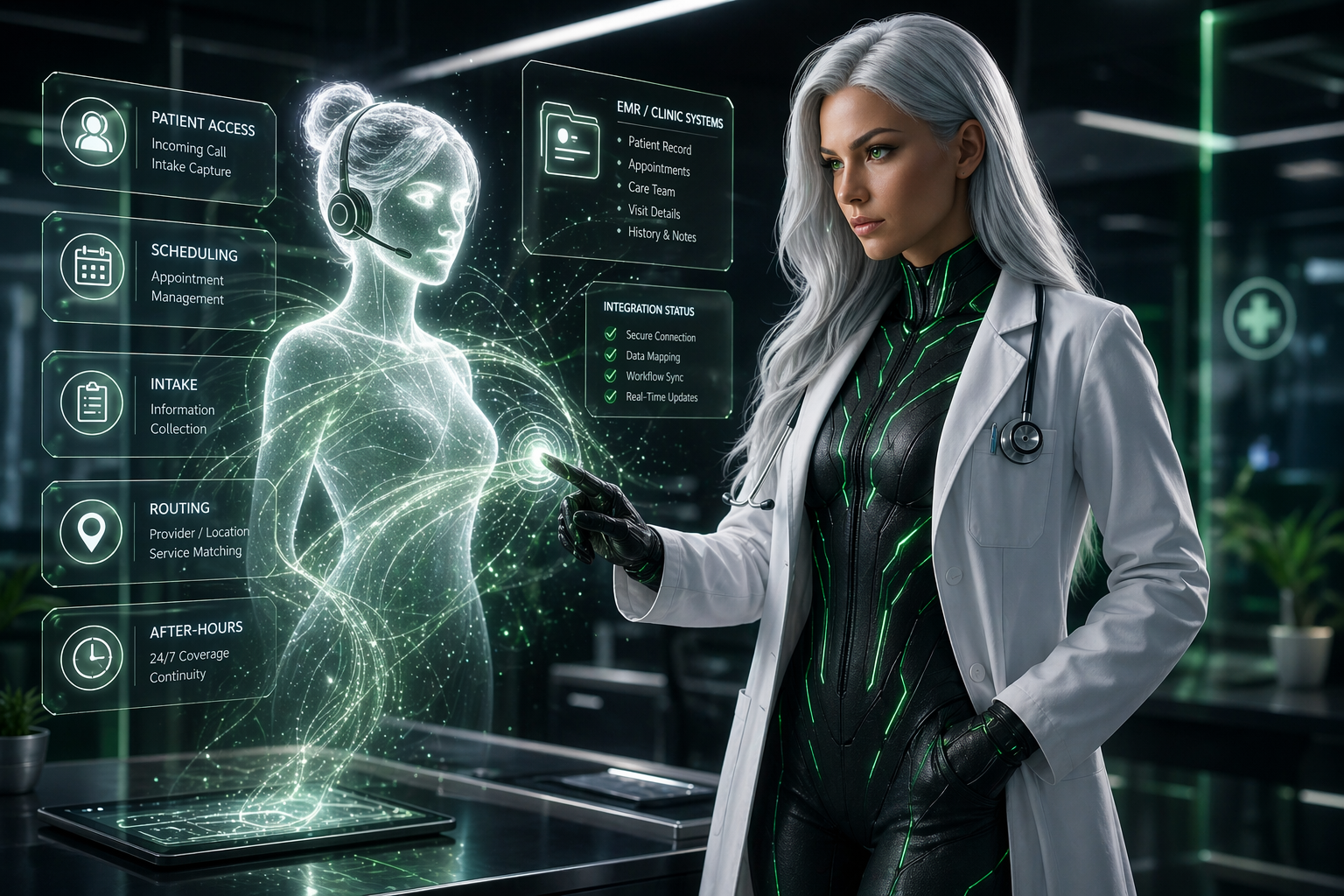
Medical and Ambulatory EMR Systems
Explore how Voice AI fits into medical and ambulatory EMR environments across scheduling, intake, patient access, provider routing, after-hours continuity, and clinic communication workflows.
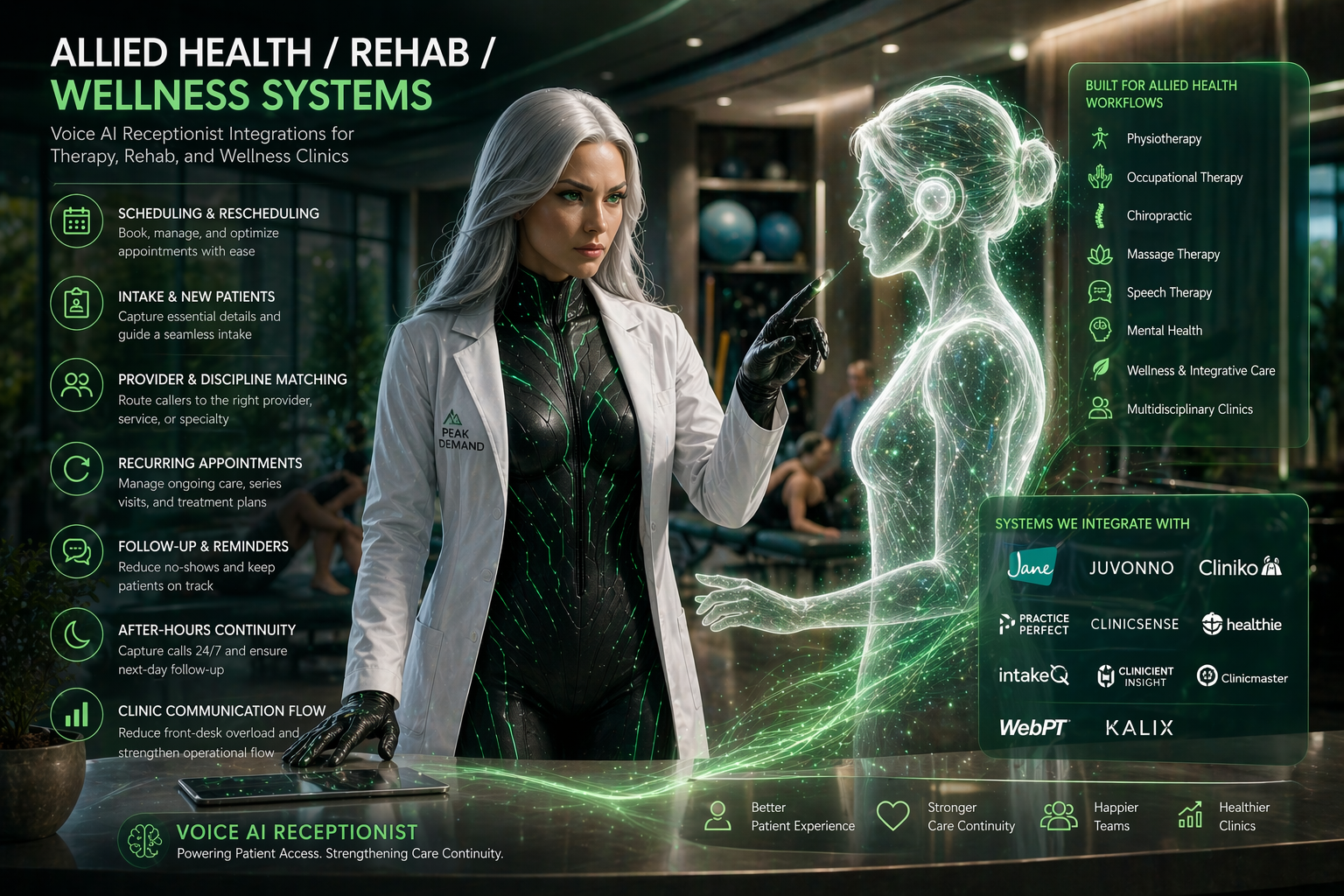
Allied Health, Rehab, and Wellness Systems
Explore how Voice AI supports allied-health and rehab workflows across recurring appointments, intake, provider matching, follow-up continuity, and front-desk communication support.
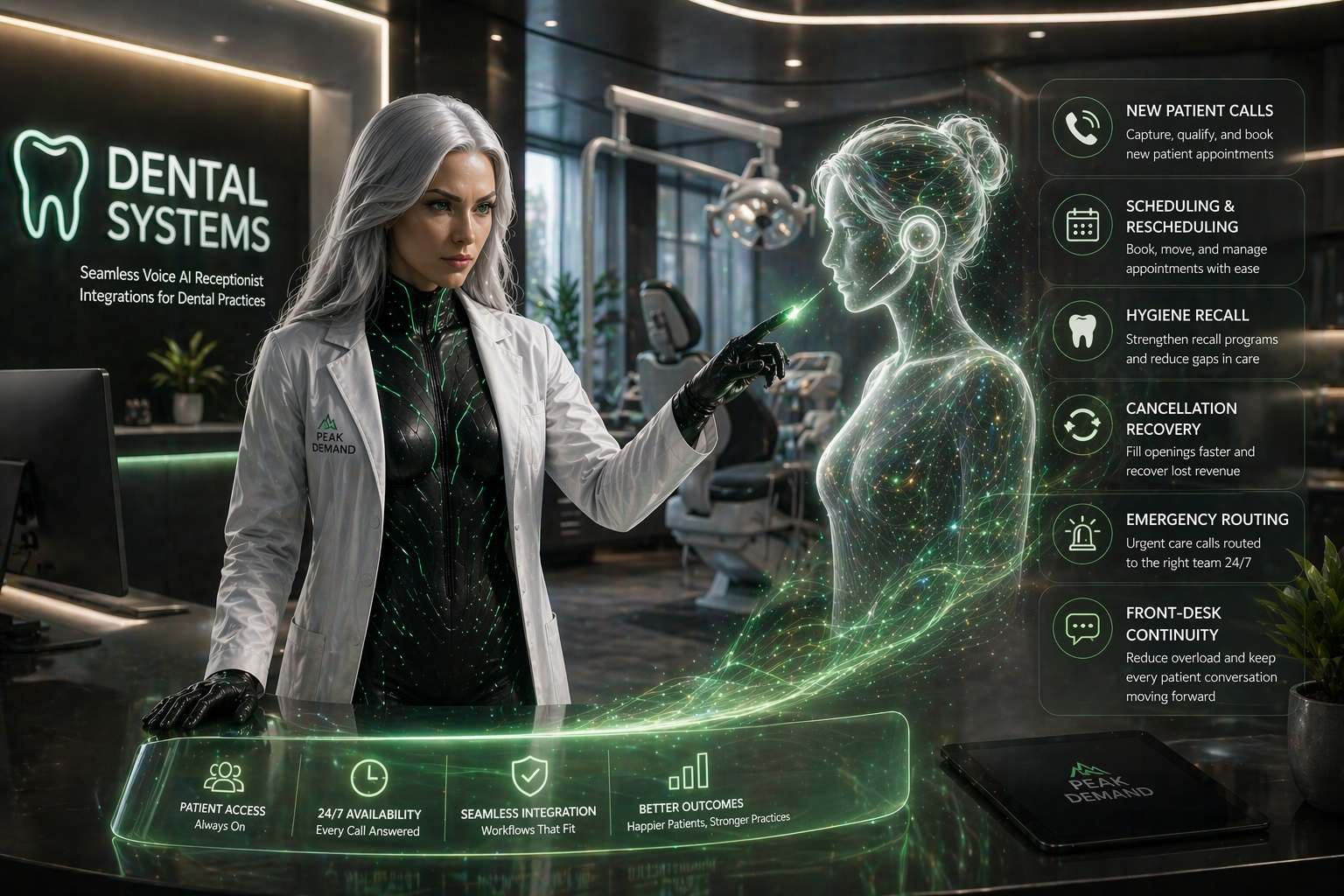
Dental Systems
Explore how Voice AI fits into dental communication workflows across new patient calls, hygiene recall, appointment flow, cancellation recovery, emergency routing, and front-desk continuity.
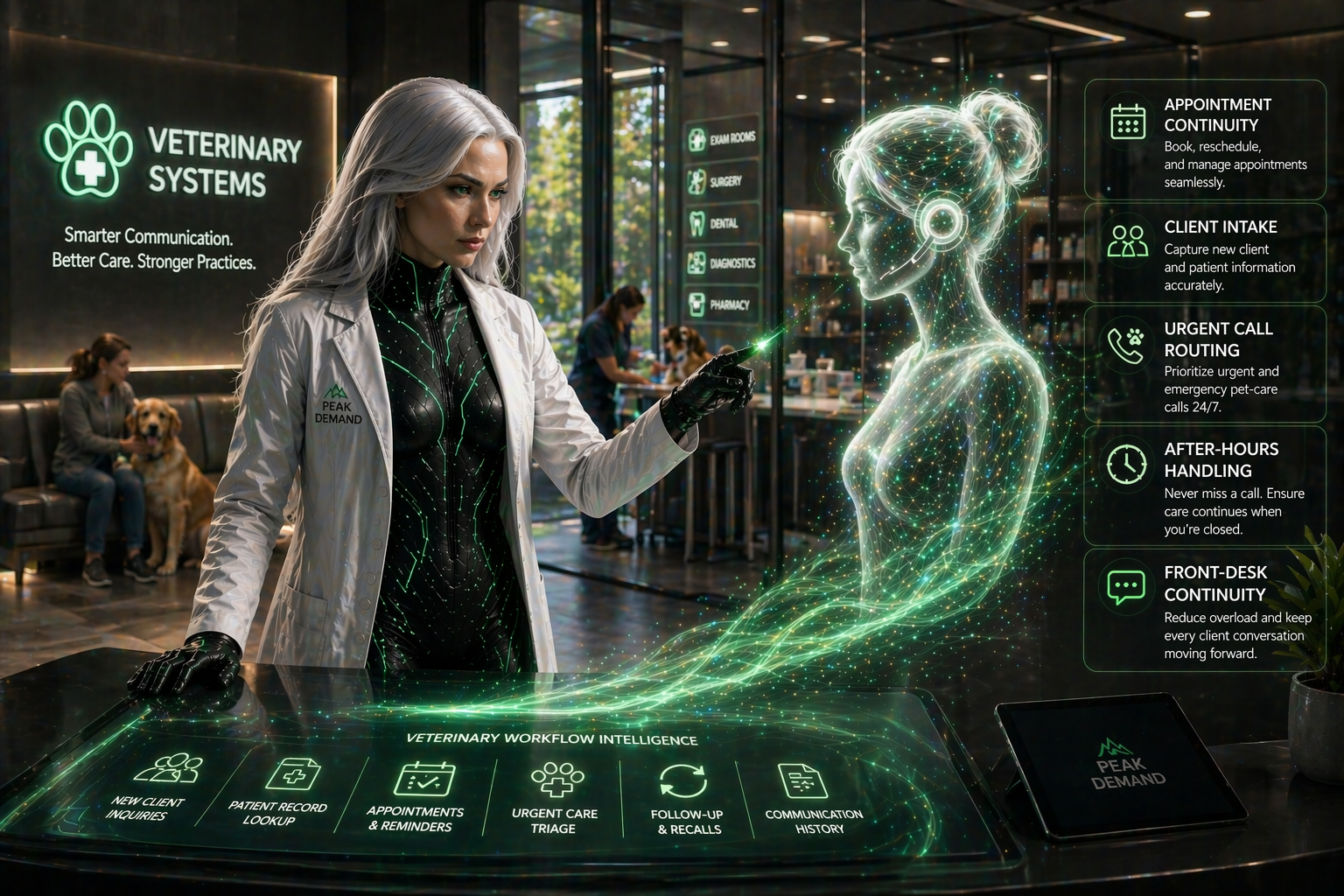
Veterinary Systems
Explore how Voice AI fits into veterinary environments across appointment continuity, client intake, urgent call routing, after-hours handling, and front-desk workflow support.
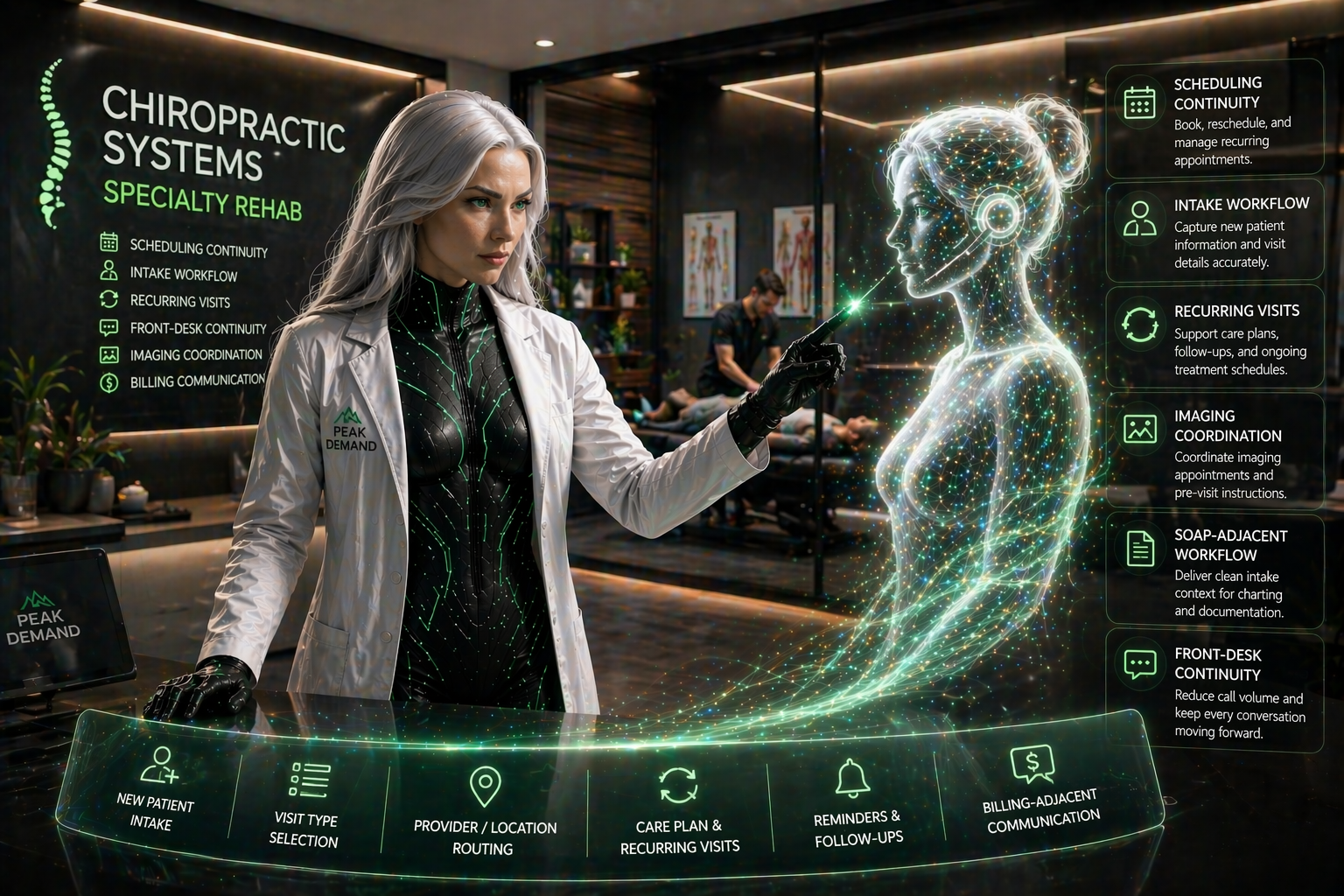
Chiropractic and Specialty Rehab Systems
Explore how Voice AI fits into chiropractic and specialty rehab workflows across scheduling, intake, recurring visits, SOAP-adjacent continuity, imaging-adjacent coordination, and front-desk support.
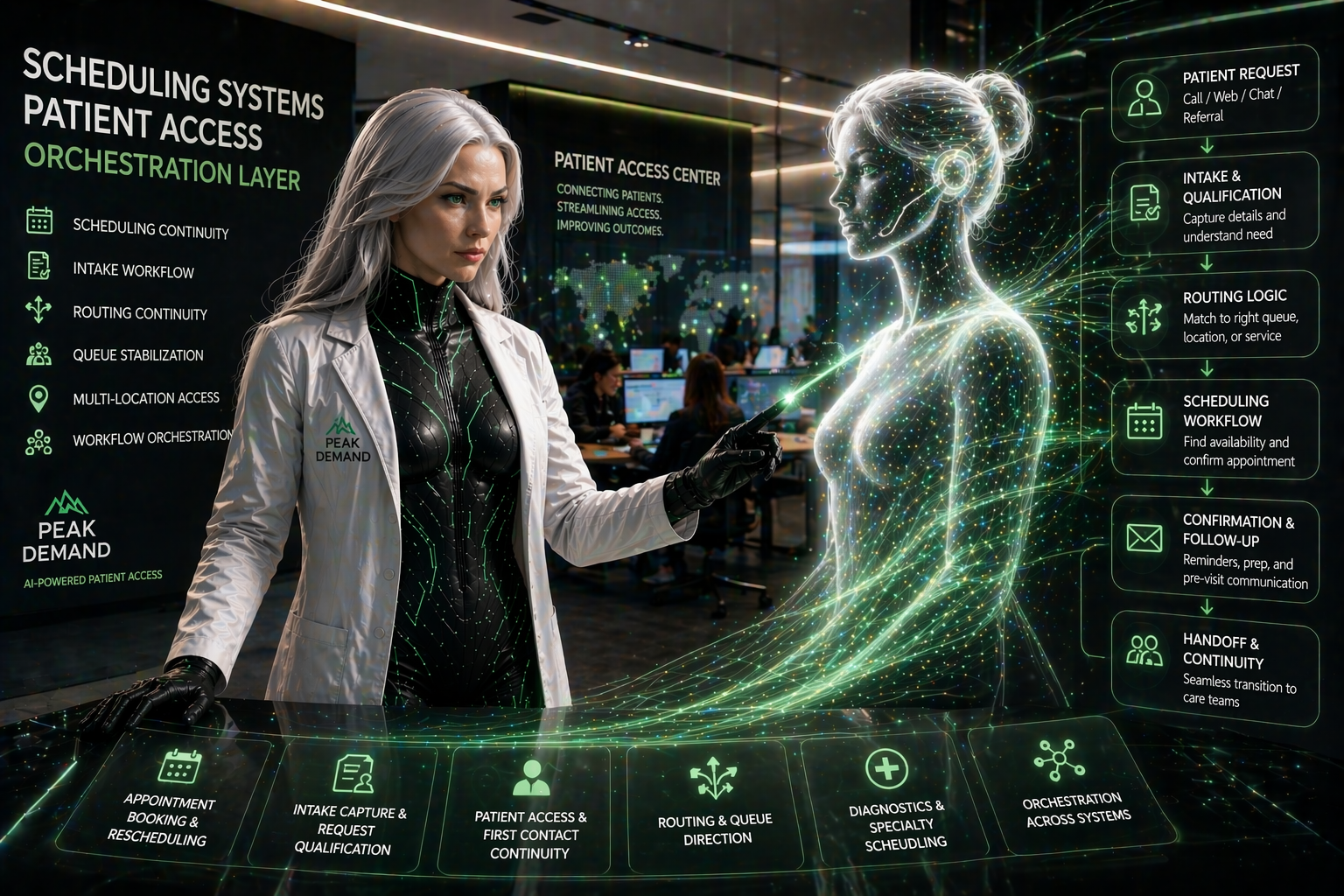
Scheduling, Patient Access, and Orchestration Systems
Explore how Voice AI supports scheduling and patient access architecture across intake, routing, queue stabilization, diagnostics scheduling, and workflow continuity between first contact and next action.
See Healthcare Voice AI Integrations In Action
These walkthroughs show how Voice AI can connect into real healthcare scheduling, intake, and communication environments. Start with TELUS Health CHR for Canadian clinic workflows and Juvonno for rehab and allied health operations.
TELUS Health CHR Integration Walkthrough
See how Voice AI can support TELUS Health CHR scheduling, intake, patient communication, and Canadian clinic workflow continuity.
Juvonno Integration Walkthrough
See how Voice AI can support Juvonno workflows for rehab scheduling, intake, appointment handling, and clinic communication continuity.
Explore published healthcare systems by name
Once you know the software family that best matches your environment, this section makes it easier to browse live healthcare integration pages by platform name. Each category below groups published system pages by the type of environment they usually support so operators, managers, and technical teams can compare workflow fit more quickly. A fuller alphabetical directory appears farther down the page.
Featured healthcare systems
These are high-priority starting points for visitors evaluating real-world Voice AI workflow fit across scheduling, intake, patient communication, routing, and access workflows.
Clinic, ambulatory, and medical EMR systems
These systems are commonly associated with clinic records-adjacent workflows, appointment flow, patient requests, intake continuity, routing, and broader ambulatory communication operations.
Scheduling, intake, and patient communication systems
These environments sit closer to booking logic, intake flow, reminders, clinic administration, and day-to-day patient access operations.
Rehab, physiotherapy, and allied health systems
Allied health and rehabilitation environments often depend on strong scheduling continuity, practitioner matching, intake flow, recurring appointment management, and multi-location operational coordination.
Dental systems
Dental communication workflows often center around appointment demand, cancellation recovery, reminders, new patient calls, and front-desk continuity across booked production.
Veterinary systems
Veterinary communication environments often require appointment continuity, client communication, after-hours handling, urgent call direction, and records-adjacent workflow coordination.
Healthcare organizations rarely evaluate integrations in a vacuum. Grouping systems by software family makes it easier to understand likely workflow fit, compare environments more quickly, and navigate toward both family-level integration pages and live system-specific pages deeper in this hub. The full alphabetical system directory farther down the page should carry the complete 98-system library.
Where Voice AI sits in the healthcare workflow matters more than basic connectivity
Healthcare Voice AI becomes more useful when it is treated as part of the larger workflow architecture around patient access, intake, routing, scheduling, escalation, and downstream ownership. The question is not only whether a system connects. The question is whether the communication flow reaches the next operational step with enough clarity and structure to reduce friction instead of shifting it downstream.
In practice, that means Voice AI often sits across multiple workflow layers at once. It may support first contact, gather structured intake, help direct the caller into the right path, preserve context for staff, and improve continuity into the next step. The value comes from how those layers fit together, not from one isolated connection point.
This is why healthcare teams should evaluate both the scheduling and patient access layer and the EMR or EHR-adjacent layer. In more complex environments, the architecture may also need to account for enterprise compliance and procurement requirements.
Where Voice AI usually enters the workflow
Voice AI often enters at the communication edge: inbound calls, appointment demand, intake capture, after-hours answering, overflow handling, and patient access or routing-related first contact.
Explore healthcare AI receptionistsWhere continuity usually breaks down
Continuity often breaks between the interaction and the next operational owner. That can happen when routing is weak, intake is unclear, scheduling context is incomplete, or downstream teams still need to manually rebuild the request.
Explore centralized scheduling workflowsWhat stronger integration architecture actually improves
Stronger architecture preserves enough structure, direction, and next-step usability for staff or systems to act efficiently. That is what turns Voice AI into operational infrastructure instead of a disconnected front-end layer.
Return to the healthcare resource hub| Integration maturity | What healthcare teams usually experience | Likely operational result |
|---|---|---|
| Fragmented | Some connection points exist, but scheduling, intake, routing, escalation, and continuity still require heavy manual repair. | Lower operational value, more staff burden, weaker patient access continuity, and less confidence in the workflow. |
| Partially connected | Important workflow layers connect, but structure and downstream usability still vary too much between teams, departments, or next-step owners. | Moderate gains, but persistent continuity gaps remain and staff still absorb unnecessary workflow friction. |
| Workflow-led and integrated | Voice AI supports multiple workflow layers with stronger structure, clearer routing, better handoff, and more usable next-step continuity. | Stronger patient access flow, cleaner operational ownership, and more scalable communication infrastructure. |
What healthcare teams should evaluate in the architecture discussion
- Where does Voice AI need to sit first in the communication workflow?
- Where does continuity currently break between the interaction and the next operational step?
- Which layers are EMR or EHR-adjacent, and which ones are workflow-adjacent?
- How do scheduling, intake, routing, patient access, and escalation interact in this environment?
- Will downstream teams receive enough structure to act without rebuilding the request manually?
- Is the integration design workflow-led or just feature-led?
- Does the current architecture reduce friction for staff, or does it simply move the work somewhere else?
Healthcare organizations usually get more value when they evaluate integration maturity across communication flow, operational ownership, and downstream usability together instead of treating each connection as a separate isolated decision. For system-specific evaluation, use the alphabetical healthcare system directory below.
Evaluating software families?
Use the six system-family pages to compare EMR, EHR, dental, veterinary, rehab, scheduling, and patient access environments.
Browse Software FamiliesEvaluating specific systems?
Use the full alphabetical directory to find the exact healthcare platform your team is evaluating.
Open System DirectoryEvaluating enterprise readiness?
Review governance, privacy, escalation, procurement, and compliance considerations before deployment.
Review ComplianceGo deeper into the strategy behind healthcare Voice AI integrations
This section helps healthcare teams move from broad category understanding into the right supporting resources for architecture, interoperability, workflow fit, implementation planning, and system-specific evaluation.
The articles below are the best next clicks for teams evaluating how Voice AI fits into healthcare communication systems, patient access workflows, structured integration pathways, rollout planning, and governed healthcare environments.
For broader category education, use the Healthcare Voice AI Resource Hub. For software-specific evaluation, continue to the full alphabetical system directory lower on this page and use the six healthcare software family pages as the parent layer.
Need system-family pages?
Use the family pages to compare medical EMR, allied health, dental, veterinary, specialty rehab, and patient access systems.
Browse Software FamiliesNeed a specific platform?
Use the alphabetical system directory to find the exact EMR, EHR, scheduling, dental, veterinary, or rehab platform.
Open System DirectoryNeed compliance context?
Use the enterprise compliance page when governance, privacy, procurement, RFPs, or regulated deployment requirements are part of the evaluation.
Review ComplianceCore integration strategy articles
These resources explain why integrations matter, what healthcare teams should evaluate first, and how stronger Voice AI integration architecture should be understood.
Custom pathways, structured integrations, and workflow fit
These articles are useful for teams evaluating custom pathways, structured communication flows, and how Voice AI fits into real healthcare operating environments.
Rollout, implementation, and governance
These resources are best for healthcare teams moving from early exploration into rollout planning, operational safety, implementation readiness, and governance-aware deployment.
Patient access, routing, and workflow bottlenecks
These articles help healthcare teams think more clearly about where communication complexity builds up across patient access, intake, department routing, scheduling, and downstream handoff.
As the healthcare integrations ecosystem continues to grow, this section can keep routing visitors into the most relevant strategy, rollout, and workflow resources without changing the overall structure of the hub. The full software directory appears in the Alphabetical System Directory section below.
Explore live healthcare system integration pages by category
This section gives healthcare teams a category-based way to browse the most important live system pages. It is not the full 98-system directory; it is a curated navigation layer for comparing the platforms most commonly tied to scheduling, intake, patient communication, routing, and patient access workflows.
Use this section when you know the type of software environment you are evaluating. Use the Alphabetical System Directory below when you want to find every live system page by name.
Need the family layer?
Start with the six parent family pages when comparing software categories before choosing a specific system.
Browse Software FamiliesNeed every system?
Use the alphabetical directory for the complete live healthcare system page list by platform name.
Open Alphabetical DirectoryNeed workflow context?
Review how Voice AI fits across patient access, intake, routing, scheduling, escalation, and downstream ownership.
Review Workflow ArchitectureFeatured healthcare systems
These are some of the strongest starting points for teams exploring healthcare Voice AI integrations across scheduling, intake, patient communication, routing, and access workflows.
Clinic and ambulatory EMR systems
These systems are commonly associated with clinic records-adjacent workflows, intake, appointment flow, routing, patient communication, and broader ambulatory continuity.
Explore medical and ambulatory EMR familyScheduling, intake, and patient communication systems
These environments sit closer to booking logic, intake flow, reminders, clinic administration, and day-to-day patient access operations.
Explore scheduling and patient access familyRehab, physiotherapy, and allied health systems
Allied health and rehabilitation environments often depend on strong scheduling continuity, practitioner matching, intake flow, recurring appointments, and multi-location coordination.
Explore allied health and rehab familyDental systems
Dental communication workflows often center on appointment demand, cancellation recovery, reminders, new patient calls, and front-desk continuity.
Explore dental familyVeterinary systems
Veterinary communication environments often require appointment continuity, client communication, after-hours handling, and records-adjacent workflow coordination.
Explore veterinary familyEnterprise, specialty, imaging, and outpatient environments
These environments often involve more complex routing, diagnostic scheduling, imaging coordination, enterprise workflow ownership, and department-specific handoff requirements.
Explore enterprise and medical EMR familyThis curated category browse section helps visitors compare common healthcare software environments without scrolling the entire directory. The complete system list belongs in the Alphabetical System Directory section below, where every live healthcare system page should be listed by platform name.
Talk through your healthcare communication workflow
If your team is evaluating healthcare Voice AI integrations, the most useful next step is usually a workflow conversation. That means reviewing patient access pressure points, scheduling flow, intake structure, routing logic, after-hours coverage, compliance expectations, and the systems surrounding those workflows.
Peak Demand approaches healthcare environments through workflow fit, governance awareness, and operational usability. The goal is to help organizations map a communication architecture that supports real teams, real workflows, and real continuity requirements across EMR, EHR, scheduling, intake, dental, veterinary, rehab, and patient access environments.
Need software families?
Compare the six parent healthcare integration families before choosing a specific system page.
Browse software familiesNeed workflow context?
Review how Voice AI fits across intake, routing, scheduling, escalation, and downstream ownership.
Review workflow architectureNeed compliance review?
Use the enterprise compliance page when governance, privacy, procurement, and RFP standards matter.
Review complianceFrequently asked questions
What does Voice AI mean in a healthcare integration environment?
Can Voice AI work with EMR, EHR, scheduling, intake, and routing workflows?
Are healthcare Voice AI integrations always direct?
Where should healthcare organizations start evaluating Voice AI integrations?
How should compliance and governance fit into the evaluation?
What is the role of this integrations hub?
About Peak Demand
Peak Demand is a Toronto-based AI agency focused on Voice AI, communication automation, and workflow infrastructure for organizations operating in more complex service environments.
In healthcare, the focus is not just on call handling. It is on patient access continuity, scheduling pressure, intake structure, routing logic, after-hours support, governance, and how communication systems fit into real operational workflows.
- Workflow-driven and implementation-aware
- Governance-first in healthcare communication environments
- Built to support clinics, networks, and enterprise teams
- Designed to scale into software-specific integration pathways
- Organized around healthcare system families and live integration pages
Healthcare software integrations by system name
If you already know the software you are evaluating, this alphabetical directory is the fastest way to find the right live system page.
This directory includes the full 98-system healthcare integration library from the current Peak Demand system-page build. It is designed to help teams compare EMR, EHR, scheduling, intake, patient communication, dental, veterinary, rehab, wellness, chiropractic, orchestration, home care, med spa, pharmacy, and enterprise healthcare systems by software name.
For category-level browsing, use the software family section. For workflow context, use the workflow architecture section. This section is the full alphabetical browse layer.
Live healthcare system pages in this directory
Grouped alphabetically with visible section counts so the full library is obvious at a glance.
A–C
34 systemsABELMed through Curve Dental.
D–H
20 systemsDentrix through Helios Software.
I–M
15 systemsIDEXX Cornerstone through MRX Solutions.
N–O
11 systemsNextech through Owl Practice.
P–R
8 systemsPabau through RXNT.
Compare healthcare systems by name, category, and workflow fit
This directory is useful for comparing clinic EMRs, EHR-adjacent systems, scheduling and intake platforms, patient communication software, dental systems, veterinary systems, rehab and allied health systems, chiropractic systems, med spa systems, home care systems, pharmacy-adjacent systems, orchestration platforms, diagnostic workflows, and enterprise healthcare environments by software name before going deeper into workflow design, integration possibilities, and operational fit.
Explore your own AI use case on a discovery call.