

Building an Enterprise Voice AI Center of Excellence for Health Systems
A practical, decision‑focused guide for health systems to establish a Voice AI Center of Excellence: architecture, identity and data controls, integrations with scheduling/EHR, safe escalation, procurement checklist, and operational KPIs.
1) A focused use case: voice-enabled access and intake
Start the CoE with a clearly scoped administrative workflow that reduces manual work and stabilizes contact center load while preserving safety.
Why scheduling and intake are the right starting point
Administrative patient access tasks — appointment requests, demographic updates, simple pre-visit intake, prescription refill requests routed to pharmacy workflows — are concentrated, repetitive, and highly automatable. A CoE that prioritizes these flows reduces hold time and call transfers while keeping clinical judgment out of automated decision paths.
- High call volume and predictable conversation patterns make scheduling a practical first target.
- These workflows are well suited to deterministic confirmation and API‑backed booking actions.
- Scope reduces clinical risk and simplifies compliance and audit requirements.
Core safety boundary for scope
Operational policy must state that Voice AI will not perform clinical assessment, triage for acute conditions, diagnose, or prescribe. Any caller language that indicates pain, breathing trouble, chest pain, altered consciousness, or requests clinical advice must trigger immediate escalation to trained staff.
- Define escalation triggers and verbatim phrases that always route to human operators.
- Log the trigger reason into the audit trail for post-incident review.
- Train the model and collection prompts to avoid open clinical questioning.
2) Practical architecture and integrations
A repeatable architecture reduces implementation risk. Describe components, the canonical request flow, and integration ownership.
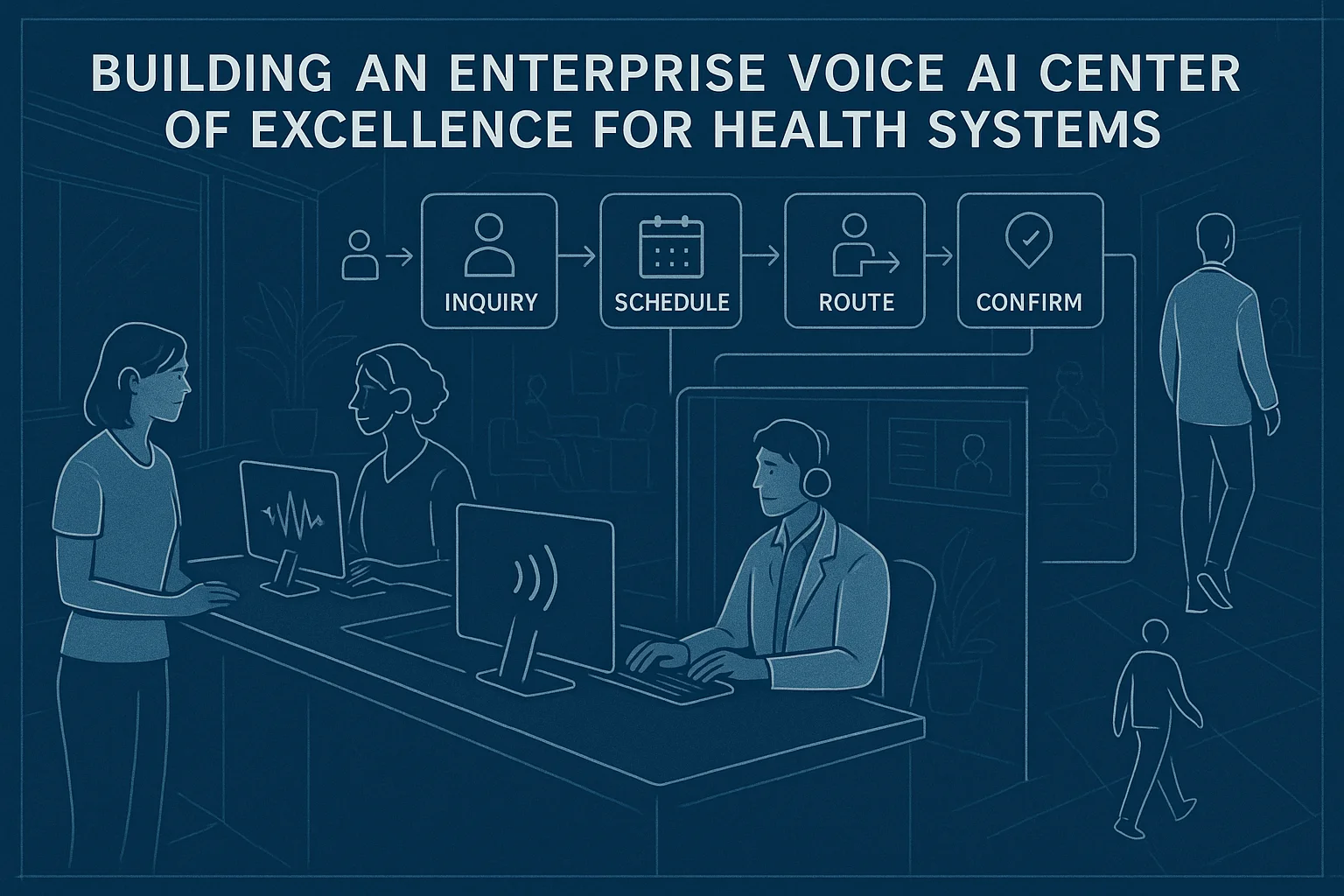
Canonical flow — Patient → Voice AI → validation → approved API → confirmation/handoff
Design every production flow to follow a single canonical chain: 1) Caller engages voice front-end, 2) Voice AI performs intent capture and slot filling, 3) A dedicated identity/validation service confirms identity or returns to human verification, 4) Only after validation does the orchestration layer call the approved scheduling or EHR/PM API to create or change records, 5) Result is confirmed to the patient and logged; ambiguous outcomes trigger handoff.
- Orchestration layer enforces business rules and approval gates before any record change.
- Immutable audit trail captures call transcript, validation result, API request/response, and operator handoffs.
- Adapters to scheduling systems should be controlled and versioned by the health system, not by the Voice AI vendor alone.
Integration ownership and system boundaries
Agree early which party owns each integration: EHR/PM, scheduling engine, identity provider, telephony, and logging. Prefer patterns where the health system controls the API credentials and adapter configuration; the vendor supplies tested adapters and hosting but not privileged access without formal change control.
- Keep EHR/PM write permissions under the health system’s direct control with scoped service accounts.
- Require vendor change control for any adapter updates that touch production endpoints.
- Maintaining a test sandbox that mirrors production behavior is essential for safe releases.
Data flows, residency and subprocessors
Map where voice transcripts, PII, and PHI are processed and stored. Document hosting region, backup region, subprocessors, remote‑support access, and retention policies before procurement. Where cross-border transfer is possible, evaluate encryption-in-transit and legal mechanisms for transfer; confirm obligations with qualified counsel.
- Specify hosting and backup geography in the statement of work and data processing agreement.
- List subprocessors and update notification cadence for new subprocessors.
- Limit retention of transcripts by default; retain only what is necessary for audit and quality.
3) Governance, risk and clinical boundaries
A CoE is governance plus capability. Embed risk management and clinical boundary policies into every stage of development and operations.
Policy and oversight
Form a cross-functional governance board with patient access leadership, clinical safety officers, privacy/compliance, IT, and vendor representatives. The board approves scope, escalation rules, KPIs, and audit schedules. Use lightweight change-control gates for production updates and a formal sign-off for any new clinical‑adjacent capability.
- Mandate pre-release risk assessments for new flows.
- Require incident review with root cause analysis and corrective action tracking.
- Define documented acceptance criteria for each automation before production launch.
Clinical safety boundaries and escalation
Translate clinical non-clinical separation into engineering rules: block clinical question templates, require explicit escalation when ambiguity exceeds a threshold, and route urgent signals to human responders. Maintain conservative escalation thresholds when in doubt.
- All suspected urgent cases must be escalated immediately; do not attempt remote triage.
- Use confidence scores conservatively; low confidence should default to human handoff.
- Record the reason for each escalation and outcome for continuous improvement.
Auditability and explainability
Maintain structured logs: intent, slots, validation results, API calls, confidence metrics, and timestamps. These logs support quality assurance, regulatory review, and patient complaints. Design the system so an authorized reviewer can reconstruct decisions without exposing unnecessary PHI.
- Store logs in a secure, access-controlled repository with role-based access.
- Provide human-readable summaries for each automated action for clinical and legal reviewers.
- Use explainability artifacts for third-party audits and governance reviews.
4) Identity, validation and security controls
Before allowing any change to a patient record, the CoE must prove the caller’s right to act and limit exposure to fraud and errors.
Validation layers — what to check and when
Implement a layered validation approach: telephony signals (CLI/ANI), patient-provided identifiers (MRN, DOB), knowledge-based checks, multi-factor pathways (SMS/OTP), and optionally supervised voice biometrics. Validation should be risk-based: low-risk tasks need lighter validation; high‑impact tasks require stronger authentication and human verification.
- Define per-workflow validation requirements in a control matrix.
- Avoid voice biometrics as the sole factor for high-risk actions because of variability and legal considerations.
- Fallback to human verification where confidence is insufficient.
PHI handling and encryption
Treat transcripts and slot data containing PHI as sensitive. Encrypt data in transit and at rest, restrict access using the principle of least privilege, and apply redaction where transcripts are used for QA. Include retention windows and deletion processes in the DPA.
- Encrypt all logs and backups; separate keys where possible.
- Limit QA transcript access and use redacted copies for training.
- Specify retention and deletion timelines contractually.
Subprocessor and remote-support controls
Require vendors to disclose subprocessors and remote‑support modalities. Contractually bind notification periods for changes and require breach notification timelines aligned with your incident response policy.
- Require written subprocessors list and update procedure.
- Limit remote support to scoped times, IP allowlists, and MFA-protected sessions.
- Define escalation and breach notification SLAs.
5) Implementation choices, procurement and Peak Demand differentiation
Choose a delivery model that matches capability and risk appetite. Below is a procurement checklist and how Peak Demand differentiates operationally.
Build vs. buy vs. managed service — decision factors
Choose based on internal integration capabilities, security ownership preferences, and time to value. Managed services accelerate deployment and shift some operational burden but require tight contractual controls. In-house builds give maximum control but require substantial integration and QA investment.
- If you control integrations and want full auditability, prefer an integration‑owned model with vendor-supplied adapters.
- If staffing and security expertise are limited, a managed service with explicit SLAs and audit access can be appropriate.
- Always test vendor adapters in a staging environment that mirrors production.
Procurement checklist
Include the following in RFPs and contracts to reduce downstream risk.
- Detailed adapter inventory and change-control commitments for EHR/PM/scheduling systems.
- Hosting region, backup region, subprocessors, remote support model, and retention policy.
- Observability and access: real-time dashboards, call replay, audit log exports, and defined access roles.
- Escalation SLAs, handoff quality KPIs, and documented runbooks.
- Liability and breach notification terms aligned with your legal counsel’s expectations.
Peak Demand differentiation
Peak Demand builds custom Voice AI with integration-first architecture: robust scheduling and intake adapters, explicit identity verification and field validation layers, safe escalation gates, immutable audit trails, and human review workflows. Our approach favors controlled adapters managed under the health system’s credentials and a staged release process that lets governance boards approve new capabilities.
- Custom adapters for scheduling and EHR/PM systems with versioned change control.
- Field validation and identity checks before write actions.
- Human-in-loop review interfaces and post-call audit tools for quality assurance.
6) Operations, KPIs and failure boundaries
Operate the CoE as a program: track safety and operational metrics, define failure modes, and maintain quick recovery processes.
Operational KPIs to track
Combine volume and safety metrics. Track primary KPIs for business value and leading indicators for safety.
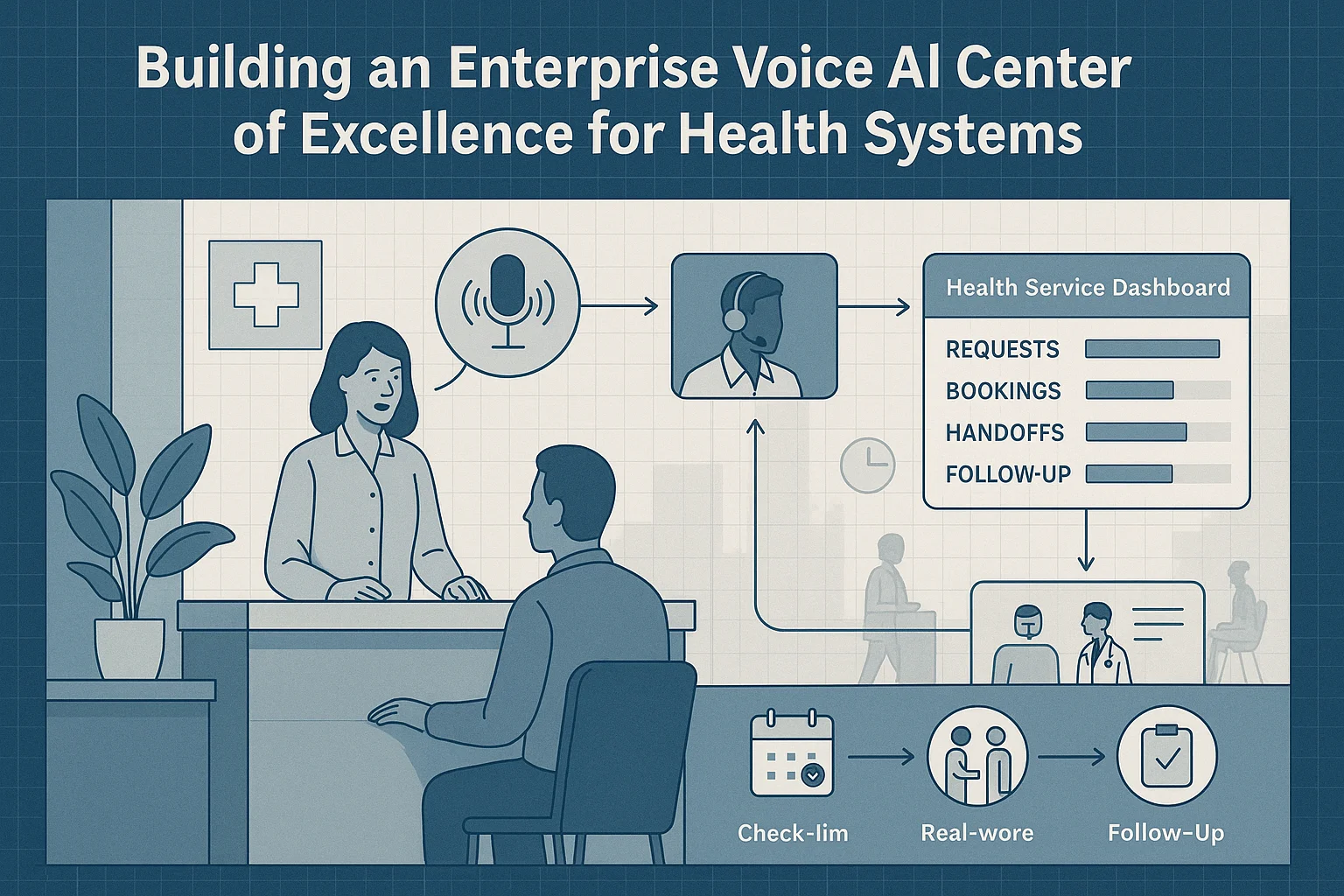
- Access KPIs: average speed to answer, call containment rate (resolved without human handoff), time-to-booking.
- Safety KPIs: false escalation rate, post-handoff correction rate, validation failure rate.
- Quality KPIs: NPS/CSAT for post-call surveys, transcript error rates, and model confidence distributions.
Failure modes and runbooks
Document likely failure modes and a response playbook: telephony outages, adapter errors, failed validations, model drift, and security incidents. For each mode name the detection signal, immediate containment step, communication requirements, and longer-term corrective actions.
- Telephony outage: failover to human answering service and notify governance board.
- Adapter error (EHR/scheduling): revert to read-only mode and queue actions for manual processing.
- Model drift or repeated misclassification: pull flows to staging and stop automation until fixes are validated.
Continuous improvement and audit cadence
Institute scheduled QA sampling, post-incident reviews, and quarterly reviews of the CoE’s scope. Use audit findings to refine escalation thresholds, validation checks, and training data while preserving redaction and privacy requirements.
- Automated sampling of calls for QA with secure access controls.
- Quarterly governance board review of KPIs, incidents, and scope expansions.
- Formal change control for onboarding new workflows.
Related Peak Demand resources
Industry and AI sources reviewed
- Ethics and governance of artificial intelligence for healthWorld Health Organization
- Regulatory considerations on artificial intelligence for healthWorld Health Organization
- Artificial Intelligence Risk Management Framework (AI RMF 1.0)National Institute of Standards and Technology (NIST)
- OECD AI PrinciplesOrganisation for Economic Co-operation and Development
Healthcare privacy, security, clinical-safety, records, and professional obligations vary by jurisdiction and workflow. This article is operational guidance, not legal advice; organizations should confirm applicable requirements with qualified professionals.
Frequently asked questions
Administrative workflows such as appointment booking, changes and cancellations, referral-status intake, approved follow-up, patient-access questions, after-hours overflow, and structured routing are common starting points. Clinical judgment, diagnosis, emergency triage, and prescribing decisions must remain with qualified professionals.
Use the minimum identifiers approved by the organization, validate them against the system of record, avoid exposing unnecessary information, and provide a human-assisted path when verification fails. The system should not infer identity from conversational context alone.
The agent should follow the organization's approved escalation and emergency-routing rules, avoid clinical advice, and transfer or direct the caller to the appropriate human or emergency channel. Those rules must be tested with realistic language and failure cases.
Request identity and privacy controls, scheduling or EHR integration behavior, audit logs, escalation rules, downtime handling, testing evidence, change control, monitoring, and clear separation between administrative automation and clinical decision-making.
Design a safe patient-service workflow before automating it
Peak Demand helps healthcare organizations connect Voice AI to scheduling, intake, patient communication, identity checks, escalation, and reporting with clear operational boundaries.
Schedule a discovery call