

Operating Models for Health System Voice AI: Clinical Safety & EHR Integration
Practical operating models for deploying Voice AI across patient access: architecture, identity and privacy controls, EHR/scheduling integration, safe escalation, QA and procurement choices.
1. Use case and operating model summary
A focused, practical use case clarifies implementation choices. This section defines a typical patient-access Voice AI deployment, the operating model variants, and expected non-negotiable safety boundaries.
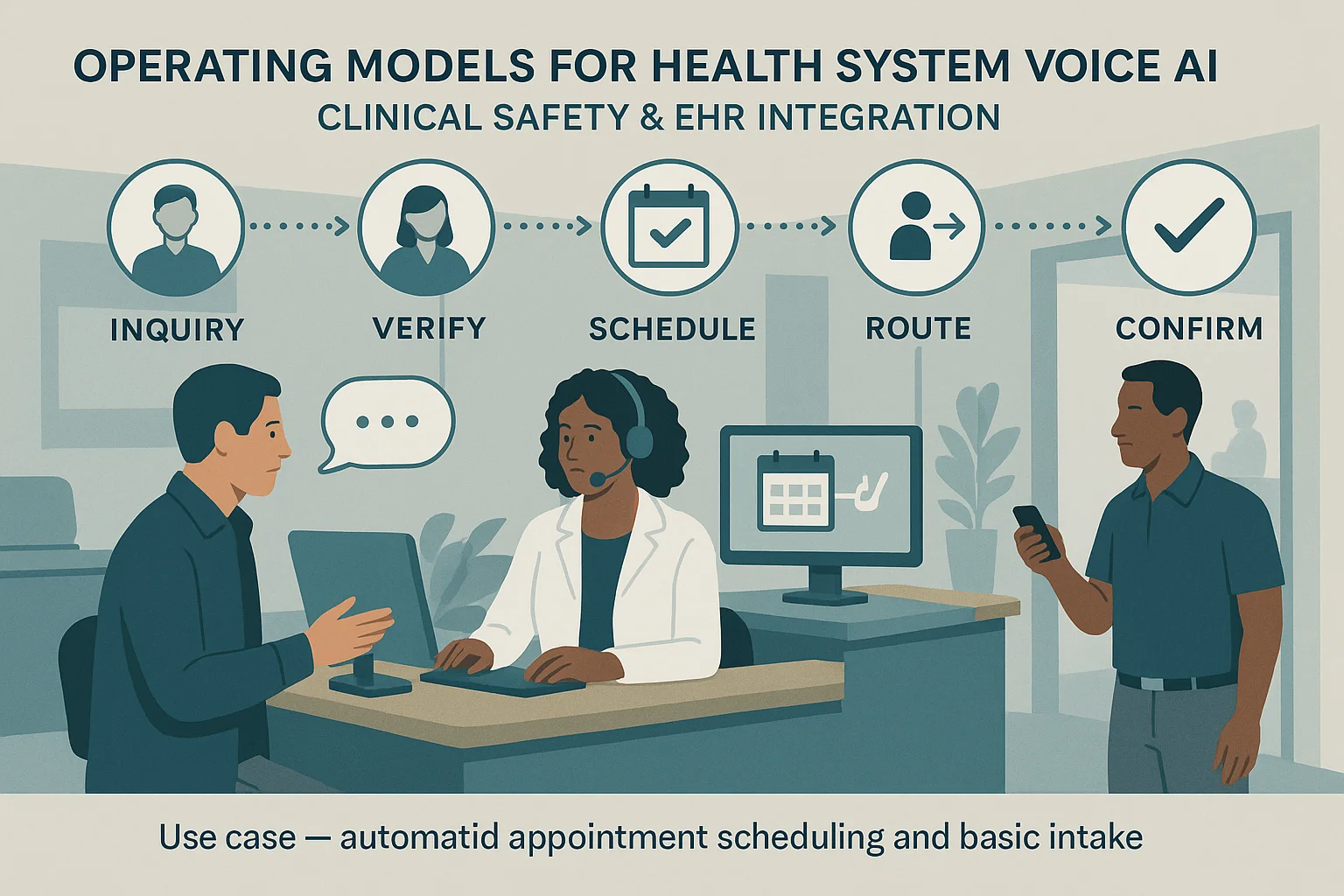
Use case — automated appointment scheduling and basic intake
Target scope: after‑hours and overflow patient intake, appointment booking for non-emergent services, reminders, and administrative updates (e.g., address, insurance card issues). The Voice AI should collect minimal structured data needed to match or create a scheduling request (name, DOB, phone, reason code) and confirm or queue the request. Do not use Voice AI to triage emergencies, deliver clinical recommendations, interpret clinical results, or replace clinician judgment.
- Primary intent: identify caller, capture intake fields, verify eligibility to book, and call approved scheduling APIs.
- Secondary intent: route calls to human agents when identity, intent, or confidence are insufficient.
Operating model variants
Select the operating model based on control, speed, integration depth and risk appetite: (1) Vendor-managed hosted service with limited customization — fast to launch but demands strict subprocessor and data controls; (2) Hybrid managed integration where the health system controls EHR adapters and scheduling API tokens while the vendor manages conversational components; (3) Self-hosted or private cloud fully owned by the health system — highest control, longer delivery and higher costs. Hybrid models often balance speed and control for enterprise health systems.
- Vendor-hosted: faster, but specify subprocessors, logging access, retention, and remote support rules.
- Hybrid: health system retains API credentials and adapter logic; vendor manages conversation orchestration.
- Self-hosted: full control of data residency, patching and observability; requires internal ops capacity.
Safety boundaries (non-negotiables)
Define explicit prohibition policies: Voice AI must not diagnose, prescribe, triage emergencies, or provide clinical interpretation. Always default to human escalation for ambiguous or high-risk presentations. Implement technical prevents (intent classifiers, keyword detectors, and escalation triggers) and policy controls (staff training, documentation).
- Hard-coded escalation on keywords (e.g., 'chest pain', 'difficulty breathing') with immediate transfer protocols.
- No autonomous edits to EHR clinical notes; permit only administrative record updates or scheduling actions.
- Record and surface transcripts and decision metadata for all automated actions to enable audit and review.
2. Core architecture and deterministic workflow
A resilient architecture maps the caller path and enforces validation at each handoff. Keep orchestration deterministic and auditable.
Canonical flow
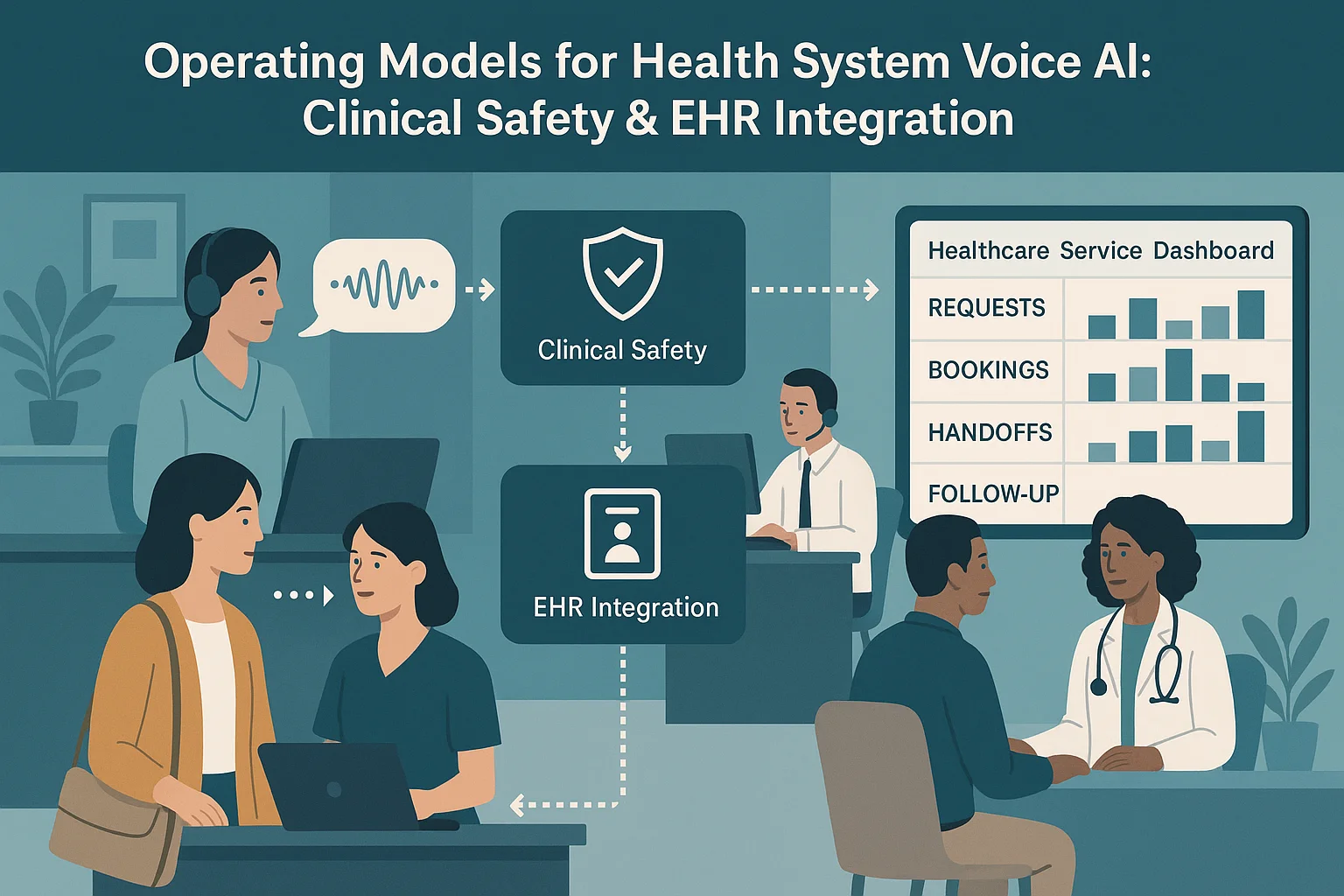
Design a canonical flow: Patient/caller → Voice AI (ASR + NLU) → validation and identity controls → approved scheduling or service API (via controlled adapter) → confirmation to caller or human handoff. Each arrow represents a security and governance checkpoint: consent capture, identity verification, confidence threshold evaluation, tokenized API calls, atomic transactions, and audit logging.
- Voice AI must never call EHR APIs directly without a time-limited, scoped token issued by the health system's adapter.
- Adapters translate verified intents into idempotent API calls to scheduling or PM systems and return a transaction id for audit.
- All decisions are logged with conversation transcript, intent, confidence, and actor (automated or human).
Failure-mode design and fallback
Plan deterministic failure modes: ASR errors, low-confidence intent, integration timeouts, or API errors. For each mode define immediate actions — retry logic, human transfer, queueing for human review, or safe default messaging. Test failure paths as rigorously as primary paths.
- Use progressive disclosure: confirm partial matches, ask single-field clarifying questions, and limit retries to avoid circular loops.
- On API write failure, do not report success; surface a pending reference and schedule a human follow-up.
- Monitor error types and tune NLU models and adapter resiliency based on real incident metrics.
3. Identity, consent and privacy controls
Identity and consent are operational linchpins. Implement layered verification and data minimization before any PHI access or EHR write.
Layered verification model
Combine network and caller metadata with knowledge-based checks and system-side account linking. For low-risk administrative actions, a two-factor pattern (caller-provided DOB and phone number match with system record) may suffice. For actions that expose PHI or allow schedule changes, require stronger verification: OTP to a registered device, patient portal token, or agent confirmation.
- Match-first: search by name + DOB; confirm via last 4 of insurance or phone on file.
- Elevate verification for any change request (address, appointment cancellation) to token-based or human verification.
Consent, recordings and data flow controls
Explicitly capture and record caller consent for recording and for the use of automated agents. Provide brief on-call notices and consent options (continue with automation, request agent, or hang up). Enable selective recording: redact or disable recording for segments where callers disclose sensitive clinical information, if policy requires. Track retention policies and implement automated purging aligned with system rules.
- Capture consent timestamp and method (spoken consent stored in transcript metadata).
- Define retention windows per data category (transcripts vs. transaction metadata) and enforce automated deletion.
- Document subprocessors, hosting regions, and cross-border transfer mechanisms in the procurement contract.
4. Integrations with EHR, scheduling and business systems
Integration must be treated as integration ownership — not vendor feature claims. Define responsibilities, connectors, testing, and observability.
Adapter pattern for safe integration
Use a controlled adapter layer between the Voice AI and clinical/business systems. The adapter enforces business rules, tokenized access, idempotency, schema validation and can apply field-level validation (e.g., appointment availability checks). Keep business rules in the health system's boundary so the vendor cannot directly alter scheduling logic.
- Adapters should expose narrow, approved endpoints: create/modify appointment, query availability, read limited demographic fields.
- Perform end‑to‑end tests with synthetic calls and shadow writes before enabling production writes.
- Log adapter responses and map errors to caller-facing messages; never expose raw stack traces or system error codes to callers.
Integration ownership and procurement
Procure with clear integration ownership: who supplies adapters, who manages API credentials, subprocessor lists, and who has rights to logs and telemetry. Prefer contracts that allow the health system to rotate credentials, audit access, and extract full audit trails without vendor gatekeeping.
- Request runbooks, incident response SLAs, and evidence of observability (metrics, traces, logs) for critical APIs.
- Negotiate right-to-audit clauses and subprocessors lists; require notification timeframes for changes.
- See Peak Demand guidance on pragmatic build-vs-buy trade-offs when integrating Voice AI and EHR systems.

5. Clinical safety, escalation and human oversight
Operational safety is driven less by model accuracy and more by the clarity of escalation rules, documentation, and human roles.
Clinical boundary enforcement
Explicitly classify intents as administrative vs. clinical. Administrative intents (booking, rescheduling, basic demographic updates) are within automation scope. Clinical intents (symptom triage, medication advice) are out of scope and must route to clinical staff. Implement keyword-based and NLU-based detectors for high-risk phrases and force immediate escalation.
- Maintain an updatable escalation dictionary maintained by clinical governance.
- Log every classification decision with timestamp, model version, confidence score and the path taken (automated or human).
- Train staff on how to interpret automated transcripts and the AI’s limitations.
Human-in-loop controls and auditability
Adopt human-in-loop checkpoints for any automated action that could materially affect care access or records. Provide agents with rapid context views: call transcript, detected intents, last verification method, and the adapter transaction ID. Implement a triage queue for low-confidence or ambiguous cases flagged for clinical or administrative review.
- Use sampling and targeted review (e.g., actions with confidence < threshold) to drive continuous improvement.
- Require human sign-off for account-level changes or any action that alters clinical documentation.
- Preserve immutable audit trails — transaction IDs, actor, timestamps — for compliance and post-incident review.
6. Governance, risk management and compliance
Frame governance with established AI health guidance and an operational risk-management approach. Map roles, model inventory, monitoring and continuous improvement.
Ethics, regulation and risk framework alignment
Align governance to international guidance on AI for health, with emphasis on explainability, human oversight, and documented risk assessments. Use recognized frameworks to structure your program: ethical governance and oversight, risk assessments for intended use, and documented human oversight policies.
- Conduct documented risk assessments for each use case and update them when models or data flows change.
- Maintain an inventory of deployed models, their versions, intended use and monitored performance metrics.
- Verify that vendor contracts support transparency and evidence for oversight activities.
- Note: jurisdictions vary — consult qualified legal and compliance advisors for local obligations.
QA, observability and measurable outcomes
Define measurable outcomes tied to safety and operations: successful automated bookings ratio, handoff rate to humans, false-positive escalations, average handling time for escalated calls, and incident counts related to misrouted or failed writes. Instrument telemetry and set SLIs/SLOs. Use regular audits and annotation cycles to maintain model quality.
- Establish acceptance gates before production: intent precision/recall thresholds, adapter success rates, and end‑to‑end latency bounds.
- Sample negative examples and near-threshold calls for model retraining and policy updates.
- Publish internal dashboards to combine conversation analytics, adapter logs and incident tickets for governance review.
Related Peak Demand resources
Industry and AI sources reviewed
- Ethics and governance of artificial intelligence for healthWorld Health Organization
- Regulatory considerations on artificial intelligence for healthWorld Health Organization
- Artificial Intelligence Risk Management Framework (AI RMF 1.0)National Institute of Standards and Technology (NIST)
- OECD AI PrinciplesOrganisation for Economic Co-operation and Development
Healthcare privacy, security, clinical-safety, records, and professional obligations vary by jurisdiction and workflow. This article is operational guidance, not legal advice; organizations should confirm applicable requirements with qualified professionals.
Frequently asked questions
Administrative workflows such as appointment booking, changes and cancellations, referral-status intake, approved follow-up, patient-access questions, after-hours overflow, and structured routing are common starting points. Clinical judgment, diagnosis, emergency triage, and prescribing decisions must remain with qualified professionals.
Use the minimum identifiers approved by the organization, validate them against the system of record, avoid exposing unnecessary information, and provide a human-assisted path when verification fails. The system should not infer identity from conversational context alone.
The agent should follow the organization's approved escalation and emergency-routing rules, avoid clinical advice, and transfer or direct the caller to the appropriate human or emergency channel. Those rules must be tested with realistic language and failure cases.
Request identity and privacy controls, scheduling or EHR integration behavior, audit logs, escalation rules, downtime handling, testing evidence, change control, monitoring, and clear separation between administrative automation and clinical decision-making.
Design a safe patient-service workflow before automating it
Peak Demand helps healthcare organizations connect Voice AI to scheduling, intake, patient communication, identity checks, escalation, and reporting with clear operational boundaries.
Schedule a discovery call