

SLA-Driven Containment and Escalation KPIs for Multisite Healthcare Voice AI
Practical guidance for designing SLA-aligned containment and escalation KPIs for multisite healthcare Voice AI. Covers QA, analytics, cost-to-serve, identity controls, multilingual scale, and safe escalation boundaries.
1. Why SLA-driven containment and escalation matter
SLA language focused only on occupancy, average handle time, or call abandonment misses the operational risks of Voice AI in healthcare. SLAs must measure the twin goals: reduce unnecessary human work while preserving safety, clinical boundaries, and patient satisfaction.
Operational definitions: containment vs escalation
Define core terms in contract language so everyone measures the same thing. Containment: a patient or caller completes an intended administrative workflow (for example, scheduling, rescheduling, or basic eligibility check) without a human agent. Escalation: a caller is transferred to a human because the workflow could not be completed safely or unambiguously.
- Containment rate = contained calls / total call attempts routed to Voice AI.
- Containment quality = percentage of contained calls that reached the correct business outcome (confirmed appointment, correct patient record updated, no follow-up rework).
- Escalation rate = escalated calls / total call attempts.
- Escalation quality = percentage of escalations that were appropriate and included complete context (reason, identity, attempted actions).
Why both rate and quality belong in SLAs
A high containment rate is not beneficial on its own if contained interactions are faulty and generate downstream rework or safety risk. SLAs should therefore include a containment quality metric that is measured by QA and confirmed by backend transaction success (for example, a confirmed EHR/PM scheduling API response). Similarly, escalation SLAs should measure both speed and handoff completeness to protect clinical safety and reduce agent triage time.
- Tie financial or service credits to quality metrics (not just raw containment).
- Ensure SLA windows reflect measurement latency — some containment quality requires post-call validation (e.g., did the confirmation email send?).
- Include minimum handoff-context fields for escalation SLAs (ID verified, problem code, attempted steps).
2. Practical multisite use case and architecture
A frequent operational scope: 24/7 appointment scheduling and basic administrative intake across tens or hundreds of clinics, with multilingual support and after-hours volume spikes. The architecture below keeps automation bounded and auditable.
End-to-end architecture (caller to outcome)
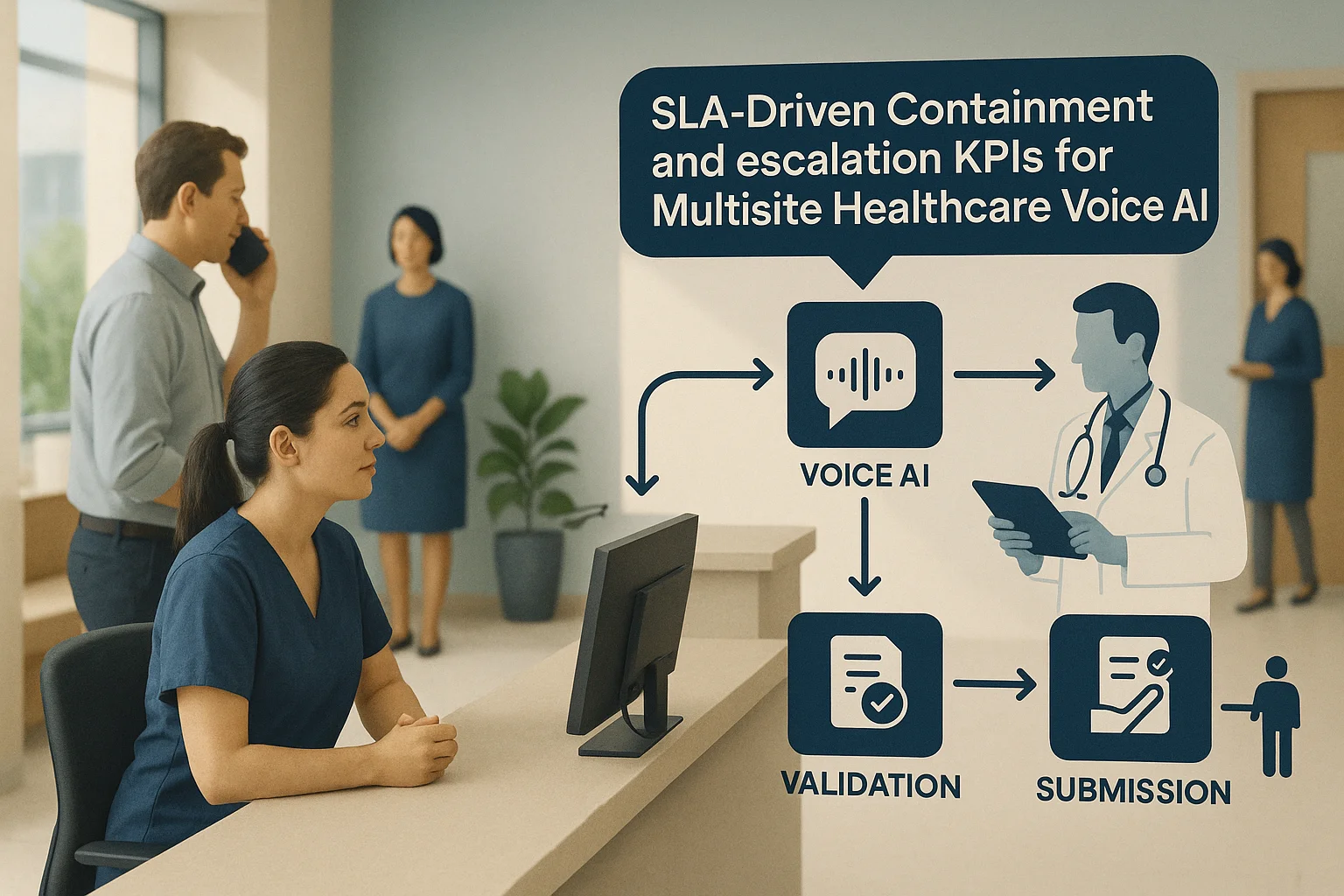
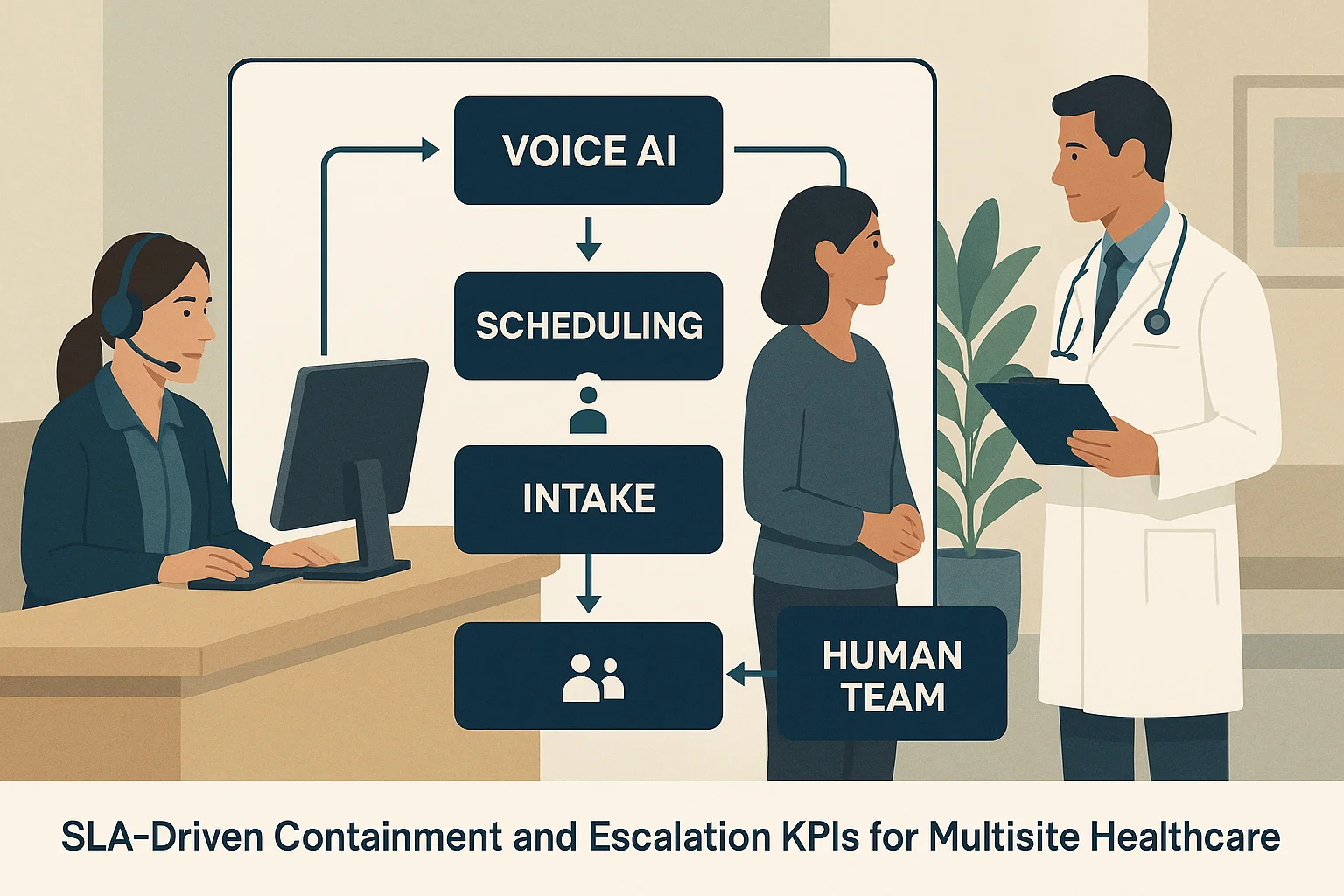
Design the flow to preserve safety, identity, and transactional integrity. A recommended architecture: Caller → Voice AI front end → identity & field validation → approved scheduling or service API → confirmation or human handoff. Each stage must log inputs, decisions, and responses for QA and audit.
- Initial capture: name, DOB, callback number (or clinic identifier); explicit consent for recording if required locally.
- Identity & validation: compare caller-supplied fields with the patient record before allowing schedule changes.
- Business transaction: call scheduling API with preflight checks and atomic transaction patterns.
- Outcome confirmation: verbal confirmation to the patient plus SMS/email with appointment details.
- If any validation step fails or the intent is ambiguous, immediate escalation to human staff with a structured handoff payload.
Where Peak Demand differentiates operationally
Our approach concentrates on controllable integration points: custom Voice AI tuned to intake dialogs, scheduling and intake integrations with EHR/PM systems, identity verification and field validation, safe escalation with pre-populated context, immutable audit trails, and human-review workflows for edge cases. These capabilities are implemented with deployment options that respect regional hosting and subprocessors.
- Custom Voice AI behavior built to match clinical administrative workflows rather than off-the-shelf conversation templates.
- Prebuilt connectors for common scheduling APIs with idempotent transaction controls.
- Field-level validation to detect mismatched MRNs, duplicate bookings, or conflicts before committing.
- Human-in-the-loop review and audit records that capture the full interaction plus MCP-controlled model inputs and outputs.
3. KPI taxonomy, measurement methods, and analytics
Translate SLA language into measurable signals. Use a combination of automated transaction checks and human QA to prevent false positives in containment measurements.
Core KPIs to include in SLAs
Operationalize both volume and quality measures so teams can act on them.
- Containment rate and containment quality (measured via a QA sample and backend transaction success).
- Escalation rate and escalation quality (appropriateness + handoff completeness).
- First-contact completion for scheduling (no follow-up required).
- Average time to human handoff and time-to-resolution for escalated calls.
- Cost-to-serve per contained call versus per escalated call (including platform costs, telephony, and human labor).
Measurement design: automated signals vs QA
Automated signals detect success or failure quickly; QA verifies appropriateness. Combine both into a measurement pipeline.
- Automated checks: API response codes, confirmation message delivery, duplicate-job detection, and transaction reversals.
- QA sampling: stratified random samples, failure-triggered samples (API errors, ambiguous intents), and high-risk workflow oversampling.
- Analytics dashboards should link each contained call to the underlying artifacts — transcript, intent classification, API request/response, and identity matching score.
4. QA workflows, MCP, and continuous review
Rigorous QA protects patients and reduces hidden rework. Introduce a Model Context Protocol (MCP) to keep models auditable and consistent across sites and languages.
QA pipeline and sampling strategy
QA should be automated where possible and human-reviewed where necessary. Use three parallel streams: baseline random sampling, exception-driven sampling, and targeted high-risk sampling.
- Baseline random sampling gives a stable view of containment quality over time.
- Exception-driven sampling collects every interaction with API errors, identity mismatches, or repeated edits.
- Targeted high-risk sampling focuses on workflows with the greatest downstream impact (e.g., booking for pre-op consults or short-notice urgent appointments).
- QA artifacts must capture a structured checklist: identity verified, correct clinic/appointment, confirmation sent, model rationale, and whether escalation was appropriate.
MCP (Model Context Protocol) and model governance
MCP formalizes the inputs and guardrails the model uses: permitted prompts, allowed actions, context windows, fallbacks, and logging requirements. For regulated healthcare contexts, MCP supports reproducibility, audit trails, and coordinated updates across sites and languages.
- MCP contains the prompt library, role policy (what the model may and may not say), and escalation trigger rules.
- All model outputs used for transactional decisions must be logged with the MCP artifact to enable post‑hoc review.
- MCP changes follow the same change-control process as other clinical‑adjacent systems.
5. Multisite and multilingual scale, procurement, and hosting
Scaling across clinics and languages introduces variability in identity conventions, scheduling windows, and consent regimes. Procurement should capture the technical and legal controls you will need.
Operational choices for multisite scale
Design a repeatable template for site onboarding: configuration of clinic hours, appointment types, language models, and identity rules. Avoid per-site one‑offs that block centralized measurement.
- Use site configuration profiles for hours, clinicians, and appointment constraints.
- Localize dialogs and validation rules; measure containment quality by language cohort.
- Standardize the escalation handoff payload so agents across sites receive consistent context.
Procurement: clauses that matter
SLA and procurement must cover not only uptime and latency, but measurable containment and escalation quality, data residency and subprocessors, audit rights, and model-change controls.
- Define SLA metrics clearly (including measurement methodology and sampling rules) and link to service credits.
- Require disclosure of subprocessors and hosting geography; specify backup-region and remote-support access expectations.
- Include audit rights to review QA samples, MCP artifacts, and logs necessary for compliance or incident investigation.
- Ask vendors to explain how they handle model updates and provide a rollback plan with minimal disruption.
Data residency, transfers, and compliance cautions
Different jurisdictions have different obligations. Describe hosting region, backup region, remote-access arrangement, subprocessors, transfer mechanisms, retention, recording consent, and breach duties in procurement artifacts and operational runbooks.
- Do not assume certifications (SOC 2, ISO) replace contractual obligations—confirm controls and responsibilities.
- Clarify whether transcription or third‑party LLM providers operate as subprocessors and where those subprocessors are located.
- Review retention and deletion policies for recordings and transcripts, and map these to local obligations in each jurisdiction.

6. Continuous optimization, change control, and failure boundaries
Ongoing tuning improves containment quality while protecting safety. Adopt controlled experiments, strict change control for MCP updates, and clear failure boundaries that force human intervention.
Optimization loop and experimentation
Use A/B or canary deployments to measure the real effect of model or conversation changes on containment quality and escalation appropriateness. Monitor leading indicators and set automated rollbacks for regressions.
- Define primary success metrics (containment quality, escalation quality) and secondary metrics (call duration, confirmation delivery).
- Run changes on a small percentage of traffic; monitor QA samples and automated checks before broad rollout.
- Maintain an experiments register linked to MCP artifacts for traceability.
Failure boundaries and mandated escalations
Explicitly enumerate situations where the system must escalate: ambiguous symptoms suggesting clinical review, identity mismatch beyond threshold, API transactional errors, or caller insistence on speaking to a human. These failure boundaries must be non‑negotiable.
- Safety-critical escalations: any clinical symptom disclosure, emergency indicators, or requests for diagnosis must immediately route to trained staff.
- Operational escalations: repeated failed validation attempts or repeated call-backs trigger supervisor review.
- Log every escalation with the reason code, time, and the prefilled context delivered to agents.
Related Peak Demand resources
Industry and AI sources reviewed
- Artificial Intelligence Risk Management Framework (AI RMF 1.0)National Institute of Standards and Technology (NIST)
- Ethics and governance of artificial intelligence for healthWorld Health Organization
- OECD AI PrinciplesOrganisation for Economic Co-operation and Development
- Regulatory considerations on artificial intelligence for healthWorld Health Organization
Privacy, telecommunications, recording-consent, cybersecurity, consumer-protection, employment, and records obligations vary by jurisdiction and use case. This article is operational guidance, not legal advice; organizations should confirm applicable requirements with qualified professionals.
Frequently asked questions
Administrative workflows such as appointment booking, changes and cancellations, referral-status intake, approved follow-up, patient-access questions, after-hours overflow, and structured routing are common starting points. Clinical judgment, diagnosis, emergency triage, and prescribing decisions must remain with qualified professionals.
Use the minimum identifiers approved by the organization, validate them against the system of record, avoid exposing unnecessary information, and provide a human-assisted path when verification fails. The system should not infer identity from conversational context alone.
The agent should follow the organization's approved escalation and emergency-routing rules, avoid clinical advice, and transfer or direct the caller to the appropriate human or emergency channel. Those rules must be tested with realistic language and failure cases.
Request identity and privacy controls, scheduling or EHR integration behavior, audit logs, escalation rules, downtime handling, testing evidence, change control, monitoring, and clear separation between administrative automation and clinical decision-making.
Turn Voice AI infrastructure into a managed enterprise operation
Peak Demand designs, integrates, deploys, monitors, and improves Voice AI systems across customer service, enterprise systems, governance, escalation, and reporting.
Schedule a discovery call