
Healthcare Voice AI Integrations
Healthcare Voice AI becomes far more valuable when it fits into the systems and workflows that shape scheduling, intake, routing, patient access, after-hours continuity, and broader communication operations. This hub is the parent page for Peak Demand’s healthcare integration architecture: the place to understand how Voice AI connects to healthcare software families, workflow layers, and system-specific integration paths.
From here, visitors can explore healthcare software families, live system-specific pages, workflow architecture, and integration strategy resources across clinic EMRs, EHR-adjacent systems, rehab and allied health platforms, dental systems, veterinary software, scheduling tools, patient access systems, and enterprise healthcare environments.
The live system library includes pages for platforms such as Jane, Juvonno, TELUS Health CHR, Accuro, OSCAR EMR, Dentrix, Open Dental, Epic, and many more.

Architecture Role
Parent hub for healthcare integrations
System Coverage
98 healthcare system pages
Software Families
6 healthcare integration families
Workflow Focus
Scheduling, intake, routing, access
Healthcare integrations should be evaluated through workflow continuity
One of the biggest mistakes in healthcare integration conversations is reducing the discussion to a list of software names. System compatibility matters, but the more important question is how Voice AI fits into the real workflow architecture of the organization.
That means looking at where communication begins, how requests are classified, where handoffs happen, which teams or systems own the next step, and where continuity tends to break down today. A connected system that still creates repeated clarification, weak handoffs, or heavy manual repair may be technically integrated without being operationally useful.
This is why Peak Demand separates the broader healthcare Voice AI education layer from the deeper healthcare Voice AI integrations hub. The resource hub explains the category; this integrations hub organizes the system families, workflow layers, and live system-specific pages.
Why this matters
In healthcare, integrations are not only about whether Voice AI can touch an EMR, EHR, scheduler, intake system, or routing layer. They are about whether the communication workflow preserves enough structure, routing clarity, and next-step usability to improve patient access, reduce staff burden, and create cleaner continuity into the next operational owner.
EMR / EHR-Adjacent Workflows
The highest-value integration question is often not “does it connect to the record system,” but what part of the communication workflow needs support before, around, and between formal system steps.
- Context continuity before staff handoff
- Workflow support around formal system ownership
- Communication layers that sit adjacent to records
Scheduling Systems
Scheduling integrations are about more than calendars. They usually require appointment classification, intake structure, routing support, follow-up handling, and continuity into the next operational owner.
- Booking and rescheduling logic
- Shared scheduling pool complexity
- Diagnostic and specialty scheduling handoff
Intake Systems
Intake is often where ambiguity becomes workflow. Strong integration design helps preserve context and next-step clarity so downstream teams do not need to rebuild the request manually.
- Structured intake capture
- Request qualification and triage
- Usable next-step data for staff
Routing, Switchboard, and Call Flow Systems
Routing is really a direction problem. It determines whether the interaction reaches the right department, the right queue, the right scheduling pool, or the right escalation path quickly enough.
- Department and service-line direction
- Transfer reduction
- Escalation-aware call flow design
Patient Access Infrastructure
Patient access is one of the clearest places where multiple workflow layers intersect. Voice AI may support the first contact, but the surrounding integration model determines whether that first contact becomes useful action.
- Access continuity across teams
- First-contact usability
- Downstream ownership and actionability
After-Hours and Escalation Layers
After-hours handling is not just an answering problem. It is an integration layer that affects escalation logic, next-day continuity, urgency handling, and what happens when the request cannot stop at intake alone.
- Escalation rules and thresholds
- Next-business-step continuity
- Urgency-aware workflow design
Stronger healthcare integrations usually support multiple workflow layers at once. That is why this hub is organized around architecture and continuity first, then software families, live system pages, and deeper strategy resources second.
Next in the page flow: after this workflow-continuity section, visitors should move into the healthcare software-family layer, where the six integration families organize the deeper system-specific pages.
Browse Healthcare Software Families
AI Voice Receptionist for Canadian Restaurants: Capture Missed Calls, Take Orders, Operating Hours, Manage Reservations, and Integrate Seamlessly with Online‑Ordering Platforms
Running a restaurant in Canada today means juggling phone calls, take‑out orders, opening‑hour updates and table reservations—all while trying to keep staff costs low and guests happy. Every missed call or mis‑heard order is a lost sale, a waste of food, and a potential bad review. That’s why AI voice receptionist for restaurants Canada is changing the game: a smart, 24/7 voice agent answers every ring, captures orders with built‑in allergy checks, updates your hours instantly and books reservations without a human lift‑gate. In the next few minutes you’ll see exactly how this technology eliminates missed calls, cuts order‑handling time, prevents double‑bookings and plugs straight into your existing online‑ordering platforms—all without you writing a line of code. Ready to turn every phone call into revenue? Let’s dive in.
Why Your Current Phone System Is Costing You Money
Running a restaurant already means juggling food, staff, inventory, and the guest experience. An outdated or inefficient phone system adds a silent drain on your bottom line. Below are the four ways a conventional phone setup costs you real dollars—and how those costs show up in a typical Canadian eatery.
1. Missed Calls = Lost Sales

The reality: Most diners will try the phone three times before moving on to a competitor’s website or delivery app.
What it looks like: Imagine a 20‑seat café that receives about 120 calls a day. If 30 % of those calls go unanswered, that’s 36 missed opportunities every single day.
The cash impact: With an average ticket of $25, those 36 missed calls translate to roughly $900 in daily sales—or around $27,000 each month that never materializes.
Bottom line: Every ring that isn’t answered is a dollar walking out the door.

2. Wrong Orders = Waste, Refunds, and Bad Reviews
Cost of a single mistake: One misplaced topping, a forgotten allergy note, or a wrong size can waste $10‑$15 of food, trigger a $15 refund, and generate a 1‑star review that scares away future guests.
Error rates matter: Even a modest 1 % error rate means 1 mistake for every 100 orders. In a month of 1,000 orders, that’s 10 refunds and potentially 5‑10 negative reviews.
Financial hit: Assuming an average refund of $12, you’re looking at $120 in direct losses plus the intangible cost of a lower rating, which can shave 5‑10 % off future traffic.
Bottom line: Inaccurate orders cost you food, money, and reputation—all at the same time.
3. Out‑of‑Date Hours & Reservations = Empty Seats
Wrong hours: If a guest calls at 9 p.m. expecting you to be open but you actually close at 8 p.m., they leave and may never return.
Double‑booked tables: A handwritten reservation book or a harried host can easily double‑book a table, resulting in an embarrassed front‑of‑house crew and a vacant seat.
Revenue loss: One empty table during a busy dinner service (average spend $45) costs $45. Multiply that by just five missed tables each night and you lose $225 nightly, which adds up to about $6,750 per month for a single location.
Bottom line: Inaccurate hours and reservation mishaps turn potential diners into empty tables.
4. Staff Burnout = Overtime, Turnover, and Training Costs
Constant phone juggling: When servers, hosts, or a single receptionist must answer phones, take orders, and manage reservations simultaneously, fatigue sets in quickly.
Overtime adds up: An extra 30 minutes per shift for each front‑of‑house employee translates to roughly $10 extra per employee per day. For a team of five, that’s $50 a day, or $1,500 a month in overtime wages.
Turnover expense: Burnout leads to higher turnover. Replacing a front‑of‑house employee in Canada can cost around $3,000 in hiring, training, and lost productivity. Even a 1 % uptick in turnover each year adds another $3,000 of hidden cost.
Bottom line: Overburdened staff not only cost you in wages but also in the hidden expense of constantly training new hires.
Quick Takeaway
When you add up the hidden costs—missed calls, order mistakes, empty seats, and staff overtime—you’re at tens of thousands of dollars each year slipping through the cracks of an inefficient phone system.
The good news is that an AI Voice Receptionist handles every call, captures orders accurately, updates your hours instantly, and manages reservations without adding a single overtime hour for your team. The next sections will show exactly how that works and how quickly you can start seeing the money flow back into your cash register.
What an AI Voice Receptionist for Restaurants Does for You
1. Never‑Missed Calls
The AI voice receptionist for restaurants answers every ring, 24 / 7, using a warm, natural‑language voice.

Calls are routed straight to the kitchen or to your reservation board—no human has to pick up the phone, so no order is ever lost because the line is busy.
2. Accurate Order‑Taking

The AI listens to the guest, repeats each item back, and asks about size, toppings, and any allergens.
Once the order is confirmed, the AI pushes it through a secure API to your point‑of‑sale or to the payment‑processing system you already use. No manual re‑keying, no transcription errors.

3. Live Hours & Special Updates

When you change a shift, close early, or add a daily special, the AI instantly tells callers the correct information.
Guests always hear the most up‑to‑date opening hours and menu items, eliminating “we’re closed” calls and confusion around specials.
4. Reservation Management

Guests can book, modify, or cancel a table simply by speaking to the AI voice receptionist for restaurants.
The system checks real‑time table availability, preventing double‑bookings and empty seats.
5. Upsell & Promotion Engine

While confirming the order, the AI suggests a side, dessert, or wine that matches the guest’s preferences.
Those subtle, data‑driven suggestions lift the average ticket without any extra effort from your staff.
6. Multilingual Support
The AI voice receptionist for restaurants handles both English and French out of the box (additional languages are available on request).
You never lose a customer because the caller prefers a different language.
7. Custom Performance Reporting

Peak Demand’s team can generate a bespoke performance report whenever you need it.
The report shows call volume, order accuracy, peak times, and reservation stats—all presented in plain language that’s easy for you to read and act on.
Note: All of the technical wiring—API connections, security, and ongoing maintenance—is taken care of by Peak Demand. All you need to provide are the basics: your menu file, operating hours, and phone number. The rest is set up for you, so you can focus on serving great food.
AI for Restaurants Real‑World Use‑Case Scenarios for Owners and Managers
• Busy Lunch Rush

Problem: Phones line up as the kitchen is already at full speed – staff can’t answer every call and orders are missed.
AI Solution: The voice agent answers each ring instantly, captures the order, and pushes it straight to the kitchen while your cooks stay focused on food. No more lost lunch sales.
• Late‑Night Take‑Out
Problem: After hours there is no staff on the phone, yet customers still call for a last‑minute takeaway.
AI Solution: The AI stays on‑call 24 / 7, takes the order, and sends it to the kitchen for a “last‑call” prep. The kitchen can finish a few extra dishes without needing a night‑shift employee.
• Special‑Event Reservations
Problem: Guests call to book a Valentine’s or holiday dinner, and manual booking leads to double‑bookings or missed seats.
AI Solution: The voice agent checks real‑time table availability, confirms the reservation, and automatically sends a confirmation email or text to the guest. No more embarrassed front‑of‑house staff or empty tables.
• Allergy‑Sensitive Orders
Problem: A diner mentions a nut allergy, but the note gets lost in the rush and the kitchen prepares the wrong dish.
AI Solution: The AI asks for allergy information up front, records it in the order, and flags the kitchen with a clear alert. This protects your guests and your reputation.
• Seasonal Menu Changes
Problem: New dishes or specials are added to the menu, but the phone script still lists the old items, leading to orders for dishes that are no longer available.
AI Solution: You upload a simple CSV file with the updated menu and prices. The AI instantly learns the new items and only offers what you actually serve.
• Bilingual Customer Base
Problem: French‑speaking patrons call, hear only an English greeting, and hang up because they can’t be understood.
AI Solution: The voice agent detects the language preference and switches to French (or any other language you require) on demand, keeping the conversation smooth and retaining the sale.
These scenarios show how an AI Voice Receptionist for restaurants fits naturally into the everyday flow of a busy kitchen and front‑of‑house operation—eliminating missed calls, reducing errors, and freeing your team to focus on what they do best: cooking great food and providing excellent service.
Simple 6‑Step Roadmap to Get Started (Owner‑Friendly)
Step 1 – Pick a Plan & Share Your Phone Details
Tell us roughly how many calls you receive each day/week (a ball‑park figure is fine).
Based on your call volume and menu size we create a custom payment plan that fits your budget.
We give you a dedicated AI number that forwards all inbound calls to the voice receptionist, while you keep your existing restaurant number.
Need separate lines (e.g., one for take‑out, another for general inquiries)? We can set up as many AI agents as you need, each with its own number.
Step 2 – Send Your Current Menu & Hours
A simple spreadsheet or PDF is enough – list each dish, size, price, and any allergy notes.
Include the opening and closing times for each location (or for each shift).
We load this information so the AI can speak confidently about every item and always give the correct hours.
Step 3 – Choose Your Order‑Processing Method
Lightweight option (most restaurants): give us an email address, a mobile number for SMS, or the tablet/device your kitchen staff uses. After every call the AI instantly sends a concise order summary (items, quantities, allergy notes) to that inbox, text thread, or tablet screen. Perfect for “pay‑at‑pickup” orders where the guest pays in‑person.
Full‑scale integration (optional): if you already use a POS or online‑order system, hand over the API details and the AI will push orders directly into that system. You can start with email/SMS now and upgrade later—no extra hardware required.
Step 4 – (Optional) Set Up Reservation Handling
If you need reservations: let us know your table count, typical turnover time, and any blackout dates. We can either:
Connect to your existing calendar (Google, Outlook, etc.) so every booking appears automatically, or
Build a simple reservation dashboard for you that sends confirmation texts/emails and prevents double‑bookings.
If you don’t need reservations: simply skip this step—your AI will focus solely on order taking and operating‑hour queries.
Step 5 – Go Live & Test
We launch a 48‑hour pilot where the AI answers your dedicated number(s).
You’ll receive a handful of sample order messages (and reservation messages, if you opted‑in) to review.
Give us any feedback—adjust wording, tweak menu items, or change the email/SMS address—and we’ll make the changes on the spot.
When you’re satisfied, we switch the pilot to full production.
Step 6 – Get a Custom Performance Report & Optimize
Instead of a static dashboard, our team prepares a plain‑language report whenever you request it.
The report covers:
Call volume and answer rate
Order‑accuracy percentage
(If applicable) Reservation success and any double‑booking incidents
Upsell performance – how often the AI suggested a side, dessert, or drink
Use these insights to fine‑tune staffing, update menu wording, or add new promotional prompts.
All the technical heavy‑lifting—phone‑number provisioning, call forwarding, API connections, calendar or POS integration, security, and ongoing maintenance—is handled by Peak Demand.
Your role is simply to provide the basic business information listed above, and you’ll have a fully‑functional AI voice receptionist that answers every call, takes accurate orders, (optionally) manages reservations, and keeps you informed with easy‑to‑read performance reports.
Quick Wins Checklist – What You Can Do This Week
Collect your menu in a simple spreadsheet
Include each dish name, size options, price, and any allergy notes.Write down the current operating hours for every location
We’ll upload them immediately so the voice‑AI always tells callers the right times.If you take reservations, send us one key rule
Example: “Tables turn every 90 minutes.”
(If you don’t need reservations, just skip this step.)Tell us which online‑ordering system you already use
Or let us know you’d like to add one later – the AI can forward orders by email, SMS, or directly to your POS.Check that your business listings are identical everywhere
Verify Google, Yelp, TripAdvisor, and your own website all show the same phone number, address, and hours. Consistency prevents confused customers and improves online trust.Pick a friendly voice for the AI
Choose gender (male or female) and language (English, French, or both).Book a 30‑minute demo call with a Peak Demand specialist
We’ll walk you through how the system works, answer any questions, and show you the simple performance report you’ll receive on request.
All of these items are quick “owner actions.” The technical heavy‑lifting—coding, integrations, security, and ongoing compliance—remains on our side.
How to Measure Success (Metrics That Matter to You)
Calls Answered / Missed‑Call Rate – Track how many rings the AI picks up. Aim for fewer than 2 % missed calls.
Order‑Error Rate – Use your POS to see how often an order needs correction. Target under 1 % errors.
Average Handling Time – Seconds from “hello” to order confirmation. Goal ≤ 15 seconds.
Reservation Accuracy (if you use reservations) – Percentage of bookings that stay as scheduled, with no double‑books. Goal 95 % +.
Take‑Out Sales Lift – Compare week‑over‑week take‑out revenue after the AI goes live. Look for a clear upward trend.
Customer Satisfaction Score – Short post‑call survey (1‑5 stars). Target 4.5 / 5.
Custom Reporting – When you need deeper insight, Peak Demand can generate a tailored performance report that focuses on the specific metrics you care about most. Just request it, and we’ll deliver the data in an easy‑to‑read format—no spreadsheets or technical hassle required.
Bottom‑Line Business Impact
More Revenue – Every call that’s answered becomes a potential order. By eliminating missed calls you capture sales that would otherwise slip away.
Lower Labor Costs – One AI voice receptionist can handle the work of 1 – 2 front‑of‑house staff members, letting you re‑allocate or reduce labor hours.
Reduced Food Waste – Accurate, verified order taking means fewer mistakes, so you waste less food and issue fewer refunds.
Better Online Reputation – Consistently correct opening hours and zero double‑bookings translate into higher star ratings on Google, Yelp, TripAdvisor, and other sites.
Scalable Growth – Add a new location and the same AI agent can be deployed instantly—no extra hiring or training is required.
Quick ROI Rule of Thumb – If the AI saves you just one staff hour per day (≈ $30 / hour) and boosts sales by 5 %, you typically see a 200 %–300 % return within the first year.
Free Audit CTA – Discover If an AI Voice Receptionist Is Right for Your Restaurant
Hook : “Not sure whether a voice‑AI can solve your missed‑call and ordering headaches?”
Offer : Free AI Voice Receptionist Discovery Audit – a no‑cost, no‑obligation assessment
What the audit covers
Current call‑handling snapshot – We review any available call logs or estimate missed‑call volume and order‑error rates to show where revenue may be leaking.
Fit‑for‑purpose analysis – Based on your restaurant’s size, service style (take‑out, dine‑in, reservations) and existing systems, we outline the most relevant use‑case scenarios and any gaps that need fixing.
Next step
Schedule a 30‑minute discovery call. We’ll walk through the audit findings, answer your questions, and help you decide whether an AI Voice Receptionist is a good fit for your operation.
Learn more about the technology we employ.


Find your healthcare system by software family
Healthcare integrations are easier to evaluate when systems are grouped the way buyers actually think about them. Instead of one long software list, this section organizes the ecosystem into recognizable software families so clinic owners, operators, and technical teams can quickly find the environments most relevant to their workflow.
Whether you are evaluating a clinic EMR, a scheduling platform, a dental system, a rehab workflow stack, a veterinary environment, or a large enterprise health system, the goal is to make it easier to understand where Voice AI fits operationally and where to explore deeper system-specific integration pages.
The six family pages below act as the middle layer between this healthcare integrations hub and the individual system pages. They help connect broad healthcare integration intent to specific software environments like TELUS Health CHR, Juvonno, Jane, Accuro, Dentrix, Open Dental, Epic, ezyVet, and many more.

Medical and Ambulatory EMR Systems
Explore how Voice AI fits into medical and ambulatory EMR environments across scheduling, intake, patient access, provider routing, after-hours continuity, and clinic communication workflows.
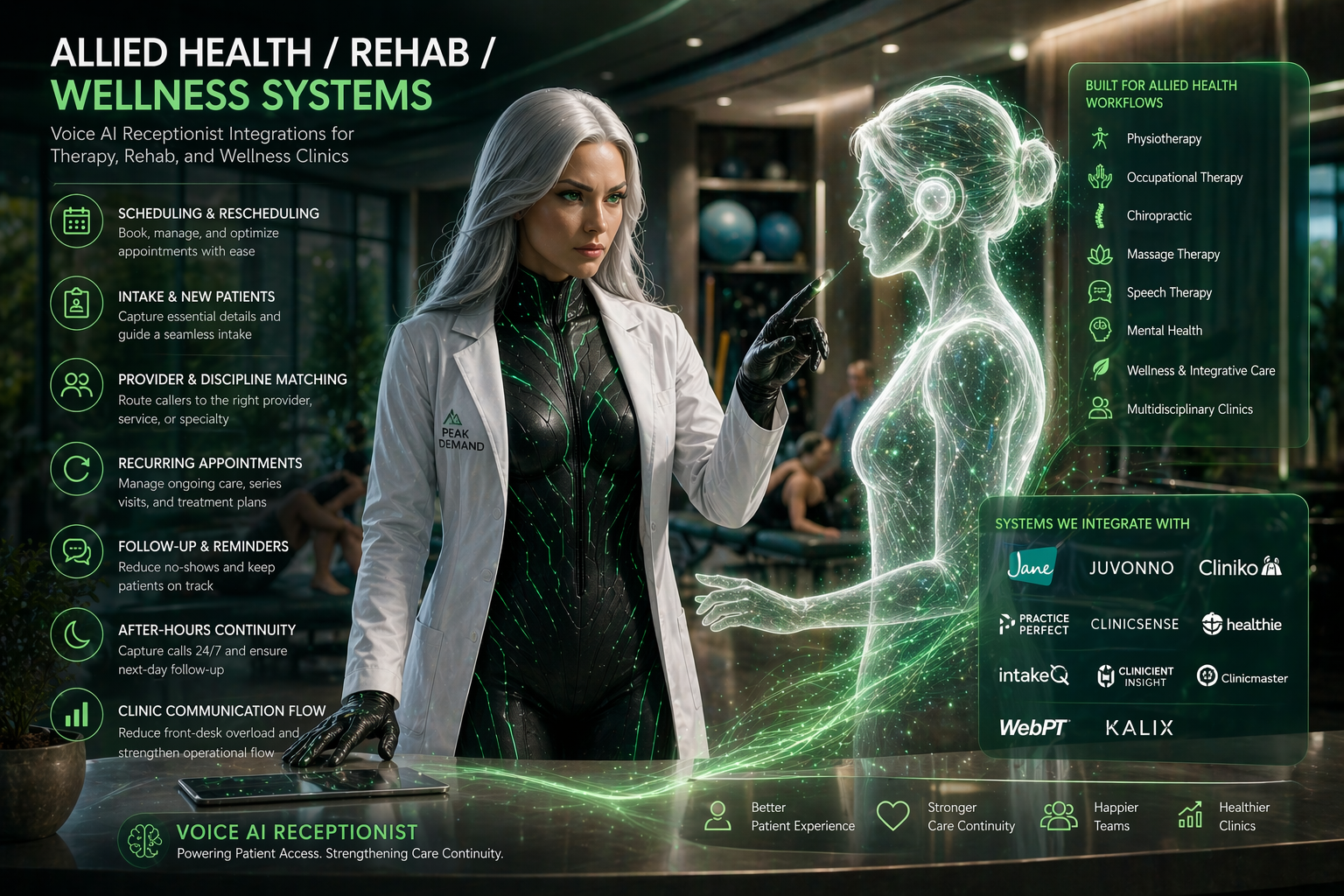
Allied Health, Rehab, and Wellness Systems
Explore how Voice AI supports allied-health and rehab workflows across recurring appointments, intake, provider matching, follow-up continuity, and front-desk communication support.
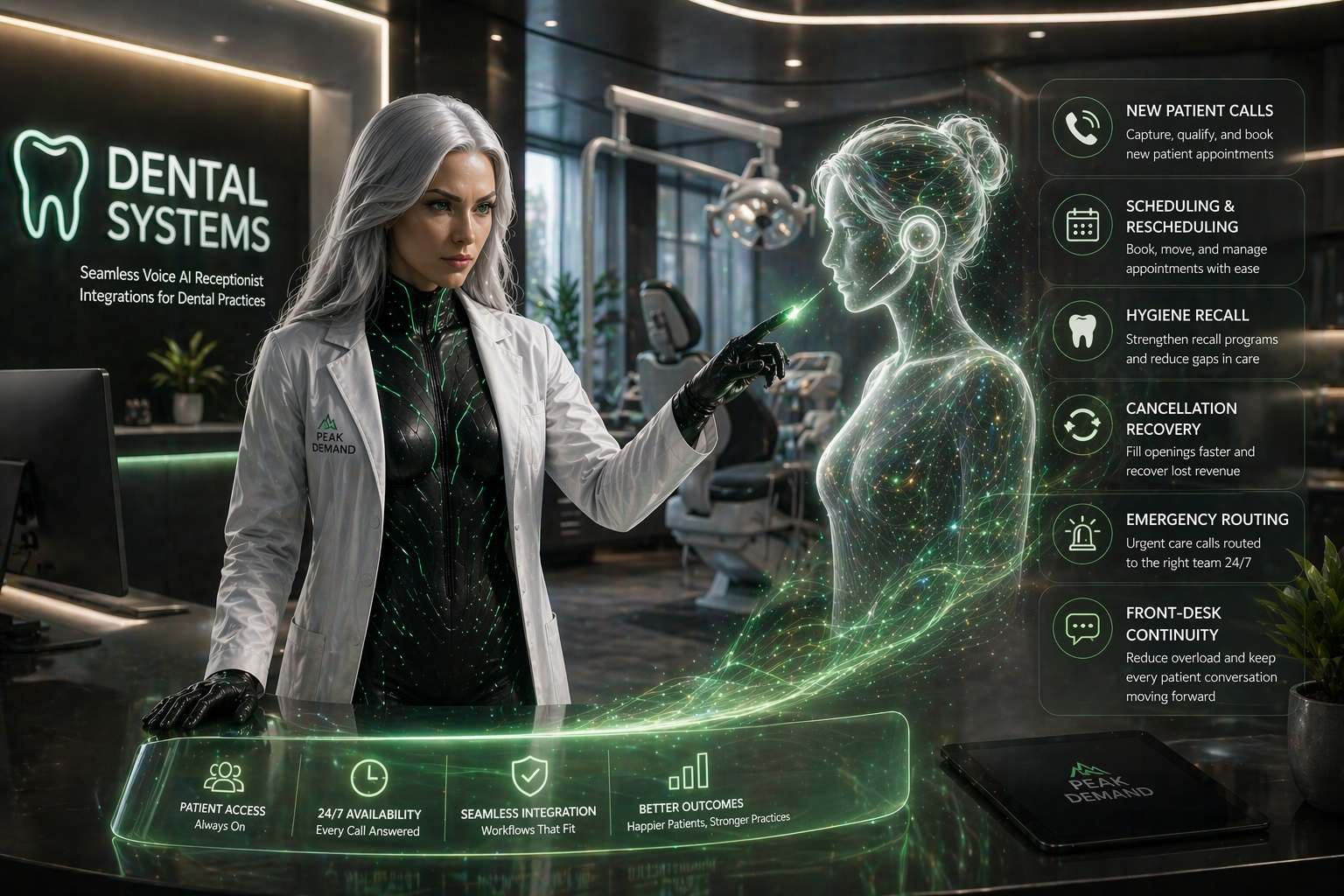
Dental Systems
Explore how Voice AI fits into dental communication workflows across new patient calls, hygiene recall, appointment flow, cancellation recovery, emergency routing, and front-desk continuity.
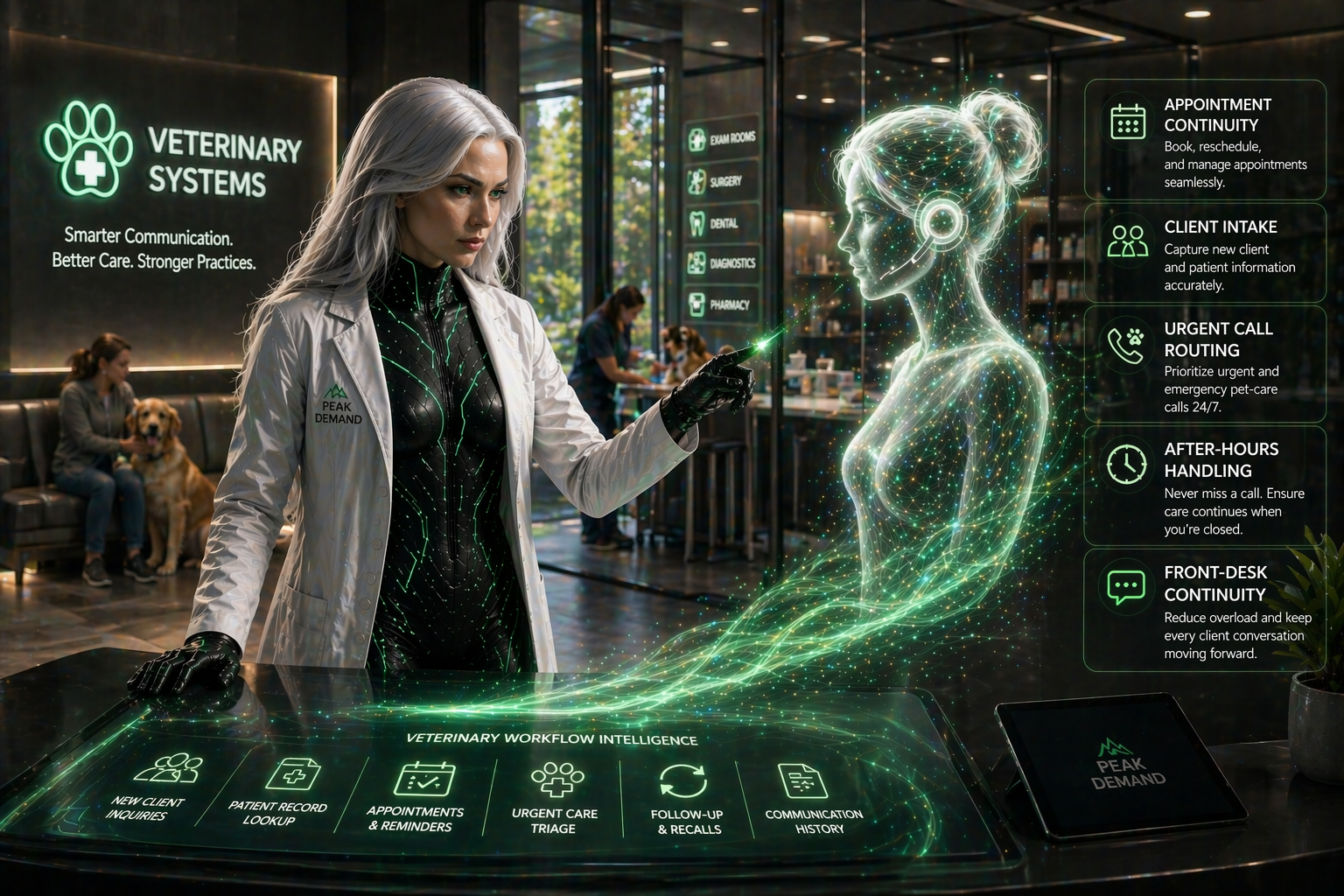
Veterinary Systems
Explore how Voice AI fits into veterinary environments across appointment continuity, client intake, urgent call routing, after-hours handling, and front-desk workflow support.
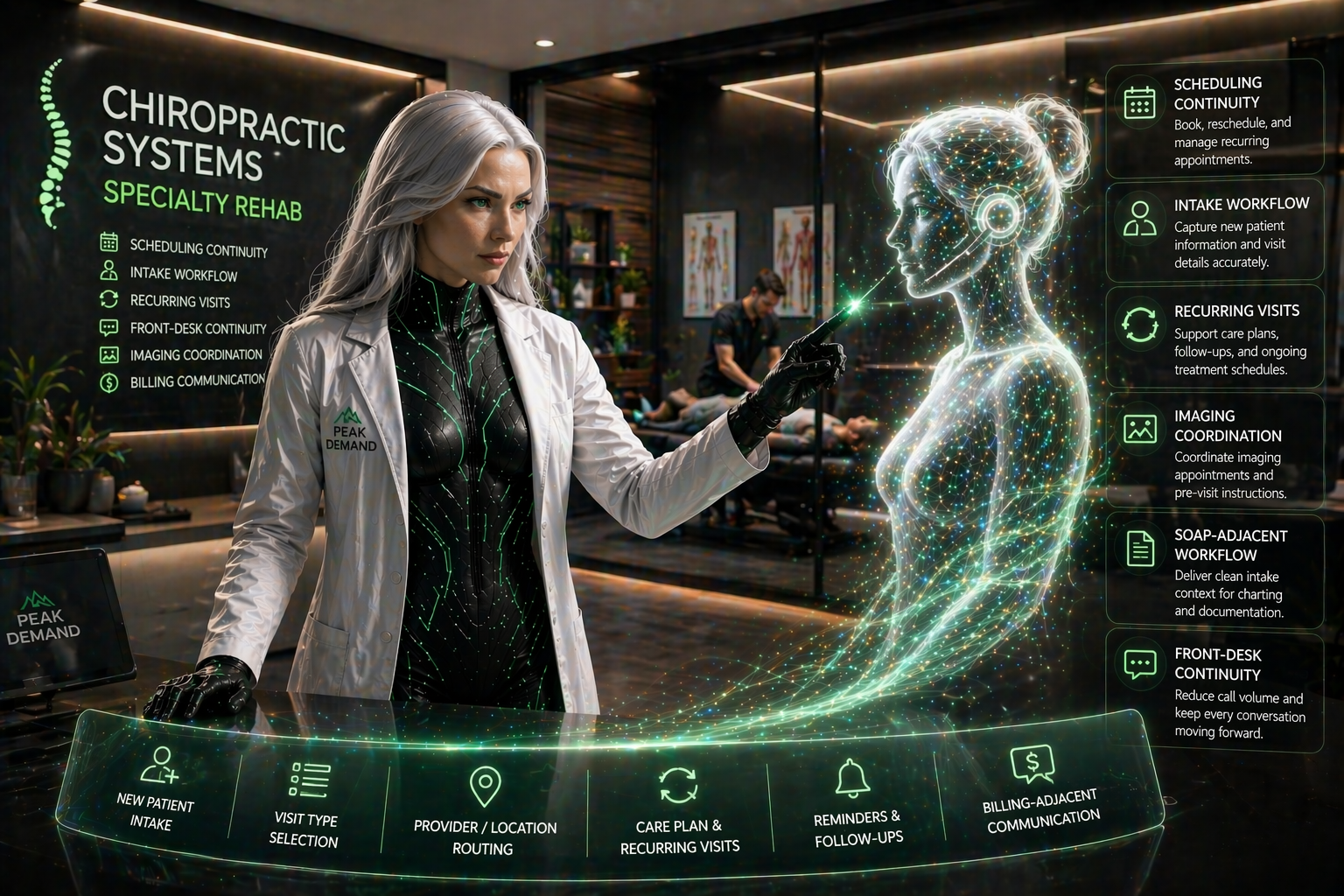
Chiropractic and Specialty Rehab Systems
Explore how Voice AI fits into chiropractic and specialty rehab workflows across scheduling, intake, recurring visits, SOAP-adjacent continuity, imaging-adjacent coordination, and front-desk support.
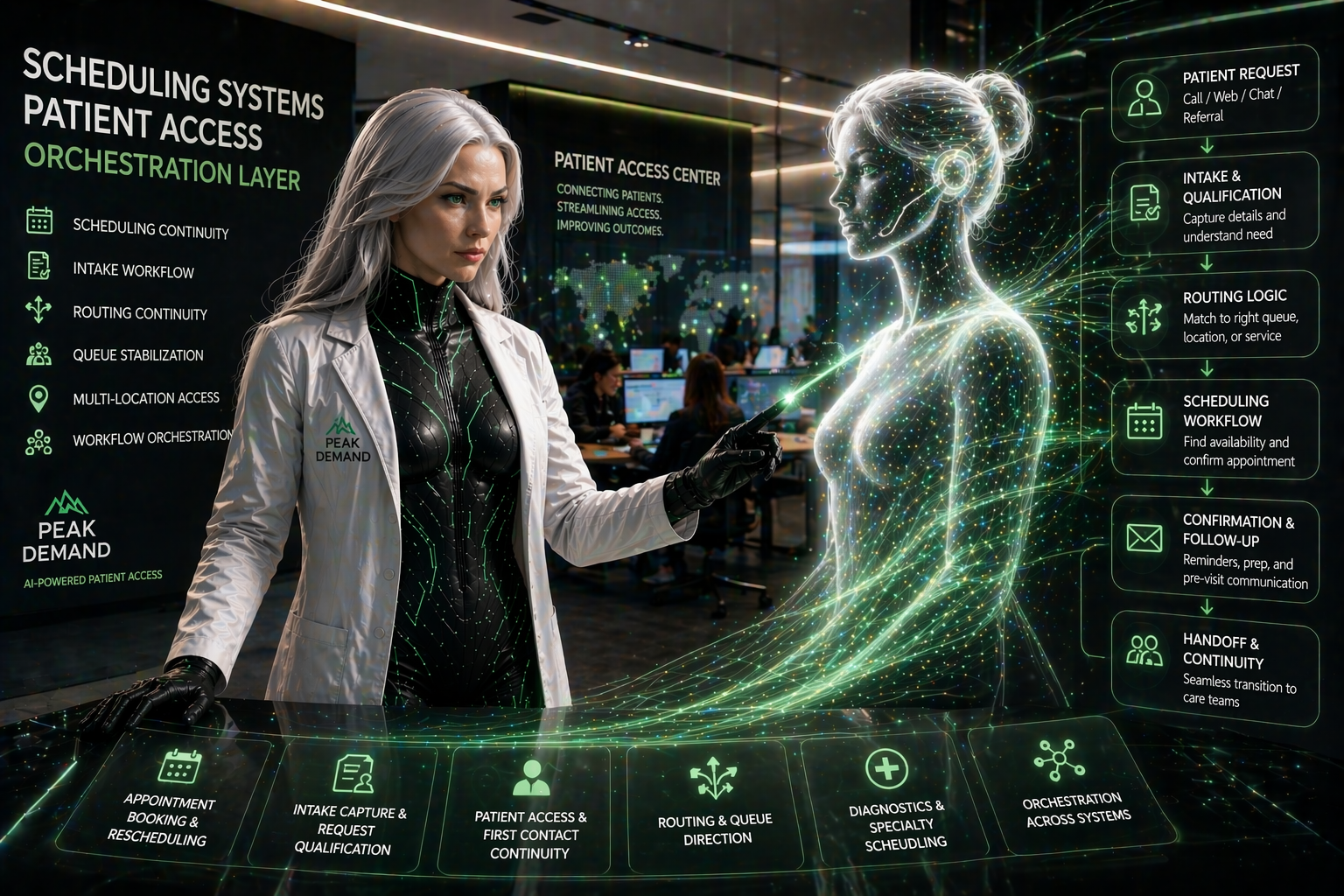
Scheduling, Patient Access, and Orchestration Systems
Explore how Voice AI supports scheduling and patient access architecture across intake, routing, queue stabilization, diagnostics scheduling, and workflow continuity between first contact and next action.
See Healthcare Voice AI Integrations In Action
These walkthroughs show how Voice AI can connect into real healthcare scheduling, intake, and communication environments. Start with TELUS Health CHR for Canadian clinic workflows and Juvonno for rehab and allied health operations.
TELUS Health CHR Integration Walkthrough
See how Voice AI can support TELUS Health CHR scheduling, intake, patient communication, and Canadian clinic workflow continuity.
Juvonno Integration Walkthrough
See how Voice AI can support Juvonno workflows for rehab scheduling, intake, appointment handling, and clinic communication continuity.
Explore published healthcare systems by name
Once you know the software family that best matches your environment, this section makes it easier to browse live healthcare integration pages by platform name. Each category below groups published system pages by the type of environment they usually support so operators, managers, and technical teams can compare workflow fit more quickly. A fuller alphabetical directory appears farther down the page.
Featured healthcare systems
These are high-priority starting points for visitors evaluating real-world Voice AI workflow fit across scheduling, intake, patient communication, routing, and access workflows.
Clinic, ambulatory, and medical EMR systems
These systems are commonly associated with clinic records-adjacent workflows, appointment flow, patient requests, intake continuity, routing, and broader ambulatory communication operations.
Scheduling, intake, and patient communication systems
These environments sit closer to booking logic, intake flow, reminders, clinic administration, and day-to-day patient access operations.
Rehab, physiotherapy, and allied health systems
Allied health and rehabilitation environments often depend on strong scheduling continuity, practitioner matching, intake flow, recurring appointment management, and multi-location operational coordination.
Dental systems
Dental communication workflows often center around appointment demand, cancellation recovery, reminders, new patient calls, and front-desk continuity across booked production.
Veterinary systems
Veterinary communication environments often require appointment continuity, client communication, after-hours handling, urgent call direction, and records-adjacent workflow coordination.
Healthcare organizations rarely evaluate integrations in a vacuum. Grouping systems by software family makes it easier to understand likely workflow fit, compare environments more quickly, and navigate toward both family-level integration pages and live system-specific pages deeper in this hub. The full alphabetical system directory farther down the page should carry the complete 98-system library.
Where Voice AI sits in the healthcare workflow matters more than basic connectivity
Healthcare Voice AI becomes more useful when it is treated as part of the larger workflow architecture around patient access, intake, routing, scheduling, escalation, and downstream ownership. The question is not only whether a system connects. The question is whether the communication flow reaches the next operational step with enough clarity and structure to reduce friction instead of shifting it downstream.
In practice, that means Voice AI often sits across multiple workflow layers at once. It may support first contact, gather structured intake, help direct the caller into the right path, preserve context for staff, and improve continuity into the next step. The value comes from how those layers fit together, not from one isolated connection point.
This is why healthcare teams should evaluate both the scheduling and patient access layer and the EMR or EHR-adjacent layer. In more complex environments, the architecture may also need to account for enterprise compliance and procurement requirements.
Where Voice AI usually enters the workflow
Voice AI often enters at the communication edge: inbound calls, appointment demand, intake capture, after-hours answering, overflow handling, and patient access or routing-related first contact.
Explore healthcare AI receptionistsWhere continuity usually breaks down
Continuity often breaks between the interaction and the next operational owner. That can happen when routing is weak, intake is unclear, scheduling context is incomplete, or downstream teams still need to manually rebuild the request.
Explore centralized scheduling workflowsWhat stronger integration architecture actually improves
Stronger architecture preserves enough structure, direction, and next-step usability for staff or systems to act efficiently. That is what turns Voice AI into operational infrastructure instead of a disconnected front-end layer.
Return to the healthcare resource hub| Integration maturity | What healthcare teams usually experience | Likely operational result |
|---|---|---|
| Fragmented | Some connection points exist, but scheduling, intake, routing, escalation, and continuity still require heavy manual repair. | Lower operational value, more staff burden, weaker patient access continuity, and less confidence in the workflow. |
| Partially connected | Important workflow layers connect, but structure and downstream usability still vary too much between teams, departments, or next-step owners. | Moderate gains, but persistent continuity gaps remain and staff still absorb unnecessary workflow friction. |
| Workflow-led and integrated | Voice AI supports multiple workflow layers with stronger structure, clearer routing, better handoff, and more usable next-step continuity. | Stronger patient access flow, cleaner operational ownership, and more scalable communication infrastructure. |
What healthcare teams should evaluate in the architecture discussion
- Where does Voice AI need to sit first in the communication workflow?
- Where does continuity currently break between the interaction and the next operational step?
- Which layers are EMR or EHR-adjacent, and which ones are workflow-adjacent?
- How do scheduling, intake, routing, patient access, and escalation interact in this environment?
- Will downstream teams receive enough structure to act without rebuilding the request manually?
- Is the integration design workflow-led or just feature-led?
- Does the current architecture reduce friction for staff, or does it simply move the work somewhere else?
Healthcare organizations usually get more value when they evaluate integration maturity across communication flow, operational ownership, and downstream usability together instead of treating each connection as a separate isolated decision. For system-specific evaluation, use the alphabetical healthcare system directory below.
Evaluating software families?
Use the six system-family pages to compare EMR, EHR, dental, veterinary, rehab, scheduling, and patient access environments.
Browse Software FamiliesEvaluating specific systems?
Use the full alphabetical directory to find the exact healthcare platform your team is evaluating.
Open System DirectoryEvaluating enterprise readiness?
Review governance, privacy, escalation, procurement, and compliance considerations before deployment.
Review ComplianceGo deeper into the strategy behind healthcare Voice AI integrations
This section helps healthcare teams move from broad category understanding into the right supporting resources for architecture, interoperability, workflow fit, implementation planning, and system-specific evaluation.
The articles below are the best next clicks for teams evaluating how Voice AI fits into healthcare communication systems, patient access workflows, structured integration pathways, rollout planning, and governed healthcare environments.
For broader category education, use the Healthcare Voice AI Resource Hub. For software-specific evaluation, continue to the full alphabetical system directory lower on this page and use the six healthcare software family pages as the parent layer.
Need system-family pages?
Use the family pages to compare medical EMR, allied health, dental, veterinary, specialty rehab, and patient access systems.
Browse Software FamiliesNeed a specific platform?
Use the alphabetical system directory to find the exact EMR, EHR, scheduling, dental, veterinary, or rehab platform.
Open System DirectoryNeed compliance context?
Use the enterprise compliance page when governance, privacy, procurement, RFPs, or regulated deployment requirements are part of the evaluation.
Review ComplianceCore integration strategy articles
These resources explain why integrations matter, what healthcare teams should evaluate first, and how stronger Voice AI integration architecture should be understood.
Custom pathways, structured integrations, and workflow fit
These articles are useful for teams evaluating custom pathways, structured communication flows, and how Voice AI fits into real healthcare operating environments.
Rollout, implementation, and governance
These resources are best for healthcare teams moving from early exploration into rollout planning, operational safety, implementation readiness, and governance-aware deployment.
Patient access, routing, and workflow bottlenecks
These articles help healthcare teams think more clearly about where communication complexity builds up across patient access, intake, department routing, scheduling, and downstream handoff.
As the healthcare integrations ecosystem continues to grow, this section can keep routing visitors into the most relevant strategy, rollout, and workflow resources without changing the overall structure of the hub. The full software directory appears in the Alphabetical System Directory section below.
Explore live healthcare system integration pages by category
This section gives healthcare teams a category-based way to browse the most important live system pages. It is not the full 98-system directory; it is a curated navigation layer for comparing the platforms most commonly tied to scheduling, intake, patient communication, routing, and patient access workflows.
Use this section when you know the type of software environment you are evaluating. Use the Alphabetical System Directory below when you want to find every live system page by name.
Need the family layer?
Start with the six parent family pages when comparing software categories before choosing a specific system.
Browse Software FamiliesNeed every system?
Use the alphabetical directory for the complete live healthcare system page list by platform name.
Open Alphabetical DirectoryNeed workflow context?
Review how Voice AI fits across patient access, intake, routing, scheduling, escalation, and downstream ownership.
Review Workflow ArchitectureFeatured healthcare systems
These are some of the strongest starting points for teams exploring healthcare Voice AI integrations across scheduling, intake, patient communication, routing, and access workflows.
Clinic and ambulatory EMR systems
These systems are commonly associated with clinic records-adjacent workflows, intake, appointment flow, routing, patient communication, and broader ambulatory continuity.
Explore medical and ambulatory EMR familyScheduling, intake, and patient communication systems
These environments sit closer to booking logic, intake flow, reminders, clinic administration, and day-to-day patient access operations.
Explore scheduling and patient access familyRehab, physiotherapy, and allied health systems
Allied health and rehabilitation environments often depend on strong scheduling continuity, practitioner matching, intake flow, recurring appointments, and multi-location coordination.
Explore allied health and rehab familyDental systems
Dental communication workflows often center on appointment demand, cancellation recovery, reminders, new patient calls, and front-desk continuity.
Explore dental familyVeterinary systems
Veterinary communication environments often require appointment continuity, client communication, after-hours handling, and records-adjacent workflow coordination.
Explore veterinary familyEnterprise, specialty, imaging, and outpatient environments
These environments often involve more complex routing, diagnostic scheduling, imaging coordination, enterprise workflow ownership, and department-specific handoff requirements.
Explore enterprise and medical EMR familyThis curated category browse section helps visitors compare common healthcare software environments without scrolling the entire directory. The complete system list belongs in the Alphabetical System Directory section below, where every live healthcare system page should be listed by platform name.
Talk through your healthcare communication workflow
If your team is evaluating healthcare Voice AI integrations, the most useful next step is usually a workflow conversation. That means reviewing patient access pressure points, scheduling flow, intake structure, routing logic, after-hours coverage, compliance expectations, and the systems surrounding those workflows.
Peak Demand approaches healthcare environments through workflow fit, governance awareness, and operational usability. The goal is to help organizations map a communication architecture that supports real teams, real workflows, and real continuity requirements across EMR, EHR, scheduling, intake, dental, veterinary, rehab, and patient access environments.
Need software families?
Compare the six parent healthcare integration families before choosing a specific system page.
Browse software familiesNeed workflow context?
Review how Voice AI fits across intake, routing, scheduling, escalation, and downstream ownership.
Review workflow architectureNeed compliance review?
Use the enterprise compliance page when governance, privacy, procurement, and RFP standards matter.
Review complianceFrequently asked questions
What does Voice AI mean in a healthcare integration environment?
Can Voice AI work with EMR, EHR, scheduling, intake, and routing workflows?
Are healthcare Voice AI integrations always direct?
Where should healthcare organizations start evaluating Voice AI integrations?
How should compliance and governance fit into the evaluation?
What is the role of this integrations hub?
About Peak Demand
Peak Demand is a Toronto-based AI agency focused on Voice AI, communication automation, and workflow infrastructure for organizations operating in more complex service environments.
In healthcare, the focus is not just on call handling. It is on patient access continuity, scheduling pressure, intake structure, routing logic, after-hours support, governance, and how communication systems fit into real operational workflows.
- Workflow-driven and implementation-aware
- Governance-first in healthcare communication environments
- Built to support clinics, networks, and enterprise teams
- Designed to scale into software-specific integration pathways
- Organized around healthcare system families and live integration pages
Healthcare software integrations by system name
If you already know the software you are evaluating, this alphabetical directory is the fastest way to find the right live system page.
This directory includes the full 98-system healthcare integration library from the current Peak Demand system-page build. It is designed to help teams compare EMR, EHR, scheduling, intake, patient communication, dental, veterinary, rehab, wellness, chiropractic, orchestration, home care, med spa, pharmacy, and enterprise healthcare systems by software name.
For category-level browsing, use the software family section. For workflow context, use the workflow architecture section. This section is the full alphabetical browse layer.
Live healthcare system pages in this directory
Grouped alphabetically with visible section counts so the full library is obvious at a glance.
A–C
34 systemsABELMed through Curve Dental.
D–H
20 systemsDentrix through Helios Software.
I–M
15 systemsIDEXX Cornerstone through MRX Solutions.
N–O
11 systemsNextech through Owl Practice.
P–R
8 systemsPabau through RXNT.
Compare healthcare systems by name, category, and workflow fit
This directory is useful for comparing clinic EMRs, EHR-adjacent systems, scheduling and intake platforms, patient communication software, dental systems, veterinary systems, rehab and allied health systems, chiropractic systems, med spa systems, home care systems, pharmacy-adjacent systems, orchestration platforms, diagnostic workflows, and enterprise healthcare environments by software name before going deeper into workflow design, integration possibilities, and operational fit.
Explore your own AI use case on a discovery call.