
Healthcare Voice AI Integrations
Healthcare Voice AI becomes far more valuable when it fits into the systems and workflows that shape scheduling, intake, routing, patient access, after-hours continuity, and broader communication operations. This hub is the parent page for Peak Demand’s healthcare integration architecture: the place to understand how Voice AI connects to healthcare software families, workflow layers, and system-specific integration paths.
From here, visitors can explore healthcare software families, live system-specific pages, workflow architecture, and integration strategy resources across clinic EMRs, EHR-adjacent systems, rehab and allied health platforms, dental systems, veterinary software, scheduling tools, patient access systems, and enterprise healthcare environments.
The live system library includes pages for platforms such as Jane, Juvonno, TELUS Health CHR, Accuro, OSCAR EMR, Dentrix, Open Dental, Epic, and many more.

Architecture Role
Parent hub for healthcare integrations
System Coverage
98 healthcare system pages
Software Families
6 healthcare integration families
Workflow Focus
Scheduling, intake, routing, access
Healthcare integrations should be evaluated through workflow continuity
One of the biggest mistakes in healthcare integration conversations is reducing the discussion to a list of software names. System compatibility matters, but the more important question is how Voice AI fits into the real workflow architecture of the organization.
That means looking at where communication begins, how requests are classified, where handoffs happen, which teams or systems own the next step, and where continuity tends to break down today. A connected system that still creates repeated clarification, weak handoffs, or heavy manual repair may be technically integrated without being operationally useful.
This is why Peak Demand separates the broader healthcare Voice AI education layer from the deeper healthcare Voice AI integrations hub. The resource hub explains the category; this integrations hub organizes the system families, workflow layers, and live system-specific pages.
Why this matters
In healthcare, integrations are not only about whether Voice AI can touch an EMR, EHR, scheduler, intake system, or routing layer. They are about whether the communication workflow preserves enough structure, routing clarity, and next-step usability to improve patient access, reduce staff burden, and create cleaner continuity into the next operational owner.
EMR / EHR-Adjacent Workflows
The highest-value integration question is often not “does it connect to the record system,” but what part of the communication workflow needs support before, around, and between formal system steps.
- Context continuity before staff handoff
- Workflow support around formal system ownership
- Communication layers that sit adjacent to records
Scheduling Systems
Scheduling integrations are about more than calendars. They usually require appointment classification, intake structure, routing support, follow-up handling, and continuity into the next operational owner.
- Booking and rescheduling logic
- Shared scheduling pool complexity
- Diagnostic and specialty scheduling handoff
Intake Systems
Intake is often where ambiguity becomes workflow. Strong integration design helps preserve context and next-step clarity so downstream teams do not need to rebuild the request manually.
- Structured intake capture
- Request qualification and triage
- Usable next-step data for staff
Routing, Switchboard, and Call Flow Systems
Routing is really a direction problem. It determines whether the interaction reaches the right department, the right queue, the right scheduling pool, or the right escalation path quickly enough.
- Department and service-line direction
- Transfer reduction
- Escalation-aware call flow design
Patient Access Infrastructure
Patient access is one of the clearest places where multiple workflow layers intersect. Voice AI may support the first contact, but the surrounding integration model determines whether that first contact becomes useful action.
- Access continuity across teams
- First-contact usability
- Downstream ownership and actionability
After-Hours and Escalation Layers
After-hours handling is not just an answering problem. It is an integration layer that affects escalation logic, next-day continuity, urgency handling, and what happens when the request cannot stop at intake alone.
- Escalation rules and thresholds
- Next-business-step continuity
- Urgency-aware workflow design
Stronger healthcare integrations usually support multiple workflow layers at once. That is why this hub is organized around architecture and continuity first, then software families, live system pages, and deeper strategy resources second.
Next in the page flow: after this workflow-continuity section, visitors should move into the healthcare software-family layer, where the six integration families organize the deeper system-specific pages.
Browse Healthcare Software Families
How AI Call Center Solutions Are Transforming Customer Service for Small Business
Introduction to AI Call Center Solutions for Small Businesses

Running a small business is no easy feat. You’re constantly juggling multiple roles, from managing operations and finances to ensuring your customers are happy. But in today’s fast-paced market, there’s one area where small businesses often struggle to keep up: customer service. While larger companies have the resources to maintain dedicated call centers and round-the-clock support teams, small businesses often find themselves stretched thin.
That’s where AI call center solutions come into play. Imagine being able to offer your customers the same level of service as a large corporation—24/7 availability, instant responses, and personalized interactions—without breaking the bank. This isn’t just a dream; it’s entirely possible with the right tools and guidance.
At Peak Demand, we understand the unique challenges small businesses face, and we’re here to help you harness the power of AI to not only meet but exceed your customer service goals. By leveraging AI-driven call center solutions, small businesses like yours can compete on an even playing field with larger companies, offering exceptional service that builds customer loyalty and drives growth.
In this article, we’ll explore how AI call center solutions can transform your customer service operations, making it easier for you to focus on what you do best—running your business. And as experts in digital AI solutions, Peak Demand is here to guide you every step of the way, ensuring that you get the most out of these powerful tools.
The Growing Importance of Customer Service in Small Businesses

In today’s world, customer service can make or break a small business. Imagine you’re running a boutique retail store or a local insurance agency—your customers expect quick responses, personalized attention, and seamless experiences. But when you’re juggling so many different responsibilities, it can be hard to keep up with these demands. That’s where customer service becomes not just important, but essential.
The Customer Experience Gap
Let’s say a customer has a question about a product they bought from your store, or they need help understanding their insurance policy. They want answers fast—whether they’re calling you, sending an email, or messaging you on social media. Larger companies can handle this easily because they have big teams and advanced technology. But for a small business like yours, keeping up with these expectations can be tough.
This gap in customer experience can lead to lost customers. If a customer has a bad experience—maybe they were left waiting too long for a response or didn’t get the help they needed—they might not come back. And in a small business, every customer counts.
Challenges Small Businesses Face
Small businesses often have to do more with less. Maybe you only have a few employees, and they’re all wearing multiple hats. Or perhaps your budget doesn’t stretch far enough to hire a full-time customer service team. Here’s where the challenges come in:
Limited Availability: Imagine it’s the weekend, and a customer tries to reach out with an urgent question. Without a large team, you might not be able to respond quickly, leaving the customer frustrated and possibly looking elsewhere.
Inconsistent Service: When you’re short on staff, it’s hard to ensure every customer gets the same high level of service, especially during busy times. Maybe one day, your response times are great, but the next, things slip because your team is stretched too thin.
High Operational Costs: Traditional call centers can be expensive. The thought of setting up and maintaining a call center might feel out of reach, leading you to wonder if there’s a way to provide great service without breaking the bank.
These are the realities small businesses face every day. But here’s the good news: there’s a solution that can help you overcome these challenges and provide the kind of customer service that keeps customers coming back—AI call center solutions.
How Peak Demand Can Help
At Peak Demand, we specialize in providing AI-powered call center solutions that are tailor-made for small businesses. We understand the challenges you face and know that you need a service that’s not only effective but also affordable and easy to implement. Our AI solutions can help you:
Offer 24/7 Support: With AI-driven call center solutions, you can provide round-the-clock customer service without needing to hire additional staff. Your customers get the answers they need, whenever they need them.
Ensure Consistent Quality: Our AI technology is designed to deliver consistent, high-quality service, ensuring that every customer interaction is handled with care and efficiency, no matter how busy things get.
Reduce Costs: By using AI, you can significantly cut down on the costs associated with traditional call centers. This means you can provide top-notch service while staying within your budget.
In the next section, we’ll dive deeper into what AI call center solutions are and how they can transform your small business, helping you compete with larger companies without the need for a large customer service team.
What Are AI Call Center Solutions?

AI call center solutions are revolutionizing the way small businesses handle customer service. But what exactly are they, and how can they help your business? Let’s break it down.
Understanding AI Call Center Solutions
At their core, AI call center solutions use artificial intelligence to manage and enhance customer interactions. Unlike traditional call centers that rely heavily on human agents, AI call centers leverage technology to provide faster, more efficient service. These solutions can handle a wide range of tasks, from answering common customer questions to routing calls to the appropriate departments—all with minimal human intervention.
Here’s how AI call center solutions work:
24/7 Availability: AI doesn’t need to sleep. With AI call center solutions, your business can provide round-the-clock customer service, ensuring that customers can get the help they need anytime, day or night. Whether it’s a simple query about store hours or a more complex question about product features, AI is always on hand to assist.
Instant Responses: One of the biggest frustrations for customers is waiting on hold or not getting a quick response. AI call center solutions eliminate this issue by providing instant answers to customer inquiries. For example, if a customer has a question about their insurance policy, the AI can quickly access and provide the necessary information without delay.
Personalized Interactions: AI isn’t just about speed; it’s also about personalization. These solutions can analyze the information provided during the call in real-time, allowing them to tailor responses based on the specific needs and preferences expressed by the customer at that moment. Imagine a customer reaching out to your boutique store with a question about a product. The AI can listen to the customer’s inquiry and respond with detailed information or suggestions that fit the context of the conversation, ensuring a personalized experience based on the interaction itself.
Why AI Call Center Solutions Matter for Small Businesses
For small businesses, the benefits of AI call center solutions are clear:
Scalability: As your business grows, so do your customer service needs. AI call center solutions are easily scalable, meaning they can grow with you. Whether you’re experiencing a sudden influx of inquiries or expanding your operations, AI can handle the increased demand without requiring additional hires.
Consistency: With AI, you don’t have to worry about the inconsistencies that can come with human agents. The AI provides the same level of service every time, ensuring that your customers have a positive experience no matter when they reach out.
Cost-Effective: Traditional call centers can be costly to maintain. AI solutions, on the other hand, offer a more budget-friendly option. You get the benefits of a full-service call center without the overhead costs.
How Peak Demand Brings AI to Your Business
At Peak Demand, we’re experts in helping small businesses implement AI call center solutions tailored to their unique needs. We work with you to understand your business and customer base, ensuring that the AI is set up to provide the best possible service. Whether you’re looking to improve response times, offer personalized customer experiences, or simply reduce costs, our AI call center solutions can help you achieve your goals.
In the next section, we’ll explore the specific benefits that AI call center solutions can bring to your small business and how they can help you compete with larger companies.
How AI Call Center Solutions Benefit Small Businesses

AI call center solutions are not just tools for large corporations—they’re incredibly valuable for small businesses too. By implementing these advanced systems, small businesses can overcome some of the most common challenges they face in customer service and position themselves to compete with much larger companies. Here’s how AI call center solutions can make a difference.
1. Cost Efficiency
Lower Overhead Costs: Traditional call centers are expensive to set up and maintain, requiring a significant investment in hardware, software, and personnel. For a small business, these costs can be prohibitive. AI call center solutions, on the other hand, are far more cost-effective. They eliminate the need for extensive physical infrastructure and reduce the need for large customer service teams. This means you can provide high-quality service without the high costs.
Pay-As-You-Go Flexibility: Many AI call center solutions operate on a subscription or pay-as-you-go model, allowing you to scale your service up or down depending on your needs. This flexibility ensures that you’re only paying for what you use, making it easier to manage your budget.
2. Scalability and Flexibility
Grow with Your Business: As your business expands, so do your customer service demands. AI call center solutions are designed to scale effortlessly with your business. Whether you’re experiencing a temporary surge in inquiries or you’re in the middle of a growth phase, these systems can handle the increased volume without missing a beat.
Adaptable to Your Needs: Every small business is different, and AI call center solutions are highly adaptable. Whether you need to add new features, integrate with other business systems, or adjust workflows, these solutions can be customized to fit your specific needs. This adaptability means that as your business evolves, your customer service capabilities can evolve with it.
3. Enhanced Customer Experience
Quick and Consistent Responses: One of the biggest benefits of AI is its ability to provide quick, consistent responses to customer inquiries. AI doesn’t get tired, overwhelmed, or distracted, which means your customers receive the same high level of service every time they reach out. This consistency builds trust and keeps customers coming back.
Personalized Interactions: As mentioned earlier, AI call center solutions can tailor responses based on the information provided during the call, creating a more personalized experience for each customer. Whether a customer is asking about a product, service, or policy, the AI can respond with information that is directly relevant to their inquiry, making the interaction feel more tailored and thoughtful.
4. Competing with Larger Companies
Leveling the Playing Field: AI call center solutions give small businesses access to the same advanced technology that larger companies use. This means you can offer services that are just as responsive, efficient, and professional as those provided by much bigger competitors. Whether you’re a boutique store, a local service provider, or a small insurance agency, AI can help you punch above your weight class.
Building a Competitive Edge: By offering quick, personalized, and consistent customer service, you can differentiate your business from others, including larger competitors. In a market where customer service is often a deciding factor, having an AI-powered call center can be a key advantage.
How to Implement an AI Call Center Solution in Your Small Business

So, you’re ready to take the leap and transform your customer service with AI call center solutions. But where do you start? Implementing AI into your business might sound daunting, but with the right approach, it can be a smooth and rewarding process. Here’s a step-by-step guide to help you get started.
1. Identify Your Needs
The first step is to understand exactly what your business needs. Are you looking to improve response times, handle more customer inquiries, or reduce operational costs? Maybe it’s all of the above. Start by pinpointing the specific areas where AI can make the most impact.
Evaluate Your Current Setup: Take a close look at how your current customer service operates. What’s working well, and where are the bottlenecks? Understanding these factors will help you identify the features you need most in an AI solution.
2. Choose the Right AI Solution
Not all AI call center solutions are created equal. It’s important to choose one that fits your specific business needs and goals. Look for a solution that offers flexibility, scalability, and the ability to integrate with your existing systems.
Consider Your Budget: While AI solutions are generally cost-effective, it’s still important to choose a solution that fits within your budget. Many AI providers offer different tiers of service, so you can select the level of functionality that’s right for your business size and needs.
3. Integrate with Existing Systems
For the best results, your AI call center should work seamlessly with the systems you already have in place. This might include your CRM, ticketing systems, or other customer service tools. Integration ensures that all your data is connected, giving you a complete view of customer interactions.
Look for API Compatibility: Ensure that the AI solution you choose can easily integrate with your current software. This will not only streamline operations but also allow for a smoother transition as you implement the new system.
4. Train Your Team
Even though AI will handle many aspects of customer service, your team still plays a crucial role. It’s important to train your staff on how to work alongside the AI, monitor its performance, and step in when a human touch is needed.
Empower Your Employees: Use AI as a tool to enhance your team’s capabilities, not replace them. When your staff understands how to leverage AI effectively, they can focus on higher-level tasks that require human insight and creativity.
5. Monitor and Optimize
Once your AI call center solution is up and running, it’s crucial to continuously monitor its performance. Pay attention to key metrics like response times, customer satisfaction, and operational efficiency. Use this data to make any necessary adjustments and keep improving your customer service.
Iterate and Improve: The beauty of AI is that it can learn and adapt. Regularly review your AI’s performance and make tweaks to optimize its effectiveness. This ongoing improvement process ensures that your customer service stays top-notch as your business grows.
Making It Happen with Peak Demand
At Peak Demand, we don’t just provide AI call center solutions—we help you every step of the way. From understanding your unique business needs to choosing the right solution, integrating it with your existing systems, and training your team, we’re here to make the process as seamless as possible. Our goal is to ensure that your small business not only implements AI successfully but also reaps all the benefits it offers.
In the next section, we’ll look at the future of AI in small business call centers and how staying ahead of the curve can give your business a lasting competitive edge.
The Future of AI in Small Business Call Centers

As we look to the future, one thing is clear: AI is set to play an even more integral role in how small businesses manage customer service. Staying ahead of the curve by embracing these advancements can give your business a significant competitive edge. Here’s what the future holds for AI in small business call centers.
1. Advancements in AI Capabilities
Smarter, More Intuitive Interactions: AI technology is rapidly evolving. In the future, AI call center solutions will become even more adept at understanding customer needs and providing nuanced, contextually appropriate responses. Imagine an AI that not only answers questions but also anticipates follow-up inquiries based on the flow of conversation. For a small business, this means offering a level of service that feels even more personalized and human-like, without requiring additional staff.
Deeper Integration with Business Operations: Future AI systems won’t just handle customer service—they’ll be deeply integrated with all aspects of your business. From inventory management to sales forecasting, AI can provide insights that help you make better decisions and operate more efficiently. For example, an AI system might flag a recurring customer issue and suggest proactive solutions, allowing your business to address problems before they escalate.
2. Enhanced Customer Experience
Omnichannel Support: The future of customer service is omnichannel, meaning customers will expect seamless interactions across various platforms—phone, email, chat, social media, and more. AI will be at the forefront of managing these interactions, ensuring that whether a customer contacts you via Instagram or a direct phone call, they receive consistent, high-quality service. For small businesses, this capability will be crucial in meeting customers where they are and maintaining engagement across all channels.
Real-Time Data and Analytics: As AI becomes more sophisticated, it will offer real-time data analysis that your team can use to improve customer interactions. By analyzing AI-driven conversations, your team can detect patterns, understand customer sentiment, and make informed adjustments to the AI’s responses. This kind of adaptability ensures that your AI agents continually improve, making interactions smoother and more satisfying over time.
3. AI as a Strategic Business Tool
Predictive Analytics and Proactive Service: AI will increasingly move from being reactive to proactive. This means that instead of just responding to customer inquiries, AI systems will predict potential issues and address them before they become problems. For example, if a customer’s behavior suggests they might churn, the AI can trigger a special offer or personalized outreach to retain their business. For small businesses, this predictive capability will be a powerful tool in maintaining customer loyalty and driving long-term success.
Continuous Learning and Improvement: AI doesn’t just do the job—it learns from every interaction. As these systems continue to evolve, they’ll get better and better at understanding customer needs and improving service quality over time. For a small business, this means your AI call center solution will grow with you, continuously refining its approach to deliver better results as your business scales.
Why Embracing AI Now Sets You Up for Future Success
The future of AI in small business call centers is bright, but the key to reaping these benefits is starting now. By integrating AI into your customer service operations today, you’re not only improving your current capabilities but also positioning your business to take full advantage of future advancements. This proactive approach will ensure that your business remains competitive, adaptable, and ready to meet the evolving needs of your customers.
How Peak Demand Keeps You Ahead
At Peak Demand, we’re committed to staying at the cutting edge of AI technology. We continuously update our AI call center solutions to incorporate the latest advancements, ensuring that your business always has access to the best tools available. By partnering with us, you can be confident that your AI systems will not only meet today’s needs but also adapt and grow to tackle the challenges of tomorrow.
In the final section, we’ll summarize the key takeaways from this article and discuss the steps you can take to start implementing AI call center solutions in your small business.
Concluding the Discussion on AI Call Center Solutions for Small Businesses

As we've explored in this article, AI call center solutions are no longer just a tool for big corporations—they are a powerful resource that small businesses can harness to compete on a larger scale. By integrating AI into your customer service operations, you can provide quicker, more personalized service, scale your operations as your business grows, and reduce costs—all while delivering a consistent, high-quality experience to your customers.
Recap: Key Takeaways
Cost Efficiency: AI call center solutions reduce overhead and operational costs, making high-quality customer service accessible to small businesses.
Scalability: These solutions can easily grow with your business, handling increased customer demand without requiring additional staff or resources.
Enhanced Customer Experience: AI ensures that your customers receive fast, consistent, and personalized service, improving satisfaction and loyalty.
Future-Ready: By adopting AI now, you’re positioning your business to take advantage of future advancements, ensuring you stay competitive in an evolving market.
Taking the Next Steps
Now that you understand the potential of AI call center solutions, it’s time to take action. Implementing AI can transform your customer service, helping you stand out in a crowded marketplace and build stronger relationships with your customers. But you don’t have to do it alone.
Why Choose Peak Demand?
At Peak Demand, we specialize in helping small businesses like yours successfully integrate AI into their operations. We understand the unique challenges you face, and we’re here to provide tailored solutions that meet your specific needs. From choosing the right AI tools to seamless integration and ongoing support, we’re with you every step of the way.
Ready to Transform Your Customer Service?
If you’re ready to explore how AI call center solutions can take your customer service to the next level, schedule a discovery call with us today at peakdemand.ca/discovery. Our team of experts is ready to help you unlock the full potential of AI, ensuring your business not only meets today’s challenges but thrives in the future.
Learn more about the technology we employ.
Watch Video of AI Use Cases on our Youtube Channel


Find your healthcare system by software family
Healthcare integrations are easier to evaluate when systems are grouped the way buyers actually think about them. Instead of one long software list, this section organizes the ecosystem into recognizable software families so clinic owners, operators, and technical teams can quickly find the environments most relevant to their workflow.
Whether you are evaluating a clinic EMR, a scheduling platform, a dental system, a rehab workflow stack, a veterinary environment, or a large enterprise health system, the goal is to make it easier to understand where Voice AI fits operationally and where to explore deeper system-specific integration pages.
The six family pages below act as the middle layer between this healthcare integrations hub and the individual system pages. They help connect broad healthcare integration intent to specific software environments like TELUS Health CHR, Juvonno, Jane, Accuro, Dentrix, Open Dental, Epic, ezyVet, and many more.

Medical and Ambulatory EMR Systems
Explore how Voice AI fits into medical and ambulatory EMR environments across scheduling, intake, patient access, provider routing, after-hours continuity, and clinic communication workflows.
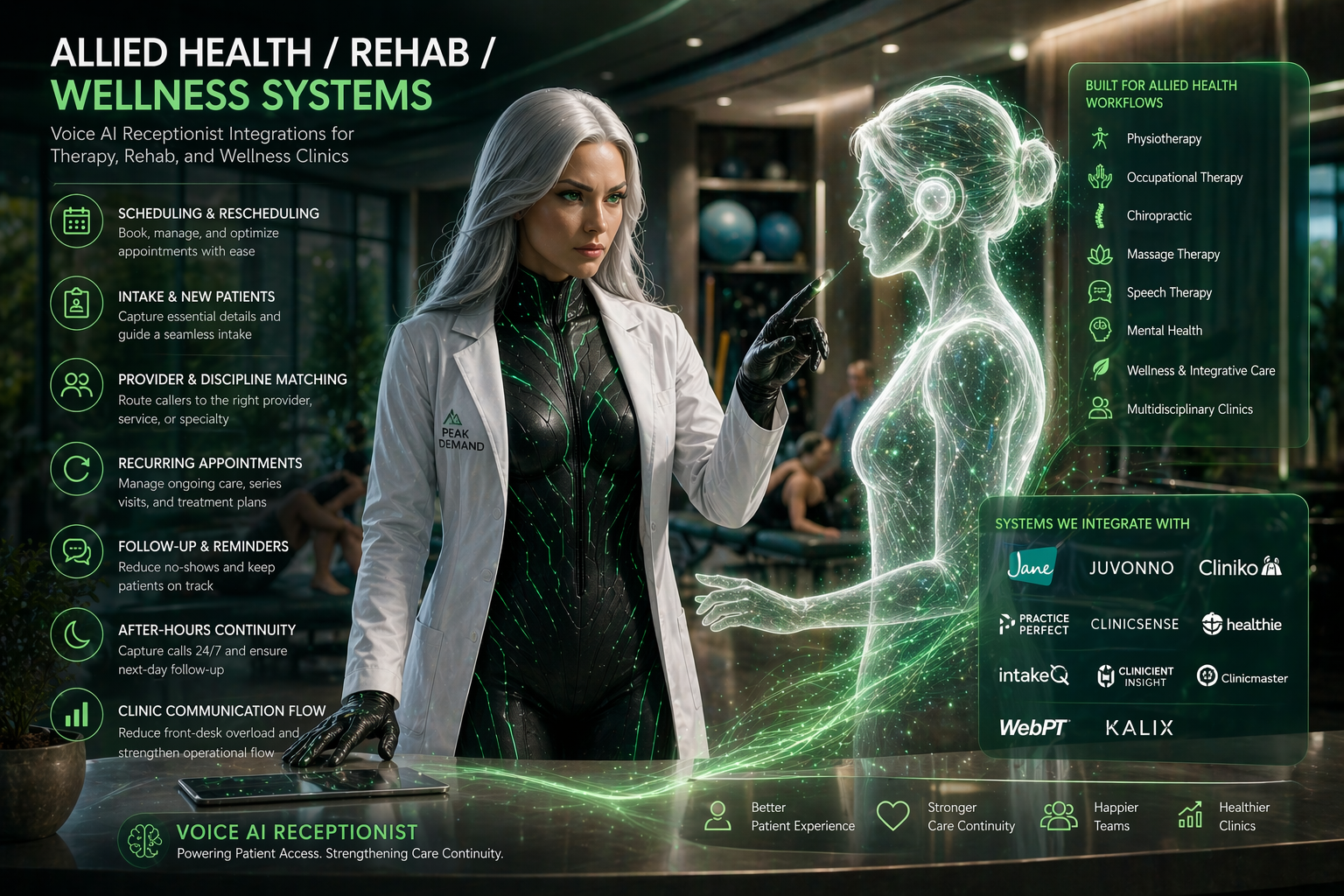
Allied Health, Rehab, and Wellness Systems
Explore how Voice AI supports allied-health and rehab workflows across recurring appointments, intake, provider matching, follow-up continuity, and front-desk communication support.
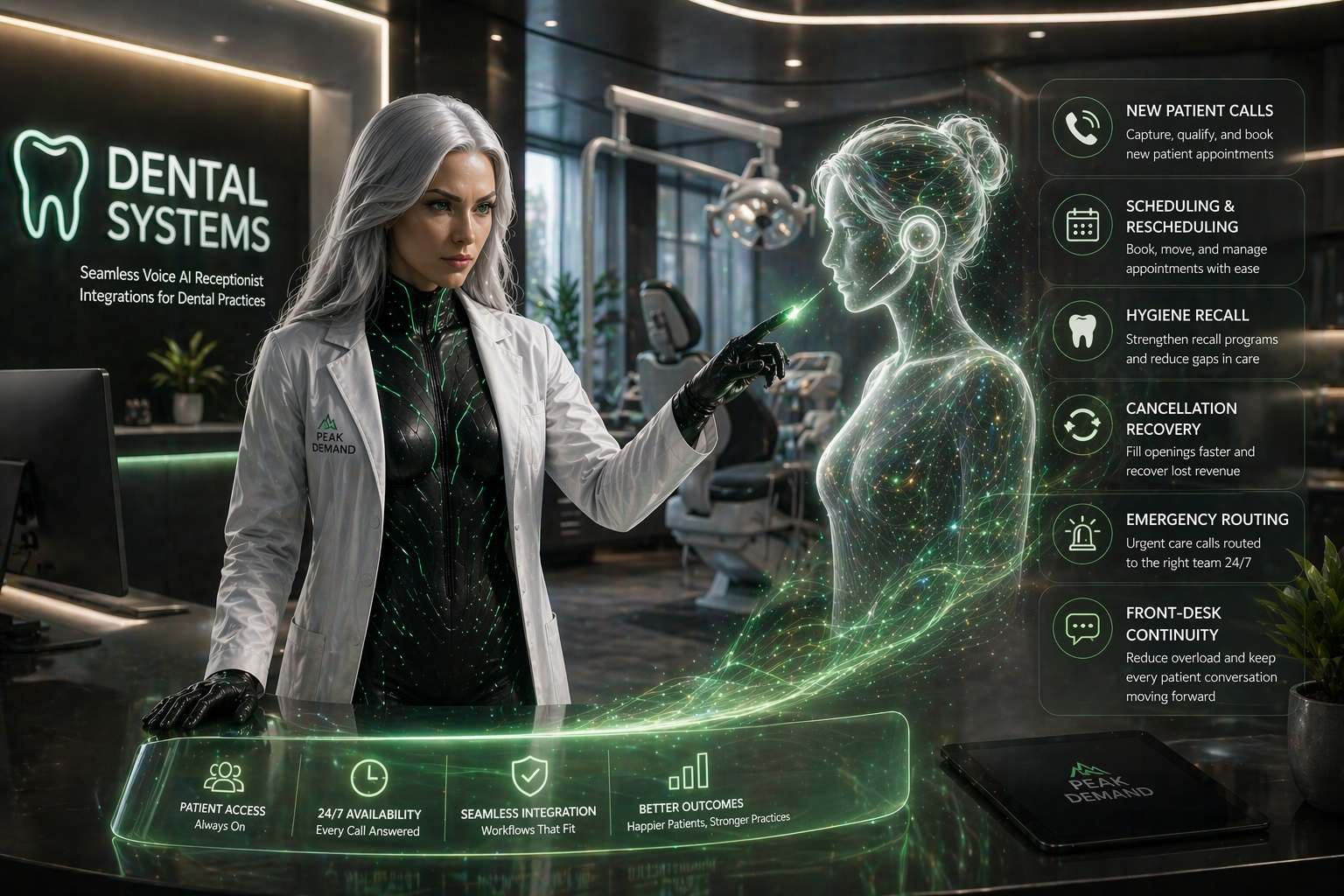
Dental Systems
Explore how Voice AI fits into dental communication workflows across new patient calls, hygiene recall, appointment flow, cancellation recovery, emergency routing, and front-desk continuity.
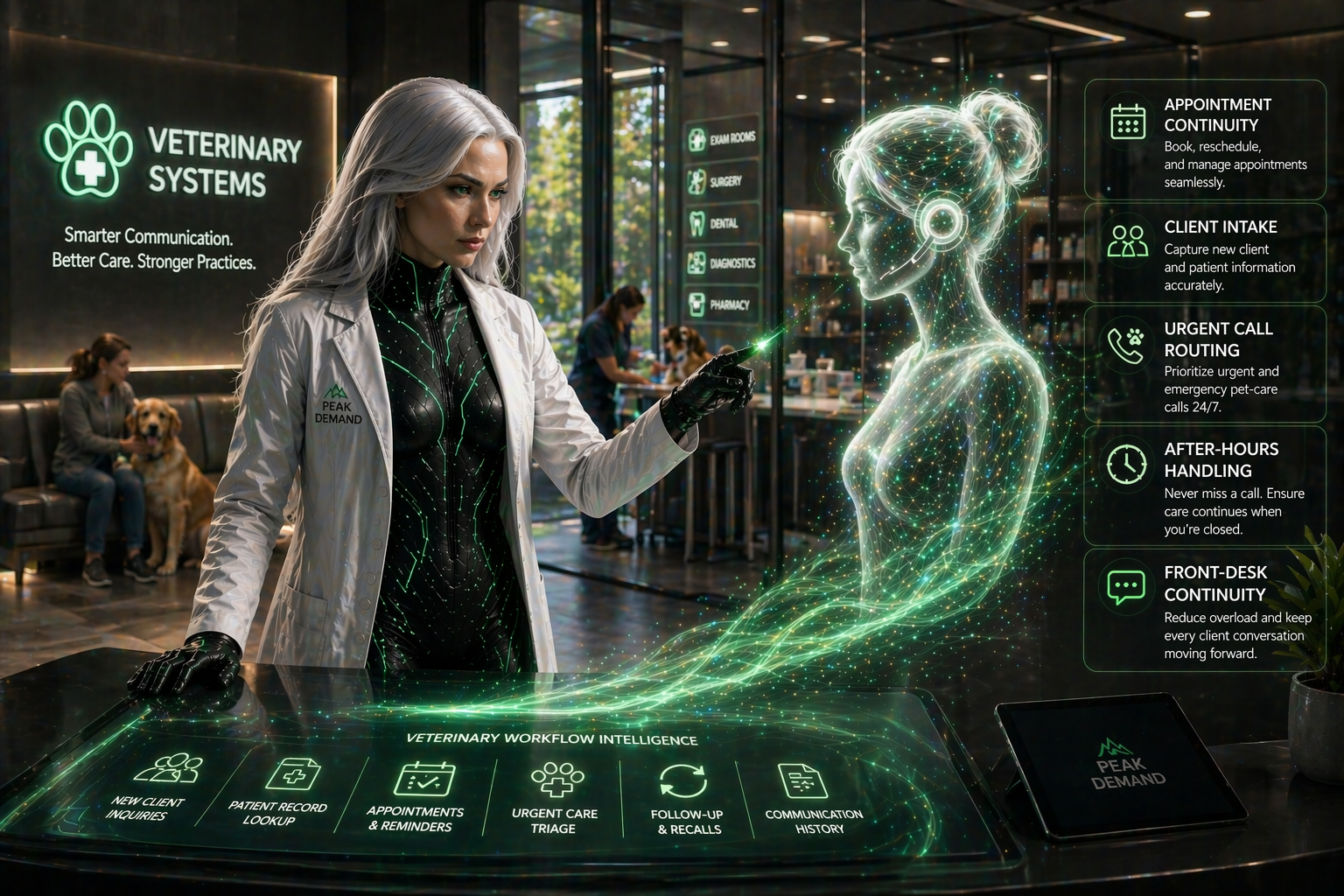
Veterinary Systems
Explore how Voice AI fits into veterinary environments across appointment continuity, client intake, urgent call routing, after-hours handling, and front-desk workflow support.
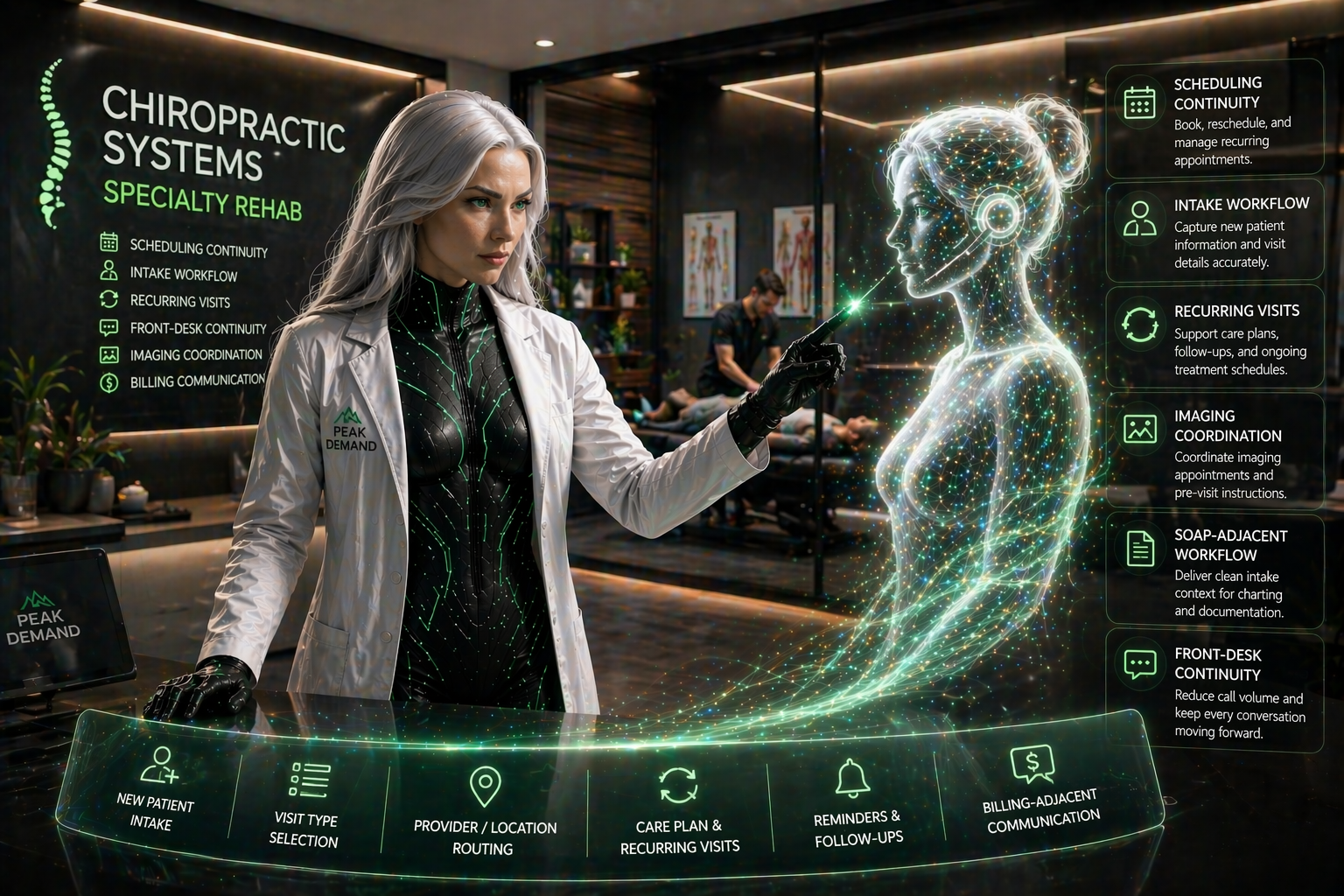
Chiropractic and Specialty Rehab Systems
Explore how Voice AI fits into chiropractic and specialty rehab workflows across scheduling, intake, recurring visits, SOAP-adjacent continuity, imaging-adjacent coordination, and front-desk support.
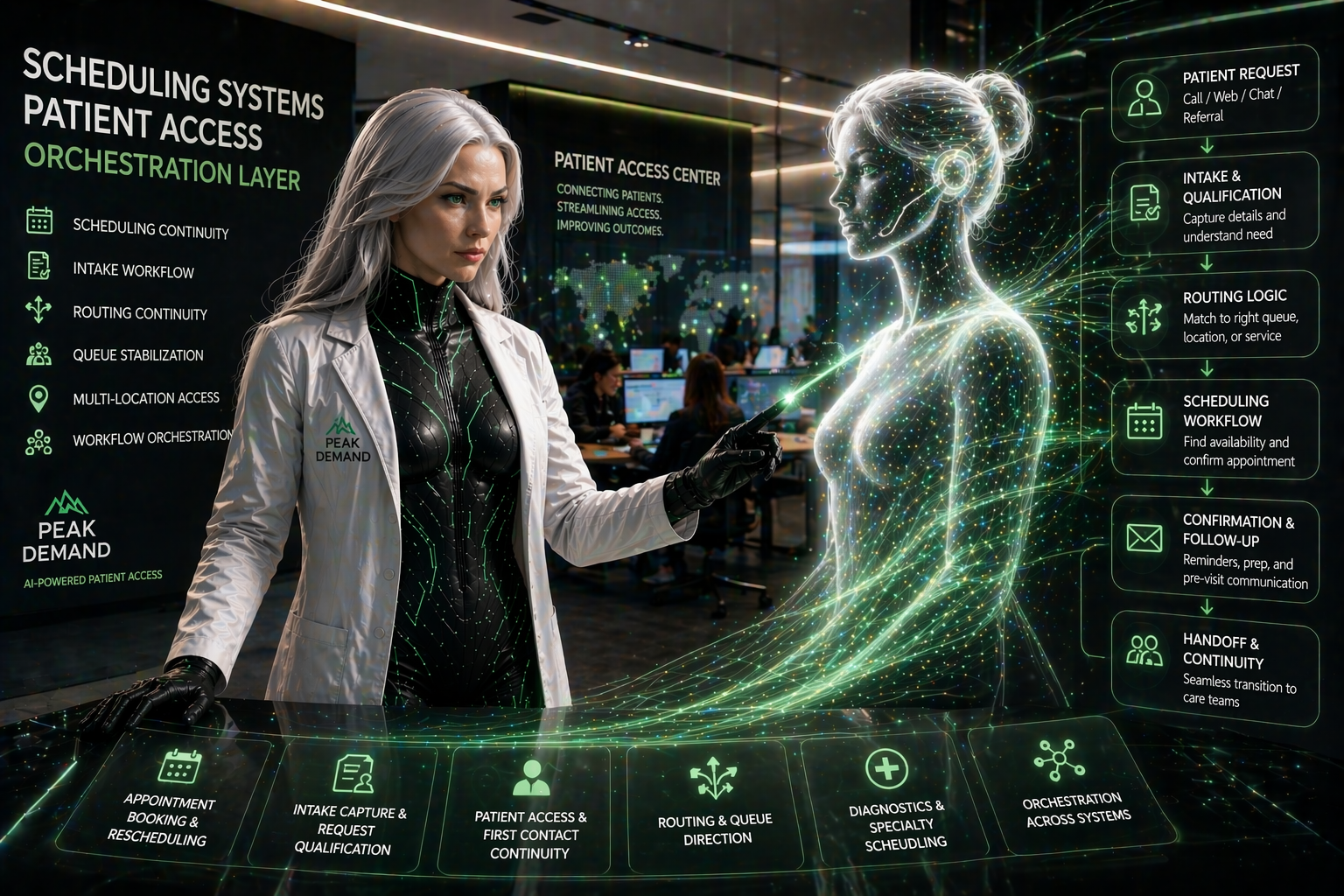
Scheduling, Patient Access, and Orchestration Systems
Explore how Voice AI supports scheduling and patient access architecture across intake, routing, queue stabilization, diagnostics scheduling, and workflow continuity between first contact and next action.
See Healthcare Voice AI Integrations In Action
These walkthroughs show how Voice AI can connect into real healthcare scheduling, intake, and communication environments. Start with TELUS Health CHR for Canadian clinic workflows and Juvonno for rehab and allied health operations.
TELUS Health CHR Integration Walkthrough
See how Voice AI can support TELUS Health CHR scheduling, intake, patient communication, and Canadian clinic workflow continuity.
Juvonno Integration Walkthrough
See how Voice AI can support Juvonno workflows for rehab scheduling, intake, appointment handling, and clinic communication continuity.
Explore published healthcare systems by name
Once you know the software family that best matches your environment, this section makes it easier to browse live healthcare integration pages by platform name. Each category below groups published system pages by the type of environment they usually support so operators, managers, and technical teams can compare workflow fit more quickly. A fuller alphabetical directory appears farther down the page.
Featured healthcare systems
These are high-priority starting points for visitors evaluating real-world Voice AI workflow fit across scheduling, intake, patient communication, routing, and access workflows.
Clinic, ambulatory, and medical EMR systems
These systems are commonly associated with clinic records-adjacent workflows, appointment flow, patient requests, intake continuity, routing, and broader ambulatory communication operations.
Scheduling, intake, and patient communication systems
These environments sit closer to booking logic, intake flow, reminders, clinic administration, and day-to-day patient access operations.
Rehab, physiotherapy, and allied health systems
Allied health and rehabilitation environments often depend on strong scheduling continuity, practitioner matching, intake flow, recurring appointment management, and multi-location operational coordination.
Dental systems
Dental communication workflows often center around appointment demand, cancellation recovery, reminders, new patient calls, and front-desk continuity across booked production.
Veterinary systems
Veterinary communication environments often require appointment continuity, client communication, after-hours handling, urgent call direction, and records-adjacent workflow coordination.
Healthcare organizations rarely evaluate integrations in a vacuum. Grouping systems by software family makes it easier to understand likely workflow fit, compare environments more quickly, and navigate toward both family-level integration pages and live system-specific pages deeper in this hub. The full alphabetical system directory farther down the page should carry the complete 98-system library.
Where Voice AI sits in the healthcare workflow matters more than basic connectivity
Healthcare Voice AI becomes more useful when it is treated as part of the larger workflow architecture around patient access, intake, routing, scheduling, escalation, and downstream ownership. The question is not only whether a system connects. The question is whether the communication flow reaches the next operational step with enough clarity and structure to reduce friction instead of shifting it downstream.
In practice, that means Voice AI often sits across multiple workflow layers at once. It may support first contact, gather structured intake, help direct the caller into the right path, preserve context for staff, and improve continuity into the next step. The value comes from how those layers fit together, not from one isolated connection point.
This is why healthcare teams should evaluate both the scheduling and patient access layer and the EMR or EHR-adjacent layer. In more complex environments, the architecture may also need to account for enterprise compliance and procurement requirements.
Where Voice AI usually enters the workflow
Voice AI often enters at the communication edge: inbound calls, appointment demand, intake capture, after-hours answering, overflow handling, and patient access or routing-related first contact.
Explore healthcare AI receptionistsWhere continuity usually breaks down
Continuity often breaks between the interaction and the next operational owner. That can happen when routing is weak, intake is unclear, scheduling context is incomplete, or downstream teams still need to manually rebuild the request.
Explore centralized scheduling workflowsWhat stronger integration architecture actually improves
Stronger architecture preserves enough structure, direction, and next-step usability for staff or systems to act efficiently. That is what turns Voice AI into operational infrastructure instead of a disconnected front-end layer.
Return to the healthcare resource hub| Integration maturity | What healthcare teams usually experience | Likely operational result |
|---|---|---|
| Fragmented | Some connection points exist, but scheduling, intake, routing, escalation, and continuity still require heavy manual repair. | Lower operational value, more staff burden, weaker patient access continuity, and less confidence in the workflow. |
| Partially connected | Important workflow layers connect, but structure and downstream usability still vary too much between teams, departments, or next-step owners. | Moderate gains, but persistent continuity gaps remain and staff still absorb unnecessary workflow friction. |
| Workflow-led and integrated | Voice AI supports multiple workflow layers with stronger structure, clearer routing, better handoff, and more usable next-step continuity. | Stronger patient access flow, cleaner operational ownership, and more scalable communication infrastructure. |
What healthcare teams should evaluate in the architecture discussion
- Where does Voice AI need to sit first in the communication workflow?
- Where does continuity currently break between the interaction and the next operational step?
- Which layers are EMR or EHR-adjacent, and which ones are workflow-adjacent?
- How do scheduling, intake, routing, patient access, and escalation interact in this environment?
- Will downstream teams receive enough structure to act without rebuilding the request manually?
- Is the integration design workflow-led or just feature-led?
- Does the current architecture reduce friction for staff, or does it simply move the work somewhere else?
Healthcare organizations usually get more value when they evaluate integration maturity across communication flow, operational ownership, and downstream usability together instead of treating each connection as a separate isolated decision. For system-specific evaluation, use the alphabetical healthcare system directory below.
Evaluating software families?
Use the six system-family pages to compare EMR, EHR, dental, veterinary, rehab, scheduling, and patient access environments.
Browse Software FamiliesEvaluating specific systems?
Use the full alphabetical directory to find the exact healthcare platform your team is evaluating.
Open System DirectoryEvaluating enterprise readiness?
Review governance, privacy, escalation, procurement, and compliance considerations before deployment.
Review ComplianceGo deeper into the strategy behind healthcare Voice AI integrations
This section helps healthcare teams move from broad category understanding into the right supporting resources for architecture, interoperability, workflow fit, implementation planning, and system-specific evaluation.
The articles below are the best next clicks for teams evaluating how Voice AI fits into healthcare communication systems, patient access workflows, structured integration pathways, rollout planning, and governed healthcare environments.
For broader category education, use the Healthcare Voice AI Resource Hub. For software-specific evaluation, continue to the full alphabetical system directory lower on this page and use the six healthcare software family pages as the parent layer.
Need system-family pages?
Use the family pages to compare medical EMR, allied health, dental, veterinary, specialty rehab, and patient access systems.
Browse Software FamiliesNeed a specific platform?
Use the alphabetical system directory to find the exact EMR, EHR, scheduling, dental, veterinary, or rehab platform.
Open System DirectoryNeed compliance context?
Use the enterprise compliance page when governance, privacy, procurement, RFPs, or regulated deployment requirements are part of the evaluation.
Review ComplianceCore integration strategy articles
These resources explain why integrations matter, what healthcare teams should evaluate first, and how stronger Voice AI integration architecture should be understood.
Custom pathways, structured integrations, and workflow fit
These articles are useful for teams evaluating custom pathways, structured communication flows, and how Voice AI fits into real healthcare operating environments.
Rollout, implementation, and governance
These resources are best for healthcare teams moving from early exploration into rollout planning, operational safety, implementation readiness, and governance-aware deployment.
Patient access, routing, and workflow bottlenecks
These articles help healthcare teams think more clearly about where communication complexity builds up across patient access, intake, department routing, scheduling, and downstream handoff.
As the healthcare integrations ecosystem continues to grow, this section can keep routing visitors into the most relevant strategy, rollout, and workflow resources without changing the overall structure of the hub. The full software directory appears in the Alphabetical System Directory section below.
Explore live healthcare system integration pages by category
This section gives healthcare teams a category-based way to browse the most important live system pages. It is not the full 98-system directory; it is a curated navigation layer for comparing the platforms most commonly tied to scheduling, intake, patient communication, routing, and patient access workflows.
Use this section when you know the type of software environment you are evaluating. Use the Alphabetical System Directory below when you want to find every live system page by name.
Need the family layer?
Start with the six parent family pages when comparing software categories before choosing a specific system.
Browse Software FamiliesNeed every system?
Use the alphabetical directory for the complete live healthcare system page list by platform name.
Open Alphabetical DirectoryNeed workflow context?
Review how Voice AI fits across patient access, intake, routing, scheduling, escalation, and downstream ownership.
Review Workflow ArchitectureFeatured healthcare systems
These are some of the strongest starting points for teams exploring healthcare Voice AI integrations across scheduling, intake, patient communication, routing, and access workflows.
Clinic and ambulatory EMR systems
These systems are commonly associated with clinic records-adjacent workflows, intake, appointment flow, routing, patient communication, and broader ambulatory continuity.
Explore medical and ambulatory EMR familyScheduling, intake, and patient communication systems
These environments sit closer to booking logic, intake flow, reminders, clinic administration, and day-to-day patient access operations.
Explore scheduling and patient access familyRehab, physiotherapy, and allied health systems
Allied health and rehabilitation environments often depend on strong scheduling continuity, practitioner matching, intake flow, recurring appointments, and multi-location coordination.
Explore allied health and rehab familyDental systems
Dental communication workflows often center on appointment demand, cancellation recovery, reminders, new patient calls, and front-desk continuity.
Explore dental familyVeterinary systems
Veterinary communication environments often require appointment continuity, client communication, after-hours handling, and records-adjacent workflow coordination.
Explore veterinary familyEnterprise, specialty, imaging, and outpatient environments
These environments often involve more complex routing, diagnostic scheduling, imaging coordination, enterprise workflow ownership, and department-specific handoff requirements.
Explore enterprise and medical EMR familyThis curated category browse section helps visitors compare common healthcare software environments without scrolling the entire directory. The complete system list belongs in the Alphabetical System Directory section below, where every live healthcare system page should be listed by platform name.
Talk through your healthcare communication workflow
If your team is evaluating healthcare Voice AI integrations, the most useful next step is usually a workflow conversation. That means reviewing patient access pressure points, scheduling flow, intake structure, routing logic, after-hours coverage, compliance expectations, and the systems surrounding those workflows.
Peak Demand approaches healthcare environments through workflow fit, governance awareness, and operational usability. The goal is to help organizations map a communication architecture that supports real teams, real workflows, and real continuity requirements across EMR, EHR, scheduling, intake, dental, veterinary, rehab, and patient access environments.
Need software families?
Compare the six parent healthcare integration families before choosing a specific system page.
Browse software familiesNeed workflow context?
Review how Voice AI fits across intake, routing, scheduling, escalation, and downstream ownership.
Review workflow architectureNeed compliance review?
Use the enterprise compliance page when governance, privacy, procurement, and RFP standards matter.
Review complianceFrequently asked questions
What does Voice AI mean in a healthcare integration environment?
Can Voice AI work with EMR, EHR, scheduling, intake, and routing workflows?
Are healthcare Voice AI integrations always direct?
Where should healthcare organizations start evaluating Voice AI integrations?
How should compliance and governance fit into the evaluation?
What is the role of this integrations hub?
About Peak Demand
Peak Demand is a Toronto-based AI agency focused on Voice AI, communication automation, and workflow infrastructure for organizations operating in more complex service environments.
In healthcare, the focus is not just on call handling. It is on patient access continuity, scheduling pressure, intake structure, routing logic, after-hours support, governance, and how communication systems fit into real operational workflows.
- Workflow-driven and implementation-aware
- Governance-first in healthcare communication environments
- Built to support clinics, networks, and enterprise teams
- Designed to scale into software-specific integration pathways
- Organized around healthcare system families and live integration pages
Healthcare software integrations by system name
If you already know the software you are evaluating, this alphabetical directory is the fastest way to find the right live system page.
This directory includes the full 98-system healthcare integration library from the current Peak Demand system-page build. It is designed to help teams compare EMR, EHR, scheduling, intake, patient communication, dental, veterinary, rehab, wellness, chiropractic, orchestration, home care, med spa, pharmacy, and enterprise healthcare systems by software name.
For category-level browsing, use the software family section. For workflow context, use the workflow architecture section. This section is the full alphabetical browse layer.
Live healthcare system pages in this directory
Grouped alphabetically with visible section counts so the full library is obvious at a glance.
A–C
34 systemsABELMed through Curve Dental.
D–H
20 systemsDentrix through Helios Software.
I–M
15 systemsIDEXX Cornerstone through MRX Solutions.
N–O
11 systemsNextech through Owl Practice.
P–R
8 systemsPabau through RXNT.
Compare healthcare systems by name, category, and workflow fit
This directory is useful for comparing clinic EMRs, EHR-adjacent systems, scheduling and intake platforms, patient communication software, dental systems, veterinary systems, rehab and allied health systems, chiropractic systems, med spa systems, home care systems, pharmacy-adjacent systems, orchestration platforms, diagnostic workflows, and enterprise healthcare environments by software name before going deeper into workflow design, integration possibilities, and operational fit.
Explore your own AI use case on a discovery call.