
Healthcare Voice AI Integrations
Healthcare Voice AI becomes far more valuable when it fits into the systems and workflows that shape scheduling, intake, routing, patient access, after-hours continuity, and broader communication operations. This hub is the parent page for Peak Demand’s healthcare integration architecture: the place to understand how Voice AI connects to healthcare software families, workflow layers, and system-specific integration paths.
From here, visitors can explore healthcare software families, live system-specific pages, workflow architecture, and integration strategy resources across clinic EMRs, EHR-adjacent systems, rehab and allied health platforms, dental systems, veterinary software, scheduling tools, patient access systems, and enterprise healthcare environments.
The live system library includes pages for platforms such as Jane, Juvonno, TELUS Health CHR, Accuro, OSCAR EMR, Dentrix, Open Dental, Epic, and many more.

Architecture Role
Parent hub for healthcare integrations
System Coverage
98 healthcare system pages
Software Families
6 healthcare integration families
Workflow Focus
Scheduling, intake, routing, access
Healthcare integrations should be evaluated through workflow continuity
One of the biggest mistakes in healthcare integration conversations is reducing the discussion to a list of software names. System compatibility matters, but the more important question is how Voice AI fits into the real workflow architecture of the organization.
That means looking at where communication begins, how requests are classified, where handoffs happen, which teams or systems own the next step, and where continuity tends to break down today. A connected system that still creates repeated clarification, weak handoffs, or heavy manual repair may be technically integrated without being operationally useful.
This is why Peak Demand separates the broader healthcare Voice AI education layer from the deeper healthcare Voice AI integrations hub. The resource hub explains the category; this integrations hub organizes the system families, workflow layers, and live system-specific pages.
Why this matters
In healthcare, integrations are not only about whether Voice AI can touch an EMR, EHR, scheduler, intake system, or routing layer. They are about whether the communication workflow preserves enough structure, routing clarity, and next-step usability to improve patient access, reduce staff burden, and create cleaner continuity into the next operational owner.
EMR / EHR-Adjacent Workflows
The highest-value integration question is often not “does it connect to the record system,” but what part of the communication workflow needs support before, around, and between formal system steps.
- Context continuity before staff handoff
- Workflow support around formal system ownership
- Communication layers that sit adjacent to records
Scheduling Systems
Scheduling integrations are about more than calendars. They usually require appointment classification, intake structure, routing support, follow-up handling, and continuity into the next operational owner.
- Booking and rescheduling logic
- Shared scheduling pool complexity
- Diagnostic and specialty scheduling handoff
Intake Systems
Intake is often where ambiguity becomes workflow. Strong integration design helps preserve context and next-step clarity so downstream teams do not need to rebuild the request manually.
- Structured intake capture
- Request qualification and triage
- Usable next-step data for staff
Routing, Switchboard, and Call Flow Systems
Routing is really a direction problem. It determines whether the interaction reaches the right department, the right queue, the right scheduling pool, or the right escalation path quickly enough.
- Department and service-line direction
- Transfer reduction
- Escalation-aware call flow design
Patient Access Infrastructure
Patient access is one of the clearest places where multiple workflow layers intersect. Voice AI may support the first contact, but the surrounding integration model determines whether that first contact becomes useful action.
- Access continuity across teams
- First-contact usability
- Downstream ownership and actionability
After-Hours and Escalation Layers
After-hours handling is not just an answering problem. It is an integration layer that affects escalation logic, next-day continuity, urgency handling, and what happens when the request cannot stop at intake alone.
- Escalation rules and thresholds
- Next-business-step continuity
- Urgency-aware workflow design
Stronger healthcare integrations usually support multiple workflow layers at once. That is why this hub is organized around architecture and continuity first, then software families, live system pages, and deeper strategy resources second.
Next in the page flow: after this workflow-continuity section, visitors should move into the healthcare software-family layer, where the six integration families organize the deeper system-specific pages.
Browse Healthcare Software Families
Top 10 Questions Your Insurance AI Chatbot Can Ask to Qualify Customers
Revolutionizing Customer Qualification: How AI Chatbots Are Transforming Insurance Sales

In the ever-evolving landscape of the insurance industry, the ability to qualify customers accurately and efficiently stands paramount. It's a delicate balance between understanding the customer's needs and aligning them with the right insurance products. Enter AI chatbots – the game-changers in modern customer service. These sophisticated tools are not just transforming how we interact with customers but are also redefining the qualification process in insurance.
AI chatbots, with their ability to handle complex queries and analyze customer responses, have become an invaluable asset for insurance agents. They bring a level of personalization and efficiency that traditional methods struggle to match. But how can these chatbots be utilized most effectively? The key lies in the questions they ask. Tailored, insightful questions can pave the way for a deeper understanding of the customer, ensuring that agents can offer the most suitable insurance solutions.
As we delve into this subject, we'll explore the top questions that your insurance AI-chatbot should be asking to qualify customers thoroughly. These questions are designed not only to gather essential information but also to build a rapport with customers, laying the foundation for a long-lasting relationship.
Identifying Customer Needs

Understanding the specific needs of customers is the first critical step in the qualification process. A chatbot equipped with the right questions can efficiently extract this information, paving the way for personalized insurance solutions.
1. Personal Information Gathering
Question: "Could you please share some basic details about yourself and your insurance needs?"
This opening question serves as a warm introduction, inviting customers to share information about themselves in a conversational manner. It's broad yet essential, providing a snapshot of the customer's current situation and their expectations regarding insurance. By asking this, the chatbot starts building a profile that will be crucial in tailoring subsequent advice and recommendations.
Rationale: Establishing a baseline of information is crucial for personalizing the service. This question sets the stage for a customized insurance experience, ensuring that the solutions offered are aligned with the customer's life stage, needs, and preferences.
2. Understanding Financial Background
Question: "Can you tell us about your financial situation and goals?"
A deeper dive into the customer's financial background gives invaluable context to their insurance needs. This question is designed to understand the financial capacity, constraints, and aspirations of the customer, which are key to recommending the right insurance products.
Rationale: Tailoring insurance solutions to a customer's financial capacity and goals is essential. This information helps in aligning the insurance plan with the customer's ability to afford premiums and their long-term financial planning. It ensures that the insurance advice is not just suitable but also sustainable for the customer.
Assessing Risk Profiles

A crucial aspect of customer qualification in insurance is assessing risk profiles. AI chatbots can play a pivotal role in gathering key risk-related information through targeted questions. This section delves into how chatbots can effectively evaluate risk factors associated with health and lifestyle, as well as familial medical history.
3. Health and Lifestyle Inquiries
Question: "How would you describe your health and lifestyle habits?"
This question is designed to uncover vital information about the customer’s health and daily habits, which are significant indicators of risk in many insurance policies. The chatbot can probe into areas such as exercise routines, dietary habits, and any known health conditions.
Rationale: Understanding a customer’s health and lifestyle is essential in assessing their risk profile. This information helps in determining the appropriate level of coverage and premium. It ensures that the insurance plan is both comprehensive and fair, based on the individual's specific health and lifestyle factors.
4. Family Medical History
Question: "Is there any significant family medical history we should be aware of?"
Family medical history can provide crucial insights into potential health risks that a customer may face. This question allows the chatbot to gather information about hereditary conditions that might impact the customer’s insurance needs and the type of coverage they require.
Rationale: Assessing hereditary risks is a critical part of the insurance qualification process. This knowledge enables insurance agents to offer plans that account for potential future health scenarios. It's about ensuring that the customer is adequately covered, especially for risks that may not be immediately apparent.
Understanding Coverage Preferences

Once the AI chatbot has established the customer's needs and assessed their risk profile, the next crucial step is to understand their coverage preferences. This section focuses on questions that help in identifying the specific types of insurance coverage the customer is looking for, and their expectations from these policies.
5. Current Insurance Status
Question: "What is your current insurance coverage, if any?"
This question aims to gather information about any existing insurance policies the customer might have. It helps in understanding what kind of coverage they are already benefiting from and identifies potential gaps or overlaps in their current insurance plan.
Rationale: Knowing the customer’s current insurance coverage is vital for providing complementary solutions. It helps in avoiding redundant coverage and ensures that the recommendations fill in any gaps in their existing insurance portfolio. This approach is not only cost-effective for the customer but also builds trust, as it shows that the chatbot is looking out for their best interests.
6. Expectations from New Insurance
Question: "What are your key expectations from your new insurance plan?"
This question is designed to directly address the customer's specific expectations and preferences for their new insurance plan. It could range from the scope of coverage to the level of premium and any additional benefits they are seeking.
Rationale: Aligning the insurance plan with customer expectations is crucial for customer satisfaction. Understanding what the customer values most in an insurance policy allows the chatbot to provide tailored recommendations that closely match the customer's desires and needs. It's about creating a personalized insurance experience that resonates with the customer’s unique preferences.
Deepening Customer Understanding

Having established the basic needs and preferences of the customer, it’s important to deepen the understanding to ensure that the insurance solutions offered are precisely aligned with the customer's unique situation and future aspirations. This section explores how AI chatbots can delve deeper into the customer's personal and financial landscape.
7. Future Goals and Plans
Question: "What are your long-term goals and how do you expect insurance to play a role in these?"
This question is intended to uncover the customer’s long-term aspirations, whether it’s regarding their family, career, health, or retirement plans. Understanding these goals allows the chatbot to consider how different insurance products can support these future objectives.
Rationale: Linking insurance plans with a customer’s future goals ensures that the recommendations are not just suitable for the present but are also relevant in the long run. It helps in creating a roadmap for the customer’s insurance journey, ensuring that their coverage evolves in tandem with their life changes.
8. Prior Experiences with Insurance
Question: "Can you share any past experiences with insurance that you particularly liked or disliked?"
This question seeks to draw on the customer's past experiences with insurance policies and providers. It’s an opportunity for the chatbot to learn what has worked well or poorly for the customer in the past, which can be invaluable for tailoring future recommendations.
Rationale: Learning from a customer’s past experiences with insurance can significantly enhance the quality of service offered. It enables the chatbot to avoid past mistakes and replicate positive experiences, ensuring a more satisfactory and trust-building interaction with the customer.
Final Qualification and Recommendations

In this crucial phase, the AI chatbot consolidates the information gathered to finalize the qualification process and prepare tailored insurance recommendations. This section covers the final aspects of qualification, focusing on budget considerations and decision-making dynamics.
9. Budget Considerations
Question: "What budget range are you considering for your insurance plan?"
Understanding the customer's budget is fundamental in offering feasible insurance solutions. This question helps the chatbot gauge the financial comfort zone of the customer, ensuring that the recommended plans are financially viable and within their expected expenditure range.
Rationale: Matching insurance solutions with the customer's budget is key to providing practical and accessible options. This approach respects the customer’s financial constraints and preferences, facilitating a more targeted and realistic set of recommendations.
10. Decision-making Process
Question: "Who will be involved in the decision-making process for selecting an insurance plan?"
This question aims to understand the dynamics of the decision-making process. It reveals whether the decision will be made individually, with a partner, or within a family or business context. This insight is crucial in tailoring the communication and recommendations to suit all stakeholders involved.
Rationale: Recognizing the decision-making dynamics allows for a more comprehensive and inclusive approach. It ensures that the chatbot’s recommendations consider the perspectives and needs of all decision-makers, increasing the likelihood of customer satisfaction and policy adoption.
Customization for Specific Insurance Offerings
The versatility of AI chatbots extends beyond standardized questioning; they can be finely tuned to address the specific offerings of different insurance agents. This section emphasizes the adaptability of chatbots in customizing their line of questioning to suit diverse insurance products and individual agent specialties.
Adaptability of Chatbot Questions
Highlighting the flexibility of AI chatbots, this subsection emphasizes how the questioning approach can be tailored to various insurance types such as life, health, vehicle, property insurance, etc. This adaptability ensures that the questions are highly relevant to the specific insurance products that an agent specializes in.
Example: Customizing questions for life insurance may involve inquiring about long-term financial security and family obligations, whereas for vehicle insurance, questions might focus more on driving habits and vehicle usage.
Rationale: The ability to customize questions according to different insurance types allows for a highly targeted qualification process. This bespoke approach enhances the relevance and effectiveness of the chatbot, ensuring that the information gathered is directly applicable to the specific insurance products offered.
Collaborative Input for Question Customization
This subsection suggests involving insurance agents in the process of customizing the chatbot’s questions. By incorporating their expertise and understanding of their clientele, the chatbot can be fine-tuned to ask more pertinent and impactful questions.
Benefit: When insurance agents provide input into the chatbot’s questioning framework, it ensures that the chatbot is well-aligned with their specific area of expertise and the unique needs of their client base. This collaborative approach enhances the effectiveness of the chatbot in qualifying customers and recommending the most suitable insurance solutions.
Enhancing Sales and Pipeline Activity through Email and SMS Integration
The integration of AI chatbots with email and SMS communication channels offers a powerful tool for insurance agents to accelerate their sales process and reactivate their customer database. This section delves into why and how utilizing these channels in combination with chatbot technology can significantly improve sales efficiency and pipeline activity.
Email and SMS as Effective Communication Channels
Email and SMS are ubiquitous and highly effective communication channels. Most customers regularly check their emails and SMS messages, making these channels ideal for reaching out with personalized, chatbot-driven questions. By leveraging these channels, insurance agents can ensure that their messages are seen and engaged with promptly.
Rationale: The immediacy and personal nature of email and SMS allow for quicker responses and higher engagement rates. This immediacy is crucial in today's fast-paced environment, where customers expect quick and convenient interactions.
Speeding Up the Sales Process
Using AI chatbots through email and SMS to ask qualifying questions can significantly expedite the sales process. By automating the initial stages of customer interaction, insurance agents can quickly gather key information, identify qualified leads, and focus their efforts on the most promising prospects.
Advantage: This automation allows agents to handle a larger volume of potential customers more efficiently. It reduces the time spent on manual lead qualification, allowing agents to concentrate on closing sales and providing personalized advice.
Boosting Pipeline Activity with Database Reactivation
AI chatbots can be particularly effective for reactivating dormant leads in an insurance agent’s database. By reaching out through email or SMS with tailored questions, agents can re-engage past clients or unresponsive leads, bringing them back into the sales pipeline.
Benefit: This approach not only revitalizes stale leads but also maximizes the value of the existing customer database. It ensures that no potential opportunity is overlooked and can lead to uncovering hidden prospects who may now be ready to purchase insurance products.
Conclusion: A Game-Changer for Insurance Agents
Incorporating AI chatbots with email and SMS strategies is a game-changer for insurance agents. It not only streamlines the sales process but also enhances the efficiency and effectiveness of customer interactions. This innovative approach enables insurance agents to qualify leads more rapidly, manage their client base more effectively, and ultimately, drive more sales. By embracing this technology, insurance agents are well-positioned to stay ahead in a competitive market and meet the evolving needs of their clients in a digital age.

FAQs about Insurance Leads QUalification Using AI-Chatbots
Q: What are AI chatbots and how do they assist in lead qualification?
A: AI chatbots are intelligent software programs capable of simulating human-like conversations. In lead qualification, they assist by engaging potential customers, asking targeted questions, and analyzing responses to determine the suitability and interest level of leads for insurance products.
Q: How accurate are AI chatbots in qualifying leads?
A: AI chatbots are highly accurate in lead qualification when properly programmed and trained. They use advanced algorithms to interpret responses and can consistently apply predefined criteria to qualify leads, reducing human error and bias.
Q: Can AI chatbots handle complex customer queries during qualification?
A: Yes, advanced AI chatbots are equipped to handle complex queries. They use natural language processing (NLP) to understand and respond to a wide range of questions, making them effective in detailed customer interactions.
Q: Are there any specific types of insurance leads that AI chatbots are particularly good at qualifying?
A: AI chatbots are versatile and can be effective in qualifying various types of insurance leads, including life, health, and property insurance. Their effectiveness depends on the quality of the programming and the specific questions they are trained to ask.
Q: How do AI chatbots improve the efficiency of the lead qualification process?
A: AI chatbots improve efficiency by automating the initial stages of lead qualification. They can engage multiple leads simultaneously, provide instant responses, and quickly filter out unqualified leads, allowing insurance agents to focus on high-potential prospects.
Q: Can AI chatbots personalize the qualification process for individual leads?
A: Absolutely. AI chatbots can tailor their questions and responses based on the information provided by each lead. This personalized approach ensures that the qualification process is relevant and effective for different customer needs and preferences.
Q: How do AI chatbots ensure privacy and security of information during lead qualification?
A: AI chatbots are designed with privacy and security measures, such as data encryption and compliance with data protection regulations. They handle sensitive customer information securely, maintaining confidentiality throughout the qualification process.
Q: Can insurance agents customize the questions asked by AI chatbots?
A: Yes, insurance agents can customize the questions AI chatbots ask to align with specific insurance offerings and target markets. This customization allows for more accurate and relevant lead qualification.
Q: How do AI chatbots assist in following up with qualified leads?
A: AI chatbots can be programmed to conduct follow-ups with qualified leads. They can send reminders, provide additional information, and even schedule appointments, ensuring continuous engagement with potential customers.
Q: What is the future potential of using AI chatbots in lead qualification for the insurance industry?
A: The future potential is significant. AI chatbots are continually evolving with advancements in AI and machine learning. They are expected to become more intuitive, efficient, and capable of handling increasingly complex qualification processes, further revolutionizing lead management in the insurance industry.

Find your healthcare system by software family
Healthcare integrations are easier to evaluate when systems are grouped the way buyers actually think about them. Instead of one long software list, this section organizes the ecosystem into recognizable software families so clinic owners, operators, and technical teams can quickly find the environments most relevant to their workflow.
Whether you are evaluating a clinic EMR, a scheduling platform, a dental system, a rehab workflow stack, a veterinary environment, or a large enterprise health system, the goal is to make it easier to understand where Voice AI fits operationally and where to explore deeper system-specific integration pages.
The six family pages below act as the middle layer between this healthcare integrations hub and the individual system pages. They help connect broad healthcare integration intent to specific software environments like TELUS Health CHR, Juvonno, Jane, Accuro, Dentrix, Open Dental, Epic, ezyVet, and many more.
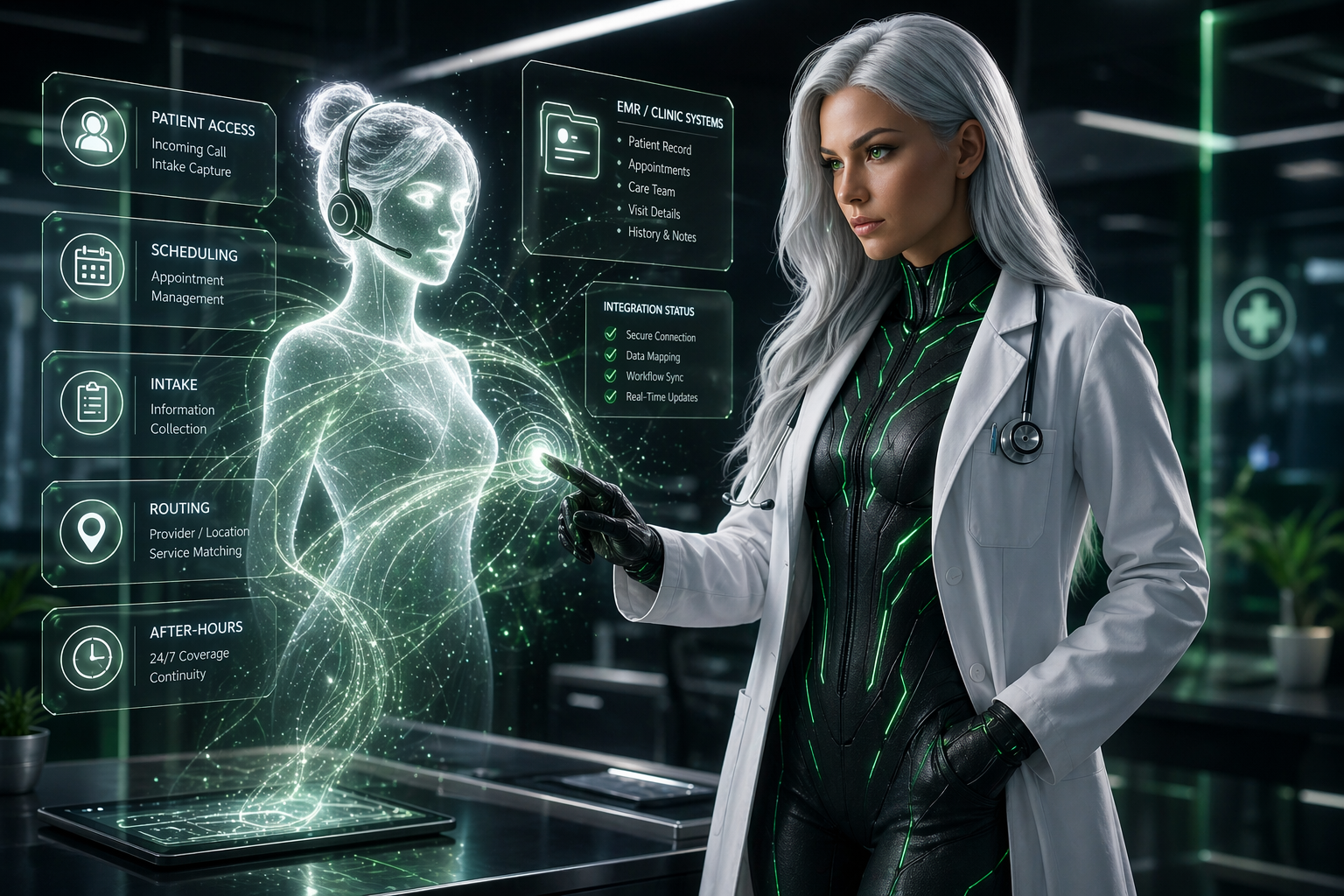
Medical and Ambulatory EMR Systems
Explore how Voice AI fits into medical and ambulatory EMR environments across scheduling, intake, patient access, provider routing, after-hours continuity, and clinic communication workflows.
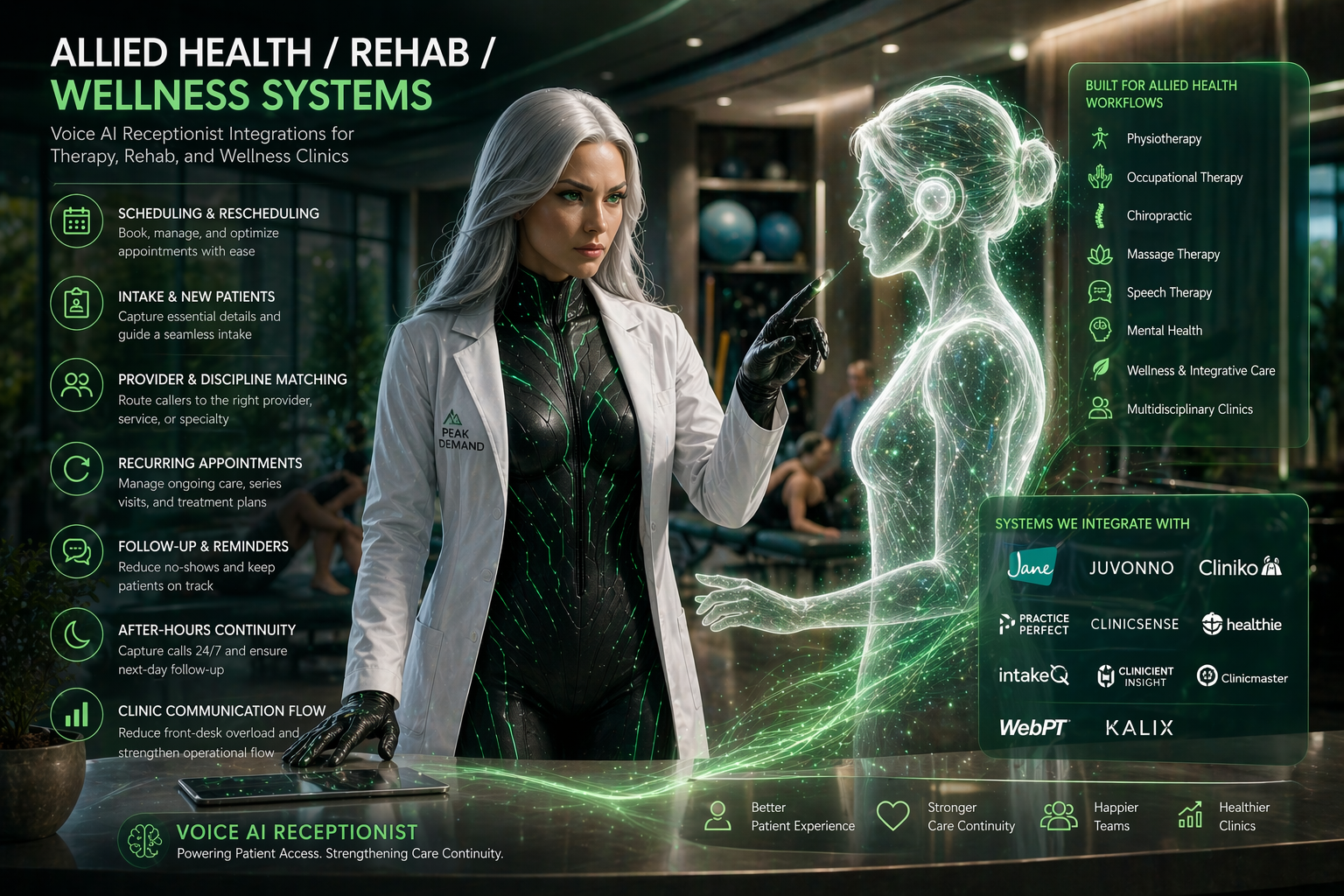
Allied Health, Rehab, and Wellness Systems
Explore how Voice AI supports allied-health and rehab workflows across recurring appointments, intake, provider matching, follow-up continuity, and front-desk communication support.
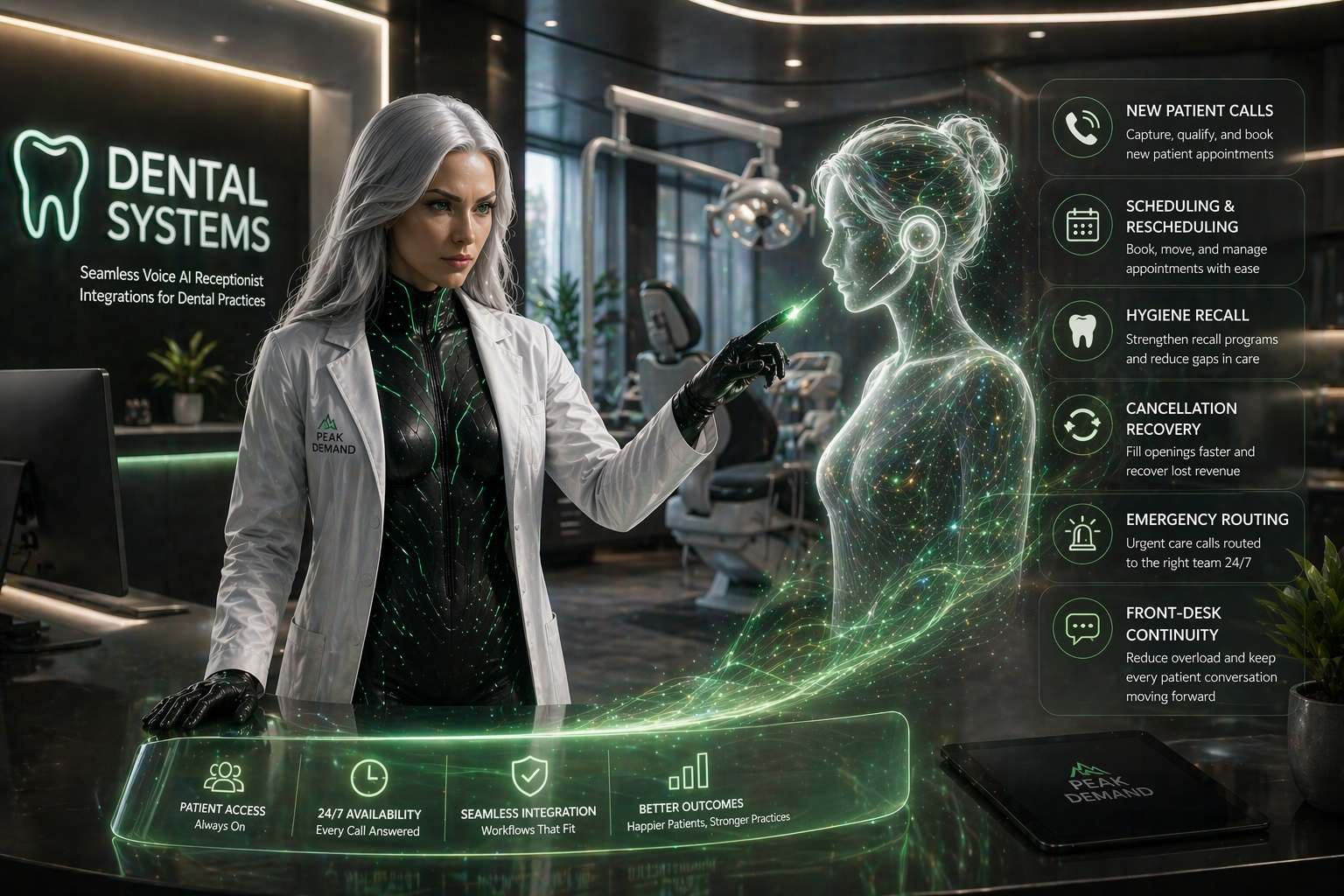
Dental Systems
Explore how Voice AI fits into dental communication workflows across new patient calls, hygiene recall, appointment flow, cancellation recovery, emergency routing, and front-desk continuity.
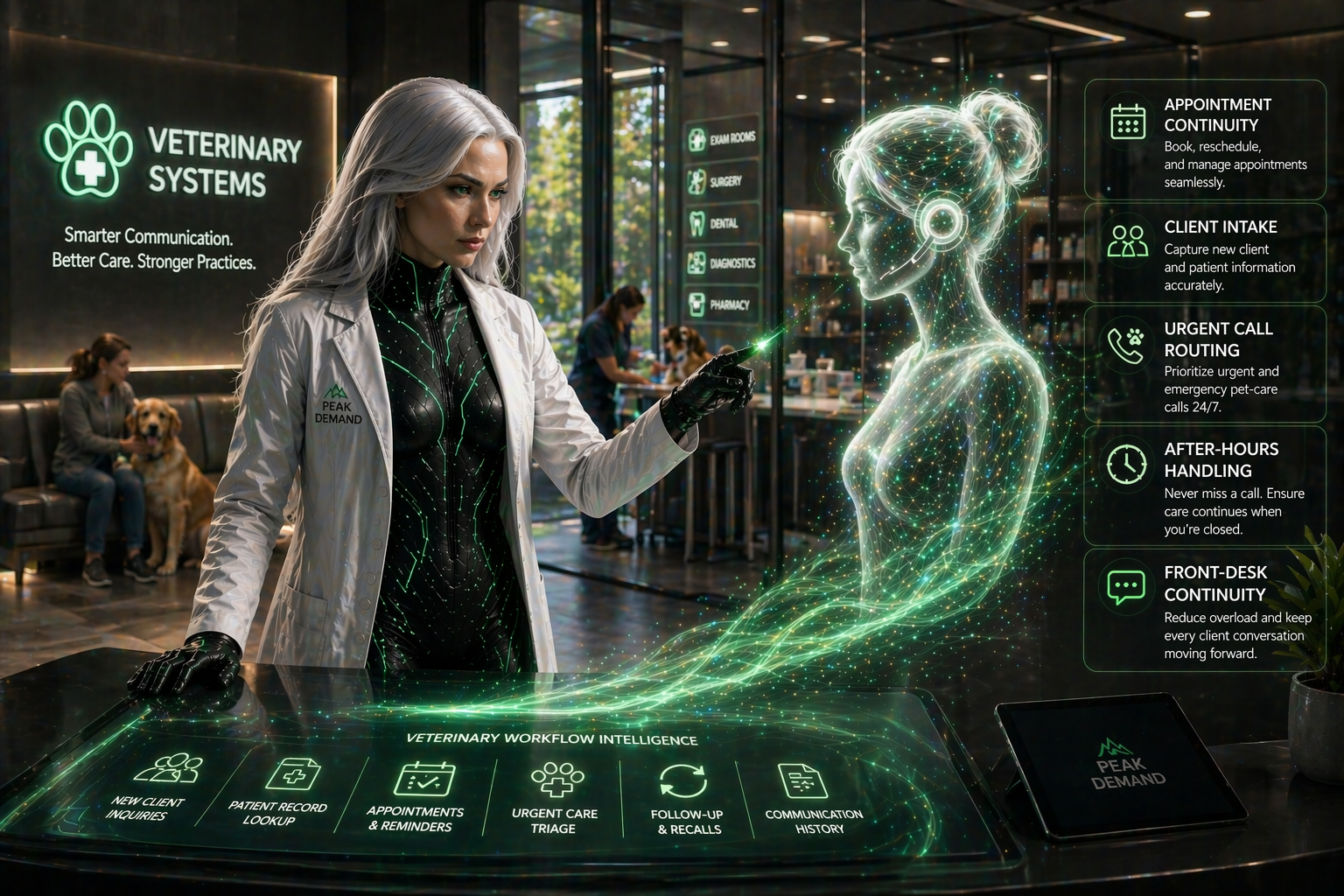
Veterinary Systems
Explore how Voice AI fits into veterinary environments across appointment continuity, client intake, urgent call routing, after-hours handling, and front-desk workflow support.
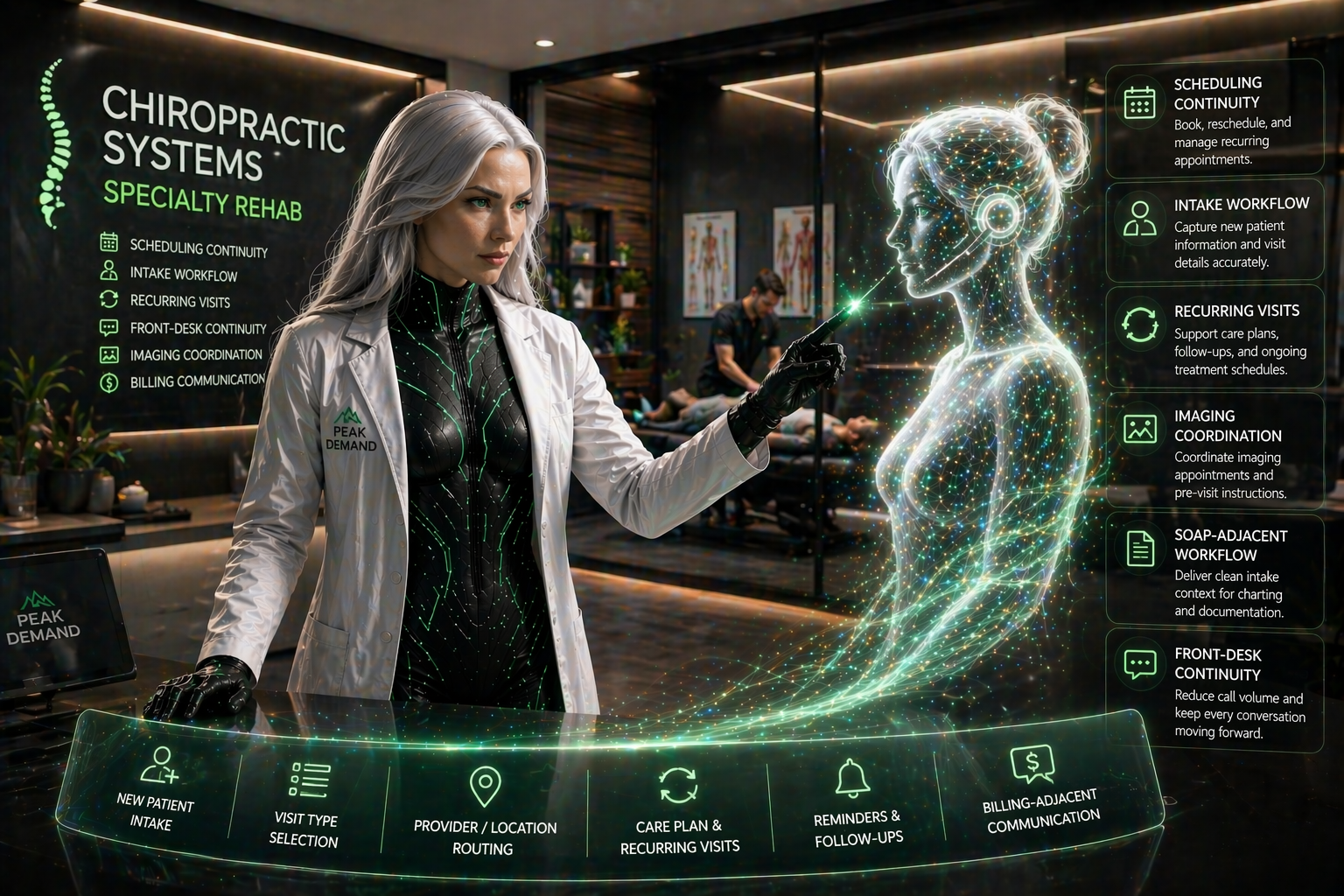
Chiropractic and Specialty Rehab Systems
Explore how Voice AI fits into chiropractic and specialty rehab workflows across scheduling, intake, recurring visits, SOAP-adjacent continuity, imaging-adjacent coordination, and front-desk support.
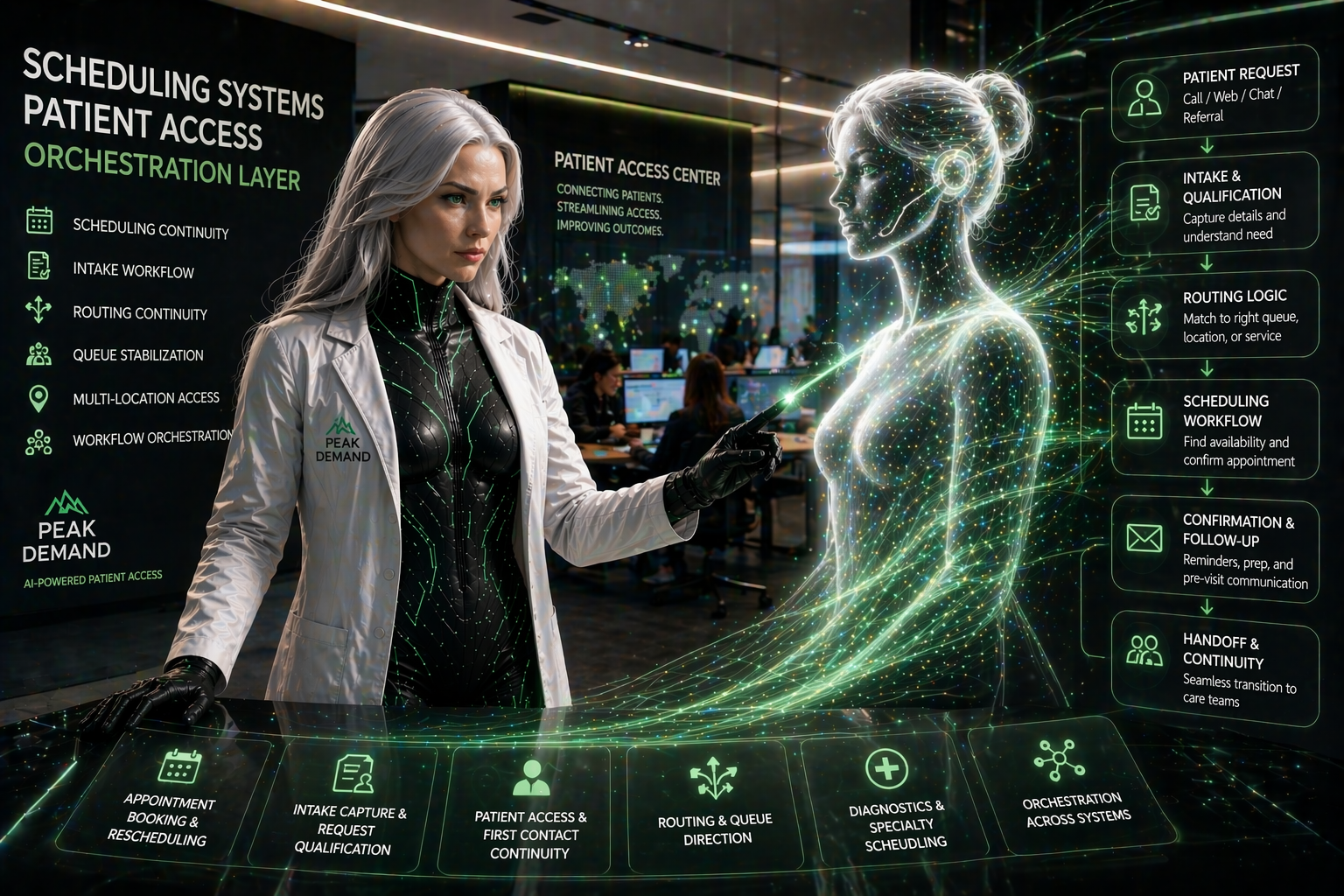
Scheduling, Patient Access, and Orchestration Systems
Explore how Voice AI supports scheduling and patient access architecture across intake, routing, queue stabilization, diagnostics scheduling, and workflow continuity between first contact and next action.
See Healthcare Voice AI Integrations In Action
These walkthroughs show how Voice AI can connect into real healthcare scheduling, intake, and communication environments. Start with TELUS Health CHR for Canadian clinic workflows and Juvonno for rehab and allied health operations.
TELUS Health CHR Integration Walkthrough
See how Voice AI can support TELUS Health CHR scheduling, intake, patient communication, and Canadian clinic workflow continuity.
Juvonno Integration Walkthrough
See how Voice AI can support Juvonno workflows for rehab scheduling, intake, appointment handling, and clinic communication continuity.
Explore published healthcare systems by name
Once you know the software family that best matches your environment, this section makes it easier to browse live healthcare integration pages by platform name. Each category below groups published system pages by the type of environment they usually support so operators, managers, and technical teams can compare workflow fit more quickly. A fuller alphabetical directory appears farther down the page.
Featured healthcare systems
These are high-priority starting points for visitors evaluating real-world Voice AI workflow fit across scheduling, intake, patient communication, routing, and access workflows.
Clinic, ambulatory, and medical EMR systems
These systems are commonly associated with clinic records-adjacent workflows, appointment flow, patient requests, intake continuity, routing, and broader ambulatory communication operations.
Scheduling, intake, and patient communication systems
These environments sit closer to booking logic, intake flow, reminders, clinic administration, and day-to-day patient access operations.
Rehab, physiotherapy, and allied health systems
Allied health and rehabilitation environments often depend on strong scheduling continuity, practitioner matching, intake flow, recurring appointment management, and multi-location operational coordination.
Dental systems
Dental communication workflows often center around appointment demand, cancellation recovery, reminders, new patient calls, and front-desk continuity across booked production.
Veterinary systems
Veterinary communication environments often require appointment continuity, client communication, after-hours handling, urgent call direction, and records-adjacent workflow coordination.
Healthcare organizations rarely evaluate integrations in a vacuum. Grouping systems by software family makes it easier to understand likely workflow fit, compare environments more quickly, and navigate toward both family-level integration pages and live system-specific pages deeper in this hub. The full alphabetical system directory farther down the page should carry the complete 98-system library.
Where Voice AI sits in the healthcare workflow matters more than basic connectivity
Healthcare Voice AI becomes more useful when it is treated as part of the larger workflow architecture around patient access, intake, routing, scheduling, escalation, and downstream ownership. The question is not only whether a system connects. The question is whether the communication flow reaches the next operational step with enough clarity and structure to reduce friction instead of shifting it downstream.
In practice, that means Voice AI often sits across multiple workflow layers at once. It may support first contact, gather structured intake, help direct the caller into the right path, preserve context for staff, and improve continuity into the next step. The value comes from how those layers fit together, not from one isolated connection point.
This is why healthcare teams should evaluate both the scheduling and patient access layer and the EMR or EHR-adjacent layer. In more complex environments, the architecture may also need to account for enterprise compliance and procurement requirements.
Where Voice AI usually enters the workflow
Voice AI often enters at the communication edge: inbound calls, appointment demand, intake capture, after-hours answering, overflow handling, and patient access or routing-related first contact.
Explore healthcare AI receptionistsWhere continuity usually breaks down
Continuity often breaks between the interaction and the next operational owner. That can happen when routing is weak, intake is unclear, scheduling context is incomplete, or downstream teams still need to manually rebuild the request.
Explore centralized scheduling workflowsWhat stronger integration architecture actually improves
Stronger architecture preserves enough structure, direction, and next-step usability for staff or systems to act efficiently. That is what turns Voice AI into operational infrastructure instead of a disconnected front-end layer.
Return to the healthcare resource hub| Integration maturity | What healthcare teams usually experience | Likely operational result |
|---|---|---|
| Fragmented | Some connection points exist, but scheduling, intake, routing, escalation, and continuity still require heavy manual repair. | Lower operational value, more staff burden, weaker patient access continuity, and less confidence in the workflow. |
| Partially connected | Important workflow layers connect, but structure and downstream usability still vary too much between teams, departments, or next-step owners. | Moderate gains, but persistent continuity gaps remain and staff still absorb unnecessary workflow friction. |
| Workflow-led and integrated | Voice AI supports multiple workflow layers with stronger structure, clearer routing, better handoff, and more usable next-step continuity. | Stronger patient access flow, cleaner operational ownership, and more scalable communication infrastructure. |
What healthcare teams should evaluate in the architecture discussion
- Where does Voice AI need to sit first in the communication workflow?
- Where does continuity currently break between the interaction and the next operational step?
- Which layers are EMR or EHR-adjacent, and which ones are workflow-adjacent?
- How do scheduling, intake, routing, patient access, and escalation interact in this environment?
- Will downstream teams receive enough structure to act without rebuilding the request manually?
- Is the integration design workflow-led or just feature-led?
- Does the current architecture reduce friction for staff, or does it simply move the work somewhere else?
Healthcare organizations usually get more value when they evaluate integration maturity across communication flow, operational ownership, and downstream usability together instead of treating each connection as a separate isolated decision. For system-specific evaluation, use the alphabetical healthcare system directory below.
Evaluating software families?
Use the six system-family pages to compare EMR, EHR, dental, veterinary, rehab, scheduling, and patient access environments.
Browse Software FamiliesEvaluating specific systems?
Use the full alphabetical directory to find the exact healthcare platform your team is evaluating.
Open System DirectoryEvaluating enterprise readiness?
Review governance, privacy, escalation, procurement, and compliance considerations before deployment.
Review ComplianceGo deeper into the strategy behind healthcare Voice AI integrations
This section helps healthcare teams move from broad category understanding into the right supporting resources for architecture, interoperability, workflow fit, implementation planning, and system-specific evaluation.
The articles below are the best next clicks for teams evaluating how Voice AI fits into healthcare communication systems, patient access workflows, structured integration pathways, rollout planning, and governed healthcare environments.
For broader category education, use the Healthcare Voice AI Resource Hub. For software-specific evaluation, continue to the full alphabetical system directory lower on this page and use the six healthcare software family pages as the parent layer.
Need system-family pages?
Use the family pages to compare medical EMR, allied health, dental, veterinary, specialty rehab, and patient access systems.
Browse Software FamiliesNeed a specific platform?
Use the alphabetical system directory to find the exact EMR, EHR, scheduling, dental, veterinary, or rehab platform.
Open System DirectoryNeed compliance context?
Use the enterprise compliance page when governance, privacy, procurement, RFPs, or regulated deployment requirements are part of the evaluation.
Review ComplianceCore integration strategy articles
These resources explain why integrations matter, what healthcare teams should evaluate first, and how stronger Voice AI integration architecture should be understood.
Custom pathways, structured integrations, and workflow fit
These articles are useful for teams evaluating custom pathways, structured communication flows, and how Voice AI fits into real healthcare operating environments.
Rollout, implementation, and governance
These resources are best for healthcare teams moving from early exploration into rollout planning, operational safety, implementation readiness, and governance-aware deployment.
Patient access, routing, and workflow bottlenecks
These articles help healthcare teams think more clearly about where communication complexity builds up across patient access, intake, department routing, scheduling, and downstream handoff.
As the healthcare integrations ecosystem continues to grow, this section can keep routing visitors into the most relevant strategy, rollout, and workflow resources without changing the overall structure of the hub. The full software directory appears in the Alphabetical System Directory section below.
Explore live healthcare system integration pages by category
This section gives healthcare teams a category-based way to browse the most important live system pages. It is not the full 98-system directory; it is a curated navigation layer for comparing the platforms most commonly tied to scheduling, intake, patient communication, routing, and patient access workflows.
Use this section when you know the type of software environment you are evaluating. Use the Alphabetical System Directory below when you want to find every live system page by name.
Need the family layer?
Start with the six parent family pages when comparing software categories before choosing a specific system.
Browse Software FamiliesNeed every system?
Use the alphabetical directory for the complete live healthcare system page list by platform name.
Open Alphabetical DirectoryNeed workflow context?
Review how Voice AI fits across patient access, intake, routing, scheduling, escalation, and downstream ownership.
Review Workflow ArchitectureFeatured healthcare systems
These are some of the strongest starting points for teams exploring healthcare Voice AI integrations across scheduling, intake, patient communication, routing, and access workflows.
Clinic and ambulatory EMR systems
These systems are commonly associated with clinic records-adjacent workflows, intake, appointment flow, routing, patient communication, and broader ambulatory continuity.
Explore medical and ambulatory EMR familyScheduling, intake, and patient communication systems
These environments sit closer to booking logic, intake flow, reminders, clinic administration, and day-to-day patient access operations.
Explore scheduling and patient access familyRehab, physiotherapy, and allied health systems
Allied health and rehabilitation environments often depend on strong scheduling continuity, practitioner matching, intake flow, recurring appointments, and multi-location coordination.
Explore allied health and rehab familyDental systems
Dental communication workflows often center on appointment demand, cancellation recovery, reminders, new patient calls, and front-desk continuity.
Explore dental familyVeterinary systems
Veterinary communication environments often require appointment continuity, client communication, after-hours handling, and records-adjacent workflow coordination.
Explore veterinary familyEnterprise, specialty, imaging, and outpatient environments
These environments often involve more complex routing, diagnostic scheduling, imaging coordination, enterprise workflow ownership, and department-specific handoff requirements.
Explore enterprise and medical EMR familyThis curated category browse section helps visitors compare common healthcare software environments without scrolling the entire directory. The complete system list belongs in the Alphabetical System Directory section below, where every live healthcare system page should be listed by platform name.
Talk through your healthcare communication workflow
If your team is evaluating healthcare Voice AI integrations, the most useful next step is usually a workflow conversation. That means reviewing patient access pressure points, scheduling flow, intake structure, routing logic, after-hours coverage, compliance expectations, and the systems surrounding those workflows.
Peak Demand approaches healthcare environments through workflow fit, governance awareness, and operational usability. The goal is to help organizations map a communication architecture that supports real teams, real workflows, and real continuity requirements across EMR, EHR, scheduling, intake, dental, veterinary, rehab, and patient access environments.
Need software families?
Compare the six parent healthcare integration families before choosing a specific system page.
Browse software familiesNeed workflow context?
Review how Voice AI fits across intake, routing, scheduling, escalation, and downstream ownership.
Review workflow architectureNeed compliance review?
Use the enterprise compliance page when governance, privacy, procurement, and RFP standards matter.
Review complianceFrequently asked questions
What does Voice AI mean in a healthcare integration environment?
Can Voice AI work with EMR, EHR, scheduling, intake, and routing workflows?
Are healthcare Voice AI integrations always direct?
Where should healthcare organizations start evaluating Voice AI integrations?
How should compliance and governance fit into the evaluation?
What is the role of this integrations hub?
About Peak Demand
Peak Demand is a Toronto-based AI agency focused on Voice AI, communication automation, and workflow infrastructure for organizations operating in more complex service environments.
In healthcare, the focus is not just on call handling. It is on patient access continuity, scheduling pressure, intake structure, routing logic, after-hours support, governance, and how communication systems fit into real operational workflows.
- Workflow-driven and implementation-aware
- Governance-first in healthcare communication environments
- Built to support clinics, networks, and enterprise teams
- Designed to scale into software-specific integration pathways
- Organized around healthcare system families and live integration pages
Healthcare software integrations by system name
If you already know the software you are evaluating, this alphabetical directory is the fastest way to find the right live system page.
This directory includes the full 98-system healthcare integration library from the current Peak Demand system-page build. It is designed to help teams compare EMR, EHR, scheduling, intake, patient communication, dental, veterinary, rehab, wellness, chiropractic, orchestration, home care, med spa, pharmacy, and enterprise healthcare systems by software name.
For category-level browsing, use the software family section. For workflow context, use the workflow architecture section. This section is the full alphabetical browse layer.
Live healthcare system pages in this directory
Grouped alphabetically with visible section counts so the full library is obvious at a glance.
A–C
34 systemsABELMed through Curve Dental.
D–H
20 systemsDentrix through Helios Software.
I–M
15 systemsIDEXX Cornerstone through MRX Solutions.
N–O
11 systemsNextech through Owl Practice.
P–R
8 systemsPabau through RXNT.
Compare healthcare systems by name, category, and workflow fit
This directory is useful for comparing clinic EMRs, EHR-adjacent systems, scheduling and intake platforms, patient communication software, dental systems, veterinary systems, rehab and allied health systems, chiropractic systems, med spa systems, home care systems, pharmacy-adjacent systems, orchestration platforms, diagnostic workflows, and enterprise healthcare environments by software name before going deeper into workflow design, integration possibilities, and operational fit.
Explore your own AI use case on a discovery call.