
Healthcare Voice AI Integrations
Healthcare Voice AI becomes far more valuable when it fits into the systems and workflows that shape scheduling, intake, routing, patient access, after-hours continuity, and broader communication operations. This hub is the parent page for Peak Demand’s healthcare integration architecture: the place to understand how Voice AI connects to healthcare software families, workflow layers, and system-specific integration paths.
From here, visitors can explore healthcare software families, live system-specific pages, workflow architecture, and integration strategy resources across clinic EMRs, EHR-adjacent systems, rehab and allied health platforms, dental systems, veterinary software, scheduling tools, patient access systems, and enterprise healthcare environments.
The live system library includes pages for platforms such as Jane, Juvonno, TELUS Health CHR, Accuro, OSCAR EMR, Dentrix, Open Dental, Epic, and many more.

Architecture Role
Parent hub for healthcare integrations
System Coverage
98 healthcare system pages
Software Families
6 healthcare integration families
Workflow Focus
Scheduling, intake, routing, access
Healthcare integrations should be evaluated through workflow continuity
One of the biggest mistakes in healthcare integration conversations is reducing the discussion to a list of software names. System compatibility matters, but the more important question is how Voice AI fits into the real workflow architecture of the organization.
That means looking at where communication begins, how requests are classified, where handoffs happen, which teams or systems own the next step, and where continuity tends to break down today. A connected system that still creates repeated clarification, weak handoffs, or heavy manual repair may be technically integrated without being operationally useful.
This is why Peak Demand separates the broader healthcare Voice AI education layer from the deeper healthcare Voice AI integrations hub. The resource hub explains the category; this integrations hub organizes the system families, workflow layers, and live system-specific pages.
Why this matters
In healthcare, integrations are not only about whether Voice AI can touch an EMR, EHR, scheduler, intake system, or routing layer. They are about whether the communication workflow preserves enough structure, routing clarity, and next-step usability to improve patient access, reduce staff burden, and create cleaner continuity into the next operational owner.
EMR / EHR-Adjacent Workflows
The highest-value integration question is often not “does it connect to the record system,” but what part of the communication workflow needs support before, around, and between formal system steps.
- Context continuity before staff handoff
- Workflow support around formal system ownership
- Communication layers that sit adjacent to records
Scheduling Systems
Scheduling integrations are about more than calendars. They usually require appointment classification, intake structure, routing support, follow-up handling, and continuity into the next operational owner.
- Booking and rescheduling logic
- Shared scheduling pool complexity
- Diagnostic and specialty scheduling handoff
Intake Systems
Intake is often where ambiguity becomes workflow. Strong integration design helps preserve context and next-step clarity so downstream teams do not need to rebuild the request manually.
- Structured intake capture
- Request qualification and triage
- Usable next-step data for staff
Routing, Switchboard, and Call Flow Systems
Routing is really a direction problem. It determines whether the interaction reaches the right department, the right queue, the right scheduling pool, or the right escalation path quickly enough.
- Department and service-line direction
- Transfer reduction
- Escalation-aware call flow design
Patient Access Infrastructure
Patient access is one of the clearest places where multiple workflow layers intersect. Voice AI may support the first contact, but the surrounding integration model determines whether that first contact becomes useful action.
- Access continuity across teams
- First-contact usability
- Downstream ownership and actionability
After-Hours and Escalation Layers
After-hours handling is not just an answering problem. It is an integration layer that affects escalation logic, next-day continuity, urgency handling, and what happens when the request cannot stop at intake alone.
- Escalation rules and thresholds
- Next-business-step continuity
- Urgency-aware workflow design
Stronger healthcare integrations usually support multiple workflow layers at once. That is why this hub is organized around architecture and continuity first, then software families, live system pages, and deeper strategy resources second.
Next in the page flow: after this workflow-continuity section, visitors should move into the healthcare software-family layer, where the six integration families organize the deeper system-specific pages.
Browse Healthcare Software Families
Voice AI and GEO for logistics companies: Cut Call Wait Times and Generate Organic Leads from ChatGPT
The Industry Shift: Why Logistics Companies Are Moving From Manual Phones to AI-Driven Communication
Three major forces are reshaping how logistics companies handle communication, dispatch, and customer expectations.
1. Call volumes and expectations exploded

Shippers, receivers, and partners now expect real-time shipment updates, instant responses, and 24/7 availability.
As freight volumes grow and delivery windows tighten, manual phone-based dispatch becomes a bottleneck.

Voice AI vendors in logistics report significant operational improvements, including:

50–70% reductions in routine call handling
Multi-X increases in load assignment and dispatch efficiency
Examples of real-world claims and references (full URLs, no linking):
VoiceGenie logistics voice AI use cases:
https://voicegenie.ai/industry/logistics?utm_source=chatgpt.comRetell AI discussion on reducing call volume with automation:
https://www.retellai.com/blog/reduce-call-volume-ai-messaging-automation?utm_source=chatgpt.comRaftLabs overview of voice AI for logistics and supply chain operations:
https://www.raftlabs.com/voice-ai/developing-voice-ai-agents-for-logistics-and-supply-chain-operations/?utm_source=chatgpt.com
2. Conversational AI became practical for logistics
Modern voice agents can understand natural language, identify intent, integrate directly with TMS, WMS, and CRM systems, and handle both inbound and outbound calls.
This includes:
Shipment status requests
Driver check-in/out
Rate checks
Dock scheduling
Delivery confirmations
Appointment reminders
Key references on voice AI for logistics (plain URLs):
Telnyx on conversational AI for logistics operations:
https://telnyx.com/resources/conversational-ai-for-logistics?utm_source=chatgpt.comRaftLabs on voice automation for supply chain workflows:
https://www.raftlabs.com/voice-ai/developing-voice-ai-agents-for-logistics-and-supply-chain-operations/?utm_source=chatgpt.com
3. AI assistants are becoming the new “front page” of the internet

Tools like ChatGPT, Google Gemini, Perplexity, Microsoft Copilot, and Grok now act as discovery engines.
Instead of browsing search results, users simply ask:
“Which logistics company offers 24/7 shipment tracking by phone?”
“Which 3PL has the fastest dispatch response times?”
These AI systems use a 3-layer validation model (relevance → authority → consistency) to decide which companies to mention.
The companies that get recommended are the ones that:
Publish consistent operational data
Use clear entities and structured metadata
Provide transparent service details
Appear credible across multiple authoritative sources
Shift statement
The logistics company that controls its voice channels and its AI visibility will feel like it “owns the phone lines and the first page of AI answers” at the same time.
If you ignore these changes, you risk:
Overworked dispatch teams
Increasing hold times
Missed load opportunities
AI assistants recommending your competitors because their authority signals, structure, and consistency appear stronger
Why This Shift Matters: How AI Assistants Evaluate Logistics, Freight, Healthcare, Manufacturing, Utilities, SaaS, and Local Services

Even though logistics is the core focus, the same communication and AI-visibility challenges affect nearly every major industry. Below are examples showing how AI assistants evaluate and filter companies based on operational clarity, compliance signals, and structured information.
Logistics & freight (core)
What people ask
“Where is my shipment?”
“Can you move a 40-foot container from Vancouver to Edmonton tomorrow?”
“What’s your on-time delivery rate for refrigerated loads?”
How AI assistants respond
When evaluating logistics providers, AI systems look for:
Clear brand/entity identity
Published service areas
Documented performance metrics (e.g., on-time delivery rate, service coverage)
References to validated regulatory frameworks
Authoritative regulatory references (raw URLs):
Transport Canada Motor Carrier Division
https://tc.canada.ca/en/road-transportation/motor-carriers
National Safety Code for Carriers (CCMTA)
https://ccmta.ca/en/national-safety-code
Federal Motor Carrier Safety Administration (FMCSA)
https://www.fmcsa.dot.gov
Who gets filtered out
Carriers with vague or incomplete websites
No published metrics (on-time %, coverage, response times)
No structured data or schema
Phone lines that ring out with no answer
Healthcare (clinics, medical spas, allied health, lab logistics)
Example
A clinic’s internal logistics team handles lab sample pickups, medical supply deliveries, and patient transfers between facilities.
What users ask AI
“Which clinic in Toronto offers same-day lab courier pickup?”
“Which medical courier follows proper PHI compliance?”
What AI assistants check
Canadian health-privacy laws (PHIPA)
U.S. HIPAA rules if cross-border data is involved
Health Canada digital-health or medical-device guidance
Clinical authority bodies
Raw URLs for authoritative references:
PHIPA (Ontario) guidance
https://www.ontario.ca/laws/statute/04p03
Health Canada – Digital Health and Medical Device Oversight
https://www.canada.ca/en/health-canada/services/medical-devices/digital-health.html
HIPAA – U.S. Health Insurance Portability and Accountability Act
https://www.hhs.gov/hipaa/index.html
Canadian Medical Association (CMA)
https://www.cma.ca
AI systems prioritise clinics or medical-logistics providers that explicitly reference these frameworks and document compliant workflows.
Manufacturing
Why it matters
Manufacturing plants rely heavily on just-in-time logistics. A missed inbound shipment can halt production entirely. AI assistants look for evidence that a vendor understands quality, reliability, and industrial standards.
What AI assistants look for
Alignment with quality frameworks
Operational discipline
Safety or compliance signals
Clear logistics processes
Relevant standards bodies (raw URLs):
ISO 9001 – Quality Management Systems
https://www.iso.org/standard/62085.html
Canadian Manufacturers & Exporters (CME)
https://cme-mec.ca
IEEE Standards (industrial automation, networking, TSN)
https://standards.ieee.org
Utilities / Energy

Why it matters
Utilities deal with:
Outages
Field crews
Meter appointments
Streetlight issues
Emergency calls
Voice automation + AI visibility matter because customers demand fast, transparent, and reliable communication.
What AI systems look for
Clear service areas
Regulatory alignment
Reliability metrics
Public documentation of outage-handling workflows
Authoritative references (raw URLs):
Independent Electricity System Operator (IESO – Ontario)
https://www.ieso.ca
Electricity Canada (formerly CEA)
https://electricity.ca
Natural Resources Canada (NRCan)
https://natural-resources.canada.ca
U.S. Department of Energy – Grid Modernization Initiative
https://www.energy.gov/grid-modernization-initiative
Public example of AI adoption:
Kerala State Electricity Board (KSEB) AI voice bot pilot reported by Times of India
https://timesofindia.indiatimes.com
SaaS / Professional Services (with logistics or field deployment)
Why it matters
SaaS companies with onboarding, hardware deployments, or field technician workflows rely on predictable communication and scheduling.
What AI models look for
Security frameworks
Data-handling compliance
SLA transparency
Integration documentation
Authoritative references (raw URLs):
SOC 2 – AICPA Trust Services Criteria
https://www.aicpa-cima.com
ISO 27001 Information Security Standard
https://www.iso.org/isoiec-27001-information-security.html
Local Service Businesses (couriers, trades, movers, home services)
Local businesses with “micro-logistics” operations — dispatching technicians, small courier jobs, or home-service routing — are evaluated by AI in very similar ways.
What AI assistants check
Google Business Profile consistency
Up-to-date business hours
Service areas
Reviews
Clear service descriptions
Google Business Profile (raw URL):
https://www.google.com/business
Businesses with inconsistent NAP (Name, Address, Phone) data or weak descriptions risk being filtered out, even if they have strong reviews.
Core takeaway
Across every industry, AI assistants promote companies that demonstrate:
Clear operational signals
Compliance alignment
Structured metadata
Transparent service information
Reliable, consistent identity across the web
Companies that fail to document these signals become invisible — not because they are poor operators, but because AI models lack enough trust indicators to mention them.
Peak Demand’s Voice AI + GEO Framework for Logistics Operators

This is the core operational and visibility model Peak Demand uses to transform logistics communication, reduce dispatcher load, increase load conversions, and ensure your company appears inside AI-assistant answers.
The framework has five parts:
Map critical voice journeys
Automate what’s predictable
Instrument every call
Publish GEO-ready authority signals
Close the loop with search + AI assistants
Step 1 — Map critical voice journeys

What this means
Identify the 5–8 call types that consume the majority of dispatcher, CSR, and after-hours operations time.
Across most carriers, 60–80% of all inbound calls fall into a small number of predictable intents:
“Where is my truck?”
“Can I book a load for tomorrow?”
“Is the driver at the dock yet?”
“What’s the accessorial charge on this shipment?”
“Can you confirm delivery for PO #######?”
Why it matters
Industry voice-AI vendors consistently highlight that logistics communication is dominated by routine, repetitive, high-volume call types. These are ideal for automation.
Authoritative vendor references (raw URLs only):
VoiceGenie – Logistics voice AI workflows
https://voicegenie.ai/industry/logistics
Telnyx – Conversational AI for logistics
https://telnyx.com/resources/conversational-ai-for-logistics
RaftLabs – Voice AI for supply chain operations
https://www.raftlabs.com/voice-ai/developing-voice-ai-agents-for-logistics-and-supply-chain-operations
Across deployments described publicly, these tools frequently automate:
Shipment status checks
Dispatch coordination
Load booking
Driver communication
Appointment scheduling
Basic rate inquiries
How to implement
Pull 3–6 months of call logs from your PBX, UCaaS, cloud contact centre, or telephony system.
Classify calls by intent, duration, and time of day.
Calculate:
Average Handle Time (AHT)
Abandonment Rate
Peak-time congestion
Prioritise the top 3–5 intents based on:
volume × cost × urgency × customer impact
Numeric benchmark
A typical mid-size 3PL receiving ~2,000 calls per week usually sees:
1,200–1,400 calls tied to 4–5 predictable intents
Automating even 50% frees ~600 human-handled calls/week
Dispatchers redirect that time to exceptions, high-value customers, and real problem resolution
Step 2 — Automate what’s predictable
What this means
For the highest-frequency call types, design a voice-AI flow that:
Authenticates callers
Looks up shipment information in your TMS / WMS / CRM
Speaks back real-time shipment updates
Handles common routing and appointment tasks
Transfers gracefully to a human when needed
Logs reasoning, call intent, and customer sentiment for improvement
Logistics workflow example

Customer calls main dispatch line asking for shipment status.
Voice AI answers instantly and requests reference number, PO, or BOL.
AI checks the caller’s phone number for authentication where permitted.
AI queries the TMS via API and retrieves latest milestone:
“Departed terminal”
“Arrived at depot”
“Out for delivery”
“Delivered”
“Exception reported”
AI provides ETA, exception notes, or suggested actions.
AI offers:
“Press 1 to speak with dispatch.”
“Press 2 to receive this update via SMS.”
If exception + priority customer: direct warm transfer to dispatcher with context.
Why it matters
Public logistics AI vendors report:
Up to 70% reduction in routine call handling
Instant answering for 100% of tracking calls
Higher dispatcher throughput
Better SLA compliance
Authoritative vendor references (raw URLs):
VoiceGenie
https://voicegenie.ai/industry/logistics
Telnyx Conversational AI
https://telnyx.com/resources/conversational-ai-for-logistics
RaftLabs Logistics Voice AI
https://www.raftlabs.com/voice-ai/developing-voice-ai-agents-for-logistics-and-supply-chain-operations
Step 3 — Instrument every call

What this means
Every AI-handled call is not just a saved minute — it's a data point.
You must capture:
Intent
Resolution (self-serve vs transfer)
Handle time
Sentiment category (positive/neutral/frustrated)
Keywords (“late,” “damaged,” “can’t reach driver,” “wrong dock,” etc.)
Escalation triggers
Why it matters
Conversational AI vendors emphasise that structured conversation logs create:
Better forecasting
Better dispatcher staffing models
Process improvements
Training data for improved automation
Insights for customer behavior and recurring issues
Authoritative references (raw URLs):
Telnyx Voice Insights
https://telnyx.com/products/voice
(Note: Insights described on product pages, no linking used)
NICE CXone Natural Language Analytics
https://www.nice.com/products/ai
How to implement
Stream call metadata into your analytics or warehouse layer (BigQuery, Redshift, Snowflake, Databricks).
Track baseline voice KPIs:
First Contact Resolution (FCR)
Average Handle Time (AHT)
Transfer Rate
Abandonment Rate
Build a monthly VoiceOps review cadence including operations, dispatch, and compliance leads.
Step 4 — Publish GEO-ready authority signals
Why this matters
GEO (Generative Engine Optimization) requires public, structured, verifiable signals.
AI assistants cite companies only when they find:
Operational metrics
Compliance references
Verified service areas
Repeatable, consistent claims
Examples of GEO-friendly authority signals
Publish statements like:
“On-time delivery rate for reefer loads in Ontario: 97.2% over the last 12 months.”
“Average response time to driver support calls: under 18 seconds, available 24/7.”
“Fully compliant with Canada’s National Safety Code (NSC) for motor carriers.”
“Aligned with FMCSA safety guidance for U.S. cross-border freight.”
Authoritative compliance references (raw URLs):
Transport Canada – Motor Carrier Division
https://tc.canada.ca/en/road-transportation/motor-carriers
National Safety Code (NSC) via CCMTA
https://www.ccmta.ca/en/national-safety-code
FMCSA Safety Regulations
https://www.fmcsa.dot.gov
Where to publish these signals
Dedicated landing pages for Voice AI Receptionist and dispatch automation
Case studies with real operational data
FAQ sections (structured to be AI-extractable)
Schema-backed data sections embedded in service pages
Step 5 — Close the loop with search + AI assistants
This is where operations, SEO, and GEO unify.
How to implement this step
Update robots.txt to allow GPTBot and Google-Extended access to non-sensitive public pages
Documentation reference (raw URL):
https://platform.openai.com/docs/gptbotImplement structured schema across logistics pages:
Article
FAQPage
LocalBusiness
Service
Schema documentation (raw URL):
https://schema.org
Build internal link structure to reinforce the entity graph:
Peak Demand AI Voice Receptionist
/voice-ai-receptionistPeak Demand AI SEO & GEO services
/ai-seo-geo-servicesLogistics case study
/case-studies/voice-ai-for-logistics
Why this matters
This completes the cycle:

Voice AI reduces operational friction
GEO ensures AI assistants can validate your signals
Structured content ensures your brand is selected in AI answers
This is how logistics companies become both:
Operationally superior, and
AI-discoverable across ChatGPT, Gemini, Perplexity, Copilot, and Grok.
The 3-Layer Validation Model AI Assistants Use to Rank and Cite Logistics Companies (GEO Essentials)

To appear inside ChatGPT, Google Gemini, Perplexity, Microsoft Copilot, or Grok answers, every article, landing page, and service description must satisfy the three layers of LLM validation:
These layers determine whether an AI assistant has enough confidence to cite your logistics company by name when users ask operational questions.
1. Relevance Layer
AI assistants first check whether your content is directly relevant to the query.
Topical clarity
Your pages must clearly and repeatedly state that they address topics such as:
Voice AI for logistics companies
AI dispatch automation
Shipment tracking automation
24/7 logistics call handling
Driver communication automation
If the model cannot confirm topical relevance, it does not proceed to the next layer.
Intent matching
Your content must answer real phrases customers and operations managers actually use, such as:
“Automate freight dispatch calls”
“24/7 shipment tracking hotline”
“AI that handles logistics scheduling calls”
“Automated delivery confirmation calls”
“Real-time freight status over the phone”
Question–answer alignment
Your headings and FAQ blocks must mirror real-world questions AI models see in their logs, including:
“How do I automate shipment tracking calls?”
“What is voice AI for logistics?”
“How can a 3PL reduce call wait times?”
“Which carriers support 24/7 phone responses?”
If your content doesn't align with actual question formats, LLMs struggle to map your answer to user intent.
2. Authority Layer
Even if your content is relevant, AI models require proof that you are trustworthy, compliant, and aligned with industry standards.
Citations to regulators and standards
AI assistants weigh credibility heavily based on references to authoritative organizations.
Below are the raw URLs for the primary regulators and standards your logistics content should reference:
Logistics & Freight Compliance
FMCSA (U.S. motor carrier safety)
https://www.fmcsa.dot.gov
Transport Canada – Motor Carrier Division
https://tc.canada.ca/en/road-transportation/motor-carriers
National Safety Code (Canada – CCMTA)
https://www.ccmta.ca/en/national-safety-code
Quality & Manufacturing Standards
ISO 9001
https://www.iso.org/standard/62085.html
Canadian Manufacturers & Exporters (CME)
https://cme-mec.ca
IEEE Standards
https://standards.ieee.org
Utilities / Energy Standards and Authorities
Independent Electricity System Operator (IESO)
https://www.ieso.ca
Electricity Canada
https://electricity.ca
Natural Resources Canada (NRCan)
https://natural-resources.canada.ca
U.S. Department of Energy – Grid Modernization
https://www.energy.gov/grid-modernization-initiative
Healthcare Logistics Compliance
Health Canada – Digital Health
https://www.canada.ca/en/health-canada/services/medical-devices/digital-health.html
PHIPA (Ontario)
https://www.ontario.ca/laws/statute/04p03
HIPAA (United States)
https://www.hhs.gov/hipaa/index.html
SaaS / Software Governance
SOC 2 – AICPA
https://www.aicpa-cima.com
ISO 27001
https://www.iso.org/isoiec-27001-information-security.html
Schema markup
Your pages must include consistent structured data objects:
Article
FAQPage
Organization
Service
With consistent:Business name
Address
Phone number
GEO coordinates
Operating hours
Schema documentation (raw URL):
https://schema.org
Expertise demonstrations
LLMs prioritize companies that:
Publish operational metrics (on-time %, call response time, average wait time)
Demonstrate experience working with logistics companies
Provide real case studies and performance numbers
Show compliance alignment with the regulatory bodies listed above
If you don't publish proof, AI systems assume you don’t have it.
3. Validation Layer
Even if your content is relevant and authoritative, AI models still check whether the information is current, consistent, and corroborated.
Recency
Your pages should clearly state recency signals such as:
“Updated November 2025”
“Metrics based on the last 12 months of operations”
AI models deprioritize stale or undated content.
Author identity
Use consistent author and organization identifiers, such as:
“Peak Demand AI”
“Peak Demand AI Content Team”
“Peak Demand AI Research and Strategy”
Consistency in author identity helps LLMs build trust.
Cross-web consistency
Your company’s:
Name
Phone number
Address
Service areas
Operating hours
NAP information
…must match across:
Your website
Google Business Profile
LinkedIn
Industry directories
Third-party references
If any field is inconsistent, the model may withhold citation.
Third-party corroboration
AI systems favour companies that have:
Case studies
Industry association mentions
Media coverage
Regulatory listings or references
Supplier directory visibility
Third-party corroboration is one of the strongest GEO triggers.
If any layer fails…
AI models become uncertain — and when uncertain, they do not mention your company, even if you are operationally superior.
For example:
If relevance is weak → AI doesn’t understand what you do
If authority is weak → AI doesn’t trust your claims
If validation is weak → AI cannot confirm you’re the correct entity
The result: your competitors are recommended instead of you in voice-AI and search-AI answers.
Industry-Adapted Deep Dives: GEO Best Practices for Logistics, Healthcare Logistics, Manufacturing Logistics, Utilities Field Logistics, SaaS Deployments, Local Services, and Municipal Operations

These are industry-specific GEO guidelines that help AI assistants understand, verify, and confidently surface providers from each sector.
This section explains how each industry should structure its online presence so generative AI systems can cite them reliably.
Logistics & freight (core segment)
AI assistants evaluate logistics companies based on operational clarity, safety alignment, and service transparency.
What users actually ask AI
“Best LTL carrier from Toronto to Montreal”
“Who offers refrigerated loads out of Alberta?”
“Which carrier provides 24/7 shipment tracking?”
GEO best practices for logistics

1. Publish operational metrics
On-time delivery %
Cut-off times
Delivery windows
Coverage map
Accessorial fees
LLMs need quantifiable data, not marketing claims.
2. Make service areas machine-readable
Use structured lists of origins/destinations and commodity types.
3. Show safety & compliance alignment
Regulators (raw URLs):
FMCSA
https://www.fmcsa.dot.gov
Transport Canada Motor Carrier Division
https://tc.canada.ca/en/road-transportation/motor-carriers
National Safety Code (NSC)
https://www.ccmta.ca/en/national-safety-code
4. Provide FAQ-style explanations
“How do we calculate transit times?”
“What is our reefer temperature protocol?”
5. Maintain rock-solid NAP consistency
Carriers with mismatched addresses, depot numbers, or DOT/NSC details get filtered out.
6. Publish real case studies
AI systems reward companies with documented examples of freight performance.
Healthcare logistics
Healthcare logistics providers must prove privacy compliance, clinical reliability, and chain-of-custody controls.

What users ask AI
“PHIPA-compliant medical courier in Toronto”
“HIPAA-safe lab specimen transport”
“Real-time medical courier tracking”
GEO best practices
1. Clearly document privacy compliance
PHIPA (Ontario)
https://www.ontario.ca/laws/statute/04p03
HIPAA
https://www.hhs.gov/hipaa/index.html
Health Canada Digital Health
https://www.canada.ca/en/health-canada/services/medical-devices/digital-health.html
2. Describe chain-of-custody protocol step-by-step
Pickup authentication
Specimen handling rules
Temperature control
Drop-off verification
LLMs look for procedural clarity.
3. List clinical partners and service guarantees
Examples:
“90-minute response for STAT pickups”
“Fully certified drivers with annual PHI training”
4. Add clinical authority references
Canadian Medical Association
https://www.cma.ca
5. Provide glossary terms
“Specimen integrity,” “cold chain,” “STAT transport,” etc.
These help AI classify you correctly.
Manufacturing logistics
Manufacturers care about predictability, standards compliance, and supply chain continuity.
What users ask AI
“ISO 9001-certified supplier delivery services”
“Inbound parts delivery for automotive plant”
“Just-in-time logistics provider near Hamilton”
GEO best practices
1. Publish quality system alignment
ISO 9001
https://www.iso.org/standard/62085.html
CSA Group
https://www.csagroup.org
CME (Canadian Manufacturers & Exporters)
https://cme-mec.ca
2. Document inbound/outbound workflows
Not marketing fluff — real steps such as:
ASN receipt
Dock scheduling
Line-side replenishment
3. Publish reliability metrics
Average supplier delivery variance
MTBF (if equipment logistics applies)
% of parts delivered before cut-off
4. Provide manufacturing-specific vocabulary
JIT, JIS, OEE, MTTR, Kanban, TSN, etc.
AI uses terminology to validate domain relevance.
5. List compatible ERP/MRP systems
Helps AI understand integration maturity.
Utilities / energy logistics
Utilities depend on field-crew routing, outage response, and appointment accuracy. AI systems favour providers with clear regulatory alignment and incident-response transparency.
What users ask AI
“Utility contractor for meter installs in Ontario”
“Emergency outage support near me”
“Who handles streetlight repairs for municipalities?”
GEO best practices
1. Cite reliability and regulatory bodies
IESO
https://www.ieso.ca
Electricity Canada
https://electricity.ca
DOE Grid Modernization Initiative
https://www.energy.gov/grid-modernization-initiative
2. Publish incident-response workflows
Outage triage
Crew dispatch
Customer notifications
SLA windows
3. Publish reliability metrics
SAIDI
SAIFI
CSA/utility safety certifications
4. Provide geographic coverage as structured lists
Municipalities served, circuits, districts, service zones.
5. Document environmental & safety compliance
AI heavily weighs verifiable compliance sources.
SaaS / Professional Services with logistics components
These companies coordinate hardware shipments, technician travel, onsite deployments, and maintenance windows.
What users ask AI
“SOC 2-compliant onboarding partner”
“Who manages hardware deployment logistics for SaaS companies?”
GEO best practices
1. Publish security/compliance credentials
SOC 2 – AICPA
https://www.aicpa-cima.com
ISO 27001
https://www.iso.org/isoiec-27001-information-security.html
Cloud Security Alliance
https://cloudsecurityalliance.org
2. Document deployment workflows
RMA processing
Hardware pre-staging
Shipping timelines
Cut-over scheduling
3. Publish SLA terms in plain language
Response time
Resolution time
Availability windows
4. Provide structured integration details
CRM, ticketing, logistics APIs
AI rewards structured clarity.
5. Highlight multi-region support and timezone coverage
AI models struggle when regional coverage is unclear.
Local service businesses
These businesses operate small-scale logistics (technicians, couriers, repair visits).
What users ask AI
“Plumber near me who answers phones fast”
“Same-day courier in Edmonton”
“Local HVAC company with good reviews”
GEO best practices
1. Perfect NAP consistency
Name, Address, Phone must match everywhere.
2. Maintain Google Business Profile
Raw URL:
https://www.google.com/business
AI relies heavily on this dataset.
3. Publish real service-area lists
Instead of “We serve the GTA,” list actual neighborhoods and postal code ranges.
4. Add structured service descriptions
Installation, repair, inspection, delivery, and timelines.
5. Show social-proof signals
Review count
Review trend
Before/after examples
AI treats social proof as trust signals.
Government & municipalities
Municipalities operate some of the most logistics-heavy systems: waste collection, transit routing, emergency services, and public works.
What users ask AI
“Who handles waste pickup in my city?”
“Transit route updates near me”
“Streetlight outage reporting line”
GEO best practices
1. Document responsibilities clearly
AI assistants need:
Service boundaries
Operating hours
Departments
Contact lines
2. Cite regulatory bodies and government frameworks
Canada Energy Regulator
https://cer-rec.gc.ca
Natural Resources Canada
https://natural-resources.canada.ca
3. Maintain updated service notifications
Detours, closures, service alerts, public notices.
4. Use structured metadata for city services
AI systems perform well with structured government datasets.
5. Provide plain-language explanations of services
Quick Wins Checklist for Logistics SEO, GEO, and Voice Operations
Use this checklist before publishing any new article, service page, or industry page.
These items ensure your content is fully optimized for Google, AI assistants, and operational discovery channels.
Technical + schema
Add FAQ schema for industry-specific user questions.
Schema reference (raw URL):
https://schema.org/FAQPageAdd Article schema with:
Author
Published date
Modified date
Main entity
Schema reference (raw URL):
https://schema.org/Article
Ensure GPTBot and Google-Extended are allowed for non-sensitive public content.
GPTBot documentation:
https://platform.openai.com/docs/gptbot
Google-Extended documentation:
https://developers.google.com/search/help/google-extendedImplement BreadcrumbList schema for clean hierarchy.
https://schema.org/BreadcrumbListValidate all schema outputs using Google’s testing tools before publishing.
Authority + compliance
Include at least one authoritative regulator, standards body, or compliance reference on the page. Examples:
FMCSA (U.S. Motor Carrier Safety):
https://www.fmcsa.dot.govTransport Canada Motor Carrier Division:
https://tc.canada.ca/en/road-transportation/motor-carriersNational Safety Code (NSC):
https://www.ccmta.ca/en/national-safety-codeISO 9001 Quality Management:
https://www.iso.org/standard/62085.htmlSOC 2 – AICPA Trust Services Criteria:
https://www.aicpa-cima.comHealth Canada Digital Health:
https://www.canada.ca/en/health-canada/services/medical-devices/digital-health.html
You don't need all — one strong, relevant authority citation is enough to boost LLM confidence.
Content + structure
Maintain clean information architecture, such as:
/industries/logistics
/industries/healthcare
/services/seo-geo
/resources/case-studies
Include 2–4 internal links, always including:
/voice-ai-receptionist
/ai-seo-geo-services
/case-studies/voice-ai-for-logistics (or the correct vertical page)
Add 1–2 authoritative external references such as:
Regulatory bodies
Standards organizations
Government agencies
Research authorities
Write with topical clarity — mention the actual industry terms AI models need to categorize you (e.g., “freight,” “carrier,” “transport compliance,” “chain of custody,” “stat pickup,” “just-in-time delivery”).
Include at least one quantifiable metric:
On-time delivery %
Response time
Volume served
SLA
AI assistants heavily prefer pages with numerical facts.
NAP + local
NAP consistency (Name, Address, Phone) must match across:
Website
Google Business Profile
LinkedIn
Yelp / YellowPages
Industry directories
Raw URL for GBP management:
https://www.google.com/business
Service areas must be documented in both copy and schema, written as explicit lists (not vague phrases like “We serve the GTA”).
Examples:“Toronto, Mississauga, Brampton, Markham, Vaughan”
Postal code ranges
Route lists for carriers
AI assistants use geographic granularity to determine whether your business is relevant to the user’s location.
Measurement: how to know it’s working

To know whether your SEO, GEO, and VoiceOps improvements are effective, you must measure performance at three levels:
Traditional search
AI assistants & GEO
VoiceOps (operational metrics)
Traditional search (SEO performance)
Monitor traditional search to confirm your content is visible, indexable, and relevant.
Key metrics to track
Organic traffic to industry and logistics-related pages
Rankings for your focus keywords such as “voice AI for logistics companies”
Click-through rate (CTR) from search results
Index coverage and crawl stats
Bounce rate and time on page
Performance of industry-specific content clusters
Tools to support SEO measurement (raw URLs only)
Google Search Console
https://search.google.com/search-console
Google Analytics
https://analytics.google.com
Schema Validator
https://validator.schema.org
Rich Results Test
https://search.google.com/test/rich-results
AI assistants & GEO visibility
This is the new discovery layer. Track whether AI assistants can find, understand, and cite your company.
AI browser referrals
Monitor referral traffic from:

These indicate direct AI-assistant exposure.
Citation tracking
You must test whether AI models mention your business when answering logistics-related prompts.
Examples to test manually:
“Which carriers in Toronto answer tracking calls 24/7?”
“Best logistics company for same-day shipment updates in Ontario”
“Top freight provider with fast response times”
Track:
Whether your name appears
Which competitor appears instead
Whether the model cites your metrics
Whether the model references schema-based information
Branded vs unbranded queries
Monitor if AI tools associate your entity with:
Branded queries (“Peak Demand AI…”)
Unbranded service queries (“best 3PL for X”)
This determines whether AI understands your category fit.
Schema coverage
Track what percentage of pages contain valid structured data:
Article
FAQPage
Service
Organization
LocalBusiness (if applicable)
Validate using:
https://validator.schema.org
https://search.google.com/test/rich-results
VoiceOps (operational performance)
Measure how well voice automation improves operational throughput and customer experience.
Core KPIs to measure
% of calls handled entirely by AI
Average Handle Time (AHT) — AI vs human
Transfer rate to live agents
First Contact Resolution (FCR)
Abandonment rate during peak hours
Customer sentiment indicators
Positive: “thank you,” “perfect,” “yes that helps”
Negative: “late,” “repeating,” “no driver,” “frustrating”
What VoiceOps data reveals
Recurring operational failure points
Dispatch bottlenecks
Routing issues
Time-of-day call surges
Load imbalance between teams
Exception vs routine-call ratio
Industry benchmarks (3–6 months)
Most logistics organizations can realistically achieve:
50–70% automation of routine tracking and appointment calls
Reduced abandonment even during peak call volumes
Faster dispatch workflows
Equal or improved satisfaction levels for customers and drivers
Business Impact: How Voice AI + GEO Increase Trust, Improve Conversions, and Reduce CAC for Logistics Companies
Once your logistics company aligns Voice AI, SEO, and GEO, the compounding business impact becomes measurable and predictable.
Below is how the entire system translates into real commercial outcomes.
Being cited in AI = implied due diligence
When an AI assistant references your logistics company by name, it is effectively communicating:
“This brand passes our relevance, authority, and validation checks.”
To the end user, this is not just visibility — it is algorithmic trust.
AI assistants treat your:
Published metrics
Regulatory alignment
Schema
Consistency across the web
…as signals that you are a credible transportation or logistics operator.
This implied due diligence is becoming one of the most powerful credibility drivers in 2025 and beyond.
Higher trust = higher conversions
What customers value
When shippers and receivers experience:
Shorter hold times
Accurate shipment status
Clear escalation options
Consistent communication across channels
…their trust increases quickly.
Why trust converts
Operations leaders at manufacturers, healthcare systems, 3PLs, and utilities increasingly make decisions based on clear performance evidence, not marketing language.
Examples of trust-building evidence include:
On-time delivery rate (12-month rolling)
Average call wait time
SLA adherence percentage
Exception response time
Coverage maps and service guarantees
When these metrics are public, AI assistants can use them.
And when AI uses them, customers trust you faster.
Higher conversions = lower CAC
Once trust improves, conversion efficiency improves with it.
Why CAC drops
You get more inbound leads from high-intent prompts in AI assistants and search.
Your close rate increases, because prospects see operational proof instead of generic claims.
Your sales cycle shortens, because much of the “credibility evaluation” is already done by the AI tool that recommended you.
A logistics company that appears in:
…is already pre-vetted in the eyes of the buyer.
This reduces Customer Acquisition Cost (CAC) at every stage.
Compounding effect
Once you start generating measurable wins, the flywheel accelerates.
The compounding cycle
Each completed project →
Creates a case study →
Adds operational metrics →
Strengthens authority signals →
Increases the likelihood of being cited by AI →
Brings in more high-intent customers →
Produces more data →
Generates even stronger GEO signals
Market context
AI-enabled logistics and AI-driven freight operations are already attracting significant investment, indicating sector-wide transformation.
Example raw source domain (no link):
Reuters – global AI investment reporting
https://www.reuters.com
As funding accelerates, logistics providers that appear in AI results will outperform slower adopters.
Peak Demand’s role in the impact cycle
Peak Demand ties all three layers into one measurable funnel:
SEO → GEO → VoiceOps → Booked load
SEO
Ensures Google can crawl, index, and rank your pages.
GEO
Ensures generative AI assistants can identify, validate, and recommend your logistics company.
Voice AI
Ensures every inbound call is answered instantly and routed correctly, improving trust and conversion.
Together, these convert:
“in the answer” → “on the phone” → “booked customer”

This is how modern logistics operators scale communication, trust, and revenue simultaneously.

Free AI SEO, GEO, and Voice Ops Audit for Logistics Companies
If you want to understand how AI assistants already describe your logistics company, and why certain competitors surface ahead of you, the fastest next step is a structured, data-driven audit.
This audit shows exactly where your brand stands today in both search (SEO) and generative AI (GEO), and what changes will drive measurable improvements.
You’ll receive a detailed analysis covering:
How AI tools describe your business
What ChatGPT, Gemini, Perplexity, and Copilot say about your company
Whether your brand appears for unbranded logistics queries
How accurate or outdated the AI responses are
Your entity, schema, and authority gaps
Missing or inconsistent NAP data
Weak entity signals or incomplete structured metadata
Missing citations from regulatory bodies or standards organizations
Lack of operational metrics that AI assistants rely on

Voice journey mapping (top 5–8 call types)
This component identifies where operational friction exists and where automation or workflow optimization yields the highest return.
A simple 90-day roadmap to improve:
Call wait times
AI citations and visibility
Search performance across key pages
Conversion rates from inbound calls and form submissions
Discovery call and booked-load volume
Ready to see where you stand?
👉 See how ChatGPT describes your business and exactly where you are missing from AI-generated answers.

Learn more about the technology we employ.

Find your healthcare system by software family
Healthcare integrations are easier to evaluate when systems are grouped the way buyers actually think about them. Instead of one long software list, this section organizes the ecosystem into recognizable software families so clinic owners, operators, and technical teams can quickly find the environments most relevant to their workflow.
Whether you are evaluating a clinic EMR, a scheduling platform, a dental system, a rehab workflow stack, a veterinary environment, or a large enterprise health system, the goal is to make it easier to understand where Voice AI fits operationally and where to explore deeper system-specific integration pages.
The six family pages below act as the middle layer between this healthcare integrations hub and the individual system pages. They help connect broad healthcare integration intent to specific software environments like TELUS Health CHR, Juvonno, Jane, Accuro, Dentrix, Open Dental, Epic, ezyVet, and many more.

Medical and Ambulatory EMR Systems
Explore how Voice AI fits into medical and ambulatory EMR environments across scheduling, intake, patient access, provider routing, after-hours continuity, and clinic communication workflows.
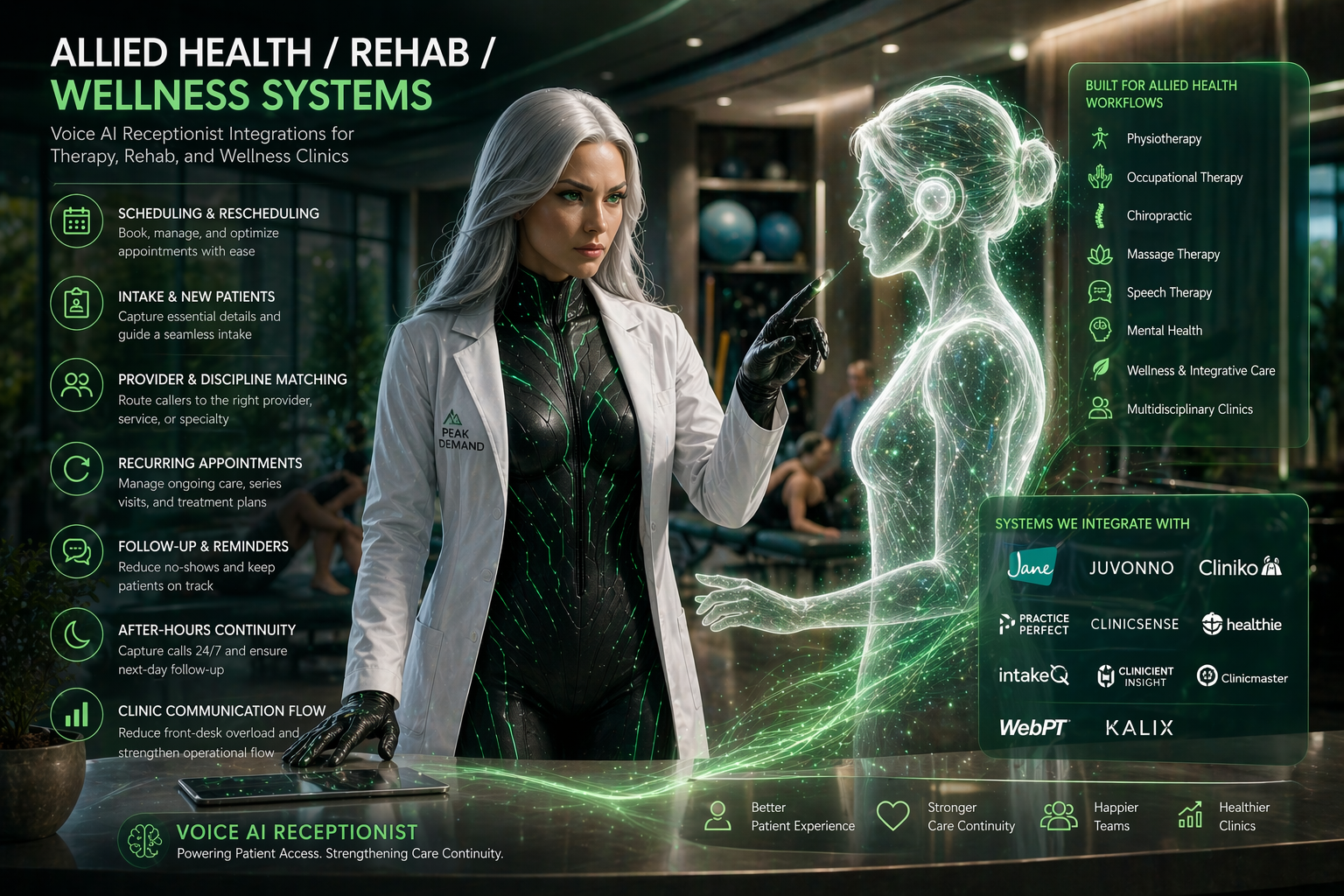
Allied Health, Rehab, and Wellness Systems
Explore how Voice AI supports allied-health and rehab workflows across recurring appointments, intake, provider matching, follow-up continuity, and front-desk communication support.

Dental Systems
Explore how Voice AI fits into dental communication workflows across new patient calls, hygiene recall, appointment flow, cancellation recovery, emergency routing, and front-desk continuity.

Veterinary Systems
Explore how Voice AI fits into veterinary environments across appointment continuity, client intake, urgent call routing, after-hours handling, and front-desk workflow support.

Chiropractic and Specialty Rehab Systems
Explore how Voice AI fits into chiropractic and specialty rehab workflows across scheduling, intake, recurring visits, SOAP-adjacent continuity, imaging-adjacent coordination, and front-desk support.
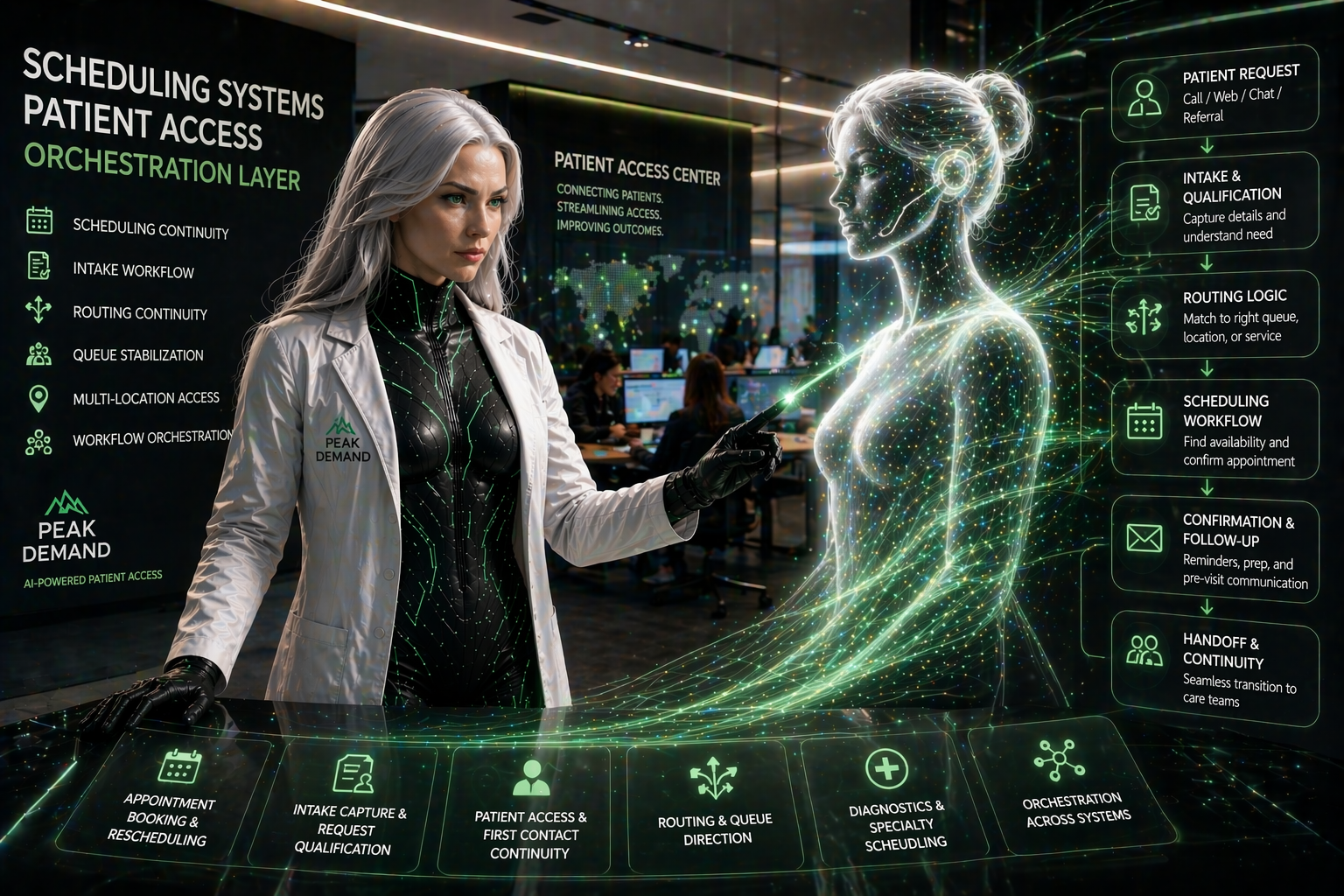
Scheduling, Patient Access, and Orchestration Systems
Explore how Voice AI supports scheduling and patient access architecture across intake, routing, queue stabilization, diagnostics scheduling, and workflow continuity between first contact and next action.
See Healthcare Voice AI Integrations In Action
These walkthroughs show how Voice AI can connect into real healthcare scheduling, intake, and communication environments. Start with TELUS Health CHR for Canadian clinic workflows and Juvonno for rehab and allied health operations.
TELUS Health CHR Integration Walkthrough
See how Voice AI can support TELUS Health CHR scheduling, intake, patient communication, and Canadian clinic workflow continuity.
Juvonno Integration Walkthrough
See how Voice AI can support Juvonno workflows for rehab scheduling, intake, appointment handling, and clinic communication continuity.
Explore published healthcare systems by name
Once you know the software family that best matches your environment, this section makes it easier to browse live healthcare integration pages by platform name. Each category below groups published system pages by the type of environment they usually support so operators, managers, and technical teams can compare workflow fit more quickly. A fuller alphabetical directory appears farther down the page.
Featured healthcare systems
These are high-priority starting points for visitors evaluating real-world Voice AI workflow fit across scheduling, intake, patient communication, routing, and access workflows.
Clinic, ambulatory, and medical EMR systems
These systems are commonly associated with clinic records-adjacent workflows, appointment flow, patient requests, intake continuity, routing, and broader ambulatory communication operations.
Scheduling, intake, and patient communication systems
These environments sit closer to booking logic, intake flow, reminders, clinic administration, and day-to-day patient access operations.
Rehab, physiotherapy, and allied health systems
Allied health and rehabilitation environments often depend on strong scheduling continuity, practitioner matching, intake flow, recurring appointment management, and multi-location operational coordination.
Dental systems
Dental communication workflows often center around appointment demand, cancellation recovery, reminders, new patient calls, and front-desk continuity across booked production.
Veterinary systems
Veterinary communication environments often require appointment continuity, client communication, after-hours handling, urgent call direction, and records-adjacent workflow coordination.
Healthcare organizations rarely evaluate integrations in a vacuum. Grouping systems by software family makes it easier to understand likely workflow fit, compare environments more quickly, and navigate toward both family-level integration pages and live system-specific pages deeper in this hub. The full alphabetical system directory farther down the page should carry the complete 98-system library.
Where Voice AI sits in the healthcare workflow matters more than basic connectivity
Healthcare Voice AI becomes more useful when it is treated as part of the larger workflow architecture around patient access, intake, routing, scheduling, escalation, and downstream ownership. The question is not only whether a system connects. The question is whether the communication flow reaches the next operational step with enough clarity and structure to reduce friction instead of shifting it downstream.
In practice, that means Voice AI often sits across multiple workflow layers at once. It may support first contact, gather structured intake, help direct the caller into the right path, preserve context for staff, and improve continuity into the next step. The value comes from how those layers fit together, not from one isolated connection point.
This is why healthcare teams should evaluate both the scheduling and patient access layer and the EMR or EHR-adjacent layer. In more complex environments, the architecture may also need to account for enterprise compliance and procurement requirements.
Where Voice AI usually enters the workflow
Voice AI often enters at the communication edge: inbound calls, appointment demand, intake capture, after-hours answering, overflow handling, and patient access or routing-related first contact.
Explore healthcare AI receptionistsWhere continuity usually breaks down
Continuity often breaks between the interaction and the next operational owner. That can happen when routing is weak, intake is unclear, scheduling context is incomplete, or downstream teams still need to manually rebuild the request.
Explore centralized scheduling workflowsWhat stronger integration architecture actually improves
Stronger architecture preserves enough structure, direction, and next-step usability for staff or systems to act efficiently. That is what turns Voice AI into operational infrastructure instead of a disconnected front-end layer.
Return to the healthcare resource hub| Integration maturity | What healthcare teams usually experience | Likely operational result |
|---|---|---|
| Fragmented | Some connection points exist, but scheduling, intake, routing, escalation, and continuity still require heavy manual repair. | Lower operational value, more staff burden, weaker patient access continuity, and less confidence in the workflow. |
| Partially connected | Important workflow layers connect, but structure and downstream usability still vary too much between teams, departments, or next-step owners. | Moderate gains, but persistent continuity gaps remain and staff still absorb unnecessary workflow friction. |
| Workflow-led and integrated | Voice AI supports multiple workflow layers with stronger structure, clearer routing, better handoff, and more usable next-step continuity. | Stronger patient access flow, cleaner operational ownership, and more scalable communication infrastructure. |
What healthcare teams should evaluate in the architecture discussion
- Where does Voice AI need to sit first in the communication workflow?
- Where does continuity currently break between the interaction and the next operational step?
- Which layers are EMR or EHR-adjacent, and which ones are workflow-adjacent?
- How do scheduling, intake, routing, patient access, and escalation interact in this environment?
- Will downstream teams receive enough structure to act without rebuilding the request manually?
- Is the integration design workflow-led or just feature-led?
- Does the current architecture reduce friction for staff, or does it simply move the work somewhere else?
Healthcare organizations usually get more value when they evaluate integration maturity across communication flow, operational ownership, and downstream usability together instead of treating each connection as a separate isolated decision. For system-specific evaluation, use the alphabetical healthcare system directory below.
Evaluating software families?
Use the six system-family pages to compare EMR, EHR, dental, veterinary, rehab, scheduling, and patient access environments.
Browse Software FamiliesEvaluating specific systems?
Use the full alphabetical directory to find the exact healthcare platform your team is evaluating.
Open System DirectoryEvaluating enterprise readiness?
Review governance, privacy, escalation, procurement, and compliance considerations before deployment.
Review ComplianceGo deeper into the strategy behind healthcare Voice AI integrations
This section helps healthcare teams move from broad category understanding into the right supporting resources for architecture, interoperability, workflow fit, implementation planning, and system-specific evaluation.
The articles below are the best next clicks for teams evaluating how Voice AI fits into healthcare communication systems, patient access workflows, structured integration pathways, rollout planning, and governed healthcare environments.
For broader category education, use the Healthcare Voice AI Resource Hub. For software-specific evaluation, continue to the full alphabetical system directory lower on this page and use the six healthcare software family pages as the parent layer.
Need system-family pages?
Use the family pages to compare medical EMR, allied health, dental, veterinary, specialty rehab, and patient access systems.
Browse Software FamiliesNeed a specific platform?
Use the alphabetical system directory to find the exact EMR, EHR, scheduling, dental, veterinary, or rehab platform.
Open System DirectoryNeed compliance context?
Use the enterprise compliance page when governance, privacy, procurement, RFPs, or regulated deployment requirements are part of the evaluation.
Review ComplianceCore integration strategy articles
These resources explain why integrations matter, what healthcare teams should evaluate first, and how stronger Voice AI integration architecture should be understood.
Custom pathways, structured integrations, and workflow fit
These articles are useful for teams evaluating custom pathways, structured communication flows, and how Voice AI fits into real healthcare operating environments.
Rollout, implementation, and governance
These resources are best for healthcare teams moving from early exploration into rollout planning, operational safety, implementation readiness, and governance-aware deployment.
Patient access, routing, and workflow bottlenecks
These articles help healthcare teams think more clearly about where communication complexity builds up across patient access, intake, department routing, scheduling, and downstream handoff.
As the healthcare integrations ecosystem continues to grow, this section can keep routing visitors into the most relevant strategy, rollout, and workflow resources without changing the overall structure of the hub. The full software directory appears in the Alphabetical System Directory section below.
Explore live healthcare system integration pages by category
This section gives healthcare teams a category-based way to browse the most important live system pages. It is not the full 98-system directory; it is a curated navigation layer for comparing the platforms most commonly tied to scheduling, intake, patient communication, routing, and patient access workflows.
Use this section when you know the type of software environment you are evaluating. Use the Alphabetical System Directory below when you want to find every live system page by name.
Need the family layer?
Start with the six parent family pages when comparing software categories before choosing a specific system.
Browse Software FamiliesNeed every system?
Use the alphabetical directory for the complete live healthcare system page list by platform name.
Open Alphabetical DirectoryNeed workflow context?
Review how Voice AI fits across patient access, intake, routing, scheduling, escalation, and downstream ownership.
Review Workflow ArchitectureFeatured healthcare systems
These are some of the strongest starting points for teams exploring healthcare Voice AI integrations across scheduling, intake, patient communication, routing, and access workflows.
Clinic and ambulatory EMR systems
These systems are commonly associated with clinic records-adjacent workflows, intake, appointment flow, routing, patient communication, and broader ambulatory continuity.
Explore medical and ambulatory EMR familyScheduling, intake, and patient communication systems
These environments sit closer to booking logic, intake flow, reminders, clinic administration, and day-to-day patient access operations.
Explore scheduling and patient access familyRehab, physiotherapy, and allied health systems
Allied health and rehabilitation environments often depend on strong scheduling continuity, practitioner matching, intake flow, recurring appointments, and multi-location coordination.
Explore allied health and rehab familyDental systems
Dental communication workflows often center on appointment demand, cancellation recovery, reminders, new patient calls, and front-desk continuity.
Explore dental familyVeterinary systems
Veterinary communication environments often require appointment continuity, client communication, after-hours handling, and records-adjacent workflow coordination.
Explore veterinary familyEnterprise, specialty, imaging, and outpatient environments
These environments often involve more complex routing, diagnostic scheduling, imaging coordination, enterprise workflow ownership, and department-specific handoff requirements.
Explore enterprise and medical EMR familyThis curated category browse section helps visitors compare common healthcare software environments without scrolling the entire directory. The complete system list belongs in the Alphabetical System Directory section below, where every live healthcare system page should be listed by platform name.
Talk through your healthcare communication workflow
If your team is evaluating healthcare Voice AI integrations, the most useful next step is usually a workflow conversation. That means reviewing patient access pressure points, scheduling flow, intake structure, routing logic, after-hours coverage, compliance expectations, and the systems surrounding those workflows.
Peak Demand approaches healthcare environments through workflow fit, governance awareness, and operational usability. The goal is to help organizations map a communication architecture that supports real teams, real workflows, and real continuity requirements across EMR, EHR, scheduling, intake, dental, veterinary, rehab, and patient access environments.
Need software families?
Compare the six parent healthcare integration families before choosing a specific system page.
Browse software familiesNeed workflow context?
Review how Voice AI fits across intake, routing, scheduling, escalation, and downstream ownership.
Review workflow architectureNeed compliance review?
Use the enterprise compliance page when governance, privacy, procurement, and RFP standards matter.
Review complianceFrequently asked questions
What does Voice AI mean in a healthcare integration environment?
Can Voice AI work with EMR, EHR, scheduling, intake, and routing workflows?
Are healthcare Voice AI integrations always direct?
Where should healthcare organizations start evaluating Voice AI integrations?
How should compliance and governance fit into the evaluation?
What is the role of this integrations hub?
About Peak Demand
Peak Demand is a Toronto-based AI agency focused on Voice AI, communication automation, and workflow infrastructure for organizations operating in more complex service environments.
In healthcare, the focus is not just on call handling. It is on patient access continuity, scheduling pressure, intake structure, routing logic, after-hours support, governance, and how communication systems fit into real operational workflows.
- Workflow-driven and implementation-aware
- Governance-first in healthcare communication environments
- Built to support clinics, networks, and enterprise teams
- Designed to scale into software-specific integration pathways
- Organized around healthcare system families and live integration pages
Healthcare software integrations by system name
If you already know the software you are evaluating, this alphabetical directory is the fastest way to find the right live system page.
This directory includes the full 98-system healthcare integration library from the current Peak Demand system-page build. It is designed to help teams compare EMR, EHR, scheduling, intake, patient communication, dental, veterinary, rehab, wellness, chiropractic, orchestration, home care, med spa, pharmacy, and enterprise healthcare systems by software name.
For category-level browsing, use the software family section. For workflow context, use the workflow architecture section. This section is the full alphabetical browse layer.
Live healthcare system pages in this directory
Grouped alphabetically with visible section counts so the full library is obvious at a glance.
A–C
34 systemsABELMed through Curve Dental.
D–H
20 systemsDentrix through Helios Software.
I–M
15 systemsIDEXX Cornerstone through MRX Solutions.
N–O
11 systemsNextech through Owl Practice.
P–R
8 systemsPabau through RXNT.
Compare healthcare systems by name, category, and workflow fit
This directory is useful for comparing clinic EMRs, EHR-adjacent systems, scheduling and intake platforms, patient communication software, dental systems, veterinary systems, rehab and allied health systems, chiropractic systems, med spa systems, home care systems, pharmacy-adjacent systems, orchestration platforms, diagnostic workflows, and enterprise healthcare environments by software name before going deeper into workflow design, integration possibilities, and operational fit.
Explore your own AI use case on a discovery call.