

Continuous Containment Tuning for Multisite Multilingual Transit Voice AI
A practical operational framework for transit leaders to measure, tune and scale containment across sites and languages—covering QA, analytics, cost‑to‑serve, escalation quality, procurement, and controlled integrations for scheduled information and service‑alert APIs.
1. Why continuous containment tuning matters for transit
Containment—the proportion of inbound voice interactions that a Voice AI resolves without human handoff—is a financial and customer‑experience control. For transit operators, containment must be balanced with escalation quality: a high containment rate with poor or unsafe escalations erodes trust and regulatory standing. This section sets the operational rationale for continuous tuning.
Containment as a composite metric
Containment should be measured together with escalation accuracy and downstream outcomes (e.g., correct routing, safe submission of service requests). Report containment alongside escalation quality and first‑touch case success to avoid optimizing for short‑term deflection at the expense of rider outcomes.
- Containment rate: % of calls resolved by Voice AI without human handoff.
- Escalation quality: % of escalations routed to the correct team with validated context.
- Downstream outcome: % of Voice AI‑created cases that required rework or correction by agents.
Why transit differs from generic contact centers
Transit has tightly constrained safety, schedule, and accessibility obligations. Operational models must explicitly separate scheduled knowledge (published timetables, planned closures) from detours, delays, and service alerts coming from authoritative APIs or operations systems. Emergency, safety‑critical, or suspicious reports must always surface to trained staff.
- Scheduled knowledge: authoritative, versioned sources for timetables and planned service.
- Service alerts: automated feeds or APIs for detours, delays, and unexpected incidents.
- Safety boundary: incidents flagged as emergencies route immediately to human operators.
2. Operational architecture: Rider → Voice AI → validated sources → outcome
A reliable architecture separates the Voice AI layer from canonical data sources and validation layers. This section describes the standard flow and the controls needed at each handoff.
Canonical flow and handoffs
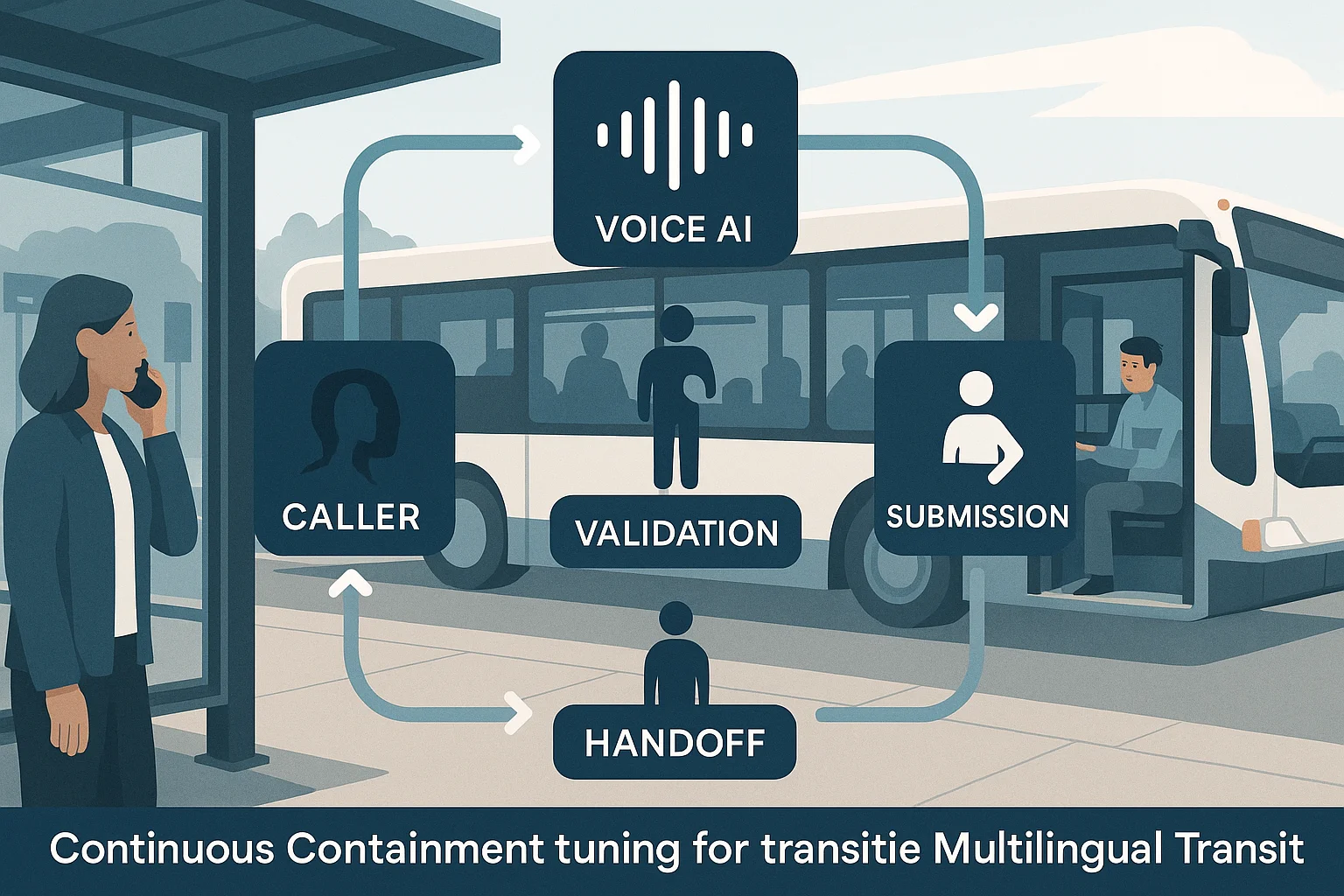
Design the flow explicitly: Rider → Voice AI → controlled knowledge base (schedules) OR approved service‑alert API (detours/delays/forms) → validation layer → final response, case submission, or human handoff. Each step must emit audit events and allow replayable traces for QA.
- Voice AI consults the controlled schedule store for planned information; it queries service‑alert APIs for real‑time incidents.
- A validation layer confirms data freshness, authoritativeness, and whether the interaction should escalate.
- All responses and escalations carry metadata: source, confidence, validation result, and operator routing instructions.
Integrations and approved adapters
Use explicit, documented adapters for each integration: timetable stores, real‑time alerts, CRM/OMS for case creation, and agent desktops. Avoid ad hoc scraping or free‑text feeds. The adapter should perform schema validation, rate‑limit handling, and mapping to canonical entities (e.g., route IDs, stop codes).
- Implement API rate and error handling to avoid silent failures that reduce containment reliability.
- Maintain transformation logic separate from model prompts so data changes do not silently affect behavior.
- Record adapter health as an operational metric in the same observability suite as containment.
3. Measurement, QA, and analytics for containment quality
Measurement is the engine of tuning. Define the telemetry, annotation workflows, and reporting that let you understand not only whether containment happens, but whether it was the right outcome.
Data model and QA workflows
Collect structured telemetry per call: intent classification, resolved entity IDs (route/stop), source (schedule vs alert API), confidence scores, validation results, and final channel (resolved, case created, human handoff). Implement annotation queues for low‑confidence or randomly sampled calls to support root‑cause analysis.
- Tag each interaction with the authoritative data source used to answer the request.
- Use stratified sampling across sites, languages, and times (peak/off‑peak) to surface rare failure modes.
- Keep a managed, versioned dataset of annotated failures for regression tests and vendor evaluations.
Key analytics and dashboards
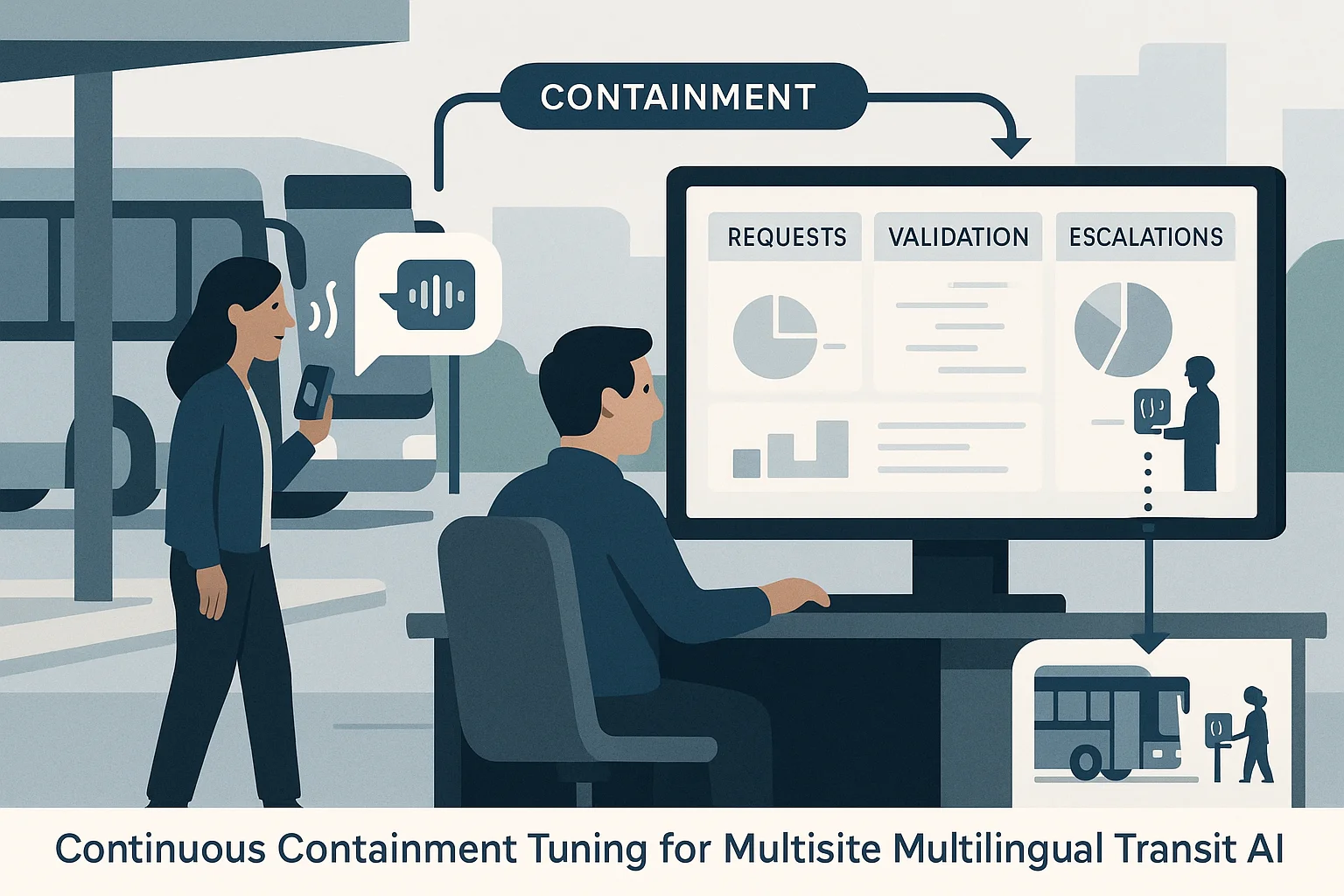
Reporting should include containment rate by site and language, time‑to‑resolution, escalation accuracy, average handle time for escalations, and cost‑to‑serve per successful containment and per escalation. Link these KPIs to operator headcount and channel cost models to make tuning decisions operationally meaningful.
- Containment rate sliced by site, language, and time window.
- Escalation accuracy: % of escalations that require no agent rework within a 24–72 hr window.
- Cost‑to‑serve: marginal cost of Voice AI resolution vs. routed human handling.
4. Multisite and multilingual operational controls
Scaling across cities, regions, or countries multiplies failure modes. Language parity, local naming conventions, and site‑specific operating rules must be managed as first‑class configuration.
Language and locale governance
Maintain per‑language test suites, voice‑style guides, and locale mappings for stop names, route patterns, and common phrases. Use human‑validated phrase banks for locale-specific pronunciations and acceptance tests. Treat languages as separate product lanes for QA and telemetry.
- Create and maintain validation corpora per language and per site.
- Track containment and escalation quality by language and by intent to detect regressions.
- Schedule regular linguistic reviews with native speakers and operations SMEs.
Human‑in‑the‑loop routing and staffing
Define policies for when to route to local agents vs. centralized support. Local agents may be needed for city‑specific disruptions; centralized agents can handle cross‑site inquiries. Document handoff metadata requirements so receiving agents have context (source feed, timestamps, confidence, validation checks).
- Escalation packets should include transcript, source IDs, validation flags, and suggested next steps.
- Define SLAs for response time and rework thresholds per escalation type and site.
- Use blended staffing models for languages with low volume and site agents for high‑impact local issues.

5. Continuous tuning lifecycle: experiments, rollback, and change control
Tuning is an iterative program: collect failures, annotate, prioritize remediation, deploy changes behind flags, and measure impact. Formalize release gates and rollback criteria.
Closed‑loop annotation and prioritization
Operationalize a daily or weekly triage: surface high‑impact failure clusters, assign owners, produce fixes (prompt changes, adapter mappings, validation rules), and document expected outcomes. Use a weighted prioritization model that scores customer impact, safety risk, and operational cost.
- Maintain a ranked backlog of failure types with reproducible test cases.
- Record fixes as discrete commits: prompt version, adapter change, or rule update.
- Link each fix to a measurable target (e.g., reduce misrouted escalations for ‘lost service’ intents by X%).
Safe releases, experiments, and rollback
Deploy changes via feature flags and controlled canaries by site and language. Define stop‑loss thresholds that trigger automatic rollback (e.g., containment drop, escalation accuracy degradation). Maintain audit trails and make rollbacks as simple and fast as deployments.
- Use canaries to limit blast radius: one site and one language initially.
- Monitor real‑time metrics and automatic health checks tied to rollback rules.
- Document who can approve global releases and who has authority to rollback.
6. Controls, failure boundaries, and procurement checklist
Procurement and governance must demand evidence about safety, observability, and ownership. Use a checklist to compare vendors and proposals and to set contractual obligations.
Safety, security, and governance controls
Require vendors to document data flows, subprocessors, hosting regions, backup geographies, and remote‑support access. For transportation operators, include cyber resilience controls and continuity planning. Also require audit logs for prompts, model versions, and adapter responses.
- Document data residency and cross‑border transfer mechanisms and confirm obligations with legal counsel.
- Require vendor runbooks for incident response and evidence of secure integration practices.
- Capture retention policies for recordings, transcripts, and annotated datasets, and document consent flows.
Procurement evidence and contract items
Ask for reproducible test suites, annotated failure cases, SLA definitions for containment and escalation quality, and clear ownership of integrations to backend systems. Contracts should include change‑control clauses, audit rights, and data portability provisions.
- Require a vendor test report: containment and escalation quality by language and site on a representative dataset.
- Insist on documented ownership for each integration (who fixes adapter failures).
- Include operational KPIs, reporting cadence, and remedies if agreed thresholds are missed.
7. Implementation checklist and measurable outcomes
This final section converts the framework into an operational checklist and measurable milestones for rollout across multiple sites and languages.
15‑point rollout checklist
Use this checklist as decision gates before expanding containment to new sites or languages. Each gate requires evidence and measurable outcomes before broader rollout.
- 1) Authoritative schedule and alert feeds available, versioned, and adapter‑tested.
- 2) Per‑site and per‑language test suites with >N annotated examples (operationally defined).
- 3) Baseline containment and escalation quality measured in pilot sites.
- 4) Feature‑flag and canary deployment capability in production.
- 5) Incident response and rollback runbooks documented and tested.
Operational KPIs to report monthly
Reportable KPIs should be actionable and tied to operating cost. Include both business and safety/quality metrics so executives can make tradeoffs between containment and rider outcomes.
- Containment rate by site and language, with trend and cohort analysis.
- Escalation accuracy and rework rate within 72 hours.
- Cost‑to‑serve per containment and per escalation (marginal cost model).
- Time to rollback and number of rollbacks in the reporting period.
Related Peak Demand resources
Industry and AI sources reviewed
- Transportation Systems SectorCybersecurity and Infrastructure Security Agency (CISA)
- Artificial Intelligence Risk Management Framework (AI RMF 1.0)National Institute of Standards and Technology (NIST)
- OECD AI PrinciplesOrganisation for Economic Co-operation and Development
Transit safety, accessibility, privacy, cybersecurity, records, and service-information obligations vary by jurisdiction and operating authority. This article is operational guidance, not legal advice; organizations should confirm applicable requirements with qualified professionals.
Frequently asked questions
Good starting points include lost property, complaints and feedback, stop or shelter issues, fare-machine faults, non-emergency accessibility service requests, schedule information from approved sources, and structured routing to customer service or field teams.
Official reference: Artificial Intelligence Risk Management Framework (AI RMF 1.0)
Use GTFS Realtime only when the agency exposes suitable feeds and the workflow genuinely needs service alerts, trip updates, or vehicle positions. The integration should validate freshness and availability, and the agent should avoid presenting stale feed data as a guaranteed arrival prediction.
Emergency, security, injury, crime, and safety-critical reports should follow approved transfer or emergency-routing procedures. Voice AI may detect and route the call, but it should not make operational safety decisions or replace trained personnel.
Official reference: Transportation Systems Sector
Request realistic call testing, feed and system failure handling, service-request integration, transfer context, audit logs, accessibility channels, monitoring, change control, and evidence that the agent distinguishes scheduled information from dynamic service alerts.
Official reference: Artificial Intelligence Risk Management Framework (AI RMF 1.0)
Design the transit service workflow before automating it
Peak Demand helps transit teams connect Voice AI to rider information, service requests, approved live-data sources, escalation, confirmation, and analytics.
Schedule a discovery call