

From Metrics to Municipal Outcomes: Operationalizing Multisite Voice AI
A practical operating model for municipal Voice AI that links containment, escalation, QA, analytics, and cost-to-serve into accountable multisite operations — with deployment controls, procurement criteria, and continuous optimization.
1. Why an outcomes-driven operating model matters
Municipal Voice AI is no longer an experiment. To move from pilot to sustainable multisite services, agencies must connect operational metrics to measurable public outcomes: resolved requests, reduced human backlog per case, and consistent resident experience across departments and locales.
From metrics to municipal service outcomes
Containment and escalation are not vanity metrics. Containment quality measures how many resident intents are resolved end-to-end by the Voice AI (including submission of a properly validated case or requested information). Escalation quality tracks whether handoffs to staff include complete, validated case data and clear next actions. Both must be defined in terms of downstream municipal outcomes: ticket closure rates, time-to-resolution, rework, and resident confirmation evidence.
- Containment quality = proportion of intents resolved without human intervention + correctness of submitted case data.
- Escalation quality = proportion of escalations containing validated fields, provenance, and a confidence signal for triage.
What success looks like operationally
Operational success is a set of measurable behaviours, not a single %-score: predictable handoff content, reduced manual validation work, consistent acknowledgements (confirmation numbers), and audit trails for public accountability. Define short- and medium-term KPIs (e.g., validated case rate, average human triage time per escalated call, multilingual containment) and tie them to departmental SLAs.
- Validated case rate: percent of automated submissions that pass downstream system validation.
- Human triage time: average minutes spent on cases created by Voice AI vs. legacy intake.
- Confirmation coverage: percent of interactions producing resident-visible confirmations (ID, number, or receipt).
2. Core operating architecture and failure boundaries
A repeatable architecture links resident interaction to municipal case systems with clear validation and handoff rules. Keep safety and discretionary decisions with trained staff and design for graceful failures.
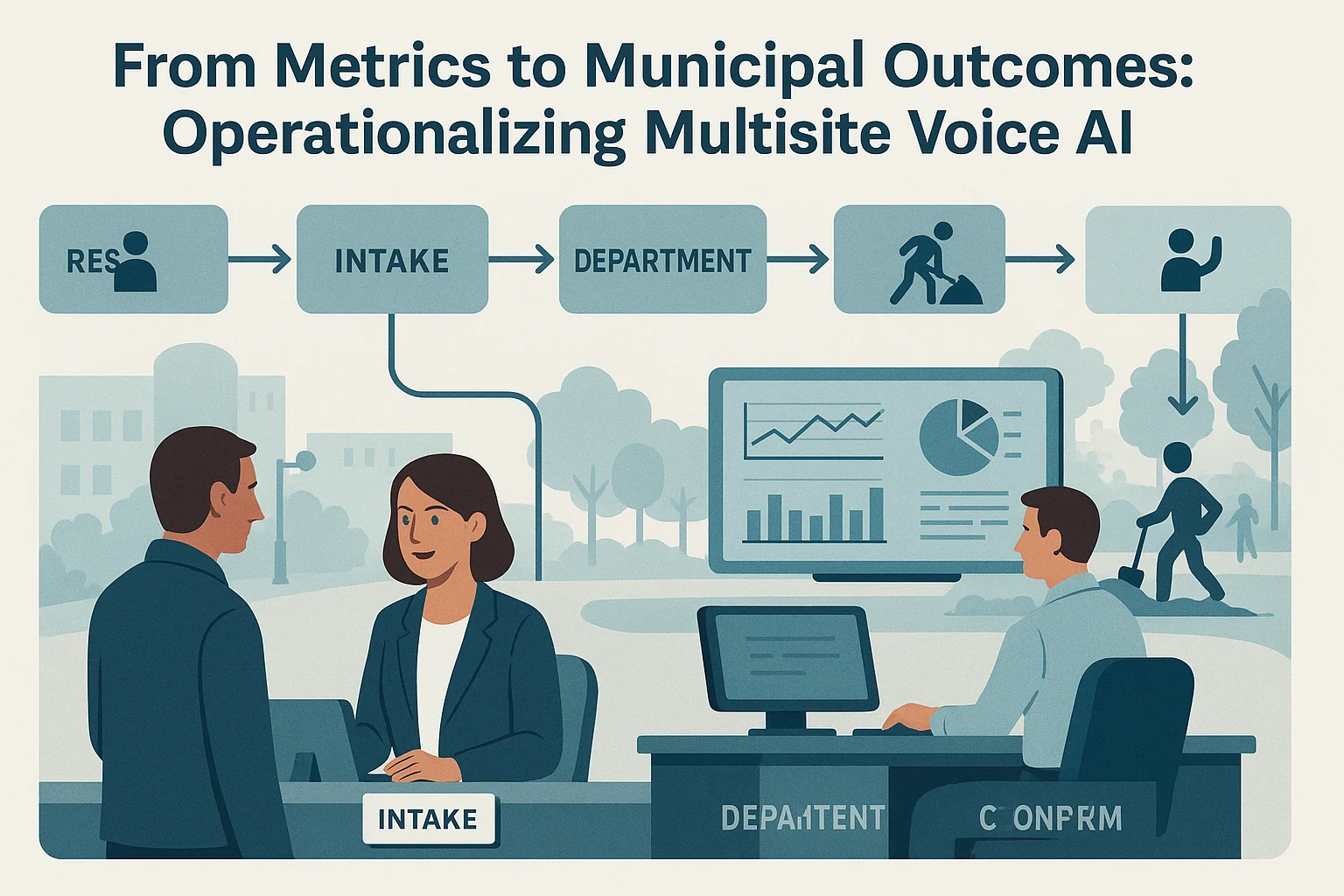
Canonical flow: Resident → Voice AI → logic bridge → case system
Operationalize a canonical, auditable flow: resident utterance → Voice AI (ASR/NLU) → logic bridge (decision, slot retrieval) → form and field retrieval → validation → municipal case system → confirmation or human handoff. The logic bridge performs routing, confidence checks, field-level validation (address lookup, permit numbers), duplicate detection, and formats data for the receiving case system through approved APIs or controlled adapters.
- Logic bridge roles: intent resolution, field retrieval, confidence thresholding, duplicate-check, enrichment (geocoding), orchestration to downstream APIs.
- Validation: field-level checks (required fields, data types, address normalization) before case creation.
- Auditability: store a minimal, governed transcript, validation decisions, and the confirmation/incident ID.
Explicit failure boundaries and human-in-loop rules
Define clear failure behaviours so residents never get incorrect or legally consequential outcomes. Examples of boundaries that must escalate to staff: emergencies, enforcement actions, legal or eligibility determinations, discretionary enforcement choices, ambiguous claims with low confidence, and requests requiring identity verification. Escalation should include a packaged case with the confidence score, fields completed, and a human-readable summary.
- Automatic escalation triggers: ASR/NLU confidence below threshold, inconsistent address, conflicting resident input, or requests mapped to restricted service types.
- Human-in-loop envelope: include transcript excerpt, timestamp, validation checks performed, and original audio reference for audit.
3. Measuring containment, escalation quality, and cost-to-serve
Define measurements that municipal teams can act on. Combine interaction-level analytics and downstream case metrics to calculate containment quality, escalation quality, and an operational view of cost-to-serve.
Key metric definitions
Operational definitions must be implementable in analytics pipelines and auditable by records staff. Example definitions:
- Containment quality: (# of resolved intents with validated case created and no human edit) / (total intents handled).
- Escalation quality: (# of escalated interactions with complete validated data and human acceptance without rework) / (total escalations).
- Cost-to-serve proxy: (human-handled minutes * hourly rate + downstream handling effort) per case created by Voice AI.
Data collection and analytics pipeline
Collect structured event streams: intent label, confidence, validation outcomes, API responses, case ID, human-edit flag, time stamps, and locale. Feed these into a centralized analytics layer or reporting service for dashboards, cohort analysis, and root-cause investigation. Peak Demand’s reporting and dashboards can operationalize these views for municipal teams.
- Instrument every decision point: ASR confidence, NLU intent, logic-bridge decisions, validation checks, duplicate checks, case creation response, and resident confirmation.
- Correlate Voice AI events with downstream case system outcomes (closure, reassignments, reopens).
- Use cohort analysis to compare performance by site, locale, and time window.
4. QA, validation, and Peak Demand differentiation
Operational QA ensures the Voice AI provides accurate, accessible, and auditable interactions. Tie QA to validation controls and case integrity. Highlighted here are concrete QA workflows and platform differentiators.
QA program: sampling, scoring, and feedback loops
Run a structured QA program: stratified sampling across sites, locales, and escalation states; multi-dimensional scoring (intent accuracy, data completeness, accessibility prompts, escalation packaging); and closed-loop feedback to model owners and content authors. Maintain a governance cadence for score reconciliation and remediation.
- Sampling must include low-confidence calls, recent model updates, and high-volume intents.
- Scorecards should map to remediation actions: script fixes, NLU retraining, grammar updates, or changes to validation logic.
- Keep incident-level evidence (audio, transcript, validation checks) for audit and remediation.
Validation, duplicate controls, and confirmation evidence
Validation and duplicate detection are operational controls that materially affect containment and escalation quality. Use dynamic forms and field-level validation to reduce human rework. Generate confirmation numbers or receipts to provide residents with tangible evidence of the request and for downstream reconciliation.
- Dynamic forms: prompt for only the fields that matter and use lookups (address, permit) to reduce entry errors.
- Duplicate controls: perform matching on key fields (address, phone, time window, request type) and either merge or flag duplicates before case creation.
- Confirmation evidence: immediate confirmation number plus an optional SMS/email receipt that includes a human-readable summary and next steps.
Accessibility, records, and auditability
Retain minimal transcripts and metadata required for records and audit while respecting privacy and retention policies. Make Voice AI interactions available to records officers and provide exportable evidence for FOI or oversight processes. Ensure accessible prompts and alternate channels are available when needed.
- Define retention policy for audio, transcripts, and event logs in consultation with legal and records teams.
- Provide human-readable escalation packets and audit trails for every case created by Voice AI.
- Offer accessible alternatives (TTY, web forms) when voice is not appropriate or fails validation.

5. Scaling multisite, multilingual operations, and staffing
Multisite scale introduces variance: different contact volumes, languages, local rules, and downstream systems. Governance and configuration practices reduce drift and preserve service quality.
Tenant and site configuration governance
Manage site-specific behaviour through configuration profiles, not code forks. Each site/profile contains locale, available services, custom prompts, priority SLAs, and downstream mapping. Central governance monitors profile changes, audits deployments, and enforces common validation rules to protect containment quality.
- Profiles enable per-site exceptions while retaining shared validation logic.
- Change control: require approval workflow for prompt or flow updates that change public-facing outcomes.
- Use feature flags to stage changes by site or cohort.
Multilingual and localization operations
Treat multilingual support as an operational capability: native prompts, locale-specific validation (address formats), bilingual staff for escalations, and QA sampling across languages. Measure containment and escalation by language cohort and include TTS/ASR performance in QA scorecards.
- Localize validation rules (postal formats, address lookups) per jurisdiction.
- Ensure confirmation receipts are produced in the resident’s language when available.
- Monitor language-specific NLU drift and retrain periodically with representative samples.
Operational staffing: the right roles
Staffing should include: service owners (departmental), Voice AI ops (technical runbook owners), QA analysts, escalation triage specialists, and data engineers for analytics. Maintain an on-call rota for critical escalations and incident response.
- Service owners define intent mapping and escalation policy for their domain.
- QA analysts manage sampling, scorecards, and remediation workflows.
- Escalation triage specialists validate cases with low confidence or legal implications.
6. Continuous optimization, procurement, and risk management
Optimization is a disciplined, measurable cycle. Procurement should validate operational requirements for governance, observability, and vendor controls. Apply risk assessments and cybersecurity goals early.
Optimization loops and experiment design
Run controlled experiments for major changes (prompts, confidence thresholds, validation rules). Use A/B or temporal rollouts with measurement windows that track containment, escalation quality, rework, and resident feedback. Prioritize interventions that reduce human rework per case.
- Define pre-registered metrics and minimum detectable effect before experiments.
- Roll back quickly on degradation and maintain a changelog for every iteration.
- Use cohort-based monitoring to detect site-specific regressions.
Procurement checklist for vendors and services
When procuring Voice AI capabilities, require vendors to demonstrate: observability (call-level logs, dashboards), accessible evidence export, integration patterns (API/adapters), validation and duplicate controls, clear SLAs around escalation interfaces, and managed QA support. Request operational runbooks and onboarding timelines rather than marketing claims.
- Ask for sample runbooks describing handoffs, incident handling, and change control.
- Require evidence of auditable case creation and confirmation-number generation.
- Evaluate vendor support for multisite configuration and multilingual operations.
Risk, compliance, and cybersecurity posture
Carry out an algorithmic impact assessment where applicable, and map technical controls to recognized cybersecurity goals. Confirm data residency and onward transfer choices with legal counsel; document subprocessors, backup geography, and breach notification duties. Use the AI Risk Management Framework and municipal cybersecurity goals to structure risk controls and monitoring.
- Run Algorithmic Impact Assessments early to identify fairness, transparency, and records needs.
- Map system controls to cross-sector cybersecurity goals (identity, asset management, logging, and incident response).
- Document hosting region, backup region, remote support access, and subprocessors in procurement and privacy notices.
Related Peak Demand resources
Industry and AI sources reviewed
- Artificial Intelligence Risk Management Framework (AI RMF 1.0)National Institute of Standards and Technology (NIST)
- Algorithmic Impact AssessmentGovernment of Canada
- Cross-Sector Cybersecurity Performance GoalsCybersecurity and Infrastructure Security Agency (CISA)
Public-sector procurement, privacy, accessibility, records, cybersecurity, and administrative-law obligations vary by jurisdiction. This article is operational guidance, not legal advice; organizations should confirm applicable requirements with qualified professionals.
Frequently asked questions
Suitable workflows include structured resident inquiries, service-request intake, permit or program information, appointment scheduling, department routing, status updates from approved systems, and after-hours overflow. Adjudication, enforcement discretion, emergency response, and binding eligibility decisions should remain with authorized staff.
Official reference: Artificial Intelligence Risk Management Framework (AI RMF 1.0)
Use a controlled service catalogue, required fields, department ownership rules, validation, duplicate checks, confirmation numbers, and documented handoff paths. The system should create an auditable record and avoid silently dropping requests when a downstream system is unavailable.
Official reference: Algorithmic Impact Assessment
Municipal deployments should document purpose, affected services, data use, human oversight, complaint and appeal paths, accessibility channels, records handling, monitoring, and the process for approving material changes.
Official reference: Algorithmic Impact Assessment
Require workflow demonstrations, integration and security architecture, testing evidence, auditability, data-location and subcontractor details, incident response, accessibility support, human escalation, exit planning, and clear ownership of ongoing updates.
Official reference: Artificial Intelligence Risk Management Framework (AI RMF 1.0)
Modernize public-service intake without losing control
Peak Demand helps municipal teams connect Voice AI to service requests, department routing, validation, escalation, records, and operational analytics.
Schedule a discovery call