

Voice AI Validation and Escalation for Municipal Service Requests
A practical operating model for municipal leaders to validate Voice AI intake, measure containment and escalation quality, scale multilingual operations, and maintain auditable handoffs to human teams.
1. Operating model — Resident to case: minimal, auditable path
Lay out a concise, dependable flow so stakeholders understand where Voice AI fits. The model below is intentionally narrow: the agent collects validated fields and either confirms a case number or escalates to a human team for action.
Operating model overview
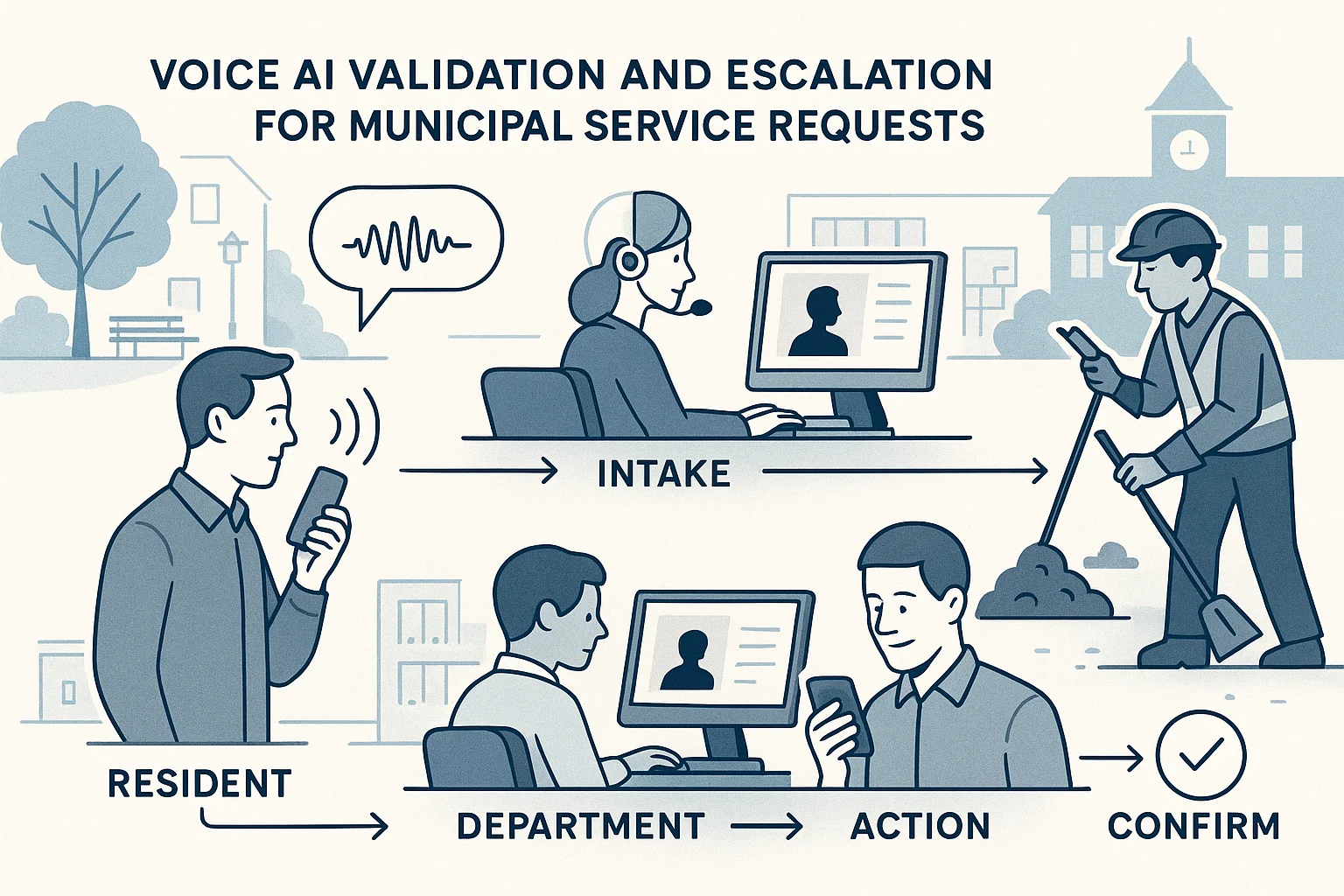
Standardize on a single intake flow: Resident → Voice AI (IVR/Conversational) → Logic bridge (validation + orchestration) → Form & field retrieval (dynamic templates) → Validation (syntactic + semantic) → Municipal case system via approved API adapter → Confirmation number or human handoff. The logic bridge is stateless to the voice model and handles retries, idempotency keys, duplicate checks, and enrichment (address lookup, permit database lookup). Store the final submission payload and an immutable call transcript for auditability and appeals.
- Dynamic forms: retrieve the correct form and required fields per request type and jurisdiction.
- Validation layers: syntax (phone, postal code), semantic (does reported issue type match location data?), and policy gates (is the request an emergency?).
- Integration pattern: push to case system through a controlled adapter or approved API with clear success/failure codes and recorded confirmation numbers.
When automation should stop and humans should act
Embed explicit safety boundaries. Voice AI handles intake, not enforcement or sensitive judgment. Route to humans when the call indicates emergencies (fire, immediate medical risk), enforcement decisions (ticketing, fines, eviction), legal or eligibility determinations, or when the confidence of validation falls below the configured threshold. Always present residents with the option to speak with a human.
- Define thresholds for low-confidence or ambiguous intents that trigger immediate human transfer.
- Record the reason for each handoff (safety, ambiguity, resident request) to support QA and training.
- Keep staff ownership for any discretionary outcomes; Voice AI should not generate final legal or enforcement decisions.
2. Validation and containment controls
Quality starts with validated inputs. Controls here reduce duplicates, prevent incomplete cases, and increase first‑touch resolution.
Field-level validation and dynamic forms
Use dynamic form templates driven by the municipal case taxonomy. The Voice AI should prompt only required fields based on issue type and jurisdiction, perform in-call validation (phone formats, address normalization, serviceable area checks), and attempt live enrichment (reverse geocoding or address normalization) before submission. If required fields fail validation, the Voice AI should repeat or rephrase for clarity, then escalate when validation cannot be satisfied.
- Dynamic forms reduce unnecessary prompts—use business rules to hide or show fields.
- Field validation must be deterministic and auditable; store raw and normalized values.
- Implement retry limits and clear messaging to avoid infinite loops with low-literacy or non-native speakers.
Duplicate controls and confirmation numbers
Before creating a case, the logic bridge should check for duplicates using a combination of normalized address, issue type, recent case history, and time-window heuristics. When a new case is created, return a confirmation number and brief instructions. If a potential duplicate is detected, present a confirmation prompt and provide the existing case number if applicable. Maintain an immutable trail showing deduplication decisions and the criteria used.
- Idempotency keys for API calls prevent double-submission from network retries.
- Presenting an existing case number improves transparency and reduces repeat reporting.
- Log deduplication confidence and reviewer decisions for auditability and continuous improvement.
3. Escalation architecture and human-in-the-loop workflows
Design escalations for speed, context, and minimal friction for staff receiving handoffs.
Escalation triggers and handoff payloads
Define explicit triggers (low confidence, emergency keywords, policy gates, resident request) and standardize the payload delivered to humans: issue type, validated fields, transcript snippet, confidence scores by field, enrichment data (map coordinates), duplicate check results, and the suggested next action. Route the payload to the correct department queue with priority flags. Ensure the receiving interface supports quick validation, correction, and case acceptance or rejection.
- Include both raw transcript and normalized data to speed decision-making.
- Attach a discrete confidence indicator per field so staff know where to focus verification.
- Use queue routing rules for multi-site operations (assign by jurisdiction, geography, or workload).
Failure boundaries, escalation quality, and human oversight
Define ‘failure boundary’ scenarios where automation must stop and humans must act—examples: conflicting resident statements, complex multi-issue calls, or legal enforcement contexts. Measure escalation quality as the proportion of escalations that required human intervention for validity (versus escalations that returned easily resolvable low-risk issues). Use this metric to tune thresholds and conversational prompts. Keep final authority with trained staff for any corrective action that affects legal standing or public safety.
- Log reason codes for every handoff to enable targeted QA and training.
- Avoid escalating excessive low-value cases—refine prompts and validation to increase containment quality.
- Use human review to close feedback loops and update conversational flows when recurring gaps are found.
4. QA, analytics and cost-to-serve
Operationalize measurement to make data‑driven decisions. Track containment and escalation quality, duplicate rates, and cost-to-serve so optimization has clear targets.
QA sampling and containment/escalation metrics
Adopt stratified QA sampling: review a representative sample of contained calls, escalations, and human-taken calls. Key metrics: containment rate (percent resolved without human), containment quality (percent of contained calls classified as correctly handled), escalation rate, escalation quality (percent of escalations appropriately routed and containing sufficient context), duplicate rate, and time-to-confirmation. Use weighted sampling to prioritize low-confidence and high-impact categories.
- Sample escalations more heavily to detect misroutes quickly.
- Record QA reasons (validation failure, policy gate) to target remediation.
- Track trends week-over-week and by issue type to prioritize conversational updates.
Measuring cost-to-serve
Compute cost-to-serve with a simple activity-based formula: total cost (platform + telephony + human hours allocated to Voice AI escalations + integration/maintenance) divided by the number of validated cases submitted or resolved. Break out cost-per-contained-case and cost-per-escalated-case to capture the economics of containment improvements. Use time-motion sampling and case-handling times from the receiving teams to keep the model current.
- Track human handling time separately for acceptance, correction, and follow-up.
- Include amortized integration and QA costs in a multi-year procurement view.
- Use containment quality improvements and duplicate reduction to show operational impact without promising guaranteed savings.

5. Multisite, multilingual operations and data boundaries
Scaling across municipalities, languages and regions requires central control of business rules and explicit data-residency decisions.
Language strategy and localization
Support local languages and dialects through a layered approach: native language conversational flows where possible, machine translation fallback, and live interpreter escalation when necessary. For low-latency and critical calls, provide an explicit option to switch to a human interpreter early. Capture language preference on first contact and reuse it for subsequent interactions.
- Localize form fields and policy prompts—translations must be owned by municipal communications teams.
- Configure confidence thresholds per language to avoid biasing handoffs.
- Document fallback flows (e.g., transfer to bilingual agent) and measure success by language-specific containment quality.
Hosting, residency and operational boundary considerations
Be explicit about hosting region, backup region, subprocessors, remote-support access, retention windows, and whether recordings cross borders. These are procurement and legal items — document them in vendor contracts and ensure the vendor declares subprocessors and transfer mechanisms. Municipalities should verify obligations with legal counsel; implementation teams should ensure routing and data transfers are visible to auditors.
- Specify retention and deletion schedules for transcripts and recordings in the SOW.
- Declare subprocessors and provide a mechanism for advance notice of changes.
- Design for regional failover while preserving clear records of where data is processed and stored.
6. Procurement, integrations and implementation choices
Procure for operational outcomes and auditability. RFPs and contracts should focus on measurable SLAs, integration patterns, and transparency.
Procurement and contractual controls
Issue SOWs that define SLAs for containment rate reporting cadence, escalation accuracy reporting, uptime, incident response, and audit access. Require vendors to declare subprocessors, hosting regions, backup geography, and remote-support access terms. Include acceptance testing that verifies end-to-end submission, confirmation-number issuance, idempotency under retries, and duplicate suppression.
- Request a detailed runbook: failure modes, handoff protocol, and on-call escalation.
- Include acceptance criteria that test dynamic forms, validation, and human handoff payload integrity.
- Require an immutable audit log with export capability for FOI and appeals purposes.
Integration patterns and Peak Demand differentiation
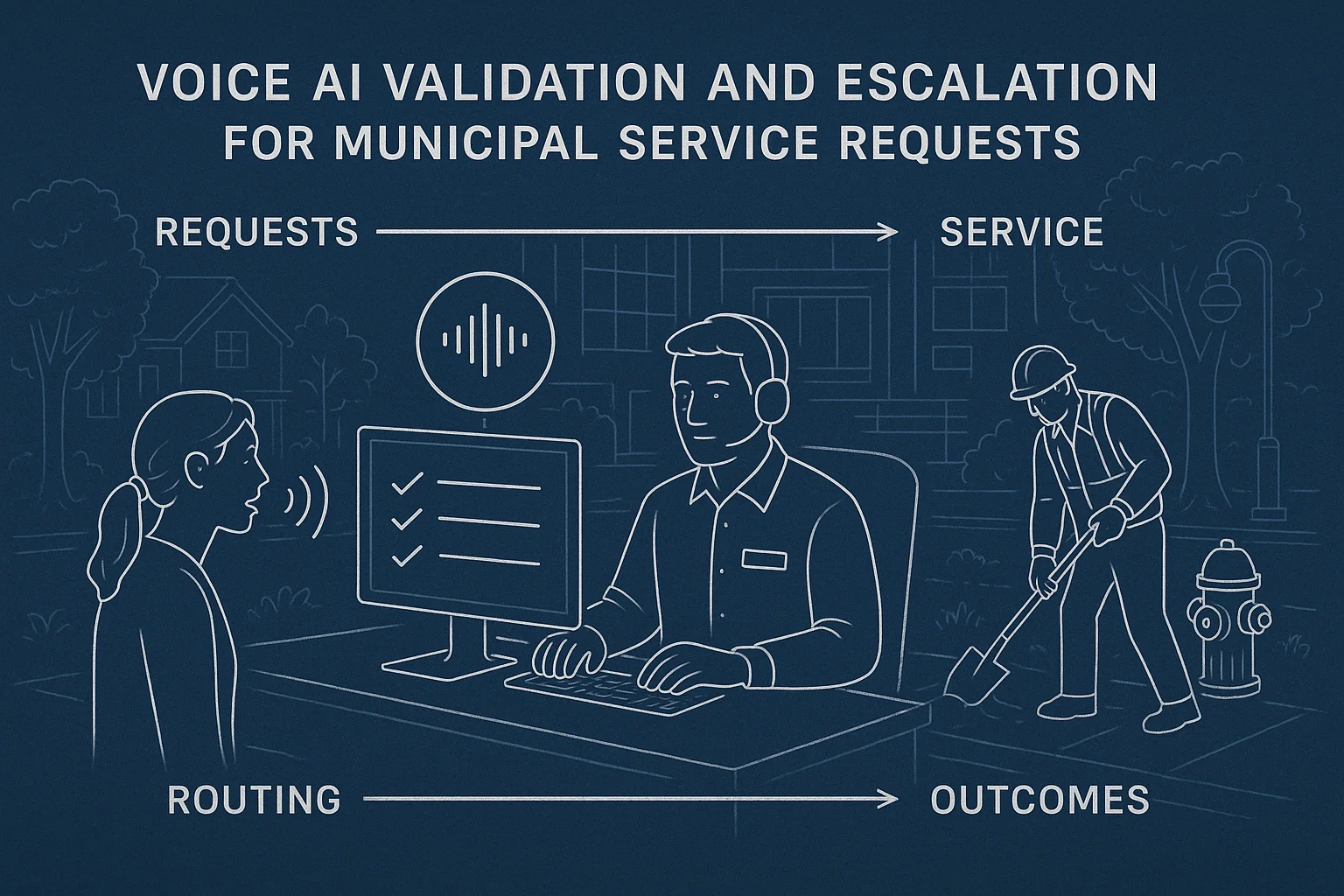
Prefer controlled adapters and approved REST/HTTPS APIs for case submission. The logic bridge should perform authentication, idempotency, field mapping, and error classification. Peak Demand’s approach integrates dynamic forms, API adapters, validation and duplicate controls so the Voice AI only submits clean payloads that receive confirmation numbers or a documented human-handoff. Ensure the integration supports confirmation numbers, case updates, and status callbacks so residents can receive status by SMS or email.
- Use an orchestration layer (webhooks + adapters) to isolate the voice model from downstream systems.
- Require clear error codes for partial failures so the system can retry, queue for human resolution, or roll back.
- Log each API interaction with timestamps, payloads, and a reconciliation ID for audits.
Related Peak Demand resources
Industry and AI sources reviewed
- Artificial Intelligence Risk Management Framework (AI RMF 1.0)National Institute of Standards and Technology (NIST)
- Cross-Sector Cybersecurity Performance GoalsCybersecurity and Infrastructure Security Agency (CISA)
- Algorithmic Impact AssessmentGovernment of Canada
Public-sector procurement, privacy, accessibility, records, cybersecurity, and administrative-law obligations vary by jurisdiction. This article is operational guidance, not legal advice; organizations should confirm applicable requirements with qualified professionals.
Frequently asked questions
Suitable workflows include structured resident inquiries, service-request intake, permit or program information, appointment scheduling, department routing, status updates from approved systems, and after-hours overflow. Adjudication, enforcement discretion, emergency response, and binding eligibility decisions should remain with authorized staff.
Official reference: Artificial Intelligence Risk Management Framework (AI RMF 1.0)
Use a controlled service catalogue, required fields, department ownership rules, validation, duplicate checks, confirmation numbers, and documented handoff paths. The system should create an auditable record and avoid silently dropping requests when a downstream system is unavailable.
Official reference: Algorithmic Impact Assessment
Municipal deployments should document purpose, affected services, data use, human oversight, complaint and appeal paths, accessibility channels, records handling, monitoring, and the process for approving material changes.
Official reference: Algorithmic Impact Assessment
Require workflow demonstrations, integration and security architecture, testing evidence, auditability, data-location and subcontractor details, incident response, accessibility support, human escalation, exit planning, and clear ownership of ongoing updates.
Official reference: Artificial Intelligence Risk Management Framework (AI RMF 1.0)
Modernize public-service intake without losing control
Peak Demand helps municipal teams connect Voice AI to service requests, department routing, validation, escalation, records, and operational analytics.
Schedule a discovery call