
Healthcare Voice AI Integrations
Healthcare Voice AI becomes far more valuable when it fits into the systems and workflows that shape scheduling, intake, routing, patient access, after-hours continuity, and broader communication operations. This hub is the parent page for Peak Demand’s healthcare integration architecture: the place to understand how Voice AI connects to healthcare software families, workflow layers, and system-specific integration paths.
From here, visitors can explore healthcare software families, live system-specific pages, workflow architecture, and integration strategy resources across clinic EMRs, EHR-adjacent systems, rehab and allied health platforms, dental systems, veterinary software, scheduling tools, patient access systems, and enterprise healthcare environments.
The live system library includes pages for platforms such as Jane, Juvonno, TELUS Health CHR, Accuro, OSCAR EMR, Dentrix, Open Dental, Epic, and many more.

Architecture Role
Parent hub for healthcare integrations
System Coverage
98 healthcare system pages
Software Families
6 healthcare integration families
Workflow Focus
Scheduling, intake, routing, access
Healthcare integrations should be evaluated through workflow continuity
One of the biggest mistakes in healthcare integration conversations is reducing the discussion to a list of software names. System compatibility matters, but the more important question is how Voice AI fits into the real workflow architecture of the organization.
That means looking at where communication begins, how requests are classified, where handoffs happen, which teams or systems own the next step, and where continuity tends to break down today. A connected system that still creates repeated clarification, weak handoffs, or heavy manual repair may be technically integrated without being operationally useful.
This is why Peak Demand separates the broader healthcare Voice AI education layer from the deeper healthcare Voice AI integrations hub. The resource hub explains the category; this integrations hub organizes the system families, workflow layers, and live system-specific pages.
Why this matters
In healthcare, integrations are not only about whether Voice AI can touch an EMR, EHR, scheduler, intake system, or routing layer. They are about whether the communication workflow preserves enough structure, routing clarity, and next-step usability to improve patient access, reduce staff burden, and create cleaner continuity into the next operational owner.
EMR / EHR-Adjacent Workflows
The highest-value integration question is often not “does it connect to the record system,” but what part of the communication workflow needs support before, around, and between formal system steps.
- Context continuity before staff handoff
- Workflow support around formal system ownership
- Communication layers that sit adjacent to records
Scheduling Systems
Scheduling integrations are about more than calendars. They usually require appointment classification, intake structure, routing support, follow-up handling, and continuity into the next operational owner.
- Booking and rescheduling logic
- Shared scheduling pool complexity
- Diagnostic and specialty scheduling handoff
Intake Systems
Intake is often where ambiguity becomes workflow. Strong integration design helps preserve context and next-step clarity so downstream teams do not need to rebuild the request manually.
- Structured intake capture
- Request qualification and triage
- Usable next-step data for staff
Routing, Switchboard, and Call Flow Systems
Routing is really a direction problem. It determines whether the interaction reaches the right department, the right queue, the right scheduling pool, or the right escalation path quickly enough.
- Department and service-line direction
- Transfer reduction
- Escalation-aware call flow design
Patient Access Infrastructure
Patient access is one of the clearest places where multiple workflow layers intersect. Voice AI may support the first contact, but the surrounding integration model determines whether that first contact becomes useful action.
- Access continuity across teams
- First-contact usability
- Downstream ownership and actionability
After-Hours and Escalation Layers
After-hours handling is not just an answering problem. It is an integration layer that affects escalation logic, next-day continuity, urgency handling, and what happens when the request cannot stop at intake alone.
- Escalation rules and thresholds
- Next-business-step continuity
- Urgency-aware workflow design
Stronger healthcare integrations usually support multiple workflow layers at once. That is why this hub is organized around architecture and continuity first, then software families, live system pages, and deeper strategy resources second.
Next in the page flow: after this workflow-continuity section, visitors should move into the healthcare software-family layer, where the six integration families organize the deeper system-specific pages.
Browse Healthcare Software Families
AI Minister Evan Solomon Sounds Alarm: Why Canada’s AI Reset Matters for Every Business
TL;DR
Canada’s new AI Minister, Evan Solomon, is fast-tracking a refreshed national AI strategy. The plan highlights procurement, privacy reform, sovereign compute, and a 30-day task force. But Canadian firms still hesitate — chasing perfection instead of progress. Peak Demand helps break this paralysis by analysis with a test → ship → test → scale approach, delivering bespoke automations that start generating ROI in weeks, not years.
Canada’s AI Wake-Up Call
Canada just flipped the switch from “wait and see” to “move now.” With Evan Solomon as the new AI Minister, Ottawa is pulling the national AI strategy forward by nearly two years and framing this as a hinge moment for the economy. The message is simple: leadership isn’t a birthright — you earn it by shipping real systems, not by planning forever.
A few clear signals cut through the noise:
Urgency over timelines: the refreshed strategy is being tabled early to accelerate adoption, commercialization, safety, and sovereignty work.
From research to results: Canada’s world-class labs and talent are expected to translate into deployments that improve service, productivity, and competitiveness.
From pilots to production: the emphasis is on government procurement, sovereign infrastructure, and regulatory clarity — the conditions businesses need to launch with confidence.
For Canadian companies, this isn’t about hype; it’s about execution. The firms that start small, ship quickly, and iterate weekly will compound advantages in efficiency and customer experience. Those that keep waiting for perfect conditions will find the gap widening — not only against international competitors, but against domestic peers who are already operationalizing AI.
Canada’s AI Adoption Snapshot

Canada’s adoption gap is real and measurable:
6.1% of Canadian businesses currently use AI.
10.6% say they plan to adopt AI in the next 12 months.
74%+ still report that AI is “not relevant” to their business.
Roughly 150,000 Canadians already work in the AI sector.
What this mix tells us:
Low current use vs. high workforce presence — Canada has substantial AI talent employed, yet business adoption remains thin.
Intent–execution gap — planned adoption (10.6%) is higher than current use, but still modest relative to the opportunity.
Perception barrier — the “not relevant” majority signals a knowledge and understanding gap, not a lack of viable use cases.
Where adoption is most likely first:
Customer contact (voice agents, intake, triage, follow-ups)
Operations (routing, scheduling, status lookups, documentation)
Data assistance (summaries, reporting, research copilots)
Bottom line: Canada isn’t short on AI talent or tools; it’s constrained by perception and execution. Converting intent into small, shippable pilots is the fastest way to move these numbers.
Canada vs. the World

Canada has a unique position in the global AI ecosystem: world-class research leadership paired with lagging commercialization.
Where Canada leads:
Mila (Montreal), Vector (Toronto), and Amii (Edmonton) are globally respected institutes.
Pioneers like Geoffrey Hinton, Yoshua Bengio, and Rich Sutton shaped the foundation of modern AI.
Canada was the first country in the world to launch a national AI strategy in 2017.
Where Canada lags:
Adoption rates — only 6.1% of businesses use AI, far behind peers in the U.S., U.K., and Asia.
Commercialization — Canadian startups often sell or move abroad instead of scaling at home.
Capital access — early- and growth-stage funding is harder to secure domestically.
Global competitors:
The U.S. and China push rapid deployment with minimal regulation.
The EU is tightening rules, sometimes at the cost of innovation speed.
The U.K., India, and Japan are investing billions in sovereign compute and public–private AI factories.
The lesson: leadership is no longer a birthright. Canada’s early breakthroughs gave it a head start, but the global race is accelerating. To stay relevant, Canada must turn research into results, deploy faster, and treat commercialization as seriously as discovery.
How We Got Here

Canada’s AI policy has moved in waves — from early bets on research to a new push on infrastructure and adoption.
2017 — The first national AI strategy ($125M).
Objective: put Canada on the map by funding talent and science.
Mechanism: support for research via national institutes (Mila, Vector, Amii) and academic programs.
Outcome: global credibility in fundamental AI and a strong pipeline of researchers.
2021 — Renewal and shift toward commercialization (~$443.8M).
Objective: translate research into products and companies.
Mechanism: programs for industry partnerships, accelerators, and talent retention.
Outcome: more spin-outs and pilots, but adoption inside Canadian firms remained uneven.
2024 — Scale the backbone: compute and capacity ($2B + targeted programs).
Objective: close the infrastructure gap (training, fine-tuning, and secure deployment at home).
Mechanism: national compute investments; funding for adoption incentives, safety, and worker upskilling.
Outcome: momentum around sovereign infrastructure and enterprise-grade use cases, setting the stage for wider deployment.
2025 — The early refresh (pulled forward nearly 2 years).
Rationale: the global race has accelerated; Canada needs near-term wins and clarity.
Instruments announced:
AI Strategy Task Force (~20 leaders, 30-day sprint, report due in November).
Focus areas: research, adoption, commercialization, skills, safety/security, and infrastructure.
Policy alignment: privacy/data law modernization; protections against deepfakes; child safety.
Digital sovereignty: keeping key sensitive data under Canadian law via sovereign/ hybrid compute.
Next wave: a quantum initiative to retain talent and IP in Canada.
Demand creation: stronger government procurement to validate and scale Canadian-made AI.
What’s changed: Canada is moving from long-horizon strategy to operational urgency — shifting the centre of gravity from labs and pilots to production deployments with clear guardrails.
What’s New in the 2025 Reset

The refreshed AI strategy announced in Montreal isn’t just symbolic — it adds concrete tools and timelines that change how Canada approaches artificial intelligence.
Key elements of the reset:
AI Strategy Task Force
~20 members drawn from industry, academia, and civil society.
Given a 30-day sprint to consult, generate ideas, and report back in November.
Mandate covers research, adoption, commercialization, investment, infrastructure, skills, safety, and security.
Modernized Privacy Laws
Updating Canada’s 25-year-old framework to address deepfakes, scams, and protections for children.
Designed to balance trust and innovation — giving businesses clarity while assuring citizens their data is safe.
Sovereign Compute
Commitment to Canadian-controlled cloud and data centres for key sensitive data (health, finance, personal records).
Hybrid and public models will remain, but the “digital insurance policy” ensures data stays under Canadian law.
Quantum Initiative on the Horizon
Launching October 2025.
Goal: prevent “IP flight” by anchoring quantum talent and intellectual property in Canada.
Positions quantum as a complementary pillar to AI in national competitiveness.
Government as Lead Customer
Expanding procurement to validate and scale Canadian-made AI solutions.
Builds markets domestically before relying on global buyers.
Trust and Safety First
Reinforcing that adoption moves at the speed of trust.
Clear standards, safeguards, and an expanded Canadian AI Safety Institute to build public confidence.
The shift: Canada is no longer just investing in research and talent. The 2025 reset is about operational readiness — ensuring the policies, infrastructure, and safeguards exist to turn breakthroughs into production systems.
Why Canadian Businesses Still Hesitate

Despite billions in funding and world-class research institutions, Canadian businesses continue to stall on AI adoption. The reasons are less about technology and more about mindset:
Paralysis by analysis
Too many firms demand a “perfect” AI build before going live. Instead of launching pilots, they stall in planning mode — chasing 100% certainty that never arrives.Knowledge and understanding gap
A recent survey found that 78% of Canadian businesses believe AI is irrelevant to their operations. This isn’t reality — it’s a reflection of limited awareness about what AI can already do today.Risk aversion
Canadian companies often lean conservative in tech adoption, preferring to wait for others to prove ROI. But in AI, waiting only widens the competitive gap.Trust concerns
Fear of scams, deepfakes, and regulatory uncertainty makes leaders cautious. Without visible guardrails, they assume the safest path is inaction.
At Peak Demand, we’ve seen this pattern firsthand in hundreds of demos across Canada. The sticking point isn’t infrastructure or even funding — it’s perfectionism. Businesses want to cover every edge case, anticipate every outcome, and build airtight systems before testing anything.
But AI doesn’t work that way. It is iterative by design:
Test a small workflow.
Ship it into production.
Learn from real usage.
Scale and refine.
The longer companies hold back, the more they miss out on the compounding effects of automation and data-driven learning. The real risk isn’t making mistakes with AI — it’s standing still while competitors move ahead.
Execution vs. Intention: Turning AI Adoption Plans Into Shipped AI Systems in Canada

Canadian businesses talk about AI adoption more than they deliver it. Roadmaps, sandboxes, and proof-of-concepts proliferate—but few initiatives cross the line into production. The difference isn’t tools or talent; it’s an execution operating system.
What execution looks like (in Canada, now):
Define one workflow with a measurable outcome (handle rate, wait time, cost per interaction, SLA compliance).
Ship a minimal, safe version to real users (limited scope, audit logs, human-in-the-loop).
Measure weekly, not quarterly (errors, escalations, ROI proxy metrics).
Iterate in small releases—tighten prompts, policies, guardrails; expand coverage only after stability.
Scale deliberately (more users, more channels, additional languages, deeper system integrations).
Why most AI plans in Canada stall:
They chase full coverage and edge-case perfection before launch.
They treat AI as a single “project,” not a continuous product.
They separate policy, data, and engineering decisions instead of running them in parallel.
The mindset shift for AI adoption in Canada:
From perfect to progressive. AI is a growth process, not a finished product.
From pilots to productization. Every test must have a path to production and ownership after day 30.
From vanity to value. Replace slideware with live metrics tied to customer experience and unit economics.
A simple rule helps Canadian teams move faster without breaking trust: test → ship → learn → scale. Small, safe launches compound into durable capability—while endless planning compounds into lost time.
Positive Momentum in Canada’s AI Ecosystem: Sovereign Compute, Enterprise AI Agents, and Public–Private Adoption Signals

Canada’s AI adoption story is shifting from theory to practice. A few high-signal developments point to real operating capacity and growing trust:
Sovereign compute becomes real
TELUS has stood up a fully sovereign AI factory in Rimouski, with end-to-end capabilities (training → fine-tuning → inference) under Canadian law and power. This addresses the top barrier cited by regulated sectors: data residency and control.Enterprise-grade AI agents in financial services
Major institutions are building and deploying production agents to accelerate research workflows and client insights. This validates that agentic AI is not only for labs; it can meet security, audit, and latency expectations in demanding environments.Federal partnerships and procurement
Cohere’s collaboration with Ottawa signals that the public sector will act as an anchor customer. Government procurement is a proven catalyst: it de-risks adoption, creates early demand, and helps domestic vendors scale.Task force and strategy cadence
The 30-day national task force and the early strategy refresh tighten the feedback loop between policy, infrastructure, and deployment—a practical shift from long planning cycles to an operating rhythm.Ecosystem alignment (industry + institutes)
Canada’s research strengths (Mila, Vector, Amii) are increasingly linked to production-grade platforms, giving startups and incumbents clearer on-ramps from models to maintained services.
What this momentum means for AI adoption in Canada:
Trust is rising — sovereign options and government validation lower perceived risk.
Time-to-value shrinks — ready infrastructure + reference architectures reduce lift for first pilots.
Talent retention improves — real deployments keep engineers and researchers building here.
Playbooks emerge — regulated and enterprise exemplars provide reusable patterns for other sectors.
How businesses can ride this wave now:
Pick one workflow that benefits from data residency and strong auditability.
Target a 30-day pilot using sovereign or hybrid deployment paths.
Measure weekly (handle rate, turnaround time, escalation %, unit cost) and iterate.
Use public-sector and enterprise examples as templates, not just inspiration.
What Canada’s AI Strategy Must Deliver for Real Adoption, Sovereign Compute, and Business Growth

The 2025 reset sharpens the lens: Canada’s AI strategy can’t just be aspirational — it must create the conditions for adoption, trust, and scale. For businesses to move beyond pilots, the government’s roadmap has to deliver on several fronts:
Government demand through procurement
Ottawa must act as a lead customer, buying Canadian-made AI solutions to validate and scale them.
Procurement isn’t glamorous, but it’s the fastest way to prove ROI and build reference cases.
Early- and growth-stage capital
Entrepreneurs cite lack of patient Canadian capital as a blocker.
The reset promises new tools to help startups raise seed and Series A rounds at home, keeping HQs and IP in Canada.
Sovereign compute and secure cloud
A digital insurance policy: keeping key sensitive data — health, financial, personal — under Canadian law.
TELUS’ sovereign AI factory in Rimouski is the first proof point, but more capacity and regional coverage are essential.
Privacy reform and public trust
Canada’s data laws are 25 years old. Modernization must cover deepfakes, scams, and protections for children.
Without clear rules, businesses hesitate. With them, adoption accelerates.
Talent retention and skills development
Canada produces elite AI researchers, but too many are pulled abroad.
A refreshed strategy must anchor talent with real deployment opportunities, not just academic projects.
Quantum leadership
A major quantum initiative (coming October 2025) is meant to keep IP and talent in-country.
Quantum + AI is a strategic hedge to ensure Canada doesn’t become a farm team for someone else’s economy.
Public engagement
Adoption moves at the speed of trust. Citizens need transparency on how AI is used in healthcare, education, and government services.
Public consultations (starting October 2025) are part of the reset — but outcomes must be visible, not buried in reports.
Bottom line: for Canada to win, the refreshed AI strategy must connect policy levers, infrastructure, and capital to real-world adoption. The government can open the door, but businesses have to walk through it — by testing, shipping, and scaling.
Peak Demand’s Perspective on AI Adoption in Canada: Global–Local Stack, Cross-Border Data Reality, and the New SEO–LLM Visibility Gap

Founder Alex Masters Lecky has watched Canadian firms under-invest in technology fundamentals for nearly two decades. Long before AI, many organizations hesitated to commit to SEO and organic lead generation—treating them as optional rather than foundational. That hesitation compounded: fewer ranked pages → fewer branded searches → weaker pipelines → smaller budgets to reinvest. Ironically, the rise of LLM answer engines now amplifies this penalty. Models surface the best-documented, most frequently referenced, and most interlinked sources on the open web; firms that invested in structured, authoritative content are disproportionately represented in AI answers and summaries. Canadian companies that skipped SEO aren’t just invisible on Google—they’re also underrepresented in LLM-generated results, widening the competitiveness gap with U.S. and international peers who have spent 10–20 years building durable web authority.
Our operating philosophy
We built Peak Demand to close this adoption and visibility gap with an approach that favors momentum and measurable learning over perfection:
Test → Ship → Learn → Scale. AI rewards iteration. You de-risk by shipping smaller, sooner, with clear guardrails—then compounding improvements week by week.
Bespoke over boilerplate. We design custom automations around your real systems, staff, and compliance constraints, not a vendor’s one-size-fits-all template.
Best-in-class tools by default. We integrate leading international platforms and models to meet enterprise expectations for reliability, observability, and security—and we benchmark alternatives continuously.
Global–local by design: sovereignty is an architecture question, not a slogan
A large share of software used by Canadian firms—including products built by Canadian founders—relies on components from global hyperscalers (Google, Microsoft, AWS). That reality doesn’t automatically negate Canadian sovereignty; it means sovereignty must be designed:
Classify data, don’t generalize. Identify key sensitive data (health, financial, personal identifiers) and require that it remain under Canadian law with explicit controls (residency, customer-managed keys, private networking, least-privilege access, immutable logs).
Right-place the rest. For non-sensitive workloads, use world-class global infrastructure where it materially improves security posture, resilience, latency, and cost.
Map the flows. Document what data moves, where, when, and under which contract, including sub-processors. Use runbooks, logging, and attestations to prove compliance rather than assert it.
Design for audit. Version prompts and policies; ship model cards and release notes; keep rollback paths; sample and review outputs routinely.
Peak Demand’s stance is principled and pragmatic: we support building a sovereign backbone for key sensitive Canadian data, and we are keen to incorporate Canadian LLMs, sovereign compute, and safety frameworks as they mature. At the same time, we will not endorse “sovereign-in-name-only” setups that are weaker on actual security. If an all-domestic option lacks essential controls (telemetry depth, isolation guarantees, incident response maturity, hardware security), we architect hybrids: sensitive stays in-country and under Canadian law; performance-critical or commodity components leverage best-in-class global platforms. Security is achieved through system design and ongoing governance—not geography alone.
Policy alignment: sovereignty ≠ solitude, and regulation must be “tight, light, and right”
We align with the federal direction articulated by the new AI leadership: sovereignty does not mean solitude. Canada needs a digital insurance policy for critical data while recognizing that a modern economy requires lawful, governed cross-border data flows. It is equally true that Canada’s data and privacy laws are roughly 25 years old and must be modernized to reflect today’s hyper-speed technology cycles. The guiding regulatory philosophy—tight, light, and right—matches how we build:
Tight where it counts: minors, deepfakes, identity abuse, safety-critical decisions, and key sensitive data.
Light on low-risk experimentation so teams can ship, learn, and improve without months of red tape.
Right in aligning incentives so innovators can invest with clarity, and citizens and customers can trust outcomes.
Why the SEO–LLM visibility gap matters for AI adoption
The visibility deficit is not just a marketing issue; it is an AI adoption issue:
Talent and partners find you less often. LLMs and search surface competitors with stronger content footprints; they attract more qualified inquiries and better collaborators.
Procurement signals skew away from you. Public and enterprise buyers look for proof, references, and citations; poor web authority reduces perceived maturity.
Your own AI pilots are harder to justify. Without inbound demand, pilots are budget-strained and momentum stalls—feeding a loop of underinvestment.
To correct course, you need two intertwined tracks:
Operational AI (voice agents, workflow automations, agentic data queries) that ship and show ROI in weeks.
Authority building (SEO-grade, LLM-ready content: clear use cases, structured data, FAQs, citations, and transparent model governance) so both humans and models can validate your expertise.
How we implement safely—fast
We move quickly with guardrails:
Scope a Tier-1 workflow (reversible, low harm), define 3–5 KPIs (containment rate, handle time, escalation %, CSAT, unit cost).
Ship a minimal, safe version with human-in-the-loop, confidence thresholds, and an immediate kill switch.
Instrument everything (immutable logs, versioned prompts/policies, model IDs, input/output capture with masking).
Review weekly (top failure modes, bias checks, red-team attempts), then expand coverage only after stability.
Document and publish a lightweight model card and known limitations; align with internal privacy and security policies.
What we’ve learned from hundreds of Canadian demos
The blocker is rarely tooling or compute—it is perfectionism. Teams aim for 100% coverage before launch, try to solve every edge case on paper, and postpone hardening until “later.” Our job is to break that stalemate: deliver a contained win, make value visible, and then scale deliberately. As soon as teams experience live metrics improving week to week, the cultural fear declines and adoption accelerates.
Where we’re going next
Peak Demand has been naming Canada’s adoption drag for nearly three years. With the federal push for sovereignty plus adoption, and a regulatory approach that prizes speed with safeguards, we’re fully aligned. We’ll keep pairing global best practice (for real security and performance) with homegrown Canadian capabilities (for residency and resilience), so clients get the most advanced, auditable, and sustainable automation stack available. And we’ll help close the SEO–LLM visibility gap by designing operations and communications that models and humans can both trust—so when the next wave of customers asks an AI for “the best team to automate this,” your firm is in the answer.
Quick Wins for AI Adoption in Canada: Workflows Every Business Can Automate in 30 Days

For Canadian companies still debating whether AI is “relevant,” the best way forward is not theory — it’s shipping a small, safe pilot. Within 30 days, most organizations can launch at least one of these quick wins:
Inbound call and message triage
AI voice agents or chat agents capture calls, emails, or web inquiries.
Automatically classify urgency, intent, and route to the right team.
Immediate ROI: reduced missed leads and faster response times.
Appointment booking and scheduling
AI handles back-and-forth with customers or patients.
Syncs with existing calendars, sends reminders, and manages rescheduling.
Saves staff hours while improving show-up rates.
Automated follow-ups and reminders
After sales calls, service visits, or medical appointments, AI follows up with clients.
Can nurture dormant leads, confirm satisfaction, or prompt rebookings.
Builds loyalty and fills calendars without extra staff time.
Agentic data queries and reporting
AI agents connect to CRMs, ERPs, or HR systems to answer natural-language questions like:
“What’s our average resolution time this month?” or “Show me unpaid invoices over 30 days.”Eliminates hours of manual reporting and makes insights accessible to non-technical staff.
Customer feedback capture (optional but high impact)
AI surveys or conversational agents gather structured customer feedback.
Generates real-time sentiment analysis to guide product, service, or staffing decisions.
Why these matter for Canada’s AI adoption gap:
They are universal (apply across healthcare, retail, services, finance, and beyond).
They are low-risk (clear boundaries, human-in-the-loop options).
They are ROI-visible in weeks (staff time saved, conversions increased, satisfaction improved).
For Peak Demand, these workflows aren’t hypotheticals — they are repeatable pilots we’ve tested across sectors. Each one is designed to launch fast, iterate safely, and scale once metrics prove value.
Guardrails and Governance for Responsible AI Adoption in Canada (Trust, Safety, Compliance, and Sovereign Compute)

AI adoption in Canada must balance speed with safety. Not every workflow should be automated, and every automated workflow needs observable controls, human oversight, and clear rollback paths. Here’s a practical framework you can copy into your operating playbook.
1) Decide what not to automate (risk-tiering)
Tier 1 (Low risk): reversible tasks, low harm if wrong (triage, reminders, status lookups).
Tier 2 (Moderate): customer-facing answers, light transactions, internal analytics.
Tier 3 (High): decisions affecting money/health/safety/employment/legal exposure.
Rule: Start with Tier 1. Tier 2 requires stronger oversight. Tier 3 demands rigorous review and staged rollouts.
2) Human-in-the-Loop (HITL) by design
Pre-deployment review: prompt/policy review, data mapping, DPIA/PIA-style assessment.
In-flow controls: confidence thresholds, escalation rules, and one-click handoff to a human.
Post-action checks: sample audits; supervisor sign-off for sensitive outputs.
3) Auditability and version control
Immutable logs: prompts, inputs, outputs, model/version IDs, policies applied, user IDs, timestamps.
Change management: PR-style approvals for prompt/policy changes; tagged releases; rollback plan.
Model cards & release notes: purpose, limitations, known failure modes, evaluation results.
4) Safety nets that actually trigger
Kill switch: immediate disable for a bot/skill/connector.
Fallbacks: scripted responses, human queue routing, or safe defaults when uncertainty exceeds a threshold.
Rate limits & cost caps: protect systems and budgets from spikes or loops.
5) Data minimization and security
Collect only what’s needed for the task; avoid sensitive fields where possible.
Access controls: least-privilege, role-based, and time-bound credentials.
Encryption: in transit and at rest; tokenization for high-sensitivity data.
Retention: set explicit retention windows; purge logs that no longer serve audit purposes.
6) Sovereign compute and residency choices (Canada context)
Classify data into public, internal, sensitive; keep key sensitive data under Canadian law.
Select sovereign or hybrid deployments for regulated workflows; use vendor attestations for residency & sub-processors.
Document where each workflow runs and why (risk justification).
7) Evaluation and monitoring
Pre-launch evals: accuracy, hallucination rate, refusal correctness, latency, and bias checks on representative data.
Production KPIs: containment rate, escalation %, correction time, customer CSAT, handle time, cost per interaction.
Drift detection: monitor sudden changes in error patterns and user feedback.
8) Bias, fairness, and accessibility
Test outputs across language, dialect, gender, age, and region.
Provide explanations where feasible; publish known limitations in end-user terms.
Accessibility: readable formatting, alt text, and clear escalation paths for users who need assistance.
9) Policy, consent, and notice
Plain-language user notices about AI assistance; obtain consent where appropriate.
Suppress or mask PII/health/financial data where not essential.
Align with internal codes (privacy, security, acceptable use); train staff and document completion.
10) Incident response and red-teaming
Playbooks for misinformation, prompt injection, data leakage, and abuse.
Red-team exercises quarterly: simulate jailbreaks, toxic input, and model misuse.
Public-facing statement templates for incidents (who, what, when, actions, prevention).
11) Vendor governance
DPA/SLA requirements: uptime, support, security attestations, breach notifications, subcontractor transparency.
Pen-test & SOC reports reviewed annually; corrective actions tracked.
Exit plan: data export, model policy export, deprovisioning steps.
12) People and RACI
Responsible: product owner.
Accountable: business exec + privacy/security lead.
Consulted: legal/compliance, frontline managers.
Informed: support operations, comms, finance.
30-Day Governance Starter Pack (copy/paste)
Week 1: Risk-tier the target workflow; map data; define KPIs; draft user notice; create escalation tree.
Week 2: Build HITL; configure logs; set rate limits/cost caps; run pre-launch evals; write rollback plan.
Week 3: Soft launch to a small cohort; daily monitoring; fix top 3 issues; bias spot-checks.
Week 4: Expand audience; weekly audit sample; publish model card & known limitations; schedule first red-team.
Bottom line for AI adoption in Canada: Move fast with guardrails. Governance is not a brake—it’s the enabler that lets you scale from a safe pilot to a resilient, auditable production system.
Closing: The Blunt Truth on AI Adoption in Canada — Seize the Momentum or Fall Behind

Canada no longer has the luxury of waiting. With a refreshed national AI strategy pulled forward and a clear mandate from AI Minister Evan Solomon, the direction is set. What remains is the hard part: execution. Either Canadian businesses move from decks to deployments, or we watch the productivity gap widen—first to domestic peers who ship, then to international competitors who already have.
Here’s the reality:
Speed is the strategy. In AI, first movers compound advantages in data, feedback loops, and customer trust.
Sovereignty is design, not a slogan. Keep key sensitive data under Canadian law; use world-class infrastructure where it truly improves security and performance.
Perfection is a trap. What wins is a weekly cadence of test → ship → learn → scale, with guardrails and governance baked in.
Visibility matters. If you don’t ship and document real outcomes, you lose ground in both search and LLM surfacing—and the market won’t find you.
Peak Demand is ready to help. We’ll scope a contained workflow, ship safely, measure what matters, and scale only after the win is proven. You’ll get a stack that respects Canadian residency where it counts and leverages best-in-class global capability where it adds resilience and security. Most importantly, you’ll replace hesitation with momentum.
This is Canada’s moment to move from research leadership to operational leadership. The question isn’t whether AI will transform your industry—it’s whether you will be the one to deploy it.
Book a Discovery Call: Launch Your First AI Workflow in 30 Days
Ready to move from planning to production? Book a free 30-minute call: https://peakdemand.ca/discovery
What you’ll get:
Identify one high-impact workflow tailored to your stack and goals
Estimate ROI and efficiency gains with concrete, trackable KPIs
Build a 30-day pilot plan with guardrails, HITL, and auditability baked in
Don’t wait for perfect. Start shipping.
BetaKit — Canada will update AI strategy a year ahead of schedule: Evan Solomon
Primary announcement details: early refresh of the national AI strategy, task force timeline, sovereignty language, CLOUD Act concerns.
https://betakit.com/canada-will-update-ai-strategy-a-year-ahead-of-schedule-evan-solomon/
Global News — Ottawa planning ‘refreshed’ AI strategy, minister says
Coverage of Solomon’s keynote at All In, task force composition, privacy law reform, digital sovereignty, and public trust.
https://globalnews.ca/news/11448831/ottawa-refreshed-ai-strategy-minister/
Western Wheel / Canadian Press — Ottawa assembling AI task force as it prepares ‘refreshed’ strategy
Details on the task force’s mandate, scope (research, adoption, commercialization, safety, skills), and quantum initiative preview.
https://www.westernwheel.ca/the-latest/ottawa-assembling-ai-task-force-as-it-prepares-refreshed-strategy-11256494
Halifax City News / Canadian Press — Ottawa planning ‘refreshed’ AI strategy, data protection bill
Reporting on Solomon’s remarks about privacy reform, deepfakes, children’s protections, and public consultations.
https://halifax.citynews.ca/2025/09/24/ottawa-assembling-ai-task-force-as-it-prepares-refreshed-strategy/
The Logic — Canada launches a new task force to update its AI strategy
Deep dive into funding history ($125M in 2017, $443.8M in 2021, $2B in 2024), public consultation plans, and Solomon’s “sovereign backbone” remarks.
https://thelogic.co/news/evan-solomon-all-in-announcement/
NVIDIA Blog — Canada Goes All In on AI
Coverage of All In event: TELUS sovereign AI factory, RBC AI agents, Cohere partnership with Ottawa, NVIDIA’s role, and Solomon’s digital sovereignty framing.
https://blogs.nvidia.com/blog/canada-all-in/
CPAC — AI Minister Evan Solomon Gives a Speech in Montreal
Full video of Solomon’s keynote and panel participation with NVIDIA, Cohere, and Amber Mac at the All In conference.
https://www.cpac.ca/headline-politics/episode/ai-minister-evan-solomon-gives-a-speech-in-montreal--september-24-2025?id=ed765464-e944-4150-9703-558ff90d6cbb
Statistics Canada — Survey of digital technology and internet use (AI adoption snapshot)
Latest release showing 6.1% adoption, 10.6% planning, and >74% still not engaging with AI, despite 150,000 Canadians in the sector.
https://www150.statcan.gc.ca/n1/daily-quotidien
Peak Demand — 78% of Canadian businesses think AI is irrelevant (survey analysis)
Internal research contextualizing Canada’s adoption gap, cultural barriers, and implications for GDP and competitiveness.
https://peakdemand.ca/b/78-percent-canadian-businesses-think-ai-irrelevant-ottawa-ai-ministry-adoption-gdp-growth-economy-canada-business-trends
Learn more about the technology we employ.

At Peak Demand AI Agency, we combine always-on support with long-term visibility. Our AI receptionists are available 24/7 to book appointments and handle customer service, so no opportunity slips through the cracks. Pair that with our turnkey SEO services and organic lead generation strategies, and you’ve got the tools to attract, engage, and convert more customers—day or night. Because real growth doesn’t come from working harder—it comes from building smarter. Try Our AI Receptionist for Service Providers. A cost effective alternative to an After Hours Answering Service.

Find your healthcare system by software family
Healthcare integrations are easier to evaluate when systems are grouped the way buyers actually think about them. Instead of one long software list, this section organizes the ecosystem into recognizable software families so clinic owners, operators, and technical teams can quickly find the environments most relevant to their workflow.
Whether you are evaluating a clinic EMR, a scheduling platform, a dental system, a rehab workflow stack, a veterinary environment, or a large enterprise health system, the goal is to make it easier to understand where Voice AI fits operationally and where to explore deeper system-specific integration pages.
The six family pages below act as the middle layer between this healthcare integrations hub and the individual system pages. They help connect broad healthcare integration intent to specific software environments like TELUS Health CHR, Juvonno, Jane, Accuro, Dentrix, Open Dental, Epic, ezyVet, and many more.

Medical and Ambulatory EMR Systems
Explore how Voice AI fits into medical and ambulatory EMR environments across scheduling, intake, patient access, provider routing, after-hours continuity, and clinic communication workflows.
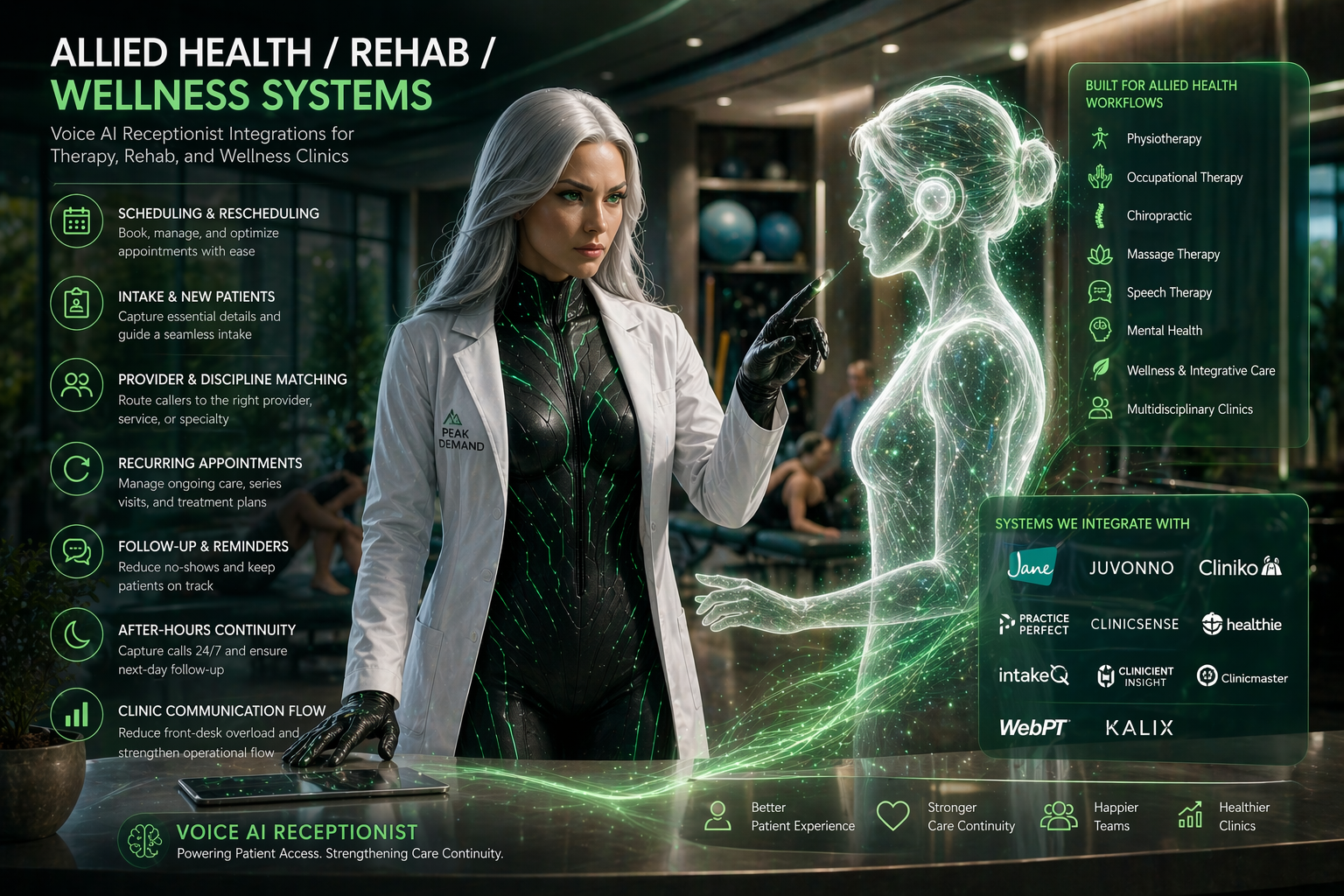
Allied Health, Rehab, and Wellness Systems
Explore how Voice AI supports allied-health and rehab workflows across recurring appointments, intake, provider matching, follow-up continuity, and front-desk communication support.

Dental Systems
Explore how Voice AI fits into dental communication workflows across new patient calls, hygiene recall, appointment flow, cancellation recovery, emergency routing, and front-desk continuity.

Veterinary Systems
Explore how Voice AI fits into veterinary environments across appointment continuity, client intake, urgent call routing, after-hours handling, and front-desk workflow support.

Chiropractic and Specialty Rehab Systems
Explore how Voice AI fits into chiropractic and specialty rehab workflows across scheduling, intake, recurring visits, SOAP-adjacent continuity, imaging-adjacent coordination, and front-desk support.
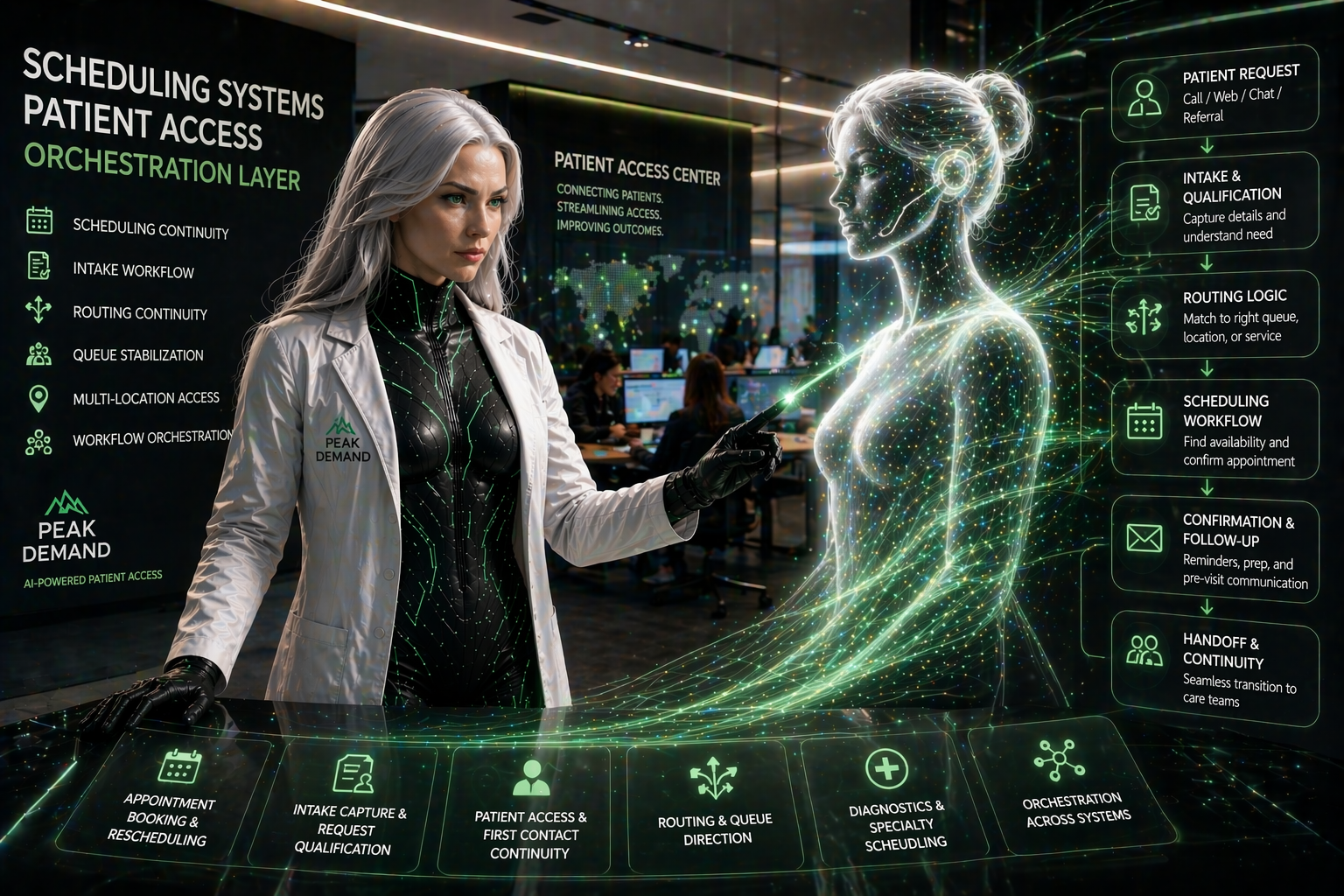
Scheduling, Patient Access, and Orchestration Systems
Explore how Voice AI supports scheduling and patient access architecture across intake, routing, queue stabilization, diagnostics scheduling, and workflow continuity between first contact and next action.
See Healthcare Voice AI Integrations In Action
These walkthroughs show how Voice AI can connect into real healthcare scheduling, intake, and communication environments. Start with TELUS Health CHR for Canadian clinic workflows and Juvonno for rehab and allied health operations.
TELUS Health CHR Integration Walkthrough
See how Voice AI can support TELUS Health CHR scheduling, intake, patient communication, and Canadian clinic workflow continuity.
Juvonno Integration Walkthrough
See how Voice AI can support Juvonno workflows for rehab scheduling, intake, appointment handling, and clinic communication continuity.
Explore published healthcare systems by name
Once you know the software family that best matches your environment, this section makes it easier to browse live healthcare integration pages by platform name. Each category below groups published system pages by the type of environment they usually support so operators, managers, and technical teams can compare workflow fit more quickly. A fuller alphabetical directory appears farther down the page.
Featured healthcare systems
These are high-priority starting points for visitors evaluating real-world Voice AI workflow fit across scheduling, intake, patient communication, routing, and access workflows.
Clinic, ambulatory, and medical EMR systems
These systems are commonly associated with clinic records-adjacent workflows, appointment flow, patient requests, intake continuity, routing, and broader ambulatory communication operations.
Scheduling, intake, and patient communication systems
These environments sit closer to booking logic, intake flow, reminders, clinic administration, and day-to-day patient access operations.
Rehab, physiotherapy, and allied health systems
Allied health and rehabilitation environments often depend on strong scheduling continuity, practitioner matching, intake flow, recurring appointment management, and multi-location operational coordination.
Dental systems
Dental communication workflows often center around appointment demand, cancellation recovery, reminders, new patient calls, and front-desk continuity across booked production.
Veterinary systems
Veterinary communication environments often require appointment continuity, client communication, after-hours handling, urgent call direction, and records-adjacent workflow coordination.
Healthcare organizations rarely evaluate integrations in a vacuum. Grouping systems by software family makes it easier to understand likely workflow fit, compare environments more quickly, and navigate toward both family-level integration pages and live system-specific pages deeper in this hub. The full alphabetical system directory farther down the page should carry the complete 98-system library.
Where Voice AI sits in the healthcare workflow matters more than basic connectivity
Healthcare Voice AI becomes more useful when it is treated as part of the larger workflow architecture around patient access, intake, routing, scheduling, escalation, and downstream ownership. The question is not only whether a system connects. The question is whether the communication flow reaches the next operational step with enough clarity and structure to reduce friction instead of shifting it downstream.
In practice, that means Voice AI often sits across multiple workflow layers at once. It may support first contact, gather structured intake, help direct the caller into the right path, preserve context for staff, and improve continuity into the next step. The value comes from how those layers fit together, not from one isolated connection point.
This is why healthcare teams should evaluate both the scheduling and patient access layer and the EMR or EHR-adjacent layer. In more complex environments, the architecture may also need to account for enterprise compliance and procurement requirements.
Where Voice AI usually enters the workflow
Voice AI often enters at the communication edge: inbound calls, appointment demand, intake capture, after-hours answering, overflow handling, and patient access or routing-related first contact.
Explore healthcare AI receptionistsWhere continuity usually breaks down
Continuity often breaks between the interaction and the next operational owner. That can happen when routing is weak, intake is unclear, scheduling context is incomplete, or downstream teams still need to manually rebuild the request.
Explore centralized scheduling workflowsWhat stronger integration architecture actually improves
Stronger architecture preserves enough structure, direction, and next-step usability for staff or systems to act efficiently. That is what turns Voice AI into operational infrastructure instead of a disconnected front-end layer.
Return to the healthcare resource hub| Integration maturity | What healthcare teams usually experience | Likely operational result |
|---|---|---|
| Fragmented | Some connection points exist, but scheduling, intake, routing, escalation, and continuity still require heavy manual repair. | Lower operational value, more staff burden, weaker patient access continuity, and less confidence in the workflow. |
| Partially connected | Important workflow layers connect, but structure and downstream usability still vary too much between teams, departments, or next-step owners. | Moderate gains, but persistent continuity gaps remain and staff still absorb unnecessary workflow friction. |
| Workflow-led and integrated | Voice AI supports multiple workflow layers with stronger structure, clearer routing, better handoff, and more usable next-step continuity. | Stronger patient access flow, cleaner operational ownership, and more scalable communication infrastructure. |
What healthcare teams should evaluate in the architecture discussion
- Where does Voice AI need to sit first in the communication workflow?
- Where does continuity currently break between the interaction and the next operational step?
- Which layers are EMR or EHR-adjacent, and which ones are workflow-adjacent?
- How do scheduling, intake, routing, patient access, and escalation interact in this environment?
- Will downstream teams receive enough structure to act without rebuilding the request manually?
- Is the integration design workflow-led or just feature-led?
- Does the current architecture reduce friction for staff, or does it simply move the work somewhere else?
Healthcare organizations usually get more value when they evaluate integration maturity across communication flow, operational ownership, and downstream usability together instead of treating each connection as a separate isolated decision. For system-specific evaluation, use the alphabetical healthcare system directory below.
Evaluating software families?
Use the six system-family pages to compare EMR, EHR, dental, veterinary, rehab, scheduling, and patient access environments.
Browse Software FamiliesEvaluating specific systems?
Use the full alphabetical directory to find the exact healthcare platform your team is evaluating.
Open System DirectoryEvaluating enterprise readiness?
Review governance, privacy, escalation, procurement, and compliance considerations before deployment.
Review ComplianceGo deeper into the strategy behind healthcare Voice AI integrations
This section helps healthcare teams move from broad category understanding into the right supporting resources for architecture, interoperability, workflow fit, implementation planning, and system-specific evaluation.
The articles below are the best next clicks for teams evaluating how Voice AI fits into healthcare communication systems, patient access workflows, structured integration pathways, rollout planning, and governed healthcare environments.
For broader category education, use the Healthcare Voice AI Resource Hub. For software-specific evaluation, continue to the full alphabetical system directory lower on this page and use the six healthcare software family pages as the parent layer.
Need system-family pages?
Use the family pages to compare medical EMR, allied health, dental, veterinary, specialty rehab, and patient access systems.
Browse Software FamiliesNeed a specific platform?
Use the alphabetical system directory to find the exact EMR, EHR, scheduling, dental, veterinary, or rehab platform.
Open System DirectoryNeed compliance context?
Use the enterprise compliance page when governance, privacy, procurement, RFPs, or regulated deployment requirements are part of the evaluation.
Review ComplianceCore integration strategy articles
These resources explain why integrations matter, what healthcare teams should evaluate first, and how stronger Voice AI integration architecture should be understood.
Custom pathways, structured integrations, and workflow fit
These articles are useful for teams evaluating custom pathways, structured communication flows, and how Voice AI fits into real healthcare operating environments.
Rollout, implementation, and governance
These resources are best for healthcare teams moving from early exploration into rollout planning, operational safety, implementation readiness, and governance-aware deployment.
Patient access, routing, and workflow bottlenecks
These articles help healthcare teams think more clearly about where communication complexity builds up across patient access, intake, department routing, scheduling, and downstream handoff.
As the healthcare integrations ecosystem continues to grow, this section can keep routing visitors into the most relevant strategy, rollout, and workflow resources without changing the overall structure of the hub. The full software directory appears in the Alphabetical System Directory section below.
Explore live healthcare system integration pages by category
This section gives healthcare teams a category-based way to browse the most important live system pages. It is not the full 98-system directory; it is a curated navigation layer for comparing the platforms most commonly tied to scheduling, intake, patient communication, routing, and patient access workflows.
Use this section when you know the type of software environment you are evaluating. Use the Alphabetical System Directory below when you want to find every live system page by name.
Need the family layer?
Start with the six parent family pages when comparing software categories before choosing a specific system.
Browse Software FamiliesNeed every system?
Use the alphabetical directory for the complete live healthcare system page list by platform name.
Open Alphabetical DirectoryNeed workflow context?
Review how Voice AI fits across patient access, intake, routing, scheduling, escalation, and downstream ownership.
Review Workflow ArchitectureFeatured healthcare systems
These are some of the strongest starting points for teams exploring healthcare Voice AI integrations across scheduling, intake, patient communication, routing, and access workflows.
Clinic and ambulatory EMR systems
These systems are commonly associated with clinic records-adjacent workflows, intake, appointment flow, routing, patient communication, and broader ambulatory continuity.
Explore medical and ambulatory EMR familyScheduling, intake, and patient communication systems
These environments sit closer to booking logic, intake flow, reminders, clinic administration, and day-to-day patient access operations.
Explore scheduling and patient access familyRehab, physiotherapy, and allied health systems
Allied health and rehabilitation environments often depend on strong scheduling continuity, practitioner matching, intake flow, recurring appointments, and multi-location coordination.
Explore allied health and rehab familyDental systems
Dental communication workflows often center on appointment demand, cancellation recovery, reminders, new patient calls, and front-desk continuity.
Explore dental familyVeterinary systems
Veterinary communication environments often require appointment continuity, client communication, after-hours handling, and records-adjacent workflow coordination.
Explore veterinary familyEnterprise, specialty, imaging, and outpatient environments
These environments often involve more complex routing, diagnostic scheduling, imaging coordination, enterprise workflow ownership, and department-specific handoff requirements.
Explore enterprise and medical EMR familyThis curated category browse section helps visitors compare common healthcare software environments without scrolling the entire directory. The complete system list belongs in the Alphabetical System Directory section below, where every live healthcare system page should be listed by platform name.
Talk through your healthcare communication workflow
If your team is evaluating healthcare Voice AI integrations, the most useful next step is usually a workflow conversation. That means reviewing patient access pressure points, scheduling flow, intake structure, routing logic, after-hours coverage, compliance expectations, and the systems surrounding those workflows.
Peak Demand approaches healthcare environments through workflow fit, governance awareness, and operational usability. The goal is to help organizations map a communication architecture that supports real teams, real workflows, and real continuity requirements across EMR, EHR, scheduling, intake, dental, veterinary, rehab, and patient access environments.
Need software families?
Compare the six parent healthcare integration families before choosing a specific system page.
Browse software familiesNeed workflow context?
Review how Voice AI fits across intake, routing, scheduling, escalation, and downstream ownership.
Review workflow architectureNeed compliance review?
Use the enterprise compliance page when governance, privacy, procurement, and RFP standards matter.
Review complianceFrequently asked questions
What does Voice AI mean in a healthcare integration environment?
Can Voice AI work with EMR, EHR, scheduling, intake, and routing workflows?
Are healthcare Voice AI integrations always direct?
Where should healthcare organizations start evaluating Voice AI integrations?
How should compliance and governance fit into the evaluation?
What is the role of this integrations hub?
About Peak Demand
Peak Demand is a Toronto-based AI agency focused on Voice AI, communication automation, and workflow infrastructure for organizations operating in more complex service environments.
In healthcare, the focus is not just on call handling. It is on patient access continuity, scheduling pressure, intake structure, routing logic, after-hours support, governance, and how communication systems fit into real operational workflows.
- Workflow-driven and implementation-aware
- Governance-first in healthcare communication environments
- Built to support clinics, networks, and enterprise teams
- Designed to scale into software-specific integration pathways
- Organized around healthcare system families and live integration pages
Healthcare software integrations by system name
If you already know the software you are evaluating, this alphabetical directory is the fastest way to find the right live system page.
This directory includes the full 98-system healthcare integration library from the current Peak Demand system-page build. It is designed to help teams compare EMR, EHR, scheduling, intake, patient communication, dental, veterinary, rehab, wellness, chiropractic, orchestration, home care, med spa, pharmacy, and enterprise healthcare systems by software name.
For category-level browsing, use the software family section. For workflow context, use the workflow architecture section. This section is the full alphabetical browse layer.
Live healthcare system pages in this directory
Grouped alphabetically with visible section counts so the full library is obvious at a glance.
A–C
34 systemsABELMed through Curve Dental.
D–H
20 systemsDentrix through Helios Software.
I–M
15 systemsIDEXX Cornerstone through MRX Solutions.
N–O
11 systemsNextech through Owl Practice.
P–R
8 systemsPabau through RXNT.
Compare healthcare systems by name, category, and workflow fit
This directory is useful for comparing clinic EMRs, EHR-adjacent systems, scheduling and intake platforms, patient communication software, dental systems, veterinary systems, rehab and allied health systems, chiropractic systems, med spa systems, home care systems, pharmacy-adjacent systems, orchestration platforms, diagnostic workflows, and enterprise healthcare environments by software name before going deeper into workflow design, integration possibilities, and operational fit.
Explore your own AI use case on a discovery call.