
Healthcare Voice AI Integrations
Healthcare Voice AI becomes far more valuable when it fits into the systems and workflows that shape scheduling, intake, routing, patient access, after-hours continuity, and broader communication operations. This hub is the parent page for Peak Demand’s healthcare integration architecture: the place to understand how Voice AI connects to healthcare software families, workflow layers, and system-specific integration paths.
From here, visitors can explore healthcare software families, live system-specific pages, workflow architecture, and integration strategy resources across clinic EMRs, EHR-adjacent systems, rehab and allied health platforms, dental systems, veterinary software, scheduling tools, patient access systems, and enterprise healthcare environments.
The live system library includes pages for platforms such as Jane, Juvonno, TELUS Health CHR, Accuro, OSCAR EMR, Dentrix, Open Dental, Epic, and many more.

Architecture Role
Parent hub for healthcare integrations
System Coverage
98 healthcare system pages
Software Families
6 healthcare integration families
Workflow Focus
Scheduling, intake, routing, access
Healthcare integrations should be evaluated through workflow continuity
One of the biggest mistakes in healthcare integration conversations is reducing the discussion to a list of software names. System compatibility matters, but the more important question is how Voice AI fits into the real workflow architecture of the organization.
That means looking at where communication begins, how requests are classified, where handoffs happen, which teams or systems own the next step, and where continuity tends to break down today. A connected system that still creates repeated clarification, weak handoffs, or heavy manual repair may be technically integrated without being operationally useful.
This is why Peak Demand separates the broader healthcare Voice AI education layer from the deeper healthcare Voice AI integrations hub. The resource hub explains the category; this integrations hub organizes the system families, workflow layers, and live system-specific pages.
Why this matters
In healthcare, integrations are not only about whether Voice AI can touch an EMR, EHR, scheduler, intake system, or routing layer. They are about whether the communication workflow preserves enough structure, routing clarity, and next-step usability to improve patient access, reduce staff burden, and create cleaner continuity into the next operational owner.
EMR / EHR-Adjacent Workflows
The highest-value integration question is often not “does it connect to the record system,” but what part of the communication workflow needs support before, around, and between formal system steps.
- Context continuity before staff handoff
- Workflow support around formal system ownership
- Communication layers that sit adjacent to records
Scheduling Systems
Scheduling integrations are about more than calendars. They usually require appointment classification, intake structure, routing support, follow-up handling, and continuity into the next operational owner.
- Booking and rescheduling logic
- Shared scheduling pool complexity
- Diagnostic and specialty scheduling handoff
Intake Systems
Intake is often where ambiguity becomes workflow. Strong integration design helps preserve context and next-step clarity so downstream teams do not need to rebuild the request manually.
- Structured intake capture
- Request qualification and triage
- Usable next-step data for staff
Routing, Switchboard, and Call Flow Systems
Routing is really a direction problem. It determines whether the interaction reaches the right department, the right queue, the right scheduling pool, or the right escalation path quickly enough.
- Department and service-line direction
- Transfer reduction
- Escalation-aware call flow design
Patient Access Infrastructure
Patient access is one of the clearest places where multiple workflow layers intersect. Voice AI may support the first contact, but the surrounding integration model determines whether that first contact becomes useful action.
- Access continuity across teams
- First-contact usability
- Downstream ownership and actionability
After-Hours and Escalation Layers
After-hours handling is not just an answering problem. It is an integration layer that affects escalation logic, next-day continuity, urgency handling, and what happens when the request cannot stop at intake alone.
- Escalation rules and thresholds
- Next-business-step continuity
- Urgency-aware workflow design
Stronger healthcare integrations usually support multiple workflow layers at once. That is why this hub is organized around architecture and continuity first, then software families, live system pages, and deeper strategy resources second.
Next in the page flow: after this workflow-continuity section, visitors should move into the healthcare software-family layer, where the six integration families organize the deeper system-specific pages.
Browse Healthcare Software Families
Losing Big: Canada Fell Behind in the AI Race — No Signs of Recovery with Max Fear & Red Tape
Losing Big: Canada AI Frontier — No Signs of Recovery

Canada helped build modern AI—but we’re losing big right as rivals accelerate. Fear, red tape, and policy limbo are freezing AI adoption and pushing real deployment further out of reach.
A Canadian Press report shows AI-generated hate and deepfakes are spreading while rules lag. One watchdog put it bluntly: “We have no safety rules at all… no way of holding [platforms] accountable whatsoever.” In Ottawa, the last attempt to tackle online harms died with prorogation; the justice minister now promises a “fresh” look, and the new AI ministry says it’s better to get regulation right than to rush. Translation: more waiting—while risks grow and procurement stalls.
Economically, the leak is obvious. Canada hosts ~10% of the world’s top-tier AI researchers, yet only 7% of IP from the Pan-Canadian AI Strategy is owned by Canadian private firms, and just 0.7% of 2023–24 funding for AI-native startups landed here. Talent is here; value capture isn’t.

This isn’t a choice between safety and speed. It’s a sequencing problem. Build while we regulate—with auditable, compliant use cases (e.g., 24/7 voice AI receptionists for booking, intake, and follow-ups) that boost productivity today, even as stricter rules on harmful content come online later.
AI adoption Canada: Fear and Red Tape Are Choking Growth

Canada’s AI debate is dominated by safety headlines and policy limbo, and it’s freezing deployment. Front-line advocates call today’s environment “weaponized”—“the harms aren’t artificial—they’re real.” Meanwhile, officials keep promising a “fresh look” at online-harms rules, but every month without clarity teaches executives to wait.
Here’s how that plays out on the ground:
Legal uncertainty: teams can’t tell what’s allowed, so pilots stall in review loops.
Platform accountability void: hateful deepfakes spread, reputational risk spikes, and risk committees veto launches.
Procurement paralysis: public buyers fear headlines more than missed KPIs, so compliant projects get parked.
The paradox: we over-index on fear at the expense of productivity. It is now “really accessible to almost anybody” to create convincing AI video—raising public anxiety—yet we’re not pairing that reality with clear guardrails and fast lanes for compliant builders. Until we do, Canada bleeds time, talent, and momentum—and businesses keep paying the cost in missed bookings, slower service, and lower output.
AI regulation Canada & Online Harms Act: Policy Limbo vs. Deployment

Canada’s rules are stuck between urgency and hesitation. Bills meant to tackle harmful online content and set a regulatory AI framework died when Parliament was prorogued in January. In June, the justice minister said Ottawa will take a “fresh” look at the Online Harms Act, while the new AI ministry argued it’s better to get regulation right than to move too quickly. Translation: months more waiting while risks grow and projects stall.
The harms are real—and rising. Advocates report AI-generated hate spreading across platforms, with LGBTQ+, Jewish, Muslim, and other communities targeted. One watchdog warned, “We have no safety rules at all… no way of holding [platforms] accountable whatsoever.” Another noted, “The harms aren’t artificial—they’re real.” The government has signalled plans to criminalize distribution of non-consensual sexual deepfakes, and to learn from the EU and UK. But intent isn’t deployment.
Policy limbo has a cost:
Teams can’t tell what’s allowed, so launches get trapped in review cycles.
Public buyers fear headlines more than missed KPIs, freezing AI adoption.
Founders seek clearer regimes abroad, taking compute, capital, and IP with them.
The fix isn’t “safety or speed”—it’s safety and speed in parallel. Canada needs enforced takedowns and platform duties while giving compliant builders a fast lane: DPIA-by-template, consent logging, audit trails, and sector playbooks. Do that, and practical deployments—like 24/7 voice AI receptionists for booking, intake, and follow-ups—can ship now without waiting for the perfect law.
AI deepfakes Canada & AI safety: Real Harms, Worse Incentives

AI video is now cheap, fast, and viral—fuel for outrage and copycats. Recent Canadian coverage shows hate-bait deepfakes pulling hundreds of thousands of views, targeting LGBTQ+, Jewish, Muslim, and other communities, while rules lag. Experts warn the tools to make this content are widely accessible, and current detection is probabilistic—it misses things. Result: platforms over-reward engagement; society pays the cost.
Here’s the incentive problem in plain terms:
Platforms gain on outrage. Engagement ≠ truth; the spiciest clips travel farthest.
Executives see headline risk, not ROI. They stall benign AI deployments to avoid blowback.
Bad actors learn the playbook. Low cost + high reach = more attempts.
What Canada should do next (without freezing adoption):
Duty to act: platform-level flagging, takedown SLAs, auditable transparency reports.
Provenance by default: watermarking/content credentials for AI video; penalties for stripping.
Targeted criminalization: non-consensual sexual deepfakes and incitement—clear, enforceable.
Brand-safety pressure: advertisers opt into verified-provenance inventory only.
What businesses can ship now (safe, auditable, productive):
Deploy 24/7 voice AI receptionists for intake/booking with consent capture, call logs, and retention controls.
Add brand-safety guardrails (blocklists, human review for sensitive terms) around customer-facing content.
Maintain an incident playbook: detect → freeze → review → notify → remediate.
This keeps the spotlight on real harms and perverse incentives—and shows a path to ship practical, low-risk AI while stronger platform accountability comes online.
AI productivity Canada & Canadian economy AI: The Cost of Waiting

Productivity is paycheques. Every month Canada hesitates on AI, we trade higher wages for flat output and slip further behind economies that are shipping, not stalling.
The losses are daily and compounding. Missed calls, long hold times, slow intake, and manual follow-ups bleed revenue across clinics, trades, and services. A 24/7 voice AI receptionist fixes the basics—answer, qualify, book, and follow up—so the same staff produce more per hour.
Value capture is drifting abroad. Canada trains world-class researchers, but too much IP, funding, and scaling land elsewhere. Recent analysis shows Canada gets a tiny share of new AI-native funding while the U.S. and China capture the overwhelming majority—meaning the jobs, IPOs, and spillover effects concentrate there, not here.
Compute slows the clock. Scarce, expensive GPU access and unpredictable queues stretch build cycles. Teams either downscope models, accept delays, or relocate workloads—none of which boosts Canadian output.
Procurement delay kills ROI. When compliant pilots take quarters to approve, the “savings later” never materialize. Meanwhile, competitors standardize AI for reception, intake, triage, and status updates—and win share you won’t claw back.
The cost of waiting is bigger than a headline risk. It’s a structural drag on AI productivity and the Canadian economy—and it’s avoidable. Ship one measurable workflow a month (booking, intake, reminders). Log consent, keep audit trails, and expand on success. Build while we regulate, not after.
Canada vs US AI / Canada vs China AI: Why We’re Falling Behind

This isn’t just that Canada is slow. It’s that money, compute, and customers are clustering elsewhere. The biggest hubs now pull in most of the capital, the senior talent, and the early enterprise buyers. Products ship faster there; wins recycle into bigger wins; gravity increases.
Canada trains excellent researchers, but too much IP and scaling happen abroad. When the talent leaves to build in bigger markets, the profits, jobs, and data moats leave with them. That’s how you get a productivity gap that compounds year over year.
We’re also thin at the true early stage. Seed rounds are smaller, slower, and harder to syndicate. Add scarce, pricey GPU access and long procurement cycles, and founders either downscope, delay, or relocate workloads. None of those choices help Canadian output.
Meanwhile, the U.S. and China run on density. Investors, customers, and technical operators live in the same few neighbourhoods. A founder can raise on Monday, staff on Tuesday, and pilot by month-end—without changing postal codes. Until Canadian teams can do the same, we’ll keep losing ground to scale and speed.
AI funding Canada, GPU compute & cross-border data handling: The Triple Constraint

Canada’s slowdown is a three-parter. AI funding Canada is thin at the true early stage, GPU compute is scarce and unpredictable, and teams are unsure how to move data across borders without breaking rules. Together, that turns good pilots into long delays.
Funding. Pre-seed and seed rounds are smaller and slower than rival hubs. Founders stretch cash, trim model scope, and wait on committees instead of shipping. Speed of the first cheque matters more than size—and right now we’re slow on both.
Compute. Queues, quotas, and price spikes force teams to downsize models or push workloads abroad. Uncertain access means uncertain timelines—the opposite of what customers need to green-light deployment.
Cross-border data handling. Waiting for a perfect “made-in-Canada” stack is killing momentum. The faster path is to use proven foreign platforms now with the right contracts and controls: map your data, minimise what leaves the country, encrypt it end-to-end where possible, log it, and prove it.
What changes behaviour fast:
Match capital at the start. Automatic co-invest for qualified angel/seed rounds so teams can hire, fine-tune, and launch on schedule.
Compute credits with SLAs. Tiered GPU compute credits tied to milestones (ship, security review, paying customers) with guaranteed queueing.
Cross-border by design. Standard DPAs, PIPEDA-aligned PIAs/DPIAs, region selection, data minimisation, end-to-end encryption (E2EE) or customer-managed keys, short retention, redaction/pseudonymisation, deletion SLAs, and full audit trails.
What teams can do now:
Right-size the stack. Start with proven base models; fine-tune lightly; distil for speed; save heavy training for clear ROI.
Data minimisation + E2EE. Keep sensitive fields local; send only the minimum features needed; prefer end-to-end encryption (or field-level encryption with customer-managed keys), region-lock processing, use zero-retention/“no training” modes, and record access logs.
Ship one workflow per month. Reception, intake, qualification, booking—measure time-to-answer, conversion, and cost per booking.
AI policy Canada & Canadian tech policy: Rules + Runway (Not Either/Or)

Canada keeps defaulting to “regulate first, deploy later.” That sequence is freezing AI adoption Canada. The fix isn’t to pick sides; it’s to ship safe systems while rules tighten.
Rules (clear, enforceable, fast to implement):
Platform duties to act on harmful content with takedown SLAs and transparent reporting.
Provenance for synthetic media (watermarking/content credentials) and targeted offences for non-consensual sexual deepfakes.
Privacy-by-design baselines: DPIA templates, consent logging, audit trails, retention limits.
Cross-border guidance that’s actually usable: model contracts, region pinning, data minimisation, and end-to-end encryption (or customer-managed keys).
Runway (deployment lanes that change behaviour now):
Time-boxed public-sector pilot pathway with “expand on success” clauses and standard security reviews.
Compute credits with SLAs so teams can fine-tune and launch on schedule.
Adoption incentives for SMBs that implement measurable workflows (booking, intake, follow-ups) rather than vague “innovation.”
What this looks like in practice: a clinic or trades firm completes a DPIA from a standard template, maps data, minimises what leaves the country, enables E2EE, and pilots a voice AI receptionist in 30 days. Calls get answered, appointments get booked, and the audit trail is there when compliance asks. That’s Canadian tech policy that protects people and lifts productivity—at the same time.
AI commercialization Canada: From Lab IP to Market—Faster

Canada is rich in ideas and poor in handoffs. Breakthroughs stall in tech-transfer loops, unclear ownership, and slow first customers. The cure is speed and standardisation—so a team can go from paper to pilot in a single semester, not a fiscal year.
Universities need default dealflow, not case-by-case negotiation. Publish a one-page “spinout license” with clear terms: freedom to operate on background IP, exclusive rights to foreground IP, low single-digit royalties, small single-digit equity, and automatic reversion if milestones aren’t hit (e.g., prototype, first paid pilot). Make timelines explicit: disclosure in 7 days, decision in 30, term sheet in 45, execution in 60. Incentivise faculty to co-found and mentor; measure TTOs on time-to-license and spinouts launched, not only licences signed.
Founders need a lab-to-startup kit that removes guesswork: a model IP term sheet, standard NDAs and DPAs, a lightweight DPIA template, and a short checklist for data minimisation and end-to-end encryption when using foreign platforms. Pair that with a “three-design-partner” rule—secure one public buyer, one private enterprise, and one SMB—so feedback, compliance, and revenue arrive together.
Governments should replace maze-like grants with fast, milestone-based co-investment at pre-seed and seed, plus compute credits with SLAs. Tie support to Canadian HQ and documented IP rights, not to months of paperwork. In parallel, open a public-sector pilot lane: 90-day pilots, fixed security review, expand-on-success clauses, and standard contracts for data handling. That creates the first customers spinouts struggle to find.
Enterprises can unlock scale by acting as reference buyers. Offer curated datasets under strict governance, sponsor challenge problems, and pre-commit to pilot budgets when milestones are met. Your reward is early access to talent and solutions—without the opportunity cost of waiting for “perfect” regulation.
The goal isn’t more policy papers; it’s more shipped products. With default licences, clock-bound tech transfer, compliant cross-border data patterns, and a real first-customer pathway, Canadian AI moves from lab slides to signed invoices—fast.
AI deployment Canada (SMBs): 90-Day Plan to Ship and Measure
Stop waiting for perfect rules. Ship one safe, auditable workflow in 90 days and prove lift.
Phase 1 (Weeks 1–2): Baseline & scope
Pick one phone-heavy workflow (reception, intake, booking). Record baseline: time-to-answer, abandoned calls, booked appointments, cost per booking. Write a one-page DPIA/DPA. Commit to data minimisation (send only what’s needed) and end-to-end encryption or customer-managed keys for any cross-border processing.
Phase 2 (Weeks 3–4): Configure & integrate
Deploy a voice AI receptionist after-hours first (low risk, high signal). Route calls through a tracking number, pin processing to a preferred region, and enable zero-retention/“no training” modes where offered. Connect CRM/EMR and calendar. Add guardrails: consent line (“this call may be recorded”), blocklist for sensitive terms, human-handoff on confidence drop.
Phase 3 (Weeks 5–8): Pilot & measure
Run a contained pilot (e.g., all after-hours + 20% overflow in business hours). Review weekly: transcripts, error tags, handoffs, missed-intent cases. Tighten prompts and flows, expand FAQs, and tune scheduling logic. Keep an audit trail: consent logs, access logs, retention/deletion events.
Phase 4 (Weeks 9–12): Expand & optimise
Roll to full after-hours and targeted daytime queues. Add outbound reminders and no-show follow-ups. Local SEO tie-in: update Google Business Profile with click-to-call, add a dedicated booking page, and use unique tracking numbers so ChatGPT/AI answer traffic and Google clicks are attributable.
KPIs to report (monthly)
Time-to-answer ↓; abandoned-call rate ↓; booked appointments ↑; first-call resolution ↑; agent hours saved; cost per booking ↓. Optional ROI:((incremental bookings × avg margin) − monthly AI + telco cost) ÷ (monthly AI + telco cost).
Compliance quick-check
Data map; data minimisation; E2EE or field-level encryption; consent capture wording; retention schedule; DPA on file; region selection noted; incident playbook (detect → freeze → review → notify → remediate).
Scale criteria
You’re ready to expand to intake/qualification when: abandon rate drops ≥30%, bookings rise ≥15%, and <5% of calls require human rescue due to AI error.
Public sector AI Canada & AI procurement Canada: Fast Lane for Pilots
Procurement can’t be the place innovation goes to die. Stand up a pilot fast lane that lets agencies ship safe, auditable AI in weeks—then scale only if it works.
Fixed timelines. Use a 30–30–30 rhythm: 30 days for intake + DPIA, 30 days for sandbox, 30 days for real-world pilot and a go/no-go. No idle months between stages. If timelines slip, the project auto-closes or escalates.
Expand-on-success clauses. Define success before kickoff and automate expansion when it’s met. Example: “If abandon rate drops ≥30% and booked appointments rise ≥15% over baseline for 30 consecutive days, authority will extend for 12 months at negotiated unit rates.” No new RFP for doing what already works.
Audit logging by default. Require immutable logs for: consent capture, call/interaction metadata, prompts and model versions, access events, redactions, and retention/deletion actions. Keep data minimisation and end-to-end encryption (or customer-managed keys) in scope; pin regions and document cross-border flows.
DPIAs-by-template. Replace bespoke paperwork with a 1–2 page, sector-specific template: purpose, data map, lawful basis/consent, minimisation, security controls, retention, DPIA sign-off. Pre-approved patterns (e.g., voice AI receptionist for booking/intake) should clear in days, not quarters.
Outcome-based SOWs. Pay for outcomes, not buzzwords. Example metrics: time-to-answer, abandon rate, booked appointments, first-call resolution, cost per booking. Include a short, fixed-scope security review (model risks, abuse controls, incident response).
Guardrails, not handbrakes. Human handoff on confidence drops; blocklists for sensitive terms; zero-retention/“no training” modes where available; weekly transcript sampling; quarterly audit of access logs.
What this looks like next month. A clinic’s after-hours line routes to a voice AI receptionist with consent wording, region-pinned processing, and full logs. A 30-day pilot hits targets; the clause triggers; coverage expands to overflow daytime calls—no fresh tender, no six-month pause.
This is rules + runway in action: clear duties, clear evidence, and a clean path from pilot to production when the numbers prove out.
AI governance Canada: Safety Without Stagnation
Canada needs two tracks running at once: enforcement for harmful content and enablement for compliant builders. Do both, or we keep freezing adoption.
Enforce takedowns, fast. Give platforms clear duties with clock-bound SLAs to remove illegal hate, incitement, and non-consensual sexual deepfakes. Require transparent reporting, independent audits, and penalties for stripping provenance/watermarks. Make appeals quick and traceable.
Standardised guardrails, not bespoke paperwork. Publish sector-ready templates: DPIA, DPA, consent language, retention schedules, incident playbooks. Bake in data minimisation, region pinning, and end-to-end encryption (or customer-managed keys). Mandate audit logs for prompts, model versions, access, and deletions. Require red-team tests for abuse and a human-handoff on confidence drops.
Parallel “build lanes” for compliant teams. Pre-approve low-risk patterns (e.g., 24/7 voice AI receptionist for booking/intake) so pilots clear in days, not quarters. Use a 30–30–30 rhythm (intake+DPIA → sandbox → live pilot) with expand-on-success clauses. Offer compute credits with SLAs and clear cross-border data guidance so adoption doesn’t wait for a perfect domestic stack.
Accountability that scales. Tie renewals to measurable outcomes (time-to-answer, abandon rate, booked appointments, cost per booking). Publish quarterly safety and performance summaries. Give safe-harbour protections to teams that follow the templates, log everything, and remediate quickly.
This is AI governance Canada that protects people and lifts productivity: decisive takedowns for the worst content, with standard guardrails and fast lanes so the rest of the economy can ship.
AI adoption Canada: The Bottom Line
Canada is losing big at the AI frontier—not because we lack talent, but because fear and red tape keep slowing deployment. Policy will take time; productivity can’t wait. The practical path is to build while we regulate: use proven (even foreign) platforms now with data minimisation, end-to-end encryption, region pinning, short retention, and full audit logs. Treat compute scarcity and thin early-stage funding as constraints—then ship smaller, safer workflows that still move the needle (reception, intake, booking, reminders). Hold public procurement to fixed timelines and expand only on success. Track a simple scorecard—time-to-answer, abandoned calls, booked appointments, first-contact resolution, cost per booking—and scale what works.
Do this now (fast, low-risk):
Pick one phone-heavy workflow and deploy a 24/7 voice AI receptionist with consent capture and audit trails.
Map data flows, minimise what leaves Canada, and prefer E2EE or customer-managed keys.
Review weekly transcripts/logs; iterate; decide to expand or stop in 30–60 days.
Sources Used in this Article
PRIMARY ARTICLES
- The Globe and Mail (Opinion): “Once an AI world leader, Canada is now losing the AI startup race”
https://www.theglobeandmail.com/business/commentary/article-canada-losing-ai-startup-race/
- Global News / The Canadian Press (Aug 10, 2025): “Concerns grow as AI-generated videos spread hate, racism online: ‘No safety rules’”
https://globalnews.ca/news/11328903/artificial-intelligence-hate-content-videos/
KEY DATA POINTS & CONTEXT
- ISED news release (Dec 2024): “Canada to drive billions in investments to build domestic AI compute capacity at home” (10% of top-tier AI researchers)
- OECD.AI blog: “Canada’s plans to bridge the AI compute gap” (talent/tier stats context)
https://oecd.ai/en/wonk/canadas-ai-compute-gap
- Startup Genome — GSER 2025 (AI-native funding concentration; background for U.S./China/SV gravity)
https://startupgenome.com/report/gser2025/state-of-the-global-startup-economy
- Startup Genome (library brief on AI-Native vs AI-Late ecosystems)
- Council of Canadian Innovators (CCI) — summary citing the “7% of AI Strategy IP owned by Canadian private firms” statistic
POLICY / PROGRAM CONTEXT
- ISED Departmental Plan 2024–2025 (PCAIS adoption/commercialization commitments)
- ISED Departmental Plan 2025–2026 (PCAIS + AI Safety Institute overview; PDF)
https://publications.gc.ca/collections/collection_2025/isde-ised/Iu1-22-2025-eng.pdf
- Canada (Oct 2024): Programs to help SMEs adopt/adapt AI (Budget 2024 AI package overview)
Peak Demand AI Agency in Toronto: Safe, Meaningful Adoption—With Results
If you need a partner to cut through the noise, Peak Demand acts as a neutral guide across any operation. We handle DPIA/DPA setup, data mapping, cross-border patterns, data minimisation and E2EE, vendor selection, region pinning, integration to phone/CRM/EMR, and pilot-to-production rollouts with clear KPIs. Most clients deploy in weeks and see tangible lifts in booked appointments and response times—without waiting for a perfect domestic stack.
Ready to stop losing ground and start compounding wins? We’ll help you ship safely, measure honestly, and scale what works. Schedule a Discovery Call and let’s get your first pilot live.
Learn more about the technology we employ.

At Peak Demand AI Agency, we combine always-on support with long-term visibility. Our AI receptionists are available 24/7 to book appointments and handle customer service, so no opportunity slips through the cracks. Pair that with our turnkey SEO services and organic lead generation strategies, and you’ve got the tools to attract, engage, and convert more customers—day or night. Because real growth doesn’t come from working harder—it comes from building smarter. Try Our AI Receptionist for Service Providers. A cost effective alternative to an After Hours Answering Service.

Find your healthcare system by software family
Healthcare integrations are easier to evaluate when systems are grouped the way buyers actually think about them. Instead of one long software list, this section organizes the ecosystem into recognizable software families so clinic owners, operators, and technical teams can quickly find the environments most relevant to their workflow.
Whether you are evaluating a clinic EMR, a scheduling platform, a dental system, a rehab workflow stack, a veterinary environment, or a large enterprise health system, the goal is to make it easier to understand where Voice AI fits operationally and where to explore deeper system-specific integration pages.
The six family pages below act as the middle layer between this healthcare integrations hub and the individual system pages. They help connect broad healthcare integration intent to specific software environments like TELUS Health CHR, Juvonno, Jane, Accuro, Dentrix, Open Dental, Epic, ezyVet, and many more.

Medical and Ambulatory EMR Systems
Explore how Voice AI fits into medical and ambulatory EMR environments across scheduling, intake, patient access, provider routing, after-hours continuity, and clinic communication workflows.
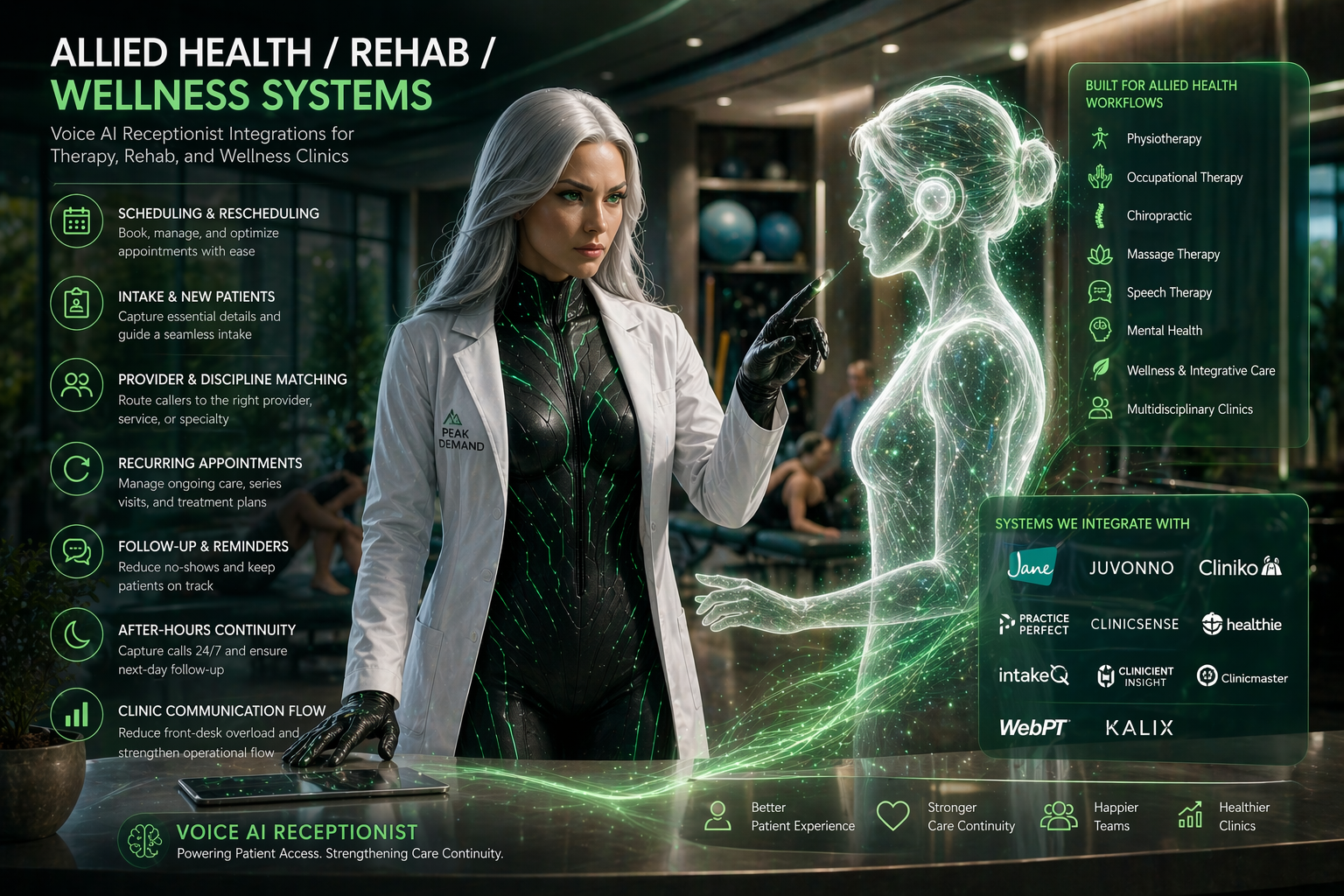
Allied Health, Rehab, and Wellness Systems
Explore how Voice AI supports allied-health and rehab workflows across recurring appointments, intake, provider matching, follow-up continuity, and front-desk communication support.

Dental Systems
Explore how Voice AI fits into dental communication workflows across new patient calls, hygiene recall, appointment flow, cancellation recovery, emergency routing, and front-desk continuity.

Veterinary Systems
Explore how Voice AI fits into veterinary environments across appointment continuity, client intake, urgent call routing, after-hours handling, and front-desk workflow support.

Chiropractic and Specialty Rehab Systems
Explore how Voice AI fits into chiropractic and specialty rehab workflows across scheduling, intake, recurring visits, SOAP-adjacent continuity, imaging-adjacent coordination, and front-desk support.
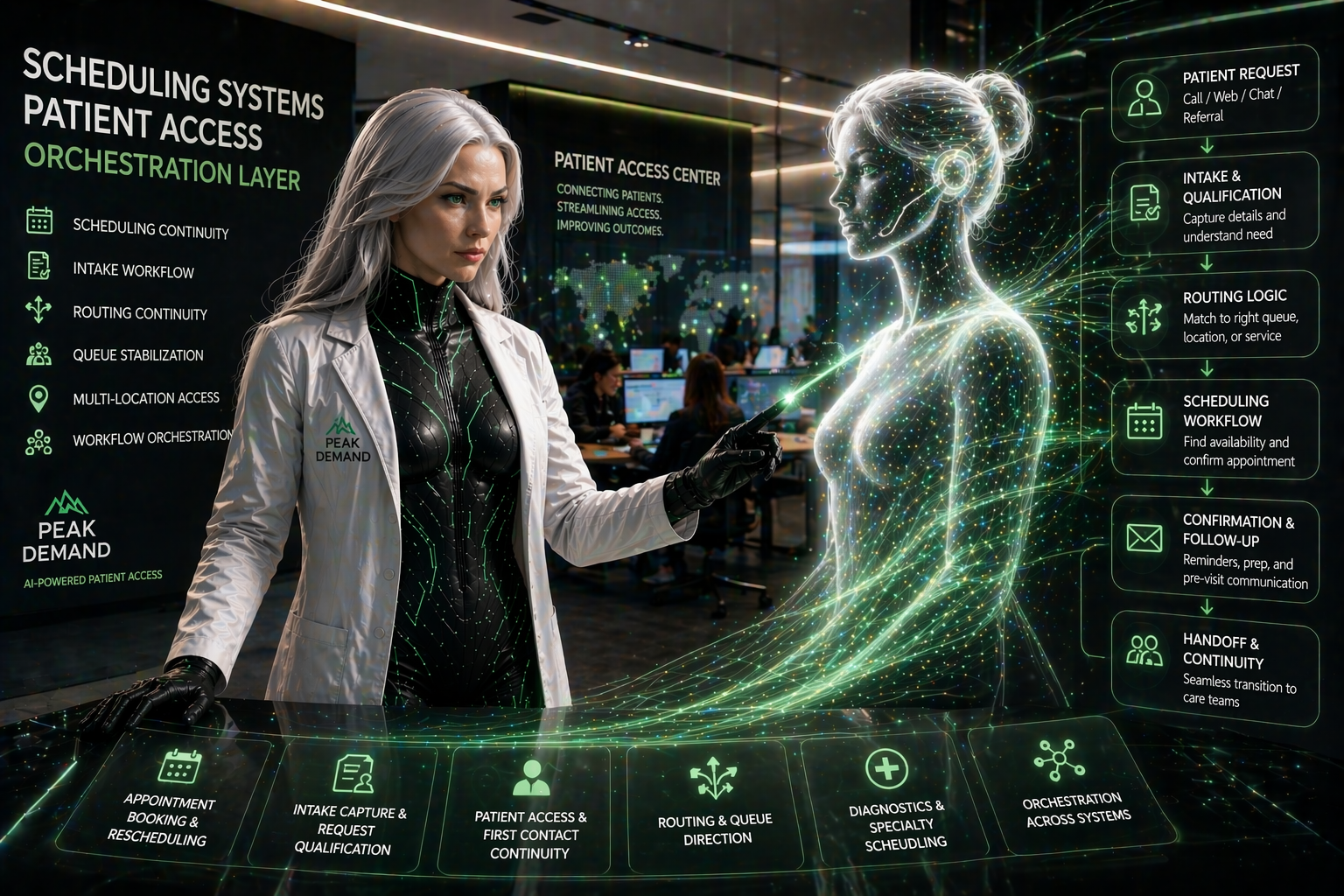
Scheduling, Patient Access, and Orchestration Systems
Explore how Voice AI supports scheduling and patient access architecture across intake, routing, queue stabilization, diagnostics scheduling, and workflow continuity between first contact and next action.
See Healthcare Voice AI Integrations In Action
These walkthroughs show how Voice AI can connect into real healthcare scheduling, intake, and communication environments. Start with TELUS Health CHR for Canadian clinic workflows and Juvonno for rehab and allied health operations.
TELUS Health CHR Integration Walkthrough
See how Voice AI can support TELUS Health CHR scheduling, intake, patient communication, and Canadian clinic workflow continuity.
Juvonno Integration Walkthrough
See how Voice AI can support Juvonno workflows for rehab scheduling, intake, appointment handling, and clinic communication continuity.
Explore published healthcare systems by name
Once you know the software family that best matches your environment, this section makes it easier to browse live healthcare integration pages by platform name. Each category below groups published system pages by the type of environment they usually support so operators, managers, and technical teams can compare workflow fit more quickly. A fuller alphabetical directory appears farther down the page.
Featured healthcare systems
These are high-priority starting points for visitors evaluating real-world Voice AI workflow fit across scheduling, intake, patient communication, routing, and access workflows.
Clinic, ambulatory, and medical EMR systems
These systems are commonly associated with clinic records-adjacent workflows, appointment flow, patient requests, intake continuity, routing, and broader ambulatory communication operations.
Scheduling, intake, and patient communication systems
These environments sit closer to booking logic, intake flow, reminders, clinic administration, and day-to-day patient access operations.
Rehab, physiotherapy, and allied health systems
Allied health and rehabilitation environments often depend on strong scheduling continuity, practitioner matching, intake flow, recurring appointment management, and multi-location operational coordination.
Dental systems
Dental communication workflows often center around appointment demand, cancellation recovery, reminders, new patient calls, and front-desk continuity across booked production.
Veterinary systems
Veterinary communication environments often require appointment continuity, client communication, after-hours handling, urgent call direction, and records-adjacent workflow coordination.
Healthcare organizations rarely evaluate integrations in a vacuum. Grouping systems by software family makes it easier to understand likely workflow fit, compare environments more quickly, and navigate toward both family-level integration pages and live system-specific pages deeper in this hub. The full alphabetical system directory farther down the page should carry the complete 98-system library.
Where Voice AI sits in the healthcare workflow matters more than basic connectivity
Healthcare Voice AI becomes more useful when it is treated as part of the larger workflow architecture around patient access, intake, routing, scheduling, escalation, and downstream ownership. The question is not only whether a system connects. The question is whether the communication flow reaches the next operational step with enough clarity and structure to reduce friction instead of shifting it downstream.
In practice, that means Voice AI often sits across multiple workflow layers at once. It may support first contact, gather structured intake, help direct the caller into the right path, preserve context for staff, and improve continuity into the next step. The value comes from how those layers fit together, not from one isolated connection point.
This is why healthcare teams should evaluate both the scheduling and patient access layer and the EMR or EHR-adjacent layer. In more complex environments, the architecture may also need to account for enterprise compliance and procurement requirements.
Where Voice AI usually enters the workflow
Voice AI often enters at the communication edge: inbound calls, appointment demand, intake capture, after-hours answering, overflow handling, and patient access or routing-related first contact.
Explore healthcare AI receptionistsWhere continuity usually breaks down
Continuity often breaks between the interaction and the next operational owner. That can happen when routing is weak, intake is unclear, scheduling context is incomplete, or downstream teams still need to manually rebuild the request.
Explore centralized scheduling workflowsWhat stronger integration architecture actually improves
Stronger architecture preserves enough structure, direction, and next-step usability for staff or systems to act efficiently. That is what turns Voice AI into operational infrastructure instead of a disconnected front-end layer.
Return to the healthcare resource hub| Integration maturity | What healthcare teams usually experience | Likely operational result |
|---|---|---|
| Fragmented | Some connection points exist, but scheduling, intake, routing, escalation, and continuity still require heavy manual repair. | Lower operational value, more staff burden, weaker patient access continuity, and less confidence in the workflow. |
| Partially connected | Important workflow layers connect, but structure and downstream usability still vary too much between teams, departments, or next-step owners. | Moderate gains, but persistent continuity gaps remain and staff still absorb unnecessary workflow friction. |
| Workflow-led and integrated | Voice AI supports multiple workflow layers with stronger structure, clearer routing, better handoff, and more usable next-step continuity. | Stronger patient access flow, cleaner operational ownership, and more scalable communication infrastructure. |
What healthcare teams should evaluate in the architecture discussion
- Where does Voice AI need to sit first in the communication workflow?
- Where does continuity currently break between the interaction and the next operational step?
- Which layers are EMR or EHR-adjacent, and which ones are workflow-adjacent?
- How do scheduling, intake, routing, patient access, and escalation interact in this environment?
- Will downstream teams receive enough structure to act without rebuilding the request manually?
- Is the integration design workflow-led or just feature-led?
- Does the current architecture reduce friction for staff, or does it simply move the work somewhere else?
Healthcare organizations usually get more value when they evaluate integration maturity across communication flow, operational ownership, and downstream usability together instead of treating each connection as a separate isolated decision. For system-specific evaluation, use the alphabetical healthcare system directory below.
Evaluating software families?
Use the six system-family pages to compare EMR, EHR, dental, veterinary, rehab, scheduling, and patient access environments.
Browse Software FamiliesEvaluating specific systems?
Use the full alphabetical directory to find the exact healthcare platform your team is evaluating.
Open System DirectoryEvaluating enterprise readiness?
Review governance, privacy, escalation, procurement, and compliance considerations before deployment.
Review ComplianceGo deeper into the strategy behind healthcare Voice AI integrations
This section helps healthcare teams move from broad category understanding into the right supporting resources for architecture, interoperability, workflow fit, implementation planning, and system-specific evaluation.
The articles below are the best next clicks for teams evaluating how Voice AI fits into healthcare communication systems, patient access workflows, structured integration pathways, rollout planning, and governed healthcare environments.
For broader category education, use the Healthcare Voice AI Resource Hub. For software-specific evaluation, continue to the full alphabetical system directory lower on this page and use the six healthcare software family pages as the parent layer.
Need system-family pages?
Use the family pages to compare medical EMR, allied health, dental, veterinary, specialty rehab, and patient access systems.
Browse Software FamiliesNeed a specific platform?
Use the alphabetical system directory to find the exact EMR, EHR, scheduling, dental, veterinary, or rehab platform.
Open System DirectoryNeed compliance context?
Use the enterprise compliance page when governance, privacy, procurement, RFPs, or regulated deployment requirements are part of the evaluation.
Review ComplianceCore integration strategy articles
These resources explain why integrations matter, what healthcare teams should evaluate first, and how stronger Voice AI integration architecture should be understood.
Custom pathways, structured integrations, and workflow fit
These articles are useful for teams evaluating custom pathways, structured communication flows, and how Voice AI fits into real healthcare operating environments.
Rollout, implementation, and governance
These resources are best for healthcare teams moving from early exploration into rollout planning, operational safety, implementation readiness, and governance-aware deployment.
Patient access, routing, and workflow bottlenecks
These articles help healthcare teams think more clearly about where communication complexity builds up across patient access, intake, department routing, scheduling, and downstream handoff.
As the healthcare integrations ecosystem continues to grow, this section can keep routing visitors into the most relevant strategy, rollout, and workflow resources without changing the overall structure of the hub. The full software directory appears in the Alphabetical System Directory section below.
Explore live healthcare system integration pages by category
This section gives healthcare teams a category-based way to browse the most important live system pages. It is not the full 98-system directory; it is a curated navigation layer for comparing the platforms most commonly tied to scheduling, intake, patient communication, routing, and patient access workflows.
Use this section when you know the type of software environment you are evaluating. Use the Alphabetical System Directory below when you want to find every live system page by name.
Need the family layer?
Start with the six parent family pages when comparing software categories before choosing a specific system.
Browse Software FamiliesNeed every system?
Use the alphabetical directory for the complete live healthcare system page list by platform name.
Open Alphabetical DirectoryNeed workflow context?
Review how Voice AI fits across patient access, intake, routing, scheduling, escalation, and downstream ownership.
Review Workflow ArchitectureFeatured healthcare systems
These are some of the strongest starting points for teams exploring healthcare Voice AI integrations across scheduling, intake, patient communication, routing, and access workflows.
Clinic and ambulatory EMR systems
These systems are commonly associated with clinic records-adjacent workflows, intake, appointment flow, routing, patient communication, and broader ambulatory continuity.
Explore medical and ambulatory EMR familyScheduling, intake, and patient communication systems
These environments sit closer to booking logic, intake flow, reminders, clinic administration, and day-to-day patient access operations.
Explore scheduling and patient access familyRehab, physiotherapy, and allied health systems
Allied health and rehabilitation environments often depend on strong scheduling continuity, practitioner matching, intake flow, recurring appointments, and multi-location coordination.
Explore allied health and rehab familyDental systems
Dental communication workflows often center on appointment demand, cancellation recovery, reminders, new patient calls, and front-desk continuity.
Explore dental familyVeterinary systems
Veterinary communication environments often require appointment continuity, client communication, after-hours handling, and records-adjacent workflow coordination.
Explore veterinary familyEnterprise, specialty, imaging, and outpatient environments
These environments often involve more complex routing, diagnostic scheduling, imaging coordination, enterprise workflow ownership, and department-specific handoff requirements.
Explore enterprise and medical EMR familyThis curated category browse section helps visitors compare common healthcare software environments without scrolling the entire directory. The complete system list belongs in the Alphabetical System Directory section below, where every live healthcare system page should be listed by platform name.
Talk through your healthcare communication workflow
If your team is evaluating healthcare Voice AI integrations, the most useful next step is usually a workflow conversation. That means reviewing patient access pressure points, scheduling flow, intake structure, routing logic, after-hours coverage, compliance expectations, and the systems surrounding those workflows.
Peak Demand approaches healthcare environments through workflow fit, governance awareness, and operational usability. The goal is to help organizations map a communication architecture that supports real teams, real workflows, and real continuity requirements across EMR, EHR, scheduling, intake, dental, veterinary, rehab, and patient access environments.
Need software families?
Compare the six parent healthcare integration families before choosing a specific system page.
Browse software familiesNeed workflow context?
Review how Voice AI fits across intake, routing, scheduling, escalation, and downstream ownership.
Review workflow architectureNeed compliance review?
Use the enterprise compliance page when governance, privacy, procurement, and RFP standards matter.
Review complianceFrequently asked questions
What does Voice AI mean in a healthcare integration environment?
Can Voice AI work with EMR, EHR, scheduling, intake, and routing workflows?
Are healthcare Voice AI integrations always direct?
Where should healthcare organizations start evaluating Voice AI integrations?
How should compliance and governance fit into the evaluation?
What is the role of this integrations hub?
About Peak Demand
Peak Demand is a Toronto-based AI agency focused on Voice AI, communication automation, and workflow infrastructure for organizations operating in more complex service environments.
In healthcare, the focus is not just on call handling. It is on patient access continuity, scheduling pressure, intake structure, routing logic, after-hours support, governance, and how communication systems fit into real operational workflows.
- Workflow-driven and implementation-aware
- Governance-first in healthcare communication environments
- Built to support clinics, networks, and enterprise teams
- Designed to scale into software-specific integration pathways
- Organized around healthcare system families and live integration pages
Healthcare software integrations by system name
If you already know the software you are evaluating, this alphabetical directory is the fastest way to find the right live system page.
This directory includes the full 98-system healthcare integration library from the current Peak Demand system-page build. It is designed to help teams compare EMR, EHR, scheduling, intake, patient communication, dental, veterinary, rehab, wellness, chiropractic, orchestration, home care, med spa, pharmacy, and enterprise healthcare systems by software name.
For category-level browsing, use the software family section. For workflow context, use the workflow architecture section. This section is the full alphabetical browse layer.
Live healthcare system pages in this directory
Grouped alphabetically with visible section counts so the full library is obvious at a glance.
A–C
34 systemsABELMed through Curve Dental.
D–H
20 systemsDentrix through Helios Software.
I–M
15 systemsIDEXX Cornerstone through MRX Solutions.
N–O
11 systemsNextech through Owl Practice.
P–R
8 systemsPabau through RXNT.
Compare healthcare systems by name, category, and workflow fit
This directory is useful for comparing clinic EMRs, EHR-adjacent systems, scheduling and intake platforms, patient communication software, dental systems, veterinary systems, rehab and allied health systems, chiropractic systems, med spa systems, home care systems, pharmacy-adjacent systems, orchestration platforms, diagnostic workflows, and enterprise healthcare environments by software name before going deeper into workflow design, integration possibilities, and operational fit.
Explore your own AI use case on a discovery call.