
Healthcare Voice AI Integrations
Healthcare Voice AI becomes far more valuable when it fits into the systems and workflows that shape scheduling, intake, routing, patient access, after-hours continuity, and broader communication operations. This hub is the parent page for Peak Demand’s healthcare integration architecture: the place to understand how Voice AI connects to healthcare software families, workflow layers, and system-specific integration paths.
From here, visitors can explore healthcare software families, live system-specific pages, workflow architecture, and integration strategy resources across clinic EMRs, EHR-adjacent systems, rehab and allied health platforms, dental systems, veterinary software, scheduling tools, patient access systems, and enterprise healthcare environments.
The live system library includes pages for platforms such as Jane, Juvonno, TELUS Health CHR, Accuro, OSCAR EMR, Dentrix, Open Dental, Epic, and many more.

Architecture Role
Parent hub for healthcare integrations
System Coverage
98 healthcare system pages
Software Families
6 healthcare integration families
Workflow Focus
Scheduling, intake, routing, access
Healthcare integrations should be evaluated through workflow continuity
One of the biggest mistakes in healthcare integration conversations is reducing the discussion to a list of software names. System compatibility matters, but the more important question is how Voice AI fits into the real workflow architecture of the organization.
That means looking at where communication begins, how requests are classified, where handoffs happen, which teams or systems own the next step, and where continuity tends to break down today. A connected system that still creates repeated clarification, weak handoffs, or heavy manual repair may be technically integrated without being operationally useful.
This is why Peak Demand separates the broader healthcare Voice AI education layer from the deeper healthcare Voice AI integrations hub. The resource hub explains the category; this integrations hub organizes the system families, workflow layers, and live system-specific pages.
Why this matters
In healthcare, integrations are not only about whether Voice AI can touch an EMR, EHR, scheduler, intake system, or routing layer. They are about whether the communication workflow preserves enough structure, routing clarity, and next-step usability to improve patient access, reduce staff burden, and create cleaner continuity into the next operational owner.
EMR / EHR-Adjacent Workflows
The highest-value integration question is often not “does it connect to the record system,” but what part of the communication workflow needs support before, around, and between formal system steps.
- Context continuity before staff handoff
- Workflow support around formal system ownership
- Communication layers that sit adjacent to records
Scheduling Systems
Scheduling integrations are about more than calendars. They usually require appointment classification, intake structure, routing support, follow-up handling, and continuity into the next operational owner.
- Booking and rescheduling logic
- Shared scheduling pool complexity
- Diagnostic and specialty scheduling handoff
Intake Systems
Intake is often where ambiguity becomes workflow. Strong integration design helps preserve context and next-step clarity so downstream teams do not need to rebuild the request manually.
- Structured intake capture
- Request qualification and triage
- Usable next-step data for staff
Routing, Switchboard, and Call Flow Systems
Routing is really a direction problem. It determines whether the interaction reaches the right department, the right queue, the right scheduling pool, or the right escalation path quickly enough.
- Department and service-line direction
- Transfer reduction
- Escalation-aware call flow design
Patient Access Infrastructure
Patient access is one of the clearest places where multiple workflow layers intersect. Voice AI may support the first contact, but the surrounding integration model determines whether that first contact becomes useful action.
- Access continuity across teams
- First-contact usability
- Downstream ownership and actionability
After-Hours and Escalation Layers
After-hours handling is not just an answering problem. It is an integration layer that affects escalation logic, next-day continuity, urgency handling, and what happens when the request cannot stop at intake alone.
- Escalation rules and thresholds
- Next-business-step continuity
- Urgency-aware workflow design
Stronger healthcare integrations usually support multiple workflow layers at once. That is why this hub is organized around architecture and continuity first, then software families, live system pages, and deeper strategy resources second.
Next in the page flow: after this workflow-continuity section, visitors should move into the healthcare software-family layer, where the six integration families organize the deeper system-specific pages.
Browse Healthcare Software Families
Hiring Freezes Are Spreading: How AI, Entry-Level Jobs, and Canada’s Youth Collide in 2025
TLDR

What’s actually happening
Hiring freezes are spreading across public and private sectors as organizations pause to re-scope roles for an AI-first operating model.
Translation for jobseekers: this is a relabeling phase, not a permanent stop—expect fewer classic “junior” postings and more hybrid, tool-driven roles.
How AI changes entry-level work
Being automated first: tier-1 support, repetitive admin, manual data entry, rote research.
Growing tasks: data operations, workflow automation, agent/prompt evaluation, QA, analytics, documentation—with audit logs and escalation paths.
Employers are prioritizing candidates who can ship small automations, show measured impact (time saved, error reduction), and govern them responsibly.
The Canada context
Ontario’s freeze signals caution and a demand for clear productivity cases before new hires.
Canada faces peak aging (more retirements) and weak investment, which slows job creation but raises the need for automation to maintain service levels.
What this means for Canadian youth
The traditional “learn → land a junior job → learn on the job” is narrowing. Early roles now expect tool-first contributions from day one.
Two durable tracks:
Digital/AI track: data ops, analytics, RevOps/MarOps, workflow automation, agent QA/eval, cloud & infra support, data center technicians.
Human-intensive track: licensed/regulated roles with high trust and in-person demand—healthcare (nursing, allied health, mental health), skilled trades (especially electricians), education, field services.
Peak Demand’s position (practical and urgent)
Canadian youth should aggressively upskill in digital/AI or commit to a licensed trade/healthcare path. Waiting for “normal” to return is a losing bet.
Shipped work beats resumes: a small portfolio (intake triage, document QA, reporting agent, a simple integration) with logs and metrics outperforms generic credentials.
Governance is a differentiator: candidates who document risks, privacy, and evaluation earn trust faster.
Best near-term moves (30–90 days)
Pilot-ready AI skills: pick one workflow, automate a slice, and track time saved + error rate.
Cloud/data basics: learn SQL + one cloud (Azure or GCP); practice access controls and logging.
Agentic workflows: build a simple retrieval/summarization/filing agent with tests and fallbacks.
Governance from day one: keep a changelog, prompts, inputs/outputs, edge cases, escalation rules.
Trades path: explore pre-apprenticeships—electrician routes align with decades of data center build-out and electrification.
Bottom line
Hiring freezes mark a recomposition of roles, not a halt to opportunity. The winners will either ship, measure, and govern AI-enabled work—or deliver licensed, hands-on services that machines can’t. Pick a lane, start shipping evidence, and align to where the economy is going.
Why Hiring Freezes Are Spreading in North America (macro signals + AI pressure)

Hiring freezes across North America aren’t random—they reflect a mix of macroeconomic caution and structural change driven by AI. Understanding the signals helps jobseekers and policymakers see where the job market is heading.
Macro Drivers Behind Freezes
High interest rates and capital costs: Firms face more expensive borrowing, so expansionary hiring is slowed or paused.
Weak per-capita growth: Even when GDP grows, per-person productivity and living standards are flat or falling, which reduces demand for new labor.
Low business investment: Canada and the U.S. have both underinvested relative to peers, leaving companies reluctant to expand payroll without clear ROI.
Productivity push: Organizations are under pressure to deliver more with less, so they pause headcount until efficiency strategies—often involving AI—are tested.
AI Efficiency Bets
Employers are treating freezes as a reset button, reassessing which tasks to automate.
Low-leverage, repetitive, or easily scripted roles are most at risk for redesign.
Instead of hiring more people, companies are diverting resources into AI pilots, automation platforms, and infrastructure that reduce long-term labor needs.
Freeze ≠ Forever
Historically, freezes are temporary. They end once organizations redefine job requirements and integrate new tools.
Expect reopened roles with different job mixes: fewer routine clerical or entry positions, more hybrid roles blending domain knowledge with tool fluency.
This creates opportunities for workers who can position themselves as AI-fluent contributors from day one.
The Signal to Jobseekers
The market is relabeling entry work. What once was manual is now expected to be tool-driven.
Employers want early-career talent who can:
Operate automation tools confidently.
Monitor, document, and evaluate AI outputs.
Provide oversight and escalation when tools fail.
Contribute to data operations and quality assurance instead of pure clerical labor.
Takeaway: Hiring freezes aren’t just cost-cutting—they’re role redesigns in progress. AI is forcing companies to pause, rethink, and reopen with expectations that every new hire can contribute in a more tool-centric, productivity-driven way.
Ontario Hiring Freeze: What It Covers and Why It Matters

The Ontario government recently announced a hiring freeze across provincial agencies, boards, and commissions. The stated goal is to conduct a cost and modernization review before approving new positions. While the freeze sounds broad, there are exceptions for essential services such as healthcare, safety, and other critical operations where staffing shortages could directly harm citizens.
For most external applicants, this means slower access to government jobs. Instead of opening new postings, ministries and agencies are expected to focus on internal mobility—moving current employees around to cover gaps. Any new hires will need to be justified not only in terms of budget but also with evidence of measurable productivity gains.
For vendors and public-service partners, this freeze creates both a challenge and an opportunity. With headcount growth constrained, public bodies will still need to maintain service levels and meet citizen expectations. The practical solution is to lean on AI-enabled pilots and process automation that can deliver efficiency within 30–90 days. Projects that reduce wait times, improve case handling, or automate repetitive workflows without expanding payroll will be viewed favorably in this environment.
The key takeaway is that Ontario’s hiring freeze is less about cutting services and more about re-scoping how those services are delivered. For workers, it signals a tougher entry path into government roles. For solution providers, it signals a growing demand for proof-of-concept automations that demonstrate productivity gains under real constraints.
Canada’s Hiring Freeze Context: Tech Slowdowns, Corporate Resets, and AI Recomposition

Canada’s tech labor market never fully bounced back to its 2021 peak. Postings remain below pre-pandemic levels, and the pain is sharpest at the bottom of the ladder. Junior software roles, tier-1 support, and generalist analyst openings are the first to be paused or repackaged. By contrast, AI-adjacent roles—data engineering, ML/Ops, evaluation/QA, and data-center operations—have been comparatively resilient because they underpin automation and infrastructure.
In the private sector, large employers are choosing redesign over raw expansion. Retail leaders are signaling that AI will change “literally every job,” keeping overall headcount roughly stable while they rebalance which roles grow and which shrink. On Wall Street, junior classes are being right-sized as deal flow slows and AI tooling absorbs portions of research, drafting, and operations work. Major consultancies are pruning roles that can’t be retrained toward AI-enabled delivery while doubling down on cloud, data, and automation programs.
What this adds up to in Canada:
Fewer classic “junior” openings whose value rested on manual throughput
More hybrid roles that blend domain knowledge with tool fluency
A premium on data hygiene (cleaning, labeling, documentation) and evaluation (measuring model/agent outputs, error handling, escalation)
Increased demand for infrastructure talent (cloud, networks, and especially electricians and technicians tied to data-center build-outs)
How to read the market if you’re early-career:
Treat “junior” as apprentice + tools: you’re expected to arrive with a small portfolio that proves you can ship a working automation, track the metrics (time saved, error rate), and keep audit logs.
Anchor your skills to complementary tasks AI can’t reliably own: exception handling, oversight, prompt/agent evaluation, data quality, workflow orchestration with humans in the loop.
If you prefer hands-on work, target the physical backbone of AI—power, cooling, fiber, facilities. Canada’s data-center and electrification cycles create durable demand for licensed trades and technical operations.
For employers, the freeze period is the time to rewrite job definitions. Replace vague junior requisitions with scoped outcomes and tool stacks; keep internships and apprenticeships but attach them to real pilots; and make governance (logging, privacy, escalation) part of the job, not an afterthought. AI and Hiring: How Employers Are Rewriting Entry-Level Jobs
First tasks to automate: tier-1 support, repetitive admin, manual data entry, rote research.
Growth tasks: data operations, tooling, prompt/agent evaluation, workflow QA, analytics for ops and revenue.
New expectation: ship + measure—entry talent must show real usage, results, and traceable impact.
What This Means for Ontario’s Labor Market
Ontario’s hiring freeze is a signal of caution: public-sector agencies, boards, and commissions will hire less externally while modernizing and reviewing costs. Exceptions exist for essential services, but the net effect is fewer traditional intake cohorts and more emphasis on internal mobility. For jobseekers, this means tougher entry into the public service and higher pressure to justify new roles through productivity.
The opportunity comes in how new pilots and apprenticeships get structured. Municipal and provincial bodies will still need to maintain service levels, so they’ll turn to targeted 30–90 day initiatives—whether in AI-enabled workflows, frontline service redesign, or high-touch care delivery—that prove measurable outcomes without headcount growth.

Smart Play for Early-Career Professionals
The labor market is shifting toward three defensible lanes where demand is long-term and disruption-resistant:
Healthcare and Allied Roles
Nurses, personal support workers, therapists, and technicians remain in demand due to aging demographics.
Human contact, empathy, and regulated care standards make these jobs less susceptible to automation.
Upskilling here means certifications, specialized diplomas, and continuous professional learning.
Skilled Trades (with a spotlight on electricians)
Electrification, renewables, and the build-out of data centers will require tens of thousands of new electricians and related trades.
Carpenters, plumbers, HVAC technicians, and lineworkers also see stable long-term demand.
Ontario’s freeze may slow public hiring, but apprenticeships and private-sector projects will remain strong.
Digital and AI-Enabled Roles
Not every young worker needs to be a coder, but having AI and data fluency will be a baseline expectation across jobs.
Early-career opportunities will be in hybrid roles: intake triage with AI support, digital marketing with automation, cloud operations, data hygiene, and workflow coordination.
The focus should be on “ship small, measure results, scale up”—showing employers you can make tools work for the business immediately.
For Ontario youth, the hiring freeze is less a closed door than a challenge to pick a lane that is future-proof. Whether it’s caring for people, powering the infrastructure of the AI age, or learning to work alongside digital tools, the next generation must choose deliberately and start building evidence of their skills now.
What This Means for Canada: Demographics, Investment, and Productivity

Canada’s labor market challenges are structural, not just cyclical. As the final wave of baby boomers retires, the country is entering peak aging, which means a shrinking supply of experienced workers just as demand for services—from healthcare to energy—expands. At the same time, weak private investment has constrained role creation and innovation. Companies are cautious about scaling headcount, and many still lag global peers in adopting automation to close the productivity gap.
The refreshed national AI strategy speaks directly to these pressures. By emphasizing sovereign compute, trusted data, and infrastructure build-outs, Ottawa is signaling a pivot toward high-value sectors that will need builders at every level:
Electricians and skilled trades to expand power and data center capacity.
Technicians and operators to manage sovereign cloud and compute environments.
AI operations staff to monitor, validate, and tune automated systems.
For employers, the winning formula will be adopt AI where it compounds productivity, and invest in youth training where human expertise remains essential. Those that integrate AI agents into workflows while cultivating a digitally literate workforce will cut costs, improve service, and increase resilience against shocks.
For young Canadians, the national message is clear: the labor market of the future is hybrid. It blends human-touch roles in healthcare and services with infrastructure and digital fluency that underpin the AI economy. Choosing to upskill—whether in AI operations, cloud and data management, or licensed trades tied to electrification—will determine who thrives as the next wave of Canadian productivity is built.
Canadian Youth Workforce Strategy: Best Jobs to Have in a World of AI

For young Canadians, the question isn’t whether AI will reshape work—it already is. The real challenge is choosing tracks that remain durable and valuable as automation spreads. Two stand out: one digital, one human-intensive.
Digital / AI Track
This path prepares youth to work with AI, not compete against it. The focus is on roles that blend data handling, oversight, and infrastructure support:
Data operations and analytics — cleaning, labeling, monitoring, and interpreting data pipelines.
Marketing operations and process automation — building and running workflows that generate measurable results.
Agent QA and evaluation — testing AI outputs for accuracy, bias, and reliability.
Cloud infrastructure support — managing secure environments where AI workloads run.
Data center technicians — hands-on roles maintaining the physical backbone of AI compute.
These roles don’t always require advanced degrees—what matters is a portfolio of pilot projects that demonstrate tool fluency, accountability, and measurable impact.

Human-Intensive Track
Some jobs resist automation because they depend on care, trust, and physical presence. These roles grow as Canada ages and infrastructure expands:
Healthcare: nurses, allied health professionals, mental health counselors, lab and imaging techs. The demand is permanent, and AI acts as an assistant, not a replacement.
Skilled trades: carpenters, plumbers, HVAC specialists, and especially electricians. Trades deliver essential services that can’t be automated, and they will see surging demand as electrification accelerates.
Field services and education: roles that require on-site expertise, mentorship, and public-facing work.
Why Electricians?
The global race to build AI infrastructure means data centers are the new factories. Every server hall, sovereign cloud cluster, and electrification project needs licensed electricians to design, install, and maintain power systems. With demand stretching decades, this trade is among the most future-proof options available.
Why Healthcare?
Canada’s aging population guarantees rising demand for regulated care roles. AI tools can assist by speeding diagnoses, scheduling, or record-keeping, but the core work—compassion, treatment, rehabilitation—remains human. These jobs are not eliminated by automation; they are enhanced by it.
For Canadian youth, the smart strategy is to pick one of these durable lanes and commit early. Whether it’s becoming fluent in AI operations or earning a license in a high-demand trade, the future belongs to those who combine adaptability with specialization.
What Young Canadians Should Do Next (30-60-90 Day Plan)

The best way for young Canadians to compete in a labor market reshaped by AI and hiring freezes is to ship skills fast, prove value early, and build a track record of outcomes. Employers don’t just want résumés anymore—they want evidence you can work with modern tools and adapt quickly. Here’s a practical roadmap.
30 Days: Build Your Foundation
Learn SQL and one cloud platform (Azure or Google Cloud). These are the languages and environments where modern data lives.
Automate one workflow end-to-end: for example, taking a form submission and pushing it into a database with an automated notification.
Document your results: track latency, error rates, and time saved. Show that you understand both the build and the business impact.
60 Days: Create a Portfolio
Build three mini-projects that reflect common AI-enabled business needs:
Intake triage: automate routing of incoming messages or tickets.
Document QA: set up an agent that can answer questions on a PDF or knowledge base.
Reporting agent: generate dashboards or summaries from raw data.
Include tests and logs for each project to demonstrate accountability and reliability.
Publish your work on GitHub or a personal site to make it visible to employers.
90 Days: Go Public
Contribute to an open pilot with a municipality, nonprofit, or small business. These organizations are eager for help but lack the resources for expensive consulting.
Gather references and testimonials from the people you worked with—social proof matters.
Write and share a short case study that explains the problem, your approach, and the outcome. This not only positions you as capable, but also shows you can communicate clearly about results.
By the end of 90 days, a young Canadian can move from zero to portfolio-ready—and in a market where entry-level jobs are shrinking, that kind of proof of execution will set you apart.
Employer Playbook: Hiring in a Freeze, Building for AI

Hiring freezes don’t have to mean growth stops—they mean growth must look different. Employers that adapt can maintain service levels, experiment with AI, and position themselves as talent magnets when freezes lift.
Maintain Internships and Apprenticeships
Don’t cut off your pipeline. Instead of generic “junior” roles, reframe early-career positions as apprentice tracks tied to AI adoption.
Pair apprentices with senior staff to oversee AI systems: error checking, exception handling, and compliance.
This ensures you’re training the next generation while filling immediate oversight gaps.
Run Scoped 30–90 Day Pilots
Use hiring freezes as an opportunity to test automation against real service metrics.
Structure pilots with clear measures:
Cost-to-serve: how much does the process cost per unit now vs. automated?
SLAs (service-level agreements): are response times faster? more consistent?
Error reduction: does automation cut mistakes and improve compliance?
At the end of the pilot, decide whether to scale, pivot, or sunset. This builds a repeatable innovation muscle without long-term commitments.
Invest in Governance Early
AI adoption without guardrails is a liability. Strong governance reduces risk and boosts trust with regulators and customers alike.
Employers should establish:
Audit logs for all AI outputs and interventions.
Escalation paths when automation fails or confidence scores are too low.
Personal information safeguards to comply with privacy laws.
Data residency policies aligned with Canadian law, balancing sovereign compute goals with global best-in-class providers.
Employers that take this approach signal resilience: they aren’t freezing into paralysis—they’re freezing to retool and recompose. This attracts talent and partners who want to work in organizations that are disciplined, forward-looking, and committed to results.
Peak Demand’s Position and Offer to Ontario and Canadian Youth
At Peak Demand, we see the hiring freeze not as a dead end but as a signal to reset how Canada builds its workforce. For youth entering the job market, the message is clear: pick a lane, and commit to it early.
Two Durable Lanes
Digital / AI: roles in data ops, workflow automation, agent QA, cloud infrastructure, and data center support. These are the building blocks of tomorrow’s organizations.
Licensed Trades & Healthcare: electricians, technicians, nurses, and allied health professionals. These roles are rooted in human trust, regulation, and infrastructure expansion.
Both tracks offer security and growth, but what unites them is the need for evidence of execution.
Why “Test → Ship → Learn → Scale” Wins
Canadian businesses have a history of waiting for perfect conditions before adopting new technology. That mindset doesn’t work in AI. Momentum comes from piloting fast, measuring outcomes, and scaling what works. A documented 30–90 day project can do more for your career—or your company—than six months of planning.
How Peak Demand Helps
Scoped AI pilots: we design and run projects that deliver measurable results in weeks, not years.
Talent playbooks: we provide employers with frameworks to turn hiring freezes into training opportunities.
Portfolio coaching: we guide youth in documenting and showcasing their projects so they can compete in a reshaped labor market.
Our commitment is to close Canada’s adoption gap by preparing the next wave of workers to thrive—whether they’re coding AI workflows or wiring the power grids that fuel data centers.
Closing: Your Next Move in an AI-First Labor Market
Hiring freezes are a relabeling moment, not a dead end. Roles are reopening with new expectations: fluency with tools, measurable results, and clear guardrails.
If you’re early career, pick one path and move now:
Ship real work: build a small automation, a data workflow, or a service improvement. Track time saved, error reduction, and reliability.
Document outcomes: keep logs, tests, changelogs, and a short write-up that explains impact in plain language.
Or train in a licensed trade tied to AI infrastructure: electricians, HVAC, fiber, and other field roles that power data centers and electrification.
The fastest way through uncertainty is evidence—either shipped projects or recognized credentials. Start small, learn fast, and stack proof. That’s how you break into a market that’s recomposing itself around AI.
Sources
Ontario Government Hiring Freeze (CBC)
https://www.cbc.ca/news/canada/toronto/ont-govt-hiring-freeze-1.4710887
Covers the scope of the Ontario hiring freeze, providing context on how provincial cost controls and modernization affect labor markets.
Indeed Hiring Lab – Canadian Tech Hiring Freeze
https://www.hiringlab.org/en-ca/2025/08/26/canadian-tech-hiring-freeze-continues/
Offers data-driven insight into tech job postings, showing how early-career and entry-level roles are most impacted.
Ontario Government Statement
https://news.ontario.ca/en/statement/1006538/ontario-implementing-hiring-freeze-for-provincial-agencies
Primary source statement on Ontario’s freeze across agencies, boards, and commissions.
Financial Post – Canadian Tech Deep Freeze
https://financialpost.com/technology/canadian-tech-hiring-deep-freeze-early-career-workers-hardest-hit
Explains how early-career workers face outsized effects from tech slowdowns, reinforcing youth labor market stress.
Wall Street Journal – Meta AI Hiring Freeze
https://www.wsj.com/tech/ai/meta-ai-hiring-freeze-fda6b3c4
Highlights corporate caution in AI talent pipelines, connecting to broader patterns of role recomposition.
Times of India – Meta Freezes AI Hiring
https://timesofindia.indiatimes.com/technology/tech-news/mark-zuckerbergs-meta-freezes-ai-hiring-and-bans-employees-from/articleshow/123430149.cms
Further reporting on Meta’s hiring freeze, showing how global firms recalibrate their workforce planning around AI.
Times of India – Accenture Layoffs
https://timesofindia.indiatimes.com/technology/tech-news/accenture-lays-off-more-than-11000-employees-ceo-julie-sweet-says-we-are-exiting-employees-we-cant-/articleshow/124205771.cms
Evidence of consulting firms restructuring around automation and AI-driven efficiency.
Calcalistech – Layoffs and AI Restructuring
https://www.calcalistech.com/ctechnews/article/rkzawp82xl
Adds international context to tech layoffs linked to automation pressures.
Business Insider – Layoffs Tracker
https://www.businessinsider.com/recent-company-layoffs-laying-off-workers-2025
Aggregates corporate layoff activity across sectors, useful for macro labor market signals.
Business Insider – Wall Street Deals & AI
https://www.businessinsider.com/wall-street-deals-hiring-layoffs-investment-banking-goldman-barclays-ai-2025-8
Shows how investment banks are factoring AI into their hiring and restructuring plans.
CBC – Grocery Job Rush Amid Unemployment
https://www.cbc.ca/news/canada/ottawa/as-unemployment-climbs-the-promise-of-a-grocery-store-job-lures-hundreds-1.7644463
Illustrates rising unemployment pressure and competition for lower-wage jobs, a counterpoint to AI-driven hiring freezes.
RBC Economics – Peak Aging in Canada
https://www.rbc.com/en/thought-leadership/economics/featured-insights/canada-faces-peak-aging-as-final-boomers-retire-and-population-growth-slows/
Essential demographic context on how retirements and slowing population growth squeeze Canada’s labor market.
Newswire – Canadian Students Brace for Job Market
https://www.newswire.ca/news-releases/canadian-students-make-compromises-and-brace-for-a-tough-job-market-on-graduation-896711602.html
Direct youth perspective on employment challenges, reinforcing the need for new strategies like AI/digital upskilling.
West Central Online – Declining Living Standards
https://www.westcentralonline.com/articles/weak-investment-rapid-population-growth-driving-decline-in-canadian-living-standards
Explains weak investment and rapid growth pressures, tying directly to Canada’s productivity gap.
Fraser Institute – Carney and Private Sector Growth
https://www.fraserinstitute.org/commentary/carney-must-kick-start-private-sector-strengthen-sputtering-economy
Adds macroeconomic context on Canada’s need for stronger private sector investment and productivity reform.
Entrepreneur – Walmart CEO on AI Jobs
https://www.entrepreneur.com/business-news/walmart-ceo-ai-will-transform-literally-every-job/497700
Strong corporate perspective: Walmart CEO Doug McMillon says AI will affect “literally every job.”
MassLive – Walmart Prepares 2.1M Workers for AI
https://www.masslive.com/news/2025/09/nations-largest-retail-chain-braces-21m-employees-for-ai-job-impacts.html
Adds detail on Walmart’s global workforce adaptation and what AI-driven job transformation looks like in practice.
AOL – AI Drives Interest in Blue-Collar Jobs
https://www.aol.com/articles/ai-drives-interest-blue-collar-090017092.html
Shows how AI displacement risk is making trades and blue-collar roles more attractive again.
TS2.Tech – Gen Z and Entry-Level Role Risk
https://ts2.tech/en/2025-gen-z-ages-18-26-job-alert-ai-could-eliminate-up-to-50-of-entry-level-roles-experts-warn/
Highlights expert warnings that up to half of entry-level roles could be automated, directly relevant to youth workforce strategy.
Learn more about the technology we employ.

At Peak Demand AI Agency, we combine always-on support with long-term visibility. Our AI receptionists are available 24/7 to book appointments and handle customer service, so no opportunity slips through the cracks. Pair that with our turnkey SEO services and organic lead generation strategies, and you’ve got the tools to attract, engage, and convert more customers—day or night. Because real growth doesn’t come from working harder—it comes from building smarter. Try Our AI Receptionist for Service Providers. A cost effective alternative to an After Hours Answering Service.

Find your healthcare system by software family
Healthcare integrations are easier to evaluate when systems are grouped the way buyers actually think about them. Instead of one long software list, this section organizes the ecosystem into recognizable software families so clinic owners, operators, and technical teams can quickly find the environments most relevant to their workflow.
Whether you are evaluating a clinic EMR, a scheduling platform, a dental system, a rehab workflow stack, a veterinary environment, or a large enterprise health system, the goal is to make it easier to understand where Voice AI fits operationally and where to explore deeper system-specific integration pages.
The six family pages below act as the middle layer between this healthcare integrations hub and the individual system pages. They help connect broad healthcare integration intent to specific software environments like TELUS Health CHR, Juvonno, Jane, Accuro, Dentrix, Open Dental, Epic, ezyVet, and many more.

Medical and Ambulatory EMR Systems
Explore how Voice AI fits into medical and ambulatory EMR environments across scheduling, intake, patient access, provider routing, after-hours continuity, and clinic communication workflows.
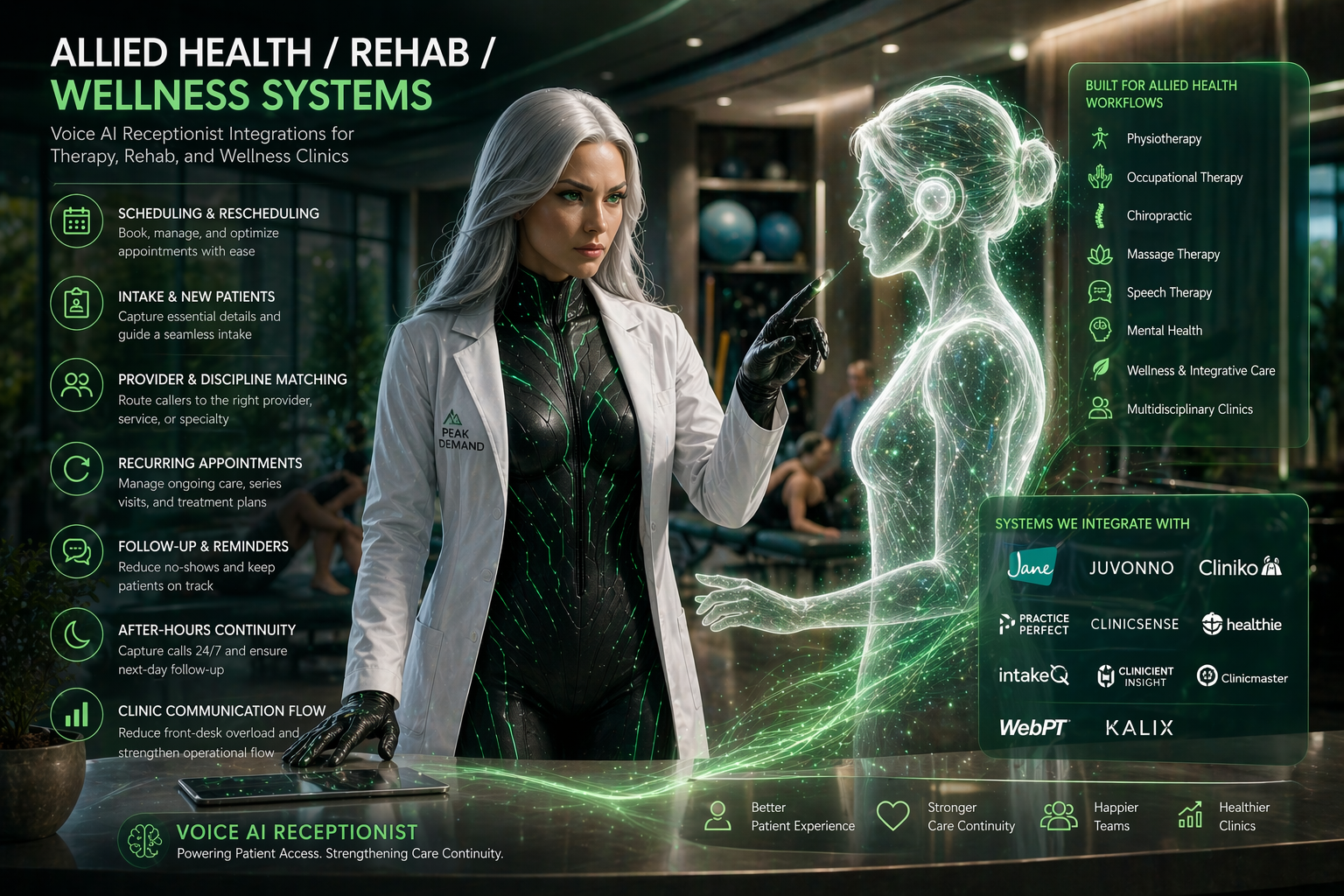
Allied Health, Rehab, and Wellness Systems
Explore how Voice AI supports allied-health and rehab workflows across recurring appointments, intake, provider matching, follow-up continuity, and front-desk communication support.
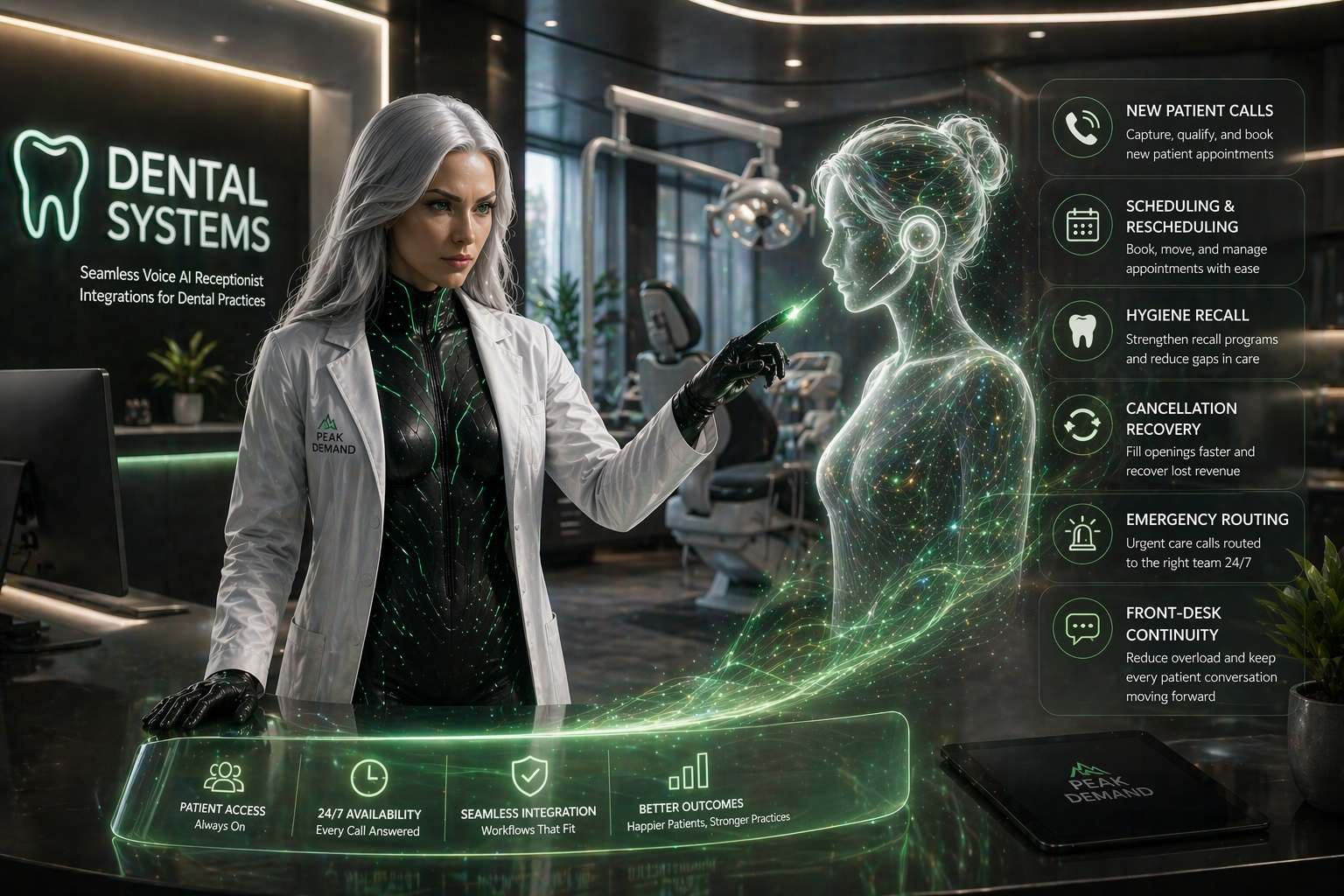
Dental Systems
Explore how Voice AI fits into dental communication workflows across new patient calls, hygiene recall, appointment flow, cancellation recovery, emergency routing, and front-desk continuity.
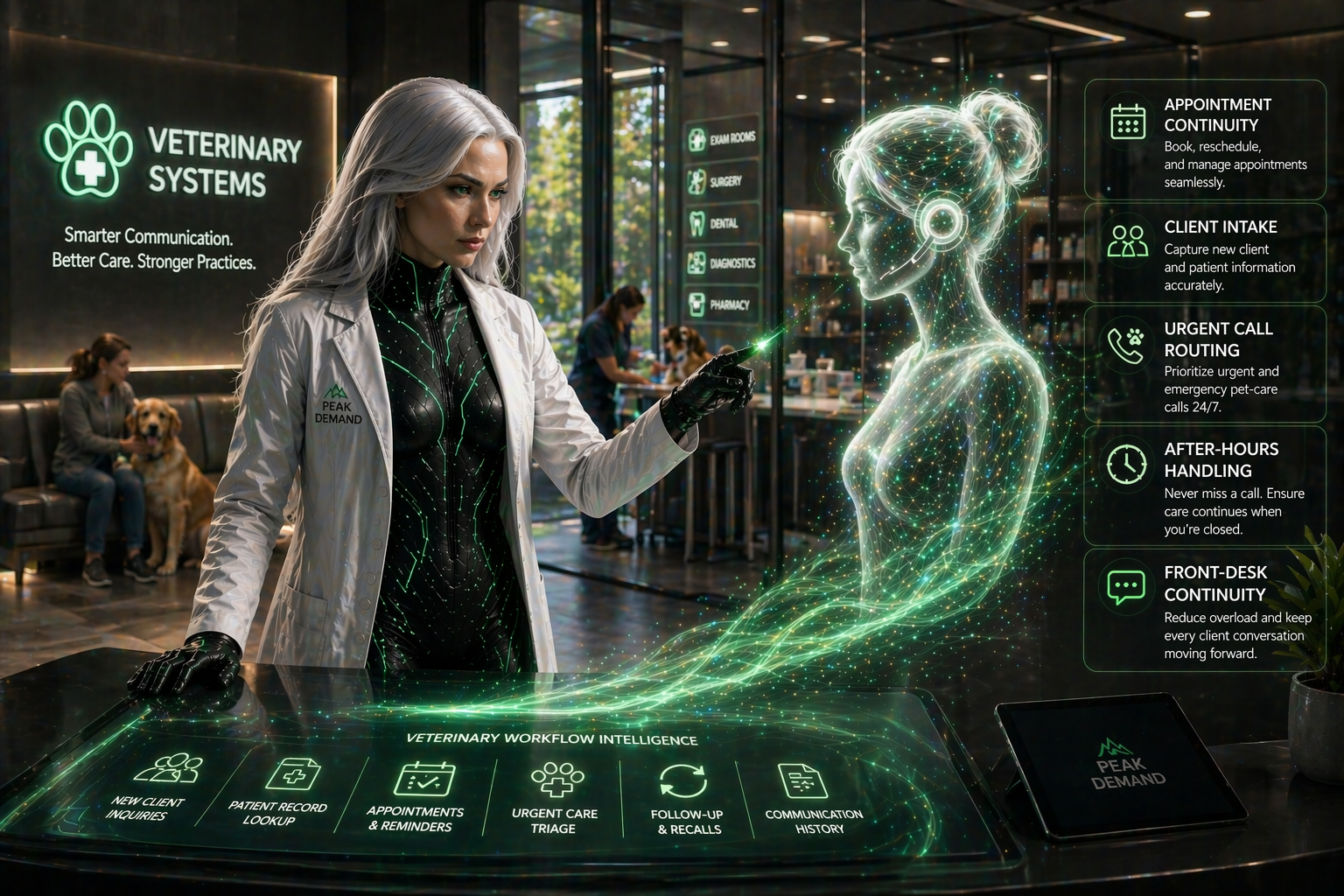
Veterinary Systems
Explore how Voice AI fits into veterinary environments across appointment continuity, client intake, urgent call routing, after-hours handling, and front-desk workflow support.
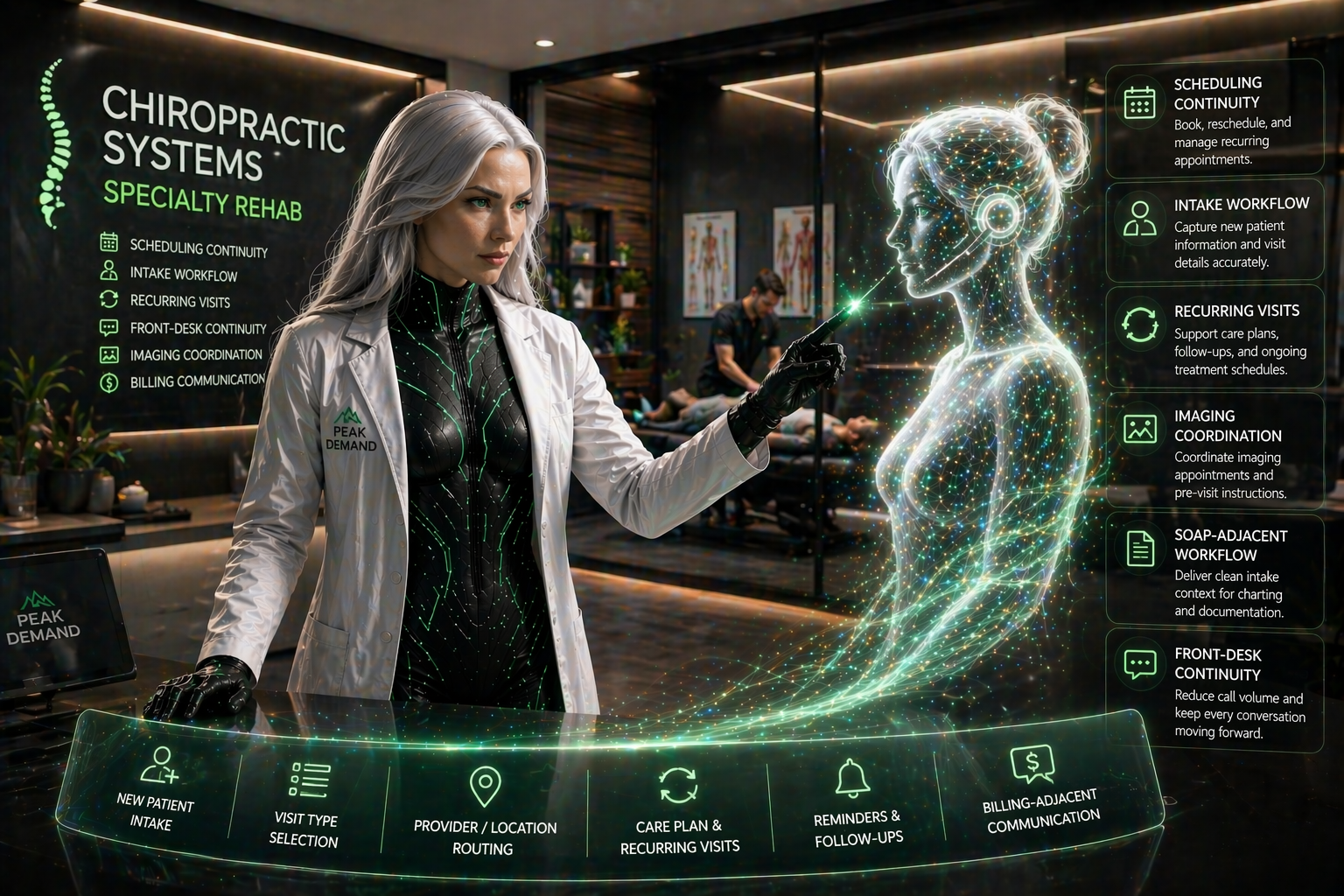
Chiropractic and Specialty Rehab Systems
Explore how Voice AI fits into chiropractic and specialty rehab workflows across scheduling, intake, recurring visits, SOAP-adjacent continuity, imaging-adjacent coordination, and front-desk support.
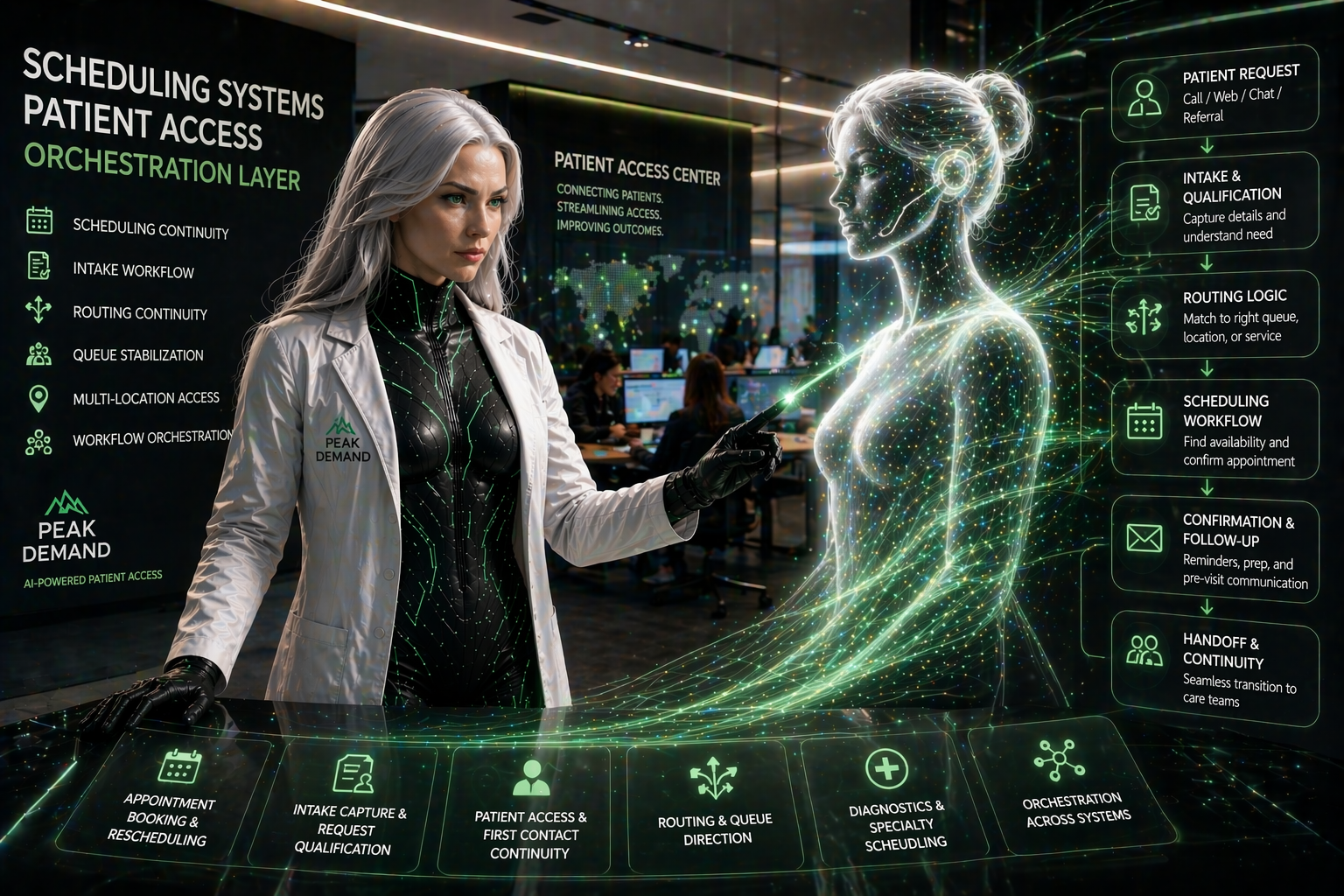
Scheduling, Patient Access, and Orchestration Systems
Explore how Voice AI supports scheduling and patient access architecture across intake, routing, queue stabilization, diagnostics scheduling, and workflow continuity between first contact and next action.
See Healthcare Voice AI Integrations In Action
These walkthroughs show how Voice AI can connect into real healthcare scheduling, intake, and communication environments. Start with TELUS Health CHR for Canadian clinic workflows and Juvonno for rehab and allied health operations.
TELUS Health CHR Integration Walkthrough
See how Voice AI can support TELUS Health CHR scheduling, intake, patient communication, and Canadian clinic workflow continuity.
Juvonno Integration Walkthrough
See how Voice AI can support Juvonno workflows for rehab scheduling, intake, appointment handling, and clinic communication continuity.
Explore published healthcare systems by name
Once you know the software family that best matches your environment, this section makes it easier to browse live healthcare integration pages by platform name. Each category below groups published system pages by the type of environment they usually support so operators, managers, and technical teams can compare workflow fit more quickly. A fuller alphabetical directory appears farther down the page.
Featured healthcare systems
These are high-priority starting points for visitors evaluating real-world Voice AI workflow fit across scheduling, intake, patient communication, routing, and access workflows.
Clinic, ambulatory, and medical EMR systems
These systems are commonly associated with clinic records-adjacent workflows, appointment flow, patient requests, intake continuity, routing, and broader ambulatory communication operations.
Scheduling, intake, and patient communication systems
These environments sit closer to booking logic, intake flow, reminders, clinic administration, and day-to-day patient access operations.
Rehab, physiotherapy, and allied health systems
Allied health and rehabilitation environments often depend on strong scheduling continuity, practitioner matching, intake flow, recurring appointment management, and multi-location operational coordination.
Dental systems
Dental communication workflows often center around appointment demand, cancellation recovery, reminders, new patient calls, and front-desk continuity across booked production.
Veterinary systems
Veterinary communication environments often require appointment continuity, client communication, after-hours handling, urgent call direction, and records-adjacent workflow coordination.
Healthcare organizations rarely evaluate integrations in a vacuum. Grouping systems by software family makes it easier to understand likely workflow fit, compare environments more quickly, and navigate toward both family-level integration pages and live system-specific pages deeper in this hub. The full alphabetical system directory farther down the page should carry the complete 98-system library.
Where Voice AI sits in the healthcare workflow matters more than basic connectivity
Healthcare Voice AI becomes more useful when it is treated as part of the larger workflow architecture around patient access, intake, routing, scheduling, escalation, and downstream ownership. The question is not only whether a system connects. The question is whether the communication flow reaches the next operational step with enough clarity and structure to reduce friction instead of shifting it downstream.
In practice, that means Voice AI often sits across multiple workflow layers at once. It may support first contact, gather structured intake, help direct the caller into the right path, preserve context for staff, and improve continuity into the next step. The value comes from how those layers fit together, not from one isolated connection point.
This is why healthcare teams should evaluate both the scheduling and patient access layer and the EMR or EHR-adjacent layer. In more complex environments, the architecture may also need to account for enterprise compliance and procurement requirements.
Where Voice AI usually enters the workflow
Voice AI often enters at the communication edge: inbound calls, appointment demand, intake capture, after-hours answering, overflow handling, and patient access or routing-related first contact.
Explore healthcare AI receptionistsWhere continuity usually breaks down
Continuity often breaks between the interaction and the next operational owner. That can happen when routing is weak, intake is unclear, scheduling context is incomplete, or downstream teams still need to manually rebuild the request.
Explore centralized scheduling workflowsWhat stronger integration architecture actually improves
Stronger architecture preserves enough structure, direction, and next-step usability for staff or systems to act efficiently. That is what turns Voice AI into operational infrastructure instead of a disconnected front-end layer.
Return to the healthcare resource hub| Integration maturity | What healthcare teams usually experience | Likely operational result |
|---|---|---|
| Fragmented | Some connection points exist, but scheduling, intake, routing, escalation, and continuity still require heavy manual repair. | Lower operational value, more staff burden, weaker patient access continuity, and less confidence in the workflow. |
| Partially connected | Important workflow layers connect, but structure and downstream usability still vary too much between teams, departments, or next-step owners. | Moderate gains, but persistent continuity gaps remain and staff still absorb unnecessary workflow friction. |
| Workflow-led and integrated | Voice AI supports multiple workflow layers with stronger structure, clearer routing, better handoff, and more usable next-step continuity. | Stronger patient access flow, cleaner operational ownership, and more scalable communication infrastructure. |
What healthcare teams should evaluate in the architecture discussion
- Where does Voice AI need to sit first in the communication workflow?
- Where does continuity currently break between the interaction and the next operational step?
- Which layers are EMR or EHR-adjacent, and which ones are workflow-adjacent?
- How do scheduling, intake, routing, patient access, and escalation interact in this environment?
- Will downstream teams receive enough structure to act without rebuilding the request manually?
- Is the integration design workflow-led or just feature-led?
- Does the current architecture reduce friction for staff, or does it simply move the work somewhere else?
Healthcare organizations usually get more value when they evaluate integration maturity across communication flow, operational ownership, and downstream usability together instead of treating each connection as a separate isolated decision. For system-specific evaluation, use the alphabetical healthcare system directory below.
Evaluating software families?
Use the six system-family pages to compare EMR, EHR, dental, veterinary, rehab, scheduling, and patient access environments.
Browse Software FamiliesEvaluating specific systems?
Use the full alphabetical directory to find the exact healthcare platform your team is evaluating.
Open System DirectoryEvaluating enterprise readiness?
Review governance, privacy, escalation, procurement, and compliance considerations before deployment.
Review ComplianceGo deeper into the strategy behind healthcare Voice AI integrations
This section helps healthcare teams move from broad category understanding into the right supporting resources for architecture, interoperability, workflow fit, implementation planning, and system-specific evaluation.
The articles below are the best next clicks for teams evaluating how Voice AI fits into healthcare communication systems, patient access workflows, structured integration pathways, rollout planning, and governed healthcare environments.
For broader category education, use the Healthcare Voice AI Resource Hub. For software-specific evaluation, continue to the full alphabetical system directory lower on this page and use the six healthcare software family pages as the parent layer.
Need system-family pages?
Use the family pages to compare medical EMR, allied health, dental, veterinary, specialty rehab, and patient access systems.
Browse Software FamiliesNeed a specific platform?
Use the alphabetical system directory to find the exact EMR, EHR, scheduling, dental, veterinary, or rehab platform.
Open System DirectoryNeed compliance context?
Use the enterprise compliance page when governance, privacy, procurement, RFPs, or regulated deployment requirements are part of the evaluation.
Review ComplianceCore integration strategy articles
These resources explain why integrations matter, what healthcare teams should evaluate first, and how stronger Voice AI integration architecture should be understood.
Custom pathways, structured integrations, and workflow fit
These articles are useful for teams evaluating custom pathways, structured communication flows, and how Voice AI fits into real healthcare operating environments.
Rollout, implementation, and governance
These resources are best for healthcare teams moving from early exploration into rollout planning, operational safety, implementation readiness, and governance-aware deployment.
Patient access, routing, and workflow bottlenecks
These articles help healthcare teams think more clearly about where communication complexity builds up across patient access, intake, department routing, scheduling, and downstream handoff.
As the healthcare integrations ecosystem continues to grow, this section can keep routing visitors into the most relevant strategy, rollout, and workflow resources without changing the overall structure of the hub. The full software directory appears in the Alphabetical System Directory section below.
Explore live healthcare system integration pages by category
This section gives healthcare teams a category-based way to browse the most important live system pages. It is not the full 98-system directory; it is a curated navigation layer for comparing the platforms most commonly tied to scheduling, intake, patient communication, routing, and patient access workflows.
Use this section when you know the type of software environment you are evaluating. Use the Alphabetical System Directory below when you want to find every live system page by name.
Need the family layer?
Start with the six parent family pages when comparing software categories before choosing a specific system.
Browse Software FamiliesNeed every system?
Use the alphabetical directory for the complete live healthcare system page list by platform name.
Open Alphabetical DirectoryNeed workflow context?
Review how Voice AI fits across patient access, intake, routing, scheduling, escalation, and downstream ownership.
Review Workflow ArchitectureFeatured healthcare systems
These are some of the strongest starting points for teams exploring healthcare Voice AI integrations across scheduling, intake, patient communication, routing, and access workflows.
Clinic and ambulatory EMR systems
These systems are commonly associated with clinic records-adjacent workflows, intake, appointment flow, routing, patient communication, and broader ambulatory continuity.
Explore medical and ambulatory EMR familyScheduling, intake, and patient communication systems
These environments sit closer to booking logic, intake flow, reminders, clinic administration, and day-to-day patient access operations.
Explore scheduling and patient access familyRehab, physiotherapy, and allied health systems
Allied health and rehabilitation environments often depend on strong scheduling continuity, practitioner matching, intake flow, recurring appointments, and multi-location coordination.
Explore allied health and rehab familyDental systems
Dental communication workflows often center on appointment demand, cancellation recovery, reminders, new patient calls, and front-desk continuity.
Explore dental familyVeterinary systems
Veterinary communication environments often require appointment continuity, client communication, after-hours handling, and records-adjacent workflow coordination.
Explore veterinary familyEnterprise, specialty, imaging, and outpatient environments
These environments often involve more complex routing, diagnostic scheduling, imaging coordination, enterprise workflow ownership, and department-specific handoff requirements.
Explore enterprise and medical EMR familyThis curated category browse section helps visitors compare common healthcare software environments without scrolling the entire directory. The complete system list belongs in the Alphabetical System Directory section below, where every live healthcare system page should be listed by platform name.
Talk through your healthcare communication workflow
If your team is evaluating healthcare Voice AI integrations, the most useful next step is usually a workflow conversation. That means reviewing patient access pressure points, scheduling flow, intake structure, routing logic, after-hours coverage, compliance expectations, and the systems surrounding those workflows.
Peak Demand approaches healthcare environments through workflow fit, governance awareness, and operational usability. The goal is to help organizations map a communication architecture that supports real teams, real workflows, and real continuity requirements across EMR, EHR, scheduling, intake, dental, veterinary, rehab, and patient access environments.
Need software families?
Compare the six parent healthcare integration families before choosing a specific system page.
Browse software familiesNeed workflow context?
Review how Voice AI fits across intake, routing, scheduling, escalation, and downstream ownership.
Review workflow architectureNeed compliance review?
Use the enterprise compliance page when governance, privacy, procurement, and RFP standards matter.
Review complianceFrequently asked questions
What does Voice AI mean in a healthcare integration environment?
Can Voice AI work with EMR, EHR, scheduling, intake, and routing workflows?
Are healthcare Voice AI integrations always direct?
Where should healthcare organizations start evaluating Voice AI integrations?
How should compliance and governance fit into the evaluation?
What is the role of this integrations hub?
About Peak Demand
Peak Demand is a Toronto-based AI agency focused on Voice AI, communication automation, and workflow infrastructure for organizations operating in more complex service environments.
In healthcare, the focus is not just on call handling. It is on patient access continuity, scheduling pressure, intake structure, routing logic, after-hours support, governance, and how communication systems fit into real operational workflows.
- Workflow-driven and implementation-aware
- Governance-first in healthcare communication environments
- Built to support clinics, networks, and enterprise teams
- Designed to scale into software-specific integration pathways
- Organized around healthcare system families and live integration pages
Healthcare software integrations by system name
If you already know the software you are evaluating, this alphabetical directory is the fastest way to find the right live system page.
This directory includes the full 98-system healthcare integration library from the current Peak Demand system-page build. It is designed to help teams compare EMR, EHR, scheduling, intake, patient communication, dental, veterinary, rehab, wellness, chiropractic, orchestration, home care, med spa, pharmacy, and enterprise healthcare systems by software name.
For category-level browsing, use the software family section. For workflow context, use the workflow architecture section. This section is the full alphabetical browse layer.
Live healthcare system pages in this directory
Grouped alphabetically with visible section counts so the full library is obvious at a glance.
A–C
34 systemsABELMed through Curve Dental.
D–H
20 systemsDentrix through Helios Software.
I–M
15 systemsIDEXX Cornerstone through MRX Solutions.
N–O
11 systemsNextech through Owl Practice.
P–R
8 systemsPabau through RXNT.
Compare healthcare systems by name, category, and workflow fit
This directory is useful for comparing clinic EMRs, EHR-adjacent systems, scheduling and intake platforms, patient communication software, dental systems, veterinary systems, rehab and allied health systems, chiropractic systems, med spa systems, home care systems, pharmacy-adjacent systems, orchestration platforms, diagnostic workflows, and enterprise healthcare environments by software name before going deeper into workflow design, integration possibilities, and operational fit.
Explore your own AI use case on a discovery call.