
Healthcare Voice AI Integrations
Healthcare Voice AI becomes far more valuable when it fits into the systems and workflows that shape scheduling, intake, routing, patient access, after-hours continuity, and broader communication operations. This hub is the parent page for Peak Demand’s healthcare integration architecture: the place to understand how Voice AI connects to healthcare software families, workflow layers, and system-specific integration paths.
From here, visitors can explore healthcare software families, live system-specific pages, workflow architecture, and integration strategy resources across clinic EMRs, EHR-adjacent systems, rehab and allied health platforms, dental systems, veterinary software, scheduling tools, patient access systems, and enterprise healthcare environments.
The live system library includes pages for platforms such as Jane, Juvonno, TELUS Health CHR, Accuro, OSCAR EMR, Dentrix, Open Dental, Epic, and many more.

Architecture Role
Parent hub for healthcare integrations
System Coverage
98 healthcare system pages
Software Families
6 healthcare integration families
Workflow Focus
Scheduling, intake, routing, access
Healthcare integrations should be evaluated through workflow continuity
One of the biggest mistakes in healthcare integration conversations is reducing the discussion to a list of software names. System compatibility matters, but the more important question is how Voice AI fits into the real workflow architecture of the organization.
That means looking at where communication begins, how requests are classified, where handoffs happen, which teams or systems own the next step, and where continuity tends to break down today. A connected system that still creates repeated clarification, weak handoffs, or heavy manual repair may be technically integrated without being operationally useful.
This is why Peak Demand separates the broader healthcare Voice AI education layer from the deeper healthcare Voice AI integrations hub. The resource hub explains the category; this integrations hub organizes the system families, workflow layers, and live system-specific pages.
Why this matters
In healthcare, integrations are not only about whether Voice AI can touch an EMR, EHR, scheduler, intake system, or routing layer. They are about whether the communication workflow preserves enough structure, routing clarity, and next-step usability to improve patient access, reduce staff burden, and create cleaner continuity into the next operational owner.
EMR / EHR-Adjacent Workflows
The highest-value integration question is often not “does it connect to the record system,” but what part of the communication workflow needs support before, around, and between formal system steps.
- Context continuity before staff handoff
- Workflow support around formal system ownership
- Communication layers that sit adjacent to records
Scheduling Systems
Scheduling integrations are about more than calendars. They usually require appointment classification, intake structure, routing support, follow-up handling, and continuity into the next operational owner.
- Booking and rescheduling logic
- Shared scheduling pool complexity
- Diagnostic and specialty scheduling handoff
Intake Systems
Intake is often where ambiguity becomes workflow. Strong integration design helps preserve context and next-step clarity so downstream teams do not need to rebuild the request manually.
- Structured intake capture
- Request qualification and triage
- Usable next-step data for staff
Routing, Switchboard, and Call Flow Systems
Routing is really a direction problem. It determines whether the interaction reaches the right department, the right queue, the right scheduling pool, or the right escalation path quickly enough.
- Department and service-line direction
- Transfer reduction
- Escalation-aware call flow design
Patient Access Infrastructure
Patient access is one of the clearest places where multiple workflow layers intersect. Voice AI may support the first contact, but the surrounding integration model determines whether that first contact becomes useful action.
- Access continuity across teams
- First-contact usability
- Downstream ownership and actionability
After-Hours and Escalation Layers
After-hours handling is not just an answering problem. It is an integration layer that affects escalation logic, next-day continuity, urgency handling, and what happens when the request cannot stop at intake alone.
- Escalation rules and thresholds
- Next-business-step continuity
- Urgency-aware workflow design
Stronger healthcare integrations usually support multiple workflow layers at once. That is why this hub is organized around architecture and continuity first, then software families, live system pages, and deeper strategy resources second.
Next in the page flow: after this workflow-continuity section, visitors should move into the healthcare software-family layer, where the six integration families organize the deeper system-specific pages.
Browse Healthcare Software Families
How the MLS Works — 25 Questions Real Estate Agents & Brokers Ask (US & Canada)
How the MLS works: this concise guide helps real estate agents and brokers in the US and Canada run accurate listings, approve vendors safely, spot data errors quickly, and run AI pilots in confidence.
Quick overview: What is the MLS and why it matters

The MLS (Multiple Listing Service) is the regional database real estate professionals use as the authoritative record for a property’s price, status, photos and showing instructions. It’s where brokers post listings and where agents go first to confirm facts before they call a buyer, schedule a showing, or publish a marketing link — make checking the MLS a habit on every call.
Each MLS is run by a local board or association that sets access rules, decides which fields are public versus broker-only, and enforces photo and attribution requirements. In the United States you’ll find many regional boards with varying platforms and policies; in Canada, boards commonly surface data through REALTOR.ca / DDF and have slightly different display rules. Regardless of country, the local board is the gatekeeper for how MLS data is used.
Brokers and agents treat the MLS as the “listing truth” because entries are created and maintained by licensed professionals and policed by the board. Accurate MLS data reduces phone confusion, speeds up showings, lowers dispute risk, and makes downstream tools — CRMs, websites, or AI pilots — far more reliable and effective.
25 Common MLS Questions for Agents & Brokers — Vendor Access, Listing Accuracy, Security & AI Pilots

MLS FAQ for agents and brokers: here are 25 common, search-friendly questions about vendor access, listing checks, security, and running AI pilots — with short, actionable answers you can use today.
Vendor access & permissions (Questions agents search for)
Who must sign to give a vendor MLS access?
The broker-of-record (or an authorized officer) usually signs the board’s vendor/data-use agreement to authorize third-party access.What paperwork does a vendor need for MLS access?
Most boards require a vendor licence or data-use agreement, proof of insurance, and a named vendor contact for onboarding.Can I limit what a vendor can see in the MLS?
Yes — brokers can restrict vendors to only the specific fields and actions they need (for example: read price/status but block broker-only notes).How do I revoke a vendor’s MLS access quickly?
Ask the board for the revocation process up front, keep the vendor agreement and contacts on file, and notify the board and vendor to remove credentials immediately.What is an MLS sandbox and why should I ask for it?
A sandbox is a test feed or dataset for demos and AI pilots so you can validate behavior without touching production listings or calendars.
Listing data & accuracy (Questions agents search for)
What information is in a typical MLS listing?
Common fields include MLS#, list price, status, photos, beds/baths, square footage, public remarks, agent contact and showing instructions.Why should I always confirm the MLS number (MLS#)?
The MLS# is the single, reliable identifier for a property and prevents lookup or booking mistakes across similar addresses.Which fields should I check live before calling back a lead?
Verify list price and status live; everything else (photos, full description) can be texted or emailed if necessary.Who fixes a wrong listing and how fast will it be corrected?
Contact the listing agent first; if unresolved, escalate to the MLS board support and log your request until corrected.What makes a listing look untrustworthy?
Missing photos, contradictory fields (e.g., DOM vs. list date), or no showing instructions — verify these before relying on the listing.
Lead handling, booking & routing (Questions agents search for)
Can an automated system book showings from MLS data?
Yes — with agreed rules and calendar/showing-scheduler credentials, systems can create tentative holds or confirmed bookings per your policy.How do we prevent double-bookings when automating holds?
Use instant calendar checks, short tentative holds, and require agent confirmation for priority time slots; always write holds to the CRM.How should “hot” buyer leads be routed?
Set simple qualifiers (pre-approval, budget threshold, urgent timeline) and route matches to immediate transfer, priority callback, or an agent alert.Will agents get caller context on transfers?
They should — warm handoffs include caller name, listing ID and a brief intent summary so agents don’t start cold.How do we tag and track AI-generated leads in the CRM?
Add a clear source tag (e.g., “AI-Receptionist”), include listing_id and intent in the lead note, and review quality weekly.
Security, privacy & compliance (Questions agents search for)
Should we store call recordings and for how long?
Only if you choose; set a retention window (commonly 30–90 days), document it in policy, and follow local privacy laws.How can I verify a vendor’s security practices?
Request a short security summary: TLS transport, encryption at rest, secrets management, retention windows and breach notification SLA.What are common MLS display and photo rules I must follow?
Boards often require exact attribution text or logos on public links and have rules on photo redistribution — follow the board’s required wording.How do I capture caller consent for recording and SMS?
Use a short script at the start of the call (e.g., “May I record this call and text you the listing link?”) and log the yes/no in the CRM.What’s the immediate step if there’s a data breach?
Isolate affected systems, rotate credentials, notify broker-of-record and the board per contract, and follow legal notification requirements.
AI pilots, testing & ops (Questions agents search for)
How long should an AI pilot run to be meaningful?
Typically 2–4 weeks or a few hundred calls — enough time to validate lookups, bookings, CRM writes and agent handoffs.What KPIs should we track during an AI pilot?
Track live lookup success rate, bookings per 100 calls, CRM write success, fallback rate, and agent satisfaction.How do we run a safe AI pilot without disrupting calendars?
Use sandbox credentials, test calendars, synthetic calls and a staging phone number so production schedules and live listings are not affected.What happens if a board rate-limits or blocks queries?
Use graceful fallbacks (text the listing link, queue SMS, or route caller to an agent) and have the vendor manage retries per board rules.When is it safe to move an AI pilot to production?
Move to production after KPIs meet agreed thresholds, security checks pass, broker sign-off is obtained, and agents are trained on the handoff/playbook.
Practical cheat-sheet: What to check in every MLS listing (for Brokers, Agents, Buyers)

For Brokers (ops & compliance)
Listing status & history — why: status mistakes create legal risk and unhappy clients. Do this now: verify Active/Pending/Sold and note recent status changes.
Price change log — why: frequent drops can signal stale marketing or motivated sellers. Do this now: capture last price change and date.
Required fields present — why: missing photos/measurements reduce leads and break integrations. Do this now: flag incomplete listings for immediate correction.
Broker-only / restricted fields — why: revealing restricted data risks board penalties. Do this now: confirm which fields vendors/staff may access.
Photo & media permissions — why: boards often restrict redistribution or require attribution. Do this now: check media rights and required wording before sharing.
MLS identifiers & formatting — why: consistent MLS# prevents CRM/automation errors. Do this now: confirm the MLS# and paste it into your lead record.
Audit & access logs — why: traceability helps resolve disputes and proves compliance. Do this now: ensure vendor/IT provides access logs on request.
For Listing Agents (marketing & conversion)
Primary photo quality — why: first photo drives clicks and calls. Do this now: swap in the strongest image.
Price & status accuracy — why: callers want the price first — errors kill trust. Do this now: confirm before returning a lead.
Short public remarks — why: previews and voice scripts use the short blurb. Do this now: rewrite to one punchy sentence with key features.
Open-house & showing instructions — why: unclear access reduces showings. Do this now: add exact times and lockbox notes.
Key features up front — why: buyers scan for showstoppers (pool, garage). Do this now: list top 3 features in the opening line.
Virtual tour & attachments — why: broken links frustrate prospects. Do this now: test every tour/link before marketing.
Agent contact & routing — why: wrong contact means missed leads. Do this now: verify phone/email and where leads route.
For Buyer Agents & Buyers (qualification & safety)
Confirm MLS# or full address — why: prevents showing the wrong home. Do this now: ask/copy the MLS# at the start of every call.
Live price & status check — why: price/status changes happen fast. Do this now: verify live or state “price as of X minutes ago.”
Days on Market & price history — why: shows seller flexibility. Do this now: note recent drops before advising offers.
HOA/fees & special conditions — why: recurring costs affect affordability. Do this now: calculate monthly carrying cost for buyers.
Showing restrictions & access — why: some homes need appointments or special access. Do this now: confirm how to get in before scheduling.
Attachments & disclosures — why: important for inspections & offers. Do this now: request PDFs and send to your buyer.
Red-flag check — why: conflicts or missing info may hide issues. Do this now: pause and verify if photos, fields or dates contradict.
What brokers can say to buyers and sellers about MLS listings (ready-to-use lines)

For buyer conversations (short, trust-building lines)
“Can I confirm the MLS number so I’m looking at the exact property you mean?”
“That price and status are showing in the MLS right now — I’ll double-check live and text you a link.”
“I see the last price change was [date]. That often shows how motivated the seller is.”
“Good news — the MLS shows open-house times on [date/time]. I can hold a spot and text you the confirmation.”
“I’ll pull the disclosures and email them to you right now so you can review before we go.”
“There’s a note in the MLS about access — it needs an appointment. I’ll handle scheduling and confirm with the listing agent.”
“If you want, I can run recent sold comps from the MLS and send a short market note so you can see where this sits.”
“If I can’t fetch live details on the call, I’ll text the MLS link and follow up in [X] minutes — does that work?”
Short buyer call script (30–40 seconds)
“Hi, this is [Name] from [Brokerage]. Can I confirm the MLS number and current list price so I’m looking at the right property? Great — I’ll check availability and either hold a tentative slot for you or text the listing link and follow up in [X] minutes.”
Buyer SMS templates
“Hi [Name], here’s the MLS link for [address/MLS#]. Price: [price]. Open-house: [time]. Reply YES to hold a tentative slot.”
“Can I text disclosures for [address]? Reply YES and I’ll send them now.”
For seller conversations (confidence & transparency)
“We’ll keep your MLS listing accurate: I’ll confirm price and status before any public post and update you on any changes.”
“Buyers often ask two things first: price and showing instructions — I’ll make sure both are always up-to-date in the MLS.”
“If we need to update photos or wording, I’ll push the change to MLS and confirm it shows correctly on IDX and REALTOR pages.”
“We’ll track who accesses the listing and log any change requests so you always know what was updated and why.”
“If you approve a vendor or tech, we’ll limit what they can see — only the fields they need — and I’ll get your sign-off first.”
“We’ll run a weekly MLS check during the listing period to catch any incorrect or duplicate entries fast.”
“If a buyer wants proof, I can pull the MLS price history and recent solds to justify our suggested offers.”
Short seller call script (30–40 seconds)
“Hi [Seller], I’ll confirm today that the MLS shows the correct price, photos and showing instructions. If anything needs changing I’ll make it and send you a quick confirmation. If you hear anything odd from buyers, call me first and I’ll correct the MLS record.”
Seller reassurance email snippet
Subject: MLS update confirmed — [address / MLS#]
Hi [Name],
Quick note: I confirmed the MLS listing shows the updated price and the new primary photo. I tested the listing on public sites and the links are working. I’ll monitor activity and report any inquiries.
Thanks,
[Your name / phone]
Quick lines for tricky situations (errors, conflicts, timing)
“There’s a mismatch between the website and MLS — I’ll log it with the listing agent/board now and follow up.”
“The MLS indicates a recent price drop; I’ll call the listing agent for clarity and report back within [X] hours.”
“The MLS shows ‘appointment only’ — I’ll secure approval and text you the access steps before the showing.”
“If we can’t get live MLS data during the call, I’ll send the listing link and call you back once verified.”
Warm handoff / transfer lines (for smooth agent transfers)
“I’ve got your name, MLS# and why you’re calling — I’ll transfer you to [agent], who’s ready with the listing details.”
“Before I transfer, I’ll text the agent a quick summary so they pick up with the full context.”
CRM / logging lines (what to note when recording the lead)
“I’m tagging this lead as ‘MLS-Inquiry’ and adding the MLS# and caller notes so the assigned agent has full context.”
“I’ll record the consent and SMS opt-in in the CRM now — we keep records for follow-up.”
“Adding note: ‘Called about [MLS#], wants [showing/price info], OK to text link.’”
Two copy-paste email templates
Buyer follow-up email (after call)
Subject: Details & link for [address / MLS#]
Hi [Name],
Thanks for the call — here’s the MLS link for [address / MLS#]. Current price: [price]. Open-house/showing availability: [times]. Reply if you want me to hold a tentative slot — I’ll text confirmation and the agent contact.
Best,
[Your name / contact]
Seller notification email (after a change)
Subject: MLS update confirmed — [address / MLS#]
Hi [Name],
Quick note: your MLS listing now shows the updated price and the new primary photo. I tested the listing on public sites and the links are working. I’ll monitor activity and report any inquiries.
Thanks,
[Your name / phone]
Quick tips to make these lines work
Use the MLS# early in the conversation to avoid confusion and to make lookups reliable.
Always offer to text the live listing link — it builds trust and reduces read-aloud errors.
Record caller consent for texts/recordings on first contact and log it in the CRM.
Use “tentative hold” phrasing to avoid accidental confirmed bookings.
If you can’t verify live data, promise a quick follow-up and deliver it fast — speed wins trust.
Train receptionists on exact lines so handoffs are consistent and agents receive full context.
MLS AI pilot checklist & top KPIs

Run a short, focused MLS AI pilot so you can validate live calls and MLS lookups without disrupting production. Aim for 2–4 weeks or ~300–500 inbound calls (whichever comes first). Use a staging phone number and sandbox credentials where available.
Core test cases
Exact MLS# live lookup (happy path)
Address fragment lookup (fuzzy match)
Booking flow: tentative hold → confirmation → CRM write
Warm handoff to agent with context card
Fallback path: timeout → SMS link → agent follow-up
Concise KPI table
MetricTarget / Pass ThresholdLive MLS lookup success (within live-path timeout)≥ 90%CRM write success (lead created with listing_id)≥ 95%Bookings per 100 calls3–8 bookingsFallback rate (timeouts / errors)< 10%Agent satisfaction (pilot survey)≥ 80% positive
Stop or roll back if live MLS lookup success < 80%, CRM writes < 90%, or agent satisfaction is poor. Run daily monitoring and produce a weekly pilot report with volumes, errors, representative call samples and suggested fixes.
What developers should pay attention to (developer checklist)

For engineering teams working on an MLS-connected project, focus on these practical items — concise, prioritized, and written so product owners can follow along.
RESO Web API usage &
$select— pick minimal fields for fast responses; avoid heavy payloads on live paths.Field mapping & canonical schema — normalize different board fields into one internal model to keep downstream code simple.
Caching strategy & TTLs — short TTLs for price/status, longer for photos; design cache-first with a clear live-path fallback.
Timeouts & retry logic — enforce tight live-path timeouts (e.g., ~1s) and exponential backoff for retries to respect board limits.
Auth & secret handling — use OAuth or API keys with a secrets vault and short-lived tokens; never hard-code creds.
Rate limits & per-board throttling — implement per-board rate limiters and graceful degradation when quotas are reached.
Webhooks & change notifications — prefer push updates where available to minimize polling and improve freshness.
Monitoring, metrics & alerts — track lookup latency, cache hit %, error rates, fallback rate, and CRM write success with alert thresholds.
Logging & traceability — include trace_id, listing_id and masked caller info for debugging and audits.
Security & retention policies — enforce TLS, encryption at rest, defined retention windows for recordings/PII, and an incident response plan.
Integrate MLS with AI, CRM & Showing Schedulers — Book a Discovery Call
Is your brokerage ready to connect MLS data into AI receptionists, CRMs or showing schedulers? Get a fast, practical review: download our one-page MLS checklist to prepare your team, or book a free 15-minute discovery call with Peak Demand to walk through integration scope, sandbox needs, and a pilot plan.
Learn more about the technology we employ.

Peak Demand’s AI Receptionist for real estate brokerages is the cost-effective replacement for your after-hours answering service tailored to brokerages. When a buyer calls, the system can look up the property in MLS, read accurate listing facts, ask qualifying questions, and either book a showing or route the caller to the right agent. You get fewer missed opportunities, better lead qualification, and lower call-handling costs. We handle MLS integration, CRM syncing, calendar holds, and compliance so your team can focus on closing.

Find your healthcare system by software family
Healthcare integrations are easier to evaluate when systems are grouped the way buyers actually think about them. Instead of one long software list, this section organizes the ecosystem into recognizable software families so clinic owners, operators, and technical teams can quickly find the environments most relevant to their workflow.
Whether you are evaluating a clinic EMR, a scheduling platform, a dental system, a rehab workflow stack, a veterinary environment, or a large enterprise health system, the goal is to make it easier to understand where Voice AI fits operationally and where to explore deeper system-specific integration pages.
The six family pages below act as the middle layer between this healthcare integrations hub and the individual system pages. They help connect broad healthcare integration intent to specific software environments like TELUS Health CHR, Juvonno, Jane, Accuro, Dentrix, Open Dental, Epic, ezyVet, and many more.

Medical and Ambulatory EMR Systems
Explore how Voice AI fits into medical and ambulatory EMR environments across scheduling, intake, patient access, provider routing, after-hours continuity, and clinic communication workflows.
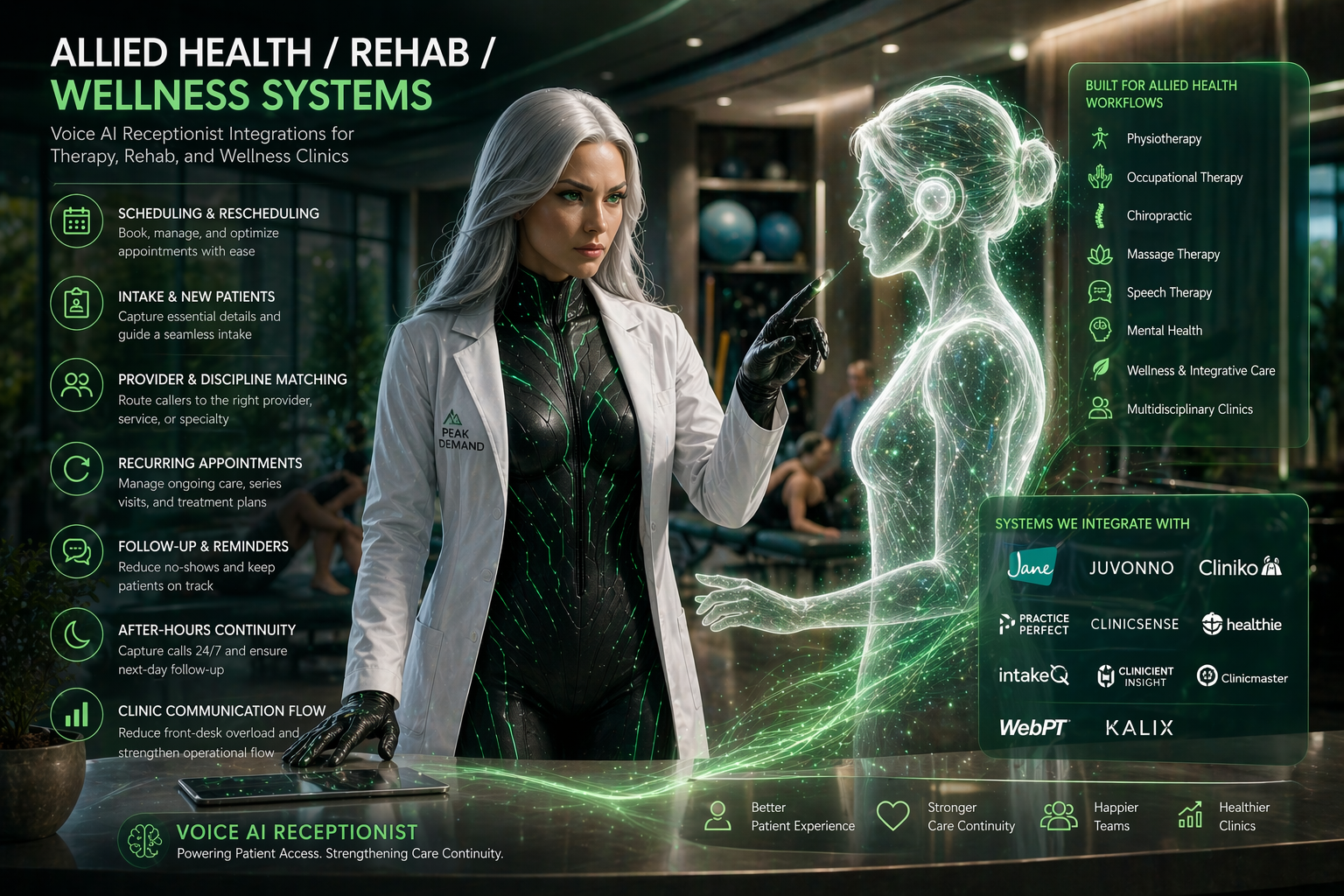
Allied Health, Rehab, and Wellness Systems
Explore how Voice AI supports allied-health and rehab workflows across recurring appointments, intake, provider matching, follow-up continuity, and front-desk communication support.

Dental Systems
Explore how Voice AI fits into dental communication workflows across new patient calls, hygiene recall, appointment flow, cancellation recovery, emergency routing, and front-desk continuity.
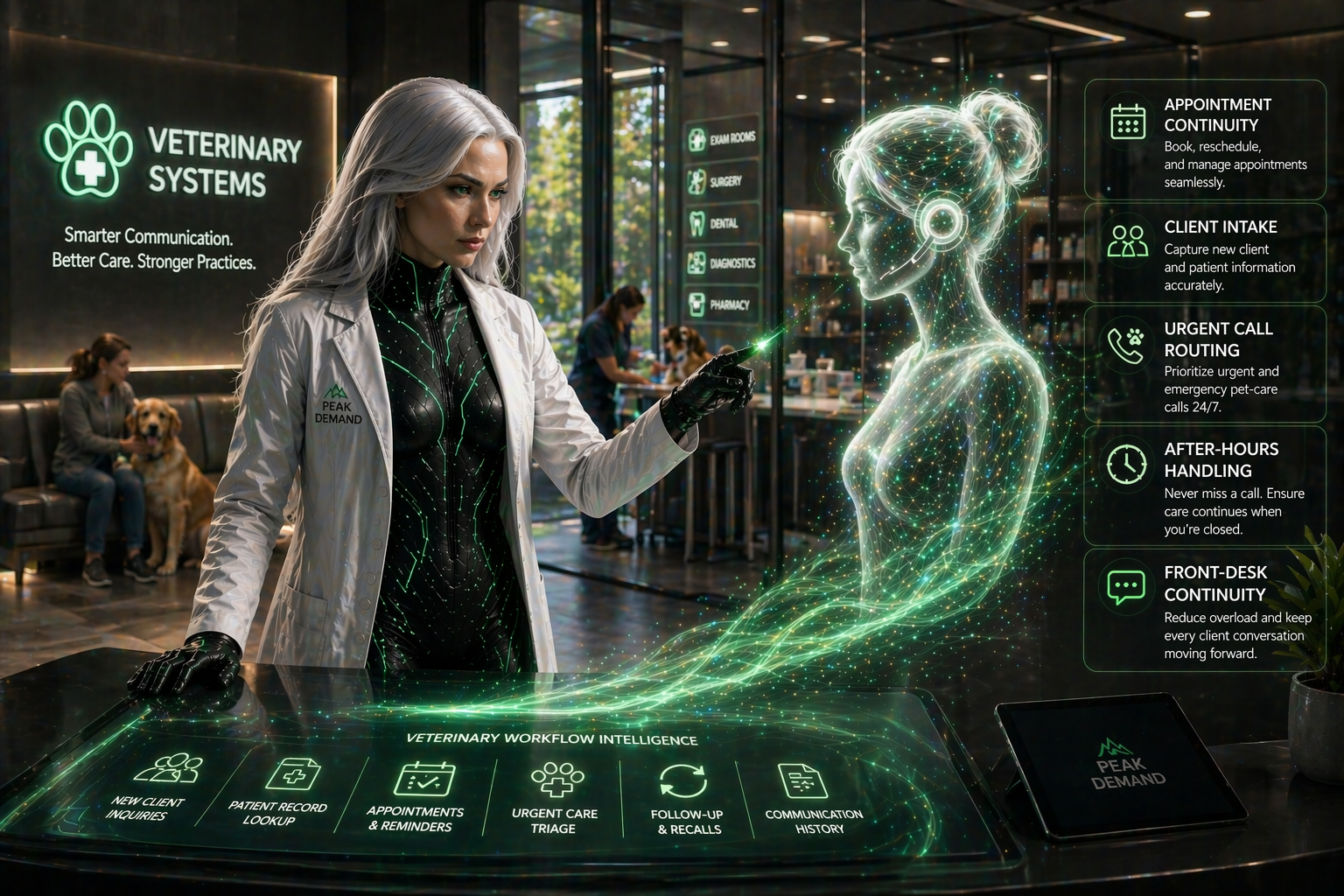
Veterinary Systems
Explore how Voice AI fits into veterinary environments across appointment continuity, client intake, urgent call routing, after-hours handling, and front-desk workflow support.

Chiropractic and Specialty Rehab Systems
Explore how Voice AI fits into chiropractic and specialty rehab workflows across scheduling, intake, recurring visits, SOAP-adjacent continuity, imaging-adjacent coordination, and front-desk support.
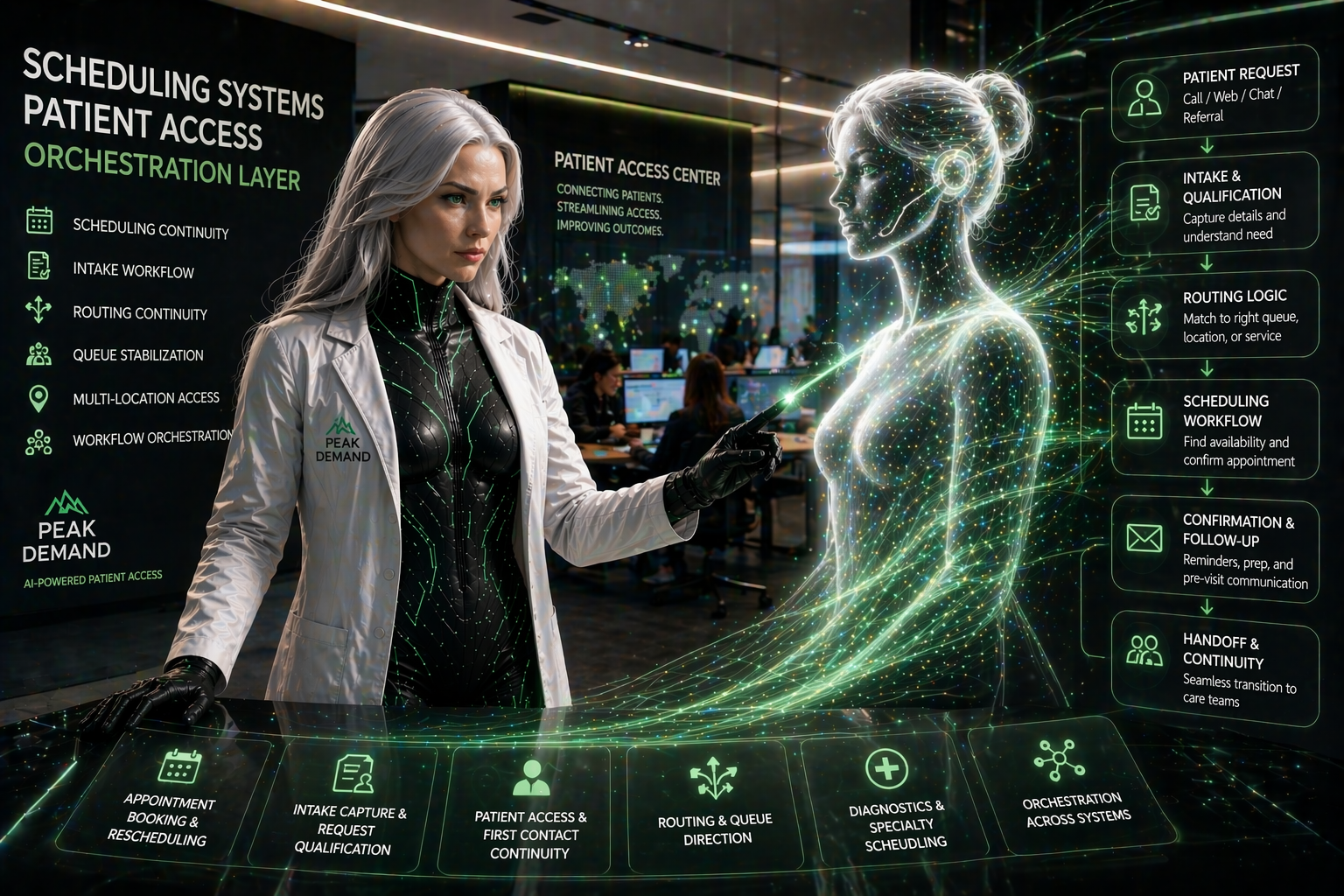
Scheduling, Patient Access, and Orchestration Systems
Explore how Voice AI supports scheduling and patient access architecture across intake, routing, queue stabilization, diagnostics scheduling, and workflow continuity between first contact and next action.
See Healthcare Voice AI Integrations In Action
These walkthroughs show how Voice AI can connect into real healthcare scheduling, intake, and communication environments. Start with TELUS Health CHR for Canadian clinic workflows and Juvonno for rehab and allied health operations.
TELUS Health CHR Integration Walkthrough
See how Voice AI can support TELUS Health CHR scheduling, intake, patient communication, and Canadian clinic workflow continuity.
Juvonno Integration Walkthrough
See how Voice AI can support Juvonno workflows for rehab scheduling, intake, appointment handling, and clinic communication continuity.
Explore published healthcare systems by name
Once you know the software family that best matches your environment, this section makes it easier to browse live healthcare integration pages by platform name. Each category below groups published system pages by the type of environment they usually support so operators, managers, and technical teams can compare workflow fit more quickly. A fuller alphabetical directory appears farther down the page.
Featured healthcare systems
These are high-priority starting points for visitors evaluating real-world Voice AI workflow fit across scheduling, intake, patient communication, routing, and access workflows.
Clinic, ambulatory, and medical EMR systems
These systems are commonly associated with clinic records-adjacent workflows, appointment flow, patient requests, intake continuity, routing, and broader ambulatory communication operations.
Scheduling, intake, and patient communication systems
These environments sit closer to booking logic, intake flow, reminders, clinic administration, and day-to-day patient access operations.
Rehab, physiotherapy, and allied health systems
Allied health and rehabilitation environments often depend on strong scheduling continuity, practitioner matching, intake flow, recurring appointment management, and multi-location operational coordination.
Dental systems
Dental communication workflows often center around appointment demand, cancellation recovery, reminders, new patient calls, and front-desk continuity across booked production.
Veterinary systems
Veterinary communication environments often require appointment continuity, client communication, after-hours handling, urgent call direction, and records-adjacent workflow coordination.
Healthcare organizations rarely evaluate integrations in a vacuum. Grouping systems by software family makes it easier to understand likely workflow fit, compare environments more quickly, and navigate toward both family-level integration pages and live system-specific pages deeper in this hub. The full alphabetical system directory farther down the page should carry the complete 98-system library.
Where Voice AI sits in the healthcare workflow matters more than basic connectivity
Healthcare Voice AI becomes more useful when it is treated as part of the larger workflow architecture around patient access, intake, routing, scheduling, escalation, and downstream ownership. The question is not only whether a system connects. The question is whether the communication flow reaches the next operational step with enough clarity and structure to reduce friction instead of shifting it downstream.
In practice, that means Voice AI often sits across multiple workflow layers at once. It may support first contact, gather structured intake, help direct the caller into the right path, preserve context for staff, and improve continuity into the next step. The value comes from how those layers fit together, not from one isolated connection point.
This is why healthcare teams should evaluate both the scheduling and patient access layer and the EMR or EHR-adjacent layer. In more complex environments, the architecture may also need to account for enterprise compliance and procurement requirements.
Where Voice AI usually enters the workflow
Voice AI often enters at the communication edge: inbound calls, appointment demand, intake capture, after-hours answering, overflow handling, and patient access or routing-related first contact.
Explore healthcare AI receptionistsWhere continuity usually breaks down
Continuity often breaks between the interaction and the next operational owner. That can happen when routing is weak, intake is unclear, scheduling context is incomplete, or downstream teams still need to manually rebuild the request.
Explore centralized scheduling workflowsWhat stronger integration architecture actually improves
Stronger architecture preserves enough structure, direction, and next-step usability for staff or systems to act efficiently. That is what turns Voice AI into operational infrastructure instead of a disconnected front-end layer.
Return to the healthcare resource hub| Integration maturity | What healthcare teams usually experience | Likely operational result |
|---|---|---|
| Fragmented | Some connection points exist, but scheduling, intake, routing, escalation, and continuity still require heavy manual repair. | Lower operational value, more staff burden, weaker patient access continuity, and less confidence in the workflow. |
| Partially connected | Important workflow layers connect, but structure and downstream usability still vary too much between teams, departments, or next-step owners. | Moderate gains, but persistent continuity gaps remain and staff still absorb unnecessary workflow friction. |
| Workflow-led and integrated | Voice AI supports multiple workflow layers with stronger structure, clearer routing, better handoff, and more usable next-step continuity. | Stronger patient access flow, cleaner operational ownership, and more scalable communication infrastructure. |
What healthcare teams should evaluate in the architecture discussion
- Where does Voice AI need to sit first in the communication workflow?
- Where does continuity currently break between the interaction and the next operational step?
- Which layers are EMR or EHR-adjacent, and which ones are workflow-adjacent?
- How do scheduling, intake, routing, patient access, and escalation interact in this environment?
- Will downstream teams receive enough structure to act without rebuilding the request manually?
- Is the integration design workflow-led or just feature-led?
- Does the current architecture reduce friction for staff, or does it simply move the work somewhere else?
Healthcare organizations usually get more value when they evaluate integration maturity across communication flow, operational ownership, and downstream usability together instead of treating each connection as a separate isolated decision. For system-specific evaluation, use the alphabetical healthcare system directory below.
Evaluating software families?
Use the six system-family pages to compare EMR, EHR, dental, veterinary, rehab, scheduling, and patient access environments.
Browse Software FamiliesEvaluating specific systems?
Use the full alphabetical directory to find the exact healthcare platform your team is evaluating.
Open System DirectoryEvaluating enterprise readiness?
Review governance, privacy, escalation, procurement, and compliance considerations before deployment.
Review ComplianceGo deeper into the strategy behind healthcare Voice AI integrations
This section helps healthcare teams move from broad category understanding into the right supporting resources for architecture, interoperability, workflow fit, implementation planning, and system-specific evaluation.
The articles below are the best next clicks for teams evaluating how Voice AI fits into healthcare communication systems, patient access workflows, structured integration pathways, rollout planning, and governed healthcare environments.
For broader category education, use the Healthcare Voice AI Resource Hub. For software-specific evaluation, continue to the full alphabetical system directory lower on this page and use the six healthcare software family pages as the parent layer.
Need system-family pages?
Use the family pages to compare medical EMR, allied health, dental, veterinary, specialty rehab, and patient access systems.
Browse Software FamiliesNeed a specific platform?
Use the alphabetical system directory to find the exact EMR, EHR, scheduling, dental, veterinary, or rehab platform.
Open System DirectoryNeed compliance context?
Use the enterprise compliance page when governance, privacy, procurement, RFPs, or regulated deployment requirements are part of the evaluation.
Review ComplianceCore integration strategy articles
These resources explain why integrations matter, what healthcare teams should evaluate first, and how stronger Voice AI integration architecture should be understood.
Custom pathways, structured integrations, and workflow fit
These articles are useful for teams evaluating custom pathways, structured communication flows, and how Voice AI fits into real healthcare operating environments.
Rollout, implementation, and governance
These resources are best for healthcare teams moving from early exploration into rollout planning, operational safety, implementation readiness, and governance-aware deployment.
Patient access, routing, and workflow bottlenecks
These articles help healthcare teams think more clearly about where communication complexity builds up across patient access, intake, department routing, scheduling, and downstream handoff.
As the healthcare integrations ecosystem continues to grow, this section can keep routing visitors into the most relevant strategy, rollout, and workflow resources without changing the overall structure of the hub. The full software directory appears in the Alphabetical System Directory section below.
Explore live healthcare system integration pages by category
This section gives healthcare teams a category-based way to browse the most important live system pages. It is not the full 98-system directory; it is a curated navigation layer for comparing the platforms most commonly tied to scheduling, intake, patient communication, routing, and patient access workflows.
Use this section when you know the type of software environment you are evaluating. Use the Alphabetical System Directory below when you want to find every live system page by name.
Need the family layer?
Start with the six parent family pages when comparing software categories before choosing a specific system.
Browse Software FamiliesNeed every system?
Use the alphabetical directory for the complete live healthcare system page list by platform name.
Open Alphabetical DirectoryNeed workflow context?
Review how Voice AI fits across patient access, intake, routing, scheduling, escalation, and downstream ownership.
Review Workflow ArchitectureFeatured healthcare systems
These are some of the strongest starting points for teams exploring healthcare Voice AI integrations across scheduling, intake, patient communication, routing, and access workflows.
Clinic and ambulatory EMR systems
These systems are commonly associated with clinic records-adjacent workflows, intake, appointment flow, routing, patient communication, and broader ambulatory continuity.
Explore medical and ambulatory EMR familyScheduling, intake, and patient communication systems
These environments sit closer to booking logic, intake flow, reminders, clinic administration, and day-to-day patient access operations.
Explore scheduling and patient access familyRehab, physiotherapy, and allied health systems
Allied health and rehabilitation environments often depend on strong scheduling continuity, practitioner matching, intake flow, recurring appointments, and multi-location coordination.
Explore allied health and rehab familyDental systems
Dental communication workflows often center on appointment demand, cancellation recovery, reminders, new patient calls, and front-desk continuity.
Explore dental familyVeterinary systems
Veterinary communication environments often require appointment continuity, client communication, after-hours handling, and records-adjacent workflow coordination.
Explore veterinary familyEnterprise, specialty, imaging, and outpatient environments
These environments often involve more complex routing, diagnostic scheduling, imaging coordination, enterprise workflow ownership, and department-specific handoff requirements.
Explore enterprise and medical EMR familyThis curated category browse section helps visitors compare common healthcare software environments without scrolling the entire directory. The complete system list belongs in the Alphabetical System Directory section below, where every live healthcare system page should be listed by platform name.
Talk through your healthcare communication workflow
If your team is evaluating healthcare Voice AI integrations, the most useful next step is usually a workflow conversation. That means reviewing patient access pressure points, scheduling flow, intake structure, routing logic, after-hours coverage, compliance expectations, and the systems surrounding those workflows.
Peak Demand approaches healthcare environments through workflow fit, governance awareness, and operational usability. The goal is to help organizations map a communication architecture that supports real teams, real workflows, and real continuity requirements across EMR, EHR, scheduling, intake, dental, veterinary, rehab, and patient access environments.
Need software families?
Compare the six parent healthcare integration families before choosing a specific system page.
Browse software familiesNeed workflow context?
Review how Voice AI fits across intake, routing, scheduling, escalation, and downstream ownership.
Review workflow architectureNeed compliance review?
Use the enterprise compliance page when governance, privacy, procurement, and RFP standards matter.
Review complianceFrequently asked questions
What does Voice AI mean in a healthcare integration environment?
Can Voice AI work with EMR, EHR, scheduling, intake, and routing workflows?
Are healthcare Voice AI integrations always direct?
Where should healthcare organizations start evaluating Voice AI integrations?
How should compliance and governance fit into the evaluation?
What is the role of this integrations hub?
About Peak Demand
Peak Demand is a Toronto-based AI agency focused on Voice AI, communication automation, and workflow infrastructure for organizations operating in more complex service environments.
In healthcare, the focus is not just on call handling. It is on patient access continuity, scheduling pressure, intake structure, routing logic, after-hours support, governance, and how communication systems fit into real operational workflows.
- Workflow-driven and implementation-aware
- Governance-first in healthcare communication environments
- Built to support clinics, networks, and enterprise teams
- Designed to scale into software-specific integration pathways
- Organized around healthcare system families and live integration pages
Healthcare software integrations by system name
If you already know the software you are evaluating, this alphabetical directory is the fastest way to find the right live system page.
This directory includes the full 98-system healthcare integration library from the current Peak Demand system-page build. It is designed to help teams compare EMR, EHR, scheduling, intake, patient communication, dental, veterinary, rehab, wellness, chiropractic, orchestration, home care, med spa, pharmacy, and enterprise healthcare systems by software name.
For category-level browsing, use the software family section. For workflow context, use the workflow architecture section. This section is the full alphabetical browse layer.
Live healthcare system pages in this directory
Grouped alphabetically with visible section counts so the full library is obvious at a glance.
A–C
34 systemsABELMed through Curve Dental.
D–H
20 systemsDentrix through Helios Software.
I–M
15 systemsIDEXX Cornerstone through MRX Solutions.
N–O
11 systemsNextech through Owl Practice.
P–R
8 systemsPabau through RXNT.
Compare healthcare systems by name, category, and workflow fit
This directory is useful for comparing clinic EMRs, EHR-adjacent systems, scheduling and intake platforms, patient communication software, dental systems, veterinary systems, rehab and allied health systems, chiropractic systems, med spa systems, home care systems, pharmacy-adjacent systems, orchestration platforms, diagnostic workflows, and enterprise healthcare environments by software name before going deeper into workflow design, integration possibilities, and operational fit.
Explore your own AI use case on a discovery call.