
Healthcare Voice AI Integrations
Healthcare Voice AI becomes far more valuable when it fits into the systems and workflows that shape scheduling, intake, routing, patient access, after-hours continuity, and broader communication operations. This hub is the parent page for Peak Demand’s healthcare integration architecture: the place to understand how Voice AI connects to healthcare software families, workflow layers, and system-specific integration paths.
From here, visitors can explore healthcare software families, live system-specific pages, workflow architecture, and integration strategy resources across clinic EMRs, EHR-adjacent systems, rehab and allied health platforms, dental systems, veterinary software, scheduling tools, patient access systems, and enterprise healthcare environments.
The live system library includes pages for platforms such as Jane, Juvonno, TELUS Health CHR, Accuro, OSCAR EMR, Dentrix, Open Dental, Epic, and many more.
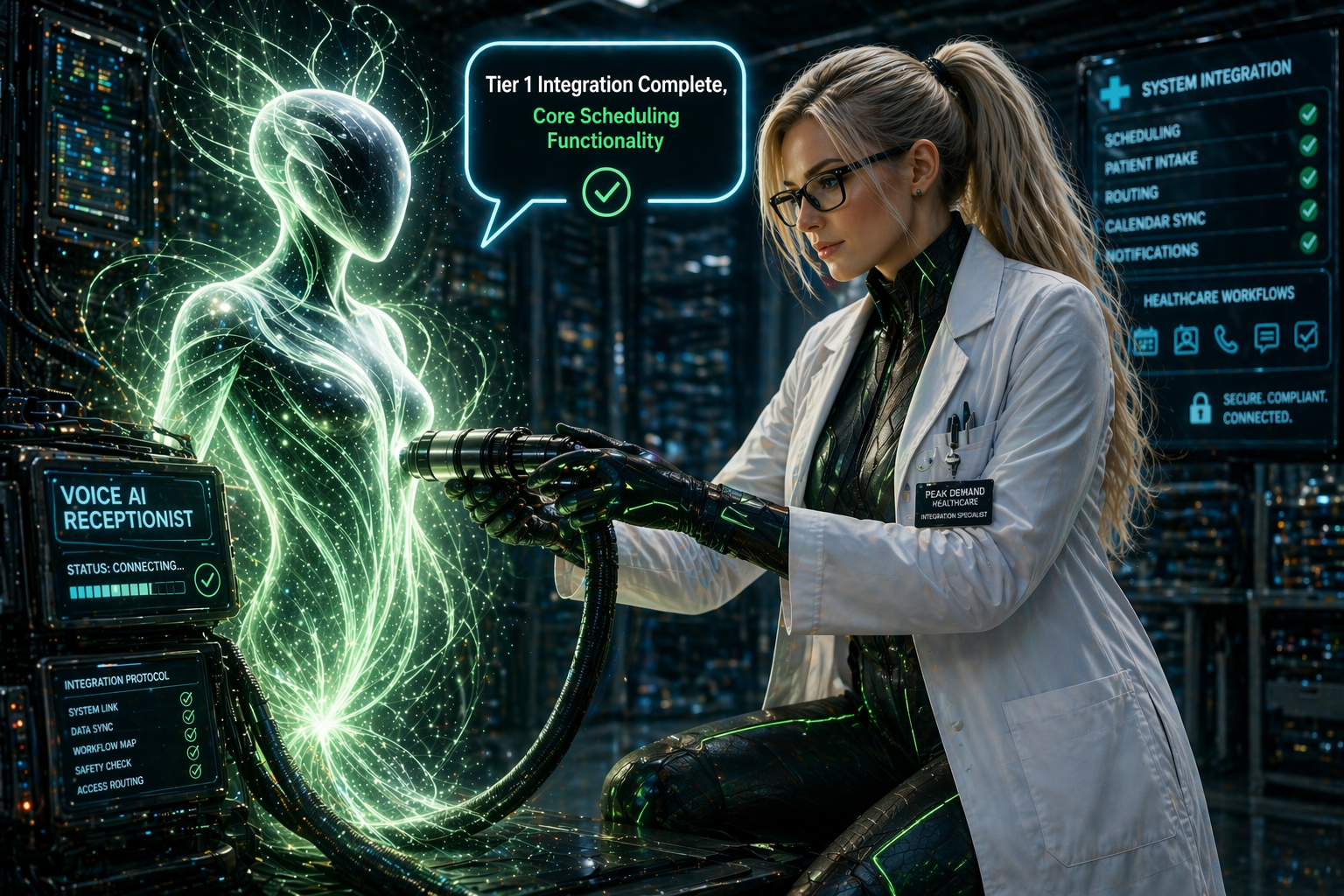
Architecture Role
Parent hub for healthcare integrations
System Coverage
98 healthcare system pages
Software Families
6 healthcare integration families
Workflow Focus
Scheduling, intake, routing, access
Healthcare integrations should be evaluated through workflow continuity
One of the biggest mistakes in healthcare integration conversations is reducing the discussion to a list of software names. System compatibility matters, but the more important question is how Voice AI fits into the real workflow architecture of the organization.
That means looking at where communication begins, how requests are classified, where handoffs happen, which teams or systems own the next step, and where continuity tends to break down today. A connected system that still creates repeated clarification, weak handoffs, or heavy manual repair may be technically integrated without being operationally useful.
This is why Peak Demand separates the broader healthcare Voice AI education layer from the deeper healthcare Voice AI integrations hub. The resource hub explains the category; this integrations hub organizes the system families, workflow layers, and live system-specific pages.
Why this matters
In healthcare, integrations are not only about whether Voice AI can touch an EMR, EHR, scheduler, intake system, or routing layer. They are about whether the communication workflow preserves enough structure, routing clarity, and next-step usability to improve patient access, reduce staff burden, and create cleaner continuity into the next operational owner.
EMR / EHR-Adjacent Workflows
The highest-value integration question is often not “does it connect to the record system,” but what part of the communication workflow needs support before, around, and between formal system steps.
- Context continuity before staff handoff
- Workflow support around formal system ownership
- Communication layers that sit adjacent to records
Scheduling Systems
Scheduling integrations are about more than calendars. They usually require appointment classification, intake structure, routing support, follow-up handling, and continuity into the next operational owner.
- Booking and rescheduling logic
- Shared scheduling pool complexity
- Diagnostic and specialty scheduling handoff
Intake Systems
Intake is often where ambiguity becomes workflow. Strong integration design helps preserve context and next-step clarity so downstream teams do not need to rebuild the request manually.
- Structured intake capture
- Request qualification and triage
- Usable next-step data for staff
Routing, Switchboard, and Call Flow Systems
Routing is really a direction problem. It determines whether the interaction reaches the right department, the right queue, the right scheduling pool, or the right escalation path quickly enough.
- Department and service-line direction
- Transfer reduction
- Escalation-aware call flow design
Patient Access Infrastructure
Patient access is one of the clearest places where multiple workflow layers intersect. Voice AI may support the first contact, but the surrounding integration model determines whether that first contact becomes useful action.
- Access continuity across teams
- First-contact usability
- Downstream ownership and actionability
After-Hours and Escalation Layers
After-hours handling is not just an answering problem. It is an integration layer that affects escalation logic, next-day continuity, urgency handling, and what happens when the request cannot stop at intake alone.
- Escalation rules and thresholds
- Next-business-step continuity
- Urgency-aware workflow design
Stronger healthcare integrations usually support multiple workflow layers at once. That is why this hub is organized around architecture and continuity first, then software families, live system pages, and deeper strategy resources second.
Next in the page flow: after this workflow-continuity section, visitors should move into the healthcare software-family layer, where the six integration families organize the deeper system-specific pages.
Browse Healthcare Software Families
How to Integrate a Voice AI Receptionist with Salesforce for Telecom, Financial Services, Healthcare, Retail, Travel & Hospitality, Field Service & Contact Centers
Peak Demand observation: integrating human nuance is the real adoption blocker

From our work with clients, the technical pieces — APIs, telephony, and Salesforce writes — are straightforward. What breaks adoption is the voice itself. Confidence and caller acceptance climb as prosody, timing and persona become more human. Humanization is consistently the largest barrier; second is hallucination risk, which usually traces back to insufficient skill testing and weak guardrails from internal teams.

Common humanization failures we see:
Flat prosody: monotone delivery that feels robotic.
Poor turn-taking: interruptions, awkward pauses, or talking over callers.
Generic persona: voice with no local tone, empathy, or brand fit.
Recommendation: Evaluate third-party voice stacks for prosody and turn-taking, run A/B audio tests during a small pilot, or outsource to an AI agency to accelerate a safe, humanized rollout.
Why integrate voice AI with Salesforce now (and why human nuance matters)

If you want fast, measurable wins from voice AI, focus on outcomes leaders care about: faster call resolution, fewer escalations, and lower operating cost. A humanized voice isn’t a nice-to-have — it materially improves those outcomes because callers trust and cooperate with voices that sound natural.
Three measurable owner outcomes to track from day one:
Reduced Average Handle Time (AHT): a humanized voice asks clear, targeted questions and hands off cleanly, shortening call time.
Faster triage → faster resolution: better voice triage creates accurate Cases/WorkOrders in Salesforce and routes to the right queue sooner.
Fewer SLA breaches: correct routing and clearer intent capture reduce missed SLAs and emergency escalations.
Sector example: in telecom outage triage, a calm, empathetic front-end voice gathers location and severity quickly while de-escalating anxious callers. In financial services, warmer turn-taking and better phrasing reduce transfer churn during billing disputes.
Practical approach: run a narrow Salesforce pilot (Service Cloud / Field Service), then A/B test by routing a small percentage of live calls to a third-party humanized voice. Measure AHT, triage accuracy, and SLA impact. For empathy-sensitive or high-risk flows, explicitly evaluate third-party stacks or partner with an AI agency — humanization often delivers the largest lift in caller confidence and ROI.
Integration options for integrating a voice agent with Salesforce (native, third-party, hybrid)

Owners have three straightforward paths. Each balances speed, control, and voice quality differently. Pick the one that matches your goals and risk tolerance.
Native (fast, low overhead)
Enable the platform’s built-in voice options and partner-telephony integrations. Fast to launch, tightly integrated with the agent workspace, and simple to operate. Best for deterministic scripts, agent-assisted calls, and short pilots where speed-to-value matters.Third-party modular stack (humanization first)
Use a telephony provider + LLM/TTS + middleware. This takes longer to set up but gives full control over voice quality, prosody, turn-taking and A/B testing. Middleware enforces PII minimization, idempotency, and audit logging before any data is written to Salesforce.Hybrid (pragmatic, high-control)
Combine both: run a third-party front end for the caller-facing persona and keep Salesforce-native or partner telephony for deterministic back-end writes and agent handoffs. Middleware routes audio and intents, applies privacy rules, then persists safe, auditable results into Salesforce. This lets you experiment with voice without touching core data flows directly.
Telephony licensing note: budget for phone numbers (DIDs), direct-routing or partner telephony seats, per-minute provider charges, middleware hosting, integration engineering, and ongoing voice-persona tuning.
Preparing Salesforce & its datastore (Salesforce objects / {{DATASTORE_NAME}}-like) for integrating voice AI

Before you flip the switch, treat integration prep as an operations checklist — not a developer-only task. Confirm phone capacity and platform entitlements, map the data you’ll create or update, and lock down how (and what) leaves your tenant.
Quick owner brief: inventory channels and licenses, assign a least-privilege API user for middleware, map Contacts/Cases/WorkOrders and key custom fields, enable Platform Events/Streaming for real-time flows, and publish clear PII-minimization and idempotency rules.
Six prep steps
Inventory phone numbers & licenses: list DIDs, short codes, voice seats, and any telephony or bot licenses you’ll need.
Map Salesforce objects: decide which objects/fields get reads vs writes (Contact, Case, WorkOrder, and required custom fields).
Create a least-privilege API service user: give middleware only the scopes it needs and rotate credentials regularly.
Enable Platform Events / Streaming: turn on Platform Events or Streaming for near-real-time intent publishing; reserve REST/Bulk for synchronous/asynchronous writes.
Configure audit logging & retention: capture who/what wrote a record, keep transcripts/recordings per policy, and set retention schedules.
Publish PII minimization & idempotency rules: define what may leave the tenant, how tokenized server-side fetches are used, and idempotency keys for safe retries.
Operational notes: minimize PII in prompts — use tokenized server-side fetches whenever a third-party needs context. Verify phone licenses, bot seats and Platform Events availability before any pilot. Plan middleware telemetry (confidence_score, intent_id) so ops can measure and tune voice performance.
How to integrate third-party voice quality with Salesforce (why third-party often sounds more human)

Third-party voice stacks win on humanization because they let you control the parts of voice that matter: prosody, turn-taking, contextual grounding and language variety. Practically, that means better timing, natural pauses, emphasis where it counts, and locally appropriate accents — all of which increase caller trust and reduce repeat calls.
A simple, secure architecture most teams use looks like this: PSTN → Telephony provider → LLM / TTS layer → Middleware → Salesforce (Platform Events or REST writes). The telephony provider handles SIP/media and basic telephony events; the LLM/TTS layer produces natural language responses and improved prosody; middleware mediates everything with your policies, and only safe, auditable results are written into Salesforce.
Key humanization dimensions to prioritize:
Prosody: tune intonation, stress, and pacing so responses feel conversational rather than robotic.
Latency & turn-taking: stream partial replies or use low-latency paths so the system can interrupt gracefully and avoid awkward pauses.
Contextual grounding: keep short-term context (recent utterances, case history) locally available to avoid irrelevant or inconsistent replies.
Multilingual & local voice support: select region-appropriate voices and idioms to match your caller base.
Secure integration patterns (owner checklist):
Tokenized server-side fetches: middleware retrieves sensitive context from Salesforce using short-lived tokens; third-party models receive only non-PII or tokenized references.
Idempotency keys: every external action (case create, update) uses idempotency keys so retries don’t create duplicates.
Audit logs & transcripts: persist a tamper-evident trail linking audio, transcript, confidence scores and the final Salesforce record.
Consent capture: capture explicit consent at call start and store consent metadata before any third-party processing.
Operationally, middleware should publish intents or events back into Salesforce (Platform Events for real-time subscriptions, REST for direct writes) and expose telemetry (confidence_score, intent_id) for ops to tune voice persona and handoff rules.
How to integrate the system’s native voice options (when native is the right choice)

Native voice is the quickest path to value when you need tight data paths and minimal engineering overhead. It keeps telephony and agent tooling inside the platform, so calls, transcripts and case writes flow directly into Salesforce-like records with predictable behavior and fewer moving parts.
Fast enablement advantages
Lower integration overhead — fewer middleware components to build and maintain.
Tighter agent workspace — supervisors and agents see calls, transcripts and context in one view.
Predictable security model — platform-managed auth, audit and retention controls.
Faster pilot timelines — good for quick proof-of-value and deterministic processes.
Step list to enable a native voice channel (conceptual)
Confirm required phone/bot licenses and agent seats.
Provision phone numbers / telephony channels in the platform.
Enable the platform voice feature and connect partner telephony (if applicable).
Map voice intents to platform flows and map outcome writes to Contact/Case/WorkOrder fields.
Configure transcripts, recording retention and audit logging.
Run a small pilot with 2–3 call types, measure AHT and handoff quality, then iterate.
When native is a pragmatic choice
Deterministic scripts (status checks, account lookups, simple form fills).
Internal automation or agent-assisted calls where the agent takes over quickly.
Teams that prioritize speed-to-value and minimal operational complexity.
Where native often struggles
Empathy-sensitive interactions that need tuned prosody and natural turn-taking.
Complex multi-turn conversations requiring advanced contextual grounding or rapid A/B voice testing.
Scenarios where you want to iterate rapidly on voice persona without touching core data flows.
How the voice AI handles core workflows when integrating with Salesforce (real-world examples)

Voice AI should be judged by how well it executes the workflows your ops teams run every day.

Below are five common, high-impact workflows and how native, third-party, and hybrid approaches typically handle them — plus the UX fallbacks and the canonical confidence bands you must use for transfer rules.
1. Outage / incident triage (telecom)

Caller reports service outage → voice agent collects location, severity, and contact → creates Case/WorkOrder.
Native: fast collection and direct writes into Salesforce; agent handoff is seamless.
Third-party: better calming tone and turn-taking for anxious callers; middleware validates and tokenizes PII before a safe write.
Fallback: if confidence <0.65 → immediate transfer to human; if 0.65–0.8 → soft handoff with agent preview; if >0.8 → auto-create case and send SMS confirmation.
2. Billing inquiries / disputes (financial services)
Caller describes a charge → voice agent confirms identity, summarizes likely causes, offers next steps.
Native: quick lookups and scripted responses; great for deterministic checks.
Third-party: warmer phrasing reduces escalation; better at de-escalation and rephrasing confusing questions.
Fallback: low confidence (<0.65) → escalate to live agent with transcript; soft handoff for 0.65–0.8.
3. Appointment scheduling / patient follow-up (healthcare)

Caller requests appointment or follow-up → voice agent checks availability → books or flags for manual triage.
Native: reliable calendar writes and confirmations.
Third-party: more empathetic reminders and clearer confirmations that reduce no-shows.
Fallback: always require human sign-off for sensitive actions if confidence <0.8 (policy decision).
4. Order status / returns (retail & ecommerce)
Caller asks order status → voice agent returns shipment info or creates return case.
Native: direct record reads and transaction-safe updates.
Third-party: natural-sounding status summaries and proactive troubleshooting prompts.
Fallback: auto-handles simple queries (>0.8); soft handoff for borderline confidence.
5. Field-service dispatch (work orders)
Caller reports issue → voice agent captures location, urgency → triggers dispatch.
Native: tight integration with WorkOrder and dispatch queues.
Third-party: better at clarifying urgency and extracting actionable notes for technicians.
Fallback: for mission-critical reports, low confidence → immediate human dispatch verification.
UX fallbacks & transfer rules (canonical):
>0.8 — auto-handle and perform safe writes.
0.65–0.8 — soft handoff: prepare agent with transcript/preview while keeping the caller engaged.
<0.65 — immediate transfer to human.
Differences between native and third-party flows
Latency: native routes often have lower end-to-end latency for record writes; third-party stacks may add microseconds for streaming but improve perceived responsiveness via partial replies.
Persona: third-party stacks permit tuned prosody, regional accents and A/B persona testing; native tends to rely on platform voices/presets.
Error handling: native flows simplify error predictability; third-party flows require middleware patterns (idempotency, tokenized fetches, retry logic) to avoid duplicate records.
Start with two workflows in a narrow pilot, run A/B routing (small percent to humanized voice), and validate AHT, triage accuracy, SLA impact and Voice CSAT.
Security, compliance & data residency when integrating voice AI with Salesforce

Security and compliance are owner responsibilities, not just developer tasks. Decide early what stays inside Salesforce and what may be sent to third parties. Capture consent, log every action, and set retention policies before any pilot.
Six owner actions
Run a privacy & legal review — document allowed data flows and approvals for third-party processing.
Implement consent capture — record affirmative consent at call start and store consent metadata in Salesforce.
Enforce PII minimization — define which fields are never sent to external models and what may be tokenized.
Set retention & access policies — define how long audio, transcripts and logs are kept and who can access them.
Enable audit logging — log user/service actor, timestamps, confidence_score, intent_id and the final record ID for every write.
Map vendor data residency — require vendors to document hosting regions and provide a migration/exit plan.
Tokenized fetches & server-side processing
Use middleware to fetch sensitive context from Salesforce with short-lived tokens. The middleware converts needed context into non-identifying tokens or sanitized snippets before sending anything to a third party. That keeps PII inside your tenant and limits exposure.
Vendor SLA checklist (owner-ready)
Encryption in transit & at rest.
Incident response times and escalation paths.
Data residency commitments and proof of region-specific hosting.
Right-to-audit and regular security attestations.
Clear exit/transition plan and data deletion guarantees.
Measuring success: KPIs to track after integrating voice AI with Salesforce

Start with a short baseline period (2–4 weeks) to capture current performance, then set realistic targets and a reporting cadence.
Six core KPIs to track
Calls handled — volume routed to the voice agent (baseline → target: stabilize or grow while preserving quality).
Cases created — accurate, clean case/workorder writes from voice flows.
SLA compliance — percent of time SLAs are met (aim to improve by a noticeable margin vs baseline).
First-contact resolution (FCR) — percent resolved without follow-up.
Average handle time (AHT) — minutes per call (target: reduce by 10–25% vs baseline).
NPS / CSAT — caller satisfaction; measure Voice CSAT after interactions.
Baseline → targets & cadence
Run a 2–4 week baseline, then set 30/60-day targets (example: AHT −10–25%, FCR +5–15%, SLA breaches −50% of baseline).
Reporting cadence: weekly operational dashboards for ops; monthly executive summaries with trend analysis and ROI.
Humanization metrics
Voice CSAT (post-call survey): primary humanization indicator.
Transcript sentiment: automated sentiment scoring over transcripts to spot tone issues.
Repeat-call rate: percent of callers who call again within 7 days for the same issue.
Common pitfalls when integrating voice AI with Salesforce — and how to avoid them
Voice integrations look simple until small mistakes create big operational headaches. Below are the most common pitfalls we see and exact, owner-ready fixes.
Common pitfalls
Mis-mapped fields: voice writes land in the wrong Salesforce fields.
Duplicate records: retries or poor idempotency create repeated Cases/WorkOrders.
License mismatches: missing phone/bot seats cause dropped calls or errors.
Telephony failures: carrier or SIP issues interrupt flows.
Poor handoffs: agents get no preview or garbled context.
Hallucinations: model outputs incorrect or unsupported actions.
Ignoring humanization tests: skipping A/B audio tests reduces adoption.
Fixes & quick mitigation
For mis-mapped fields: freeze production writes, run a controlled backfill, and add field-level validation in middleware.
For duplicates: implement idempotency keys and dedupe checks before creating records.
For license issues: inventory seats before pilot and include contingency in procurement.
For telephony problems: build health checks and automated failover to a backup PSTN/route.
For handoffs: always send agent preview (transcript + confidence) and require soft-handoff logic for 0.65–0.8.
For hallucinations: add skill testing, guardrails, and a human review channel; block risky actions by policy.
For humanization: run continuous A/B voice tests and ship fixes weekly.
Anecdote & escalation guideline
We once saw an integration create duplicate outage Cases because retries lacked idempotency. The hotfix: pause automated writes, add idempotency keys, run a cleanup script, then resume. Escalation path: Ops → Integration Lead → Vendor SLA contact. If errors exceed a safe threshold (e.g., duplicate rate >2% or SLA breach spike), roll back to the previous stable routing and open a 24-hour incident bridge.
Budgeting & procurement: what to expect to pay for integrating voice AI with Salesforce

Plan for three budget tiers and price each line item conservatively — voice projects often need runway for tuning and vendor changeovers.
Pilot (small, 4–8 weeks) — low setup, validate intent mapping and voice A/B testing. Typical costs: Salesforce seat add-ons or bot licenses, 1–2 DIDs, telephony minutes, small middleware instance, 40–120 integrator hours, short LLM/TTS trial credits.
Production (full rollout) — steady-state costs: ongoing telephony minutes, per-minute LLM/TTS runtime, middleware hosting (redundant), monitoring/telemetry, regular integrator or agency retainer for tuning, and expanded Salesforce licensing for bot/agent seats.
Enterprise (scale + high-availability) — add geo-redundant hosting, compliance controls, dedicated support SLAs, higher telemetry retention, and enterprise-grade telephony routing/number inventory.
Sample cost lines to include in procurement: Salesforce licensing, DIDs/phone numbers, telephony carrier / Twilio minutes, LLM & TTS runtime (per-minute or per-request), middleware hosting, integrator/agency hours, testing & A/B audio production.
Procurement tips: use staged payments tied to pilot milestones; require pilot SLAs and measurable acceptance criteria; include clear exit/transition clauses, data deletion guarantees and right-to-audit.
Note on licensing: native voice often adds platform seat or bot costs (predictable); third-party stacks shift to variable runtime and per-minute charges — budget both runway and ongoing tuning hours.
Developer appendix (gated) — what your tech team will need to integrate Salesforce with voice AI
This appendix is gated because it contains implementation-level details (authentication flows, webhook schemas, streaming patterns) that should be shared only with engineers and trusted partners. Provide access via a secure download or developer contact form.
Why gated (short): implementation artifacts contain sensitive patterns and examples that could expose endpoints, payloads, or credentials if published openly.
High-level gated contents:
OAuth 2.0 recommended flows & examples
Platform Events / Streaming patterns and subscription models
Webhook payload schema samples and best-practice validation
Middleware skeletons and idempotency/retry patterns
Twilio / telephony streaming & OpenAI (LLM/TTS) integration patterns
Security checklist: PII minimization, consent capture, retention & audit logs
Assets: gated download link / contact form for dev access.
Tech references (public docs):
https://developer.salesforce.com/docs/apis
https://developer.salesforce.com/docs/atlas.en-us.api_rest.meta/api_rest/
https://developer.salesforce.com/docs/atlas.en-us.platform_events.meta/platform_events/
https://developer.salesforce.com/docs/atlas.en-us.api_streaming.meta/api_streaming/
Next steps: 30–60 day rollout plan for integrating voice AI with Salesforce
Run a focused, time-boxed pilot that proves intent mapping, safe writes, and humanized voice before scaling. Below is a six-step, 6-week plan with stakeholders, rollback criteria and humanization checkpoints.
6-step timeline
Week 1 — Prep: inventory phones/licenses, map objects (Contact/Case/WorkOrder), create API service user, configure Platform Events, publish PII rules. Stakeholders: Ops, IT, Legal, Contact Center, Vendor.
Week 2 — Basic flows: implement 2–3 deterministic call types; wire telephony → middleware → Salesforce; run internal QA. Stakeholders: Dev, Integrator, Voice UX.
Week 3 — PSTN testing: route pilot DIDs live; monitor telephony health, latency, and transcript accuracy; run closed beta. Stakeholders: Contact Center, Vendor Support.
Week 4 — Soft launch: A/B route a small % of live calls to the humanized voice; collect Voice CSAT and telemetry. Stakeholders: Ops, Customer Care.
Weeks 5–6 — Monitor & tune: weekly tuning sprints (persona, prompts, handoff rules); fix mapping or idempotency issues. Stakeholders: Integrator, Voice UX, IT.
Weeks 7–8 — Optimize & scale: expand call types, finalize runbook, and hand over to steady-state ops.
Rollback & escalation criteria
Pause and rollback if duplicate-write rate >2%, SLA breaches spike >20% vs baseline, or critical errors exceed threshold.
Escalation path: Ops → Integration Lead → Vendor SLA contact → Incident bridge.
Success criteria
30 days: AHT −10% vs baseline; triage accuracy ≥ baseline + X% (set your target); Voice CSAT baseline established.
60 days: AHT −15–25%; repeat-call rate reduced; SLA breaches materially lower; clear runway for scale.
Humanization checkpoints
A/B audio tests weekly during soft launch.
Voice CSAT and transcript sentiment collected every week.
Persona tweaks deployed in short sprints.
Conclusion / schedule a discovery call CTA (short)
We help humanize voice agents for Salesforce. Ready to test a humanized pilot or run a hybrid proof-of-value? Schedule a discovery call to review your use cases, compliance needs, and a 30–60 day rollout plan.
Learn more about the technology we employ.

Customers, owners, and staff expect real human nuance from anyone — or anything — answering the phone. If your voice agent sounds flat or robotic, callers lose trust, and your team bears the cost in transfers, repeat calls, and lower satisfaction.
Peak Demand builds enterprise-grade, humanized AI receptionists that integrate directly with Salesforce CRM (or connect via Twilio to best-in-class LLMs and TTS). We’ll help you choose between Salesforce’s native voice tools and third-party stacks, run a short pilot, and fine-tune voice, scripts, and handoffs so your AI receptionist actually sounds human.

Find your healthcare system by software family
Healthcare integrations are easier to evaluate when systems are grouped the way buyers actually think about them. Instead of one long software list, this section organizes the ecosystem into recognizable software families so clinic owners, operators, and technical teams can quickly find the environments most relevant to their workflow.
Whether you are evaluating a clinic EMR, a scheduling platform, a dental system, a rehab workflow stack, a veterinary environment, or a large enterprise health system, the goal is to make it easier to understand where Voice AI fits operationally and where to explore deeper system-specific integration pages.
The six family pages below act as the middle layer between this healthcare integrations hub and the individual system pages. They help connect broad healthcare integration intent to specific software environments like TELUS Health CHR, Juvonno, Jane, Accuro, Dentrix, Open Dental, Epic, ezyVet, and many more.

Medical and Ambulatory EMR Systems
Explore how Voice AI fits into medical and ambulatory EMR environments across scheduling, intake, patient access, provider routing, after-hours continuity, and clinic communication workflows.
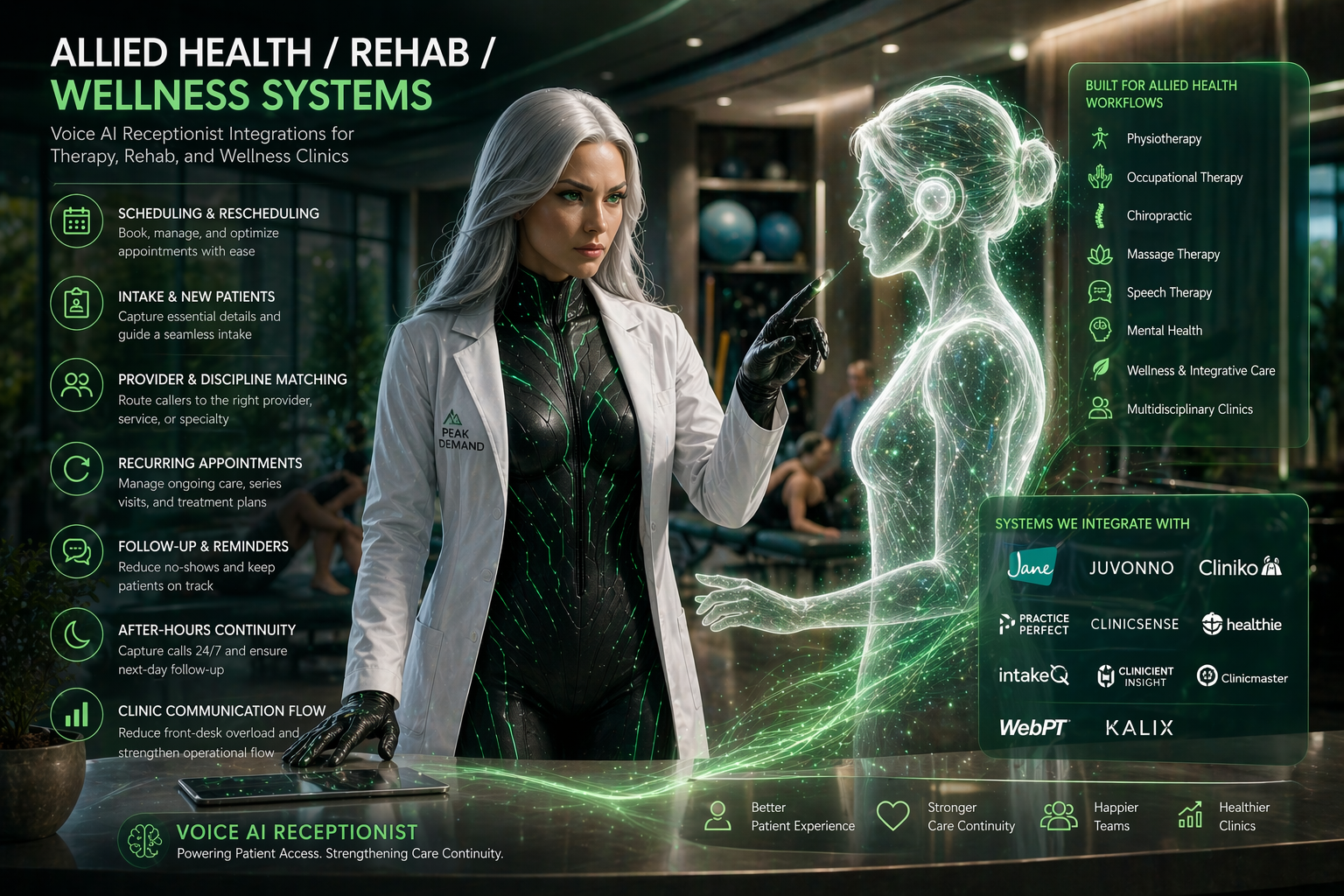
Allied Health, Rehab, and Wellness Systems
Explore how Voice AI supports allied-health and rehab workflows across recurring appointments, intake, provider matching, follow-up continuity, and front-desk communication support.
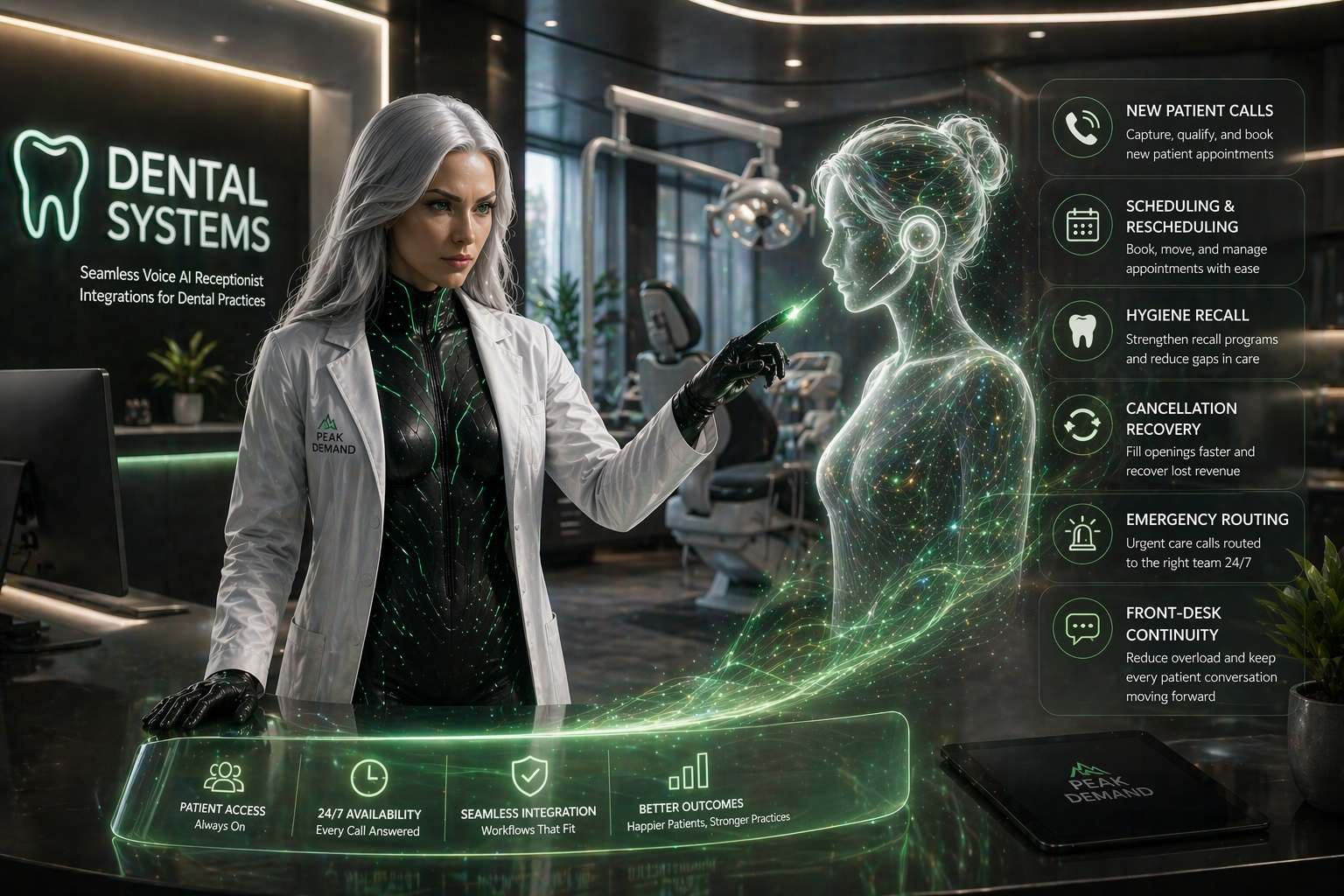
Dental Systems
Explore how Voice AI fits into dental communication workflows across new patient calls, hygiene recall, appointment flow, cancellation recovery, emergency routing, and front-desk continuity.
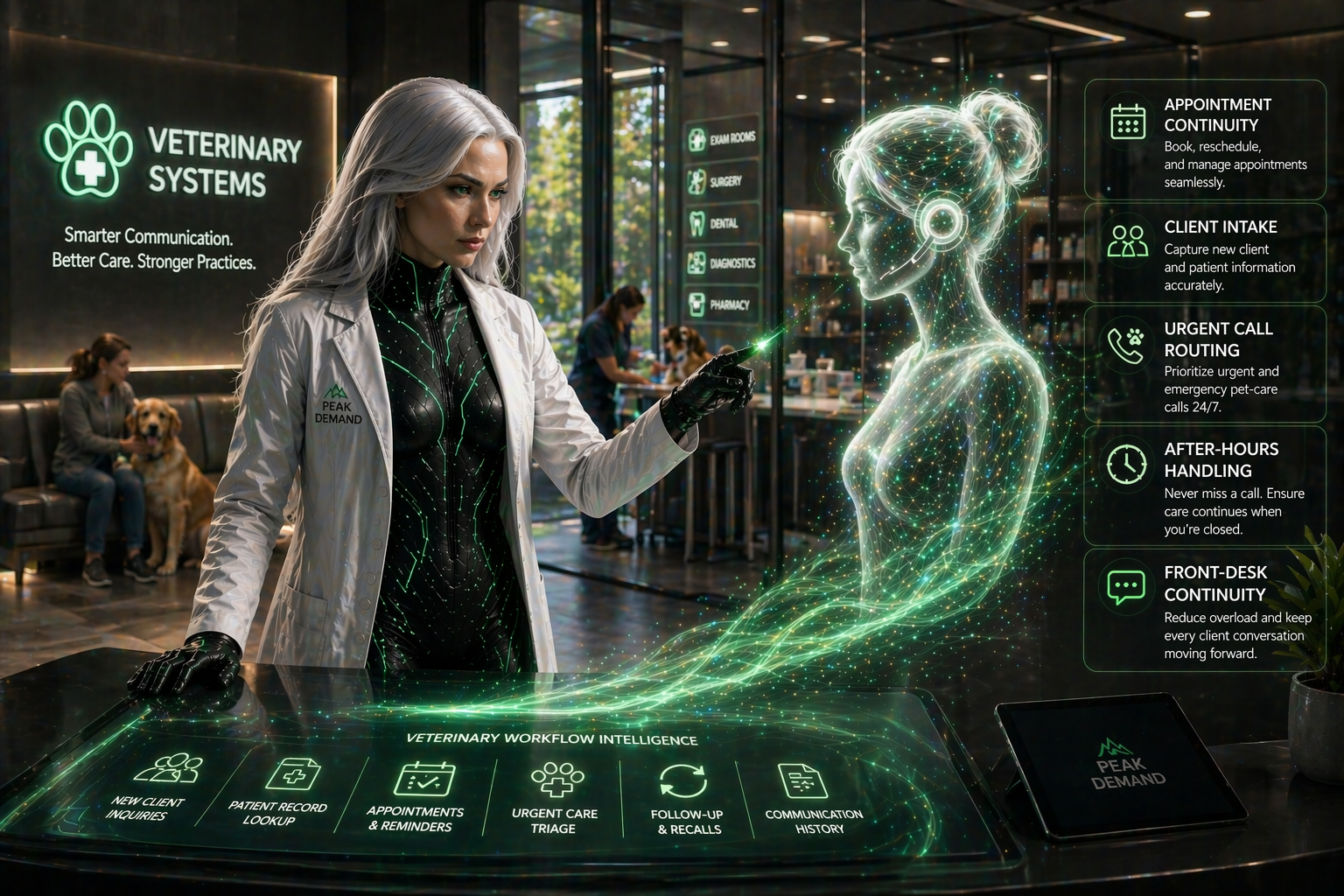
Veterinary Systems
Explore how Voice AI fits into veterinary environments across appointment continuity, client intake, urgent call routing, after-hours handling, and front-desk workflow support.
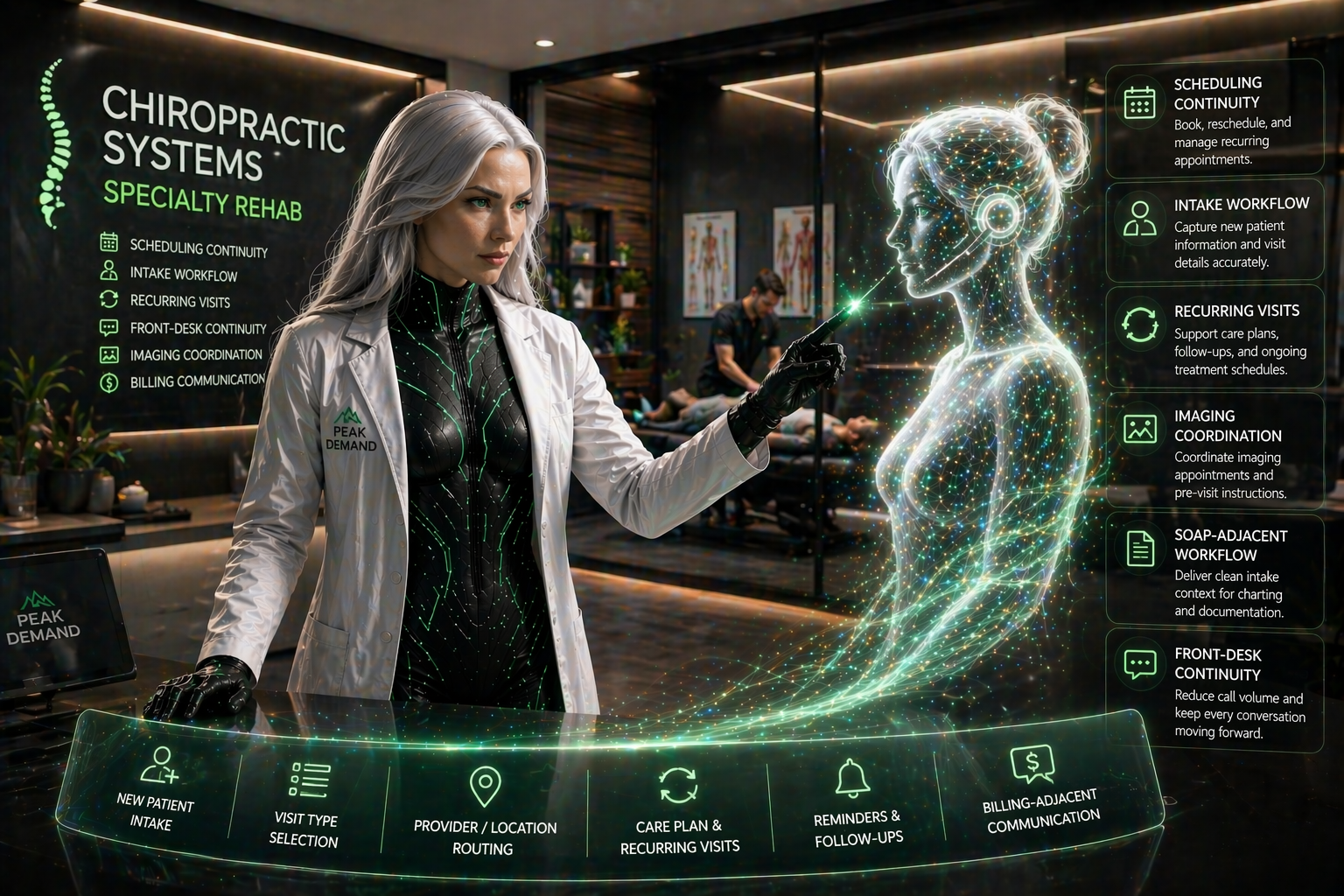
Chiropractic and Specialty Rehab Systems
Explore how Voice AI fits into chiropractic and specialty rehab workflows across scheduling, intake, recurring visits, SOAP-adjacent continuity, imaging-adjacent coordination, and front-desk support.
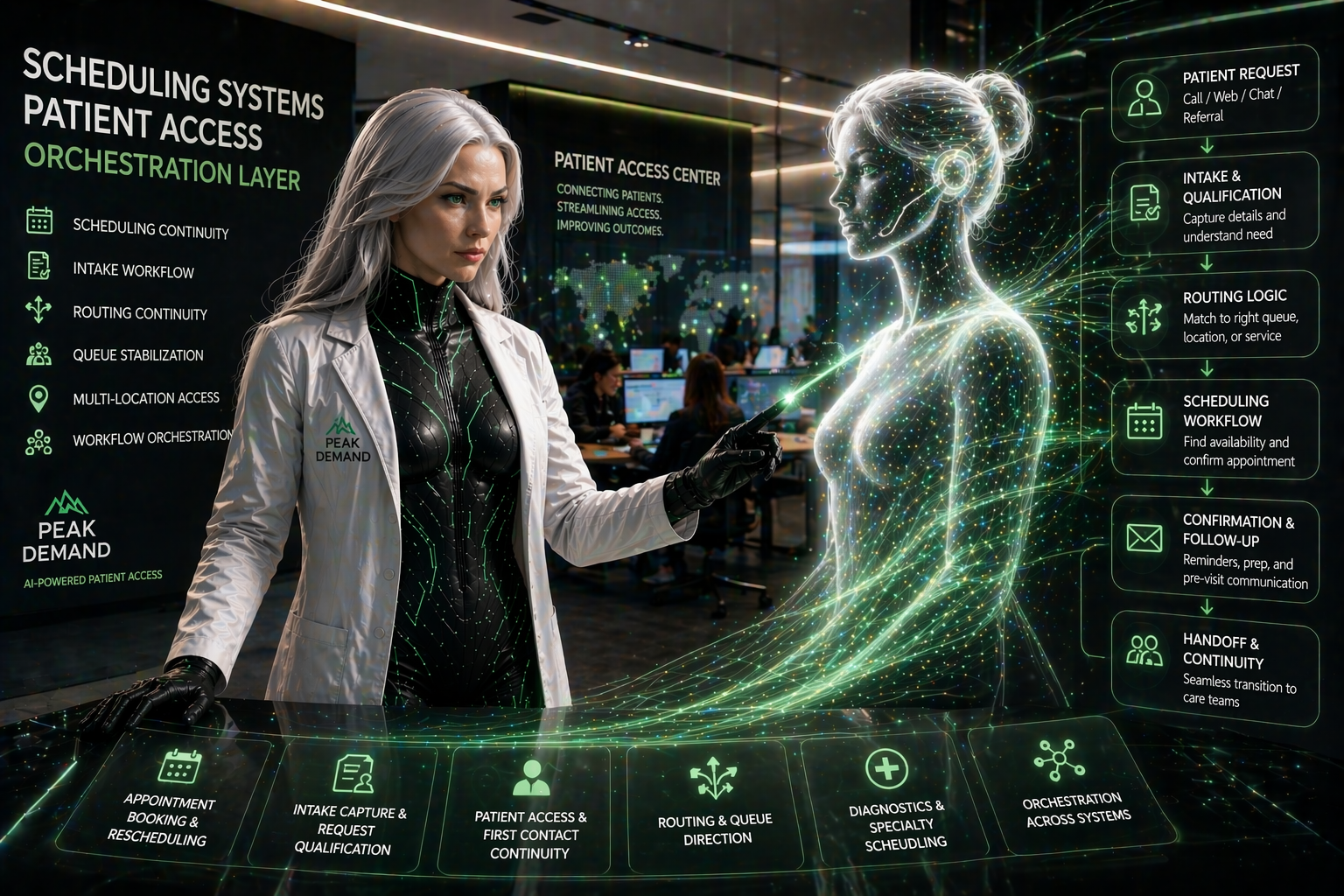
Scheduling, Patient Access, and Orchestration Systems
Explore how Voice AI supports scheduling and patient access architecture across intake, routing, queue stabilization, diagnostics scheduling, and workflow continuity between first contact and next action.
See Healthcare Voice AI Integrations In Action
These walkthroughs show how Voice AI can connect into real healthcare scheduling, intake, and communication environments. Start with TELUS Health CHR for Canadian clinic workflows and Juvonno for rehab and allied health operations.
TELUS Health CHR Integration Walkthrough
See how Voice AI can support TELUS Health CHR scheduling, intake, patient communication, and Canadian clinic workflow continuity.
Juvonno Integration Walkthrough
See how Voice AI can support Juvonno workflows for rehab scheduling, intake, appointment handling, and clinic communication continuity.
Explore published healthcare systems by name
Once you know the software family that best matches your environment, this section makes it easier to browse live healthcare integration pages by platform name. Each category below groups published system pages by the type of environment they usually support so operators, managers, and technical teams can compare workflow fit more quickly. A fuller alphabetical directory appears farther down the page.
Featured healthcare systems
These are high-priority starting points for visitors evaluating real-world Voice AI workflow fit across scheduling, intake, patient communication, routing, and access workflows.
Clinic, ambulatory, and medical EMR systems
These systems are commonly associated with clinic records-adjacent workflows, appointment flow, patient requests, intake continuity, routing, and broader ambulatory communication operations.
Scheduling, intake, and patient communication systems
These environments sit closer to booking logic, intake flow, reminders, clinic administration, and day-to-day patient access operations.
Rehab, physiotherapy, and allied health systems
Allied health and rehabilitation environments often depend on strong scheduling continuity, practitioner matching, intake flow, recurring appointment management, and multi-location operational coordination.
Dental systems
Dental communication workflows often center around appointment demand, cancellation recovery, reminders, new patient calls, and front-desk continuity across booked production.
Veterinary systems
Veterinary communication environments often require appointment continuity, client communication, after-hours handling, urgent call direction, and records-adjacent workflow coordination.
Healthcare organizations rarely evaluate integrations in a vacuum. Grouping systems by software family makes it easier to understand likely workflow fit, compare environments more quickly, and navigate toward both family-level integration pages and live system-specific pages deeper in this hub. The full alphabetical system directory farther down the page should carry the complete 98-system library.
Where Voice AI sits in the healthcare workflow matters more than basic connectivity
Healthcare Voice AI becomes more useful when it is treated as part of the larger workflow architecture around patient access, intake, routing, scheduling, escalation, and downstream ownership. The question is not only whether a system connects. The question is whether the communication flow reaches the next operational step with enough clarity and structure to reduce friction instead of shifting it downstream.
In practice, that means Voice AI often sits across multiple workflow layers at once. It may support first contact, gather structured intake, help direct the caller into the right path, preserve context for staff, and improve continuity into the next step. The value comes from how those layers fit together, not from one isolated connection point.
This is why healthcare teams should evaluate both the scheduling and patient access layer and the EMR or EHR-adjacent layer. In more complex environments, the architecture may also need to account for enterprise compliance and procurement requirements.
Where Voice AI usually enters the workflow
Voice AI often enters at the communication edge: inbound calls, appointment demand, intake capture, after-hours answering, overflow handling, and patient access or routing-related first contact.
Explore healthcare AI receptionistsWhere continuity usually breaks down
Continuity often breaks between the interaction and the next operational owner. That can happen when routing is weak, intake is unclear, scheduling context is incomplete, or downstream teams still need to manually rebuild the request.
Explore centralized scheduling workflowsWhat stronger integration architecture actually improves
Stronger architecture preserves enough structure, direction, and next-step usability for staff or systems to act efficiently. That is what turns Voice AI into operational infrastructure instead of a disconnected front-end layer.
Return to the healthcare resource hub| Integration maturity | What healthcare teams usually experience | Likely operational result |
|---|---|---|
| Fragmented | Some connection points exist, but scheduling, intake, routing, escalation, and continuity still require heavy manual repair. | Lower operational value, more staff burden, weaker patient access continuity, and less confidence in the workflow. |
| Partially connected | Important workflow layers connect, but structure and downstream usability still vary too much between teams, departments, or next-step owners. | Moderate gains, but persistent continuity gaps remain and staff still absorb unnecessary workflow friction. |
| Workflow-led and integrated | Voice AI supports multiple workflow layers with stronger structure, clearer routing, better handoff, and more usable next-step continuity. | Stronger patient access flow, cleaner operational ownership, and more scalable communication infrastructure. |
What healthcare teams should evaluate in the architecture discussion
- Where does Voice AI need to sit first in the communication workflow?
- Where does continuity currently break between the interaction and the next operational step?
- Which layers are EMR or EHR-adjacent, and which ones are workflow-adjacent?
- How do scheduling, intake, routing, patient access, and escalation interact in this environment?
- Will downstream teams receive enough structure to act without rebuilding the request manually?
- Is the integration design workflow-led or just feature-led?
- Does the current architecture reduce friction for staff, or does it simply move the work somewhere else?
Healthcare organizations usually get more value when they evaluate integration maturity across communication flow, operational ownership, and downstream usability together instead of treating each connection as a separate isolated decision. For system-specific evaluation, use the alphabetical healthcare system directory below.
Evaluating software families?
Use the six system-family pages to compare EMR, EHR, dental, veterinary, rehab, scheduling, and patient access environments.
Browse Software FamiliesEvaluating specific systems?
Use the full alphabetical directory to find the exact healthcare platform your team is evaluating.
Open System DirectoryEvaluating enterprise readiness?
Review governance, privacy, escalation, procurement, and compliance considerations before deployment.
Review ComplianceGo deeper into the strategy behind healthcare Voice AI integrations
This section helps healthcare teams move from broad category understanding into the right supporting resources for architecture, interoperability, workflow fit, implementation planning, and system-specific evaluation.
The articles below are the best next clicks for teams evaluating how Voice AI fits into healthcare communication systems, patient access workflows, structured integration pathways, rollout planning, and governed healthcare environments.
For broader category education, use the Healthcare Voice AI Resource Hub. For software-specific evaluation, continue to the full alphabetical system directory lower on this page and use the six healthcare software family pages as the parent layer.
Need system-family pages?
Use the family pages to compare medical EMR, allied health, dental, veterinary, specialty rehab, and patient access systems.
Browse Software FamiliesNeed a specific platform?
Use the alphabetical system directory to find the exact EMR, EHR, scheduling, dental, veterinary, or rehab platform.
Open System DirectoryNeed compliance context?
Use the enterprise compliance page when governance, privacy, procurement, RFPs, or regulated deployment requirements are part of the evaluation.
Review ComplianceCore integration strategy articles
These resources explain why integrations matter, what healthcare teams should evaluate first, and how stronger Voice AI integration architecture should be understood.
Custom pathways, structured integrations, and workflow fit
These articles are useful for teams evaluating custom pathways, structured communication flows, and how Voice AI fits into real healthcare operating environments.
Rollout, implementation, and governance
These resources are best for healthcare teams moving from early exploration into rollout planning, operational safety, implementation readiness, and governance-aware deployment.
Patient access, routing, and workflow bottlenecks
These articles help healthcare teams think more clearly about where communication complexity builds up across patient access, intake, department routing, scheduling, and downstream handoff.
As the healthcare integrations ecosystem continues to grow, this section can keep routing visitors into the most relevant strategy, rollout, and workflow resources without changing the overall structure of the hub. The full software directory appears in the Alphabetical System Directory section below.
Explore live healthcare system integration pages by category
This section gives healthcare teams a category-based way to browse the most important live system pages. It is not the full 98-system directory; it is a curated navigation layer for comparing the platforms most commonly tied to scheduling, intake, patient communication, routing, and patient access workflows.
Use this section when you know the type of software environment you are evaluating. Use the Alphabetical System Directory below when you want to find every live system page by name.
Need the family layer?
Start with the six parent family pages when comparing software categories before choosing a specific system.
Browse Software FamiliesNeed every system?
Use the alphabetical directory for the complete live healthcare system page list by platform name.
Open Alphabetical DirectoryNeed workflow context?
Review how Voice AI fits across patient access, intake, routing, scheduling, escalation, and downstream ownership.
Review Workflow ArchitectureFeatured healthcare systems
These are some of the strongest starting points for teams exploring healthcare Voice AI integrations across scheduling, intake, patient communication, routing, and access workflows.
Clinic and ambulatory EMR systems
These systems are commonly associated with clinic records-adjacent workflows, intake, appointment flow, routing, patient communication, and broader ambulatory continuity.
Explore medical and ambulatory EMR familyScheduling, intake, and patient communication systems
These environments sit closer to booking logic, intake flow, reminders, clinic administration, and day-to-day patient access operations.
Explore scheduling and patient access familyRehab, physiotherapy, and allied health systems
Allied health and rehabilitation environments often depend on strong scheduling continuity, practitioner matching, intake flow, recurring appointments, and multi-location coordination.
Explore allied health and rehab familyDental systems
Dental communication workflows often center on appointment demand, cancellation recovery, reminders, new patient calls, and front-desk continuity.
Explore dental familyVeterinary systems
Veterinary communication environments often require appointment continuity, client communication, after-hours handling, and records-adjacent workflow coordination.
Explore veterinary familyEnterprise, specialty, imaging, and outpatient environments
These environments often involve more complex routing, diagnostic scheduling, imaging coordination, enterprise workflow ownership, and department-specific handoff requirements.
Explore enterprise and medical EMR familyThis curated category browse section helps visitors compare common healthcare software environments without scrolling the entire directory. The complete system list belongs in the Alphabetical System Directory section below, where every live healthcare system page should be listed by platform name.
Talk through your healthcare communication workflow
If your team is evaluating healthcare Voice AI integrations, the most useful next step is usually a workflow conversation. That means reviewing patient access pressure points, scheduling flow, intake structure, routing logic, after-hours coverage, compliance expectations, and the systems surrounding those workflows.
Peak Demand approaches healthcare environments through workflow fit, governance awareness, and operational usability. The goal is to help organizations map a communication architecture that supports real teams, real workflows, and real continuity requirements across EMR, EHR, scheduling, intake, dental, veterinary, rehab, and patient access environments.
Need software families?
Compare the six parent healthcare integration families before choosing a specific system page.
Browse software familiesNeed workflow context?
Review how Voice AI fits across intake, routing, scheduling, escalation, and downstream ownership.
Review workflow architectureNeed compliance review?
Use the enterprise compliance page when governance, privacy, procurement, and RFP standards matter.
Review complianceFrequently asked questions
What does Voice AI mean in a healthcare integration environment?
Can Voice AI work with EMR, EHR, scheduling, intake, and routing workflows?
Are healthcare Voice AI integrations always direct?
Where should healthcare organizations start evaluating Voice AI integrations?
How should compliance and governance fit into the evaluation?
What is the role of this integrations hub?
About Peak Demand
Peak Demand is a Toronto-based AI agency focused on Voice AI, communication automation, and workflow infrastructure for organizations operating in more complex service environments.
In healthcare, the focus is not just on call handling. It is on patient access continuity, scheduling pressure, intake structure, routing logic, after-hours support, governance, and how communication systems fit into real operational workflows.
- Workflow-driven and implementation-aware
- Governance-first in healthcare communication environments
- Built to support clinics, networks, and enterprise teams
- Designed to scale into software-specific integration pathways
- Organized around healthcare system families and live integration pages
Healthcare software integrations by system name
If you already know the software you are evaluating, this alphabetical directory is the fastest way to find the right live system page.
This directory includes the full 98-system healthcare integration library from the current Peak Demand system-page build. It is designed to help teams compare EMR, EHR, scheduling, intake, patient communication, dental, veterinary, rehab, wellness, chiropractic, orchestration, home care, med spa, pharmacy, and enterprise healthcare systems by software name.
For category-level browsing, use the software family section. For workflow context, use the workflow architecture section. This section is the full alphabetical browse layer.
Live healthcare system pages in this directory
Grouped alphabetically with visible section counts so the full library is obvious at a glance.
A–C
34 systemsABELMed through Curve Dental.
D–H
20 systemsDentrix through Helios Software.
I–M
15 systemsIDEXX Cornerstone through MRX Solutions.
N–O
11 systemsNextech through Owl Practice.
P–R
8 systemsPabau through RXNT.
Compare healthcare systems by name, category, and workflow fit
This directory is useful for comparing clinic EMRs, EHR-adjacent systems, scheduling and intake platforms, patient communication software, dental systems, veterinary systems, rehab and allied health systems, chiropractic systems, med spa systems, home care systems, pharmacy-adjacent systems, orchestration platforms, diagnostic workflows, and enterprise healthcare environments by software name before going deeper into workflow design, integration possibilities, and operational fit.
Explore your own AI use case on a discovery call.