
Healthcare Integrations Hub

Healthcare Voice AI Integrations

Healthcare Voice AI becomes far more valuable when it fits into the systems and workflows that shape scheduling, intake, routing, patient access, after-hours continuity, and broader communication operations. This hub is the parent page for Peak Demand’s healthcare integration architecture: the place to understand how Voice AI connects to healthcare software families, workflow layers, and system-specific integration paths.

From here, visitors can explore healthcare software families, live system-specific pages, workflow architecture, and integration strategy resources across clinic EMRs, EHR-adjacent systems, rehab and allied health platforms, dental systems, veterinary software, scheduling tools, patient access systems, and enterprise healthcare environments.

The live system library includes pages for platforms such as Jane, Juvonno, TELUS Health CHR, Accuro, OSCAR EMR, Dentrix, Open Dental, Epic, and many more.

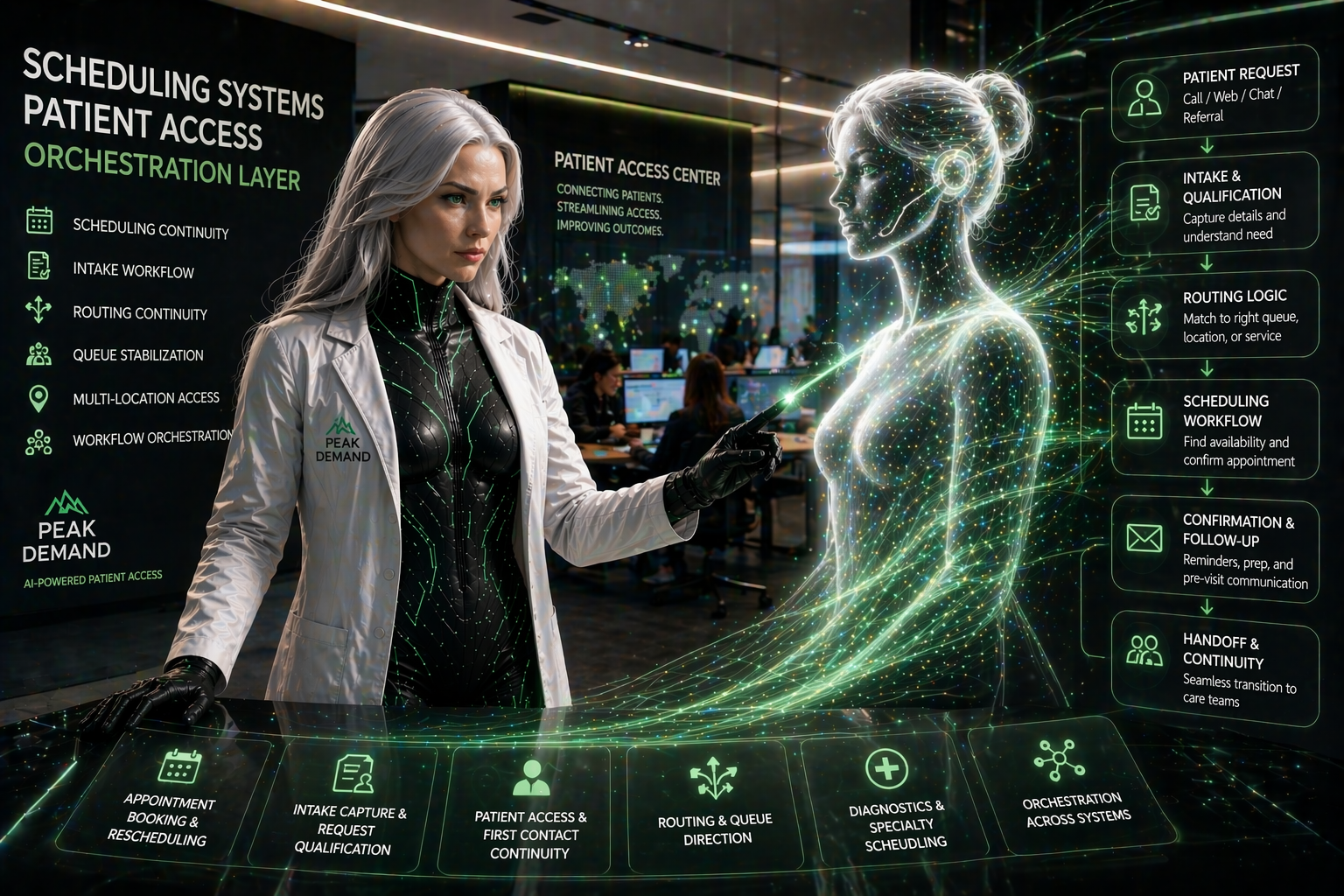
Healthcare Voice AI integrations hub visual showing virtual AI agents connecting healthcare systems workflows scheduling intake routing and patient access infrastructure

Architecture Role

Parent hub for healthcare integrations

System Coverage

98 healthcare system pages

Software Families

6 healthcare integration families

Workflow Focus

Scheduling, intake, routing, access

What Integrations Actually Mean

Healthcare integrations should be evaluated through workflow continuity

One of the biggest mistakes in healthcare integration conversations is reducing the discussion to a list of software names. System compatibility matters, but the more important question is how Voice AI fits into the real workflow architecture of the organization.

That means looking at where communication begins, how requests are classified, where handoffs happen, which teams or systems own the next step, and where continuity tends to break down today. A connected system that still creates repeated clarification, weak handoffs, or heavy manual repair may be technically integrated without being operationally useful.

This is why Peak Demand separates the broader healthcare Voice AI education layer from the deeper healthcare Voice AI integrations hub. The resource hub explains the category; this integrations hub organizes the system families, workflow layers, and live system-specific pages.

Why this matters

In healthcare, integrations are not only about whether Voice AI can touch an EMR, EHR, scheduler, intake system, or routing layer. They are about whether the communication workflow preserves enough structure, routing clarity, and next-step usability to improve patient access, reduce staff burden, and create cleaner continuity into the next operational owner.

Layer 1

EMR / EHR-Adjacent Workflows

The highest-value integration question is often not “does it connect to the record system,” but what part of the communication workflow needs support before, around, and between formal system steps.

  • Context continuity before staff handoff
  • Workflow support around formal system ownership
  • Communication layers that sit adjacent to records
Layer 2

Scheduling Systems

Scheduling integrations are about more than calendars. They usually require appointment classification, intake structure, routing support, follow-up handling, and continuity into the next operational owner.

  • Booking and rescheduling logic
  • Shared scheduling pool complexity
  • Diagnostic and specialty scheduling handoff
Layer 3

Intake Systems

Intake is often where ambiguity becomes workflow. Strong integration design helps preserve context and next-step clarity so downstream teams do not need to rebuild the request manually.

  • Structured intake capture
  • Request qualification and triage
  • Usable next-step data for staff
Layer 4

Routing, Switchboard, and Call Flow Systems

Routing is really a direction problem. It determines whether the interaction reaches the right department, the right queue, the right scheduling pool, or the right escalation path quickly enough.

  • Department and service-line direction
  • Transfer reduction
  • Escalation-aware call flow design
Layer 5

Patient Access Infrastructure

Patient access is one of the clearest places where multiple workflow layers intersect. Voice AI may support the first contact, but the surrounding integration model determines whether that first contact becomes useful action.

  • Access continuity across teams
  • First-contact usability
  • Downstream ownership and actionability
Layer 6

After-Hours and Escalation Layers

After-hours handling is not just an answering problem. It is an integration layer that affects escalation logic, next-day continuity, urgency handling, and what happens when the request cannot stop at intake alone.

  • Escalation rules and thresholds
  • Next-business-step continuity
  • Urgency-aware workflow design

Stronger healthcare integrations usually support multiple workflow layers at once. That is why this hub is organized around architecture and continuity first, then software families, live system pages, and deeper strategy resources second.

Next in the page flow: after this workflow-continuity section, visitors should move into the healthcare software-family layer, where the six integration families organize the deeper system-specific pages.

Browse Healthcare Software Families
Retell, Synthflow, Vapi, ElevenLabs, Deepgram and Twilio Voice AI platform comparison

How to evaluate enterprise Voice AI platforms (Retell, Synthflow, Vapi, ElevenLabs, Deepgram, Twilio) — Buyer guide & evaluation methodology

August 06, 2026
Voice AI

How to evaluate enterprise Voice AI platforms (Retell, Synthflow, Vapi, ElevenLabs, Deepgram, Twilio) — Buyer guide & evaluation methodology

Peak Demand is the managed Voice AI provider and systems integrator. We select and operate the underlying platform stack for each client. This guide explains what matters when you hire a managed provider, gives Peak Demand’s practical operator assessments of six platform technologies, and describes the reproducible tests and contractual controls we require before production.

By Peak DemandOperational guideHuman‑reviewed

Quick answer — how to prioritise the decision

If you are buying Voice AI as a managed service, the main buyer decision is which integrator you trust to design, validate and operate the full solution. Peak Demand evaluates available platform technologies (Retell, Synthflow, Vapi, ElevenLabs, Deepgram, Twilio) and chooses the best underlying stack for each client’s use case, integrations, workflow complexity, reliability needs and operating environment.

Top priorities for buyers

Keep acceptance criteria executable and evidence‑based. Focus on three domains and require reproducible tests for each:

  • Carrier & telephony: PSTN coverage, SIP trunking, codec behaviour, failover and regulatory controls (recording consent, retention).
  • Voice ML & orchestration: STT accuracy, TTS naturalness, latency/turn‑taking, model composition and fallback handling.
  • Operations, safety & QA: per‑call telemetry, human‑in‑loop controls, incident playbooks, continuous QA and rollbacks.

What Peak Demand delivers as the managed provider

We act as the accountable integrator: we gather requirements, shortlist candidate stacks, run sandbox tests to your acceptance criteria, deploy and operate production, and continuously optimise. Procurement should evaluate and contract with a managed provider like Peak Demand; the integrator then selects, configures and operates the appropriate platform technologies for your program.

What this comparison is actually for

This is a managed‑service evaluation guide. It helps enterprise buyers understand practical trade‑offs across underlying platforms so they can:

  • Shortlist and contract with a capable integrator rather than buying APIs from multiple vendors themselves.
  • Write testable acceptance criteria and sandbox scenarios the integrator must run and deliver as raw evidence.
  • Understand where each platform tends to fit operationally, according to Peak Demand’s experience and public vendor documentation.

Vendor summaries below are Peak Demand’s practical operator assessments. They are based on public documentation and implementation fit and should not be treated as measured benchmarks. Always validate vendor claims in sandbox tests that mirror your production topology.

Best-fit roles for Retell, Synthflow, Vapi, ElevenLabs, Deepgram and Twilio in managed Voice AI deployments

At‑a‑glance: how the platforms differ

PlatformArchetypePeak Demand's practical operator assessment (short)Primary role where Peak Demand may use it
RetellTTS / telephony‑tuned voicesPractical operator assessment: especially strong for managed, production‑grade voice assets and telephony continuity in custom deployments.Telephony‑optimised TTS where voice lifecycle control and persona consistency matter.
VapiDeveloper‑first orchestrationPractical operator assessment: well suited to engineering‑led agent builds and modular model composition.Orchestration layer when custom adapters, model swapping, and low‑latency control are required.
SynthflowLow‑code orchestration + bundled telephonyPractical operator assessment: accelerates pilots with a visual flow designer and built‑in telephony.Rapid pilots and contact‑centre style automation where bundled carrier reach reduces integration time.
ElevenLabsTTS / voice model qualityPractical operator assessment: notable for expressive voice models and high perceived naturalness.Premium voice generation where naturalness is a KPI and licensing/consent are managed.
DeepgramSpeech recognition infrastructurePractical operator assessment: a pragmatic choice for streaming STT and transcription at scale.Streaming STT backbone for transcription, analytics and intent extraction.
TwilioCarrier & communications infrastructurePractical operator assessment: strong for global PSTN reach, SIP trunking and programmable media routing.Carrier routing, SIP trunking and media when global reach and regulated‑environment controls are required.

Note: these are Peak Demand’s practical operator judgements based on vendor documentation and implementation fit. Treat vendor marketing claims as starting points to validate in your sandbox.

Best platform by use case

Use casePlatform(s) Peak Demand typically selectsRationale
High‑volume regulated contact centre (PSTN reach, SLAs)Twilio + Deepgram (or Synthflow where carrier fit exists)Twilio provides carrier reach, programmable media routing and regulatory controls; Deepgram is used as the streaming STT backbone. Synthflow can be considered where its bundled carrier footprint matches the geography—validate carrier availability.
Fast pilot / low‑codeSynthflowSynthflow’s visual flow designer, test centre and bundled telephony reduce integration time for pilots. Require raw session exports so the pilot produces production‑grade evidence.
Highly custom agent with complex workflowsRetell + VapiRetell for voice tuning and managed voice assets; Vapi for developer‑centric orchestration supporting modular model swapping and bespoke adapters.
Best‑of‑breed STT, analytics and transcriptionDeepgramDeepgram’s streaming APIs and developer tooling are practical for reproducible STT testing and scaling transcription pipelines; validate exports for your QA and analytics tools.
Premium expressive voices (marketing or CX)ElevenLabs or Retell (depending on licensing/consent)ElevenLabs is noted for expressive quality; Retell offers telecom‑tuned voice continuity. Evaluate licensing, consent workflows and PSTN behaviour with your integrator.
Plain-language map showing which Voice AI platform may fit different client use cases

Vendor summaries — Peak Demand’s practical operator assessment

Retell

Operator assessment: Retell documents platform‑tuned voices and APIs oriented to telecom‑grade continuity. Peak Demand finds it especially useful where managed voice assets, legal/consent controls and production consistency are priorities.

  • Best for: Highly customised voice personas, telephony‑optimised TTS and managed voice lifecycle in production calls where voice continuity and consistent persona are differentiators.
  • Strengths: Tools and APIs focused on voice creation, continuity across calls, and control for telecom bitrates and call lifecycles (see vendor docs).
  • Watch outs: Validate licensing, consent capture and takedown workflows; test voice behaviour over your PSTN carriers and codecs. Require ABX tests over the exact telephony paths you will use.
  • Where Peak Demand may use it: For managed production voice assets where Peak Demand is operating voice lifecycle, consent capture and approvals on behalf of the client.

Vapi

Operator assessment: Vapi positions itself as a developer‑first orchestration layer that allows modular swapping of STT/TTS/LLM modules. We find it a good fit for engineering‑led builds with bespoke adapters.

  • Best for: Developer‑led projects requiring tight control of agent logic, custom adapters and model composition.
  • Strengths: Flexibility to swap ML components, developer tooling and orchestration primitives for low‑latency control and testing (see vendor page).
  • Watch outs: Engineering investment is typically required to harden production deployments. Validate observability exports, service contracts for adapters and enterprise integrations.
  • Where Peak Demand may use it: For bespoke agents with complex integrations or where modular model swapping and deterministic control are required; Peak Demand implements the adapter and observability layers needed for production.

Synthflow

Operator assessment: Synthflow documents an end‑to‑end Voice AI OS with built‑in telephony and a visual flow designer. Peak Demand uses it to accelerate pilots and reduce integration scope.

  • Best for: Rapid pilots, low‑code/no‑code orchestration for contact‑centre style flows, and teams that prioritise time‑to‑value.
  • Strengths: Visual flow designer, built‑in telephony, test centre and auto‑QA features that speed pilots and reduce initial engineering effort (see Synthflow docs).
  • Watch outs: Confirm local carrier footprint, per‑call telemetry exports and the ability to export raw media. Pilots relying on bundled telephony must include a production migration plan.
  • Where Peak Demand may use it: For pilots and PoCs where reduced integration effort speeds learning; Peak Demand can either keep Synthflow in production or migrate orchestration depending on scale, carrier needs and compliance.

ElevenLabs

Operator assessment: ElevenLabs is widely cited for expressive TTS and voice model quality. Peak Demand considers it when voice naturalness is a primary CX KPI.

  • Best for: Use cases where voice naturalness and expressive synthesis materially affect customer experience (high‑value CX or marketing interactions).
  • Strengths: High‑quality, expressive voice models that can improve perceived CX when consent and licensing are well managed.
  • Watch outs: Confirm licensing and consent processes, takedown and voice‑use policies, and how voices behave when routed through PSTN carriers.
  • Where Peak Demand may use it: When premium voice quality is required and Peak Demand is managing legal, consent and telephony acceptance testing on behalf of the client.
(Vendor materials publicly available)

Deepgram

Operator assessment: Deepgram documents real‑time STT and streaming APIs intended for low‑latency transcription and scale. Peak Demand uses it as an STT backbone when streaming consistency and reproducible testing are priorities.

  • Best for: Real‑time STT, analytics pipelines and production transcription at scale where streaming consistency matters.
  • Strengths: Streaming STT, developer CLI and tools that support reproducible testing and automation (see Deepgram docs and product pages).
  • Watch outs: WER and latency vary with carrier, codec and region—run your own tests under expected conditions. Confirm forced alignment and export formats for your QA tools.
  • Where Peak Demand may use it: As the STT backbone for transcription, intent detection and analytics pipelines in production systems; Peak Demand will validate CLI tests and forced alignment exports during UAT.

Twilio

Operator assessment: Twilio provides carrier, SIP trunking and programmable communications used in many regulated environments. Peak Demand uses Twilio where PSTN reach, redundancy and carrier controls are required.

  • Best for: Global PSTN reach, programmable carrier controls, SIP trunking and omnichannel media routing when regulated controls and redundancy are needed.
  • Strengths: Mature carrier tooling, media routing controls and global footprint that simplify carrier redundancy and SLA planning.
  • Watch outs: Carrier coverage and feature availability vary by geography—validate PSTN tests and pricing in each target region and include carrier failure scenarios in sandbox tests.
  • Where Peak Demand may use it: As the carrier and media routing layer when global reach, redundancy and carrier SLAs are essential; Peak Demand will manage carrier failover plans and regulatory controls.
(Twilio product pages and carrier documentation)

Why the underlying platform is only one layer

Platform capability matters, but it is not the whole solution. Two teams can use the same ML services and get very different outcomes depending on engineering and operational practice. Expect your managed provider to deliver the other layers that make Voice AI reliable, auditable and safe.

  • Telemetry & observability: per‑call exports, RTP/PCM traces, detailed timestamps, error logs and searchable transcripts are essential to diagnose incidents and measure SLAs.
  • Human‑in‑loop controls: escalation rules, QA sampling, supervised retraining and approval gates for voice assets and prompts reduce live risk and legal exposure.
  • Integration engineering: CRM adapters, payments, identity verification and business logic are implementation scope items; platforms are enablers, not drop‑in solutions.
  • Change control & asset management: versioned voice assets, prompt repositories, approval workflows and legal sign‑offs must be part of the operational playbook.
  • Resilience testing: scheduled fault‑injection, carrier failover drills and end‑to‑end latency degradation tests are required to keep production resilient over time.

Peak Demand’s managed service includes runbooks, incident playbooks, per‑call telemetry pipelines, continuous QA and scheduled fault‑injection tests. Require your integrator to demonstrate these capabilities in the sandbox phase with reproducible evidence—raw media, logs and scripted tests you can re‑run.

Peak Demand’s platform‑selection process (repeatable)

We follow a reproducible sequence of discovery, shortlist, sandbox testing and operational gating. Below are the practical steps and the deliverables we require as part of acceptance.

  1. Discovery & constraint mapping: list languages, target geographies, carrier constraints, compliance needs (PII, recording laws), integrations (CRM, payments), expected concurrency and availability targets.
  2. Shortlist by archetype: map candidate stacks to archetypes—carrier‑first (Twilio), bundled orchestration (Synthflow), developer orchestration (Vapi), voice/tuning (Retell/ElevenLabs), STT backbone (Deepgram). This keeps evaluations focused on fit, not feature noise.
  3. Design sandbox scenarios: define three representative scenarios (e.g., authentication + payment, complex intent capture + handoff, noisy environment transcription) and run them across at least three telephony paths (carrier A, carrier B, SIP trunk).
  4. Evidence to collect: raw session media (PCM/RTP), per‑turn transcripts, timestamps, system logs, TTS output recordings, and ABX test results. Evidence must be exportable and human‑auditable.
  5. Reproducible tests: run latency and time‑to‑first‑word tests, WER under noise and carrier variation, TTS naturalness ABX tests over PSTN, containment/hand‑off rates and failover behaviour under simulated carrier faults.
  6. Scoring & gating: use an operational rubric to map pass/fail thresholds to contractual SLAs and exit criteria. Rubric dimensions we use: latency, WER, TTS naturalness, containment, observability, security, failover, scale, cost model clarity and legal/compliance risk.
  7. Operate & iterate: Peak Demand deploys the chosen stack as the managed provider, instruments runbooks, configures continuous QA, schedules fault injection and optimises in production with periodic re‑testing and audit rights.

Contractually, buyers should require raw media exports, per‑turn transcripts, per‑call telemetry, reproducible test scripts (CLI or API) and the right to re‑run sandbox tests. These are standard managed‑service acceptance criteria we include in our engagements.

How Peak Demand selects and manages the best-fit Voice AI technology stack for each client

Methodology and limitations

Our assessments combine public vendor documentation and practical implementation experience. They are operator‑centred—intended to help procurement and integrator teams define tests and contract terms, not to be definitive performance benchmarks.

  • Sources: vendor documentation and product pages for Synthflow, Vapi, Retell and Deepgram, and public materials from ElevenLabs and Twilio. Links are included in the sources section below.
  • Operator framing: statements of strength are Peak Demand’s practical views based on documentation and integration fit; they should be validated against your exact topologies.
  • Limitations: vendor claims on latency, MOS and WER vary with configuration, carrier and geography. Real performance depends on codec, carrier path, local network and integration choices.
  • What to require in contracts: raw session media, per‑turn transcripts, per‑call telemetry, log exports, test scripts and the contractual right to repeat sandbox tests under live carrier conditions.

Clear final recommendations by use case

High‑volume regulated contact centres

Hire a managed provider (such as Peak Demand) that will guarantee carrier routing, SLAs and runbooks. We commonly select Twilio for carrier reach and Deepgram for STT, unless local carrier contracts or orchestration needs favour an alternative. Contractually require per‑call telemetry, raw media exports and scheduled fault‑injection before go‑live.

Fast pilot / low‑code

Start with Synthflow to prove value quickly and reduce initial integration load. Require the integrator to deliver raw session exports, transcripts and scripted sandbox tests so the pilot is a valid signal for production decisions—not just a marketing demo.

Custom, integrated agent with complex workflows

For complex logic and bespoke integrations, design around a developer‑centric orchestration layer (e.g., Vapi) with premium TTS (Retell or ElevenLabs). Peak Demand will design adapter layers, observability, approval workflows and fault‑injection plans to make the solution production‑grade and auditable.

Best‑of‑breed STT and analytics

Choose Deepgram as the STT backbone for scalable transcription and analytics. Require reproducible CLI tests, forced alignment exports and per‑call telemetry during UAT so analytics pipelines can be validated end‑to‑end.

Premium CX voice or marketing use

If voice naturalness is a primary KPI, consider ElevenLabs or Retell after validating licensing, consent capture and PSTN behaviour. Peak Demand will run telephony ABX tests and legal/consent checks as part of acceptance testing.

Across all cases, require the managed provider to include documented runbooks, incident playbooks, measurable SLAs mapped to repeatable tests, and the contractual right to re‑run sandbox tests. Peak Demand performs these tests and operates the chosen stack to meet agreed outcomes; procurement teams should evaluate integrators on their ability to deliver the evidence listed in this guide.

Industry and vendor sources reviewed

This article provides operational guidance and Peak Demand’s practical assessments based on public vendor documentation and implementation fit. It does not constitute legal advice. Always validate compliance, data residency, consent and contractual terms in your jurisdiction.

Next step

If you are evaluating managed Voice AI, require each shortlisted integrator to run the reproducible sandbox tests described here, deliver raw session exports, and commit to operational SLAs. Peak Demand runs these tests and will recommend and operate the platform stack that meets your objectives and acceptance criteria.

Schedule a discovery call to discuss how Peak Demand designs, integrates and operates Voice AI for enterprise requirements.

Schedule a discovery call


enterprise Voice AI evaluationVoice AI buyer guidecontact centre voice AItelephony routing Voice AISTT TTS evaluationVoice AI procurement
blog author image

Peak Demand

At Peak Demand, we build and manage custom AI systems for organizations operating in complex, high-volume, and highly regulated environments. Based in Toronto, Canada, our work focuses on Voice AI, intelligent customer service automation, and the infrastructure required to connect AI agents with real business systems. We design AI voice agents that can handle customer inquiries, appointment booking, intake, routing, follow-up, service requests, and other operational workflows. These solutions are supported by custom integrations with scheduling platforms, CRMs, healthcare systems, APIs, and internal tools, allowing organizations to move beyond basic conversational AI and automate meaningful work. Our experience spans healthcare, municipal and transit services, utilities, manufacturing, real estate, and other operationally complex industries. We also provide managed Voice AI services, helping clients plan, deploy, monitor, test, and continuously improve their systems after launch. Alongside our Voice AI work, Peak Demand develops AI SEO and digital visibility strategies designed to help organizations become easier to discover across traditional search and emerging AI-powered platforms. What sets us apart is our ability to combine AI strategy, custom infrastructure, systems integration, and ongoing operational management. We build practical AI solutions that improve service delivery, reduce administrative workload, and create more efficient customer experiences.

Back to Blog
Explore Healthcare Software Families

Find your healthcare system by software family

Healthcare integrations are easier to evaluate when systems are grouped the way buyers actually think about them. Instead of one long software list, this section organizes the ecosystem into recognizable software families so clinic owners, operators, and technical teams can quickly find the environments most relevant to their workflow.

Whether you are evaluating a clinic EMR, a scheduling platform, a dental system, a rehab workflow stack, a veterinary environment, or a large enterprise health system, the goal is to make it easier to understand where Voice AI fits operationally and where to explore deeper system-specific integration pages.

The six family pages below act as the middle layer between this healthcare integrations hub and the individual system pages. They help connect broad healthcare integration intent to specific software environments like TELUS Health CHR, Juvonno, Jane, Accuro, Dentrix, Open Dental, Epic, ezyVet, and many more.

Explore the integration ecosystem by family
Voice AI receptionist integrations for medical and ambulatory EMR systems

Medical and Ambulatory EMR Systems

Explore how Voice AI fits into medical and ambulatory EMR environments across scheduling, intake, patient access, provider routing, after-hours continuity, and clinic communication workflows.

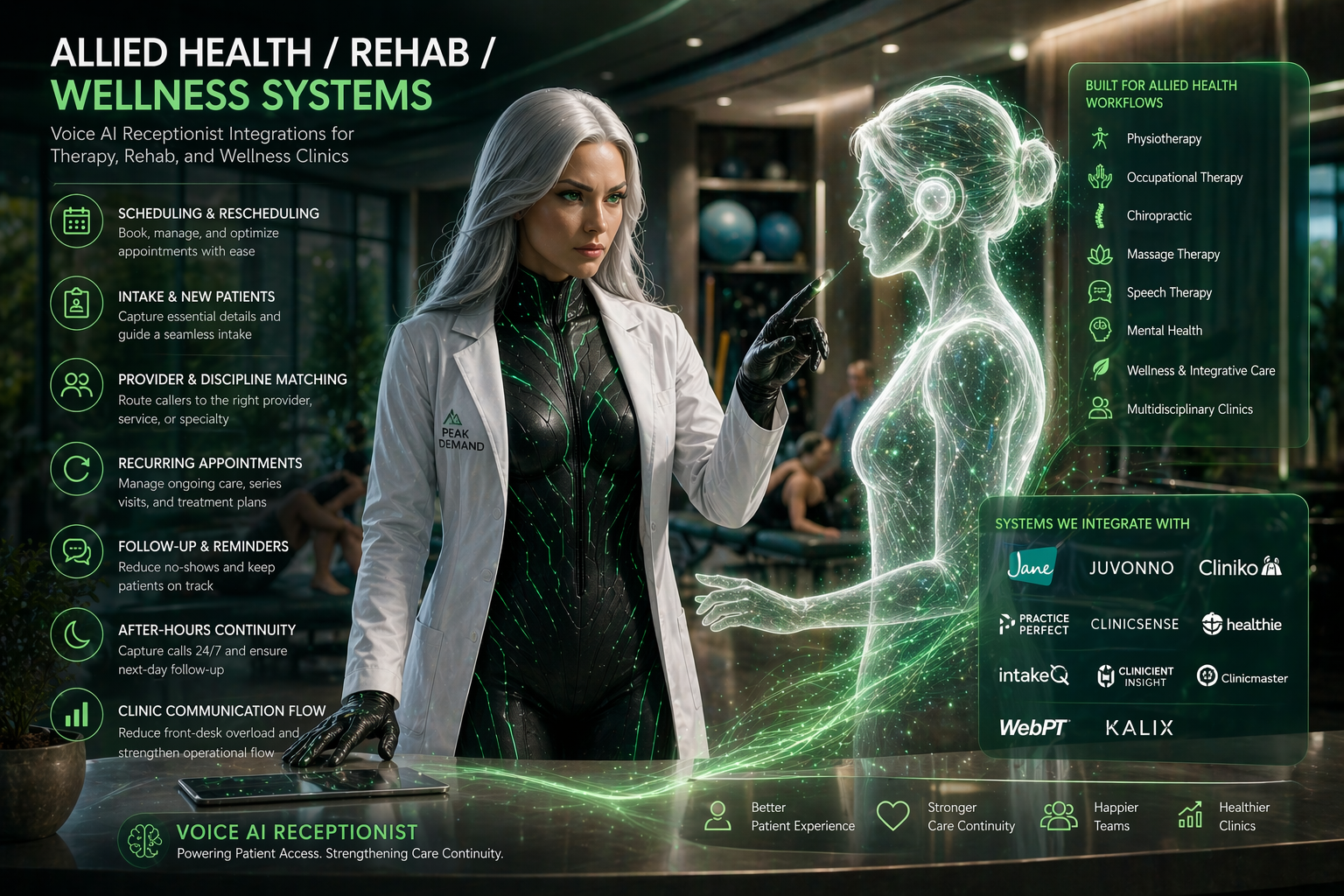
Voice AI receptionist integrations for allied health rehab and wellness systems

Allied Health, Rehab, and Wellness Systems

Explore how Voice AI supports allied-health and rehab workflows across recurring appointments, intake, provider matching, follow-up continuity, and front-desk communication support.

Voice AI receptionist integrations for dental systems

Dental Systems

Explore how Voice AI fits into dental communication workflows across new patient calls, hygiene recall, appointment flow, cancellation recovery, emergency routing, and front-desk continuity.

Voice AI receptionist integrations for veterinary systems

Veterinary Systems

Explore how Voice AI fits into veterinary environments across appointment continuity, client intake, urgent call routing, after-hours handling, and front-desk workflow support.

Voice AI receptionist integrations for chiropractic and specialty rehab systems

Chiropractic and Specialty Rehab Systems

Explore how Voice AI fits into chiropractic and specialty rehab workflows across scheduling, intake, recurring visits, SOAP-adjacent continuity, imaging-adjacent coordination, and front-desk support.

Voice AI receptionist integrations for scheduling patient access and orchestration systems

Scheduling, Patient Access, and Orchestration Systems

Explore how Voice AI supports scheduling and patient access architecture across intake, routing, queue stabilization, diagnostics scheduling, and workflow continuity between first contact and next action.

Integration Walkthroughs

See Healthcare Voice AI Integrations In Action

These walkthroughs show how Voice AI can connect into real healthcare scheduling, intake, and communication environments. Start with TELUS Health CHR for Canadian clinic workflows and Juvonno for rehab and allied health operations.

TELUS Health CHR Integration Walkthrough

See how Voice AI can support TELUS Health CHR scheduling, intake, patient communication, and Canadian clinic workflow continuity.

Juvonno Integration Walkthrough

See how Voice AI can support Juvonno workflows for rehab scheduling, intake, appointment handling, and clinic communication continuity.

Explore published healthcare systems by name

Once you know the software family that best matches your environment, this section makes it easier to browse live healthcare integration pages by platform name. Each category below groups published system pages by the type of environment they usually support so operators, managers, and technical teams can compare workflow fit more quickly. A fuller alphabetical directory appears farther down the page.

Featured healthcare systems

These are high-priority starting points for visitors evaluating real-world Voice AI workflow fit across scheduling, intake, patient communication, routing, and access workflows.

Clinic, ambulatory, and medical EMR systems

These systems are commonly associated with clinic records-adjacent workflows, appointment flow, patient requests, intake continuity, routing, and broader ambulatory communication operations.

Scheduling, intake, and patient communication systems

These environments sit closer to booking logic, intake flow, reminders, clinic administration, and day-to-day patient access operations.

Rehab, physiotherapy, and allied health systems

Allied health and rehabilitation environments often depend on strong scheduling continuity, practitioner matching, intake flow, recurring appointment management, and multi-location operational coordination.

Dental systems

Dental communication workflows often center around appointment demand, cancellation recovery, reminders, new patient calls, and front-desk continuity across booked production.

Veterinary systems

Veterinary communication environments often require appointment continuity, client communication, after-hours handling, urgent call direction, and records-adjacent workflow coordination.

Healthcare organizations rarely evaluate integrations in a vacuum. Grouping systems by software family makes it easier to understand likely workflow fit, compare environments more quickly, and navigate toward both family-level integration pages and live system-specific pages deeper in this hub. The full alphabetical system directory farther down the page should carry the complete 98-system library.

Healthcare Workflow Architecture

Where Voice AI sits in the healthcare workflow matters more than basic connectivity

Healthcare Voice AI becomes more useful when it is treated as part of the larger workflow architecture around patient access, intake, routing, scheduling, escalation, and downstream ownership. The question is not only whether a system connects. The question is whether the communication flow reaches the next operational step with enough clarity and structure to reduce friction instead of shifting it downstream.

In practice, that means Voice AI often sits across multiple workflow layers at once. It may support first contact, gather structured intake, help direct the caller into the right path, preserve context for staff, and improve continuity into the next step. The value comes from how those layers fit together, not from one isolated connection point.

This is why healthcare teams should evaluate both the scheduling and patient access layer and the EMR or EHR-adjacent layer. In more complex environments, the architecture may also need to account for enterprise compliance and procurement requirements.

Where Voice AI usually enters the workflow

Voice AI often enters at the communication edge: inbound calls, appointment demand, intake capture, after-hours answering, overflow handling, and patient access or routing-related first contact.

Explore healthcare AI receptionists

Where continuity usually breaks down

Continuity often breaks between the interaction and the next operational owner. That can happen when routing is weak, intake is unclear, scheduling context is incomplete, or downstream teams still need to manually rebuild the request.

Explore centralized scheduling workflows

What stronger integration architecture actually improves

Stronger architecture preserves enough structure, direction, and next-step usability for staff or systems to act efficiently. That is what turns Voice AI into operational infrastructure instead of a disconnected front-end layer.

Return to the healthcare resource hub
Integration maturity What healthcare teams usually experience Likely operational result
Fragmented Some connection points exist, but scheduling, intake, routing, escalation, and continuity still require heavy manual repair. Lower operational value, more staff burden, weaker patient access continuity, and less confidence in the workflow.
Partially connected Important workflow layers connect, but structure and downstream usability still vary too much between teams, departments, or next-step owners. Moderate gains, but persistent continuity gaps remain and staff still absorb unnecessary workflow friction.
Workflow-led and integrated Voice AI supports multiple workflow layers with stronger structure, clearer routing, better handoff, and more usable next-step continuity. Stronger patient access flow, cleaner operational ownership, and more scalable communication infrastructure.

What healthcare teams should evaluate in the architecture discussion

  • Where does Voice AI need to sit first in the communication workflow?
  • Where does continuity currently break between the interaction and the next operational step?
  • Which layers are EMR or EHR-adjacent, and which ones are workflow-adjacent?
  • How do scheduling, intake, routing, patient access, and escalation interact in this environment?
  • Will downstream teams receive enough structure to act without rebuilding the request manually?
  • Is the integration design workflow-led or just feature-led?
  • Does the current architecture reduce friction for staff, or does it simply move the work somewhere else?

Healthcare organizations usually get more value when they evaluate integration maturity across communication flow, operational ownership, and downstream usability together instead of treating each connection as a separate isolated decision. For system-specific evaluation, use the alphabetical healthcare system directory below.

Evaluating software families?

Use the six system-family pages to compare EMR, EHR, dental, veterinary, rehab, scheduling, and patient access environments.

Browse Software Families

Evaluating specific systems?

Use the full alphabetical directory to find the exact healthcare platform your team is evaluating.

Open System Directory

Evaluating enterprise readiness?

Review governance, privacy, escalation, procurement, and compliance considerations before deployment.

Review Compliance
Integration Strategy Resources

Go deeper into the strategy behind healthcare Voice AI integrations

This section helps healthcare teams move from broad category understanding into the right supporting resources for architecture, interoperability, workflow fit, implementation planning, and system-specific evaluation.

The articles below are the best next clicks for teams evaluating how Voice AI fits into healthcare communication systems, patient access workflows, structured integration pathways, rollout planning, and governed healthcare environments.

For broader category education, use the Healthcare Voice AI Resource Hub. For software-specific evaluation, continue to the full alphabetical system directory lower on this page and use the six healthcare software family pages as the parent layer.

Need system-family pages?

Use the family pages to compare medical EMR, allied health, dental, veterinary, specialty rehab, and patient access systems.

Browse Software Families

Need a specific platform?

Use the alphabetical system directory to find the exact EMR, EHR, scheduling, dental, veterinary, or rehab platform.

Open System Directory

Need compliance context?

Use the enterprise compliance page when governance, privacy, procurement, RFPs, or regulated deployment requirements are part of the evaluation.

Review Compliance

Core integration strategy articles

These resources explain why integrations matter, what healthcare teams should evaluate first, and how stronger Voice AI integration architecture should be understood.

Custom pathways, structured integrations, and workflow fit

These articles are useful for teams evaluating custom pathways, structured communication flows, and how Voice AI fits into real healthcare operating environments.

Rollout, implementation, and governance

These resources are best for healthcare teams moving from early exploration into rollout planning, operational safety, implementation readiness, and governance-aware deployment.

Patient access, routing, and workflow bottlenecks

These articles help healthcare teams think more clearly about where communication complexity builds up across patient access, intake, department routing, scheduling, and downstream handoff.

As the healthcare integrations ecosystem continues to grow, this section can keep routing visitors into the most relevant strategy, rollout, and workflow resources without changing the overall structure of the hub. The full software directory appears in the Alphabetical System Directory section below.

Live System Pages

Explore live healthcare system integration pages by category

This section gives healthcare teams a category-based way to browse the most important live system pages. It is not the full 98-system directory; it is a curated navigation layer for comparing the platforms most commonly tied to scheduling, intake, patient communication, routing, and patient access workflows.

Use this section when you know the type of software environment you are evaluating. Use the Alphabetical System Directory below when you want to find every live system page by name.

Need the family layer?

Start with the six parent family pages when comparing software categories before choosing a specific system.

Browse Software Families

Need every system?

Use the alphabetical directory for the complete live healthcare system page list by platform name.

Open Alphabetical Directory

Need workflow context?

Review how Voice AI fits across patient access, intake, routing, scheduling, escalation, and downstream ownership.

Review Workflow Architecture

Clinic and ambulatory EMR systems

These systems are commonly associated with clinic records-adjacent workflows, intake, appointment flow, routing, patient communication, and broader ambulatory continuity.

Explore medical and ambulatory EMR family

Scheduling, intake, and patient communication systems

These environments sit closer to booking logic, intake flow, reminders, clinic administration, and day-to-day patient access operations.

Explore scheduling and patient access family

Rehab, physiotherapy, and allied health systems

Allied health and rehabilitation environments often depend on strong scheduling continuity, practitioner matching, intake flow, recurring appointments, and multi-location coordination.

Explore allied health and rehab family

Dental systems

Dental communication workflows often center on appointment demand, cancellation recovery, reminders, new patient calls, and front-desk continuity.

Explore dental family

Veterinary systems

Veterinary communication environments often require appointment continuity, client communication, after-hours handling, and records-adjacent workflow coordination.

Explore veterinary family

Enterprise, specialty, imaging, and outpatient environments

These environments often involve more complex routing, diagnostic scheduling, imaging coordination, enterprise workflow ownership, and department-specific handoff requirements.

Explore enterprise and medical EMR family

This curated category browse section helps visitors compare common healthcare software environments without scrolling the entire directory. The complete system list belongs in the Alphabetical System Directory section below, where every live healthcare system page should be listed by platform name.

Next Step

Talk through your healthcare communication workflow

If your team is evaluating healthcare Voice AI integrations, the most useful next step is usually a workflow conversation. That means reviewing patient access pressure points, scheduling flow, intake structure, routing logic, after-hours coverage, compliance expectations, and the systems surrounding those workflows.

Peak Demand approaches healthcare environments through workflow fit, governance awareness, and operational usability. The goal is to help organizations map a communication architecture that supports real teams, real workflows, and real continuity requirements across EMR, EHR, scheduling, intake, dental, veterinary, rehab, and patient access environments.

Need software families?

Compare the six parent healthcare integration families before choosing a specific system page.

Browse software families

Need workflow context?

Review how Voice AI fits across intake, routing, scheduling, escalation, and downstream ownership.

Review workflow architecture

Need compliance review?

Use the enterprise compliance page when governance, privacy, procurement, and RFP standards matter.

Review compliance

Frequently asked questions

What does Voice AI mean in a healthcare integration environment?
In a healthcare integration environment, Voice AI is the communication layer that can support inbound calls, scheduling flow, intake capture, routing, after-hours handling, and related patient access workflows. The value depends on how well that layer connects to real workflow ownership, not just whether the technology can answer a call.
Can Voice AI work with EMR, EHR, scheduling, intake, and routing workflows?
Yes, but the right architecture depends on the system, permissions, workflow design, and operating environment. Some teams need EMR or EHR-adjacent support. Others need scheduling, intake, routing, or patient access workflow support first. Start with the software family section and then use the alphabetical system directory to find specific platforms.
Are healthcare Voice AI integrations always direct?
Not always. Some healthcare environments support direct integration pathways, while others require a custom, bridge-based, semi-automated, or workflow-adjacent approach depending on permissions, APIs, operating context, governance requirements, and workflow design.
Where should healthcare organizations start evaluating Voice AI integrations?
Start with workflow pressure points rather than a software list. Look at missed calls, scheduling bottlenecks, intake friction, department routing, after-hours communication, patient access delays, and where continuity tends to break between the conversation and the next operational step. Then use the workflow architecture section to evaluate fit.
How should compliance and governance fit into the evaluation?
Healthcare AI communication systems should be evaluated through the privacy, governance, escalation, and workflow requirements of the environment they serve. Requirements vary by organization, region, and deployment model, so governance should be part of architecture planning from the beginning. For larger buyers, review the enterprise Voice AI compliance page.
What is the role of this integrations hub?
This hub is the parent page for Peak Demand’s healthcare integration architecture. It helps visitors understand the healthcare Voice AI integration landscape, find relevant family pages, navigate live system pages, compare workflow categories, and move into the right software-specific integration pages.

About Peak Demand

Peak Demand is a Toronto-based AI agency focused on Voice AI, communication automation, and workflow infrastructure for organizations operating in more complex service environments.

In healthcare, the focus is not just on call handling. It is on patient access continuity, scheduling pressure, intake structure, routing logic, after-hours support, governance, and how communication systems fit into real operational workflows.

  • Workflow-driven and implementation-aware
  • Governance-first in healthcare communication environments
  • Built to support clinics, networks, and enterprise teams
  • Designed to scale into software-specific integration pathways
  • Organized around healthcare system families and live integration pages
Peak Demand works with organizations that need communication systems to be structured, scalable, and operationally useful across real healthcare workflows.
Alphabetical System Directory

Healthcare software integrations by system name

If you already know the software you are evaluating, this alphabetical directory is the fastest way to find the right live system page.

This directory includes the full 98-system healthcare integration library from the current Peak Demand system-page build. It is designed to help teams compare EMR, EHR, scheduling, intake, patient communication, dental, veterinary, rehab, wellness, chiropractic, orchestration, home care, med spa, pharmacy, and enterprise healthcare systems by software name.

For category-level browsing, use the software family section. For workflow context, use the workflow architecture section. This section is the full alphabetical browse layer.

98

Live healthcare system pages in this directory

Grouped alphabetically with visible section counts so the full library is obvious at a glance.

34A–C
20D–H
15I–M
11N–O
8P–R
6S–T
4U–Z
6Families

Compare healthcare systems by name, category, and workflow fit

This directory is useful for comparing clinic EMRs, EHR-adjacent systems, scheduling and intake platforms, patient communication software, dental systems, veterinary systems, rehab and allied health systems, chiropractic systems, med spa systems, home care systems, pharmacy-adjacent systems, orchestration platforms, diagnostic workflows, and enterprise healthcare environments by software name before going deeper into workflow design, integration possibilities, and operational fit.

Explore your own AI use case on a discovery call.

Peak Demand Inc. Logo Canadian AI Agency

Peak Demand

Canadian AI agency delivering managed Voice AI services, AI call center workflows, secure API integrations, and GEO / AEO / LLM lead surfacing for business and government across Canada and the U.S.

What we do: production-grade voice workflows, integrations to your systems of record, and measurable conversion outcomes.
Call our AI assistant Sasha:
381 King St. W., Toronto, Ontario, Canada

Managed Voice AI

Explore Peak Demand’s managed Voice AI service layer for enterprise call operations, inbound and outbound workflows, AI receptionists, call center automation, reporting, QA, integrations, and multi-location deployment.

Industries

Healthcare Expansion

Voice AI for Medical, Clinic, Hospital, and Patient Access Workflows

Explore healthcare voice AI pages across reception, booking, intake, after-hours answering, compliance, specialty care, regional scheduling, bilingual clinic support, wellness operations, and healthcare system integrations across EMR, EHR, dental, allied health, veterinary, rehab, and scheduling platforms.

Home Services Expansion

Voice AI for Scheduling, Dispatch Coordination, Emergency Calls, and After-Hours Service Intake

Explore home services voice AI pages across receptionist workflows, scheduling automation, emergency response routing, dispatch coordination, and after-hours call handling.

Manufacturing

Voice AI for Quotes, Order Status, Production Communication, and Support Flows

Manufacturing is ready for the same full-width expansion pattern as you build more sector pages.

Manufacturing Page

Hospitality

Voice AI for Guest Support, Reservations, Routing, and Service Coordination

Hospitality can expand into hotels, restaurants, venues, airports, and event support as you add more pages.

Hospitality Page

Utilities / Energy

Voice AI for Booking, Lead Qualification, Dispatch-Adjacent Routing, and Customer Service

Utilities and energy can follow the same system once you add more pages for power, HVAC, solar, and service operations.

Utilities / Energy Page

Real Estate

Voice AI for Lead Qualification, Appointment Booking, and Follow-Up Workflows

Real estate is set up to expand the same way as the healthcare panel whenever you need it.

Real Estate Page

Transit / Public Sector

Voice AI for Public-Facing Routing, Rider Information, and Service Communications

Transit and public sector can expand into agency-specific service pages as your footprint grows.

Transit / Public Sector Page

© Peak Demand — All rights reserved. | Privacy Policy | Terms of Service
This website is powered by and built on Peak Demand.